MACHINE
LEARNING
&
the future of Artificial Intelligence
By Ankan Das, UEM-Kolkata
CONTENTS:
∫ What Is Machine Learning?
∫ What Have We Achieved With It?
∫ The Big Difference?
∫ Statistics On The Usage Of Machine Learning
∫ The “Pro Et Contra” Of The System
∫ Jobs And Market
∫ How To Get Started?
WHAT IS MACHINE LEARNING?
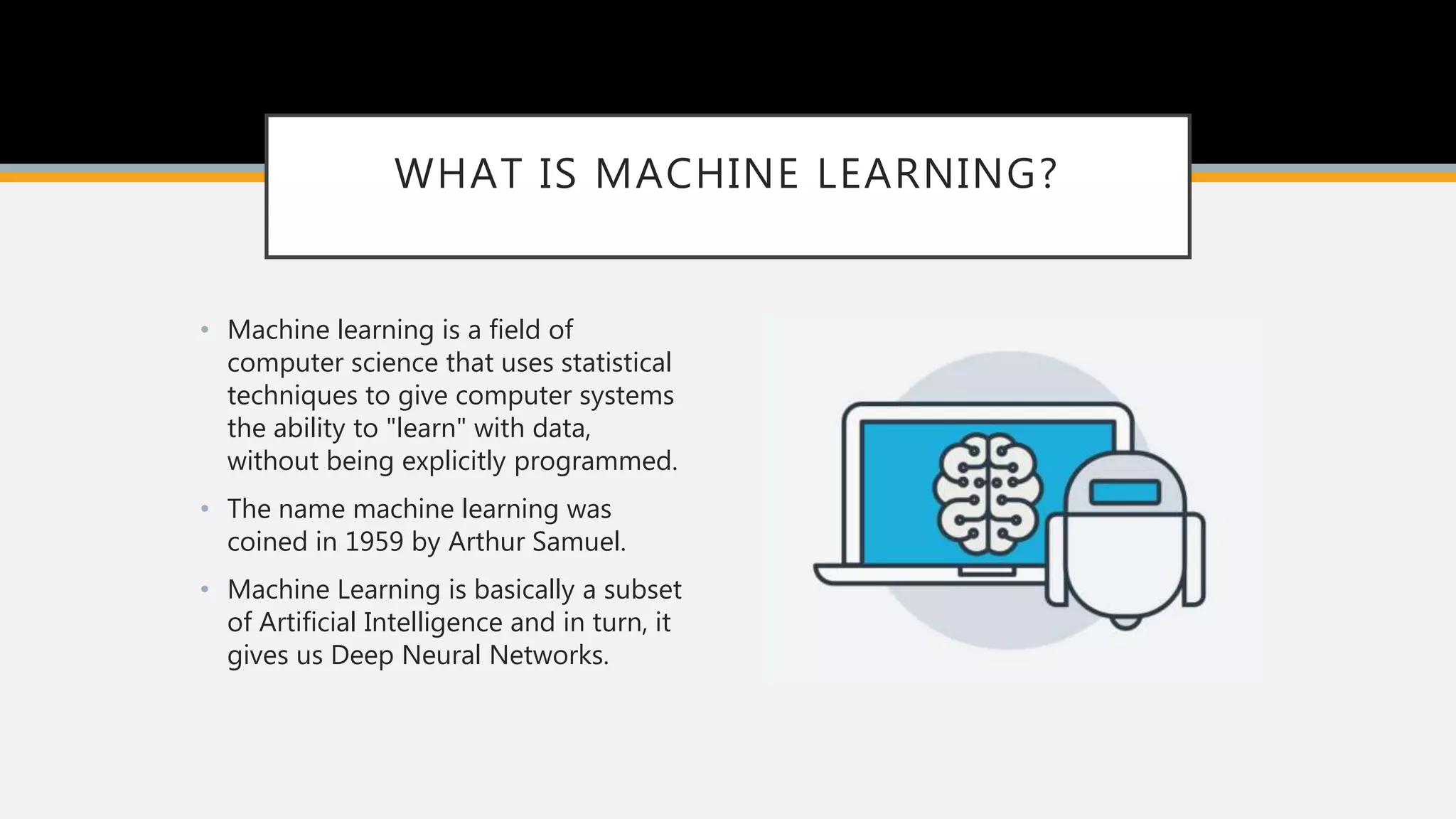
• Machine learning is a field of
computer science that uses statistical
techniques to give computer systems
the ability to "learn" with data,
without being explicitly programmed.
• The name machine learning was
coined in 1959 by Arthur Samuel.
• Machine Learning is basically a subset
of Artificial Intelligence and in turn, it
gives us Deep Neural Networks.
WHAT HAVE WE ACHIEVED?
I. Google, Youtube and Netflix are
powered by it.
II. Even the random people you add
on Facebook aren’t so random
after all.
III. Siri, Alexa and Google Assistant –
All of them use Machine Learning.
IV. Tesla, the world’s first commercial
self-driving car is built on deep
learning.
V. Neuralink, the world’s first human
brain-machine interface is being
built upon it.
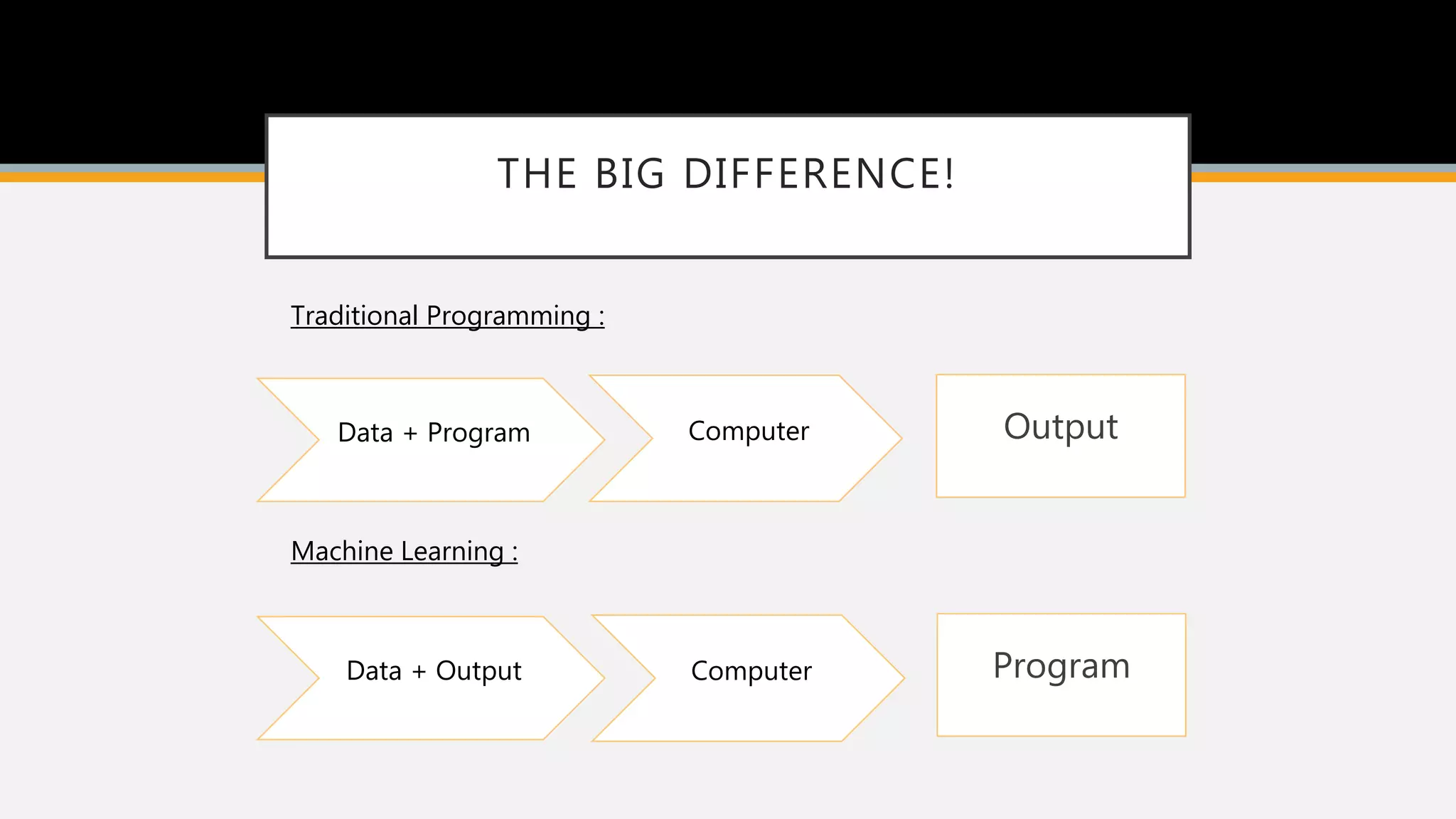
THE BIG DIFFERENCE!
Data + Program Computer Output
Data + Output Computer Program
Traditional Programming :
Machine Learning :
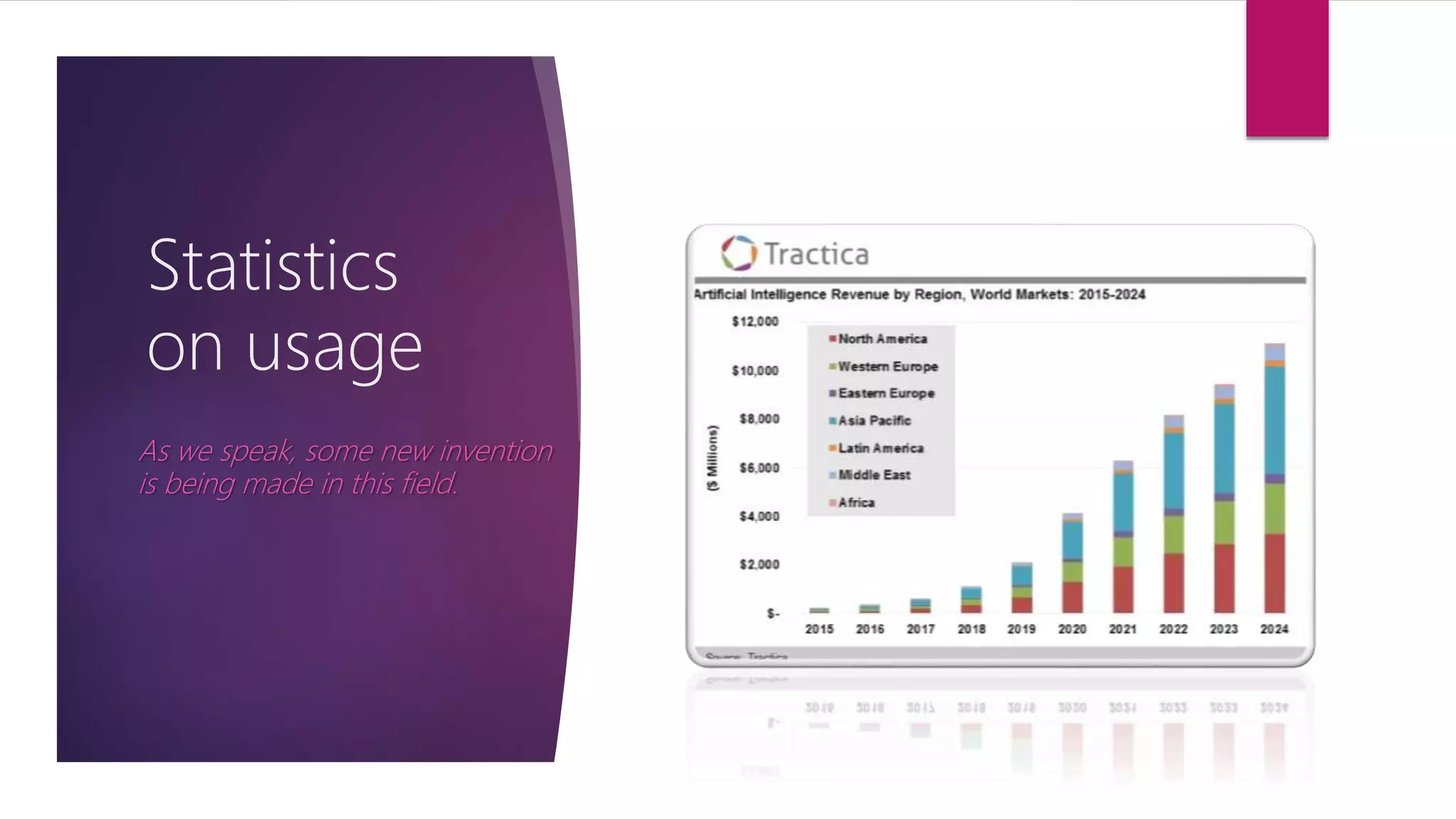
Statistics
on usage
As we speak, some new invention
is being made in this field.
PROS AND CONS
I. PROS:
• Accurate weather predictions
• Disaster predictions
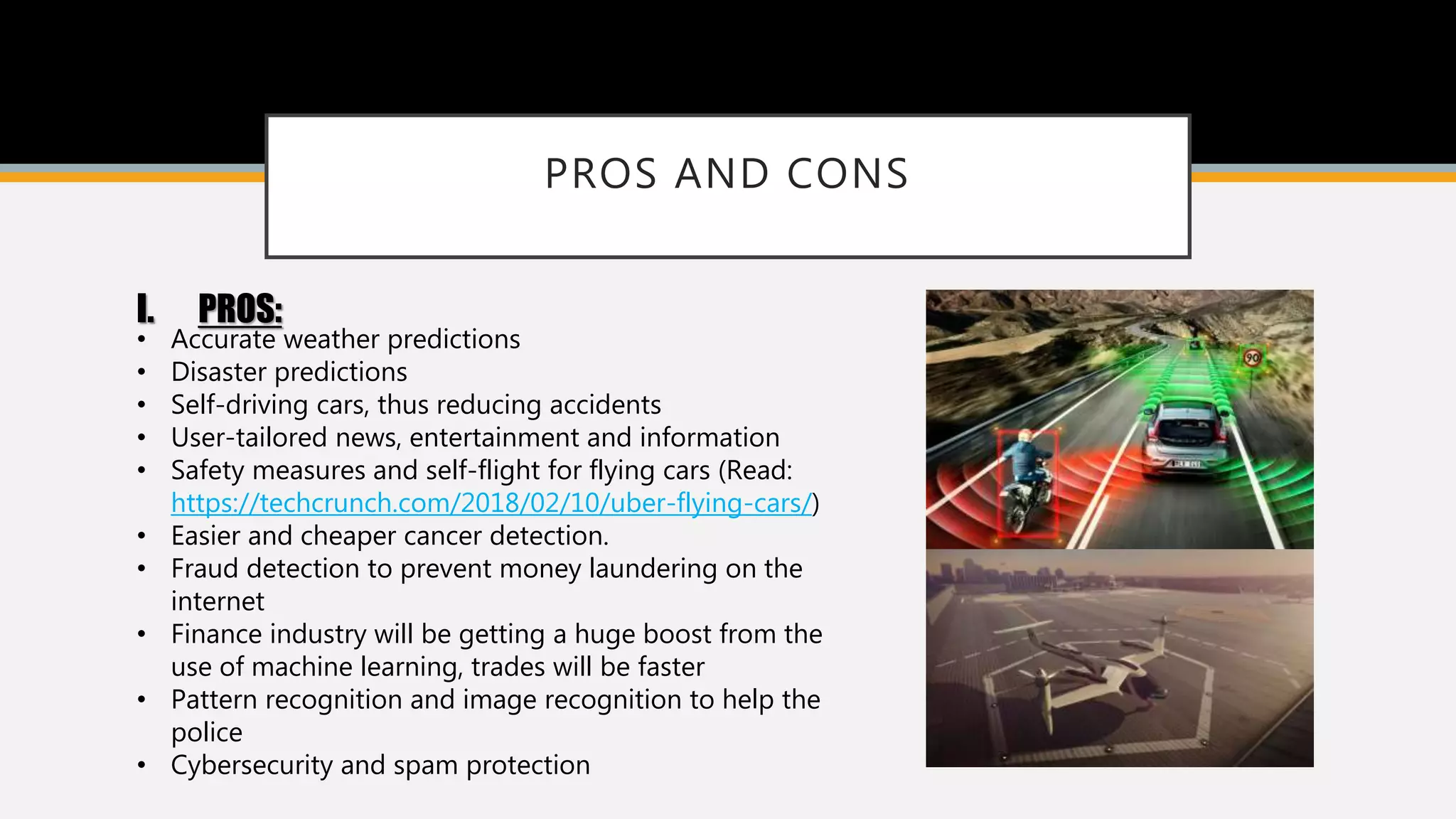
• Self-driving cars, thus reducing accidents
• User-tailored news, entertainment and information
• Safety measures and self-flight for flying cars (Read:
https://techcrunch.com/2018/02/10/uber-flying-cars/)
• Easier and cheaper cancer detection.
• Fraud detection to prevent money laundering on the
internet
• Finance industry will be getting a huge boost from the
use of machine learning, trades will be faster
• Pattern recognition and image recognition to help the
police
• Cybersecurity and spam protection
PROS AND CONS
I. PROS (continued):
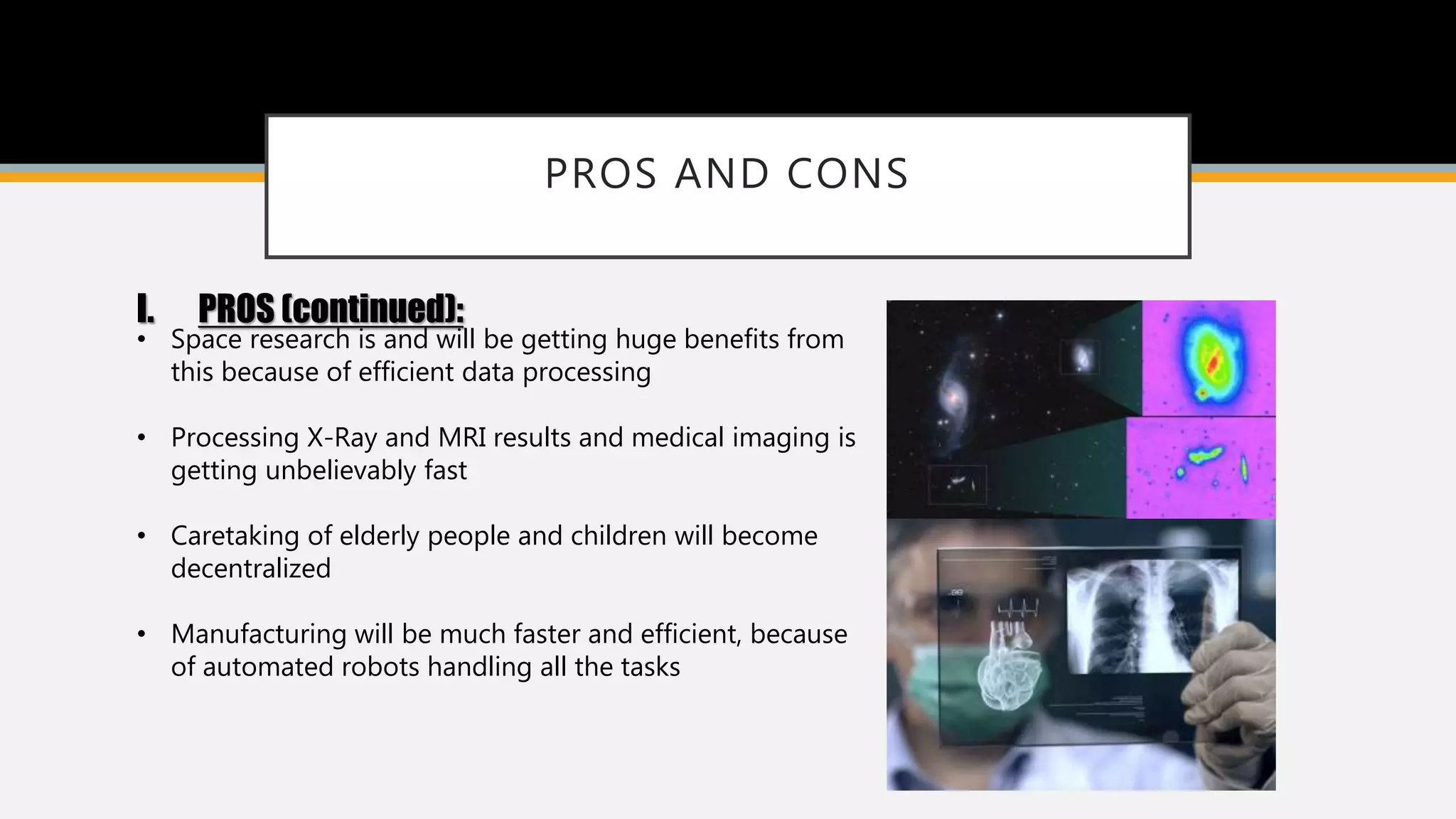
• Space research is and will be getting huge benefits from
this because of efficient data processing
• Processing X-Ray and MRI results and medical imaging is
getting unbelievably fast
• Caretaking of elderly people and children will become
decentralized
• Manufacturing will be much faster and efficient, because
of automated robots handling all the tasks
PROS AND CONS
I. PROS (continued):
• Robots will be available for doing the household
chores
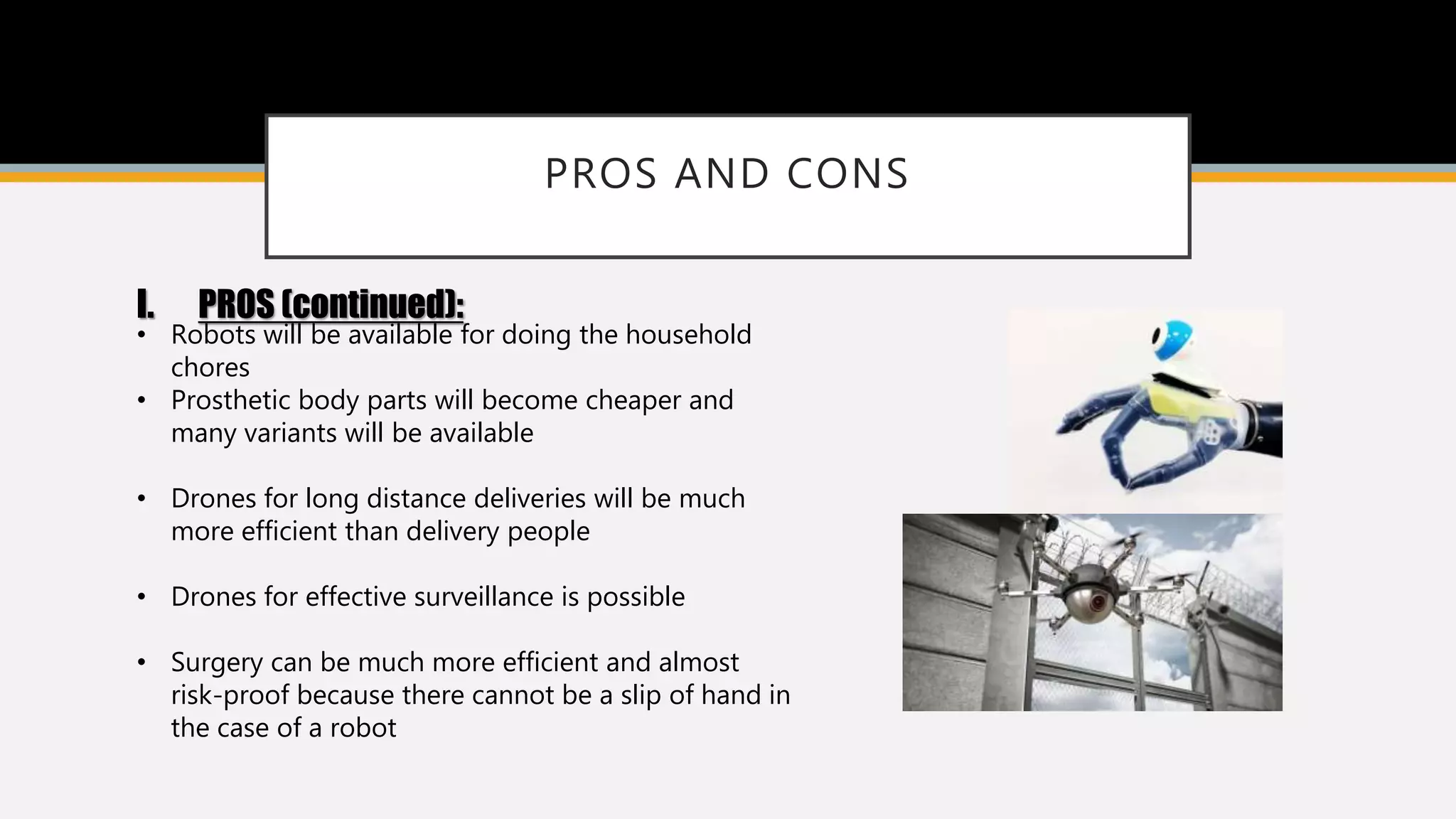
• Prosthetic body parts will become cheaper and
many variants will be available
• Drones for long distance deliveries will be much
more efficient than delivery people
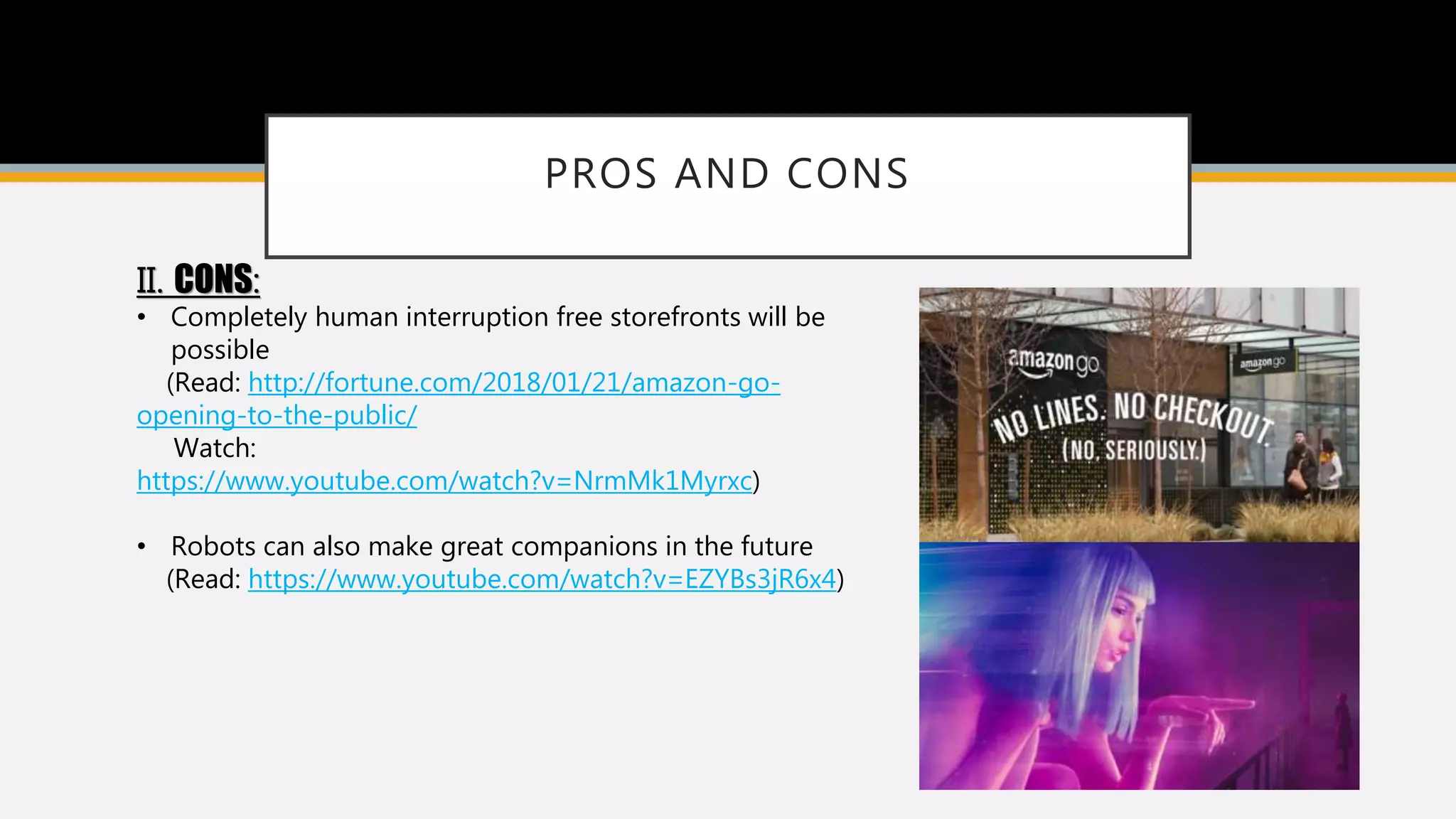
• Drones for effective surveillance is possible
• Surgery can be much more efficient and almost
risk-proof because there cannot be a slip of hand in
the case of a robot
PROS AND CONS
II. CONS:
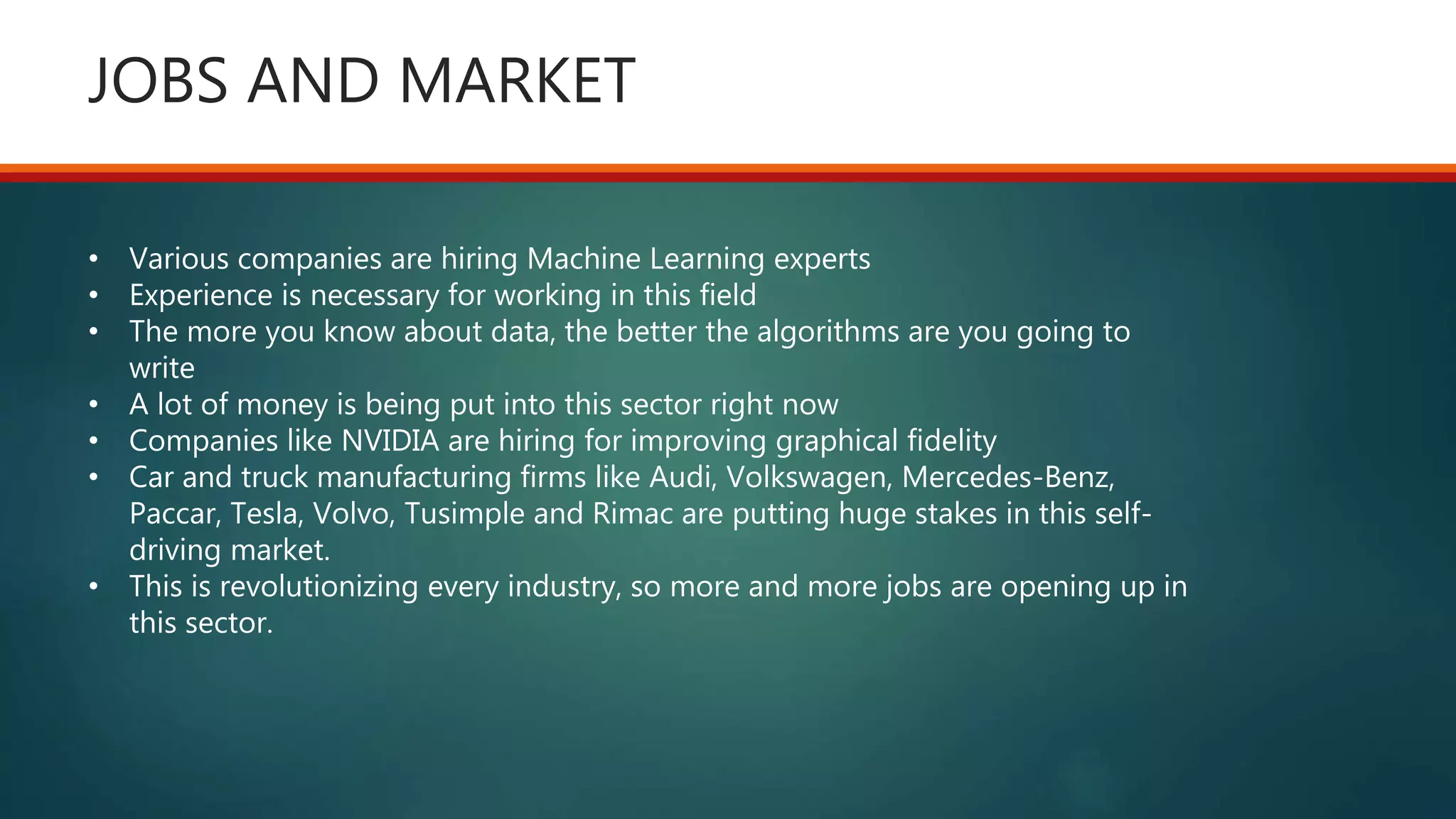
• Completely human interruption free storefronts will be
possible
(Read: http://fortune.com/2018/01/21/amazon-go-
opening-to-the-public/
Watch:
https://www.youtube.com/watch?v=NrmMk1Myrxc)
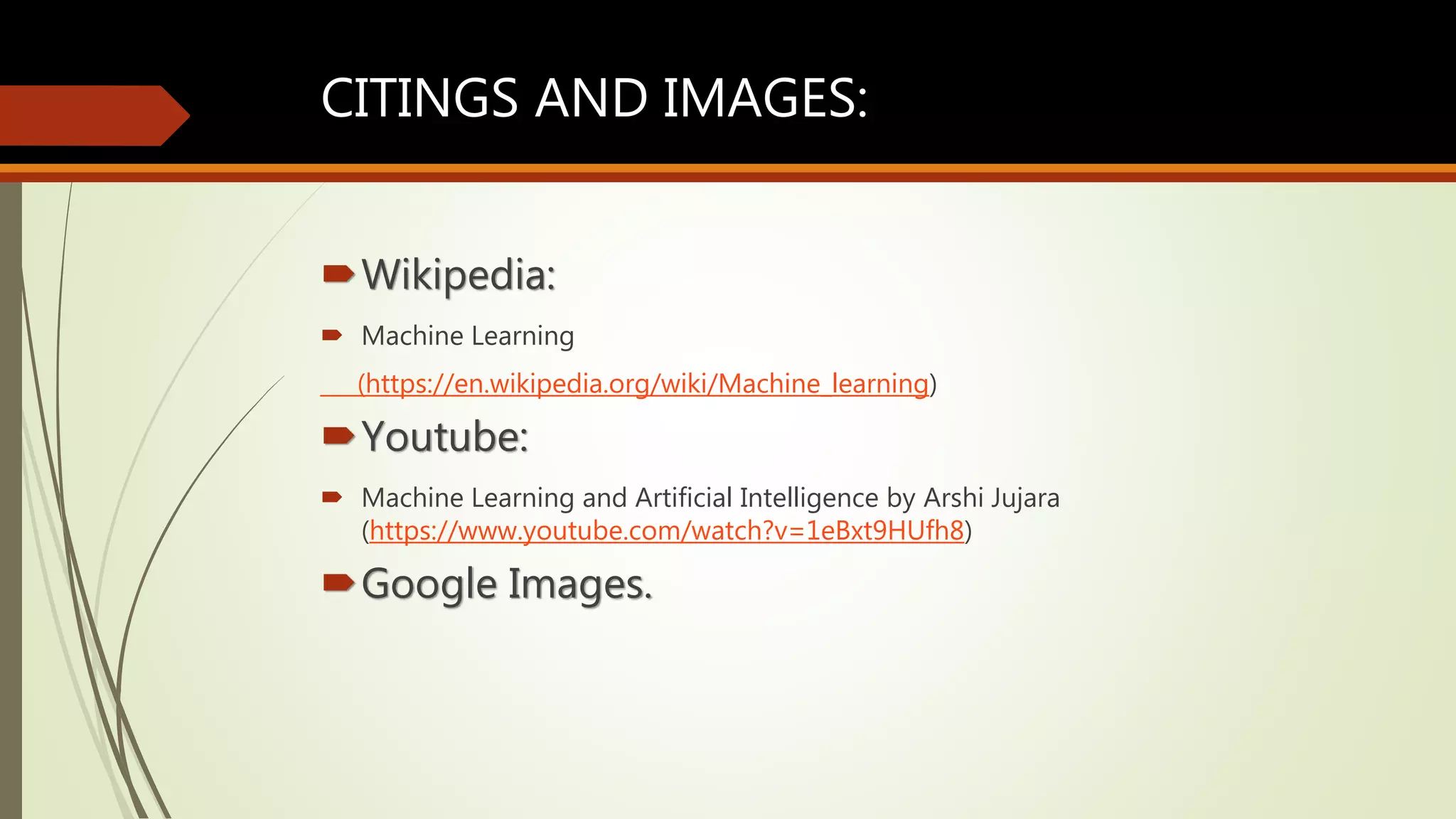
• Robots can also make great companions in the future
(Read: https://www.youtube.com/watch?v=EZYBs3jR6x4)
JOBS AND MARKET
• Various companies are hiring Machine Learning experts
• Experience is necessary for working in this field
• The more you know about data, the better the algorithms are you going to
write
• A lot of money is being put into this sector right now
• Companies like NVIDIA are hiring for improving graphical fidelity
• Car and truck manufacturing firms like Audi, Volkswagen, Mercedes-Benz,
Paccar, Tesla, Volvo, Tusimple and Rimac are putting huge stakes in this self-
driving market.
• This is revolutionizing every industry, so more and more jobs are opening up in
this sector.
HOW TO GET STARTED?
1. https://in.udacity.com/course/deep-
learning-nanodegree--nd101
2. https://in.udacity.com/course/intro-
to-machine-learning--ud120
1.
https://www.udemy.com/deeplearnin
g/
2.
https://www.udemy.com/machinelear
CITINGS AND IMAGES:
Wikipedia:
 Machine Learning
(https://en.wikipedia.org/wiki/Machine_learning)
Youtube:
 Machine Learning and Artificial Intelligence by Arshi Jujara
(https://www.youtube.com/watch?v=1eBxt9HUfh8)
Google Images.
PRESENTED BY:
1.Ankan Das
2.Arkojit Dey
3.Joydeep Dhar
Machine Learning & The Future Of AI

Machine Learning & The Future Of AI

  • 1.
    MACHINE LEARNING & the future ofArtificial Intelligence By Ankan Das, UEM-Kolkata
  • 2.
    CONTENTS: ∫ What IsMachine Learning? ∫ What Have We Achieved With It? ∫ The Big Difference? ∫ Statistics On The Usage Of Machine Learning ∫ The “Pro Et Contra” Of The System ∫ Jobs And Market ∫ How To Get Started?
  • 3.
    WHAT IS MACHINELEARNING? • Machine learning is a field of computer science that uses statistical techniques to give computer systems the ability to "learn" with data, without being explicitly programmed. • The name machine learning was coined in 1959 by Arthur Samuel. • Machine Learning is basically a subset of Artificial Intelligence and in turn, it gives us Deep Neural Networks.
  • 4.
    WHAT HAVE WEACHIEVED? I. Google, Youtube and Netflix are powered by it. II. Even the random people you add on Facebook aren’t so random after all. III. Siri, Alexa and Google Assistant – All of them use Machine Learning. IV. Tesla, the world’s first commercial self-driving car is built on deep learning. V. Neuralink, the world’s first human brain-machine interface is being built upon it.
  • 5.
    THE BIG DIFFERENCE! Data+ Program Computer Output Data + Output Computer Program Traditional Programming : Machine Learning :
  • 6.
    Statistics on usage As wespeak, some new invention is being made in this field.
  • 7.
    PROS AND CONS I.PROS: • Accurate weather predictions • Disaster predictions • Self-driving cars, thus reducing accidents • User-tailored news, entertainment and information • Safety measures and self-flight for flying cars (Read: https://techcrunch.com/2018/02/10/uber-flying-cars/) • Easier and cheaper cancer detection. • Fraud detection to prevent money laundering on the internet • Finance industry will be getting a huge boost from the use of machine learning, trades will be faster • Pattern recognition and image recognition to help the police • Cybersecurity and spam protection
  • 8.
    PROS AND CONS I.PROS (continued): • Space research is and will be getting huge benefits from this because of efficient data processing • Processing X-Ray and MRI results and medical imaging is getting unbelievably fast • Caretaking of elderly people and children will become decentralized • Manufacturing will be much faster and efficient, because of automated robots handling all the tasks
  • 9.
    PROS AND CONS I.PROS (continued): • Robots will be available for doing the household chores • Prosthetic body parts will become cheaper and many variants will be available • Drones for long distance deliveries will be much more efficient than delivery people • Drones for effective surveillance is possible • Surgery can be much more efficient and almost risk-proof because there cannot be a slip of hand in the case of a robot
  • 10.
    PROS AND CONS II.CONS: • Completely human interruption free storefronts will be possible (Read: http://fortune.com/2018/01/21/amazon-go- opening-to-the-public/ Watch: https://www.youtube.com/watch?v=NrmMk1Myrxc) • Robots can also make great companions in the future (Read: https://www.youtube.com/watch?v=EZYBs3jR6x4)
  • 11.
    JOBS AND MARKET •Various companies are hiring Machine Learning experts • Experience is necessary for working in this field • The more you know about data, the better the algorithms are you going to write • A lot of money is being put into this sector right now • Companies like NVIDIA are hiring for improving graphical fidelity • Car and truck manufacturing firms like Audi, Volkswagen, Mercedes-Benz, Paccar, Tesla, Volvo, Tusimple and Rimac are putting huge stakes in this self- driving market. • This is revolutionizing every industry, so more and more jobs are opening up in this sector.
  • 12.
    HOW TO GETSTARTED? 1. https://in.udacity.com/course/deep- learning-nanodegree--nd101 2. https://in.udacity.com/course/intro- to-machine-learning--ud120 1. https://www.udemy.com/deeplearnin g/ 2. https://www.udemy.com/machinelear
  • 13.
    CITINGS AND IMAGES: Wikipedia: Machine Learning (https://en.wikipedia.org/wiki/Machine_learning) Youtube:  Machine Learning and Artificial Intelligence by Arshi Jujara (https://www.youtube.com/watch?v=1eBxt9HUfh8) Google Images.
  • 14.

Editor's Notes

  • #2 To change the image on this slide, select the picture and delete it. Then click the Pictures icon in the placeholder to insert your own image.