INTRODUCTION
Machine Learning(ML) is a core branch of Artificial
Intelligence (AI) that focuses on enabling computer
systems to learn from data and improve their performance
over time without being explicitly programmed. Instead
of relying solely on fixed rules written by developers,
machine learning systems identify patterns, relationships,
and trends in large datasets, allowing them to make
intelligent decisions and predictions.
3.
WHAT IS MACHINELEARNING
A machine is a man-made device or system designed to perform a specific task by
using energy to produce useful work. Machines are created to make human
activities easier, faster, more accurate, and more efficient. They can reduce physical
effort, improve precision, and handle tasks that may be difficult or impossible for
humans to perform manually.
4.
TYPES OF MACHINELEARNING
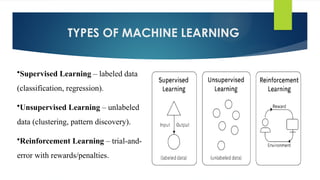
•Supervised Learning – labeled data
(classification, regression).
•Unsupervised Learning – unlabeled
data (clustering, pattern discovery).
•Reinforcement Learning – trial-and-
error with rewards/penalties.
5.
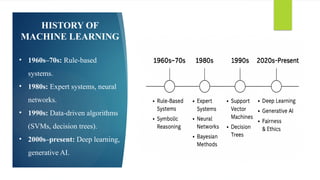
HISTORY OF
MACHINE LEARNING
•1960s–70s: Rule-based
systems.
• 1980s: Expert systems, neural
networks.
• 1990s: Data-driven algorithms
(SVMs, decision trees).
• 2000s–present: Deep learning,
generative AI.
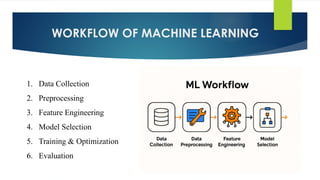
WORKFLOW OF MACHINELEARNING
1. Data Collection
2. Preprocessing
3. Feature Engineering
4. Model Selection
5. Training & Optimization
6. Evaluation
8.
SUPERVISED LEARNING
• SupervisedLearning is a type of machine learning in which a model is trained using labeled
data. In this approach, each training example consists of an input and a corresponding
correct output (label). The main objective of supervised learning is to learn a mapping
between inputs and outputs so that the model can accurately predict results for new, unseen
data. During training, the algorithm compares its predicted output with the actual label and
adjusts itself to minimize errors. This learning process continues until the model achieves an
acceptable level of accuracy. Because the model learns under the guidance of known
answers, the process is described as “supervised,” similar to a teacher guiding a student.
9.
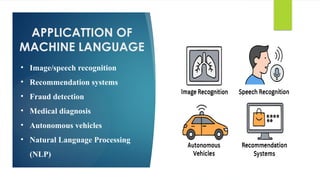
APPLICATTION OF
MACHINE LANGUAGE
•Image/speech recognition
• Recommendation systems
• Fraud detection
• Medical diagnosis
• Autonomous vehicles
• Natural Language Processing
(NLP)
10.
CONCLUSION
Machine learningis no longer just a technological breakthrough — it is a
transformative force reshaping how we live, work, and interact with the world.
From personalized recommendations and intelligent assistants to autonomous
vehicles and medical diagnostics, ML is embedded in the fabric of modern society.
Its ability to learn from data, adapt to new patterns, and make informed decisions
has unlocked possibilities that were once unimaginable.