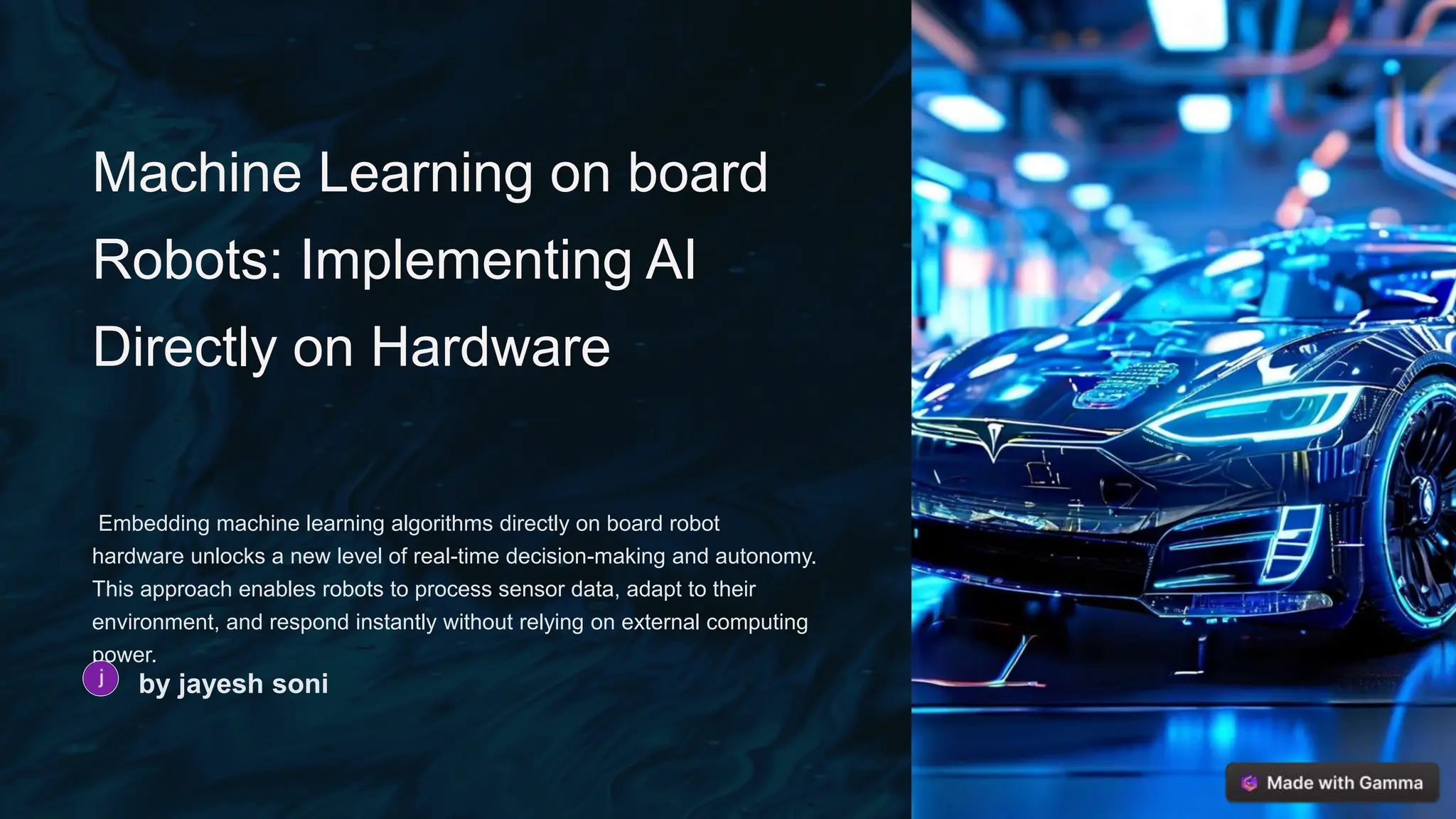
Machine Learning on board
Robots: Implementing AI
Directly on Hardware
Embedding machine learning algorithms directly on board robot
hardware unlocks a new level of real-time decision-making and autonomy.
This approach enables robots to process sensor data, adapt to their
environment, and respond instantly without relying on external computing
power.
by jayesh soni
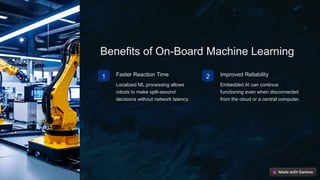
Benefits of On-Board Machine Learning
1 Faster Reaction Time
Localized ML processing allows
robots to make split-second
decisions without network latency.
2 Improved Reliability
Embedded AI can continue
functioning even when disconnected
from the cloud or a central computer.
Challenges of Deploying ML on Robots
Resource Constraints
Embedded systems have
limited processing power,
memory, and energy
compared to server-grade
hardware.
Model Optimization
ML models must be
carefully tuned to run
efficiently on low-power
microcontrollers and
SoCs.
Integration Complexity
Seamlessly combining
sensors, actuators, and AI
algorithms requires
specialized engineering
expertise.
Selecting Appropriate ML Algorithms
Lightweight Models
Algorithms like decision trees, random
forests, and shallow neural networks
are well-suited for embedded use.
Online Learning
Techniques that can continuously
update models, like incremental
decision trees, enable ongoing
adaptation.
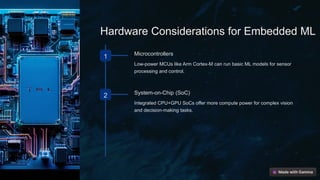
Hardware Considerations for Embedded ML
1 Microcontrollers
Low-power MCUs like Arm Cortex-M can run basic ML models for sensor
processing and control.
2 System-on-Chip (SoC)
Integrated CPU+GPU SoCs offer more compute power for complex vision
and decision-making tasks.
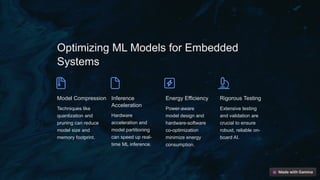
Optimizing ML Models for Embedded
Systems
Model Compression
Techniques like
quantization and
pruning can reduce
model size and
memory footprint.
Inference
Acceleration
Hardware
acceleration and
model partitioning
can speed up real-
time ML inference.
Energy Efficiency
Power-aware
model design and
hardware-software
co-optimization
minimize energy
consumption.
Rigorous Testing
Extensive testing
and validation are
crucial to ensure
robust, reliable on-
board AI.
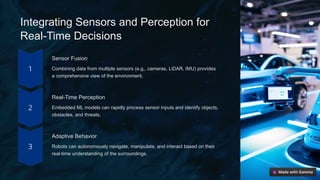
Integrating Sensors and Perception for
Real-Time Decisions
Sensor Fusion
Combining data from multiple sensors (e.g., cameras, LiDAR, IMU) provides
a comprehensive view of the environment.
Real-Time Perception
Embedded ML models can rapidly process sensor inputs and identify objects,
obstacles, and threats.
Adaptive Behavior
Robots can autonomously navigate, manipulate, and interact based on their
real-time understanding of the surroundings.
Case Studies and Best Practices
Autonomous Vehicles On-board ML for perception, prediction,
and control enables self-driving cars to
operate safely in dynamic environments.
Robotic Prosthetics Embedded AI allows advanced prosthetic
limbs to interpret neural signals and
provide intuitive, responsive control.
Drone Navigation Lightweight ML models running on
drones' microcontrollers enable robust,
real-time obstacle avoidance and path
planning.

Machine-Learning-on-board-Robots-Implementing-AI-Directly-on-Hardware.pptx

  • 1.
    Machine Learning onboard Robots: Implementing AI Directly on Hardware Embedding machine learning algorithms directly on board robot hardware unlocks a new level of real-time decision-making and autonomy. This approach enables robots to process sensor data, adapt to their environment, and respond instantly without relying on external computing power. by jayesh soni
  • 2.
    Benefits of On-BoardMachine Learning 1 Faster Reaction Time Localized ML processing allows robots to make split-second decisions without network latency. 2 Improved Reliability Embedded AI can continue functioning even when disconnected from the cloud or a central computer.
  • 3.
    Challenges of DeployingML on Robots Resource Constraints Embedded systems have limited processing power, memory, and energy compared to server-grade hardware. Model Optimization ML models must be carefully tuned to run efficiently on low-power microcontrollers and SoCs. Integration Complexity Seamlessly combining sensors, actuators, and AI algorithms requires specialized engineering expertise.
  • 4.
    Selecting Appropriate MLAlgorithms Lightweight Models Algorithms like decision trees, random forests, and shallow neural networks are well-suited for embedded use. Online Learning Techniques that can continuously update models, like incremental decision trees, enable ongoing adaptation.
  • 5.
    Hardware Considerations forEmbedded ML 1 Microcontrollers Low-power MCUs like Arm Cortex-M can run basic ML models for sensor processing and control. 2 System-on-Chip (SoC) Integrated CPU+GPU SoCs offer more compute power for complex vision and decision-making tasks.
  • 6.
    Optimizing ML Modelsfor Embedded Systems Model Compression Techniques like quantization and pruning can reduce model size and memory footprint. Inference Acceleration Hardware acceleration and model partitioning can speed up real- time ML inference. Energy Efficiency Power-aware model design and hardware-software co-optimization minimize energy consumption. Rigorous Testing Extensive testing and validation are crucial to ensure robust, reliable on- board AI.
  • 7.
    Integrating Sensors andPerception for Real-Time Decisions Sensor Fusion Combining data from multiple sensors (e.g., cameras, LiDAR, IMU) provides a comprehensive view of the environment. Real-Time Perception Embedded ML models can rapidly process sensor inputs and identify objects, obstacles, and threats. Adaptive Behavior Robots can autonomously navigate, manipulate, and interact based on their real-time understanding of the surroundings.
  • 8.
    Case Studies andBest Practices Autonomous Vehicles On-board ML for perception, prediction, and control enables self-driving cars to operate safely in dynamic environments. Robotic Prosthetics Embedded AI allows advanced prosthetic limbs to interpret neural signals and provide intuitive, responsive control. Drone Navigation Lightweight ML models running on drones' microcontrollers enable robust, real-time obstacle avoidance and path planning.