MACHINE LEARNING FOR
EPIDEMIOLOGICAL MODELS
E. Meloni, A. Zugarini, A. Panizza, A. Betti, M. Gori
September 24, 2020
SAILab, University of Siena
TABLE OF CONTENTS
1. SIR Models
2. The data
3. The learning problem
4. Regularization
5. Fitting the data
1
SIR Models
WHY LEARN EPIDEMIC MODELS?
During 2020, the spread of COVID-19 infection affected the
whole world.
Some countries resorted to non-pharmaceutical interventions of
various degrees to control the spread of the virus, such as
lockdowns or imposing the use of masks.
Many countries collected vast amounts of detailed data about the
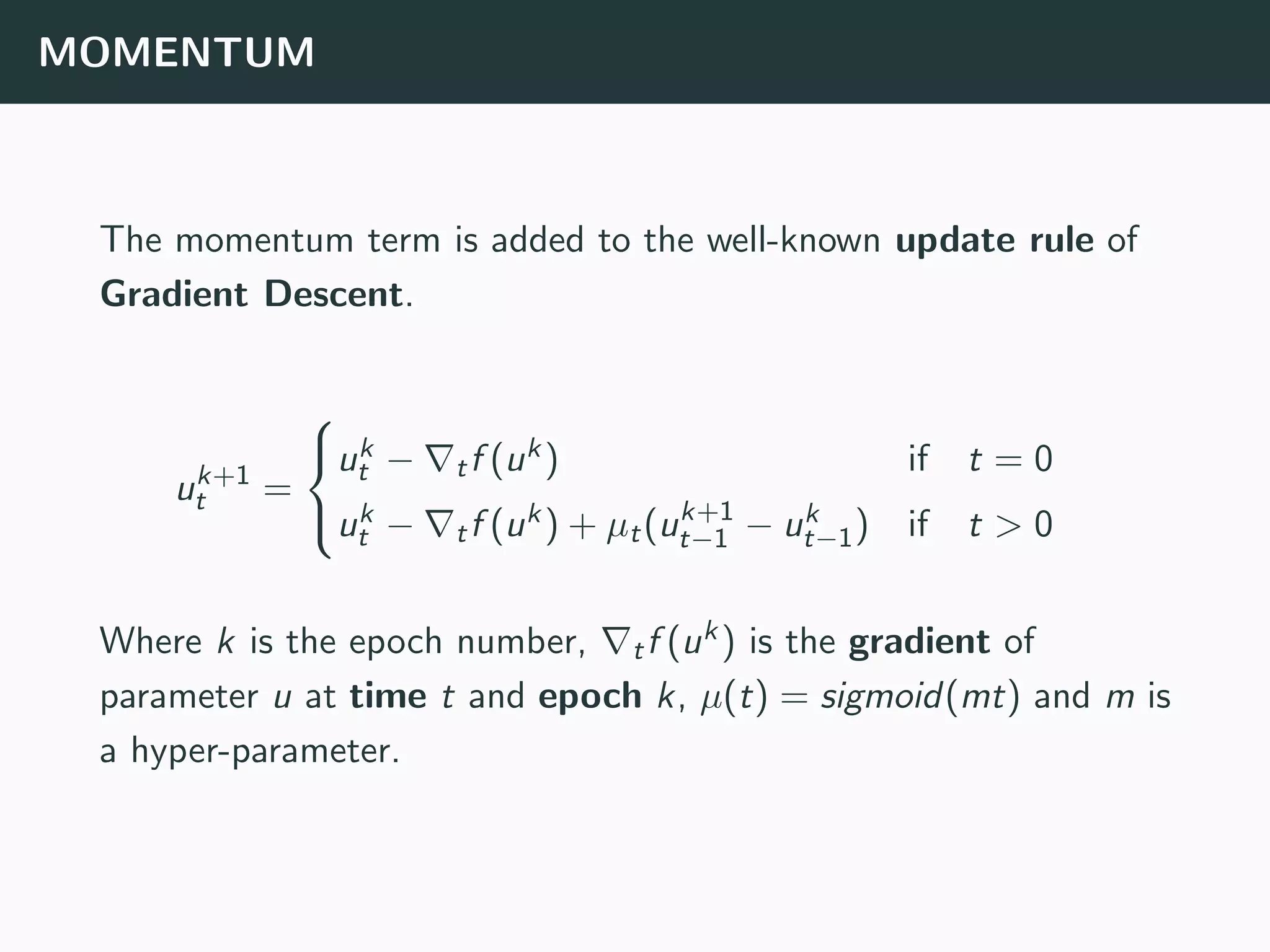
evolution of the epidemic.
Understanding the evolution of the epidemic from the data can
help us understand the efficacy of this interventions and predict
the spread of the illness if no action is taken.
2
WHY LEARN EPIDEMIC MODELS?
Deterministic epidemic models, such as SIR, usually model the
evolution through some constant parameters, such as infection
rate.
Constant parameters are ill-suited to model a dynamic
phenomenon where the spread is counter-acted by the
intervention of national authorities.
Time-varying parameters are better suited, but the parameter
space becomes quickly too big to be manually fine-tuned where
analytical solutions do not exist.
A Machine Learning approach can be used to explore the
parameter space and find interesting and useful models.
3
THE MODEL
A classical deterministic approach to model an epidemic is the
susceptible, infectious, removed (SIR) model.
A population of N individuals is divided into
• x(t) = (# of susceptible at time t)
• y(t) = (# of infectious at time t)
• z(t) = (# of removed at time t)
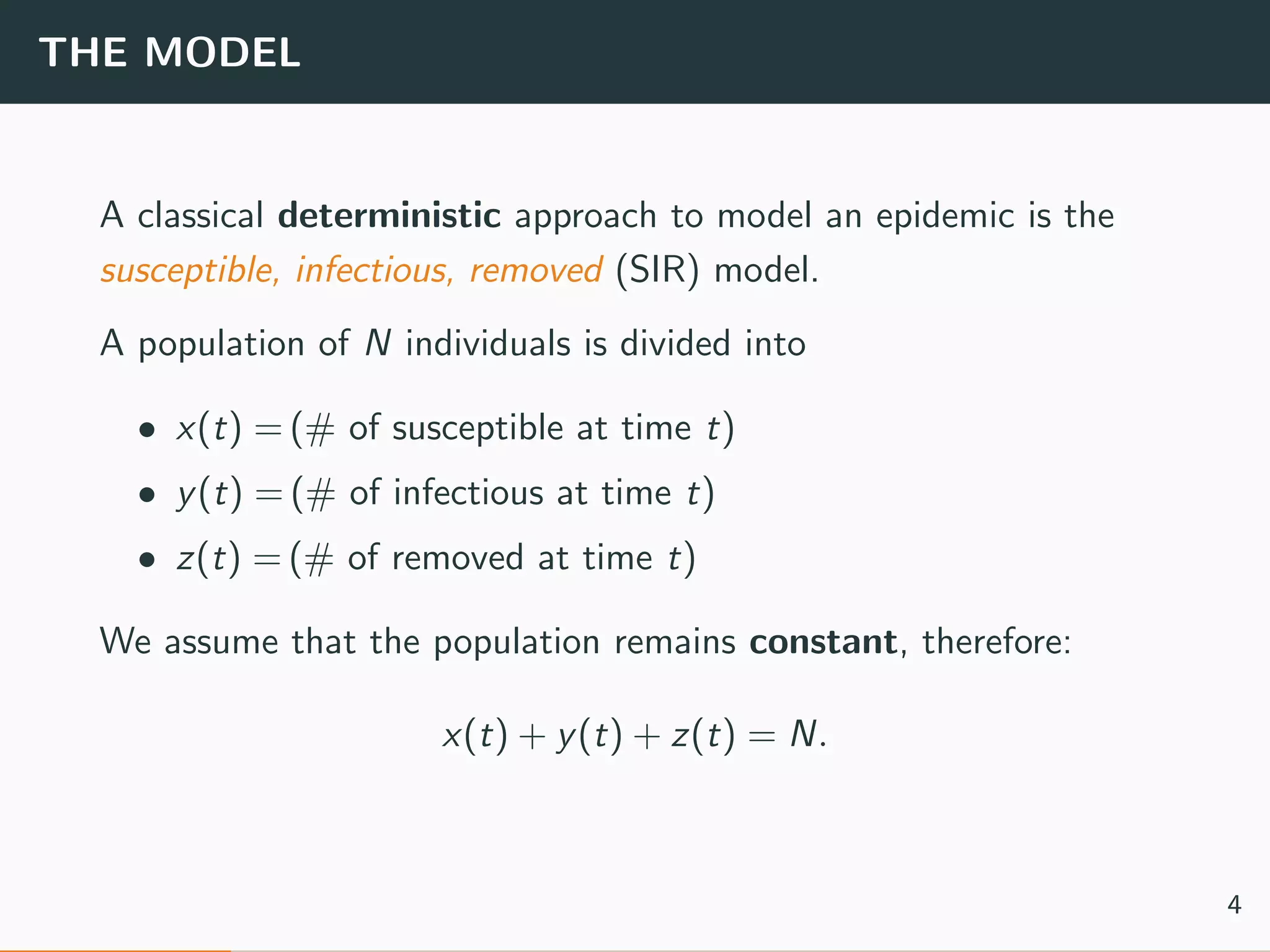
We assume that the population remains constant, therefore:
x(t) + y(t) + z(t) = N.
4
THE MODEL
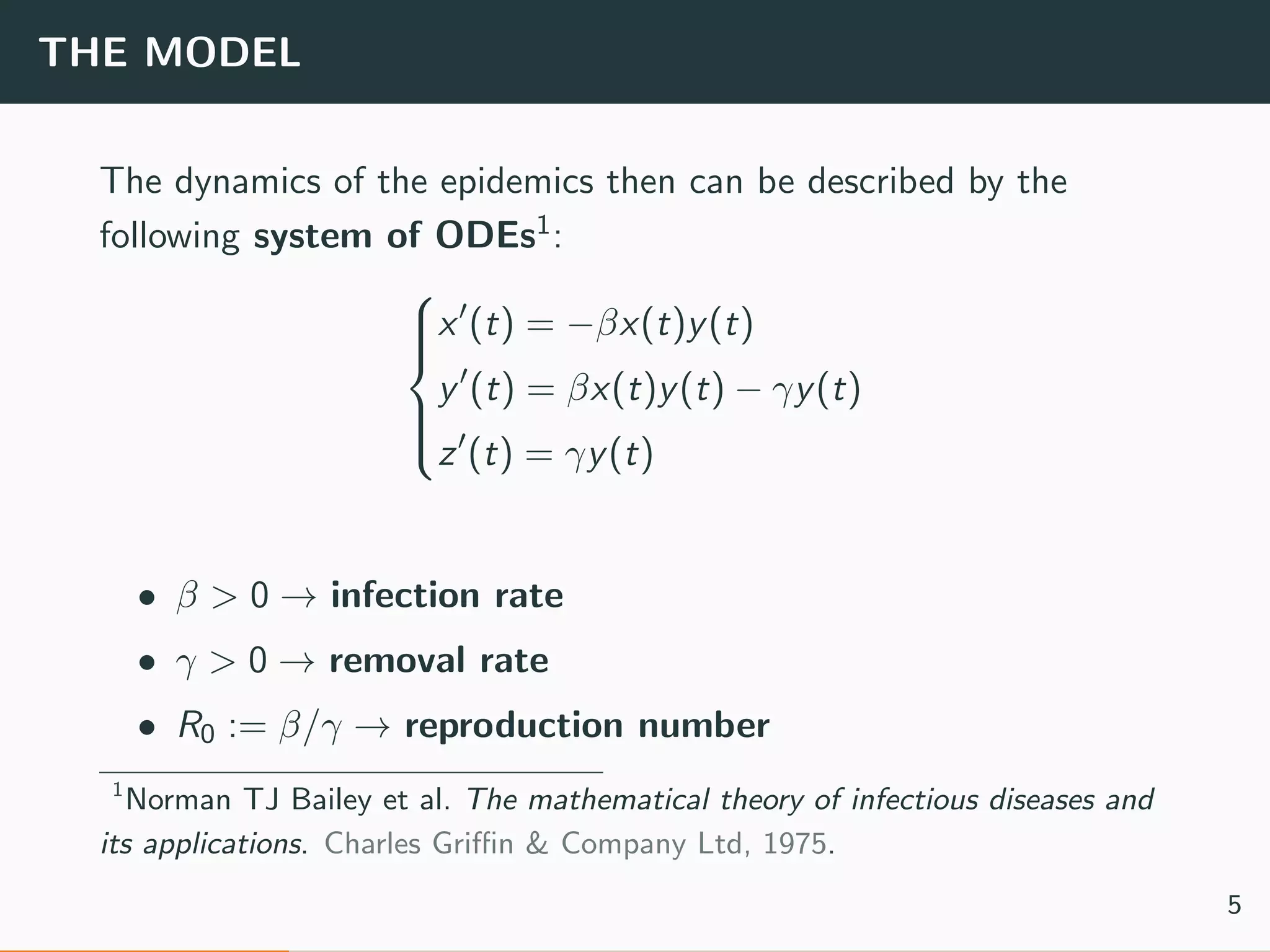
The dynamics of the epidemics then can be described by the
following system of ODEs1:



x (t) = −βx(t)y(t)
y (t) = βx(t)y(t) − γy(t)
z (t) = γy(t)
• β > 0 → infection rate
• γ > 0 → removal rate
• R0 := β/γ → reproduction number
1
Norman TJ Bailey et al. The mathematical theory of infectious diseases and
its applications. Charles Griffin & Company Ltd, 1975.
5
SIDARTHE
S I
D
R
H
E
T
A
α, β, γ, δ
ε
η
ξ
ζ
µ
τ
ρ
λ
κ
ν
σθ
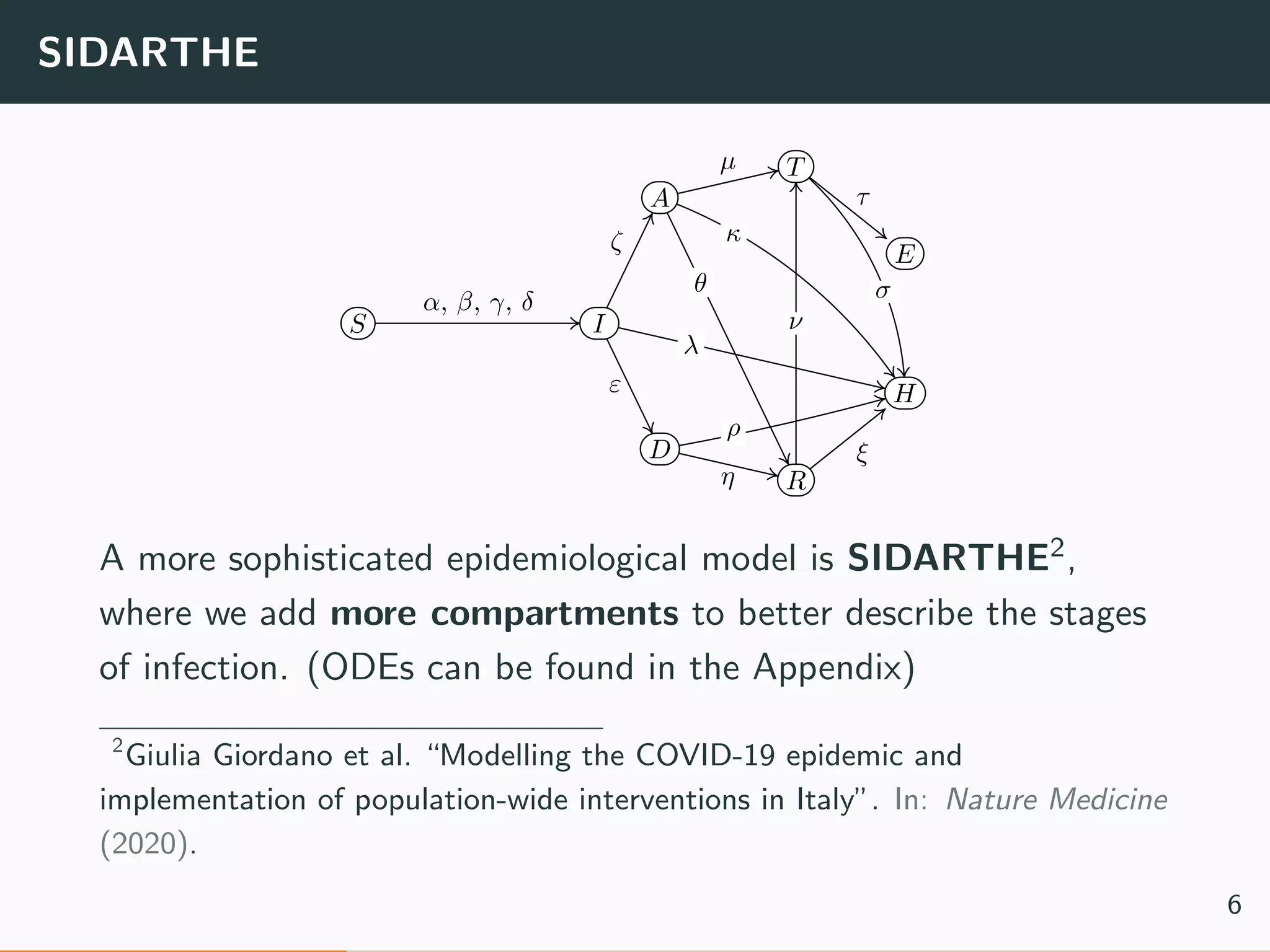
A more sophisticated epidemiological model is SIDARTHE2,
where we add more compartments to better describe the stages
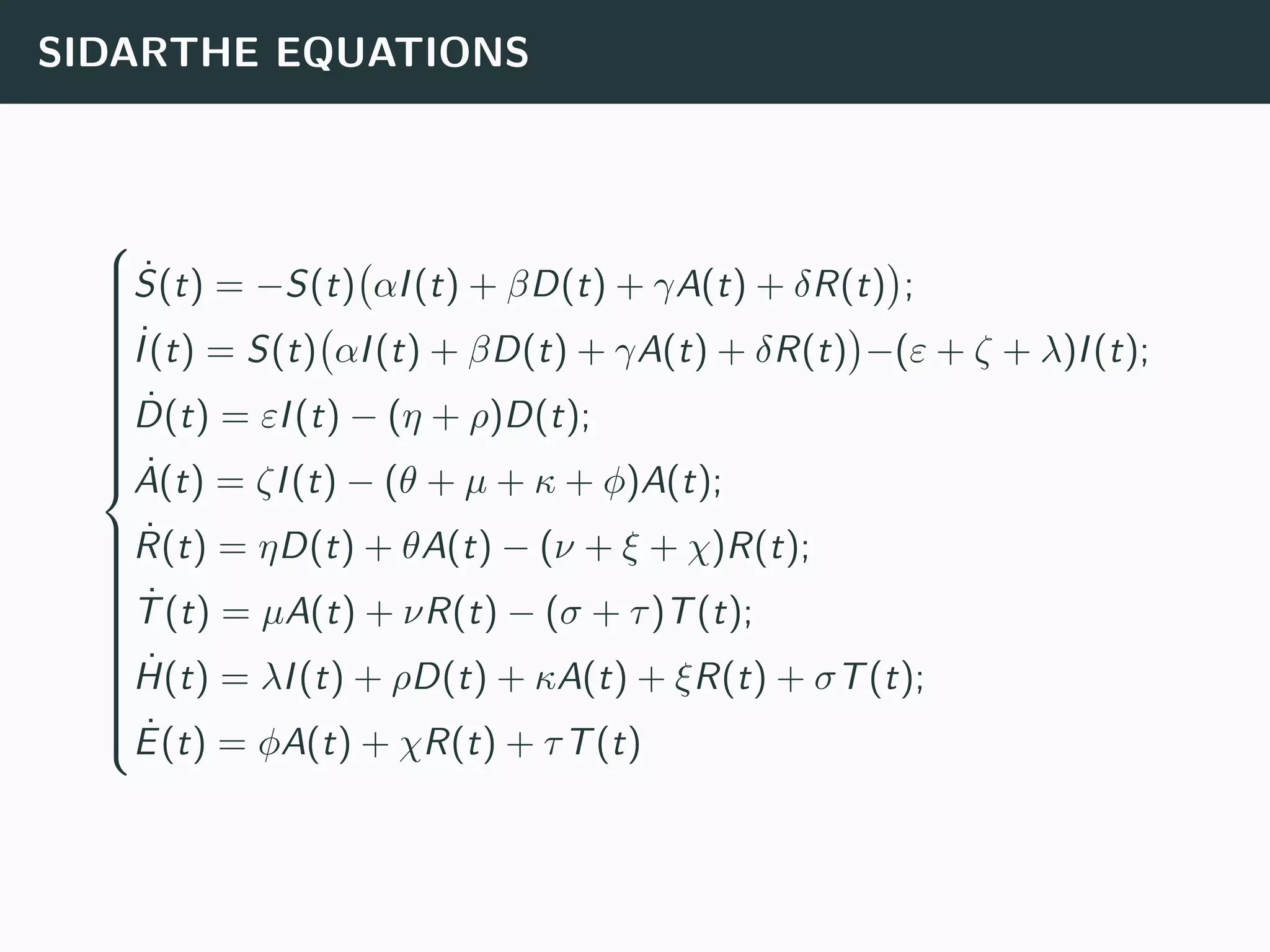
of infection. (ODEs can be found in the Appendix)
2
Giulia Giordano et al. “Modelling the COVID-19 epidemic and
implementation of population-wide interventions in Italy”. In: Nature Medicine
(2020).
6
SIDARTHE
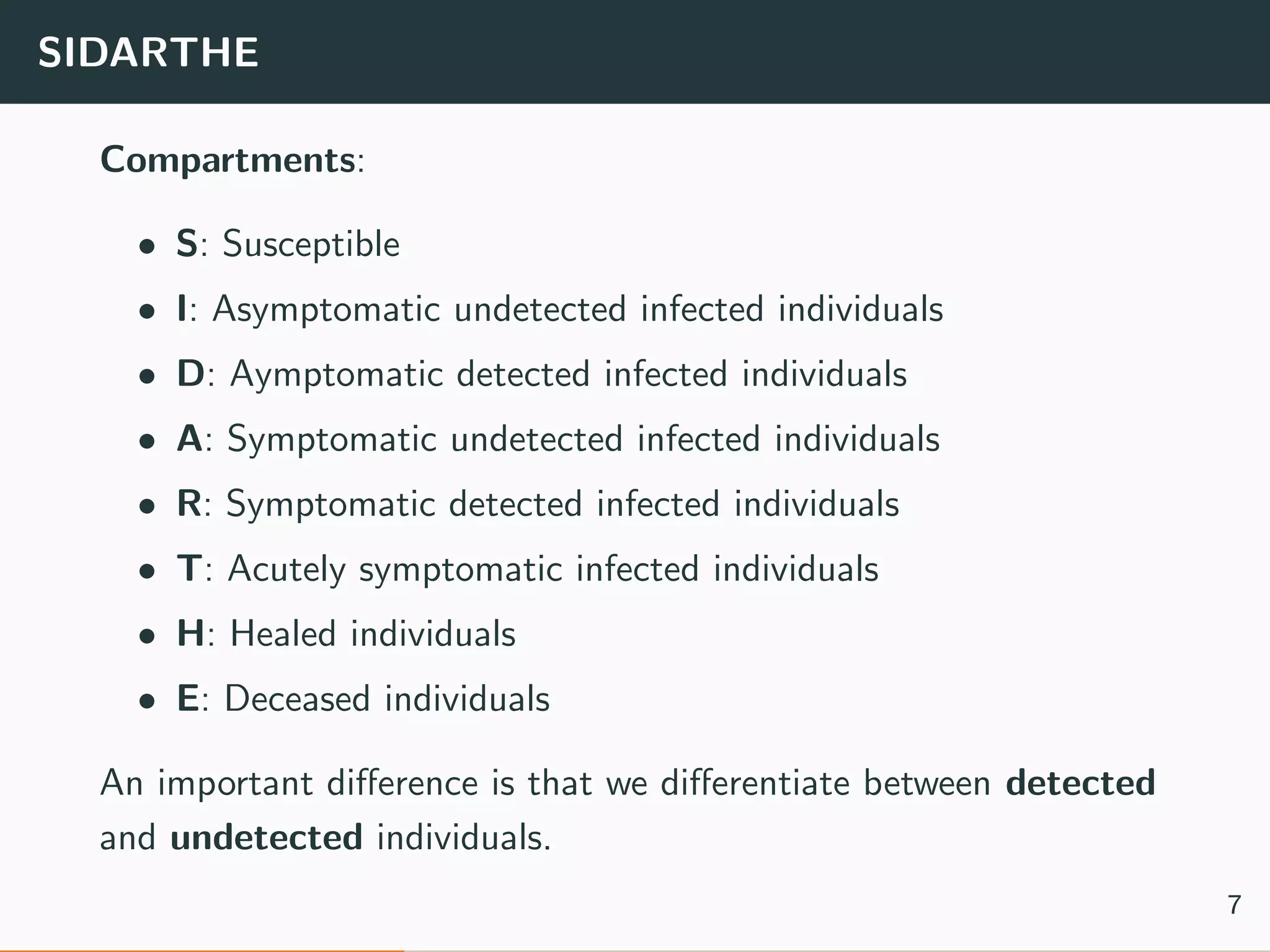
Compartments:
• S: Susceptible
• I: Asymptomatic undetected infected individuals
• D: Aymptomatic detected infected individuals
• A: Symptomatic undetected infected individuals
• R: Symptomatic detected infected individuals
• T: Acutely symptomatic infected individuals
• H: Healed individuals
• E: Deceased individuals
An important difference is that we differentiate between detected
and undetected individuals.
7
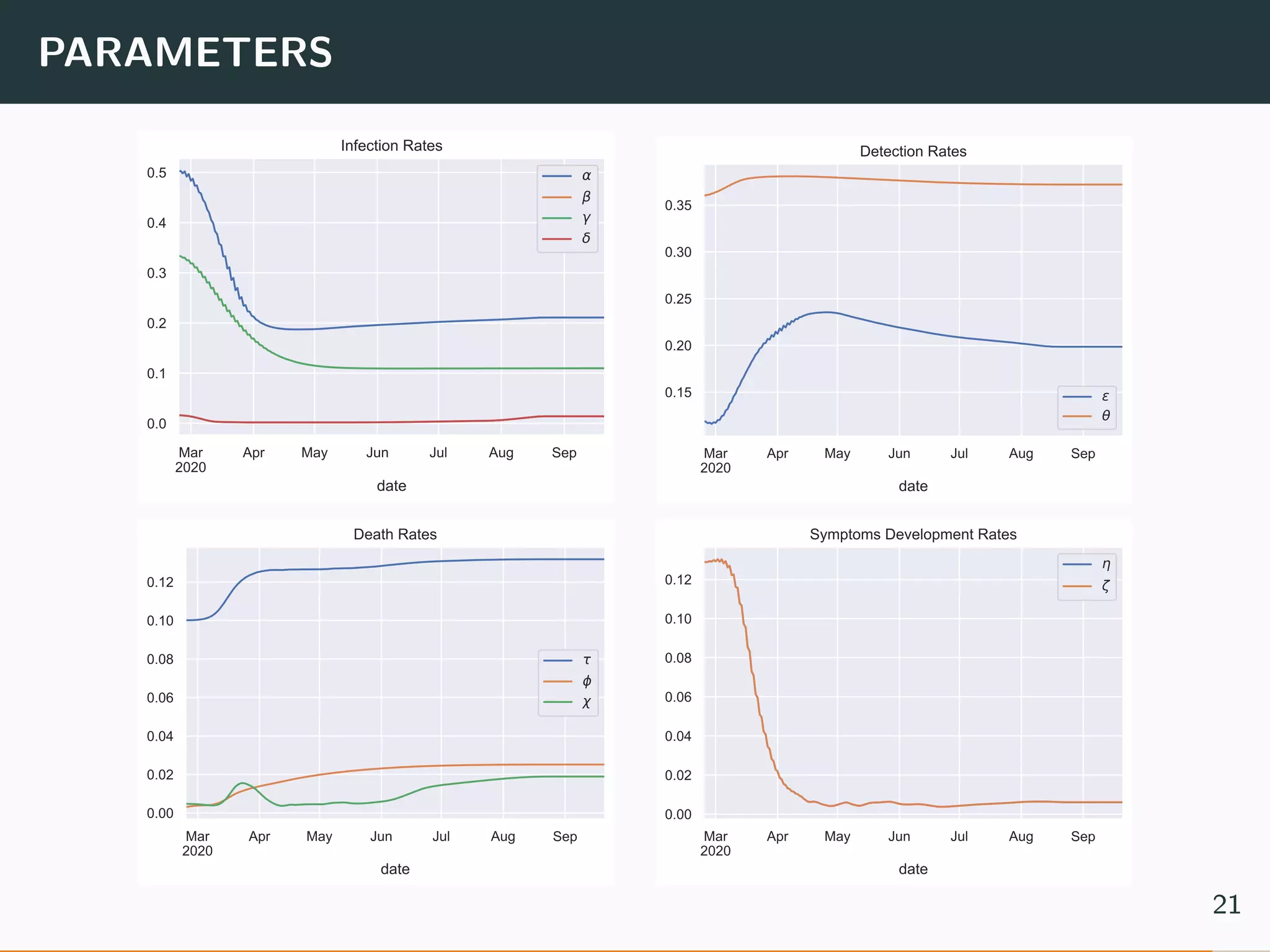
DYNAMIC PARAMETERS
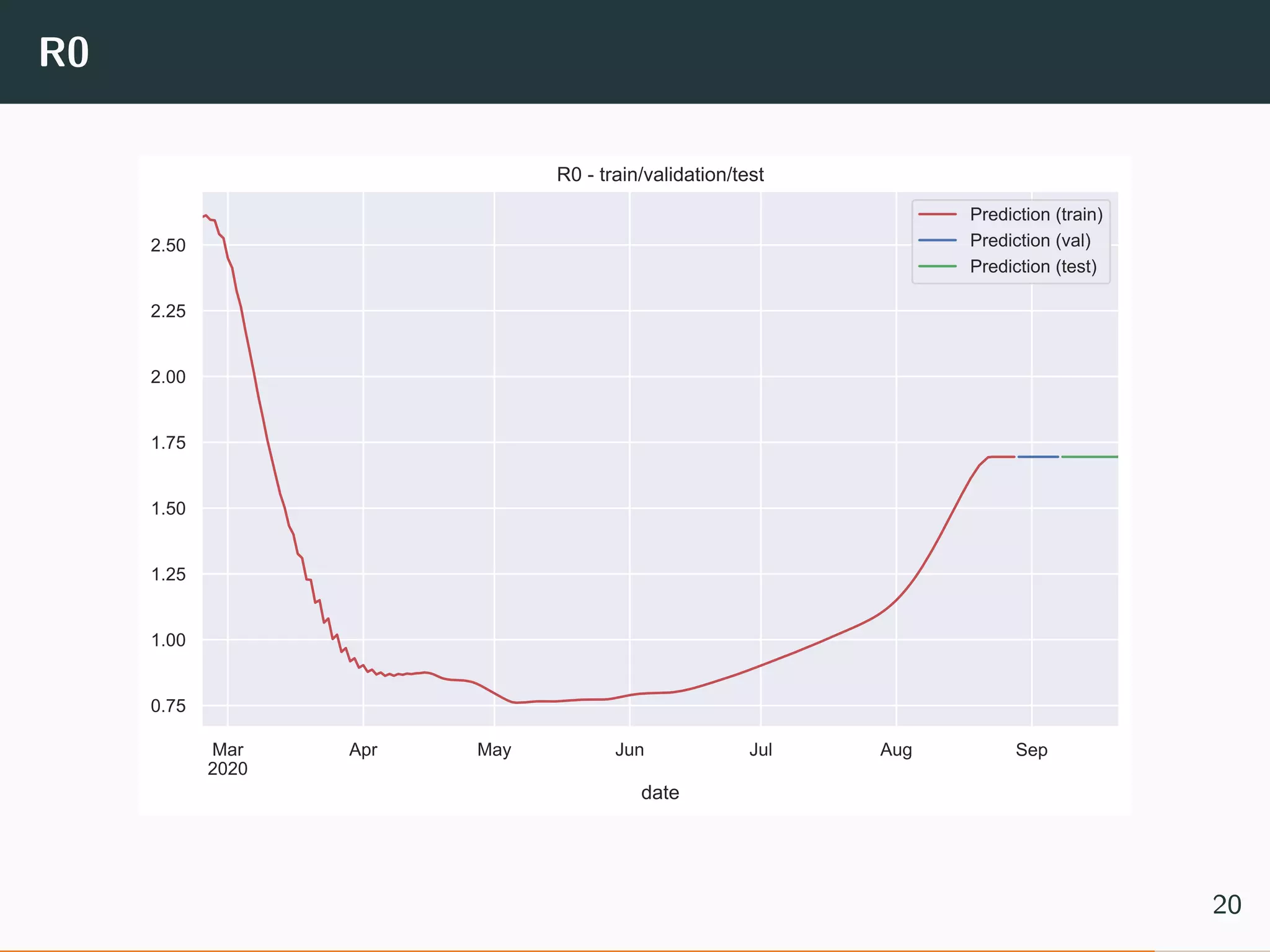
The epidemiological parameters are usually considered constant in
time.
This prevents the model from describing changes due to
non-pharmaceutical interventions (lockdown, etc...).
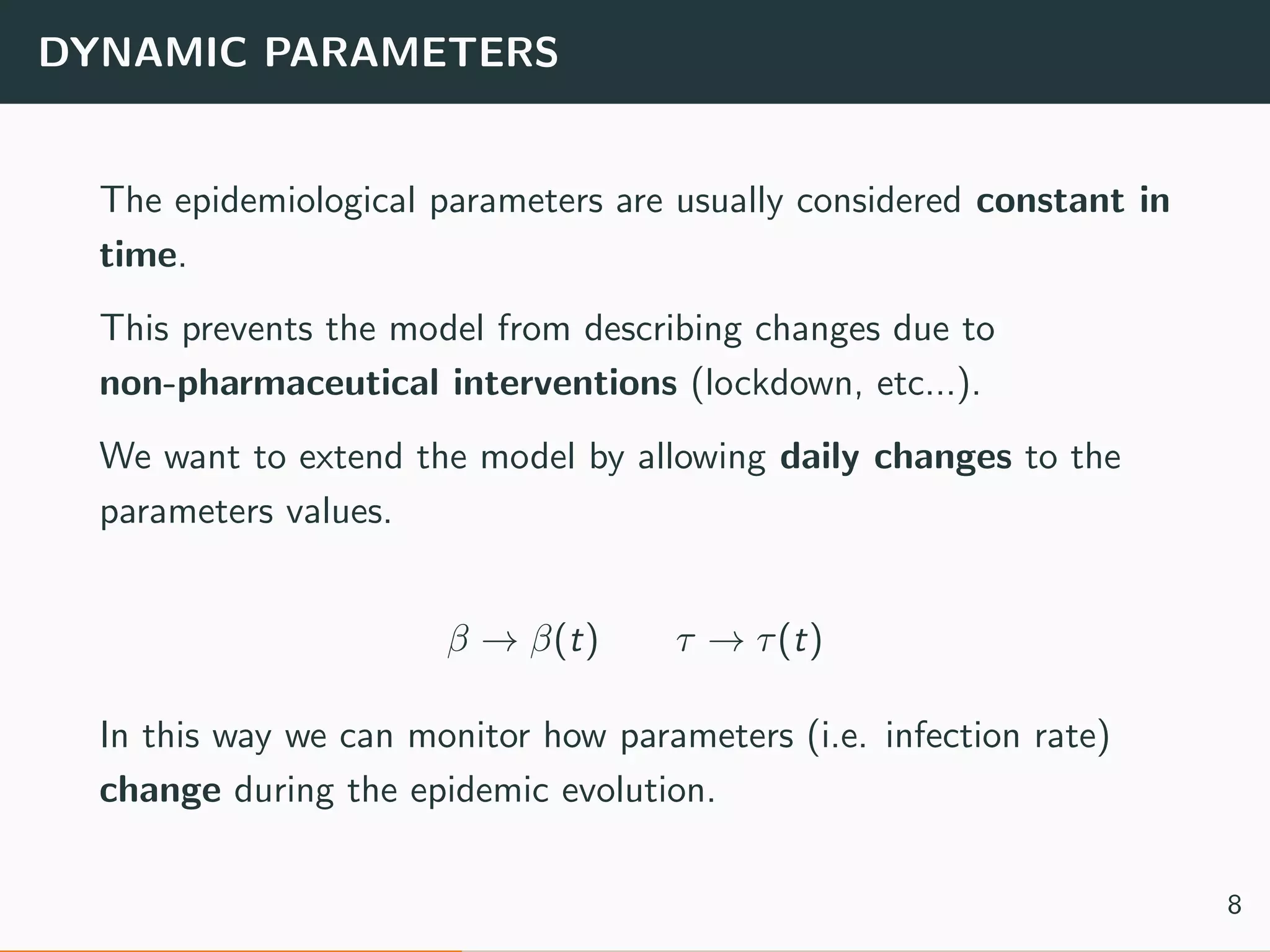
We want to extend the model by allowing daily changes to the
parameters values.
β → β(t) τ → τ(t)
In this way we can monitor how parameters (i.e. infection rate)
change during the epidemic evolution.
8
The data
OFFICIAL DATA
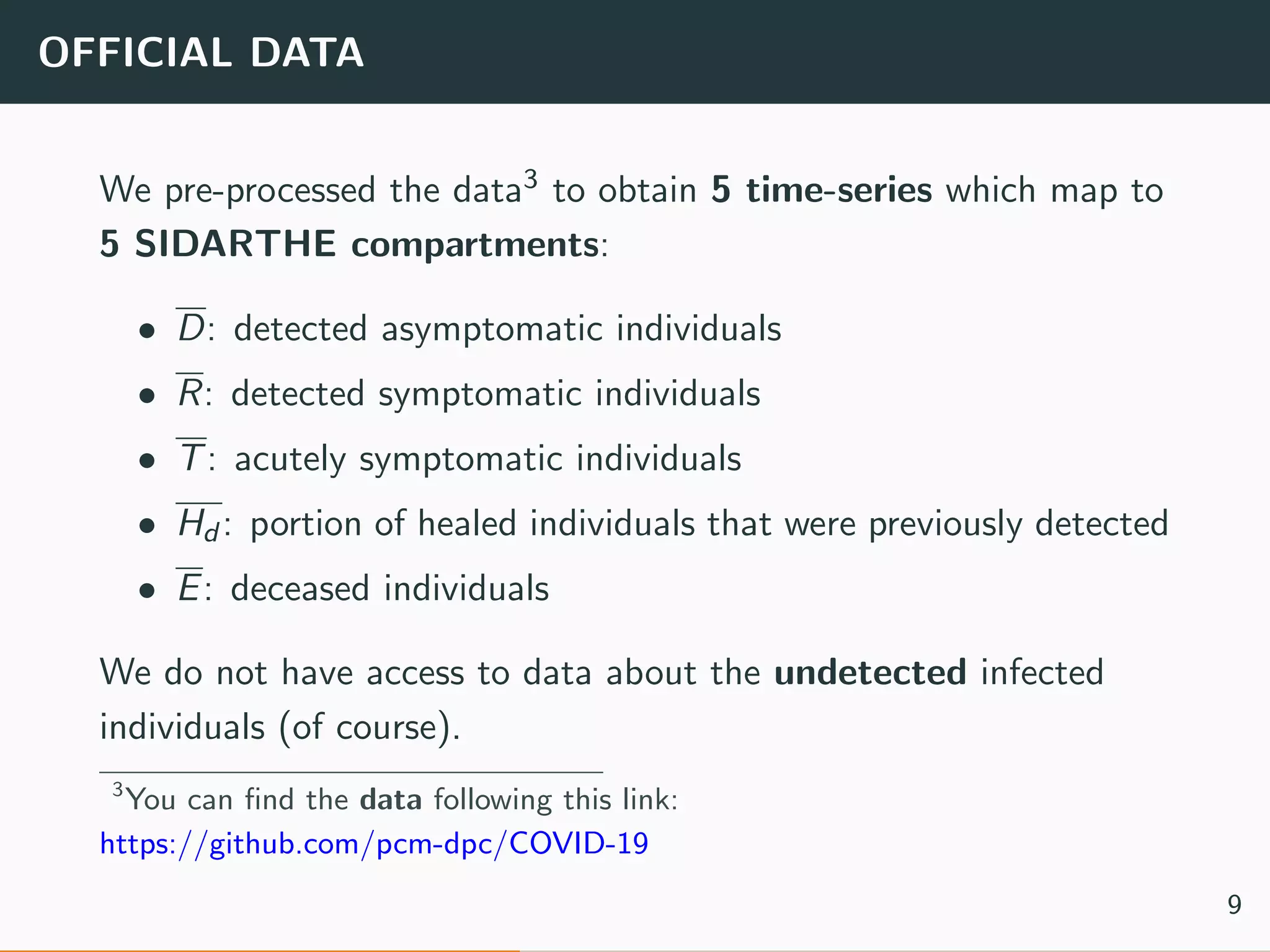
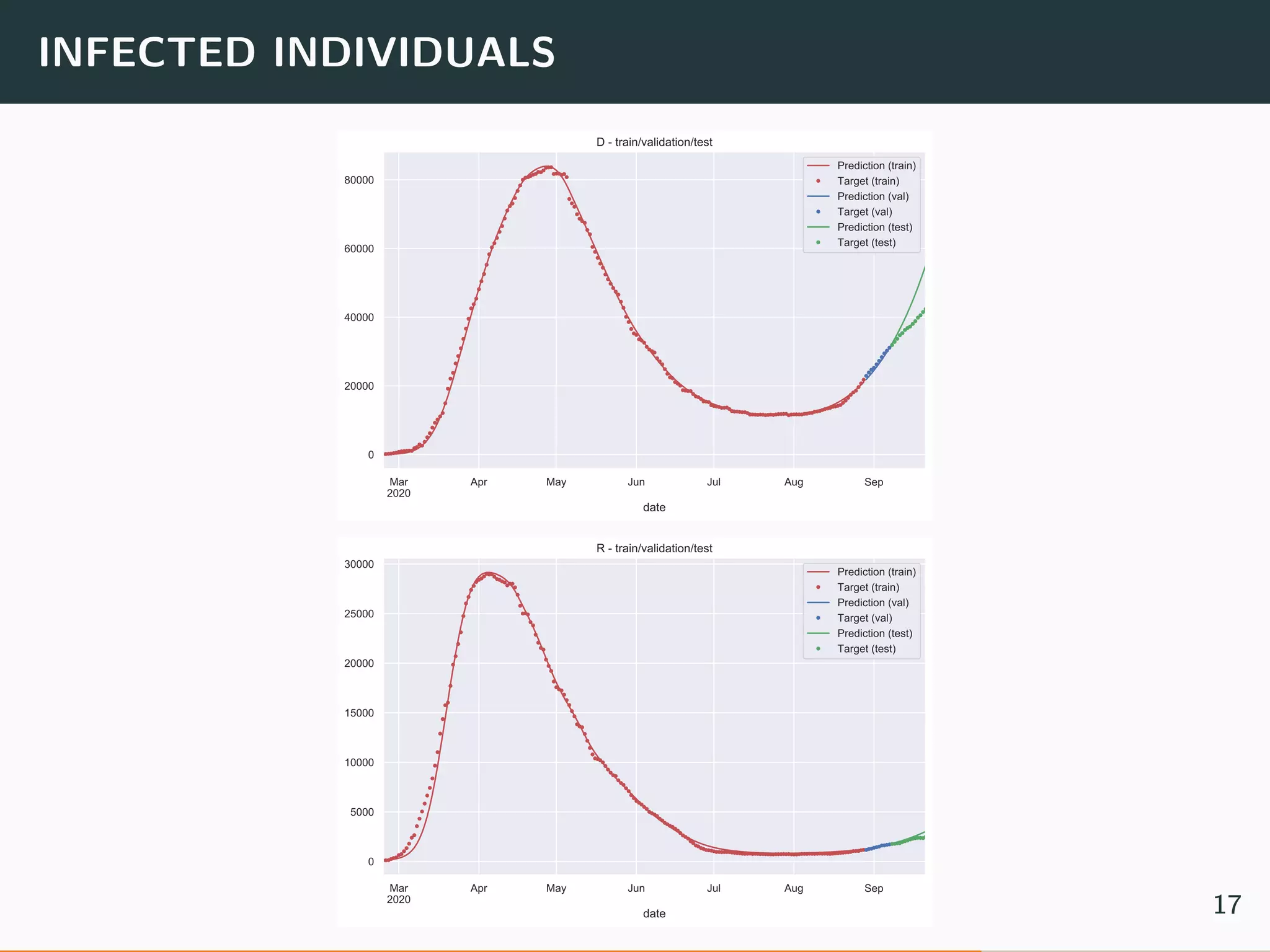
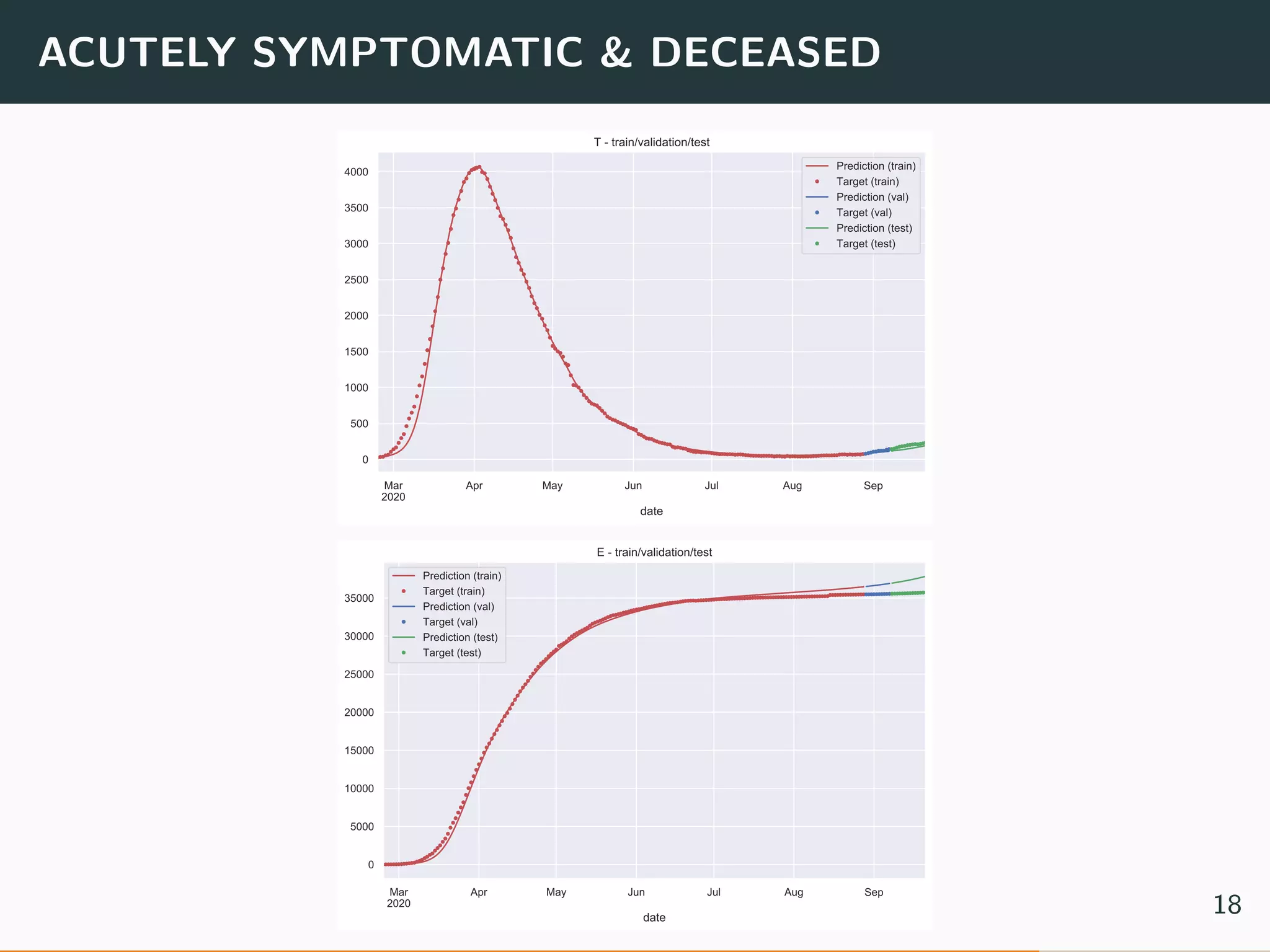
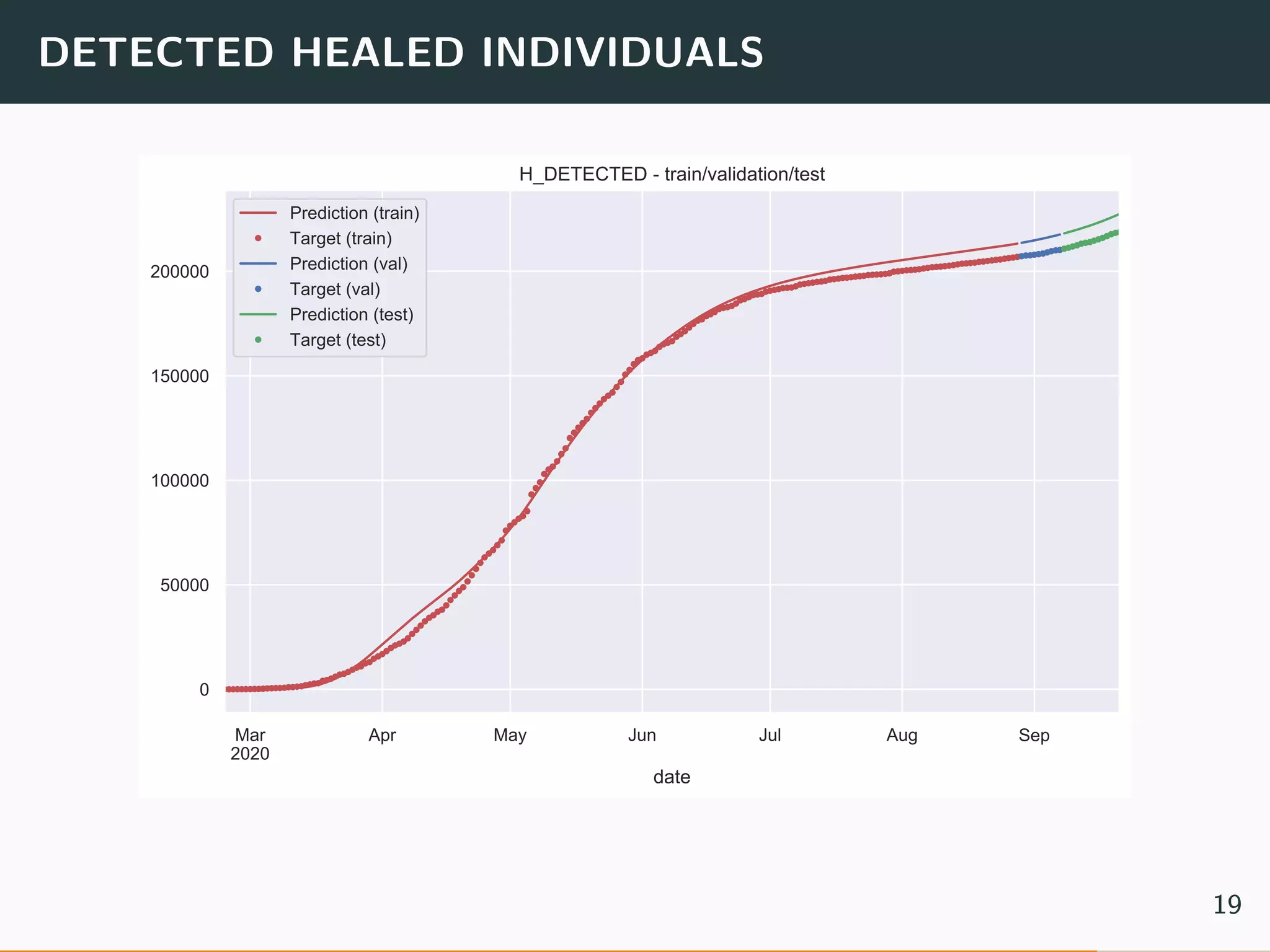
We pre-processed the data3 to obtain 5 time-series which map to
5 SIDARTHE compartments:
• D: detected asymptomatic individuals
• R: detected symptomatic individuals
• T: acutely symptomatic individuals
• Hd : portion of healed individuals that were previously detected
• E: deceased individuals
We do not have access to data about the undetected infected
individuals (of course).
3
You can find the data following this link:
https://github.com/pcm-dpc/COVID-19
9
TRAIN/VALIDATION/TEST SPLIT
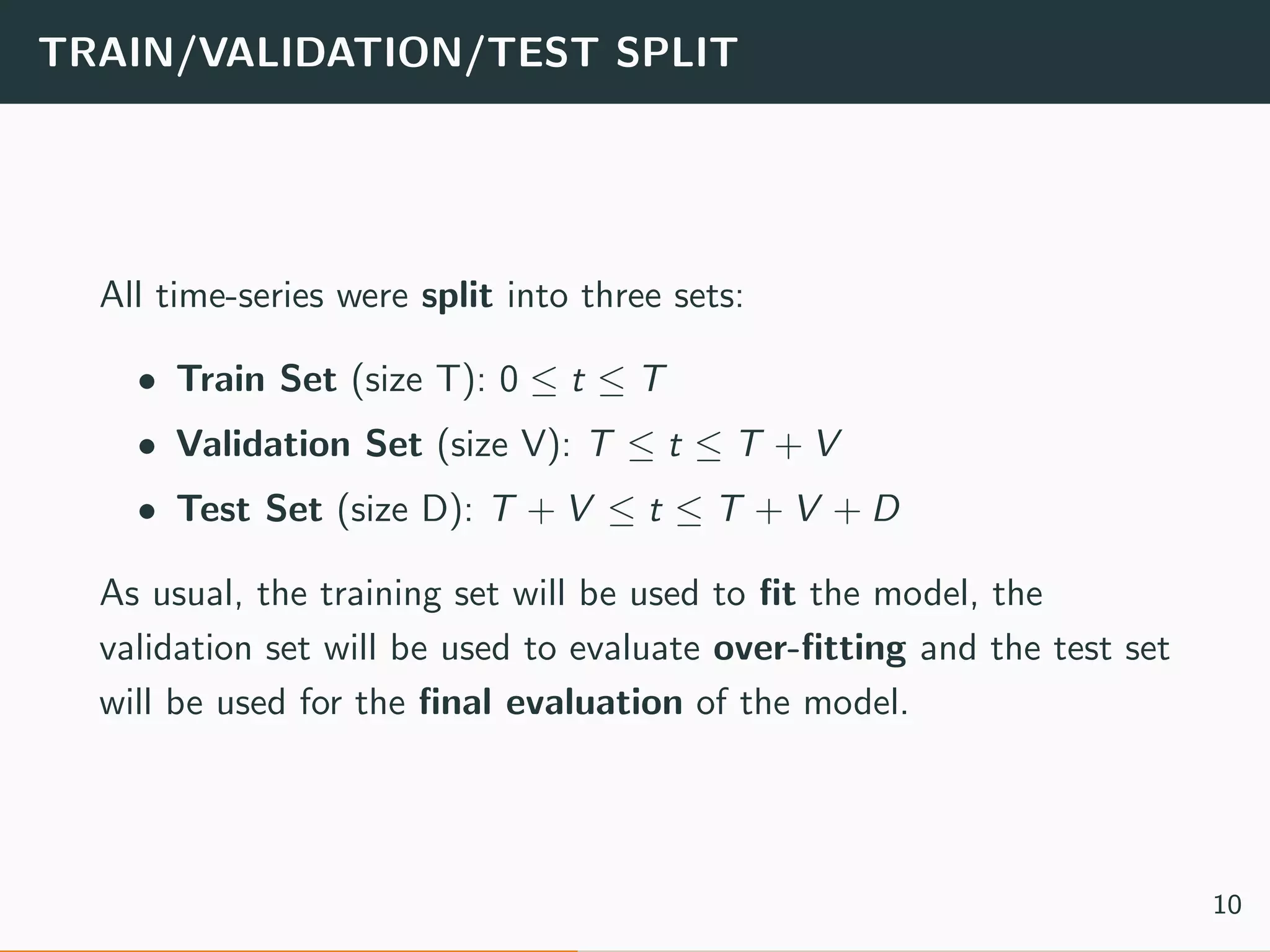
All time-series were split into three sets:
• Train Set (size T): 0 ≤ t ≤ T
• Validation Set (size V): T ≤ t ≤ T + V
• Test Set (size D): T + V ≤ t ≤ T + V + D
As usual, the training set will be used to fit the model, the
validation set will be used to evaluate over-fitting and the test set
will be used for the final evaluation of the model.
10
The learning problem
GENERIC STATEMENT
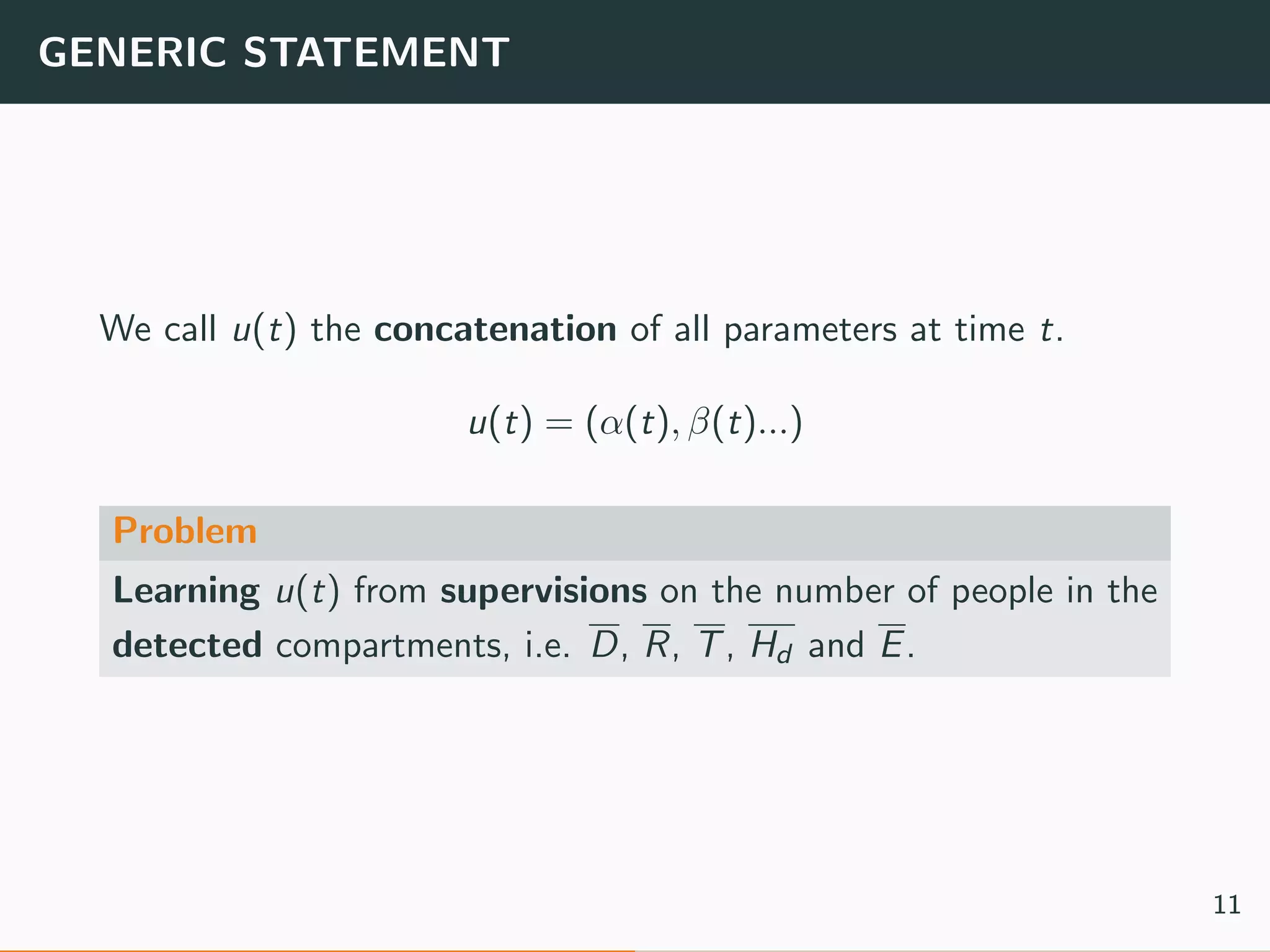
We call u(t) the concatenation of all parameters at time t.
u(t) = (α(t), β(t)...)
Problem
Learning u(t) from supervisions on the number of people in the
detected compartments, i.e. D, R, T, Hd and E.
11
PRECISE FORMULATION
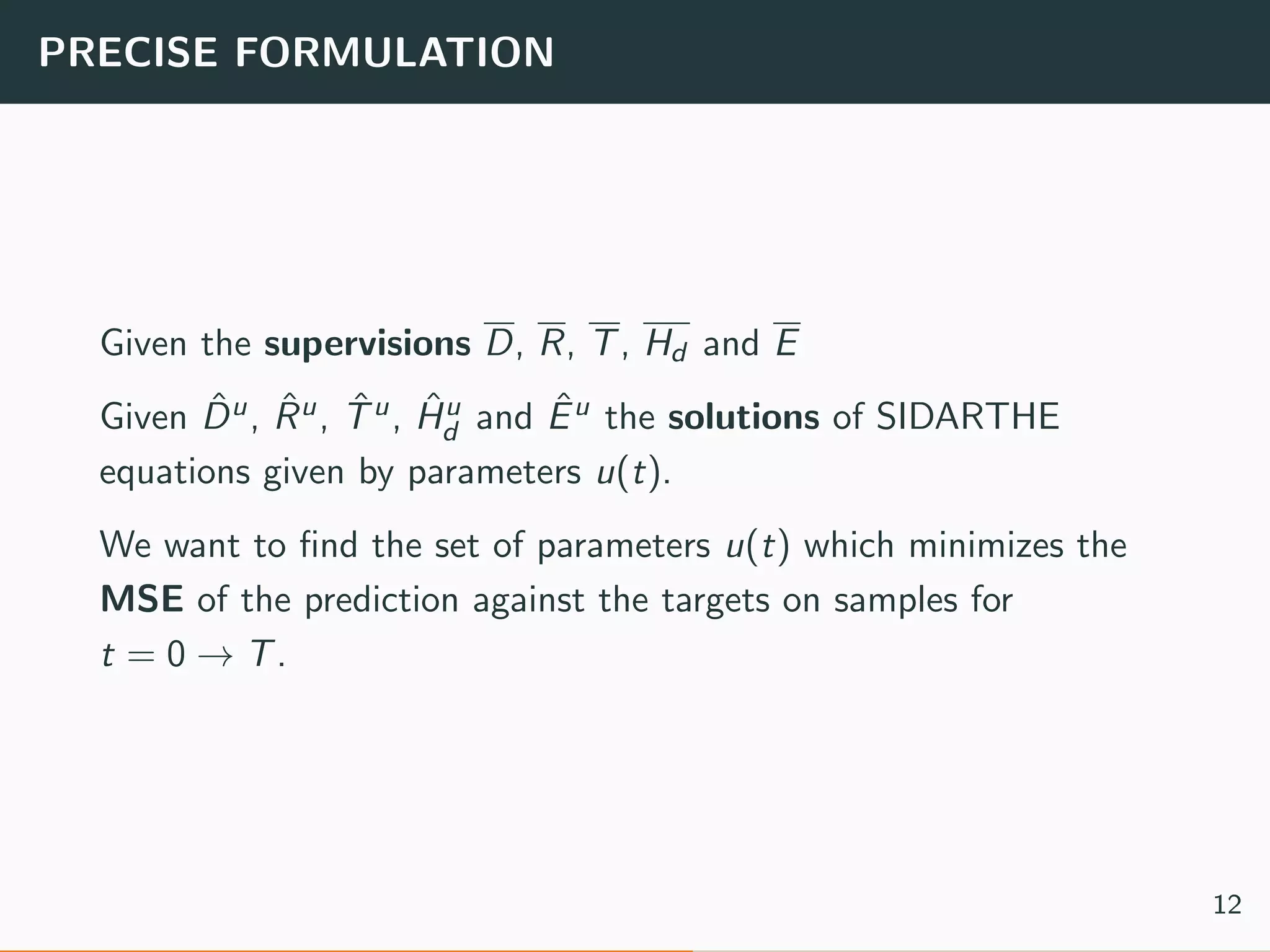
Given the supervisions D, R, T, Hd and E
Given ˆDu, ˆRu, ˆTu, ˆHu
d and ˆEu the solutions of SIDARTHE
equations given by parameters u(t).
We want to find the set of parameters u(t) which minimizes the
MSE of the prediction against the targets on samples for
t = 0 → T.
12
GRADIENT DESCENT THROUGH ODES
The learning is done through Gradient Descent.
The SIDARTHE equations are computed through numeric
integration, using Heun method and a fixed time step.
To obtain the gradient of parameters through the integration, we
have implemented the Heun method in PyTorch to leverage its
powerful autograd framework.
Sidenote: there are strong similarities with Neural ODEs.
13
Regularization
SMOOTHNESS
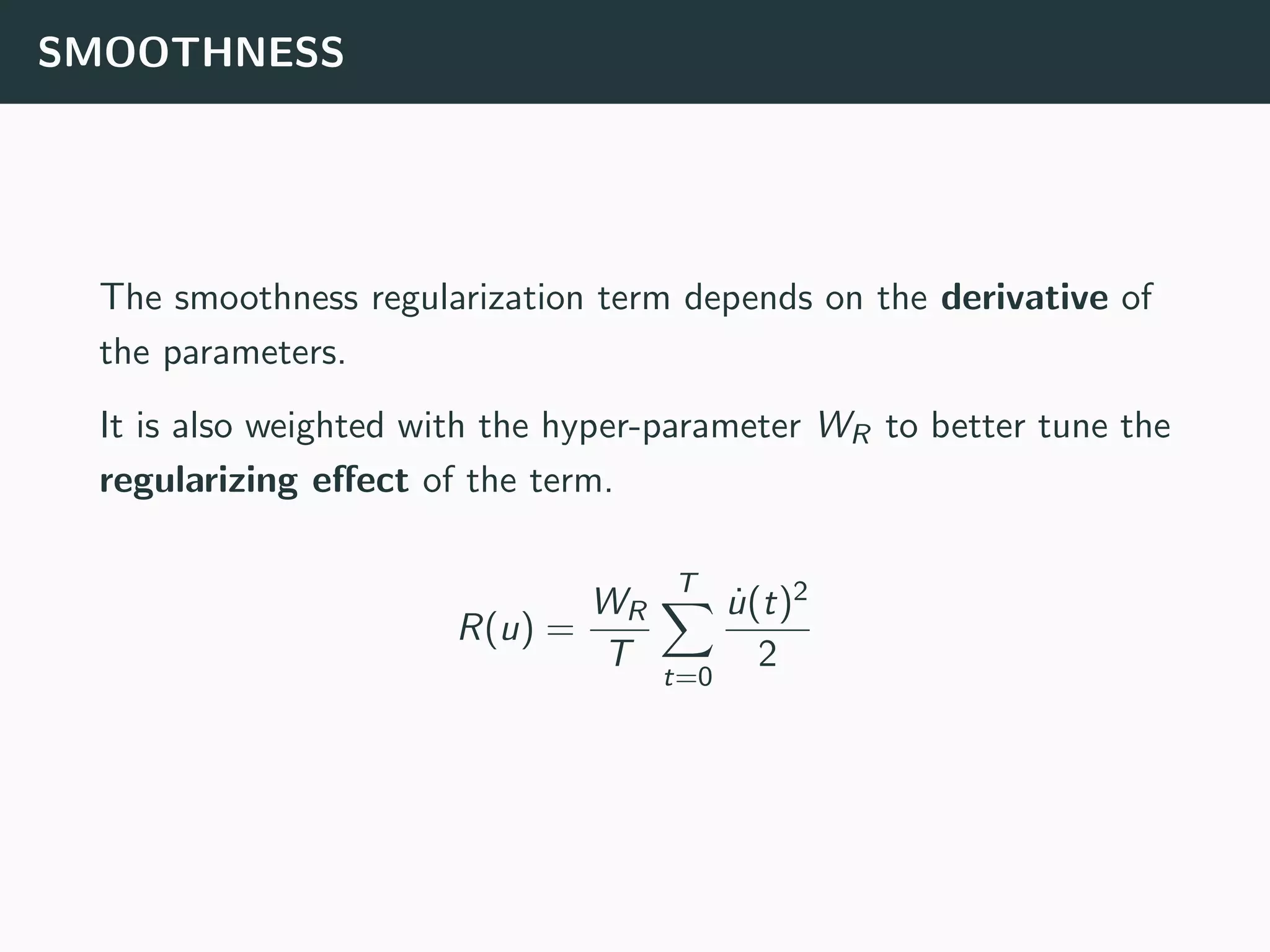
In case of overfitting, the learned parameters could result in a
discontinuous and wrinkled function of time.
To avoid this problem and reduce overfitting, we augment the loss
function with a regularization term R(u).
The penalty R(u) is higher when the parameters are discontinuous
and enforces a smooth function.
14
MOMENTUM
Since the solution is computed through integration, the value of
parameters at initial time steps have a bigger impact on the
solution w.r.t. values at final time steps.
This can be seen in the gradient of each parameter: for t → T,
gradients approach 0.
Hence, we augmented the Gradient Descent update rule with a
momentum term, which manages to distribute the gradient
throughout the u function.
Important note: the commonly known momentum carries the
gradient over subsequent epochs; this momentum term carries the
gradient over subsequent time steps of the parameters u(t)
15
TARGET NORMALIZATION
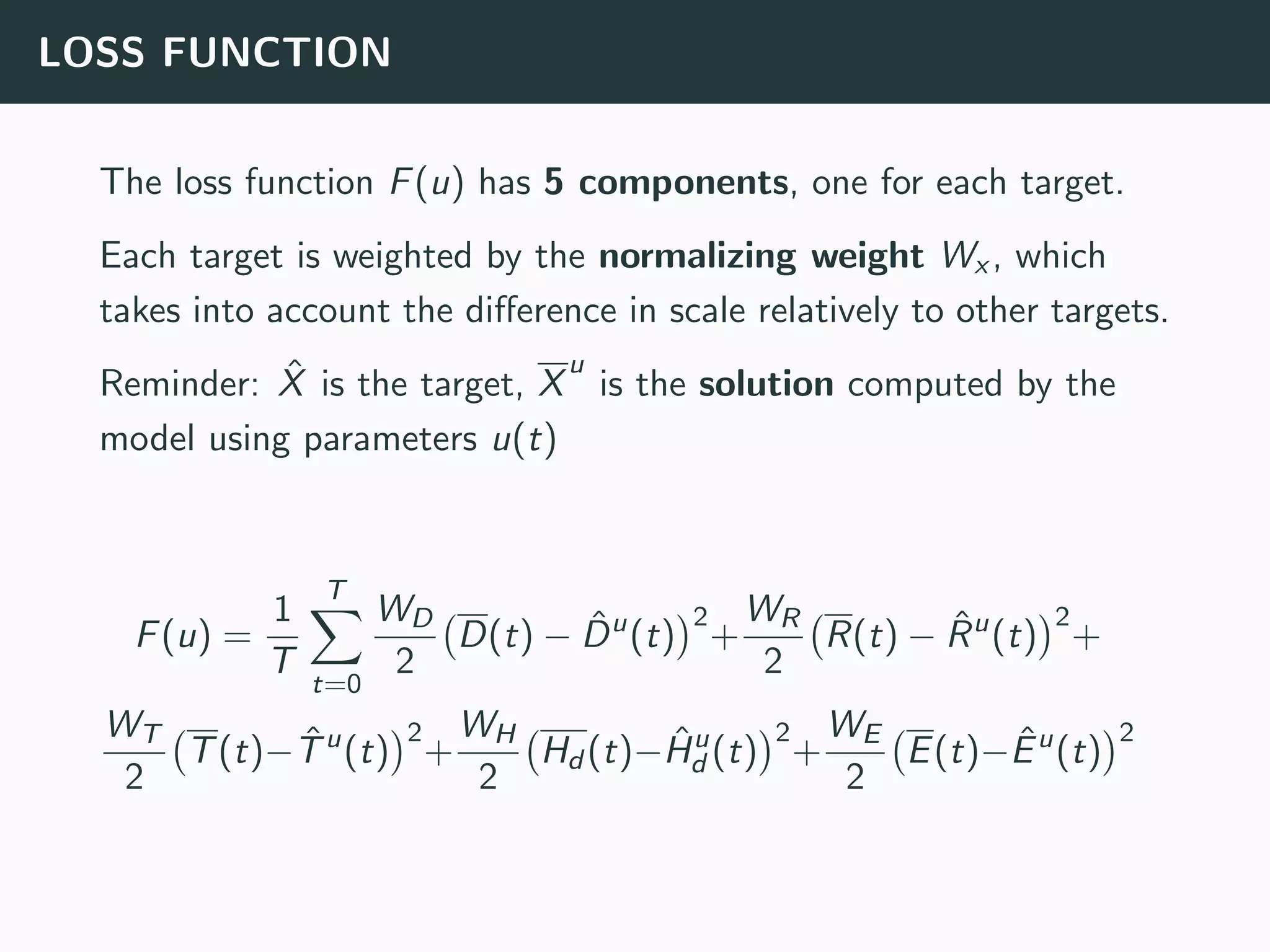
D, R, T, Hd and E have very different scales of values.
E.g. max(Hd ) ≈ 200 000 and max(T) ≈ 4 000
This could cause the learning to prefer a target at the expense of
another one.
We weight the loss components for each target based on its scale
relative to the other targets.
16
Fitting the data
INFECTED INDIVIDUALS
0DU

$SU 0D -XQ -XO $XJ 6HS
GDWH


'WUDLQYDOLGDWLRQWHVW
3UHGLFWLRQWUDLQ
7DUJHWWUDLQ
3UHGLFWLRQYDO
7DUJHWYDO
3UHGLFWLRQWHVW
7DUJHWWHVW
0DU

$SU 0D -XQ -XO $XJ 6HS
GDWH


5WUDLQYDOLGDWLRQWHVW
3UHGLFWLRQWUDLQ
7DUJHWWUDLQ
3UHGLFWLRQYDO
7DUJHWYDO
3UHGLFWLRQWHVW
7DUJHWWHVW
17

Machine Learning for Epidemiological Models (Enrico Meloni)

  • 1.
    MACHINE LEARNING FOR EPIDEMIOLOGICALMODELS E. Meloni, A. Zugarini, A. Panizza, A. Betti, M. Gori September 24, 2020 SAILab, University of Siena
  • 2.
    TABLE OF CONTENTS 1.SIR Models 2. The data 3. The learning problem 4. Regularization 5. Fitting the data 1
  • 3.
  • 4.
    WHY LEARN EPIDEMICMODELS? During 2020, the spread of COVID-19 infection affected the whole world. Some countries resorted to non-pharmaceutical interventions of various degrees to control the spread of the virus, such as lockdowns or imposing the use of masks. Many countries collected vast amounts of detailed data about the evolution of the epidemic. Understanding the evolution of the epidemic from the data can help us understand the efficacy of this interventions and predict the spread of the illness if no action is taken. 2
  • 5.
    WHY LEARN EPIDEMICMODELS? Deterministic epidemic models, such as SIR, usually model the evolution through some constant parameters, such as infection rate. Constant parameters are ill-suited to model a dynamic phenomenon where the spread is counter-acted by the intervention of national authorities. Time-varying parameters are better suited, but the parameter space becomes quickly too big to be manually fine-tuned where analytical solutions do not exist. A Machine Learning approach can be used to explore the parameter space and find interesting and useful models. 3
  • 6.
    THE MODEL A classicaldeterministic approach to model an epidemic is the susceptible, infectious, removed (SIR) model. A population of N individuals is divided into • x(t) = (# of susceptible at time t) • y(t) = (# of infectious at time t) • z(t) = (# of removed at time t) We assume that the population remains constant, therefore: x(t) + y(t) + z(t) = N. 4
  • 7.
    THE MODEL The dynamicsof the epidemics then can be described by the following system of ODEs1:    x (t) = −βx(t)y(t) y (t) = βx(t)y(t) − γy(t) z (t) = γy(t) • β > 0 → infection rate • γ > 0 → removal rate • R0 := β/γ → reproduction number 1 Norman TJ Bailey et al. The mathematical theory of infectious diseases and its applications. Charles Griffin & Company Ltd, 1975. 5
  • 8.
    SIDARTHE S I D R H E T A α, β,γ, δ ε η ξ ζ µ τ ρ λ κ ν σθ A more sophisticated epidemiological model is SIDARTHE2, where we add more compartments to better describe the stages of infection. (ODEs can be found in the Appendix) 2 Giulia Giordano et al. “Modelling the COVID-19 epidemic and implementation of population-wide interventions in Italy”. In: Nature Medicine (2020). 6
  • 9.
    SIDARTHE Compartments: • S: Susceptible •I: Asymptomatic undetected infected individuals • D: Aymptomatic detected infected individuals • A: Symptomatic undetected infected individuals • R: Symptomatic detected infected individuals • T: Acutely symptomatic infected individuals • H: Healed individuals • E: Deceased individuals An important difference is that we differentiate between detected and undetected individuals. 7
  • 10.
    DYNAMIC PARAMETERS The epidemiologicalparameters are usually considered constant in time. This prevents the model from describing changes due to non-pharmaceutical interventions (lockdown, etc...). We want to extend the model by allowing daily changes to the parameters values. β → β(t) τ → τ(t) In this way we can monitor how parameters (i.e. infection rate) change during the epidemic evolution. 8
  • 11.
  • 12.
    OFFICIAL DATA We pre-processedthe data3 to obtain 5 time-series which map to 5 SIDARTHE compartments: • D: detected asymptomatic individuals • R: detected symptomatic individuals • T: acutely symptomatic individuals • Hd : portion of healed individuals that were previously detected • E: deceased individuals We do not have access to data about the undetected infected individuals (of course). 3 You can find the data following this link: https://github.com/pcm-dpc/COVID-19 9
  • 13.
    TRAIN/VALIDATION/TEST SPLIT All time-serieswere split into three sets: • Train Set (size T): 0 ≤ t ≤ T • Validation Set (size V): T ≤ t ≤ T + V • Test Set (size D): T + V ≤ t ≤ T + V + D As usual, the training set will be used to fit the model, the validation set will be used to evaluate over-fitting and the test set will be used for the final evaluation of the model. 10
  • 14.
  • 15.
    GENERIC STATEMENT We callu(t) the concatenation of all parameters at time t. u(t) = (α(t), β(t)...) Problem Learning u(t) from supervisions on the number of people in the detected compartments, i.e. D, R, T, Hd and E. 11
  • 16.
    PRECISE FORMULATION Given thesupervisions D, R, T, Hd and E Given ˆDu, ˆRu, ˆTu, ˆHu d and ˆEu the solutions of SIDARTHE equations given by parameters u(t). We want to find the set of parameters u(t) which minimizes the MSE of the prediction against the targets on samples for t = 0 → T. 12
  • 17.
    GRADIENT DESCENT THROUGHODES The learning is done through Gradient Descent. The SIDARTHE equations are computed through numeric integration, using Heun method and a fixed time step. To obtain the gradient of parameters through the integration, we have implemented the Heun method in PyTorch to leverage its powerful autograd framework. Sidenote: there are strong similarities with Neural ODEs. 13
  • 18.
  • 19.
    SMOOTHNESS In case ofoverfitting, the learned parameters could result in a discontinuous and wrinkled function of time. To avoid this problem and reduce overfitting, we augment the loss function with a regularization term R(u). The penalty R(u) is higher when the parameters are discontinuous and enforces a smooth function. 14
  • 20.
    MOMENTUM Since the solutionis computed through integration, the value of parameters at initial time steps have a bigger impact on the solution w.r.t. values at final time steps. This can be seen in the gradient of each parameter: for t → T, gradients approach 0. Hence, we augmented the Gradient Descent update rule with a momentum term, which manages to distribute the gradient throughout the u function. Important note: the commonly known momentum carries the gradient over subsequent epochs; this momentum term carries the gradient over subsequent time steps of the parameters u(t) 15
  • 21.
    TARGET NORMALIZATION D, R,T, Hd and E have very different scales of values. E.g. max(Hd ) ≈ 200 000 and max(T) ≈ 4 000 This could cause the learning to prefer a target at the expense of another one. We weight the loss components for each target based on its scale relative to the other targets. 16
  • 22.
  • 23.
    INFECTED INDIVIDUALS 0DU $SU 0D-XQ -XO $XJ 6HS GDWH 'WUDLQYDOLGDWLRQWHVW 3UHGLFWLRQWUDLQ
  • 24.
  • 25.
  • 26.
  • 27.
  • 28.
  • 29.
    0DU $SU 0D -XQ-XO $XJ 6HS GDWH 5WUDLQYDOLGDWLRQWHVW 3UHGLFWLRQWUDLQ
  • 30.
  • 31.
  • 32.
  • 33.
  • 34.
  • 35.
  • 36.
    ACUTELY SYMPTOMATIC DECEASED 0DU $SU 0D -XQ -XO $XJ 6HS GDWH 7WUDLQYDOLGDWLRQWHVW 3UHGLFWLRQWUDLQ
  • 37.
  • 38.
  • 39.
  • 40.
  • 41.
  • 42.
    0DU $SU 0D -XQ-XO $XJ 6HS GDWH (WUDLQYDOLGDWLRQWHVW 3UHGLFWLRQWUDLQ
  • 43.
  • 44.
  • 45.
  • 46.
  • 47.
  • 48.
  • 49.
    DETECTED HEALED INDIVIDUALS 0DU $SU0D -XQ -XO $XJ 6HS GDWH +B'(7(7('WUDLQYDOLGDWLRQWHVW 3UHGLFWLRQWUDLQ
  • 50.
  • 51.
  • 52.
  • 53.
  • 54.
  • 55.
  • 56.
    R0 0DU $SU 0D -XQ-XO $XJ 6HS GDWH 5WUDLQYDOLGDWLRQWHVW 3UHGLFWLRQWUDLQ
  • 57.
  • 58.
  • 59.
  • 60.
    PARAMETERS 0DU $SU 0D -XQ-XO $XJ 6HS GDWH ,QIHFWLRQ5DWHV 0DU $SU 0D -XQ -XO $XJ 6HS GDWH 'HWHFWLRQ5DWHV 0DU $SU 0D -XQ -XO $XJ 6HS GDWH 'HDWK5DWHV 0DU $SU 0D -XQ -XO $XJ 6HS GDWH 6PSWRPV'HYHORSPHQW5DWHV 21
  • 61.
    Thank you forlistening! 21
  • 62.
    References Bailey, Norman TJet al. The mathematical theory of infectious diseases and its applications. Charles Griffin Company Ltd, 1975. Giordano, Giulia et al. “Modelling the COVID-19 epidemic and implementation of population-wide interventions in Italy”. In: Nature Medicine (2020). 22
  • 63.
  • 64.
    SIDARTHE EQUATIONS    ˙S(t) =−S(t) αI(t) + βD(t) + γA(t) + δR(t) ; ˙I(t) = S(t) αI(t) + βD(t) + γA(t) + δR(t) −(ε + ζ + λ)I(t); ˙D(t) = εI(t) − (η + ρ)D(t); ˙A(t) = ζI(t) − (θ + µ + κ + φ)A(t); ˙R(t) = ηD(t) + θA(t) − (ν + ξ + χ)R(t); ˙T(t) = µA(t) + νR(t) − (σ + τ)T(t); ˙H(t) = λI(t) + ρD(t) + κA(t) + ξR(t) + σT(t); ˙E(t) = φA(t) + χR(t) + τT(t)
  • 65.
    LOSS FUNCTION The lossfunction F(u) has 5 components, one for each target. Each target is weighted by the normalizing weight Wx , which takes into account the difference in scale relatively to other targets. Reminder: ˆX is the target, X u is the solution computed by the model using parameters u(t) F(u) = 1 T T t=0 WD 2 D(t) − ˆDu (t) 2 + WR 2 R(t) − ˆRu (t) 2 + WT 2 T(t)− ˆTu (t) 2 + WH 2 Hd (t)− ˆHu d (t) 2 + WE 2 E(t)− ˆEu (t) 2
  • 66.
    SMOOTHNESS The smoothness regularizationterm depends on the derivative of the parameters. It is also weighted with the hyper-parameter WR to better tune the regularizing effect of the term. R(u) = WR T T t=0 ˙u(t)2 2
  • 67.
    MOMENTUM The momentum termis added to the well-known update rule of Gradient Descent. uk+1 t =    uk t − tf (uk) if t = 0 uk t − tf (uk) + µt(uk+1 t−1 − uk t−1) if t 0 Where k is the epoch number, tf (uk) is the gradient of parameter u at time t and epoch k, µ(t) = sigmoid(mt) and m is a hyper-parameter.
  • 68.
    LINKS SAILab: https://sailab.diism.unisi.it/ Code: https://github.com/sailab-code/learning-sidarthe Data:https://github.com/pcm-dpc/COVID-19 Speaker webpage: https://enricomeloni.github.io