Graphical Model Transformation Framework (GMTF) - Normalizing heterogeneous models into UML – a suggested approach
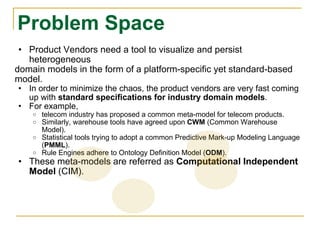
Problem Space  Product Vendors need a tool to visualize and persist heterogeneous  domain models in the form of a platform-specific yet standard-based  model. In order to minimize the chaos, the product vendors are very fast coming up with  standard specifications for industry domain models .  For example,  telecom industry has proposed a common meta-model for telecom products.  Similarly, warehouse tools have agreed upon  CWM  (Common Warehouse Model). Statistical tools trying to adopt a common Predictive Mark-up Modeling Language ( PMML ). Rule Engines adhere to Ontology Definition Model ( ODM ). These meta-models are referred as  Computational Independent Model  (CIM).
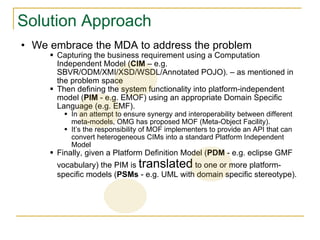
Solution Approach We embrace the MDA to address the problem Capturing the business requirement using a Computation Independent Model ( CIM  – e.g. SBVR/ODM/XMI/XSD/WSDL/Annotated POJO). – as mentioned in the problem space Then defining the system functionality into platform-independent model ( PIM  - e.g. EMOF) using an appropriate Domain Specific Language (e.g. EMF). In an attempt to ensure synergy and interoperability between different meta-models, OMG has proposed MOF (Meta-Object Facility). It’s the responsibility of MOF implementers to provide an API that can convert heterogeneous CIMs into a standard Platform Independent Model  Finally, given a Platform Definition Model ( PDM  - e.g. eclipse GMF vocabulary) the PIM is  translated  to one or more platform-specific models ( PSMs  - e.g. UML with domain specific stereotype).
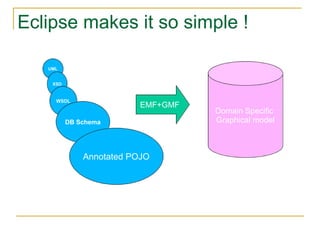
Eclipse makes it so simple ! UML XSD WSDL DB Schema EMF+GMF Domain Specific  Graphical model Annotated POJO
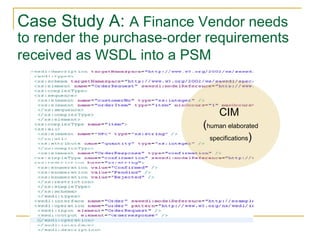
Case Study A:  A Finance Vendor needs to render the purchase-order requirements received as WSDL into a PSM   CIM  ( human elaborated specifications )
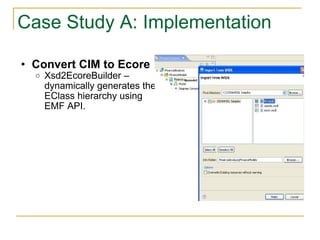
Case Study A: Implementation Convert CIM to Ecore Xsd2EcoreBuilder – dynamically generates the EClass hierarchy using EMF API.
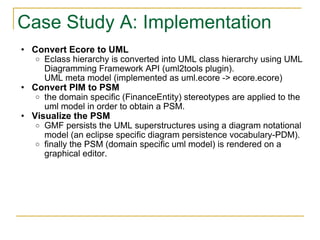
Case Study A: Implementation Convert Ecore to UML Eclass hierarchy is converted into UML class hierarchy using UML Diagramming Framework API (uml2tools plugin).  UML meta model (implemented as uml.ecore -> ecore.ecore) Convert PIM to PSM the domain specific (FinanceEntity) stereotypes are applied to the uml model in order to obtain a PSM. Visualize the PSM GMF persists the UML superstructures using a diagram notational model (an eclipse specific diagram persistence vocabulary-PDM). finally the PSM (domain specific uml model) is rendered on a graphical editor.
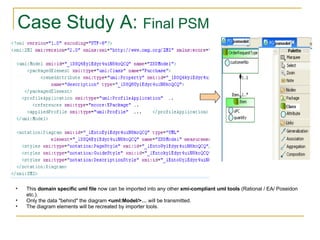
Case Study A:  Final PSM This  domain specific uml file  now can be imported into any other  xmi-compliant uml tools  (Rational / EA/ Poseidon etc.). Only the data &quot;behind&quot; the diagram  <uml:Model/>…  will be transmitted.  The diagram elements will be recreated by importer tools.
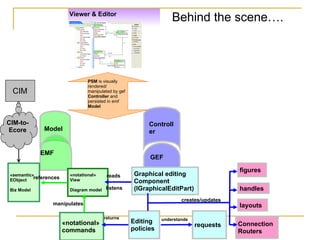
Viewer & Editor Controller GEF Model EMF «notational» View Diagram model «semantic» EObject Biz Model «notational» commands Graphical editing  Component  (IGraphicalEditPart) Editing  policies requests figures layouts references manipulates reads listens returns understands handles Connection Routers creates/updates PSM  is visually rendered/ manipulated by gef  Controller  and persisted in emf  Model CIM CIM-to-Ecore Behind the scene….
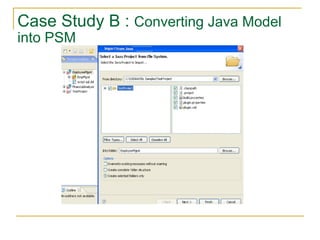
Case Study B :  Converting Java Model into PSM
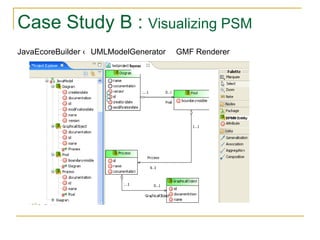
Case Study B :  Visualizing PSM JavaEcoreBuilder  UMLModelGenerator  GMF Renderer
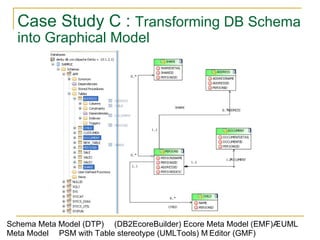
Case Study C :  Transforming DB Schema into Graphical Model Schema Meta Model (DTP)  (DB2EcoreBuilder) Ecore Meta Model (EMF) UML Meta Model  PSM with Table stereotype (UMLTools)  Editor (GMF)
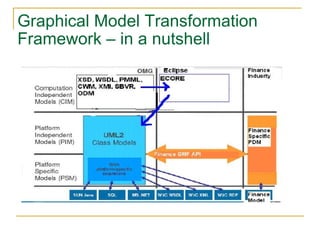
Graphical Model Transformation Framework – in a nutshell

Graphical Model Transformation Framework

  • 1.
    Graphical Model TransformationFramework (GMTF) - Normalizing heterogeneous models into UML – a suggested approach
  • 2.
    Problem Space  ProductVendors need a tool to visualize and persist heterogeneous domain models in the form of a platform-specific yet standard-based model. In order to minimize the chaos, the product vendors are very fast coming up with standard specifications for industry domain models . For example, telecom industry has proposed a common meta-model for telecom products. Similarly, warehouse tools have agreed upon CWM (Common Warehouse Model). Statistical tools trying to adopt a common Predictive Mark-up Modeling Language ( PMML ). Rule Engines adhere to Ontology Definition Model ( ODM ). These meta-models are referred as Computational Independent Model (CIM).
  • 3.
    Solution Approach Weembrace the MDA to address the problem Capturing the business requirement using a Computation Independent Model ( CIM – e.g. SBVR/ODM/XMI/XSD/WSDL/Annotated POJO). – as mentioned in the problem space Then defining the system functionality into platform-independent model ( PIM - e.g. EMOF) using an appropriate Domain Specific Language (e.g. EMF). In an attempt to ensure synergy and interoperability between different meta-models, OMG has proposed MOF (Meta-Object Facility). It’s the responsibility of MOF implementers to provide an API that can convert heterogeneous CIMs into a standard Platform Independent Model Finally, given a Platform Definition Model ( PDM - e.g. eclipse GMF vocabulary) the PIM is translated to one or more platform-specific models ( PSMs - e.g. UML with domain specific stereotype).
  • 4.
    Eclipse makes itso simple ! UML XSD WSDL DB Schema EMF+GMF Domain Specific Graphical model Annotated POJO
  • 5.
    Case Study A: A Finance Vendor needs to render the purchase-order requirements received as WSDL into a PSM CIM ( human elaborated specifications )
  • 6.
    Case Study A:Implementation Convert CIM to Ecore Xsd2EcoreBuilder – dynamically generates the EClass hierarchy using EMF API.
  • 7.
    Case Study A:Implementation Convert Ecore to UML Eclass hierarchy is converted into UML class hierarchy using UML Diagramming Framework API (uml2tools plugin). UML meta model (implemented as uml.ecore -> ecore.ecore) Convert PIM to PSM the domain specific (FinanceEntity) stereotypes are applied to the uml model in order to obtain a PSM. Visualize the PSM GMF persists the UML superstructures using a diagram notational model (an eclipse specific diagram persistence vocabulary-PDM). finally the PSM (domain specific uml model) is rendered on a graphical editor.
  • 8.
    Case Study A: Final PSM This domain specific uml file now can be imported into any other xmi-compliant uml tools (Rational / EA/ Poseidon etc.). Only the data &quot;behind&quot; the diagram <uml:Model/>… will be transmitted. The diagram elements will be recreated by importer tools.
  • 9.
    Viewer & EditorController GEF Model EMF «notational» View Diagram model «semantic» EObject Biz Model «notational» commands Graphical editing Component (IGraphicalEditPart) Editing policies requests figures layouts references manipulates reads listens returns understands handles Connection Routers creates/updates PSM is visually rendered/ manipulated by gef Controller and persisted in emf Model CIM CIM-to-Ecore Behind the scene….
  • 10.
    Case Study B: Converting Java Model into PSM
  • 11.
    Case Study B: Visualizing PSM JavaEcoreBuilder  UMLModelGenerator  GMF Renderer
  • 12.
    Case Study C: Transforming DB Schema into Graphical Model Schema Meta Model (DTP)  (DB2EcoreBuilder) Ecore Meta Model (EMF) UML Meta Model  PSM with Table stereotype (UMLTools)  Editor (GMF)
  • 13.
    Graphical Model TransformationFramework – in a nutshell