BY- Group 3
Akash
Anjali
Ishan Nirupam Srivastava
Mitali
Pallavi
Genre of Maachis
• The main genre of maachis is “Social
Drama”.
• It is very clearly shown in the whole film
describing that how a normal person becomes
the terrorist.
• Other genres that used in movie are:
1.Action
2.Crime
3.Thriller
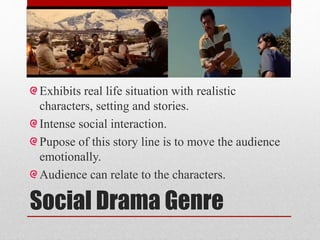
Social Drama Genre
Exhibits real life situation with realistic
characters, setting and stories.
Intense social interaction.
Pupose of this story line is to move the audience
emotionally.
Audience can relate to the characters.
ACTION
Genre in which physical action takes precedence
in story telling.
These type of film includes physical
stunt,chases,fights,battles and races.
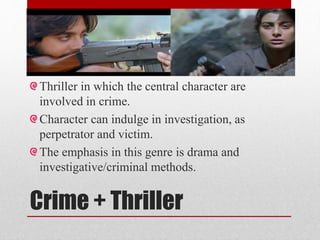
Crime + Thriller
Thriller in which the central character are
involved in crime.
Character can indulge in investigation, as
perpetrator and victim.
The emphasis in this genre is drama and
investigative/criminal methods.
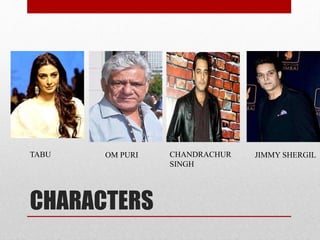
CHARACTERS
TABU OM PURI CHANDRACHUR
SINGH
JIMMY SHERGIL
CONTENT
Maachis (Matches) is a 1996 Indian Hindi film directed by
Gulzar and produced by R. V. Pandit. The film stars Om
Puri, Tabu, Chandrachur Singh and Jimmy Shergill in the
lead roles. The title of the film is used as a metaphor that
conveys that the youth of any nation are matchsticks that
could get ignited due to the deficiencies in the political and
policing systems. The film portrays the circumstances
surrounding the rise of the Sikh insurgency in Punjab in the
1980s and traces the transformation of a youth from a boy
next door to a dreaded terrorist.
CONTENT
• Written by Gulzar
• Theme – Thrillar, terrorism, crime.
• Language- Hindi and some words of regional Punjabi is
used.
• Gulzar uses flashback technique in all of his film. Use of
symbols like bird in flight, flowing river, shadows etc.
• Gulzar explores human relationships in his films. In a scene
Jaswant Singh Randhawa returns home at night after police
releases him. It is obvious from his physical condition that
the police have tortured him. The villagers come together to
see Jaswant Singh Randhawa. They feel the pain. One of
the villagers, in a frontal shot, says: “yah doSa hI Apnaa
nahIM lagata (This bloody country does not seem like ours
anymore).”
STRUCTURE
• Lighting
• Mise en scene
• Editing techniques
• Camera moments
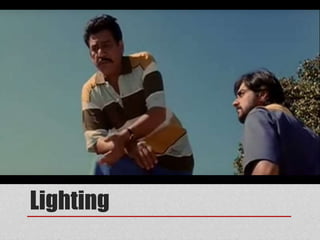
LIGHTING
Natural lighting
Lighting
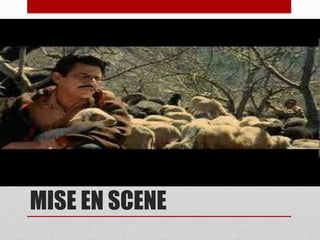
MISE EN SCENE
• What we see within a frame
• It includes props , setup of the frame according to
the requirement
MISE EN SCENE
EDITING TECNIQUES
• There are different types of editing techniques to
show a climax or any kind of change in the
continuity of the scenes
EDITING TECHNIQUES
• Cross cut
• Jump cut
• Continuity editing
• Sequence shot
• TRANSITIONS
Only CUT was used
CAMERA MOMENTS
• Pan
• Tilt
• Zoom
• Tracking
• Crane
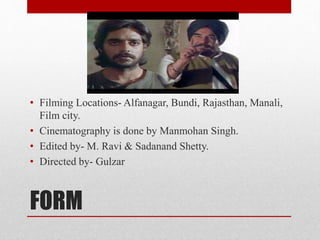
FORM
• Filming Locations- Alfanagar, Bundi, Rajasthan, Manali,
Film city.
• Cinematography is done by Manmohan Singh.
• Edited by- M. Ravi & Sadanand Shetty.
• Directed by- Gulzar
FORM
• Sound- The score and soundtrack of the film is composed by
Vishal Bhardwaj with lyrics by Gulzar. Arun Bose- dolby
mixer: Prasad Labs, Madras
• Vilas Chauhan- sound assistant (as Vilas Chavan)
• Sajjan Choudhary- synchronic effects (as Sajjan Chowdhary)
• Rajendra Gupta- synchronic effects (as Rajender Gupta)
• Taranath Pujari- sound assistant
• Chhoddh Aaye Hum, Tum Gaye, Yaad Na Aaye, Aey Hawaa,
Pani Pani Re, Chappa Chappa Charkha Chale, Maachis Theme
Closing, these were the songs in the movie.
RELEVENCE
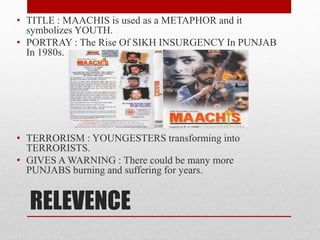
• TITLE : MAACHIS is used as a METAPHOR and it
symbolizes YOUTH.
• PORTRAY : The Rise Of SIKH INSURGENCY In PUNJAB
In 1980s.
• TERRORISM : YOUNGESTERS transforming into
TERRORISTS.
• GIVES A WARNING : There could be many more
PUNJABS burning and suffering for years.
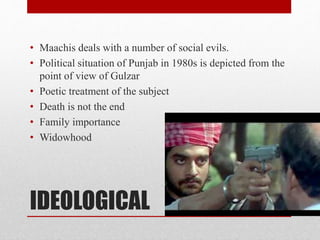
IDEOLOGICAL
• Maachis deals with a number of social evils.
• Political situation of Punjab in 1980s is depicted from the
point of view of Gulzar
• Poetic treatment of the subject
• Death is not the end
• Family importance
• Widowhood
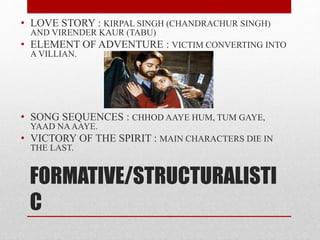
FORMATIVE/STRUCTURALISTI
C
• LOVE STORY : KIRPAL SINGH (CHANDRACHUR SINGH)
AND VIRENDER KAUR (TABU)
• ELEMENT OF ADVENTURE : VICTIM CONVERTING INTO
A VILLIAN.
• SONG SEQUENCES : CHHOD AAYE HUM, TUM GAYE,
YAAD NAAAYE.
• VICTORY OF THE SPIRIT : MAIN CHARACTERS DIE IN
THE LAST.
REALISTIC
• An emotional subject handled very well in a practical and
logical way
• Depiction of limitless torture and brutality
• Misery caused to everyone by a conflict
• Story of a young man transforming into a terrorist
• Circumstances forces common man to become terrorist
• Real locations are used
CONTEXTUAL
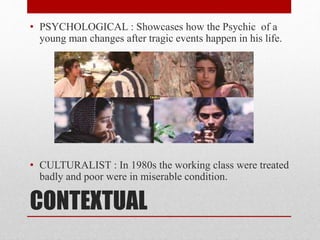
• PSYCHOLOGICAL : Showcases how the Psychic of a
young man changes after tragic events happen in his life.
• CULTURALIST : In 1980s the working class were treated
badly and poor were in miserable condition.
Maachis - movie analysis

Maachis - movie analysis

  • 1.
    BY- Group 3 Akash Anjali IshanNirupam Srivastava Mitali Pallavi
  • 2.
    Genre of Maachis •The main genre of maachis is “Social Drama”. • It is very clearly shown in the whole film describing that how a normal person becomes the terrorist. • Other genres that used in movie are: 1.Action 2.Crime 3.Thriller
  • 3.
    Social Drama Genre Exhibitsreal life situation with realistic characters, setting and stories. Intense social interaction. Pupose of this story line is to move the audience emotionally. Audience can relate to the characters.
  • 4.
    ACTION Genre in whichphysical action takes precedence in story telling. These type of film includes physical stunt,chases,fights,battles and races.
  • 5.
    Crime + Thriller Thrillerin which the central character are involved in crime. Character can indulge in investigation, as perpetrator and victim. The emphasis in this genre is drama and investigative/criminal methods.
  • 6.
    CHARACTERS TABU OM PURICHANDRACHUR SINGH JIMMY SHERGIL
  • 7.
    CONTENT Maachis (Matches) isa 1996 Indian Hindi film directed by Gulzar and produced by R. V. Pandit. The film stars Om Puri, Tabu, Chandrachur Singh and Jimmy Shergill in the lead roles. The title of the film is used as a metaphor that conveys that the youth of any nation are matchsticks that could get ignited due to the deficiencies in the political and policing systems. The film portrays the circumstances surrounding the rise of the Sikh insurgency in Punjab in the 1980s and traces the transformation of a youth from a boy next door to a dreaded terrorist.
  • 8.
    CONTENT • Written byGulzar • Theme – Thrillar, terrorism, crime. • Language- Hindi and some words of regional Punjabi is used. • Gulzar uses flashback technique in all of his film. Use of symbols like bird in flight, flowing river, shadows etc. • Gulzar explores human relationships in his films. In a scene Jaswant Singh Randhawa returns home at night after police releases him. It is obvious from his physical condition that the police have tortured him. The villagers come together to see Jaswant Singh Randhawa. They feel the pain. One of the villagers, in a frontal shot, says: “yah doSa hI Apnaa nahIM lagata (This bloody country does not seem like ours anymore).”
  • 9.
    STRUCTURE • Lighting • Miseen scene • Editing techniques • Camera moments
  • 10.
  • 11.
  • 12.
    MISE EN SCENE •What we see within a frame • It includes props , setup of the frame according to the requirement
  • 13.
  • 14.
    EDITING TECNIQUES • Thereare different types of editing techniques to show a climax or any kind of change in the continuity of the scenes
  • 15.
    EDITING TECHNIQUES • Crosscut • Jump cut • Continuity editing • Sequence shot • TRANSITIONS Only CUT was used
  • 16.
    CAMERA MOMENTS • Pan •Tilt • Zoom • Tracking • Crane
  • 17.
    FORM • Filming Locations-Alfanagar, Bundi, Rajasthan, Manali, Film city. • Cinematography is done by Manmohan Singh. • Edited by- M. Ravi & Sadanand Shetty. • Directed by- Gulzar
  • 18.
    FORM • Sound- Thescore and soundtrack of the film is composed by Vishal Bhardwaj with lyrics by Gulzar. Arun Bose- dolby mixer: Prasad Labs, Madras • Vilas Chauhan- sound assistant (as Vilas Chavan) • Sajjan Choudhary- synchronic effects (as Sajjan Chowdhary) • Rajendra Gupta- synchronic effects (as Rajender Gupta) • Taranath Pujari- sound assistant • Chhoddh Aaye Hum, Tum Gaye, Yaad Na Aaye, Aey Hawaa, Pani Pani Re, Chappa Chappa Charkha Chale, Maachis Theme Closing, these were the songs in the movie.
  • 19.
    RELEVENCE • TITLE :MAACHIS is used as a METAPHOR and it symbolizes YOUTH. • PORTRAY : The Rise Of SIKH INSURGENCY In PUNJAB In 1980s. • TERRORISM : YOUNGESTERS transforming into TERRORISTS. • GIVES A WARNING : There could be many more PUNJABS burning and suffering for years.
  • 20.
    IDEOLOGICAL • Maachis dealswith a number of social evils. • Political situation of Punjab in 1980s is depicted from the point of view of Gulzar • Poetic treatment of the subject • Death is not the end • Family importance • Widowhood
  • 21.
    FORMATIVE/STRUCTURALISTI C • LOVE STORY: KIRPAL SINGH (CHANDRACHUR SINGH) AND VIRENDER KAUR (TABU) • ELEMENT OF ADVENTURE : VICTIM CONVERTING INTO A VILLIAN. • SONG SEQUENCES : CHHOD AAYE HUM, TUM GAYE, YAAD NAAAYE. • VICTORY OF THE SPIRIT : MAIN CHARACTERS DIE IN THE LAST.
  • 22.
    REALISTIC • An emotionalsubject handled very well in a practical and logical way • Depiction of limitless torture and brutality • Misery caused to everyone by a conflict • Story of a young man transforming into a terrorist • Circumstances forces common man to become terrorist • Real locations are used
  • 23.
    CONTEXTUAL • PSYCHOLOGICAL :Showcases how the Psychic of a young man changes after tragic events happen in his life. • CULTURALIST : In 1980s the working class were treated badly and poor were in miserable condition.