ENGL 102-13
College Writing and Rhetoric
Spring 2017
Lectures: MWF 12:30-1:20
Instructor: Lauren Yarnall
E-mail: lyarnall@uidaho.edu
Office: Brink 107
Office Hours: MW 1:30-2:30 or by appointment
Course Description
English 102 is an introductory composition course, designed to improve your skills in
persuasive, expository writing, the sort you will be doing in other courses in college and
in many jobs. Sometimes this kind of writing is called transactional writing; it is used to
transact something—persuade and inform a reasonably well-educated audience, conduct
business, evaluate, review, or explain a complex process, procedure, or event. By the end
of the course, a successful student should be able to...
1. Accurately assess and effectively respond to a wide variety of audiences and
rhetorical situations.
2. Comprehend college-level and professional prose and analyze how authors
present their ideas in view of their probable purposes, audiences, and occasions.
3. Present ideas as related to, but clearly distinguished from, the ideas of others
(including the ability to paraphrase, summarize, and correctly cite and document
borrowed material).
4. Focus on, articulate, and sustain a purpose that meets the needs of specific writing
situations.
5. Explicitly articulate why they are writing, who they are writing for, and what they
are saying.
6. Write critical analyses and syntheses of college-level and professional prose.
7. Be able to make the connection between questions and problems in your life both
within and outside of college.
8. Gather and evaluate information and use it for a rhetorical purpose in writing a
research paper.
9. Attend to and productively incorporate a variety of perspectives.
10. Develop flexible strategies for generating, revising, editing, and proofreading.
11. Understand writing as an open process that permits writers to use later invention
and re-thinking to revise their work.
12. Give and receive constructive feedback from peers.
13. Use conventions of format and structure appropriate to the rhetorical situation and
practice appropriate means of documenting their work.
14. Locate, evaluate, organize, and use research material collected from electronic
sources, including scholarly library databases; other official databases (e.g.,
federal government databases); and informal electronic networks and Internet
sources.
Required Texts
John Ramage et al, The Allyn & Bacon Guide to Writing (7th edition).
(Available at the UI Bookstore)
Office Hours: My office hours and office number are listed on the BbLearn home page. I
enjoy talking to students outside of class, and welcome you to stop by to discuss your
work, questions about the course, etc., during that time. (In fact, at least once during the
semester I will require you to come for a conference about your work.) If for some reason
you can’t come during my regularly posted hours, please email me or stop by after class,
and we can make other arrangements.
Attendance: Attendance in English 101 is mandatory. For the MWF schedule, each
student will be allowed 6 unexcused absences over the course of the semester (this
amounts to 2 weeks of class). More than six absences for a MWF class is grounds for
failing the course. Thus, plan for unforeseen emergencies or illnesses later in the
semester. Being in attendance means being physically present, awake, coherent, and fully
prepared for class, with the day’s assignments completed. If you do not meet all of these
conditions, you will be marked absent for the day. You are responsible for making up all
of the work that you missed.
Participation: Participation is an important part of classroom interaction, and everyone
has the right and responsibility to contribute to class discussions/activities. Participation
accounts for 25% of your grade, so it is important to not only show up to class, but to
show up and be heard! That being said, the classroom is a learning community and
should be a safe space for all who enter. Any behavior that compromises the
safety/community of the classroom will not be tolerated. This includes speaking to other
students while the instructor is talking, using a cell phone or other electronic device
(laptops, tablets, MP3 players, etc.) when not given explicit permission, sleeping, passing
notes, being rude or belligerent to the instructor or other students, etc. Please be
respectful of your fellow students and your instructor. To do any of these will involve a
loss in participation points and possible removal from the classroom. If you have a
problem with anything in the course, you may speak to me about it privately after class or
in my office hours.
Classroom Citizenship: Again, this is a classroom environment and should be treated as
such. This means that we will respect the classroom itself and those who are in it. When
we leave the classroom, it should be free of any trash/containers, the desks should be
organized in their original positions, and the board/floor should be clean.
I have a zero tolerance policy for hate speech whether it is generalized or directed. This
can result in expulsion from the class and/or the course entirely.
University of Idaho Civility Clause:
In any classroom environment where people gather to learn, it is essential that all
members feel as free and safe as possible in their participation. To this end, it is expected
that everyone in this course will be treated with mutual respect and civility, with an
understanding that all of us (students, instructors, professors, guests, teaching assistants,
etc.) will be respectful and civil to one another in discussion, in action, in teaching, and in
learning.
Should you feel our classroom interactions do not reflect an environment of civility and
respect, you are encouraged to meet with your instructor during office hours to discuss
your concern. Additional resources for expression of concern or requesting support
include the Dean of Students office and staff (885-6757), the UI Counseling & Testing
Center’s confidential services (885-6717) or the UI Office of Human Rights, Access, &
Inclusion (885-4285).
Technology. Since more often than not technological devices in college classrooms serve
as distractions to you and the people around you rather than as supplements to learning,
we have a no-tolerance policy. In understanding that emergencies do happen, I do not
require you to turn your cell phone off, but all cell phones should be put away. Texting
and taking calls is not permitted in class. If I see you using your cell phone after class has
begun, I will ask you to put it away. If I see it again after your first warning, I will ask
you to leave and you will receive an unexcused absence for the day. Since there will be
days where laptops/tablets will be utilized, I ask that you bring it with you to each class—
this means less email announcements for me to send out/for you to read. However, all
laptops should be shut and stowed unless you have been given explicit permission to use
your laptop.
Email etiquette. I certainly welcome your emails – if you have questions about the
course, your work, meeting times, etc., please don’t hesitate to contact me at the address
listed on the Blackboard home page. However, you should treat this as professional
correspondence: that is, it should have a greeting, complete sentences, and your name at
the bottom. If not, I may choose not to respond. I will also not respond if your question
can be easily answered by looking at the syllabus/writing prompt/etc.
Course Requirements:
Essays/Writing Assignments:
The majority of your grade will be earned through five major writing assignments that are
to be completed over the course of this semester: (1) a personal narrative, (2) an
exploratory essay, (3) an annotated bibliography, (4) a research-based letter written
to your Congressman, and (5) a remediation assignment. Further instructions for each
assignment will be available on BBlearn.
Late assignments will not be accepted without prior notification.
Due to the nature of this course, it is of utmost importance that you complete each
assignment, as they will inform the assignment that follows. Failure to complete certain
assignments will result in failure of the course.
Daily Assignments/Homework:
There will be also be shorter (what we call “invention”) assignments due almost every
day: generally reading assignments, followed by assignments in which you write short
responses (75 to 100 words) and longer responses (300 – 500 words) to those readings
that prepare you for the upcoming major assignment. For each major assignment, you
will also be asked to read and comment on the papers of other students.
In order to complete these invention assignments, I ask that you bring a journal (it doesn’t
matter what kind… spiral notebook, composition book, etc.) to class each day. You will
be turning these journals in to me at the end of each week for participation points. This
journal must be dedicated to ENGL 102 and no other subject… I do not want to get
emails over the weekend about how you need your journal back because your chemistry
notes are in it— you will be out of luck!
I do not care about doodles or formatting, as long as each entry has the date marked and
the title of the invention assignment at the top of the entry. I also ask that you sign your
name on the inside cover, for reasons that should be apparent.
Because this journal will have your invention assignments and reading quizzes in them,
be sure to keep track of its whereabouts. I will be their keeper over most weekends but it
is up to you not to lose them during the school week.
Please note that the points that you lose for missing these assignments add up quickly:
you cannot pass the course if you don’t do the homework assignments. More than points,
though, these shorter assignments are designed to help you complete the major writing
assignments. Please take them seriously.
We will also be having random reading quizzes to make sure that you are keeping up
with the material. The material for the reading quizzes will come from the readings
assigned in class. The points earned from the reading quizzes contribute to your
participation points. The reading quizzes will be completed in your journals.
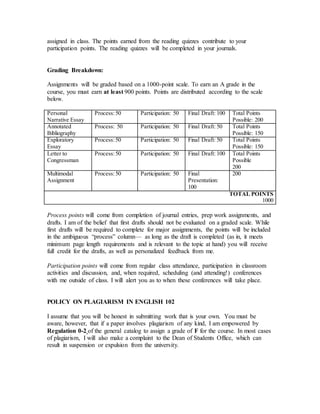
Grading Breakdown:
Assignments will be graded based on a 1000-point scale. To earn an A grade in the
course, you must earn at least 900 points. Points are distributed according to the scale
below.
Personal
Narrative Essay
Process:50 Participation: 50 Final Draft: 100 Total Points
Possible: 200
Annotated
Bibliography
Process: 50 Participation: 50 Final Draft: 50 Total Points
Possible: 150
Exploratory
Essay
Process:50 Participation: 50 Final Draft: 50 Total Points
Possible: 150
Letter to
Congressman
Process:50 Participation: 50 Final Draft: 100 Total Points
Possible
200
Multimodal
Assignment
Process:50 Participation: 50 Final
Presentation:
100
200
TOTAL POINTS
1000
Process points will come from completion of journal entries, prep work assignments, and
drafts. I am of the belief that first drafts should not be evaluated on a graded scale. While
first drafts will be required to complete for major assignments, the points will be included
in the ambiguous “process” column— as long as the draft is completed (as in, it meets
minimum page length requirements and is relevant to the topic at hand) you will receive
full credit for the drafts, as well as personalized feedback from me.
Participation points will come from regular class attendance, participation in classroom
activities and discussion, and, when required, scheduling (and attending!) conferences
with me outside of class. I will alert you as to when these conferences will take place.
POLICY ON PLAGIARISM IN ENGLISH 102
I assume that you will be honest in submitting work that is your own. You must be
aware, however, that if a paper involves plagiarism of any kind, I am empowered by
Regulation 0-2 of the general catalog to assign a grade of F for the course. In most cases
of plagiarism, I will also make a complaint to the Dean of Students Office, which can
result in suspension or expulsion from the university.
I am aware, however, that many students struggle to properly accredit the work of others
within papers, and I recognize two basic kinds of plagiarism, as outlined with the Modern
Language Association of America:
1. Malicious or intentional plagiarism. This is the most serious kind of academic theft.
It involves using someone else’s work as your own without citing the source,
including direct copying, rephrasing, and summarizing, submitting someone else’s
paper as your own, or submitting your own work from a different semester or
different course. It also involves taking someone else’s idea and putting it in different
words. Even if several different sources were copied, it is still plagiarism.
2. “Plagia-phrasing” or mosaic plagiarism. Not indicating directly quoted passages or
ideas even while citing the work as a general source.
If a paper involves plagiarism of the second kind, I will ask you to rewrite the paper using
correct forms of documentation. However, if you persist in committing this kind of
plagiarism, you could be subjected to a more severe penalty of the type described above.
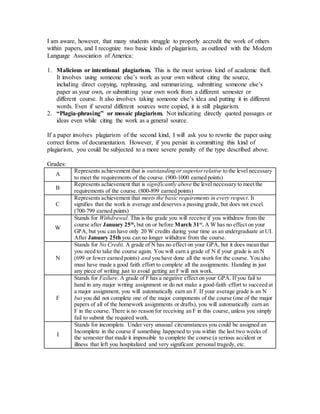
Grades:
A
Represents achievement that is outstanding or superiorrelative to the level necessary
to meet the requirements of the course. (900-1000 earned points)
B
Represents achievement that is significantly above the level necessary to meet the
requirements of the course. (800-899 earned points)
C
Represents achievement that meets the basic requirements in every respect. It
signifies that the work is average and deserves a passing grade, but does not excel.
(700-799 earned points)
W
Stands for Withdrawal. This is the grade you will receive if you withdraw from the
course after January 25th
, but on or before March 31st
. A W has no effect on your
GPA, but you can have only 20 W credits during your time as an undergraduate at UI.
After January 25th you can no longer withdraw from the course.
N
Stands for No Credit. A grade of N has no effect on your GPA, but it does mean that
you need to take the course again. You will earn a grade of N if your grade is an N
(699 or fewer earned points) and you have done all the work for the course. You also
must have made a good faith effort to complete all the assignments. Handing in just
any piece of writing just to avoid getting an F will not work.
F
Stands for Failure. A grade of F has a negative effect on your GPA. If you fail to
hand in any major writing assignment or do not make a good-faith effort to succeed at
a major assignment, you will automatically earn an F. If your average grade is an N
but you did not complete one of the major components of the course (one of the major
papers of all of the homework assignments or drafts), you will automatically earn an
F in the course. There is no reason for receiving an F in this course, unless you simply
fail to submit the required work.
I
Stands for incomplete. Under very unusual circumstances you could be assigned an
Incomplete in the course if something happened to you within the last two weeks of
the semester that made it impossible to complete the course (a serious accident or
illness that left you hospitalized and very significant personal tragedy, etc.
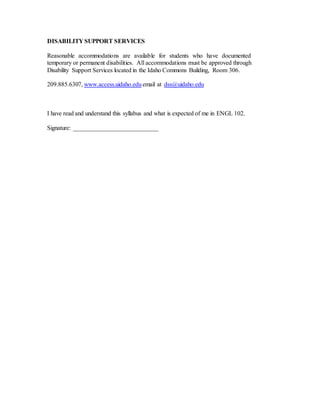
DISABILITY SUPPORT SERVICES
Reasonable accommodations are available for students who have documented
temporary or permanent disabilities. All accommodations must be approved through
Disability Support Services located in the Idaho Commons Building, Room 306.
209.885.6307, www.access.uidaho.eduemail at dss@uidaho.edu
I have read and understand this syllabus and what is expected of me in ENGL 102.
Signature: ____________________________

Engl 102 syllabus

  • 1.
    ENGL 102-13 College Writingand Rhetoric Spring 2017 Lectures: MWF 12:30-1:20 Instructor: Lauren Yarnall E-mail: lyarnall@uidaho.edu Office: Brink 107 Office Hours: MW 1:30-2:30 or by appointment Course Description English 102 is an introductory composition course, designed to improve your skills in persuasive, expository writing, the sort you will be doing in other courses in college and in many jobs. Sometimes this kind of writing is called transactional writing; it is used to transact something—persuade and inform a reasonably well-educated audience, conduct business, evaluate, review, or explain a complex process, procedure, or event. By the end of the course, a successful student should be able to... 1. Accurately assess and effectively respond to a wide variety of audiences and rhetorical situations. 2. Comprehend college-level and professional prose and analyze how authors present their ideas in view of their probable purposes, audiences, and occasions. 3. Present ideas as related to, but clearly distinguished from, the ideas of others (including the ability to paraphrase, summarize, and correctly cite and document borrowed material). 4. Focus on, articulate, and sustain a purpose that meets the needs of specific writing situations. 5. Explicitly articulate why they are writing, who they are writing for, and what they are saying. 6. Write critical analyses and syntheses of college-level and professional prose. 7. Be able to make the connection between questions and problems in your life both within and outside of college. 8. Gather and evaluate information and use it for a rhetorical purpose in writing a research paper. 9. Attend to and productively incorporate a variety of perspectives. 10. Develop flexible strategies for generating, revising, editing, and proofreading. 11. Understand writing as an open process that permits writers to use later invention and re-thinking to revise their work. 12. Give and receive constructive feedback from peers. 13. Use conventions of format and structure appropriate to the rhetorical situation and practice appropriate means of documenting their work. 14. Locate, evaluate, organize, and use research material collected from electronic sources, including scholarly library databases; other official databases (e.g., federal government databases); and informal electronic networks and Internet sources.
  • 2.
    Required Texts John Ramageet al, The Allyn & Bacon Guide to Writing (7th edition). (Available at the UI Bookstore) Office Hours: My office hours and office number are listed on the BbLearn home page. I enjoy talking to students outside of class, and welcome you to stop by to discuss your work, questions about the course, etc., during that time. (In fact, at least once during the semester I will require you to come for a conference about your work.) If for some reason you can’t come during my regularly posted hours, please email me or stop by after class, and we can make other arrangements. Attendance: Attendance in English 101 is mandatory. For the MWF schedule, each student will be allowed 6 unexcused absences over the course of the semester (this amounts to 2 weeks of class). More than six absences for a MWF class is grounds for failing the course. Thus, plan for unforeseen emergencies or illnesses later in the semester. Being in attendance means being physically present, awake, coherent, and fully prepared for class, with the day’s assignments completed. If you do not meet all of these conditions, you will be marked absent for the day. You are responsible for making up all of the work that you missed. Participation: Participation is an important part of classroom interaction, and everyone has the right and responsibility to contribute to class discussions/activities. Participation accounts for 25% of your grade, so it is important to not only show up to class, but to show up and be heard! That being said, the classroom is a learning community and should be a safe space for all who enter. Any behavior that compromises the safety/community of the classroom will not be tolerated. This includes speaking to other students while the instructor is talking, using a cell phone or other electronic device (laptops, tablets, MP3 players, etc.) when not given explicit permission, sleeping, passing notes, being rude or belligerent to the instructor or other students, etc. Please be respectful of your fellow students and your instructor. To do any of these will involve a loss in participation points and possible removal from the classroom. If you have a problem with anything in the course, you may speak to me about it privately after class or in my office hours. Classroom Citizenship: Again, this is a classroom environment and should be treated as such. This means that we will respect the classroom itself and those who are in it. When we leave the classroom, it should be free of any trash/containers, the desks should be organized in their original positions, and the board/floor should be clean. I have a zero tolerance policy for hate speech whether it is generalized or directed. This can result in expulsion from the class and/or the course entirely.
  • 3.
    University of IdahoCivility Clause: In any classroom environment where people gather to learn, it is essential that all members feel as free and safe as possible in their participation. To this end, it is expected that everyone in this course will be treated with mutual respect and civility, with an understanding that all of us (students, instructors, professors, guests, teaching assistants, etc.) will be respectful and civil to one another in discussion, in action, in teaching, and in learning. Should you feel our classroom interactions do not reflect an environment of civility and respect, you are encouraged to meet with your instructor during office hours to discuss your concern. Additional resources for expression of concern or requesting support include the Dean of Students office and staff (885-6757), the UI Counseling & Testing Center’s confidential services (885-6717) or the UI Office of Human Rights, Access, & Inclusion (885-4285). Technology. Since more often than not technological devices in college classrooms serve as distractions to you and the people around you rather than as supplements to learning, we have a no-tolerance policy. In understanding that emergencies do happen, I do not require you to turn your cell phone off, but all cell phones should be put away. Texting and taking calls is not permitted in class. If I see you using your cell phone after class has begun, I will ask you to put it away. If I see it again after your first warning, I will ask you to leave and you will receive an unexcused absence for the day. Since there will be days where laptops/tablets will be utilized, I ask that you bring it with you to each class— this means less email announcements for me to send out/for you to read. However, all laptops should be shut and stowed unless you have been given explicit permission to use your laptop. Email etiquette. I certainly welcome your emails – if you have questions about the course, your work, meeting times, etc., please don’t hesitate to contact me at the address listed on the Blackboard home page. However, you should treat this as professional correspondence: that is, it should have a greeting, complete sentences, and your name at the bottom. If not, I may choose not to respond. I will also not respond if your question can be easily answered by looking at the syllabus/writing prompt/etc.
  • 4.
    Course Requirements: Essays/Writing Assignments: Themajority of your grade will be earned through five major writing assignments that are to be completed over the course of this semester: (1) a personal narrative, (2) an exploratory essay, (3) an annotated bibliography, (4) a research-based letter written to your Congressman, and (5) a remediation assignment. Further instructions for each assignment will be available on BBlearn. Late assignments will not be accepted without prior notification. Due to the nature of this course, it is of utmost importance that you complete each assignment, as they will inform the assignment that follows. Failure to complete certain assignments will result in failure of the course. Daily Assignments/Homework: There will be also be shorter (what we call “invention”) assignments due almost every day: generally reading assignments, followed by assignments in which you write short responses (75 to 100 words) and longer responses (300 – 500 words) to those readings that prepare you for the upcoming major assignment. For each major assignment, you will also be asked to read and comment on the papers of other students. In order to complete these invention assignments, I ask that you bring a journal (it doesn’t matter what kind… spiral notebook, composition book, etc.) to class each day. You will be turning these journals in to me at the end of each week for participation points. This journal must be dedicated to ENGL 102 and no other subject… I do not want to get emails over the weekend about how you need your journal back because your chemistry notes are in it— you will be out of luck! I do not care about doodles or formatting, as long as each entry has the date marked and the title of the invention assignment at the top of the entry. I also ask that you sign your name on the inside cover, for reasons that should be apparent. Because this journal will have your invention assignments and reading quizzes in them, be sure to keep track of its whereabouts. I will be their keeper over most weekends but it is up to you not to lose them during the school week. Please note that the points that you lose for missing these assignments add up quickly: you cannot pass the course if you don’t do the homework assignments. More than points, though, these shorter assignments are designed to help you complete the major writing assignments. Please take them seriously. We will also be having random reading quizzes to make sure that you are keeping up with the material. The material for the reading quizzes will come from the readings
  • 5.
    assigned in class.The points earned from the reading quizzes contribute to your participation points. The reading quizzes will be completed in your journals. Grading Breakdown: Assignments will be graded based on a 1000-point scale. To earn an A grade in the course, you must earn at least 900 points. Points are distributed according to the scale below. Personal Narrative Essay Process:50 Participation: 50 Final Draft: 100 Total Points Possible: 200 Annotated Bibliography Process: 50 Participation: 50 Final Draft: 50 Total Points Possible: 150 Exploratory Essay Process:50 Participation: 50 Final Draft: 50 Total Points Possible: 150 Letter to Congressman Process:50 Participation: 50 Final Draft: 100 Total Points Possible 200 Multimodal Assignment Process:50 Participation: 50 Final Presentation: 100 200 TOTAL POINTS 1000 Process points will come from completion of journal entries, prep work assignments, and drafts. I am of the belief that first drafts should not be evaluated on a graded scale. While first drafts will be required to complete for major assignments, the points will be included in the ambiguous “process” column— as long as the draft is completed (as in, it meets minimum page length requirements and is relevant to the topic at hand) you will receive full credit for the drafts, as well as personalized feedback from me. Participation points will come from regular class attendance, participation in classroom activities and discussion, and, when required, scheduling (and attending!) conferences with me outside of class. I will alert you as to when these conferences will take place. POLICY ON PLAGIARISM IN ENGLISH 102 I assume that you will be honest in submitting work that is your own. You must be aware, however, that if a paper involves plagiarism of any kind, I am empowered by Regulation 0-2 of the general catalog to assign a grade of F for the course. In most cases of plagiarism, I will also make a complaint to the Dean of Students Office, which can result in suspension or expulsion from the university.
  • 6.
    I am aware,however, that many students struggle to properly accredit the work of others within papers, and I recognize two basic kinds of plagiarism, as outlined with the Modern Language Association of America: 1. Malicious or intentional plagiarism. This is the most serious kind of academic theft. It involves using someone else’s work as your own without citing the source, including direct copying, rephrasing, and summarizing, submitting someone else’s paper as your own, or submitting your own work from a different semester or different course. It also involves taking someone else’s idea and putting it in different words. Even if several different sources were copied, it is still plagiarism. 2. “Plagia-phrasing” or mosaic plagiarism. Not indicating directly quoted passages or ideas even while citing the work as a general source. If a paper involves plagiarism of the second kind, I will ask you to rewrite the paper using correct forms of documentation. However, if you persist in committing this kind of plagiarism, you could be subjected to a more severe penalty of the type described above. Grades: A Represents achievement that is outstanding or superiorrelative to the level necessary to meet the requirements of the course. (900-1000 earned points) B Represents achievement that is significantly above the level necessary to meet the requirements of the course. (800-899 earned points) C Represents achievement that meets the basic requirements in every respect. It signifies that the work is average and deserves a passing grade, but does not excel. (700-799 earned points) W Stands for Withdrawal. This is the grade you will receive if you withdraw from the course after January 25th , but on or before March 31st . A W has no effect on your GPA, but you can have only 20 W credits during your time as an undergraduate at UI. After January 25th you can no longer withdraw from the course. N Stands for No Credit. A grade of N has no effect on your GPA, but it does mean that you need to take the course again. You will earn a grade of N if your grade is an N (699 or fewer earned points) and you have done all the work for the course. You also must have made a good faith effort to complete all the assignments. Handing in just any piece of writing just to avoid getting an F will not work. F Stands for Failure. A grade of F has a negative effect on your GPA. If you fail to hand in any major writing assignment or do not make a good-faith effort to succeed at a major assignment, you will automatically earn an F. If your average grade is an N but you did not complete one of the major components of the course (one of the major papers of all of the homework assignments or drafts), you will automatically earn an F in the course. There is no reason for receiving an F in this course, unless you simply fail to submit the required work. I Stands for incomplete. Under very unusual circumstances you could be assigned an Incomplete in the course if something happened to you within the last two weeks of the semester that made it impossible to complete the course (a serious accident or illness that left you hospitalized and very significant personal tragedy, etc.
  • 7.
    DISABILITY SUPPORT SERVICES Reasonableaccommodations are available for students who have documented temporary or permanent disabilities. All accommodations must be approved through Disability Support Services located in the Idaho Commons Building, Room 306. 209.885.6307, www.access.uidaho.eduemail at dss@uidaho.edu I have read and understand this syllabus and what is expected of me in ENGL 102. Signature: ____________________________