Reducing Maint Interruptions /
Increasing MTBF of Critical Equipment
( Six Sigma Black Belt Project)
2
Start Date : April 2010
Black Belt : Vijay S.Dhonde
Master Black Belt : Naveen Narayanan
Project sponsor : DGM Maintenance
Team Members : K K Nanduri / John Bosco
Neelesh Bhagwat &
RC Agarwal (BB) for guidance
ControlImproveAnalyzeMeasureDefine
DMAIC
• Focus on reducing variation
• Involving cross functional teams
• Concentration on processes rather than isolated events
• Share the experience
Define Measure Analyze Improve Control
Opportunity
/ project
Current
performance
Root causes To eliminate
root causes
To sustain
gains
4
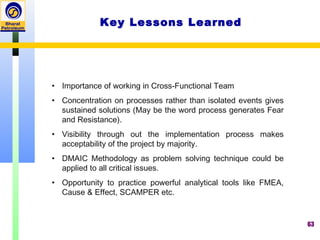
Key Lessons Learned
• Importance of working in Cross-Functional Team
• Concentration on processes rather than isolated events gives
sustained solutions (May be the word process generates Fear
and Resistance).
• Visibility through out the implementation process makes
acceptability of the project by majority.
• DMAIC Methodology as problem solving technique could be
applied to all critical issues.
• Opportunity to practice powerful analytical tools like FMEA,
Cause & Effect, SCAMPER etc.
5
Project
SIPOC
VOC
Diagrams1
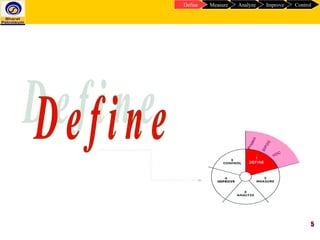
DEFINE
ControlImproveAnalyzeMeasureDefine
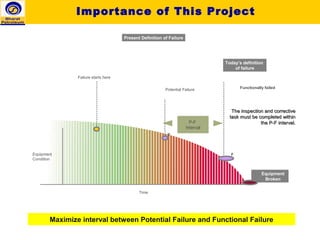
Present Definition of Failure
Failure starts here
Equipment
Condition
P
Potential Failure
F
Functionally failed
Today’s definition
of failure
Equipment
Broken
Time
The inspection and correctiveThe inspection and corrective
task must be completed withintask must be completed within
the P-F interval.the P-F interval.P-F
Interval
Maximize interval between Potential Failure and Functional Failure
Importance of This Project
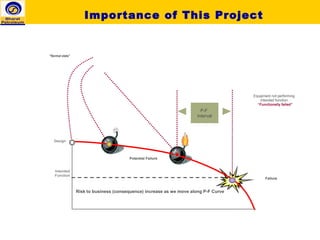
P
P-F
Interval
Failure
Equipment not performing
intended function
“Functionally failed”
“Normal state”
Potential Failure
Intended
Function
Design
Risk to business (consequence) increase as we move along P-F Curve
8
Project Assumptions
ControlImproveAnalyzeMeasureDefine
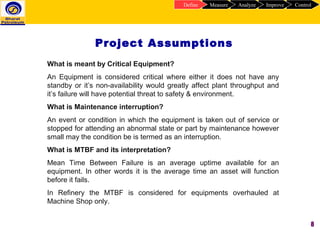
What is meant by Critical Equipment?
An Equipment is considered critical where either it does not have any
standby or it’s non-availability would greatly affect plant throughput and
it’s failure will have potential threat to safety & environment.
What is Maintenance interruption?
An event or condition in which the equipment is taken out of service or
stopped for attending an abnormal state or part by maintenance however
small may the condition be is termed as an interruption.
What is MTBF and its interpretation?
Mean Time Between Failure is an average uptime available for an
equipment. In other words it is the average time an asset will function
before it fails.
In Refinery the MTBF is considered for equipments overhauled at
Machine Shop only.
9
Project Assumptions
ControlImproveAnalyzeMeasureDefine
Why consider only equipment overhauled at shop for MTBF?
• When pump is overhauled at shop it will be critically examined and
assembled.
• Also Machine shop follows standard procedures laid down by Original
Equipment Manufacturer and Overhauling activity is carried out by skilled
Maint personnel.
How failure of rotary equipment is recorded?
An equipment failure is recorded through basically in two modes in SAP.
• One by malfunction report generated by Operations through SAP
Notification type M2.
• Another by Rotary Recommendation generated by Rotary Cell through
SAP Notification type M6.
10
Project Assumptions
ControlImproveAnalyzeMeasureDefine
What base line data is being considered for the analysis?
Notifications or Job generation by Rotary Cell through SAP type M6 is being
considered for analysis.
Why Rotary Reco (SAP Type M6) alone is considered for analysis?
• Data in type M6 is highly authenticated, precise and created by a trained
professional.
• Data in type M2 majority of times incomplete and sometimes duplicate in
nature created by working level person.
• Type M2 notification data is more of descriptive in nature, while M6 data
comprises measurable data.
• While generating notification through M6 analysis would be conducted
based on condition monitoring of the equipment by the in charge.
• Also, data shows over 90% of cases bearing failures were captured in
M6 Data
Failure Pattern Identification (Equipment
Wise)
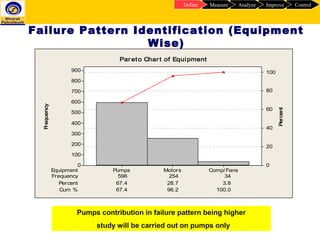
Frequency 596 254 34
Percent 67.4 28.7 3.8
Cum % 67.4 96.2 100.0
Equipment Comp/FansMotorsPumps
900
800
700
600
500
400
300
200
100
0
100
80
60
40
20
0
Frequency
Percent
Pareto Chart of Equipment
Pumps contribution in failure pattern being higher
study will be carried out on pumps only
ControlImproveAnalyzeMeasureDefine
12
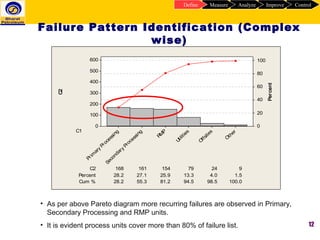
• As per above Pareto diagram more recurring failures are observed in Primary,
Secondary Processing and RMP units.
• It is evident process units cover more than 80% of failure list.
Failure Pattern Identification (Complex
wise)
ControlImproveAnalyzeMeasureDefine
C2 168 161 154 79 24 9
Percent 28.2 27.1 25.9 13.3 4.0 1.5
Cum % 28.2 55.3 81.2 94.5 98.5 100.0
C1
Other
Offsites
Utilities
RM
P
Secondary
Processing
Prim
ary
Processing
600
500
400
300
200
100
0
100
80
60
40
20
0
C2
Percent
 
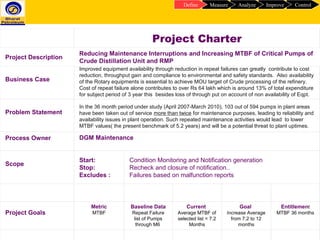
Project Charter
Project Description
Reducing Maintenance Interruptions and Increasing MTBF of Critical Pumps of
Crude Distillation Unit and RMP
Business Case
Improved equipment availability through reduction in repeat failures can greatly contribute to cost
reduction, throughput gain and compliance to environmental and safety standards. Also availability
of the Rotary equipments is essential to achieve MOU target of Crude processing of the refinery.
Cost of repeat failure alone contributes to over Rs 64 lakh which is around 13% of total expenditure
for subject period of 3 year this besides loss of through put on account of non availability of Eqpt.
Problem Statement
In the 36 month period under study (April 2007-March 2010), 103 out of 594 pumps in plant areas
have been taken out of service more than twice for maintenance purposes, leading to reliability and
availability issues in plant operation. Such repeated maintenance activities would lead to lower
MTBF values( the present benchmark of 5.2 years) and will be a potential threat to plant uptimes.
Process Owner DGM Maintenance
Scope
Start:
Stop:
Excludes :
Condition Monitoring and Notification generation
Recheck and closure of notification..
Failures based on malfunction reports
 
Project Goals
Metric
MTBF
Baseline Data
Repeat Failure
list of Pumps
through M6
Current
Average MTBF of
selected list = 7.2
Months
Goal
Increase Average
from 7.2 to 12
months
Entitlement
MTBF 36 months
           
ControlImproveAnalyzeMeasureDefine
15
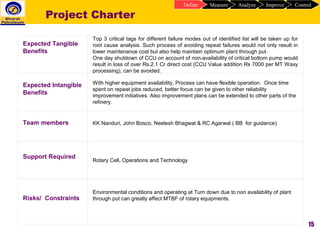
Expected Tangible
Benefits
Top 3 critical tags for different failure modes out of identified list will be taken up for
root cause analysis. Such process of avoiding repeat failures would not only result in
lower maintenance cost but also help maintain optimum plant through put.
One day shutdown of CCU on account of non-availability of critical bottom pump would
result in loss of over Rs.2.1 Cr direct cost (CCU Value addition Rs 7000 per MT Waxy
processing), can be avoided.
Expected Intangible
Benefits
With higher equipment availability, Process can have flexible operation. Once time
spent on repeat jobs reduced, better focus can be given to other reliability
improvement initiatives. Also improvement plans can be extended to other parts of the
refinery.
Team members KK Nanduri, John Bosco, Neelesh Bhagwat & RC Agarwal ( BB for guidance)
Support Required
Rotary Cell, Operations and Technology
Risks/ Constraints
Environmental conditions and operating at Turn down due to non availability of plant
through put can greatly affect MTBF of rotary equipments.
ControlImproveAnalyzeMeasureDefine
Project Charter
16
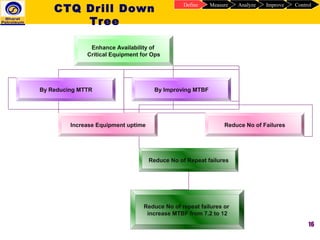
CTQ Drill Down
Tree
ControlImproveAnalyzeMeasureDefine
Enhance Availability of
Critical Equipment for Ops
By Reducing MTTR By Improving MTBF
Increase Equipment uptime Reduce No of Failures
Reduce No of Repeat failures
Reduce No of repeat failures or
increase MTBF from 7.2 to 12
17
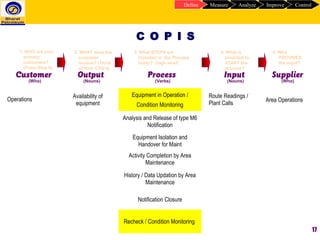
Customer Output Process Input Supplier
1. WHO are your
primary
customers?
(From Step A)
2. WHAT does the
customer
receive? (Think
of their CTQ’s)
3. What STEPS are
Included in the Process
today? (high level)
4. What is
provided to
START the
process?
5. Who
PROVIDES
the input?
(Who) (Nouns) (Verbs) (Nouns) (Who)
Equipment in Operation /
Condition Monitoring
Analysis and Release of type M6
Notification
Equipment Isolation and
Handover for Maint
Activity Completion by Area
Maintenance
History / Data Updation by Area
Maintenance
Notification Closure
Recheck / Condition Monitoring
Availability of
equipment
Operations
Route Readings /
Plant Calls
Area Operations
C O P I S
ControlImproveAnalyzeMeasureDefine
18
ControlImproveAnalyzeMeasureDefine
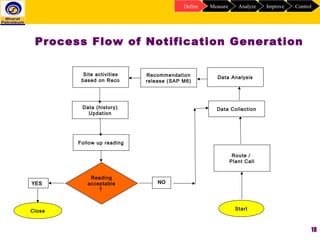
Process Flow of Notification Generation
Data AnalysisRecommendation
release (SAP M6)
Start
Data Collection
Site activities
based on Reco
Close
Data (history)
Updation
Reading
acceptable
?
NOYES
Follow up reading
Route /
Plant Call
19
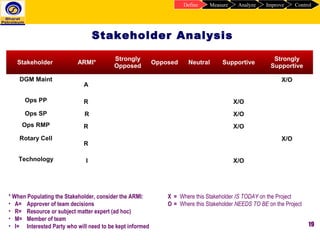
X = Where this Stakeholder IS TODAY on the Project
O = Where this Stakeholder NEEDS TO BE on the Project
* When Populating the Stakeholder, consider the ARMI:
• A= Approver of team decisions
• R= Resource or subject matter expert (ad hoc)
• M= Member of team
• I= Interested Party who will need to be kept informed
Stakeholder ARMI*
Strongly
Opposed
Opposed Neutral Supportive
Strongly
Supportive
DGM Maint
A
X/O
Ops PP R X/O
Ops SP R X/O
Ops RMP R X/O
Rotary Cell
R
X/O
Technology I X/O
Stakeholder Analysis
ControlImproveAnalyzeMeasureDefine
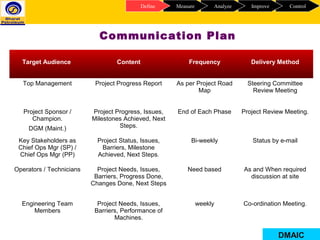
Target Audience Content Frequency Delivery Method
Top Management Project Progress Report As per Project Road
Map
Steering Committee
Review Meeting
Project Sponsor /
Champion.
DGM (Maint.)
Project Progress, Issues,
Milestones Achieved, Next
Steps.
End of Each Phase Project Review Meeting.
Key Stakeholders as
Chief Ops Mgr (SP) /
Chief Ops Mgr (PP)
Project Status, Issues,
Barriers, Milestone
Achieved, Next Steps.
Bi-weekly Status by e-mail
Operators / Technicians Project Needs, Issues,
Barriers, Progress Done,
Changes Done, Next Steps
Need based As and When required
discussion at site
Engineering Team
Members
Project Needs, Issues,
Barriers, Performance of
Machines.
weekly Co-ordination Meeting.
Communication Plan
ControlImproveAnalyzeMeasureDefine
DMAIC
Data
Pareto
Patterns
Capability
MEASURE
DEFINE
ANALYZE
IMPROVE
21
ControlImproveAnalyzeMeasureDefine
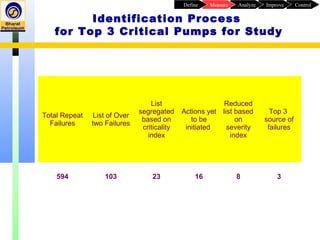
Identification Process
for Top 3 Critical Pumps for Study
Total Repeat
Failures
List of Over
two Failures
List
segregated
based on
criticality
index
Actions yet
to be
initiated
Reduced
list based
on
severity
index
Top 3
source of
failures
594 103 23 16 8 3
ControlImproveAnalyzeMeasureDefine
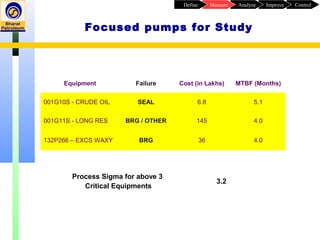
Focused pumps for Study
Equipment Failure Cost (in Lakhs) MTBF (Months)
001G10S - CRUDE OIL SEAL 6.8 5.1
001G11S - LONG RES BRG / OTHER 145 4.0
132P266 – EXCS WAXY BRG 36 4.0
Process Sigma for above 3
Critical Equipments
3.2
ControlImproveAnalyzeMeasureDefine
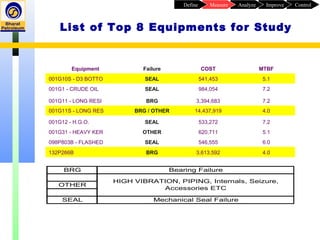
List of Top 8 Equipments for Study
Equipment Failure COST MTBF
001G10S - D3 BOTTO SEAL 541,453 5.1
001G1 - CRUDE OIL SEAL 984,054 7.2
001G11 - LONG RESI BRG 3,394,683 7.2
001G11S - LONG RES BRG / OTHER 14,437,919 4.0
001G12 - H.G.O. SEAL 533,272 7.2
001G31 - HEAVY KER OTHER 620,711 5.1
098P803B - FLASHED SEAL 546,555 6.0
132P266B BRG 3,613,592 4.0
BRG Bearing Failure
OTHER
SEAL Mechanical Seal Failure
HIGH VIBRATION, PIPING, Internals, Seizure,
Accessories ETC
ControlImproveAnalyzeMeasureDefine
Back ground analysis
For Identifying top 3 Critical pumps for study
Back Up Slides for Measure Phase
ControlImproveAnalyzeMeasureDefine
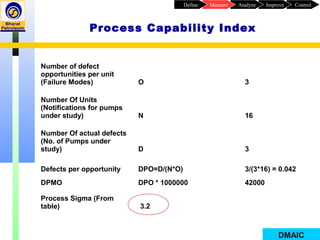
Process Capability Index
Number of defect
opportunities per unit
(Failure Modes) O 3
Number Of Units
(Notifications for pumps
under study) N 16
Number Of actual defects
(No. of Pumps under
study) D 3
Defects per opportunity DPO=D/(N*O) 3/(3*16) = 0.042
DPMO DPO * 1000000 42000
Process Sigma (From
table) 3.2
ControlImproveAnalyzeMeasureDefine
DMAIC
FM
EA
Regression
DOE
MASURE
DEFINE
ANALYZE
IMPROVE
2
MEASURE
ControlImproveAnalyzeMeasureDefine
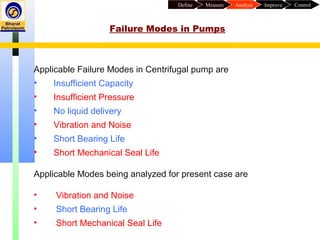
Applicable Failure Modes in Centrifugal pump are
• Insufficient Capacity
• Insufficient Pressure
• No liquid delivery
• Vibration and Noise
• Short Bearing Life
• Short Mechanical Seal Life
Applicable Modes being analyzed for present case are
• Vibration and Noise
• Short Bearing Life
• Short Mechanical Seal Life
Failure Modes in Pumps
ControlImproveAnalyzeMeasureDefine
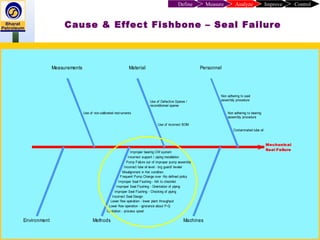
Cause & Effect Fishbone – Seal Failure
Seal Failure
Mechanical
Environment
Measurements
Methods
Material
Machines
Personnel
Contaminated lube oil
assembly procedure
Non adhering to bearing
assembly procedure
Non adhering to seal
Use of incorrect BOM
reconditioned spares
Use of Defective Spares /
Improper bearing CW system
Incorrect support / piping installation
Pump Failure out of improper pump assembly
Incorrect lube oil level - brg guard/ leveler
Misalignment in Hot condition
Frequent Pump Change over -No defined policy
Improper Seal Flushing - NA to checklist
Improper Seal Flushing - Orientation of piping
Improper Seal Flushing - Chocking of piping
Incorrect Seal Design
Lower flow operation - lower plant throughput
Lower flow operation - ignorance about P-Q
Cavitation - process upset
Use of non-calibrated instruments
ControlImproveAnalyzeMeasureDefine
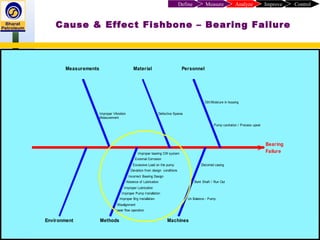
Cause & Effect Fishbone – Bearing Failure
Failure
Bearing
Environment
Measurements
Methods
Material
Machines
Personnel
Pump cavitation / Process upset
Dirt/Moisture in housing
Distorted casing
Bent Shaft / Run Out
Un Balance - Pump
Defective Spares
Improper bearing CW system
External Corrosion
Excessive Load on the pump
Deviation from design conditions
Incorrect Bearing Design
Absence of Lubrication
Improper Lubrication
Improper Pump Installation
Improper Brg Installation
Misalignment
Lower flow operation
Measurement
Improper Vibration
Mechanical Seal Failure
Analysis
ControlImproveAnalyzeMeasureDefine
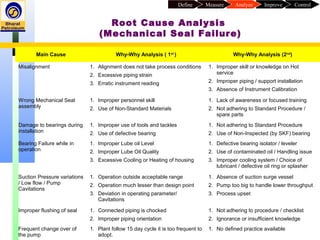
Main Cause Why-Why Analysis ( 1st
) Why-Why Analysis (2nd
)
Misalignment 1. Alignment does not take process conditions
2. Excessive piping strain
3. Erratic instrument reading
1. Improper skill or knowledge on Hot
service
2. Improper piping / support installation
3. Absence of Instrument Calibration
Wrong Mechanical Seal
assembly
1. Improper personnel skill
2. Use of Non-Standard Materials
1. Lack of awareness or focused training
2. Not adhering to Standard Procedure /
spare parts
Damage to bearings during
installation
1. Improper use of tools and tackles
2. Use of defective bearing
1. Not adhering to Standard Procedure
2. Use of Non-Inspected (by SKF) bearing
Bearing Failure while in
operation
1. Improper Lube oil Level
2. Improper Lube Oil Quality
3. Excessive Cooling or Heating of housing
1. Defective bearing isolator / leveler
2. Use of contaminated oil / Handling issue
3. Improper cooling system / Choice of
lubricant / defective oil ring or splasher
Suction Pressure variations
/ Low flow / Pump
Cavitations
1. Operation outside acceptable range
2. Operation much lesser than design point
3. Deviation in operating parameter/
Cavitations
1. Absence of suction surge vessel
2. Pump too big to handle lower throughput
3. Process upset
Improper flushing of seal 1. Connected piping is chocked
2. Improper piping orientation
1. Not adhering to procedure / checklist
2. Ignorance or insufficient knowledge
Frequent change over of
the pump
1. Plant follow 15 day cycle it is too frequent to
adopt.
1. No defined practice available
Root Cause Analysis
(Mechanical Seal Failure)
ControlImproveAnalyzeMeasureDefine
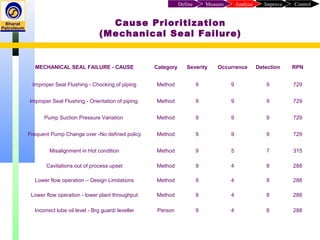
MECHANICAL SEAL FAILURE - CAUSE Category Severity Occurrence Detection RPN
Improper Seal Flushing - Chocking of piping Method 9 9 9 729
Improper Seal Flushing - Orientation of piping. Method 9 9 9 729
Pump Suction Pressure Variation Method 9 9 9 729
Frequent Pump Change over -No defined policy Method 9 9 9 729
Misalignment in Hot condition Method 9 5 7 315
Cavitations out of process upset Method 9 4 8 288
Lower flow operation – Design Limitations Method 9 4 8 288
Lower flow operation - lower plant throughput Method 9 4 8 288
Incorrect lube oil level - Brg guard/ leveller Person 9 4 8 288
Cause Prioritization
(Mechanical Seal Failure)
Cause
“For Improper Mechanical
Seal Flushing Plans”
Cause Validation
(Mechanical Seal Failure)
ControlImproveAnalyzeMeasureDefine
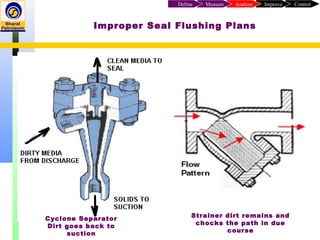
Improper Seal Flushing Plans in
CDU G10/10S/G2/G2S/G11/G11S
Original Seal Flushing Plan API
31
Present Seal Flushing Plan API
12
Cyclone
Separator
Replaced by
Strainer
ControlImproveAnalyzeMeasureDefine
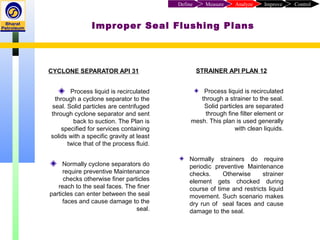
Improper Seal Flushing Plans
Cyclone Separator
Dirt goes back to
suction
Strainer dirt remains and
chocks the path in due
course
ControlImproveAnalyzeMeasureDefine
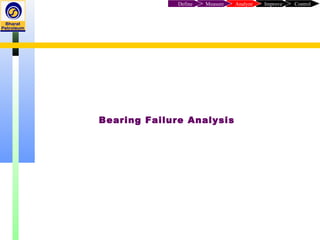
CYCLONE SEPARATOR API 31
Process liquid is recirculated
through a cyclone separator to the
seal. Solid particles are centrifuged
through cyclone separator and sent
back to suction. The Plan is
specified for services containing
solids with a specific gravity at least
twice that of the process fluid.
Normally cyclone separators do
require preventive Maintenance
checks otherwise finer particles
reach to the seal faces. The finer
particles can enter between the seal
faces and cause damage to the
seal.
Improper Seal Flushing Plans
STRAINER API PLAN 12
Process liquid is recirculated
through a strainer to the seal.
Solid particles are separated
through fine filter element or
mesh. This plan is used generally
with clean liquids.
Normally strainers do require
periodic preventive Maintenance
checks. Otherwise strainer
element gets chocked during
course of time and restricts liquid
movement. Such scenario makes
dry run of seal faces and cause
damage to the seal.
ControlImproveAnalyzeMeasureDefine
Bearing Failure Analysis
ControlImproveAnalyzeMeasureDefine
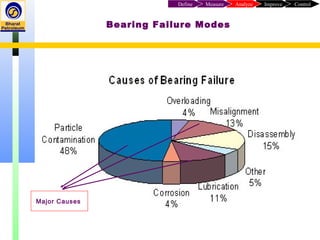
Bearing Failure Modes
ControlImproveAnalyzeMeasureDefine
Major Causes
ControlImproveAnalyzeMeasureDefine
Main Cause Why-Why Analysis ( 1st
) Why-Why Analysis (2nd
)
Misalignment 1. Alignment does not take process conditions
2. Excessive piping strain
3. Erratic instrument reading
1. Improper skill or knowledge on Hot service
2. Improper piping / support installation
3. Absence of Instrument Calibration
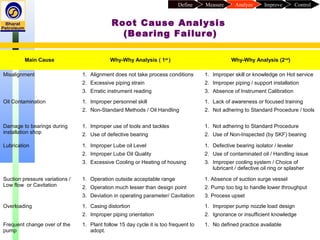
Oil Contamination 1. Improper personnel skill
2. Non-Standard Methods / Oil Handling
1. Lack of awareness or focused training
2. Not adhering to Standard Procedure / tools
Damage to bearings during
installation shop
1. Improper use of tools and tackles
2. Use of defective bearing
1. Not adhering to Standard Procedure
2. Use of Non-Inspected (by SKF) bearing
Lubrication 1. Improper Lube oil Level
2. Improper Lube Oil Quality
3. Excessive Cooling or Heating of housing
1. Defective bearing isolator / leveler
2. Use of contaminated oil / Handling issue
3. Improper cooling system / Choice of
lubricant / defective oil ring or splasher
Suction pressure variations /
Low flow or Cavitation
1. Operation outside acceptable range
2. Operation much lesser than design point
3. Deviation in operating parameter/ Cavitation
1. Absence of suction surge vessel
2. Pump too big to handle lower throughput
3. Process upset
Overloading 1. Casing distortion
2. Improper piping orientation
1. Improper pump nozzle load design
2. Ignorance or insufficient knowledge
Frequent change over of the
pump
1. Plant follow 15 day cycle it is too frequent to
adopt.
1. No defined practice available
Root Cause Analysis
(Bearing Failure)
ControlImproveAnalyzeMeasureDefine
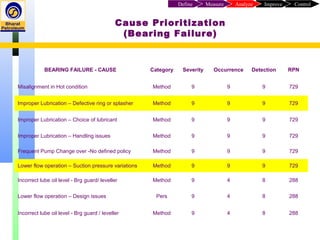
BEARING FAILURE - CAUSE Category Severity Occurrence Detection RPN
Misalignment in Hot condition Method 9 9 9 729
Improper Lubrication – Defective ring or splasher Method 9 9 9 729
Improper Lubrication – Choice of lubricant Method 9 9 9 729
Improper Lubrication – Handling issues Method 9 9 9 729
Frequent Pump Change over -No defined policy Method 9 9 9 729
Lower flow operation – Suction pressure variations Method 9 9 9 729
Incorrect lube oil level - Brg guard/ leveller Method 9 4 8 288
Lower flow operation – Design issues Pers 9 4 8 288
Incorrect lube oil level - Brg guard / leveller Method 9 4 8 288
Cause Prioritization
(Bearing Failure)
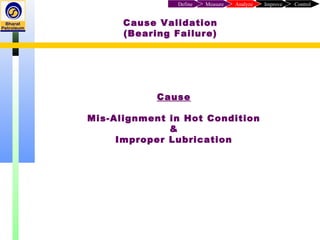
Cause
Mis-Alignment in Hot Condition
&
Improper Lubrication
Cause Validation
(Bearing Failure)
ControlImproveAnalyzeMeasureDefine
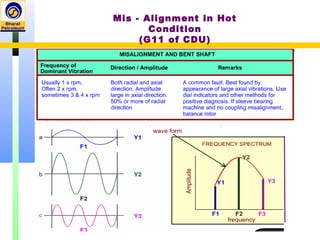
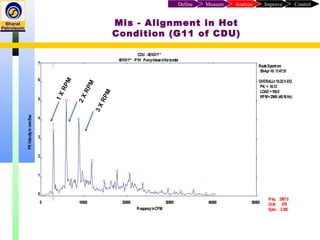
Mis - Alignment in Hot
Condition
(G11 of CDU)
Mis - Alignment in Hot
Condition (G11 of CDU)
ControlImproveAnalyzeMeasureDefine
CDU -001G11**
001G11** -P1H PumpInboardHorizontal
RouteSpectrum
09-Apr-10 11:47:31
OVERALL=10.23V-DG
PK = 10.13
LOAD =100.0
RPM=2949.(49.16Hz)
0 10000 20000 30000 40000 50000
0
1
2
3
4
5
6
7
FrequencyinCPM
PKVelocityinmm/Sec
Freq:
Ordr:
Spec:
2887.5
.979
3.385
1XRPM
2XRPM
3XRPM
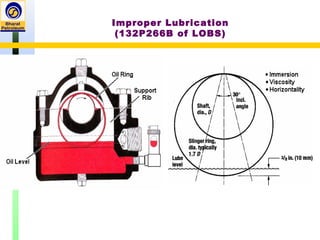
Improper Lubrication
(132P266B of LOBS)
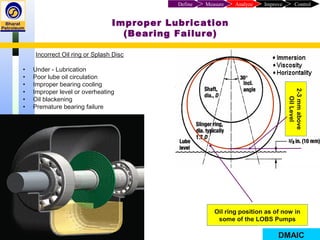
2-3mmabove
OilLevel
Incorrect Oil ring or Splash Disc
• Under - Lubrication
• Poor lube oil circulation
• Improper bearing cooling
• Improper level or overheating
• Oil blackening
• Premature bearing failure
Improper Lubrication
(Bearing Failure)
ControlImproveAnalyzeMeasureDefine
Oil ring position as of now in
some of the LOBS Pumps
DMAIC
SCAM
PER
MASURE
DEFINE
ANALYZE
IMPROVE
2
MEASURE
Sol. Proi.
Cost benefit. Ana.
FMEA – Pilot Sol’n.
ControlImproveAnalyzeMeasureDefine
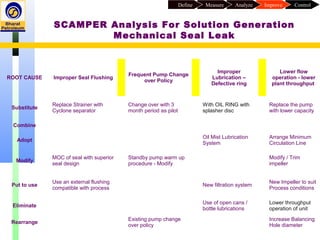
ROOT CAUSE Improper Seal Flushing
Frequent Pump Change
over Policy
Improper
Lubrication –
Defective ring
Lower flow
operation - lower
plant throughput
Substitute
Replace Strainer with
Cyclone separator
Change over with 3
month period as pilot
With OIL RING with
splasher disc
Replace the pump
with lower capacity
Combine
Adopt
Oil Mist Lubrication
System
Arrange Minimum
Circulation Line
Modify
MOC of seal with superior
seal design
Standby pump warm up
procedure - Modify
Modify / Trim
impeller
Put to use
Use an external flushing
compatible with process
New filtration system
New Impeller to suit
Process conditions
Eliminate
Use of open cans /
bottle lubrications
Lower throughput
operation of unit
Rearrange
Existing pump change
over policy
Increase Balancing
Hole diameter
SCAMPER Analysis For Solution Generation
Mechanical Seal Leak
ControlImproveAnalyzeMeasureDefine
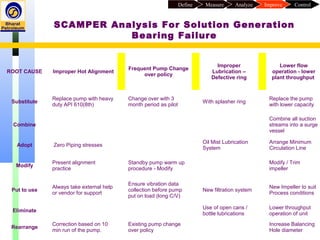
ROOT CAUSE Improper Hot Alignment
Frequent Pump Change
over policy
Improper
Lubrication –
Defective ring
Lower flow
operation - lower
plant throughput
Substitute
Replace pump with heavy
duty API 610(8th)
Change over with 3
month period as pilot
With splasher ring
Replace the pump
with lower capacity
Combine
Combine all suction
streams into a surge
vessel
Adopt Zero Piping stresses
Oil Mist Lubrication
System
Arrange Minimum
Circulation Line
Modify
Present alignment
practice
Standby pump warm up
procedure - Modify
Modify / Trim
impeller
Put to use
Always take external help
or vendor for support
Ensure vibration data
collection before pump
put on load (long C/V)
New filtration system
New Impeller to suit
Process conditions
Eliminate
Use of open cans /
bottle lubrications
Lower throughput
operation of unit
Rearrange
Correction based on 10
min run of the pump.
Existing pump change
over policy
Increase Balancing
Hole diameter
SCAMPER Analysis For Solution Generation
Bearing Failure
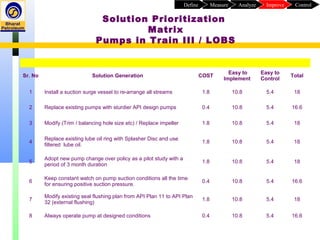
Sr. No Solution Generation COST
Easy to
Implement
Easy to
Control
Total
1 Install a suction surge vessel to re-arrange all streams 1.8 10.8 5.4 18
2 Replace existing pumps with sturdier API design pumps 0.4 10.8 5.4 16.6
3 Modify (Trim / balancing hole size etc) / Replace impeller 1.8 10.8 5.4 18
4
Replace existing lube oil ring with Splasher Disc and use
filtered lube oil.
1.8 10.8 5.4 18
5
Adopt new pump change over policy as a pilot study with a
period of 3 month duration
1.8 10.8 5.4 18
6
Keep constant watch on pump suction conditions all the time
for ensuring positive suction pressure.
0.4 10.8 5.4 16.6
7
Modify existing seal flushing plan from API Plan 11 to API Plan
32 (external flushing)
1.8 10.8 5.4 18
8 Always operate pump at designed conditions 0.4 10.8 5.4 16.6
Solution Prioritization
Matrix
Pumps in Train III / LOBS
ControlImproveAnalyzeMeasureDefine
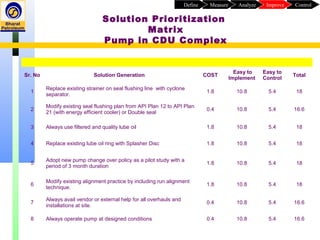
Sr. No Solution Generation COST
Easy to
Implement
Easy to
Control
Total
1
Replace existing strainer on seal flushing line with cyclone
separator.
1.8 10.8 5.4 18
2
Modify existing seal flushing plan from API Plan 12 to API Plan
21 (with energy efficient cooler) or Double seal
0.4 10.8 5.4 16.6
3 Always use filtered and quality lube oil 1.8 10.8 5.4 18
4 Replace existing lube oil ring with Splasher Disc 1.8 10.8 5.4 18
5
Adopt new pump change over policy as a pilot study with a
period of 3 month duration
1.8 10.8 5.4 18
6
Modify existing alignment practice by including run alignment
technique.
1.8 10.8 5.4 18
7
Always avail vendor or external help for all overhauls and
installations at site.
0.4 10.8 5.4 16.6
8 Always operate pump at designed conditions 0.4 10.8 5.4 16.6
Solution Prioritization
Matrix
Pump in CDU Complex
ControlImproveAnalyzeMeasureDefine
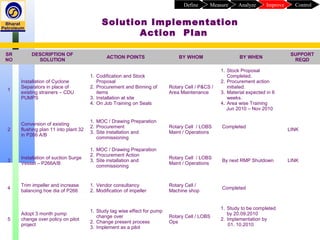
Solution Implementation
Action Plan
SR
NO
DESCRIPTION OF
SOLUTION
ACTION POINTS BY WHOM BY WHEN
SUPPORT
REQD
1
Installation of Cyclone
Separators in place of
existing strainers – CDU
PUMPS
1. Codification and Stock
Proposal
2. Procurement and Binning of
items
3. Installation at site
4. On Job Training on Seals
Rotary Cell / P&CS /
Area Maintenance
1. Stock Proposal
Completed.
2. Procurement action
initiated.
3. Material expected in 6
weeks.
4. Area wise Training
Jun 2010 – Nov 2010
2
Conversion of existing
flushing plan 11 into plant 32
in P266 A/B
1. MOC / Drawing Preparation
2. Procurement
3. Site installation and
commissioning
Rotary Cell / LOBS
Maint / Operations
Completed
LINK
3
Installation of suction Surge
Vessel – P266A/B
1. MOC / Drawing Preparation
2. Procurement Action
3. Site installation and
commissioning
Rotary Cell / LOBS
Maint / Operations
By next RMP Shutdown LINK
4
Trim impeller and increase
balancing hoe dia of P266
1. Vendor consultancy
2. Modification of impeller
Rotary Cell /
Machine shop
Completed
5
Adopt 3 month pump
change over policy on pilot
project
1. Study tag wise effect for pump
change over
2. Change present process
3. Implement as a pilot
Rotary Cell / LOBS
Ops
1. Study to be completed
by 20.09.2010
2. Implementation by
01. 10.2010
ControlImproveAnalyzeMeasureDefine
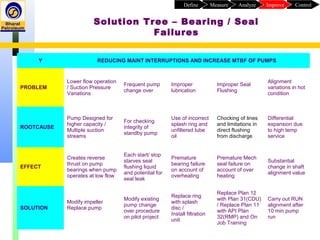
Solution Tree – Bearing / Seal
Failures
Y REDUCING MAINT INTERRUPTIONS AND INCREASE MTBF OF PUMPS
PROBLEM
Lower flow operation
/ Suction Pressure
Variations
Frequent pump
change over
Improper
lubrication
Improper Seal
Flushing
Alignment
variations in hot
condition
ROOTCAUSE
Pump Designed for
higher capacity /
Multiple suction
streams
For checking
integrity of
standby pump
Use of incorrect
splash ring and
unfiltered lube
oil
Chocking of lines
and limitations in
direct flushing
from discharge
Differential
expansion due
to high temp
service
EFFECT
Creates reverse
thrust on pump
bearings when pump
operates at low flow
Each start/ stop
starves seal
flushing liquid
and potential for
seal leak
Premature
bearing failure
on account of
overheating
Premature Mech
seal failure on
account of over
heating
Substantial
change in shaft
alignment value
SOLUTION
Modify impeller
Replace pump
Modify existing
pump change
over procedure
on pilot project
Replace ring
with splash
disc /
Install filtration
unit
Replace Plan 12
with Plan 31(CDU)
/ Replace Plan 11
with API Plan
32(RMP) and On
Job Training
Carry out RUN
alignment after
10 min pump
run
ControlImproveAnalyzeMeasureDefine
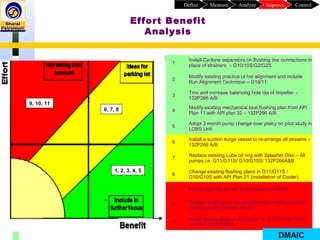
1
Install Cyclone separators on flushing line connections in
place of strainers – G10/10S/G2/G2S
2
Modify existing practice of hot alignment and include
Run Alignment Technique – G10/11
3
Trim and increase balancing hole dia of Impeller -
132P266 A/B
4
Modify existing mechanical seal flushing plan from API
Plan 11 with API plan 32 – 132P266 A/B
5
Adopt 3 month pump change over policy on pilot study in
LOBS Unit
6
Install a suction surge vessel to re-arrange all streams –
132P266 A/B
7
Replace existing Lube oil ring with Splasher Disc – All
pumps i.e. G11/G11S/ G10/G10S/ 132P266A&B
8
Change existing flushing plans in G11/G11S /
G10/G10S with API Plan 21 (installation of Cooler)
9 Always operate pumps at designed conditions
10
Replace existing pumps considering present operating
conditions with sturdier design.
11
Install double seals in all pumps i.e. G11/G11S/ G10/
G10S/ 132P266A&B
Effort Benefit
Analysis
ControlImproveAnalyzeMeasureDefine
6, 7, 8
9, 10, 11
1, 2, 3, 4, 5
DMAIC
61
CO
NTR
O
L
PLAN
FM
EA
MASURE
DEFINE
ANALYZE
IMPROVE
2
MEASURE
ControlImproveAnalyzeMeasureDefine
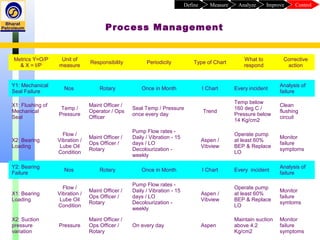
Process Management
ControlImproveAnalyzeMeasureDefine
Metrics Y=O/P
& X = I/P
Unit of
measure
Responsibility Periodicity Type of Chart
What to
respond
Corrective
action
Y1: Mechanical
Seal Failure
Nos Rotary Once in Month I Chart Every incident
Analysis of
failure
X1: Flushing of
Mechanical
Seal
Temp /
Pressure
Maint Officer /
Operator / Ops
Officer
Seal Temp / Pressure
once every day
Trend
Temp below
160 deg C /
Pressure below
14 Kg/cm2
Clean
flushing
circuit
X2: Bearing
Loading
Flow /
Vibration /
Lube Oil
Condition
Maint Officer /
Ops Officer /
Rotary
Pump Flow rates -
Daily / Vibration - 15
days / LO
Decolourization -
weekly
Aspen /
Vibview
Operate pump
at least 60%
BEP & Replace
LO
Monitor
failure
symptoms
Y2: Bearing
Failure
Nos Rotary Once in Month I Chart Every incident
Analysis of
failure
X1: Bearing
Loading
Flow /
Vibration /
Lube Oil
Condition
Maint Officer /
Ops Officer /
Rotary
Pump Flow rates -
Daily / Vibration - 15
days / LO
Decolourization -
weekly
Aspen /
Vibview
Operate pump
at least 60%
BEP & Replace
LO
Monitor
failure
symtoms
X2: Suction
pressure
variation
Pressure
Maint Officer /
Ops Officer /
Rotary
On every day Aspen
Maintain suction
above 4.2
Kg/cm2
Monitor
failure
symptoms
63
Key Lessons Learned
• Importance of working in Cross-Functional Team
• Concentration on processes rather than isolated events gives
sustained solutions (May be the word process generates Fear
and Resistance).
• Visibility through out the implementation process makes
acceptability of the project by majority.
• DMAIC Methodology as problem solving technique could be
applied to all critical issues.
• Opportunity to practice powerful analytical tools like FMEA,
Cause & Effect, SCAMPER etc.
End of Presentation
Thank You
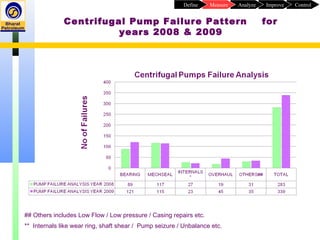
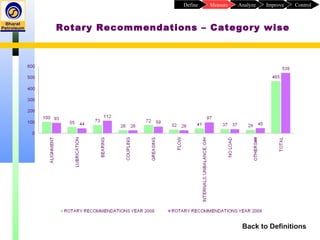
Centrifugal Pump Failure Pattern for
years 2008 & 2009
## Others includes Low Flow / Low pressure / Casing repairs etc.
** Internals like wear ring, shaft shear / Pump seizure / Unbalance etc.
ControlImproveAnalyzeMeasureDefine
Rotary Recommendations – Category wise
Back to Definitions
ControlImproveAnalyzeMeasureDefine
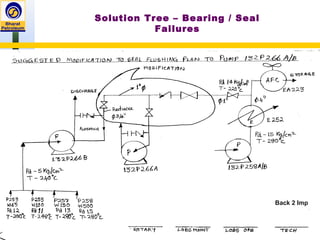
Solution Tree – Bearing / Seal
Failures
Back 2 Imp
STRAINER
ORIFICE
PRESSURE
GAUGE
EXTERNAL FLUSH
TO SEAL
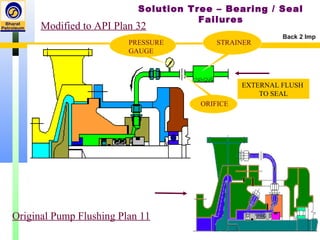
Modified to API Plan 32
Original Pump Flushing Plan 11
Solution Tree – Bearing / Seal
Failures
Back 2 Imp

M6 BLACKBELT PROJECT Rev 6.4

  • 1.
    Reducing Maint Interruptions/ Increasing MTBF of Critical Equipment ( Six Sigma Black Belt Project)
  • 2.
    2 Start Date :April 2010 Black Belt : Vijay S.Dhonde Master Black Belt : Naveen Narayanan Project sponsor : DGM Maintenance Team Members : K K Nanduri / John Bosco Neelesh Bhagwat & RC Agarwal (BB) for guidance ControlImproveAnalyzeMeasureDefine
  • 3.
    DMAIC • Focus onreducing variation • Involving cross functional teams • Concentration on processes rather than isolated events • Share the experience Define Measure Analyze Improve Control Opportunity / project Current performance Root causes To eliminate root causes To sustain gains
  • 4.
    4 Key Lessons Learned •Importance of working in Cross-Functional Team • Concentration on processes rather than isolated events gives sustained solutions (May be the word process generates Fear and Resistance). • Visibility through out the implementation process makes acceptability of the project by majority. • DMAIC Methodology as problem solving technique could be applied to all critical issues. • Opportunity to practice powerful analytical tools like FMEA, Cause & Effect, SCAMPER etc.
  • 5.
  • 6.
    Present Definition ofFailure Failure starts here Equipment Condition P Potential Failure F Functionally failed Today’s definition of failure Equipment Broken Time The inspection and correctiveThe inspection and corrective task must be completed withintask must be completed within the P-F interval.the P-F interval.P-F Interval Maximize interval between Potential Failure and Functional Failure Importance of This Project
  • 7.
    Importance of ThisProject P P-F Interval Failure Equipment not performing intended function “Functionally failed” “Normal state” Potential Failure Intended Function Design Risk to business (consequence) increase as we move along P-F Curve
  • 8.
    8 Project Assumptions ControlImproveAnalyzeMeasureDefine What ismeant by Critical Equipment? An Equipment is considered critical where either it does not have any standby or it’s non-availability would greatly affect plant throughput and it’s failure will have potential threat to safety & environment. What is Maintenance interruption? An event or condition in which the equipment is taken out of service or stopped for attending an abnormal state or part by maintenance however small may the condition be is termed as an interruption. What is MTBF and its interpretation? Mean Time Between Failure is an average uptime available for an equipment. In other words it is the average time an asset will function before it fails. In Refinery the MTBF is considered for equipments overhauled at Machine Shop only.
  • 9.
    9 Project Assumptions ControlImproveAnalyzeMeasureDefine Why consideronly equipment overhauled at shop for MTBF? • When pump is overhauled at shop it will be critically examined and assembled. • Also Machine shop follows standard procedures laid down by Original Equipment Manufacturer and Overhauling activity is carried out by skilled Maint personnel. How failure of rotary equipment is recorded? An equipment failure is recorded through basically in two modes in SAP. • One by malfunction report generated by Operations through SAP Notification type M2. • Another by Rotary Recommendation generated by Rotary Cell through SAP Notification type M6.
  • 10.
    10 Project Assumptions ControlImproveAnalyzeMeasureDefine What baseline data is being considered for the analysis? Notifications or Job generation by Rotary Cell through SAP type M6 is being considered for analysis. Why Rotary Reco (SAP Type M6) alone is considered for analysis? • Data in type M6 is highly authenticated, precise and created by a trained professional. • Data in type M2 majority of times incomplete and sometimes duplicate in nature created by working level person. • Type M2 notification data is more of descriptive in nature, while M6 data comprises measurable data. • While generating notification through M6 analysis would be conducted based on condition monitoring of the equipment by the in charge. • Also, data shows over 90% of cases bearing failures were captured in M6 Data
  • 11.
    Failure Pattern Identification(Equipment Wise) Frequency 596 254 34 Percent 67.4 28.7 3.8 Cum % 67.4 96.2 100.0 Equipment Comp/FansMotorsPumps 900 800 700 600 500 400 300 200 100 0 100 80 60 40 20 0 Frequency Percent Pareto Chart of Equipment Pumps contribution in failure pattern being higher study will be carried out on pumps only ControlImproveAnalyzeMeasureDefine
  • 12.
    12 • As perabove Pareto diagram more recurring failures are observed in Primary, Secondary Processing and RMP units. • It is evident process units cover more than 80% of failure list. Failure Pattern Identification (Complex wise) ControlImproveAnalyzeMeasureDefine C2 168 161 154 79 24 9 Percent 28.2 27.1 25.9 13.3 4.0 1.5 Cum % 28.2 55.3 81.2 94.5 98.5 100.0 C1 Other Offsites Utilities RM P Secondary Processing Prim ary Processing 600 500 400 300 200 100 0 100 80 60 40 20 0 C2 Percent
  • 13.
      Project Charter Project Description ReducingMaintenance Interruptions and Increasing MTBF of Critical Pumps of Crude Distillation Unit and RMP Business Case Improved equipment availability through reduction in repeat failures can greatly contribute to cost reduction, throughput gain and compliance to environmental and safety standards. Also availability of the Rotary equipments is essential to achieve MOU target of Crude processing of the refinery. Cost of repeat failure alone contributes to over Rs 64 lakh which is around 13% of total expenditure for subject period of 3 year this besides loss of through put on account of non availability of Eqpt. Problem Statement In the 36 month period under study (April 2007-March 2010), 103 out of 594 pumps in plant areas have been taken out of service more than twice for maintenance purposes, leading to reliability and availability issues in plant operation. Such repeated maintenance activities would lead to lower MTBF values( the present benchmark of 5.2 years) and will be a potential threat to plant uptimes. Process Owner DGM Maintenance Scope Start: Stop: Excludes : Condition Monitoring and Notification generation Recheck and closure of notification.. Failures based on malfunction reports   Project Goals Metric MTBF Baseline Data Repeat Failure list of Pumps through M6 Current Average MTBF of selected list = 7.2 Months Goal Increase Average from 7.2 to 12 months Entitlement MTBF 36 months             ControlImproveAnalyzeMeasureDefine
  • 14.
    15 Expected Tangible Benefits Top 3critical tags for different failure modes out of identified list will be taken up for root cause analysis. Such process of avoiding repeat failures would not only result in lower maintenance cost but also help maintain optimum plant through put. One day shutdown of CCU on account of non-availability of critical bottom pump would result in loss of over Rs.2.1 Cr direct cost (CCU Value addition Rs 7000 per MT Waxy processing), can be avoided. Expected Intangible Benefits With higher equipment availability, Process can have flexible operation. Once time spent on repeat jobs reduced, better focus can be given to other reliability improvement initiatives. Also improvement plans can be extended to other parts of the refinery. Team members KK Nanduri, John Bosco, Neelesh Bhagwat & RC Agarwal ( BB for guidance) Support Required Rotary Cell, Operations and Technology Risks/ Constraints Environmental conditions and operating at Turn down due to non availability of plant through put can greatly affect MTBF of rotary equipments. ControlImproveAnalyzeMeasureDefine Project Charter
  • 15.
    16 CTQ Drill Down Tree ControlImproveAnalyzeMeasureDefine EnhanceAvailability of Critical Equipment for Ops By Reducing MTTR By Improving MTBF Increase Equipment uptime Reduce No of Failures Reduce No of Repeat failures Reduce No of repeat failures or increase MTBF from 7.2 to 12
  • 16.
    17 Customer Output ProcessInput Supplier 1. WHO are your primary customers? (From Step A) 2. WHAT does the customer receive? (Think of their CTQ’s) 3. What STEPS are Included in the Process today? (high level) 4. What is provided to START the process? 5. Who PROVIDES the input? (Who) (Nouns) (Verbs) (Nouns) (Who) Equipment in Operation / Condition Monitoring Analysis and Release of type M6 Notification Equipment Isolation and Handover for Maint Activity Completion by Area Maintenance History / Data Updation by Area Maintenance Notification Closure Recheck / Condition Monitoring Availability of equipment Operations Route Readings / Plant Calls Area Operations C O P I S ControlImproveAnalyzeMeasureDefine
  • 17.
    18 ControlImproveAnalyzeMeasureDefine Process Flow ofNotification Generation Data AnalysisRecommendation release (SAP M6) Start Data Collection Site activities based on Reco Close Data (history) Updation Reading acceptable ? NOYES Follow up reading Route / Plant Call
  • 18.
    19 X = Wherethis Stakeholder IS TODAY on the Project O = Where this Stakeholder NEEDS TO BE on the Project * When Populating the Stakeholder, consider the ARMI: • A= Approver of team decisions • R= Resource or subject matter expert (ad hoc) • M= Member of team • I= Interested Party who will need to be kept informed Stakeholder ARMI* Strongly Opposed Opposed Neutral Supportive Strongly Supportive DGM Maint A X/O Ops PP R X/O Ops SP R X/O Ops RMP R X/O Rotary Cell R X/O Technology I X/O Stakeholder Analysis ControlImproveAnalyzeMeasureDefine
  • 19.
    Target Audience ContentFrequency Delivery Method Top Management Project Progress Report As per Project Road Map Steering Committee Review Meeting Project Sponsor / Champion. DGM (Maint.) Project Progress, Issues, Milestones Achieved, Next Steps. End of Each Phase Project Review Meeting. Key Stakeholders as Chief Ops Mgr (SP) / Chief Ops Mgr (PP) Project Status, Issues, Barriers, Milestone Achieved, Next Steps. Bi-weekly Status by e-mail Operators / Technicians Project Needs, Issues, Barriers, Progress Done, Changes Done, Next Steps Need based As and When required discussion at site Engineering Team Members Project Needs, Issues, Barriers, Performance of Machines. weekly Co-ordination Meeting. Communication Plan ControlImproveAnalyzeMeasureDefine DMAIC
  • 20.
  • 21.
    Identification Process for Top3 Critical Pumps for Study Total Repeat Failures List of Over two Failures List segregated based on criticality index Actions yet to be initiated Reduced list based on severity index Top 3 source of failures 594 103 23 16 8 3 ControlImproveAnalyzeMeasureDefine
  • 22.
    Focused pumps forStudy Equipment Failure Cost (in Lakhs) MTBF (Months) 001G10S - CRUDE OIL SEAL 6.8 5.1 001G11S - LONG RES BRG / OTHER 145 4.0 132P266 – EXCS WAXY BRG 36 4.0 Process Sigma for above 3 Critical Equipments 3.2 ControlImproveAnalyzeMeasureDefine
  • 23.
    List of Top8 Equipments for Study Equipment Failure COST MTBF 001G10S - D3 BOTTO SEAL 541,453 5.1 001G1 - CRUDE OIL SEAL 984,054 7.2 001G11 - LONG RESI BRG 3,394,683 7.2 001G11S - LONG RES BRG / OTHER 14,437,919 4.0 001G12 - H.G.O. SEAL 533,272 7.2 001G31 - HEAVY KER OTHER 620,711 5.1 098P803B - FLASHED SEAL 546,555 6.0 132P266B BRG 3,613,592 4.0 BRG Bearing Failure OTHER SEAL Mechanical Seal Failure HIGH VIBRATION, PIPING, Internals, Seizure, Accessories ETC ControlImproveAnalyzeMeasureDefine
  • 24.
    Back ground analysis ForIdentifying top 3 Critical pumps for study Back Up Slides for Measure Phase ControlImproveAnalyzeMeasureDefine
  • 25.
    Process Capability Index Numberof defect opportunities per unit (Failure Modes) O 3 Number Of Units (Notifications for pumps under study) N 16 Number Of actual defects (No. of Pumps under study) D 3 Defects per opportunity DPO=D/(N*O) 3/(3*16) = 0.042 DPMO DPO * 1000000 42000 Process Sigma (From table) 3.2 ControlImproveAnalyzeMeasureDefine DMAIC
  • 26.
  • 27.
    ControlImproveAnalyzeMeasureDefine Applicable Failure Modesin Centrifugal pump are • Insufficient Capacity • Insufficient Pressure • No liquid delivery • Vibration and Noise • Short Bearing Life • Short Mechanical Seal Life Applicable Modes being analyzed for present case are • Vibration and Noise • Short Bearing Life • Short Mechanical Seal Life Failure Modes in Pumps
  • 28.
    ControlImproveAnalyzeMeasureDefine Cause & EffectFishbone – Seal Failure Seal Failure Mechanical Environment Measurements Methods Material Machines Personnel Contaminated lube oil assembly procedure Non adhering to bearing assembly procedure Non adhering to seal Use of incorrect BOM reconditioned spares Use of Defective Spares / Improper bearing CW system Incorrect support / piping installation Pump Failure out of improper pump assembly Incorrect lube oil level - brg guard/ leveler Misalignment in Hot condition Frequent Pump Change over -No defined policy Improper Seal Flushing - NA to checklist Improper Seal Flushing - Orientation of piping Improper Seal Flushing - Chocking of piping Incorrect Seal Design Lower flow operation - lower plant throughput Lower flow operation - ignorance about P-Q Cavitation - process upset Use of non-calibrated instruments
  • 29.
    ControlImproveAnalyzeMeasureDefine Cause & EffectFishbone – Bearing Failure Failure Bearing Environment Measurements Methods Material Machines Personnel Pump cavitation / Process upset Dirt/Moisture in housing Distorted casing Bent Shaft / Run Out Un Balance - Pump Defective Spares Improper bearing CW system External Corrosion Excessive Load on the pump Deviation from design conditions Incorrect Bearing Design Absence of Lubrication Improper Lubrication Improper Pump Installation Improper Brg Installation Misalignment Lower flow operation Measurement Improper Vibration
  • 30.
  • 31.
    ControlImproveAnalyzeMeasureDefine Main Cause Why-WhyAnalysis ( 1st ) Why-Why Analysis (2nd ) Misalignment 1. Alignment does not take process conditions 2. Excessive piping strain 3. Erratic instrument reading 1. Improper skill or knowledge on Hot service 2. Improper piping / support installation 3. Absence of Instrument Calibration Wrong Mechanical Seal assembly 1. Improper personnel skill 2. Use of Non-Standard Materials 1. Lack of awareness or focused training 2. Not adhering to Standard Procedure / spare parts Damage to bearings during installation 1. Improper use of tools and tackles 2. Use of defective bearing 1. Not adhering to Standard Procedure 2. Use of Non-Inspected (by SKF) bearing Bearing Failure while in operation 1. Improper Lube oil Level 2. Improper Lube Oil Quality 3. Excessive Cooling or Heating of housing 1. Defective bearing isolator / leveler 2. Use of contaminated oil / Handling issue 3. Improper cooling system / Choice of lubricant / defective oil ring or splasher Suction Pressure variations / Low flow / Pump Cavitations 1. Operation outside acceptable range 2. Operation much lesser than design point 3. Deviation in operating parameter/ Cavitations 1. Absence of suction surge vessel 2. Pump too big to handle lower throughput 3. Process upset Improper flushing of seal 1. Connected piping is chocked 2. Improper piping orientation 1. Not adhering to procedure / checklist 2. Ignorance or insufficient knowledge Frequent change over of the pump 1. Plant follow 15 day cycle it is too frequent to adopt. 1. No defined practice available Root Cause Analysis (Mechanical Seal Failure)
  • 32.
    ControlImproveAnalyzeMeasureDefine MECHANICAL SEAL FAILURE- CAUSE Category Severity Occurrence Detection RPN Improper Seal Flushing - Chocking of piping Method 9 9 9 729 Improper Seal Flushing - Orientation of piping. Method 9 9 9 729 Pump Suction Pressure Variation Method 9 9 9 729 Frequent Pump Change over -No defined policy Method 9 9 9 729 Misalignment in Hot condition Method 9 5 7 315 Cavitations out of process upset Method 9 4 8 288 Lower flow operation – Design Limitations Method 9 4 8 288 Lower flow operation - lower plant throughput Method 9 4 8 288 Incorrect lube oil level - Brg guard/ leveller Person 9 4 8 288 Cause Prioritization (Mechanical Seal Failure)
  • 33.
    Cause “For Improper Mechanical SealFlushing Plans” Cause Validation (Mechanical Seal Failure) ControlImproveAnalyzeMeasureDefine
  • 34.
    Improper Seal FlushingPlans in CDU G10/10S/G2/G2S/G11/G11S Original Seal Flushing Plan API 31 Present Seal Flushing Plan API 12 Cyclone Separator Replaced by Strainer ControlImproveAnalyzeMeasureDefine
  • 35.
    Improper Seal FlushingPlans Cyclone Separator Dirt goes back to suction Strainer dirt remains and chocks the path in due course ControlImproveAnalyzeMeasureDefine
  • 36.
    CYCLONE SEPARATOR API31 Process liquid is recirculated through a cyclone separator to the seal. Solid particles are centrifuged through cyclone separator and sent back to suction. The Plan is specified for services containing solids with a specific gravity at least twice that of the process fluid. Normally cyclone separators do require preventive Maintenance checks otherwise finer particles reach to the seal faces. The finer particles can enter between the seal faces and cause damage to the seal. Improper Seal Flushing Plans STRAINER API PLAN 12 Process liquid is recirculated through a strainer to the seal. Solid particles are separated through fine filter element or mesh. This plan is used generally with clean liquids. Normally strainers do require periodic preventive Maintenance checks. Otherwise strainer element gets chocked during course of time and restricts liquid movement. Such scenario makes dry run of seal faces and cause damage to the seal. ControlImproveAnalyzeMeasureDefine
  • 37.
  • 38.
  • 39.
    ControlImproveAnalyzeMeasureDefine Main Cause Why-WhyAnalysis ( 1st ) Why-Why Analysis (2nd ) Misalignment 1. Alignment does not take process conditions 2. Excessive piping strain 3. Erratic instrument reading 1. Improper skill or knowledge on Hot service 2. Improper piping / support installation 3. Absence of Instrument Calibration Oil Contamination 1. Improper personnel skill 2. Non-Standard Methods / Oil Handling 1. Lack of awareness or focused training 2. Not adhering to Standard Procedure / tools Damage to bearings during installation shop 1. Improper use of tools and tackles 2. Use of defective bearing 1. Not adhering to Standard Procedure 2. Use of Non-Inspected (by SKF) bearing Lubrication 1. Improper Lube oil Level 2. Improper Lube Oil Quality 3. Excessive Cooling or Heating of housing 1. Defective bearing isolator / leveler 2. Use of contaminated oil / Handling issue 3. Improper cooling system / Choice of lubricant / defective oil ring or splasher Suction pressure variations / Low flow or Cavitation 1. Operation outside acceptable range 2. Operation much lesser than design point 3. Deviation in operating parameter/ Cavitation 1. Absence of suction surge vessel 2. Pump too big to handle lower throughput 3. Process upset Overloading 1. Casing distortion 2. Improper piping orientation 1. Improper pump nozzle load design 2. Ignorance or insufficient knowledge Frequent change over of the pump 1. Plant follow 15 day cycle it is too frequent to adopt. 1. No defined practice available Root Cause Analysis (Bearing Failure)
  • 40.
    ControlImproveAnalyzeMeasureDefine BEARING FAILURE -CAUSE Category Severity Occurrence Detection RPN Misalignment in Hot condition Method 9 9 9 729 Improper Lubrication – Defective ring or splasher Method 9 9 9 729 Improper Lubrication – Choice of lubricant Method 9 9 9 729 Improper Lubrication – Handling issues Method 9 9 9 729 Frequent Pump Change over -No defined policy Method 9 9 9 729 Lower flow operation – Suction pressure variations Method 9 9 9 729 Incorrect lube oil level - Brg guard/ leveller Method 9 4 8 288 Lower flow operation – Design issues Pers 9 4 8 288 Incorrect lube oil level - Brg guard / leveller Method 9 4 8 288 Cause Prioritization (Bearing Failure)
  • 41.
    Cause Mis-Alignment in HotCondition & Improper Lubrication Cause Validation (Bearing Failure) ControlImproveAnalyzeMeasureDefine
  • 42.
    Mis - Alignmentin Hot Condition (G11 of CDU)
  • 43.
    Mis - Alignmentin Hot Condition (G11 of CDU) ControlImproveAnalyzeMeasureDefine CDU -001G11** 001G11** -P1H PumpInboardHorizontal RouteSpectrum 09-Apr-10 11:47:31 OVERALL=10.23V-DG PK = 10.13 LOAD =100.0 RPM=2949.(49.16Hz) 0 10000 20000 30000 40000 50000 0 1 2 3 4 5 6 7 FrequencyinCPM PKVelocityinmm/Sec Freq: Ordr: Spec: 2887.5 .979 3.385 1XRPM 2XRPM 3XRPM
  • 44.
  • 45.
    2-3mmabove OilLevel Incorrect Oil ringor Splash Disc • Under - Lubrication • Poor lube oil circulation • Improper bearing cooling • Improper level or overheating • Oil blackening • Premature bearing failure Improper Lubrication (Bearing Failure) ControlImproveAnalyzeMeasureDefine Oil ring position as of now in some of the LOBS Pumps DMAIC
  • 46.
    SCAM PER MASURE DEFINE ANALYZE IMPROVE 2 MEASURE Sol. Proi. Cost benefit.Ana. FMEA – Pilot Sol’n. ControlImproveAnalyzeMeasureDefine
  • 47.
    ControlImproveAnalyzeMeasureDefine ROOT CAUSE ImproperSeal Flushing Frequent Pump Change over Policy Improper Lubrication – Defective ring Lower flow operation - lower plant throughput Substitute Replace Strainer with Cyclone separator Change over with 3 month period as pilot With OIL RING with splasher disc Replace the pump with lower capacity Combine Adopt Oil Mist Lubrication System Arrange Minimum Circulation Line Modify MOC of seal with superior seal design Standby pump warm up procedure - Modify Modify / Trim impeller Put to use Use an external flushing compatible with process New filtration system New Impeller to suit Process conditions Eliminate Use of open cans / bottle lubrications Lower throughput operation of unit Rearrange Existing pump change over policy Increase Balancing Hole diameter SCAMPER Analysis For Solution Generation Mechanical Seal Leak
  • 48.
    ControlImproveAnalyzeMeasureDefine ROOT CAUSE ImproperHot Alignment Frequent Pump Change over policy Improper Lubrication – Defective ring Lower flow operation - lower plant throughput Substitute Replace pump with heavy duty API 610(8th) Change over with 3 month period as pilot With splasher ring Replace the pump with lower capacity Combine Combine all suction streams into a surge vessel Adopt Zero Piping stresses Oil Mist Lubrication System Arrange Minimum Circulation Line Modify Present alignment practice Standby pump warm up procedure - Modify Modify / Trim impeller Put to use Always take external help or vendor for support Ensure vibration data collection before pump put on load (long C/V) New filtration system New Impeller to suit Process conditions Eliminate Use of open cans / bottle lubrications Lower throughput operation of unit Rearrange Correction based on 10 min run of the pump. Existing pump change over policy Increase Balancing Hole diameter SCAMPER Analysis For Solution Generation Bearing Failure
  • 49.
    Sr. No SolutionGeneration COST Easy to Implement Easy to Control Total 1 Install a suction surge vessel to re-arrange all streams 1.8 10.8 5.4 18 2 Replace existing pumps with sturdier API design pumps 0.4 10.8 5.4 16.6 3 Modify (Trim / balancing hole size etc) / Replace impeller 1.8 10.8 5.4 18 4 Replace existing lube oil ring with Splasher Disc and use filtered lube oil. 1.8 10.8 5.4 18 5 Adopt new pump change over policy as a pilot study with a period of 3 month duration 1.8 10.8 5.4 18 6 Keep constant watch on pump suction conditions all the time for ensuring positive suction pressure. 0.4 10.8 5.4 16.6 7 Modify existing seal flushing plan from API Plan 11 to API Plan 32 (external flushing) 1.8 10.8 5.4 18 8 Always operate pump at designed conditions 0.4 10.8 5.4 16.6 Solution Prioritization Matrix Pumps in Train III / LOBS ControlImproveAnalyzeMeasureDefine
  • 50.
    Sr. No SolutionGeneration COST Easy to Implement Easy to Control Total 1 Replace existing strainer on seal flushing line with cyclone separator. 1.8 10.8 5.4 18 2 Modify existing seal flushing plan from API Plan 12 to API Plan 21 (with energy efficient cooler) or Double seal 0.4 10.8 5.4 16.6 3 Always use filtered and quality lube oil 1.8 10.8 5.4 18 4 Replace existing lube oil ring with Splasher Disc 1.8 10.8 5.4 18 5 Adopt new pump change over policy as a pilot study with a period of 3 month duration 1.8 10.8 5.4 18 6 Modify existing alignment practice by including run alignment technique. 1.8 10.8 5.4 18 7 Always avail vendor or external help for all overhauls and installations at site. 0.4 10.8 5.4 16.6 8 Always operate pump at designed conditions 0.4 10.8 5.4 16.6 Solution Prioritization Matrix Pump in CDU Complex ControlImproveAnalyzeMeasureDefine
  • 51.
    Solution Implementation Action Plan SR NO DESCRIPTIONOF SOLUTION ACTION POINTS BY WHOM BY WHEN SUPPORT REQD 1 Installation of Cyclone Separators in place of existing strainers – CDU PUMPS 1. Codification and Stock Proposal 2. Procurement and Binning of items 3. Installation at site 4. On Job Training on Seals Rotary Cell / P&CS / Area Maintenance 1. Stock Proposal Completed. 2. Procurement action initiated. 3. Material expected in 6 weeks. 4. Area wise Training Jun 2010 – Nov 2010 2 Conversion of existing flushing plan 11 into plant 32 in P266 A/B 1. MOC / Drawing Preparation 2. Procurement 3. Site installation and commissioning Rotary Cell / LOBS Maint / Operations Completed LINK 3 Installation of suction Surge Vessel – P266A/B 1. MOC / Drawing Preparation 2. Procurement Action 3. Site installation and commissioning Rotary Cell / LOBS Maint / Operations By next RMP Shutdown LINK 4 Trim impeller and increase balancing hoe dia of P266 1. Vendor consultancy 2. Modification of impeller Rotary Cell / Machine shop Completed 5 Adopt 3 month pump change over policy on pilot project 1. Study tag wise effect for pump change over 2. Change present process 3. Implement as a pilot Rotary Cell / LOBS Ops 1. Study to be completed by 20.09.2010 2. Implementation by 01. 10.2010 ControlImproveAnalyzeMeasureDefine
  • 52.
    Solution Tree –Bearing / Seal Failures Y REDUCING MAINT INTERRUPTIONS AND INCREASE MTBF OF PUMPS PROBLEM Lower flow operation / Suction Pressure Variations Frequent pump change over Improper lubrication Improper Seal Flushing Alignment variations in hot condition ROOTCAUSE Pump Designed for higher capacity / Multiple suction streams For checking integrity of standby pump Use of incorrect splash ring and unfiltered lube oil Chocking of lines and limitations in direct flushing from discharge Differential expansion due to high temp service EFFECT Creates reverse thrust on pump bearings when pump operates at low flow Each start/ stop starves seal flushing liquid and potential for seal leak Premature bearing failure on account of overheating Premature Mech seal failure on account of over heating Substantial change in shaft alignment value SOLUTION Modify impeller Replace pump Modify existing pump change over procedure on pilot project Replace ring with splash disc / Install filtration unit Replace Plan 12 with Plan 31(CDU) / Replace Plan 11 with API Plan 32(RMP) and On Job Training Carry out RUN alignment after 10 min pump run ControlImproveAnalyzeMeasureDefine
  • 53.
    1 Install Cyclone separatorson flushing line connections in place of strainers – G10/10S/G2/G2S 2 Modify existing practice of hot alignment and include Run Alignment Technique – G10/11 3 Trim and increase balancing hole dia of Impeller - 132P266 A/B 4 Modify existing mechanical seal flushing plan from API Plan 11 with API plan 32 – 132P266 A/B 5 Adopt 3 month pump change over policy on pilot study in LOBS Unit 6 Install a suction surge vessel to re-arrange all streams – 132P266 A/B 7 Replace existing Lube oil ring with Splasher Disc – All pumps i.e. G11/G11S/ G10/G10S/ 132P266A&B 8 Change existing flushing plans in G11/G11S / G10/G10S with API Plan 21 (installation of Cooler) 9 Always operate pumps at designed conditions 10 Replace existing pumps considering present operating conditions with sturdier design. 11 Install double seals in all pumps i.e. G11/G11S/ G10/ G10S/ 132P266A&B Effort Benefit Analysis ControlImproveAnalyzeMeasureDefine 6, 7, 8 9, 10, 11 1, 2, 3, 4, 5 DMAIC
  • 54.
  • 55.
    Process Management ControlImproveAnalyzeMeasureDefine Metrics Y=O/P &X = I/P Unit of measure Responsibility Periodicity Type of Chart What to respond Corrective action Y1: Mechanical Seal Failure Nos Rotary Once in Month I Chart Every incident Analysis of failure X1: Flushing of Mechanical Seal Temp / Pressure Maint Officer / Operator / Ops Officer Seal Temp / Pressure once every day Trend Temp below 160 deg C / Pressure below 14 Kg/cm2 Clean flushing circuit X2: Bearing Loading Flow / Vibration / Lube Oil Condition Maint Officer / Ops Officer / Rotary Pump Flow rates - Daily / Vibration - 15 days / LO Decolourization - weekly Aspen / Vibview Operate pump at least 60% BEP & Replace LO Monitor failure symptoms Y2: Bearing Failure Nos Rotary Once in Month I Chart Every incident Analysis of failure X1: Bearing Loading Flow / Vibration / Lube Oil Condition Maint Officer / Ops Officer / Rotary Pump Flow rates - Daily / Vibration - 15 days / LO Decolourization - weekly Aspen / Vibview Operate pump at least 60% BEP & Replace LO Monitor failure symtoms X2: Suction pressure variation Pressure Maint Officer / Ops Officer / Rotary On every day Aspen Maintain suction above 4.2 Kg/cm2 Monitor failure symptoms
  • 56.
    63 Key Lessons Learned •Importance of working in Cross-Functional Team • Concentration on processes rather than isolated events gives sustained solutions (May be the word process generates Fear and Resistance). • Visibility through out the implementation process makes acceptability of the project by majority. • DMAIC Methodology as problem solving technique could be applied to all critical issues. • Opportunity to practice powerful analytical tools like FMEA, Cause & Effect, SCAMPER etc.
  • 57.
  • 58.
    Centrifugal Pump FailurePattern for years 2008 & 2009 ## Others includes Low Flow / Low pressure / Casing repairs etc. ** Internals like wear ring, shaft shear / Pump seizure / Unbalance etc. ControlImproveAnalyzeMeasureDefine
  • 59.
    Rotary Recommendations –Category wise Back to Definitions ControlImproveAnalyzeMeasureDefine
  • 60.
    Solution Tree –Bearing / Seal Failures Back 2 Imp
  • 61.
    STRAINER ORIFICE PRESSURE GAUGE EXTERNAL FLUSH TO SEAL Modifiedto API Plan 32 Original Pump Flushing Plan 11 Solution Tree – Bearing / Seal Failures Back 2 Imp

Editor's Notes

  • #17 To use the the CTQ Drill Down Tree above: 1. Drill-down into your CTQ (Big Y) to determine key drivers (little y’s) and their process and input drivers (X’s) 2. Evaluate the amount of IMPACT each driver (y) has on your CTQ, and the CONTROL you have to change each driver (y) 3. Select the key driver (y) to focus on for the rest of the project. Note, “y” is measurable could be a characteristic about the main process could be a characteristic of a sub-process For the CTQ Translation Matrix:
  • #18 You may need more / less boxes than highlighted on this template. You can add / delete as necessary for your project. When identifying Supplier(s), consider who starts and/or provides input to the process. When identifying Customer(s), consider who ends the process and/or is the recipient of the output.
  • #19 To use the the CTQ Drill Down Tree above: 1. Drill-down into your CTQ (Big Y) to determine key drivers (little y’s) and their process and input drivers (X’s) 2. Evaluate the amount of IMPACT each driver (y) has on your CTQ, and the CONTROL you have to change each driver (y) 3. Select the key driver (y) to focus on for the rest of the project. Note, “y” is measurable could be a characteristic about the main process could be a characteristic of a sub-process For the CTQ Translation Matrix:
  • #20 These Change tools are optional. Another alternative you can use is a “Threat / Opportunity” matrix.