1
Obstetrical Anatomy
M2 2009
Pr. Fomulu / Dr. Nana
27/04/09
2
Obstetrical anatomy-1
 Plan
 Introduction- Definition
 Objectives:
 General:
 Student should be able to correctly examine the pelvis at
term, identify the different types of pelvises and
determine mode of delivery.
Nana
3
Obstetrical anatomy-2
 Specific:
 Name the bones of the bony pelvis.
 Name the major joints and ligaments of the pelvis.
 Discuss the functions of the pelvis.
 Discuss the obstetrical pelvic measurements.
 Describe the variations of the pelvic shape.
 Discuss some clinical features associated with the bony
pelvis.
Nana
4
Obstetrical anatomy-3
 Definition:
• Bony structure, also called pelvic girdle.
• Above it supports the vertebral column.
• Below it recieves the lower limbs, through the
acetabulum cavity.
• It consist of a true and false pelvis, has the following
functions.
Nana
5
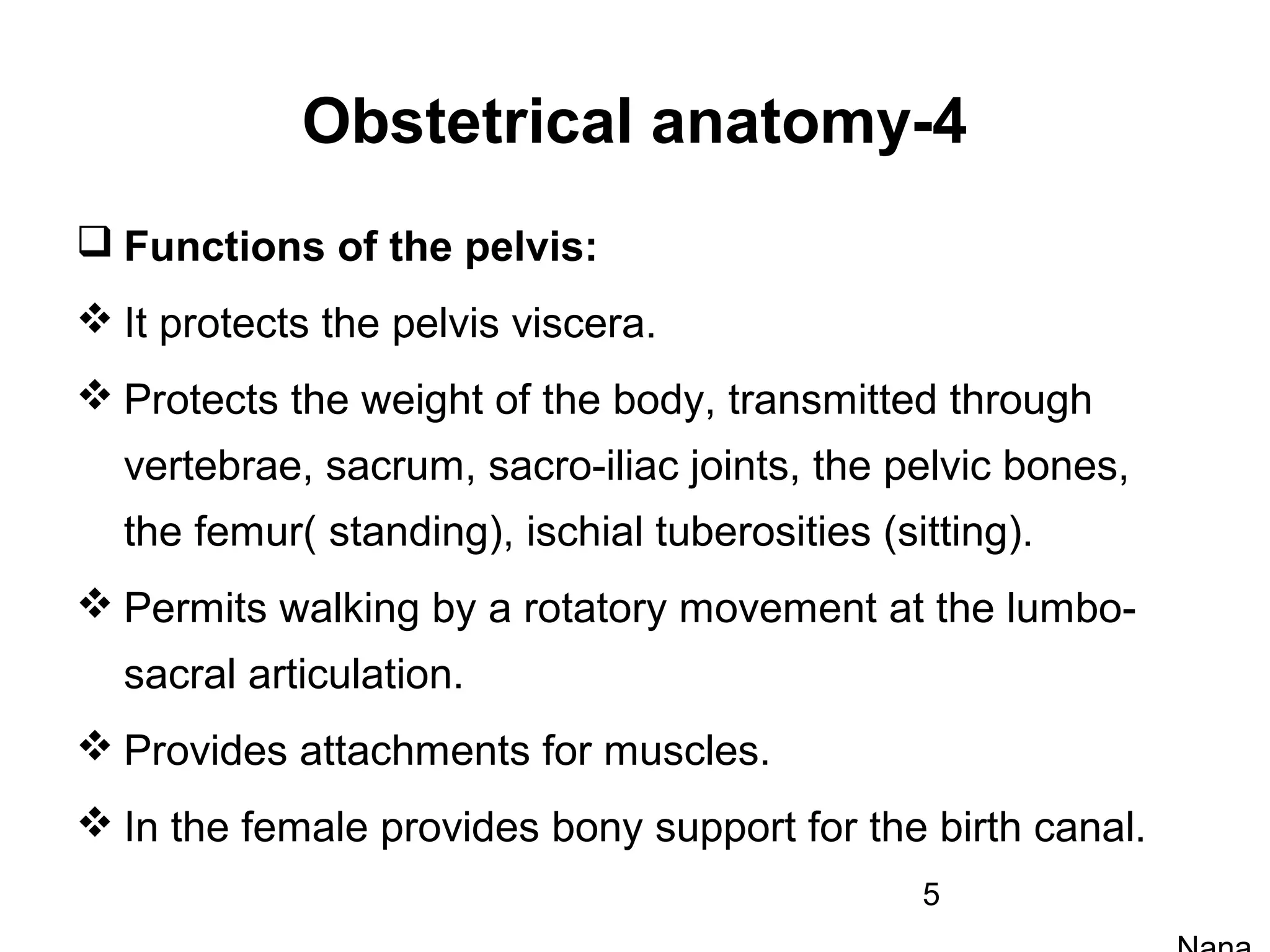
Obstetrical anatomy-4
 Functions of the pelvis:
 It protects the pelvis viscera.
 Protects the weight of the body, transmitted through
vertebrae, sacrum, sacro-iliac joints, the pelvic bones,
the femur( standing), ischial tuberosities (sitting).
 Permits walking by a rotatory movement at the lumbo-
sacral articulation.
 Provides attachments for muscles.
 In the female provides bony support for the birth canal.
6
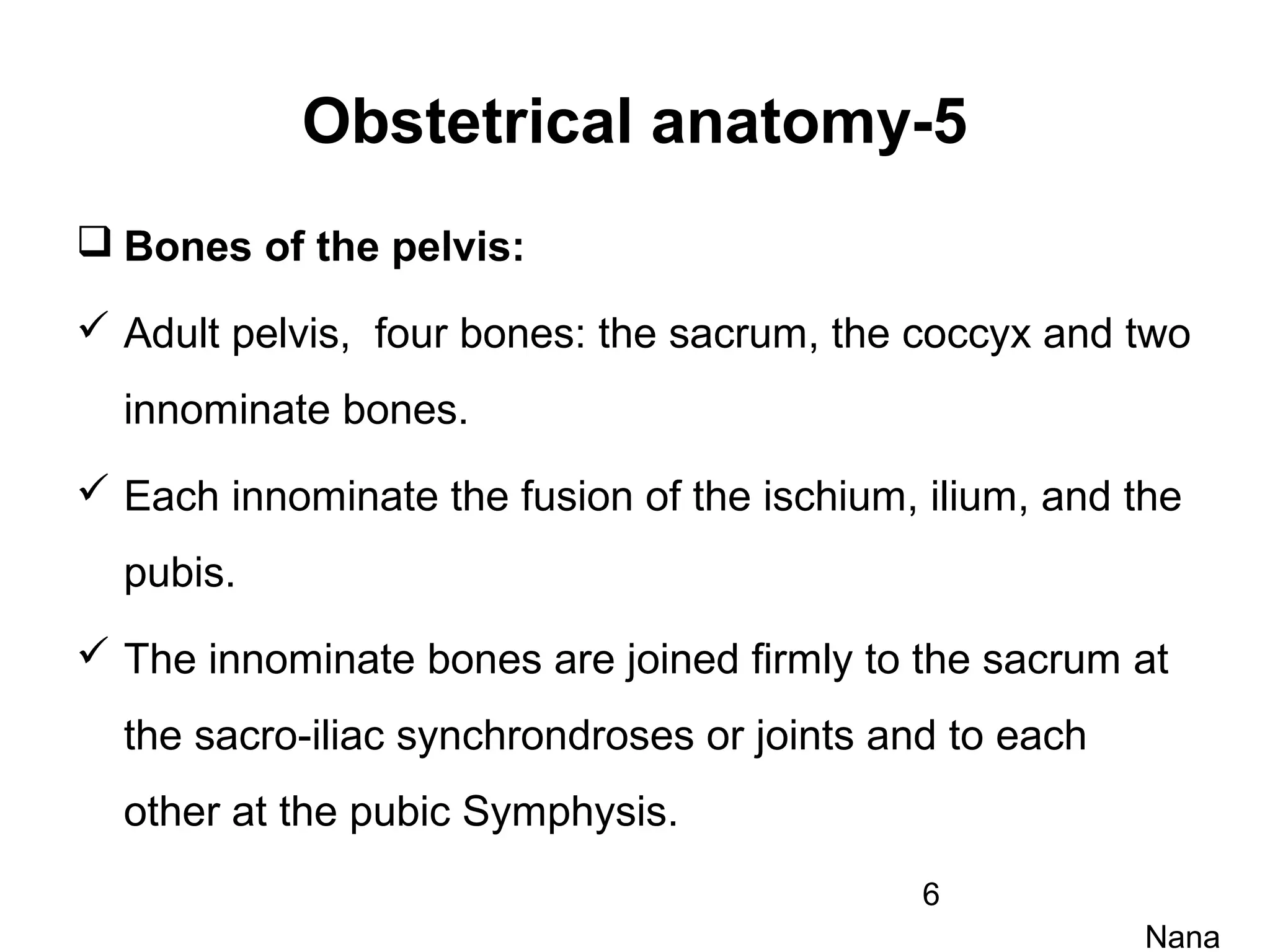
Obstetrical anatomy-5
 Bones of the pelvis:
 Adult pelvis, four bones: the sacrum, the coccyx and two
innominate bones.
 Each innominate the fusion of the ischium, ilium, and the
pubis.
 The innominate bones are joined firmly to the sacrum at
the sacro-iliac synchrondroses or joints and to each
other at the pubic Symphysis.
Nana
7
Obstetrical anatomy-6
 ILIUM runs between the anterior and posterior
superior iliac spines .
 Its inner surface bears the large auricular
surface which articulates with the sacrum.
The ileopectinal line runs forward from the apex
of the auricular surface and demarcates the true
from false pelvis.
8
Obstetrical anatomy-7
 PUBIS comprises the body and inferior pubic rami.
 ISCHIUM:
 Bears the ischial spine on its posterior border which
demarcates an upper (greater) and lower (lesser) sciatic
notch.
 Inferior pole of the bone bears the ischial tuberosity, then
projects forward almost at right angle into the ischial
ramus to meet the inferior pubic ramus.
9
Obstetrical anatomy-8
 The obturator foramen lies bounded by the body and
rami of the pubis and the body and ramus of the ischium.
o All three bones fuse at the acetabulum, forming the
socket for the femoral head.
o Pelvis tilted in the erect position, plane of its inlet is at an
angle of 60° to the horizontal.
Nana
10
Obstetrical anatomy-9
 SACRUM:
 Made up of five fused vertebrae.
 It is roughly triangular in shape.
 Upper part of the anterior border is called sacral
promontory.
 Anterior aspect presents a central mass, and a row of
four anterior sacral foramina.
 Lateral to the foramina are the lateral masses.
 Posteriorly lies the sacral canal, a continuation of the
vertebral canal.
11
Obstetrical anatomy-10
 Inferiorly the canal terminates in the sacral hiatus, which
transmits the 5th
sacral nerve.
 Lateral aspect, the sacrum presents the articular facet
for articulation with the corresponding ilium.
• 5th
lumbar vertebrae may occasionally fuse in part or
whole with the sacrum or 1st
sacral segment wholly or
partially separated from the rest of sacrum.
• Dura sheath terminates distally at the second piece of
the sacrum. Beyond the sacral canal contains fatty tissue
of the extra dural space and the nerve filaments of the
filum terminale.
Nana
12
Obstetrical anatomy-11
• COCCYX: 3-5 fused vertebrae,
articulating with sacrum. Occasionally
the 1st
segment remains separate.
13
Obstetrical anatomy-12
 JOINTS:
 Symphysis pubis, joint between the pubic bones.
 Each pubic bone, covered by a layer of hyaline cartilage,
connected across the mid-line by a dense layer of
fibrocartilage.
 Joint surrounded and strengthened by fibrous ligaments
above and below especially.
 Sacro-iliac joints: Joint between the auricular surfaces
of the sacrum and ilium.
Nana
14
Obstetrical anatomy-13
The sacrum hangs from these joints supported
by the dense sacro-iliac ligaments.
 These are the strongest ligaments in the body
and supports the whole weight of the body.
Their action assisted by an interlocking of the
grooves between the articular surfaces of the
sacrum and coccyx
15
Obstetrical anatomy-14
 Ligaments of the pelvis:
 Sacrospinous ligament passes from the ischial spine to
the side of the sacrum and coccyx.
 Sacrotuberous ligament passes from the ischial
tuberosity to the side of the sacrum and coccyx.
• These two ligaments help to define two important exits
from the pelvis: the greater sciatic foramen formed by
the sacrospinous ligament and the greater sciatic notch,
the lesser sciatic foramen formed by the sacrotuberous
ligament and the lesser sciatic notch.
Nana
16
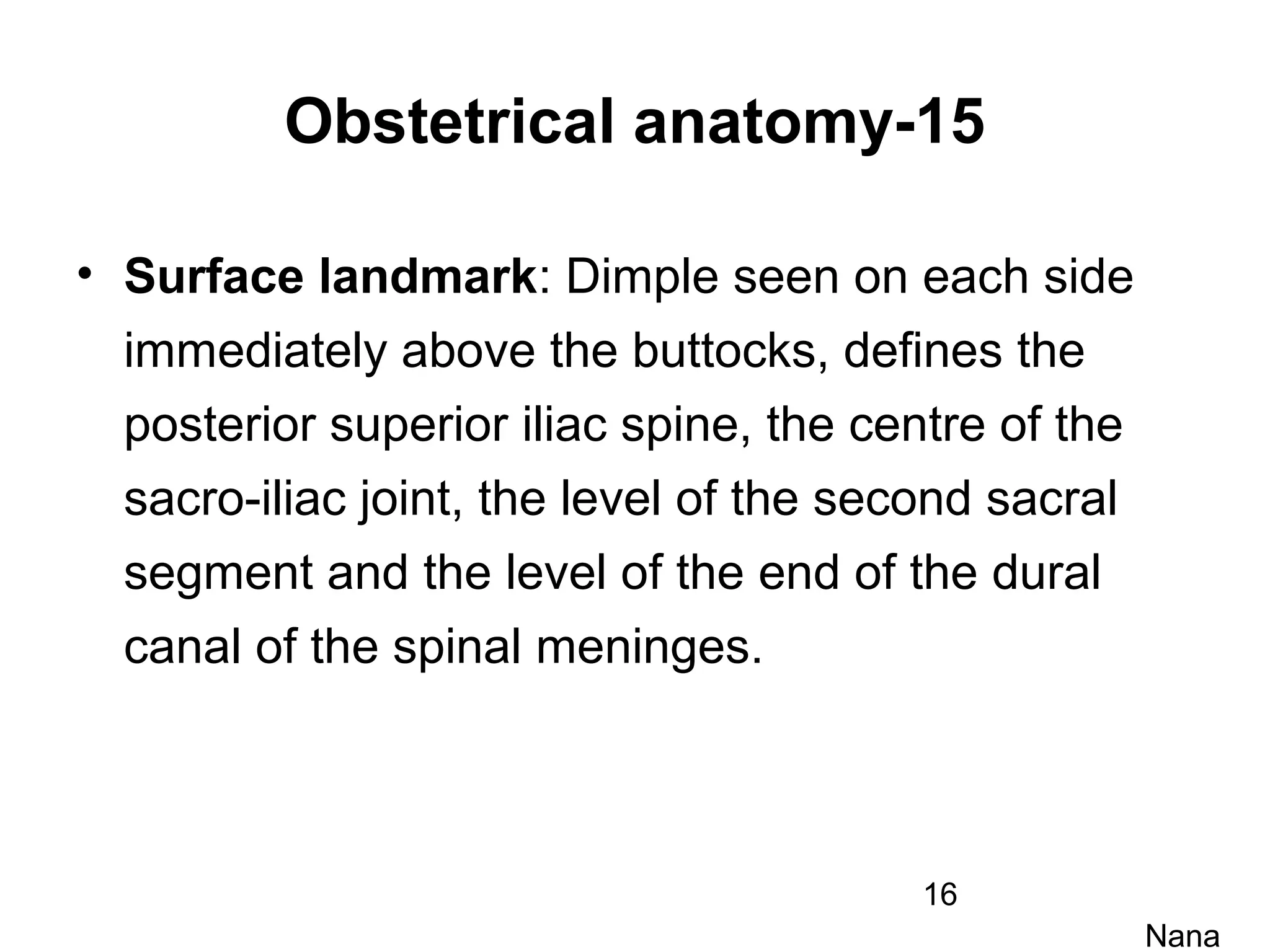
Obstetrical anatomy-15
• Surface landmark: Dimple seen on each side
immediately above the buttocks, defines the
posterior superior iliac spine, the centre of the
sacro-iliac joint, the level of the second sacral
segment and the level of the end of the dural
canal of the spinal meninges.
Nana
17
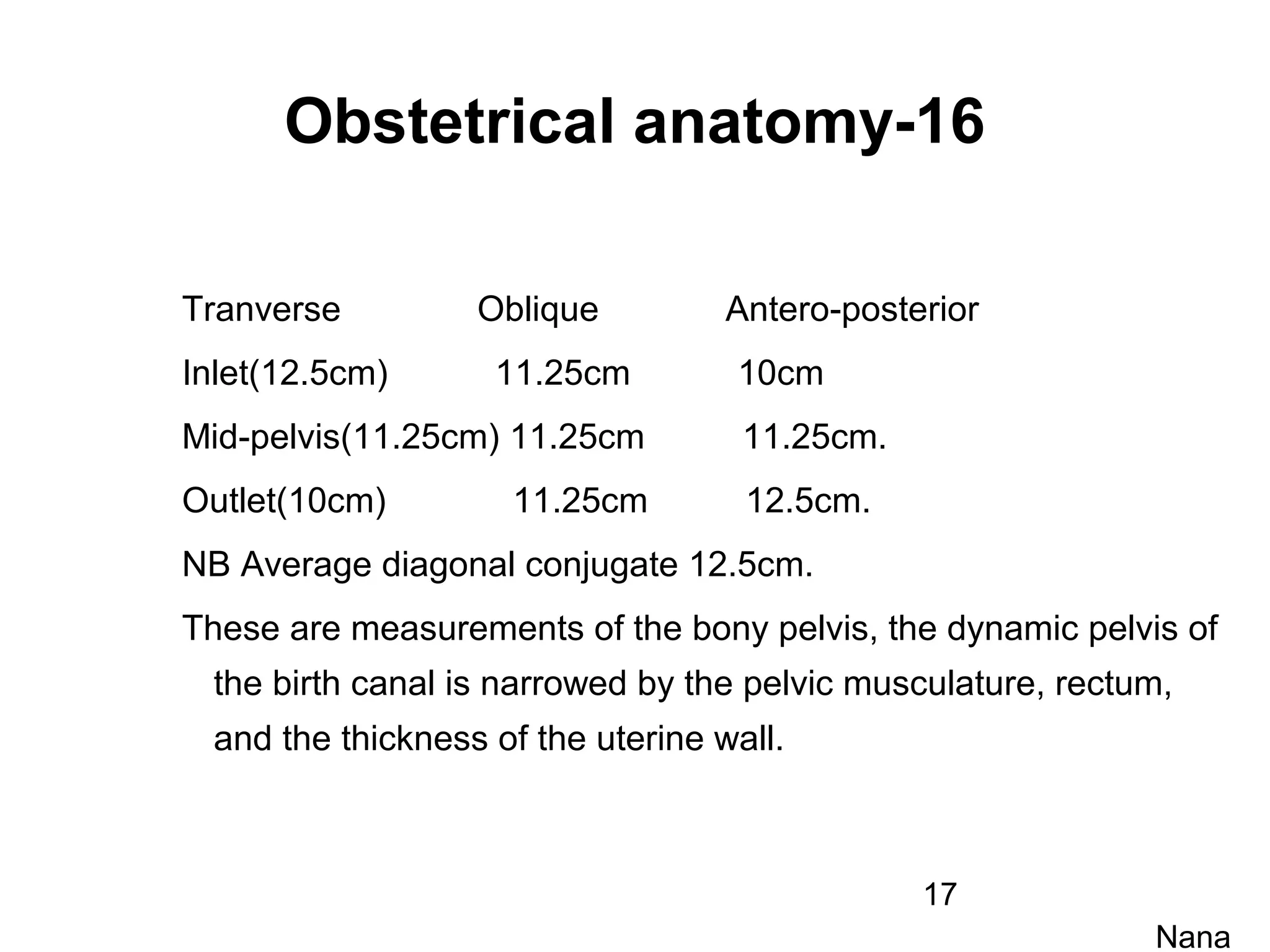
Obstetrical anatomy-16
Tranverse Oblique Antero-posterior
Inlet(12.5cm) 11.25cm 10cm
Mid-pelvis(11.25cm) 11.25cm 11.25cm.
Outlet(10cm) 11.25cm 12.5cm.
NB Average diagonal conjugate 12.5cm.
These are measurements of the bony pelvis, the dynamic pelvis of
the birth canal is narrowed by the pelvic musculature, rectum,
and the thickness of the uterine wall.
Nana
18
Obstetrical anatomy-17
The female pelvic shapes may be subdivided (after Caldwell and
Moloy) as follows.
 The normal and its variants:
 Gynaecoid- normal
 Android- the male type of pelvis
 Platypelloid-shortened in the A-P diameter ,increased in the
transverse diameter (the non rachitic flat pelvis).
 Anthropoid-Resembling that of an anthropoid ape with A-P
lengthened and transverse shortened
Nana
19
Obstetrical anatomy-18
 Symmetrically contracted pelvis.
 The rachitic flat pelvis.
 The asymmetrical pelvis ( scoliosis, congenital
dislocation, Naegele pelvis which is congenital absence
of one wing of sacrum or its destruction by disease.
NB Fractures of the pelvis may lead to a varied
complication including bone deformity and soft tissue
injuries.
Nana
20
Obstetrical anatomy-19
 Conclusion:
• Obstetrical pelvis, evaluated at 36 weeks, clinically, then
by radio-scan or radio-pelvimetry.
• Permits determination of adequate, borderline or a
contracted pelvis.
• Helps determine mode of delivery, essential before trial
of scar or pelvis.
• However, pelvic gift,cannot be evaluated without uterine
contractions.
Nana

M2 2009 obstetrical anatomy (3)

  • 1.
    1 Obstetrical Anatomy M2 2009 Pr.Fomulu / Dr. Nana 27/04/09
  • 2.
    2 Obstetrical anatomy-1  Plan Introduction- Definition  Objectives:  General:  Student should be able to correctly examine the pelvis at term, identify the different types of pelvises and determine mode of delivery. Nana
  • 3.
    3 Obstetrical anatomy-2  Specific: Name the bones of the bony pelvis.  Name the major joints and ligaments of the pelvis.  Discuss the functions of the pelvis.  Discuss the obstetrical pelvic measurements.  Describe the variations of the pelvic shape.  Discuss some clinical features associated with the bony pelvis. Nana
  • 4.
    4 Obstetrical anatomy-3  Definition: •Bony structure, also called pelvic girdle. • Above it supports the vertebral column. • Below it recieves the lower limbs, through the acetabulum cavity. • It consist of a true and false pelvis, has the following functions. Nana
  • 5.
    5 Obstetrical anatomy-4  Functionsof the pelvis:  It protects the pelvis viscera.  Protects the weight of the body, transmitted through vertebrae, sacrum, sacro-iliac joints, the pelvic bones, the femur( standing), ischial tuberosities (sitting).  Permits walking by a rotatory movement at the lumbo- sacral articulation.  Provides attachments for muscles.  In the female provides bony support for the birth canal.
  • 6.
    6 Obstetrical anatomy-5  Bonesof the pelvis:  Adult pelvis, four bones: the sacrum, the coccyx and two innominate bones.  Each innominate the fusion of the ischium, ilium, and the pubis.  The innominate bones are joined firmly to the sacrum at the sacro-iliac synchrondroses or joints and to each other at the pubic Symphysis. Nana
  • 7.
    7 Obstetrical anatomy-6  ILIUMruns between the anterior and posterior superior iliac spines .  Its inner surface bears the large auricular surface which articulates with the sacrum. The ileopectinal line runs forward from the apex of the auricular surface and demarcates the true from false pelvis.
  • 8.
    8 Obstetrical anatomy-7  PUBIScomprises the body and inferior pubic rami.  ISCHIUM:  Bears the ischial spine on its posterior border which demarcates an upper (greater) and lower (lesser) sciatic notch.  Inferior pole of the bone bears the ischial tuberosity, then projects forward almost at right angle into the ischial ramus to meet the inferior pubic ramus.
  • 9.
    9 Obstetrical anatomy-8  Theobturator foramen lies bounded by the body and rami of the pubis and the body and ramus of the ischium. o All three bones fuse at the acetabulum, forming the socket for the femoral head. o Pelvis tilted in the erect position, plane of its inlet is at an angle of 60° to the horizontal. Nana
  • 10.
    10 Obstetrical anatomy-9  SACRUM: Made up of five fused vertebrae.  It is roughly triangular in shape.  Upper part of the anterior border is called sacral promontory.  Anterior aspect presents a central mass, and a row of four anterior sacral foramina.  Lateral to the foramina are the lateral masses.  Posteriorly lies the sacral canal, a continuation of the vertebral canal.
  • 11.
    11 Obstetrical anatomy-10  Inferiorlythe canal terminates in the sacral hiatus, which transmits the 5th sacral nerve.  Lateral aspect, the sacrum presents the articular facet for articulation with the corresponding ilium. • 5th lumbar vertebrae may occasionally fuse in part or whole with the sacrum or 1st sacral segment wholly or partially separated from the rest of sacrum. • Dura sheath terminates distally at the second piece of the sacrum. Beyond the sacral canal contains fatty tissue of the extra dural space and the nerve filaments of the filum terminale. Nana
  • 12.
    12 Obstetrical anatomy-11 • COCCYX:3-5 fused vertebrae, articulating with sacrum. Occasionally the 1st segment remains separate.
  • 13.
    13 Obstetrical anatomy-12  JOINTS: Symphysis pubis, joint between the pubic bones.  Each pubic bone, covered by a layer of hyaline cartilage, connected across the mid-line by a dense layer of fibrocartilage.  Joint surrounded and strengthened by fibrous ligaments above and below especially.  Sacro-iliac joints: Joint between the auricular surfaces of the sacrum and ilium. Nana
  • 14.
    14 Obstetrical anatomy-13 The sacrumhangs from these joints supported by the dense sacro-iliac ligaments.  These are the strongest ligaments in the body and supports the whole weight of the body. Their action assisted by an interlocking of the grooves between the articular surfaces of the sacrum and coccyx
  • 15.
    15 Obstetrical anatomy-14  Ligamentsof the pelvis:  Sacrospinous ligament passes from the ischial spine to the side of the sacrum and coccyx.  Sacrotuberous ligament passes from the ischial tuberosity to the side of the sacrum and coccyx. • These two ligaments help to define two important exits from the pelvis: the greater sciatic foramen formed by the sacrospinous ligament and the greater sciatic notch, the lesser sciatic foramen formed by the sacrotuberous ligament and the lesser sciatic notch. Nana
  • 16.
    16 Obstetrical anatomy-15 • Surfacelandmark: Dimple seen on each side immediately above the buttocks, defines the posterior superior iliac spine, the centre of the sacro-iliac joint, the level of the second sacral segment and the level of the end of the dural canal of the spinal meninges. Nana
  • 17.
    17 Obstetrical anatomy-16 Tranverse ObliqueAntero-posterior Inlet(12.5cm) 11.25cm 10cm Mid-pelvis(11.25cm) 11.25cm 11.25cm. Outlet(10cm) 11.25cm 12.5cm. NB Average diagonal conjugate 12.5cm. These are measurements of the bony pelvis, the dynamic pelvis of the birth canal is narrowed by the pelvic musculature, rectum, and the thickness of the uterine wall. Nana
  • 18.
    18 Obstetrical anatomy-17 The femalepelvic shapes may be subdivided (after Caldwell and Moloy) as follows.  The normal and its variants:  Gynaecoid- normal  Android- the male type of pelvis  Platypelloid-shortened in the A-P diameter ,increased in the transverse diameter (the non rachitic flat pelvis).  Anthropoid-Resembling that of an anthropoid ape with A-P lengthened and transverse shortened Nana
  • 19.
    19 Obstetrical anatomy-18  Symmetricallycontracted pelvis.  The rachitic flat pelvis.  The asymmetrical pelvis ( scoliosis, congenital dislocation, Naegele pelvis which is congenital absence of one wing of sacrum or its destruction by disease. NB Fractures of the pelvis may lead to a varied complication including bone deformity and soft tissue injuries. Nana
  • 20.
    20 Obstetrical anatomy-19  Conclusion: •Obstetrical pelvis, evaluated at 36 weeks, clinically, then by radio-scan or radio-pelvimetry. • Permits determination of adequate, borderline or a contracted pelvis. • Helps determine mode of delivery, essential before trial of scar or pelvis. • However, pelvic gift,cannot be evaluated without uterine contractions. Nana