
Leadership across cultureDongWoo, Carlos, Warren
Leadership Across CulturesFoundation for LeadershipLeadership in the International ContextRecent Findings and Insights About LeadershipCase: An Offer from Down Under
Foundation for LeadershipWhat is leadership???
Foundation for LeadershipLeadership: The process of influencing people to direct their efforts toward the achievement of some particular goal or goals.
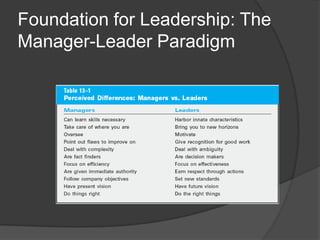
Foundation for Leadership: The Manager-Leader Paradigm
Foundation for Leadership: The Manager-Leader ParadigmWhat cultures would be the most likely to perceive differences between managerial and leadership duties? What cultures would view them as the same? Use evidence to support your answer.
Foundation for Leadership: Philosophical BackgroundTheory X managerBelieves that people are basically lazy and that coercion and threats of punishment often are necessary to get them to work.
Foundation for Leadership: Philosophical BackgroundTheory Y managerBelieves that under the right conditions people not only will work hard but will seek increased responsibility and challenge.
Foundation for Leadership: Philosophical BackgroundTheory Z managerBelieves that workers seek opportunities to participate in management and are motivated by teamwork and responsibility sharing.
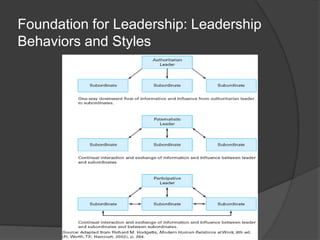
Foundation for Leadership: Leadership Behaviors and Styles
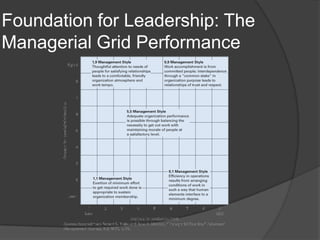
Foundation for Leadership: The Managerial Grid Performance
Four areas relevant to leadershipCapacity for Leadership and Initiative- Theory X or YSharing Information and Objectives- Leader-Subordinate Interactions (Figure 13-1)ParticipationInternal or External Control(External: Reward, Punishment)
DiscussionIs there any relationship between company size and European managers’ attitude toward participative leadership style?There was more support among manager in small firms than in large ones regarding the belief that individuals have a capacity for leadership and initiativeHowever, respondent from larger firms were more supportive of sharing information and objectives, participation, and use of internal control.
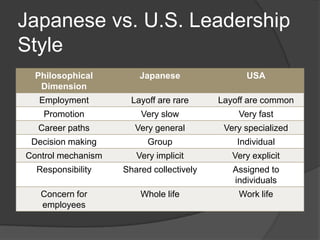
Japanese vs. U.S. Leadership Style
Another DifferenceVariety Amplification	Japanese executives are taught and tend to use variety amplification – the creation of uncertainty and the analysis of many alternatives regarding future actionVariety Reduction 	U.S. executives are taught and tend to use variety reduction – the limiting of uncertainty and the focusing of action on a limited number of alternatives
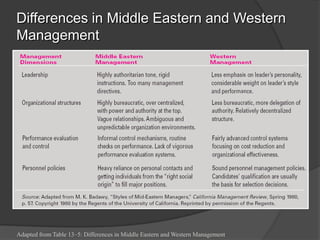
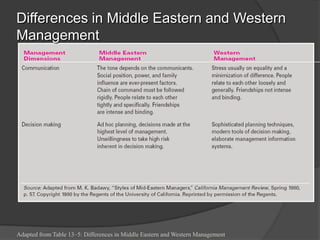
Differences in Middle Eastern and Western ManagementAdapted from Table 13–5: Differences in Middle Eastern and Western Management
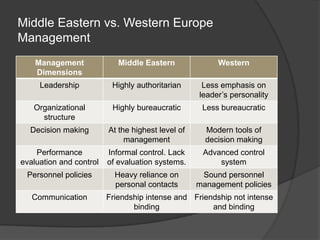
Middle Eastern vs. Western Europe Management
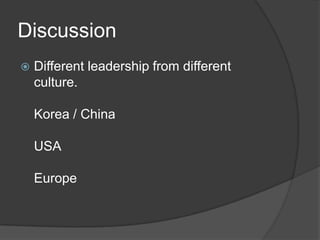
DiscussionDifferent leadership from different culture.Korea / ChinaUSAEurope
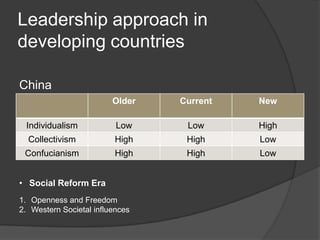
Leadership approach in developing countriesChinaSocial Reform EraOpenness and FreedomWestern Societal influences
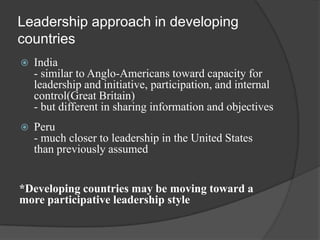
Leadership approach in developing countriesIndia - similar to Anglo-Americans toward capacity for leadership and initiative, participation, and internal control(Great Britain)- but different in sharing information and objectivesPeru - much closer to leadership in the United States than previously assumed*Developing countries may be moving toward a more participative leadership style
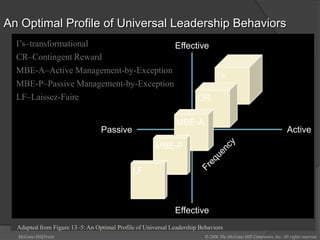
EffectiveActivePassiveEffectiveAn Optimal Profile of Universal Leadership BehaviorsI’s–transformationalCR–Contingent RewardMBE-A–Active Management-by-ExceptionMBE-P–Passive Management-by-ExceptionLF–Laissez-FaireI’sCRMBE-AMBE-PFrequencyLFAdapted from Figure 13–5: An Optimal Profile of Universal Leadership BehaviorsMcGraw-Hill/Irwin© 2006 The McGraw-Hill Companies, Inc. All rights reserved.
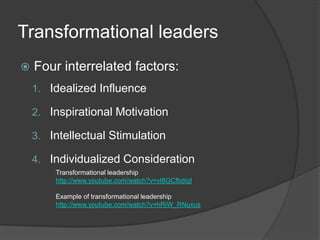
Transformational leadersFour interrelated factors:Idealized InfluenceInspirational MotivationIntellectual StimulationIndividualized ConsiderationTransformational leadershiphttp://www.youtube.com/watch?v=vI8GCfbdigIExample of transformational leadershiphttp://www.youtube.com/watch?v=hRiW_RNuxus
ExerciseRole Playing	: Manage your employees who is constantly late for meetings.
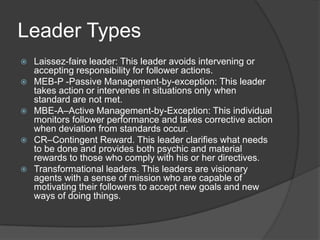
Leader TypesLaissez-faire leader: This leader avoids intervening or accepting responsibility for follower actions. MEB-P -Passive Management-by-exception: This leader takes action or intervenes in situations only when standard are not met. MBE-A–Active Management-by-Exception: This individual monitors follower performance and takes corrective action when deviation from standards occur. CR–Contingent Reward. This leader clarifies what needs to be done and provides both psychic and material rewards to those who comply with his or her directives. Transformational leaders. This leaders are visionary agents with a sense of mission who are capable of motivating their followers to accept new goals and new ways of doing things.
Discuss Is effective leadership behavior universal, or does it vary from culture to culture?
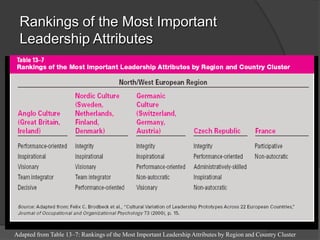
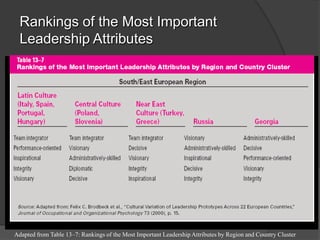
Rankings of the Most Important Leadership AttributesAdapted from Table 13–7: Rankings of the Most Important Leadership Attributes by Region and Country Cluster
Authentic LeadershipFour distinct characteristics of authentic leadersThey do not fake their actionsThey are driven from internal forces (not external rewards)They are unique and guide based on personal beliefs, not other’s ordersThey act based on individual passion and values
Discuss	How are authentic leaders different from transformational leaders?
An Offer from Down UnderGandriff Corp. is a successful retail chain in the Midwest. Wants to expand!Australian investors offer $100 million to help set up down under. Operations will be run by Gandriff.Gandriff thinks Europe will have better growth.Australians offer another $100m if Australia if first.
An Offer from Down UnderWill the leadership style used in the United States be successful in Australia, or will the Australians respond better to another?If the retailer goes into Europe, in which country will it have the least problem using its U.S.-based leadership style? Why?If the company goes into Europe, what changes might it have to make in accommodating its leadership approach to the local environment? Use Germany as an example.
Leadership Across CulturesAny questions?

M12

  • 1.
  • 2.
    Leadership Across CulturesFoundationfor LeadershipLeadership in the International ContextRecent Findings and Insights About LeadershipCase: An Offer from Down Under
  • 3.
  • 4.
    Foundation for LeadershipLeadership:The process of influencing people to direct their efforts toward the achievement of some particular goal or goals.
  • 5.
    Foundation for Leadership:The Manager-Leader Paradigm
  • 6.
    Foundation for Leadership:The Manager-Leader Paradigm
  • 7.
    Foundation for Leadership:The Manager-Leader ParadigmWhat cultures would be the most likely to perceive differences between managerial and leadership duties? What cultures would view them as the same? Use evidence to support your answer.
  • 8.
    Foundation for Leadership:Philosophical BackgroundTheory X managerBelieves that people are basically lazy and that coercion and threats of punishment often are necessary to get them to work.
  • 9.
    Foundation for Leadership:Philosophical BackgroundTheory Y managerBelieves that under the right conditions people not only will work hard but will seek increased responsibility and challenge.
  • 10.
    Foundation for Leadership:Philosophical BackgroundTheory Z managerBelieves that workers seek opportunities to participate in management and are motivated by teamwork and responsibility sharing.
  • 11.
    Foundation for Leadership:Leadership Behaviors and Styles
  • 12.
    Foundation for Leadership:The Managerial Grid Performance
  • 13.
    Four areas relevantto leadershipCapacity for Leadership and Initiative- Theory X or YSharing Information and Objectives- Leader-Subordinate Interactions (Figure 13-1)ParticipationInternal or External Control(External: Reward, Punishment)
  • 14.
    DiscussionIs there anyrelationship between company size and European managers’ attitude toward participative leadership style?There was more support among manager in small firms than in large ones regarding the belief that individuals have a capacity for leadership and initiativeHowever, respondent from larger firms were more supportive of sharing information and objectives, participation, and use of internal control.
  • 15.
    Japanese vs. U.S.Leadership Style
  • 16.
    Another DifferenceVariety Amplification Japaneseexecutives are taught and tend to use variety amplification – the creation of uncertainty and the analysis of many alternatives regarding future actionVariety Reduction U.S. executives are taught and tend to use variety reduction – the limiting of uncertainty and the focusing of action on a limited number of alternatives
  • 17.
    Differences in MiddleEastern and Western ManagementAdapted from Table 13–5: Differences in Middle Eastern and Western Management
  • 18.
    Differences in MiddleEastern and Western ManagementAdapted from Table 13–5: Differences in Middle Eastern and Western Management
  • 19.
    Middle Eastern vs.Western Europe Management
  • 20.
    DiscussionDifferent leadership fromdifferent culture.Korea / ChinaUSAEurope
  • 21.
    Leadership approach indeveloping countriesChinaSocial Reform EraOpenness and FreedomWestern Societal influences
  • 22.
    Leadership approach indeveloping countriesIndia - similar to Anglo-Americans toward capacity for leadership and initiative, participation, and internal control(Great Britain)- but different in sharing information and objectivesPeru - much closer to leadership in the United States than previously assumed*Developing countries may be moving toward a more participative leadership style
  • 23.
    EffectiveActivePassiveEffectiveAn Optimal Profileof Universal Leadership BehaviorsI’s–transformationalCR–Contingent RewardMBE-A–Active Management-by-ExceptionMBE-P–Passive Management-by-ExceptionLF–Laissez-FaireI’sCRMBE-AMBE-PFrequencyLFAdapted from Figure 13–5: An Optimal Profile of Universal Leadership BehaviorsMcGraw-Hill/Irwin© 2006 The McGraw-Hill Companies, Inc. All rights reserved.
  • 24.
    Transformational leadersFour interrelatedfactors:Idealized InfluenceInspirational MotivationIntellectual StimulationIndividualized ConsiderationTransformational leadershiphttp://www.youtube.com/watch?v=vI8GCfbdigIExample of transformational leadershiphttp://www.youtube.com/watch?v=hRiW_RNuxus
  • 25.
    ExerciseRole Playing : Manageyour employees who is constantly late for meetings.
  • 26.
    Leader TypesLaissez-faire leader:This leader avoids intervening or accepting responsibility for follower actions. MEB-P -Passive Management-by-exception: This leader takes action or intervenes in situations only when standard are not met. MBE-A–Active Management-by-Exception: This individual monitors follower performance and takes corrective action when deviation from standards occur. CR–Contingent Reward. This leader clarifies what needs to be done and provides both psychic and material rewards to those who comply with his or her directives. Transformational leaders. This leaders are visionary agents with a sense of mission who are capable of motivating their followers to accept new goals and new ways of doing things.
  • 27.
    Discuss Is effectiveleadership behavior universal, or does it vary from culture to culture?
  • 28.
    Rankings of theMost Important Leadership AttributesAdapted from Table 13–7: Rankings of the Most Important Leadership Attributes by Region and Country Cluster
  • 29.
    Rankings of theMost Important Leadership AttributesAdapted from Table 13–7: Rankings of the Most Important Leadership Attributes by Region and Country Cluster
  • 30.
    Authentic LeadershipFour distinctcharacteristics of authentic leadersThey do not fake their actionsThey are driven from internal forces (not external rewards)They are unique and guide based on personal beliefs, not other’s ordersThey act based on individual passion and values
  • 31.
    Discuss How are authenticleaders different from transformational leaders?
  • 32.
    An Offer fromDown UnderGandriff Corp. is a successful retail chain in the Midwest. Wants to expand!Australian investors offer $100 million to help set up down under. Operations will be run by Gandriff.Gandriff thinks Europe will have better growth.Australians offer another $100m if Australia if first.
  • 33.
    An Offer fromDown UnderWill the leadership style used in the United States be successful in Australia, or will the Australians respond better to another?If the retailer goes into Europe, in which country will it have the least problem using its U.S.-based leadership style? Why?If the company goes into Europe, what changes might it have to make in accommodating its leadership approach to the local environment? Use Germany as an example.
  • 34.

Editor's Notes

  • #29 453PThis table shows that effective leader behaviors tend to vary by cultural cluster. While there are similarities between some of the cultures, none of the lists of leadership attributes is identical.