TOEIC® Upgrade
Contents
Introduction to TOEIC® Upgrade
• Overview
• Why TOEIC® Upgrade?
• The New TOEIC®
Student Book Walkthrough
• General features
• Additional features
• Practice Test
Teachers Materials
Overview
• Developed by the Educational Testing Service (ETS), the TOEIC® is used worldwide to assess
the proficiency of English-language learners. TOEIC® scores are a strong pre-requisite that
corporations, universities, and governments rely on to measure an individual’s English-
language skills.
• The test is divided into two sections: Listening Comprehension (Parts 1 through 4) and
Reading (parts 5 through 7).
• The TOEIC® is a test of general English ability. While much of the test focuses on the use of
English at work (as well as in other everyday situations), its content is not specialized for any
particular field. All of the directions and questions are given in English.
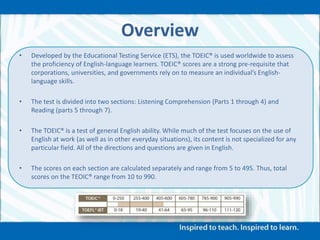
• The scores on each section are calculated separately and range from 5 to 495. Thus, total
scores on the TEOIC® range from 10 to 990.
Why TOEIC® Upgrade?
TOEIC® Upgrade is a comprehensive, up-to-date guide to the language and test-taking skills
needed to maximize your score on the TOEIC®. It includes clear examples and explanations of
each question type that appears on the test, as well as systematic practice exercises for each.
TOEIC® Upgrade is one of the first test-prep books to provide full information about recent
changes to the TOEIC® format. Learners will also benefit from the numerous test-taking tips that
appear throughout the book as well as three complete downloadable practice tests that
accompany it. (One test is available to students, and two more are available to educators). TOEIC®
Upgrade comes with an answer key and complete transcript of all listening exercises and tests.
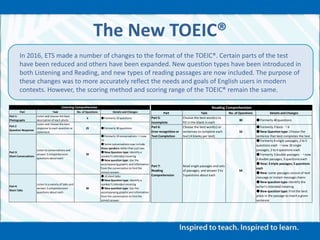
The New TOEIC®
Part Task No. of Questions Details and Changes
Part 1:
Photographs
Listen and choose the best
description of each photo
6 ● Formerly 10 questions
Part 2
Question-Response
Listen and choose the best
response to each question or
statement
25 ● Formerly 30 questions
Part 3:
Short Conversations
Listen to conversations and
answer 3 comprehension
questions about each
39
● Formerly 10 conversations → now
13
● Some conversations now include
three speakers rather than just two
● New Question type: Identify a
speaker's intended meaning
● New question type: Use the
accompanying graphic and information
from the conversation to find the
correct answer
Part 4:
Short Talks
Listen to a variety of talks and
asnwer 3 comprehension
questions about each
30
● 10 short talks
● New Question type: Identify a
speaker's intended meaning
● New question type: Use the
accompanying graphic and information
from the conversation to find the
correct answer
Listening Comprehension
Part Task No. of Questions Details and Changes
Part 5:
Incomplete
Choose the best word(s) to
fill in the blank in each
30 ● Formerly 40 questions
Part 6:
Error recognition or
Text Completion
Choose the best word(s) or
sentences to complete each
text (4 blanks per text)
16
● Formerly 3 texts →4
● New Question type: Choose the
sentence that best completes the text
Part 7:
Reading
Comprehension
Read single passages and sets
of passages, and answer 2 to
5 questions about each
54
● Formerly 9 single passages, 2 to 5
questions each →now 10 single
passages, 2 to 4 questions each
● Formerly 3 double passages →now
2 double passages, 5 questions each
● New: 3 triple passages; 5 questions
each
● New: some passages consist of text
message or instant message chains
● New question type: Identify the
writer's intended meaning
● New question type: Find the best
place in the passage to insert a given
sentence
Reading Comprehension
In 2016, ETS made a number of changes to the format of the TOEIC®. Certain parts of the test
have been reduced and others have been expanded. New question types have been introduced in
both Listening and Reading, and new types of reading passages are now included. The purpose of
these changes was to more accurately reflect the needs and goals of English users in modern
contexts. However, the scoring method and scoring range of the TOEIC® remain the same.
Student Book
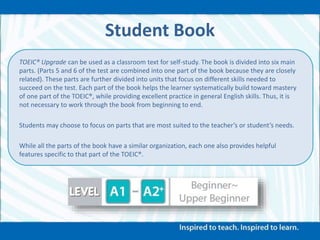
TOEIC® Upgrade can be used as a classroom text for self-study. The book is divided into six main
parts. (Parts 5 and 6 of the test are combined into one part of the book because they are closely
related). These parts are further divided into units that focus on different skills needed to
succeed on the test. Each part of the book helps the learner systematically build toward mastery
of one part of the TOEIC®, while providing excellent practice in general English skills. Thus, it is
not necessary to work through the book from beginning to end.
Students may choose to focus on parts that are most suited to the teacher’s or student’s needs.
While all the parts of the book have a similar organization, each one also provides helpful
features specific to that part of the TOEIC®.
General Features
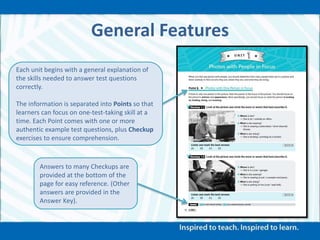
Each unit begins with a general explanation of
the skills needed to answer test questions
correctly.
The information is separated into Points so that
learners can focus on one-test-taking skill at a
time. Each Point comes with one or more
authentic example test questions, plus Checkup
exercises to ensure comprehension.
Answers to many Checkups are
provided at the bottom of the
page for easy reference. (Other
answers are provided in the
Answer Key).
General Features
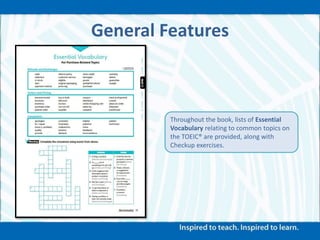
Throughout the book, lists of Essential
Vocabulary relating to common topics on
the TOEIC® are provided, along with
Checkup exercises.
General Features
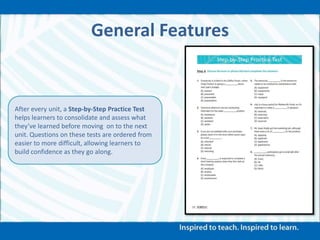
After every unit, a Step-by-Step Practice Test
helps learners to consolidate and assess what
they’ve learned before moving on to the next
unit. Questions on these tests are ordered from
easier to more difficult, allowing learners to
build confidence as they go along.
General Features
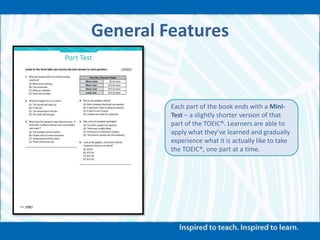
Each part of the book ends with a Mini-
Test – a slightly shorter version of that
part of the TOEIC®. Learners are able to
apply what they’ve learned and gradually
experience what it is actually like to take
the TOEIC®, one part at a time.
Additional Features
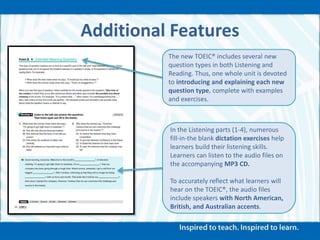
The new TOEIC® includes several new
question types in both Listening and
Reading. Thus, one whole unit is devoted
to introducing and explaining each new
question type, complete with examples
and exercises.
In the Listening parts (1-4), numerous
fill-in-the blank dictation exercises help
learners build their listening skills.
Learners can listen to the audio files on
the accompanying MP3 CD.
To accurately reflect what learners will
hear on the TOEIC®, the audio files
include speakers with North American,
British, and Australian accents.
Additional Features
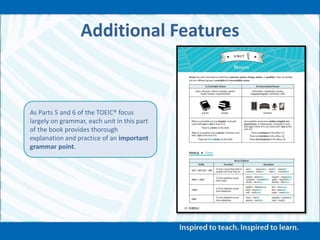
As Parts 5 and 6 of the TOEIC® focus
largely on grammar, each unit in this part
of the book provides thorough
explanation and practice of an important
grammar point.
Additional Features
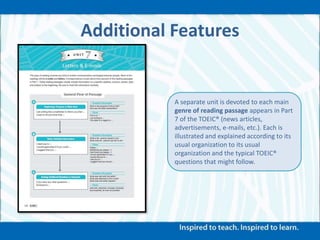
A separate unit is devoted to each main
genre of reading passage appears in Part
7 of the TOEIC® (news articles,
advertisements, e-mails, etc.). Each is
illustrated and explained according to its
usual organization to its usual
organization and the typical TOEIC®
questions that might follow.
Additional Features
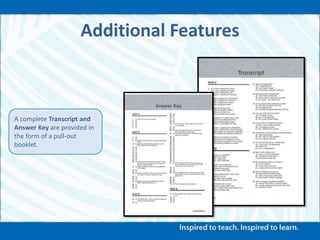
A complete Transcript and
Answer Key are provided in
the form of a pull-out
booklet.
Practice Test
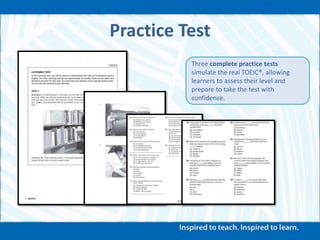
Three complete practice tests
simulate the real TOEIC®, allowing
learners to assess their level and
prepare to take the test with
confidence.
Teacher’s Materials
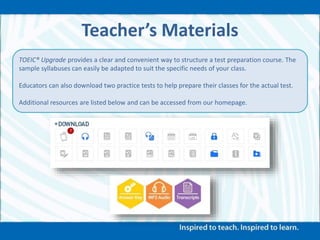
TOEIC® Upgrade provides a clear and convenient way to structure a test preparation course. The
sample syllabuses can easily be adapted to suit the specific needs of your class.
Educators can also download two practice tests to help prepare their classes for the actual test.
Additional resources are listed below and can be accessed from our homepage.
Thank You!
For information on this product
or other ELT materials, connect with us!
facebook.com/compasspublishing
@CompassELT
info@compasspub.com
compasspublishing
slideshare.net/CompassPublishing

TOEIC Upgrade - Walkthrough

  • 1.
  • 2.
    Contents Introduction to TOEIC®Upgrade • Overview • Why TOEIC® Upgrade? • The New TOEIC® Student Book Walkthrough • General features • Additional features • Practice Test Teachers Materials
  • 3.
    Overview • Developed bythe Educational Testing Service (ETS), the TOEIC® is used worldwide to assess the proficiency of English-language learners. TOEIC® scores are a strong pre-requisite that corporations, universities, and governments rely on to measure an individual’s English- language skills. • The test is divided into two sections: Listening Comprehension (Parts 1 through 4) and Reading (parts 5 through 7). • The TOEIC® is a test of general English ability. While much of the test focuses on the use of English at work (as well as in other everyday situations), its content is not specialized for any particular field. All of the directions and questions are given in English. • The scores on each section are calculated separately and range from 5 to 495. Thus, total scores on the TEOIC® range from 10 to 990.
  • 4.
    Why TOEIC® Upgrade? TOEIC®Upgrade is a comprehensive, up-to-date guide to the language and test-taking skills needed to maximize your score on the TOEIC®. It includes clear examples and explanations of each question type that appears on the test, as well as systematic practice exercises for each. TOEIC® Upgrade is one of the first test-prep books to provide full information about recent changes to the TOEIC® format. Learners will also benefit from the numerous test-taking tips that appear throughout the book as well as three complete downloadable practice tests that accompany it. (One test is available to students, and two more are available to educators). TOEIC® Upgrade comes with an answer key and complete transcript of all listening exercises and tests.
  • 5.
    The New TOEIC® PartTask No. of Questions Details and Changes Part 1: Photographs Listen and choose the best description of each photo 6 ● Formerly 10 questions Part 2 Question-Response Listen and choose the best response to each question or statement 25 ● Formerly 30 questions Part 3: Short Conversations Listen to conversations and answer 3 comprehension questions about each 39 ● Formerly 10 conversations → now 13 ● Some conversations now include three speakers rather than just two ● New Question type: Identify a speaker's intended meaning ● New question type: Use the accompanying graphic and information from the conversation to find the correct answer Part 4: Short Talks Listen to a variety of talks and asnwer 3 comprehension questions about each 30 ● 10 short talks ● New Question type: Identify a speaker's intended meaning ● New question type: Use the accompanying graphic and information from the conversation to find the correct answer Listening Comprehension Part Task No. of Questions Details and Changes Part 5: Incomplete Choose the best word(s) to fill in the blank in each 30 ● Formerly 40 questions Part 6: Error recognition or Text Completion Choose the best word(s) or sentences to complete each text (4 blanks per text) 16 ● Formerly 3 texts →4 ● New Question type: Choose the sentence that best completes the text Part 7: Reading Comprehension Read single passages and sets of passages, and answer 2 to 5 questions about each 54 ● Formerly 9 single passages, 2 to 5 questions each →now 10 single passages, 2 to 4 questions each ● Formerly 3 double passages →now 2 double passages, 5 questions each ● New: 3 triple passages; 5 questions each ● New: some passages consist of text message or instant message chains ● New question type: Identify the writer's intended meaning ● New question type: Find the best place in the passage to insert a given sentence Reading Comprehension In 2016, ETS made a number of changes to the format of the TOEIC®. Certain parts of the test have been reduced and others have been expanded. New question types have been introduced in both Listening and Reading, and new types of reading passages are now included. The purpose of these changes was to more accurately reflect the needs and goals of English users in modern contexts. However, the scoring method and scoring range of the TOEIC® remain the same.
  • 6.
    Student Book TOEIC® Upgradecan be used as a classroom text for self-study. The book is divided into six main parts. (Parts 5 and 6 of the test are combined into one part of the book because they are closely related). These parts are further divided into units that focus on different skills needed to succeed on the test. Each part of the book helps the learner systematically build toward mastery of one part of the TOEIC®, while providing excellent practice in general English skills. Thus, it is not necessary to work through the book from beginning to end. Students may choose to focus on parts that are most suited to the teacher’s or student’s needs. While all the parts of the book have a similar organization, each one also provides helpful features specific to that part of the TOEIC®.
  • 7.
    General Features Each unitbegins with a general explanation of the skills needed to answer test questions correctly. The information is separated into Points so that learners can focus on one-test-taking skill at a time. Each Point comes with one or more authentic example test questions, plus Checkup exercises to ensure comprehension. Answers to many Checkups are provided at the bottom of the page for easy reference. (Other answers are provided in the Answer Key).
  • 8.
    General Features Throughout thebook, lists of Essential Vocabulary relating to common topics on the TOEIC® are provided, along with Checkup exercises.
  • 9.
    General Features After everyunit, a Step-by-Step Practice Test helps learners to consolidate and assess what they’ve learned before moving on to the next unit. Questions on these tests are ordered from easier to more difficult, allowing learners to build confidence as they go along.
  • 10.
    General Features Each partof the book ends with a Mini- Test – a slightly shorter version of that part of the TOEIC®. Learners are able to apply what they’ve learned and gradually experience what it is actually like to take the TOEIC®, one part at a time.
  • 11.
    Additional Features The newTOEIC® includes several new question types in both Listening and Reading. Thus, one whole unit is devoted to introducing and explaining each new question type, complete with examples and exercises. In the Listening parts (1-4), numerous fill-in-the blank dictation exercises help learners build their listening skills. Learners can listen to the audio files on the accompanying MP3 CD. To accurately reflect what learners will hear on the TOEIC®, the audio files include speakers with North American, British, and Australian accents.
  • 12.
    Additional Features As Parts5 and 6 of the TOEIC® focus largely on grammar, each unit in this part of the book provides thorough explanation and practice of an important grammar point.
  • 13.
    Additional Features A separateunit is devoted to each main genre of reading passage appears in Part 7 of the TOEIC® (news articles, advertisements, e-mails, etc.). Each is illustrated and explained according to its usual organization to its usual organization and the typical TOEIC® questions that might follow.
  • 14.
    Additional Features A completeTranscript and Answer Key are provided in the form of a pull-out booklet.
  • 15.
    Practice Test Three completepractice tests simulate the real TOEIC®, allowing learners to assess their level and prepare to take the test with confidence.
  • 16.
    Teacher’s Materials TOEIC® Upgradeprovides a clear and convenient way to structure a test preparation course. The sample syllabuses can easily be adapted to suit the specific needs of your class. Educators can also download two practice tests to help prepare their classes for the actual test. Additional resources are listed below and can be accessed from our homepage.
  • 17.
    Thank You! For informationon this product or other ELT materials, connect with us! facebook.com/compasspublishing @CompassELT info@compasspub.com compasspublishing slideshare.net/CompassPublishing