Indian Milkweed – Asclepias eriocarpa (as-KLEP-ee-us air-ee-oh-CAR-puh)
Family: Asclepiadiceae (Milkweed family)
Native to: West Coast from WA to Baja CA; locally in Santa Monica & San Gabriel mountains &
foothills. Grows in colonies on plains, hills, and valleys, in summer-dry areas and along stream
sides, primarily in chaparral, oak woodland.
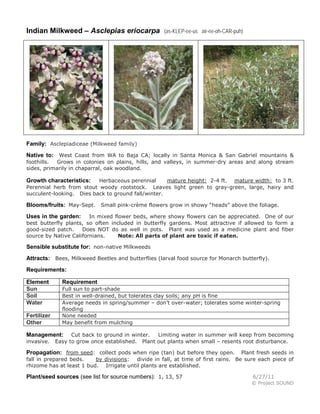
Growth characteristics: Herbaceous perennial mature height: 2-4 ft. mature width: to 3 ft.
Perennial herb from stout woody rootstock. Leaves light green to gray-green, large, hairy and
succulent-looking. Dies back to ground fall/winter.
Blooms/fruits: May-Sept. Small pink-crème flowers grow in showy “heads” above the foliage.
Uses in the garden: In mixed flower beds, where showy flowers can be appreciated. One of our
best butterfly plants, so often included in butterfly gardens. Most attractive if allowed to form a
good-sized patch. Does NOT do as well in pots. Plant was used as a medicine plant and fiber
source by Native Californians. Note: All parts of plant are toxic if eaten.
Sensible substitute for: non-native Milkweeds
Attracts: Bees, Milkweed Beetles and butterflies (larval food source for Monarch butterfly).
Requirements:
Element Requirement
Sun Full sun to part-shade
Soil Best in well-drained, but tolerates clay soils; any pH is fine
Water Average needs in spring/summer – don’t over-water; tolerates some winter-spring
flooding
Fertilizer None needed
Other May benefit from mulching
Management: Cut back to ground in winter. Limiting water in summer will keep from becoming
invasive. Easy to grow once established. Plant out plants when small – resents root disturbance.
Propagation: from seed: collect pods when ripe (tan) but before they open. Plant fresh seeds in
fall in prepared beds. by divisions: divide in fall, at time of first rains. Be sure each piece of
rhizome has at least 1 bud. Irrigate until plants are established.
Plant/seed sources (see list for source numbers): 1, 13, 57 6/27/11
© Project SOUND

Qm asclepias eriocarpa

  • 1.
    Indian Milkweed –Asclepias eriocarpa (as-KLEP-ee-us air-ee-oh-CAR-puh) Family: Asclepiadiceae (Milkweed family) Native to: West Coast from WA to Baja CA; locally in Santa Monica & San Gabriel mountains & foothills. Grows in colonies on plains, hills, and valleys, in summer-dry areas and along stream sides, primarily in chaparral, oak woodland. Growth characteristics: Herbaceous perennial mature height: 2-4 ft. mature width: to 3 ft. Perennial herb from stout woody rootstock. Leaves light green to gray-green, large, hairy and succulent-looking. Dies back to ground fall/winter. Blooms/fruits: May-Sept. Small pink-crème flowers grow in showy “heads” above the foliage. Uses in the garden: In mixed flower beds, where showy flowers can be appreciated. One of our best butterfly plants, so often included in butterfly gardens. Most attractive if allowed to form a good-sized patch. Does NOT do as well in pots. Plant was used as a medicine plant and fiber source by Native Californians. Note: All parts of plant are toxic if eaten. Sensible substitute for: non-native Milkweeds Attracts: Bees, Milkweed Beetles and butterflies (larval food source for Monarch butterfly). Requirements: Element Requirement Sun Full sun to part-shade Soil Best in well-drained, but tolerates clay soils; any pH is fine Water Average needs in spring/summer – don’t over-water; tolerates some winter-spring flooding Fertilizer None needed Other May benefit from mulching Management: Cut back to ground in winter. Limiting water in summer will keep from becoming invasive. Easy to grow once established. Plant out plants when small – resents root disturbance. Propagation: from seed: collect pods when ripe (tan) but before they open. Plant fresh seeds in fall in prepared beds. by divisions: divide in fall, at time of first rains. Be sure each piece of rhizome has at least 1 bud. Irrigate until plants are established. Plant/seed sources (see list for source numbers): 1, 13, 57 6/27/11 © Project SOUND