LUNG CANCER DETECTION USING DEEP
LEARNING
Presented by :
Vivek Kumar 2201320100193
Vishveshver 2201320100192
Vatsal Chaudhary 2201320100184
Submitted to:
Mr. Rakesh Raushan
Index
Title Page No.
1. Motivation for project 03
2. Introduction 04
3. Problem Statement 05
4. Tools Environment Used 06
5. Modules 08-10
6. E-R Diagram 11-12
7. Result & Scope 13-14
Motivation For Project
• The main motivation is to improve early detection and diagnosis of
lung cancer. The framework provides a critical tool for healthcare
professionals to identify lung cancer more accurately and efficiently
using deep learning technology.
• A Deep Learning-Based Lung Cancer Detection System has the
potential to enhance diagnostic accuracy, reduce mortality rates
through early detection, and transform the standard of care for
patients by integrating cutting-edge AI techniques into medical
imaging analysis.
Introduction
• This project focuses on developing a system that leverages deep learning
techniques to detect lung cancer from medical imaging with high
accuracy, aiming to improve early diagnosis and patient outcomes. By
utilizing advanced neural networks and image processing algorithms, the
system can analyze complex patterns in radiological scans.
• The system identifies and classifies abnormalities indicative of lung
cancer, providing healthcare professionals with a reliable diagnostic tool.
This solution seeks to enhance accessibility to accurate diagnosis, reduce
diagnostic errors, and support timely treatment, contributing to
improved survival rates and a higher standard of care in medical
environments.
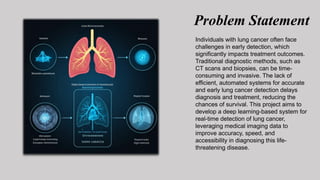
Problem Statement
Individuals with lung cancer often face
challenges in early detection, which
significantly impacts treatment outcomes.
Traditional diagnostic methods, such as
CT scans and biopsies, can be time-
consuming and invasive. The lack of
efficient, automated systems for accurate
and early lung cancer detection delays
diagnosis and treatment, reducing the
chances of survival. This project aims to
develop a deep learning-based system for
real-time detection of lung cancer,
leveraging medical imaging data to
improve accuracy, speed, and
accessibility in diagnosing this life-
threatening disease.
Tools/Environment Used
• Programming Languages: Python, R.
• Frameworks:
1. Tensor Flow
2. Pytorch
3. Keras
• Development Environment:
1. Jupyter Notebook
2. Pycharm
3. Visual Studio Code
• Data Handling and Visualization:
1. Pandas (library for data analysis)
2. Matplotlib and Seaborn
• Version Control:
1. Git (for source code management)
2. Docker
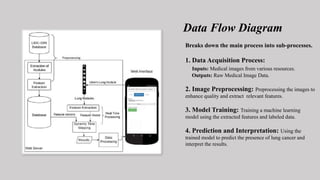
Data Flow Diagram
Breaks down the main process into sub-processes.
1. Data Acquisition Process:
Inputs: Medical images from various resources.
Outputs: Raw Medical Image Data.
2. Image Preprocessing: Preprocessing the images to
enhance quality and extract relevant features.
3. Model Training: Training a machine learning
model using the extracted features and labeled data.
4. Prediction and Interpretation: Using the
trained model to predict the presence of lung cancer and
interpret the results.
Modules
1. Data Acquisition:
This initial stage involves gathering a
substantial and diverse dataset of medical
images (e.g., CT scans, X-rays) from
various sources such as hospitals,
research institutions, and public
repositories. The dataset should include
both cancerous and non-cancerous cases
for effective model training.
2. Data Preprocessing and feature extraction:
This crucial step involves preparing the
raw image data for analysis. It includes
tasks such as image resizing,
normalization, noise reduction, and
segmentation to isolate the region of
interest (lung nodules). Feature extraction
techniques, such as handcrafted features or
deep learning-based methods, are then
applied to extract relevant information
from the preprocessed images.
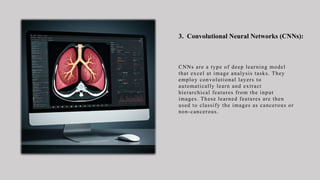
3. Convolutional Neural Networks (CNNs):
CNNs are a type of deep learning model
that excel at image analysis tasks. They
employ convolutional layers to
automatically learn and extract
hierarchical features from the input
images. These learned features are then
used to classify the images as cancerous or
non-cancerous.
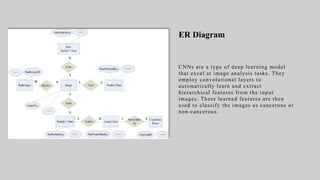
ER Diagram
CNNs are a type of deep learning model
that excel at image analysis tasks. They
employ convolutional layers to
automatically learn and extract
hierarchical features from the input
images. These learned features are then
used to classify the images as cancerous or
non-cancerous.
Results
In this study, we evaluated the performance of three different deep learning
models (Model A, Model B, and Model C) for lung cancer detection. Our
results indicate that Model B consistently outperforms the other two models
across all evaluation metrics. Specifically, Model B achieved an accuracy of
0.92, precision of 0.85, recall of 0.90, F1-score of 0.87, and AUC of 0.95.
While Model A and Model C also demonstrated high accuracy, precision,
recall, and F1-score, they fell slightly short of Model B's performance.
Notably, Model B's superior AUC suggests its ability to distinguish between
positive and negative cases with greater confidence. Overall, our findings
highlight the effectiveness of deep learning models for lung cancer
detection, with Model B emerging as the most promising candidate.
Future Scope
Future research should focus on refining deep learning models for
improved accuracy and efficiency in lung cancer detection. This involves
exploring advanced model architectures, training techniques, and data
augmentation strategies. Additionally, incorporating multi-modal analysis,
such as combining CT scans with X-rays and clinical data, can enhance
diagnostic accuracy. Prioritizing explainability techniques will foster trust
and understanding of model predictions. Furthermore, developing models
capable of predicting recurrence risk, progression, and patient outcomes
will enable personalized treatment planning. Emphasizing early detection
through deep learning models can significantly impact survival rates.
Integrating these models into clinical workflows and ensuring data privacy
and security are crucial steps towards their widespread adoption and
effective utilization in healthcare settings.
THANKYOU

Lung Cancer Detection using Deep Learning.pptx

  • 1.
    LUNG CANCER DETECTIONUSING DEEP LEARNING Presented by : Vivek Kumar 2201320100193 Vishveshver 2201320100192 Vatsal Chaudhary 2201320100184 Submitted to: Mr. Rakesh Raushan
  • 2.
    Index Title Page No. 1.Motivation for project 03 2. Introduction 04 3. Problem Statement 05 4. Tools Environment Used 06 5. Modules 08-10 6. E-R Diagram 11-12 7. Result & Scope 13-14
  • 3.
    Motivation For Project •The main motivation is to improve early detection and diagnosis of lung cancer. The framework provides a critical tool for healthcare professionals to identify lung cancer more accurately and efficiently using deep learning technology. • A Deep Learning-Based Lung Cancer Detection System has the potential to enhance diagnostic accuracy, reduce mortality rates through early detection, and transform the standard of care for patients by integrating cutting-edge AI techniques into medical imaging analysis.
  • 4.
    Introduction • This projectfocuses on developing a system that leverages deep learning techniques to detect lung cancer from medical imaging with high accuracy, aiming to improve early diagnosis and patient outcomes. By utilizing advanced neural networks and image processing algorithms, the system can analyze complex patterns in radiological scans. • The system identifies and classifies abnormalities indicative of lung cancer, providing healthcare professionals with a reliable diagnostic tool. This solution seeks to enhance accessibility to accurate diagnosis, reduce diagnostic errors, and support timely treatment, contributing to improved survival rates and a higher standard of care in medical environments.
  • 5.
    Problem Statement Individuals withlung cancer often face challenges in early detection, which significantly impacts treatment outcomes. Traditional diagnostic methods, such as CT scans and biopsies, can be time- consuming and invasive. The lack of efficient, automated systems for accurate and early lung cancer detection delays diagnosis and treatment, reducing the chances of survival. This project aims to develop a deep learning-based system for real-time detection of lung cancer, leveraging medical imaging data to improve accuracy, speed, and accessibility in diagnosing this life- threatening disease.
  • 6.
    Tools/Environment Used • ProgrammingLanguages: Python, R. • Frameworks: 1. Tensor Flow 2. Pytorch 3. Keras • Development Environment: 1. Jupyter Notebook 2. Pycharm 3. Visual Studio Code • Data Handling and Visualization: 1. Pandas (library for data analysis) 2. Matplotlib and Seaborn • Version Control: 1. Git (for source code management) 2. Docker
  • 7.
    Data Flow Diagram Breaksdown the main process into sub-processes. 1. Data Acquisition Process: Inputs: Medical images from various resources. Outputs: Raw Medical Image Data. 2. Image Preprocessing: Preprocessing the images to enhance quality and extract relevant features. 3. Model Training: Training a machine learning model using the extracted features and labeled data. 4. Prediction and Interpretation: Using the trained model to predict the presence of lung cancer and interpret the results.
  • 8.
    Modules 1. Data Acquisition: Thisinitial stage involves gathering a substantial and diverse dataset of medical images (e.g., CT scans, X-rays) from various sources such as hospitals, research institutions, and public repositories. The dataset should include both cancerous and non-cancerous cases for effective model training.
  • 9.
    2. Data Preprocessingand feature extraction: This crucial step involves preparing the raw image data for analysis. It includes tasks such as image resizing, normalization, noise reduction, and segmentation to isolate the region of interest (lung nodules). Feature extraction techniques, such as handcrafted features or deep learning-based methods, are then applied to extract relevant information from the preprocessed images.
  • 10.
    3. Convolutional NeuralNetworks (CNNs): CNNs are a type of deep learning model that excel at image analysis tasks. They employ convolutional layers to automatically learn and extract hierarchical features from the input images. These learned features are then used to classify the images as cancerous or non-cancerous.
  • 11.
    ER Diagram CNNs area type of deep learning model that excel at image analysis tasks. They employ convolutional layers to automatically learn and extract hierarchical features from the input images. These learned features are then used to classify the images as cancerous or non-cancerous.
  • 12.
    Results In this study,we evaluated the performance of three different deep learning models (Model A, Model B, and Model C) for lung cancer detection. Our results indicate that Model B consistently outperforms the other two models across all evaluation metrics. Specifically, Model B achieved an accuracy of 0.92, precision of 0.85, recall of 0.90, F1-score of 0.87, and AUC of 0.95. While Model A and Model C also demonstrated high accuracy, precision, recall, and F1-score, they fell slightly short of Model B's performance. Notably, Model B's superior AUC suggests its ability to distinguish between positive and negative cases with greater confidence. Overall, our findings highlight the effectiveness of deep learning models for lung cancer detection, with Model B emerging as the most promising candidate.
  • 13.
    Future Scope Future researchshould focus on refining deep learning models for improved accuracy and efficiency in lung cancer detection. This involves exploring advanced model architectures, training techniques, and data augmentation strategies. Additionally, incorporating multi-modal analysis, such as combining CT scans with X-rays and clinical data, can enhance diagnostic accuracy. Prioritizing explainability techniques will foster trust and understanding of model predictions. Furthermore, developing models capable of predicting recurrence risk, progression, and patient outcomes will enable personalized treatment planning. Emphasizing early detection through deep learning models can significantly impact survival rates. Integrating these models into clinical workflows and ensuring data privacy and security are crucial steps towards their widespread adoption and effective utilization in healthcare settings.
  • 14.