Organic Led Material Process And Devices Mtls Sci S Ko
Organic Led Material Process And Devices Mtls Sci S Ko
Organic Led Material Process And Devices Mtls Sci S Ko
Organic Led Material Process And Devices Mtls Sci S Ko
Organic Led Material Process And Devices Mtls Sci S Ko
1.
Organic Led MaterialProcess And Devices Mtls
Sci S Ko download
https://ebookbell.com/product/organic-led-material-process-and-
devices-mtls-sci-s-ko-4114600
Explore and download more ebooks at ebookbell.com
2.
Here are somerecommended products that we believe you will be
interested in. You can click the link to download.
Developments In Organic Leds Parker Jim
https://ebookbell.com/product/developments-in-organic-leds-parker-
jim-4673306
Productled Seo The Why Behind Building Your Organic Growth Strategy
Eli Schwartz
https://ebookbell.com/product/productled-seo-the-why-behind-building-
your-organic-growth-strategy-eli-schwartz-46770320
How To Grow Organic Plants Indoors With Led Lights For Beginners And
Advanced Gardeners Advice From A Professional Grower Ryan Crippen
https://ebookbell.com/product/how-to-grow-organic-plants-indoors-with-
led-lights-for-beginners-and-advanced-gardeners-advice-from-a-
professional-grower-ryan-crippen-11182164
How To Grow Organic Plants Indoors With Led Lights For Beginners And
Advanced Gardeners Advice From A Professional Grower Ryan Crippen
https://ebookbell.com/product/how-to-grow-organic-plants-indoors-with-
led-lights-for-beginners-and-advanced-gardeners-advice-from-a-
professional-grower-ryan-crippen-22335662
3.
Decomposition Of OrganicChemicals By Zeolitetio2 Nanocomposite
Supported Onto Low Density Polyethylene Film Under Uvled Powered By
Solar Radiation Mohammad Reza Eskandarian Mostafa Fazli Mohammad
Hossein Rasoulifard Hyeok Choi
https://ebookbell.com/product/decomposition-of-organic-chemicals-by-
zeolitetio2-nanocomposite-supported-onto-low-density-polyethylene-
film-under-uvled-powered-by-solar-radiation-mohammad-reza-eskandarian-
mostafa-fazli-mohammad-hossein-rasoulifard-hyeok-choi-59171192
Organic Farming For Sustainable Development Jeyabalan Sangeetha
https://ebookbell.com/product/organic-farming-for-sustainable-
development-jeyabalan-sangeetha-44993052
Organic Marxism An Alternative To Capitalismand Ecological Catastrophe
Philip Clayton
https://ebookbell.com/product/organic-marxism-an-alternative-to-
capitalismand-ecological-catastrophe-philip-clayton-46078876
Organic Chemistry Student Study Guide And Solutions Manual 4th Edition
David R Klein
https://ebookbell.com/product/organic-chemistry-student-study-guide-
and-solutions-manual-4th-edition-david-r-klein-46098490
Organic Narrowband Photodetectors Materials Devices And Applications
Vincenzo Pecunia
https://ebookbell.com/product/organic-narrowband-photodetectors-
materials-devices-and-applications-vincenzo-pecunia-46124674
free online editionsof InTech
Books and Journals can be found at
www.intechopen.com
9.
Contents
Preface IX
Part 1OLED Materials 1
Chapter 1 Synthesis, and Photo- and Electro-Luminescent
Properties of Phosphorescent Iridium- and
Platinum-Containing Polymers 3
Yuji Koga and Kouki Matsubara
Chapter 2 Synthesis and Photophysical Properties of Pyrene-Based
Multiply Conjugated Shaped Light-Emitting Architectures:
Toward Efficient Organic-Light-Emitting Diodes 21
Jian-Yong Hu and Takehiko Yamato
Chapter 3 Organometallic Materials for
Electroluminescent and Photovoltaic Devices 61
Boris Minaev, Xin Li, Zhijun Ning, He Tian and Hans Ågren
Chapter 4 High Efficiency Red Phosphorescent Organic
Light-Emitting Diodes with Simple Structure 101
Ramchandra Pode and Jang Hyuk Kwon
Chapter 5 Organic Field-Effect Transistors Using
Hetero-Layered Structure with OLED Materials 147
Ken-ichi Nakayama, Yong-Jin Pu, Junji Kido
and Masaaki Yokoyama
Chapter 6 Organic Light Emitting Diodes Based
on Novel Zn and Al Complexes 161
Petia Klimentova Petrova, Reni Lyubomirova Tomova
and Rumiana Toteva Stoycheva-Topalova
Part 2 OLED Processes and Devices 193
Chapter 7 Unconventional, Laser Based OLED Material
Direct Patterning and Transfer Method 195
Seung Hwan Ko and Costas P. Grigoropoulos
10.
VI Contents
Chapter 8Interlayer Processing for Active Matrix Organic
Light Emitting Diode (OLED) Displays 215
Peter Vicca, Soeren Steudel, Steve Smout, Kris Myny,
Jan Genoe, Gerwin G.H. Gelinck and Paul Heremans
Chapter 9 Transparent Conductive Oxide (TCO) Films for
Organic Light Emissive Devices (OLEDs) 233
Sunyoung Sohn and Hwa-Min Kim
Chapter 10 Micro-Cavity in Organic Light-Emitting Diode 275
Young-Gu Ju
Chapter 11 Fast-Response Organic Light-Emitting Diode
for Interactive Optical Communication 291
Takeshi Fukuda and Yoshio Taniguchi
Chapter 12 Effect of High Magnetic Field on
Organic Light Emitting Diodes 311
Toshihiro Shimada
13.
Preface
Organic light-emitting diodes(OLED) are playing a major role in information technol-
ogy (IT) by providing the promise of further expanding the use of digital displays
through making display fabrication technology lower in cost and higher in perfor-
mance to replace liquid crystal displays (LCD). Due to various attractive features such
as high contrast, high brightness, large color gamut and thin structure, various sized
OLED displays from small-sized mobile phone display to large-sized TV display have
already begun to be mass-produced.
This book is a collection of state-of-the-art works intended to cover theoretical and ex-
perimental aspects of OLED from material synthesis and characterization (Chapter 1-
6) to actual process development and devices applications (Chapter 7-12). Each chap-
ter features remarkable breakthrough on OLED and provides latest scientific
knowledge and leading-edge technology. They offer research agenda and accelerate
the research, development and distribution of OLED. I expect that this book will be
useful to encourage further experimental and theoretical research in OLED.
In closing, I wish to express my sincere gratitude to the contributing authors of each
chapter, publishing process manager Ms. Iva Lipovic, and the publishing staffs. In par-
ticular, I am deeply grateful to Prof. Costas P. Grigoropoulos (UC Berkeley), Dr. Hee
K. Park (AppliFlex), Dr. Ming-Tsang Lee (Lawrence Berkeley National Laboratory),
Dr. Heng Pan (Applied Materials. Inc) for valuable suggestions. I dedicate this book to
my parents and my wife, Ms. Hyun Jung Kim.
Dr. Seung Hwan Ko
Applied Nano Technology and Science (ANTS) Lab
Korea Advanced Institute of Science and Technology (KAIST),
Daejeon, Korea
1
Synthesis, and Photo-and Electro-Luminescent
Properties of Phosphorescent Iridium- and
Platinum-Containing Polymers
Yuji Koga and Kouki Matsubara
Department of Chemistry, Faculty of Science, Fukuoka University
Japan
1. Introduction
Development of polymer light-emitting diode (PLED) has been attracted considerable
attentions,1 because polymeric materials could be applied to low-cost production of electro-
luminescent (EL) devices exhibiting efficient luminescence for flat-panel displays. As
polymeric property of the materials enables the solution processes, such as spin-coating,
screen printing, and ink-jet printing (Figure 1), large-area and fine-pixel displays could be
easily developed in comparison with the vapor deposition process. In addition to such easy
preparation, it is of significant that it requires a fewer number of layers in PLED devices,
which enables low driving voltage, even though PLED still has a drawback in lower
luminescence efficiency than that of the organic light-emitting diode (OLED) in general.
to pump
substrate
source
Vapor deposition
Vapor deposition
nozzle
substrate
nozzle
substrate
spin
Spin-coating
Spin-coating Ink-jet printing
Ink-jet printing
Fig. 1. Vapor deposition process, spin-coating, and ink-jet printing
In contrast to widely developed fluorescent -conjugated polymers, such as polyfluorenes
and polyphenylene vinylenes (PPVs), as polymeric EL materials (Figure 2),2 researches for
phosphorescent polymers are still now in progress, because it follows the development of
the phosphorescent metal complexes, which are also in progress. Two types of
18.
Organic Light EmittingDiode – Material, Process and Devices
4
phosphorescent PLED materials are known: (1) host polymers such as poly(vinylcarbazole)
(PVK) and poly(9,9-di-n-octyl-2,7-fluorene) (PFO), into which phosphorescent small
molecules are doped,1a-f and (2) polymers having phosphorescent pendant units in the side
chain. In the former polymer, phase separation and crystallization of the small molecules in
the polymer matrix may reduce the luminescence efficiency due to self-quenching
mechanism and prevent uniform emission all over the films. Thus, several studies were
focused on the latter phosphorescent polymer. Lee et al.3 and Tokito et al.4 independently
developed non-conjugative copolymers in which monomers having luminescent
cyclometalated iridium pendant units copolymerized (Figure 3), whereas Chen et al.
reported preparation of a conjugative fluorene copolymer from a cyclometalated iridium-
suspended co-monomer (Figure 4).5
n
PPV
polyfluorene
n
CnH2n+1
CnH2n+1
Fig. 2. Structure of polyfluorene and PPV
N
N N
Ir
x y z
Lee et al.
N
N
CH CH2 CH CH2
m n
N
O
N O
O
Ir N
N
F
F
F
F
CH CH2 CH CH2
m n
N
O
O
Ir
N
N
S
S
CH CH2 CH CH2
m n
N
O
O
Ir
N
N
Tokito et al.
Fig. 3. Structure of non-conjugated copolymers with luminescent cyclometalated iridium
pendant units
Scheme 1 depicts the general synthetic methodologies for the metallopolymers including the
metal complex side chain. Almost all of the luminescent metallopolymers ((D) in Scheme 1)
have been synthesized via monomers containing metal-complex pendant units (B) (Scheme
1, Method A).6 However, polymerization of these metal-containing monomers led to the
19.
Synthesis, and Photo-and Electro-Luminescent Properties
of Phosphorescent Iridium- and Platinum-Containing Polymers 5
m n p q
N N
O
Ir
O O
Ir
O
N
N
S
2 2
Chen et al.
Fig. 4. Structure of conjugated fluorene copolymer with luminescent cyclometallated
iridium pendant units
elimination of metal fragments to some extent or failure of polymer weight control.
Alternatively, the polymer (D) can be synthesized by polymerization of a ligand-containing
monomer followed by the reaction of the copolymer ligand (C) with a metal pendant unit
(Scheme 1, Method B). Method B is seemed to be favored against Method A in the preparation
of phosphorescent metallopolymers, because various kinds of ligand monomers can be
easily copolymerized in desirable content with previously developed radical
copolymerization processes in metal-containing polymer chemistry.7 However, in the early
reports, synthesis of luminescent metallopolymers via Method B was conducted only under
severe conditions, such as Lee, Schulz or Fréchet reported (Scheme 2, 3, 4).3, 7g
Furthermore, there are few examples that the alpha and/or omega ends of the polmers are
capped eith phosphorescent units for EL materials that can be provided by the final
combination of the ligand unid units in the polymer ends with metal precursors.
Polymerization
Polymerization
Complexation
Complexation
(C) Polymer Ligand
(A) Monomer Ligand (B) Metal-containing Monomer
(D) Metal-containing Polymer
Method A
Method B
L MLn
L MLn
L L L MLn
MLn
MLn
Scheme 1. Synthetic methodology of metal-containing polymer.
20.
Organic Light EmittingDiode – Material, Process and Devices
6
N
N N
Ir(ppy)2
x y z
ethylene glycol
170o
C, 17 h
N
N
x y
+ +
N
Ir
O
O
O
O
O
O
Scheme 2.
N N
C6H13
C6H13 C6H13
C6H13
Ir
N
2
x y
N N
C6H13
C6H13 C6H13
C6H13
Ir
2
x y
O O
N
C6H13
C6H13
x + y
Ir
O
O
O
O
O
O
+
m-cresol
reflux, 12 h
m-cresol
reflux, 12 h
N
+
Scheme 3.
O
N
O
Ir
O
N
O
N
N
N
R
R = H, OC12H25
2
x y z
O
N
O O
N
O
N
N
x y z
N N
Ir Ir
Cl
Cl
R R
2 2
+
85o
C, 5 h
Na2CO3
Scheme 4.
L
L
L
MLn
MLn
MLn
Complexation
Polymer Ligand
Metal-containing Polymer
and/or
Scheme 5.
We previously developed metallopolymers produced from methyl methacrylate (MMA)
and 4-styryldiphenylphosphine copolymers with an iridium precursor. The iridium
polymers performed both photo- and electroluminescence, and showed characteristic
21.
Synthesis, and Photo-and Electro-Luminescent Properties
of Phosphorescent Iridium- and Platinum-Containing Polymers 7
features depending upon the content ratios of the iridium and phosphorus in the
copolymers.8 However, the devices containing these polymers exhibited rather low
luminescent efficiency, because of its low charge-transporting ability caused by the
nonconductive polyolefin backbone.
Here, we developed several series of iridium or platinum-containing metallopolymers
under mild conditions in Method B, where pyridine was used as a linker module between
the polymer main chain and the luminescent metal unit. Metal-incorporation effects of the
metallopolymers on their luminescent properties were investigated in order to develop
devices with high luminescent efficiency. Two independent types of the metallopolymers
are shown in the following chapters: one is that composed of polyolefin main chain and
metal units in its side chain, and the other is -conjugated polymers, which has the
luminescent metal groups in the chain ends.
2. Preparation of metallopolymers containing polyolefin main chain
In the previous paper, we have reported that luminescent polymers can be easily prepared
by the reaction of the phosphorus ligand copolymers derived from MMA and 4-
styryldiphenylphosphine with the iridium precursor under mild conditions.8 Unfortunately,
we found that the phosphorus side chain was easily oxidized to form oxide, probably
leading to desorption of metal species from the metallopolymer. Alternatively, to improve
the luminescent polymers, we used 4-vinylpyridine (Vp) as a linker module comonomer. It
has been generally used as a ligand in metallopolymers.9 In this chapter, we have reported
preparation of a series of new luminescent metallopolymers. First, pyridine-containing
polymers were produced as ligands for metal modules. Then, some amount of iridium
complex precursor, [IrCl(piq)2]2 (3), where piq is 1-phenylisoquinoline, was added to the
ligand polymer.
Scheme 6 depicts the synthetic procedure for the ligand copolymer 1 and the iridium-
containing polymer 5. MMA and Vp were copolymerized in the presence of benzoylperoxide
(BPO) at 80 °C for 10 h to form the random copolymer 1.10 The number-averaged molecular
weight of 1 was 963000 g/mol, determined by size-exclusion chromatography (SEC) which
was calibrated using polystyrene standards. The 1H NMR spectroscopy of 1 revealed that the
content of Vp was 23 mol%. These copolymers reacted with [IrCl(piq)2]2 (3) in CH2Cl2
efficiently to form 5, as a red compound. The expected quantity of the vinylpyridine iridium
unit, [IrCl(piq)(Vp)], in metallopolymer 5 was 49 wt%, which was calculated by the feed ratios
of 3 and Vp in 1. The luminescent polymer of platinum analog 6 was also prepared efficiently
by the reaction of 1 with a platinum precursor, [PtCl(piq)]2 (4), in CH2Cl2.
In these luminescent polymers, MMA were used as a comonomer in order to reveal the
properties of luminescent modules. However, as noted below, the EL efficiencies of the
devices including such metallopolymers were extremely low, because of the poor
conductivity of MMA copolymer. Therefore, we used N-vinylcarbazole (Vc) as an
alternative comonomer instead of MMA to improve the conductivity and luminescence
property. Poly(N-vinylcarbazole) (PVK) has been known as a host material for OLED
component, performing high conductivity due to closely arranged conjugated sites which
hang from the polyolefin backbone as a pendant group.11 Scheme 7 depicts the synthetic
procedure for the iridium-containing polymers 7a and 7b from ligand copolymers 2a and
2b, which have different Vp contents, 4.7 and 15 mol%, respectively. The content of Vp was
determined by absorption coefficient ratio for PVK at 345 nm in CHCl3 (Table 1). The ligand
copolymers 2a and 2b were prepared in the presence of AIBN.12 The reaction of these
22.
Organic Light EmittingDiode – Material, Process and Devices
8
copolymers with [IrCl(piq)2]2 (3) in CH2Cl2 gave red solutions, similar to the prior
experimental result forming 5 (Table 2). The quantities of the iridium unit,
[IrCl(piq)2(Vp)]y2, content in the metallopolymers 7a and 7b were 8.4 and 25 wt%, which
were determined by the feed ratios of 3 and Vp in 2a-b.
N
O OMe
+
Me
80℃, 10 h
Me
N
MeO O
x y
1
BPO
reflux, overnight
CH2Cl2
+ [MCl(piq)n]2
Me
N
MeO O
x y1
N
y2
N
M
Cl
1
6 : M = Pt, n = 1
4 : M = Pt, n = 1
3 : M = Ir, n = 2
5 : M = Ir, n = 2
n
Scheme 6. Preparation of 1, 5, and 6.
N
+
65℃, 3 h
N
N
x y
2
AIBN
N
DMF
reflux, 16 h
CH2Cl2
+ N
N
x y1
N
y2
N
Ir
Cl
2
2
7
3
Scheme 7. Synthesis of copolymers 2a-b, and metallopolymers 7a-b.
23.
Synthesis, and Photo-and Electro-Luminescent Properties
of Phosphorescent Iridium- and Platinum-Containing Polymers 9
The MMA-copolymerized metallopolymers 5 and 6 were readily soluble in several organic
solvents, such as CH2Cl2, and CHCl3, whereas the Vc-copolymerized metallopolymers 7 had
poor solubility toward these solvents. Figure 5 shows the 1H NMR spectra for the
monomeric complex 14, 1, and 5. Broadened signals due to the aromatic protons of 1
appeared from δ 8.5 to 8.2 and from δ 7.1 to 6.6 (Figure 5 (b)), whereas new broad
resonances were observed from δ 10.1 to 6.1 (c), assigned as aromatic protons of the
incorporated iridium unit in 5, which provided the similar set of signals to those
corresponding to 14 (a). The result suggested that the iridium unit in 5 has the same
chemical structure as that of 14. The spectra for 6 were similarly observed. Several
broadened signals assigned as aromatic groups of the iridium unit in 7 were also observed
as shown in Figure 6 (b) and (d). These signals were shifted to the higher field when these
signals were compared with those due to the monomeric analog 14 (Figure 6 (e)), probably
due to the shielding effect of the surrounding aromatic groups of the carbazole side chain.
Ligand
Polymer
Comonomer
Initiator
(mmol)
Yield
(%)
Vp Content
(mol%)
Mn
(×104
g/mol)
PDI
Vp
(mmol)
Other
(mmol)
1 0.93 MMA 9.3 BPO 0.050 100 23 96 2.7
2a 1.0 Vc 20 AIBN 0.10 82 4.7 5.0 2.1
2b 2.0 Vc 20 AIBN 0.10 20 15 3.8 3.5
Table 1. Preparation of Ligand Polymers
Polymer
Complex
Feed Polymer Ligand
(Pyridine Content /
mmol)
Feed Precursor
Complex
(Metal Content / mmol)
Yield
(%)
[IrCl(piq)2(Vp)]y2
Content (wt%)
5 1 0.40 3 0.10 94 49
6 1 0.041 4 0.010 94 41
7a 2a 0.20 3 0.049 95 8.4
7b 2b 0.20 3 0.050 92 25
Table 2. Preparation of Metallopolymers
3. Preparation of metallopolymers containing conjugated polymer main chain
EL materials containing small molecules as doping luminescent compounds and
conjugated polymers, such as PPV and PFO, have been developed as EL materials. Those
performing more efficient luminescence have also been developed directly binding
chromophores in the side chain of the conjugated polymers (Figure 4 and Scheme 3). 5,7f,7g
However, it is unknown that the luminescent iridium or platinum unit directory combines
to the end of the conjugated polymers without breaking the -conjugation, except one
example.13 The conjugated binding between the host polymer and the guest chromophore
is expected that intramolecular electron transfer occurs easily. Here we developed new
24.
Organic Light EmittingDiode – Material, Process and Devices
10
Fig. 5. 1H NMR spectra in CD2Cl2 for (a) 14, (b) ligand polymer 1, and (c) metallopolymer 5
in the aromatic region.
Fig. 6. 1H NMR spectra in CD2Cl2 for (a) 2a, (b) 7a, (c) 2b, (d) 7b and (e) 14 in the aromatic
region.
(a)
(b)
(c)
(d)
(e)
25.
Synthesis, and Photo-and Electro-Luminescent Properties
of Phosphorescent Iridium- and Platinum-Containing Polymers 11
series of conjugated ligand polymers where a pyridyl group was introduced in the both
ends of the polymers. As the previous preparation for the polyolefin metallopolymers, the
luminescent 1-phenylisoquinoline iridium module was efficiently combined to the ligand
polymers after polymerization. The procedures of the ligand polymers 8 and 9 and
metallopolymers 10-13 are shown in Schemes 8 and 9. The conjugated polymer was
prepared by the polycondensation reaction of two comonomers, 9,9-dioctylfluorene
dibromide and bisboronic ester, mediated by a the catalyst system using palladium
acetate, tri(o-methoxyphenyl)phosphine, and sodium carbonate. Subsequent reaction of
the obtained mixture with pyridylboronic acid pinacol ester or pyridylboronic acid
formed the end-capped ligand polymers 8a and 8b in 34 or 53% yield. The content of the
pyridyl group was 2.9 or 2.0 mol%, which was determined by 1H NMR spectrum. On the
other hand, a comonomer, 4-sec-butylphenyl-N,N-bis(4-bromophenyl)amine, was added
to the polycondensation, resulted in the formation of triarylamine-containing ligand
copolymers 9a and 9b. The yields, averaged moleculer weights, and pyridyl-group
contents are listed in Table 3. The reactions of the ligand polymers 8a and 9a with the
iridium precursor 3 efficiently formed the metallopolymers 10 and 12. The theoretical
ratios of the iridium unit, [IrCl(piq)2(py)] in 10 and 12 were 1.7 and 1.7 wt%.
The platinum analogs 11, 13 were similarly synthesized from 8b, 9b and the platinum
precursor 5. The yields and the content ratios of iridium and platinum are listed in
Table 4.
Toluene / Na2CO3 aq.
Aliquat 336
Pd(OAc)2
P(o-MeOC6H4)3
1) 105℃, 3 h
2) 105℃, 21 h
B B
C8H17 C8H17
O
O
O
O
Br Br
C8H17 C8H17
N BR
+ +
2)
9 : y / z = 0.9 / 0.1
C8H17 C8H17
N
y
N N
z x
N
Br Br
8 : y / z = 1.0 / 0.0
+
BR =
O
B
O
B
OH
OH
or
Scheme 8. Preparation of the conjugated ligand polymers 8 and 9.
The metallopolymers 12 and 13, in which the 4-sec-butylphenyl-diphenyleneamine group
was included in the main chain, were readily soluble in several organic solvents, such as
CH2Cl2, and CHCl3, whereas the metallopolymers 10, 11 had poor solubility toward these
solvents. The 1H NMR spectra for 10 and 12 demonstrated no existence of the precursor 3
but small amount of the iridium unit binding to the terminal as shown in Figure 7. In
addition to the signals around 8.7 and from 7.0 to 8.5, small new signals, most of which
agreed with those due to the monomeric iridium analog 14, appeared, suggesting that the
iridium unit in 10 and 12 has the similar structure to 14. The appearance of the signal at 8.7
in the spectra for the products indicated that the free pyridyl group at the end of the
polymers still remained in part, even after combination of the iridium module. The spectra
26.
Organic Light EmittingDiode – Material, Process and Devices
12
for the analogous polymers 11 and 13 containing platinum unit also showed the successful
formation of the metallopolymers, in which the platinum unit has the similar structure to 15.
5 : M = Pt, n = 1
3 : M = Ir, n = 2
reflux, overnight
CH2Cl2
+
8 N
N
M
Cl
n
[MCl(piq)n]2
C8H17 C8H17
x
11 : M = Pt, n = 1
10 : M = Ir, n = 2
N
reflux, overnight
CH2Cl2
+
9 N
N
M
Cl
n
C8H17 C8H17
0.9
N
0.1 x
5 : M = Pt, n = 1
3 : M = Ir, n = 2
[MCl(piq)n]2
13 : M = Pt, n = 1
12 : M = Ir, n = 2
N
Scheme 9. Preparation of the conjugated metallopolymers 10-13.
Ligand
Polymer
Comonomer
Yield
(%)
Pyridine
Content
(mol%)
Mn
(×104
g/mol)
PDI
FlBO
(mmol)
FlBr
(mmol)
PABr
(mmol)
PyBO
(mmol)
8aa 5.1 6.2 0.0 1.8 34 2.9 2.9 1.4
8b 5.2 6.2 0.0 1.8 53 2.0 3.4 1.6
9aa 5.2 5.0 1.2 1.8 28 3.5 3.1 1.3
9b 5.4 5.0 1.2 1.8 52 2.6 3.9 1.4
a Pinacol ester instead of boronic acid was used as a coupling reagent in the synthesis of 8a
and 9a.
Table 3. Preparation of the conjugated ligand copolymers.
Polymer
Complex
Ligand Copolymer Metal Precursor
Yield
(%)
[IrCl(piq)2(py)]
Content
(wt%)
Pyridine
Content
(mmol)
Metal Content
(mmol)
10 8a 0.029 3 0.0051 80 1.7
11 8b 0.032 5 0.0056 76 1.1
12 9a 0.016 3 0.0030 68 1.7
13 9b 0.029 5 0.0055 34 1.0
Table 4. Preparation of the conjugated metallopolymers.
27.
Synthesis, and Photo-and Electro-Luminescent Properties
of Phosphorescent Iridium- and Platinum-Containing Polymers 13
4. PL behavior of metallopolymers
The corresponding pyridine-substituted monomeric complexes of iridium and platinum
(Figure 8 (a)) were also prepared for the first time in order to estimate the luminescent
behavior of the metallopolymers containing the similar metal units,14 because polymer
backbone sometimes influences luminescence of the metal units significantly both in the
solid and solution states.8, 15 The structures of these complexes were well defined and the PL
behaviors were compared with those of the metallopolymers.14 All the iridium and platinum
complexes and polymers were irradiated at 462 and 433 nm, respectively, to observe the
luminescence. As shown in Figure 8 (b), both the luminescent bands for the iridium and
platinum complexes 14 and 15 were observed in almost the same area from 570 to 850 nm,
although the low-energy absorption bands appeared in the different area (c).
Fig. 7. 1H NMR spectra in CD2Cl2 for (a) 12, (b) 10 and (c) 14 in the aromatic region.
Figure 9 (a) and (b) show the PL spectra of the metallopolymers 5, 6, 7a and 7b in the CH2Cl2
solutions. Similar photoluminescent properties of the metallopolymers in the solutions to
those of the monomeric metal analogs were observed when the concentrations of the metal
units in the solutions were comparable. For example, red luminescence from 5 was observed
and the wavelength at the maximum intensity was 620 nm. The PL spectra for 7 showed the
emissions at ~620 nm from the incorporated [IrCl(piq)2] unit. The intensity of the spectrum
for the iridium polymer 5 was more than four times stronger than that for the platinum
analog 6. Lower intensity for 7a than 7b was coincident with the content ratios of the
iridium unit in the metallopolymers (Table 2).
The PL spectra for the conjugated metallopolymers were shown in Figure 10. The spectra
indicated that each structure of the metal unit was almost the same as that of the monomeric
metal complex. The iridium–containing polymers 10 and 12 exhibited the similar
luminescent spectra to that for the monomeric analog 14, whereas the spectra for the
platinum polymers 11 and 13 showed a characteristic strong band due to the conjugated
(b)
(a)
(c)
28.
Organic Light EmittingDiode – Material, Process and Devices
14
main chain under 570 nm in addition to the luminescence emitted by the platinum unit. The
result of the latter suggested that the low-energy absorption band of the conjugated main
chain, which was irradiated simultaneously, lies on almost the same wavelength area as that
of the platinum unit. It was confirmed by the electronic spectra for these compounds.
N
Ir
Cl
N
2
N
Pt
Cl
N
14
15
0
50
100
150
500 600 700 800
14
15
Wavelength (nm)
0
0.02
0.04
0.06
0.08
400 450 500 550 600
14
15
Wavelength (nm)
Fig. 8. (a) Structures, (b) PL and (c) UV-vis spectra of the monomeric complexes of iridium
and platinum. (concentrations of the both complexes were 1 10-5 M.)
0
20
40
60
80
100
500 600 700 800
5
6
Wavelength (nm)
0
100
200
300
400
500
500 600 700 800
7a
7b
Wavelength (nm)
Fig. 9. PL spectra for (a) 5, 6 and (b) 7. Iridium polymers 5 and 7 and platinum polymer 6
were irradiated at 462 and 433 nm, respectively (metallopolymers 5, 6 were 0.05 g/L and
metallopolymers 7 were 0.5 g/L).
(a)
(b) (c)
(a) (b)
29.
Synthesis, and Photo-and Electro-Luminescent Properties
of Phosphorescent Iridium- and Platinum-Containing Polymers 15
0
50
100
150
500 600 700 800
10
11
Wavelength (nm)
0
100
200
300
400
500 600 700 800
12
13
Wavelength (nm)
Fig. 10. PL spectra for (a) 10, 11, (b) 12 and 13 in CH2Cl2. Iridium polymers 10 and 12 and
platinum polymers 11 and 13 were irradiated at 462 and 433 nm, respectively (at 0.5 g/L).
5. EL behavior of the metallopolymers
EL behavior of devices containing the metallopolymers and the monomeric metal complexes
was investigated. The metallopolymers composed of the conductive conjugated main chain
exhibited the best performance among them, indicating that the structures of the polymer
backbone closely affect the luminescence behavior, compared with those in the PL
measurements.
We prepared several EL devices containing the luminescence layer of the metallopolymers
as shown in Table 5. The first device A in entry 1 has only the iridium polymer 5 made from
MMA / Vp copolymer, as the luminescence layer. The device performed 7.4 V of threshold
voltage at 1 cd/m2 and 0.026 cd/A (at 17.4 V) of maximum current efficiency, better than
those of the previously reported iridium polymer made from 4-styryldiphenylphosphine
copolymer, 13.2 V of threshold voltage at 1 cd/m2 and 0.06 cd/A (at 20.0 V) of maximum
current efficiency.8 The better performance in device A than the phosphine-based
copolymer is probably derived from improved conductivity of the pyridine-based
copolymer.
When a host polymer 16 was added to the luminescent layer of 5 to make devices B-D, the
threshold voltage and maximum current efficiency were improved to some extent. The
threshold voltage decreased particularly to the comparable level to the devices Q and R,
which were based on the monomeric iridium analog 14. However, the dominant
luminescence in these devices was from the host polymer 16 at 435 nm, indicating that
energy transfer from the host to the guest polymer may be disrupted by the non-conductive
polyolefin main chain and methacrylate side chain. The device E did not emit at least up to
20 V, whereas the emission was slightly observed from the platinum unit but mainly from
the host polymer 16 in device F. The behavior was different from the devices T and U, in
which the luminescence from the doped platinum complex (605 and 650 nm) into 16 was
detected. These results strongly suggest the presence of non-conductive copolymers
involved in the metallopolymers lead to poor EL performance.
The devices G and J, in which the Vc copolymer was involved instead of MMA copolymer,
showed unexpected high threshold voltage, despite PVK was known as conductive host
polymer in EL devices.11 The device S, containing the monomeric 14-doped PVK, also
performed high threshold voltage, suggesting that PVK does not perform enough
(b)
(a)
30.
Organic Light EmittingDiode – Material, Process and Devices
16
conductivity in the absence of conductive polymers. This high voltage was improved, when
the conductive host polymer 16 was added to the luminescent layer. However, the
maximum current efficiencies were not so different among devices H, I and K, L, in spite of
the different iridium unit content ratios in these metallopolymers 7a and 7b (7a < 7b, see
Tables 1-3). Although the total performances of these devices based on the Vc copolymer
were still not satisfactory, the energy transfer from the host polymer 16 to the
metallopolymers occurred smoothly, leading to decrease of luminescence at 435 nm from
the host 16, in comparison with copolyMMA-based devices.
entry Devicea
Emitting Layer
Metal Unit
Contentb
Vth
c
(V)
c max
d
(cd/A, V)
max
e
(nm)
Hostf
Guest
Feed Ratio
(Host / Guest)
(wt%)
1 A ― 5 0 / 100 Ir 49 7.4 0.026, 17.4 635
2 B 16 5 80 / 20 Ir 9.8 5.0 0.063, 7.4 430
3 C 16 5 90 / 10 Ir 4.9 5.6 0.15, 8.2 435
4 D 16 5 95 / 5 Ir 2.5 4.8 0.091, 12.6 435
5 E ― 6 0 / 100 Pt 41 ― ― ―
6 F 16 6 95 / 5 Pt 2.1 5.6 0.096, 9.6 435
7 G ― 7a 0 / 100 Ir 8.4 19.2 0.026, 20.0 625
8 H 16 7a 60 / 40 Ir 3.4 4.2 0.13, 6.8 430
9 I 16 7a 80 / 20 Ir 1.7 4.6 0.14, 7.6 430
10 J ― 7b 0 / 100 Ir 25 11.0 0.082, 20.0 630
11 K 16 7b 60 / 40 Ir 10 4.4 0.12, 6.4 430
12 L 16 7b 80 / 20 Ir 5 4.0 0.097, 5.8 430
13 M ― 10 0 / 100 Ir 1.7 4.0 1.14, 4.0 625
14 N ― 11 0 / 100 Pt 1.1 5.4 0.14, 7.6 605, 650
15 O ― 12 0 / 100 Ir 1.7 3.4 0.47, 3.6 620
16 P ― 13 0 / 100 Pt 1.0 5.8 0.36, 10.0 605, 650
17 Q 16 14 90 / 10 Ir 10 6.4 0.31, 9.2 625
18 R 16 14 95 / 5 Ir 5.0 5.0 0.30, 8.2 615
19 S PVK 14 95 / 5 Ir 5.0 8.0 0.014, 19.8 630
20 T 16 15 90 / 10 Pt 10 10.0 0.024, 16.2 605, 650
21 U 16 15 95 / 5 Pt 5.0 6.8 0.048, 9.8 435
a Device structure: ITO/PEDOT:PSS/Emitting layer/Ba/Al
b Metal unit is [MCl(piq)n(Py-)] (n = 2, Ir; n = 1, Pt) or the monomeric complex in the emitting layer.
c Threshold voltage at 1 cd/m2.
d Maximum current efficiency.
e The max values correspond to the highest intensity peak in the EL spectrum at maximum current
efficiency.
f 16:
N
C8H17 C8H17
1
9
Table 5. EL properties of the devices containing the metallopolymers
31.
Synthesis, and Photo-and Electro-Luminescent Properties
of Phosphorescent Iridium- and Platinum-Containing Polymers 17
The devices M, N, O, and P containing metal end-capped conjugated polymers provided
satisfactory luminescence performances, compared with the other devices. As shown in
Figure 11, negligible luminescence around 435 nm derived from the conjugated main chain
was observed in the devices M and O containing iridium-capped polymers 10 and 12,
whereas considerable luminescence from the conjugated main chain appeared in the
platinum-based devices N and P. We can conclude that iridium-based devices are superior
to platinum-based ones in energy-transfer ability in this EL device system. The device O
showed the highest performance as a red EL device among all the devices. It is of interest
that the performances of the devices M, O, N, P excelled those of the devices Q, R, T, U,
which contained the layer of the monomeric complex 14- or 15-doped copolymer 16. We
found that these devices M, O, N, P showed more than 1 V lower threshold voltages than
those of the devices Q, R, T, U. These devices have the same structure except whether the
metal chromophore is bound to the end of the host polymer (M, O, N, P) or exists
independently (Q, R, T, U). We considered that direct combination of the conductive
polymer and the metal unit led to facile electron transfer to the metal unit, resulting in low
threshold voltages and high current efficiency of these devices. As for the iridium unit-
containing devices, additional easy energy transfer from the host polymer to iridium caused
the highest performance.
0
0.2
0.4
0.6
0.8
1
1.2
400 500 600 700
Device M
Device O
Device R
Wavelength (nm)
0
0.2
0.4
0.6
0.8
1
1.2
400 500 600 700
Device N
Device P
Device U
Wavelength (nm)
Fig. 11. EL spectra for (a) devices M, O and R, (b) devices N, P and U, of which the
structures are shown in Table 5. (at 4.0, 4.0, 8.0, 8.0, 10.0, and 10.0 V, respectively) The origin
of the small luminescnet bands from 480 to 570 nm in (b) is not identified.
6. Conclusion
One of the most important factors to design new devices that contain complicated
organic/inorganic/polymeric compounds is how to prepare the compounds easily and
efficiently. Here we described the successful preparation of several luminescent polymer
materials in a few steps, that contained the simple coordination of the metal module precursor
to the pyridine-bound ligand polymers under mild conditions. After several attempts to
investigate the EL behavior of the devices containing the obtained metallopolymers, we found
that structure of backbone host polymer is quite important for efficient luminescence and low
driving voltage in these devices. We also demonstrated that the good EL performance was
provided when the guest unit directly bound to the host polymer.
(b)
(a)
32.
Organic Light EmittingDiode – Material, Process and Devices
18
7. Experimental details
7.1 Synthesis of pyridine-capped conjugated copolymers
As a typical example, into a 200-mL three-necked flask equipped with a condenser, 2.77 g
(5.2 mmol) of 9,9-dioctylfluorene-2,7-bis(boronic acid ethylene glycol ester), 2.72 g (5.0
mmol) of 9,9-dioctyl-2,7-dibromofluorene, 0.551 g (1.2 mmol) of 4-(1-methylpropyl)-N,N-
bis(4-bromophenyl)aniline, 0.79 g of methyltrioctylammonium chloride (Aliquat 336, made
by Sigma-Aldrich Corporation), and 60 mL of toluene were placed. Under a nitrogen
atmosphere, 2.2 mg of palladium diacetate and 12.9 mg of tris(2-methoxyphenyl)phosphine
were added to the solution, and the solution was heated to 95°C. While a 17.5 wt% sodium
carbonate aqueous solution (16.5 mL) was dropped to the obtained solution over 30
minutes, the solution was heated to 105°C, and subsequently stirred at 105°C for 3 hours.
Then, 369 mg of 4-(4,4,5,5-tetramethyl-1,3,2-dioxaborolan-2-yl)pyridine dissolved in toluene
(30 mL) was added, and the mixture was stirred at 105°C for 21 hours. After the aqueous
layer was removed, 3.65 g of sodium N,N-diethyldithiocarbamate trihydrate and 36 mL of
water were added, and the solution was stirred at 85°C for 2 hours. An organic layer was
separated and washed with water (78 mL, twice), a 3 wt% aqueous acetic acid (78 mL,
twice), and then water (78 mL, twice). The organic layer was dropped to methanol to form
precipitates, which were filtrated and dried to obtain a solid. The residual solid was
dissolved in toluene (186 mL), and the solution was passed through a silica gel / alumina
column, where toluene was passed in advance. The filtrate was concentrated under reduced
pressure and dropped into methanol, and a precipitate was filtered to obtain ligand polymer
9a (1.26 g). The number-averaged molecular weight Mn was 3.1 × 10⁴ g/mol, which was
determined by SEC calibrated with polystyrene standards.
7.2 Synthesis of conjugated iridium polymers
As a typical example, under an inert-gas atmosphere, a mixture of [IrCl(piq)2]2 (3) (0.0038 g,
0.0030 mmol) and pyridine-capped copolymer 9a (0.243 g, containing 0.016 mmol of
pyridine) in CH2Cl2 (6 mL) was refluxed for 16 h. After cooling to room temperature, the
resulting solution was poured into hexane to afford a precipitate, which was filtered and
washed with hexane and dried under reduced pressure to obtain light orange powder 10 in
80 % yield (Mn = 3.3×10⁴l g/mol).
8. Acknowledgement
The EL experiments in this study were conducted with kind supports of Sumitomo
Chemical Co., Ltd.
9. Abbreviations
PL: photo-luminescent
EL: electro-luminescent
PLED: polymer light-emitting diode
OLED: organic light-emitting diode
PPV: polyphenylene vinylene
PVK: poly(vinylcarbazole)
PFO: poly(9,9-di-n-octyl-2,7-fluorene)
33.
Synthesis, and Photo-and Electro-Luminescent Properties
of Phosphorescent Iridium- and Platinum-Containing Polymers 19
MMA: methyl methacrylate
Vp: 4-vinylpyridine
piq: 1-phenylisoquinoline
SEC: size-exclusion chromatography
Vc: N-vinylcarbazole
AIBN: azobisisobutylonitrile
BPO: benzoylperoxide
FlBO: 9,9-dioctylfluorene-2,7-bis(boronic acid ethylene glycol ester)
FlBr: 9,9-dioctyl-2,7-dibromofluorene
PABr: 4-sec-butylphenyl-N,N-bis(4-bromophenyl)amine
PyBO: 4-(4,4,5,5-tetramethyl-1,3,2-dioxaborolan-2-yl)pyridine boronic acid
10. References
[1] (a) Lee, C.-L.; Lee, K. B.; Kim, J.-J. Appl Phys Lett 2000, 77, 2280–2282; (b) Negres, R. A.;
Gong, X.; Ostrowski, J. C.; Bazan, G. C.; Moses, D.; Heeger, A. J. Phys Rev B 2003,
68, 115209; (c) Zhu, W. G.; Ke, Y.; Wang, F.; Liu, C. Z.; Yuan, M.; Cao, Y. Synth Met
2003, 137, 1079–1080; (d) van Dijken, A.; Bastiaanssen, J. J. A. M.; Kiggen, N. M. M.;
Langeveld, B. M. W.; Rothe, C.; Monkman, A.; Bach, I.; Stössel, P.; Brunner, K. J Am
Chem Soc 2004, 126, 7718–7727; (e) Tanaka, I.; Tabata, Y.; Tokito, S. Jpn J Appl Phys
2004, 43, L1601–L1603; (f) Xia, H.; Zhang, C.; Qiu, S.; Lu, P.; Zhang, J.; Ma, Y. Appl
Phys Lett 2004, 84, 290–292; (g) Gong, X.; Robinson, M. R.; Ostrowski, J. C.; Moses,
D.; Bazan, G. C.; Heeger, A. J. Adv Mater 2002, 14, 581–585; (h) Jiang, C.; Yang, W.;
Peng, J.; Xiao, S.; Cao, Y. Adv Mater 2004, 16, 537–541; (i) Adachi, C.; Kwong, R.;
Forrest, S. R. Org Electron 2001, 2, 37–43; (j) Lee, C.-C.; Yeh, K.-M.; Chen, Y. J Polym
Sci Part A: Polym Chem 2008, 46, 7960–7971; (k) Wang, P.; Chai, C.; Yang, Q.;
Wang, F.; Shen, Z.; Guo, H.; Chen, X.; Fan, X.; Zou, D.; Zhou, Q. J Polym Sci Part A:
Polym Chem 2008, 46, 5452–5460; (l) Yuan, M.-C.; Shih, P.-I.; Chien, C.-H.; Shu, C.-
F. J Polym Sci Part A: Polym Chem 2007, 45, 2925–2937.
[2] Kraft, A.; Grimsdale, A. C.; Holmes, A. B. Angew Chem Int Ed 1998, 37, 402.
[3] Lee, C.-L.; Kang, N.-G.; Cho, Y.-S.; Lee, J.-S.; Kim, J.-J. Opt Mater 2002, 21, 119–123
[4] Tokito, S.; Suzuki, M.; Sato, F.; Kamachi, M.; Shirane, K. Org Electron 2003, 4, 105–111.
[5] Chen, X.; Liao, J.-L.; Liang, Y.; Ahmed, M. O.; Tseng, H.-E.; Chen, S.-A. J Am Chem Soc
2003, 125, 636–637.
[6] (a) Xu, Y.; Guan, R.; Jiang, J.; Yang, W.; Zhen, H.; Peng, J.; Cao, Y. J Polym Sci Part A:
Polym Chem 2008, 46, 453–463; (b) Mei, C.; Ding, J.; Yao, B.; Cheng, Y.; Xie, Z.;
Geng, Y.; Wang, L. J Polym Sci Part A: Polym Chem 2007, 45, 1746–1757.
[7] (a) Yamada, Y. M. A.; Takeda, K.; Takahashi, H.; Ikegami, S. Org Lett 2002, 4, 3371–3374;
(b) Yamada, Y. M. A.; Takeda, K.; Takahashi, H.; Ikegami, S. J Org Chem 2003, 68,
7733–7741; (c) Bianchini, C.; Frediani, M.; Vizza, F. Chem Commun Commun 2001,
479–480; (d) Borbone, F.; Caruso, U.; Maria, A. D.; Fusco, M.; Panunzi, B.; Roviello,
A. Macromol Symp 2004, 218, 313–321; (e) Marin, V.; Holder, E.; Hoogenboom, R.;
Schubert, U. J Polym Sci Part A: Polym Chem 2004, 42, 4153–4160; (f) Deng, L.;
Furuta, P. T.; Garon, S.; Li, J.; Kavulak, D.; Thompson, M. E.; Fre´chet, J. M. J Chem
Mater 2006, 18, 386–395; (g) Schulz, G. L.; Chen, X.; Chen, S.-A.; Holdcroft, S.
Macromolecules 2006, 39, 9157–9165; (h) Aamer, K. A.; Tew, G. N. J Polym Sci Part
A: Polym Chem 2007, 45, 1109–1121.
34.
Organic Light EmittingDiode – Material, Process and Devices
20
[8] Koga, Y.; Yoshida, N.; Matsubara, K. J Polym Sci Part A: Polym Chem 2009, 47, 4366–
4378.
[9] (a) Daniel, S.; Gladis, J. M.; Rao, T. P. Anal Chim Acta 2003, 349, 173–182; (b) Sumi, V. S.;
Kala, R.; Praveen, R. S.; Rao, T. P. Int J Pharm 2008, 349, 30–37; (c) Fan, P.; Wang, B.
J Appl Polym Sci 2010, 116, 258–266.
[10] Salahuddin, N. J. Appl. Polym. Sci. 2007, 104, 3317-3323
[11] (a) Xiao, J.; Yao, Y.; Deng, Z.; Wang, X.; Liang, C. J Lumin 2007, 122–123, 639–641; (b)
Ye, T.; Chen, J.; Ma, D. Phys. Chem. Chem. Phys. 2010, 12, 15410–15413; (c) Song,
M.; Park, J. S.; Yoon, M.; Kim, A. J.; Kim Y. I.; Gal, Y.-S.; Lee, J. W.; Jin, S.-H. J
Organomet Chem 2011, 696, 2122-2128.
[12] Zhang, H.; Zhou, Z.; Liu, K.; Wang, R.; Yang, B. J. Mater. Chem. 2003, 13, 1356-1361.
[13] Zhang, K.; Chen, Z.; Yang, C.; Zou, Y. ; Gong, S.; Tao, Y.; Qin, J.; Cao, Y. J Mater Chem
2008, 18, 3366–3375.
[14] Koga, Y.; Matsumoto, T.; Matsubara, K. unpublished results.
[15] Koga, Y.; Ueno, K.; Matsubara, K. J Polym Sci Part A: Polym Chem 2006, 44, 4204–4213.
35.
2
Synthesis and PhotophysicalProperties of
Pyrene-Based Multiply Conjugated Shaped
Light-Emitting Architectures: Toward
Efficient Organic-Light-Emitting Diodes
Jian-Yong Hu1,2 and Takehiko Yamato1
1Department of Applied Chemistry, Faculty of Science and Engineering, Saga University
2Department of Organic Device Engineering, Yamagata University
Japan
1. Introduction
Since the pioneering works on the first double-layer thin-film Organic electroluminescence
(EL) devices (OLEDs) by C. W. Tang and co-workers in the Kodak Company in 1987 (Tang
Vanslyke, 1987), OLEDs have attracted enormous attentions in the scientific community due to
their high technological potential toward the next generation of full-color-flat-panel displays
(Hung Chen, 2002; Wu et al., 2005; Geffroy et al., 2006) and lighting applications (Duggal et
al., 2007; So et al., 2008). In today’s developments of OLED technologies, the trends of organic
EL devices are mainly focusing both on optimizations of EL structures and on developing new
optoelectronic emitting materials. Obviously the key point of OLEDs development for full-
color-flat display is to find out materials emitting pure colors of red, green and blue (RGB)
with excellent emission efficiency and high stability. Numerous materials with brightness RGB
emission have been designed and developed to meet the requirements toward the full-color
displays. Among them, organic small molecules containing polycyclic aromatic hydrocarbons
(PAHs) (e. g. naphthalene, anthracene, perylene, fluorene, carbazole, pyrene, etc.) are well
known and are suitable for applications in OLEDs. Recently, naphthalene, anthracene,
perylene, fluorene, carbazole, pyrene and their derivatives have been widely used as efficient
electron-/hole-transporting materials or host emitting materials in OLED applications. In this
chapter an overview is presented of the synthesis and photophysical properties of pyrene-
based, multiply conjugated shaped, fluorescent light-emitting materials that have been
disclosed in recent literatures, in which several pyrenes have been successfully used as
efficient hole-/electron-transporting materials or host emitters or emitters in OLEDs, by which
a series of pyrene-based, cruciform-shaped -conjugated blue-light-emitting architectures can
be prepared with an emphasis on how synthetic design can contribute to the meeting of
promising potential in OLEDs applications.
2. Pyrene and pyrene derivatives
Pyrene is an alternant polycyclic aromatic hydrocarbon (PAH) and consists of four fused
benzene rings, resulting in a large, flat aromatic system. Pyrene is a colorless or pale yellow
36.
Organic Light EmittingDiode – Material, Process and Devices
22
solid, and pyrene forms during incomplete combustion of organic materials and therefore
can be isolated from coal tar together with a broad range of related compounds. Pyrene has
been the subject of tremendous investigation. In the last four decades, a number of research
works have been reported on both the theoretical and experimental investigation of pyrene
concerning on its electronic structure, UV-vis absorption and fluorescence emission
spectrum. Indeed, this polycyclic aromatic hydrocarbon exhibits a set of many interesting
electrochemical and photophysical attributes, which have results in its utilization in a
variety of scientific areas. Some recent advanced applications of pyrene include fluorescent
labelling of oligonucleotides for DNA assay (Yamana et al., 2002), electrochemically
generated luminescence (Daub et al., 1996), carbon nanotube functionallization (Martin et
al., 2004), fluorescence chemosensory (Strauss Daub, 2002; Benniston et al., 2003), design
of luminescence liquid crystals (de Halleux et al., 2004), supermolecular self-assembly
(Barboiu et al., 2004), etc.. On the other hand, as mentioned above, PAHS (e. g. naphthalene,
anthracene, perylene, fluorene, carbazole, etc.) and their derivatives have been developed as
RGB emitters in OLEDs because of their promising fluorescent properties (Jiang et al., 2001;
Balaganesan et al., 2003; Shibano et al., 2007; Liao et al., 2007; Thomas et al., 2001). In
particular, these compounds have a strong -electron delocalization character and they can
be substituted with a range of functional groups, which could be used for OLEDs materials
with tuneable wavelength. Similarly, pyrene has strong UV-vis absorption spectra between
310 and 340 nm and emission spectra between 360 and 380 nm (Clar Schmidt, 1976),
especially its expanded -electron delocalization, high thermal stability, electron accepted
nature as well as good performance in solution. From its excellent properties, it seems that
pyrene is suitable for developing emitters to OLEDs applications; however, the use of
pyrene molecules is limited, because pyrene molecules easily formed -aggregates/excimers
and the formation of -aggregates/excimers leads to an additional emission band in long
wavelength and the quenching of fluorescence, resulting in low solid-state fluorescence
quantum yields. Recently, this problem is mainly solved by both the introduction of long or
big branched side chains into pyrene molecules and co-polymerization with a suitable bulky
co-monomer. Very recently, it was reported that pyrene derivatives are useful in OLEDs
applications (Otsubo et al., 2002; Thomas et al., 2005; Ohshita et al., 2003; Jia et al., 2004; Tang et
al., 2006; Moorthy et al., 2007) as hole-transporting materials (Thomas et al., 2005; Tang et al.,
2006) or host blue-emitting materials (Otsubo et al., 2002; Ohshita et al., 2003; Jia et al., 2004;
Moorthy et al., 2007). To date, various pyrene-based light-emitting materials have been
disclosed in recent literatures, which can be roughly categorized into three types of materials:
(1) Functionalized pyrene-based light-emitting monomers; (2) Functionalized pyrene-based light-
emitting dendrimers; and (3) Functionalized pyrene-based light-emitting oligomers and polymers.
3. Functionalized pyrene-based light-emitting monomers
Because of its extensive -electron delocalization and electron-accepted nature, pyrene is a
fascinating core for developing fluorescent -conjugation light-emitting monomers. In those
compounds, pyrene was used as a conjugation centre core substituted by some
functionalized groups or as function substituents introduced into others PAHs rings. In this
section, the synthesis and photophysical properties of two types of functionalized pyrene-
based light-emitting monomers, namely, pyrene-cored organic light-emitting monomers and
pyrene-functionalized PAHs-cored organic light-emitting monomers were fully presented. In
particular, the use of these light-emitting monomers as efficient emitters in OLEDs will be
discussed in detail.
37.
Synthesis and PhotophysicalProperties of Pyrene-Based Multiply Conjugated
Shaped Light-Emitting Architectures: Toward Efficient Organic-Light-Emitting Diodes 23
3.1 Pyrene-cored organic light-emitting monomers
Although pyrene and its derivatives have been widely used as fluorescence probes in many
applications, there are two major drawbacks using pyrene as a fluorescence probe: One is
the absorption and emission wavelengths of the pyrene monomer are confined to the UV
region of 310-380 nm, and the other is pyrene can easily forms an excimer above
concentrations of 0.1 mM. In order to probe biological membranes using fluorescence
techniques it is desirable to have a fluorophore probe that absorbs and emits in the long
wavelength region, preferably in the visible region of the electromagnetic spectrum in order
to minimize the spectral overlap of the intrinsic fluorescence of the bio-molecules that occur
in the UV region. Furthermore, molecular systems that are light emitters in the visible
region are potentially useful in the fabrication of organic light emitting diodes (OLEDs).
Therefore, it is desirable to design molecules that have emission in the visible region.
Consequently, the most common method to bathochromically shift the absorption and
emission characteristics of a fluorophore is to extend the -conjugation by introducing
unsaturated functional groups (e. g. acetylenic group) or rigid, bulky PAHs moieties (e. g.
phenylene, thiophene, bithiophene, thienothiophene, benzothiadiazole-thiophene, pridine,
etc.) to the core of the fluorophore. In recent papers, using pyrene as a conjugation centre
core, the synthesis, absorption and fluorescence-emission properties of the 1,3,6,8-
tetraethynylpyrenes and its derivatives have been reported (Venkataramana
Sankararaman 2005, 2006; Fujimoto et al., 2009), and monomers of 1-mono, 1,6-bis-, 1,8-bis-,
1,3,6-tris-, and 1,3,6,8-tetrakis-(alkynyl)pyrenes have also been prepared (Maeda et al., 2006;
Kim et al., 2008; Oh et al., 2009). On the other hand, 1,3,6,8-tetraarylpyrenes as fluorescent
liquid-crystalline columns (de Halleux et al., 2004; Sienkowska et al., 2004) or organic
semiconductors for organic field effect transistors (OFETs) (Zhang et al., 2006) or efficient
host blue emitters (Moorthy et al., 2007; Sonar et al., 2010) or electron transport material (Oh
et al., 2009) have recently been reported. The starting point for the above-mentioned
synthesis was 1-mono (2a), 1,6-di-(2b), 1,8-di-(2c), 1,3,6-tris-(2d), and 1,3,6,8-
tetrabromopyrenes (2e), which is readily prepared by electrophinic bromination of pyrene
(1) with one to excess equivalents of bromine under the corresponding reaction conditions,
respectively (Grimshaw et al., 1972; Vollmann et al., 1937) (Scheme 1). These materials were
consequently converted to the corresponding alkynylpyrenes (pyrene-CC-R) or
arylpyrenes (pyrene-R) by Sonogashira cross-coupling reaction or Suzuki cross-coupling
reaction, respectively.
1 2
Bromination
X1 X2
X4 X3
2a: X1 = Br, X2 = X3 = X4 = H
2b: X1 = X3 = Br, X2 = X4 = H
2c: X1 = X4 = Br, X2 = X3 = H
2d: X1 = X2 = X3 = Br, X4 = H
2e: X1 = X2 = X3 = X4 = Br
Scheme 1. Electrophilic bromination of pyrene (1)
38.
Organic Light EmittingDiode – Material, Process and Devices
24
3.1.1 Alkynyl-functionalized pyrene-cored light-emitting monomers
Acetylene has been widely applied for linking -conjugated units and for effectively
extending the -conjugation length. The progress of such -conjugated materials by means
of acetylene chemistry has strongly dependent on the development of Sonogashira coupling
reaction. Thereby, many attractive acetylene-linked molecules have emerged such as for
semiconducting polymers (Swager et al., 2005; Swager Zheng, 2005), macrocyclic
molecules (Kawase, 2007; Hoger et al., 2005), helical polymers (Yamashita Maeda, 2008)
and energy transfer cassettes (Loudet et al., 2008; Han et al., 2007; Jiao et al., 2006;
Bandichhor et al., 2006). Accordingly, the use of acetylene group for extending the
conjugation of the pyrene chromophore is one of the most common methods. Sankararaman
et al. (Venkataramana Sankararaman, 2005) reported the synthesis, absorption and
fluorescence-emission of 1,3,6,8-tetraethynylpyrene derivatives 3a-f, which were prepared
by the Sonogashira coupling of tetrabromomide (2e) with various terminal acetylenes
yielded the corresponding tetraethynylpyrenes. Significant bathochromic shifts of
absorptions band were observed in the region of 350-450 nm for 3a-d, 375-474 nm for 3e-f,
respectively, compare with that of pyrene (1) in dilute THF solutions due to the extended
conjugation of the pyrene chromophore with the acetylenic units. Similarly, the fluorescence
emission bands of 3a-f are also bathochromically shifted in region of 420-550 nm in
comparison of pyrene in THF. The quantum efficiency of fluorescence emission for 3a-d was
in the rang of 0.4-0.7; these values are comparable to that of pyrene, while 3e and 3f are low
due to the deactivation of the excited state resulting from the free rotation of the phenyl
groups. The results suggest these derivatives are potentially useful as emitters in the
fabrication of organic light emitting diodes (OLEDs). A pyrene octaaldehyde derivative 4
and its aggregations through - and C-HO interactions in solution and in the solid state
probed by its fluorescence emission and other spectroscopic methods are also prepared by
Sankararaman et al. (Venkataramana Sankararaman, 2006) In view of its solid-state
fluorescence, this octaaldehyde 4 and its derivatives might find applications in the field of
molecular optoelectronics. Similarly, Fujimoto and co-workers (Maeda et al., 2006) have
synthesized a variety of alkynylpyrene derivatives 5a-d from mono- to tetrabromo-pyrenes
(2a-2e) and arylacetylenes using the Sonogashira coupling, and comprehensively examined
their photophysical properties. The alkynylpyrenes 5a-h thus prepared showed not only
long absorption (365-434 nm, 1.0 x 10⁻⁵ M, in EtOH) and fluorescence emission (386-438 nm,
1.6-2.5 x 10⁻⁷ M, in EtOH) wavelengths but also high fluorescence quantum yields (0.55-0.99,
standards used were 9,10-diphenylanthracene) as compared with pyrene itself.
Additionally, the alkynylpyrene skeletons could be applied to practically useful
fluorescence probes for proteins and DNAs. Fujimoto et al. (Fujimoto et al., 2009) recently
also prepared a series of 1,3,6,8-tetrakis(arylethynyl)pyrenes 6a-e bearing electron-donating
or electron-withdrawing groups. Their photophysical properties analysis demonstrated that
the donor-modified tetrakis(arylethynyl)pyrene 6a-c showed fluorescence solvatochromism
on the basis of intramolecular charge transfer (ICT) mechanism, while the acceptor-modified
ones 6d-e never did. Furthermore, the donor-modified tetrakis(arylethynyl)pyrene 6a-c
were found to be stable under laboratory weathering as compared with that of coumarin.
Thus, the tetrakis(arylethynyl)pyrenes 6 are expected to be applicable to bioprobes for
hydrophobic pockets in various biomolecules and photomaterials.
More recently, Kim et al. prepared a series of alkynylpyrenes 7a-e that bear peripheral [4-
(N,N-dimethylamino)phenylethynyl] (DMA-ethynyl) units using pyrene as the -center and
their two-photon absorption properties (Kim et al., 2008) and electrogenerated
39.
Synthesis and PhotophysicalProperties of Pyrene-Based Multiply Conjugated
Shaped Light-Emitting Architectures: Toward Efficient Organic-Light-Emitting Diodes 25
chemiluminescence (ECL) properties (Oh et al., 2009) were investigated in detail,
respectively. These alkynylpyrenes 7a-e showed unique patterns in photophysical and
electrochemical properties. For example, compound 7e, which has four peripheral DMA-
ethynyl moieties, exhibits a marked enhancement in ECL intensity compared to the other
compounds 7a-7d; this is attributable to its highly conjugated network that gives an
extraordinary stability of cation and anion radicals in oxidation and reduction process,
respectively. The result is a promising step in the development of highly efficient light-
emitting materials for applications such as organic light-emitting diodes (OLEDs).
(Me)3C
CHO
CHO OHC
CHO
C(Me)3
CHO
OHC C(Me)3
CHO
CHO
(Me)3C
4
3
3a: R = SiMe3
3b: R = C(Me)2OH
3c: R = CH2OH
3d:R = CH(OEt)2
3e: R = C6H5
3f: R = 4-CF3C6H4
R R
R
R
5
R3 R1
R4
R2
5a: R1 = CCSiMe3, R2 = R3 = R4 = H
5b: R1 = R2 = CCSiMe3, R3 = R4 = H
5c: R1 = R2 = R3 = CCSiMe3, R4 = H
5d: R1 = R2 = R3 = R4 = CCSiMe3
R R
R
R
6
6a: R = NMe2
6b: R = NPh2
6c: R = H
6d:R = CF3
6e: R = CO2C2H5
7
R1 R2
R4 R3
7a: R1 = A, R2 = R3 = R4 = H
7b: R1 = X3 = A, R2 = R4 = H
7c: R1 = R4 = A, R2 = R43 = H
7d: R1 = R2 = R3 = A, R4 = H
7e: R1 = R2 = R3 = R4 = A
N
A
N
N
8
N
N
9
N
N
Fig. 1. Alkynyl-functionalized pyrene-cored light-emitting monomers (3-9).
Despite various alkynyl-functionalized pyrene-based light-emitting monomers with
excellent efficiency and stability have been designed and studied by many research groups,
there are very few examples of alkynylpyrenes-based OLED materials. Xing et al. (Xing et
al., 2005) synthesized two ethynyl-linked carbazole-pyrene-based organic emitters (8 and 9,
Figure 1) for electroluminescent devices. Both 8 and 9 show extremely high fluorescence
quantum yield of nearly 100% because of the inserting of pyrene as electron-acceptor. Due
to its higher solubility and easier fabrication than those of 8, they fabricated a single-layer
electroluminescence device by doping 9 into PVK. The single-layer device (ITO/PVK: 9 (10:
1, w/w)/Al) showed turn-on voltage at 8 V, the maximum luminance of 60 cd/m2 at 17 V,
and the luminous efficiency of 0.023 lm/W at 20 V. the poor performance of the device is
probably due to the unbalance of electrons and holes in PVK. To improve the device
performance, an additional electron-transporting layer (1,3,5-tri(phenyl-2-
40.
Organic Light EmittingDiode – Material, Process and Devices
26
benzimidazole)benzene (TPBI) was deposited by vacuum thermal evaporation in the
structure of device: ITO/PVK : 9 (10 : 1, w/w) (60 nm)/TPBI (30 nm)/Al (100 nm). Physical
performance of the device appeared to be improved: turn-on voltage 11 V, maximum
luminance reached 1000 cd/m2, external quantum efficiency was found to 0.85% at 15.5 V,
and luminous efficiency was 1.1 lm/W at 15.5 V. The molecular structures of these alkynyl-
functionalized pyrene-cored light-emitting monomers (3-9) are shown in Figure. 1.
3.1.2 Aryl-functionalized pyrene-cored light-emitting monomers
Recently, due to their extended delocalized -electron, discotic shaped, high
photoluminescence efficiency, and good hole-injection/transport properties, 1,3,6,8-
tetrafunctional pyrene-based materials (i. e. 1,3,6,8-tetra-alkynylpyrenes and 1,3,6,8-
tetraarylpyrenes) have the potential to be very interesting class of materials for opto-
electronic applications. All the tetraarylpyrenes were mainly synthesized starting from the
1,3,6,8-tetrabromopyrene (2e). Suzuki coupling reaction between the tetrabromopyrene 2e
and the corresponding arylboronic acids or esters under Pd-catalyzed conditions afforded
the corresponding tetraarylpyrenes. The first example of tetraarylpyrenes is 1,3,6,8-
tetraphenylpyrene (TPPy, 10). TPPy is a highly efficient fluorophore showing strong blue
luminescence in solution (quantum yield = 0.9 in cyclohexane) (Berlamn, 1970), and the
organic light emitting field-effect transistor devices (OLEFET) based on TPPy have been
shown to exhibit electroluminescence (EL) with an external quantum efficiency of only 0.5%
due to aggregation (Oyamada et al., 2005). In view of its high fluorescence quantum yield in
solution and ease of substitution by flexible later side chains, TPPy has recently been
selected as a discotic core to promote liquid-crystalline fluorescent columns. Greets and co-
workers synthesized and studied several new derivatives of pyrenes (11) (de Halleux et al.,
2004); the pyrene core has been substituted at the 1,3,6,8-positions by phenylene rings
bearing alkoxy, ester, thioether, or tris(alkoxy)benzoate groups on the para positions. In
order to generate liquid-crystalline phases, they varied the nature, number, and size of the
side chains as well as the degree of polarity around the TTPy core, however, the desired
liquid-crystalline behavior has not been observed. Kaszynski et al. (Sienkowska et al., 2007)
also prepared and investigated series 1,3,6,8-tetraarylpyrenes 12 on their liquid crystalline
behavior by using thermal, optical, spectroscopic, and powder XRD analysis. No mesogenic
properties for these tetraarylpyrenes exhibited. Zhang and co-workers (Zhang et al., 2006)
recently reported the synthesis and characterization of the first examples of novel butterfly
pyrene derivatives 13 and 14, in which thienyl and trifluoromethylphenyl aromatic groups
were introduced in the 1-, 3-, 6- and 8-positions of pyrene cores through Suzuki coupling
reactions of 2-thiopheneboronic acid and 4-trifluoromethylphenylboronic acid with 1,3,6,8-
tetrabromopyrene (2e) in refluxing dioxane under a nitrogen atmosphere in good yields,
respectively. The physical properties of 13 and 14 were investigated. The absorption
maximum of 13, containing electron-donating thienyl units has double absorption
maximum at 314 nm and 406 nm, while 14, with electron-withdrawing groups of
trifluoromethylphenyl is located at 381 nm. The optical band gaps obtained from the
absorption edges are 2.58 eV for 13 and 2.84 eV for 14. The lower band gap for 13 is probably
attributable to intramolecular charge transfer from thienyl ring to the pyrene core.
Furthermore, compounds 13 and 14 exhibit strong green (max = 545 nm) and blue (max =
452 nm) fluorescence emission at longer wavelengths in the solid state than in solution (max
= 467 nm for 13; max = 425 nm for 14; 27-78 nm red shift), indicating strong intermolecular
41.
Synthesis and PhotophysicalProperties of Pyrene-Based Multiply Conjugated
Shaped Light-Emitting Architectures: Toward Efficient Organic-Light-Emitting Diodes 27
interaction in the solid state. The field effect transistors (FETs) device based on 14 did not
show any FET performance, while the FET device using 13 as active material exhibited p-
type performance. The mobility was 3.7 10-3 cm2V-1s-1 with an on/off ratio of 104, and the
threshold voltage was -21 V. This is the first example of a p-type FET using a butterfly
pyrene-type moleculae (13) as the active material. More recently, a typical example of
piezochromic luminescence material 15 based on TPPy was designed and prepared by Araki et
al. (Sagara et al., 2007), in which to the para position of the phenyl groups of this parent
molecule TPPy, four hexyl amide units were introduced as the multiple hydrogen-bonding
sites. The addition of methanol to a chloroform solution of 15 resulted in precipitation of a
white powder (B-form), interestingly; this blue-emitting white solid (B-form) was converted to
a yellowish solid showing a strong greenish luminescence (G-form) simply by pressing it with
a spatula. The absorption and fluorescence bands of 15 in chloroform solution showed
structureless features at 392 and 439 nm ( = 0.7, life time = 1.3 ns), respectively, which are
not much different form those of TPPy (Raytchev et al., 2003). In the solid state, the emission
band of the B-form ( = 0.3, = 3.1 ns) appeared at a position similar to that in solution, but
the G-Form solid showed considerable red-shifted emission at 472 nm ( = 0.3, = 3.2 ns). To
clarify the different spectroscopic properties of these two solids, their solid-state structures
were studied by IR spectra analysis and powder X-ray diffraction (XRD), respectively.
10 11
RO OR
OR
RO
11a: R = C6H13
11b: R = C8H17
11c: R = C10H21
11d:R = (CH2)2O(CH2)2OCH3
11e: R = CH2CH(C2H5)C4H9 rac.
11f: R = COC7H15
11g: R = COCH(C3H7)
11h:
OC10H21
OC10H21
OC10H21
O
12
RO OR
OR
RO
12a: R = OC8H17
12b: R = OC8H17
OC8H1
7
12c: R =
OC8H17
OC8H17
13
F3C CF3
CF3
F3C
14
S
S
S
S
15
O O
O
O
H H
H
H
Me Me
Me
Me
16
Me
Me
Me
Me
Me
Me
Me
Me
17
Me
Me
Me
Me
Me
Me
Me
Me
Me
Me
Me
Me
Me
Me
Me
Me
18
Me
Me
Me
Me
Me
Me
Me
Me
MeO OMe
OMe
MeO
R R
R
R
19
19a: R = OC4H9
19b: R =
S
S
C9H19
19c: R = S
S C6H13
S
N N
S
C8H17
19d: R =
R
R
N
N
20
20a: R =
20b: R =
Fig. 2. Aryl-functionalized pyrene-cored light-emitting monomers (10-20).
Although the IR spectra of 15 in the B- and G-form were essentially the same, and the lower-
shifted peak of the amide NH stretching at 3282 cm-1 indicated the formation of strong
42.
Organic Light EmittingDiode – Material, Process and Devices
28
hydrogen bonds, however, closer examination of the spectra revealed that the NH stretching
peak of the G-form solid was apparently broader and extended to the higher wave-number
side, indicating the presence of weakly hydrogen-bonded amide units. The powder X-ray
diffraction pattern of the B-form solid showed clear reflection peaks, indicating that 15
molecules in the B-form were packed in a relatively well-defined microcrystalline-like
structure. On the other hand, the G-form solid did not show any noticeable diffraction in the
XRD profile. The results indicated that the crystalline-like ordered structure of the B-form
was disrupted in the G-form solid, agreeing well with the IR results. Therefore, the design
principle in the studies could be widely applicable to other molecular systems.
As described above, numerous aryl-functionalized pyrene-cored light emitting materials
have been developed, but very few of these offer OLED devices. Quite recently, several
1,3,6,8-tetraaryl-functionlized pyrenes as efficient emitters in organic light emitting diodes
(OLEDs) have been reported. Moorthy et al. (Moorthy et al., 2007) prepared three sterically
congested tetraarylpyrenes 16-18, which can be readily accessed by Suzuki coupling
between the 1,3,6,8-tetrabromopyrene (2e) and the corresponding arylboronic acids in
isolated yields. The UV-vis absorption spectra of these arylpyrenes revealed a vibronic
feature that is characteristics of unsubstituted parent pyrene with short wavelength
absorption maximum at ca. 289 nm. The long wavelength absorption maximum for 16, 17,
and 18 occurred at 363, 364, and 367 nm, respectively, which points to only a marginal
difference. The photoluminescence (PL) spectra for 16-18 show that their emission
maximum lie in the region between 400 and 450 nm with maximum bands at 411 nm for 16,
412 nm for 17, 411 nm for 18 in solutions, and at 435 nm for 16, 434 nm for 17, 442 nm for 18
in the solid-state, respectively. The absence of palpable red-shifted emission in all 16-18
attests to the fact that the molecules do not aggregate in the solid state to form excimers,
which is also evidenced from X-ray crystal structure determination of 16. The PL quantum
yields of 16-18 in cyclohexane solution and vacuum-deposited films were found to be in the
range of 0.28-0.38 and 0.24-0.44, respectively. The HOMOs and LUMOs for 16-18 vary from
5.75 to 5.80 eV and 2.56 to 2.62 eV, respectively. Thermal properties of 16-18 were gauged by
thermogravimetric analysis (TGA) and differential scanning calorimetry (DSC), which were
found to exhibit decomposition temperatures (Td) above 300 °C and a broad endothermic
melting transition (Tm) above 240 °C, respectively. The functional behavior of 16-18 as pure
blue host emitting materials in OLEDs was investigated by fabricating devices for capturing
electroluminescence (EL) as following: ITO/NPB (40 nm)/16-18 (10 nm)/TPBI (40 nm)/LiF
(1 nm)/Al (150 nm), where ITO (indium tin oxide) was the anode, NPB (N,N’-bis-
(naphthlen-1-yl)-N,N’-bis(phenyl)benzidine) served as a hole-transporting layer, 16/17/18
as an emitting layer, TPBI (1,3,5-tri(phenyl-2-benzimidazole)-benzene) as an electron-
transporting layer, and LiF:Al as the composite cathode. The luminance and external
quantum efficiencies of the devices constructed for 16 were 1.85 cd/A and 2.2%,
respectively, at a current density of 20 mA/cm2 (9.48 V). The maximum luminance achieved
was 3106 cd/m2 with CIE of (0.15, 0.10). In contrast, the device constructed for 18 exhibited
much better performance yielding a maximum external quantum efficiency of ca. 3.3% at 6.5
V. The maximum luminance efficiency achieved was 2.7 cd/A at a current density of 5.25
mA/cm2 (6.5) with a maximum luminance of 4730 cd/m2 with CIE of (0.14, 0.09). Thus, the
maximum external efficiency achieved for the non-doped blue emitting device fabricated for
18 is 3.3%; this value is comparable to commonly used blue emitting materials based on
spirofluorene (3.2 cd/A) (Kim et al., 2001), diarylanthracences (2.6-3.0 cd/A) (Kim et al.,
2005; Tao et al., 2004), diphenylvinylbiphenyls (1.78 cd/A) (Xie et al., 2003), biaryls
43.
Synthesis and PhotophysicalProperties of Pyrene-Based Multiply Conjugated
Shaped Light-Emitting Architectures: Toward Efficient Organic-Light-Emitting Diodes 29
(4.0cd/A) (Shih et al., 2002), etc. The maximum luminance efficiency of 2.7 cd/A achieved in
18 underscores the fact that the attachment of sterically hindered substituents to the pyrene
does indeed lead to suppression of face-to-face aggregation.
Small molecules advantageous because they can be i) purified by column techniques such as
recrystalliztion, chromatography, and sublimation and ii) vacuum-deposited in multilayer
stack both important for device lifetime and efficiency (Anthony et al., 2008). However,
vacuum-deposition techniques require costly processes that are limited to practical substrate
size and relatively low yields in the manufacture of high volume products using masking
technologies (Shtein et al., 2004). On the other hand, polymers are generally of lower purity
than small molecules but can be used to achieve larger display sizes at much lower costs
using technologies such as inkjet and screen printing (Krebs, 2009; Loo McCulloch, 2008;
Sirringhaus Ando, 2008). By combining the advantages of both small molecules and
polymers, specially, 1,3,6,8-tetraarylpyrenes (19) with high purity and solution
processability for application in organic electronics was recently reported by Sellinger and
co-workers (Sonar et al., 2010), which were synthesized by both Stille and Suzuki-Miyaura
cross coupling, respectively. All compounds 19a-d are readily soluble in common organic
solvents such as CHCl3, CH2Cl2, THF and toluene, which allows for purification by column
chromatography and solution processing. The photophysical properties of 19 were
measured by UV-vis absorption and photoluminescence (PL) spectroscopy in chloroform
and in thin films. Compounds 19a and 19d show red-shifted wavelength absorption
maximum (max) at 451 and 452 nm in comparison to 19b and 19c (max = 394 and 429 nm,
respectively) due to their slightly more extended conjugation lengths. In thin film
absorption, compounds 19a, 19c, and 19d show red shifts of ca. 13-19 nm, while 19b shows
similar absorbance compared to their respective dilute solutions. Solution PL spectra of 19b
and 19c show deep blue and sky blue emission, respectively, at 433 and 490 nm, whereas
19a and 19d exhibit green and orange emission at 530 and 541 nm, respectively. In thin film
PL, all compounds 19 are red-shifted 29-95 nm compared their corresponding solutions due
to aggregation in the solid state. The calculated HOMO values for 19 are in range of 5.15 to
5.33 eV, these energy levels match quite with commonly used hole injection/transport layer
and anodes such as PEDOT: PSS (5.1 eV) and ITO (4.9 eV), indicating the materials are
suitable for application in OLEDs. The strong PL emission, tunable energy levels, excellent
solubility, enhanced thermal properties, and good film-forming properties make these
materials promising candidates for application in solution-processed devices. Using 19b as a
potential deep blue emitting material, a structure of the OLED is fabricated as following:
indium tin oxide (ITO)/PEDOT: PSS (50 nm)/19b (50 nm)/1,3,5-tris(phenyl-
20benzimidazolyl)-benzene (TPBI) (20 nm)/Ca (20 nm)/Ag (100 nm) where PEDOT/PSS
and TPBI act as hole-injecting/transport and electron-injecting/transport layers,
respectively. The maximum brightness and luminance efficiency are 5015 cd/m2 (at 11 V)
and 2.56 cd/A (at 10 cd/m2) with CIE coordinates (0,15, 0.18), respectively. The efficiency
numbers are quite promising for unoptimized small molecule solution processed blue
OLEDs (Zhang et al., 2010; Wang et al., 2009). The turn-on voltage for the device of around 3
V is quite low, suggesting that the barrier for hole injection from PEDOT: PSS is low, which
is expected from the measured HOMO level of 19b.
For OLEDs, to achieve maximum device efficiency is highly depended on the balance of
carrier recombination, because the hole mobility is usually much higher than the electron
mobility under the same electric field (Chen et al., 1999; Chu et al., 2007). And thus, emitting
and charge-transporting materials with a high ionization potential values such as oxadiazole
44.
Organic Light EmittingDiode – Material, Process and Devices
30
(Tokito et al., 1997), benzimidazole (Shi et al., 1997), diarylsilole group materials (Uchida et
al., 2001) and electron transport materials (ETMs) (Kulkarni et al., 2004; Strohriegl
Grazulevicius, 2002) were synthesized and applied to OLEDs. On the other hand, the
polycyclic aromatic hydrocarbons such as naphthalenes, anthracenes, and pyrenes,
compared with hetero-aromatic compounds, are known to be not suitable for ETMs due to
their high reduction potentials, but they have good thermal stability and no absorption at
longer wavelengths than 430 nm (Tonzola et al., 2003). Among them, pyrene has relatively
high electron affinity values and better thermal stability. Lee an co-workers (Oh et al., 2009)
synthesized new kinds of pyrene-based electron transport materials (ETMs): 1,6-di(pyridin-
3-yl)-3,8-di-(naphthlen-1-yl)pyrene (20a) and 1,6-di(pyridin-3-yl)-3,8-di(naphthlen-2-
yl)pyrene (20b) via Suzuki coupling reaction starting from 1,6-dibromopyrene (2b).
Three blue OLEDs (1-3) were fabricated by high-vacuum thermal evaporation of OLED
materials on to ITO-coated glass as following: ITO/DNTPD (60 nm)/NPB (30 nm)/AND:
TBP 3wt% (25 nm)/Alq3 (device 1) or 20a (device 2) or 20b (device 3) (25 nm)/LiF (0.5
nm)/Al (100 nm), where 4,4’-bis[N-[4-{N,N-bis(3-methylphenyl)amino}-phenyl]-N-
phenylamino]biphenyl (DNTPD) and 4,4’-bis[N-(1-naphthyl)-N-phenylamino] biphenyl
(NPB) act as hole-injecting/transport layers (HTL), AND : TBP 3wt% act as emitting layers
(EML), and Alq3 or 20a or 20b act as electron-injecting/transport layers (ETL), respectively.
The external quantum efficiencies of the devices 2-3 with the newly-developed pyrene-
based molecules 20a/20b as electron transport materials increase by more than 50% at 1 mA
cm-2 compared with those of the device 1 with representative Alq3 as an electron transport
material. The enhanced quantum efficiencies are due to the balanced charge recombination
in an emissive layer. Electron mobilities in 20a and 20b films are 3.7 x 10⁻⁵ cm2 (Vs)-1 and 4.3
x 10-5 cm2 (Vs)-1, respectively. These values are three times higher than that of Alq3. Highly
enhanced power efficiency is achieved at 1.4 lm/W for device 1 with Alq3, 2.0 lm/W for
device 2 with 20a, and 2.1 lm/W for device 3 with 20b at 2000 cd/m2 due to a low electron
injection barrier and high electron mobility. All structures for these 1,3,6,8-tetraaryl-
functionalized pyrene-cored light-emitting monomers (10-20) are shown in Figure. 2.
3.2 Pyrenyl-functionalized PAHs-cored light-emitting monomers
Due to the most attractive features of its excimer formation, delayed fluorescence, rather
fluorescence lifetimes, etc., pyrene is also a fascinating subchromophores for constructing
highly efficient fluorescent light-emitting monomers for OLEDs applications. Recent
literatures survey revealed that there are many number of investigations concerning the
attachment of pyrene to other aromatic fluorophores such as benzene, fluorene, and
carbazole, etc. as highly efficient emitters in OLEDs. In this section, the synthesis and
photophysical properties of three types of pyrenyl-functionalized PAHs-cored light-
emitting monomers were summarized. Especially, several these light-emitting monomers as
emitters in efficient OLEDs will be fully discussed.
3.2.1 Pyrenyl-functionalized benzene-cored light-emitting monomers
Hexaarylbenzenes have received much attention in material science in recent years (Rathore
et al., 2001; Rathore et al., 2004; Sun et al., 2005) for application as light emitting and charge-
transport layer in OLEDs (Jia et al., 2005). Lambet et al. (Rausch Lambert, 2006) designed a
synthetic route to the first hexapyrenylbenzene 21 starting from 4,5,9,10-tetrahydropyrene,
in which six pyrenyl substituents are arranged in a regular manner and held together by a
45.
Synthesis and PhotophysicalProperties of Pyrene-Based Multiply Conjugated
Shaped Light-Emitting Architectures: Toward Efficient Organic-Light-Emitting Diodes 31
central benzene core. The absorption spectrum of 21 in dichloromethane shows the typical
allowed bands at 465 and 398 nm, and the much weaker forbidden bands at 347 and 280 nm,
respectively, which display vibronic structure and are distinctly shifted to lower energy
region. The emission spectrum of 21, peaked at 415 nm, also shows a vibronic fine structure
but is much less resolved than that of the parent pyrene. At the low-energy side, there is a
broad and unresolved shoulder at 483 nm, which is more intense in polar solvents than in
moderately or apolar solvents. The emission spectrum is independent of the concentration
such that excimer formation between two molecules of 21 could be excluded, which is both
from locally excited pyrene states and from the excitonic states of the aggregate. The others
pyrenyl-functionalized benzenes such as 1,3,5-tripyrenyl-functionalized benzenes (22) and
dipyrenylbenzens (23), as organic luminescence (EL) lighting materials are recently
disclosed by many patents (Charles et al., 2005; Cheng Lin, 2009). For example, 1,3,5-
tripyrenylbenzene 22, this arrangement results in a good blue emissive material with a peak
emission at 450 nm. However, the compound still has a minor aggregation problem in its
solid state, resulting in a shoulder emission at 482 nm and reduced blue color purity. More
recently, Sun and co-workers (Yang et al., 2007) reported the synthesis of dipyrenylbenzenes
(24 and 25) as the light emissive layer for highly efficient organic electroluminescence (EL)
diodes. The UV-vis absorption of 24 and 25, in chloroform, shows the characteristic
vibration pattern of the pyrene group at 280, 330 and 349 nm for 24, 281 and 352 nm for 25,
respectively. Upon excitation, the PL spectra with max = 430, 426 nm are observed and the
full-widths at half-maximum (FWHM) of 24 and 25 are 63 and 64 nm, respectively. To study
the EL properties of 24 and 25, multilayer devices with the configuration of ITO/NPB (50
nm)/24 or 25 (30 nm)/BCP (10 nm)/Alq3 (30 nm)/LiF (1 nm)/Al were fabricated. For device
with 24, the maximum intensity is located at 488 nm with the CIE coordinates of (0.21, 0.35).
The color of the emission is bluish green, covering the visible region of 420-600 nm, which
probably due to the injected charge carriers are recombined at NPB layer, results in
broadening the EL spectrum for this device. For device with 25, EL emission is centered at
468 nm and the CIE coordinates are (0.19, 0.25). The best power efficiency obtained for the
24 device and the 25 device was 4.09 lm/W at a voltage, current density, and luminance of
5.6 V, 20 mA/cm2, and 1459 cd/m2, and 5.18 lm/W at a voltage, current density, and
luminance of 5.2 V, 20 mA/cm2, and 1714 cd/m2, respectively. Another examples of
dipyrenylbenzene derivatives, 1-(4-(1-pyrenyl)phenyl)pyrene (PPP, 26a), 1-(2,5-dimethoxy-
4-(1-pyrenyl)-phenyl)pyrene (DOPPP, 26b), and 1-(2,5-dimethyl-4-(1-
pyrenyl)phenyl)pyrene (DMPPP, 26c) have been recently reported by Cheng et al. (Wu et al.,
2008), which was synthesized by the Suzuki coupling reaction of aryl dibromides with
pyreneboronic acid. These compounds exhibit high glass-transition temperatures (Tg) at 97
oC for PPP, 135 °C for DOPPP, and 137 °C for DMPPP, respectively. The lower Tg of PPP is
probably because of the low rotations barrier of the central phenylene group in PPP
compared with that of substituted phenylene group in DOPPP and DMPPP. Single-crystal
X-ray analysis revealed that these dipyrenylbenzenes adopt a twisted conformation with
inter-ring torsion angles of 44.5°-63.2° in the solid state. Thus, The twisted structure is
responsible for the low degree of aggregation in the films that leads to fluorescence emission
of the neat films at 446-463 nm, which is shorten than that of the typical pyrene excimer
emission, and also conductive for the observed high fluorescence quantum yields of 63-75
%. The absorption spectra for PPP, DOPPP and DMPPP in dilute dichloromethane
solutions (< 10-4 M) showed vibronic structures typical for the pyrene moiety at 300-350 nm.
46.
Organic Light EmittingDiode – Material, Process and Devices
32
The PL spectra of PPP and DOPPP have lost vibronic structure and red-shifted to 428-433
nm with respect to the pyrene monomer emission, while the DMPPP emission centered at
394 nm still maintains a weak vibronic feature. On the other hand, the absorption spectra of
these thin-film samples show a broad band at 354-361 nm, which is red-shifted by approx.
10 nm relative to those in solution. The PL spectra of PPP, DOPPP, and DMPPP are red-
shifted by 18-52 nm to 463, 451, and 446 nm, respectively and become broader with a
FWHM of 68-78 nm from dichloromethane solution to the thin-film state. Such red-shifts
could be attributed to i) the aggregation of pyrene groups and ii) the extension of -
delocalization caused by the more coplanar configuration (An et al., 2002) of these
dipyrenylbenzenes (26) in the neat film. A bilayer device using PPP as the hole transporter
and Alq3 as the emitter emits green light at 513 nm from the Alq3 emitter, which can
comparable to the common Alq3-based devices using NPB as the hole transporter, indicating
PPP is an excellent hole transporter. Furthermore, three devices consists of [ITO/CuPc (10
nm)/NPB (50 nm)/PPP or DOPPP or DMPP (30 nm)/TPBI (40 nm)/ Mg:Ag/Ag] were
fabricated, where CuPc act as a hole injecter, TPBI act as a hole blocker and electron
transporter, respectively. PPP-based device emits blue light at 474 nm efficiently with a
maximum ext of 4.5 % and CIE coordinates of (0.14, 0.20); at a current density of 20
mA/cm2, the luminance and the ext are 1300 cd m-2 and 4.2 %, respectively. In particular,
DOPPP-based device emits blue light at 455 nm efficiently with a maximum ext of 4.3 %
and CIE coordinates of (0.15, 0.16); at a current density of 20 mA/cm2, the luminance and
the ext are 980 cd m-2 and 3.7 %, respectively. DMPPP-based device emits deep-blue light at
446 nm with CIE coordinates of (0.15, 0.11), the maximum ext and luminance reach as high
as 5.2 % and 40400 cd m-2 (14 V), respectively, at 20 mA cm-2, the luminance and ext are 902
cd m-2 and 4.4 %, respectively. All chemical structures of these pyrenyl-functionalized
benzenes are show in Figure. 3.
O
O
O
O
O
O
O O
O
O
O
O
C8H17
C8H17
C8H17
C8H17
C8H17
C8H17
21
22
n = 2-5
R
R
23 R =
24 25 a: R = H
b: R = OMe
c: R = Me
26
R
R
Fig. 3. Pyrenyl-functionalized benzene-cored light-emitting monomers (21-26).
47.
Synthesis and PhotophysicalProperties of Pyrene-Based Multiply Conjugated
Shaped Light-Emitting Architectures: Toward Efficient Organic-Light-Emitting Diodes 33
3.2.2 Pyrenyl-functionalized fluorene-cored light-emitting monomers
Because of their high photoluminescence (PL) efficiency, much research into blue-emitting
materials has focused on conjugated fluorene derivatives (Yu et al., 2000; Wong et al., 2002;
Kim et al., 2001), and further the introduction of aryl groups at C9 position of fluorene could
improve the stability of the materials. On the other hand, as a large conjugated aromatic
ring, pyrene has the advantages of high PL efficiency, high carrier mobility, and the much
improved hole-injection ability than oligofluorenes or polyfluorene (Tao et al., 2005). Thus,
the combination of the high thermal stability of diarylfluorene with the high efficiency and
hole-injection ability of pyrene is expected to develop new blue-light-emitting materials for
OLEDs applications. Recently, some fluorene derivatives that functionalized by pyrenyl
groups at 2-, and 7-positions have been used in OLEDs. Tao et al. (Tao et al., 2005) reported
the synthesis and characterization of a series of fluorene detivatives, 2,7-dipyrene-9,9’-
dimethylfluorene (27, DPF), 2,7-dipyrene-9,9’-diphenylfluorene (28, DPhDPF), and 2,7-
dipyrene-9,9’-spirobifluorene (29, SDPF), in which pyrenyl groups are introduced because
they are highly emissive, bulky, and rigid, and thus expected to improve the fluorescence
quantum yields and thermal stability of the fluorene derivatives. The fluorene derivatives
(27-29) have high fluorenscence yields (0.68-0.78, in CH2Cl2 solution), good thermal stability
(stable up to 450 °C in air), and high glass-transition temperatures in the range of 145-193 °C.
All UV-vis absorption spectra of DPF, DPhDPF, and SDPF in dilute CH2Cl2 solution
exhibits the characteristic vibration pattern of the isolated pyrene groups with maximum
peaks at 360 nm for DPF, 362 nm for DPhDPF, and 364 nm for SDPF, respectively. The PL
spectrum of the DPF, DPhDPF, and SDPF and films shows blue emission peaks at 421, 422,
and 422 nm in solution, and 460, 465, and 465 nm in films, respectively. The shifts are
probably due to the difference in dielectric constant of the environment (Salbeck et al., 1997).
Using the three derivatives as host emitters, Blue-light-emitting OLEDs were fabricated in
the configuration of ITO/CuPc ( 15 nm)/NPB ( 50 nm)/DPF or DPhDPF or SDPF (30
nm)/Alq3 (50 nm)/Mg:Ag (200 nm). Among them, the turn-on voltage of the DPF-based
device is 5.8 V and the device achieves a maximum brightness of 14300 cd/m2 at a voltage of
16 V and a current density of 390 mA/cm2 with CIE coordinates of (0.17, 0.24). The
maximum current efficiency of the blue OLEDs made with DPF, DPhDPF, and SDPF host
layers is 4.8, 5.0, and 4.9 cd/A, respectively. To confine and enhance electron-hole
recombination in the EML and thus to increase device efficiency, a hole-blocking layer, such
as a layer of 2,2’,2”-(benzen-1,3,5-triyl)tris(1-phenyl-1H-benzimidazole) (TPBI) is commonly
used between the EML and ETL. Thus, a modified device with a configuration: ITO/CuPc
(15 nm)/NPB (50 nm)/DPF ( nm)/TPBI (50 nm)/Mg:Ag was fabricated Compared to the
Alq3-based device, the TPBI-based device indeed shows a higher efficiency of 5.3 cd/A and
3.0 lm/W, and better CIE coordinates of (0.16, 0.22) with a lower turn-on voltage of 5.2 V.
Along this line, Huang and co-workers (Tang et al., 2006) also designed and synthesized two
highly efficient blue-emitting fluorene derivatives, 2-pyrenyl-9-phenyl-9-pyrenylfluorene
(30a, P1) and 2,7-dipyrenyl-9-phenyl-9-pyrenyl-fluorene (30b, P2). They fabricated devices of
ITO/TCTA (8 nm)/P1 or P2 (30 nm)/BCP (40 nm)/Mg: Ag, where the TCTA (4,4’,4”,-tri(N-
carbazolyl)triphenylamine) was used as both the buffer layer and hole-transporting layer,
and BCP (2,9-dimethyl-4,7-diphenyl-1,10-phenanthroline) as both the buffer layer and
electron-transporting layer. The devices have low turn-on voltages of 4 and 3.5 V, with high
current efficiencies of 2.56 (9.5 V) and 3.08 cd/A (9 V), high power efficiencies of 0.85 and
1.17 lm/W (7.5 V), and high brightness of 16664 (15 V) and 19885 cd/m2 (13 V) for P1-based
device and P2-based device, respectively. The peaks of the blue EL spectra were all at 454
48.
Organic Light EmittingDiode – Material, Process and Devices
34
nm with CIE coordinates of (0.17, 0.17) and (0.17, 0.19) for P1-based device and P2-based
device, respectively. In order to obtain a better solubility and a low tendency to crystallize in
devices, a long chain alkyloxy group was introduced into C9 phenyl at para-position, two
new efficient blue-light-emitting materials, 2-pyrenyl-9-alkyloxyphenyl-9-pyrenylfluorene
(31a) and 2,7-dipyrenyl-9- alkyloxyphenyl-9-pyrenylfluorene (31b) have also been reported
by Huang’s group (Tang et al., 2006). A preliminary simple three layer blue-light-emitting
diodes with a configuration of ITO/TCTA (8 nm)/31a (30 nm)/BCP (45 nm)/Mg:Ag, was
fabricated and obtained without the need for a hole-injection layer, with high luminance of
11620 cd/m2 (14.6 V), turn-on voltage of 4.0 V, current efficiency of 3.04 cd/A (8.8 V) and
CIE coordinates of (0.18, 0.23). More recently, two solution-processable, pyrenyl-
functionalized, fluorene-based light emitting materials, 2-(1-ethynylpyrenyl)-9-
alkyloxyphenyl-9-pyrenylfluorene (32a) and 2,7-di(1-ethynyl-pyrenyl)-9- alkyloxyphenyl-9-
pyrenylfluorene (32b) were reported by Huang’s group (Liu et al., 2009). They emit blue
light in solution and green light in film at 412, 439 nm and 514, 495 nm, respectively.
Because of the good thermal stability and excellent film-forming ability, 32a was chosen as
the active material in solution processed devices. Two single layered devices with the
configurations of [ITO/PEDOT: PSS (40 nm)/32a (80 nm)/Ba (4 nm)/Al (120 nm)] (Device
1) and [ITO/PEDOT: PSS (40 nm)/32a (80 nm)/CsF (4 nm)/Al (120 nm)] (Device 2) were
fabricated. For device 1, it showed bright green emission with peak at 522 nm with CIE
coordinate of (0.36, 0.54). The turn-on voltage was 4.2 V, the maximum brightness was 3544
cd/m2 and the maximum current efficiency reached 0.9 cd/A. For device 2, it showed bright
green emission with peak at 528 nm with CIE coordinate of (0.39, 0.54). The turn-on voltage
was 3.2 V, the maximum brightness was 8325 cd/m2 and the maximum current efficiency
reached 2.55 cd/A. The results suggest that for pyrene-based materials, CsF was a more
efficient cathode than barium in electron injection. This was because the Ba was still an
injection limited cathode for 32a, While the presence of Al capping cathode, free low work
function alkali metal would be generated at the 32a/CsF interface and the CsF layer
produced an interfacial dipole. Another solution processable, pyrenyl-functionalized
28 (DPhDPF) 29 (SDPF)
a: R = H (P1)
b: R = Pyrenyl (P2)
R
30
a: R1 = 2-ethylhethoxyl; R2 = H.
b: R1 = 2-ethylhethoxyl; R2 = Pyrenyl.
R2
R1O
31
a: R = H
b: R = 1-ethynylpyrene
R
O
32
33
27 (DPF)
Fig. 4. Pyrenyl-functionalized fluorene-based light-emitting monomers (27-33).
49.
Synthesis and PhotophysicalProperties of Pyrene-Based Multiply Conjugated
Shaped Light-Emitting Architectures: Toward Efficient Organic-Light-Emitting Diodes 35
fluorene-based light-emitting material (33) was reported by Adachi and co-worker
(Mikroyannidis et al., 2006), which was carried out by the Heck coupling reaction of 9,9-
dihexyl-2,7-divinylfluorene with 1-bromopyrene (2a). However, very poor EL efficiency of
EL ~ 10-5% at 30 V was observed in the OLED device with 33, which might due to both
unbalanced hole and electron injection, and the interior film quality of the 33 layer. The
structures of the pyrenyl-functionalised fluorene-based light-emitting monomers are shown
in Figure 4.
3.2.3 Carbazole/arylamine/fluorene/pyrene-composed hybrids light-emitting
monomers
Performance of the Organic EL device significantly affects by the charge balance between
electrons and holes from opposite electrodes. One useful and simple approach of balancing
the rates of injection of electrons and holes employs a bilayer structure comprising a hole-
transport layer and an electron-transport layer, with one or both being luminescent (Chen et
al., 1998). Another extremely important issue of organic EL materials is their durability (i.e.
thermal and morphological stability). It is well demonstrated that the thermal stability or
glass-state durability of organic compounds could be greatly improved upon incorporation
of a carbazole or fused aromatic moiety in the core structure (Kuwabara et al., 1994; Koene
et al., 1998; O’Brien et al., 1998). Furthermore, the carbazole moiety can be easily
functionalized at its 3-, 6-, or 9-positions and covalently linked to other molecular moieties
(Joule, 1984), such as alkyl, phenyl, diarylamine, pyrenyl, etc. Similarly, the fluorene
molecule can also be easily functionalized at its 2-, 7-, and 9-positions (Lee et al., 2001; Zhao
et al., 2006). Therefore, thermally and morphologically stable hybrids possessing dual
functions, high light emitting and hole transporting, should be available by composing the
carbazole, fluorene, and pyrene, etc. Thomas and co-workers (Thomas et al., 2000) firstly
reported the synthesis of the carbazole/arylamine/pyrene-composed hybrids (34-36, Figure.
5) by palladium-catalyzed amination of 3,6-di-bromocarbazole, and the use of the resulting
hybrids in OLEDs fabrication. As expected, for these compounds 34-36, both high
decomposition temperatures (Td > 450 °C) and rather high glass transition temperatures
(Tg = 180-184 °C) were obtained, which may offer improved lifetime in devices. Double-
layer EL devices of ITO/34 (40 nm)/TPBI (40 nm)/Mg: Ag were fabricated using compound
34 as the hole-transport layer as well as the emitting layer and TPBI as the electron-transport
layer. Green light emission at 530 nm was observed and the physical performance appears
to be promising: turn-on voltage 5 V, maximum luminescence (38000 cd/m2) at 13.5 V,
external quantum efficiency of 1.5 % at 5 V, and luminous efficiency of 2.5 lm/W at 5V,
which are in general better than those of typical green-light-emitting devices of
ITO/diamine/Alq3/Mg: Ag (Kido et al., 1997). Similar results were also obtained in
preliminary studies of the devices with 35 and 36. Another series of
carbazole/arylamine/pyrene-composed hybrids (37a-c, Figure 5) were also prepared and
reported by Thomas et al. in their follow-up works (Thomas et al., 2001). The UV-vis
absorption spectra of 37 display bands resulting from the combination of carbazole and
pyrene chromophores and cover the entire UV-vis region (250-450 nm). All the compounds
emit green light at 548 nm for 37a, 515 nm for 37b, and 537 nm for 37c in CH2Cl2 solution,
while a significant blue-shift (25 nm for 37a, 6 nm for 37b, and 26 nm for 37c) in the
corresponding film states and bandwidth narrowing were observed, indicating the sterically
demanding bulky pyrenyl substituents prevent the close packing in the solid state. Using
50.
Organic Light EmittingDiode – Material, Process and Devices
36
these compounds as both hole-transport and emitting materials, two types of double-
layered EL devices were fabricated: (I) ITO/37/TPBI/Mg: Ag; (II) ITO/37/Alq3/Mg: Ag. In
the type I devices with TPBI as ETL, emissions from the hybrids 37 were observed at 516 nm
for 37a, 500 nm for 37b, and 500, 526 nm for 37c, respectively, as suggested from a close
resemblance of the EL and the PL of the corresponding compounds 37. In the type II devices
with Alq3 as ETL, again the emission from the compounds 37 layer was found at 516 nm fro
37a, 500 nm for 37b, and 502, 528 for 37c, respectively. While the devices are not optimized,
the physical performance appears to be promising: maximum luminescence (37a, 41973
cd/m2 at 14.0 V; 37b, 48853 cd/m2 at 13.5 V; 37c, 33783 cd/m2 at 14.5 V), maximum external
quantum efficiency (37a, 1.66 % at 6.0 V; 37b, 2.19 % at 4.0 V; 37c, 1.74% at 4.0 V), and
maximum luminous efficiency (37a, 3.88 lm/W at 4.0 V; 37b, 4.77 lm/W at 3.5 V; 37c, 5.68
lm/W at 3.0 V). Thus, the EL devices based on the compounds 37 are also better than those
of typical green-light-emitting devices of ITO/diamine/Alq3/Mg: Ag (Kido Lizumi,
1997). Very recently, Pu and co-workers (Pu et al., 2008) reported a
fluorene/arylamine/pyrene-composed fluorescent hybrid (38, Figure 5) as solution
processable light-emitting dye in organic EL device, which was synthesized by palladium-
catalysed cross-coupling reaction between 2-(2’-bromo-9’,9’-diethylfluoren-7’-yl)- 9,9-
diethylfluorene and 1-aminopyrene. Light emitting devices with the configuration of
ITO/PEDOT: PSS (40 nm)/38 (50 nm)/BAlq (50 nm)/LiF (0.5 nm)/Al (100 nm) were
fabricated. PEDOT: PSS and the emitting layer (38) were deposited by spin-coating in open
atmosphere. BAlq (4-phenylphenolato)aluminium(III)) was deposited by evaporation under
vacuum act as a hole blocking layer. The device emits a yellow light at 572 nm, the turn-on
voltage, current efficiency, luminance efficiency, and ext are 6.07 V, 1.42 lm/W, 2.75 cd/A,
and 0.93% at 100 cd/m2, respectively; the turn-on voltage, current efficiency, luminance
efficiency, and ext are 8.65 V, 0.75 lm/W, 2.07 cd/A, and 0.71% at 1000 cd/m2, respectively.
N
N N
34
N
N N
35
Me
Me
N
N N
36
MeO
MeO
a: R = Et
b: R = PhCN
c: R = 9,9-diethyl-2-fluorenyl
N
N N
37
R
38
N
39
N N
Fig. 5. Carbazole/arylamine/fluorene/pyrene-composed hybrids light-emitting monomers
(34-39).
51.
Synthesis and PhotophysicalProperties of Pyrene-Based Multiply Conjugated
Shaped Light-Emitting Architectures: Toward Efficient Organic-Light-Emitting Diodes 37
Quite recently, Tao et al. (Tao et al., 2010) reported the synthesis and characterization of a
new carbazole/fluorene/pyrene-composed organic light emitting hybrids, 9,9-bis-(3-9-
phenyl-carbazoyl)-2,7-dipyrenylfluorene (39). Using 39 as a emitter, a nondoped device with
typical three-layer structure of ITO/NPB (50 nm)/39 (20 nm)/TPBI (30 nm)/LiF (0.5
nm)/MgAg (100 nm) was fabricated. The device exhibits deep-blue emission with a peak
centered at 458 nm and CIE coordinates of (0.15, 0.15). The devices shows a turn-on voltage
(at 1 cd/m2) of < 3.5 V and achieves a maximum brightness of 7332 cd/m2 at a voltage of 9 V
and a current density of 175 mA/cm2, the maximum current efficiency of 4.4 cd/A (at 3.1
lm/W). The results indicate that introduction of carbazole units at the 9-position of fluorene
is an efficient means for reducing red shift of the emission from molecular aggregation.
Furthermore, the chemical structures for the carbazole/arylamine/ fluorene/pyrene-
composed hybrids light-emitting monomers are show in Figure. 5.
4. Functionalized pyrene-based light-emitting dendrimers
Dendrimers are hyperbranched macromolecules that consist of a core, dendrons and surface
groups (Newkome et al., 1996). Generally light-emitting dendrimers consist of a fluorescent
light-emitting core to which one or more branched dendrons are attached. Furthermore,
light-emitting dendrimers possess many potential advantages over conjugated polymers
and small molecule materials. First, their key electronic properties, such as light emission,
can be finely tuned by the selection of the core drawing from a wide range of luminescent
chromophores, including fluorescent groups and phosphorescent groups. Second, by
selecting the appropriate surface groups, solubility of the molecule can be adjusted. Finally,
the level of intermolecular interactions of the dendrimers can be controlled by the type and
generations of the dendrons employed, that are vital element to OLEDs performance.
Recently, several types of fluorescent light-emitting dendrimers (Wang et al., 1996; Halim et
al., 1999; Freeman et al., 2000; Adronov et al., 2000; Lupton et al., 2001; Kwok Wong, 2001)
and phosphorescent light-emitting dendrimers (Lo et al., 2002, 2003; Markham et al., 2004;
Ding et al., 2006) have been disclosed in recent literatures that successfully used in the
fabrication of OLEDs by means of solution process. For example, Ding and co-workers have
developed a class of phosphorescent iridium dendrimers based on carbazole dendrons
(Ding et al., 2006), with a device structure of ITO/PEDOT: PSS/neat
dendrimers/TPBI/LiF/Al, a maximum external quantum efficiency (EQE) of 10.3 % and a
maximum luminous efficiency of 34.7 cd A-1 are realized. By doping these dendrimers into
carbazole-based host, the maximum EQE can be further improved to 16.6%.
On the other hand, substitution in the pyrene core at the most active centers (i.e. 1-, 3-, 6-,
and 8-positions) exclusively by the dendrons can lead to interesting dendritic architectures
with a well-defined number of chromophores in a confined volume. Thus, pyrene is a
fascinating core for constructing fluorescent-conjugated
light emitting dendrimers. In addition, several types of chromophoric dendrimers backbone
such as polyphenylene (Gong et al., 2001; Xu et al., 2002; Kimura et al., 2001),
poly(phenylacetylene) (Xu Moore, 1993; Meliger et al., 2002), and poly(benzyl ether)
(Jiang Aida, 1997; Harth et al., 2002) have been widely used as light absorbers, and the
energy was efficiently funnelled to the core accepter. In this section, we presented the
synthesis and photophysical properties of pyrene-cored light-emitting dendrimers that have
been investigated for the preparation of optoelectronically active solution-processable light
emitting dendritic materials and concentrate on the potential applications in OLEDs, in
52.
Organic Light EmittingDiode – Material, Process and Devices
38
40
41
a: R = H; b: R = C14.10
R
R
R
R
R
R
R
R
R
R
R
R
R
R
R
R
42
43
Fig. 6. Polyphenylene-functionalized pyrene-cored light emitting dendrimers (40-43).
53.
Synthesis and PhotophysicalProperties of Pyrene-Based Multiply Conjugated
Shaped Light-Emitting Architectures: Toward Efficient Organic-Light-Emitting Diodes 39
which some light emitting dendrimers have been used. Due to its highly stiff, rigid, and
shaped-persistent dendritic backbone (Wind et al., 2001; Rosenfeldt et al., 2003, 2004), recently,
Mullen and co-workers (Bernhardt et al., 2006) successfully prepared a series of encapsulation
(40-43, Figure 6) in a rigid polyphenylene shell using pyrene as chromophore and electrophore
core. Around the fluorescent pyrene core, a first-generation (40), a second-generation (41), a
third-generation (42), and a fourth-generation (43) polyphenylene dendritic environment
consisting pyrene building blocks are constructed starting from the fourfold ethynyl-
substituted chromophore, 1,3,6,8-tetraethynylpyrene by combining divergent and convergent
growth methods. All UV-vis absorption spectra of the first- to fourth-generation dendrimers
40, 41a, 42,and 43 in CHCl3 showed two distinct bands, one in the visible region at ca. 395 nm
and the other in the UV region at ca. 280-350 nm. The absorption in the visible region is due to
the -* transition of the pyrene core and showed a red shift of up to 55 nm compared with
unsubstituted parent pyrene (337 nm). Additionally, the fine structure of the pyrene
absorption spectrum was lost due to substitution with the phenyl rings. The absorption band
in the UV region can be predominantly attributed to the polyphenylene dendrons (Liu et al.,
2003), as indicated by the linear increase in theextinction coefficients () with increasing
number of attached phenylene moieties. The emission spectra of 40, 41a, 42, and 43 displayed a
broad emission band at 425 nm upon excited the pyrene core at 390 nm. No change was
observed in emission maximum or fluorescence intensity of the pyrene core with the changes
of the dendrimers generation. Excitation of the polyphenylene dendrons at 310 nm resulted in
strong emission of the pyrene core at 425 nm, which indicates efficient energy transfer from
the polyphenylene dendrons to the pyrene core. By using 9,10-diphenylanthracene as
reference chromophore, the fluorenscence quantum yieldsf of 40, 41a, 42, and 43 in CHCl3
were determined at 0.92-0.97. Furthermore, the Stern-Volmer quenching experiments and
temperature-dependent fluorescence spectroscopy indicated that a second-generation
dendrimers shell (41) is sufficient for efficiently shielding the pyrene core and thereby
suppressing aggregation. In order to investigate the solid-state photophysics of
polyphenylene-dendronized pyrenes (40-43), the absorption and emission spectra of alkyl-
chain-decorated second-generation dendromers 41b were recorded. Films of good optical
quality were obtained by Simple drop casting and spin coating from toluene solution onto
quartz substrates. Thin-film of the second-generation 41b displayed an absorption maximum
of at 393 nm, almost unshifted compared with solution spectra. The absorption band in the UV
region (ca. 260 nm) should be assigned to the polyphenylene dendrons. The emission spectra
of 41b occurred at 449 nm, that is, a bathochromic shift of only 20 nm compared with solution
spectra. Thus, these pyrene-cored dendrimers (40-43) are exciting new light-emitting materials
that combine excellent optical features and good film-forming ability, which make them
promising candidates for several applications in electronic devices such as OLEDs.
The synthesis and characterization of a new class of dendrimers (44 (PyG0), 45 (PyG1), and
45 (PyG2), Figure 7) consisting of a polysulfurated pyrene core, namely, 1,3,6,8-tetra-
(arylthio)pyrene moiety, with appended thiophenylene units, recently, reported by Gingras
et al. (Gingras et al., 2008). The UV-vis absorption spectra of the compounds 44 (PyG0), 45
(PyG1), and 45 (PyG2) in CH2Cl2 solutions showed broad absorption band in the visible
region with a maximum at 435 nm, which is essentially the identical for the three
dendrimers, can be straightforwardly assigned to the pyrene core strongly perturbed by the
four sulfur substituents. The band with a maximum around 260 nm can be assigned to the
dendrons of thiophenylene units, which increase in intensity with the dendrimers
generation. The emission bands for these three dendrimers in CHCl3 solutions
54.
Organic Light EmittingDiode – Material, Process and Devices
40
44 (PyG0)
S S
S
S
H3C CH3
CH3
H3C
45 (PyG1)
S S
S
S
S
S S
S
S
S
S
S
H3C
H3C CH3
CH3
CH3
CH3
H3C
H3C
46 (PyG2)
S S
S
S
S
S S
S
S
S
S
S
S
S S
S
S
S
S
S
S
S
S
S
S
S
S
S
H3C
H3C
H3C
H3C
H3C
H3C
H3C
H3C CH3
CH3
CH3
CH3
CH3
CH3
CH3
CH3
Fig. 7. Polythiophenylene-functionalized pyrene-cored light emitting dendrimers (44-46).
strongly red-shifted with maximum at 448 nm for 44, 452 nm for 45, and 457 nm for 46,
respectively, compared to that of pyrene (375 nm). Compared to pyrene (277 ns), a
remarkable difference is that the excited state lifetime is so short at 1.4-2.4 ns that it is
unaffected by the presence of oxygen. The strong fluorescence is also present in the solid
state (powder) as a broader band at lower energy with the same lifetime. The fluorescence
anisotropy and redox properties for the three dendrimers 44-46 were also investigated in
cyclohexane solution at 293 K and in CH2Cl2 solutions, respectively. Thus, these newly
developed dendrimers with unique photophysical properties might be exploited for
optoelectronic and electrochromic applications.
Examples of light emitting dendrimers including pyrene both at the core and periphery are
very rare (Mondrakowski et al., 2001), and multichromophoric dendrimers consisting
exclusively of pyrene units have recently been reported by Mullen group (Figueira-Duarte
et al., 2008). They designed and characterized a new type of light emitting dendrimers,
polypyrene dendrimers, represented by the first-generation dendrimer (49, Py(5)) and the
second-generation dendrimers (50, Py(17)), consisting of five and seventeen pyrene units,
respectively, as well two model compounds, 47 (Py(2)), and 48 (Py(3)), comprising two and
three pyrene chromophores, respectively (Figure 8). The UV-vis absorption and fluorescence
spectra of the polypyrene dendrimers Py(n) (n = 2, 3, 5, and 17) were recorded in toluene at
25 °C. In the absorption spectra, from 47 (Py(2) to 50 (Py(17), the broad red sifted from the
structural part of the spectrum increases in relative intensity. This broad band reflects the
intramolecular interaction between the pyrene units in the Py(n) compounds, which
becomes stronger from 47 to 50. The fluorescence spectra of Py(2) consists of a single band,
with some vibrational structure. The fluorescence band shifts to red from 23300 cm-1 for 47
(Py(2)) to 20660 cm-1 for 50 (Py(17)), with a simultaneous loss of structure. The fluorescence
quantum yields (f) are 0.72 for 47, 0.72 for 48, 0.70 for 49, and 0.69 for 50, respectively. The
fluorescence decay times of 47 (Py(2)), 48 (Py(3)), and 49 (Py(5)) are 1.76, 1.86, and 1.51 ns,
respectively, while, for 50 (Py(17)), a triple-exponential decay is found, with 1 = 1.75 ns as
the major component. The results indicates that the intermolecular excimer formation in the
polypyrene dendrimers 47-50 can be excluded due to their small concentrations (< 10-5 mol
L-1) and the short monomer-fluorescence lifetime 1 of around 2 ns. In addition, the
Without this antipathy,and outside his own primary world, he pretty
generally fails. One recalls, for example, old Mrs. Trafford in
Marriage, evidently intended to be his ideal of the enlightened
woman grown old. She is a pale, dimly perfect, automatically wise
old lady carved out of wood. Trafford himself, one feels, is a chip of
the same block. Trafford obviously is not Wells himself, as Ponderevo
and Remington are Wells: he is the Utopian counterpart of these
persons, at least in the matter that concerns Wells most, the matter
of sex. One could show that, aside from the six or eight chief
characters who in their various ways express the nature and
experience of Wells himself, he succeeds in his portraiture only
where no demand is made on his sympathies.
The same absence of social background which throws into relief his
primary world of characters throws into relief also the primary facts
of human nature. Trafford and Marjorie, the most conventionally
placed of his characters, pull up stakes, leave their children, and go
to Labrador. His other men and women are even more independent
of the social network. Consequently they are independent of that
chain of relationships—friendship, affection, minor obligations—
which mitigate, subdue, soften the primary motives of most people.
They are almost startlingly physical. Their instincts are as sure as
those of cavemen, and their conduct as direct. They are as clear
about the essential matter of love as ever Schopenhauer was, or
Adam and Eve, and they stand out as sharply against the
embarrassments and secrecies of the usual world as a volcanic rock
stands out against a tropical landscape. In this without doubt they
exhibit the fact that socialism does and will actually alter human
nature, and that in the instinctive socialist human nature is already
altered. For socialism inflexibly militates against those more
sentimental aspects of love, love of country as such, the paternal
and feudal principles, love of property, and the like, which belong
properly to the intelligence, all those functions where love, in a
majority of cases, goes wrong, blunders, stultifies growth, confuses
the public design of the world. As a result it throws love into relief,
57.
emphasizes the natureof sex and the raison d'être of reproduction;
makes it, to use a favorite word of Wells, stark.
I pause at this word. It is one of those talismanic words one finds
perpetually cropping up in the writings of men who have a marked
point of view, words that express deep and abiding preferences and
often set the key of an entire philosophy. "I like bare things," says
George Ponderevo, in Tono-Bungay; "stripped things, plain, austere,
and continent things, fine lines and cold colors." That is the gesture
of an artistic mind which repudiates, with an impatient sharpness, all
the entanglements of the ordinary world. It is Oriental, it is
Japanese, it is anything you like; but if it is English also it marks an
entirely new regime. Without question it is English, and American as
well. Thousands of people share that preference, and were economic
socialism to go by the board we should still have to reckon with the
progress of socialistic human nature. It detaches itself each day a
little more from property, locality, and the hope of reward; it ceases
to be necessitarian, it becomes voluntary; it relegates drudgery to
mechanical devices; it releases the individual to a sense of his own
coöperative and contributory place in the scheme of a more orderly
future. Relatively speaking, the tendency of our kind is all away from
luxury, sloth, complacency, confusion, ignorance, filth, heat,
proprietorship, and all in the direction of light, austerity, agility,
intelligence, coolness, athletic energy, understanding, cleanliness,
order, "bare things, fine lines, and cold colors."
That is evident, and it is equally evident that the personal character
and career of Wells are emblematic of this entire tendency. He has
unravelled himself by science, talent, and vigor out of "lower middle
class" Victorianism. Is it strange that he has adopted as a kind of
sacred image that light, free, and charming product of our decade,
the aeroplane, sprung as it is out of the wreckage, out of the secret
beginnings, the confused muscularities, the effort and smoke of the
most chaotic of all centuries, like a blade of exquisitely tempered
and chased steel which justifies everything that was most laborious
and unsightly in the forge?
58.
But considered asa sacred image the aeroplane has its limitations.
So also, considered as an exponent of fife, has Wells. Philosophy and
religion, as he presents them, are simply what he chooses to think
and feel, what he has been led by his own experience to think and
feel. His main experience has been the experience of disentangling
himself, and therefore life, reflected from within himself, is to him a
thing also which disentangles itself and grows ever more free,
simple, and lucid. In the mind of Wells this process, has taken on an
altogether mystical, transcendental significance, a religious aspect.
Possible as that is to himself personally, how far can it be taken as
an argument to the human soul? How does it qualify him as a
teacher, a public voice, a thinker for the mass of men? How does the
conception of life purely as a process relate itself to human
experience?
Applied to history, it seems to fail. Wells is devoid of historical
imagination. In his portrait of Margaret in The New Machiavelli he
has properly, though somewhat harshly, repudiated what ordinarily
passes for culture. But had he himself possessed the reality of what
seems to him simply "living at second hand," he would never have
been led to refer to Leonardo, Michael Angelo, and Dürer as
"pathetically reaching out, as it were, with empty desirous hands
toward the unborn possibilities of the engineer." That is a very
interesting and a very extraordinary statement, and it is quite true
that each of these men would have rejoiced in the engineering
possibilities of our time. But how much of the soul of Michael
Angelo, for example, was involved in engineering? How far can his
hands be said to have been "empty" for the want of scope in
engineering? The power and the function of Michael Angelo can
rightly be seen, not in relation to any sort of social or mechanical
process, but in relation to things that are permanent in human
nature, in relation to just those matters included in the admonition
of Wells to "reject all such ideas as Right, Liberty, Happiness, Duty,
and Beauty and hold fast to the assertion of the fundamental nature
of life as a tissue and succession of births." Again, consider a
somewhat similar reference to Marcus Aurelius, of which the gist is
59.
that the authorof the Meditations was, actually in consequence of
his own character, the father of one of the worst rulers the world has
known. The implication here is that the study of self-perfection in
the father was complementary to, if not responsible for, the social
impotence and blindness of the son. Instead of dedicating himself to
the static ideal of personal character, the assumption seems to be,
Marcus Aurelius ought to have lived exclusively in his function as
ruler and father. He studied himself, not as a ruler but as a man, and
the social process had its revenge on his line. To Wells, in a word,
the static elements of character and the study of perfection are not
to be distinguished from vicious self-consequence.
Consider also a recent passage in which he has given a general
impression of literature:
It seems to me more and more as I live longer that most poetry
and most literature and particularly the literature of the past is
discordant with the vastness and variety, the reserves and
resources and recuperations of life as we live it to-day. It is the
expression of life under cruder and more rigid conditions than
ours, lived by people who loved and hated more naively, aged
sooner, and died younger than we do. Solitary persons and
single events dominated them as they do not dominate us.
To appreciate this meditation one has to remember the character
and career which led to the writing of it. But so far as we others are
concerned, how far can the assumption it rests upon be considered
valid, the assumption of a process that sweeps men on and leads
human nature, as it were, progressively to shed itself? Dr. Johnson,
for example, was a man the conditions of whose life were crude and
rigid in the extreme, a man singularly dominated by solitary persons
and single events, but is his conversation discordant with the variety,
the "reserves, resources, and recuperations of life as we live it to-
day"? I can well understand this feeling. To pass directly from the
thin, tentative, exhilarating, expansive air of our own time into the
presence of that funny, stuffy, cocksure, pompous old man is to
60.
receive a preposterousshock. But having come to laugh, one stops
with a very different sensation. The depths of personality and
wisdom that exist there take on a disconcerting significance in
relation to contemporary pragmatism. The mass of men veer about;
far-separated epochs have their elective affinities, and if anything
about the future is plain it is that this, that, and the other generation
will find in Dr. Johnson a strangely premature contemporary.
Wells has himself admitted this principle. To Plutarch, Rabelais,
Machiavelli he has paid his tribute. Hear what George Ponderevo has
to say about Plutarch in his recollections of Bladesover House:
I found Langhorne's Plutarch too, I remember, on those shelves.
It seems queer to me now to think that I acquired pride and
self-respect, the idea of a state and the germ of public spirit, in
such a furtive fashion; queer, too, that it should rest with an old
Greek, dead these eighteen hundred years, to teach me that.
Considering what part the notion of a state plays in his range of
ideas, that is a remarkable confession. But why stop with statecraft?
The human mind could not, in all epochs, have established
permanent ideals of statecraft without permanent ideals of a more
strictly personal kind.
The truth is that Wells, for all that he has passed outside the
economics of socialism, is really bounded by the circle of ideas which
produced them. The typical Marxian, the concentrated Marxian, will
tell you that life is summed up in the theory of value, and that the
only true thing is economic determinism. Measuring all thought by
that criterion, he finds Dante and Shakespeare unintelligible and
offensive gibberish, and will scent the trail of the capitalist in
Grimm's Fairy Tales. That is the crude form in which exclusive
socialism presents itself. To say that "the fundamental nature of life
is a tissue and succession of births" is merely a refinement of this. It
is true, just as the economic determinism of Marx on the whole is
true. But the world is full of a number of things; or rather it is the
business of a reasonable mind to see it in a number of ways at once.
61.
Because there isa Will to Live and a Will to Power, because things
grow and continue to grow, that does not explain love, or pain, or
friendship, or music, or poetry, or indeed life. Life is a tangle, a
tangle which every socialist must feel to be disentangling itself; but
it is also a riddle, and on that point socialism has nothing to say at
all.
It is in presenting life wholly as a tangle and not at all as a riddle
that the philosophy and religion of Wells appear so inadequate.
Could Wells write a poem? one asks oneself, and the question is full
of meaning. There is nothing to suggest that at any moment of his
life he has felt this impulse, which has been the normal thing in
English authors. "Modern poetry, with an exception or so," he
remarks somewhere, and for all his writings reveal of him he might
have said poetry as a whole, "does not signify at all." It is the same
with regard to music, art, external nature. He is not wanting in the
plastic sense: his writings are filled with picturesque groupings,
figures cut in outline against a sunset, masses of machinery in the
glare of the forge, things that suggest the etcher's eye. But they are
curiously impersonal. Consider, for example, his description of
Worms Cathedral:
It rises over this green and flowery peace, a towering, lithe,
light brown, sunlit, easy thing, as unconsciously and irrelevantly
splendid as a tall ship in the evening glow under a press of
canvas.
You cannot doubt that he has felt a beauty in this, but the beauty he
feels is essentially the beauty of a piece of engineering; he is as
untouched by the strictly personal artistic and religious qualities of
this building, not to mention its connection with human history, as if
he had seen it through a telescope from another planet. It is not the
changeless riddle and partial solution of life for which this building
stands that stir in Wells the sense of beauty and meaning: it is the
mechanism, the process—his emotions gather about the physical
result which appears to justify these.
À
62.
À chacun soninfini.
There will always be some to whom the significance of things, the
meaning of any given present will seem to evaporate in this
conception of mankind as "permanently in transition." Reading those
passages where Wells has expressed the meaning life has for him, I
feel much as I should feel with regard to music if I heard a mass of
Mozart played at the rate of sixty beats a second, or, with regard to
painting, if a procession of Rembrandts were moved rapidly across
my field of vision. The music as a whole is a tissue and succession of
sounds, the pictures as a whole are a tissue and succession of
colors. But that is not music, that is not art. Nor is a tissue and
succession of births life.
But indeed nothing is easier than to reduce Wells to an absurdity. If
he implies anything at all he implies a "transvaluation of all values."
It remains to consider him from this point of view.
63.
[1] September 21,1866.
CHAPTER VII
THE SPIRIT OF WELLS
In order to understand Wells at all one must grasp the fact that he
belongs to a type of mind which has long existed in European
literature but which is comparatively new in the English-speaking
world, the type of mind of the so-called "intellectual." He is an
"intellectual" rather than an artist; that is to say, he naturally grasps
and interprets life in the light of ideas rather than in the light of
experience.
To pass from a definition to an example, let me compare Wells in
this respect with the greatest and most typical figure of the opposite
camp in contemporary English fiction; I mean Joseph Conrad. This
comparison is all the more apt because just as much as Wells
Conrad typifies the spirit of "unrest" (a word he has almost made his
own, so often does he use it) which is the note of our age. Both of
these novelists have endeavored to express the spirit of unrest; both
have suggested a way of making it contributory to the attainment of
an ideal. But how different is their method, how different is their
ideal! And roughly the difference is this: that to Conrad the spirit of
unrest is a personal mood, a thing, as people used to say, between
man and his Maker; whereas to Wells the spirit of unrest is not a
mood but a rationally explicable frame of mind, a sense of restricted
function, an issue to be fought out not between man and nature but
between man and society. In other words, where Conrad's point of
view is moral, Wells's point of view is social; and whereas in Conrad
the spirit of unrest can only be appeased by holding fast to certain
simple instinctive moral principles, integrity, honor, loyalty, etc.,
contributing in this way to the ideal of personal character, the spirit
64.
of unrest inWells is to be appeased by working through the
established fact, by altering the environment in which man lives,
contributing in this way to the ideal of a great society of which
personal character is at once the essence and the product.
In the end, of course, both these views of life come to the same
thing, for you cannot have a great society which is not composed of
greatly living individuals, or vice versa. But practically there is a
world of difference between them, according as any given mind
emphasizes the one or the other. This difference, I say, is the
difference between life approached through experience and life
approached through ideas. And when we penetrate behind these
points of view we find that they are determined very largely by the
characters and modes of living of the men who hold them. That
explains the vital importance in literary criticism of knowing
something about the man one is discussing, as distinguished from
the work of his brain pure and simple. There is a reason why the
intellectualist point of view occurs as a rule in men who have
habitually lived the delocalized, detached, and comparatively
depersonalized life of cities, while men of the soil, of the sea, of the
elements, men, so to speak, of intensive experience, novelists like
Conrad or Tolstoy or Hardy, are fundamentally non-intellectual,
pessimistic, and moral.
And this explains the natural opposition between Conrad and Wells.
Aside from the original bent of his mind, the intensive quality of
Conrad's experience—an experience of ships and the minute, simple,
personal, tragic life of ships, set off against the impersonal, appalling
sea and an always indifferent universe, a life remote from change, in
which the relations of things are in a peculiar sense abiding and in
which only one problem exists, the problem of character, imminent
nature being kept at bay only through the loyalty, integrity and grit
of men—the intensive quality of this experience, I say, acting upon
an artistic mind, would naturally tend to produce not only a bitterly
profound wisdom, but an equally profound contempt for the play of
ideas, so irresponsible in comparison, and for a view of the world
based upon ideas the real cost of which has never been counted in
65.
the face ofhunger, icy winds, storm and shipwreck, and the abysmal
forces of nature. Men who go down to the sea in ships have a right
to say for themselves (tempering the credulity of those who have
remained at home) that the intellectualist view of life is altogether
too easy and too glib. It is they who throw into relief the deep,
obscure conviction of the "plain man"—commonly the good man—
that to endeavor to make life conform with ideas is in some way to
deprive the world of just those elements which create character and
to strike at an ideal forged through immemorial suffering and effort.
Merely to dismiss as dumb folly an all but universal contention of this
kind (no doubt in the back of people's minds when they say that
socialism, for instance, is "against human nature") is to beg the
whole question of intellectualism itself. For, if it could be conclusively
shown that any view of life not incidentally but by its nature
emasculated life and destroyed the roots of character, then of
course, no matter how rationally self-evident it might be and how
much confusion and suffering it might avert, it would never even
justify its own reason for being—it would never succeed, the best
part of human nature would oppose it to the end of time and the
intelligence itself would be discredited. And indeed to the man of
experience rather than the man of ideas, just because of his rich
humanity, just because he never passes out of the personal range,
belong the ideal things, morality, philosophy, art. Like charity, these
things "begin at home"; and whenever (as in pragmatism, when
pragmatism ceases to be a method and claims to be an
interpretation of life) they are approached not from the side of
experience but from the side of ideas they cease to have any real
substance. Morality has no substance when it springs from the mind
instead of the conscience, art when it appeals to the mind instead of
the perceptions; and as to philosophy, what is any scheme of things
that springs out of the head of a man who is not himself wise? It is a
certain condemnation of Bergson, for example, that he would never
pass muster in a group of old fishermen smoking their pipes on the
end of a pier. Not that they would be expected in any case to know
what he was talking about, but that his fibre so plainly is the fibre
66.
not of awise but of a clever man and that in everything, as Emerson
said, you must have a source higher than your tap.
That is why, as it seems to me, Wells ought not to be considered
from any of these absolute standpoints. He has put before us not so
much a well-wrought body of artistic work, or a moral programme,
or an explanation of life—words quite out of place in connection with
him—as a certain new spirit, filled with all sorts of puzzled
intimations of a new beauty and even a new religion to be generated
out of a new order of things that is only glimpsed at present. And
the point I should like to make about this spirit is that it is entirely
irrelevant to the values of life as we know them, but that it may in
the end prove to have contributed to an altogether fresh basis for
human values.
To illustrate what I mean by this irrelevance as regards present
values and this possibility as regards future values let me turn to
that long brilliant passage in The New Machiavelli where Remington
goes from club to club, passing in review the spiritual possibilities of
each political party, and finds nothing but a desolation of triviality,
pomposity, confusion, and "utterly damned old men." Consider the
contempt and hopelessness that fill his mind. One has to forget
entirely the ordinary man's view of politics, sincerely held as it is;
one has to think of politics as a means of straightening out and re-
engendering a whole world of confused anguish before one can see
any justification for this righteous wit and savage indignation against
the dulness of leaders. Considered by the current values of life in
which politics are regarded as an effect of man's incompetence
rather than as a cause of his virtue, treated intensively, as a novelist
of experience rather than of ideas would have treated them, in what
a different light each of these "utterly damned old men" would
appear, each one a tiny epic of tragic and comic efforts,
disappointments, misconceptions, providing one in the end with how
much of an excuse for blame, ridicule or contempt! Everything
indeed depends upon where a given mind chooses to lay emphasis.
In this scene Wells has judged everything by his ideal of a great
society, just as Conrad, faced with the same material, would have
67.
judged everything byhis ideal of personal character. Conrad would
have used those men to give us an understanding of life as it is,
whereas Wells has used them simply to throw into relief his idea of
what life ought to be. Conrad would have created a work of art,
illustrated a moral programme, and interpreted life. Wells, admittedly
a clever caricaturist, only rises above the level of a clever caricaturist
according as we accept the validity of his ideal and share the spirit in
which he writes. Like many children of light, Wells is not wise in his
own generation. But perhaps another generation will justify him.
If Wells had lingered in these deep realities of his own time he would
have been a greater artist. And indeed so marked has been his own
development away from the world of ideas and toward the world of
experience that were he to begin afresh it is likely that he would
resemble the type of novelist of which I have taken Conrad as an
example far more than his former self. Of socialism he has
abandoned all the theories and most of the schemes and retained
only the frame of mind. He has taken year by year a more intensive
view of life, he has grown too conscious of the inertia that impedes
ideas and the overwhelming immediacies of the actual world to be
called glib and easy any more. "How little and feeble is the life of
man, a thing of chances, preposterously unable to find the will to
realize even the most timid of its dreams!" he says in one of his
latest novels, and if he has kept alive his faith in ideas, who will deny
that he has begun to count the cost of it?
From this side, I think, it is no longer possible for anyone to assail
him, so frankly has he given hostages to "actuality." It is from the
other side, his own side, and especially in the light of his own ideal,
that an answer is required for the slackness which has come upon
him and which is very marked in his recent novels. Is it possible to
ignore the fact that since he wrote The New Machiavelli the work of
Wells has lived on its capital and lost the passionate curiosity and
personal conviction that made him the force he was in our epoch?
Always unwilling to check his talent and publish only the results of
his genuine mental progress, he has become, in spite of splendid
moments, too much of the common professional novelist, dealing
68.
with levels andphases of life where he obviously does not belong,
astray from his own natural point of intense contact with things. I
want to avoid the usual habit of critics who think it their business to
put authors in their places, but is it not a fact that Wells understands
the Kippses and Pollys far better than the lords and ladies of England
and that he was at his best in elaborating a bridge—a wonderful
visionary bridge—between the little world of dumb routine and the
great world of spacious initiatives? Carlyle with his Great Man theory,
forged out of his own travail and weakness, in the end fell on his
knees before the illusion of lordship. Fifteen years ago one might
have predicted the same future for the Samurai of Wells, not
because the Samurai are themselves equivocal but because Wells is
an Englishman. There so plainly to the English mind the great
gentlemen are, the men who can and the men who never do!
Towards this Circe of the English imagination Wells has travelled with
a fatal consistency, and the result to be foreseen was first of all
fatuity and in the end extinction.
After he had written The New Machiavelli Wells had reached a point
where his ideas, in order to be saved, had to be rescued from
himself. To believe that life can be straightened out by the
intelligence is necessarily to have "travelled light," in a measure; too
much experience is the end of that frame of mind. In Tono-Bungay
and The New Machiavelli ideas and experience met in a certain
invisible point —that is the marvel which has made these books
unique and, I suppose, permanent; the greatest possible faith in
ideas was united with the greatest possible grasp of everything that
impedes them. One had therefore a sense of tragic struggle, in
which the whole life of our time was caught up and fiercely wrestled
with; one had the feeling that here was the greatest moment in the
life of a writer suddenly become great. But with these books some
secret virtue seems to have passed out of Wells. Since then his ideas
have been hardly more than a perfunctory repetition and his
experience more and more remote and unreal; and looking back one
seems to discover something highly symbolic in the tragical conquest
of ideas by passion with which The New Machiavelli concludes.
69.
But indeed Wellswas always a man whose ideas were greater than
himself. "I stumble and flounder," says George Ponderevo, "but I
know that over all these merry immediate things, there are other
things that are great and serene, very high, beautiful things—the
reality. I haven't got it, but it's there nevertheless. I'm a spiritual
guttersnipe in love with unimaginable goddesses." And just for this
reason the spirit which in his great days possessed him is
independent of any fate that may befall Wells himself and his art.
More than this, by frankly and fully testing his ideas in a life-and-
death struggle with reality he has, even at the cost of his own
shipwreck, removed from the cause of ideas the greatest reproach
which has always been brought against it. Revolutionists,
doctrinaires, idealogues have notoriously failed to test the validity of
their ideas even in the face of their own private passions and
confusions; they have rarely considered for a moment that their own
lives totally unfit them for supposing that men are naturally good
and that to make reason prevail is one of the simplest operations in
the world. Wells, on the other hand, has consistently shown that
theory divorced from practice is a mode of charlatanism, that "love
and fine thinking" must go together, and that precisely because of
man's individual incapacity to live, as things are, with equal honesty
the life of ideas and the life of experience, the cause he has at heart
must be taken out of the hands of the individual and made to form a
common impersonal will and purpose in the mind of the race as a
whole.
Intellectualism, in fact, the view that life can be determined by ideas
(and of this socialism is the essence) if it can be justified at all has to
be justified in the face of all current human values. It is based on an
assumption, a grand and generous assumption, I maintain, and one
that has to take what is called a sporting chance with all the odds
against it. This assumption is, that on the whole human nature can
be trusted to take care of itself while the surplus energy of life,
70.
commonly absorbed inthe struggle against incapacity, sloth,
perversity, and disorder ("original sin," to sum it all up), is released
for the organization of a better scheme for mankind; and further,
that this better scheme, acting on a race naturally capable of a
richer and fuller life, will have the effect on men as a whole that re-
environing has on any cramped, ill-nourished, unventilated
organism, and that art, religion, morals (all that makes up the
substance and meaning of life) instead of being checked and
blighted in the process will in the end, strong enough to bear
transplantation, be re-engendered on a finer and freer basis. This, in
a word, is the contention of the intellectual, a splendid gambler's
chance, on which the future rests, and to which people have
committed themselves more than they know. It is a bridge thrown
out across the void, resting at one end on the good intentions of
mankind and relying at the other upon mankind's fulfilling those
good intentions. It is based like every great enterprise of the modern
world upon credit, and its only security is the fact that men thus far
and on the whole have measured up to each enlargement of their
freedom and responsibility.
To feel the force of this one has to think of the world as a world.
Just here has been the office of socialism, to show that society is a
colossal machine of which we are all parts and that men in the most
exact sense are members one of another. In the intellectualist
scheme of things that mathematical proof has to come first; it has to
take root and bury itself and become the second nature of
humankind before the new world of instinct can spring out of it and
come to blossom.
That has been the office of socialism, and just so far as that proof
has been established socialism has played its part. Now the point I
want to make about Wells is that in him one sees already in an
almost precocious form the second stage of this process. In him this
new world of intelligence is already exuberant with instinct; the
social machine has become a personality; that cold abstraction the
world has become in his hands a throbbing, breathing, living thing,
as alive, awake, aware of itself, as engaging, adventurous, free,
71.
critical, well-primed, continent,and all-of-a-piece as a strong man
running a race. People never felt nature as a personality before
Wordsworth showed them that it was, or a locomotive before Kipling
wrote McAndrew's Hymn; and it seems to me that Wells has done
for the social organism very much what Wordsworth did for nature,
discovering in a thing previously felt to be inanimate a matter for art
and a basis for religious emotion.
But if the world is a personality it is a very stupid, sluggish,
unawakened personality, differing from nature in this respect, that
we ourselves compose the whole of it and have it in our hands to do
what we will with it. It has always been out of joint, a great slipshod
Leviathan, at sixes and sevens, invertebrate and fungus-brained.
Just so is the average man, sunk in routine, oppressed with
microscopic tasks that give birth one to another, his stomach at war
with his head, his legs unwilling to exercise him, resentful of his own
capacity not to be dull. But certain happier moments bring him an
exuberant quickened life in which routine tasks fall nimbly from his
fingers and he is aware of a wide, humorous, generous, enlightened
vision of things; he pulls himself together, his parts reinforce one
another, his mind wakens, his heart opens, his fancy stirs, he is all
generosity and happiness, capable of anything that is disinterested,
fine, and becoming to a free man. It is in these moments that
individual men have done all the things which make up the real
history of this planet.
If individual men are capable of this amazing experience, then why
not the world? That is the spirited question Wells has propounded in
a hundred different forms, in his earlier, more theoretical, and more
optimistic writings suggesting that society as a whole should turn
over a new leaf, and even picturing it as doing so, in his later work,
more experienced and less hopeful but with a compensating fervor,
picturing the attempt of delegated individuals to act on society's
behalf. I do not wish at this point to become pious and solemn in
tone; that would be inept in connection with Wells. But I do wish to
make it plain that if he is devoid of those grander traits which spring
from the sense of being "tenon'd and mortised" upon something
72.
beyond change, ifhis strength lies wholly in his intelligence, the
intelligence itself in Wells is an amazing organ, a troubled and
rapturous organ, an organ as visionary and sensitive as the soul of a
Christian saint. That is why I have said that in him the new world,
governed by the intelligence, is already exuberant with instinct; and
anyone who doubts that he has lavished a very genuine religious
instinct upon the social process itself and in the dream of a society
free, magnanimous and seemly, should turn to the passage where
he describes Machiavelli, after the heat and pettiness of the day,
retiring into his chamber alone, putting on his dress of ceremony
and sitting down before his table in the presence of that magnificent
thought.
The mass of men have acted more consistently than they know on
the principle that the whole world is nothing in comparison with one
soul, for their politics and economic science, solemn as they appear,
are as frivolous and secondary as if they actually did believe
fervently that heaven is their true home and the world a bad
business of little account. In all that concerns private virtue and the
private life, in religion, poetry, their lawyer, their doctor, their broker,
they exact the last degree of excellence and efficiency, but they trust
to the blind enterprise of individual men to push mankind chaotically
forward little by little. We are in fact so wonderfully made that if our
grocer tells us in the morning that he has no fresh eggs he throws
us into a deeper despondency than six readings of the Inferno could
ever do. And that explains why so few people can extend themselves
imaginatively into the greater circles that surround them, why, on
the social plane, we never think of demanding wisdom from
politicians, why we never dream of remembering that they should
belong to the august family of Plutarch, why it is not the profound
views of wise men and the brilliant discoveries of science that fill the
newspapers, but the incredibly banal remarks of this president and
that prime minister, why presidents and prime ministers in a society
that lives from hand to mouth are so much more important than
poets and prophets, and why statesmanship has gathered about
itself a literature so incomparably trivial and dull. Socialists, indeed,
73.
just because theyalone are serious about the world, are apt to be
the least mundane in spirit; they are, as Wells has himself said,
"other-worldly" about the world itself.
But indeed I should make a mistake were I to over-stress the
solemnities that underlie the spirit of Wells. In tone he is more
profane than sacred, that is to say he is a realist. He wants a world
thrillingly alive, curious, exercised, magnanimous, with all its dim
corners lighted up, shaken out of its dulness and complacency, keen,
elastic, tempered like a fine blade—the counterpart on a grand scale
of what he most admires in the individual. "Stephen," says Lady
Mary in The Passionate Friends, "promise me. Whatever you
become, you promise and swear here and now never to be grey and
grubby, never to be humpy and snuffy, never to be respectable and
modest and dull and a little fat, like—like everybody." And in First
and Last Things he gives the other side of the medal:
Much more to me than the desire to live is the desire to taste
life. I am not happy until I have done and felt things. I want to
get as near as I can to the thrill of a dog going into a fight or
the delight of a bird in the air. And not simply in the heroic field
of war and the air do I want to understand. I want to know
something of the jolly wholesome satisfaction that a hungry pig
must find in its wash. I want to get the fine quintessence of
that.
It stands to reason that a spirit of this kind does not consort with
any pre-arranged pocket ground-plan, so to speak, of the world as it
should be. Of this, to be sure, he is often accused, and he has given
us a humorous version of his Utopia as it may appear to certain of
his contemporaries:
Mr. G.K. Chesterton mocks valiantly and passionately, I know,
against an oppressive and obstinately recurrent anticipation of
himself in Socialist hands, hair clipped, meals of a strictly
hygienic description at regular hours, a fine for laughing, not
that he would want to laugh, and austere exercises in several of
74.
the more metallicvirtues daily. Mr. Max Beerbohm's conception
is rather in the nature of a nightmare, a hopeless, horrid, frozen
flight from the pursuit of Mr. Sidney Webb and myself, both of
us short, inelegant men, but for all that terribly resolute,
indefatigable, incessant to capture him, to drag him off to a
mechanical Utopia, and then to take his thumb-mark and his
name, number him distinctly in indelible ink, and let him loose
(under inspection) in a world of great round lakes of blue lime-
water and vistas of white sanitary tiling.
That is a not unjust parody of Wells's Utopia as it would be if he had
remained in the circle of his Fabian friends. Being what he is, it
bears much the same relation to his idea as that world of harps and
crowns and milk and honey bore in the mediæval imagination to the
idea of heaven. You have to mingle these notions with your
experience of human hearts to realize the inadequacy of symbols.
Wells, I suspect, has a fondness for white sanitary tiling, just as
plenty of good Christians have found in milk and honey a foretaste
of unthinkable felicity; but when it comes to the actual architecture
and domestic arrangements of paradise they are both quite willing to
take on trust the accommodating good will of God and man.
Somehow or other, by the time we have got there, we shall not find
it monotonous—to this, at least, one's faith, whatever it may be,
ought to be equal.
I have given too few quotations in this book, and now I have left it
to a point where if I give any at all it must be to illustrate less the art
of Wells as a thing by itself than a train of thought. He is at his best
in brief scenes, where all his gifts of humor, satire, characterization
and phrase come to a head (think, for example, of Aunt
Plessington's speech, the funeral of Mr. Polly's father, the pages
dealing with Cousin Nicodemus Frapp's house-hold, and the
somewhat prolonged episode of the "reet Staffordshire" cousins in
The New Machiavelli); and indeed, so insistent is his point of view
that in every one of these episodes one finds in opposition the
irrepressible new world of Wells and the stagnant world out of which
75.
it springs. Oneof the best of these scenes, luckily, is brief and
connected enough to be quoted as a whole. It is a picture of the
tea-hour in the servants' hall at Bladesover House.
I sat among these people on a high, hard, early Gregorian chair,
trying to exist, like a feeble seedling amidst great rocks, and my
mother sat with an eye upon me, resolute to suppress the
slightest manifestation of vitality. It was hard on me, but
perhaps it was also hard upon these rather over-fed, ageing,
pretending people, that my youthful restlessness and rebellious
unbelieving eyes should be thrust in among their dignities.
Tea lasted for nearly three-quarters of an hour, and I sat it out
perforce; and day after day the talk was exactly the same.
"Sugar, Mrs. Mackridge?" my mother used to ask. "Sugar, Mrs.
Latude-Fernay?"
The word sugar would stir the mind of Mrs. Mackridge. "They
say," she would begin, issuing her proclamation—at least half
her sentences began "they say"—"sugar is fatt-an-ing,
nowadays. Many of the best people do not take it at all."
"Not with their tea, ma'am," said Rabbits, intelligently.
"Not with anaything," said Mrs. Mackridge, with an air of
crushing repartee, and drank.
"What won't they say next?" said Miss Fison.
"They do say such things!" said Mrs. Booch.
"They say," said Mrs. Mackridge, inflexibly, "the doctors are not
recomm-an-ding it now."
My Mother: "No, ma'am?"
Mrs. Mackridge: "No, ma'am."
Then, to the table at large: "Poor Sir Roderick, before he died,
consumed great quan-ta-ties of sugar. I have sometimes fancied
it may have hastened his end."
76.
This ended thefirst skirmish. A certain gloom of manner and a
pause was considered due to the sacred memory of Sir
Roderick.
"George," said my mother, "don't kick the chair!"
Then, perhaps, Mrs. Booch would produce a favorite piece from
her repertoire. "The evenings are drawing out nicely," she would
say, or if the season was decadent, "How the evenings draw in!"
It was an invaluable remark to her; I do not know how she
would have got along without it.
My mother, who sat with her back to the window, would always
consider it due to Mrs. Booch to turn about and regard the
evening in the act of elongation or contraction, whichever phase
it might be.
A brisk discussion of how long we were to the longest or
shortest day would ensue, and die away at last exhausted.
There is, I think, a special sort of connection between Wells and
America; and there are times when it seems to me that were the
spirit of America suddenly to become critical of itself it would
resemble nothing in the world so much as the spirit of Wells
magnified by many diameters. His instincts are all as it were instincts
of the intelligence; his mind, like the American mind, is a disinherited
mind, not connected with tradition, thinking and acting de novo
because there is nothing to prevent it from doing so. Perfectly
American is his alertness, his versatility, adaptability, his thorough-
going pragmatism, perfectly American are the disconcerting
questions that he asks ("Is the Navy bright?"). Perfectly American is
his view of the traditional English ideal of human nature—that
strange compound of good intentions, homely affection, stubborn
strength, insensibility to ideas, irrational self-sacrifice, domestic
despotism, a strong sense of property in things and people,
stupidity, sweetness and confusion of mind—an ideal through which
it has been one of his never-failing delights to send electric shocks.
And indeed the type of character he has presented in his heroes, in
77.
Remington, Trafford andPonderevo, is a type to be found perhaps
more plentifully than elsewhere in American research bureaus,
hospitals and laboratories. He thinks and feels critically so many of
the things America lives and does unconsciously. Perhaps in this
distinction lies the immediate value of his criticism for us.
For in his mind Americans can see themselves reflected in the light
of what they chiefly need, that synthetic motive without which a
secular and industrial race is as devoid of animating morality as a
swarm of flies. This want, most obvious on the political and
economic plane, is indeed fundamental. Wells has grasped it from
many different angles but never with more point than in his essay
The American Population. Consider this passage, where he takes as
a text one of Arthur Brisbane's editorials in the "New York Journal":
It is the voice of the American tradition strained to the utmost
to make itself audible to the new world, and cracking into italics
and breaking into capitals with the strain. The rest of that
enormous bale of paper is eloquent of a public void of moral
ambitions, lost to any sense of comprehensive things, deaf to
ideas, impervious to generalizations, a public which has carried
the conception of freedom to its logical extreme of entire
individual detachment. These telltale columns deal all with
personality and the drama of personal life. They witness to no
interest but the interest in intense individual experiences. The
engagements, the love affairs, the scandals of conspicuous
people are given in pitiless detail in articles adorned with
vigorous portraits and sensational pictorial comments. Even the
eavesdroppers who write this stuff strike the personal note, and
their heavily muscular portraits frown beside the initial letter.
Murders and crimes are worked up to the keenest pitch of
realization, and any new indelicacy in fashionable costume, any
new medical device or cure, any new dance or athleticism, any
new breach in the moral code, any novelty in sea-bathing or the
woman's seat on horse-back, or the like, is given copious and
moving illustration, stirring headlines, and eloquent reprobation.
78.
There is acolored supplement of knock-about fun, written
chiefly in the quaint dialect of the New York slums. It is a
language from which "th" has vanished, and it presents a world
in which the kicking by a mule of an endless succession of
victims is an inexhaustible joy to young and old. "Dat ole Maud!"
There is a smaller bale dealing with sport. In the advertisement
columns one finds nothing of books, nothing of art; but great
choice of bust developers, hair restorers, nervous tonics,
clothing sales, self-contained flats, and business opportunities....
Individuality has, in fact, got home to itself, and, as people say,
taken off its frills.... The "New York American" represents a
clientèle to be counted by the hundred thousand, manifestly
with no other solicitudes, just burning to live and living to burn.
Now that is a very fair picture, not merely of popular America but of
the whole contemporary phase of popular civilization, uprooted from
the state of instinct, intensive experience and the immemorial
immediacies of duty and the soil. To the artist and the moralist it is a
cause of hopeless pessimism, as any civilization must be which has
lost touch with all its values and been rationalized to the point of
anarchy. For this there is only one salvation. If civilization has lost
the faculty of commanding itself and pulling itself together in its
individual aspect, it must pull itself together collectively. That
essentially is the fighting chance of intellectualism, the hope that,
inasmuch as the world has already lost touch with experience and
committed itself to a regime of ideas, by organizing this regime of
ideas and by mechanizing so far as possible the material aspect of
things, the values of life can be re-engendered on a fresh basis.
From this follows the oft-repeated phrase of Wells that the chief
want of the American people is a "sense of the state." For the peril
and the hope of American life (granting that, as things are, society
must be brought into some kind of coherence before morality, art
and religion can once more attain any real meaning) lies in the fact
that while at present Americans are aware of themselves only as
isolated individuals they are unconsciously engaged in works of an
79.
almost appalling significancefor the future of society. A Trust is a
work of this kind, and whether it is to be a gigantic good or a
gigantic evil depends wholly upon whether its controlling minds are
more conscious of their individual or their social function. The
mechanism of society in America is already developed to a very high
point; what is wanting, and without this everything is wanting, is an
understanding of the right function of this mechanism. So much
does it all depend upon whether the financial mind can subdue itself
to the greater mind of the race.
If the future is anywhere going to follow the lines that Wells has
suggested for it—and being an opportunist his aims are always in
touch with agreeable probabilities—it will most likely be in America.
He has lately given his idea of what the State should aim to be
—"planned as an electric traction system is planned, without
reference to pre-existing apparatus, upon scientific lines"; an idea
remarkably of a piece with the American imagination and one which
the American imagination is perfectly capable of translating into fact.
American, too, are the methods in which Wells has come to believe
for bringing the Great State into existence. His conviction is that
socialism will come through an enlightened individualism, outside the
recognized governmental institutions, and that the ostensible States
will be superseded virtually by informal centres of gravity quite
independent of them. America alone at present justifies this
speculation. For the centre of gravity in American affairs has always
been extra-governmental, and consistently in America where wealth
gathers there also the institutions of socialism spring into being. The
rudiments of the Socialist State, falsely based as they are but always
tending to subvert this false basis, are certainly to be found, if
anywhere, in the Rockefeller Institute, the Carnegie and Russell
Sage Foundations, the endowed universities and bureaus of
research, and in the type of men they breed. Consider the following
passage from The Passionate Friends and the character of the
American, Gidding, which is indicated in it:
80.
To Gidding itwas neither preposterous nor insufferably
magnificent that we should set about a propaganda of all
science, all knowledge, all philosophical and political ideas,
round about the habitable globe. His mind began producing
concrete projects as a firework being lit produces sparks, and
soon he was "figuring out" the most colossal of printing and
publishing projects, as a man might work out the particulars for
an alteration to his bathroom. It was so entirely natural to him,
it was so entirely novel to me, to go on from the proposition
that understanding was the primary need of humanity to the
systematic organization of free publishing, exhaustive
discussion, intellectual stimulation. He set about it as a company
of pharmacists might organize the distribution of some
beneficial cure.
"Say, Stratton," he said, after a conversation that had seemed to
me half fantasy, "let's do it."
It is perfectly possible in fact that socialism will come into being first
of all under the form of Cecil Rhodes's dream, as a secret order of
millionaires "promoting" not their own aims but society itself. That is
one of the possibilities at least that lie in what Wells has called the
"gigantic childishness" of the American mind.
INDEX
America, The Future in, 35, 136
America, Wells and, 176-185
American Population, The, 180-181
Ann Veronica, 121
Anticipations, 80-83
Arnold, Matthew, 15, 16, 17, 54, 97, 126
81.
Welcome to ourwebsite – the perfect destination for book lovers and
knowledge seekers. We believe that every book holds a new world,
offering opportunities for learning, discovery, and personal growth.
That’s why we are dedicated to bringing you a diverse collection of
books, ranging from classic literature and specialized publications to
self-development guides and children's books.
More than just a book-buying platform, we strive to be a bridge
connecting you with timeless cultural and intellectual values. With an
elegant, user-friendly interface and a smart search system, you can
quickly find the books that best suit your interests. Additionally,
our special promotions and home delivery services help you save time
and fully enjoy the joy of reading.
Join us on a journey of knowledge exploration, passion nurturing, and
personal growth every day!
ebookbell.com






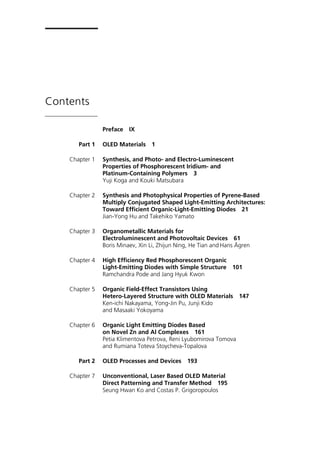





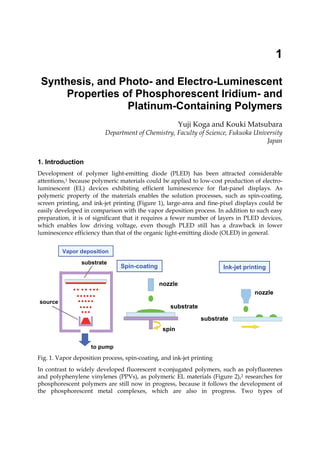
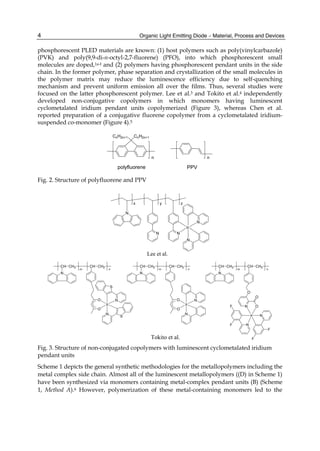
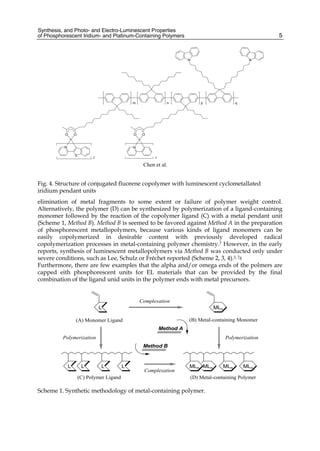
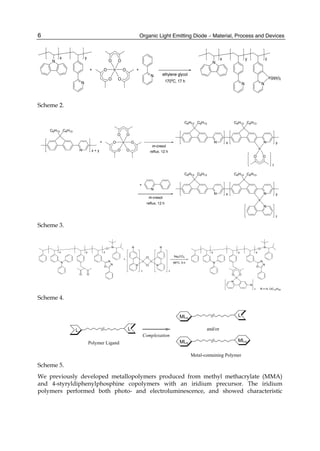
![Synthesis, and Photo- and Electro-Luminescent Properties
of Phosphorescent Iridium- and Platinum-Containing Polymers 7
features depending upon the content ratios of the iridium and phosphorus in the
copolymers.8 However, the devices containing these polymers exhibited rather low
luminescent efficiency, because of its low charge-transporting ability caused by the
nonconductive polyolefin backbone.
Here, we developed several series of iridium or platinum-containing metallopolymers
under mild conditions in Method B, where pyridine was used as a linker module between
the polymer main chain and the luminescent metal unit. Metal-incorporation effects of the
metallopolymers on their luminescent properties were investigated in order to develop
devices with high luminescent efficiency. Two independent types of the metallopolymers
are shown in the following chapters: one is that composed of polyolefin main chain and
metal units in its side chain, and the other is -conjugated polymers, which has the
luminescent metal groups in the chain ends.
2. Preparation of metallopolymers containing polyolefin main chain
In the previous paper, we have reported that luminescent polymers can be easily prepared
by the reaction of the phosphorus ligand copolymers derived from MMA and 4-
styryldiphenylphosphine with the iridium precursor under mild conditions.8 Unfortunately,
we found that the phosphorus side chain was easily oxidized to form oxide, probably
leading to desorption of metal species from the metallopolymer. Alternatively, to improve
the luminescent polymers, we used 4-vinylpyridine (Vp) as a linker module comonomer. It
has been generally used as a ligand in metallopolymers.9 In this chapter, we have reported
preparation of a series of new luminescent metallopolymers. First, pyridine-containing
polymers were produced as ligands for metal modules. Then, some amount of iridium
complex precursor, [IrCl(piq)2]2 (3), where piq is 1-phenylisoquinoline, was added to the
ligand polymer.
Scheme 6 depicts the synthetic procedure for the ligand copolymer 1 and the iridium-
containing polymer 5. MMA and Vp were copolymerized in the presence of benzoylperoxide
(BPO) at 80 °C for 10 h to form the random copolymer 1.10 The number-averaged molecular
weight of 1 was 963000 g/mol, determined by size-exclusion chromatography (SEC) which
was calibrated using polystyrene standards. The 1H NMR spectroscopy of 1 revealed that the
content of Vp was 23 mol%. These copolymers reacted with [IrCl(piq)2]2 (3) in CH2Cl2
efficiently to form 5, as a red compound. The expected quantity of the vinylpyridine iridium
unit, [IrCl(piq)(Vp)], in metallopolymer 5 was 49 wt%, which was calculated by the feed ratios
of 3 and Vp in 1. The luminescent polymer of platinum analog 6 was also prepared efficiently
by the reaction of 1 with a platinum precursor, [PtCl(piq)]2 (4), in CH2Cl2.
In these luminescent polymers, MMA were used as a comonomer in order to reveal the
properties of luminescent modules. However, as noted below, the EL efficiencies of the
devices including such metallopolymers were extremely low, because of the poor
conductivity of MMA copolymer. Therefore, we used N-vinylcarbazole (Vc) as an
alternative comonomer instead of MMA to improve the conductivity and luminescence
property. Poly(N-vinylcarbazole) (PVK) has been known as a host material for OLED
component, performing high conductivity due to closely arranged conjugated sites which
hang from the polyolefin backbone as a pendant group.11 Scheme 7 depicts the synthetic
procedure for the iridium-containing polymers 7a and 7b from ligand copolymers 2a and
2b, which have different Vp contents, 4.7 and 15 mol%, respectively. The content of Vp was
determined by absorption coefficient ratio for PVK at 345 nm in CHCl3 (Table 1). The ligand
copolymers 2a and 2b were prepared in the presence of AIBN.12 The reaction of these](https://image.slidesharecdn.com/2057300-250604125320-a50a4530/85/Organic-Led-Material-Process-And-Devices-Mtls-Sci-S-Ko-21-320.jpg)
![Organic Light Emitting Diode – Material, Process and Devices
8
copolymers with [IrCl(piq)2]2 (3) in CH2Cl2 gave red solutions, similar to the prior
experimental result forming 5 (Table 2). The quantities of the iridium unit,
[IrCl(piq)2(Vp)]y2, content in the metallopolymers 7a and 7b were 8.4 and 25 wt%, which
were determined by the feed ratios of 3 and Vp in 2a-b.
N
O OMe
+
Me
80℃, 10 h
Me
N
MeO O
x y
1
BPO
reflux, overnight
CH2Cl2
+ [MCl(piq)n]2
Me
N
MeO O
x y1
N
y2
N
M
Cl
1
6 : M = Pt, n = 1
4 : M = Pt, n = 1
3 : M = Ir, n = 2
5 : M = Ir, n = 2
n
Scheme 6. Preparation of 1, 5, and 6.
N
+
65℃, 3 h
N
N
x y
2
AIBN
N
DMF
reflux, 16 h
CH2Cl2
+ N
N
x y1
N
y2
N
Ir
Cl
2
2
7
3
Scheme 7. Synthesis of copolymers 2a-b, and metallopolymers 7a-b.](https://image.slidesharecdn.com/2057300-250604125320-a50a4530/85/Organic-Led-Material-Process-And-Devices-Mtls-Sci-S-Ko-22-320.jpg)
![Synthesis, and Photo- and Electro-Luminescent Properties
of Phosphorescent Iridium- and Platinum-Containing Polymers 9
The MMA-copolymerized metallopolymers 5 and 6 were readily soluble in several organic
solvents, such as CH2Cl2, and CHCl3, whereas the Vc-copolymerized metallopolymers 7 had
poor solubility toward these solvents. Figure 5 shows the 1H NMR spectra for the
monomeric complex 14, 1, and 5. Broadened signals due to the aromatic protons of 1
appeared from δ 8.5 to 8.2 and from δ 7.1 to 6.6 (Figure 5 (b)), whereas new broad
resonances were observed from δ 10.1 to 6.1 (c), assigned as aromatic protons of the
incorporated iridium unit in 5, which provided the similar set of signals to those
corresponding to 14 (a). The result suggested that the iridium unit in 5 has the same
chemical structure as that of 14. The spectra for 6 were similarly observed. Several
broadened signals assigned as aromatic groups of the iridium unit in 7 were also observed
as shown in Figure 6 (b) and (d). These signals were shifted to the higher field when these
signals were compared with those due to the monomeric analog 14 (Figure 6 (e)), probably
due to the shielding effect of the surrounding aromatic groups of the carbazole side chain.
Ligand
Polymer
Comonomer
Initiator
(mmol)
Yield
(%)
Vp Content
(mol%)
Mn
(×104
g/mol)
PDI
Vp
(mmol)
Other
(mmol)
1 0.93 MMA 9.3 BPO 0.050 100 23 96 2.7
2a 1.0 Vc 20 AIBN 0.10 82 4.7 5.0 2.1
2b 2.0 Vc 20 AIBN 0.10 20 15 3.8 3.5
Table 1. Preparation of Ligand Polymers
Polymer
Complex
Feed Polymer Ligand
(Pyridine Content /
mmol)
Feed Precursor
Complex
(Metal Content / mmol)
Yield
(%)
[IrCl(piq)2(Vp)]y2
Content (wt%)
5 1 0.40 3 0.10 94 49
6 1 0.041 4 0.010 94 41
7a 2a 0.20 3 0.049 95 8.4
7b 2b 0.20 3 0.050 92 25
Table 2. Preparation of Metallopolymers
3. Preparation of metallopolymers containing conjugated polymer main chain
EL materials containing small molecules as doping luminescent compounds and
conjugated polymers, such as PPV and PFO, have been developed as EL materials. Those
performing more efficient luminescence have also been developed directly binding
chromophores in the side chain of the conjugated polymers (Figure 4 and Scheme 3). 5,7f,7g
However, it is unknown that the luminescent iridium or platinum unit directory combines
to the end of the conjugated polymers without breaking the -conjugation, except one
example.13 The conjugated binding between the host polymer and the guest chromophore
is expected that intramolecular electron transfer occurs easily. Here we developed new](https://image.slidesharecdn.com/2057300-250604125320-a50a4530/85/Organic-Led-Material-Process-And-Devices-Mtls-Sci-S-Ko-23-320.jpg)
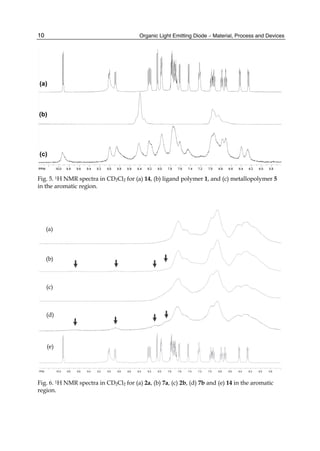
![Synthesis, and Photo- and Electro-Luminescent Properties
of Phosphorescent Iridium- and Platinum-Containing Polymers 11
series of conjugated ligand polymers where a pyridyl group was introduced in the both
ends of the polymers. As the previous preparation for the polyolefin metallopolymers, the
luminescent 1-phenylisoquinoline iridium module was efficiently combined to the ligand
polymers after polymerization. The procedures of the ligand polymers 8 and 9 and
metallopolymers 10-13 are shown in Schemes 8 and 9. The conjugated polymer was
prepared by the polycondensation reaction of two comonomers, 9,9-dioctylfluorene
dibromide and bisboronic ester, mediated by a the catalyst system using palladium
acetate, tri(o-methoxyphenyl)phosphine, and sodium carbonate. Subsequent reaction of
the obtained mixture with pyridylboronic acid pinacol ester or pyridylboronic acid
formed the end-capped ligand polymers 8a and 8b in 34 or 53% yield. The content of the
pyridyl group was 2.9 or 2.0 mol%, which was determined by 1H NMR spectrum. On the
other hand, a comonomer, 4-sec-butylphenyl-N,N-bis(4-bromophenyl)amine, was added
to the polycondensation, resulted in the formation of triarylamine-containing ligand
copolymers 9a and 9b. The yields, averaged moleculer weights, and pyridyl-group
contents are listed in Table 3. The reactions of the ligand polymers 8a and 9a with the
iridium precursor 3 efficiently formed the metallopolymers 10 and 12. The theoretical
ratios of the iridium unit, [IrCl(piq)2(py)] in 10 and 12 were 1.7 and 1.7 wt%.
The platinum analogs 11, 13 were similarly synthesized from 8b, 9b and the platinum
precursor 5. The yields and the content ratios of iridium and platinum are listed in
Table 4.
Toluene / Na2CO3 aq.
Aliquat 336
Pd(OAc)2
P(o-MeOC6H4)3
1) 105℃, 3 h
2) 105℃, 21 h
B B
C8H17 C8H17
O
O
O
O
Br Br
C8H17 C8H17
N BR
+ +
2)
9 : y / z = 0.9 / 0.1
C8H17 C8H17
N
y
N N
z x
N
Br Br
8 : y / z = 1.0 / 0.0
+
BR =
O
B
O
B
OH
OH
or
Scheme 8. Preparation of the conjugated ligand polymers 8 and 9.
The metallopolymers 12 and 13, in which the 4-sec-butylphenyl-diphenyleneamine group
was included in the main chain, were readily soluble in several organic solvents, such as
CH2Cl2, and CHCl3, whereas the metallopolymers 10, 11 had poor solubility toward these
solvents. The 1H NMR spectra for 10 and 12 demonstrated no existence of the precursor 3
but small amount of the iridium unit binding to the terminal as shown in Figure 7. In
addition to the signals around 8.7 and from 7.0 to 8.5, small new signals, most of which
agreed with those due to the monomeric iridium analog 14, appeared, suggesting that the
iridium unit in 10 and 12 has the similar structure to 14. The appearance of the signal at 8.7
in the spectra for the products indicated that the free pyridyl group at the end of the
polymers still remained in part, even after combination of the iridium module. The spectra](https://image.slidesharecdn.com/2057300-250604125320-a50a4530/85/Organic-Led-Material-Process-And-Devices-Mtls-Sci-S-Ko-25-320.jpg)
![Organic Light Emitting Diode – Material, Process and Devices
12
for the analogous polymers 11 and 13 containing platinum unit also showed the successful
formation of the metallopolymers, in which the platinum unit has the similar structure to 15.
5 : M = Pt, n = 1
3 : M = Ir, n = 2
reflux, overnight
CH2Cl2
+
8 N
N
M
Cl
n
[MCl(piq)n]2
C8H17 C8H17
x
11 : M = Pt, n = 1
10 : M = Ir, n = 2
N
reflux, overnight
CH2Cl2
+
9 N
N
M
Cl
n
C8H17 C8H17
0.9
N
0.1 x
5 : M = Pt, n = 1
3 : M = Ir, n = 2
[MCl(piq)n]2
13 : M = Pt, n = 1
12 : M = Ir, n = 2
N
Scheme 9. Preparation of the conjugated metallopolymers 10-13.
Ligand
Polymer
Comonomer
Yield
(%)
Pyridine
Content
(mol%)
Mn
(×104
g/mol)
PDI
FlBO
(mmol)
FlBr
(mmol)
PABr
(mmol)
PyBO
(mmol)
8aa 5.1 6.2 0.0 1.8 34 2.9 2.9 1.4
8b 5.2 6.2 0.0 1.8 53 2.0 3.4 1.6
9aa 5.2 5.0 1.2 1.8 28 3.5 3.1 1.3
9b 5.4 5.0 1.2 1.8 52 2.6 3.9 1.4
a Pinacol ester instead of boronic acid was used as a coupling reagent in the synthesis of 8a
and 9a.
Table 3. Preparation of the conjugated ligand copolymers.
Polymer
Complex
Ligand Copolymer Metal Precursor
Yield
(%)
[IrCl(piq)2(py)]
Content
(wt%)
Pyridine
Content
(mmol)
Metal Content
(mmol)
10 8a 0.029 3 0.0051 80 1.7
11 8b 0.032 5 0.0056 76 1.1
12 9a 0.016 3 0.0030 68 1.7
13 9b 0.029 5 0.0055 34 1.0
Table 4. Preparation of the conjugated metallopolymers.](https://image.slidesharecdn.com/2057300-250604125320-a50a4530/85/Organic-Led-Material-Process-And-Devices-Mtls-Sci-S-Ko-26-320.jpg)
![Synthesis, and Photo- and Electro-Luminescent Properties
of Phosphorescent Iridium- and Platinum-Containing Polymers 13
4. PL behavior of metallopolymers
The corresponding pyridine-substituted monomeric complexes of iridium and platinum
(Figure 8 (a)) were also prepared for the first time in order to estimate the luminescent
behavior of the metallopolymers containing the similar metal units,14 because polymer
backbone sometimes influences luminescence of the metal units significantly both in the
solid and solution states.8, 15 The structures of these complexes were well defined and the PL
behaviors were compared with those of the metallopolymers.14 All the iridium and platinum
complexes and polymers were irradiated at 462 and 433 nm, respectively, to observe the
luminescence. As shown in Figure 8 (b), both the luminescent bands for the iridium and
platinum complexes 14 and 15 were observed in almost the same area from 570 to 850 nm,
although the low-energy absorption bands appeared in the different area (c).
Fig. 7. 1H NMR spectra in CD2Cl2 for (a) 12, (b) 10 and (c) 14 in the aromatic region.
Figure 9 (a) and (b) show the PL spectra of the metallopolymers 5, 6, 7a and 7b in the CH2Cl2
solutions. Similar photoluminescent properties of the metallopolymers in the solutions to
those of the monomeric metal analogs were observed when the concentrations of the metal
units in the solutions were comparable. For example, red luminescence from 5 was observed
and the wavelength at the maximum intensity was 620 nm. The PL spectra for 7 showed the
emissions at ~620 nm from the incorporated [IrCl(piq)2] unit. The intensity of the spectrum
for the iridium polymer 5 was more than four times stronger than that for the platinum
analog 6. Lower intensity for 7a than 7b was coincident with the content ratios of the
iridium unit in the metallopolymers (Table 2).
The PL spectra for the conjugated metallopolymers were shown in Figure 10. The spectra
indicated that each structure of the metal unit was almost the same as that of the monomeric
metal complex. The iridium–containing polymers 10 and 12 exhibited the similar
luminescent spectra to that for the monomeric analog 14, whereas the spectra for the
platinum polymers 11 and 13 showed a characteristic strong band due to the conjugated
(b)
(a)
(c)](https://image.slidesharecdn.com/2057300-250604125320-a50a4530/85/Organic-Led-Material-Process-And-Devices-Mtls-Sci-S-Ko-27-320.jpg)
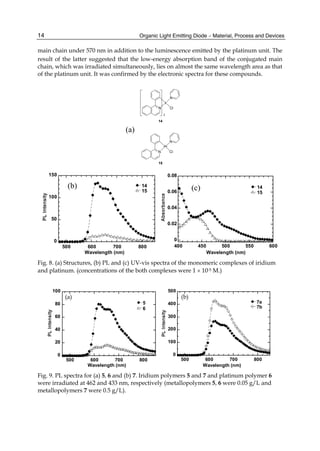
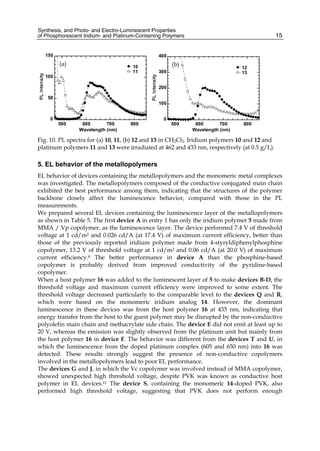
![Organic Light Emitting Diode – Material, Process and Devices
16
conductivity in the absence of conductive polymers. This high voltage was improved, when
the conductive host polymer 16 was added to the luminescent layer. However, the
maximum current efficiencies were not so different among devices H, I and K, L, in spite of
the different iridium unit content ratios in these metallopolymers 7a and 7b (7a < 7b, see
Tables 1-3). Although the total performances of these devices based on the Vc copolymer
were still not satisfactory, the energy transfer from the host polymer 16 to the
metallopolymers occurred smoothly, leading to decrease of luminescence at 435 nm from
the host 16, in comparison with copolyMMA-based devices.
entry Devicea
Emitting Layer
Metal Unit
Contentb
Vth
c
(V)
c max
d
(cd/A, V)
max
e
(nm)
Hostf
Guest
Feed Ratio
(Host / Guest)
(wt%)
1 A ― 5 0 / 100 Ir 49 7.4 0.026, 17.4 635
2 B 16 5 80 / 20 Ir 9.8 5.0 0.063, 7.4 430
3 C 16 5 90 / 10 Ir 4.9 5.6 0.15, 8.2 435
4 D 16 5 95 / 5 Ir 2.5 4.8 0.091, 12.6 435
5 E ― 6 0 / 100 Pt 41 ― ― ―
6 F 16 6 95 / 5 Pt 2.1 5.6 0.096, 9.6 435
7 G ― 7a 0 / 100 Ir 8.4 19.2 0.026, 20.0 625
8 H 16 7a 60 / 40 Ir 3.4 4.2 0.13, 6.8 430
9 I 16 7a 80 / 20 Ir 1.7 4.6 0.14, 7.6 430
10 J ― 7b 0 / 100 Ir 25 11.0 0.082, 20.0 630
11 K 16 7b 60 / 40 Ir 10 4.4 0.12, 6.4 430
12 L 16 7b 80 / 20 Ir 5 4.0 0.097, 5.8 430
13 M ― 10 0 / 100 Ir 1.7 4.0 1.14, 4.0 625
14 N ― 11 0 / 100 Pt 1.1 5.4 0.14, 7.6 605, 650
15 O ― 12 0 / 100 Ir 1.7 3.4 0.47, 3.6 620
16 P ― 13 0 / 100 Pt 1.0 5.8 0.36, 10.0 605, 650
17 Q 16 14 90 / 10 Ir 10 6.4 0.31, 9.2 625
18 R 16 14 95 / 5 Ir 5.0 5.0 0.30, 8.2 615
19 S PVK 14 95 / 5 Ir 5.0 8.0 0.014, 19.8 630
20 T 16 15 90 / 10 Pt 10 10.0 0.024, 16.2 605, 650
21 U 16 15 95 / 5 Pt 5.0 6.8 0.048, 9.8 435
a Device structure: ITO/PEDOT:PSS/Emitting layer/Ba/Al
b Metal unit is [MCl(piq)n(Py-)] (n = 2, Ir; n = 1, Pt) or the monomeric complex in the emitting layer.
c Threshold voltage at 1 cd/m2.
d Maximum current efficiency.
e The max values correspond to the highest intensity peak in the EL spectrum at maximum current
efficiency.
f 16:
N
C8H17 C8H17
1
9
Table 5. EL properties of the devices containing the metallopolymers](https://image.slidesharecdn.com/2057300-250604125320-a50a4530/85/Organic-Led-Material-Process-And-Devices-Mtls-Sci-S-Ko-30-320.jpg)
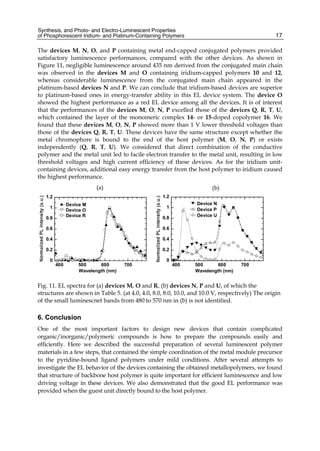
![Organic Light Emitting Diode – Material, Process and Devices
18
7. Experimental details
7.1 Synthesis of pyridine-capped conjugated copolymers
As a typical example, into a 200-mL three-necked flask equipped with a condenser, 2.77 g
(5.2 mmol) of 9,9-dioctylfluorene-2,7-bis(boronic acid ethylene glycol ester), 2.72 g (5.0
mmol) of 9,9-dioctyl-2,7-dibromofluorene, 0.551 g (1.2 mmol) of 4-(1-methylpropyl)-N,N-
bis(4-bromophenyl)aniline, 0.79 g of methyltrioctylammonium chloride (Aliquat 336, made
by Sigma-Aldrich Corporation), and 60 mL of toluene were placed. Under a nitrogen
atmosphere, 2.2 mg of palladium diacetate and 12.9 mg of tris(2-methoxyphenyl)phosphine
were added to the solution, and the solution was heated to 95°C. While a 17.5 wt% sodium
carbonate aqueous solution (16.5 mL) was dropped to the obtained solution over 30
minutes, the solution was heated to 105°C, and subsequently stirred at 105°C for 3 hours.
Then, 369 mg of 4-(4,4,5,5-tetramethyl-1,3,2-dioxaborolan-2-yl)pyridine dissolved in toluene
(30 mL) was added, and the mixture was stirred at 105°C for 21 hours. After the aqueous
layer was removed, 3.65 g of sodium N,N-diethyldithiocarbamate trihydrate and 36 mL of
water were added, and the solution was stirred at 85°C for 2 hours. An organic layer was
separated and washed with water (78 mL, twice), a 3 wt% aqueous acetic acid (78 mL,
twice), and then water (78 mL, twice). The organic layer was dropped to methanol to form
precipitates, which were filtrated and dried to obtain a solid. The residual solid was
dissolved in toluene (186 mL), and the solution was passed through a silica gel / alumina
column, where toluene was passed in advance. The filtrate was concentrated under reduced
pressure and dropped into methanol, and a precipitate was filtered to obtain ligand polymer
9a (1.26 g). The number-averaged molecular weight Mn was 3.1 × 10⁴ g/mol, which was
determined by SEC calibrated with polystyrene standards.
7.2 Synthesis of conjugated iridium polymers
As a typical example, under an inert-gas atmosphere, a mixture of [IrCl(piq)2]2 (3) (0.0038 g,
0.0030 mmol) and pyridine-capped copolymer 9a (0.243 g, containing 0.016 mmol of
pyridine) in CH2Cl2 (6 mL) was refluxed for 16 h. After cooling to room temperature, the
resulting solution was poured into hexane to afford a precipitate, which was filtered and
washed with hexane and dried under reduced pressure to obtain light orange powder 10 in
80 % yield (Mn = 3.3×10⁴l g/mol).
8. Acknowledgement
The EL experiments in this study were conducted with kind supports of Sumitomo
Chemical Co., Ltd.
9. Abbreviations
PL: photo-luminescent
EL: electro-luminescent
PLED: polymer light-emitting diode
OLED: organic light-emitting diode
PPV: polyphenylene vinylene
PVK: poly(vinylcarbazole)
PFO: poly(9,9-di-n-octyl-2,7-fluorene)](https://image.slidesharecdn.com/2057300-250604125320-a50a4530/85/Organic-Led-Material-Process-And-Devices-Mtls-Sci-S-Ko-32-320.jpg)
![Synthesis, and Photo- and Electro-Luminescent Properties
of Phosphorescent Iridium- and Platinum-Containing Polymers 19
MMA: methyl methacrylate
Vp: 4-vinylpyridine
piq: 1-phenylisoquinoline
SEC: size-exclusion chromatography
Vc: N-vinylcarbazole
AIBN: azobisisobutylonitrile
BPO: benzoylperoxide
FlBO: 9,9-dioctylfluorene-2,7-bis(boronic acid ethylene glycol ester)
FlBr: 9,9-dioctyl-2,7-dibromofluorene
PABr: 4-sec-butylphenyl-N,N-bis(4-bromophenyl)amine
PyBO: 4-(4,4,5,5-tetramethyl-1,3,2-dioxaborolan-2-yl)pyridine boronic acid
10. References
[1] (a) Lee, C.-L.; Lee, K. B.; Kim, J.-J. Appl Phys Lett 2000, 77, 2280–2282; (b) Negres, R. A.;
Gong, X.; Ostrowski, J. C.; Bazan, G. C.; Moses, D.; Heeger, A. J. Phys Rev B 2003,
68, 115209; (c) Zhu, W. G.; Ke, Y.; Wang, F.; Liu, C. Z.; Yuan, M.; Cao, Y. Synth Met
2003, 137, 1079–1080; (d) van Dijken, A.; Bastiaanssen, J. J. A. M.; Kiggen, N. M. M.;
Langeveld, B. M. W.; Rothe, C.; Monkman, A.; Bach, I.; Stössel, P.; Brunner, K. J Am
Chem Soc 2004, 126, 7718–7727; (e) Tanaka, I.; Tabata, Y.; Tokito, S. Jpn J Appl Phys
2004, 43, L1601–L1603; (f) Xia, H.; Zhang, C.; Qiu, S.; Lu, P.; Zhang, J.; Ma, Y. Appl
Phys Lett 2004, 84, 290–292; (g) Gong, X.; Robinson, M. R.; Ostrowski, J. C.; Moses,
D.; Bazan, G. C.; Heeger, A. J. Adv Mater 2002, 14, 581–585; (h) Jiang, C.; Yang, W.;
Peng, J.; Xiao, S.; Cao, Y. Adv Mater 2004, 16, 537–541; (i) Adachi, C.; Kwong, R.;
Forrest, S. R. Org Electron 2001, 2, 37–43; (j) Lee, C.-C.; Yeh, K.-M.; Chen, Y. J Polym
Sci Part A: Polym Chem 2008, 46, 7960–7971; (k) Wang, P.; Chai, C.; Yang, Q.;
Wang, F.; Shen, Z.; Guo, H.; Chen, X.; Fan, X.; Zou, D.; Zhou, Q. J Polym Sci Part A:
Polym Chem 2008, 46, 5452–5460; (l) Yuan, M.-C.; Shih, P.-I.; Chien, C.-H.; Shu, C.-
F. J Polym Sci Part A: Polym Chem 2007, 45, 2925–2937.
[2] Kraft, A.; Grimsdale, A. C.; Holmes, A. B. Angew Chem Int Ed 1998, 37, 402.
[3] Lee, C.-L.; Kang, N.-G.; Cho, Y.-S.; Lee, J.-S.; Kim, J.-J. Opt Mater 2002, 21, 119–123
[4] Tokito, S.; Suzuki, M.; Sato, F.; Kamachi, M.; Shirane, K. Org Electron 2003, 4, 105–111.
[5] Chen, X.; Liao, J.-L.; Liang, Y.; Ahmed, M. O.; Tseng, H.-E.; Chen, S.-A. J Am Chem Soc
2003, 125, 636–637.
[6] (a) Xu, Y.; Guan, R.; Jiang, J.; Yang, W.; Zhen, H.; Peng, J.; Cao, Y. J Polym Sci Part A:
Polym Chem 2008, 46, 453–463; (b) Mei, C.; Ding, J.; Yao, B.; Cheng, Y.; Xie, Z.;
Geng, Y.; Wang, L. J Polym Sci Part A: Polym Chem 2007, 45, 1746–1757.
[7] (a) Yamada, Y. M. A.; Takeda, K.; Takahashi, H.; Ikegami, S. Org Lett 2002, 4, 3371–3374;
(b) Yamada, Y. M. A.; Takeda, K.; Takahashi, H.; Ikegami, S. J Org Chem 2003, 68,
7733–7741; (c) Bianchini, C.; Frediani, M.; Vizza, F. Chem Commun Commun 2001,
479–480; (d) Borbone, F.; Caruso, U.; Maria, A. D.; Fusco, M.; Panunzi, B.; Roviello,
A. Macromol Symp 2004, 218, 313–321; (e) Marin, V.; Holder, E.; Hoogenboom, R.;
Schubert, U. J Polym Sci Part A: Polym Chem 2004, 42, 4153–4160; (f) Deng, L.;
Furuta, P. T.; Garon, S.; Li, J.; Kavulak, D.; Thompson, M. E.; Fre´chet, J. M. J Chem
Mater 2006, 18, 386–395; (g) Schulz, G. L.; Chen, X.; Chen, S.-A.; Holdcroft, S.
Macromolecules 2006, 39, 9157–9165; (h) Aamer, K. A.; Tew, G. N. J Polym Sci Part
A: Polym Chem 2007, 45, 1109–1121.](https://image.slidesharecdn.com/2057300-250604125320-a50a4530/85/Organic-Led-Material-Process-And-Devices-Mtls-Sci-S-Ko-33-320.jpg)
![Organic Light Emitting Diode – Material, Process and Devices
20
[8] Koga, Y.; Yoshida, N.; Matsubara, K. J Polym Sci Part A: Polym Chem 2009, 47, 4366–
4378.
[9] (a) Daniel, S.; Gladis, J. M.; Rao, T. P. Anal Chim Acta 2003, 349, 173–182; (b) Sumi, V. S.;
Kala, R.; Praveen, R. S.; Rao, T. P. Int J Pharm 2008, 349, 30–37; (c) Fan, P.; Wang, B.
J Appl Polym Sci 2010, 116, 258–266.
[10] Salahuddin, N. J. Appl. Polym. Sci. 2007, 104, 3317-3323
[11] (a) Xiao, J.; Yao, Y.; Deng, Z.; Wang, X.; Liang, C. J Lumin 2007, 122–123, 639–641; (b)
Ye, T.; Chen, J.; Ma, D. Phys. Chem. Chem. Phys. 2010, 12, 15410–15413; (c) Song,
M.; Park, J. S.; Yoon, M.; Kim, A. J.; Kim Y. I.; Gal, Y.-S.; Lee, J. W.; Jin, S.-H. J
Organomet Chem 2011, 696, 2122-2128.
[12] Zhang, H.; Zhou, Z.; Liu, K.; Wang, R.; Yang, B. J. Mater. Chem. 2003, 13, 1356-1361.
[13] Zhang, K.; Chen, Z.; Yang, C.; Zou, Y. ; Gong, S.; Tao, Y.; Qin, J.; Cao, Y. J Mater Chem
2008, 18, 3366–3375.
[14] Koga, Y.; Matsumoto, T.; Matsubara, K. unpublished results.
[15] Koga, Y.; Ueno, K.; Matsubara, K. J Polym Sci Part A: Polym Chem 2006, 44, 4204–4213.](https://image.slidesharecdn.com/2057300-250604125320-a50a4530/85/Organic-Led-Material-Process-And-Devices-Mtls-Sci-S-Ko-34-320.jpg)
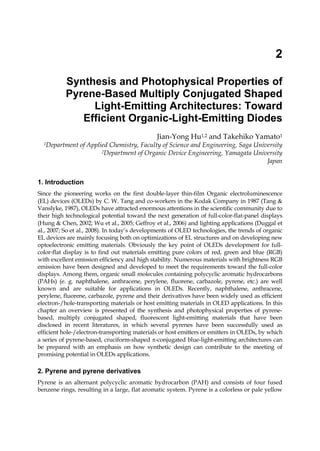
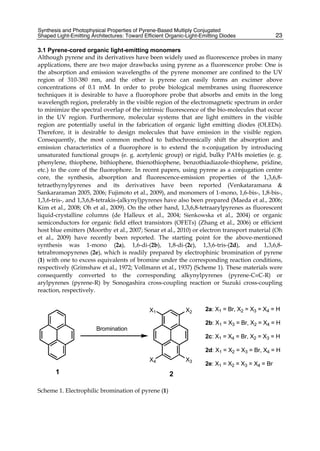
![Organic Light Emitting Diode – Material, Process and Devices
24
3.1.1 Alkynyl-functionalized pyrene-cored light-emitting monomers
Acetylene has been widely applied for linking -conjugated units and for effectively
extending the -conjugation length. The progress of such -conjugated materials by means
of acetylene chemistry has strongly dependent on the development of Sonogashira coupling
reaction. Thereby, many attractive acetylene-linked molecules have emerged such as for
semiconducting polymers (Swager et al., 2005; Swager Zheng, 2005), macrocyclic
molecules (Kawase, 2007; Hoger et al., 2005), helical polymers (Yamashita Maeda, 2008)
and energy transfer cassettes (Loudet et al., 2008; Han et al., 2007; Jiao et al., 2006;
Bandichhor et al., 2006). Accordingly, the use of acetylene group for extending the
conjugation of the pyrene chromophore is one of the most common methods. Sankararaman
et al. (Venkataramana Sankararaman, 2005) reported the synthesis, absorption and
fluorescence-emission of 1,3,6,8-tetraethynylpyrene derivatives 3a-f, which were prepared
by the Sonogashira coupling of tetrabromomide (2e) with various terminal acetylenes
yielded the corresponding tetraethynylpyrenes. Significant bathochromic shifts of
absorptions band were observed in the region of 350-450 nm for 3a-d, 375-474 nm for 3e-f,
respectively, compare with that of pyrene (1) in dilute THF solutions due to the extended
conjugation of the pyrene chromophore with the acetylenic units. Similarly, the fluorescence
emission bands of 3a-f are also bathochromically shifted in region of 420-550 nm in
comparison of pyrene in THF. The quantum efficiency of fluorescence emission for 3a-d was
in the rang of 0.4-0.7; these values are comparable to that of pyrene, while 3e and 3f are low
due to the deactivation of the excited state resulting from the free rotation of the phenyl
groups. The results suggest these derivatives are potentially useful as emitters in the
fabrication of organic light emitting diodes (OLEDs). A pyrene octaaldehyde derivative 4
and its aggregations through - and C-HO interactions in solution and in the solid state
probed by its fluorescence emission and other spectroscopic methods are also prepared by
Sankararaman et al. (Venkataramana Sankararaman, 2006) In view of its solid-state
fluorescence, this octaaldehyde 4 and its derivatives might find applications in the field of
molecular optoelectronics. Similarly, Fujimoto and co-workers (Maeda et al., 2006) have
synthesized a variety of alkynylpyrene derivatives 5a-d from mono- to tetrabromo-pyrenes
(2a-2e) and arylacetylenes using the Sonogashira coupling, and comprehensively examined
their photophysical properties. The alkynylpyrenes 5a-h thus prepared showed not only
long absorption (365-434 nm, 1.0 x 10⁻⁵ M, in EtOH) and fluorescence emission (386-438 nm,
1.6-2.5 x 10⁻⁷ M, in EtOH) wavelengths but also high fluorescence quantum yields (0.55-0.99,
standards used were 9,10-diphenylanthracene) as compared with pyrene itself.
Additionally, the alkynylpyrene skeletons could be applied to practically useful
fluorescence probes for proteins and DNAs. Fujimoto et al. (Fujimoto et al., 2009) recently
also prepared a series of 1,3,6,8-tetrakis(arylethynyl)pyrenes 6a-e bearing electron-donating
or electron-withdrawing groups. Their photophysical properties analysis demonstrated that
the donor-modified tetrakis(arylethynyl)pyrene 6a-c showed fluorescence solvatochromism
on the basis of intramolecular charge transfer (ICT) mechanism, while the acceptor-modified
ones 6d-e never did. Furthermore, the donor-modified tetrakis(arylethynyl)pyrene 6a-c
were found to be stable under laboratory weathering as compared with that of coumarin.
Thus, the tetrakis(arylethynyl)pyrenes 6 are expected to be applicable to bioprobes for
hydrophobic pockets in various biomolecules and photomaterials.
More recently, Kim et al. prepared a series of alkynylpyrenes 7a-e that bear peripheral [4-
(N,N-dimethylamino)phenylethynyl] (DMA-ethynyl) units using pyrene as the -center and
their two-photon absorption properties (Kim et al., 2008) and electrogenerated](https://image.slidesharecdn.com/2057300-250604125320-a50a4530/85/Organic-Led-Material-Process-And-Devices-Mtls-Sci-S-Ko-38-320.jpg)
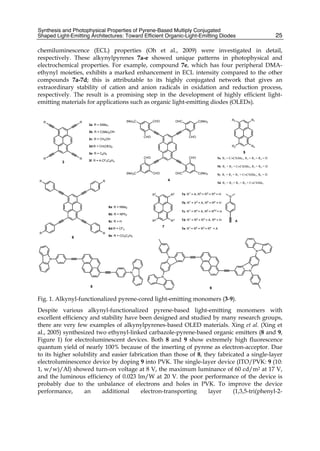
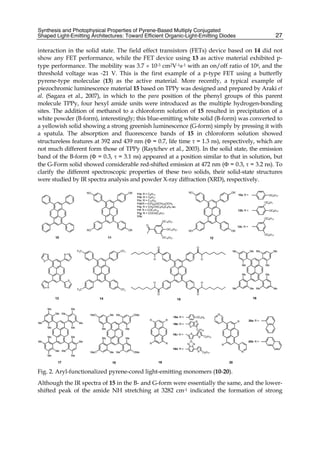
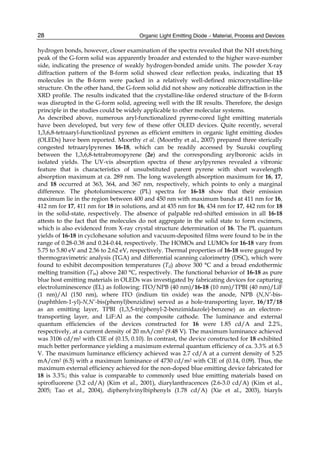
![Organic Light Emitting Diode – Material, Process and Devices
30
(Tokito et al., 1997), benzimidazole (Shi et al., 1997), diarylsilole group materials (Uchida et
al., 2001) and electron transport materials (ETMs) (Kulkarni et al., 2004; Strohriegl
Grazulevicius, 2002) were synthesized and applied to OLEDs. On the other hand, the
polycyclic aromatic hydrocarbons such as naphthalenes, anthracenes, and pyrenes,
compared with hetero-aromatic compounds, are known to be not suitable for ETMs due to
their high reduction potentials, but they have good thermal stability and no absorption at
longer wavelengths than 430 nm (Tonzola et al., 2003). Among them, pyrene has relatively
high electron affinity values and better thermal stability. Lee an co-workers (Oh et al., 2009)
synthesized new kinds of pyrene-based electron transport materials (ETMs): 1,6-di(pyridin-
3-yl)-3,8-di-(naphthlen-1-yl)pyrene (20a) and 1,6-di(pyridin-3-yl)-3,8-di(naphthlen-2-
yl)pyrene (20b) via Suzuki coupling reaction starting from 1,6-dibromopyrene (2b).
Three blue OLEDs (1-3) were fabricated by high-vacuum thermal evaporation of OLED
materials on to ITO-coated glass as following: ITO/DNTPD (60 nm)/NPB (30 nm)/AND:
TBP 3wt% (25 nm)/Alq3 (device 1) or 20a (device 2) or 20b (device 3) (25 nm)/LiF (0.5
nm)/Al (100 nm), where 4,4’-bis[N-[4-{N,N-bis(3-methylphenyl)amino}-phenyl]-N-
phenylamino]biphenyl (DNTPD) and 4,4’-bis[N-(1-naphthyl)-N-phenylamino] biphenyl
(NPB) act as hole-injecting/transport layers (HTL), AND : TBP 3wt% act as emitting layers
(EML), and Alq3 or 20a or 20b act as electron-injecting/transport layers (ETL), respectively.
The external quantum efficiencies of the devices 2-3 with the newly-developed pyrene-
based molecules 20a/20b as electron transport materials increase by more than 50% at 1 mA
cm-2 compared with those of the device 1 with representative Alq3 as an electron transport
material. The enhanced quantum efficiencies are due to the balanced charge recombination
in an emissive layer. Electron mobilities in 20a and 20b films are 3.7 x 10⁻⁵ cm2 (Vs)-1 and 4.3
x 10-5 cm2 (Vs)-1, respectively. These values are three times higher than that of Alq3. Highly
enhanced power efficiency is achieved at 1.4 lm/W for device 1 with Alq3, 2.0 lm/W for
device 2 with 20a, and 2.1 lm/W for device 3 with 20b at 2000 cd/m2 due to a low electron
injection barrier and high electron mobility. All structures for these 1,3,6,8-tetraaryl-
functionalized pyrene-cored light-emitting monomers (10-20) are shown in Figure. 2.
3.2 Pyrenyl-functionalized PAHs-cored light-emitting monomers
Due to the most attractive features of its excimer formation, delayed fluorescence, rather
fluorescence lifetimes, etc., pyrene is also a fascinating subchromophores for constructing
highly efficient fluorescent light-emitting monomers for OLEDs applications. Recent
literatures survey revealed that there are many number of investigations concerning the
attachment of pyrene to other aromatic fluorophores such as benzene, fluorene, and
carbazole, etc. as highly efficient emitters in OLEDs. In this section, the synthesis and
photophysical properties of three types of pyrenyl-functionalized PAHs-cored light-
emitting monomers were summarized. Especially, several these light-emitting monomers as
emitters in efficient OLEDs will be fully discussed.
3.2.1 Pyrenyl-functionalized benzene-cored light-emitting monomers
Hexaarylbenzenes have received much attention in material science in recent years (Rathore
et al., 2001; Rathore et al., 2004; Sun et al., 2005) for application as light emitting and charge-
transport layer in OLEDs (Jia et al., 2005). Lambet et al. (Rausch Lambert, 2006) designed a
synthetic route to the first hexapyrenylbenzene 21 starting from 4,5,9,10-tetrahydropyrene,
in which six pyrenyl substituents are arranged in a regular manner and held together by a](https://image.slidesharecdn.com/2057300-250604125320-a50a4530/85/Organic-Led-Material-Process-And-Devices-Mtls-Sci-S-Ko-44-320.jpg)
![Organic Light Emitting Diode – Material, Process and Devices
32
The PL spectra of PPP and DOPPP have lost vibronic structure and red-shifted to 428-433
nm with respect to the pyrene monomer emission, while the DMPPP emission centered at
394 nm still maintains a weak vibronic feature. On the other hand, the absorption spectra of
these thin-film samples show a broad band at 354-361 nm, which is red-shifted by approx.
10 nm relative to those in solution. The PL spectra of PPP, DOPPP, and DMPPP are red-
shifted by 18-52 nm to 463, 451, and 446 nm, respectively and become broader with a
FWHM of 68-78 nm from dichloromethane solution to the thin-film state. Such red-shifts
could be attributed to i) the aggregation of pyrene groups and ii) the extension of -
delocalization caused by the more coplanar configuration (An et al., 2002) of these
dipyrenylbenzenes (26) in the neat film. A bilayer device using PPP as the hole transporter
and Alq3 as the emitter emits green light at 513 nm from the Alq3 emitter, which can
comparable to the common Alq3-based devices using NPB as the hole transporter, indicating
PPP is an excellent hole transporter. Furthermore, three devices consists of [ITO/CuPc (10
nm)/NPB (50 nm)/PPP or DOPPP or DMPP (30 nm)/TPBI (40 nm)/ Mg:Ag/Ag] were
fabricated, where CuPc act as a hole injecter, TPBI act as a hole blocker and electron
transporter, respectively. PPP-based device emits blue light at 474 nm efficiently with a
maximum ext of 4.5 % and CIE coordinates of (0.14, 0.20); at a current density of 20
mA/cm2, the luminance and the ext are 1300 cd m-2 and 4.2 %, respectively. In particular,
DOPPP-based device emits blue light at 455 nm efficiently with a maximum ext of 4.3 %
and CIE coordinates of (0.15, 0.16); at a current density of 20 mA/cm2, the luminance and
the ext are 980 cd m-2 and 3.7 %, respectively. DMPPP-based device emits deep-blue light at
446 nm with CIE coordinates of (0.15, 0.11), the maximum ext and luminance reach as high
as 5.2 % and 40400 cd m-2 (14 V), respectively, at 20 mA cm-2, the luminance and ext are 902
cd m-2 and 4.4 %, respectively. All chemical structures of these pyrenyl-functionalized
benzenes are show in Figure. 3.
O
O
O
O
O
O
O O
O
O
O
O
C8H17
C8H17
C8H17
C8H17
C8H17
C8H17
21
22
n = 2-5
R
R
23 R =
24 25 a: R = H
b: R = OMe
c: R = Me
26
R
R
Fig. 3. Pyrenyl-functionalized benzene-cored light-emitting monomers (21-26).](https://image.slidesharecdn.com/2057300-250604125320-a50a4530/85/Organic-Led-Material-Process-And-Devices-Mtls-Sci-S-Ko-46-320.jpg)
![Organic Light Emitting Diode – Material, Process and Devices
34
nm with CIE coordinates of (0.17, 0.17) and (0.17, 0.19) for P1-based device and P2-based
device, respectively. In order to obtain a better solubility and a low tendency to crystallize in
devices, a long chain alkyloxy group was introduced into C9 phenyl at para-position, two
new efficient blue-light-emitting materials, 2-pyrenyl-9-alkyloxyphenyl-9-pyrenylfluorene
(31a) and 2,7-dipyrenyl-9- alkyloxyphenyl-9-pyrenylfluorene (31b) have also been reported
by Huang’s group (Tang et al., 2006). A preliminary simple three layer blue-light-emitting
diodes with a configuration of ITO/TCTA (8 nm)/31a (30 nm)/BCP (45 nm)/Mg:Ag, was
fabricated and obtained without the need for a hole-injection layer, with high luminance of
11620 cd/m2 (14.6 V), turn-on voltage of 4.0 V, current efficiency of 3.04 cd/A (8.8 V) and
CIE coordinates of (0.18, 0.23). More recently, two solution-processable, pyrenyl-
functionalized, fluorene-based light emitting materials, 2-(1-ethynylpyrenyl)-9-
alkyloxyphenyl-9-pyrenylfluorene (32a) and 2,7-di(1-ethynyl-pyrenyl)-9- alkyloxyphenyl-9-
pyrenylfluorene (32b) were reported by Huang’s group (Liu et al., 2009). They emit blue
light in solution and green light in film at 412, 439 nm and 514, 495 nm, respectively.
Because of the good thermal stability and excellent film-forming ability, 32a was chosen as
the active material in solution processed devices. Two single layered devices with the
configurations of [ITO/PEDOT: PSS (40 nm)/32a (80 nm)/Ba (4 nm)/Al (120 nm)] (Device
1) and [ITO/PEDOT: PSS (40 nm)/32a (80 nm)/CsF (4 nm)/Al (120 nm)] (Device 2) were
fabricated. For device 1, it showed bright green emission with peak at 522 nm with CIE
coordinate of (0.36, 0.54). The turn-on voltage was 4.2 V, the maximum brightness was 3544
cd/m2 and the maximum current efficiency reached 0.9 cd/A. For device 2, it showed bright
green emission with peak at 528 nm with CIE coordinate of (0.39, 0.54). The turn-on voltage
was 3.2 V, the maximum brightness was 8325 cd/m2 and the maximum current efficiency
reached 2.55 cd/A. The results suggest that for pyrene-based materials, CsF was a more
efficient cathode than barium in electron injection. This was because the Ba was still an
injection limited cathode for 32a, While the presence of Al capping cathode, free low work
function alkali metal would be generated at the 32a/CsF interface and the CsF layer
produced an interfacial dipole. Another solution processable, pyrenyl-functionalized
28 (DPhDPF) 29 (SDPF)
a: R = H (P1)
b: R = Pyrenyl (P2)
R
30
a: R1 = 2-ethylhethoxyl; R2 = H.
b: R1 = 2-ethylhethoxyl; R2 = Pyrenyl.
R2
R1O
31
a: R = H
b: R = 1-ethynylpyrene
R
O
32
33
27 (DPF)
Fig. 4. Pyrenyl-functionalized fluorene-based light-emitting monomers (27-33).](https://image.slidesharecdn.com/2057300-250604125320-a50a4530/85/Organic-Led-Material-Process-And-Devices-Mtls-Sci-S-Ko-48-320.jpg)
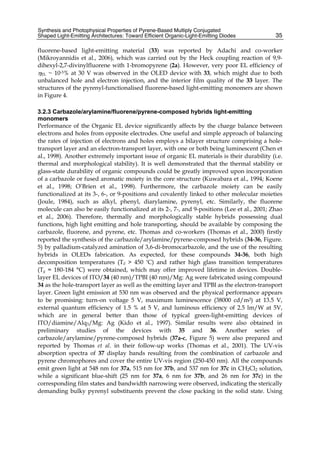
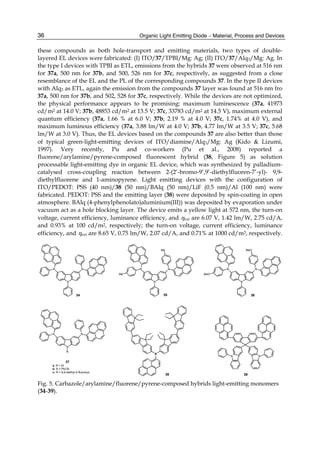
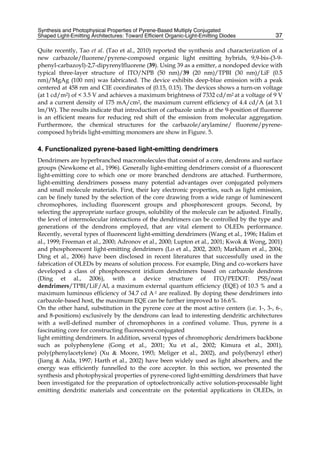
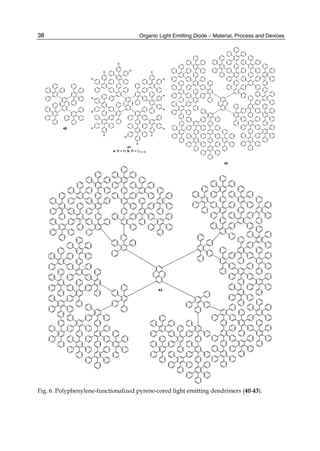
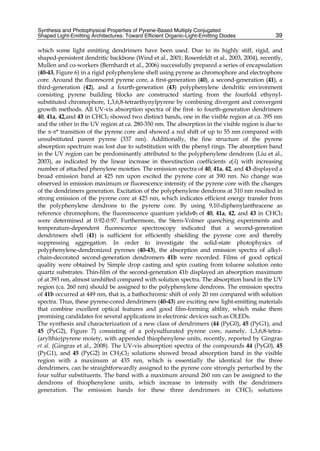
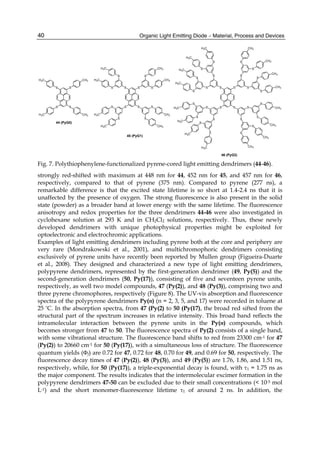






![[1] September 21, 1866.
CHAPTER VII
THE SPIRIT OF WELLS
In order to understand Wells at all one must grasp the fact that he
belongs to a type of mind which has long existed in European
literature but which is comparatively new in the English-speaking
world, the type of mind of the so-called "intellectual." He is an
"intellectual" rather than an artist; that is to say, he naturally grasps
and interprets life in the light of ideas rather than in the light of
experience.
To pass from a definition to an example, let me compare Wells in
this respect with the greatest and most typical figure of the opposite
camp in contemporary English fiction; I mean Joseph Conrad. This
comparison is all the more apt because just as much as Wells
Conrad typifies the spirit of "unrest" (a word he has almost made his
own, so often does he use it) which is the note of our age. Both of
these novelists have endeavored to express the spirit of unrest; both
have suggested a way of making it contributory to the attainment of
an ideal. But how different is their method, how different is their
ideal! And roughly the difference is this: that to Conrad the spirit of
unrest is a personal mood, a thing, as people used to say, between
man and his Maker; whereas to Wells the spirit of unrest is not a
mood but a rationally explicable frame of mind, a sense of restricted
function, an issue to be fought out not between man and nature but
between man and society. In other words, where Conrad's point of
view is moral, Wells's point of view is social; and whereas in Conrad
the spirit of unrest can only be appeased by holding fast to certain
simple instinctive moral principles, integrity, honor, loyalty, etc.,
contributing in this way to the ideal of personal character, the spirit](https://image.slidesharecdn.com/2057300-250604125320-a50a4530/85/Organic-Led-Material-Process-And-Devices-Mtls-Sci-S-Ko-63-320.jpg)









![[Marco mazzeo] organic_light_emitting_diode(book_zz.org)](https://cdn.slidesharecdn.com/ss_thumbnails/marcomazzeoorganiclightemittingdiodebookzz-150114151251-conversion-gate01-thumbnail.jpg?width=640&height=640&fit=bounds)


