Building and Industrial Mat
2011 Spring Meeting
MAY 18 – 20
BASIC INDUSTRIAL DRYING
FUNDAMENTALS AND METHODS
Richard Luedtke
Radiant Energy Systems, Inc.
Hawthorne, NJ
www.radiantenergy.com
(973) 423-5220
TAPPI
SESSION AGENDA
1. DEFINING THE PROCESS REQUIREMENTS
2. “CONVENTIONAL” DRYING METHODS
3. UNDERSTANDING THE DRYING/HEATING
PROCESS
4. UNDERSTANDING CONVECTION DRYING
5. UNDERSTANDING INFRARED DRYING
6. EQUIPMENT SELECTION: PROS AND CONS
Richard Luedtke
Radiant Energy Systems, Inc.
DEFINING THE PROCESS
REQUIREMENTS
• Drying; Solvent vaporization/evaporation
• Curing; A final web/coating temperature
requirement (normally following a drying
requirement)
• Heating; Raising the temperature of a
product: Substrate Heat set? Curing? Before
lamination?; film, foils, etc.
Richard Luedtke
Radiant Energy Systems, Inc.
CONVENTIONAL TECHNOLOGIES USED FOR
DRYING, CURING AND HEATING A WEB
• CONVECTION SYSTEMS
– IMPINGEMENT DRYING
– FLOATATION DRYING
– THROUGH AIR DRYING
– BATCH DRYERS/OVENS
• RADIANT HEATING/DRYING SYSTEMS
– ELECTRIC INFRARED
– GAS FIRED INFRARED
Richard Luedtke
Radiant Energy Systems, Inc.
A DRYER IS A “HEAT
EXCHANGER”
Dryer/Oven
System
Web and
Coating
Finished
Product
Richard Luedtke
Radiant Energy Systems, Inc.
Radiant Heat or
Conditioned Hot Air
Heating a Web
Richard Luedtke
Radiant Energy Systems, Inc.
TIME
Dryer
Operating
Temp.
Web Temperature
Dryer Temperature Set Point
Drying and Heating Stages of a
Coated Web
TIME
Sensible
Heat Up
Constant
Rate Drying
Cure-
Heating
Web and Coating
Temperature
Dryer
Operating
Temp.
Richard Luedtke
Radiant Energy Systems, Inc.
DEFINING CONVECTION:
• “The transfer of heat by circulation of a
gas or a liquid in contact with the object
to be heated.”
• Convection dryers use ‘conditioned’
(Temperature and humidity controlled)
hot air for heat transfer.
• Liquid Vaporization and Evaporation by
both heat conduction and turbulent air
flow.
• Convection dryers use a Nozzle array or
ducted distribution of the air to uniformly
heat the product as it passes through the
confined Dryer atmosphere
Richard Luedtke
Radiant Energy Systems, Inc.
Richard Luedtke
Radiant Energy Systems, Inc.
Web and
Coating
Finished
Product
100% FRESH AIR
FLOW
Dryer/Oven System
Radiation
Losses
Product Heat
Load
Fuel Input
to System
Exhaust
Heat Load
CONVECTION DRYER
HEAT LOADS – 100%
FRESH AIR DESIGN
Web and
Coating
Finished
Product
RECIRCULATED
AIR FLOW
Dryer/Oven System
Exhaust Heat
Load
Radiation
Losses
Product Heat
Load
Fuel Input
Richard Luedtke
Radiant Energy Systems, Inc.
CONVECTION DRYER HEAT
LOADS – Using 50% TO
90% RECIRCULATION
IMPINGEMENT DRYERS
Richard Luedtke
Radiant Energy Systems, Inc.
Convection Air Drying
Mechanics
Richard Luedtke
Radiant Energy Systems, Inc.
Laminar Layer at
Drying Surface
Coating: Solids and
Solvent - Substrate -
Moisture Removal;
Exhaust/Recirculated
Air Flow
Turbulent Air at
Surface
Impingement Air at Supply
Air DB Temp. (T1)
Factors that impact Heat Transfer
by Impingement:
• Velocity effect on Heat transfer is approximately proportional to
the 0.6 power of the change. (V1/V2)0.6
• Drying air temperature increase or decrease will yield an
approximate linear change in heat transfer.
• Humidity of the Supply air (Low Exhaust/High Recirculation)
will reduce the heat transfer. This is due to a lowering of the dT
used when a higher wet bulb temperature (higher moisture content
in the Exhaust/Return air) vs. the dryer supply temperature is
present.
• Nozzle Distance from the web impacts the ‘Effective’ heat
transfer (seen on the web surface) by approximately 10% per inch
of distance; i.e.: A 1 inch nozzle to web distance will achieve
20% more theoretical heat transfer than a nozzle 3 inches away.
Richard Luedtke
Radiant Energy Systems, Inc.
Richard Luedtke
Radiant Energy Systems, Inc.
Theoretical Impingement Heat Transfer vs. Temperature/Velocity
0
1,000
2,000
3,000
4,000
5,000
6,000
7,000
8,000
9,000
10,000
11,000
2,000 4,000 6,000 8,000 10,000 12,000
Nozzle Velocity in AFPM
B
TU
/H
r/Ft
2
/Side
500
o
F
450
o
F
300
o
F
350
o
F
400
o
F
150
o
F
200
o
F
250
o
F
6" on Ctr. Impingement style
nozzle with 0.1" Slot Opening
1-1/2" from the Product
IMPINGEMENT DRYER
ADVANTAGES
� Heat transfer input (Velocity/Temperature) is somewhat
independent of web handling issues.
� Can be easily arranged for multiple heat transfer zones,
and also easily changed for different products
requirements
� Accurate and uniform control of the dryer temperature for
heating products irregardless of shape, size or color.
� Multiple Nozzle configurations and web pass
configurations can be used with heat transfer to the top
and/or bottom side of the web as required.
� Cost effective and can be adapted to multiple products
with simple velocity and temperature adjustments.
Richard Luedtke
Radiant Energy Systems, Inc.
IMPINGEMENT NEGATIVES
� Roll or conveyor support needed along with the associated
initial costs, maintenance issues, and web tension
requirements for longer dryers.
� Possibility of Web Scratching or marking from contact with
web support idlers.
� Lower rates of heat transfer and heating by conduction
from the surface being impinged on (Thicker products will
take longer to heat).
� Limitation of heat transfer velocities which may disturb or
contaminate the coating.
� Generally slow to heat up to operating levels and slow to
cool down which results in the limitation of maximum
operating temperatures that may be dictated by the web
properties.
Richard Luedtke
Radiant Energy Systems, Inc.
FLOATATION DRYERS
Richard Luedtke
Radiant Energy Systems, Inc.
COANDA EFFECT
Richard Luedtke
Radiant Energy Systems, Inc.
COANDA EFFECT ON AN AIRFOIL
Higher velocity and Coanda
Effect cause Negative
component on Wing
Coanda Nozzle
Cross Section
Lowered pressure
(negative component)
“A fluid flowing
along a curved
surface will tend to
follow the surface”
FLOATATION MECHANICS
Coanda Radius Effect
yields nozzle to nozzle
tension components
Pressure pads at nozzles develop
Controllable Sine Wave Web path
Web
Tension
Richard Luedtke
Radiant Energy Systems, Inc.
Richard Luedtke
Radiant Energy Systems, Inc.
FLOATATION NOZZLE
ARRAY
Exhaust/Return
Air from Dryer
Exhaust/Return
Air from Dryer
Heated Supply
Air Ducted to
Nozzles
Heated Supply
Air Ducted to
Nozzles
FLOATATION DRYER ADVANTAGES
� Non-contact web support eliminating issues with
marking or scratching.
� Eliminates the need for support rolls or conveyor with
obvious benefits for running a saturated or 2-side
coated web.
� Sine wave float eliminates edge curl.
� Positive web tracking through the dryer (‘self
centering’) with minimum tension requirements.
� Accurate and uniform control of the dryer
temperatures.
� Nozzle input from both sides of a coated web
increases heat transfer capability and shortens the
dryer length needed in most cases as compared to
one side impingement.
Richard Luedtke
Radiant Energy Systems, Inc.
FLOATATION NEGATIVES
� Lower rates of heat transfer and heating by
conduction from the surface being impinged on
(Thicker products will take longer to heat).
� Boundary layer breakup is better with
impingement, but, the Coanda creates parallel flow
averaging of heat transfer.
� Limitation of heat transfer velocities which may
disturb or contaminate the coating.
� Velocity and flow balance needed to float against
line tension may limit heat transfer.
� Generally slow to heat up to operating levels and
slow to cool down which results in the limitation of
maximum operating temperatures.
Richard Luedtke
Radiant Energy Systems, Inc.
THROUGH AIR DRYING
SYSTEMS
Richard Luedtke
Radiant Energy Systems, Inc.
THROUGH AIR DRYERS
Richard Luedtke
Radiant Energy Systems, Inc.
Supply Air
Exhaust Air
Supply Air
Exhaust Air
FLAT BED THRU AIR DRYER
ROTARY THRU AIR
DRYER
HIGH TO MEDIUM PERMEABILITY
(dP UP TO 6” W.C.)
MEDIUM TO LOW PERMEABILITY
( dP CAN BE OVER 20” W.C.)
THROUGH AIR ADVANTAGES
� 2 to 3 times higher Air flow (Heat Transfer)
than conventional convection.
� Intimate contact with product interior heats
uniformly and rapidly.
� High thermal efficiency for Heating, cooling or
Drying applications.
� Accurate and uniform temperature control to
heat “through” the product.
� Extremely high evaporation rates from a
combination of mechanical and thermal drying.
� Enhances the ‘Hand’ of Non woven materials.
� Self tracking suction beds and Simple
operation.
Richard Luedtke
Radiant Energy Systems, Inc.
THROUGH AIR NEGATIVES
� Dependent on Permeability of the web.
� Wet to dry permeability changes in the web
properties require multiple zones for Fan selection
and efficient operation.
� Higher Blower Pressure drop needed for the
higher air flow rates and to overcome product
pressure drops; requires higher HP than
convection in most cases.
� Mechanical losses of fiber and coating are carried
in the through air stream.
� Most Products require a support conveyor or
screen to maintain the ‘Flat’ bed with associated
maintenance costs.
Richard Luedtke
Radiant Energy Systems, Inc.
RADIANT HEATING
Richard Luedtke
Radiant Energy Systems, Inc.
“The transfer of heat via
electromagnetic waves between the heat
source and the object to be heated.”
Electromagnetic Energy Spectrum
Richard Luedtke
Radiant Energy Systems, Inc.
INDUSTRIAL PROCESS INFRARED
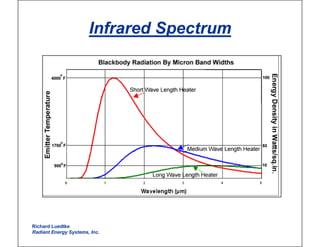
• Wavelengths used for Industrial Infrared
heating applications range from 1.17 micron
(4000º F) to 5.4 micron (500º F).
� Short Wave Emitters – 2150º F to 4000º F
� Medium Wave Emitters – 900º F to 2150º F
� Long Wave Emitters – 500º F to 900º F
• Wavelength is inversely proportional to the
temperature of the emitter. (i.e.: As
temperature increases; the wavelength
decreases)
Richard Luedtke
Radiant Energy Systems, Inc.
Infrared Spectrum
Richard Luedtke
Radiant Energy Systems, Inc.
Efficiency of Industrial Infrared
Emissions
Richard Luedtke
Radiant Energy Systems, Inc.
Energy Reflected back
from the Object
Energy Absorbed
by the Object
Energy Transmitted
Through the object
IR Emitter
Stefan Boltzman Law to Determine
Infrared Power
Richard Luedtke
Radiant Energy Systems, Inc.
The total energy radiated is equal to the
black body temperature to the 4th power
Q = kT4
Q = Emitted Energy
k = Constant (0.172 x 10⁻⁸)
T = Source temperature (°K)
For example: If the temperature of the emitter
is increased by 50%, the energy emitted is
increased by 500%
Determining Wavelength
λ = C/T
λ – wavelength in microns
C - Constant (2898)
T - Source temperature (ºK)
Wien’s Law
The peak wave length of
emission of an infrared
heater can be calculated
by Wien’s Law
Richard Luedtke
Radiant Energy Systems, Inc.
Typical IR Absorption Curves
Richard Luedtke
Radiant Energy Systems, Inc.
Infrared Advantages
� Higher rate of heat transfer/Square Ft. compared to
Convection
� Floor space savings due to higher density Heat
output
� Easy to zone for uniform heating of the product and
range of widths being processed.
� Fast response to changing process conditions
� Quick start up and shut down in most styles of
heaters
� ‘Infinite’ temperature control and ‘tune-ability’ with
Electric IR Source.
� Lower initial capital and installation cost
� Easily added to existing conventional dryers to
increase line speed
� Infrared/Air dryers suitable for solvent based coatings
Richard Luedtke
Radiant Energy Systems, Inc.
Infrared Negatives
� Some coatings may not be able to take advantage
of higher rates of heat transfer and may skin and
blister
� Difficult to work with temperature sensitive
substrates
� Electric Source Infrared Kw costs are generally
higher than equivalent gas costs – (direct energy
cost comparisons)
� Gas Fired IR has limited turn down and control.
Sizing is job specific.
� Since IR is basically a surface conduction
phenomenon, harder to dry heavier coatings
rapidly without overheating the surface
� Almost essential to run trials in lab or on a pilot line
to confirm dryer sizing and desired finish product.
Richard Luedtke
Radiant Energy Systems, Inc.
To Sum it All up …….
Richard Luedtke
Radiant Energy Systems, Inc.
Which Drying Method is the
Best for the Application ??
�Convection ?
�Infrared ?
�Other ?
Richard Luedtke
Radiant Energy Systems, Inc.
ANSWER:
NO SINGLE METHOD
� Product and Web handling issues should
always be considered a part of the decision.
� Best Design and Efficiency will normally be a
combination of the available technologies.
� Use and consider the advantages (and
Negatives) of each.
� Input the features needed to handle
special product requirements, cleaning,
maintenance, and ease of operation.
Richard Luedtke
Radiant Energy Systems, Inc.
COMPARISON OF DRYING
TECHNOLOGIES
Coating
Moisture
%
Time
Convection Dryer
Infrared Dryer
Combination Dryers
Richard Luedtke
Radiant Energy Systems, Inc.
Excellence in Process Heating… Since 1985
175 North Ethel Ave.
Hawthorne, NJ
07506
(973) 423-5220

luedtke.pdf

  • 1.
    Building and IndustrialMat 2011 Spring Meeting MAY 18 – 20 BASIC INDUSTRIAL DRYING FUNDAMENTALS AND METHODS Richard Luedtke Radiant Energy Systems, Inc. Hawthorne, NJ www.radiantenergy.com (973) 423-5220 TAPPI
  • 2.
    SESSION AGENDA 1. DEFININGTHE PROCESS REQUIREMENTS 2. “CONVENTIONAL” DRYING METHODS 3. UNDERSTANDING THE DRYING/HEATING PROCESS 4. UNDERSTANDING CONVECTION DRYING 5. UNDERSTANDING INFRARED DRYING 6. EQUIPMENT SELECTION: PROS AND CONS Richard Luedtke Radiant Energy Systems, Inc.
  • 3.
    DEFINING THE PROCESS REQUIREMENTS •Drying; Solvent vaporization/evaporation • Curing; A final web/coating temperature requirement (normally following a drying requirement) • Heating; Raising the temperature of a product: Substrate Heat set? Curing? Before lamination?; film, foils, etc. Richard Luedtke Radiant Energy Systems, Inc.
  • 4.
    CONVENTIONAL TECHNOLOGIES USEDFOR DRYING, CURING AND HEATING A WEB • CONVECTION SYSTEMS – IMPINGEMENT DRYING – FLOATATION DRYING – THROUGH AIR DRYING – BATCH DRYERS/OVENS • RADIANT HEATING/DRYING SYSTEMS – ELECTRIC INFRARED – GAS FIRED INFRARED Richard Luedtke Radiant Energy Systems, Inc.
  • 5.
    A DRYER ISA “HEAT EXCHANGER” Dryer/Oven System Web and Coating Finished Product Richard Luedtke Radiant Energy Systems, Inc. Radiant Heat or Conditioned Hot Air
  • 6.
    Heating a Web RichardLuedtke Radiant Energy Systems, Inc. TIME Dryer Operating Temp. Web Temperature Dryer Temperature Set Point
  • 7.
    Drying and HeatingStages of a Coated Web TIME Sensible Heat Up Constant Rate Drying Cure- Heating Web and Coating Temperature Dryer Operating Temp. Richard Luedtke Radiant Energy Systems, Inc.
  • 8.
    DEFINING CONVECTION: • “Thetransfer of heat by circulation of a gas or a liquid in contact with the object to be heated.” • Convection dryers use ‘conditioned’ (Temperature and humidity controlled) hot air for heat transfer. • Liquid Vaporization and Evaporation by both heat conduction and turbulent air flow. • Convection dryers use a Nozzle array or ducted distribution of the air to uniformly heat the product as it passes through the confined Dryer atmosphere Richard Luedtke Radiant Energy Systems, Inc.
  • 9.
    Richard Luedtke Radiant EnergySystems, Inc. Web and Coating Finished Product 100% FRESH AIR FLOW Dryer/Oven System Radiation Losses Product Heat Load Fuel Input to System Exhaust Heat Load CONVECTION DRYER HEAT LOADS – 100% FRESH AIR DESIGN
  • 10.
    Web and Coating Finished Product RECIRCULATED AIR FLOW Dryer/OvenSystem Exhaust Heat Load Radiation Losses Product Heat Load Fuel Input Richard Luedtke Radiant Energy Systems, Inc. CONVECTION DRYER HEAT LOADS – Using 50% TO 90% RECIRCULATION
  • 11.
  • 12.
    Convection Air Drying Mechanics RichardLuedtke Radiant Energy Systems, Inc. Laminar Layer at Drying Surface Coating: Solids and Solvent - Substrate - Moisture Removal; Exhaust/Recirculated Air Flow Turbulent Air at Surface Impingement Air at Supply Air DB Temp. (T1)
  • 13.
    Factors that impactHeat Transfer by Impingement: • Velocity effect on Heat transfer is approximately proportional to the 0.6 power of the change. (V1/V2)0.6 • Drying air temperature increase or decrease will yield an approximate linear change in heat transfer. • Humidity of the Supply air (Low Exhaust/High Recirculation) will reduce the heat transfer. This is due to a lowering of the dT used when a higher wet bulb temperature (higher moisture content in the Exhaust/Return air) vs. the dryer supply temperature is present. • Nozzle Distance from the web impacts the ‘Effective’ heat transfer (seen on the web surface) by approximately 10% per inch of distance; i.e.: A 1 inch nozzle to web distance will achieve 20% more theoretical heat transfer than a nozzle 3 inches away. Richard Luedtke Radiant Energy Systems, Inc.
  • 14.
    Richard Luedtke Radiant EnergySystems, Inc. Theoretical Impingement Heat Transfer vs. Temperature/Velocity 0 1,000 2,000 3,000 4,000 5,000 6,000 7,000 8,000 9,000 10,000 11,000 2,000 4,000 6,000 8,000 10,000 12,000 Nozzle Velocity in AFPM B TU /H r/Ft 2 /Side 500 o F 450 o F 300 o F 350 o F 400 o F 150 o F 200 o F 250 o F 6" on Ctr. Impingement style nozzle with 0.1" Slot Opening 1-1/2" from the Product
  • 15.
    IMPINGEMENT DRYER ADVANTAGES � Heattransfer input (Velocity/Temperature) is somewhat independent of web handling issues. � Can be easily arranged for multiple heat transfer zones, and also easily changed for different products requirements � Accurate and uniform control of the dryer temperature for heating products irregardless of shape, size or color. � Multiple Nozzle configurations and web pass configurations can be used with heat transfer to the top and/or bottom side of the web as required. � Cost effective and can be adapted to multiple products with simple velocity and temperature adjustments. Richard Luedtke Radiant Energy Systems, Inc.
  • 16.
    IMPINGEMENT NEGATIVES � Rollor conveyor support needed along with the associated initial costs, maintenance issues, and web tension requirements for longer dryers. � Possibility of Web Scratching or marking from contact with web support idlers. � Lower rates of heat transfer and heating by conduction from the surface being impinged on (Thicker products will take longer to heat). � Limitation of heat transfer velocities which may disturb or contaminate the coating. � Generally slow to heat up to operating levels and slow to cool down which results in the limitation of maximum operating temperatures that may be dictated by the web properties. Richard Luedtke Radiant Energy Systems, Inc.
  • 17.
  • 18.
    COANDA EFFECT Richard Luedtke RadiantEnergy Systems, Inc. COANDA EFFECT ON AN AIRFOIL Higher velocity and Coanda Effect cause Negative component on Wing Coanda Nozzle Cross Section Lowered pressure (negative component) “A fluid flowing along a curved surface will tend to follow the surface”
  • 19.
    FLOATATION MECHANICS Coanda RadiusEffect yields nozzle to nozzle tension components Pressure pads at nozzles develop Controllable Sine Wave Web path Web Tension Richard Luedtke Radiant Energy Systems, Inc.
  • 20.
    Richard Luedtke Radiant EnergySystems, Inc. FLOATATION NOZZLE ARRAY Exhaust/Return Air from Dryer Exhaust/Return Air from Dryer Heated Supply Air Ducted to Nozzles Heated Supply Air Ducted to Nozzles
  • 21.
    FLOATATION DRYER ADVANTAGES �Non-contact web support eliminating issues with marking or scratching. � Eliminates the need for support rolls or conveyor with obvious benefits for running a saturated or 2-side coated web. � Sine wave float eliminates edge curl. � Positive web tracking through the dryer (‘self centering’) with minimum tension requirements. � Accurate and uniform control of the dryer temperatures. � Nozzle input from both sides of a coated web increases heat transfer capability and shortens the dryer length needed in most cases as compared to one side impingement. Richard Luedtke Radiant Energy Systems, Inc.
  • 22.
    FLOATATION NEGATIVES � Lowerrates of heat transfer and heating by conduction from the surface being impinged on (Thicker products will take longer to heat). � Boundary layer breakup is better with impingement, but, the Coanda creates parallel flow averaging of heat transfer. � Limitation of heat transfer velocities which may disturb or contaminate the coating. � Velocity and flow balance needed to float against line tension may limit heat transfer. � Generally slow to heat up to operating levels and slow to cool down which results in the limitation of maximum operating temperatures. Richard Luedtke Radiant Energy Systems, Inc.
  • 23.
    THROUGH AIR DRYING SYSTEMS RichardLuedtke Radiant Energy Systems, Inc.
  • 24.
    THROUGH AIR DRYERS RichardLuedtke Radiant Energy Systems, Inc. Supply Air Exhaust Air Supply Air Exhaust Air FLAT BED THRU AIR DRYER ROTARY THRU AIR DRYER HIGH TO MEDIUM PERMEABILITY (dP UP TO 6” W.C.) MEDIUM TO LOW PERMEABILITY ( dP CAN BE OVER 20” W.C.)
  • 25.
    THROUGH AIR ADVANTAGES �2 to 3 times higher Air flow (Heat Transfer) than conventional convection. � Intimate contact with product interior heats uniformly and rapidly. � High thermal efficiency for Heating, cooling or Drying applications. � Accurate and uniform temperature control to heat “through” the product. � Extremely high evaporation rates from a combination of mechanical and thermal drying. � Enhances the ‘Hand’ of Non woven materials. � Self tracking suction beds and Simple operation. Richard Luedtke Radiant Energy Systems, Inc.
  • 26.
    THROUGH AIR NEGATIVES �Dependent on Permeability of the web. � Wet to dry permeability changes in the web properties require multiple zones for Fan selection and efficient operation. � Higher Blower Pressure drop needed for the higher air flow rates and to overcome product pressure drops; requires higher HP than convection in most cases. � Mechanical losses of fiber and coating are carried in the through air stream. � Most Products require a support conveyor or screen to maintain the ‘Flat’ bed with associated maintenance costs. Richard Luedtke Radiant Energy Systems, Inc.
  • 27.
    RADIANT HEATING Richard Luedtke RadiantEnergy Systems, Inc. “The transfer of heat via electromagnetic waves between the heat source and the object to be heated.”
  • 28.
    Electromagnetic Energy Spectrum RichardLuedtke Radiant Energy Systems, Inc.
  • 29.
    INDUSTRIAL PROCESS INFRARED •Wavelengths used for Industrial Infrared heating applications range from 1.17 micron (4000º F) to 5.4 micron (500º F). � Short Wave Emitters – 2150º F to 4000º F � Medium Wave Emitters – 900º F to 2150º F � Long Wave Emitters – 500º F to 900º F • Wavelength is inversely proportional to the temperature of the emitter. (i.e.: As temperature increases; the wavelength decreases) Richard Luedtke Radiant Energy Systems, Inc.
  • 30.
  • 31.
    Efficiency of IndustrialInfrared Emissions Richard Luedtke Radiant Energy Systems, Inc. Energy Reflected back from the Object Energy Absorbed by the Object Energy Transmitted Through the object IR Emitter
  • 32.
    Stefan Boltzman Lawto Determine Infrared Power Richard Luedtke Radiant Energy Systems, Inc. The total energy radiated is equal to the black body temperature to the 4th power Q = kT4 Q = Emitted Energy k = Constant (0.172 x 10⁻⁸) T = Source temperature (°K) For example: If the temperature of the emitter is increased by 50%, the energy emitted is increased by 500%
  • 33.
    Determining Wavelength λ =C/T λ – wavelength in microns C - Constant (2898) T - Source temperature (ºK) Wien’s Law The peak wave length of emission of an infrared heater can be calculated by Wien’s Law Richard Luedtke Radiant Energy Systems, Inc.
  • 34.
    Typical IR AbsorptionCurves Richard Luedtke Radiant Energy Systems, Inc.
  • 35.
    Infrared Advantages � Higherrate of heat transfer/Square Ft. compared to Convection � Floor space savings due to higher density Heat output � Easy to zone for uniform heating of the product and range of widths being processed. � Fast response to changing process conditions � Quick start up and shut down in most styles of heaters � ‘Infinite’ temperature control and ‘tune-ability’ with Electric IR Source. � Lower initial capital and installation cost � Easily added to existing conventional dryers to increase line speed � Infrared/Air dryers suitable for solvent based coatings Richard Luedtke Radiant Energy Systems, Inc.
  • 36.
    Infrared Negatives � Somecoatings may not be able to take advantage of higher rates of heat transfer and may skin and blister � Difficult to work with temperature sensitive substrates � Electric Source Infrared Kw costs are generally higher than equivalent gas costs – (direct energy cost comparisons) � Gas Fired IR has limited turn down and control. Sizing is job specific. � Since IR is basically a surface conduction phenomenon, harder to dry heavier coatings rapidly without overheating the surface � Almost essential to run trials in lab or on a pilot line to confirm dryer sizing and desired finish product. Richard Luedtke Radiant Energy Systems, Inc.
  • 37.
    To Sum itAll up ……. Richard Luedtke Radiant Energy Systems, Inc.
  • 38.
    Which Drying Methodis the Best for the Application ?? �Convection ? �Infrared ? �Other ? Richard Luedtke Radiant Energy Systems, Inc.
  • 39.
    ANSWER: NO SINGLE METHOD �Product and Web handling issues should always be considered a part of the decision. � Best Design and Efficiency will normally be a combination of the available technologies. � Use and consider the advantages (and Negatives) of each. � Input the features needed to handle special product requirements, cleaning, maintenance, and ease of operation. Richard Luedtke Radiant Energy Systems, Inc.
  • 40.
    COMPARISON OF DRYING TECHNOLOGIES Coating Moisture % Time ConvectionDryer Infrared Dryer Combination Dryers Richard Luedtke Radiant Energy Systems, Inc.
  • 41.
    Excellence in ProcessHeating… Since 1985 175 North Ethel Ave. Hawthorne, NJ 07506 (973) 423-5220