Energy conservation in textile industry
Title of paper :
Energy conservation experience
in a textile Printing factory
Author:
C. Chullabodhi & s.
Wangsupakukosol
 This paper reports on the energy conservation study
carried out in a textile printing factory
 The investigation focused on 5 process equipments
namely boiler, cabinet dryer, color fixing dryer, hot
water tanks, and cylindrical dryer
Introduction
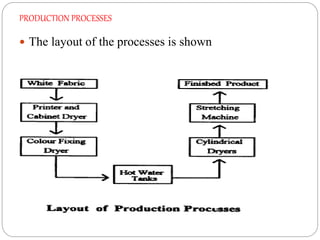
PRODUCTION PROCESSES
 The layout of the processes is shown
ENERGY CONSUMPTION
 Amount of steam was used as a heating medium in the drying
cabinet, the colour fixing dryer, the hot water tanks and the cylindrical
dryers.
 Electricity was used in driving pumps, fans, blowers, rollers, screw
conveyors and the cylindrical dryers.
ANALYSIS OF ENERGY UTILIZATION EFFICIENCY
 The study concentrated on thermal energy, whereby the processes
that employed large amount of heat would be investigated, i.e. boiler,
cabinet dryer, colour fixing dryer, hot water tanks, and the cylindrical
dryers
Boiler
 horizontal fired-tube type with 7 ton/h capacity at the steam pressure of 4.92 bar. It
operated 12 hours
 Filtered water from a nearby canal was used as feed water with no other treatment or
preheat. Sawdust with the average moisture content of 31.1 % was used as fuel.
 By direct measurements of the amounts of feed water, fuel, ashes, unbumt carbon, and the
percentages of O2 and CO in the flue gases, the boiler efficiency was found to be 48.38 %
with the amount of boiler heat transfer loss being 6.32 % of the energy inputs.
Cont…
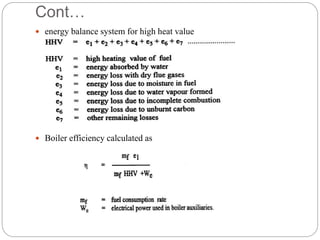
 energy balance system for high heat value
 Boiler efficiency calculated as
Cabinet Dryer
 It was an insulated rectangular box of size, 2.4 m x 5 m x 2.45 m, with the drying
heat being obtained from a set of steam pipes located at the lower half of the box.
 The printed fabric was fed into the cabinet, through an opening adjacent to the
printing machine, at a constant rate by means of motor-driven rollers.
 The moisture was drawn out through a fan outlet located at the top wall. There were
2 dryers in operation.
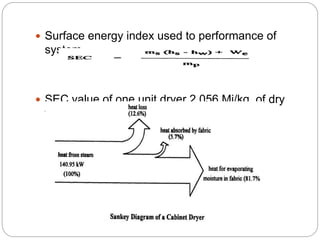
 The dryer effectiveness was found to be 3.29 MJ/kg of the evaporated moisture
with amount of heat loss being 12.9% of the energy units
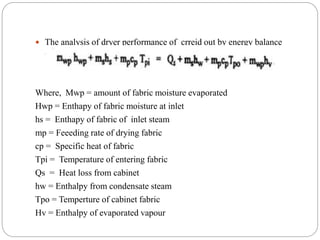
 The analysis of dryer performance of crreid out by energy balance
equation
Where, Mwp = amount of fabric moisture evaporated
Hwp = Enthapy of fabric moisture at inlet
hs = Enthapy of fabric of inlet steam
mp = Feeeding rate of drying fabric
cp = Specific heat of fabric
Tpi = Temperature of entering fabric
Qs = Heat loss from cabinet
hw = Enthalpy from condensate steam
Tpo = Temperture of cabinet fabric
Hv = Enthalpy of evaporated vapour
 Surface energy index used to performance of
system
 SEC value of one unit dryer 2.056 Mj/kg of dry
fabric
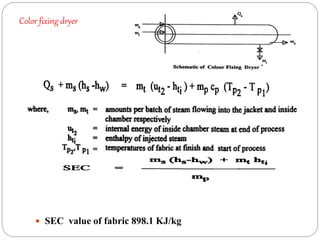
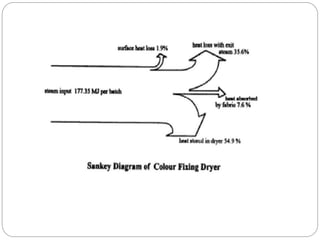
Color fixing dryer
 Energy balance equation for this system
 SEC value of fabric 898.1 KJ/kg
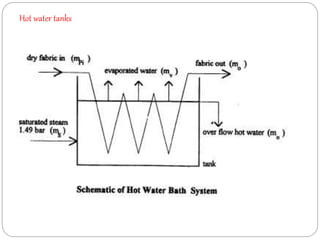
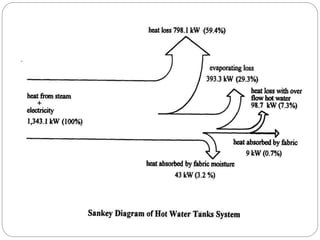
Hot water tanks
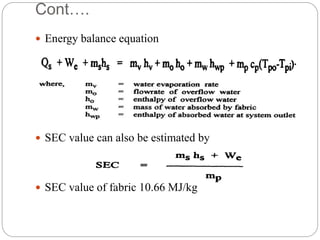
Cont….
 Energy balance equation
 SEC value can also be estimated by
 SEC value of fabric 10.66 MJ/kg
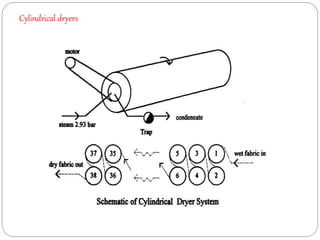
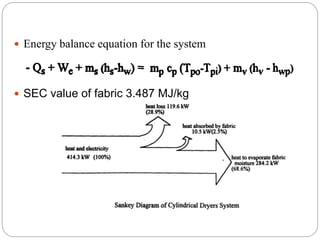
Cylindrical dryers
 Energy balance equation for the system
 SEC value of fabric 3.487 MJ/kg
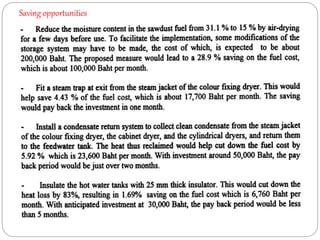
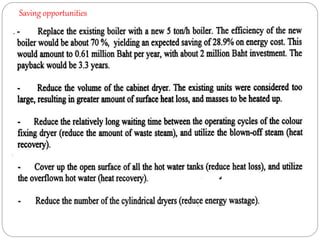
Saving opportunities
Implementations
 Boiler
 Cabinet Dryer
 Cabinet Dryer
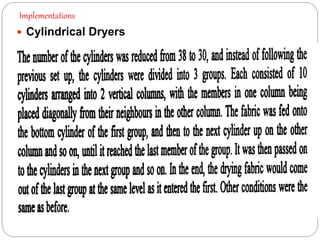
Implementations
 Cylindrical Dryers
Implementations
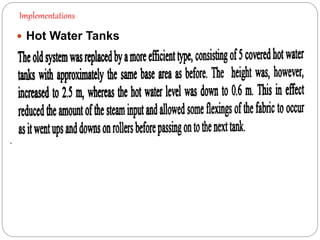
 Hot Water Tanks
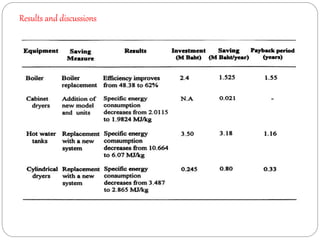
Results and discussions
conclusion
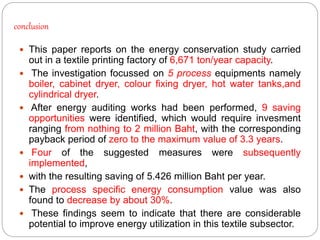
 This paper reports on the energy conservation study carried
out in a textile printing factory of 6,671 ton/year capacity.
 The investigation focussed on 5 process equipments namely
boiler, cabinet dryer, colour fixing dryer, hot water tanks,and
cylindrical dryer.
 After energy auditing works had been performed, 9 saving
opportunities were identified, which would require invesment
ranging from nothing to 2 million Baht, with the corresponding
payback period of zero to the maximum value of 3.3 years.
 Four of the suggested measures were subsequently
implemented,
 with the resulting saving of 5.426 million Baht per year.
 The process specific energy consumption value was also
found to decrease by about 30%.
 These findings seem to indicate that there are considerable
potential to improve energy utilization in this textile subsector.
Thank You

Finalpresentationonenergyconservationintextileindustry 140505074437-phpapp02

  • 1.
    Energy conservation intextile industry
  • 2.
    Title of paper: Energy conservation experience in a textile Printing factory Author: C. Chullabodhi & s. Wangsupakukosol
  • 3.
     This paperreports on the energy conservation study carried out in a textile printing factory  The investigation focused on 5 process equipments namely boiler, cabinet dryer, color fixing dryer, hot water tanks, and cylindrical dryer Introduction
  • 4.
    PRODUCTION PROCESSES  Thelayout of the processes is shown
  • 5.
    ENERGY CONSUMPTION  Amountof steam was used as a heating medium in the drying cabinet, the colour fixing dryer, the hot water tanks and the cylindrical dryers.  Electricity was used in driving pumps, fans, blowers, rollers, screw conveyors and the cylindrical dryers. ANALYSIS OF ENERGY UTILIZATION EFFICIENCY  The study concentrated on thermal energy, whereby the processes that employed large amount of heat would be investigated, i.e. boiler, cabinet dryer, colour fixing dryer, hot water tanks, and the cylindrical dryers
  • 6.
    Boiler  horizontal fired-tubetype with 7 ton/h capacity at the steam pressure of 4.92 bar. It operated 12 hours  Filtered water from a nearby canal was used as feed water with no other treatment or preheat. Sawdust with the average moisture content of 31.1 % was used as fuel.  By direct measurements of the amounts of feed water, fuel, ashes, unbumt carbon, and the percentages of O2 and CO in the flue gases, the boiler efficiency was found to be 48.38 % with the amount of boiler heat transfer loss being 6.32 % of the energy inputs.
  • 7.
    Cont…  energy balancesystem for high heat value  Boiler efficiency calculated as
  • 8.
    Cabinet Dryer  Itwas an insulated rectangular box of size, 2.4 m x 5 m x 2.45 m, with the drying heat being obtained from a set of steam pipes located at the lower half of the box.  The printed fabric was fed into the cabinet, through an opening adjacent to the printing machine, at a constant rate by means of motor-driven rollers.  The moisture was drawn out through a fan outlet located at the top wall. There were 2 dryers in operation.  The dryer effectiveness was found to be 3.29 MJ/kg of the evaporated moisture with amount of heat loss being 12.9% of the energy units
  • 9.
     The analysisof dryer performance of crreid out by energy balance equation Where, Mwp = amount of fabric moisture evaporated Hwp = Enthapy of fabric moisture at inlet hs = Enthapy of fabric of inlet steam mp = Feeeding rate of drying fabric cp = Specific heat of fabric Tpi = Temperature of entering fabric Qs = Heat loss from cabinet hw = Enthalpy from condensate steam Tpo = Temperture of cabinet fabric Hv = Enthalpy of evaporated vapour
  • 10.
     Surface energyindex used to performance of system  SEC value of one unit dryer 2.056 Mj/kg of dry fabric
  • 11.
    Color fixing dryer Energy balance equation for this system  SEC value of fabric 898.1 KJ/kg
  • 13.
  • 14.
    Cont….  Energy balanceequation  SEC value can also be estimated by  SEC value of fabric 10.66 MJ/kg
  • 16.
  • 17.
     Energy balanceequation for the system  SEC value of fabric 3.487 MJ/kg
  • 18.
  • 19.
  • 20.
  • 21.
  • 22.
  • 23.
  • 24.
    conclusion  This paperreports on the energy conservation study carried out in a textile printing factory of 6,671 ton/year capacity.  The investigation focussed on 5 process equipments namely boiler, cabinet dryer, colour fixing dryer, hot water tanks,and cylindrical dryer.  After energy auditing works had been performed, 9 saving opportunities were identified, which would require invesment ranging from nothing to 2 million Baht, with the corresponding payback period of zero to the maximum value of 3.3 years.  Four of the suggested measures were subsequently implemented,  with the resulting saving of 5.426 million Baht per year.  The process specific energy consumption value was also found to decrease by about 30%.  These findings seem to indicate that there are considerable potential to improve energy utilization in this textile subsector.
  • 25.