1 Ā© Nokia Siemens Networks Presentation / Author / Date
Company Confidential
PRACH Planning
PCI Planning
UL DM RS Planning
Key Planning Areas parameters – TD-LTE
2 Ā© Nokia Siemens Networks Presentation / Author / Date
Company Confidential
PRACH Planning
Principle
PRACH configuration two cells must be different within the PRACH re-use distance to
increase the RACH decoding success rate
PRACH transmission can be separated by:
• Time (prachConfIndex)
– PRACH-PUSCH interference: If PRACH resources are separated in time within eNB
– PRACH-PRACH interference: If same PRACH resources are used for the cells of an
eNodeB.
– PRACH-PRACH interference is preferred to PRACH-PUSCH interference so
prachConfIndex of the cells on one site should be the same
• Frequency (prachFreqOff)
– Allocation of PRACH area should be next to PUCCH area either at upper or lower
border of frequency band, however should not overlap with PUCCH area
– Avoid separation of PUSCH in two areas by PRACH (scheduler can only handle one
PUSCH area)
– For simplicity use same configuration for all cells
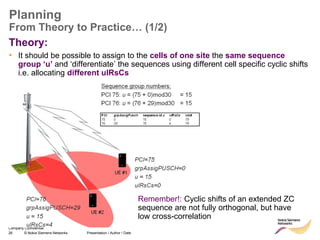
• Sequence (PRACH CS and RootSeqIndex)
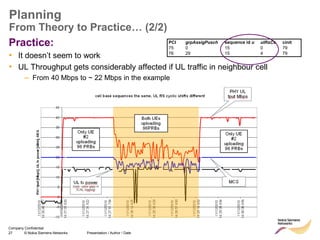
– Use different sequences for all neighbour cells
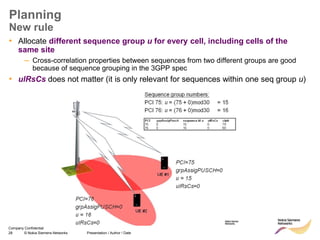
3 Ā© Nokia Siemens Networks Presentation / Author / Date
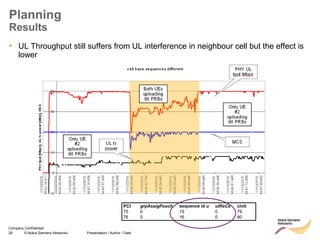
Company Confidential
Preamble Formats, FDD+TDD common
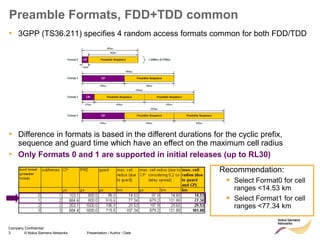
• 3GPP (TS36.211) specifies 4 random access formats common for both FDD/TDD
• Difference in formats is based in the different durations for the cyclic prefix,
sequence and guard time which have an effect on the maximum cell radius
• Only Formats 0 and 1 are supported in initial releases (up to RL30)
Recommendation:
ļ‚§ Select Format0 for cell
ranges <14.53 km
ļ‚§ Select Format1 for cell
ranges <77.34 km
4 Ā© Nokia Siemens Networks Presentation / Author / Date
Company Confidential
Preamble Format 4, TDD-only
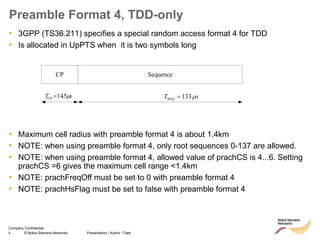
• 3GPP (TS36.211) specifies a special random access format 4 for TDD
• Is allocated in UpPTS when it is two symbols long
• Maximum cell radius with preamble format 4 is about 1.4km
• NOTE: when using preamble format 4, only root sequences 0-137 are allowed.
• NOTE: when using preamble format 4, allowed value of prachCS is 4...6. Setting
prachCS =6 gives the maximum cell range <1.4km
• NOTE: prachFreqOff must be set to 0 with preamble format 4
• NOTE: prachHsFlag must be set to false with preamble format 4
SequenceCP
sT 5.14CP  sT 133SEQ 
5 Ā© Nokia Siemens Networks Presentation / Author / Date
Company Confidential
PRACH Configuration Index, prachConfIndex TDD
RL15
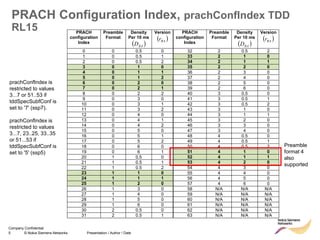
prachConfIndex is
restricted to values
3...7 or 51..53 if
tddSpecSubfConf is
set to '7' (ssp7).
prachConfIndex is
restricted to values
3...7, 23..25, 33..35
or 51...53 if
tddSpecSubfConf is
set to '5' (ssp5)
Preamble
format 4
also
supported
PRACH
configuration
Index
Preamble
Format
Density
Per 10 ms
 RAD
Version
 RAr
PRACH
configuration
Index
Preamble
Format
Density
Per 10 ms
 RAD
Version
 RAr
0 0 0.5 0 32 2 0.5 2
1 0 0.5 1 33 2 1 0
2 0 0.5 2 34 2 1 1
3 0 1 0 35 2 2 0
4 0 1 1 36 2 3 0
5 0 1 2 37 2 4 0
6 0 2 0 38 2 5 0
7 0 2 1 39 2 6 0
8 0 2 2 40 3 0.5 0
9 0 3 0 41 3 0.5 1
10 0 3 1 42 3 0.5 2
11 0 3 2 43 3 1 0
12 0 4 0 44 3 1 1
13 0 4 1 45 3 2 0
14 0 4 2 46 3 3 0
15 0 5 0 47 3 4 0
16 0 5 1 48 4 0.5 0
17 0 5 2 49 4 0.5 1
18 0 6 0 50 4 0.5 2
19 0 6 1 51 4 1 0
20 1 0.5 0 52 4 1 1
21 1 0.5 1 53 4 2 0
22 1 0.5 2 54 4 3 0
23 1 1 0 55 4 4 0
24 1 1 1 56 4 5 0
25 1 2 0 57 4 6 0
26 1 3 0 58 N/A N/A N/A
27 1 4 0 59 N/A N/A N/A
28 1 5 0 60 N/A N/A N/A
29 1 6 0 61 N/A N/A N/A
30 2 0.5 0 62 N/A N/A N/A
31 2 0.5 1 63 N/A N/A N/A
6 Ā© Nokia Siemens Networks Presentation / Author / Date
Company Confidential
RACH Density
• Based on the expected RACH procedures per second and the maximum
collision probability of the RACH preambles it is possible to estimate the
RACH density as follows:
100*
100
1ln*64*)1(
)__(







 UE
collp
LoadRachex
x
UE
collp = maximum collisiion probability [%]
Ex-RACH_Load = expected RACH Procedures per sec
0.5 ≤ x => RACH Density = 0.5
0.5 < x ≤ 1 => RACH Density = 1
1 < x ≤ 2 => RACH Density = 2
2 < x ≤ 3 => RACH Density = 3
3 < x ≤ 5 => RACH Density = 5
5 < x => RACH Density = 10
• Recommendation: use PRACH density 1 for
start
• Since PRACH performance measurement
counters are available (RL15 – M8001- Cell Load)
it will be possible to evaluate the amount of
PRACH / RACH procedures in time and adapt
/optimize the settings
• Future features: PRACH Management (auto-
configuration, future SON feature called PRACH
optimization (an aspect of this feature is to adjust
the PRACH density to the traffic in the cell)
7 Ā© Nokia Siemens Networks Presentation / Author / Date
Company Confidential
PRACH Frequency Offset
prachFreqOff
• Indicates the first PRB available for PRACH in the UL frequency band
• PRACH area (6 PRBs) should be next to PUCCH area either at upper or lower
border of frequency band to maximize the PUSCH area but not overlap with
PUCCH area
• Parameter is configured based on the PUCCH region (see PUCCH dimensioning)
i.e. its value depends on how many PUCCH resources are available.
• If PRACH area is placed at the lower border of UL frequency band then:
PRACH-Frequency Offset= roundup [PUCCH resources/2]
• If PRACH area is placed at the upper border of the UL frequency band then:
PRACH-Frequency Offset= NRB -6- roundup [PUCCH resources/2]
NRB: Number of Resource Blocks
NOTE: prachFreqOff must be set to 0 if prachConfIndex is set to 51...53 (preamble
4)
8 Ā© Nokia Siemens Networks Presentation / Author / Date
Company Confidential
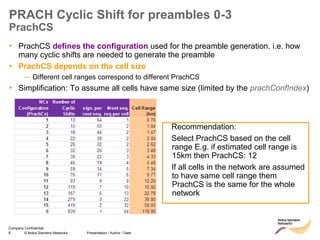
PRACH Cyclic Shift for preambles 0-3
PrachCS
• PrachCS defines the configuration used for the preamble generation. i.e. how
many cyclic shifts are needed to generate the preamble
• PrachCS depends on the cell size
– Different cell ranges correspond to different PrachCS
• Simplification: To assume all cells have same size (limited by the prachConfIndex)
Recommendation:
Select PrachCS based on the cell
range E.g. if estimated cell range is
15km then PrachCS: 12
If all cells in the network are assumed
to have same cell range them
PrachCS is the same for the whole
network
9 Ā© Nokia Siemens Networks Presentation / Author / Date
Company Confidential
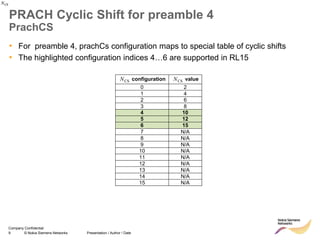
PRACH Cyclic Shift for preamble 4
PrachCS
• For preamble 4, prachCs configuration maps to special table of cyclic shifts
• The highlighted configuration indices 4…6 are supported in RL15
CSNCSN
CSN configuration CSN value
0 2
1 4
2 6
3 8
4 10
5 12
6 15
7 N/A
8 N/A
9 N/A
10 N/A
11 N/A
12 N/A
13 N/A
14 N/A
15 N/A
10 Ā© Nokia Siemens Networks Presentation / Author / Date
Company Confidential
PrachCS and rootSeqIndex
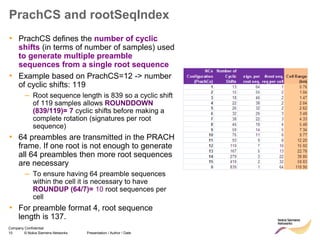
• PrachCS defines the number of cyclic
shifts (in terms of number of samples) used
to generate multiple preamble
sequences from a single root sequence
• Example based on PrachCS=12 -> number
of cyclic shifts: 119
– Root sequence length is 839 so a cyclic shift
of 119 samples allows ROUNDDOWN
(839/119)= 7 cyclic shifts before making a
complete rotation (signatures per root
sequence)
• 64 preambles are transmitted in the PRACH
frame. If one root is not enough to generate
all 64 preambles then more root sequences
are necessary
– To ensure having 64 preamble sequences
within the cell it is necessary to have
ROUNDUP (64/7)= 10 root sequences per
cell
• For preamble format 4, root sequence
length is 137.
11 Ā© Nokia Siemens Networks Presentation / Author / Date
Company Confidential
PRACH Cyclic Shift
rootSeqIndex
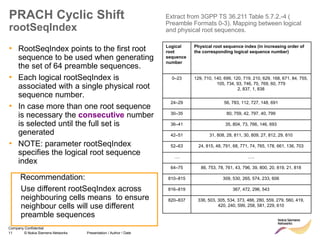
• RootSeqIndex points to the first root
sequence to be used when generating
the set of 64 preamble sequences.
• Each logical rootSeqIndex is
associated with a single physical root
sequence number.
• In case more than one root sequence
is necessary the consecutive number
is selected until the full set is
generated
• NOTE: parameter rootSeqIndex
specifies the logical root sequence
index
Logical
root
sequence
number
Physical root sequence index (in increasing order of
the corresponding logical sequence number)
0–23 129, 710, 140, 699, 120, 719, 210, 629, 168, 671, 84, 755,
105, 734, 93, 746, 70, 769, 60, 779
2, 837, 1, 838
24–29 56, 783, 112, 727, 148, 691
30–35 80, 759, 42, 797, 40, 799
36–41 35, 804, 73, 766, 146, 693
42–51 31, 808, 28, 811, 30, 809, 27, 812, 29, 810
52–63 24, 815, 48, 791, 68, 771, 74, 765, 178, 661, 136, 703
…. …..
64–75 86, 753, 78, 761, 43, 796, 39, 800, 20, 819, 21, 818
810–815 309, 530, 265, 574, 233, 606
816–819 367, 472, 296, 543
820–837 336, 503, 305, 534, 373, 466, 280, 559, 279, 560, 419,
420, 240, 599, 258, 581, 229, 610
Extract from 3GPP TS 36.211 Table 5.7.2.-4 (
Preamble Formats 0-3). Mapping between logical
and physical root sequences.
Recommendation:
Use different rootSeqIndex across
neighbouring cells means to ensure
neighbour cells will use different
preamble sequences
12 Ā© Nokia Siemens Networks Presentation / Author / Date
Company Confidential
PRACH Planning
Wrap Up
Steps:
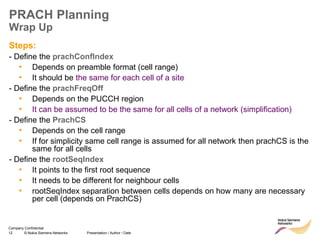
- Define the prachConfIndex
• Depends on preamble format (cell range)
• It should be the same for each cell of a site
- Define the prachFreqOff
• Depends on the PUCCH region
• It can be assumed to be the same for all cells of a network (simplification)
- Define the PrachCS
• Depends on the cell range
• If for simplicity same cell range is assumed for all network then prachCS is the
same for all cells
- Define the rootSeqIndex
• It points to the first root sequence
• It needs to be different for neighbour cells
• rootSeqIndex separation between cells depends on how many are necessary
per cell (depends on PrachCS)
13 Ā© Nokia Siemens Networks Presentation / Author / Date
Company Confidential
PRACH Planning example
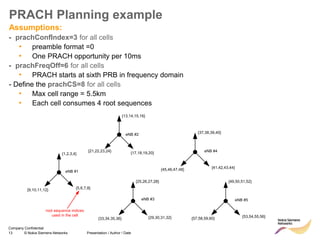
Assumptions:
- prachConfIndex=3 for all cells
• preamble format =0
• One PRACH opportunity per 10ms
- prachFreqOff=6 for all cells
• PRACH starts at sixth PRB in frequency domain
- Define the prachCS=8 for all cells
• Max cell range = 5.5km
• Each cell consumes 4 root sequences
{1,2,3,4}
{5,6,7,8}{9,10,11,12}
{13,14,15,16}
{21,22,23,24} {17,18,19,20}
{25,26,27,28}
{33,34,35,36} {29,30,31,32}
{37,38,39,40}
{41,42,43,44}{45,46,47,48}eNB #1
eNB #2
eNB #3
eNB #4
{49,50,51,52}
{53,54,55,56}{57,58,59,60}
eNB #5
root sequence indices
used in the cell
14 Ā© Nokia Siemens Networks Presentation / Author / Date
Company Confidential
Exercise
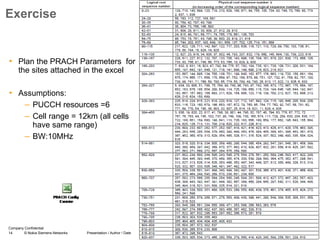
• Plan the PRACH Parameters for
the sites attached in the excel
• Assumptions:
– PUCCH resources =6
– Cell range = 12km (all cells
have same range)
– BW:10MHz
15 Ā© Nokia Siemens Networks Presentation / Author / Date
Company Confidential
PCI Planning
Introduction
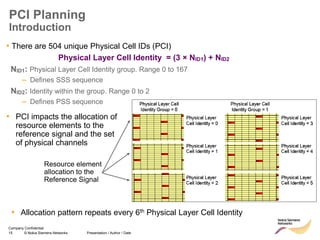
• There are 504 unique Physical Cell IDs (PCI)
Physical Layer Cell Identity = (3 Ɨ NID1) + NID2
NID1: Physical Layer Cell Identity group. Range 0 to 167
– Defines SSS sequence
NID2: Identity within the group. Range 0 to 2
– Defines PSS sequence
Resource element
allocation to the
Reference Signal
• PCI impacts the allocation of
resource elements to the
reference signal and the set
of physical channels
• Allocation pattern repeats every 6th Physical Layer Cell Identity
16 Ā© Nokia Siemens Networks Presentation / Author / Date
Company Confidential
PCI Planning
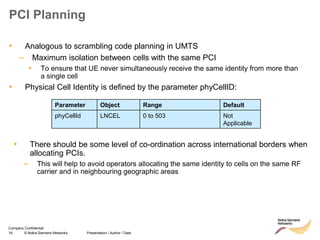
• Analogous to scrambling code planning in UMTS
– Maximum isolation between cells with the same PCI
ā–Ŗ To ensure that UE never simultaneously receive the same identity from more than
a single cell
• Physical Cell Identity is defined by the parameter phyCellID:
Parameter Object Range Default
phyCellId LNCEL 0 to 503 Not
Applicable
• There should be some level of co-ordination across international borders when
allocating PCIs.
– This will help to avoid operators allocating the same identity to cells on the same RF
carrier and in neighbouring geographic areas
17 Ā© Nokia Siemens Networks Presentation / Author / Date
Company Confidential
PCI Planning
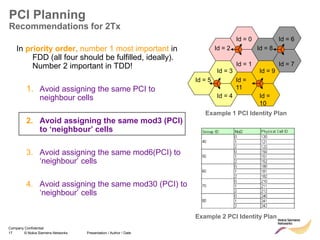
Recommendations for 2Tx
In priority order, number 1 most important in
FDD (all four should be fulfilled, ideally).
Number 2 important in TDD!
1. Avoid assigning the same PCI to
neighbour cells
2. Avoid assigning the same mod3 (PCI)
to ā€˜neighbour’ cells
3. Avoid assigning the same mod6(PCI) to
ā€˜neighbour’ cells
4. Avoid assigning the same mod30 (PCI) to
ā€˜neighbour’ cells
Id = 5
Id = 4
Id = 3
Id =
11
Id =
10
Id = 9
Id = 8
Id = 7
Id = 6
Id = 2
Id = 1
Id = 0
Example 1 PCI Identity Plan
Example 2 PCI Identity Plan
18 Ā© Nokia Siemens Networks Presentation / Author / Date
Company Confidential
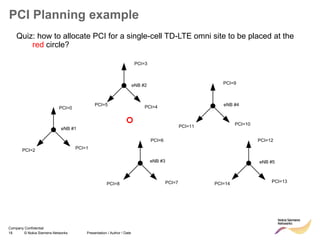
PCI Planning example
PCI=0
PCI=1PCI=2
PCI=3
PCI=5 PCI=4
PCI=6
PCI=8 PCI=7
PCI=9
PCI=10PCI=11eNB #1
eNB #2
eNB #3
eNB #4
PCI=12
PCI=13PCI=14
eNB #5
Quiz: how to allocate PCI for a single-cell TD-LTE omni site to be placed at the
red circle?
19 Ā© Nokia Siemens Networks Presentation / Author / Date
Company Confidential
- UlseqHop
- UlGrpHop
- grpAssigPUSCH
- ulRsCs
- Sequence Group Number (u)
UL Reference Signal Planning
20 Ā© Nokia Siemens Networks Presentation / Author / Date
Company Confidential
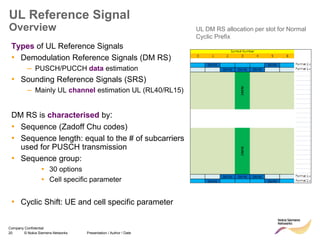
UL Reference Signal
Overview
Types of UL Reference Signals
• Demodulation Reference Signals (DM RS)
– PUSCH/PUCCH data estimation
• Sounding Reference Signals (SRS)
– Mainly UL channel estimation UL (RL40/RL15)
DM RS is characterised by:
• Sequence (Zadoff Chu codes)
• Sequence length: equal to the # of subcarriers
used for PUSCH transmission
• Sequence group:
ā–Ŗ 30 options
ā–Ŗ Cell specific parameter
• Cyclic Shift: UE and cell specific parameter
UL DM RS allocation per slot for Normal
Cyclic Prefix
21 Ā© Nokia Siemens Networks Presentation / Author / Date
Company Confidential
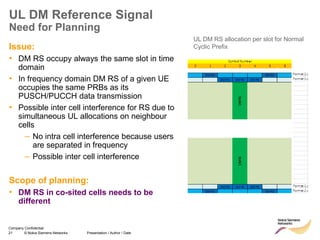
UL DM Reference Signal
Need for Planning
Issue:
• DM RS occupy always the same slot in time
domain
• In frequency domain DM RS of a given UE
occupies the same PRBs as its
PUSCH/PUCCH data transmission
• Possible inter cell interference for RS due to
simultaneous UL allocations on neighbour
cells
– No intra cell interference because users
are separated in frequency
– Possible inter cell interference
Scope of planning:
• DM RS in co-sited cells needs to be
different
UL DM RS allocation per slot for Normal
Cyclic Prefix
23 Ā© Nokia Siemens Networks Presentation / Author / Date
Company Confidential
• RS sequences for PUSCH have different lengths depending the UL
bandwidth allocated for a UE
• 30 possible sequences for each PRB allocation length of 1-100 PRBs
• Sequences are grouped into 30 groups so they can be assigned to cells
• Sequence group number ā€˜u’:
RS Sequences and RS Sequence Groups
Sequence Group Id, ā€˜u’
  30modSCHgrpAssigPU PCIu
grpAssigPUSCH: group
assignment for PUSCH Range
[0…29], step 1
24 Ā© Nokia Siemens Networks Presentation / Author / Date
Company Confidential
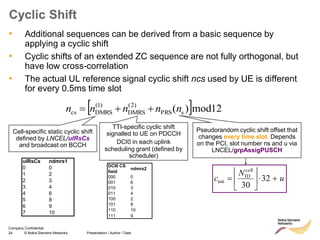
Cyclic Shift
• Additional sequences can be derived from a basic sequence by
applying a cyclic shift
• Cyclic shifts of an extended ZC sequence are not fully orthogonal, but
have low cross-correlation
• The actual UL reference signal cyclic shift ncs used by UE is different
for every 0.5ms time slot
 ļ 12mod)( sPRS
)2(
DMRS
)1(
DMRScs nnnnn 
Cell-specific static cyclic shift
defined by LNCEL/ulRsCs
and broadcast on BCCH
TTI-specific cyclic shift
signalled to UE on PDCCH
DCI0 in each uplink
scheduling grant (defined by
scheduler)
Pseudorandom cyclic shift offset that
changes every time slot. Depends
on the PCI, slot number ns and u via
LNCEL/grpAssigPUSCH
ulRsCs ndmrs1
0 0
1 2
2 3
3 4
4 6
5 8
6 9
7 10
DCI0 CS
field
ndmrs2
000 0
001 6
010 3
011 4
100 2
101 8
110 10
111 9
u
N
c ļ€«ļƒ—ļƒŗ





 32
30
cell
ID
init
25 Ā© Nokia Siemens Networks Presentation / Author / Date
Company Confidential
UL DM Reference Signal
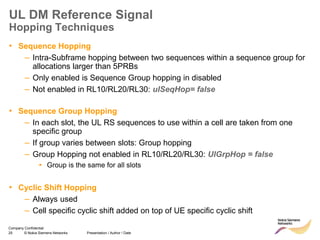
Hopping Techniques
• Sequence Hopping
– Intra-Subframe hopping between two sequences within a sequence group for
allocations larger than 5PRBs
– Only enabled is Sequence Group hopping in disabled
– Not enabled in RL10/RL20/RL30: ulSeqHop= false
• Sequence Group Hopping
– In each slot, the UL RS sequences to use within a cell are taken from one
specific group
– If group varies between slots: Group hopping
– Group Hopping not enabled in RL10/RL20/RL30: UlGrpHop = false
ā–Ŗ Group is the same for all slots
• Cyclic Shift Hopping
– Always used
– Cell specific cyclic shift added on top of UE specific cyclic shift
26 Ā© Nokia Siemens Networks Presentation / Author / Date
Company Confidential
Planning
From Theory to Practice… (1/2)
Theory:
• It should be possible to assign to the cells of one site the same sequence
group ā€˜u’ and ā€˜differentiate’ the sequences using different cell specific cyclic shifts
i.e. allocating different ulRsCs
Remember!: Cyclic shifts of an extended ZC
sequence are not fully orthogonal, but have
low cross-correlation
27 Ā© Nokia Siemens Networks Presentation / Author / Date
Company Confidential
Planning
From Theory to Practice… (2/2)
Practice:
• It doesn’t seem to work
• UL Throughput gets considerably affected if UL traffic in neighbour cell
– From 40 Mbps to ~ 22 Mbps in the example
PCI grpAssigPusch sequence id u ulRsCs cinit
75 0 15 0 79
76 29 15 4 79
28 Ā© Nokia Siemens Networks Presentation / Author / Date
Company Confidential
Planning
New rule
• Allocate different sequence group u for every cell, including cells of the
same site
– Cross-correlation properties between sequences from two different groups are good
because of sequence grouping in the 3GPP spec
• ulRsCs does not matter (it is only relevant for sequences within one seq group u)
29 Ā© Nokia Siemens Networks Presentation / Author / Date
Company Confidential
Planning
Results
• UL Throughput still suffers from UL interference in neighbour cell but the effect is
lower
PCI grpAssigPusch sequence id u ulRsCs cinit
75 0 15 0 79
76 0 16 0 80
30 Ā© Nokia Siemens Networks Presentation / Author / Date
Company Confidential
Pros an cons of the new planning rule
• [+]: Results seem to be better
• [+]: Less parameters to plan, only PCI planning needed
– UlRsCs only relevant when using sequences of the same group
– ā€˜u’ will be different if PCI module 3 rule is followed. In that case
ā€˜grpAssigPUSCH’ value is not relevant
• [ -]: Reduced group reuse distance compared to the case of assigning the same
group per each site
  30modSCHgrpAssigPU PCIu
31 Ā© Nokia Siemens Networks Presentation / Author / Date
Company Confidential
UL DM RS Planning
Wrap up
– If cells of the site follow the PCImod3 rule, the sequence group number ā€˜u’ will be
different
– If PCImod3 rule is not followed, check PCImod30 rule
ā–Ŗ If problems use grpAssigPUSCH to differentiate the ā€˜u’ - sequence group
number-
– If same ā€˜u’ has to be used in neighbouring cells and cannot be changed using
grpAssigPUSCH then assign different ulRsCs to the cells of a site. Range [0…7]
• Principle: DM RS needs to be different in cells of the same eNodeB
• Current planning approach:
– Assign different sequence group number ā€˜u’ to the cells of the same
site. Range: [0…29]. grpAssigPUSCH can be constant =no need for
planning
  30modSCHgrpAssigPU PCIu
32 Ā© Nokia Siemens Networks Presentation / Author / Date
Company Confidential
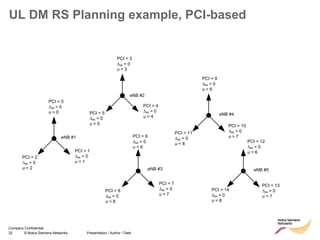
UL DM RS Planning example, PCI-based
PCI = 1
Dss = 0
u = 1
eNB #1
eNB #2
eNB #3
eNB #4
eNB #5
PCI = 0
Dss = 0
u = 0
PCI = 2
Dss = 0
u = 2
PCI = 3
Dss = 0
u = 3
PCI = 4
Dss = 0
u = 4
PCI = 5
Dss = 0
u = 5
PCI = 9
Dss = 0
u = 6
PCI = 10
Dss = 0
u = 7
PCI = 11
Dss = 0
u = 8
PCI = 12
Dss = 0
u = 6
PCI = 13
Dss = 0
u = 7
PCI = 14
Dss = 0
u = 8
PCI = 6
Dss = 0
u = 6
PCI = 7
Dss = 0
u = 7
PCI = 8
Dss = 0
u = 8
33 Ā© Nokia Siemens Networks Presentation / Author / Date
Company Confidential
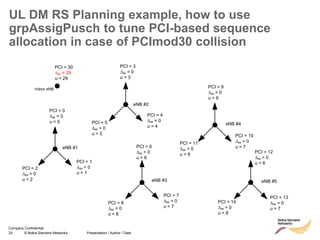
UL DM RS Planning example, how to use
grpAssigPusch to tune PCI-based sequence
allocation in case of PCImod30 collision
PCI = 1
Dss = 0
u = 1
eNB #1
eNB #2
eNB #3
eNB #4
eNB #5
PCI = 0
Dss = 0
u = 0
PCI = 2
Dss = 0
u = 2
PCI = 3
Dss = 0
u = 3
PCI = 4
Dss = 0
u = 4
PCI = 5
Dss = 0
u = 5
PCI = 9
Dss = 0
u = 6
PCI = 10
Dss = 0
u = 7
PCI = 11
Dss = 0
u = 8
PCI = 12
Dss = 0
u = 6
PCI = 13
Dss = 0
u = 7
PCI = 14
Dss = 0
u = 8
PCI = 6
Dss = 0
u = 6
PCI = 7
Dss = 0
u = 7
PCI = 8
Dss = 0
u = 8
indoor eNB
PCI = 30
Dss = 29
u = 29

305090798 04-basic-parameter-planning-rules-v1-1

  • 1.
    1 Ā© NokiaSiemens Networks Presentation / Author / Date Company Confidential PRACH Planning PCI Planning UL DM RS Planning Key Planning Areas parameters – TD-LTE
  • 2.
    2 Ā© NokiaSiemens Networks Presentation / Author / Date Company Confidential PRACH Planning Principle PRACH configuration two cells must be different within the PRACH re-use distance to increase the RACH decoding success rate PRACH transmission can be separated by: • Time (prachConfIndex) – PRACH-PUSCH interference: If PRACH resources are separated in time within eNB – PRACH-PRACH interference: If same PRACH resources are used for the cells of an eNodeB. – PRACH-PRACH interference is preferred to PRACH-PUSCH interference so prachConfIndex of the cells on one site should be the same • Frequency (prachFreqOff) – Allocation of PRACH area should be next to PUCCH area either at upper or lower border of frequency band, however should not overlap with PUCCH area – Avoid separation of PUSCH in two areas by PRACH (scheduler can only handle one PUSCH area) – For simplicity use same configuration for all cells • Sequence (PRACH CS and RootSeqIndex) – Use different sequences for all neighbour cells
  • 3.
    3 Ā© NokiaSiemens Networks Presentation / Author / Date Company Confidential Preamble Formats, FDD+TDD common • 3GPP (TS36.211) specifies 4 random access formats common for both FDD/TDD • Difference in formats is based in the different durations for the cyclic prefix, sequence and guard time which have an effect on the maximum cell radius • Only Formats 0 and 1 are supported in initial releases (up to RL30) Recommendation: ļ‚§ Select Format0 for cell ranges <14.53 km ļ‚§ Select Format1 for cell ranges <77.34 km
  • 4.
    4 Ā© NokiaSiemens Networks Presentation / Author / Date Company Confidential Preamble Format 4, TDD-only • 3GPP (TS36.211) specifies a special random access format 4 for TDD • Is allocated in UpPTS when it is two symbols long • Maximum cell radius with preamble format 4 is about 1.4km • NOTE: when using preamble format 4, only root sequences 0-137 are allowed. • NOTE: when using preamble format 4, allowed value of prachCS is 4...6. Setting prachCS =6 gives the maximum cell range <1.4km • NOTE: prachFreqOff must be set to 0 with preamble format 4 • NOTE: prachHsFlag must be set to false with preamble format 4 SequenceCP sT 5.14CP  sT 133SEQ 
  • 5.
    5 Ā© NokiaSiemens Networks Presentation / Author / Date Company Confidential PRACH Configuration Index, prachConfIndex TDD RL15 prachConfIndex is restricted to values 3...7 or 51..53 if tddSpecSubfConf is set to '7' (ssp7). prachConfIndex is restricted to values 3...7, 23..25, 33..35 or 51...53 if tddSpecSubfConf is set to '5' (ssp5) Preamble format 4 also supported PRACH configuration Index Preamble Format Density Per 10 ms  RAD Version  RAr PRACH configuration Index Preamble Format Density Per 10 ms  RAD Version  RAr 0 0 0.5 0 32 2 0.5 2 1 0 0.5 1 33 2 1 0 2 0 0.5 2 34 2 1 1 3 0 1 0 35 2 2 0 4 0 1 1 36 2 3 0 5 0 1 2 37 2 4 0 6 0 2 0 38 2 5 0 7 0 2 1 39 2 6 0 8 0 2 2 40 3 0.5 0 9 0 3 0 41 3 0.5 1 10 0 3 1 42 3 0.5 2 11 0 3 2 43 3 1 0 12 0 4 0 44 3 1 1 13 0 4 1 45 3 2 0 14 0 4 2 46 3 3 0 15 0 5 0 47 3 4 0 16 0 5 1 48 4 0.5 0 17 0 5 2 49 4 0.5 1 18 0 6 0 50 4 0.5 2 19 0 6 1 51 4 1 0 20 1 0.5 0 52 4 1 1 21 1 0.5 1 53 4 2 0 22 1 0.5 2 54 4 3 0 23 1 1 0 55 4 4 0 24 1 1 1 56 4 5 0 25 1 2 0 57 4 6 0 26 1 3 0 58 N/A N/A N/A 27 1 4 0 59 N/A N/A N/A 28 1 5 0 60 N/A N/A N/A 29 1 6 0 61 N/A N/A N/A 30 2 0.5 0 62 N/A N/A N/A 31 2 0.5 1 63 N/A N/A N/A
  • 6.
    6 Ā© NokiaSiemens Networks Presentation / Author / Date Company Confidential RACH Density • Based on the expected RACH procedures per second and the maximum collision probability of the RACH preambles it is possible to estimate the RACH density as follows: 100* 100 1ln*64*)1( )__(         UE collp LoadRachex x UE collp = maximum collisiion probability [%] Ex-RACH_Load = expected RACH Procedures per sec 0.5 ≤ x => RACH Density = 0.5 0.5 < x ≤ 1 => RACH Density = 1 1 < x ≤ 2 => RACH Density = 2 2 < x ≤ 3 => RACH Density = 3 3 < x ≤ 5 => RACH Density = 5 5 < x => RACH Density = 10 • Recommendation: use PRACH density 1 for start • Since PRACH performance measurement counters are available (RL15 – M8001- Cell Load) it will be possible to evaluate the amount of PRACH / RACH procedures in time and adapt /optimize the settings • Future features: PRACH Management (auto- configuration, future SON feature called PRACH optimization (an aspect of this feature is to adjust the PRACH density to the traffic in the cell)
  • 7.
    7 Ā© NokiaSiemens Networks Presentation / Author / Date Company Confidential PRACH Frequency Offset prachFreqOff • Indicates the first PRB available for PRACH in the UL frequency band • PRACH area (6 PRBs) should be next to PUCCH area either at upper or lower border of frequency band to maximize the PUSCH area but not overlap with PUCCH area • Parameter is configured based on the PUCCH region (see PUCCH dimensioning) i.e. its value depends on how many PUCCH resources are available. • If PRACH area is placed at the lower border of UL frequency band then: PRACH-Frequency Offset= roundup [PUCCH resources/2] • If PRACH area is placed at the upper border of the UL frequency band then: PRACH-Frequency Offset= NRB -6- roundup [PUCCH resources/2] NRB: Number of Resource Blocks NOTE: prachFreqOff must be set to 0 if prachConfIndex is set to 51...53 (preamble 4)
  • 8.
    8 Ā© NokiaSiemens Networks Presentation / Author / Date Company Confidential PRACH Cyclic Shift for preambles 0-3 PrachCS • PrachCS defines the configuration used for the preamble generation. i.e. how many cyclic shifts are needed to generate the preamble • PrachCS depends on the cell size – Different cell ranges correspond to different PrachCS • Simplification: To assume all cells have same size (limited by the prachConfIndex) Recommendation: Select PrachCS based on the cell range E.g. if estimated cell range is 15km then PrachCS: 12 If all cells in the network are assumed to have same cell range them PrachCS is the same for the whole network
  • 9.
    9 Ā© NokiaSiemens Networks Presentation / Author / Date Company Confidential PRACH Cyclic Shift for preamble 4 PrachCS • For preamble 4, prachCs configuration maps to special table of cyclic shifts • The highlighted configuration indices 4…6 are supported in RL15 CSNCSN CSN configuration CSN value 0 2 1 4 2 6 3 8 4 10 5 12 6 15 7 N/A 8 N/A 9 N/A 10 N/A 11 N/A 12 N/A 13 N/A 14 N/A 15 N/A
  • 10.
    10 Ā© NokiaSiemens Networks Presentation / Author / Date Company Confidential PrachCS and rootSeqIndex • PrachCS defines the number of cyclic shifts (in terms of number of samples) used to generate multiple preamble sequences from a single root sequence • Example based on PrachCS=12 -> number of cyclic shifts: 119 – Root sequence length is 839 so a cyclic shift of 119 samples allows ROUNDDOWN (839/119)= 7 cyclic shifts before making a complete rotation (signatures per root sequence) • 64 preambles are transmitted in the PRACH frame. If one root is not enough to generate all 64 preambles then more root sequences are necessary – To ensure having 64 preamble sequences within the cell it is necessary to have ROUNDUP (64/7)= 10 root sequences per cell • For preamble format 4, root sequence length is 137.
  • 11.
    11 Ā© NokiaSiemens Networks Presentation / Author / Date Company Confidential PRACH Cyclic Shift rootSeqIndex • RootSeqIndex points to the first root sequence to be used when generating the set of 64 preamble sequences. • Each logical rootSeqIndex is associated with a single physical root sequence number. • In case more than one root sequence is necessary the consecutive number is selected until the full set is generated • NOTE: parameter rootSeqIndex specifies the logical root sequence index Logical root sequence number Physical root sequence index (in increasing order of the corresponding logical sequence number) 0–23 129, 710, 140, 699, 120, 719, 210, 629, 168, 671, 84, 755, 105, 734, 93, 746, 70, 769, 60, 779 2, 837, 1, 838 24–29 56, 783, 112, 727, 148, 691 30–35 80, 759, 42, 797, 40, 799 36–41 35, 804, 73, 766, 146, 693 42–51 31, 808, 28, 811, 30, 809, 27, 812, 29, 810 52–63 24, 815, 48, 791, 68, 771, 74, 765, 178, 661, 136, 703 …. ….. 64–75 86, 753, 78, 761, 43, 796, 39, 800, 20, 819, 21, 818 810–815 309, 530, 265, 574, 233, 606 816–819 367, 472, 296, 543 820–837 336, 503, 305, 534, 373, 466, 280, 559, 279, 560, 419, 420, 240, 599, 258, 581, 229, 610 Extract from 3GPP TS 36.211 Table 5.7.2.-4 ( Preamble Formats 0-3). Mapping between logical and physical root sequences. Recommendation: Use different rootSeqIndex across neighbouring cells means to ensure neighbour cells will use different preamble sequences
  • 12.
    12 Ā© NokiaSiemens Networks Presentation / Author / Date Company Confidential PRACH Planning Wrap Up Steps: - Define the prachConfIndex • Depends on preamble format (cell range) • It should be the same for each cell of a site - Define the prachFreqOff • Depends on the PUCCH region • It can be assumed to be the same for all cells of a network (simplification) - Define the PrachCS • Depends on the cell range • If for simplicity same cell range is assumed for all network then prachCS is the same for all cells - Define the rootSeqIndex • It points to the first root sequence • It needs to be different for neighbour cells • rootSeqIndex separation between cells depends on how many are necessary per cell (depends on PrachCS)
  • 13.
    13 Ā© NokiaSiemens Networks Presentation / Author / Date Company Confidential PRACH Planning example Assumptions: - prachConfIndex=3 for all cells • preamble format =0 • One PRACH opportunity per 10ms - prachFreqOff=6 for all cells • PRACH starts at sixth PRB in frequency domain - Define the prachCS=8 for all cells • Max cell range = 5.5km • Each cell consumes 4 root sequences {1,2,3,4} {5,6,7,8}{9,10,11,12} {13,14,15,16} {21,22,23,24} {17,18,19,20} {25,26,27,28} {33,34,35,36} {29,30,31,32} {37,38,39,40} {41,42,43,44}{45,46,47,48}eNB #1 eNB #2 eNB #3 eNB #4 {49,50,51,52} {53,54,55,56}{57,58,59,60} eNB #5 root sequence indices used in the cell
  • 14.
    14 Ā© NokiaSiemens Networks Presentation / Author / Date Company Confidential Exercise • Plan the PRACH Parameters for the sites attached in the excel • Assumptions: – PUCCH resources =6 – Cell range = 12km (all cells have same range) – BW:10MHz
  • 15.
    15 Ā© NokiaSiemens Networks Presentation / Author / Date Company Confidential PCI Planning Introduction • There are 504 unique Physical Cell IDs (PCI) Physical Layer Cell Identity = (3 Ɨ NID1) + NID2 NID1: Physical Layer Cell Identity group. Range 0 to 167 – Defines SSS sequence NID2: Identity within the group. Range 0 to 2 – Defines PSS sequence Resource element allocation to the Reference Signal • PCI impacts the allocation of resource elements to the reference signal and the set of physical channels • Allocation pattern repeats every 6th Physical Layer Cell Identity
  • 16.
    16 Ā© NokiaSiemens Networks Presentation / Author / Date Company Confidential PCI Planning • Analogous to scrambling code planning in UMTS – Maximum isolation between cells with the same PCI ā–Ŗ To ensure that UE never simultaneously receive the same identity from more than a single cell • Physical Cell Identity is defined by the parameter phyCellID: Parameter Object Range Default phyCellId LNCEL 0 to 503 Not Applicable • There should be some level of co-ordination across international borders when allocating PCIs. – This will help to avoid operators allocating the same identity to cells on the same RF carrier and in neighbouring geographic areas
  • 17.
    17 Ā© NokiaSiemens Networks Presentation / Author / Date Company Confidential PCI Planning Recommendations for 2Tx In priority order, number 1 most important in FDD (all four should be fulfilled, ideally). Number 2 important in TDD! 1. Avoid assigning the same PCI to neighbour cells 2. Avoid assigning the same mod3 (PCI) to ā€˜neighbour’ cells 3. Avoid assigning the same mod6(PCI) to ā€˜neighbour’ cells 4. Avoid assigning the same mod30 (PCI) to ā€˜neighbour’ cells Id = 5 Id = 4 Id = 3 Id = 11 Id = 10 Id = 9 Id = 8 Id = 7 Id = 6 Id = 2 Id = 1 Id = 0 Example 1 PCI Identity Plan Example 2 PCI Identity Plan
  • 18.
    18 Ā© NokiaSiemens Networks Presentation / Author / Date Company Confidential PCI Planning example PCI=0 PCI=1PCI=2 PCI=3 PCI=5 PCI=4 PCI=6 PCI=8 PCI=7 PCI=9 PCI=10PCI=11eNB #1 eNB #2 eNB #3 eNB #4 PCI=12 PCI=13PCI=14 eNB #5 Quiz: how to allocate PCI for a single-cell TD-LTE omni site to be placed at the red circle?
  • 19.
    19 Ā© NokiaSiemens Networks Presentation / Author / Date Company Confidential - UlseqHop - UlGrpHop - grpAssigPUSCH - ulRsCs - Sequence Group Number (u) UL Reference Signal Planning
  • 20.
    20 Ā© NokiaSiemens Networks Presentation / Author / Date Company Confidential UL Reference Signal Overview Types of UL Reference Signals • Demodulation Reference Signals (DM RS) – PUSCH/PUCCH data estimation • Sounding Reference Signals (SRS) – Mainly UL channel estimation UL (RL40/RL15) DM RS is characterised by: • Sequence (Zadoff Chu codes) • Sequence length: equal to the # of subcarriers used for PUSCH transmission • Sequence group: ā–Ŗ 30 options ā–Ŗ Cell specific parameter • Cyclic Shift: UE and cell specific parameter UL DM RS allocation per slot for Normal Cyclic Prefix
  • 21.
    21 Ā© NokiaSiemens Networks Presentation / Author / Date Company Confidential UL DM Reference Signal Need for Planning Issue: • DM RS occupy always the same slot in time domain • In frequency domain DM RS of a given UE occupies the same PRBs as its PUSCH/PUCCH data transmission • Possible inter cell interference for RS due to simultaneous UL allocations on neighbour cells – No intra cell interference because users are separated in frequency – Possible inter cell interference Scope of planning: • DM RS in co-sited cells needs to be different UL DM RS allocation per slot for Normal Cyclic Prefix
  • 22.
    23 Ā© NokiaSiemens Networks Presentation / Author / Date Company Confidential • RS sequences for PUSCH have different lengths depending the UL bandwidth allocated for a UE • 30 possible sequences for each PRB allocation length of 1-100 PRBs • Sequences are grouped into 30 groups so they can be assigned to cells • Sequence group number ā€˜u’: RS Sequences and RS Sequence Groups Sequence Group Id, ā€˜u’   30modSCHgrpAssigPU PCIu grpAssigPUSCH: group assignment for PUSCH Range [0…29], step 1
  • 23.
    24 Ā© NokiaSiemens Networks Presentation / Author / Date Company Confidential Cyclic Shift • Additional sequences can be derived from a basic sequence by applying a cyclic shift • Cyclic shifts of an extended ZC sequence are not fully orthogonal, but have low cross-correlation • The actual UL reference signal cyclic shift ncs used by UE is different for every 0.5ms time slot  ļ 12mod)( sPRS )2( DMRS )1( DMRScs nnnnn  Cell-specific static cyclic shift defined by LNCEL/ulRsCs and broadcast on BCCH TTI-specific cyclic shift signalled to UE on PDCCH DCI0 in each uplink scheduling grant (defined by scheduler) Pseudorandom cyclic shift offset that changes every time slot. Depends on the PCI, slot number ns and u via LNCEL/grpAssigPUSCH ulRsCs ndmrs1 0 0 1 2 2 3 3 4 4 6 5 8 6 9 7 10 DCI0 CS field ndmrs2 000 0 001 6 010 3 011 4 100 2 101 8 110 10 111 9 u N c ļ€«ļƒ—ļƒŗ       32 30 cell ID init
  • 24.
    25 Ā© NokiaSiemens Networks Presentation / Author / Date Company Confidential UL DM Reference Signal Hopping Techniques • Sequence Hopping – Intra-Subframe hopping between two sequences within a sequence group for allocations larger than 5PRBs – Only enabled is Sequence Group hopping in disabled – Not enabled in RL10/RL20/RL30: ulSeqHop= false • Sequence Group Hopping – In each slot, the UL RS sequences to use within a cell are taken from one specific group – If group varies between slots: Group hopping – Group Hopping not enabled in RL10/RL20/RL30: UlGrpHop = false ā–Ŗ Group is the same for all slots • Cyclic Shift Hopping – Always used – Cell specific cyclic shift added on top of UE specific cyclic shift
  • 25.
    26 Ā© NokiaSiemens Networks Presentation / Author / Date Company Confidential Planning From Theory to Practice… (1/2) Theory: • It should be possible to assign to the cells of one site the same sequence group ā€˜u’ and ā€˜differentiate’ the sequences using different cell specific cyclic shifts i.e. allocating different ulRsCs Remember!: Cyclic shifts of an extended ZC sequence are not fully orthogonal, but have low cross-correlation
  • 26.
    27 Ā© NokiaSiemens Networks Presentation / Author / Date Company Confidential Planning From Theory to Practice… (2/2) Practice: • It doesn’t seem to work • UL Throughput gets considerably affected if UL traffic in neighbour cell – From 40 Mbps to ~ 22 Mbps in the example PCI grpAssigPusch sequence id u ulRsCs cinit 75 0 15 0 79 76 29 15 4 79
  • 27.
    28 Ā© NokiaSiemens Networks Presentation / Author / Date Company Confidential Planning New rule • Allocate different sequence group u for every cell, including cells of the same site – Cross-correlation properties between sequences from two different groups are good because of sequence grouping in the 3GPP spec • ulRsCs does not matter (it is only relevant for sequences within one seq group u)
  • 28.
    29 Ā© NokiaSiemens Networks Presentation / Author / Date Company Confidential Planning Results • UL Throughput still suffers from UL interference in neighbour cell but the effect is lower PCI grpAssigPusch sequence id u ulRsCs cinit 75 0 15 0 79 76 0 16 0 80
  • 29.
    30 Ā© NokiaSiemens Networks Presentation / Author / Date Company Confidential Pros an cons of the new planning rule • [+]: Results seem to be better • [+]: Less parameters to plan, only PCI planning needed – UlRsCs only relevant when using sequences of the same group – ā€˜u’ will be different if PCI module 3 rule is followed. In that case ā€˜grpAssigPUSCH’ value is not relevant • [ -]: Reduced group reuse distance compared to the case of assigning the same group per each site   30modSCHgrpAssigPU PCIu
  • 30.
    31 Ā© NokiaSiemens Networks Presentation / Author / Date Company Confidential UL DM RS Planning Wrap up – If cells of the site follow the PCImod3 rule, the sequence group number ā€˜u’ will be different – If PCImod3 rule is not followed, check PCImod30 rule ā–Ŗ If problems use grpAssigPUSCH to differentiate the ā€˜u’ - sequence group number- – If same ā€˜u’ has to be used in neighbouring cells and cannot be changed using grpAssigPUSCH then assign different ulRsCs to the cells of a site. Range [0…7] • Principle: DM RS needs to be different in cells of the same eNodeB • Current planning approach: – Assign different sequence group number ā€˜u’ to the cells of the same site. Range: [0…29]. grpAssigPUSCH can be constant =no need for planning   30modSCHgrpAssigPU PCIu
  • 31.
    32 Ā© NokiaSiemens Networks Presentation / Author / Date Company Confidential UL DM RS Planning example, PCI-based PCI = 1 Dss = 0 u = 1 eNB #1 eNB #2 eNB #3 eNB #4 eNB #5 PCI = 0 Dss = 0 u = 0 PCI = 2 Dss = 0 u = 2 PCI = 3 Dss = 0 u = 3 PCI = 4 Dss = 0 u = 4 PCI = 5 Dss = 0 u = 5 PCI = 9 Dss = 0 u = 6 PCI = 10 Dss = 0 u = 7 PCI = 11 Dss = 0 u = 8 PCI = 12 Dss = 0 u = 6 PCI = 13 Dss = 0 u = 7 PCI = 14 Dss = 0 u = 8 PCI = 6 Dss = 0 u = 6 PCI = 7 Dss = 0 u = 7 PCI = 8 Dss = 0 u = 8
  • 32.
    33 Ā© NokiaSiemens Networks Presentation / Author / Date Company Confidential UL DM RS Planning example, how to use grpAssigPusch to tune PCI-based sequence allocation in case of PCImod30 collision PCI = 1 Dss = 0 u = 1 eNB #1 eNB #2 eNB #3 eNB #4 eNB #5 PCI = 0 Dss = 0 u = 0 PCI = 2 Dss = 0 u = 2 PCI = 3 Dss = 0 u = 3 PCI = 4 Dss = 0 u = 4 PCI = 5 Dss = 0 u = 5 PCI = 9 Dss = 0 u = 6 PCI = 10 Dss = 0 u = 7 PCI = 11 Dss = 0 u = 8 PCI = 12 Dss = 0 u = 6 PCI = 13 Dss = 0 u = 7 PCI = 14 Dss = 0 u = 8 PCI = 6 Dss = 0 u = 6 PCI = 7 Dss = 0 u = 7 PCI = 8 Dss = 0 u = 8 indoor eNB PCI = 30 Dss = 29 u = 29

Editor's Notes

  • #3Ā PUSCH Rx power (SINR) can be very high compared to PRACH SINR in the neighbour cell and hence effectively swamp the PRACH preambles and/or resulting in misdetections (ghost RACH). Also ghost RACH if prachConfIndex, prachFreqOff and RootSeqIndex are the sameis because whenever UE sends a non-dedicated PRACH preamble it may be captured by more than one cell. All the cells capturing the preamble send random access response, hence reserving PDCCH and PUSCH capacity. These are commonly called ā€œphantom PRACHsā€ or ā€œghost PRACHsā€.
  • #4Ā Note: An additional format to these four is specified for TDD Preamble format 2 supported in RL40
  • #5Ā Note: An additional format to these four is specified for TDD Preamble format 2 supported in RL40
  • #6Ā 1 Random access attempt = 1 RACH resource = 6 PRBs Note: By configuring the PRACH Configuration Indexes at cells belonging to the same site we use the same subframes for PRACH transmission Neighbouring eNodeBs are not synchronised in FDD so even if the same PRACH configuration indices, there is no guarantee that the PRACH will clash in the time domain. It is possible to set different frequency offsets so PRACH doesn’t clash in frequency domain. In TD-LTE, neighbouring cells are frame-synchronized.
  • #9Ā PrachCS also depends on the high speed flag but it is not supported in RL10 Currently the common practice is to assume the same cell ranges for all cells: If all cells are considered to have the same size, the utilization of root sequences will not be optimal as we will end up using more root sequences per cell than the needed for certain cell range.
  • #10Ā PrachCS also depends on the high speed flag but it is not supported in RL10. HS flag supported in RL15, special Ncs allocation rules apply, check PDDB for list of restrictions. Preamble format 4 is mainly applicable to indoor cells or small microcells. Currently the common practice is to assume the same cell ranges for all cells: If all cells are considered to have the same size, the utilization of root sequences will not be optimal as we will end up using more root sequences per cell than the needed for certain cell range.
  • #12Ā Recommendation: Plan different logical root sequence numbers to generate different physical root sequence numbers.
  • #16Ā First: PSS and SSS signals: The PSS is generated out of 3 different sequences – each of these sequences indicates one Physical Layer Cell Identity The SSS is generated out of 168 sequences – each of these sequences indicates one Physical Layer Cell Identity Group
  • #18Ā Mod3 (PCI): 1.Mod 3 of the PCI is equal to the Physical Layer Cell Identity so if different then PSS signals are different which facilitates the cell search and synch procedure. 2. RS, carrying one of the 504 PCI has a frequency shift given by mod6(PCI) so collisions between RS are avoided up to 6 adjacent cells ( if 1Tx antenna). For 2Tx ant, # RS is doubled so to avoid collisions in adjacent cells: mod3(PCI) should be different. Try to stick to (1) up to (4) If (i) is fulfilled then also (i+1) is fulfilled [for i = 2,3,4] If (i) is not fulfilled then also (i-1) is not fulfilled [for i=3,4] The lower the number the higher the priority, this means (1) has the highest priority If (4) is not fulfilled, delta_ss (grpAssigPUSCH) can be used to fix it. With 2Tx configuration the cells of the same site should have different PCImod3, with 1Tx the PCImod6 should be different. This is to have frequency shift for RS of different cells, because cells of a given site are frame-synchronized in the sense that DL radio frame transmission starts at the same time instant in all the cells --> hence also RSĀ symbols are transmittedĀ at the same time instant. To avoid RS of different cells (of the same site) interfering in the DL, a frequency shift is applied. Ā  The situation changes slightly for cells of different sites, where in RL10 FDD different sites are not in general frame-synchronized (except by chance). In TDD different sites must be frame-synchronized. But in FDD, the DL RS received from cells of two different sites have a random frame offset with respect to each other and hence the RS symbols may or may not overlap (interfere) in any given measurement position. But as you said, because of irregular cell shapes, it may well happen that there are spots where there is strong interference between RSĀ received from cells of different sites, i.e. RS symbols collide in both time and frequency. If you have a TDD network, this scenario happens probably quite often. In these cases, perhaps depending on the SINR estimation method used by the particular receiver, the estimation result may be unreliable.
  • #23Ā Phase shift: For 1-2PRBs: computer-optimized lookup table in 3GPP TS 36.211 0<n<=Nz
  • #24Ā 6 or more PRBs there are two sequences per group, for a given PRB allocation length. With sequence hopping (there are 2x30=60 sequences for 6 or more PRBs
  • #25Ā Ndmrs2: cyclic time shift offset indicated in each scheduling grant Hopping sequence is the same when initial seed cinit is the same
  • #26Ā If RB allocations is 5 or less, there is only one base sequence per group whereas for allocations of more than 5 PRBs there are 2 RS base sequences per group.
  • #33Ā Delta_ SS = grpAssigPusch
  • #34Ā Delta_ SS = grpAssigPusch