Page 1 © LTE Broadcast Alliance November 2016
LTE Broadcast – Lessons Learned from Trials and Early Deployments
1. Introduction
LTE Broadcast technology (also known as eMBMS, and LTE Multicast) is enabling a broad range of
different services and applications as it is introduced into wireless operator networks around the
world. It is also enabling re-imagining of existing services. To realise the full potential of the
technology requires further work on the part of network equipment vendors, network operators,
chipset, middleware and device vendors, and standardisation bodies. However, the benefits of LTE
Broadcast to players throughout the wireless industry and beyond are now clear, thanks to several
commercial and trial deployments.
The growth of streaming video consumption on mobile networks is also undeniable. As recently as
August, as athletes from around the world set new records at the Olympic Games, the Telstra
network set new records too. The Olympics became the most streamed sporting event in the history
of Telstra’s network. During some events, Telstra customers watching on mobile devices added the
equivalent of 25 per cent of the peak daily demand to the network data traffic. Telstra has modelled
that the cost to augment its network to implement LTE Broadcast, which would help deliver content
at times like these, would be justified by carrying as little as 1% of the network traffic by 2021.
The capabilities of LTE Broadcast have also attracted the attention of broadcasters such as
Bayerischer Rundfunk, who have tested the technology as a potential complement to, or
replacement for, other means of delivering digital TV content. Also, LTE Broadcast has potential in
areas where digital terrestrial TV (DTT) coverage is currently poor (such as in developing countries
where LTE infrastructure may be better developed than broadcasting infrastructure, in buildings,
and in dense urban environments). Broadcasters want to ensure that their content is viewable to the
largest possible audience.
Of course, LTE Broadcast needs LTE networks, and it is worth noting that the number of LTE
networks and subscribers around the world is growing fast. For instance, the September 2016
interim update of Ericsson’s Mobility Report1
estimates the number of LTE subscriptions worldwide
at 1.4 billion (around 19% of the global total mobile subscription base), an increase of 170 million
over the previous quarter. The GSA said in November 2016 that there were 537 active LTE, LTE-
Advanced or LTE-Advanced Pro networks worldwide2
.
This paper explains how LTE Broadcast has developed from a network technology initially intended
to support the efficient streaming of live video to multiple users into a way of supporting a large
number of different services. It details the lessons learned from early commercial deployments and
trials. It describes the way that players in the LTE Broadcast ecosystem have successfully worked
together to finalise network implementations and prove commercial cases. The report also shows
the growing momentum behind LTE Broadcast as more services are prepared for launch.
1
https://www.ericsson.com/res/docs/2016/mobility-report/emr-interim-september-2016.pdf
2
http://gsacom.com/paper/global-lte-network-deployments-537-commercially-launched-170-countries/
LTE Broadcast – Lessons Learned from Trials and Early Deployments
Page 2 © LTE Broadcast Alliance November 2016
The paper, which has been prepared by analyst company Innovation Observatory on behalf of the
LTE Broadcast Alliance3
, has been assisted by the founding operators in the Alliance, EE, Telstra, KT
and Verizon.
1.1. The Three Mutually Dependent Parts of LTE Broadcast
LTE Broadcast, or eMBMS, was envisaged as a collection of network technologies and device
middleware that between them enable the simultaneous broadcast of content to multiple devices
within any specific network cells. The initial aim of the technology was to increase the efficiency with
which video and other content could be delivered to multiple users simultaneously, making better
use of network resources and enabling higher quality of experience for consumers.
However, LTE Broadcast is now much more than a network technology. As trials and commercial
services have been launched it has become clear that it is important to think of LTE Broadcast as a
combination of three mutually dependent aspects: network, services and devices, that enable a
wide variety of use cases. These three aspects are discussed in detail in this paper.
Trials have gone beyond simply testing network equipment, middleware, devices and specific use
cases such as live video delivery, and have led to an understanding that there is no “killer app” (as
some device vendors have been looking for). Rather, LTE Broadcast is an enabling technology that
supports a multitude of service ideas that individually have a sound business case, and collectively
deliver a return on investment for all key parties: infrastructure and device vendors, network
operators and content partners.
This is resulting in opportunities for partners in the telecoms, consumer electronics, broadcasting
and content creation industries to come together to jointly develop service concepts. For instance, in
the UK, EE is creating six “innovation zones” in its network where closed user groups equipped with
eMBMS-enabled phones can try out new service ideas in a live network environment. As well as
concepts focused on smartphones and tablets, EE says V2X (vehicle-to-vehicle/infrastructure)
applications are likely to be among the first ideas trialled. EE’s Matt Stagg says “It’s all about
removing barriers to entry.” In Australia, Telstra enables partners equipped with suitable equipment
to test service ideas across the live network coverage footprint.
1.2. LTE Broadcast Around the World
LTE Broadcast technology has been the subject of many demonstrations and trials since Mobile
World Congress in 2013. Operators that have announced public work with the technology include 3,
AT&T, Bell Mobility, China Mobile, China Telecom (including Wuxi Telecom), EE, Etisalat, Globe
Telecom, KPN, KT, Megafon, Meo, MTS, Orange, PCCW, Polkomtel Plus, Reliance Jio, Singtel, SK
Telecom, Smart Communications, Smartfren, TIM, Telstra, T-Mobile, Turkcell, Verizon Wireless, Vivo
and Vodafone. A paper published by the Global mobile Suppliers Association (GSA) in November
20154
contains more details about these early trials. The GSA’s market update from October 2016
lists 37 separate operator announcements relating to LTE Broadcast.5
Proposed service ideas for LTE Broadcast have addressed a very wide range of use cases, including
3
The LTE Broadcast Alliance was formed in April 2016. Its operator members are operators CSL Mobile, EE,
HKT, KT, Reliance Jio, Smartfren, Telstra, TIM, Turkcell and Verizon Wireless. The Alliance aims to facilitate the
development of the LTE Broadcast ecosystem.
4
http://gsacom.com/paper/evaluating-the-lte-broadcast-opportunity/ (registration required)
5
http://gsacom.com/paper/gsa-snapshot-lte-broadcast-embms-global-status-summary-deployments-
activities-2/ (registration required)
LTE Broadcast – Lessons Learned from Trials and Early Deployments
Page 3 © LTE Broadcast Alliance November 2016
 Distribution of live and linear HD streaming video, for instance in congested areas, in
buildings and where DTT coverage is poor
 Pre-positioning video and other content on to mobile devices
 Sport, music and other stadium services – multi-angle replays, additional information
services etc
 Priority and mission-critical push-to-talk and push-to-video wireless services for police, fire,
ambulance and other blue-light services
 Public safety, public information distribution and notifications
 Software and other content distribution, including upgrades to mobile devices, and content
in campuses, airports, hotels etc, and for public transport information
 Distribution of digital signage (video advertising poster) content
 Configuration of connected devices in IoT networks.
As trials have progressed and commercial services have been launched, these ideas have been
refined in the light of experience. In the next section we look at lessons learned.
2. Lessons Learned From Trials and Deployments
Commercial deployments and extensive trials have resulted in a great deal being understood about
how LTE Broadcast works in practice for a number of different use cases. The table below gives
details of some of the most well-developed services and most extensive trials.
Operator (and
partners)
Service / trial Date,
country
Details
China Telecom; ZTE and
Huawei (equipment);
Expway (middleware)
Live mobile video of Youth
Olympic Games and other
video content to a very
large number of users
During
2014, China
Two trials of campus area deployments; the
first involving the Youth Olympic Games
village and a university campus in Nanjing,
with 18,000 volunteer trialists. The second
trial was at three university sites in Wuxi
EE; BBC (content),
Samsung, Qualcomm
(handsets,
middleware),
Live stream and enhanced
content trial at FA Cup Final
and Commonwealth Games
Trials during
2014 and
2015, UK
Up to 30 users; HD streaming; choice of 3
camera angles and replays from multiple
angles; user control via app
Telstra; Foxsports and
Channel 9 (content),
Expway/Qualcomm
(middleware),
Intellicore (app),
Ericsson, EVS, Envivio &
Elemental (network
equipment, video
production), Samsung/
LG (devices)
Live stream and enhanced
content trials at National
Rugby League Grand Final,
T20 international cricket
match, V8 Supercars race
and other sporting events
Trials during
2014 and
2015,
Australia
Up to 3 live video and replay feeds plus
highlights and additional data (e.g. game
statistics, upcoming racing schedule)
Telstra; Channel 7
(content), Qualcomm
(middleware), Ericsson,
Samsung (devices)
Live stream of the Spring
Racing Carnival
Trials during
2014,
Australia
Up to 3 live video feeds plus 2 additional data
channels (Race info, betting odds, form guide
and results)
Verizon Wireless;
Ericsson, Nokia
(network equipment)
INDYCAR app Commercial
since April
2016, US
Though available for iOS and Android, only
Android users have LTE Broadcast capability at
the track. Service positioned as high-quality,
buffer- and lag-free live video. Three exclusive
live streams plus audio tracks
Telstra; studio content
providers for BigPond
Movies application;
Qualcomm/Expway
(middleware);
Content pre-positioning
proof of concept
Trials on
Telstra
network
June–
September
Movie VoD service delivery; trial has looked at
user-profile-based LTE Broadcast delivery of
trailers and complete movies, user
notification, device caching and management,
and seamless transition between partial to full
LTE Broadcast – Lessons Learned from Trials and Early Deployments
Page 4 © LTE Broadcast Alliance November 2016
Samsung/LG (devices);
Ericsson (network)
2016,
Australia
file. It complements live streams with pre-
positioned content for increased end-user
engagement
KT Live TV broadcasting to
busy city locations
Commercial
during 2015
and 2016,
South Korea
Mobile TV on Seoul and Busan underground
railways; one live TV stream
KT Live sports event services at
stadiums
Commercial
during 2015
and 2016,
South Korea
Seven stadiums covered by April 2016; live
video streams of games from other locations
2.1. Network
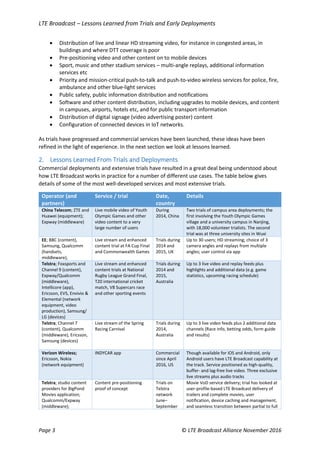
Figure 1 below shows in brief the typical way that eMBMS is deployed within existing LTE networks.
Figure 1: eMBMS deployment in the network
Key takeaways
 LTE Broadcast can be deployed to suit multiple strategies in accordance with an operator’s
plans for specific services, or its strategic aims. Most network operators that have looked at
LTE Broadcast have selected limited geographic areas for trials. Stadiums have often been
chosen as places where video streaming, user experience and efficiency of broadcast in
congested locations can be tested for both stadium- and non-stadium-based use cases, and
these trials have worked well. Other rollout strategies have also been adopted, though.
Verizon Wireless has enabled its US network nationwide to support the INDYCAR app.
Telstra and EE are committed to widespread or nationwide network rollouts in support of
content distribution network strategies. To support its GiGA Power Live broadcast service in
South Korea, KT has progressively enabled LTE Broadcast in subway lines throughout the
Seoul metropolitan area and in Busan. It has also deployed it at selected sports stadiums and
busy city centre locations across the country.
 Overlapping cells help improve quality. Trials at EE and Telstra have shown that there is a
quality gain for the user resulting from a device being able to receive and combine broadcast
streams from multiple broadcasting base stations. In addition, the trials have proved that
broadcast mode delivers a high-quality stream if the throughput of the RAN is sufficiently
high.
 It is simple to provide the necessary RAN synchronisation. While a high degree of
synchronisation (to IEEE 1588 v2 standard) is required across all eMBMS-enabled eNodeBs,
any method can be used and GPS-based synchronisation has been found to work well. It is as
simple as adding a GPS module and suitable antenna to the element. Note that RANs are
generally being upgraded with this synchronisation in any case.
 A single broadcast stream gives maximum network efficiency. Trials show that the load on
the transport nodes where multicasting duplication is performed can be quite intense. This
may limit the number of simultaneous streams that can be carried in a certain area. Multiple
streams are still efficient with multiple users in the cell watching each stream. Furthermore,
LTE Broadcast – Lessons Learned from Trials and Early Deployments
Page 5 © LTE Broadcast Alliance November 2016
where available, MLD (Multicast Listener Discovery) snooping should be able to reduce
transport network load.
 Transport networks need to support multicast IP address ranges. Rollouts of LTE Broadcast
have highlighted that transport network elements need to support the multicast IP address
ranges (223.00–227.xx; Band D) as well as the unicast IP address ranges (Bands A-C).
Vendors may need to be asked to enable this in their elements and generally this is a simple
remote software enablement. Protocol Independent Multicast Sparse Mode (PIM-SM) may
need enabling in the transport network too. New or enhanced switches can be introduced at
local VLAN aggregation points.
 Multiple routes to the BM-SC should be provided. When designing practical commercial LTE
Broadcast networks, it is useful to consider the interconnect with content owners’ PoPs, and
to provide suitable on-ramps for content to the eMBMS network. This is standard for all
network traffic. eMBMS itself does not require changes to interconnect design. In trials, it is
often the case that BM-SC and content servers are colocated, but in commercial
deployments this is unlikely to always be the case.
 Trials of LTE Broadcast by broadcasters show that it has potential as a replacement or
complement to other broadcasting distribution technologies for TV.
The points above show how operators and others have been working to enable eMBMS in their
networks. Operators and their partners have risen to the challenges and shown that the technology
works well.
Issues emerging and future developments
In addition to the lessons learned and described above, a number of issues have emerged during
commercial rollout and trials that the wider LTE Broadcast community is now addressing. The most
significant of these are listed below. All these issues are now being considered within 3GPP
processes and the LTE Broadcast Alliance would value support from the ecosystem to ensure they
are addressed for Release 14.
 Extending the LTE cyclic prefix to increase the LTE inter-cell-site range beyond 5km will
significantly help rollout economics of LTE Broadcast. The existing standard was developed
with a stadium-type use case in mind, and LTE Broadcast has now been shown to be suitable
for content streaming and distribution in much wider areas, so the technical standard has
recently been agreed to be extended in 3GPP.
 Increasing the subframe limit will enable new broadcast business cases to be developed. At
present the LTE Broadcast standard assumes that of ten available subframes, a maximum of
six can be used for broadcast mode. This assumes that operators would always want to use
unicast in the same carrier as their broadcast. However, some operators have sufficient
spectrum holdings that they want to be able to devote more than six subframes within a
carrier to broadcast mode. A change to the LTE Broadcast technical standards will enable
this. A future 3GPP capability also allows for dedicated eMBMS carriers where the entire
carrier is used for broadcast.
 Session continuity has been ratified by 3GPP and is required for seamless broadcast /
unicast handover and as a pre-requisite to dynamic scheduling (e.g. MOOD – see below).
Both network and middleware need upgrades to support session continuity. The application
must also support the MOOD capability for seamless experience between unicast and
broadcast. Therefore, development and integration with MOOD capable LTE Broadcast
middleware SDKs is needed. Resolving the different modulation and coding schemes
between broadcast and unicast streams needs tight integration between eMBMS networks
and traditional video delivery networks (including CDNs) that use adaptive bitrate streaming
per user. Network equipment and video encoder hardware vendors’ work to enable this
LTE Broadcast – Lessons Learned from Trials and Early Deployments
Page 6 © LTE Broadcast Alliance November 2016
(being carried out in vendor labs) should be complete by the end of 2016, and the feature
should be rolled out in 2017. Commercial launches (before MOOD) will rely on historic and
real time network analytics to identify capacity hot spots and turn on eMBMS in those cells
to avoid any ‘broadcast to nobody’ scenarios.
 Dynamic scheduling (e.g., MOOD) will enhance the business case for some LTE Broadcast
services by switching on broadcast mode on a granular (perhaps per-cell) basis only when
there are sufficient users in the cell that will benefit from it. This will enable greater
spectrum efficiency on an area basis. Because a neighbouring cell may be unicast, session
continuity is an essential adjunct. MOOD should be ready for deployment in 2017 after the
conclusion of work on session continuity. Note that for MOOD to work effectively and to
maximise the performance gain the solution requires dynamic adaptation on the modulation
and coding scheme to compensate for the increases/decreases of the MBSFN gains
associated with the dynamic size of the MBSFN area.
 LTE Broadcast end-to-end latency performance may need improving to support some
applications such as VoD replay in live streaming, though for many applications, latency
requirements are not as onerous. Network tuning can reduce latency to some extent, but
further technical work will be needed to ensure LTE Broadcast can keep pace with improving
latency performance of LTE-Advanced Pro networks.
Actions needed to create an optimal operator LTE Broadcast network include:
Careful planning of architecture, taking into account content partner networks, transport
network capabilities and RAN cell site configuration and coverage design
Continuing interoperability testing involving network equipment vendors, content hardware
vendors and device vendors
Further geographic rollout to support more use cases
Work with device vendors to ensure adoption of the technology
Collaborative R&D work to ensure LTE Broadcast evolves seamlessly into 5G networks, for
instance through the 5G-PPP 5G-XCast programme (see later)
2.2. Services
As LTE Broadcast rollouts and trials have continued through 2015 and 2016, the applications for the
technology have become clearer – and so has the way of thinking about those applications. Services
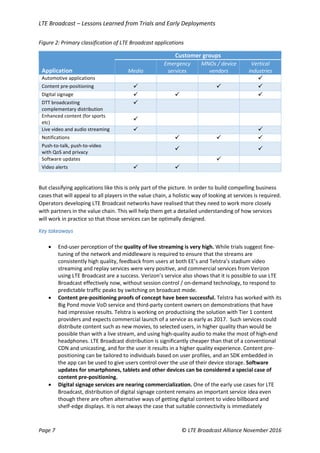
that can make use of LTE Broadcast appeal to one or more customer groups. The table shows the
likely primary use of some of the most well developed LTE Broadcast applications and their key
target customer groups.
LTE Broadcast – Lessons Learned from Trials and Early Deployments
Page 7 © LTE Broadcast Alliance November 2016
Figure 2: Primary classification of LTE Broadcast applications
Customer groups
Application Media
Emergency
services
MNOs / device
vendors
Vertical
industries
Automotive applications 
Content pre-positioning   
Digital signage   
DTT broadcasting
complementary distribution

Enhanced content (for sports
etc)

Live video and audio streaming  
Notifications   
Push-to-talk, push-to-video
with QoS and privacy
 
Software updates 
Video alerts  
But classifying applications like this is only part of the picture. In order to build compelling business
cases that will appeal to all players in the value chain, a holistic way of looking at services is required.
Operators developing LTE Broadcast networks have realised that they need to work more closely
with partners in the value chain. This will help them get a detailed understanding of how services
will work in practice so that those services can be optimally designed.
Key takeaways
 End-user perception of the quality of live streaming is very high. While trials suggest fine-
tuning of the network and middleware is required to ensure that the streams are
consistently high quality, feedback from users at both EE’s and Telstra’s stadium video
streaming and replay services were very positive, and commercial services from Verizon
using LTE Broadcast are a success. Verizon’s service also shows that it is possible to use LTE
Broadcast effectively now, without session control / on-demand technology, to respond to
predictable traffic peaks by switching on broadcast mode.
 Content pre-positioning proofs of concept have been successful. Telstra has worked with its
Big Pond movie VoD service and third-party content owners on demonstrations that have
had impressive results. Telstra is working on productising the solution with Tier 1 content
providers and expects commercial launch of a service as early as 2017. Such services could
distribute content such as new movies, to selected users, in higher quality than would be
possible than with a live stream, and using high-quality audio to make the most of high-end
headphones. LTE Broadcast distribution is significantly cheaper than that of a conventional
CDN and unicasting, and for the user it results in a higher quality experience. Content pre-
positioning can be tailored to individuals based on user profiles, and an SDK embedded in
the app can be used to give users control over the use of their device storage. Software
updates for smartphones, tablets and other devices can be considered a special case of
content pre-positioning.
 Digital signage services are nearing commercialization. One of the early use cases for LTE
Broadcast, distribution of digital signage content remains an important service idea even
though there are often alternative ways of getting digital content to video billboard and
shelf-edge displays. It is not always the case that suitable connectivity is immediately
LTE Broadcast – Lessons Learned from Trials and Early Deployments
Page 8 © LTE Broadcast Alliance November 2016
available in the places where billboards and displays are located. This is where LTE Broadcast
can step in, as deployment costs can be very much lower than if new fixed connections need
to be supplied. Digital signage is one application that Verizon Wireless will have
commercialized by early 2017, having demonstrated the concept in 2014.
 Other enterprise applications will follow. While consumer-oriented services have
dominated many of the early trials, they require eMBMS technology to be enabled in a high
proportion of consumer devices before they will really take off, even if nationwide or near-
nationwide network coverage is available. Enterprise applications with devices that are more
closely bound to the specific service are therefore easier to get off the ground, and
operators are working to develop these applications by making it easy for service concepts
to be tried out in live networks.
 LTE Broadcast enables scaling of emergency service network capacity and prioritization.
Some emergency service applications do not need large amounts of bandwidth and are a
good early match for operators’ eMBMS networks – especially where limited or distributed
spectrum holdings make live TV and video delivery services less attractive. Operators can
provide such services without having to commit to reserving large amounts of capacity: it
can be enabled when needed, in response to an emergency. Private mobile radio networks
can be replaced at lower cost with several LTE (and LTE Advanced and Advanced Pro)
features, including push-to-talk or mission-critical push-to-talk over cellular (PTToC), QoS,
privacy and broadcasting of alerts (with guaranteed delivery, and including video alerts,
which LTE Broadcast can support efficiently). Telstra has been working with Ericsson to
develop Telstra’s network for such a combination of features, and EE and others are also
developing this use case.
 More work will be needed on LTE Broadcast service monitoring. There are some challenges
with LTE Broadcast service monitoring from an operator’s perspective as there are no
immediate indicators on the received experience and performance of the broadcast in the
coverage area. To ensure LTE Broadcast is working correctly for the end-user, monitoring on
end-devices, and improvement to reception reporting, need to be developed.
 Moving to the H.265 codec as soon as possible is to be encouraged, as its superior
compression performance means greater efficiency.
Issues emerging and future developments
 Services need to be considered end-to-end, and designed with the capabilities of LTE
Broadcast in mind. For instance, operators have been considering how news and sports
content might be packaged up to offer both live and pre-positioned content. This would be
tailored to individual subscribers’ preferences, with content presentation and use of device
resources controlled by the user via a smartphone or tablet app. For digital signage, the
integration of new services into existing business models must be considered – for instance,
it may be necessary to develop end-point devices that fit existing form factor and other local
requirements.
 Operators have realised that they must understand applications in depth. For some
applications, automation of the content ingestion process, via an API, will be necessary. For
some other applications it is important to know that content has been delivered to all
recipients when broadcast. (Dropped packets must be identified per user and retransmitted,
in the same way that satellite broadcasters do.) Telstra, for instance, has been developing an
“application adaptation layer” between content creator and LTE Broadcast network. This
specifies how the network will be used by the service, while automatically scheduling a
broadcast through an API-driven CDN and LTE Broadcast system integration – essentially
industrialising the process of provisioning a service based on the network.
LTE Broadcast – Lessons Learned from Trials and Early Deployments
Page 9 © LTE Broadcast Alliance November 2016
 Content owners are significant partners in service development and ease of use for them of
the LTE Broadcast network is a major consideration. Partners need somewhere to try out
new service concepts and to answer their core question: “how will it work in practice?”
Complete services must be co-created, and this can take a long time.
 Revenue models are likely to remain diverse. Services launched and tested so far have
demonstrated multiple ways in which they can improve revenues, reduce costs and increase
market differentiation, and there will continue to be multiple business models as LTE
Broadcast develops. Existing services are improved through the use LTE Broadcast
transmission so the business models that apply to those services will be retained, but
improved. And new services will be commercially attractive to both end users and content
and service partners. However, as some LTE Broadcast services are only now approaching
proof-of-concept stage, the final revenue mix is not known.
 Handset penetration is an important factor for content partners. Media content owners
need to know that their content is reaching the largest possible audience at the highest
possible quality. Penetration of LTE Broadcast into smartphones and tablets is key to this.
Additionally, consumers need control over media apps so they can make the most of the LTE
Broadcast services: trials of stadium applications for instance have shown that multi-angle
replays and additional services are of more value to users than live streams.
Actions needed:
Publishing results of trials and roadmaps for device compatibility
Further development of live “labs” for partners and more proofs of concept, with
demonstration of clear business cases with customer benefits articulated
Broad consumer market research to test revenue models
Expansion of device ecosystem to bring on board more content and media partners
2.3. Devices
While network operators and their infrastructure vendor partners can control how their networks
support LTE Broadcast capability, user devices also need to support the eMBMS technology itself,
and the services that will use eMBMS. Device vendors participating in LTE Broadcast trials have been
extremely helpful and have demonstrated a willingness to address and overcome technical
challenges. For commercially launched LTE Broadcast services too, sufficient end user devices have
been suitably enabled to make the services successful. However, to ensure the best possible market
for LTE Broadcast-enabled services, penetration of key technologies on devices needs to be
maximized.
Key takeaways
 EE has proved that user smartphone / tablet battery life is better using eMBMS than using
unicast when viewing a stream, giving an increase in battery life of around an hour during
sporting event trials. In the context of the length of a sporting or music event, this is a
significant benefit. The increase in battery life results from a decrease in the number of
device-to-network communication events required during a broadcast stream compared
with a unicast stream.
 LTE Broadcast work in commercial services and trials has made clear that the cost of
enabling devices to use the technology will be small. A very low percentage of the total
LTE Broadcast – Lessons Learned from Trials and Early Deployments
Page 10 © LTE Broadcast Alliance November 2016
device bill of materials (BoM) will be accounted for by the IP constituent of the chipsets. The
cost of middleware will be in line with the cost of licences to play Flash or mpeg streams. As
such we recommend the vendor integrates the middleware licence into the device to enable
LTE Broadcast.
 Phones will need large internal or card memory and fast processors to get the best out of
some LTE Broadcast services. Content pre-positioning services depend on there being
sufficient available storage, and the ability to decode multiple video streams enables more
responsive replay services. The smartphone market is supporting high performance in top-
end smartphones but services will be targeted at the mass market, so mid-range phones
need to be equipped to cope with LTE Broadcast services too.
 Broadcast video decoding needs specific features to be available on devices and / or
middleware to deal with for video codecs and understand media descriptors; operators,
device vendors and chipset vendors now understand the requirements.
 It is important to test end-to-end with different combinations of devices, middleware and
video encoders. Through trials and testing Telstra has observed different behaviours and
issues when moving from one middleware to another, when using different video encoder
equipment, or using different end devices.
Issues emerging and future developments
 Operators have different approaches to over-the-air updates to devices. Some are happy
to push software or firmware updates to enable LTE Broadcast to existing devices in the
field; others prefer the lower-risk approach where capability is enabled in devices when they
are shipped from the manufacturer. To achieve the greatest possible device penetration in
the market for LTE Broadcast services, devices should be shipped with LTE Broadcast
enabled, and the upgrade can be achieved in the market via over-the-air activation. This
requires as many device vendors as possible to implement eMBMS functionality as a
standard part of their products’ feature sets.
 Knowledge of plans for LTE Broadcast device enablement will help bring service partners
on board. Media and other service partners in trials have indicated that knowing future
device compatibility with LTE Broadcast is important in order that business cases can be built
for specific services.
 Standardization of LTE Broadcast middleware will be beneficial. Device vendors do not
want to be faced with having to handle operator-specific implementations of eMBMS
middleware. A workstream of 3GPP – TRAPI (MBMS Transport Protocol and APIs)6
– is
addressing this issue for Release 14 of the 3GPP standards, and work is expected to be
completed during the first half of 2017. Telstra and Ericsson have shared a list of
requirements and principles that is expected from the standardized API to ease the app
development and integration into an operator’s ecosystem. In the longer term, the LTE
Broadcast Alliance would hope to see eMBMS functionality embedded in the device
operating system.
Details of device requirements
Telstra has documented the specific device requirements for eMBMS, identifying those that are
common across all LTE Broadcast services, and those that are specific to service types. Telstra’s
document forms the Appendix to this paper.
6
http://www.3gpp.org/DynaReport/GanttChart-Level-2.htm#bm700054
LTE Broadcast – Lessons Learned from Trials and Early Deployments
Page 11 © LTE Broadcast Alliance November 2016
The table below briefly summarises some of the requirements Telstra has identified, in addition to
basic support for eMBMS middleware with APIs, that have not already been discussed earlier in this
paper. These are a basic set of requirements to ensure minimal interoperability with eMBMS. There
are many additional requirements which operators will define to ensure full service interoperability.
Requirements Purpose
Multi-band eMBMS support To enable widest possible application of the technology within a region and
worldwide
SIB13, 15 and 16 support To ensure basic interworking
DRM and FEC Repair support / 3GPP
26.346
To properly enable content distribution and file download applications
H.264/H.265/3GP-DASH support, and
decoding of three simultaneous H.265
streams
To enable most efficient broadcast and unicast video stream delivery and
most likely broadcast service designs. Simultaneous decode allows for fast
channel switching but consumes more power
Support for AMR-WB and EVS codecs,
and 3GPP GCSE
To enable current and future push-to-talk applications
Support for FLUTE, Keep Updated
FLUTE service and max:stale caching
directive
To enable file delivery over unidirectional links such as UDP
Support for max:stale and expires
caching directives
To enable appropriate use of local caching of content
Align to 3GPP bootstrapping URL
definition
Simplify access to the service
Many handset vendors have enabled eMBMS in many devices. The GSA’s report from November
2015 listed around 100 devices that were known to be shipping with eMBMS-capable chipsets or
middleware. Verizon’s LTE Broadcast-enhanced services have been accessible to users with a
selection of enabled phones including models from Samsung, LG and Motorola running Qualcomm
chipsets and middleware. In KT’s commercial LTE Broadcast services, Samsung devices with Expway
middleware are used as well as those with Qualcomm’s. More chipset vendors are also adding
capability – during 2016 Mediatek joined Qualcomm, Sequans, Altair, GCT, Marvell and Intel in
having eMBMS-capable products.
Actions needed
Enablement via chipset and middleware of specific feature set as outlined above
Operator-specific implementations should be reduced for maximum supply-side efficiency
Device vendors to understand operator specific eMBMS implementations
3. Fit with LTE-Advanced Pro and 5G
Several of the LTE Broadcast use cases will be significantly enhanced by other features in the latest
and future releases of 3GPP LTE standards. For instance, emergency services applications of LTE
Broadcast will be able to make use of mission-critical push-to-talk (MCPTT) voice over LTE, a Release
13 feature (Rel. 13 was frozen by 3GPP in April 2016). Some LTE Broadcast features, such as
Multiband eMBMS, are themselves part of Release 13.
Evolution of LTE networks will also enable new types of service and application that will themselves
then benefit from LTE Broadcast. For instance, IoT applications for cellular networks are expected to
develop rapidly now that NB-IoT and LTE Cat-M1 standards have been finalised. While these IoT
LTE Broadcast – Lessons Learned from Trials and Early Deployments
Page 12 © LTE Broadcast Alliance November 2016
applications are at an early stage of development, they can benefit from the ability of LTE Broadcast
to efficiently distribute software and security updates to millions of connected devices.
The LTE Broadcast Alliance realises that beyond LTE Advanced and LTE Advanced Pro, LTE Broadcast
requires an evolution path to 5G; it will not remain a 4G technology. (However, it is important to
note that the 5G broadcast capability is deferred well into 5G Phase 2 timeframes and this highlights
the relevance of 4G as the main technology for some time to come.) As an example of broadcast
evolution, connected cars and broader V2X applications will develop to make use of the improved
latency and reliability of 5G compared with today’s networks, and LTE Broadcast’s one-to-many
capabilities must show an ability to move seamlessly to the next generation of networks.
There is a great deal of R&D work being undertaken around the world to develop technologies for
5G networks, though the multicast aspects of this work have so far not been as visible as those on
the new radio (NR) interface, network slicing, IoT and other constituent parts of 5G. Emerging ideas
include segmenting frequencies and using specific frequencies, along with latency characteristics, as
network slices, to provide bandwidth for specific applications. LTE Broadcast could become a
network slice for multicast / broadcast of content, and for other uses, as defined by the 5G network.
Note that network slicing does not require 5G and network slices can be created in 4G networks too.
So 5G doesn’t invalidate LTE Broadcast; rather LTE Broadcast becomes a part of what 5G will be.
In Europe, the 5G-XCast project of the 5G-PPP7
aims to develop and demonstrate a large-scale media
delivery technology solution for 5G over mobile, fixed and broadcast networks, with built-in
unicast/multicast/broadcast and caching capabilities. The project will make use of multiple European
5G testbeds and its work will cover physical layer, radio interface to the transport and application
layers, including protocols and application program interfaces, as well as network and system
architecture aspects. Telecom and media organisations are involved.
4. Conclusions
Important progress is being made in the development of LTE Broadcast, with proofs of concept
completed and underway, commercial services launched and new services nearing
commercialization. Many technical trials have proved that the technology works, and that it
supports multiple deployment models. Many of the issues have been resolved, and operators,
network equipment providers, middleware, chipset and device vendors now know what is required.
They can take steps now to drive LTE Broadcast forward to a successful future based on real services
with proven business cases. Many are doing this, and others can learn from their experience.
The market potential is large: forecasts published by GSA in November 2015 suggested service
revenues may reach USD14bn by 2020, with a customer base of two billion by that time8
. Where
there are service provider revenue opportunities there are also opportunities throughout the
ecosystem for content partners, network equipment vendors, middleware and chipset vendors and
device manufacturers. The LTE Broadcast Alliance members serve over 370 million customers.
LTE Broadcast complements many LTE Advanced and Advanced Pro developments, and there is a
stream of work underway to future-proof LTE Broadcast as 5G networks move closer.
7
https://5g-ppp.eu/
8
http://gsacom.com/press-release/gsa-forecasts-market-for-lte-broadcast-services-will-reach-14bn-
worldwide-by-2020/
LTE Broadcast – Lessons Learned from Trials and Early Deployments
Page 13 © LTE Broadcast Alliance November 2016
During the work to date, some important lessons have been learned, and some areas for further
work have been identified. The most important of these are:
 Handset vendors need to embed the necessary LTE Broadcast features as standard in all new
devices, and plan to introduce new key features such as MOOD and session continuity to
ensure greater adoption of the service.
 LTE Broadcast will support multiple service ideas – it’s not just about streaming video or
stadium services – and those services are at or near commercialization
 There are some additional requirements that need work within and beyond the
standardization bodies’ processes, relating to cyclic prefix length, subframe percentage and
middleware implementation
 Operators, content, device vendors and other partners need to work together, and consider
LTE Broadcast-based services end-to-end, rather than focusing on separate parts of the
value chain. While service ideas can be developed in testbeds involving a few prototype
devices, development of larger live-network tests will help
 Service partners need more details of device vendors’ LTE Broadcast roadmap – what
devices will be enabled and when – so they can complete their business plans. Trials have
resulted in a detailed checklist of device features that should be enabled.
The LTE Broadcast Alliance founding members welcome feedback and comment on this paper,
and are happy to respond to operators’ requests for more information about LTE Broadcast in
general; trials and commercial services; and device requirements for LTE Broadcast services.
If you are a network operator, please email enquiries@lteba.org
LTE Broadcast – Lessons Learned from Trials and Early Deployments
Page 14 © LTE Broadcast Alliance November 2016
APPENDIX: Features Telstra Recommends Operators Ask For As Mandatory or Desirable
in a Device
This appendix summarises the key device technical requirements and considerations to support an
LTE Broadcast device launch. A service requires full end to end support for a commercial launch. As a
result, the device technical requirements are split into two areas:
 Common requirements which are needed for any LTE Broadcast service deployment
 Requirements that are specific to certain service offerings, which are limited to the two main
areas of streaming and file download
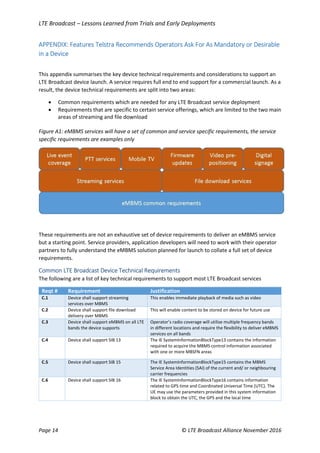
Figure A1: eMBMS services will have a set of common and service specific requirements, the service
specific requirements are examples only
These requirements are not an exhaustive set of device requirements to deliver an eMBMS service
but a starting point. Service providers, application developers will need to work with their operator
partners to fully understand the eMBMS solution planned for launch to collate a full set of device
requirements.
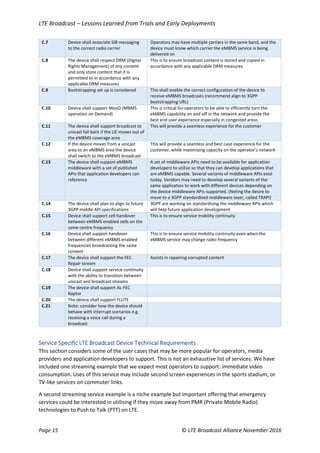
Common LTE Broadcast Device Technical Requirements
The following are a list of key technical requirements to support most LTE Broadcast services
Reqt # Requirement Justification
C.1 Device shall support streaming
services over MBMS
This enables immediate playback of media such as video
C.2 Device shall support file download
delivery over MBMS
This will enable content to be stored on device for future use
C.3 Device shall support eMBMS on all LTE
bands the device supports
Operator’s radio coverage will utilise multiple frequency bands
in different locations and require the flexibility to deliver eMBMS
services on all bands
C.4 Device shall support SIB 13 The IE SystemInformationBlockType13 contains the information
required to acquire the MBMS control information associated
with one or more MBSFN areas
C.5 Device shall support SIB 15 The IE SystemInformationBlockType15 contains the MBMS
Service Area Identities (SAI) of the current and/ or neighbouring
carrier frequencies
C.6 Device shall support SIB 16 The IE SystemInformationBlockType16 contains information
related to GPS time and Coordinated Universal Time (UTC). The
UE may use the parameters provided in this system information
block to obtain the UTC, the GPS and the local time
LTE Broadcast – Lessons Learned from Trials and Early Deployments
Page 15 © LTE Broadcast Alliance November 2016
C.7 Device shall associate SIB messaging
to the correct radio carrier
Operators may have multiple carriers in the same band, and the
device must know which carrier the eMBMS service is being
delivered on
C.8 The device shall respect DRM (Digital
Rights Management) of any content
and only store content that it is
permitted to in accordance with any
applicable DRM measures
This is to ensure broadcast content is stored and copied in
accordance with any applicable DRM measures
C.9 Bootstrapping set up is considered This shall enable the correct configuration of the device to
receive eMBMS broadcasts (recommend align to 3GPP
bootstrapping URL)
C.10 Device shall support MooD (MBMS
operation on Demand)
This is critical for operators to be able to efficiently turn the
eMBMS capability on and off in the network and provide the
best end user experience especially in congested areas
C.11 The device shall support broadcast to
unicast fall back if the UE moves out of
the eMBMS coverage area
This will provide a seamless experience for the customer
C.12 If the device moves from a unicast
area to an eMBMS area the device
shall switch to the eMBMS broadcast
This will provide a seamless and best case experience for the
customer, while maximising capacity on the operator’s network
C.13 The device shall support eMBMS
middleware with a set of published
APIs that application developers can
reference
A set of middleware APIs need to be available for application
developers to utilise so that they can develop applications that
are eMBMS capable. Several variants of middleware APIs exist
today. Vendors may need to develop several variants of the
same application to work with different devices depending on
the device middleware APIs supported. (Noting the desire to
move to a 3GPP standardised middleware layer, called TRAPI)
C.14 The device shall plan to align to future
3GPP middle API specifications
3GPP are working on standardising the middleware APIs which
will help future application development
C.15 Device shall support cell handover
between eMBMS enabled cells on the
same centre frequency
This is to ensure service mobility continuity
C.16 Device shall support handover
between different eMBMS enabled
frequencies broadcasting the same
content
This is to ensure service mobility continuity even when the
eMBMS service may change radio frequency
C.17 The device shall support the FEC
Repair stream
Assists in repairing corrupted content
C.18 Device shall support service continuity
with the ability to transition between
unicast and broadcast streams
C.19 The device shall support AL-FEC
Raptor
C.20 The device shall support FLUTE
C.21 Note: consider how the device should
behave with interrupt scenarios e.g.
receiving a voice call during a
broadcast
Service Specific LTE Broadcast Device Technical Requirements
This section considers some of the user cases that may be more popular for operators, media
providers and application developers to support. This is not an exhaustive list of services. We have
included one streaming example that we expect most operators to support: immediate video
consumption. Uses of this service may include second screen experiences in the sports stadium, or
TV-like services on commuter links.
A second streaming service example is a niche example but important offering that emergency
services could be interested in utilising if they move away from PMR (Private Mobile Radio)
technologies to Push to Talk (PTT) on LTE.
LTE Broadcast – Lessons Learned from Trials and Early Deployments
Page 16 © LTE Broadcast Alliance November 2016
Finally, there is a generic file download service that could be used for firmware updates or video
content pre-positioning. In all these service scenarios, there are many more device and application
requirements needed for a full service to be realised.
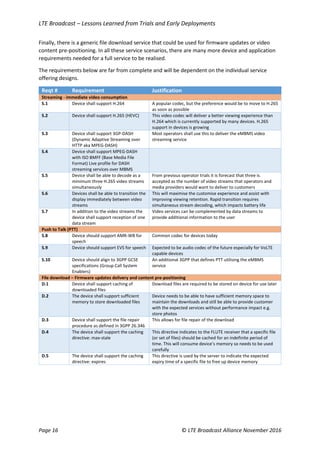
The requirements below are far from complete and will be dependent on the individual service
offering designs.
Reqt # Requirement Justification
Streaming - immediate video consumption
S.1 Device shall support H.264 A popular codec, but the preference would be to move to H.265
as soon as possible
S.2 Device shall support H.265 (HEVC) This video codec will deliver a better viewing experience than
H.264 which is currently supported by many devices. H.265
support in devices is growing
S.3 Device shall support 3GP-DASH
(Dynamic Adaptive Streaming over
HTTP aka MPEG-DASH)
Most operators shall use this to deliver the eMBMS video
streaming service
S.4 Device shall support MPEG-DASH
with ISO BMFF (Base Media File
Format) Live profile for DASH
streaming services over MBMS
S.5 Device shall be able to decode as a
minimum three H.265 video streams
simultaneously
From previous operator trials it is forecast that three is
accepted as the number of video streams that operators and
media providers would want to deliver to customers
S.6 Devices shall be able to transition the
display immediately between video
streams
This will maximise the customise experience and assist with
improving viewing retention. Rapid transition requires
simultaneous stream decoding, which impacts battery life
S.7 In addition to the video streams the
device shall support reception of one
data stream
Video services can be complemented by data streams to
provide additional information to the user
Push to Talk (PTT)
S.8 Device should support AMR-WB for
speech
Common codec for devices today
S.9 Device should support EVS for speech Expected to be audio codec of the future especially for VoLTE
capable devices
S.10 Device should align to 3GPP GCSE
specifications (Group Call System
Enablers)
An additional 3GPP that defines PTT utilising the eMBMS
service
File download – Firmware updates delivery and content pre-positioning
D.1 Device shall support caching of
downloaded files
Download files are required to be stored on device for use later
D.2 The device shall support sufficient
memory to store downloaded files
Device needs to be able to have sufficient memory space to
maintain the downloads and still be able to provide customer
with the expected services without performance impact e.g.
store photos
D.3 Device shall support the file repair
procedure as defined in 3GPP 26.346
This allows for file repair of the download
D.4 The device shall support the caching
directive: max-stale
This directive indicates to the FLUTE receiver that a specific file
(or set of files) should be cached for an indefinite period of
time. This will consume device’s memory so needs to be used
carefully
D.5 The device shall support the caching
directive: expires
This directive is used by the server to indicate the expected
expiry time of a specific file to free up device memory
LTE Broadcast – Lessons Learned from Trials and Early Deployments
Page 17 © LTE Broadcast Alliance November 2016
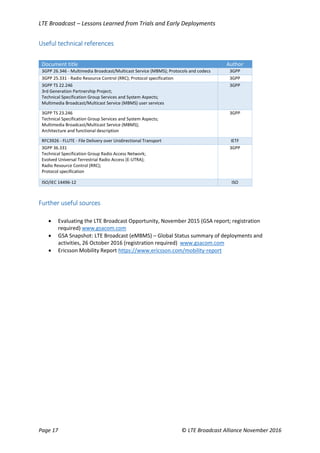
Useful technical references
Document title Author
3GPP 26.346 - Multimedia Broadcast/Multicast Service (MBMS); Protocols and codecs 3GPP
3GPP 25.331 - Radio Resource Control (RRC); Protocol specification 3GPP
3GPP TS 22.246
3rd Generation Partnership Project;
Technical Specification Group Services and System Aspects;
Multimedia Broadcast/Multicast Service (MBMS) user services
3GPP
3GPP TS 23.246
Technical Specification Group Services and System Aspects;
Multimedia Broadcast/Multicast Service (MBMS);
Architecture and functional description
3GPP
RFC3926 - FLUTE - File Delivery over Unidirectional Transport IETF
3GPP 36.331
Technical Specification Group Radio Access Network;
Evolved Universal Terrestrial Radio Access (E-UTRA);
Radio Resource Control (RRC);
Protocol specification
3GPP
ISO/IEC 14496-12 ISO
Further useful sources
 Evaluating the LTE Broadcast Opportunity, November 2015 (GSA report; registration
required) www.gsacom.com
 GSA Snapshot: LTE Broadcast (eMBMS) – Global Status summary of deployments and
activities, 26 October 2016 (registration required) www.gsacom.com
 Ericsson Mobility Report https://www.ericsson.com/mobility-report

LTE Broadcast - Lessons Learned from Trials and Early Deployments

  • 1.
    Page 1 ©LTE Broadcast Alliance November 2016 LTE Broadcast – Lessons Learned from Trials and Early Deployments 1. Introduction LTE Broadcast technology (also known as eMBMS, and LTE Multicast) is enabling a broad range of different services and applications as it is introduced into wireless operator networks around the world. It is also enabling re-imagining of existing services. To realise the full potential of the technology requires further work on the part of network equipment vendors, network operators, chipset, middleware and device vendors, and standardisation bodies. However, the benefits of LTE Broadcast to players throughout the wireless industry and beyond are now clear, thanks to several commercial and trial deployments. The growth of streaming video consumption on mobile networks is also undeniable. As recently as August, as athletes from around the world set new records at the Olympic Games, the Telstra network set new records too. The Olympics became the most streamed sporting event in the history of Telstra’s network. During some events, Telstra customers watching on mobile devices added the equivalent of 25 per cent of the peak daily demand to the network data traffic. Telstra has modelled that the cost to augment its network to implement LTE Broadcast, which would help deliver content at times like these, would be justified by carrying as little as 1% of the network traffic by 2021. The capabilities of LTE Broadcast have also attracted the attention of broadcasters such as Bayerischer Rundfunk, who have tested the technology as a potential complement to, or replacement for, other means of delivering digital TV content. Also, LTE Broadcast has potential in areas where digital terrestrial TV (DTT) coverage is currently poor (such as in developing countries where LTE infrastructure may be better developed than broadcasting infrastructure, in buildings, and in dense urban environments). Broadcasters want to ensure that their content is viewable to the largest possible audience. Of course, LTE Broadcast needs LTE networks, and it is worth noting that the number of LTE networks and subscribers around the world is growing fast. For instance, the September 2016 interim update of Ericsson’s Mobility Report1 estimates the number of LTE subscriptions worldwide at 1.4 billion (around 19% of the global total mobile subscription base), an increase of 170 million over the previous quarter. The GSA said in November 2016 that there were 537 active LTE, LTE- Advanced or LTE-Advanced Pro networks worldwide2 . This paper explains how LTE Broadcast has developed from a network technology initially intended to support the efficient streaming of live video to multiple users into a way of supporting a large number of different services. It details the lessons learned from early commercial deployments and trials. It describes the way that players in the LTE Broadcast ecosystem have successfully worked together to finalise network implementations and prove commercial cases. The report also shows the growing momentum behind LTE Broadcast as more services are prepared for launch. 1 https://www.ericsson.com/res/docs/2016/mobility-report/emr-interim-september-2016.pdf 2 http://gsacom.com/paper/global-lte-network-deployments-537-commercially-launched-170-countries/
  • 2.
    LTE Broadcast –Lessons Learned from Trials and Early Deployments Page 2 © LTE Broadcast Alliance November 2016 The paper, which has been prepared by analyst company Innovation Observatory on behalf of the LTE Broadcast Alliance3 , has been assisted by the founding operators in the Alliance, EE, Telstra, KT and Verizon. 1.1. The Three Mutually Dependent Parts of LTE Broadcast LTE Broadcast, or eMBMS, was envisaged as a collection of network technologies and device middleware that between them enable the simultaneous broadcast of content to multiple devices within any specific network cells. The initial aim of the technology was to increase the efficiency with which video and other content could be delivered to multiple users simultaneously, making better use of network resources and enabling higher quality of experience for consumers. However, LTE Broadcast is now much more than a network technology. As trials and commercial services have been launched it has become clear that it is important to think of LTE Broadcast as a combination of three mutually dependent aspects: network, services and devices, that enable a wide variety of use cases. These three aspects are discussed in detail in this paper. Trials have gone beyond simply testing network equipment, middleware, devices and specific use cases such as live video delivery, and have led to an understanding that there is no “killer app” (as some device vendors have been looking for). Rather, LTE Broadcast is an enabling technology that supports a multitude of service ideas that individually have a sound business case, and collectively deliver a return on investment for all key parties: infrastructure and device vendors, network operators and content partners. This is resulting in opportunities for partners in the telecoms, consumer electronics, broadcasting and content creation industries to come together to jointly develop service concepts. For instance, in the UK, EE is creating six “innovation zones” in its network where closed user groups equipped with eMBMS-enabled phones can try out new service ideas in a live network environment. As well as concepts focused on smartphones and tablets, EE says V2X (vehicle-to-vehicle/infrastructure) applications are likely to be among the first ideas trialled. EE’s Matt Stagg says “It’s all about removing barriers to entry.” In Australia, Telstra enables partners equipped with suitable equipment to test service ideas across the live network coverage footprint. 1.2. LTE Broadcast Around the World LTE Broadcast technology has been the subject of many demonstrations and trials since Mobile World Congress in 2013. Operators that have announced public work with the technology include 3, AT&T, Bell Mobility, China Mobile, China Telecom (including Wuxi Telecom), EE, Etisalat, Globe Telecom, KPN, KT, Megafon, Meo, MTS, Orange, PCCW, Polkomtel Plus, Reliance Jio, Singtel, SK Telecom, Smart Communications, Smartfren, TIM, Telstra, T-Mobile, Turkcell, Verizon Wireless, Vivo and Vodafone. A paper published by the Global mobile Suppliers Association (GSA) in November 20154 contains more details about these early trials. The GSA’s market update from October 2016 lists 37 separate operator announcements relating to LTE Broadcast.5 Proposed service ideas for LTE Broadcast have addressed a very wide range of use cases, including 3 The LTE Broadcast Alliance was formed in April 2016. Its operator members are operators CSL Mobile, EE, HKT, KT, Reliance Jio, Smartfren, Telstra, TIM, Turkcell and Verizon Wireless. The Alliance aims to facilitate the development of the LTE Broadcast ecosystem. 4 http://gsacom.com/paper/evaluating-the-lte-broadcast-opportunity/ (registration required) 5 http://gsacom.com/paper/gsa-snapshot-lte-broadcast-embms-global-status-summary-deployments- activities-2/ (registration required)
  • 3.
    LTE Broadcast –Lessons Learned from Trials and Early Deployments Page 3 © LTE Broadcast Alliance November 2016  Distribution of live and linear HD streaming video, for instance in congested areas, in buildings and where DTT coverage is poor  Pre-positioning video and other content on to mobile devices  Sport, music and other stadium services – multi-angle replays, additional information services etc  Priority and mission-critical push-to-talk and push-to-video wireless services for police, fire, ambulance and other blue-light services  Public safety, public information distribution and notifications  Software and other content distribution, including upgrades to mobile devices, and content in campuses, airports, hotels etc, and for public transport information  Distribution of digital signage (video advertising poster) content  Configuration of connected devices in IoT networks. As trials have progressed and commercial services have been launched, these ideas have been refined in the light of experience. In the next section we look at lessons learned. 2. Lessons Learned From Trials and Deployments Commercial deployments and extensive trials have resulted in a great deal being understood about how LTE Broadcast works in practice for a number of different use cases. The table below gives details of some of the most well-developed services and most extensive trials. Operator (and partners) Service / trial Date, country Details China Telecom; ZTE and Huawei (equipment); Expway (middleware) Live mobile video of Youth Olympic Games and other video content to a very large number of users During 2014, China Two trials of campus area deployments; the first involving the Youth Olympic Games village and a university campus in Nanjing, with 18,000 volunteer trialists. The second trial was at three university sites in Wuxi EE; BBC (content), Samsung, Qualcomm (handsets, middleware), Live stream and enhanced content trial at FA Cup Final and Commonwealth Games Trials during 2014 and 2015, UK Up to 30 users; HD streaming; choice of 3 camera angles and replays from multiple angles; user control via app Telstra; Foxsports and Channel 9 (content), Expway/Qualcomm (middleware), Intellicore (app), Ericsson, EVS, Envivio & Elemental (network equipment, video production), Samsung/ LG (devices) Live stream and enhanced content trials at National Rugby League Grand Final, T20 international cricket match, V8 Supercars race and other sporting events Trials during 2014 and 2015, Australia Up to 3 live video and replay feeds plus highlights and additional data (e.g. game statistics, upcoming racing schedule) Telstra; Channel 7 (content), Qualcomm (middleware), Ericsson, Samsung (devices) Live stream of the Spring Racing Carnival Trials during 2014, Australia Up to 3 live video feeds plus 2 additional data channels (Race info, betting odds, form guide and results) Verizon Wireless; Ericsson, Nokia (network equipment) INDYCAR app Commercial since April 2016, US Though available for iOS and Android, only Android users have LTE Broadcast capability at the track. Service positioned as high-quality, buffer- and lag-free live video. Three exclusive live streams plus audio tracks Telstra; studio content providers for BigPond Movies application; Qualcomm/Expway (middleware); Content pre-positioning proof of concept Trials on Telstra network June– September Movie VoD service delivery; trial has looked at user-profile-based LTE Broadcast delivery of trailers and complete movies, user notification, device caching and management, and seamless transition between partial to full
  • 4.
    LTE Broadcast –Lessons Learned from Trials and Early Deployments Page 4 © LTE Broadcast Alliance November 2016 Samsung/LG (devices); Ericsson (network) 2016, Australia file. It complements live streams with pre- positioned content for increased end-user engagement KT Live TV broadcasting to busy city locations Commercial during 2015 and 2016, South Korea Mobile TV on Seoul and Busan underground railways; one live TV stream KT Live sports event services at stadiums Commercial during 2015 and 2016, South Korea Seven stadiums covered by April 2016; live video streams of games from other locations 2.1. Network Figure 1 below shows in brief the typical way that eMBMS is deployed within existing LTE networks. Figure 1: eMBMS deployment in the network Key takeaways  LTE Broadcast can be deployed to suit multiple strategies in accordance with an operator’s plans for specific services, or its strategic aims. Most network operators that have looked at LTE Broadcast have selected limited geographic areas for trials. Stadiums have often been chosen as places where video streaming, user experience and efficiency of broadcast in congested locations can be tested for both stadium- and non-stadium-based use cases, and these trials have worked well. Other rollout strategies have also been adopted, though. Verizon Wireless has enabled its US network nationwide to support the INDYCAR app. Telstra and EE are committed to widespread or nationwide network rollouts in support of content distribution network strategies. To support its GiGA Power Live broadcast service in South Korea, KT has progressively enabled LTE Broadcast in subway lines throughout the Seoul metropolitan area and in Busan. It has also deployed it at selected sports stadiums and busy city centre locations across the country.  Overlapping cells help improve quality. Trials at EE and Telstra have shown that there is a quality gain for the user resulting from a device being able to receive and combine broadcast streams from multiple broadcasting base stations. In addition, the trials have proved that broadcast mode delivers a high-quality stream if the throughput of the RAN is sufficiently high.  It is simple to provide the necessary RAN synchronisation. While a high degree of synchronisation (to IEEE 1588 v2 standard) is required across all eMBMS-enabled eNodeBs, any method can be used and GPS-based synchronisation has been found to work well. It is as simple as adding a GPS module and suitable antenna to the element. Note that RANs are generally being upgraded with this synchronisation in any case.  A single broadcast stream gives maximum network efficiency. Trials show that the load on the transport nodes where multicasting duplication is performed can be quite intense. This may limit the number of simultaneous streams that can be carried in a certain area. Multiple streams are still efficient with multiple users in the cell watching each stream. Furthermore,
  • 5.
    LTE Broadcast –Lessons Learned from Trials and Early Deployments Page 5 © LTE Broadcast Alliance November 2016 where available, MLD (Multicast Listener Discovery) snooping should be able to reduce transport network load.  Transport networks need to support multicast IP address ranges. Rollouts of LTE Broadcast have highlighted that transport network elements need to support the multicast IP address ranges (223.00–227.xx; Band D) as well as the unicast IP address ranges (Bands A-C). Vendors may need to be asked to enable this in their elements and generally this is a simple remote software enablement. Protocol Independent Multicast Sparse Mode (PIM-SM) may need enabling in the transport network too. New or enhanced switches can be introduced at local VLAN aggregation points.  Multiple routes to the BM-SC should be provided. When designing practical commercial LTE Broadcast networks, it is useful to consider the interconnect with content owners’ PoPs, and to provide suitable on-ramps for content to the eMBMS network. This is standard for all network traffic. eMBMS itself does not require changes to interconnect design. In trials, it is often the case that BM-SC and content servers are colocated, but in commercial deployments this is unlikely to always be the case.  Trials of LTE Broadcast by broadcasters show that it has potential as a replacement or complement to other broadcasting distribution technologies for TV. The points above show how operators and others have been working to enable eMBMS in their networks. Operators and their partners have risen to the challenges and shown that the technology works well. Issues emerging and future developments In addition to the lessons learned and described above, a number of issues have emerged during commercial rollout and trials that the wider LTE Broadcast community is now addressing. The most significant of these are listed below. All these issues are now being considered within 3GPP processes and the LTE Broadcast Alliance would value support from the ecosystem to ensure they are addressed for Release 14.  Extending the LTE cyclic prefix to increase the LTE inter-cell-site range beyond 5km will significantly help rollout economics of LTE Broadcast. The existing standard was developed with a stadium-type use case in mind, and LTE Broadcast has now been shown to be suitable for content streaming and distribution in much wider areas, so the technical standard has recently been agreed to be extended in 3GPP.  Increasing the subframe limit will enable new broadcast business cases to be developed. At present the LTE Broadcast standard assumes that of ten available subframes, a maximum of six can be used for broadcast mode. This assumes that operators would always want to use unicast in the same carrier as their broadcast. However, some operators have sufficient spectrum holdings that they want to be able to devote more than six subframes within a carrier to broadcast mode. A change to the LTE Broadcast technical standards will enable this. A future 3GPP capability also allows for dedicated eMBMS carriers where the entire carrier is used for broadcast.  Session continuity has been ratified by 3GPP and is required for seamless broadcast / unicast handover and as a pre-requisite to dynamic scheduling (e.g. MOOD – see below). Both network and middleware need upgrades to support session continuity. The application must also support the MOOD capability for seamless experience between unicast and broadcast. Therefore, development and integration with MOOD capable LTE Broadcast middleware SDKs is needed. Resolving the different modulation and coding schemes between broadcast and unicast streams needs tight integration between eMBMS networks and traditional video delivery networks (including CDNs) that use adaptive bitrate streaming per user. Network equipment and video encoder hardware vendors’ work to enable this
  • 6.
    LTE Broadcast –Lessons Learned from Trials and Early Deployments Page 6 © LTE Broadcast Alliance November 2016 (being carried out in vendor labs) should be complete by the end of 2016, and the feature should be rolled out in 2017. Commercial launches (before MOOD) will rely on historic and real time network analytics to identify capacity hot spots and turn on eMBMS in those cells to avoid any ‘broadcast to nobody’ scenarios.  Dynamic scheduling (e.g., MOOD) will enhance the business case for some LTE Broadcast services by switching on broadcast mode on a granular (perhaps per-cell) basis only when there are sufficient users in the cell that will benefit from it. This will enable greater spectrum efficiency on an area basis. Because a neighbouring cell may be unicast, session continuity is an essential adjunct. MOOD should be ready for deployment in 2017 after the conclusion of work on session continuity. Note that for MOOD to work effectively and to maximise the performance gain the solution requires dynamic adaptation on the modulation and coding scheme to compensate for the increases/decreases of the MBSFN gains associated with the dynamic size of the MBSFN area.  LTE Broadcast end-to-end latency performance may need improving to support some applications such as VoD replay in live streaming, though for many applications, latency requirements are not as onerous. Network tuning can reduce latency to some extent, but further technical work will be needed to ensure LTE Broadcast can keep pace with improving latency performance of LTE-Advanced Pro networks. Actions needed to create an optimal operator LTE Broadcast network include: Careful planning of architecture, taking into account content partner networks, transport network capabilities and RAN cell site configuration and coverage design Continuing interoperability testing involving network equipment vendors, content hardware vendors and device vendors Further geographic rollout to support more use cases Work with device vendors to ensure adoption of the technology Collaborative R&D work to ensure LTE Broadcast evolves seamlessly into 5G networks, for instance through the 5G-PPP 5G-XCast programme (see later) 2.2. Services As LTE Broadcast rollouts and trials have continued through 2015 and 2016, the applications for the technology have become clearer – and so has the way of thinking about those applications. Services that can make use of LTE Broadcast appeal to one or more customer groups. The table shows the likely primary use of some of the most well developed LTE Broadcast applications and their key target customer groups.
  • 7.
    LTE Broadcast –Lessons Learned from Trials and Early Deployments Page 7 © LTE Broadcast Alliance November 2016 Figure 2: Primary classification of LTE Broadcast applications Customer groups Application Media Emergency services MNOs / device vendors Vertical industries Automotive applications  Content pre-positioning    Digital signage    DTT broadcasting complementary distribution  Enhanced content (for sports etc)  Live video and audio streaming   Notifications    Push-to-talk, push-to-video with QoS and privacy   Software updates  Video alerts   But classifying applications like this is only part of the picture. In order to build compelling business cases that will appeal to all players in the value chain, a holistic way of looking at services is required. Operators developing LTE Broadcast networks have realised that they need to work more closely with partners in the value chain. This will help them get a detailed understanding of how services will work in practice so that those services can be optimally designed. Key takeaways  End-user perception of the quality of live streaming is very high. While trials suggest fine- tuning of the network and middleware is required to ensure that the streams are consistently high quality, feedback from users at both EE’s and Telstra’s stadium video streaming and replay services were very positive, and commercial services from Verizon using LTE Broadcast are a success. Verizon’s service also shows that it is possible to use LTE Broadcast effectively now, without session control / on-demand technology, to respond to predictable traffic peaks by switching on broadcast mode.  Content pre-positioning proofs of concept have been successful. Telstra has worked with its Big Pond movie VoD service and third-party content owners on demonstrations that have had impressive results. Telstra is working on productising the solution with Tier 1 content providers and expects commercial launch of a service as early as 2017. Such services could distribute content such as new movies, to selected users, in higher quality than would be possible than with a live stream, and using high-quality audio to make the most of high-end headphones. LTE Broadcast distribution is significantly cheaper than that of a conventional CDN and unicasting, and for the user it results in a higher quality experience. Content pre- positioning can be tailored to individuals based on user profiles, and an SDK embedded in the app can be used to give users control over the use of their device storage. Software updates for smartphones, tablets and other devices can be considered a special case of content pre-positioning.  Digital signage services are nearing commercialization. One of the early use cases for LTE Broadcast, distribution of digital signage content remains an important service idea even though there are often alternative ways of getting digital content to video billboard and shelf-edge displays. It is not always the case that suitable connectivity is immediately
  • 8.
    LTE Broadcast –Lessons Learned from Trials and Early Deployments Page 8 © LTE Broadcast Alliance November 2016 available in the places where billboards and displays are located. This is where LTE Broadcast can step in, as deployment costs can be very much lower than if new fixed connections need to be supplied. Digital signage is one application that Verizon Wireless will have commercialized by early 2017, having demonstrated the concept in 2014.  Other enterprise applications will follow. While consumer-oriented services have dominated many of the early trials, they require eMBMS technology to be enabled in a high proportion of consumer devices before they will really take off, even if nationwide or near- nationwide network coverage is available. Enterprise applications with devices that are more closely bound to the specific service are therefore easier to get off the ground, and operators are working to develop these applications by making it easy for service concepts to be tried out in live networks.  LTE Broadcast enables scaling of emergency service network capacity and prioritization. Some emergency service applications do not need large amounts of bandwidth and are a good early match for operators’ eMBMS networks – especially where limited or distributed spectrum holdings make live TV and video delivery services less attractive. Operators can provide such services without having to commit to reserving large amounts of capacity: it can be enabled when needed, in response to an emergency. Private mobile radio networks can be replaced at lower cost with several LTE (and LTE Advanced and Advanced Pro) features, including push-to-talk or mission-critical push-to-talk over cellular (PTToC), QoS, privacy and broadcasting of alerts (with guaranteed delivery, and including video alerts, which LTE Broadcast can support efficiently). Telstra has been working with Ericsson to develop Telstra’s network for such a combination of features, and EE and others are also developing this use case.  More work will be needed on LTE Broadcast service monitoring. There are some challenges with LTE Broadcast service monitoring from an operator’s perspective as there are no immediate indicators on the received experience and performance of the broadcast in the coverage area. To ensure LTE Broadcast is working correctly for the end-user, monitoring on end-devices, and improvement to reception reporting, need to be developed.  Moving to the H.265 codec as soon as possible is to be encouraged, as its superior compression performance means greater efficiency. Issues emerging and future developments  Services need to be considered end-to-end, and designed with the capabilities of LTE Broadcast in mind. For instance, operators have been considering how news and sports content might be packaged up to offer both live and pre-positioned content. This would be tailored to individual subscribers’ preferences, with content presentation and use of device resources controlled by the user via a smartphone or tablet app. For digital signage, the integration of new services into existing business models must be considered – for instance, it may be necessary to develop end-point devices that fit existing form factor and other local requirements.  Operators have realised that they must understand applications in depth. For some applications, automation of the content ingestion process, via an API, will be necessary. For some other applications it is important to know that content has been delivered to all recipients when broadcast. (Dropped packets must be identified per user and retransmitted, in the same way that satellite broadcasters do.) Telstra, for instance, has been developing an “application adaptation layer” between content creator and LTE Broadcast network. This specifies how the network will be used by the service, while automatically scheduling a broadcast through an API-driven CDN and LTE Broadcast system integration – essentially industrialising the process of provisioning a service based on the network.
  • 9.
    LTE Broadcast –Lessons Learned from Trials and Early Deployments Page 9 © LTE Broadcast Alliance November 2016  Content owners are significant partners in service development and ease of use for them of the LTE Broadcast network is a major consideration. Partners need somewhere to try out new service concepts and to answer their core question: “how will it work in practice?” Complete services must be co-created, and this can take a long time.  Revenue models are likely to remain diverse. Services launched and tested so far have demonstrated multiple ways in which they can improve revenues, reduce costs and increase market differentiation, and there will continue to be multiple business models as LTE Broadcast develops. Existing services are improved through the use LTE Broadcast transmission so the business models that apply to those services will be retained, but improved. And new services will be commercially attractive to both end users and content and service partners. However, as some LTE Broadcast services are only now approaching proof-of-concept stage, the final revenue mix is not known.  Handset penetration is an important factor for content partners. Media content owners need to know that their content is reaching the largest possible audience at the highest possible quality. Penetration of LTE Broadcast into smartphones and tablets is key to this. Additionally, consumers need control over media apps so they can make the most of the LTE Broadcast services: trials of stadium applications for instance have shown that multi-angle replays and additional services are of more value to users than live streams. Actions needed: Publishing results of trials and roadmaps for device compatibility Further development of live “labs” for partners and more proofs of concept, with demonstration of clear business cases with customer benefits articulated Broad consumer market research to test revenue models Expansion of device ecosystem to bring on board more content and media partners 2.3. Devices While network operators and their infrastructure vendor partners can control how their networks support LTE Broadcast capability, user devices also need to support the eMBMS technology itself, and the services that will use eMBMS. Device vendors participating in LTE Broadcast trials have been extremely helpful and have demonstrated a willingness to address and overcome technical challenges. For commercially launched LTE Broadcast services too, sufficient end user devices have been suitably enabled to make the services successful. However, to ensure the best possible market for LTE Broadcast-enabled services, penetration of key technologies on devices needs to be maximized. Key takeaways  EE has proved that user smartphone / tablet battery life is better using eMBMS than using unicast when viewing a stream, giving an increase in battery life of around an hour during sporting event trials. In the context of the length of a sporting or music event, this is a significant benefit. The increase in battery life results from a decrease in the number of device-to-network communication events required during a broadcast stream compared with a unicast stream.  LTE Broadcast work in commercial services and trials has made clear that the cost of enabling devices to use the technology will be small. A very low percentage of the total
  • 10.
    LTE Broadcast –Lessons Learned from Trials and Early Deployments Page 10 © LTE Broadcast Alliance November 2016 device bill of materials (BoM) will be accounted for by the IP constituent of the chipsets. The cost of middleware will be in line with the cost of licences to play Flash or mpeg streams. As such we recommend the vendor integrates the middleware licence into the device to enable LTE Broadcast.  Phones will need large internal or card memory and fast processors to get the best out of some LTE Broadcast services. Content pre-positioning services depend on there being sufficient available storage, and the ability to decode multiple video streams enables more responsive replay services. The smartphone market is supporting high performance in top- end smartphones but services will be targeted at the mass market, so mid-range phones need to be equipped to cope with LTE Broadcast services too.  Broadcast video decoding needs specific features to be available on devices and / or middleware to deal with for video codecs and understand media descriptors; operators, device vendors and chipset vendors now understand the requirements.  It is important to test end-to-end with different combinations of devices, middleware and video encoders. Through trials and testing Telstra has observed different behaviours and issues when moving from one middleware to another, when using different video encoder equipment, or using different end devices. Issues emerging and future developments  Operators have different approaches to over-the-air updates to devices. Some are happy to push software or firmware updates to enable LTE Broadcast to existing devices in the field; others prefer the lower-risk approach where capability is enabled in devices when they are shipped from the manufacturer. To achieve the greatest possible device penetration in the market for LTE Broadcast services, devices should be shipped with LTE Broadcast enabled, and the upgrade can be achieved in the market via over-the-air activation. This requires as many device vendors as possible to implement eMBMS functionality as a standard part of their products’ feature sets.  Knowledge of plans for LTE Broadcast device enablement will help bring service partners on board. Media and other service partners in trials have indicated that knowing future device compatibility with LTE Broadcast is important in order that business cases can be built for specific services.  Standardization of LTE Broadcast middleware will be beneficial. Device vendors do not want to be faced with having to handle operator-specific implementations of eMBMS middleware. A workstream of 3GPP – TRAPI (MBMS Transport Protocol and APIs)6 – is addressing this issue for Release 14 of the 3GPP standards, and work is expected to be completed during the first half of 2017. Telstra and Ericsson have shared a list of requirements and principles that is expected from the standardized API to ease the app development and integration into an operator’s ecosystem. In the longer term, the LTE Broadcast Alliance would hope to see eMBMS functionality embedded in the device operating system. Details of device requirements Telstra has documented the specific device requirements for eMBMS, identifying those that are common across all LTE Broadcast services, and those that are specific to service types. Telstra’s document forms the Appendix to this paper. 6 http://www.3gpp.org/DynaReport/GanttChart-Level-2.htm#bm700054
  • 11.
    LTE Broadcast –Lessons Learned from Trials and Early Deployments Page 11 © LTE Broadcast Alliance November 2016 The table below briefly summarises some of the requirements Telstra has identified, in addition to basic support for eMBMS middleware with APIs, that have not already been discussed earlier in this paper. These are a basic set of requirements to ensure minimal interoperability with eMBMS. There are many additional requirements which operators will define to ensure full service interoperability. Requirements Purpose Multi-band eMBMS support To enable widest possible application of the technology within a region and worldwide SIB13, 15 and 16 support To ensure basic interworking DRM and FEC Repair support / 3GPP 26.346 To properly enable content distribution and file download applications H.264/H.265/3GP-DASH support, and decoding of three simultaneous H.265 streams To enable most efficient broadcast and unicast video stream delivery and most likely broadcast service designs. Simultaneous decode allows for fast channel switching but consumes more power Support for AMR-WB and EVS codecs, and 3GPP GCSE To enable current and future push-to-talk applications Support for FLUTE, Keep Updated FLUTE service and max:stale caching directive To enable file delivery over unidirectional links such as UDP Support for max:stale and expires caching directives To enable appropriate use of local caching of content Align to 3GPP bootstrapping URL definition Simplify access to the service Many handset vendors have enabled eMBMS in many devices. The GSA’s report from November 2015 listed around 100 devices that were known to be shipping with eMBMS-capable chipsets or middleware. Verizon’s LTE Broadcast-enhanced services have been accessible to users with a selection of enabled phones including models from Samsung, LG and Motorola running Qualcomm chipsets and middleware. In KT’s commercial LTE Broadcast services, Samsung devices with Expway middleware are used as well as those with Qualcomm’s. More chipset vendors are also adding capability – during 2016 Mediatek joined Qualcomm, Sequans, Altair, GCT, Marvell and Intel in having eMBMS-capable products. Actions needed Enablement via chipset and middleware of specific feature set as outlined above Operator-specific implementations should be reduced for maximum supply-side efficiency Device vendors to understand operator specific eMBMS implementations 3. Fit with LTE-Advanced Pro and 5G Several of the LTE Broadcast use cases will be significantly enhanced by other features in the latest and future releases of 3GPP LTE standards. For instance, emergency services applications of LTE Broadcast will be able to make use of mission-critical push-to-talk (MCPTT) voice over LTE, a Release 13 feature (Rel. 13 was frozen by 3GPP in April 2016). Some LTE Broadcast features, such as Multiband eMBMS, are themselves part of Release 13. Evolution of LTE networks will also enable new types of service and application that will themselves then benefit from LTE Broadcast. For instance, IoT applications for cellular networks are expected to develop rapidly now that NB-IoT and LTE Cat-M1 standards have been finalised. While these IoT
  • 12.
    LTE Broadcast –Lessons Learned from Trials and Early Deployments Page 12 © LTE Broadcast Alliance November 2016 applications are at an early stage of development, they can benefit from the ability of LTE Broadcast to efficiently distribute software and security updates to millions of connected devices. The LTE Broadcast Alliance realises that beyond LTE Advanced and LTE Advanced Pro, LTE Broadcast requires an evolution path to 5G; it will not remain a 4G technology. (However, it is important to note that the 5G broadcast capability is deferred well into 5G Phase 2 timeframes and this highlights the relevance of 4G as the main technology for some time to come.) As an example of broadcast evolution, connected cars and broader V2X applications will develop to make use of the improved latency and reliability of 5G compared with today’s networks, and LTE Broadcast’s one-to-many capabilities must show an ability to move seamlessly to the next generation of networks. There is a great deal of R&D work being undertaken around the world to develop technologies for 5G networks, though the multicast aspects of this work have so far not been as visible as those on the new radio (NR) interface, network slicing, IoT and other constituent parts of 5G. Emerging ideas include segmenting frequencies and using specific frequencies, along with latency characteristics, as network slices, to provide bandwidth for specific applications. LTE Broadcast could become a network slice for multicast / broadcast of content, and for other uses, as defined by the 5G network. Note that network slicing does not require 5G and network slices can be created in 4G networks too. So 5G doesn’t invalidate LTE Broadcast; rather LTE Broadcast becomes a part of what 5G will be. In Europe, the 5G-XCast project of the 5G-PPP7 aims to develop and demonstrate a large-scale media delivery technology solution for 5G over mobile, fixed and broadcast networks, with built-in unicast/multicast/broadcast and caching capabilities. The project will make use of multiple European 5G testbeds and its work will cover physical layer, radio interface to the transport and application layers, including protocols and application program interfaces, as well as network and system architecture aspects. Telecom and media organisations are involved. 4. Conclusions Important progress is being made in the development of LTE Broadcast, with proofs of concept completed and underway, commercial services launched and new services nearing commercialization. Many technical trials have proved that the technology works, and that it supports multiple deployment models. Many of the issues have been resolved, and operators, network equipment providers, middleware, chipset and device vendors now know what is required. They can take steps now to drive LTE Broadcast forward to a successful future based on real services with proven business cases. Many are doing this, and others can learn from their experience. The market potential is large: forecasts published by GSA in November 2015 suggested service revenues may reach USD14bn by 2020, with a customer base of two billion by that time8 . Where there are service provider revenue opportunities there are also opportunities throughout the ecosystem for content partners, network equipment vendors, middleware and chipset vendors and device manufacturers. The LTE Broadcast Alliance members serve over 370 million customers. LTE Broadcast complements many LTE Advanced and Advanced Pro developments, and there is a stream of work underway to future-proof LTE Broadcast as 5G networks move closer. 7 https://5g-ppp.eu/ 8 http://gsacom.com/press-release/gsa-forecasts-market-for-lte-broadcast-services-will-reach-14bn- worldwide-by-2020/
  • 13.
    LTE Broadcast –Lessons Learned from Trials and Early Deployments Page 13 © LTE Broadcast Alliance November 2016 During the work to date, some important lessons have been learned, and some areas for further work have been identified. The most important of these are:  Handset vendors need to embed the necessary LTE Broadcast features as standard in all new devices, and plan to introduce new key features such as MOOD and session continuity to ensure greater adoption of the service.  LTE Broadcast will support multiple service ideas – it’s not just about streaming video or stadium services – and those services are at or near commercialization  There are some additional requirements that need work within and beyond the standardization bodies’ processes, relating to cyclic prefix length, subframe percentage and middleware implementation  Operators, content, device vendors and other partners need to work together, and consider LTE Broadcast-based services end-to-end, rather than focusing on separate parts of the value chain. While service ideas can be developed in testbeds involving a few prototype devices, development of larger live-network tests will help  Service partners need more details of device vendors’ LTE Broadcast roadmap – what devices will be enabled and when – so they can complete their business plans. Trials have resulted in a detailed checklist of device features that should be enabled. The LTE Broadcast Alliance founding members welcome feedback and comment on this paper, and are happy to respond to operators’ requests for more information about LTE Broadcast in general; trials and commercial services; and device requirements for LTE Broadcast services. If you are a network operator, please email enquiries@lteba.org
  • 14.
    LTE Broadcast –Lessons Learned from Trials and Early Deployments Page 14 © LTE Broadcast Alliance November 2016 APPENDIX: Features Telstra Recommends Operators Ask For As Mandatory or Desirable in a Device This appendix summarises the key device technical requirements and considerations to support an LTE Broadcast device launch. A service requires full end to end support for a commercial launch. As a result, the device technical requirements are split into two areas:  Common requirements which are needed for any LTE Broadcast service deployment  Requirements that are specific to certain service offerings, which are limited to the two main areas of streaming and file download Figure A1: eMBMS services will have a set of common and service specific requirements, the service specific requirements are examples only These requirements are not an exhaustive set of device requirements to deliver an eMBMS service but a starting point. Service providers, application developers will need to work with their operator partners to fully understand the eMBMS solution planned for launch to collate a full set of device requirements. Common LTE Broadcast Device Technical Requirements The following are a list of key technical requirements to support most LTE Broadcast services Reqt # Requirement Justification C.1 Device shall support streaming services over MBMS This enables immediate playback of media such as video C.2 Device shall support file download delivery over MBMS This will enable content to be stored on device for future use C.3 Device shall support eMBMS on all LTE bands the device supports Operator’s radio coverage will utilise multiple frequency bands in different locations and require the flexibility to deliver eMBMS services on all bands C.4 Device shall support SIB 13 The IE SystemInformationBlockType13 contains the information required to acquire the MBMS control information associated with one or more MBSFN areas C.5 Device shall support SIB 15 The IE SystemInformationBlockType15 contains the MBMS Service Area Identities (SAI) of the current and/ or neighbouring carrier frequencies C.6 Device shall support SIB 16 The IE SystemInformationBlockType16 contains information related to GPS time and Coordinated Universal Time (UTC). The UE may use the parameters provided in this system information block to obtain the UTC, the GPS and the local time
  • 15.
    LTE Broadcast –Lessons Learned from Trials and Early Deployments Page 15 © LTE Broadcast Alliance November 2016 C.7 Device shall associate SIB messaging to the correct radio carrier Operators may have multiple carriers in the same band, and the device must know which carrier the eMBMS service is being delivered on C.8 The device shall respect DRM (Digital Rights Management) of any content and only store content that it is permitted to in accordance with any applicable DRM measures This is to ensure broadcast content is stored and copied in accordance with any applicable DRM measures C.9 Bootstrapping set up is considered This shall enable the correct configuration of the device to receive eMBMS broadcasts (recommend align to 3GPP bootstrapping URL) C.10 Device shall support MooD (MBMS operation on Demand) This is critical for operators to be able to efficiently turn the eMBMS capability on and off in the network and provide the best end user experience especially in congested areas C.11 The device shall support broadcast to unicast fall back if the UE moves out of the eMBMS coverage area This will provide a seamless experience for the customer C.12 If the device moves from a unicast area to an eMBMS area the device shall switch to the eMBMS broadcast This will provide a seamless and best case experience for the customer, while maximising capacity on the operator’s network C.13 The device shall support eMBMS middleware with a set of published APIs that application developers can reference A set of middleware APIs need to be available for application developers to utilise so that they can develop applications that are eMBMS capable. Several variants of middleware APIs exist today. Vendors may need to develop several variants of the same application to work with different devices depending on the device middleware APIs supported. (Noting the desire to move to a 3GPP standardised middleware layer, called TRAPI) C.14 The device shall plan to align to future 3GPP middle API specifications 3GPP are working on standardising the middleware APIs which will help future application development C.15 Device shall support cell handover between eMBMS enabled cells on the same centre frequency This is to ensure service mobility continuity C.16 Device shall support handover between different eMBMS enabled frequencies broadcasting the same content This is to ensure service mobility continuity even when the eMBMS service may change radio frequency C.17 The device shall support the FEC Repair stream Assists in repairing corrupted content C.18 Device shall support service continuity with the ability to transition between unicast and broadcast streams C.19 The device shall support AL-FEC Raptor C.20 The device shall support FLUTE C.21 Note: consider how the device should behave with interrupt scenarios e.g. receiving a voice call during a broadcast Service Specific LTE Broadcast Device Technical Requirements This section considers some of the user cases that may be more popular for operators, media providers and application developers to support. This is not an exhaustive list of services. We have included one streaming example that we expect most operators to support: immediate video consumption. Uses of this service may include second screen experiences in the sports stadium, or TV-like services on commuter links. A second streaming service example is a niche example but important offering that emergency services could be interested in utilising if they move away from PMR (Private Mobile Radio) technologies to Push to Talk (PTT) on LTE.
  • 16.
    LTE Broadcast –Lessons Learned from Trials and Early Deployments Page 16 © LTE Broadcast Alliance November 2016 Finally, there is a generic file download service that could be used for firmware updates or video content pre-positioning. In all these service scenarios, there are many more device and application requirements needed for a full service to be realised. The requirements below are far from complete and will be dependent on the individual service offering designs. Reqt # Requirement Justification Streaming - immediate video consumption S.1 Device shall support H.264 A popular codec, but the preference would be to move to H.265 as soon as possible S.2 Device shall support H.265 (HEVC) This video codec will deliver a better viewing experience than H.264 which is currently supported by many devices. H.265 support in devices is growing S.3 Device shall support 3GP-DASH (Dynamic Adaptive Streaming over HTTP aka MPEG-DASH) Most operators shall use this to deliver the eMBMS video streaming service S.4 Device shall support MPEG-DASH with ISO BMFF (Base Media File Format) Live profile for DASH streaming services over MBMS S.5 Device shall be able to decode as a minimum three H.265 video streams simultaneously From previous operator trials it is forecast that three is accepted as the number of video streams that operators and media providers would want to deliver to customers S.6 Devices shall be able to transition the display immediately between video streams This will maximise the customise experience and assist with improving viewing retention. Rapid transition requires simultaneous stream decoding, which impacts battery life S.7 In addition to the video streams the device shall support reception of one data stream Video services can be complemented by data streams to provide additional information to the user Push to Talk (PTT) S.8 Device should support AMR-WB for speech Common codec for devices today S.9 Device should support EVS for speech Expected to be audio codec of the future especially for VoLTE capable devices S.10 Device should align to 3GPP GCSE specifications (Group Call System Enablers) An additional 3GPP that defines PTT utilising the eMBMS service File download – Firmware updates delivery and content pre-positioning D.1 Device shall support caching of downloaded files Download files are required to be stored on device for use later D.2 The device shall support sufficient memory to store downloaded files Device needs to be able to have sufficient memory space to maintain the downloads and still be able to provide customer with the expected services without performance impact e.g. store photos D.3 Device shall support the file repair procedure as defined in 3GPP 26.346 This allows for file repair of the download D.4 The device shall support the caching directive: max-stale This directive indicates to the FLUTE receiver that a specific file (or set of files) should be cached for an indefinite period of time. This will consume device’s memory so needs to be used carefully D.5 The device shall support the caching directive: expires This directive is used by the server to indicate the expected expiry time of a specific file to free up device memory
  • 17.
    LTE Broadcast –Lessons Learned from Trials and Early Deployments Page 17 © LTE Broadcast Alliance November 2016 Useful technical references Document title Author 3GPP 26.346 - Multimedia Broadcast/Multicast Service (MBMS); Protocols and codecs 3GPP 3GPP 25.331 - Radio Resource Control (RRC); Protocol specification 3GPP 3GPP TS 22.246 3rd Generation Partnership Project; Technical Specification Group Services and System Aspects; Multimedia Broadcast/Multicast Service (MBMS) user services 3GPP 3GPP TS 23.246 Technical Specification Group Services and System Aspects; Multimedia Broadcast/Multicast Service (MBMS); Architecture and functional description 3GPP RFC3926 - FLUTE - File Delivery over Unidirectional Transport IETF 3GPP 36.331 Technical Specification Group Radio Access Network; Evolved Universal Terrestrial Radio Access (E-UTRA); Radio Resource Control (RRC); Protocol specification 3GPP ISO/IEC 14496-12 ISO Further useful sources  Evaluating the LTE Broadcast Opportunity, November 2015 (GSA report; registration required) www.gsacom.com  GSA Snapshot: LTE Broadcast (eMBMS) – Global Status summary of deployments and activities, 26 October 2016 (registration required) www.gsacom.com  Ericsson Mobility Report https://www.ericsson.com/mobility-report