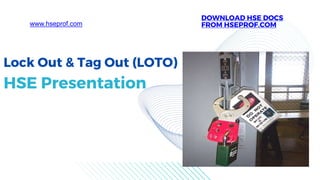
Lock Out & Tag Out (LOTO)
HSE Presentation
www.hseprof.com
DOWNLOAD HSE DOCS
FROM HSEPROF.COM
www.hseprof.com
DOWNLOAD HSE DOCS
FROM HSEPROF.COM
Approximately 3 million workers service equipment and face the
greatest risk of injury if lockout/tagout is not properly implemented.
Compliance with the lockout/tagout standard (29 CFR 1910.147)
prevents an estimated 120 fatalities and 50,000 injuries each year.
Introduction of HSE Presentation
www.hseprof.com
DOWNLOAD HSE DOCS
FROM HSEPROF.COM
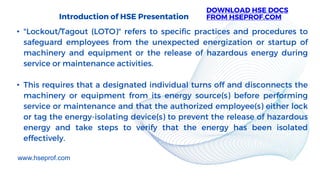
• "Lockout/Tagout (LOTO)" refers to specific practices and procedures to
safeguard employees from the unexpected energization or startup of
machinery and equipment or the release of hazardous energy during
service or maintenance activities.
• This requires that a designated individual turns off and disconnects the
machinery or equipment from its energy source(s) before performing
service or maintenance and that the authorized employee(s) either lock
or tag the energy-isolating device(s) to prevent the release of hazardous
energy and take steps to verify that the energy has been isolated
effectively.
Introduction of HSE Presentation
www.hseprof.com
DOWNLOAD HSE DOCS
FROM HSEPROF.COM
The “Fatal Five” Main Causes of
Lockout/Tagout Injuries
• Failure to stop equipment
• Failure to disconnect from
power source
• Failure to dissipate (bleed,
neutralize) residual energy
www.hseprof.com
DOWNLOAD HSE DOCS
FROM HSEPROF.COM
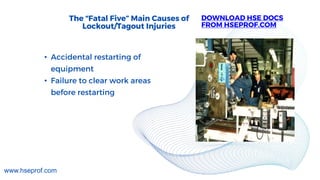
The “Fatal Five” Main Causes of
Lockout/Tagout Injuries
• Accidental restarting of
equipment
• Failure to clear work areas
before restarting
www.hseprof.com
DOWNLOAD HSE DOCS
FROM HSEPROF.COM
Responsibilities
• Authorized Employee - one who locks out
machines or equipment in order to perform the
servicing or maintenance on that machine or
equipment.
• Affected Employee - one whose job requires
him/her to operate or use a machine or
equipment on which servicing or maintenance
is being performed under lockout, or whose job
requires him/her to work in an area in which
such servicing or maintenance is being
performed.
• Energy Isolating Device - A mechanical device that
physically prevents the transmission or release of
energy.
• Tagging System – identification tag provided in the
valve together with the lock to identify the users of
tag, the purpose, duration of activities, contact
number or location, etc…
• Energy Control Procedure - A safety program
adopted by the employer that includes energy
control procedures plus provisions for inspecting
the procedures and training employees for
lockout/tagout.
DOWNLOAD HSE DOCS
FROM HSEPROF.COM
Definition
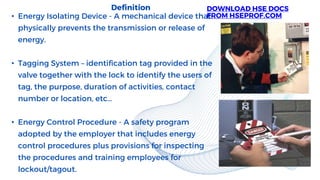
• Energy Isolating Device - A mechanical device that
physically prevents the transmission or release of
energy.
• Tagging System – identification tag provided in the
valve together with the lock to identify the users of
tag, the purpose, duration of activities, contact
number or location, etc…
• Energy Control Procedure - A safety program
adopted by the employer that includes energy
control procedures plus provisions for inspecting
the procedures and training employees for
lockout/tagout.
DOWNLOAD HSE DOCS
FROM HSEPROF.COM
Definition
www.hseprof.com DOWNLOAD HSE DOCS
FROM HSEPROF.COM
Types of Lockout Devices
• Electrical
- Generated
- Static
• Mechanical
- Transitional
- Rotational
• Thermal
- Machines or Equipment
- Chemical Reactions
• Potential
- Pressure
- Hydraulic
- Pneumatic
- Vacuum
• Springs
• Gravity
www.hseprof.com DOWNLOAD HSE DOCS
FROM HSEPROF.COM
Types of Lockout
Devices
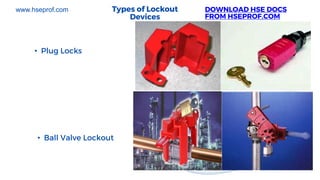
• Plug Locks
• Ball Valve Lockout
www.hseprof.com DOWNLOAD HSE DOCS
FROM HSEPROF.COM
Types of Lockout
Devices
• Gate Valve Lockout
• Group Lockout Hasp
Lockout Procedure
www.hseprof.com
DOWNLOAD HSE DOCS
FROM HSEPROF.COM
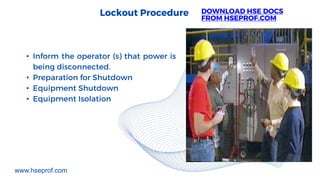
• Inform the operator (s) that power is
being disconnected.
• Preparation for Shutdown
• Equipment Shutdown
• Equipment Isolation
Lockout Procedure
www.hseprof.com
DOWNLOAD HSE DOCS
FROM HSEPROF.COM
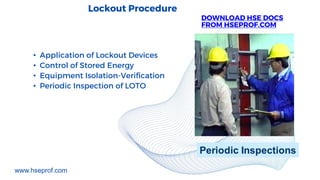
• Application of Lockout Devices
• Control of Stored Energy
• Equipment Isolation-Verification
• Periodic Inspection of LOTO
Removal of Lockout
www.hseprof.com
DOWNLOAD HSE DOCS
FROM HSEPROF.COM
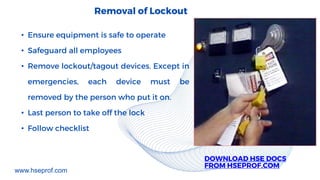
• Ensure equipment is safe to operate
• Safeguard all employees
• Remove lockout/tagout devices. Except in
emergencies, each device must be
removed by the person who put it on.
• Last person to take off the lock
• Follow checklist
www.hseprof.com
DOWNLOAD HSE DOCS
FROM HSEPROF.COM
Temporarily Reactivating Equipment
• Remove unnecessary tools from the work area and make sure everyone is
clear of the equipment
• Remove lockout/tagout devices and re-energize the system
• As soon as the energy is no longer needed, isolate the equipment and re-
apply lockout/tagout, using the procedure.
Special Situations
www.hseprof.com
DOWNLOAD HSE DOCS
FROM HSEPROF.COM
• Servicing lasts longer than one shift.
• Contractors are performing service or maintenance at your workplace
• Worker who applied lock is not available
• Never attempt lockout/tagout procedures unless you have been trained
and certified by your employer under an approved Energy Control
Program.
• Never loan or share your lock, combination, or key with anybody else.
• Always be sure all lockout/tagout devices are compatible with the
environment in which they will be used i.e. corrosive, humid, etc.
www.hseprof.com
SUMMARY OF THE HSE PRESETATION
DOWNLOAD HSE DOCS
FROM HSEPROF.COM
www.hseprof.com
REPOST
WITH YOUR NETWORK!
DOWNLOAD HSE DOCS
FROM HSEPROF.COM

LOTO.pptx

  • 1.
    Lock Out &Tag Out (LOTO) HSE Presentation www.hseprof.com DOWNLOAD HSE DOCS FROM HSEPROF.COM
  • 2.
    www.hseprof.com DOWNLOAD HSE DOCS FROMHSEPROF.COM Approximately 3 million workers service equipment and face the greatest risk of injury if lockout/tagout is not properly implemented. Compliance with the lockout/tagout standard (29 CFR 1910.147) prevents an estimated 120 fatalities and 50,000 injuries each year. Introduction of HSE Presentation
  • 3.
    www.hseprof.com DOWNLOAD HSE DOCS FROMHSEPROF.COM • "Lockout/Tagout (LOTO)" refers to specific practices and procedures to safeguard employees from the unexpected energization or startup of machinery and equipment or the release of hazardous energy during service or maintenance activities. • This requires that a designated individual turns off and disconnects the machinery or equipment from its energy source(s) before performing service or maintenance and that the authorized employee(s) either lock or tag the energy-isolating device(s) to prevent the release of hazardous energy and take steps to verify that the energy has been isolated effectively. Introduction of HSE Presentation
  • 4.
    www.hseprof.com DOWNLOAD HSE DOCS FROMHSEPROF.COM The “Fatal Five” Main Causes of Lockout/Tagout Injuries • Failure to stop equipment • Failure to disconnect from power source • Failure to dissipate (bleed, neutralize) residual energy
  • 5.
    www.hseprof.com DOWNLOAD HSE DOCS FROMHSEPROF.COM The “Fatal Five” Main Causes of Lockout/Tagout Injuries • Accidental restarting of equipment • Failure to clear work areas before restarting
  • 6.
    www.hseprof.com DOWNLOAD HSE DOCS FROMHSEPROF.COM Responsibilities • Authorized Employee - one who locks out machines or equipment in order to perform the servicing or maintenance on that machine or equipment. • Affected Employee - one whose job requires him/her to operate or use a machine or equipment on which servicing or maintenance is being performed under lockout, or whose job requires him/her to work in an area in which such servicing or maintenance is being performed.
  • 7.
    • Energy IsolatingDevice - A mechanical device that physically prevents the transmission or release of energy. • Tagging System – identification tag provided in the valve together with the lock to identify the users of tag, the purpose, duration of activities, contact number or location, etc… • Energy Control Procedure - A safety program adopted by the employer that includes energy control procedures plus provisions for inspecting the procedures and training employees for lockout/tagout. DOWNLOAD HSE DOCS FROM HSEPROF.COM Definition
  • 8.
    • Energy IsolatingDevice - A mechanical device that physically prevents the transmission or release of energy. • Tagging System – identification tag provided in the valve together with the lock to identify the users of tag, the purpose, duration of activities, contact number or location, etc… • Energy Control Procedure - A safety program adopted by the employer that includes energy control procedures plus provisions for inspecting the procedures and training employees for lockout/tagout. DOWNLOAD HSE DOCS FROM HSEPROF.COM Definition
  • 9.
    www.hseprof.com DOWNLOAD HSEDOCS FROM HSEPROF.COM Types of Lockout Devices • Electrical - Generated - Static • Mechanical - Transitional - Rotational • Thermal - Machines or Equipment - Chemical Reactions • Potential - Pressure - Hydraulic - Pneumatic - Vacuum • Springs • Gravity
  • 10.
    www.hseprof.com DOWNLOAD HSEDOCS FROM HSEPROF.COM Types of Lockout Devices • Plug Locks • Ball Valve Lockout
  • 11.
    www.hseprof.com DOWNLOAD HSEDOCS FROM HSEPROF.COM Types of Lockout Devices • Gate Valve Lockout • Group Lockout Hasp
  • 12.
    Lockout Procedure www.hseprof.com DOWNLOAD HSEDOCS FROM HSEPROF.COM • Inform the operator (s) that power is being disconnected. • Preparation for Shutdown • Equipment Shutdown • Equipment Isolation
  • 13.
    Lockout Procedure www.hseprof.com DOWNLOAD HSEDOCS FROM HSEPROF.COM • Application of Lockout Devices • Control of Stored Energy • Equipment Isolation-Verification • Periodic Inspection of LOTO
  • 14.
    Removal of Lockout www.hseprof.com DOWNLOADHSE DOCS FROM HSEPROF.COM • Ensure equipment is safe to operate • Safeguard all employees • Remove lockout/tagout devices. Except in emergencies, each device must be removed by the person who put it on. • Last person to take off the lock • Follow checklist
  • 15.
    www.hseprof.com DOWNLOAD HSE DOCS FROMHSEPROF.COM Temporarily Reactivating Equipment • Remove unnecessary tools from the work area and make sure everyone is clear of the equipment • Remove lockout/tagout devices and re-energize the system • As soon as the energy is no longer needed, isolate the equipment and re- apply lockout/tagout, using the procedure.
  • 16.
    Special Situations www.hseprof.com DOWNLOAD HSEDOCS FROM HSEPROF.COM • Servicing lasts longer than one shift. • Contractors are performing service or maintenance at your workplace • Worker who applied lock is not available
  • 17.
    • Never attemptlockout/tagout procedures unless you have been trained and certified by your employer under an approved Energy Control Program. • Never loan or share your lock, combination, or key with anybody else. • Always be sure all lockout/tagout devices are compatible with the environment in which they will be used i.e. corrosive, humid, etc. www.hseprof.com SUMMARY OF THE HSE PRESETATION DOWNLOAD HSE DOCS FROM HSEPROF.COM
  • 18.