“LOST AND ACQUIRED”
ISLAMIC STATE TERRITORIAL EXPANSION.
DiegoRodríguez2ºF- May 2015
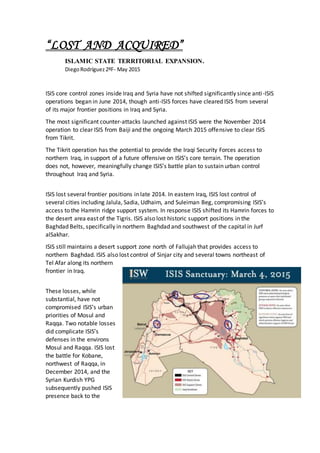
ISIS core control zones inside Iraq and Syria have not shifted significantly since anti-ISIS
operations began in June 2014, though anti-ISIS forces have cleared ISIS from several
of its major frontier positions in Iraq and Syria.
The most significant counter-attacks launched against ISIS were the November 2014
operation to clear ISIS from Baiji and the ongoing March 2015 offensive to clear ISIS
from Tikrit.
The Tikrit operation has the potential to provide the Iraqi Security Forces access to
northern Iraq, in support of a future offensive on ISIS’s core terrain. The operation
does not, however, meaningfully change ISIS’s battle plan to sustain urban control
throughout Iraq and Syria.
ISIS lost several frontier positions in late 2014. In eastern Iraq, ISIS lost control of
several cities including Jalula, Sadia, Udhaim, and Suleiman Beg, compromising ISIS’s
access to the Hamrin ridge support system. In response ISIS shifted its Hamrin forces to
the desert area east of the Tigris. ISIS also lost historic support positions in the
Baghdad Belts, specifically in northern Baghdad and southwest of the capital in Jurf
alSakhar.
ISIS still maintains a desert support zone north of Fallujah that provides access to
northern Baghdad. ISIS also lost control of Sinjar city and several towns northeast of
Tel Afar along its northern
frontier in Iraq.
These losses, while
substantial, have not
compromised ISIS’s urban
priorities of Mosul and
Raqqa. Two notable losses
did complicate ISIS’s
defenses in the environs
Mosul and Raqqa. ISIS lost
the battle for Kobane,
northwest of Raqqa, in
December 2014, and the
Syrian Kurdish YPG
subsequently pushed ISIS
presence back to the
perimeter of Raqqa district, re-capturing two strategic bridges along the upper
Euphrates.
In response ISIS consolidated its defenses between Raqqa city and these new Kurdish
positions. In Iraq, Kurdish Peshmerga attacks at Gwer and anti-ISIS Sunni tribal activity
near Qayarra and Sharqat in early 2015 perforated a critical ISIS stronghold in southern
Ninewa. Losses in this area compromise ISIS’s ability to defend Mosul from the south.
ISIS reacted to the Peshmerga and Sunni tribal attacks by declaring new governorates
in the Jazeera and the Zaab in February 2015, suggesting a greater defensive
mobilization around Mosul. ISIS is expanding visibly on two fronts: in Hasaka province
in northeastern Syria and in the Damascus, Qalamoun, and Bekaa valley region in
southwestern Syria.
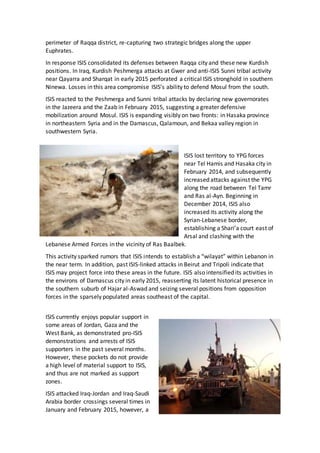
ISIS lost territory to YPG forces
near Tel Hamis and Hasaka city in
February 2014, and subsequently
increased attacks against the YPG
along the road between Tel Tamr
and Ras al-Ayn. Beginning in
December 2014, ISIS also
increased its activity along the
Syrian-Lebanese border,
establishing a Shari’a court east of
Arsal and clashing with the
Lebanese Armed Forces in the vicinity of Ras Baalbek.
This activity sparked rumors that ISIS intends to establish a “wilayat” within Lebanon in
the near term. In addition, past ISIS-linked attacks in Beirut and Tripoli indicate that
ISIS may project force into these areas in the future. ISIS also intensified its activities in
the environs of Damascus city in early 2015, reasserting its latent historical presence in
the southern suburb of Hajar al-Aswad and seizing several positions from opposition
forces in the sparsely populated areas southeast of the capital.
ISIS currently enjoys popular support in
some areas of Jordan, Gaza and the
West Bank, as demonstrated pro-ISIS
demonstrations and arrests of ISIS
supporters in the past several months.
However, these pockets do not provide
a high level of material support to ISIS,
and thus are not marked as support
zones.
ISIS attacked Iraq-Jordan and Iraq-Saudi
Arabia border crossings several times in
January and February 2015, however, a
reminder that ISIS is engaging neighboring states
with more than violent rhetoric. ISIS’s current
mission, as articulated in the October 2014 issue of
its English-language Dabiq magazine, is to both
“Remain and Expand.” ISIS will persist in its
expansion attempts even as its strategic defenses
are tested in Iraq and Syria. ISW will continue to
update this ISIS sanctuary map to account for ISIS’s
losses and gains.

Lost and acquired. (ISIS)

  • 1.
    “LOST AND ACQUIRED” ISLAMICSTATE TERRITORIAL EXPANSION. DiegoRodríguez2ºF- May 2015 ISIS core control zones inside Iraq and Syria have not shifted significantly since anti-ISIS operations began in June 2014, though anti-ISIS forces have cleared ISIS from several of its major frontier positions in Iraq and Syria. The most significant counter-attacks launched against ISIS were the November 2014 operation to clear ISIS from Baiji and the ongoing March 2015 offensive to clear ISIS from Tikrit. The Tikrit operation has the potential to provide the Iraqi Security Forces access to northern Iraq, in support of a future offensive on ISIS’s core terrain. The operation does not, however, meaningfully change ISIS’s battle plan to sustain urban control throughout Iraq and Syria. ISIS lost several frontier positions in late 2014. In eastern Iraq, ISIS lost control of several cities including Jalula, Sadia, Udhaim, and Suleiman Beg, compromising ISIS’s access to the Hamrin ridge support system. In response ISIS shifted its Hamrin forces to the desert area east of the Tigris. ISIS also lost historic support positions in the Baghdad Belts, specifically in northern Baghdad and southwest of the capital in Jurf alSakhar. ISIS still maintains a desert support zone north of Fallujah that provides access to northern Baghdad. ISIS also lost control of Sinjar city and several towns northeast of Tel Afar along its northern frontier in Iraq. These losses, while substantial, have not compromised ISIS’s urban priorities of Mosul and Raqqa. Two notable losses did complicate ISIS’s defenses in the environs Mosul and Raqqa. ISIS lost the battle for Kobane, northwest of Raqqa, in December 2014, and the Syrian Kurdish YPG subsequently pushed ISIS presence back to the
  • 2.
    perimeter of Raqqadistrict, re-capturing two strategic bridges along the upper Euphrates. In response ISIS consolidated its defenses between Raqqa city and these new Kurdish positions. In Iraq, Kurdish Peshmerga attacks at Gwer and anti-ISIS Sunni tribal activity near Qayarra and Sharqat in early 2015 perforated a critical ISIS stronghold in southern Ninewa. Losses in this area compromise ISIS’s ability to defend Mosul from the south. ISIS reacted to the Peshmerga and Sunni tribal attacks by declaring new governorates in the Jazeera and the Zaab in February 2015, suggesting a greater defensive mobilization around Mosul. ISIS is expanding visibly on two fronts: in Hasaka province in northeastern Syria and in the Damascus, Qalamoun, and Bekaa valley region in southwestern Syria. ISIS lost territory to YPG forces near Tel Hamis and Hasaka city in February 2014, and subsequently increased attacks against the YPG along the road between Tel Tamr and Ras al-Ayn. Beginning in December 2014, ISIS also increased its activity along the Syrian-Lebanese border, establishing a Shari’a court east of Arsal and clashing with the Lebanese Armed Forces in the vicinity of Ras Baalbek. This activity sparked rumors that ISIS intends to establish a “wilayat” within Lebanon in the near term. In addition, past ISIS-linked attacks in Beirut and Tripoli indicate that ISIS may project force into these areas in the future. ISIS also intensified its activities in the environs of Damascus city in early 2015, reasserting its latent historical presence in the southern suburb of Hajar al-Aswad and seizing several positions from opposition forces in the sparsely populated areas southeast of the capital. ISIS currently enjoys popular support in some areas of Jordan, Gaza and the West Bank, as demonstrated pro-ISIS demonstrations and arrests of ISIS supporters in the past several months. However, these pockets do not provide a high level of material support to ISIS, and thus are not marked as support zones. ISIS attacked Iraq-Jordan and Iraq-Saudi Arabia border crossings several times in January and February 2015, however, a
  • 3.
    reminder that ISISis engaging neighboring states with more than violent rhetoric. ISIS’s current mission, as articulated in the October 2014 issue of its English-language Dabiq magazine, is to both “Remain and Expand.” ISIS will persist in its expansion attempts even as its strategic defenses are tested in Iraq and Syria. ISW will continue to update this ISIS sanctuary map to account for ISIS’s losses and gains.