Lord of the Flies

William Golding’s Masterpiece
         1911- 1993
Author and Context
 William Golding was born on September 19, 1911
  in England
 1940 Golding joined the Royal Navy
 Participated in D-Day
 Experience in WWII had a profound effect on his
  view of humanity and the evils of which it was
  capable.
 His first and greatest success came with Lord of
  the Flies (1954)
About the Novel

Set in mid 1940’s when Europe engulfed in
 war.
A plane carrying British school boys is
 mistaken for a military craft and shot down.
Only the boys survive the crash, and try to
 form a society and govern themselves.
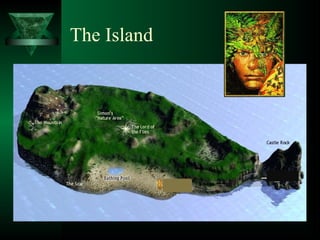
The Island
Themes
 Civilization vs. Savagery
 Loss of Innocence
 Original Sin
 Fear that separates one from God
 Nature of Good and Evil
 Goodness is rare and fleeting
 Absolute Power
Allusions

– Reference to a well known “thing”
  from history, literature, work of art
  • Classical literature

  • Mythology

  • Christian Symbolism
Symbols in the Novel

The Conch-
Piggy’s Glasses-
Lord of the Flies-
Fire Signal-
Religious Symbols
 The Island . . .
 The snake in the Garden of Eden
 The parachutist and Piggy. . .
 Jack and Ralph . . .
 Simon . . .
Allegory

 A work of fiction carrying two levels of
  meaning:
     - 1) a surface plot/narrative (literal)
     - 2) symbolic/metaphorical meaning in
     which everything in story symbolizes
  something greater
A Freudian Allegory
                      Ralph, Jack, and Piggy
 Id
   – The part of the personality reflecting unorganized, instinctual
      impulses. If unbridled, it seeks immediate gratification of primitive
      needs.
 Ego
   – The part of the personality corresponding most nearly to the
      perceived self, the controlling self that holds back the impulsiveness of
      the id in the effort to delay gratification until it can be found in
      socially approved ways.
 Superego
   – The part of the personality corresponding most nearly to conscience,
      controlling through moral scruples rather than by way of social
      expediency. The superego is said to be an uncompromising and
      punishing conscience.
 Unconscious
   – Memories, impulses and desires that are not available to
      consciousness. According to the psychoanalytic theories of Freud,
      painful memories and wishes are sometimes repressed – that is,
      diverted to the unconscious where they continue to influence our
      actions even though we are not aware of them.
Social Influence
 1. Compliance
   – The person at whom the influence is directed (the target) publicly
      conforms to the wishes of the influencing source but does not
      change his or her private beliefs or attitudes. (The child eats the
      spinach but continues to dislike it.)
 2. Internalization
   – The target changes his or her beliefs, attitudes, or behaviors
      because of a genuine belief in the validity of the position
      advocated by the influencing source. (A middle-aged man gives up
      smoking after reading – and believing – the surgeon general's
      warnings that smoking causes cancer.)
 3. Identification
   – The target changes his or her beliefs, attitudes, or behaviors in
      order to resemble an influencing source that is respected or
      admired. (A high school girl takes up smoking in order to be like a
      group of older girls she admires.)
 Deindividuation – sense of self diminished when in a crowd (mob
  mentality)
Concerning the Title
 Beel’zebub- Hebrew translation for Lord of the flies
 The title is said to be a reference to the Hebrew
  name Beelzebub (‫ ,בעל זבוב‬Ba'al-zvuv, "god of the
  fly", "host of the fly" or literally "Lord of Flies"), a
  name sometimes used as a synonym for Satan. [3]
 Ba‘al Zebûb might mean 'Lord of Zebûb', referring
  to an unknown place called Zebûb, or 'Lord of
  things that fly' (zebûb being a Hebrew collective
  noun for 'fly', thus the common lay translation 'Lord
  of the Flies').
Modern Day Allusions

Allusion- (n.) an indirect reference to
  something
There are many, many modern day allusions
  to Lord of the Flies in popular culture.
For example….
The Simpsons
The Simpson’s
 episode titled Das
 Bus is a parody of
 Lord of the Flies.
Survivor
MarK Burnett’s CBS
 island show is said to
 have been inspired
 by LOTF.
Sponge Bob Squarepants
The episode Club
 Spongebob is a
 spoof of LOTF.
Popular Music
        Bands such as Taking
         Back Sunday, Nine Inch
         Nails, AFI, Iron
         Maiden, Rolling Stones,
         and Pink Floyd have
         written songs about or
         have alluded to LOTF in
         their music.
Lord of-the-flies-introduction

Lord of-the-flies-introduction

  • 1.
    Lord of theFlies William Golding’s Masterpiece 1911- 1993
  • 2.
    Author and Context William Golding was born on September 19, 1911 in England  1940 Golding joined the Royal Navy  Participated in D-Day  Experience in WWII had a profound effect on his view of humanity and the evils of which it was capable.  His first and greatest success came with Lord of the Flies (1954)
  • 3.
    About the Novel Setin mid 1940’s when Europe engulfed in war. A plane carrying British school boys is mistaken for a military craft and shot down. Only the boys survive the crash, and try to form a society and govern themselves.
  • 4.
  • 5.
    Themes  Civilization vs.Savagery  Loss of Innocence  Original Sin  Fear that separates one from God  Nature of Good and Evil  Goodness is rare and fleeting  Absolute Power
  • 6.
    Allusions – Reference toa well known “thing” from history, literature, work of art • Classical literature • Mythology • Christian Symbolism
  • 7.
    Symbols in theNovel The Conch- Piggy’s Glasses- Lord of the Flies- Fire Signal-
  • 8.
    Religious Symbols  TheIsland . . .  The snake in the Garden of Eden  The parachutist and Piggy. . .  Jack and Ralph . . .  Simon . . .
  • 9.
    Allegory  A workof fiction carrying two levels of meaning: - 1) a surface plot/narrative (literal) - 2) symbolic/metaphorical meaning in which everything in story symbolizes something greater
  • 10.
    A Freudian Allegory Ralph, Jack, and Piggy  Id – The part of the personality reflecting unorganized, instinctual impulses. If unbridled, it seeks immediate gratification of primitive needs.  Ego – The part of the personality corresponding most nearly to the perceived self, the controlling self that holds back the impulsiveness of the id in the effort to delay gratification until it can be found in socially approved ways.  Superego – The part of the personality corresponding most nearly to conscience, controlling through moral scruples rather than by way of social expediency. The superego is said to be an uncompromising and punishing conscience.  Unconscious – Memories, impulses and desires that are not available to consciousness. According to the psychoanalytic theories of Freud, painful memories and wishes are sometimes repressed – that is, diverted to the unconscious where they continue to influence our actions even though we are not aware of them.
  • 11.
    Social Influence  1.Compliance – The person at whom the influence is directed (the target) publicly conforms to the wishes of the influencing source but does not change his or her private beliefs or attitudes. (The child eats the spinach but continues to dislike it.)  2. Internalization – The target changes his or her beliefs, attitudes, or behaviors because of a genuine belief in the validity of the position advocated by the influencing source. (A middle-aged man gives up smoking after reading – and believing – the surgeon general's warnings that smoking causes cancer.)  3. Identification – The target changes his or her beliefs, attitudes, or behaviors in order to resemble an influencing source that is respected or admired. (A high school girl takes up smoking in order to be like a group of older girls she admires.)  Deindividuation – sense of self diminished when in a crowd (mob mentality)
  • 12.
    Concerning the Title Beel’zebub- Hebrew translation for Lord of the flies  The title is said to be a reference to the Hebrew name Beelzebub (‫ ,בעל זבוב‬Ba'al-zvuv, "god of the fly", "host of the fly" or literally "Lord of Flies"), a name sometimes used as a synonym for Satan. [3]  Ba‘al Zebûb might mean 'Lord of Zebûb', referring to an unknown place called Zebûb, or 'Lord of things that fly' (zebûb being a Hebrew collective noun for 'fly', thus the common lay translation 'Lord of the Flies').
  • 13.
    Modern Day Allusions Allusion-(n.) an indirect reference to something There are many, many modern day allusions to Lord of the Flies in popular culture. For example….
  • 14.
    The Simpsons The Simpson’s episode titled Das Bus is a parody of Lord of the Flies.
  • 15.
    Survivor MarK Burnett’s CBS island show is said to have been inspired by LOTF.
  • 16.
    Sponge Bob Squarepants Theepisode Club Spongebob is a spoof of LOTF.
  • 17.
    Popular Music  Bands such as Taking Back Sunday, Nine Inch Nails, AFI, Iron Maiden, Rolling Stones, and Pink Floyd have written songs about or have alluded to LOTF in their music.