- R. M. Dharaneesh
 Loops
 For loops
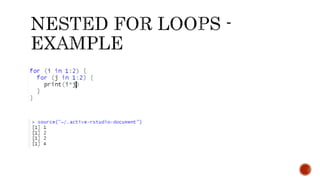
 Nested for loops
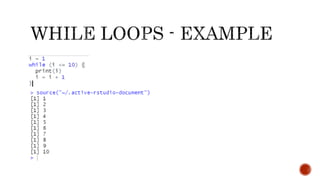
 While loops
 break
 Repeat loops
 next
 In computer programming, a loop is a sequence of instructions that are
continually repeated until a certain condition is reached.
 Loops can either be entry-controlled or exit-controlled.
 Entry-controlled loops run only if the condition for the looping process stays true.
 Exit-controlled loops run at least once, regardless of the condition, conditions are
checked for only at the end of the loop block.
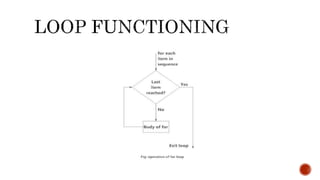
 For loops are an entry-controlled type of loops, i.e., conditions are given on the
entry of the loop.
 If the conditions are not satisfied, then the loop doesn't execute.
 Otherwise, the loop runs until the condition becomes false.
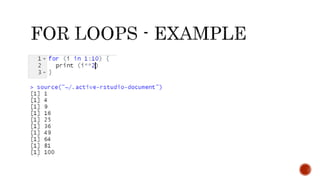
 It is used to iterate over the items of a sequence, usually only when the range of
the sequence is known.
 Update statements are not needed as the loop automatically updates the counter
variable.
 For loops can be nested, i.e., for loops can be placed inside of other for loops.
 If for example, the outer loop will make 'm' iterations and the inner loop will make
'n' iterations, then the total number of iterations made will be m * n.
 While loops are another entry-controlled type of loop in R.
 While loops are usually used when the total number of iterations are not known,
although they can also be used when the number of iterations are known.
 Update statements have to be explicitly mentioned in while loops.
 The 'break' keyword is used to 'break' out of a loop abruptly in between its
execution.
 Once a 'break' statement is encountered in a loop, the control exits out of the loop
completely.
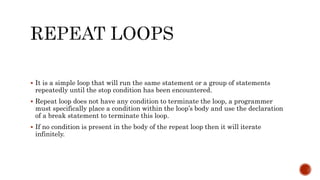
 It is a simple loop that will run the same statement or a group of statements
repeatedly until the stop condition has been encountered.
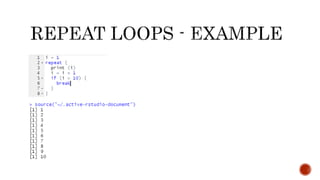
 Repeat loop does not have any condition to terminate the loop, a programmer
must specifically place a condition within the loop’s body and use the declaration
of a break statement to terminate this loop.
 If no condition is present in the body of the repeat loop then it will iterate
infinitely.
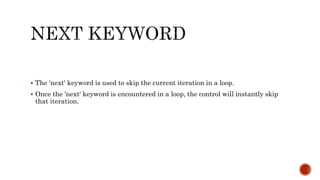
 The 'next' keyword is used to skip the current iteration in a loop.
 Once the 'next' keyword is encountered in a loop, the control will instantly skip
that iteration.
Thank
you

Loops in R

  • 1.
    - R. M.Dharaneesh
  • 2.
     Loops  Forloops  Nested for loops  While loops  break  Repeat loops  next
  • 3.
     In computerprogramming, a loop is a sequence of instructions that are continually repeated until a certain condition is reached.  Loops can either be entry-controlled or exit-controlled.  Entry-controlled loops run only if the condition for the looping process stays true.  Exit-controlled loops run at least once, regardless of the condition, conditions are checked for only at the end of the loop block.
  • 5.
     For loopsare an entry-controlled type of loops, i.e., conditions are given on the entry of the loop.  If the conditions are not satisfied, then the loop doesn't execute.  Otherwise, the loop runs until the condition becomes false.  It is used to iterate over the items of a sequence, usually only when the range of the sequence is known.  Update statements are not needed as the loop automatically updates the counter variable.
  • 7.
     For loopscan be nested, i.e., for loops can be placed inside of other for loops.  If for example, the outer loop will make 'm' iterations and the inner loop will make 'n' iterations, then the total number of iterations made will be m * n.
  • 9.
     While loopsare another entry-controlled type of loop in R.  While loops are usually used when the total number of iterations are not known, although they can also be used when the number of iterations are known.  Update statements have to be explicitly mentioned in while loops.
  • 11.
     The 'break'keyword is used to 'break' out of a loop abruptly in between its execution.  Once a 'break' statement is encountered in a loop, the control exits out of the loop completely.
  • 12.
     It isa simple loop that will run the same statement or a group of statements repeatedly until the stop condition has been encountered.  Repeat loop does not have any condition to terminate the loop, a programmer must specifically place a condition within the loop’s body and use the declaration of a break statement to terminate this loop.  If no condition is present in the body of the repeat loop then it will iterate infinitely.
  • 14.
     The 'next'keyword is used to skip the current iteration in a loop.  Once the 'next' keyword is encountered in a loop, the control will instantly skip that iteration.
  • 16.