The United Kingdom
Buckingham Palace This palace was built in 1705 by the duke of Buckingham. Queen Victoria was the first of the royal family to live in it. A flag is always raised when the queen is at the palace. Today, the palace has over 600 rooms which includes a throne room and a grand ball room.
Windsor Castle Windsor Castle is the largest inhabited castle in the world with its earliest resident being William the Conqueror. The castle’s total floor area is 484,000 square feet. Along with Buckingham Palace, it  is one of the places the  English royal family  resides.
Edinburgh Castle Edinburgh Castle sits  upon the volcanic  Castle Rock. The castle  dates back to around the  time of David I in the  12 th  century. Much of the fortress was destroyed in the 16 th  century but today it is the National War Museum of Scotland.
Harlech Castle  Nestled on a cliff close to the Irish Sea this fortress has been inspiration for songs and a beautiful attraction in Wales. It was built in the 13 th  century by King Edward I and is known for its giant gatehouse.
St. Paul’s Cathedral This 365 foot cathedral dates back to the 17 th  century  when it was built by Sir. Christopher Wren. Today, it is the seat of the Bishop  of London and services  still are held daily.
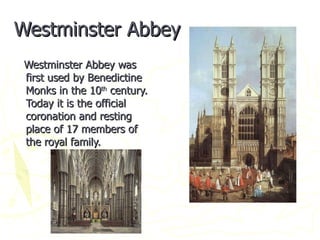
Westminster Abbey Westminster Abbey was first used by Benedictine Monks in the 10 th  century. Today it is the official coronation and resting place of 17 members of the royal family.
The White Cliffs of Dover The White Cliffs of Dover form the British coastline that faces the Strait of Dover and France. These cliffs are part of the North Downs formation and some reach up to 305 feet. You are also able to see the cliffs from France on a clear day.
Blackpool Tower Inspired by the Eiffel Tower in  Paris, France this tower is  518 feet tall and can be seen  almost everywhere in a  30 mile radius. It was opened  on May 14, 1894 and has a  time capsule buried under it.  The  construction used about  5 million bricks.
Hadrian’s Wall  This fortress, also known as the “Roman Wall”, was built in 122 AD and was constructed out of stone and timber. Built by the Roman Empire under the rule of emperor Hadrian the wall spans the width of northern England. Much of the wall still stands today.
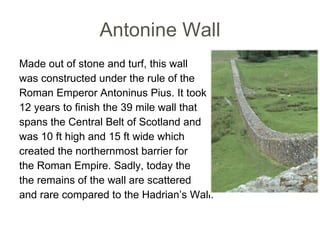
Antonine Wall Made out of stone and turf, this wall was constructed under the rule of the  Roman Emperor Antoninus Pius. It took 12 years to finish the 39 mile wall that  spans the Central Belt of Scotland and was 10 ft high and 15 ft wide which created the northernmost barrier for the Roman Empire. Sadly, today the the remains of the wall are scattered  and rare compared to the Hadrian’s Wall.
The Wellington Arch The Wellington Arch was built  between 1826-1830. It was intended to be a monument for  the first Duke of Wellington and  was the entryway for Buckingham  Palace. The arch was moved from  the palace in 1882 and placed in  Hyde Park where it still sits today.
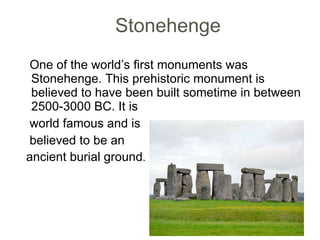
Stonehenge  One of the world’s first monuments was Stonehenge. This prehistoric monument is believed to have been built sometime in between 2500-3000 BC. It is world famous and is  believed to be an  ancient burial ground .
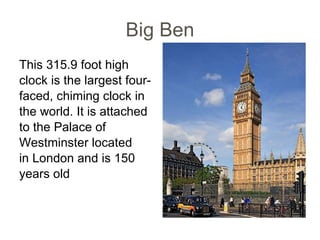
Big Ben This 315.9 foot high  clock is the largest four- faced, chiming clock in the world. It is attached  to the Palace of  Westminster located in London and is 150 years old
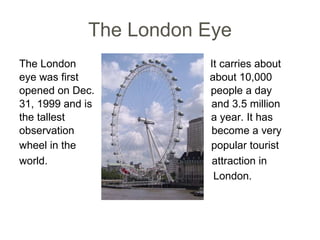
The London Eye The London  It carries about eye was first  about 10,000 opened on Dec.  people a day  31, 1999 and is  and 3.5 million the tallest  a year. It has  observation  become a very wheel in the   popular tourist  world.  attraction in   London.

Uk Powerpoint[1]

  • 1.
  • 2.
    Buckingham Palace Thispalace was built in 1705 by the duke of Buckingham. Queen Victoria was the first of the royal family to live in it. A flag is always raised when the queen is at the palace. Today, the palace has over 600 rooms which includes a throne room and a grand ball room.
  • 3.
    Windsor Castle WindsorCastle is the largest inhabited castle in the world with its earliest resident being William the Conqueror. The castle’s total floor area is 484,000 square feet. Along with Buckingham Palace, it is one of the places the English royal family resides.
  • 4.
    Edinburgh Castle EdinburghCastle sits upon the volcanic Castle Rock. The castle dates back to around the time of David I in the 12 th century. Much of the fortress was destroyed in the 16 th century but today it is the National War Museum of Scotland.
  • 5.
    Harlech Castle Nestled on a cliff close to the Irish Sea this fortress has been inspiration for songs and a beautiful attraction in Wales. It was built in the 13 th century by King Edward I and is known for its giant gatehouse.
  • 6.
    St. Paul’s CathedralThis 365 foot cathedral dates back to the 17 th century when it was built by Sir. Christopher Wren. Today, it is the seat of the Bishop of London and services still are held daily.
  • 7.
    Westminster Abbey WestminsterAbbey was first used by Benedictine Monks in the 10 th century. Today it is the official coronation and resting place of 17 members of the royal family.
  • 8.
    The White Cliffsof Dover The White Cliffs of Dover form the British coastline that faces the Strait of Dover and France. These cliffs are part of the North Downs formation and some reach up to 305 feet. You are also able to see the cliffs from France on a clear day.
  • 9.
    Blackpool Tower Inspiredby the Eiffel Tower in Paris, France this tower is 518 feet tall and can be seen almost everywhere in a 30 mile radius. It was opened on May 14, 1894 and has a time capsule buried under it. The construction used about 5 million bricks.
  • 10.
    Hadrian’s Wall This fortress, also known as the “Roman Wall”, was built in 122 AD and was constructed out of stone and timber. Built by the Roman Empire under the rule of emperor Hadrian the wall spans the width of northern England. Much of the wall still stands today.
  • 11.
    Antonine Wall Madeout of stone and turf, this wall was constructed under the rule of the Roman Emperor Antoninus Pius. It took 12 years to finish the 39 mile wall that spans the Central Belt of Scotland and was 10 ft high and 15 ft wide which created the northernmost barrier for the Roman Empire. Sadly, today the the remains of the wall are scattered and rare compared to the Hadrian’s Wall.
  • 12.
    The Wellington ArchThe Wellington Arch was built between 1826-1830. It was intended to be a monument for the first Duke of Wellington and was the entryway for Buckingham Palace. The arch was moved from the palace in 1882 and placed in Hyde Park where it still sits today.
  • 13.
    Stonehenge Oneof the world’s first monuments was Stonehenge. This prehistoric monument is believed to have been built sometime in between 2500-3000 BC. It is world famous and is believed to be an ancient burial ground .
  • 14.
    Big Ben This315.9 foot high clock is the largest four- faced, chiming clock in the world. It is attached to the Palace of Westminster located in London and is 150 years old
  • 15.
    The London EyeThe London It carries about eye was first about 10,000 opened on Dec. people a day 31, 1999 and is and 3.5 million the tallest a year. It has observation become a very wheel in the popular tourist world. attraction in London.

Editor's Notes

  • #15 Enter into bibliography page "Six Must See Tourist Attractions In London." Chooseurfun.com - . Web. 10 Dec. 2009. <http://www.chooseurfun.com/six-must-see-tourist-attractions-in-london>.
  • #16 Put in bibliography: "London guided tours | See the sights of London from a speed boat on the Thames." The Thames Cruise with a unique difference | London RIB Voyages . Web. 11 Dec. 2009. <http://www.londonribvoyages.com/location.php>.