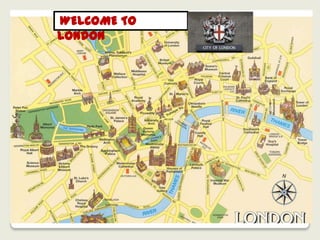
WELCOME TO
LONDON
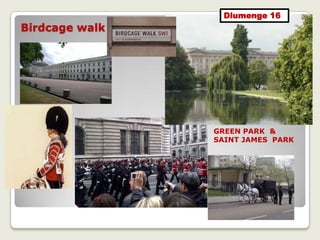
Birdcage walk
GREEN PARK &
SAINT JAMES PARK
Diumenge 16
Whitehall
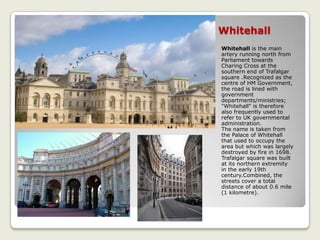
Whitehall is the main
artery running north from
Parliament towards
Charing Cross at the
southern end of Trafalgar
square .Recognized as the
centre of HM Government,
the road is lined with
government
departments/ministries;
"Whitehall" is therefore
also frequently used to
refer to UK governmental
administration.
The name is taken from
the Palace of Whitehall
that used to occupy the
area but which was largely
destroyed by fire in 1698.
Trafalgar square was built
at its northern extremity
in the early 19th
century.Combined, the
streets cover a total
distance of about 0.6 mile
(1 kilometre).
DOWNING ST.
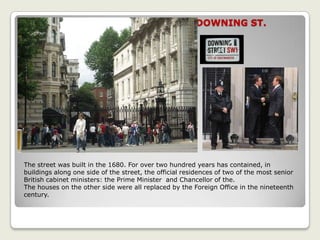
The street was built in the 1680. For over two hundred years has contained, in
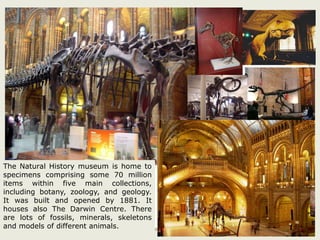
buildings along one side of the street, the official residences of two of the most senior
British cabinet ministers: the Prime Minister and Chancellor of the.
The houses on the other side were all replaced by the Foreign Office in the nineteenth
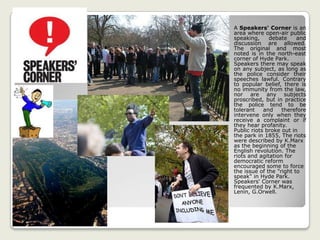
century.
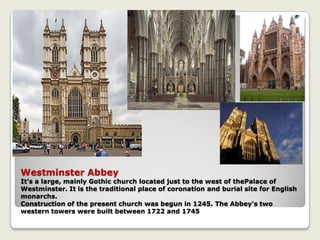
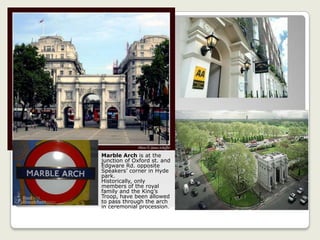
Westminster Abbey
It’s a large, mainly Gothic church located just to the west of thePalace of
Westminster. It is the traditional place of coronation and burial site for English
monarchs.
Construction of the present church was begun in 1245. The Abbey's two
western towers were built between 1722 and 1745
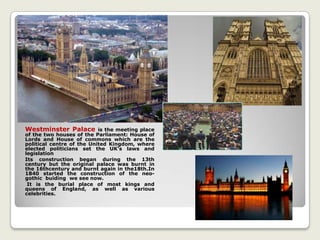
Westminster Palace is the meeting place
of the two houses of the Parliament: House of
Lords and House of commons which are the
political centre of the United Kingdom, where
elected politicians set the UK’s laws and
legislation
Its construction began during the 13th
century but the original palace was burnt in
the 16thcentury and burnt again in the18th.In
1840 started the construction of the neo-
gothic buiding we see now.
It is the burial place of most kings and
queens of England, as well as various
celebrities.
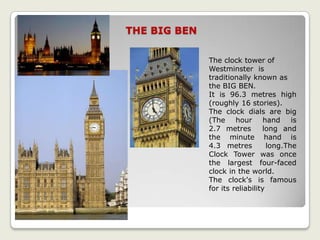
THE BIG BEN
The clock tower of
Westminster is
traditionally known as
the BIG BEN.
It is 96.3 metres high
(roughly 16 stories).
The clock dials are big
(The hour hand is
2.7 metres long and
the minute hand is
4.3 metres long.The
Clock Tower was once
the largest four-faced
clock in the world.
The clock's is famous
for its reliability
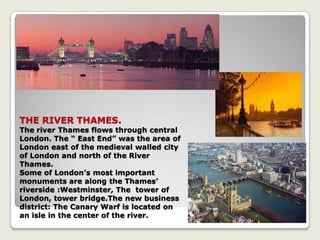
THE RIVER THAMES.
The river Thames flows through central
London. The “ East End” was the area of
London east of the medieval walled city
of London and north of the River
Thames.
Some of London’s most important
monuments are along the Thames’
riverside :Westminster, The tower of
London, tower bridge.The new business
district: The Canary Warf is located on
an isle in the center of the river.
Trafalgar square
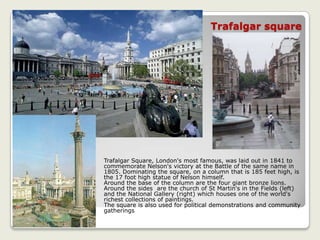
Trafalgar Square, London's most famous, was laid out in 1841 to
commemorate Nelson's victory at the Battle of the same name in
1805. Dominating the square, on a column that is 185 feet high, is
the 17 foot high statue of Nelson himself.
Around the base of the column are the four giant bronze lions.
Around the sides are the church of St Martin's in the Fields (left)
and the National Gallery (right) which houses one of the world's
richest collections of paintings.
The square is also used for political demonstrations and community
gatherings
Picadilly Circus
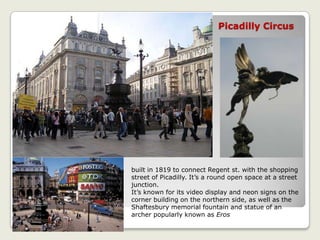
built in 1819 to connect Regent st. with the shopping
street of Picadilly. It’s a round open space at a street
junction.
It’s known for its video display and neon signs on the
corner building on the northern side, as well as the
Shaftesbury memorial fountain and statue of an
archer popularly known as Eros
LEICESTER SQUARE
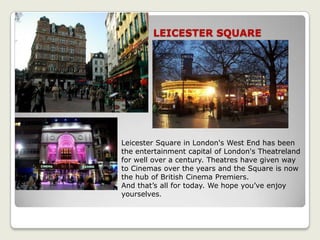
Leicester Square in London's West End has been
the entertainment capital of London's Theatreland
for well over a century. Theatres have given way
to Cinemas over the years and the Square is now
the hub of British Cinema Premiers.
And that’s all for today. We hope you’ve enjoy
yourselves.
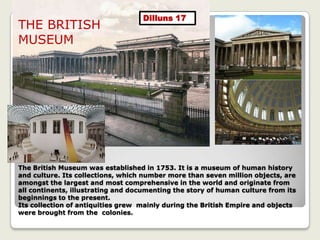
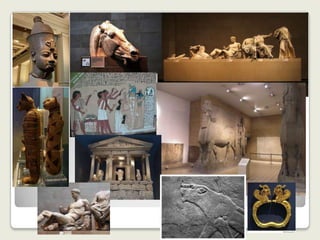
The British Museum was established in 1753. It is a museum of human history
and culture. Its collections, which number more than seven million objects, are
amongst the largest and most comprehensive in the world and originate from
all continents, illustrating and documenting the story of human culture from its
beginnings to the present.
Its collection of antiquities grew mainly during the British Empire and objects
were brought from the colonies.
THE BRITISH
MUSEUM
Dilluns 17
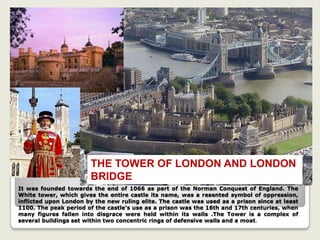
It was founded towards the end of 1066 as part of the Norman Conquest of England. The
White tower, which gives the entire castle its name, was a resented symbol of oppression,
inflicted upon London by the new ruling elite. The castle was used as a prison since at least
1100. The peak period of the castle's use as a prison was the 16th and 17th centuries, when
many figures fallen into disgrace were held within its walls .The Tower is a complex of
several buildings set within two concentric rings of defensive walls and a moat.
THE TOWER OF LONDON AND LONDON
BRIDGE
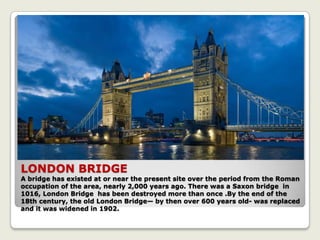
LONDON BRIDGE
A bridge has existed at or near the present site over the period from the Roman
occupation of the area, nearly 2,000 years ago. There was a Saxon bridge in
1016, London Bridge has been destroyed more than once .By the end of the
18th century, the old London Bridge— by then over 600 years old- was replaced
and it was widened in 1902.
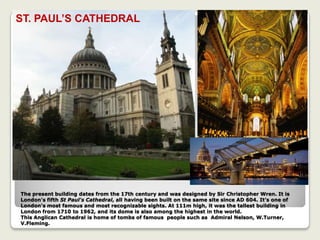
The present building dates from the 17th century and was designed by Sir Christopher Wren. It is
London's fifth St Paul's Cathedral, all having been built on the same site since AD 604. It’s one of
London's most famous and most recognizable sights. At 111m high, it was the tallest building in
London from 1710 to 1962, and its dome is also among the highest in the world.
This Anglican Cathedral is home of tombs of famous people such as Admiral Nelson, W.Turner,
V.Fleming.
ST. PAUL’S CATHEDRAL
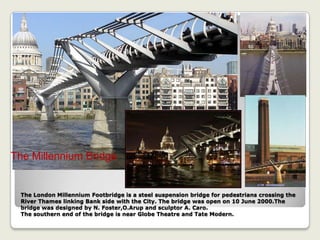
The London Millennium Footbridge is a steel suspension bridge for pedestrians crossing the
River Thames linking Bank side with the City. The bridge was open on 10 June 2000.The
bridge was designed by N. Foster,O.Arup and sculptor A. Caro.
The southern end of the bridge is near Globe Theatre and Tate Modern.
The Millennium Bridge
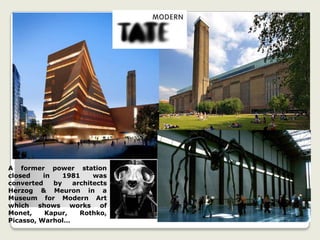
A former power station
closed in 1981 was
converted by architects
Herzog & Meuron in a
Museum for Modern Art
which shows works of
Monet, Kapur, Rothko,
Picasso, Warhol…
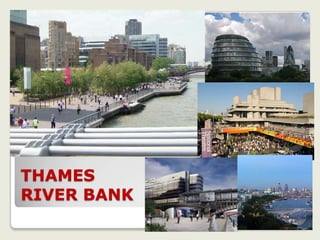
THAMES
RIVER BANK
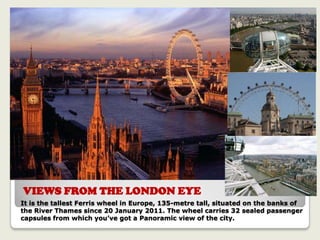
It is the tallest Ferris wheel in Europe, 135-metre tall, situated on the banks of
the River Thames since 20 January 2011. The wheel carries 32 sealed passenger
capsules from which you’ve got a Panoramic view of the city.
VIEWS FROM THE LONDON EYE
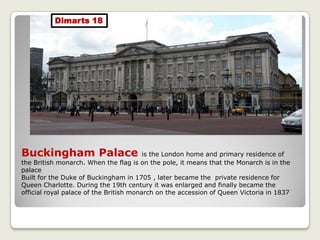
Buckingham Palace is the London home and primary residence of
the British monarch. When the flag is on the pole, it means that the Monarch is in the
palace
Built for the Duke of Buckingham in 1705 , later became the private residence for
Queen Charlotte. During the 19th century it was enlarged and finally became the
official royal palace of the British monarch on the accession of Queen Victoria in 1837
Dimarts 18
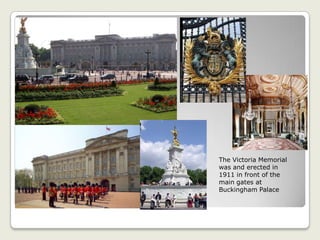
The Victoria Memorial
was and erected in
1911 in front of the
main gates at
Buckingham Palace
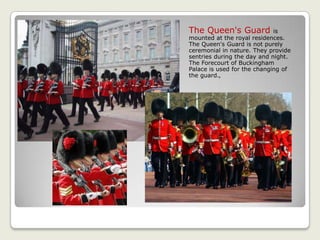
The Queen's Guard is
mounted at the royal residences.
The Queen's Guard is not purely
ceremonial in nature. They provide
sentries during the day and night.
The Forecourt of Buckingham
Palace is used for the changing of
the guard.,
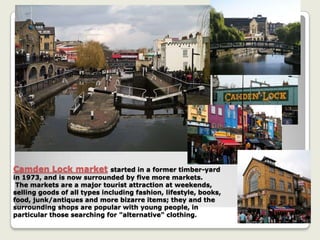
Camden Lock market started in a former timber-yard
in 1973, and is now surrounded by five more markets.
The markets are a major tourist attraction at weekends,
selling goods of all types including fashion, lifestyle, books,
food, junk/antiques and more bizarre items; they and the
surrounding shops are popular with young people, in
particular those searching for "alternative" clothing.
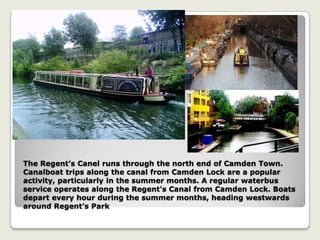
The Regent’s Canel runs through the north end of Camden Town.
Canalboat trips along the canal from Camden Lock are a popular
activity, particularly in the summer months. A regular waterbus
service operates along the Regent's Canal from Camden Lock. Boats
depart every hour during the summer months, heading westwards
around Regent’s Park
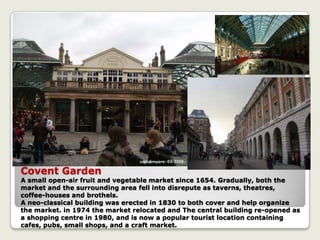
Covent Garden
A small open-air fruit and vegetable market since 1654. Gradually, both the
market and the surrounding area fell into disrepute as taverns, theatres,
coffee-houses and brothels.
A neo-classical building was erected in 1830 to both cover and help organize
the market. in 1974 the market relocated and The central building re-opened as
a shopping centre in 1980, and is now a popular tourist location containing
cafes, pubs, small shops, and a craft market.
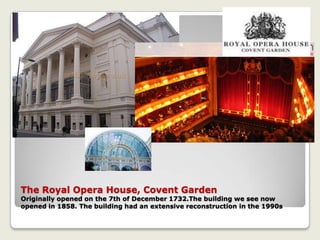
The Royal Opera House, Covent Garden
Originally opened on the 7th of December 1732.The building we see now
opened in 1858. The building had an extensive reconstruction in the 1990s
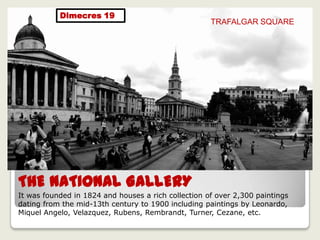
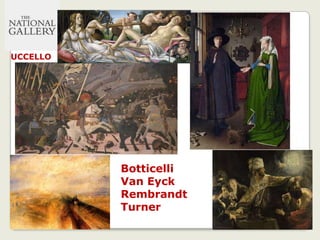
THE NATIONAL GALLERY
It was founded in 1824 and houses a rich collection of over 2,300 paintings
dating from the mid-13th century to 1900 including paintings by Leonardo,
Miquel Angelo, Velazquez, Rubens, Rembrandt, Turner, Cezane, etc.
TRAFALGAR SQUARE
Dimecres 19
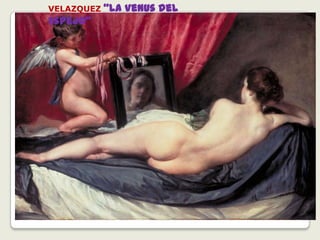
VELAZQUEZ “La Venus del
Espejo”
UCCELLO
Botticelli
Van Eyck
Rembrandt
Turner
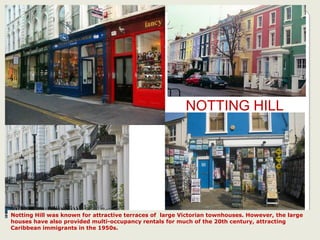
NOTTING HILL
Notting Hill was known for attractive terraces of large Victorian townhouses. However, the large
houses have also provided multi-occupancy rentals for much of the 20th century, attracting
Caribbean immigrants in the 1950s.
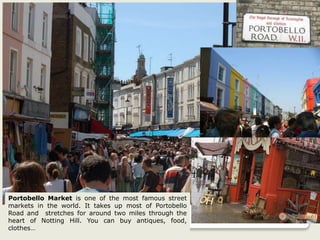
Portobello Market is one of the most famous street
markets in the world. It takes up most of Portobello
Road and stretches for around two miles through the
heart of Notting Hill. You can buy antiques, food,
clothes…
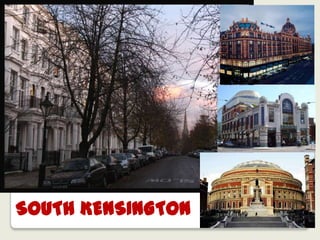
SOUTH KENSINGTON
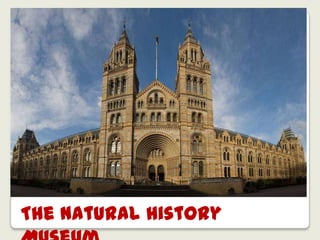
The Natural History
The Natural History museum is home to
specimens comprising some 70 million
items within five main collections,
including botany, zoology, and geology.
It was built and opened by 1881. It
houses also The Darwin Centre. There
are lots of fossils, minerals, skeletons
and models of different animals.
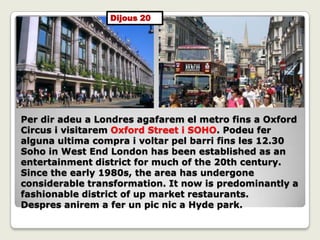
Per dir adeu a Londres agafarem el metro fins a Oxford
Circus i visitarem Oxford Street i SOHO. Podeu fer
alguna ultima compra i voltar pel barri fins les 12.30
Soho in West End London has been established as an
entertainment district for much of the 20th century.
Since the early 1980s, the area has undergone
considerable transformation. It now is predominantly a
fashionable district of up market restaurants.
Despres anirem a fer un pic nic a Hyde park.
Dijous 20
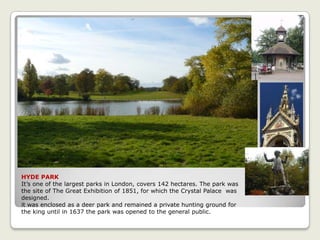
HYDE PARK
It’s one of the largest parks in London, covers 142 hectares. The park was
the site of The Great Exhibition of 1851, for which the Crystal Palace was
designed.
it was enclosed as a deer park and remained a private hunting ground for
the king until in 1637 the park was opened to the general public.
A Speakers' Corner is an
area where open-air public
speaking, debate and
discussion are allowed.
The original and most
noted is in the north-east
corner of Hyde Park.
Speakers there may speak
on any subject, as long as
the police consider their
speeches lawful. Contrary
to popular belief, there is
no immunity from the law,
nor are any subjects
proscribed, but in practice
the police tend to be
tolerant and therefore
intervene only when they
receive a complaint or if
they hear profanity.
Public riots broke out in
the park in 1855, The riots
were described by K.Marx
as the beginning of the
English revolution. The
riots and agitation for
democratic reform
encouraged some to force
the issue of the "right to
speak" in Hyde Park.
Speakers' Corner was
frequented by K.Marx,
Lenin, G.Orwell.
Marble Arch is at the
junction of Oxford st. and
Edgware Rd. opposite
Speakers’ corner in Hyde
park.
Historically, only
members of the royal
family and the King’s
Troop, have been allowed
to pass through the arch
in ceremonial procession.
A les 13.30 ens recolliran per tornar a
l’aeroport.
Arribada a BCN terminal 1/20.25
Dijous 20:
Últim dia. Hem de deixar
l’alberg a les 10h.
Deixarem les maletes a
consigna.
Recordeu deixar
fora els
documents !

London 16 -20 juny 2013

  • 1.
  • 2.
    Birdcage walk GREEN PARK& SAINT JAMES PARK Diumenge 16
  • 3.
    Whitehall Whitehall is themain artery running north from Parliament towards Charing Cross at the southern end of Trafalgar square .Recognized as the centre of HM Government, the road is lined with government departments/ministries; "Whitehall" is therefore also frequently used to refer to UK governmental administration. The name is taken from the Palace of Whitehall that used to occupy the area but which was largely destroyed by fire in 1698. Trafalgar square was built at its northern extremity in the early 19th century.Combined, the streets cover a total distance of about 0.6 mile (1 kilometre).
  • 4.
    DOWNING ST. The streetwas built in the 1680. For over two hundred years has contained, in buildings along one side of the street, the official residences of two of the most senior British cabinet ministers: the Prime Minister and Chancellor of the. The houses on the other side were all replaced by the Foreign Office in the nineteenth century.
  • 5.
    Westminster Abbey It’s alarge, mainly Gothic church located just to the west of thePalace of Westminster. It is the traditional place of coronation and burial site for English monarchs. Construction of the present church was begun in 1245. The Abbey's two western towers were built between 1722 and 1745
  • 6.
    Westminster Palace isthe meeting place of the two houses of the Parliament: House of Lords and House of commons which are the political centre of the United Kingdom, where elected politicians set the UK’s laws and legislation Its construction began during the 13th century but the original palace was burnt in the 16thcentury and burnt again in the18th.In 1840 started the construction of the neo- gothic buiding we see now. It is the burial place of most kings and queens of England, as well as various celebrities.
  • 7.
    THE BIG BEN Theclock tower of Westminster is traditionally known as the BIG BEN. It is 96.3 metres high (roughly 16 stories). The clock dials are big (The hour hand is 2.7 metres long and the minute hand is 4.3 metres long.The Clock Tower was once the largest four-faced clock in the world. The clock's is famous for its reliability
  • 8.
    THE RIVER THAMES. Theriver Thames flows through central London. The “ East End” was the area of London east of the medieval walled city of London and north of the River Thames. Some of London’s most important monuments are along the Thames’ riverside :Westminster, The tower of London, tower bridge.The new business district: The Canary Warf is located on an isle in the center of the river.
  • 9.
    Trafalgar square Trafalgar Square,London's most famous, was laid out in 1841 to commemorate Nelson's victory at the Battle of the same name in 1805. Dominating the square, on a column that is 185 feet high, is the 17 foot high statue of Nelson himself. Around the base of the column are the four giant bronze lions. Around the sides are the church of St Martin's in the Fields (left) and the National Gallery (right) which houses one of the world's richest collections of paintings. The square is also used for political demonstrations and community gatherings
  • 10.
    Picadilly Circus built in1819 to connect Regent st. with the shopping street of Picadilly. It’s a round open space at a street junction. It’s known for its video display and neon signs on the corner building on the northern side, as well as the Shaftesbury memorial fountain and statue of an archer popularly known as Eros
  • 11.
    LEICESTER SQUARE Leicester Squarein London's West End has been the entertainment capital of London's Theatreland for well over a century. Theatres have given way to Cinemas over the years and the Square is now the hub of British Cinema Premiers. And that’s all for today. We hope you’ve enjoy yourselves.
  • 12.
    The British Museumwas established in 1753. It is a museum of human history and culture. Its collections, which number more than seven million objects, are amongst the largest and most comprehensive in the world and originate from all continents, illustrating and documenting the story of human culture from its beginnings to the present. Its collection of antiquities grew mainly during the British Empire and objects were brought from the colonies. THE BRITISH MUSEUM Dilluns 17
  • 14.
    It was foundedtowards the end of 1066 as part of the Norman Conquest of England. The White tower, which gives the entire castle its name, was a resented symbol of oppression, inflicted upon London by the new ruling elite. The castle was used as a prison since at least 1100. The peak period of the castle's use as a prison was the 16th and 17th centuries, when many figures fallen into disgrace were held within its walls .The Tower is a complex of several buildings set within two concentric rings of defensive walls and a moat. THE TOWER OF LONDON AND LONDON BRIDGE
  • 15.
    LONDON BRIDGE A bridgehas existed at or near the present site over the period from the Roman occupation of the area, nearly 2,000 years ago. There was a Saxon bridge in 1016, London Bridge has been destroyed more than once .By the end of the 18th century, the old London Bridge— by then over 600 years old- was replaced and it was widened in 1902.
  • 16.
    The present buildingdates from the 17th century and was designed by Sir Christopher Wren. It is London's fifth St Paul's Cathedral, all having been built on the same site since AD 604. It’s one of London's most famous and most recognizable sights. At 111m high, it was the tallest building in London from 1710 to 1962, and its dome is also among the highest in the world. This Anglican Cathedral is home of tombs of famous people such as Admiral Nelson, W.Turner, V.Fleming. ST. PAUL’S CATHEDRAL
  • 17.
    The London MillenniumFootbridge is a steel suspension bridge for pedestrians crossing the River Thames linking Bank side with the City. The bridge was open on 10 June 2000.The bridge was designed by N. Foster,O.Arup and sculptor A. Caro. The southern end of the bridge is near Globe Theatre and Tate Modern. The Millennium Bridge
  • 18.
    A former powerstation closed in 1981 was converted by architects Herzog & Meuron in a Museum for Modern Art which shows works of Monet, Kapur, Rothko, Picasso, Warhol…
  • 19.
  • 20.
    It is thetallest Ferris wheel in Europe, 135-metre tall, situated on the banks of the River Thames since 20 January 2011. The wheel carries 32 sealed passenger capsules from which you’ve got a Panoramic view of the city. VIEWS FROM THE LONDON EYE
  • 21.
    Buckingham Palace isthe London home and primary residence of the British monarch. When the flag is on the pole, it means that the Monarch is in the palace Built for the Duke of Buckingham in 1705 , later became the private residence for Queen Charlotte. During the 19th century it was enlarged and finally became the official royal palace of the British monarch on the accession of Queen Victoria in 1837 Dimarts 18
  • 22.
    The Victoria Memorial wasand erected in 1911 in front of the main gates at Buckingham Palace
  • 23.
    The Queen's Guardis mounted at the royal residences. The Queen's Guard is not purely ceremonial in nature. They provide sentries during the day and night. The Forecourt of Buckingham Palace is used for the changing of the guard.,
  • 24.
    Camden Lock marketstarted in a former timber-yard in 1973, and is now surrounded by five more markets. The markets are a major tourist attraction at weekends, selling goods of all types including fashion, lifestyle, books, food, junk/antiques and more bizarre items; they and the surrounding shops are popular with young people, in particular those searching for "alternative" clothing.
  • 25.
    The Regent’s Canelruns through the north end of Camden Town. Canalboat trips along the canal from Camden Lock are a popular activity, particularly in the summer months. A regular waterbus service operates along the Regent's Canal from Camden Lock. Boats depart every hour during the summer months, heading westwards around Regent’s Park
  • 26.
    Covent Garden A smallopen-air fruit and vegetable market since 1654. Gradually, both the market and the surrounding area fell into disrepute as taverns, theatres, coffee-houses and brothels. A neo-classical building was erected in 1830 to both cover and help organize the market. in 1974 the market relocated and The central building re-opened as a shopping centre in 1980, and is now a popular tourist location containing cafes, pubs, small shops, and a craft market.
  • 27.
    The Royal OperaHouse, Covent Garden Originally opened on the 7th of December 1732.The building we see now opened in 1858. The building had an extensive reconstruction in the 1990s
  • 28.
    THE NATIONAL GALLERY Itwas founded in 1824 and houses a rich collection of over 2,300 paintings dating from the mid-13th century to 1900 including paintings by Leonardo, Miquel Angelo, Velazquez, Rubens, Rembrandt, Turner, Cezane, etc. TRAFALGAR SQUARE Dimecres 19
  • 29.
    VELAZQUEZ “La Venusdel Espejo”
  • 30.
  • 31.
    NOTTING HILL Notting Hillwas known for attractive terraces of large Victorian townhouses. However, the large houses have also provided multi-occupancy rentals for much of the 20th century, attracting Caribbean immigrants in the 1950s.
  • 32.
    Portobello Market isone of the most famous street markets in the world. It takes up most of Portobello Road and stretches for around two miles through the heart of Notting Hill. You can buy antiques, food, clothes…
  • 33.
  • 34.
  • 35.
    The Natural Historymuseum is home to specimens comprising some 70 million items within five main collections, including botany, zoology, and geology. It was built and opened by 1881. It houses also The Darwin Centre. There are lots of fossils, minerals, skeletons and models of different animals.
  • 36.
    Per dir adeua Londres agafarem el metro fins a Oxford Circus i visitarem Oxford Street i SOHO. Podeu fer alguna ultima compra i voltar pel barri fins les 12.30 Soho in West End London has been established as an entertainment district for much of the 20th century. Since the early 1980s, the area has undergone considerable transformation. It now is predominantly a fashionable district of up market restaurants. Despres anirem a fer un pic nic a Hyde park. Dijous 20
  • 37.
    HYDE PARK It’s oneof the largest parks in London, covers 142 hectares. The park was the site of The Great Exhibition of 1851, for which the Crystal Palace was designed. it was enclosed as a deer park and remained a private hunting ground for the king until in 1637 the park was opened to the general public.
  • 38.
    A Speakers' Corneris an area where open-air public speaking, debate and discussion are allowed. The original and most noted is in the north-east corner of Hyde Park. Speakers there may speak on any subject, as long as the police consider their speeches lawful. Contrary to popular belief, there is no immunity from the law, nor are any subjects proscribed, but in practice the police tend to be tolerant and therefore intervene only when they receive a complaint or if they hear profanity. Public riots broke out in the park in 1855, The riots were described by K.Marx as the beginning of the English revolution. The riots and agitation for democratic reform encouraged some to force the issue of the "right to speak" in Hyde Park. Speakers' Corner was frequented by K.Marx, Lenin, G.Orwell.
  • 39.
    Marble Arch isat the junction of Oxford st. and Edgware Rd. opposite Speakers’ corner in Hyde park. Historically, only members of the royal family and the King’s Troop, have been allowed to pass through the arch in ceremonial procession.
  • 40.
    A les 13.30ens recolliran per tornar a l’aeroport. Arribada a BCN terminal 1/20.25 Dijous 20: Últim dia. Hem de deixar l’alberg a les 10h. Deixarem les maletes a consigna. Recordeu deixar fora els documents !