Insurance for Logistics:
CH 5: MARINE
INSURANCE
Lloyd’s of London
Dr Narudh Cheramakara
2017
CLS-SSRU
1. Intro
• Lloyd's of London, generally known simply as Lloyd's, is
an insurance market located in the City of London,
which exists inside London.
• Unlike most of its competitors in the industry, it is not
an insurance company.
• Rather, Lloyd's is a corporate body governed by the
Lloyd's Act of 1871 and subsequent Acts of
Parliament and operates as a partially-mutualised
marketplace within which multiple financial backers,
grouped in syndicates, come together to pool and
spread risk. These underwriters, or "members", are a
collection of both corporations and private individuals,
the latter being traditionally known as "Names".
1. Intro Cond’t
• The business underwritten at Lloyd's is
predominantly general insurance and reinsurance,
although a small number of syndicates write term
life assurance.
• The market has its roots in marine insurance and
was founded by Edward Lloyd at his coffee house
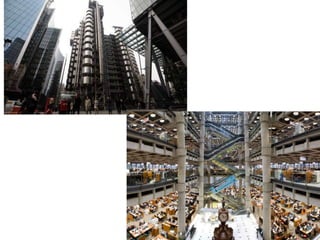
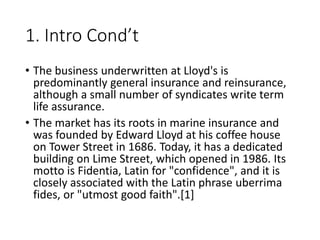
on Tower Street in 1686. Today, it has a dedicated
building on Lime Street, which opened in 1986. Its
motto is Fidentia, Latin for "confidence", and it is
closely associated with the Latin phrase uberrima
fides, or "utmost good faith".[1]
1. Intro Cond’t
• In 2016 there were 99 syndicates (compared to 84
in 2015), managed by 57 managing agencies, that
collectively wrote £29.862 billion of gross
premiums (up from £26.69bn in 2015) on business
placed by 258 Lloyd's approved brokers (242 in
2015). Direct insurance represented 69 per cent of
the policies written, mainly covering property and
liability ("casualty"), while the remaining 31 per
cent was reinsurance. The market reported a pre-
tax profit of £2.107bn and a combined ratio result
of 97.7 per cent for 2016 (up from 90 per cent in
2015).[2]
2. History: Formation and First
Lloyd’s Act
• The market began in Lloyd's Coffee House, opened by Edward
Lloyd in 1686 on Tower Street in the City of London.[3]
• This establishment was a popular place for sailors, merchants,
and ship-owners, and Lloyd catered to them with reliable shipping
news.
• The coffee house soon became recognised as an ideal place for
obtaining marine insurance. The shop was also frequented by
mariners involved in the slave trade. Historian Eric Williams notes:
"Lloyd's, like other insurance companies, insured slaves and slave
ships, and was vitally interested in legal decisions as to what
constituted 'natural death' and 'perils of the sea'."[4]
• Lloyd's obtained a monopoly on maritime insurance related to
the slave trade and maintained it until the early 19th century.[5]
2. Development
In 1696, a newspaper was established to publish
information about commercial transactions and
shipping movements around the world. This initiative
gave rise to Lloyd's Lists, published since 1726, and
still the most important publication in the shipping
and commercial world.
Lloyd's eventually moved to its current location of
the Royal Exchange and is still considered the
greatest and most important single commercial
factor in the mercantile world.
2. Development
Lloyd's Coffee House in London was the main location for
conducting this type of business. Much of marine insurance law and
its governing custom were developed there by seafaring men and
merchants engaged in foreign trade, who gathered to arrange “their
mutual contracts of insurance against the sea”.
The person seeking insurance would pass around a slip showing a
written description of the vessel and its cargo, the name of the
master and the character of his crew and the voyage considered.
Those wishing to insure the venture would write their names and
initials below that description with the amount that each was
willing to be liable for as an insurer. When the total amount of
insurance sought by the owner of the ship was thus underwritten,
the contract was complete, hence the term ―underwriters‖ now
applied to insurers.
2. Development
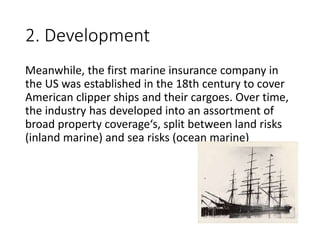
Meanwhile, the first marine insurance company in
the US was established in the 18th century to cover
American clipper ships and their cargoes. Over time,
the industry has developed into an assortment of
broad property coverage‘s, split between land risks
(inland marine) and sea risks (ocean marine)
2. Development
Until the 20th century, marine insurance traditionally
did not cover a substantial number of risks, bestowing
responsibility on owners of property to look after it
themselves as per car accident-insurance policies. Now,
ship owners can apply for comprehensive coverage which
protects them against virtually all risks including
“collision and running down” clauses, war-risk riders, and
protection and indemnity insurance.
Ship owners carry hull insurance on their own ships and
protect themselves against claims by third parties in
various ways. Should a ship or its cargo be damaged, the
matter is settled between insurance carriers.
2. History: Formation and First
Lloyd’s Act
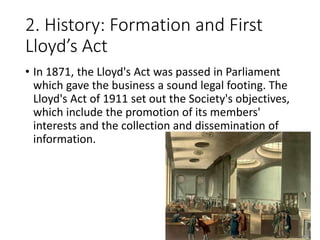
• In 1871, the Lloyd's Act was passed in Parliament
which gave the business a sound legal footing. The
Lloyd's Act of 1911 set out the Society's objectives,
which include the promotion of its members'
interests and the collection and dissemination of
information.
2. History: San Francisco earthquake
 Establishing reputations
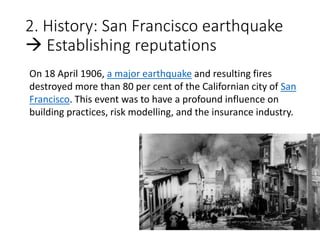
On 18 April 1906, a major earthquake and resulting fires
destroyed more than 80 per cent of the Californian city of San
Francisco. This event was to have a profound influence on
building practices, risk modelling, and the insurance industry.
2. History: San Francisco earthquake
 Establishing reputations
• Lloyd's losses from the earthquake and fires were
substantial
• One of Lloyd's leading underwriters, Cuthbert Heath,
famously instructed his agent in San Francisco to "pay all of
our policyholders in full, irrespective of the terms of their
policies".
• The prompt and full payment of all claims arising out of the
disaster helped to cement Lloyd's reputation for reliable
claims payment and as an important trading partner for US
brokers and policyholders. It was estimated that around 90
per cent of the damage to the city was caused by the
resultant fires.
• Since 1906, fire following earthquake has generally been an
insured peril under most policies.
3. Second Lloyd’s Act
• In 1980, Sir Henry Fisher was commissioned by the Council
of Lloyd's to produce the foundation for a new Lloyd's Act.
The recommendations of his Report addressed the
'democratic deficit' and the lack of regulatory muscle.
• The Lloyd's Act of 1982 further redefined the structure of
the business, and was designed to give the 'external
Names', introduced in response to the Cromer Report, a say
in the running of the business through a new governing
Council. The main purpose of the 1982 Act was to separate
the ownership of the managing agents of the Lloyd's
underwriting syndicates from the ownership of the
insurance broking firms (which acted as intermediaries, not
as underwriters) with the objective of removing conflicts of
interest
3. Second Lloyd’s Act: 1988 -1996
developments
• In the late 1980s and early 1990s, Lloyd's went through
the most traumatic period in its history. Unexpectedly
large legal awards in U.S. courts for punitive damages
led to large claims by insured‘s, especially on APH
(asbestos, pollution and health hazard) policies, some
dating as far back as the 1940s. Many of these policies
were designed to cover all liabilities not excluded on
broad form liability policies.
• Also in the 1980s Lloyd's was accused of fraud by
several American states and the external "names"
(investors in underwriting syndicates). Some of the
more high profile accusations included:
3. Second Lloyd’s Act: 1988 -1996
developments
• Lloyd's withheld their knowledge of asbestosis and
pollution claims until they could recruit more investors
to take on these liabilities that were unknown to
investors prior to investing in Lloyd's;
• Enforcement officials in 11 U.S. states charged Lloyd's
and some of its associates with various wrongs such as
fraud and selling unregistered securities;
• Ian Postage, one of Lloyd's leading underwriters, was
charged with skimming money from investors and
secretly trying to buy a Swiss bank; he was later
acquitted.
4.Lloyd’s structure
Lloyd's is not an insurance company. It is an insurance
market of members. As the oldest continuously active
insurance marketplace in the world, Lloyd's has retained
some unusual structures and practices that differ from all
other insurance providers today. Originally created as a
non-incorporated association of subscribing members in
1774, it was incorporated by the Lloyd's Act 1871, and it
is currently governed under the Lloyd's Acts of 1871
through to 1982. Lloyd's itself does not underwrite
insurance business, leaving that to its members (see
below). Instead the Society operates effectively as a
market regulator, setting rules under which members
operate and offering centralized administrative services
to those members
5. The council of Lloyd’s
• The Lloyd's Act 1982 defines the management structure and rules under which
Lloyd's operates.
• Under the Act, the Council of Lloyd's is responsible for the management and
supervision of the market. It is regulated by the Financial Services Authority
(FSA) under the Financial Services and Markets Act 2000.
• The Council normally has six working, six external and six nominated members.
The appointment of nominated members, including that of the Chief Executive
Officer, is confirmed by the Governor of the Bank of England.
• The working and external members are elected by Lloyd's members. The
Chairman and Deputy Chairmen are elected annually by the Council from
among the working members of the Council. All members are approved by the
FSA.
• The Council can discharge some of its functions directly by making decisions and
issuing resolutions, requirements, rules and byelaws. The Council delegates
most of its daily oversight roles, particularly relating to ensuring the market
operate successfully, to the franchise board
6. The franchise Board
• The Franchise Board lays down guidelines for all
syndicates and operates a business planning and
monitoring process to safeguard high standards of
underwriting and risk management, thereby improving
sustainable profitability and enhancing the financial
strength of the market.
• Lloyd's syndicates write a diverse range of policies, both
direct insurance and reinsurance, covering casualty,
property, marine, energy, motor, aviation and many
other types of risk. Lloyd's has a unique niche in
unusual, specialist business such as kidnap and ransom,
fine art, aviation, marine, and other insurances.
7. Type of policies
• Lloyd's syndicates write a diverse range of policies, both direct insurance and reinsurance,
covering casualty, property, marine, energy, motor, aviation and many other types of
risk.[33] Lloyd's also has a unique niche in unusual, specialist business such as kidnap and ransom,
fine art, specie, aviation war, satellites, personal accident, bloodstock and other insurances.
• The general public knows of Lloyd's for some unusual or notable policies that were written
there. For example, Lloyd's has been the marketplace which allowed the following to be insured:
• silent film comedian Ben Turpin's eyes against uncrossing
• Marlene Dietrich's, Betty Grable's,[34] Brooke Shields's, and Tina Turner's legs
• cricketer Merv Hughes's trademark walrus mustache while playing for Australia between 1985
and 1994[35]
• Jimmy Durante's nose
• the hands of the 1932 World Yo-Yo Champion Harvey Lowe[35]
• Keith Richards' fingers
• food critic and gourmet Egon Ronay's taste buds for £250,000[34]
• Whitney Houston's, Toni Braxton's, Celine Dion's, Bob Dylan's and Bruce Springsteen's vocal
cords[35]
7. Type of policies
• Whitney Houston's, Toni Braxton's, Celine Dion's, Bob Dylan's and Bruce Springsteen's vocal
cords[35]
• Michael Flatley's legs for $47 million[35] (the policy was only in effect when he was touring, and
forbade him from dancing except on stage)
• America Ferrera's smile for $10 million
• Ken Dodd's teeth for $7.4 million[35]
• Steve Fossett's life for $50 million
• the bodies of several professional wrestlers, including Bret Hart, Ric Flair, Curt Hennig, Rick
Rude, Brian Adams, and Joe Laurinaitis, better known as Road Warrior Animal. However, as of
2017, Dave Meltzer reported that they no longer insure wrestlers.[36]
• Diana Lee's hair
• Troy Polamalu's hair for $1 million[37]
• pa grain of rice with a portrait of the Queen and the Duke of Edinburgh engraved on it for
$20,000[34]
• a confident comedy theatre group against the risk of a member of their audience dying of
laughter[34]
8. Institute of London Underwriters
• The Institute of London Underwriters (ILU) is the body to which
most companies writing London Market Marine insurance belong
and the ILU provides the same sort of services to its members
that Lloyd's provides to syndicates.
• It was founded in 1884 to act as a trade association and to
provide a forum for underwriters to discuss current affairs and
the problems of the moment; at first Lloyd's underwriters were
also members but in 1909 the Lloyd's underwriters Association
was set up as it had become apparent that separate bodies were
needed to represent the Lloyd's and company markets. Matters
which concern the Marine market in London as a whole are still
dealt with by joint (Lloyd's and ILU) committees which normally
have equal membership from each side and an arrangement
whereby a chairman from one side will be succeeded by one from
the other side.
8. Institute of London Underwriters
• At present the ILU has approximately 110 members. Membership of the ILU has
always been thought to add prestige to a member and applications for
membership are examined thoroughly.
• The accounts of member companies are carefully vetted, with associate
members(those who have been members for less than 5 years, or whose
ownership has changed in the last 5 years) submitting quarterly returns and
providing business plans in advance.
• A relatively high standard of solvency is required of ILU members and where a
member is a subsidiary of another (often overseas)company, a substantial
guarantee is required from the parent
• . In consequence the ILU is able to boast proudly that no ILU company has ever
defaulted on its obligations. Two years ago the ILU building was opened. This is a
centre for underwriting in which member companies can rent space and most
have chosen to do so. As with Lloyd's this certainly makes it easier for brokers
placing marine risks and probably gives a competitive advantage to those
companies in the building because of the extra convenience for brokers. It has
been estimated that it now takes half a day to place a risk that used to take 2-3
days.
• LLOYD'S POLICY SIGNING OFFICE (LPSO)
• After a risk has been circulated around the Underwriting
room at Lloyd's, and each participating Underwriter has
signed the "slip" indicating the share he wishes to accept,
the details are checked and the policy document is prepared
and signed at LPSO.
• As documents are passed backwards and forwards between
the broker and LPSO for agreement and queries are
resolved, there is generally 2 to 3 months delay between
risk inception and policy signing, but it is the latter date
which determines· the underwriting year of account to
which premium and corresponding claims are allocated.
• LPSO's principal functions are:
i) To check transactions and sign policies and endorsements
ensuring that the terms on the "slip" are correctly followed through
and that various Lloyd's and statutory requirements are met.
ii) To provide a central accounting scheme whereby monetary
transactions between the many syndicates and brokers are settled
on a balance basis. Settlements were made at regular fixed intervals
with specific terms of credit until the recent introduction of flexible
settlement whereby the settlement date is agreed at the time of
placing the risk. LPSO effectively acts as a clearing house collecting
premiums and paying claims and refunds, including syndicate
reinsurance transactions, once agreement has been reached
between broker and lead underwriter.
iii) To extract and record accounting and limited statistical
information on a per policy basis for use by brokers and
underwriters. The records are made available both in a form
suitable for data processing (on punched cards and magnetic tape)
and also in a visual narrative form on the aforementioned cards.
iv) To provide statistical files for use by various Corporation of
Lloyd's departments
• LLOYD'S UNDERWRITERS' CLAIMS & RECOVERIES
OFFICE (LUCRO)
• LUCRO's main function is to provide an integrated
claims and recoveries service for Lloyd's marine
business and has absolute authority from the vast
majority of Lloyd's Marine Underwriters to
administer and settle claims on their behalf. Claims
are handled on the various risks written by Marine
Underwriters including Non-Marine, Aviation etc.
LUCRO also operates a computer system called
OMCAS (Outstanding Marine Claims Advice
Scheme) which enables the underwriters to be kept
informed of any outstanding claims amounts
advised.
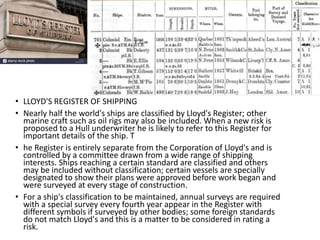
• LLOYD'S REGISTER OF SHIPPING
• Nearly half the world's ships are classified by Lloyd's Register; other
marine craft such as oil rigs may also be included. When a new risk is
proposed to a Hull underwriter he is likely to refer to this Register for
important details of the ship. T
• he Register is entirely separate from the Corporation of Lloyd's and is
controlled by a committee drawn from a wide range of shipping
interests. Ships reaching a certain standard are classified and others
may be included without classification; certain vessels are specially
designated to show their plans were approved before work began and
were surveyed at every stage of construction.
• For a ship's classification to be maintained, annual surveys are required
with a special survey every fourth year appear in the Register with
different symbols if surveyed by other bodies; some foreign standards
do not match Lloyd's and this is a matter to be considered in rating a
risk.
• SALVAGE ASSOCIATION
• The Salvage Association is a non profit-making body
which has over 100 surveyors around the world and its
main role is to assess the nature and extent of damage
to a ship or cargo and recommend appropriate repairs
or salvage. Association surveyors are often involved
where a warranty to a policy requires a surveyor to
approve fitness of a vessel for proposed activity, in
negotiation of ship repair contracts, in checking
stranded cargo and in approving arrangements for the
laying up of ships.
12. Other Organisations
• Association of British Insurers (ABI)
This is a trade association which represents and holds information
on most UK insurers. www.abi.org.uk
• The British Standards Institution (BSI)
• This organization provides information on ISO standards.
www.bsi.org.uk
• Chartered Insurance Institute (CII)
• This is the professional and educational body for insurance and
financial services companies. Lloyd's training and development is
provided by the CII. They work together to deliver and develop a
range of high-quality services for all market participants.
www.cii.co.uk
• Financial Services Authority (FSA) Lloyd's is
regulated by the FSA, an independent non-
governmental body with statutory powers under
the Financial Services and Markets Act 2000.
www.fsa.gov.uk
International Maritime Bureau
• It is a specialized department of the International Chamber of
Commerce.
• The IMB's responsibilities lie in fighting crimes related
to maritime trade and transportation, particularly piracy and
commercial fraud, and in protecting the crews of ocean-going
vessels. It publishes a weekly piracy report and maintains a
24-hour piracy reporting centre in Kuala Lumpur, Malaysia.
• The IMB is part of ICC Commercial Crime Services whose
other divisions include The Counterfeiting Intelligence
Bureau, The Financial Investigation Bureau and FraudNet.
• FraudNet is the world's leading network of fraud and asset
recovery lawyers with 63 lawyers in 56 different jurisdictions.
• The bureau, endorsed by the UN's International Maritime
Organisation, was founded in 1981. The body has observer
status with Interpol