August 26, 2025 EASTERN MEDITERRANEAN UNIVERSITY 1
Digital Logic Design I
Gate-Level Minimization
Mustafa Kemal Uyguroğlu
August 26, 2025
2
3-1 Introduction
 Gate-level minimization refers to the design task of
finding an optimal gate-level implementation of Boolean
functions describing a digital circuit.
August 26, 2025
3
3-2 The Map Method
 The complexity of the digital logic gates
 The complexity of the algebraic expression
 Logic minimization
 Algebraic approaches: lack specific rules
 The Karnaugh map
 A simple straight forward procedure
 A pictorial form of a truth table
 Applicable if the # of variables < 7
 A diagram made up of squares
 Each square represents one minterm
August 26, 2025
4
Review of Boolean Function
 Boolean function
 Sum of minterms
 Sum of products (or product of sum) in the simplest form
 A minimum number of terms
 A minimum number of literals
 The simplified expression may not be unique
August 26, 2025
5
Two-Variable Map
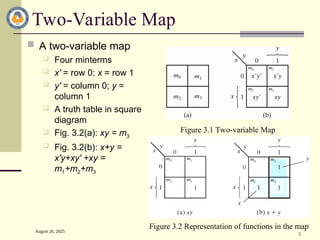
 A two-variable map
 Four minterms
 x' = row 0; x = row 1
 y' = column 0; y =
column 1
 A truth table in square
diagram
 Fig. 3.2(a): xy = m3
 Fig. 3.2(b): x+y =
x'y+xy' +xy =
m1+m2+m3
Figure 3.2 Representation of functions in the map
Figure 3.1 Two-variable Map
August 26, 2025
6
A Three-variable Map
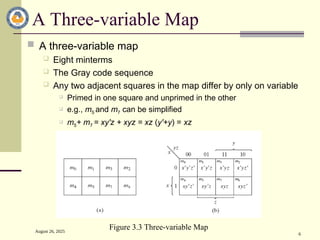
 A three-variable map
 Eight minterms
 The Gray code sequence
 Any two adjacent squares in the map differ by only on variable
 Primed in one square and unprimed in the other
 e.g., m5 and m7 can be simplified
 m5+ m7 = xy'z + xyz = xz (y'+y) = xz
Figure 3.3 Three-variable Map
August 26, 2025
7
A Three-variable Map
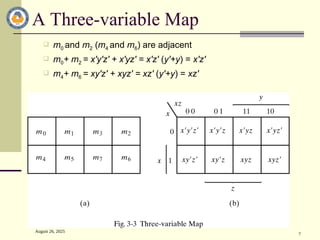
 m0 and m2 (m4 and m6) are adjacent
 m0+ m2 = x'y'z' + x'yz' = x'z' (y'+y) = x'z'
 m4+ m6 = xy'z' + xyz' = xz' (y'+y) = xz'
August 26, 2025
8
Example 3.1
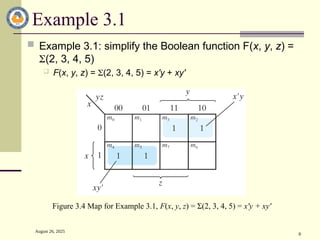
 Example 3.1: simplify the Boolean function F(x, y, z) =
(2, 3, 4, 5)
 F(x, y, z) = (2, 3, 4, 5) = x'y + xy'
Figure 3.4 Map for Example 3.1, F(x, y, z) = Σ(2, 3, 4, 5) = x'y + xy'
August 26, 2025
9
Example 3.2
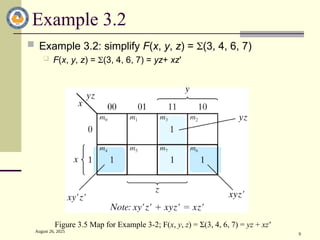
 Example 3.2: simplify F(x, y, z) = (3, 4, 6, 7)
 F(x, y, z) = (3, 4, 6, 7) = yz+ xz'
Figure 3.5 Map for Example 3-2; F(x, y, z) = Σ(3, 4, 6, 7) = yz + xz'
August 26, 2025
10
Four adjacent Squares
 Consider four adjacent squares
 2, 4, and 8 squares
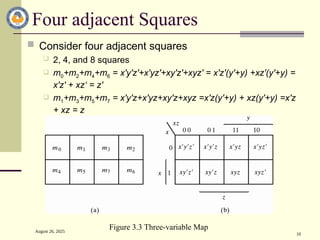
 m0+m2+m4+m6 = x'y'z'+x'yz'+xy'z'+xyz' = x'z'(y'+y) +xz'(y'+y) =
x'z' + xz‘ = z'
 m1+m3+m5+m7 = x'y'z+x'yz+xy'z+xyz =x'z(y'+y) + xz(y'+y) =x'z
+ xz = z
Figure 3.3 Three-variable Map
August 26, 2025
11
Example 3.3
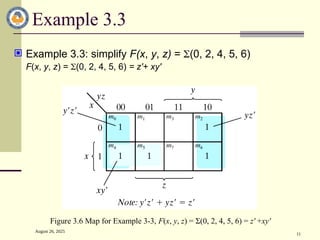
 Example 3.3: simplify F(x, y, z) = (0, 2, 4, 5, 6)
 F(x, y, z) = (0, 2, 4, 5, 6) = z'+ xy'
Figure 3.6 Map for Example 3-3, F(x, y, z) = Σ(0, 2, 4, 5, 6) = z' +xy'
August 26, 2025
12
Example 3.4
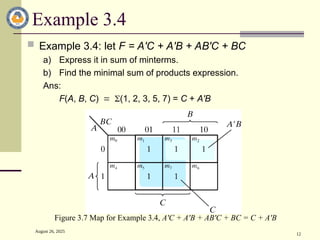
 Example 3.4: let F = A'C + A'B + AB'C + BC
a) Express it in sum of minterms.
b) Find the minimal sum of products expression.
Ans:
F(A, B, C)(1, 2, 3, 5, 7) = C + A'B
Figure 3.7 Map for Example 3.4, A'C + A'B + AB'C + BC = C + A'B
August 26, 2025
13
3.3 Four-Variable Map
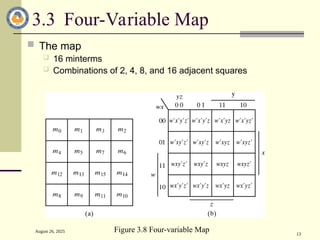
 The map
 16 minterms
 Combinations of 2, 4, 8, and 16 adjacent squares
Figure 3.8 Four-variable Map
August 26, 2025
14
Example 3.5
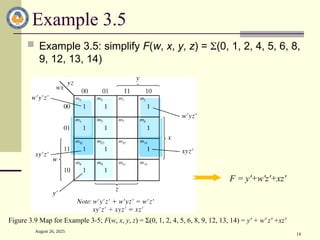
 Example 3.5: simplify F(w, x, y, z) = (0, 1, 2, 4, 5, 6, 8,
9, 12, 13, 14)
F = y'+w'z'+xz'
Figure 3.9 Map for Example 3-5; F(w, x, y, z) = Σ(0, 1, 2, 4, 5, 6, 8, 9, 12, 13, 14) = y' + w' z' +xz'
August 26, 2025
15
Example 3.6
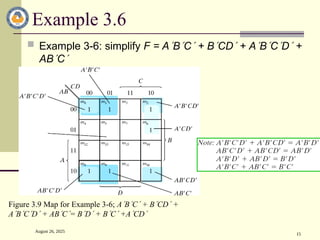
 Example 3-6: simplify F = ABC + BCD + ABCD +
ABC
Figure 3.9 Map for Example 3-6; ABC + BCD +
ABCD + ABC= BD + BC +ACD
August 26, 2025
16
Prime Implicants
 Prime Implicants
 All the minterms are covered.
 Minimize the number of terms.
 A prime implicant: a product term obtained by combining the
maximum possible number of adjacent squares (combining all
possible maximum numbers of squares).
 Essential P.I.: a minterm is covered by only one prime
implicant.
 The essential P.I. must be included.
August 26, 2025
17
Prime Implicants
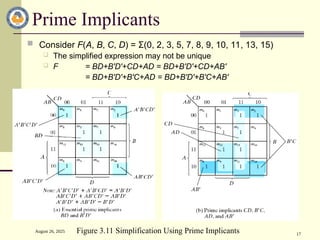
 Consider F(A, B, C, D) = Σ(0, 2, 3, 5, 7, 8, 9, 10, 11, 13, 15)
 The simplified expression may not be unique
 F = BD+B'D'+CD+AD = BD+B'D'+CD+AB'
= BD+B'D'+B'C+AD = BD+B'D'+B'C+AB'
Figure 3.11 Simplification Using Prime Implicants
August 26, 2025
18
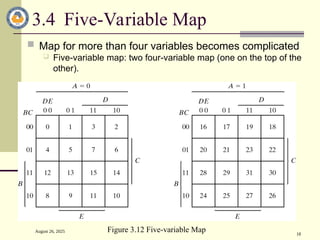
3.4 Five-Variable Map
 Map for more than four variables becomes complicated
 Five-variable map: two four-variable map (one on the top of the
other).
Figure 3.12 Five-variable Map
August 26, 2025
19
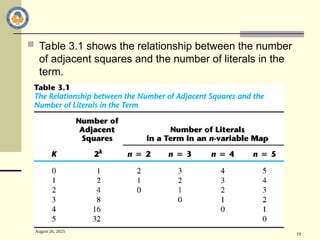
 Table 3.1 shows the relationship between the number
of adjacent squares and the number of literals in the
term.
August 26, 2025
20
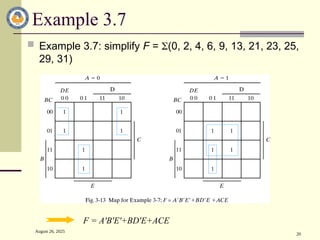
Example 3.7
 Example 3.7: simplify F = (0, 2, 4, 6, 9, 13, 21, 23, 25,
29, 31)
F = A'B'E'+BD'E+ACE
August 26, 2025
21
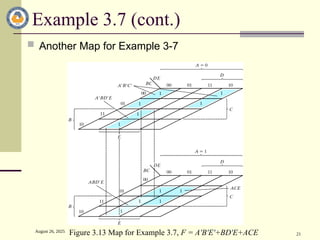
Example 3.7 (cont.)
 Another Map for Example 3-7
Figure 3.13 Map for Example 3.7, F = A'B'E'+BD'E+ACE
August 26, 2025
22
3-5 Product of Sums Simplification
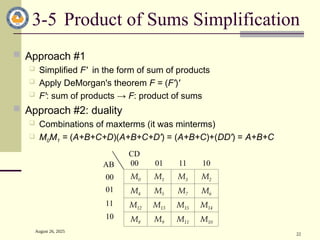
 Approach #1
 Simplified F' in the form of sum of products
 Apply DeMorgan's theorem F = (F')'
 F': sum of products → F: product of sums
 Approach #2: duality
 Combinations of maxterms (it was minterms)
 M0M1 = (A+B+C+D)(A+B+C+D') = (A+B+C)+(DD') = A+B+C
M0 M1 M3 M2
M4 M5 M7 M6
M12 M13 M15 M14
M8 M9 M11 M10
00
01
11
10
00 01 11 10
AB
CD
August 26, 2025
23
Example 3.8
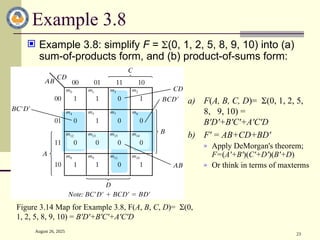
 Example 3.8: simplify F = (0, 1, 2, 5, 8, 9, 10) into (a)
sum-of-products form, and (b) product-of-sums form:
Figure 3.14 Map for Example 3.8, F(A, B, C, D)=(0,
1, 2, 5, 8, 9, 10) = B'D'+B'C'+A'C'D
a) F(A, B, C, D)=(0, 1, 2, 5,
8, 9, 10) =
B'D'+B'C'+A'C'D
b) F' = AB+CD+BD'
» Apply DeMorgan's theorem;
F=(A'+B')(C'+D')(B'+D)
» Or think in terms of maxterms
August 26, 2025
24
Example 3.8 (cont.)
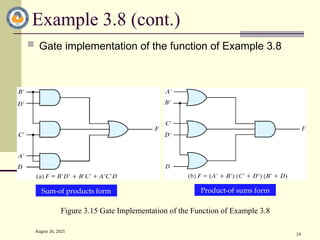
 Gate implementation of the function of Example 3.8
Figure 3.15 Gate Implementation of the Function of Example 3.8
Product-of sums form
Sum-of products form
August 26, 2025
25
Sum-of-Minterm Procedure
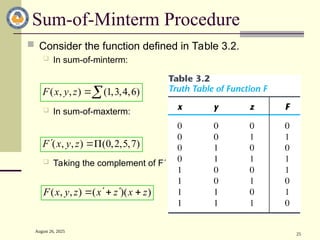
 Consider the function defined in Table 3.2.
 In sum-of-minterm:
 In sum-of-maxterm:
 Taking the complement of F
( , , ) (1,3,4,6)
F x y z 
( , , ) (0,2,5,7)
F x y z
 
( , , ) ( )( )
F x y z x z x z
 
  
August 26, 2025
26
Sum-of-Minterm Procedure
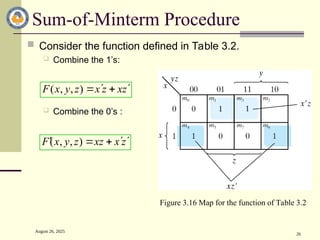
 Consider the function defined in Table 3.2.
 Combine the 1’s:
 Combine the 0’s :
( , , )
F x y z x z xz
 
 
( , , )
F x y z xz x z
 
 
Figure 3.16 Map for the function of Table 3.2
'
August 26, 2025
27
3-6 Don't-Care Conditions
 The value of a function is not specified for certain
combinations of variables
 BCD; 1010-1111: don't care
 The don't-care conditions can be utilized in logic
minimization
 Can be implemented as 0 or 1
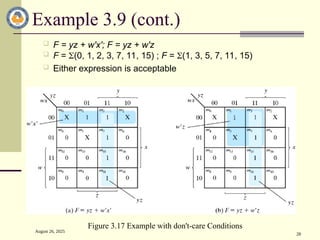
 Example 3.9: simplify F(w, x, y, z) = (1, 3, 7, 11, 15)
which has the don't-care conditions d(w, x, y, z) = (0,
2, 5).
August 26, 2025
28
Example 3.9 (cont.)
 F = yz + w'x'; F = yz + w'z
 F = (0, 1, 2, 3, 7, 11, 15) ; F = (1, 3, 5, 7, 11, 15)
 Either expression is acceptable
Figure 3.17 Example with don't-care Conditions
August 26, 2025
29
3-7 NAND and NOR Implementation
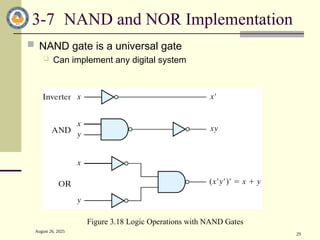
 NAND gate is a universal gate
 Can implement any digital system
Figure 3.18 Logic Operations with NAND Gates
August 26, 2025
30
NAND Gate
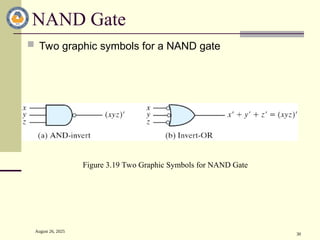
 Two graphic symbols for a NAND gate
Figure 3.19 Two Graphic Symbols for NAND Gate
August 26, 2025
31
Two-level Implementation
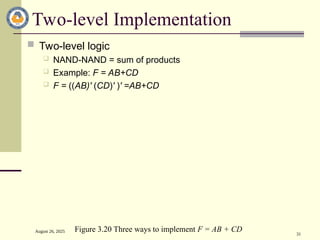
 Two-level logic
 NAND-NAND = sum of products
 Example: F = AB+CD
 F = ((AB)' (CD)' )' =AB+CD
Figure 3.20 Three ways to implement F = AB + CD
August 26, 2025
32
Example 3.10
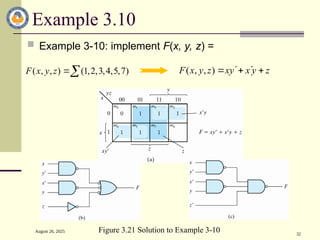
 Example 3-10: implement F(x, y, z) =
( , , ) (1,2,3,4,5,7)
F x y z  ( , , )
F x y z xy x y z
 
  
Figure 3.21 Solution to Example 3-10
August 26, 2025
33
Procedure with Two Levels NAND
 The procedure
 Simplified in the form of sum of products;
 A NAND gate for each product term; the inputs to each NAND
gate are the literals of the term (the first level);
 A single NAND gate for the second sum term (the second
level);
 A term with a single literal requires an inverter in the first level.
August 26, 2025
34
Multilevel NAND Circuits
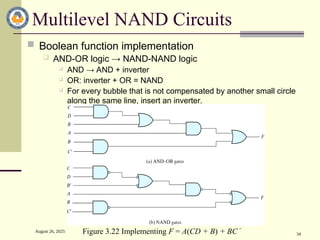
 Boolean function implementation
 AND-OR logic → NAND-NAND logic
 AND → AND + inverter
 OR: inverter + OR = NAND
 For every bubble that is not compensated by another small circle
along the same line, insert an inverter.
Figure 3.22 Implementing F = A(CD + B) + BC
August 26, 2025
35
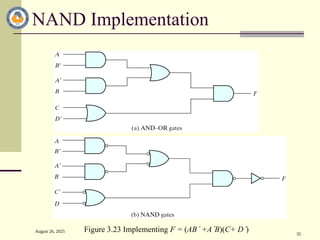
NAND Implementation
Figure 3.23 Implementing F = (AB +AB)(C+ D)
August 26, 2025
36
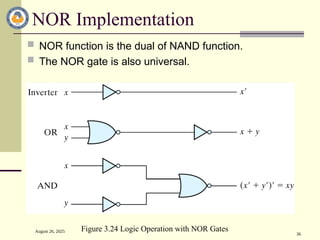
NOR Implementation
 NOR function is the dual of NAND function.
 The NOR gate is also universal.
Figure 3.24 Logic Operation with NOR Gates
August 26, 2025
37
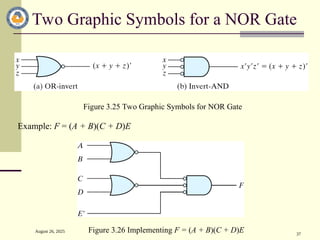
Two Graphic Symbols for a NOR Gate
Example: F = (A + B)(C + D)E
Figure 3.26 Implementing F = (A + B)(C + D)E
Figure 3.25 Two Graphic Symbols for NOR Gate
August 26, 2025
38
Example
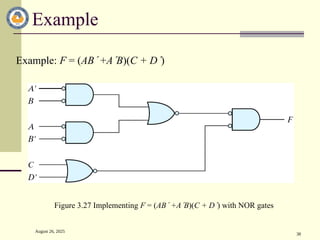
Example: F = (AB +AB)(C + D)
Figure 3.27 Implementing F = (AB +AB)(C + D) with NOR gates
August 26, 2025
39
3-8 Other Two-level Implementations (
 Wired logic
 A wire connection between the outputs of two gates
 Open-collector TTL NAND gates: wired-AND logic
 The NOR output of ECL gates: wired-OR logic
( ) ( ) ( ) ( )( )
( ) ( ) [( )( )]
F AB CD AB CD A B C D
F A B C D A B C D
      
      
  
      
AND-OR-INVERT function
OR-AND-INVERT function
Figure 3.28 Wired Logic
August 26, 2025
40
Non-degenerate Forms
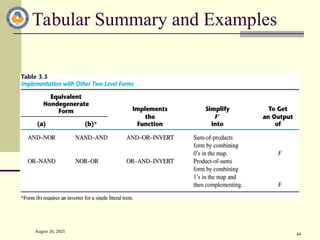
 16 possible combinations of two-level forms
 Eight of them: degenerate forms = a single operation
 AND-AND, AND-NAND, OR-OR, OR-NOR, NAND-OR, NAND-
NOR, NOR-AND, NOR-NAND.
 The eight non-degenerate forms
 AND-OR, OR-AND, NAND-NAND, NOR-NOR, NOR-OR, NAND-
AND, OR-NAND, AND-NOR.
 AND-OR and NAND-NAND = sum of products.
 OR-AND and NOR-NOR = product of sums.
 NOR-OR, NAND-AND, OR-NAND, AND-NOR = ?
August 26, 2025
41
AND-OR-Invert Implementation
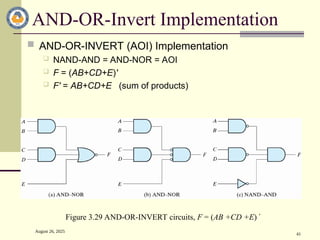
 AND-OR-INVERT (AOI) Implementation
 NAND-AND = AND-NOR = AOI
 F = (AB+CD+E)'
 F' = AB+CD+E (sum of products)
Figure 3.29 AND-OR-INVERT circuits, F = (AB +CD +E)
August 26, 2025
42
OR-AND-Invert Implementation
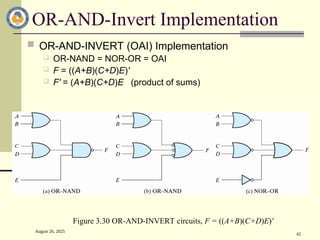
 OR-AND-INVERT (OAI) Implementation
 OR-NAND = NOR-OR = OAI
 F = ((A+B)(C+D)E)'
 F' = (A+B)(C+D)E (product of sums)
Figure 3.30 OR-AND-INVERT circuits, F = ((A+B)(C+D)E)'
August 26, 2025
43
Tabular Summary and Examples
 Example 3-11: F = x'y'z'+xyz'
 F' = x'y+xy'+z (F': sum of products)
 F = (x'y+xy'+z)' (F: AOI implementation)
 F = x'y'z' + xyz' (F: sum of products)
 F' = (x+y+z)(x'+y'+z) (F': product of sums)
 F = ((x+y+z)(x'+y'+z))' (F: OAI)
August 26, 2025
44
Tabular Summary and Examples
August 26, 2025
45
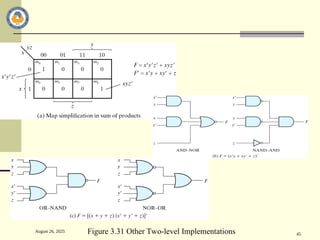
Figure 3.31 Other Two-level Implementations
August 26, 2025
46
3-9 Exclusive-OR Function
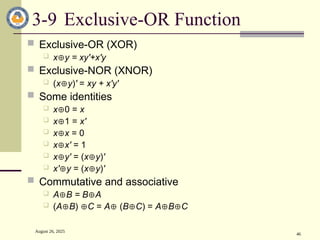
 Exclusive-OR (XOR)
 xy = xy'+x'y
 Exclusive-NOR (XNOR)
 (xy)' = xy + x'y'
 Some identities
 x0 = x
 x1 = x'
 xx = 0
 xx' = 1
 xy' = (xy)'
 x'y = (xy)'
 Commutative and associative
 AB = BA
 (AB) C = A (BC) = ABC
August 26, 2025
47
Exclusive-OR Implementations
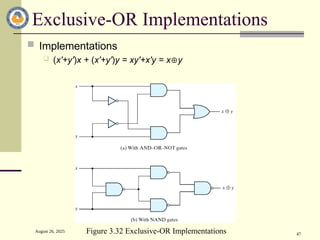
 Implementations
 (x'+y')x + (x'+y')y = xy'+x'y = xy
Figure 3.32 Exclusive-OR Implementations
August 26, 2025
48
Odd Function
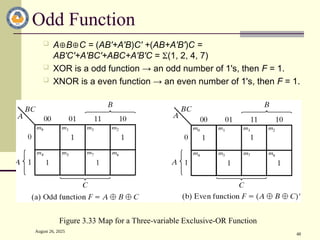
 ABC = (AB'+A'B)C' +(AB+A'B')C =
AB'C'+A'BC'+ABC+A'B'C = (1, 2, 4, 7)
 XOR is a odd function → an odd number of 1's, then F = 1.
 XNOR is a even function → an even number of 1's, then F = 1.
Figure 3.33 Map for a Three-variable Exclusive-OR Function
August 26, 2025
49
XOR and XNOR
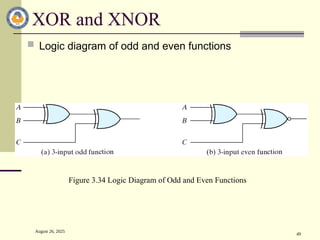
 Logic diagram of odd and even functions
Figure 3.34 Logic Diagram of Odd and Even Functions
August 26, 2025
50
Four-variable Exclusive-OR
function
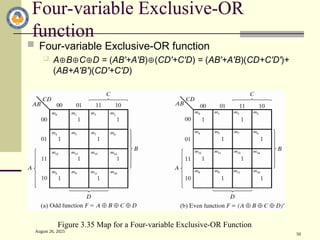
 Four-variable Exclusive-OR function
 ABCD = (AB'+A'B)(CD'+C'D) = (AB'+A'B)(CD+C'D')+
(AB+A'B')(CD'+C'D)
Figure 3.35 Map for a Four-variable Exclusive-OR Function
August 26, 2025
51
Parity Generation and Checking
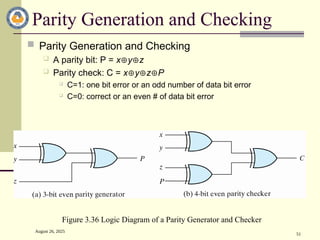
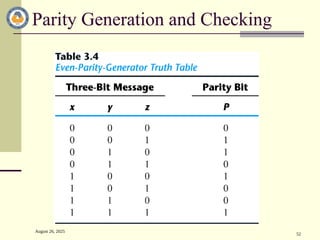
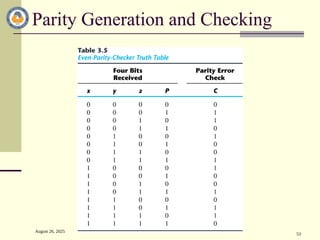
 Parity Generation and Checking
 A parity bit: P = xyz
 Parity check: C = xyzP
 C=1: one bit error or an odd number of data bit error
 C=0: correct or an even # of data bit error
Figure 3.36 Logic Diagram of a Parity Generator and Checker
August 26, 2025
52
Parity Generation and Checking
August 26, 2025
53
Parity Generation and Checking
August 26, 2025
54
3.10Hardware Description Language
(HDL)
 Describe the design of digital systems in a textual form
 Hardware structure
 Function/behavior
 Timing
 VHDL and Verilog HDL
August 26, 2025
55
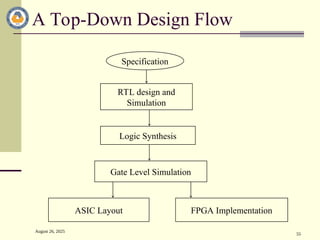
A Top-Down Design Flow
Specification
RTL design and
Simulation
Logic Synthesis
Gate Level Simulation
ASIC Layout FPGA Implementation
August 26, 2025
56
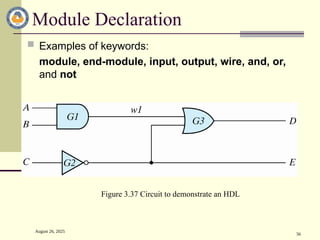
Module Declaration
 Examples of keywords:
module, end-module, input, output, wire, and, or,
and not
Figure 3.37 Circuit to demonstrate an HDL
August 26, 2025
57
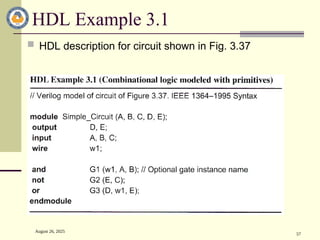
HDL Example 3.1
 HDL description for circuit shown in Fig. 3.37
August 26, 2025
58
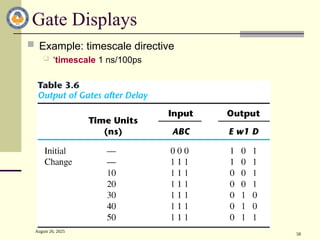
Gate Displays
 Example: timescale directive
 ‘timescale 1 ns/100ps
August 26, 2025
59
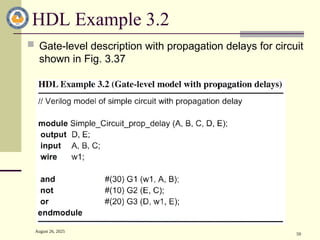
HDL Example 3.2
 Gate-level description with propagation delays for circuit
shown in Fig. 3.37
August 26, 2025
60
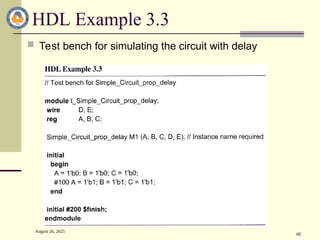
HDL Example 3.3
 Test bench for simulating the circuit with delay
August 26, 2025
61
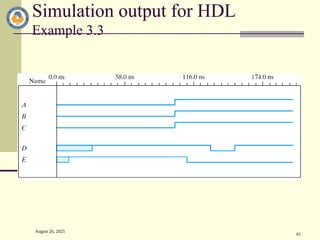
Simulation output for HDL
Example 3.3
August 26, 2025
62
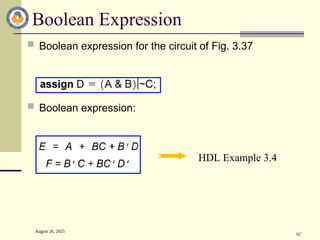
Boolean Expression
 Boolean expression for the circuit of Fig. 3.37
 Boolean expression:
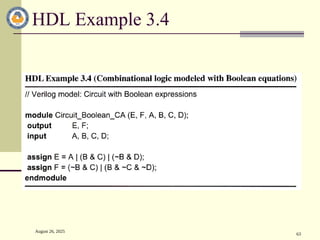
HDL Example 3.4
August 26, 2025
63
HDL Example 3.4
August 26, 2025
64
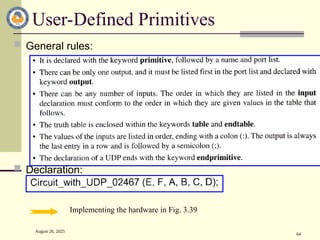
User-Defined Primitives
 General rules:
 Declaration:
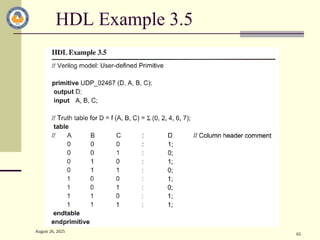
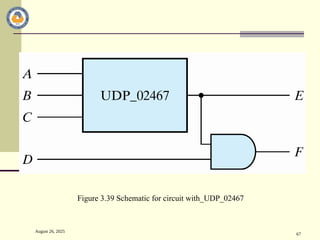
Implementing the hardware in Fig. 3.39
August 26, 2025
65
HDL Example 3.5
August 26, 2025
66
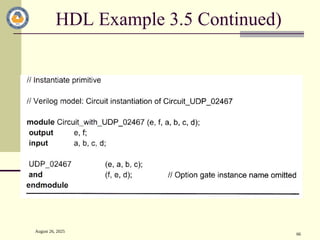
HDL Example 3.5 Continued)
August 26, 2025
67
Figure 3.39 Schematic for circuit with_UDP_02467

Logic Gate Level Minimization techniques

  • 1.
    August 26, 2025EASTERN MEDITERRANEAN UNIVERSITY 1 Digital Logic Design I Gate-Level Minimization Mustafa Kemal Uyguroğlu
  • 2.
    August 26, 2025 2 3-1Introduction  Gate-level minimization refers to the design task of finding an optimal gate-level implementation of Boolean functions describing a digital circuit.
  • 3.
    August 26, 2025 3 3-2The Map Method  The complexity of the digital logic gates  The complexity of the algebraic expression  Logic minimization  Algebraic approaches: lack specific rules  The Karnaugh map  A simple straight forward procedure  A pictorial form of a truth table  Applicable if the # of variables < 7  A diagram made up of squares  Each square represents one minterm
  • 4.
    August 26, 2025 4 Reviewof Boolean Function  Boolean function  Sum of minterms  Sum of products (or product of sum) in the simplest form  A minimum number of terms  A minimum number of literals  The simplified expression may not be unique
  • 5.
    August 26, 2025 5 Two-VariableMap  A two-variable map  Four minterms  x' = row 0; x = row 1  y' = column 0; y = column 1  A truth table in square diagram  Fig. 3.2(a): xy = m3  Fig. 3.2(b): x+y = x'y+xy' +xy = m1+m2+m3 Figure 3.2 Representation of functions in the map Figure 3.1 Two-variable Map
  • 6.
    August 26, 2025 6 AThree-variable Map  A three-variable map  Eight minterms  The Gray code sequence  Any two adjacent squares in the map differ by only on variable  Primed in one square and unprimed in the other  e.g., m5 and m7 can be simplified  m5+ m7 = xy'z + xyz = xz (y'+y) = xz Figure 3.3 Three-variable Map
  • 7.
    August 26, 2025 7 AThree-variable Map  m0 and m2 (m4 and m6) are adjacent  m0+ m2 = x'y'z' + x'yz' = x'z' (y'+y) = x'z'  m4+ m6 = xy'z' + xyz' = xz' (y'+y) = xz'
  • 8.
    August 26, 2025 8 Example3.1  Example 3.1: simplify the Boolean function F(x, y, z) = (2, 3, 4, 5)  F(x, y, z) = (2, 3, 4, 5) = x'y + xy' Figure 3.4 Map for Example 3.1, F(x, y, z) = Σ(2, 3, 4, 5) = x'y + xy'
  • 9.
    August 26, 2025 9 Example3.2  Example 3.2: simplify F(x, y, z) = (3, 4, 6, 7)  F(x, y, z) = (3, 4, 6, 7) = yz+ xz' Figure 3.5 Map for Example 3-2; F(x, y, z) = Σ(3, 4, 6, 7) = yz + xz'
  • 10.
    August 26, 2025 10 Fouradjacent Squares  Consider four adjacent squares  2, 4, and 8 squares  m0+m2+m4+m6 = x'y'z'+x'yz'+xy'z'+xyz' = x'z'(y'+y) +xz'(y'+y) = x'z' + xz‘ = z'  m1+m3+m5+m7 = x'y'z+x'yz+xy'z+xyz =x'z(y'+y) + xz(y'+y) =x'z + xz = z Figure 3.3 Three-variable Map
  • 11.
    August 26, 2025 11 Example3.3  Example 3.3: simplify F(x, y, z) = (0, 2, 4, 5, 6)  F(x, y, z) = (0, 2, 4, 5, 6) = z'+ xy' Figure 3.6 Map for Example 3-3, F(x, y, z) = Σ(0, 2, 4, 5, 6) = z' +xy'
  • 12.
    August 26, 2025 12 Example3.4  Example 3.4: let F = A'C + A'B + AB'C + BC a) Express it in sum of minterms. b) Find the minimal sum of products expression. Ans: F(A, B, C)(1, 2, 3, 5, 7) = C + A'B Figure 3.7 Map for Example 3.4, A'C + A'B + AB'C + BC = C + A'B
  • 13.
    August 26, 2025 13 3.3Four-Variable Map  The map  16 minterms  Combinations of 2, 4, 8, and 16 adjacent squares Figure 3.8 Four-variable Map
  • 14.
    August 26, 2025 14 Example3.5  Example 3.5: simplify F(w, x, y, z) = (0, 1, 2, 4, 5, 6, 8, 9, 12, 13, 14) F = y'+w'z'+xz' Figure 3.9 Map for Example 3-5; F(w, x, y, z) = Σ(0, 1, 2, 4, 5, 6, 8, 9, 12, 13, 14) = y' + w' z' +xz'
  • 15.
    August 26, 2025 15 Example3.6  Example 3-6: simplify F = ABC + BCD + ABCD + ABC Figure 3.9 Map for Example 3-6; ABC + BCD + ABCD + ABC= BD + BC +ACD
  • 16.
    August 26, 2025 16 PrimeImplicants  Prime Implicants  All the minterms are covered.  Minimize the number of terms.  A prime implicant: a product term obtained by combining the maximum possible number of adjacent squares (combining all possible maximum numbers of squares).  Essential P.I.: a minterm is covered by only one prime implicant.  The essential P.I. must be included.
  • 17.
    August 26, 2025 17 PrimeImplicants  Consider F(A, B, C, D) = Σ(0, 2, 3, 5, 7, 8, 9, 10, 11, 13, 15)  The simplified expression may not be unique  F = BD+B'D'+CD+AD = BD+B'D'+CD+AB' = BD+B'D'+B'C+AD = BD+B'D'+B'C+AB' Figure 3.11 Simplification Using Prime Implicants
  • 18.
    August 26, 2025 18 3.4Five-Variable Map  Map for more than four variables becomes complicated  Five-variable map: two four-variable map (one on the top of the other). Figure 3.12 Five-variable Map
  • 19.
    August 26, 2025 19 Table 3.1 shows the relationship between the number of adjacent squares and the number of literals in the term.
  • 20.
    August 26, 2025 20 Example3.7  Example 3.7: simplify F = (0, 2, 4, 6, 9, 13, 21, 23, 25, 29, 31) F = A'B'E'+BD'E+ACE
  • 21.
    August 26, 2025 21 Example3.7 (cont.)  Another Map for Example 3-7 Figure 3.13 Map for Example 3.7, F = A'B'E'+BD'E+ACE
  • 22.
    August 26, 2025 22 3-5Product of Sums Simplification  Approach #1  Simplified F' in the form of sum of products  Apply DeMorgan's theorem F = (F')'  F': sum of products → F: product of sums  Approach #2: duality  Combinations of maxterms (it was minterms)  M0M1 = (A+B+C+D)(A+B+C+D') = (A+B+C)+(DD') = A+B+C M0 M1 M3 M2 M4 M5 M7 M6 M12 M13 M15 M14 M8 M9 M11 M10 00 01 11 10 00 01 11 10 AB CD
  • 23.
    August 26, 2025 23 Example3.8  Example 3.8: simplify F = (0, 1, 2, 5, 8, 9, 10) into (a) sum-of-products form, and (b) product-of-sums form: Figure 3.14 Map for Example 3.8, F(A, B, C, D)=(0, 1, 2, 5, 8, 9, 10) = B'D'+B'C'+A'C'D a) F(A, B, C, D)=(0, 1, 2, 5, 8, 9, 10) = B'D'+B'C'+A'C'D b) F' = AB+CD+BD' » Apply DeMorgan's theorem; F=(A'+B')(C'+D')(B'+D) » Or think in terms of maxterms
  • 24.
    August 26, 2025 24 Example3.8 (cont.)  Gate implementation of the function of Example 3.8 Figure 3.15 Gate Implementation of the Function of Example 3.8 Product-of sums form Sum-of products form
  • 25.
    August 26, 2025 25 Sum-of-MintermProcedure  Consider the function defined in Table 3.2.  In sum-of-minterm:  In sum-of-maxterm:  Taking the complement of F ( , , ) (1,3,4,6) F x y z  ( , , ) (0,2,5,7) F x y z   ( , , ) ( )( ) F x y z x z x z     
  • 26.
    August 26, 2025 26 Sum-of-MintermProcedure  Consider the function defined in Table 3.2.  Combine the 1’s:  Combine the 0’s : ( , , ) F x y z x z xz     ( , , ) F x y z xz x z     Figure 3.16 Map for the function of Table 3.2 '
  • 27.
    August 26, 2025 27 3-6Don't-Care Conditions  The value of a function is not specified for certain combinations of variables  BCD; 1010-1111: don't care  The don't-care conditions can be utilized in logic minimization  Can be implemented as 0 or 1  Example 3.9: simplify F(w, x, y, z) = (1, 3, 7, 11, 15) which has the don't-care conditions d(w, x, y, z) = (0, 2, 5).
  • 28.
    August 26, 2025 28 Example3.9 (cont.)  F = yz + w'x'; F = yz + w'z  F = (0, 1, 2, 3, 7, 11, 15) ; F = (1, 3, 5, 7, 11, 15)  Either expression is acceptable Figure 3.17 Example with don't-care Conditions
  • 29.
    August 26, 2025 29 3-7NAND and NOR Implementation  NAND gate is a universal gate  Can implement any digital system Figure 3.18 Logic Operations with NAND Gates
  • 30.
    August 26, 2025 30 NANDGate  Two graphic symbols for a NAND gate Figure 3.19 Two Graphic Symbols for NAND Gate
  • 31.
    August 26, 2025 31 Two-levelImplementation  Two-level logic  NAND-NAND = sum of products  Example: F = AB+CD  F = ((AB)' (CD)' )' =AB+CD Figure 3.20 Three ways to implement F = AB + CD
  • 32.
    August 26, 2025 32 Example3.10  Example 3-10: implement F(x, y, z) = ( , , ) (1,2,3,4,5,7) F x y z  ( , , ) F x y z xy x y z      Figure 3.21 Solution to Example 3-10
  • 33.
    August 26, 2025 33 Procedurewith Two Levels NAND  The procedure  Simplified in the form of sum of products;  A NAND gate for each product term; the inputs to each NAND gate are the literals of the term (the first level);  A single NAND gate for the second sum term (the second level);  A term with a single literal requires an inverter in the first level.
  • 34.
    August 26, 2025 34 MultilevelNAND Circuits  Boolean function implementation  AND-OR logic → NAND-NAND logic  AND → AND + inverter  OR: inverter + OR = NAND  For every bubble that is not compensated by another small circle along the same line, insert an inverter. Figure 3.22 Implementing F = A(CD + B) + BC
  • 35.
    August 26, 2025 35 NANDImplementation Figure 3.23 Implementing F = (AB +AB)(C+ D)
  • 36.
    August 26, 2025 36 NORImplementation  NOR function is the dual of NAND function.  The NOR gate is also universal. Figure 3.24 Logic Operation with NOR Gates
  • 37.
    August 26, 2025 37 TwoGraphic Symbols for a NOR Gate Example: F = (A + B)(C + D)E Figure 3.26 Implementing F = (A + B)(C + D)E Figure 3.25 Two Graphic Symbols for NOR Gate
  • 38.
    August 26, 2025 38 Example Example:F = (AB +AB)(C + D) Figure 3.27 Implementing F = (AB +AB)(C + D) with NOR gates
  • 39.
    August 26, 2025 39 3-8Other Two-level Implementations (  Wired logic  A wire connection between the outputs of two gates  Open-collector TTL NAND gates: wired-AND logic  The NOR output of ECL gates: wired-OR logic ( ) ( ) ( ) ( )( ) ( ) ( ) [( )( )] F AB CD AB CD A B C D F A B C D A B C D                         AND-OR-INVERT function OR-AND-INVERT function Figure 3.28 Wired Logic
  • 40.
    August 26, 2025 40 Non-degenerateForms  16 possible combinations of two-level forms  Eight of them: degenerate forms = a single operation  AND-AND, AND-NAND, OR-OR, OR-NOR, NAND-OR, NAND- NOR, NOR-AND, NOR-NAND.  The eight non-degenerate forms  AND-OR, OR-AND, NAND-NAND, NOR-NOR, NOR-OR, NAND- AND, OR-NAND, AND-NOR.  AND-OR and NAND-NAND = sum of products.  OR-AND and NOR-NOR = product of sums.  NOR-OR, NAND-AND, OR-NAND, AND-NOR = ?
  • 41.
    August 26, 2025 41 AND-OR-InvertImplementation  AND-OR-INVERT (AOI) Implementation  NAND-AND = AND-NOR = AOI  F = (AB+CD+E)'  F' = AB+CD+E (sum of products) Figure 3.29 AND-OR-INVERT circuits, F = (AB +CD +E)
  • 42.
    August 26, 2025 42 OR-AND-InvertImplementation  OR-AND-INVERT (OAI) Implementation  OR-NAND = NOR-OR = OAI  F = ((A+B)(C+D)E)'  F' = (A+B)(C+D)E (product of sums) Figure 3.30 OR-AND-INVERT circuits, F = ((A+B)(C+D)E)'
  • 43.
    August 26, 2025 43 TabularSummary and Examples  Example 3-11: F = x'y'z'+xyz'  F' = x'y+xy'+z (F': sum of products)  F = (x'y+xy'+z)' (F: AOI implementation)  F = x'y'z' + xyz' (F: sum of products)  F' = (x+y+z)(x'+y'+z) (F': product of sums)  F = ((x+y+z)(x'+y'+z))' (F: OAI)
  • 44.
    August 26, 2025 44 TabularSummary and Examples
  • 45.
    August 26, 2025 45 Figure3.31 Other Two-level Implementations
  • 46.
    August 26, 2025 46 3-9Exclusive-OR Function  Exclusive-OR (XOR)  xy = xy'+x'y  Exclusive-NOR (XNOR)  (xy)' = xy + x'y'  Some identities  x0 = x  x1 = x'  xx = 0  xx' = 1  xy' = (xy)'  x'y = (xy)'  Commutative and associative  AB = BA  (AB) C = A (BC) = ABC
  • 47.
    August 26, 2025 47 Exclusive-ORImplementations  Implementations  (x'+y')x + (x'+y')y = xy'+x'y = xy Figure 3.32 Exclusive-OR Implementations
  • 48.
    August 26, 2025 48 OddFunction  ABC = (AB'+A'B)C' +(AB+A'B')C = AB'C'+A'BC'+ABC+A'B'C = (1, 2, 4, 7)  XOR is a odd function → an odd number of 1's, then F = 1.  XNOR is a even function → an even number of 1's, then F = 1. Figure 3.33 Map for a Three-variable Exclusive-OR Function
  • 49.
    August 26, 2025 49 XORand XNOR  Logic diagram of odd and even functions Figure 3.34 Logic Diagram of Odd and Even Functions
  • 50.
    August 26, 2025 50 Four-variableExclusive-OR function  Four-variable Exclusive-OR function  ABCD = (AB'+A'B)(CD'+C'D) = (AB'+A'B)(CD+C'D')+ (AB+A'B')(CD'+C'D) Figure 3.35 Map for a Four-variable Exclusive-OR Function
  • 51.
    August 26, 2025 51 ParityGeneration and Checking  Parity Generation and Checking  A parity bit: P = xyz  Parity check: C = xyzP  C=1: one bit error or an odd number of data bit error  C=0: correct or an even # of data bit error Figure 3.36 Logic Diagram of a Parity Generator and Checker
  • 52.
    August 26, 2025 52 ParityGeneration and Checking
  • 53.
    August 26, 2025 53 ParityGeneration and Checking
  • 54.
    August 26, 2025 54 3.10HardwareDescription Language (HDL)  Describe the design of digital systems in a textual form  Hardware structure  Function/behavior  Timing  VHDL and Verilog HDL
  • 55.
    August 26, 2025 55 ATop-Down Design Flow Specification RTL design and Simulation Logic Synthesis Gate Level Simulation ASIC Layout FPGA Implementation
  • 56.
    August 26, 2025 56 ModuleDeclaration  Examples of keywords: module, end-module, input, output, wire, and, or, and not Figure 3.37 Circuit to demonstrate an HDL
  • 57.
    August 26, 2025 57 HDLExample 3.1  HDL description for circuit shown in Fig. 3.37
  • 58.
    August 26, 2025 58 GateDisplays  Example: timescale directive  ‘timescale 1 ns/100ps
  • 59.
    August 26, 2025 59 HDLExample 3.2  Gate-level description with propagation delays for circuit shown in Fig. 3.37
  • 60.
    August 26, 2025 60 HDLExample 3.3  Test bench for simulating the circuit with delay
  • 61.
    August 26, 2025 61 Simulationoutput for HDL Example 3.3
  • 62.
    August 26, 2025 62 BooleanExpression  Boolean expression for the circuit of Fig. 3.37  Boolean expression: HDL Example 3.4
  • 63.
  • 64.
    August 26, 2025 64 User-DefinedPrimitives  General rules:  Declaration: Implementing the hardware in Fig. 3.39
  • 65.
  • 66.
    August 26, 2025 66 HDLExample 3.5 Continued)
  • 67.
    August 26, 2025 67 Figure3.39 Schematic for circuit with_UDP_02467