Valid Arguments in Propositional Logic
1 L Al-zaid Math1101
Argument
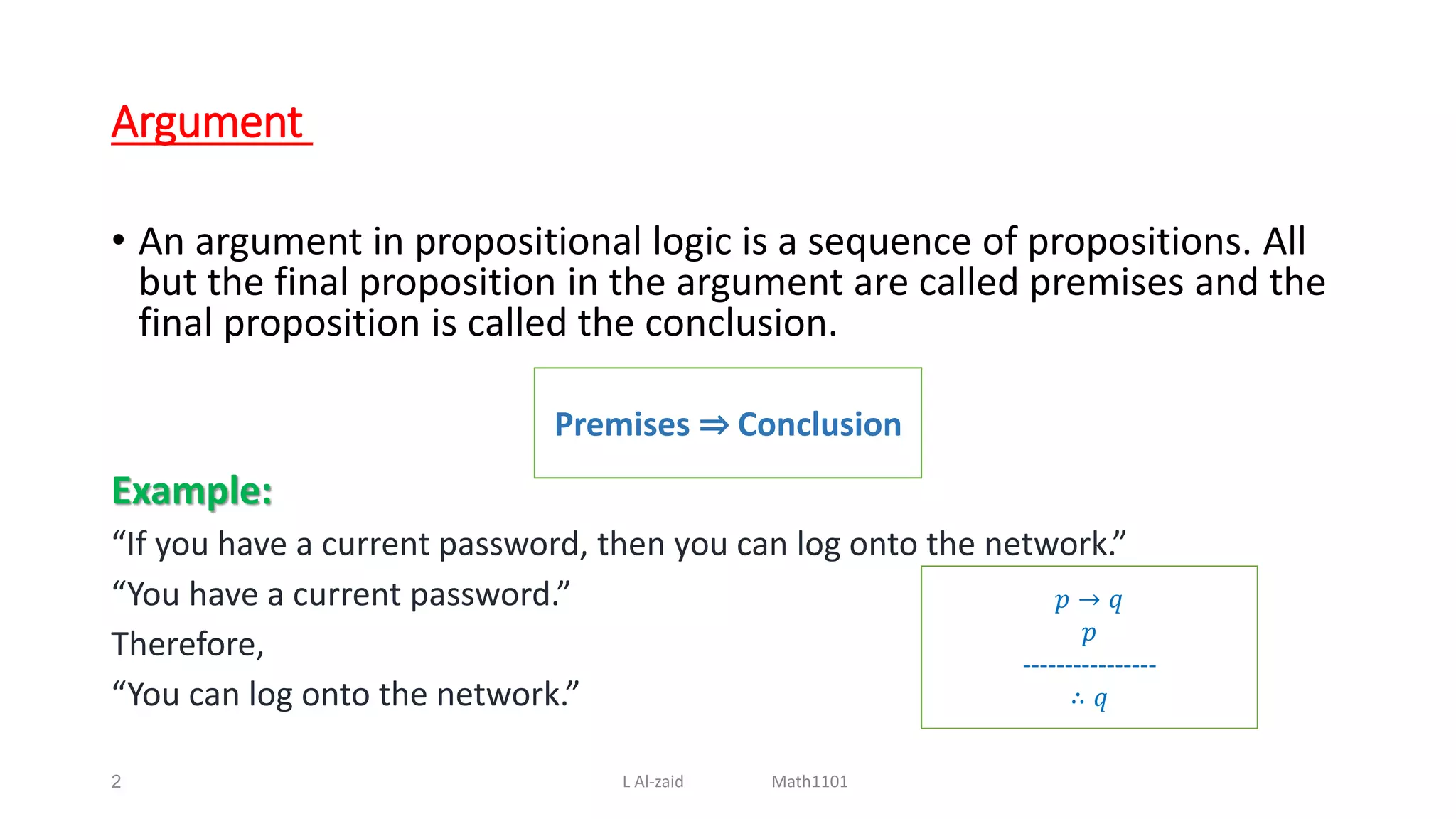
• An argument in propositional logic is a sequence of propositions. All
but the final proposition in the argument are called premises and the
final proposition is called the conclusion.
Example:
“If you have a current password, then you can log onto the network.”
“You have a current password.”
Therefore,
“You can log onto the network.”
2
Premises ⇒ Conclusion
𝑝 → 𝑞
𝑝
----------------
∴ 𝑞
L Al-zaid Math1101
• An argument is valid if the truth of all its premises implies that the
conclusion is true.
• An argument form in propositional logic is a sequence of compound
propositions involving propositional variables.
• An argument form is valid if no matter which particular propositions
are substituted for the propositional variables in its premises, the
conclusion is true if the premises are all true.
• The conclusion is true if the premises are all true.
3 L Al-zaid Math1101
Example:
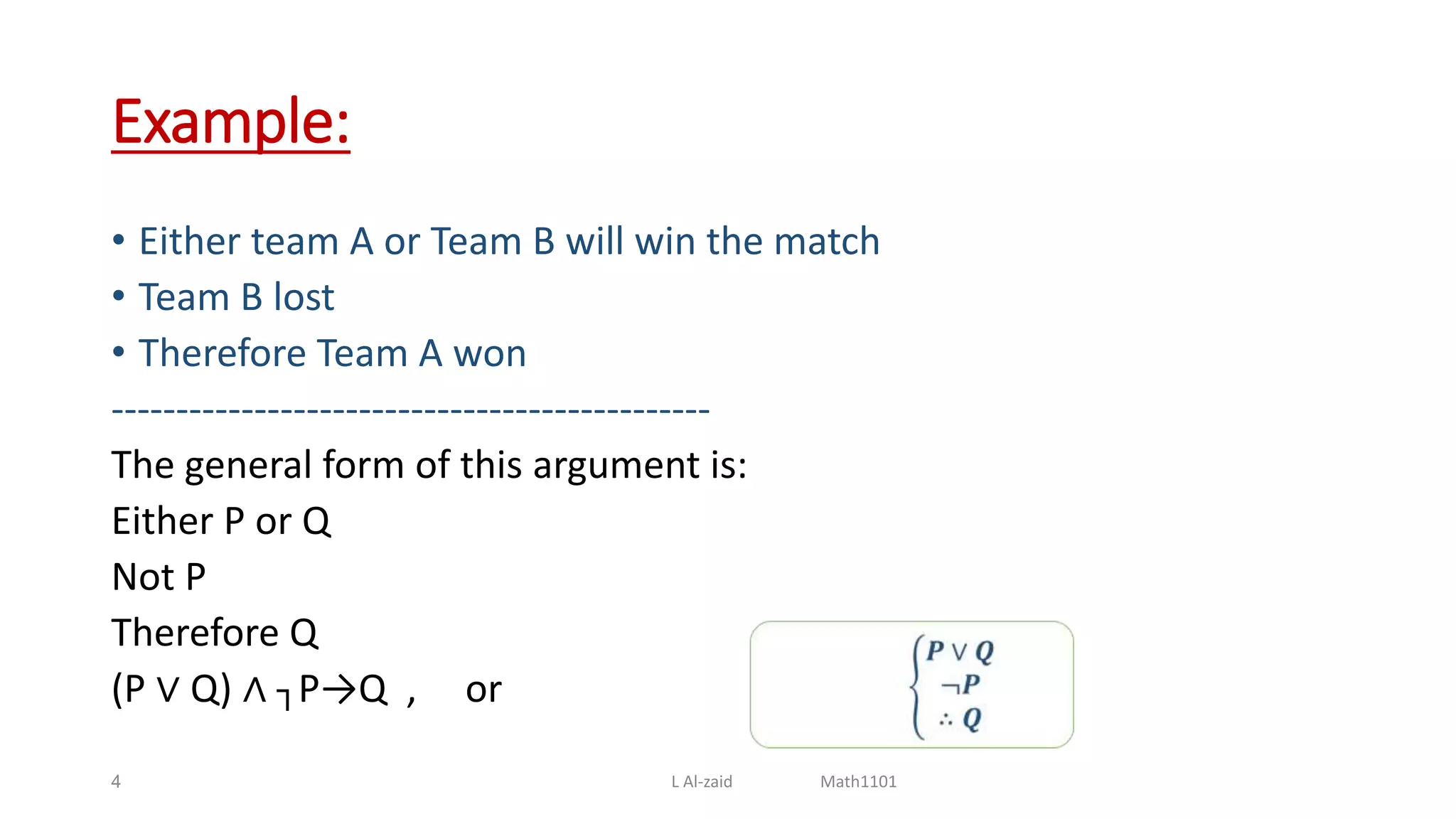
• Either team A or Team B will win the match
• Team B lost
• Therefore Team A won
----------------------------------------------
The general form of this argument is:
Either P or Q
Not P
Therefore Q
(P ∨ Q) ∧ ┐P→Q , or
4 L Al-zaid Math1101
Rules of Inference for Propositional Logic
• We can always use a truth table to show that an argument form is
valid. We do this by showing that whenever the premises are true,
the conclusion must also be true.
5 L Al-zaid Math1101
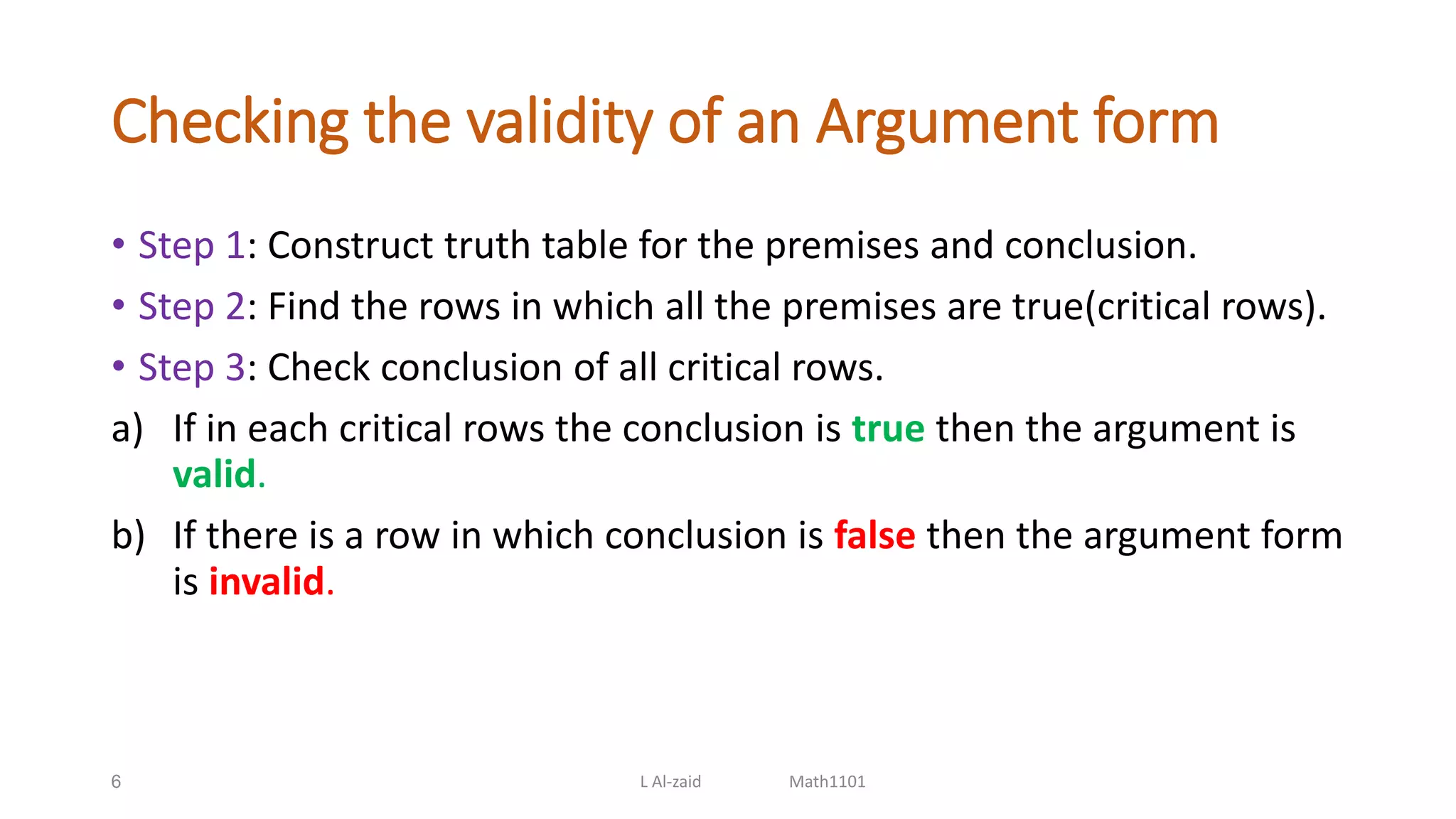
Checking the validity of an Argument form
• Step 1: Construct truth table for the premises and conclusion.
• Step 2: Find the rows in which all the premises are true(critical rows).
• Step 3: Check conclusion of all critical rows.
a) If in each critical rows the conclusion is true then the argument is
valid.
b) If there is a row in which conclusion is false then the argument form
is invalid.
6 L Al-zaid Math1101
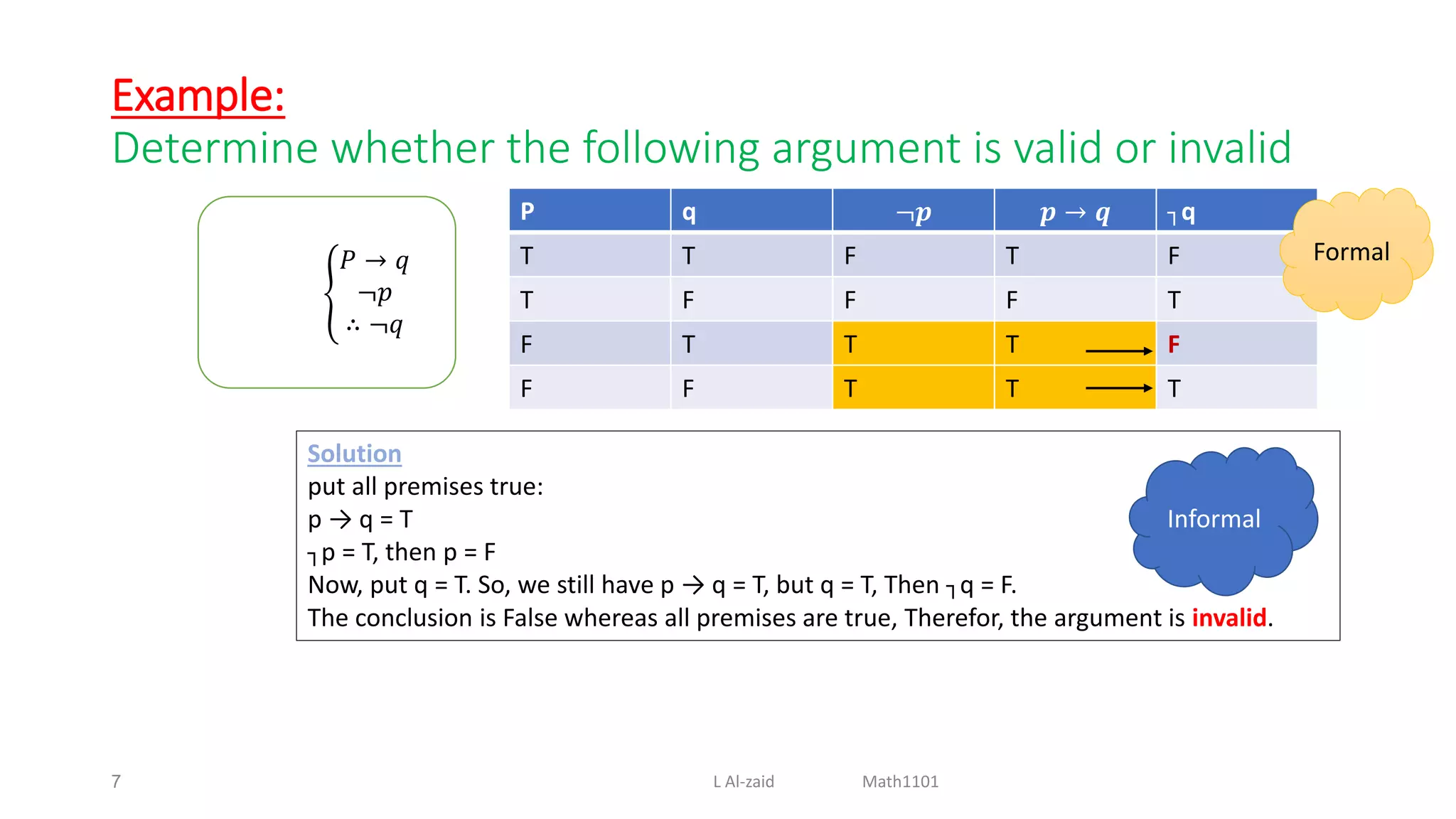
Example:
Determine whether the following argument is valid or invalid
7
𝑃 → 𝑞
¬𝑝
∴ ¬𝑞
q
┐
𝒑 → 𝒒
¬𝒑
q
P
F
T
F
T
T
T
F
F
F
T
F
T
T
T
F
T
T
T
F
F
Solution
put all premises true:
p → q = T
┐p = T, then p = F
Now, put q = T. So, we still have p → q = T, but q = T, Then ┐q = F.
The conclusion is False whereas all premises are true, Therefor, the argument is invalid.
Informal
Formal
L Al-zaid Math1101
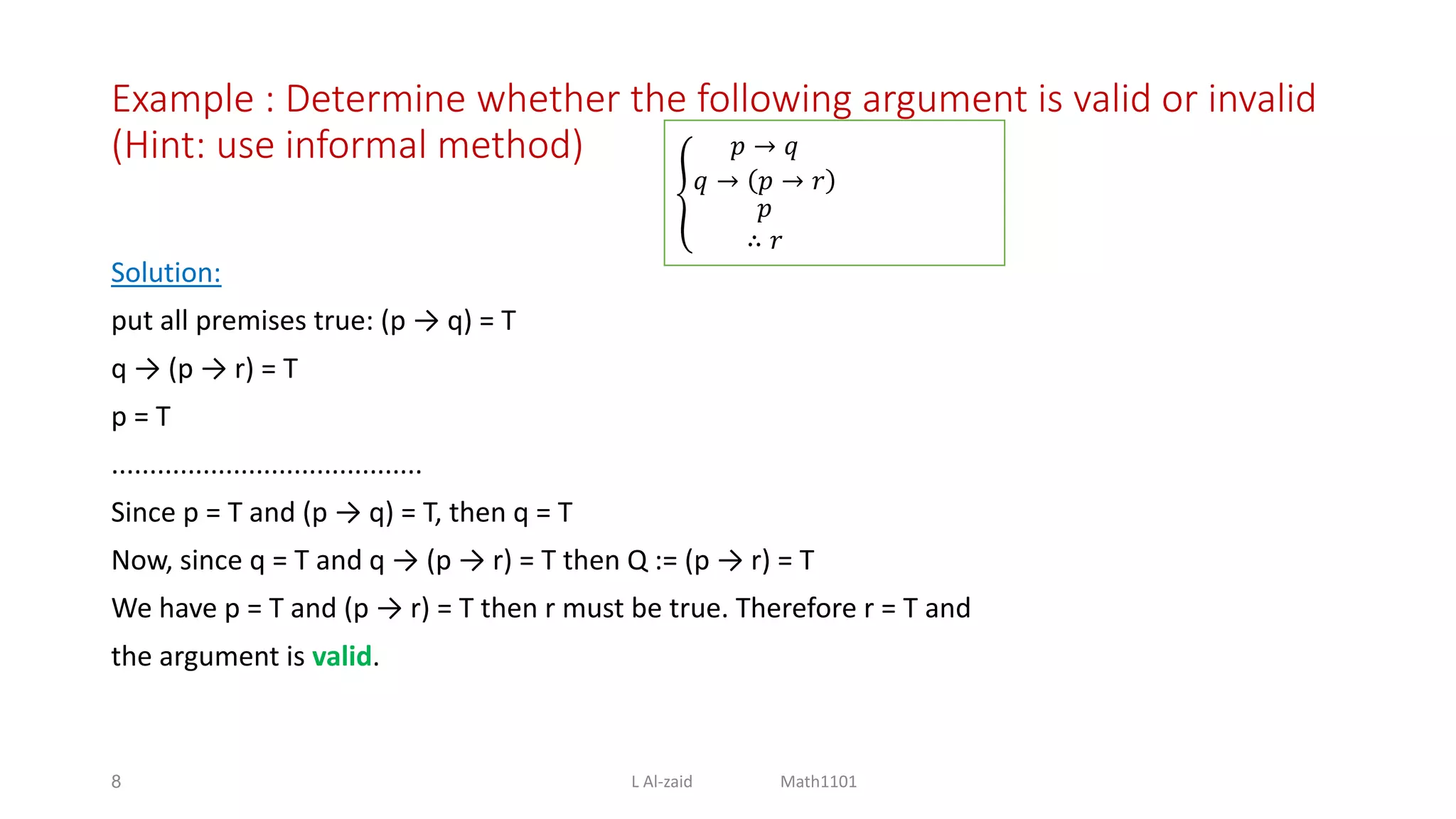
Example : Determine whether the following argument is valid or invalid
(Hint: use informal method)
Solution:
put all premises true: (p → q) = T
q → (p → r) = T
p = T
.........................................
Since p = T and (p → q) = T, then q = T
Now, since q = T and q → (p → r) = T then Q := (p → r) = T
We have p = T and (p → r) = T then r must be true. Therefore r = T and
the argument is valid.
8
𝑝 → 𝑞
𝑞 → 𝑝 → 𝑟
𝑝
∴ 𝑟
L Al-zaid Math1101
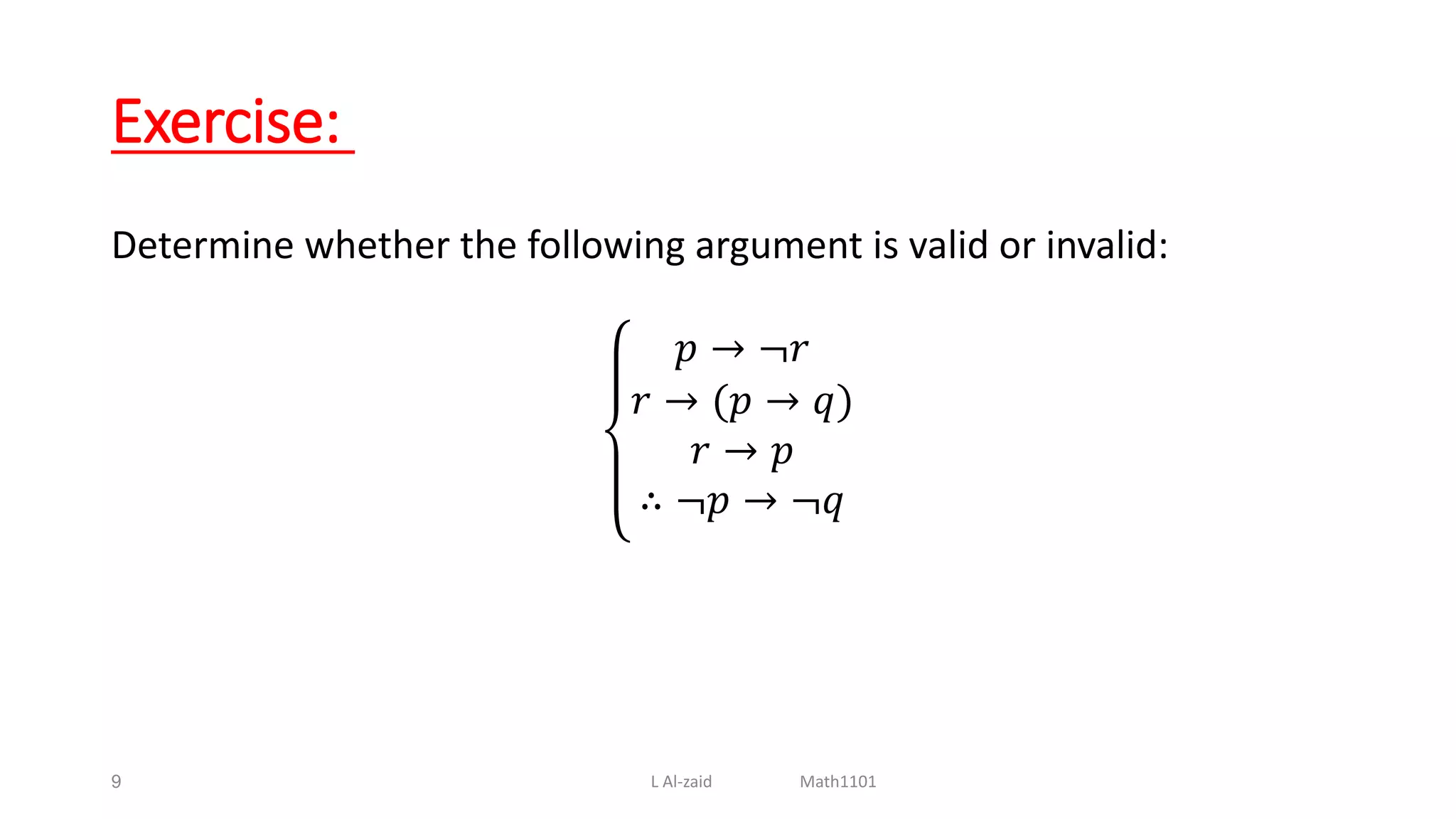
Exercise:
Determine whether the following argument is valid or invalid:
𝑝 → ¬𝑟
𝑟 → (𝑝 → 𝑞)
𝑟 → 𝑝
∴ ¬𝑝 → ¬𝑞
9 L Al-zaid Math1101

Logic 1

  • 1.
    Valid Arguments inPropositional Logic 1 L Al-zaid Math1101
  • 2.
    Argument • An argumentin propositional logic is a sequence of propositions. All but the final proposition in the argument are called premises and the final proposition is called the conclusion. Example: “If you have a current password, then you can log onto the network.” “You have a current password.” Therefore, “You can log onto the network.” 2 Premises ⇒ Conclusion 𝑝 → 𝑞 𝑝 ---------------- ∴ 𝑞 L Al-zaid Math1101
  • 3.
    • An argumentis valid if the truth of all its premises implies that the conclusion is true. • An argument form in propositional logic is a sequence of compound propositions involving propositional variables. • An argument form is valid if no matter which particular propositions are substituted for the propositional variables in its premises, the conclusion is true if the premises are all true. • The conclusion is true if the premises are all true. 3 L Al-zaid Math1101
  • 4.
    Example: • Either teamA or Team B will win the match • Team B lost • Therefore Team A won ---------------------------------------------- The general form of this argument is: Either P or Q Not P Therefore Q (P ∨ Q) ∧ ┐P→Q , or 4 L Al-zaid Math1101
  • 5.
    Rules of Inferencefor Propositional Logic • We can always use a truth table to show that an argument form is valid. We do this by showing that whenever the premises are true, the conclusion must also be true. 5 L Al-zaid Math1101
  • 6.
    Checking the validityof an Argument form • Step 1: Construct truth table for the premises and conclusion. • Step 2: Find the rows in which all the premises are true(critical rows). • Step 3: Check conclusion of all critical rows. a) If in each critical rows the conclusion is true then the argument is valid. b) If there is a row in which conclusion is false then the argument form is invalid. 6 L Al-zaid Math1101
  • 7.
    Example: Determine whether thefollowing argument is valid or invalid 7 𝑃 → 𝑞 ¬𝑝 ∴ ¬𝑞 q ┐ 𝒑 → 𝒒 ¬𝒑 q P F T F T T T F F F T F T T T F T T T F F Solution put all premises true: p → q = T ┐p = T, then p = F Now, put q = T. So, we still have p → q = T, but q = T, Then ┐q = F. The conclusion is False whereas all premises are true, Therefor, the argument is invalid. Informal Formal L Al-zaid Math1101
  • 8.
    Example : Determinewhether the following argument is valid or invalid (Hint: use informal method) Solution: put all premises true: (p → q) = T q → (p → r) = T p = T ......................................... Since p = T and (p → q) = T, then q = T Now, since q = T and q → (p → r) = T then Q := (p → r) = T We have p = T and (p → r) = T then r must be true. Therefore r = T and the argument is valid. 8 𝑝 → 𝑞 𝑞 → 𝑝 → 𝑟 𝑝 ∴ 𝑟 L Al-zaid Math1101
  • 9.
    Exercise: Determine whether thefollowing argument is valid or invalid: 𝑝 → ¬𝑟 𝑟 → (𝑝 → 𝑞) 𝑟 → 𝑝 ∴ ¬𝑝 → ¬𝑞 9 L Al-zaid Math1101