The Localization Industry: Past, Present and Future
Published in 2007!
The same can still be said today – 2014!
Disclaimer
• Subjektive nicht objektive Sicht.
• Lücken, nicht vollständig.
• Das Eine oder Andere ist vielleicht nicht richtig.
• Einige Folien habe ich von Jaap van der Meer geklaut.
Danke Jaap!
• Als Anstoß zum Weiterreden gedacht…
1950‘s Business Tools
1960‘s Revolution:
Computers for Companies
1980‘s Revolution:
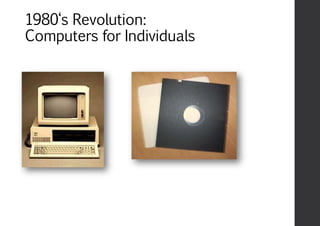
Computers for Individuals
1980‘s Revolution:
Privately Networked Computers
1990‘s Revolution: Publicly Networked
Computers, Web and Internet
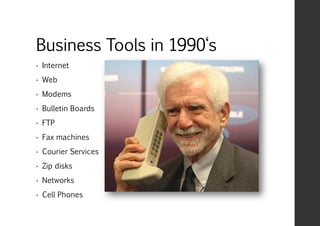
Business Tools in 1990‘s
• Internet
• Web
• Modems
• Bulletin Boards
• FTP
• Fax machines
• Courier Services
• Zip disks
• Networks
• Cell Phones
Business Tools in 2000‘s
• I do everything
(except cook…maybe next year!)
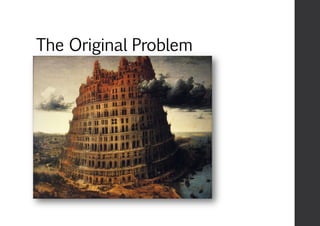
The Original Problem
An Early Solution (196 BC)
Famous Translators (note tools)
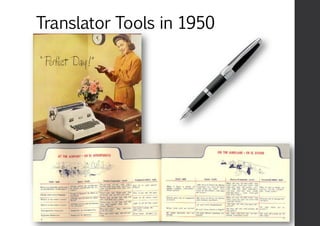
Translator Tools in 1950
Globalization Tools in 2000‘s
• Workflow Engine
• On demand MT and TM
• Speech recognition
• Portals
• Corpora
• GMS
• TMS
• GIM
• CMS
• XML
• SOA
• CRM
• XLIFF
1950-1980 Translation Industry
• Inhouse translation departments (IBM, DEC, XEROX, etc.)
• Little or no outsourcing
• No tools (well, mainframe word processors and SGML)
• Updates cut-and-paste on paper or manually retype
• DTP (typesetting) a separate, expensive science
• Local Translation Agencies with Freelancers for personal
documents
• Fax machines and modems were huge innovations!
1980-1993 INK leads the way
• 1980-Jaap van der Meer starts INK in Amsterdam, which
provided translation, writing and localization services
• 1987-INK develops its own computer-aided translation
software and dictionary management tools
• Quickly expands with offices all over Europe
• Becomes the blueprint for localization companies with
distributed offices and freelance translators and other
resources
• 1993-sold to R.R: Donnelley
The 90‘s Big 3, 4, 5, …
• US and European based
• Berlitz, Alpnet, INK, SDL, Lernout&Hauspie, Xerox
• Then Lionbridge, Bowne Global Solutions
• Now Asia: TOIN, watch out for India and China…
The 1990‘s – Dublin Becomes World
Software Localization Capital
• 1970‘s and 1980‘s Irish government provides great tax
incentives to foreign corporations
• Hungry, English-speaking, well-educated, low-cost workforce
• Many multinationals move their European HQ to Dublin
• Easy to get Visas for foreign workers (translators!)
• Universities offer advanced translation training, and
especially software engineering
• Microsoft also has localization HQ in Dublin
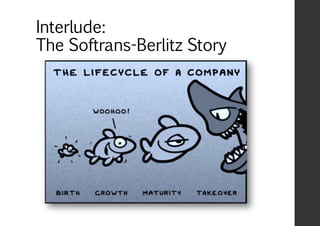
Interlude:
The Softrans-Berlitz Story
Berlitz
• 1878 German immigrant Maximillion Berlitz establishes a
language school in New York
• Develops the „Berlitz Method“ of total immersion language
teaching
• Company grows through WW II, begins offering translation
services on the side (mostly personal docs)
• Establishes language schools all over the world
• Berlitz acquired and sold by big publishing companies such
as R.R. Donnelley
• 1987 Berlitz acquired by Fukutake Publishing (Japan!)
• 1988 Berlitz Translation Services becomes independent
Business Unit
Softrans
• 1986 the „fab four“ get tired of working for Apple Computer, see
a „Marktlücke“ for software localization services and found
Softrans in Dublin
• Rapid growth with huge contracts from many of the Ireland-
based European HQ‘s of big multinationals
• Company is engineering-oriented, technically savvy, but Euro-
centric, needs Asian reach, scalability, access to US customers
• 1993 Berlitz acquires Softrans:
a match made in heaven and
lubricated with copious amounts
of Guinness
Softrans + Berlitz =
Berlitz GlobalNET
• BGN becomes one of the top 3 localization companies with
26 offices in 24 countries, and the first to crack the $100
Million revenue barrier
• Grows, acquires geographies, technologies, resources
• 2001 Berlitz International (Fukutake) decides that their core
competency is language instruction, not localization
• 2002 BGN acquired by Bowne Global Solutions (which was put
together out of acquisitions of Mendez, GECAP and others)
• 2004 BGS acquired by Lionbridge (which was put together
from acquisitions of ALPNET, ITP, …)
• 2008 Lionbridge acquired by VIPRO ???
Sideswipe:
Microsoft Dirty Laundry
• Microsoft became an early driver of software localization
and has continued to be one of the first companies to
tackle new, obscure languages
• MS early strategy was to completely dominate a small, in-
country translation company demanding complete
transparency
• MS dictates everything from human resources to
processes to tools to allowable margins to timelines to
total profitability
• Of course everyone wanted to work with MS, but MS
destroyed many excellent, small in-country vendors and in
the early to mid 1990‘s many vendors refused to work with
MS because they feared for their lives
• MS continues to be aggressive and quasi-dictatorial, but
they have learned that they have to treat their suppliers as
partners or else everybody loses
How do I Get Into the Localization
Business?
• Sideways, no real training for localization specialists or
engineers or DTPers or Project Managers or other resources:
parallel to the early days of technical writing or software
engineering; new industry, no standards, no best practices
• By accident
• Training starts in earnest only in the late 90‘s
• University of Limmerick, Dublin, Rosario, etc. Translator
training
• Localization training Monterey, University of Limmerick
• Localization Certification: CSU CHICO, Localization Institute,
etc., LISA
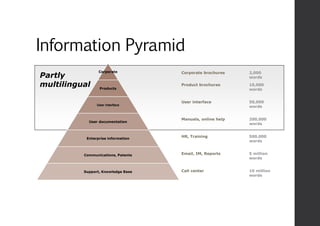
Information Pyramid
Corporate
Products
User interface
User documentation
Enterprise information
Communications, Patents
Support, Knowledge Base
Corporate brochures 2,000
words
Product brochures 10,000
words
User interface 50,000
words
Manuals, online help 200,000
words
HR, Training 500,000
words
Email, IM, Reports 5 million
words
Call center 10 million
words
Partly
multilingual
1
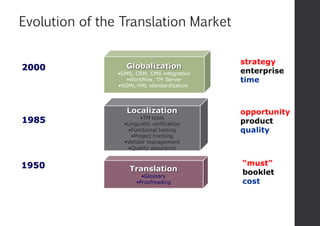
Translation
•Glossary
•Proofreading
Localization
•TM tools
•Linguistic verification
•Functional testing
•Project tracking
•Vendor management
•Quality assurance
Globalization
•GMS, CRM, CMS integration
•Workflow, TM Server
•SGML-XML standardization
1950
1985
2000
“must”
booklet
cost
opportunity
product
quality
strategy
enterprise
time
Evolution of the Translation Market
Translation?
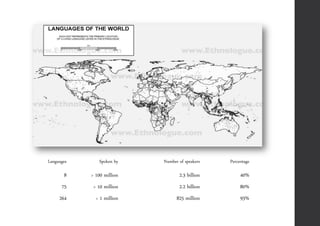
Languages Spoken by Number of speakers Percentage
8 > 100 million 2.3 billion 40%
75 > 10 million 2.2 billion 80%
264 > 1 million 825 million 93%
Clients
MLV’s
In country
offices/partners
Distributed
translators/authors
4 to 30 vendors
10 to 40 languages
100’ to 1000’s
translators/authors
Vendor Management Project Management
Quality Assurance Translation Memory
Account Management
Resources Management
Quality Assurance
Project Management Translation Memory
Resources Management
Quality Assurance
Project Management
Translation Memory
Quality Assurance Translation Memory
Cascaded Supply Chain
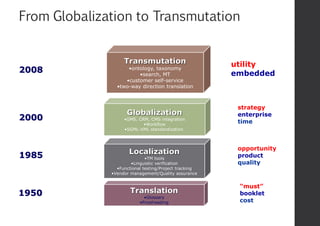
Translation
•Glossary
•Proofreading
Localization
•TM tools
•Linguistic verification
•Functional testing/Project tracking
•Vendor management/Quality assurance
Globalization
•GMS, CRM, CMS integration
•Workflow
•SGML-XML standardization
1950
1985
2000
“must”
booklet
cost
opportunity
product
quality
strategy
enterprise
time
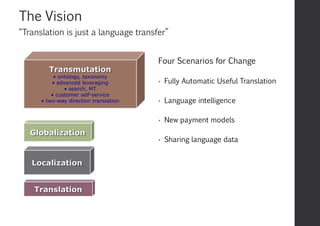
Transmutation
•ontology, taxonomy
•search, MT
•customer self-service
•two-way direction translation
utility
embedded2008
From Globalization to Transmutation
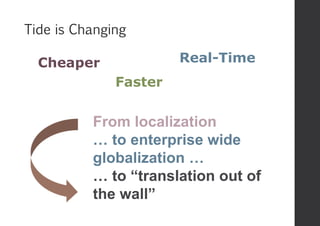
From localization
… to enterprise wide
globalization …
… to “translation out of
the wall”
Cheaper
Faster
Real-Time
Tide is Changing
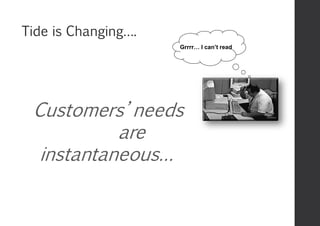
Customers’ needs
are
instantaneous…
Tide is Changing….
Grrrr… I can’t read
Integrated Hybrid Translation Model
TM
MT
Shared
TM
C P-E
T R
Terminology
Workflow
P r a c t i t i o n e r s
Source Control
Translation
Localization
Globalization
Transmutation
• ontology, taxonomy
• advanced leveraging
• search, MT
• customer self-service
• two-way direction translation
The Vision
“Translation is just a language transfer”
Four Scenarios for Change
• Fully Automatic Useful Translation
• Language intelligence
• New payment models
• Sharing language data
Embrace the Imperfection of Machine Translation
• Benefits
 Security
 Quality
 Expand customer base
 More job opportunities
• Needs
 Standard interfaces
 Develop best practice in post-editing
MT
 Learning MT systems
 Hybrid MT systems
Everyday more words are translated by machines than by professional translators…
Integrate MT in existing translation infrastructure and other applications (search, intranet, support)
Develop Language Intelligence
Translation 1.0
(translation)
Cost
Translation 2.0
(localization)
Opportunity
Translation 4.0
(transmutation)
Embedded
Translation 3.0
(globalization)
Strategy
Market size
Languageintelligence
Translation
Proofreading
Glossaries
Project management
Translation
Memory
Terminology
management
Functional testing
QA
GMS
Workflow
TM Server
XML
CMS
CRM
Taxonomies
Ontologies
Unified
Terminology
Search
MT
Semantic
Technology
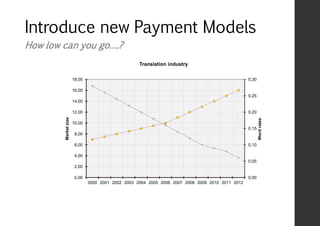
Introduce new Payment Models
0,00
0,05
0,10
0,15
0,20
0,25
0,30
0,00
2,00
4,00
6,00
8,00
10,00
12,00
14,00
16,00
18,00
2000 2001 2002 2003 2004 2005 2006 2007 2008 2009 2010 2011 2012
Wordrates
Marketsize
Translation industry
How low can you go….?
Why do we communicate?
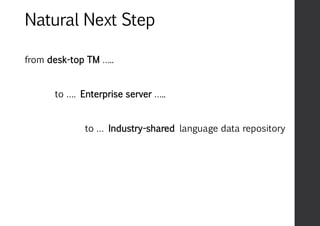
Natural Next Step
from desk-top TM …..
to …. Enterprise server …..
to … Industry-shared language data repository
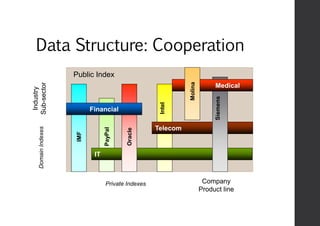
Industry
Sub-sector
Company
Product line
IT
Financial
Oracle
Intel
Telecom
IMF
PayPal
Siemens
Medical
Molina
Public Index
Private Indexes
DomainIndexes
Data Structure: Cooperation
How the Co-operative Works
User scenarios
o Language search freely available on public index:
 Translation matches of terms and phrases
 Possibly an attribute for domain
 No attributes for organizations or products
o Language search on domain and private indexes (only for members):
 Translation matches with attributes for domain, company, product, date of
use and other metadata
o Advanced leveraging:
 Process documents to retrieve best matches for all terms and phrases
 Output in industry standard format
o Automatic translation:
 Automatic translation engines trained on domain and private indexes
 Output in industry standard format
Languages and Global Coverage
“We have around a billion users today – what we’re all interested in
is where the next billion users are coming from.”
Craig Barrett, Chairman of Intel at a United Nations Meeting of
technology leaders and representatives of developing countries, March 2007
LOOKING TO THE FUTURE: Microsoft boss Bill
Gates wants to double the number of computer
users to 2 billion by 2015.
What languages will the next billion users speak?
Vielen Dank

Localization past present-future 2007-2014

  • 1.
    The Localization Industry:Past, Present and Future Published in 2007! The same can still be said today – 2014!
  • 2.
    Disclaimer • Subjektive nichtobjektive Sicht. • Lücken, nicht vollständig. • Das Eine oder Andere ist vielleicht nicht richtig. • Einige Folien habe ich von Jaap van der Meer geklaut. Danke Jaap! • Als Anstoß zum Weiterreden gedacht…
  • 3.
  • 4.
  • 5.
  • 6.
  • 7.
    1990‘s Revolution: PubliclyNetworked Computers, Web and Internet
  • 8.
    Business Tools in1990‘s • Internet • Web • Modems • Bulletin Boards • FTP • Fax machines • Courier Services • Zip disks • Networks • Cell Phones
  • 9.
    Business Tools in2000‘s • I do everything (except cook…maybe next year!)
  • 10.
  • 11.
  • 12.
  • 13.
  • 14.
    Globalization Tools in2000‘s • Workflow Engine • On demand MT and TM • Speech recognition • Portals • Corpora • GMS • TMS • GIM • CMS • XML • SOA • CRM • XLIFF
  • 15.
    1950-1980 Translation Industry •Inhouse translation departments (IBM, DEC, XEROX, etc.) • Little or no outsourcing • No tools (well, mainframe word processors and SGML) • Updates cut-and-paste on paper or manually retype • DTP (typesetting) a separate, expensive science • Local Translation Agencies with Freelancers for personal documents • Fax machines and modems were huge innovations!
  • 16.
    1980-1993 INK leadsthe way • 1980-Jaap van der Meer starts INK in Amsterdam, which provided translation, writing and localization services • 1987-INK develops its own computer-aided translation software and dictionary management tools • Quickly expands with offices all over Europe • Becomes the blueprint for localization companies with distributed offices and freelance translators and other resources • 1993-sold to R.R: Donnelley
  • 17.
    The 90‘s Big3, 4, 5, … • US and European based • Berlitz, Alpnet, INK, SDL, Lernout&Hauspie, Xerox • Then Lionbridge, Bowne Global Solutions • Now Asia: TOIN, watch out for India and China…
  • 18.
    The 1990‘s –Dublin Becomes World Software Localization Capital • 1970‘s and 1980‘s Irish government provides great tax incentives to foreign corporations • Hungry, English-speaking, well-educated, low-cost workforce • Many multinationals move their European HQ to Dublin • Easy to get Visas for foreign workers (translators!) • Universities offer advanced translation training, and especially software engineering • Microsoft also has localization HQ in Dublin
  • 19.
  • 20.
    Berlitz • 1878 Germanimmigrant Maximillion Berlitz establishes a language school in New York • Develops the „Berlitz Method“ of total immersion language teaching • Company grows through WW II, begins offering translation services on the side (mostly personal docs) • Establishes language schools all over the world • Berlitz acquired and sold by big publishing companies such as R.R. Donnelley • 1987 Berlitz acquired by Fukutake Publishing (Japan!) • 1988 Berlitz Translation Services becomes independent Business Unit
  • 21.
    Softrans • 1986 the„fab four“ get tired of working for Apple Computer, see a „Marktlücke“ for software localization services and found Softrans in Dublin • Rapid growth with huge contracts from many of the Ireland- based European HQ‘s of big multinationals • Company is engineering-oriented, technically savvy, but Euro- centric, needs Asian reach, scalability, access to US customers • 1993 Berlitz acquires Softrans: a match made in heaven and lubricated with copious amounts of Guinness
  • 22.
    Softrans + Berlitz= Berlitz GlobalNET • BGN becomes one of the top 3 localization companies with 26 offices in 24 countries, and the first to crack the $100 Million revenue barrier • Grows, acquires geographies, technologies, resources • 2001 Berlitz International (Fukutake) decides that their core competency is language instruction, not localization • 2002 BGN acquired by Bowne Global Solutions (which was put together out of acquisitions of Mendez, GECAP and others) • 2004 BGS acquired by Lionbridge (which was put together from acquisitions of ALPNET, ITP, …) • 2008 Lionbridge acquired by VIPRO ???
  • 23.
    Sideswipe: Microsoft Dirty Laundry •Microsoft became an early driver of software localization and has continued to be one of the first companies to tackle new, obscure languages • MS early strategy was to completely dominate a small, in- country translation company demanding complete transparency • MS dictates everything from human resources to processes to tools to allowable margins to timelines to total profitability • Of course everyone wanted to work with MS, but MS destroyed many excellent, small in-country vendors and in the early to mid 1990‘s many vendors refused to work with MS because they feared for their lives • MS continues to be aggressive and quasi-dictatorial, but they have learned that they have to treat their suppliers as partners or else everybody loses
  • 24.
    How do IGet Into the Localization Business? • Sideways, no real training for localization specialists or engineers or DTPers or Project Managers or other resources: parallel to the early days of technical writing or software engineering; new industry, no standards, no best practices • By accident • Training starts in earnest only in the late 90‘s • University of Limmerick, Dublin, Rosario, etc. Translator training • Localization training Monterey, University of Limmerick • Localization Certification: CSU CHICO, Localization Institute, etc., LISA
  • 25.
    Information Pyramid Corporate Products User interface Userdocumentation Enterprise information Communications, Patents Support, Knowledge Base Corporate brochures 2,000 words Product brochures 10,000 words User interface 50,000 words Manuals, online help 200,000 words HR, Training 500,000 words Email, IM, Reports 5 million words Call center 10 million words Partly multilingual
  • 26.
    1 Translation •Glossary •Proofreading Localization •TM tools •Linguistic verification •Functionaltesting •Project tracking •Vendor management •Quality assurance Globalization •GMS, CRM, CMS integration •Workflow, TM Server •SGML-XML standardization 1950 1985 2000 “must” booklet cost opportunity product quality strategy enterprise time Evolution of the Translation Market
  • 27.
    Translation? Languages Spoken byNumber of speakers Percentage 8 > 100 million 2.3 billion 40% 75 > 10 million 2.2 billion 80% 264 > 1 million 825 million 93%
  • 28.
    Clients MLV’s In country offices/partners Distributed translators/authors 4 to30 vendors 10 to 40 languages 100’ to 1000’s translators/authors Vendor Management Project Management Quality Assurance Translation Memory Account Management Resources Management Quality Assurance Project Management Translation Memory Resources Management Quality Assurance Project Management Translation Memory Quality Assurance Translation Memory Cascaded Supply Chain
  • 29.
    Translation •Glossary •Proofreading Localization •TM tools •Linguistic verification •Functionaltesting/Project tracking •Vendor management/Quality assurance Globalization •GMS, CRM, CMS integration •Workflow •SGML-XML standardization 1950 1985 2000 “must” booklet cost opportunity product quality strategy enterprise time Transmutation •ontology, taxonomy •search, MT •customer self-service •two-way direction translation utility embedded2008 From Globalization to Transmutation
  • 30.
    From localization … toenterprise wide globalization … … to “translation out of the wall” Cheaper Faster Real-Time Tide is Changing
  • 31.
    Customers’ needs are instantaneous… Tide isChanging…. Grrrr… I can’t read
  • 32.
    Integrated Hybrid TranslationModel TM MT Shared TM C P-E T R Terminology Workflow P r a c t i t i o n e r s Source Control
  • 33.
    Translation Localization Globalization Transmutation • ontology, taxonomy •advanced leveraging • search, MT • customer self-service • two-way direction translation The Vision “Translation is just a language transfer” Four Scenarios for Change • Fully Automatic Useful Translation • Language intelligence • New payment models • Sharing language data
  • 34.
    Embrace the Imperfectionof Machine Translation • Benefits  Security  Quality  Expand customer base  More job opportunities • Needs  Standard interfaces  Develop best practice in post-editing MT  Learning MT systems  Hybrid MT systems Everyday more words are translated by machines than by professional translators… Integrate MT in existing translation infrastructure and other applications (search, intranet, support)
  • 35.
    Develop Language Intelligence Translation1.0 (translation) Cost Translation 2.0 (localization) Opportunity Translation 4.0 (transmutation) Embedded Translation 3.0 (globalization) Strategy Market size Languageintelligence Translation Proofreading Glossaries Project management Translation Memory Terminology management Functional testing QA GMS Workflow TM Server XML CMS CRM Taxonomies Ontologies Unified Terminology Search MT Semantic Technology
  • 36.
    Introduce new PaymentModels 0,00 0,05 0,10 0,15 0,20 0,25 0,30 0,00 2,00 4,00 6,00 8,00 10,00 12,00 14,00 16,00 18,00 2000 2001 2002 2003 2004 2005 2006 2007 2008 2009 2010 2011 2012 Wordrates Marketsize Translation industry How low can you go….?
  • 37.
    Why do wecommunicate?
  • 38.
    Natural Next Step fromdesk-top TM ….. to …. Enterprise server ….. to … Industry-shared language data repository
  • 39.
  • 40.
    How the Co-operativeWorks User scenarios o Language search freely available on public index:  Translation matches of terms and phrases  Possibly an attribute for domain  No attributes for organizations or products o Language search on domain and private indexes (only for members):  Translation matches with attributes for domain, company, product, date of use and other metadata o Advanced leveraging:  Process documents to retrieve best matches for all terms and phrases  Output in industry standard format o Automatic translation:  Automatic translation engines trained on domain and private indexes  Output in industry standard format
  • 41.
    Languages and GlobalCoverage “We have around a billion users today – what we’re all interested in is where the next billion users are coming from.” Craig Barrett, Chairman of Intel at a United Nations Meeting of technology leaders and representatives of developing countries, March 2007 LOOKING TO THE FUTURE: Microsoft boss Bill Gates wants to double the number of computer users to 2 billion by 2015. What languages will the next billion users speak?
  • 42.