272: Software Engineering
Fall 2012
Instructor: Tevfik Bultan
Lecture 0: Introduction
Software Engineering
• In 1968 a seminal NATO Conference was held in Germany.
– Purpose: to look for a solution to software crisis
– 50 top computer scientists, programmers and industry leaders got
together to look for a solution to the difficulties in building large
software systems (i.e., software crisis)
– The term “software engineering” was first used in that
conference to indicate a systematic, disciplined, quantifiable
approach to the production and maintenance of software
• Three-decades later (1994) an article in Scientific American (Sept.
94, pp. 85-96) by W. Wayt Gibbs was titled:
– “Software’s Chronic Crisis’’
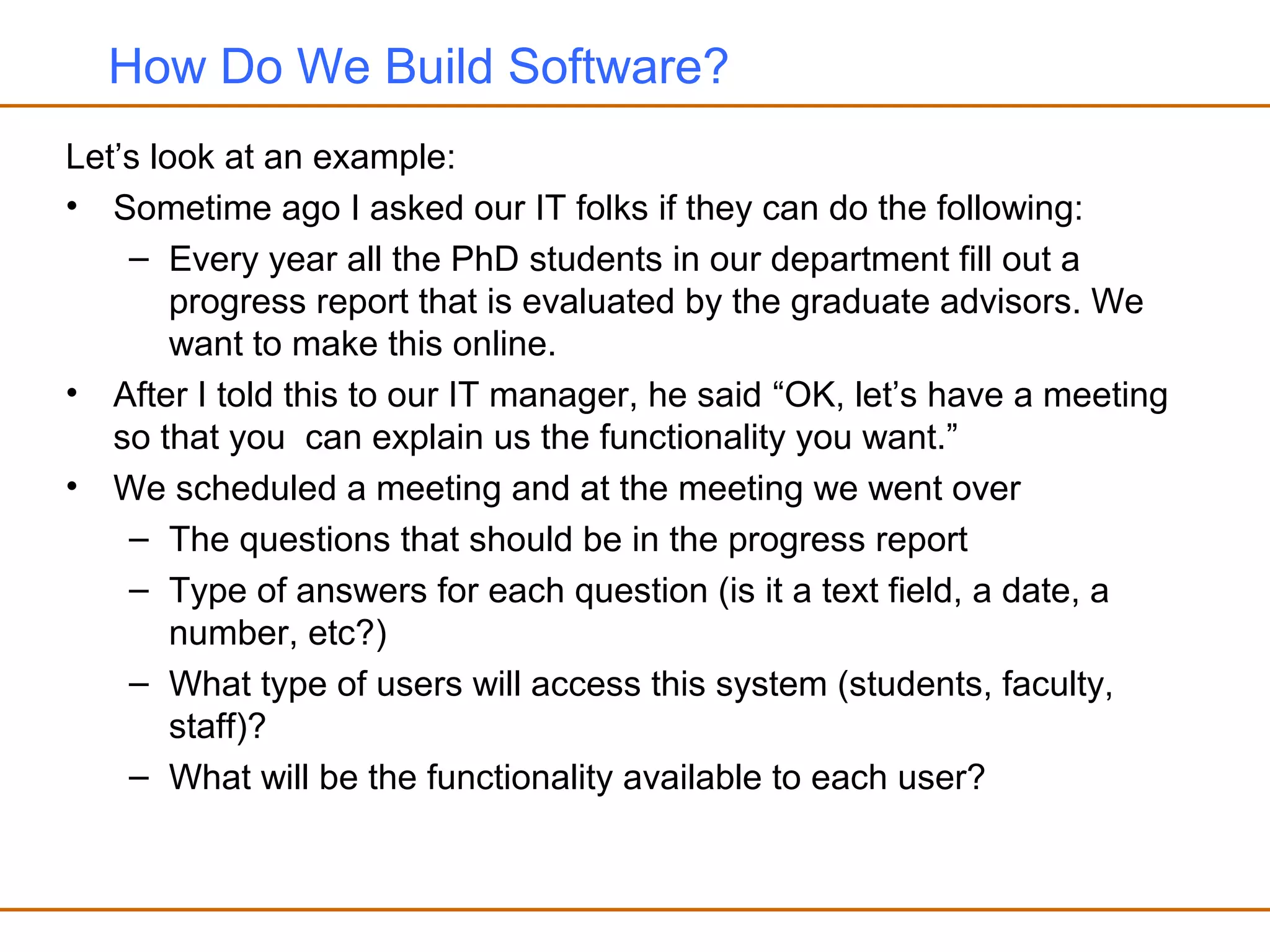
How Do We Build Software?
Let’s look at an example:
• Sometime ago I asked our IT folks if they can do the following:
– Every year all the PhD students in our department fill out a
progress report that is evaluated by the graduate advisors. We
want to make this online.
• After I told this to our IT manager, he said “OK, let’s have a meeting
so that you can explain us the functionality you want.”
• We scheduled a meeting and at the meeting we went over
– The questions that should be in the progress report
– Type of answers for each question (is it a text field, a date, a
number, etc?)
– What type of users will access this system (students, faculty,
staff)?
– What will be the functionality available to each user?
Requirements Analysis and Specification
• This meeting where we discussed the functionality, input and output
formats, types of users, etc. is called requirements analysis
– During requirements analysis software developers try to figure out
the functionality required by the client
• After the requirements analysis all these issues can be clarified as a
set of Requirements specifications
– Maybe the IT folks who attended the requirements analysis
meeting are not the ones who will develop the software, so the
software developers will need a specification of what they are
supposed to build.
• Writing precise requirements specifications can be very challenging:
– Formal (mathematical) specifications are precise, but hard to read
and write
– English is easy to read and write, but ambiguous
Design
• After figuring out the requirements specifications, we have to build the
software
• In our example, I assume that the IT folks are going to talk about the
structure of this application first.
– There will be a backend database, the users will first login using
an authorization module, etc.
• Deciding on how to modularize the software is part of the
Architectural Design.
– It is helpful (most of the time necessary, since one may be
working in a team) to document the design architecture (i.e.,
modules and their interfaces) before starting the implementation.
• After figuring out the modules, the next step is to figure out how to
build those modules.
• Detailed Design involves writing a detailed description of the
processing that will be done in each module before implementing it.
– Generally written in some structured pseudo-code.
Implementation and Testing
• Finally, the IT folks are going to pick an implementation language
(PHP, Java Servlets, etc) and start writing code.
• This is the Implementation phase:
– Implement the modules defined by the architectural design and
the detailed design.
• After the implementation is finished the IT folks will need to check if
the software does what it is supposed to do.
• Use a set of inputs to Test the program
– When are they done with testing?
– Can they test parts of the program in isolation?
Maintenance
• After they finished the implementation, tested it, fixed all the bugs, are
they done?
• No, I (client) may say, “I would like to add a new question to the PhD
progress report” or “I found a bug when I was using it” or “You know,
it would be nice if we can also do the MS progress reports online” etc.
– The difficulty of changing the program may depend on how we
designed and implemented it:
• Are the module interfaces in the program well defined? Is
changing one part of the code effect all the other parts?
• This is called the Maintenance phase where the software is
continually modified to adopt to the changing needs of the customer
and the environment.
Software Process
• Then there is the question of how to organize the activities we
mentioned before (requirements analysis, design, implementation,
testing).
• There have been significant research on how to organize these
activities
– Waterfall model, spiral model, agile software development,
extreme programming, Scrum, etc.

Lo 20

  • 1.
    272: Software Engineering Fall2012 Instructor: Tevfik Bultan Lecture 0: Introduction
  • 2.
    Software Engineering • In1968 a seminal NATO Conference was held in Germany. – Purpose: to look for a solution to software crisis – 50 top computer scientists, programmers and industry leaders got together to look for a solution to the difficulties in building large software systems (i.e., software crisis) – The term “software engineering” was first used in that conference to indicate a systematic, disciplined, quantifiable approach to the production and maintenance of software • Three-decades later (1994) an article in Scientific American (Sept. 94, pp. 85-96) by W. Wayt Gibbs was titled: – “Software’s Chronic Crisis’’
  • 3.
    How Do WeBuild Software? Let’s look at an example: • Sometime ago I asked our IT folks if they can do the following: – Every year all the PhD students in our department fill out a progress report that is evaluated by the graduate advisors. We want to make this online. • After I told this to our IT manager, he said “OK, let’s have a meeting so that you can explain us the functionality you want.” • We scheduled a meeting and at the meeting we went over – The questions that should be in the progress report – Type of answers for each question (is it a text field, a date, a number, etc?) – What type of users will access this system (students, faculty, staff)? – What will be the functionality available to each user?
  • 4.
    Requirements Analysis andSpecification • This meeting where we discussed the functionality, input and output formats, types of users, etc. is called requirements analysis – During requirements analysis software developers try to figure out the functionality required by the client • After the requirements analysis all these issues can be clarified as a set of Requirements specifications – Maybe the IT folks who attended the requirements analysis meeting are not the ones who will develop the software, so the software developers will need a specification of what they are supposed to build. • Writing precise requirements specifications can be very challenging: – Formal (mathematical) specifications are precise, but hard to read and write – English is easy to read and write, but ambiguous
  • 5.
    Design • After figuringout the requirements specifications, we have to build the software • In our example, I assume that the IT folks are going to talk about the structure of this application first. – There will be a backend database, the users will first login using an authorization module, etc. • Deciding on how to modularize the software is part of the Architectural Design. – It is helpful (most of the time necessary, since one may be working in a team) to document the design architecture (i.e., modules and their interfaces) before starting the implementation. • After figuring out the modules, the next step is to figure out how to build those modules. • Detailed Design involves writing a detailed description of the processing that will be done in each module before implementing it. – Generally written in some structured pseudo-code.
  • 6.
    Implementation and Testing •Finally, the IT folks are going to pick an implementation language (PHP, Java Servlets, etc) and start writing code. • This is the Implementation phase: – Implement the modules defined by the architectural design and the detailed design. • After the implementation is finished the IT folks will need to check if the software does what it is supposed to do. • Use a set of inputs to Test the program – When are they done with testing? – Can they test parts of the program in isolation?
  • 7.
    Maintenance • After theyfinished the implementation, tested it, fixed all the bugs, are they done? • No, I (client) may say, “I would like to add a new question to the PhD progress report” or “I found a bug when I was using it” or “You know, it would be nice if we can also do the MS progress reports online” etc. – The difficulty of changing the program may depend on how we designed and implemented it: • Are the module interfaces in the program well defined? Is changing one part of the code effect all the other parts? • This is called the Maintenance phase where the software is continually modified to adopt to the changing needs of the customer and the environment.
  • 8.
    Software Process • Thenthere is the question of how to organize the activities we mentioned before (requirements analysis, design, implementation, testing). • There have been significant research on how to organize these activities – Waterfall model, spiral model, agile software development, extreme programming, Scrum, etc.