Leader-Member Exchange
Theory (LMX)
• News
• Quiz
• Multiple-Linkage Model
• Leader-Member Exchange (LMX) & Vertical
Dyad Linkage (VDL)
• Team Task
Question: what is the relationship
between leaders & followers & how does
that affect response?
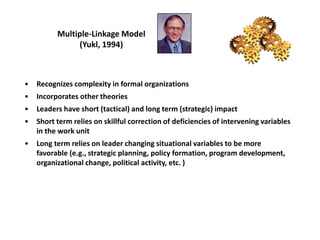
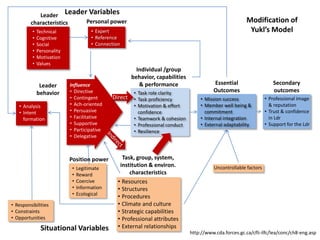
Multiple-Linkage Model
(Yukl, 1994)
• Recognizes complexity in formal organizations
• Incorporates other theories
• Leaders have short (tactical) and long term (strategic) impact
• Short term relies on skillful correction of deficiencies of intervening variables
in the work unit
• Long term relies on leader changing situational variables to be more
favorable (e.g., strategic planning, policy formation, program development,
organizational change, political activity, etc. )
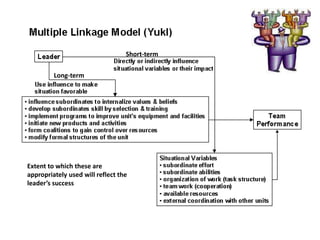
Short-term
Long-term
Extent to which these are
appropriately used will reflect the
leader’s success
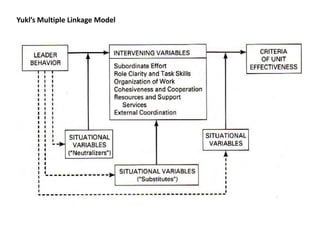
Yukl’s Multiple Linkage Model
• Mission success
• Member well being &
commitment
• Internal integration
• External adaptability
• Technical
• Cognitive
• Social
• Personality
• Motivation
• Values
• Analysis
• Intent
formation
Influence
• Directive
• Contingent
• Ach-oriented
• Persuasive
• Facilitative
• Supportive
• Participative
• Delegative
• Legitimate
• Reward
• Coercive
• Information
• Ecological
• Responsibilities
• Constraints
• Opportunities
• Resources
• Structures
• Procedures
• Climate and culture
• Strategic capabilities
• Professional attributes
• External relationships
Uncontrollable factors
• Task role clarity
• Task proficiency
• Motivation & effort
confidence
• Teamwork & cohesion
• Professional conduct
• Resilience
• Professional image
& reputation
• Trust & confidence
in Ldr
• Support for the Ldr
• Expert
• Reference
• Connection
Leader
characteristics Personal power
Leader
behavior
Direct
Position power Task, group, system,
institution & environ.
characteristics
Individual /group
behavior, capabilities
& performance Essential
Outcomes
Secondary
outcomes
Modification of
Yukl’s Model
http://www.cda.forces.gc.ca/cfli-ilfc/lea/conc/ch8-eng.asp
Leader Variables
Situational Variables
Vertical Dyad Linkage (VDL) / Leader-
Member Relations (LMX)
• Think of a work/team situation in which there have been
an “in-group (close to the boss) and “out-group” (well
established but just not given those special tasks)
• How what influenced the formation of those two
groups?
• What did the boss expect of each group? How did s/he
treat them differently?
• What were advantages and disadvantages of being in
each group?
• How did the groups perceive each other?
• What was the effect on the work environment &
relationships?
Vertical-Dyad Linkage (VDL)
Leader-Member Exchange (LMX)
(Dansereau, Cashman, & Graen, 1973)
• While most leadership theories account for the
impact of leadership on groups or the organization
as a whole, Leader-Member Exchange Theory
uniquely focuses on the Leader-Follower dyad.
• Not every follower is treated the same by the
leader due to time and resources. This differential
treatment, expectation, and exchange separates
followers into two groups: the “in-group” and “out-
group”
• Interaction varies from dyad to dyad, exchanging
privilege for performance, & focuses on quality of
interaction
• Negotiating latitude: as relationship evolves, the
leader enables the role incumbent to further
define his/her own role
Perceptions of the
“out-group” when LMX
is not going well
The Role theory of Katz and Kuhn (1966) is the original
theoretical base of the LMX (Graen, 1976). Leaders accomplish
their work through role sets, in which the leader is most
influential. The leader communicates to the member a set of
expectations regarding the appropriate role behavior of the
member (role expectation). The member then receives and
interprets these sent expectations (received role) and may
modify his or her role behavior. Finally, the member's role
behavior transmits feedback to the leader (monitored behavior).
Burns and Otte (1999) describe the three stages:
Phase 1: Role-taking as leaders and members come to understand how the other views and
desires respect, the leader communicates role expectations to the member, with no
reciprocal contribution from the member.
Phase 2: Role-making is the trust that develops in order for leaders and members to further
extend the relationship and influence over each other's attitudes and behaviors. Both
contribute to role re-definition and this is where in/out work groups are differentiated
Phase 3: Role-routinization of the social exchange pattern becomes established and
routine
http://business.nmsu.edu/~dboje/teaching/338/power_and_leadership.htm
Leader-Member Exchange (LMX)
Vertical-Dyad Linkage (VDL)
Leader
Subordinate
Other Subordinates--
Viewed as having less
potential, interest, or
opportunity
“Out-Group”
• Comply with basic role requirements
• Accept legitimate direction
• Standard benefits and compensation
• Alienation
• Apathy
• Hostility
• Low performance
“In-Group”
• Unstructured tasks
• Volunteer extra
• Additional
responsibilities
• Special projects
•Leadership potential
•Competency
•Compatibility
•Agreement
•Personality
•Loyalty
•Commitment
Perceived
Equity or
Inequity
• Inside information
• Influence decisions
• Task assignment
• Job latitude
• Support
• Attention
High----Negotiating Latitude-----Low
High Power Leaders give more negotiating
latitude to high power employees)
Strengths of LMX
• As a descriptive theory, it notes the importance of the
existence of in-groups and out-groups within an organization
• The LMX theory is unique as the only leadership theory that makes
the the dyadic relationship the central factor of the leadership
process
• LMX directs our attention to the importance of leadership
communication and relationships
• Research substantiates how the practice of the LMX theory is related
to positive organizational outcomes
http://www.d.umn.edu/~stau0106/group/LMX.doc
Strengths & Weaknesses of LMX
Weaknesses of LMX
http://www.d.umn.edu/~stau0106/group/LMX.doc
• The LMX theory runs counter to basic human belief in
fairness: It gives the appearance of discrimination against
groups that don’t receive the special attention
• The basic ideas and theory are not fully developed: details
of compatibility of personality, interpersonal skills, how trust is
developed, etc., are not presented or discussed how important
they are compared to other constructs
• Few empirical studies have used dyadic measures to analyze the
LMX process
• Measurement scales lack content validity (may lack what they
intended to measure) and unclear whether they measure single
or many dimensions
What makes a good “follower”?
Team Discussion
• Pick a case you are familiar with that involves
in/out group dynamics
• Use the theory to analyze what went well/not
well and why
• If you were a trainer or consultant to this
leader, write out a series of recommendations
about what should be changed to improve
the situation (consider selection criteria for
subordinates, how in/out groups are framed,
equity issues, opportunities to break into the
in-group, dealing with alienation, etc.)

Lmxleader 130208005622-phpapp02

  • 1.
    Leader-Member Exchange Theory (LMX) •News • Quiz • Multiple-Linkage Model • Leader-Member Exchange (LMX) & Vertical Dyad Linkage (VDL) • Team Task Question: what is the relationship between leaders & followers & how does that affect response?
  • 2.
    Multiple-Linkage Model (Yukl, 1994) •Recognizes complexity in formal organizations • Incorporates other theories • Leaders have short (tactical) and long term (strategic) impact • Short term relies on skillful correction of deficiencies of intervening variables in the work unit • Long term relies on leader changing situational variables to be more favorable (e.g., strategic planning, policy formation, program development, organizational change, political activity, etc. )
  • 3.
    Short-term Long-term Extent to whichthese are appropriately used will reflect the leader’s success
  • 4.
  • 5.
    • Mission success •Member well being & commitment • Internal integration • External adaptability • Technical • Cognitive • Social • Personality • Motivation • Values • Analysis • Intent formation Influence • Directive • Contingent • Ach-oriented • Persuasive • Facilitative • Supportive • Participative • Delegative • Legitimate • Reward • Coercive • Information • Ecological • Responsibilities • Constraints • Opportunities • Resources • Structures • Procedures • Climate and culture • Strategic capabilities • Professional attributes • External relationships Uncontrollable factors • Task role clarity • Task proficiency • Motivation & effort confidence • Teamwork & cohesion • Professional conduct • Resilience • Professional image & reputation • Trust & confidence in Ldr • Support for the Ldr • Expert • Reference • Connection Leader characteristics Personal power Leader behavior Direct Position power Task, group, system, institution & environ. characteristics Individual /group behavior, capabilities & performance Essential Outcomes Secondary outcomes Modification of Yukl’s Model http://www.cda.forces.gc.ca/cfli-ilfc/lea/conc/ch8-eng.asp Leader Variables Situational Variables
  • 6.
    Vertical Dyad Linkage(VDL) / Leader- Member Relations (LMX) • Think of a work/team situation in which there have been an “in-group (close to the boss) and “out-group” (well established but just not given those special tasks) • How what influenced the formation of those two groups? • What did the boss expect of each group? How did s/he treat them differently? • What were advantages and disadvantages of being in each group? • How did the groups perceive each other? • What was the effect on the work environment & relationships?
  • 7.
    Vertical-Dyad Linkage (VDL) Leader-MemberExchange (LMX) (Dansereau, Cashman, & Graen, 1973) • While most leadership theories account for the impact of leadership on groups or the organization as a whole, Leader-Member Exchange Theory uniquely focuses on the Leader-Follower dyad. • Not every follower is treated the same by the leader due to time and resources. This differential treatment, expectation, and exchange separates followers into two groups: the “in-group” and “out- group” • Interaction varies from dyad to dyad, exchanging privilege for performance, & focuses on quality of interaction • Negotiating latitude: as relationship evolves, the leader enables the role incumbent to further define his/her own role Perceptions of the “out-group” when LMX is not going well
  • 8.
    The Role theoryof Katz and Kuhn (1966) is the original theoretical base of the LMX (Graen, 1976). Leaders accomplish their work through role sets, in which the leader is most influential. The leader communicates to the member a set of expectations regarding the appropriate role behavior of the member (role expectation). The member then receives and interprets these sent expectations (received role) and may modify his or her role behavior. Finally, the member's role behavior transmits feedback to the leader (monitored behavior). Burns and Otte (1999) describe the three stages: Phase 1: Role-taking as leaders and members come to understand how the other views and desires respect, the leader communicates role expectations to the member, with no reciprocal contribution from the member. Phase 2: Role-making is the trust that develops in order for leaders and members to further extend the relationship and influence over each other's attitudes and behaviors. Both contribute to role re-definition and this is where in/out work groups are differentiated Phase 3: Role-routinization of the social exchange pattern becomes established and routine http://business.nmsu.edu/~dboje/teaching/338/power_and_leadership.htm
  • 9.
    Leader-Member Exchange (LMX) Vertical-DyadLinkage (VDL) Leader Subordinate Other Subordinates-- Viewed as having less potential, interest, or opportunity “Out-Group” • Comply with basic role requirements • Accept legitimate direction • Standard benefits and compensation • Alienation • Apathy • Hostility • Low performance “In-Group” • Unstructured tasks • Volunteer extra • Additional responsibilities • Special projects •Leadership potential •Competency •Compatibility •Agreement •Personality •Loyalty •Commitment Perceived Equity or Inequity • Inside information • Influence decisions • Task assignment • Job latitude • Support • Attention High----Negotiating Latitude-----Low High Power Leaders give more negotiating latitude to high power employees)
  • 10.
    Strengths of LMX •As a descriptive theory, it notes the importance of the existence of in-groups and out-groups within an organization • The LMX theory is unique as the only leadership theory that makes the the dyadic relationship the central factor of the leadership process • LMX directs our attention to the importance of leadership communication and relationships • Research substantiates how the practice of the LMX theory is related to positive organizational outcomes http://www.d.umn.edu/~stau0106/group/LMX.doc Strengths & Weaknesses of LMX
  • 11.
    Weaknesses of LMX http://www.d.umn.edu/~stau0106/group/LMX.doc •The LMX theory runs counter to basic human belief in fairness: It gives the appearance of discrimination against groups that don’t receive the special attention • The basic ideas and theory are not fully developed: details of compatibility of personality, interpersonal skills, how trust is developed, etc., are not presented or discussed how important they are compared to other constructs • Few empirical studies have used dyadic measures to analyze the LMX process • Measurement scales lack content validity (may lack what they intended to measure) and unclear whether they measure single or many dimensions
  • 12.
    What makes agood “follower”?
  • 13.
    Team Discussion • Picka case you are familiar with that involves in/out group dynamics • Use the theory to analyze what went well/not well and why • If you were a trainer or consultant to this leader, write out a series of recommendations about what should be changed to improve the situation (consider selection criteria for subordinates, how in/out groups are framed, equity issues, opportunities to break into the in-group, dealing with alienation, etc.)