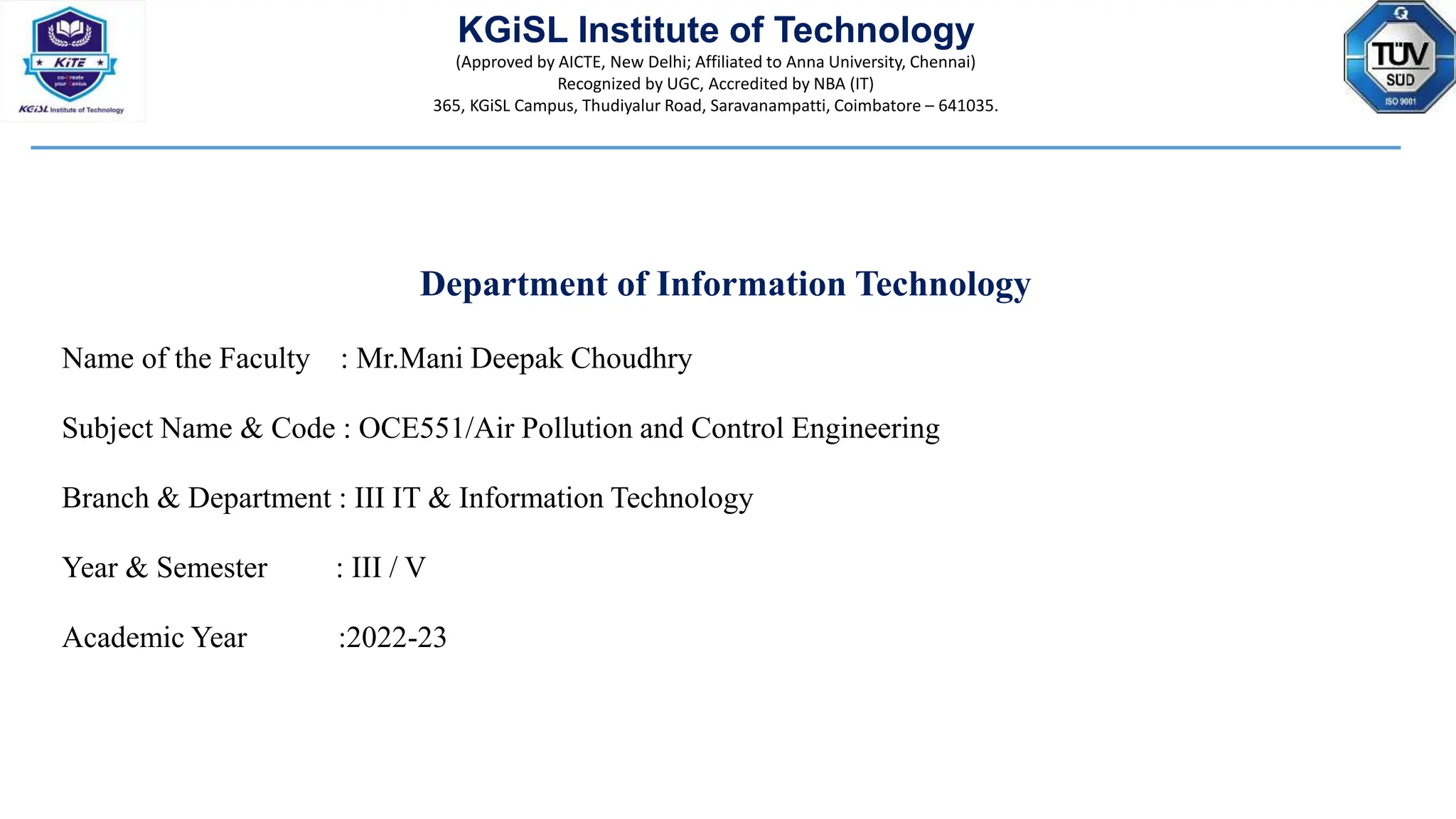
KGiSL Institute of Technology
(Approved by AICTE, New Delhi; Affiliated to Anna University, Chennai)
Recognized by UGC, Accredited by NBA (IT)
365, KGiSL Campus, Thudiyalur Road, Saravanampatti, Coimbatore – 641035.
Department of Information Technology
Name of the Faculty : Mr.Mani Deepak Choudhry
Subject Name & Code : OCE551/Air Pollution and Control Engineering
Branch & Department : III IT & Information Technology
Year & Semester : III / V
Academic Year :2022-23
SYLLABUS
UNIT 1 - INTRODUCTION
Structure and composition of Atmosphere – Definition, Scope and
Scales of Air Pollution – Sources and classification of air pollutants and
their effect on human health, vegetation, animals, property, aesthetic
value and visibility- Ambient Air Quality and Emission standards.
OCE551/APCE/III IT/V SEM/KG-KiTE
Course Outcomes
CO 1 Understand the nature and characteristics of air pollutants,
noise pollution and basic concepts of air quality management K2 LEVEL
OCE551/APCE/III IT/V SEM/KG-KiTE
Topic
1. Structure and composition of Atmosphere
2. Definition, Scope and Scales of Air Pollution
3. Sources of air pollutants
4. Classification of air pollutants and their effect on human health
5. Effect of air Pollutants on Vegetation & animals
6. Effect of air Pollutants on Property aesthetic value and visibility
7. Ambient Air Quality and Emission standards.
OCE551/APCE/III IT/V SEM/KG-KiTE
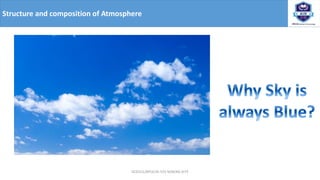
Structure and composition of Atmosphere
OCE551/APCE/III IT/V SEM/KG-KiTE
Contd..
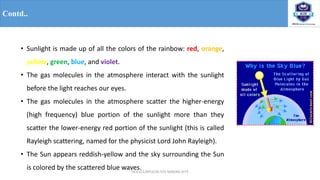
• Sunlight is made up of all the colors of the rainbow: red, orange,
yellow, green, blue, and violet.
• The gas molecules in the atmosphere interact with the sunlight
before the light reaches our eyes.
• The gas molecules in the atmosphere scatter the higher-energy
(high frequency) blue portion of the sunlight more than they
scatter the lower-energy red portion of the sunlight (this is called
Rayleigh scattering, named for the physicist Lord John Rayleigh).
• The Sun appears reddish-yellow and the sky surrounding the Sun
is colored by the scattered blue waves.
OCE551/APCE/III IT/V SEM/KG-KiTE
Contd..
• The air is one among the necessary conditions for the existence of life on this planet.
• The air is a mixture of several gases and it encompasses the earth from all sides.
• The air surrounding the earth is called the atmosphere.
• It helps in stopping the ultraviolet rays harmful to the life and maintains the suitable
temperature necessary for life.
• Generally, atmosphere extends up to about 1600 km from the earth’s surface. However, 99
% of the total mass of the atmosphere is confined to the height of 32 km from the earth’s
surface.
OCE551/APCE/III IT/V SEM/KG-KiTE
Composition of Atmosphere
• The atmosphere is made up of different gases, water vapor and dust particles.
• The composition of the atmosphere is not static and it changes according to the time and
place.
OCE551/APCE/III IT/V SEM/KG-KiTE
Gases
• The atmosphere of earth is composed of nitrogen (78%), oxygen (21%), argon (0.9%), carbon
dioxide (0.04%) and trace gases.
• A variable amount of water vapor is also present in the atmosphere (approx.1% at sea level)
and it decreases with altitude.
• Carbon dioxide gas is largely responsible for the greenhouse effect.
• Dust particles are also present in the atmosphere.
OCE551/APCE/III IT/V SEM/KG-KiTE
Gases
• Nitrogen cannot be used directly from the air. (78%)
• Biotic things need nitrogen to make proteins.
• The Nitrogen Cycle is the way of supplying the required nitrogen for living things.
• Oxygen is used by all living things and is essential for respiration. (21%)
• Argon are mainly used in light bulbs.
• Carbon Dioxide - Plants use it to make oxygen.
OCE551/APCE/III IT/V SEM/KG-KiTE
Gases
• Dust Particles - Dust particles are in higher concentrations in temperate and
subtropical regions due to dry winds in contrast to the polar and equatorial regions.
• Water Vapor - It acts like a blanket letting the earth from becoming neither too hot
nor too cold. It is a variable gas, declines with altitude.
• Ozone Gas - Present around 10-50 km above the earth’s surface and acts as a sieve,
absorbing UV (ultraviolet rays) from the sun.
OCE551/APCE/III IT/V SEM/KG-KiTE
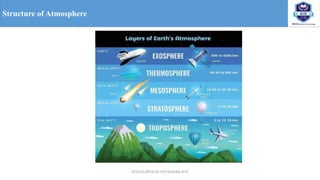
Structure of Atmosphere
OCE551/APCE/III IT/V SEM/KG-KiTE
Structure of Atmosphere - Troposphere
• This is the first and the lowest layer of Earth’s atmosphere.
• All life on this planet is affected by the changes that happen in this layer, as all the weather changes
take place in the troposphere.
• It starts from the ground (or sea level) of our planet and expands up to 10 km up in the sky.
• There is continuous flow and swirling of air constantly through convection currents redistributing
heat and moisture around the globe.
• This results in the short-lived and local patterns of temperature and moisture that we call weather.
• The air never remains static in this layer. Therefore this layer is called ‘changing sphere’ or
troposphere.
• The zone separating troposphere from the stratosphere is known as tropopause.
OCE551/APCE/III IT/V SEM/KG-KiTE
Structure of Atmosphere - Stratosphere
• Stratosphere is found just above the troposphere.
• It extends up to a height of 50 km.
• Weather related incidents do not take place in this layer. The air blows
horizontally here. Therefore this layer is considered ideal for flying of aircraft.
• One important feature of stratosphere is that it contains a layer of ozone gas.
• The relative thickness of the ozone layer is measured in Dobson Units.
OCE551/APCE/III IT/V SEM/KG-KiTE
Structure of Atmosphere - Mesosphere
• It is the third layer of the atmosphere spreading over the stratosphere.
• It extends up to a height of 80 km.
• Meteors or falling stars occur in this layer.
• The upper limit of the mesosphere is known as mesopause.
OCE551/APCE/III IT/V SEM/KG-KiTE
Structure of Atmosphere - Thermosphere
• This layer is located between 80 and 400 km above the mesopause.
• It contains electrically charged particles known as ions, and hence, it is known
as the ionosphere.
• Radio waves transmitted from the earth are reflected back to the earth by this
layer and due to this, radio broadcasting has become possible.
OCE551/APCE/III IT/V SEM/KG-KiTE
Structure of Atmosphere - Exosphere
• The exosphere is the uppermost layer of the atmosphere.
• Gases are very sparse in this sphere due to the lack of gravitational force.
Therefore, the density of air is very less here.
OCE551/APCE/III IT/V SEM/KG-KiTE

LM1 - Structure & Composition of Atmosphere.pptx

  • 1.
    KGiSL Institute ofTechnology (Approved by AICTE, New Delhi; Affiliated to Anna University, Chennai) Recognized by UGC, Accredited by NBA (IT) 365, KGiSL Campus, Thudiyalur Road, Saravanampatti, Coimbatore – 641035. Department of Information Technology Name of the Faculty : Mr.Mani Deepak Choudhry Subject Name & Code : OCE551/Air Pollution and Control Engineering Branch & Department : III IT & Information Technology Year & Semester : III / V Academic Year :2022-23
  • 2.
    SYLLABUS UNIT 1 -INTRODUCTION Structure and composition of Atmosphere – Definition, Scope and Scales of Air Pollution – Sources and classification of air pollutants and their effect on human health, vegetation, animals, property, aesthetic value and visibility- Ambient Air Quality and Emission standards. OCE551/APCE/III IT/V SEM/KG-KiTE
  • 3.
    OCE551/APCE/III IT/V SEM/KG-KiTE CourseOutcomes CO 1 Understand the nature and characteristics of air pollutants, noise pollution and basic concepts of air quality management K2 LEVEL
  • 4.
    OCE551/APCE/III IT/V SEM/KG-KiTE Topic 1.Structure and composition of Atmosphere 2. Definition, Scope and Scales of Air Pollution 3. Sources of air pollutants 4. Classification of air pollutants and their effect on human health 5. Effect of air Pollutants on Vegetation & animals 6. Effect of air Pollutants on Property aesthetic value and visibility 7. Ambient Air Quality and Emission standards.
  • 5.
    OCE551/APCE/III IT/V SEM/KG-KiTE Structureand composition of Atmosphere
  • 6.
    OCE551/APCE/III IT/V SEM/KG-KiTE Contd.. •Sunlight is made up of all the colors of the rainbow: red, orange, yellow, green, blue, and violet. • The gas molecules in the atmosphere interact with the sunlight before the light reaches our eyes. • The gas molecules in the atmosphere scatter the higher-energy (high frequency) blue portion of the sunlight more than they scatter the lower-energy red portion of the sunlight (this is called Rayleigh scattering, named for the physicist Lord John Rayleigh). • The Sun appears reddish-yellow and the sky surrounding the Sun is colored by the scattered blue waves.
  • 7.
    OCE551/APCE/III IT/V SEM/KG-KiTE Contd.. •The air is one among the necessary conditions for the existence of life on this planet. • The air is a mixture of several gases and it encompasses the earth from all sides. • The air surrounding the earth is called the atmosphere. • It helps in stopping the ultraviolet rays harmful to the life and maintains the suitable temperature necessary for life. • Generally, atmosphere extends up to about 1600 km from the earth’s surface. However, 99 % of the total mass of the atmosphere is confined to the height of 32 km from the earth’s surface.
  • 8.
    OCE551/APCE/III IT/V SEM/KG-KiTE Compositionof Atmosphere • The atmosphere is made up of different gases, water vapor and dust particles. • The composition of the atmosphere is not static and it changes according to the time and place.
  • 9.
    OCE551/APCE/III IT/V SEM/KG-KiTE Gases •The atmosphere of earth is composed of nitrogen (78%), oxygen (21%), argon (0.9%), carbon dioxide (0.04%) and trace gases. • A variable amount of water vapor is also present in the atmosphere (approx.1% at sea level) and it decreases with altitude. • Carbon dioxide gas is largely responsible for the greenhouse effect. • Dust particles are also present in the atmosphere.
  • 10.
    OCE551/APCE/III IT/V SEM/KG-KiTE Gases •Nitrogen cannot be used directly from the air. (78%) • Biotic things need nitrogen to make proteins. • The Nitrogen Cycle is the way of supplying the required nitrogen for living things. • Oxygen is used by all living things and is essential for respiration. (21%) • Argon are mainly used in light bulbs. • Carbon Dioxide - Plants use it to make oxygen.
  • 11.
    OCE551/APCE/III IT/V SEM/KG-KiTE Gases •Dust Particles - Dust particles are in higher concentrations in temperate and subtropical regions due to dry winds in contrast to the polar and equatorial regions. • Water Vapor - It acts like a blanket letting the earth from becoming neither too hot nor too cold. It is a variable gas, declines with altitude. • Ozone Gas - Present around 10-50 km above the earth’s surface and acts as a sieve, absorbing UV (ultraviolet rays) from the sun.
  • 12.
  • 13.
    OCE551/APCE/III IT/V SEM/KG-KiTE Structureof Atmosphere - Troposphere • This is the first and the lowest layer of Earth’s atmosphere. • All life on this planet is affected by the changes that happen in this layer, as all the weather changes take place in the troposphere. • It starts from the ground (or sea level) of our planet and expands up to 10 km up in the sky. • There is continuous flow and swirling of air constantly through convection currents redistributing heat and moisture around the globe. • This results in the short-lived and local patterns of temperature and moisture that we call weather. • The air never remains static in this layer. Therefore this layer is called ‘changing sphere’ or troposphere. • The zone separating troposphere from the stratosphere is known as tropopause.
  • 14.
    OCE551/APCE/III IT/V SEM/KG-KiTE Structureof Atmosphere - Stratosphere • Stratosphere is found just above the troposphere. • It extends up to a height of 50 km. • Weather related incidents do not take place in this layer. The air blows horizontally here. Therefore this layer is considered ideal for flying of aircraft. • One important feature of stratosphere is that it contains a layer of ozone gas. • The relative thickness of the ozone layer is measured in Dobson Units.
  • 15.
    OCE551/APCE/III IT/V SEM/KG-KiTE Structureof Atmosphere - Mesosphere • It is the third layer of the atmosphere spreading over the stratosphere. • It extends up to a height of 80 km. • Meteors or falling stars occur in this layer. • The upper limit of the mesosphere is known as mesopause.
  • 16.
    OCE551/APCE/III IT/V SEM/KG-KiTE Structureof Atmosphere - Thermosphere • This layer is located between 80 and 400 km above the mesopause. • It contains electrically charged particles known as ions, and hence, it is known as the ionosphere. • Radio waves transmitted from the earth are reflected back to the earth by this layer and due to this, radio broadcasting has become possible.
  • 17.
    OCE551/APCE/III IT/V SEM/KG-KiTE Structureof Atmosphere - Exosphere • The exosphere is the uppermost layer of the atmosphere. • Gases are very sparse in this sphere due to the lack of gravitational force. Therefore, the density of air is very less here.
  • 18.