Why Not Wikipedia?
Sonnet Ireland, Assistant Librarian
Jennifer Jackson, Assistant Librarian
Earl K. Long Library
University of New Orleans
Why Wikipedia is Bad
It’s a wiki, which means that it is a collaborative
site with an openly editable model.
That means anyone can write anything about
anything, regardless of the person’s expertise or
even basic knowledge on the topic.
Then How can Wikipedia be Good ?
Wikipedia can actually be a great starting point for
researchers.
Sure, there are a lot of flaws, but…
Don’t throw the baby out with the bathwater!
The Fast Answer
Wikipedia is BRILLIANT for the fast answer to a
question.
If a student really doesn’t understand the topic of
research, Wikipedia can help clarify.
Examples
In a history class, the student might have problems
understanding the correct order of French
monarchs…
List of French Monarchs
http://en.wikipedia.org/wiki/List_of_French_monarchs
Examples
Or understanding the order of battles in the
American Revolution…
List of American Revolutionary War battles
http://en.wikipedia.org/wiki/List_of_American_Revolutionary_War_battles
Examples
Or, in a biology class, a student might not know what
a Tsetse fly is…
Tsetse fly
http://en.wikipedia.org/wiki/Tsetse_fly
Or, in math, the student doesn’t know what a
polynomial is…
Polynomial
http://en.wikipedia.org/wiki/Polynomial
Duh…
Now I’m sure you’re all thinking, “We already
know that. Tell us something new…”
Well, did you know that Wikipedia now offers
references?
Cite your Work!
Now, Wikipedia strongly encourages citing
references within the article.
This means that most articles now have a list of
references.
These can contain Notes, Citations,
Sources…
Examples
2013-2014 Thai Political Crisis
http://en.wikipedia.org/wiki/2013%E2%80%9314_Thai_political_crisis
Interstate 805
http://en.wikipedia.org/wiki/Interstate_805
La Leyenda
http://en.wikipedia.org/wiki/La_Leyenda
Unraveling the Sweater
When showing a student how to do research, I like
to talk to them about “unraveling the sweater.”
Basically, it’s the idea of finding more resources
through the bibliography of one source.
This works with Wikipedia, too. Especially on a
topic that you can’t find a lot on.
True Story
A student was looking for resources on the legal
dispute between the World Wildlife Fund and the
World Wrestling Federation.
This was not a U.S. case, so it was a little more
difficult to find documentation for it.
True Story
We found cases, but we also checked Wikipedia…
WWE
http://en.wikipedia.org/wiki/WWE
World Wide Fund for Nature
http://en.wikipedia.org/wiki/World_Wide_Fund_for_Nature
It led to 9 more resources,
including the text of the agreement.
The Bad Side…?
As with everything on the Internet…sometimes the
links in the References section die…
And, of course, it should NEVER be cited on a
paper….
But here are some resources that are easy to search
(like Wikipedia) but are reliable and useful for papers.
All are available at any public library.
Why even try Wikipedia?
Because…it’s what people are using.
According to the OCLC report Perceptions of
Libraries, 2010: Context and Community:
“Wikipedia is now used by 73% of Americans, with
half of these users visiting the site at least once a
month. This usage rate rivals both search engines and
social sites, making Wikipedia an information staple
for online Americans.” p34
Why even try Wikipedia?
And don’t try to convince yourself that those 73% are
all kids or older folks. Nope…88% of college
students use Wikipedia to find information, second
only to search engines (93%). p52
The library website? Only 57% of college students
use that…and our online databases? 30%!
Sadly, most people don’t even know that their library
has a website. I kid you not.
But fret not! All is not lost…
For those who are hesitant about or intimidated by
using our resources…Wikipedia is the perfect gateway
drug…to information!
Show your users how to effectively use Wikipedia…
and then show them some cool resources that are easy
to use (like Wikipedia) but more reliable (unlike
Wikipedia).
After all, only 3% of Americans surveyed considered
Wikipedia a trusted source. p41
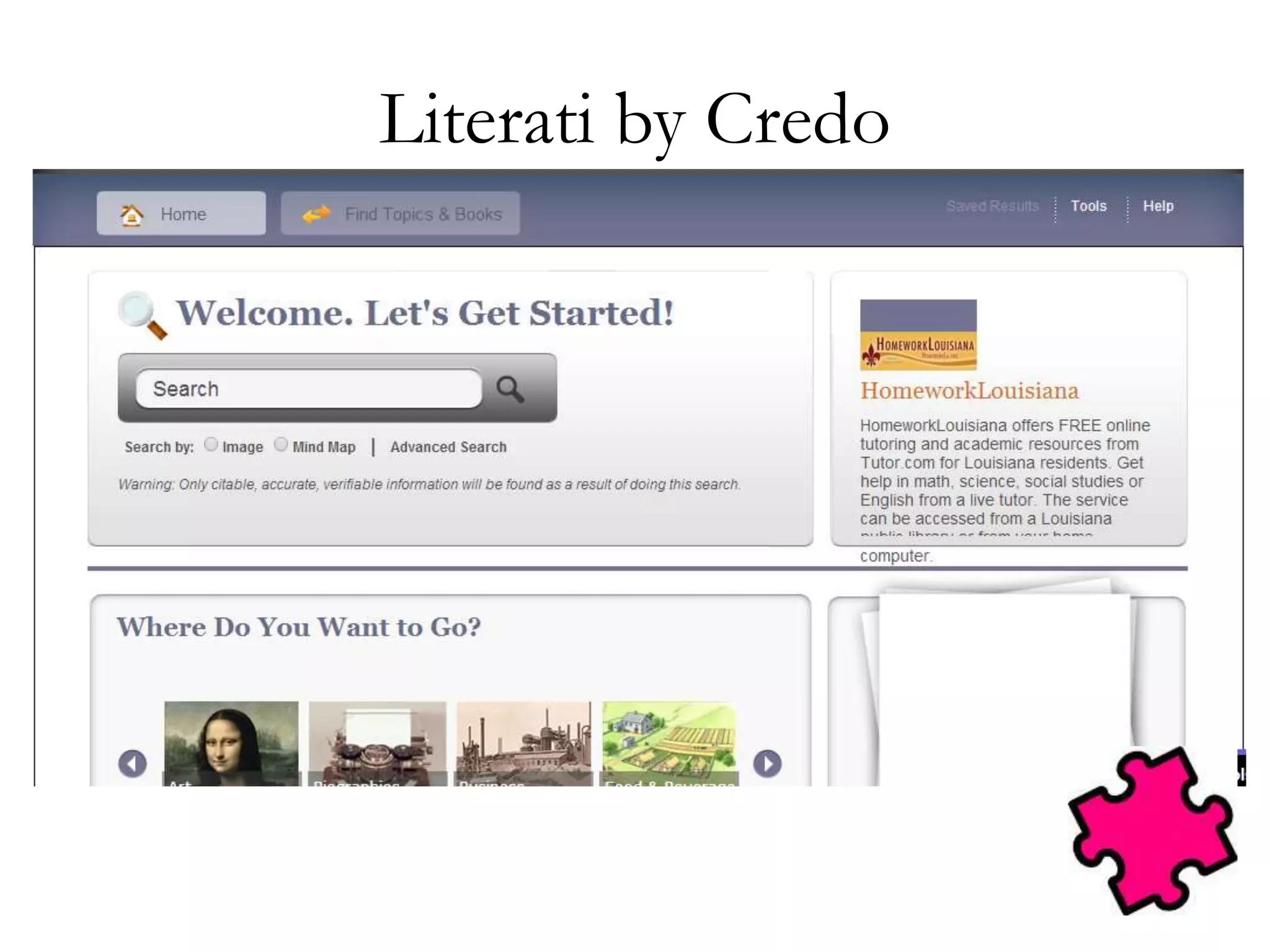
Literati by Credo
An all in one database Literati by Credo includes
topic pages providing students an overview of the
topic.
Literati by Credo also identifies relevant source
material from other databases and websites.
Literati by Credo
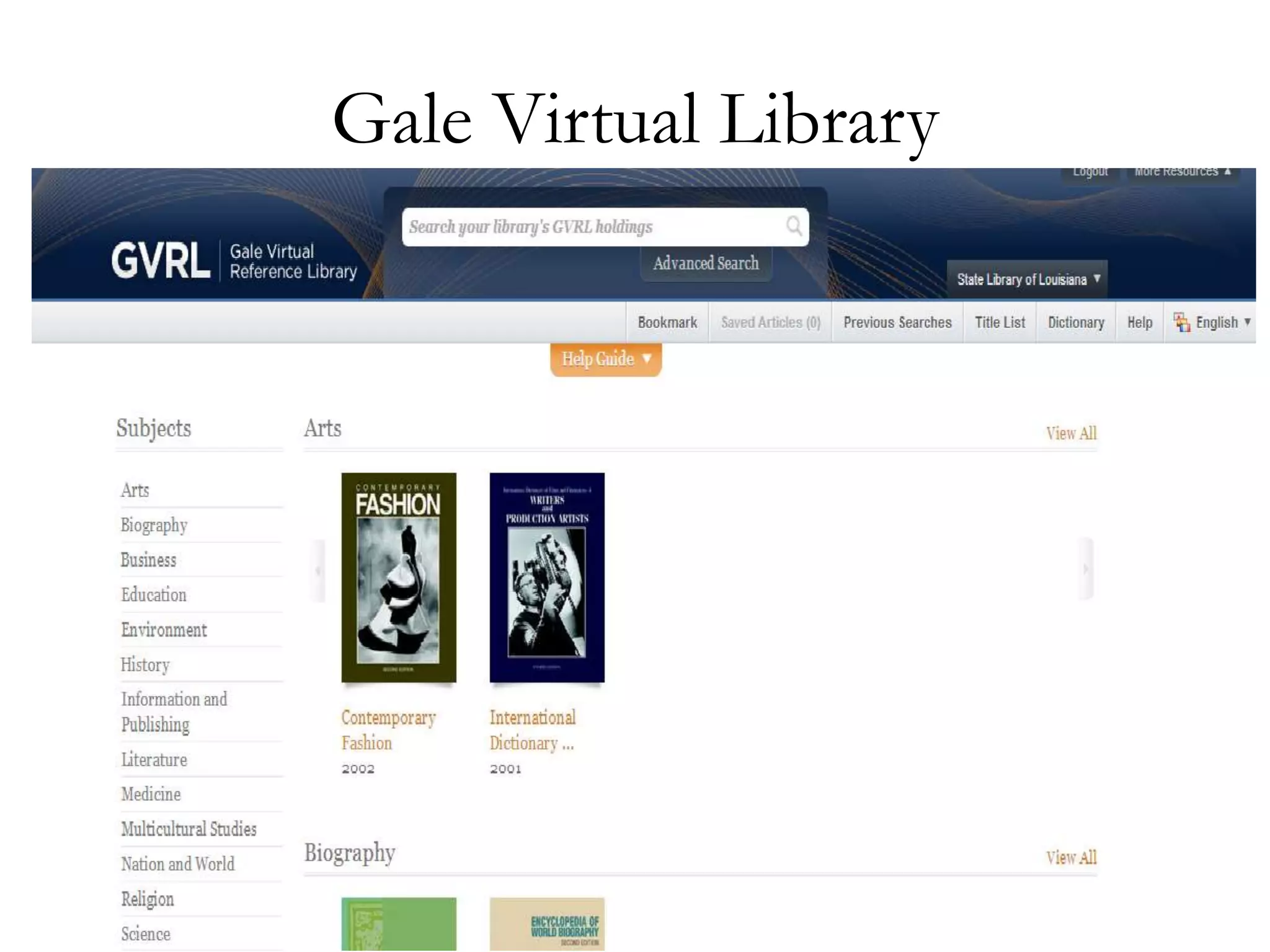
Gale Virtual Library
Gale Virtual Reference Library (GVRL) offers an
online collection of reference eBooks.
You can search a single eBook, within a Subject, or
across your library’s entire eBook collection.
Gale Virtual Library
Thank you!
Sonnet Ireland
Assistant Librarian
Head of Federal Documents, Microforms and Analog Media
sebrown3@uno.edu
Jennifer Jackson
Assistant Librarian
Instruction and Learning Commons Librarian
jmjacks9@uno.edu
OCLC. 2011. Perceptions of Libraries, 2010: Context and Community.
A Report to the OCLC Membership.
https://www.oclc.org/en-US/reports/2010perceptions.html

LLA 2014: Why Not Wikipedia?

  • 1.
    Why Not Wikipedia? SonnetIreland, Assistant Librarian Jennifer Jackson, Assistant Librarian Earl K. Long Library University of New Orleans
  • 2.
    Why Wikipedia isBad It’s a wiki, which means that it is a collaborative site with an openly editable model. That means anyone can write anything about anything, regardless of the person’s expertise or even basic knowledge on the topic.
  • 3.
    Then How canWikipedia be Good ? Wikipedia can actually be a great starting point for researchers. Sure, there are a lot of flaws, but… Don’t throw the baby out with the bathwater!
  • 4.
    The Fast Answer Wikipediais BRILLIANT for the fast answer to a question. If a student really doesn’t understand the topic of research, Wikipedia can help clarify.
  • 5.
    Examples In a historyclass, the student might have problems understanding the correct order of French monarchs… List of French Monarchs http://en.wikipedia.org/wiki/List_of_French_monarchs
  • 6.
    Examples Or understanding theorder of battles in the American Revolution… List of American Revolutionary War battles http://en.wikipedia.org/wiki/List_of_American_Revolutionary_War_battles
  • 7.
    Examples Or, in abiology class, a student might not know what a Tsetse fly is… Tsetse fly http://en.wikipedia.org/wiki/Tsetse_fly Or, in math, the student doesn’t know what a polynomial is… Polynomial http://en.wikipedia.org/wiki/Polynomial
  • 8.
    Duh… Now I’m sureyou’re all thinking, “We already know that. Tell us something new…” Well, did you know that Wikipedia now offers references?
  • 9.
    Cite your Work! Now,Wikipedia strongly encourages citing references within the article. This means that most articles now have a list of references. These can contain Notes, Citations, Sources…
  • 10.
    Examples 2013-2014 Thai PoliticalCrisis http://en.wikipedia.org/wiki/2013%E2%80%9314_Thai_political_crisis Interstate 805 http://en.wikipedia.org/wiki/Interstate_805 La Leyenda http://en.wikipedia.org/wiki/La_Leyenda
  • 11.
    Unraveling the Sweater Whenshowing a student how to do research, I like to talk to them about “unraveling the sweater.” Basically, it’s the idea of finding more resources through the bibliography of one source. This works with Wikipedia, too. Especially on a topic that you can’t find a lot on.
  • 12.
    True Story A studentwas looking for resources on the legal dispute between the World Wildlife Fund and the World Wrestling Federation. This was not a U.S. case, so it was a little more difficult to find documentation for it.
  • 13.
    True Story We foundcases, but we also checked Wikipedia… WWE http://en.wikipedia.org/wiki/WWE World Wide Fund for Nature http://en.wikipedia.org/wiki/World_Wide_Fund_for_Nature It led to 9 more resources, including the text of the agreement.
  • 14.
    The Bad Side…? Aswith everything on the Internet…sometimes the links in the References section die… And, of course, it should NEVER be cited on a paper…. But here are some resources that are easy to search (like Wikipedia) but are reliable and useful for papers. All are available at any public library.
  • 15.
    Why even tryWikipedia? Because…it’s what people are using. According to the OCLC report Perceptions of Libraries, 2010: Context and Community: “Wikipedia is now used by 73% of Americans, with half of these users visiting the site at least once a month. This usage rate rivals both search engines and social sites, making Wikipedia an information staple for online Americans.” p34
  • 16.
    Why even tryWikipedia? And don’t try to convince yourself that those 73% are all kids or older folks. Nope…88% of college students use Wikipedia to find information, second only to search engines (93%). p52 The library website? Only 57% of college students use that…and our online databases? 30%! Sadly, most people don’t even know that their library has a website. I kid you not.
  • 17.
    But fret not!All is not lost… For those who are hesitant about or intimidated by using our resources…Wikipedia is the perfect gateway drug…to information! Show your users how to effectively use Wikipedia… and then show them some cool resources that are easy to use (like Wikipedia) but more reliable (unlike Wikipedia). After all, only 3% of Americans surveyed considered Wikipedia a trusted source. p41
  • 18.
    Literati by Credo Anall in one database Literati by Credo includes topic pages providing students an overview of the topic. Literati by Credo also identifies relevant source material from other databases and websites.
  • 19.
  • 20.
    Gale Virtual Library GaleVirtual Reference Library (GVRL) offers an online collection of reference eBooks. You can search a single eBook, within a Subject, or across your library’s entire eBook collection.
  • 21.
  • 22.
    Thank you! Sonnet Ireland AssistantLibrarian Head of Federal Documents, Microforms and Analog Media sebrown3@uno.edu Jennifer Jackson Assistant Librarian Instruction and Learning Commons Librarian jmjacks9@uno.edu OCLC. 2011. Perceptions of Libraries, 2010: Context and Community. A Report to the OCLC Membership. https://www.oclc.org/en-US/reports/2010perceptions.html