Bro. Manuelito R. Putong
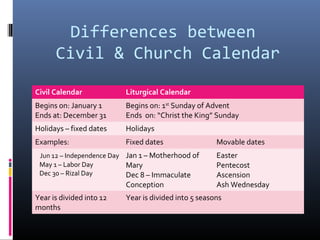
Differences between
Civil & Church Calendar
Civil Calendar Liturgical Calendar
Begins on: January 1
Ends at: December 31
Begins on: 1st
Sunday of Advent
Ends on: “Christ the King” Sunday
Holidays – fixed dates Holidays
Examples: Fixed dates Movable dates
Jun 12 – Independence Day
May 1 – Labor Day
Dec 30 – Rizal Day
Jan 1 – Motherhood of
Mary
Dec 8 – Immaculate
Conception
Easter
Pentecost
Ascension
Ash Wednesday
Year is divided into 12
months
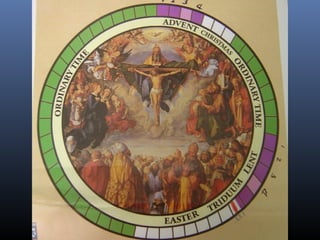
Year is divided into 5 seasons
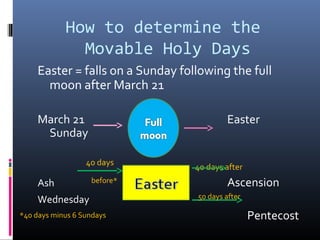
How to determine the
Movable Holy Days
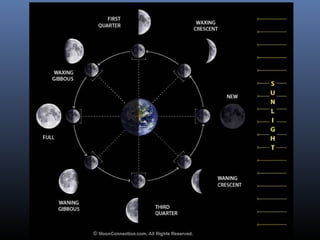
Easter = falls on a Sunday following the full
moon after March 21
March 21 Easter
Sunday
40 days after
Ash Ascension
Wednesday
Pentecost
40 days
before*
50 days after
*40 days minus 6 Sundays
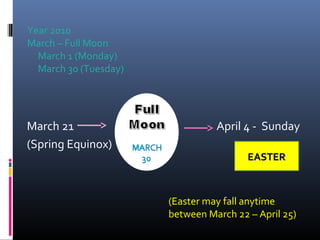
March 21 April 4 - Sunday
(Spring Equinox)
EASTEREASTER
Year 2010
March – Full Moon
March 1 (Monday)
March 30 (Tuesday)
(Easter may fall anytime
between March 22 – April 25)
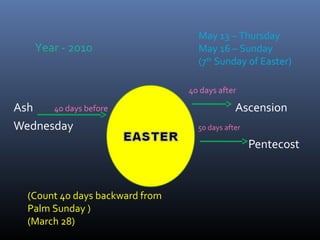
40 days after
Ash Ascension
Wednesday
Pentecost
40 days before
50 days after
Year - 2010
May 13 – Thursday
May 16 – Sunday
(7th
Sunday of Easter)
(Count 40 days backward from
Palm Sunday )
(March 28)
The Seasons in the
Liturgical Year
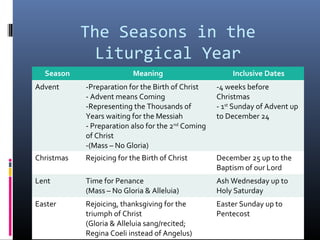
Season Meaning Inclusive Dates
Advent -Preparation for the Birth of Christ
- Advent means Coming
-Representing the Thousands of
Years waiting for the Messiah
- Preparation also for the 2nd
Coming
of Christ
-(Mass – No Gloria)
-4 weeks before
Christmas
- 1st
Sunday of Advent up
to December 24
Christmas Rejoicing for the Birth of Christ December 25 up to the
Baptism of our Lord
Lent Time for Penance
(Mass – No Gloria & Alleluia)
Ash Wednesday up to
Holy Saturday
Easter Rejoicing, thanksgiving for the
triumph of Christ
(Gloria & Alleluia sang/recited;
Regina Coeli instead of Angelus)
Easter Sunday up to
Pentecost
The Seasons in the
Liturgical Year
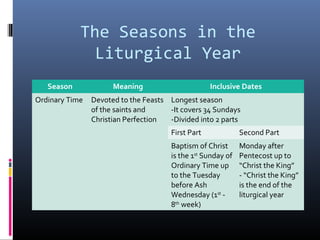
Season Meaning Inclusive Dates
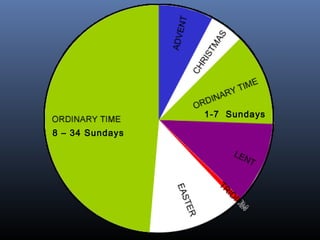
Ordinary Time Devoted to the Feasts
of the saints and
Christian Perfection
Longest season
-It covers 34 Sundays
-Divided into 2 parts
First Part Second Part
Baptism of Christ
is the 1st
Sunday of
Ordinary Time up
to the Tuesday
before Ash
Wednesday (1st
-
8th
week)
Monday after
Pentecost up to
“Christ the King”
- “Christ the King”
is the end of the
liturgical year
8 – 34 Sundays
1-7 Sundays
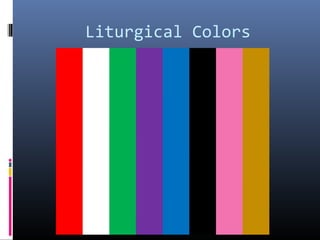
Liturgical Colors
Liturgical
Colors
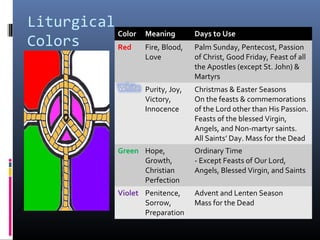
Color Meaning Days to Use
Red Fire, Blood,
Love
Palm Sunday, Pentecost, Passion
of Christ, Good Friday, Feast of all
the Apostles (except St. John) &
Martyrs
Purity, Joy,
Victory,
Innocence
Christmas & Easter Seasons
On the feasts & commemorations
of the Lord other than His Passion.
Feasts of the blessed Virgin,
Angels, and Non-martyr saints.
All Saints’ Day. Mass for the Dead
Green Hope,
Growth,
Christian
Perfection
Ordinary Time
- Except Feasts of Our Lord,
Angels, Blessed Virgin, and Saints
Violet Penitence,
Sorrow,
Preparation
Advent and Lenten Season
Mass for the Dead
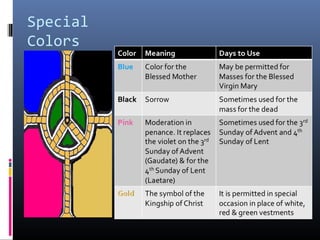
Special
Colors
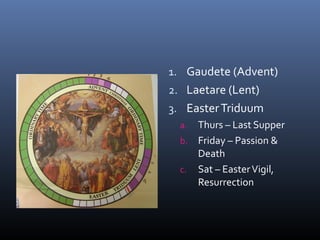
1. Gaudete (Advent)
2. Laetare (Lent)
3. EasterTriduum
a. Thurs – Last Supper
b. Friday – Passion &
Death
c. Sat – EasterVigil,
Resurrection
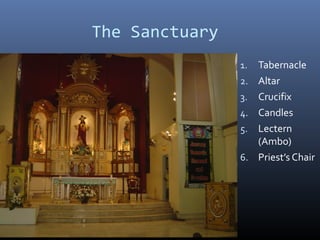
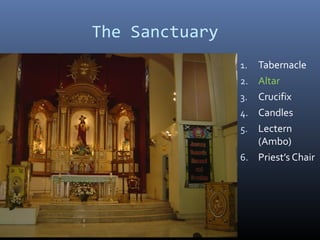
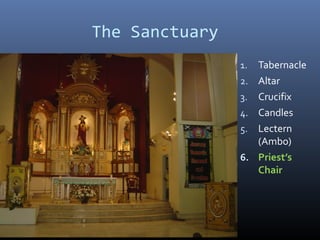
The Sanctuary
1. Tabernacle
2. Altar
3. Crucifix
4. Candles
5. Lectern
(Ambo)
6. Priest’s Chair
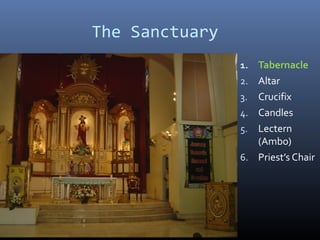
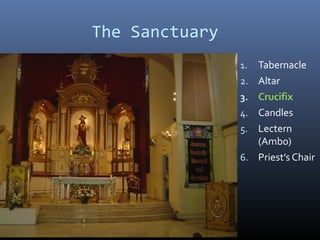
The Sanctuary
1. Tabernacle
2. Altar
3. Crucifix
4. Candles
5. Lectern
(Ambo)
6. Priest’s Chair
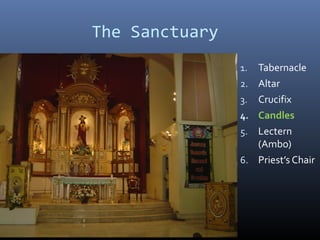
The Sanctuary
1. Tabernacle
2. Altar
3. Crucifix
4. Candles
5. Lectern
(Ambo)
6. Priest’s Chair
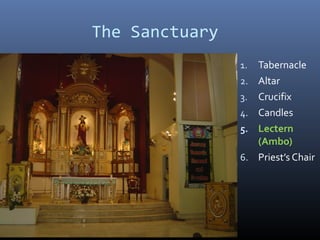
The Sanctuary
1. Tabernacle
2. Altar
3. Crucifix
4. Candles
5. Lectern
(Ambo)
6. Priest’s Chair
The Sanctuary
1. Tabernacle
2. Altar
3. Crucifix
4. Candles
5. Lectern
(Ambo)
6. Priest’s Chair
The Sanctuary
1. Tabernacle
2. Altar
3. Crucifix
4. Candles
5. Lectern
(Ambo)
6. Priest’s Chair
The Sanctuary
1. Tabernacle
2. Altar
3. Crucifix
4. Candles
5. Lectern
(Ambo)
6. Priest’s
Chair
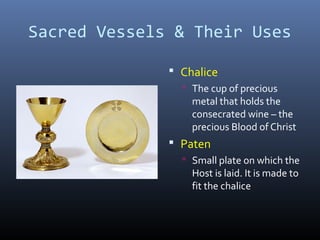
Sacred Vessels & Their Uses
 Chalice
 The cup of precious
metal that holds the
consecrated wine – the
precious Blood of Christ
 Paten
 Small plate on which the
Host is laid. It is made to
fit the chalice
Sacred Vessels & Their Uses
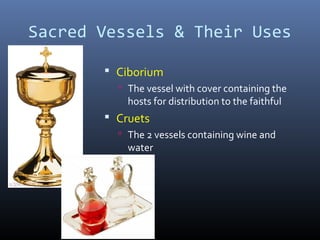
 Ciborium
 The vessel with cover containing the
hosts for distribution to the faithful
 Cruets
 The 2 vessels containing wine and
water
Sacred Vessels & Their Uses
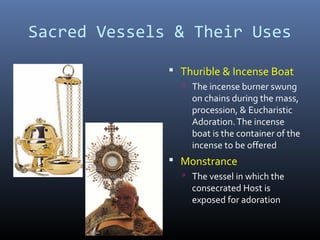
 Thurible & Incense Boat
 The incense burner swung
on chains during the mass,
procession, & Eucharistic
Adoration.The incense
boat is the container of the
incense to be offered
 Monstrance
 The vessel in which the
consecrated Host is
exposed for adoration
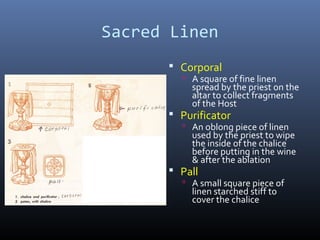
Sacred Linen
 Corporal
 A square of fine linen
spread by the priest on the
altar to collect fragments
of the Host
 Purificator
 An oblong piece of linen
used by the priest to wipe
the inside of the chalice
before putting in the wine
& after the ablation
 Pall
 A small square piece of
linen starched stiff to
cover the chalice
r
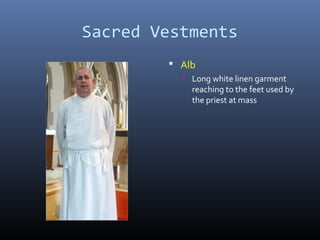
Sacred Vestments
 Alb
 Long white linen garment
reaching to the feet used by
the priest at mass
Sacred Vestments
 Alb
 Long white linen garment
reaching to the feet used by
the priest at mass
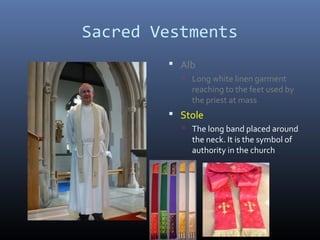
 Stole
 The long band placed around
the neck. It is the symbol of
authority in the church
Sacred Vestments
 Alb
 Long white linen garment
reaching to the feet used by
the priest at mass
 Stole
 The long band placed around
the neck. It is the symbol of
authority in the church
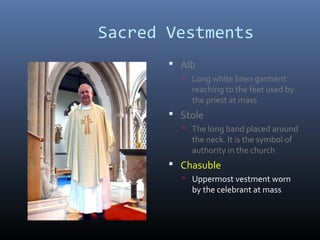
 Chasuble
 Uppermost vestment worn
by the celebrant at mass
Sacred Vestments
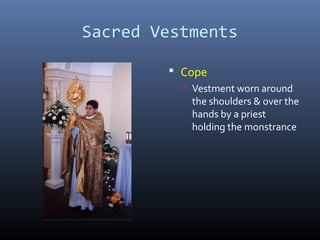
 Cope
 Vestment worn around
the shoulders & over the
hands by a priest
holding the monstrance
The Sacred Books
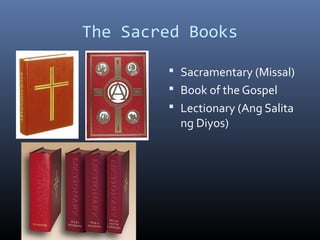
 Sacramentary (Missal)
 Book of the Gospel
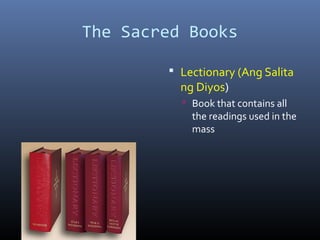
 Lectionary (Ang Salita
ng Diyos)
The Sacred Books
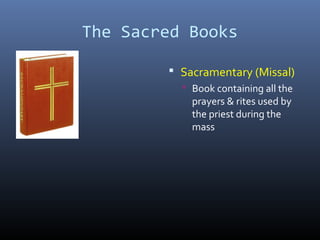
 Sacramentary (Missal)
 Book containing all the
prayers & rites used by
the priest during the
mass
The Sacred Books
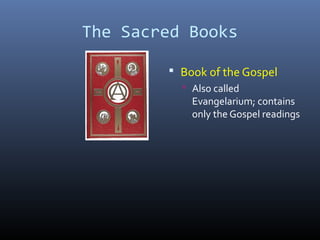
 Book of the Gospel
 Also called
Evangelarium; contains
only the Gospel readings
The Sacred Books
 Lectionary (Ang Salita
ng Diyos)
 Book that contains all
the readings used in the
mass
The Lectionary
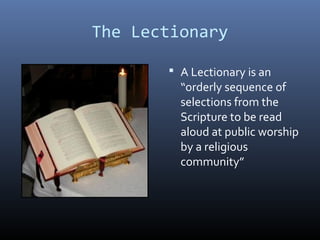
 A Lectionary is an
“orderly sequence of
selections from the
Scripture to be read
aloud at public worship
by a religious
community”
Parts of the Lectionary
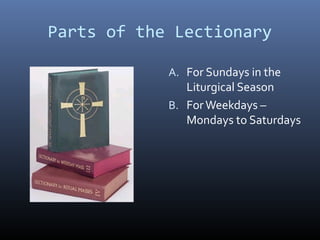
A. For Sundays in the
Liturgical Season
B. ForWeekdays –
Mondays to Saturdays
Hanay ng mga Panahon
(Liturgical Seasons)
I. Mga Pabasa para sa mga Araw ng Linggo
(Sundays)
1. Panahon ng Pagdating ng Panginoon (Advent/Advento)
2. Panahon ng Paskong Pagsilang (Christmas Season)
3. Panahon ng Apatnapung Araw ng Paghahanda para sa
Pasko ng Pagkabuhay (Lent/Kuwaresma)
4. Ang Tatlong Araw ng Pagdiriwang ng Pagpapasakit at
Pagkabuhay
a. Panahon ng Pasko ng Muling Pagkabuhay (Easter)
5. Ang Karaniwang Panahon (Ordinary Time)
a. Mga Dakilang Kapistahan ng Panginoon sa Karaniwang
Panahon
b. Mga Awiting Salmong Tugunan
Hanay ng mga Panahon
(Liturgical Seasons)
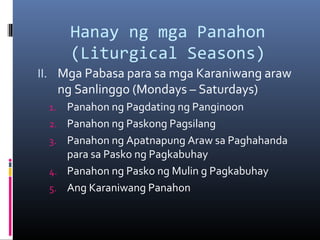
II. Mga Pabasa para sa mga Karaniwang araw
ng Sanlinggo (Mondays – Saturdays)
1. Panahon ng Pagdating ng Panginoon
2. Panahon ng Paskong Pagsilang
3. Panahon ng Apatnapung Araw sa Paghahanda
para sa Pasko ng Pagkabuhay
4. Panahon ng Pasko ng Mulin g Pagkabuhay
5. Ang Karaniwang Panahon
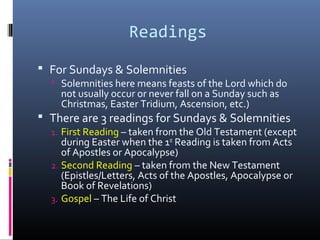
Readings
 For Sundays & Solemnities
 Solemnities here means feasts of the Lord which do
not usually occur or never fall on a Sunday such as
Christmas, Easter Tridium, Ascension, etc.)
 There are 3 readings for Sundays & Solemnities
1. First Reading – taken from the Old Testament (except
during Easter when the 1st
Reading is taken from Acts
of Apostles or Apocalypse)
2. Second Reading – taken from the New Testament
(Epistles/Letters, Acts of the Apostles, Apocalypse or
Book of Revelations)
3. Gospel – The Life of Christ
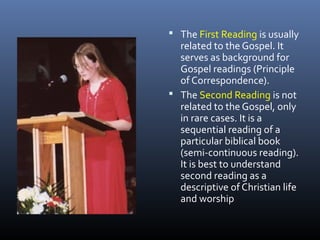
 The First Reading is usually
related to the Gospel. It
serves as background for
Gospel readings (Principle
of Correspondence).
 The Second Reading is not
related to the Gospel, only
in rare cases. It is a
sequential reading of a
particular biblical book
(semi-continuous reading).
It is best to understand
second reading as a
descriptive of Christian life
and worship
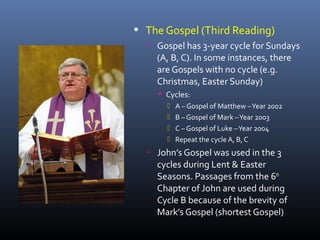
 The Gospel (Third Reading)
 Gospel has 3-year cycle for Sundays
(A, B, C). In some instances, there
are Gospels with no cycle (e.g.
Christmas, Easter Sunday)
 Cycles:
 A – Gospel of Matthew –Year 2002
 B – Gospel of Mark –Year 2003
 C – Gospel of Luke –Year 2004
 Repeat the cycle A, B,C
 John’s Gospel was used in the 3
cycles during Lent & Easter
Seasons. Passages from the 6th
Chapter of John are used during
Cycle B because of the brevity of
Mark’s Gospel (shortest Gospel)
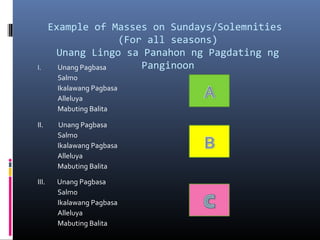
Example of Masses on Sundays/Solemnities
(For all seasons)
Unang Lingo sa Panahon ng Pagdating ng
PanginoonI. Unang Pagbasa
Salmo
Ikalawang Pagbasa
Alleluya
Mabuting Balita
II. Unang Pagbasa
Salmo
Ikalawang Pagbasa
Alleluya
Mabuting Balita
III. Unang Pagbasa
Salmo
Ikalawang Pagbasa
Alleluya
Mabuting Balita
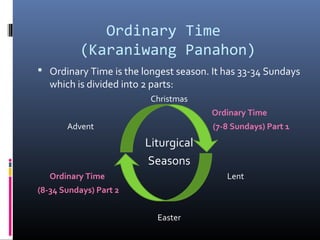
Ordinary Time
(Karaniwang Panahon)
 Ordinary Time is the longest season. It has 33-34 Sundays
which is divided into 2 parts:
Christmas
Ordinary Time
Advent (7-8 Sundays) Part 1
Liturgical
Seasons
Ordinary Time Lent
(8-34 Sundays) Part 2
Easter
 During weekdays (Mondays to Saturdays) in all
seasons there are only 2 readings (1st
Reading &
Gospel)
 However in Ordinary Time the 1st
Reading is
semi-continuous. It is arranged in 2-year cycle.
 Example:
 Year I – odd number year – Year 2003
 Year II – even number year – Year 2004
 The Gospel (Weekdays-Ordinary Time) readings
are arranged in single cycle repeated every year:
 1st
week- 9th
week – Mark
 10th
week-21st
week – Matthew
 22nd
week-34th
week – Luke
 There is a common (one) Gospel for Year I and
Year II
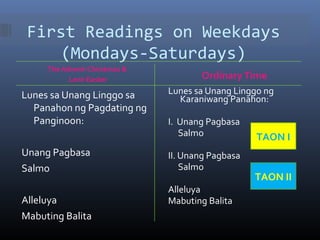
First Readings on Weekdays
(Mondays-Saturdays)
The Advent-Christmas &
Lent-Easter OrdinaryTime
Lunes sa Unang Linggo sa
Panahon ng Pagdating ng
Panginoon:
Unang Pagbasa
Salmo
Alleluya
Mabuting Balita
Lunes sa Unang Linggo ng
Karaniwang Panahon:
I. Unang Pagbasa
Salmo
II. Unang Pagbasa
Salmo
Alleluya
Mabuting Balita
TAON I
TAON II
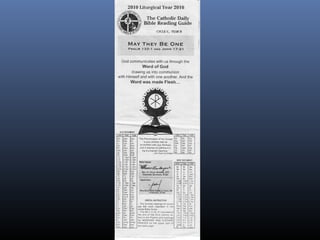
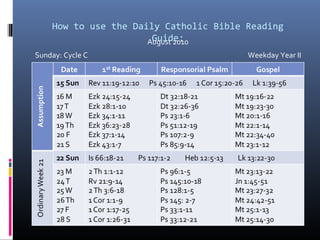
How to use the Daily Catholic Bible Reading
Guide:August 2010
Sunday: Cycle C Weekday Year II
How to use the Ordo
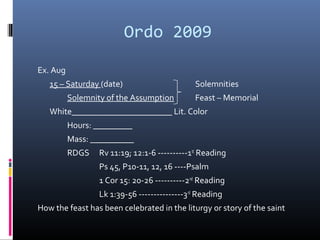
Ordo 2009
Ex. Aug
15 – Saturday (date) Solemnities
Solemnity of the Assumption Feast – Memorial
White_______________________ Lit. Color
Hours: _________
Mass: __________
RDGS Rv 11:19; 12:1-6 ----------1st
Reading
Ps 45, P10-11, 12, 16 ----Psalm
1 Cor 15: 20-26 ----------2nd
Reading
Lk 1:39-56 ---------------3rd
Reading
How the feast has been celebrated in the liturgy or story of the saint
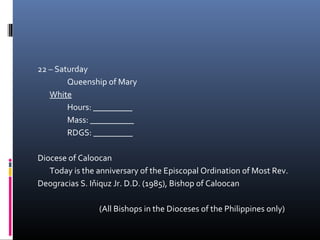
22 – Saturday
Queenship of Mary
White
Hours: _________
Mass: __________
RDGS: _________
Diocese of Caloocan
Today is the anniversary of the Episcopal Ordination of Most Rev.
Deogracias S. Iňiquz Jr. D.D. (1985), Bishop of Caloocan
(All Bishops in the Dioceses of the Philippines only)
Liturgical Year

Liturgical Year

  • 1.
  • 2.
    Differences between Civil &Church Calendar Civil Calendar Liturgical Calendar Begins on: January 1 Ends at: December 31 Begins on: 1st Sunday of Advent Ends on: “Christ the King” Sunday Holidays – fixed dates Holidays Examples: Fixed dates Movable dates Jun 12 – Independence Day May 1 – Labor Day Dec 30 – Rizal Day Jan 1 – Motherhood of Mary Dec 8 – Immaculate Conception Easter Pentecost Ascension Ash Wednesday Year is divided into 12 months Year is divided into 5 seasons
  • 3.
    How to determinethe Movable Holy Days Easter = falls on a Sunday following the full moon after March 21 March 21 Easter Sunday 40 days after Ash Ascension Wednesday Pentecost 40 days before* 50 days after *40 days minus 6 Sundays
  • 4.
    March 21 April4 - Sunday (Spring Equinox) EASTEREASTER Year 2010 March – Full Moon March 1 (Monday) March 30 (Tuesday) (Easter may fall anytime between March 22 – April 25)
  • 6.
    40 days after AshAscension Wednesday Pentecost 40 days before 50 days after Year - 2010 May 13 – Thursday May 16 – Sunday (7th Sunday of Easter) (Count 40 days backward from Palm Sunday ) (March 28)
  • 7.
    The Seasons inthe Liturgical Year Season Meaning Inclusive Dates Advent -Preparation for the Birth of Christ - Advent means Coming -Representing the Thousands of Years waiting for the Messiah - Preparation also for the 2nd Coming of Christ -(Mass – No Gloria) -4 weeks before Christmas - 1st Sunday of Advent up to December 24 Christmas Rejoicing for the Birth of Christ December 25 up to the Baptism of our Lord Lent Time for Penance (Mass – No Gloria & Alleluia) Ash Wednesday up to Holy Saturday Easter Rejoicing, thanksgiving for the triumph of Christ (Gloria & Alleluia sang/recited; Regina Coeli instead of Angelus) Easter Sunday up to Pentecost
  • 8.
    The Seasons inthe Liturgical Year Season Meaning Inclusive Dates Ordinary Time Devoted to the Feasts of the saints and Christian Perfection Longest season -It covers 34 Sundays -Divided into 2 parts First Part Second Part Baptism of Christ is the 1st Sunday of Ordinary Time up to the Tuesday before Ash Wednesday (1st - 8th week) Monday after Pentecost up to “Christ the King” - “Christ the King” is the end of the liturgical year
  • 9.
    8 – 34Sundays 1-7 Sundays
  • 10.
  • 11.
    Liturgical Colors Color Meaning Daysto Use Red Fire, Blood, Love Palm Sunday, Pentecost, Passion of Christ, Good Friday, Feast of all the Apostles (except St. John) & Martyrs Purity, Joy, Victory, Innocence Christmas & Easter Seasons On the feasts & commemorations of the Lord other than His Passion. Feasts of the blessed Virgin, Angels, and Non-martyr saints. All Saints’ Day. Mass for the Dead Green Hope, Growth, Christian Perfection Ordinary Time - Except Feasts of Our Lord, Angels, Blessed Virgin, and Saints Violet Penitence, Sorrow, Preparation Advent and Lenten Season Mass for the Dead
  • 13.
  • 14.
    1. Gaudete (Advent) 2.Laetare (Lent) 3. EasterTriduum a. Thurs – Last Supper b. Friday – Passion & Death c. Sat – EasterVigil, Resurrection
  • 15.
    The Sanctuary 1. Tabernacle 2.Altar 3. Crucifix 4. Candles 5. Lectern (Ambo) 6. Priest’s Chair
  • 16.
    The Sanctuary 1. Tabernacle 2.Altar 3. Crucifix 4. Candles 5. Lectern (Ambo) 6. Priest’s Chair
  • 17.
    The Sanctuary 1. Tabernacle 2.Altar 3. Crucifix 4. Candles 5. Lectern (Ambo) 6. Priest’s Chair
  • 18.
    The Sanctuary 1. Tabernacle 2.Altar 3. Crucifix 4. Candles 5. Lectern (Ambo) 6. Priest’s Chair
  • 19.
    The Sanctuary 1. Tabernacle 2.Altar 3. Crucifix 4. Candles 5. Lectern (Ambo) 6. Priest’s Chair
  • 20.
    The Sanctuary 1. Tabernacle 2.Altar 3. Crucifix 4. Candles 5. Lectern (Ambo) 6. Priest’s Chair
  • 21.
    The Sanctuary 1. Tabernacle 2.Altar 3. Crucifix 4. Candles 5. Lectern (Ambo) 6. Priest’s Chair
  • 22.
    Sacred Vessels &Their Uses  Chalice  The cup of precious metal that holds the consecrated wine – the precious Blood of Christ  Paten  Small plate on which the Host is laid. It is made to fit the chalice
  • 23.
    Sacred Vessels &Their Uses  Ciborium  The vessel with cover containing the hosts for distribution to the faithful  Cruets  The 2 vessels containing wine and water
  • 24.
    Sacred Vessels &Their Uses  Thurible & Incense Boat  The incense burner swung on chains during the mass, procession, & Eucharistic Adoration.The incense boat is the container of the incense to be offered  Monstrance  The vessel in which the consecrated Host is exposed for adoration
  • 25.
    Sacred Linen  Corporal A square of fine linen spread by the priest on the altar to collect fragments of the Host  Purificator  An oblong piece of linen used by the priest to wipe the inside of the chalice before putting in the wine & after the ablation  Pall  A small square piece of linen starched stiff to cover the chalice r
  • 26.
    Sacred Vestments  Alb Long white linen garment reaching to the feet used by the priest at mass
  • 27.
    Sacred Vestments  Alb Long white linen garment reaching to the feet used by the priest at mass  Stole  The long band placed around the neck. It is the symbol of authority in the church
  • 28.
    Sacred Vestments  Alb Long white linen garment reaching to the feet used by the priest at mass  Stole  The long band placed around the neck. It is the symbol of authority in the church  Chasuble  Uppermost vestment worn by the celebrant at mass
  • 29.
    Sacred Vestments  Cope Vestment worn around the shoulders & over the hands by a priest holding the monstrance
  • 30.
    The Sacred Books Sacramentary (Missal)  Book of the Gospel  Lectionary (Ang Salita ng Diyos)
  • 31.
    The Sacred Books Sacramentary (Missal)  Book containing all the prayers & rites used by the priest during the mass
  • 32.
    The Sacred Books Book of the Gospel  Also called Evangelarium; contains only the Gospel readings
  • 33.
    The Sacred Books Lectionary (Ang Salita ng Diyos)  Book that contains all the readings used in the mass
  • 34.
    The Lectionary  ALectionary is an “orderly sequence of selections from the Scripture to be read aloud at public worship by a religious community”
  • 35.
    Parts of theLectionary A. For Sundays in the Liturgical Season B. ForWeekdays – Mondays to Saturdays
  • 36.
    Hanay ng mgaPanahon (Liturgical Seasons) I. Mga Pabasa para sa mga Araw ng Linggo (Sundays) 1. Panahon ng Pagdating ng Panginoon (Advent/Advento) 2. Panahon ng Paskong Pagsilang (Christmas Season) 3. Panahon ng Apatnapung Araw ng Paghahanda para sa Pasko ng Pagkabuhay (Lent/Kuwaresma) 4. Ang Tatlong Araw ng Pagdiriwang ng Pagpapasakit at Pagkabuhay a. Panahon ng Pasko ng Muling Pagkabuhay (Easter) 5. Ang Karaniwang Panahon (Ordinary Time) a. Mga Dakilang Kapistahan ng Panginoon sa Karaniwang Panahon b. Mga Awiting Salmong Tugunan
  • 37.
    Hanay ng mgaPanahon (Liturgical Seasons) II. Mga Pabasa para sa mga Karaniwang araw ng Sanlinggo (Mondays – Saturdays) 1. Panahon ng Pagdating ng Panginoon 2. Panahon ng Paskong Pagsilang 3. Panahon ng Apatnapung Araw sa Paghahanda para sa Pasko ng Pagkabuhay 4. Panahon ng Pasko ng Mulin g Pagkabuhay 5. Ang Karaniwang Panahon
  • 38.
    Readings  For Sundays& Solemnities  Solemnities here means feasts of the Lord which do not usually occur or never fall on a Sunday such as Christmas, Easter Tridium, Ascension, etc.)  There are 3 readings for Sundays & Solemnities 1. First Reading – taken from the Old Testament (except during Easter when the 1st Reading is taken from Acts of Apostles or Apocalypse) 2. Second Reading – taken from the New Testament (Epistles/Letters, Acts of the Apostles, Apocalypse or Book of Revelations) 3. Gospel – The Life of Christ
  • 39.
     The FirstReading is usually related to the Gospel. It serves as background for Gospel readings (Principle of Correspondence).  The Second Reading is not related to the Gospel, only in rare cases. It is a sequential reading of a particular biblical book (semi-continuous reading). It is best to understand second reading as a descriptive of Christian life and worship
  • 40.
     The Gospel(Third Reading)  Gospel has 3-year cycle for Sundays (A, B, C). In some instances, there are Gospels with no cycle (e.g. Christmas, Easter Sunday)  Cycles:  A – Gospel of Matthew –Year 2002  B – Gospel of Mark –Year 2003  C – Gospel of Luke –Year 2004  Repeat the cycle A, B,C  John’s Gospel was used in the 3 cycles during Lent & Easter Seasons. Passages from the 6th Chapter of John are used during Cycle B because of the brevity of Mark’s Gospel (shortest Gospel)
  • 42.
    Example of Masseson Sundays/Solemnities (For all seasons) Unang Lingo sa Panahon ng Pagdating ng PanginoonI. Unang Pagbasa Salmo Ikalawang Pagbasa Alleluya Mabuting Balita II. Unang Pagbasa Salmo Ikalawang Pagbasa Alleluya Mabuting Balita III. Unang Pagbasa Salmo Ikalawang Pagbasa Alleluya Mabuting Balita
  • 43.
    Ordinary Time (Karaniwang Panahon) Ordinary Time is the longest season. It has 33-34 Sundays which is divided into 2 parts: Christmas Ordinary Time Advent (7-8 Sundays) Part 1 Liturgical Seasons Ordinary Time Lent (8-34 Sundays) Part 2 Easter
  • 44.
     During weekdays(Mondays to Saturdays) in all seasons there are only 2 readings (1st Reading & Gospel)  However in Ordinary Time the 1st Reading is semi-continuous. It is arranged in 2-year cycle.  Example:  Year I – odd number year – Year 2003  Year II – even number year – Year 2004  The Gospel (Weekdays-Ordinary Time) readings are arranged in single cycle repeated every year:  1st week- 9th week – Mark  10th week-21st week – Matthew  22nd week-34th week – Luke  There is a common (one) Gospel for Year I and Year II
  • 45.
    First Readings onWeekdays (Mondays-Saturdays) The Advent-Christmas & Lent-Easter OrdinaryTime Lunes sa Unang Linggo sa Panahon ng Pagdating ng Panginoon: Unang Pagbasa Salmo Alleluya Mabuting Balita Lunes sa Unang Linggo ng Karaniwang Panahon: I. Unang Pagbasa Salmo II. Unang Pagbasa Salmo Alleluya Mabuting Balita TAON I TAON II
  • 47.
    How to usethe Daily Catholic Bible Reading Guide:August 2010 Sunday: Cycle C Weekday Year II
  • 48.
    How to usethe Ordo
  • 49.
    Ordo 2009 Ex. Aug 15– Saturday (date) Solemnities Solemnity of the Assumption Feast – Memorial White_______________________ Lit. Color Hours: _________ Mass: __________ RDGS Rv 11:19; 12:1-6 ----------1st Reading Ps 45, P10-11, 12, 16 ----Psalm 1 Cor 15: 20-26 ----------2nd Reading Lk 1:39-56 ---------------3rd Reading How the feast has been celebrated in the liturgy or story of the saint
  • 50.
    22 – Saturday Queenshipof Mary White Hours: _________ Mass: __________ RDGS: _________ Diocese of Caloocan Today is the anniversary of the Episcopal Ordination of Most Rev. Deogracias S. Iňiquz Jr. D.D. (1985), Bishop of Caloocan (All Bishops in the Dioceses of the Philippines only)