“Through your generousand conscientious
participation in the Liturgy, which is the
heart of the Christian life and which is, as
the Council said, ‘the climax to which all the
action of the Church tends and the source
from whence her strength comes’, we see
that the ideal of the Christian lay person,
the ready and active collaborator of the
Catholic priesthood, is realized in you.”
-Pope Paul VI
9.
The Liturgy
It comesfrom the Greek word for public duty, a
service or a public organization, but when the word
was adopted by the Church, we are no longer
talking only about the things that we do, rather we
are talking about what God does.
It emphasizes on the action of our Lord Jesus
Christ, the eternal High Priest, for He is truly
present and active in his people, for He is our Risen
Lord whose perfect sacrifice is accepted by the
Father, in the Holy Spirit.
10.
Your Role inthe Liturgy
The General Instruction of the Roman
Missal (GIRM) describes you as “the
ministers.”
You are there to assist the Priest/Bishop
representing the people in the sanctuary
area.
You are a direct link between the people
and the priest.
11.
The Server isa Sign
The server is a part of the
visible sign, an instrument
through whom God acts and
gives his message of love.
12.
Symbolism in theLiturgy
Liturgical symbols, range from those
we have inherited or have been
introduced to us, such as the use of
candles, incense, kneeling and etc. to
those special signs given to us by our
Lord Jesus Christ.
13.
Liturgical Time
The churchrecalls and celebrates
the whole mystery of Christ, his
coming and birth, his ministry, his
saving death and resurrection, his
ascension and the sending of the
Holy Spirit and our lives in Him, as
we await the second coming.
14.
Great Seasons ofthe Year
Advent Season – the beginning of the
Church year, celebrates the two fold
coming of Christ (Incarnation and Final
Judgement). With Christian joy, we
celebrate His first coming. In Christian
hope, we await his second coming. The
color is violet. Advent has 4 weeks,
including the 9 days of Simbang gabi.
15.
Great Seasons ofthe Year
Christmas Season – celebrates Jesus’ Birth,
the Incarnation, God becoming Man. There
are 2 focal points: 1. Christmas Day with its
octave (8 days), including several feasts
and concluding with the Solemnity of Mary,
Mother of God (Jan.1), 2. The Solemnity of
the Epiphany that includes the Baptism of
the Lord, which is also the First Sunday in
Ordinary Time. The color is white.
16.
Great Seasons ofthe Year
Lenten Season – when we give
ourselves to prayer and penance, to
hearing the Word of God and to acts of
Charity. We prepare for Easter and we
recall the graces of Baptism. It runs
from Ash Wednesday until the Mass of
the Lord’s Supper exclusive (on Holy
Thursday.)
17.
The color isviolet. The Sundays of
Lent have priority over all solemnities
and feast of the Lord. All weekdays of
Lent takes precedence over obligatory
memorials (M). The 6th
Sunday of Lent
marks the beginning of Holy Week,
also known as Palm Sunday. Holy
Week recalls the sufferings of our
Lord.
18.
Great Seasons ofthe Year
The Easter Triduum – the three days of the
Passion and resurrection of Christ which is the
highest point of the whole year. The Triduum
begins on Holy Thursday with the Evening Mass
of the Lord’s Supper, continues through Good
Friday with the solemn commemoration of the
Lord’s Passion and death, and reaches its high
point in the celebration of the Easter Vigil. The
Triduum closes in the evening of Easter Sunday.
The color is white, but red on Good Friday.
19.
Great Seasons ofthe Year
The Easter Season – covers the 50 days
between Easter Sunday and Pentecost.
These days are celebrated as feast
days, but the first 8 days after Easter
Sunday are called the Easter Octave
and are celebrated as Solemnities of
the Lord. The color is white.
20.
On the 40th
dayafter Easter, the
Church celebrates the Ascension of the
Lord to heaven. In the days after the
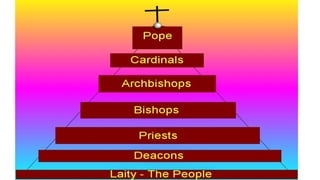
Ascension to the Saturday before
Pentecost, we prepare for the coming
of the Holy Spirit. On Pentecost
Sunday, we celebrate the sending of
the Holy Spirit to the Church. The Color
is red.
21.
Great Seasons ofthe year
Sundays in Ordinary Time – it is categorized
into two:
1. Sundays between the Epiphany and Ash
Wednesday
2. Sundays between Pentecost and Advent.
The last Sunday of the Liturgical Year is
the Solemnity of Christ the King.
•In the CatholicChurch, colors are
more than just aesthetic choices; they
hold deep spiritual significance. One
of the most visible ways that the
Church communicates the rhythm of
her liturgical year is through the use
of liturgical colors.
25.
•They offer avisual expression of the
Church’s life, accentuating the mood of a
liturgical season or specific celebration.
They serve as an exterior sign that invites
us to an interior reflection. As we explore
the meanings behind these colors, we’ll see
how they can deepen our understanding of
the faith.
26.
Understanding the Importanceof Liturgy
•“The liturgy is the summit toward which the
activity of the Church is directed; at the
same time, it is the font from which all her
power flows.” (CCC 1074) In simple terms,
the liturgy is both the high point of what
the Church does and the source of her
strength.
27.
White: Purity andJoy
White is probably the most recognized of the
liturgical colors. It is used during the most joyful
times in the Church calendar, such as Christmas
and Easter. It is also worn at baptisms, weddings,
and funerals to symbolize the Resurrection. In the
Bible, white garments are often associated with
purity, holiness, and new life. In the book of
Revelation, we find, “They have washed their robes
and made them white in the blood of the Lamb.”
(Revelation 7:14)
28.
Green: Ordinary Time
Afterthe Christmas and Easter seasons, the
Church returns to what’s called Ordinary Time.
This period, represented by the color green,
isn’t “ordinary” in the sense of being common or
mundane. Instead, it’s a time for growth and
maturation in our faith, much like a plant grows
in the natural world. Green signifies this
hopeful, unfolding journey of discipleship.
29.
Purple: Repentance andPreparation
Purple is used during Advent and Lent, seasons of
waiting and preparation for the celebrations of
Christmas and Easter, respectively. The color is
traditionally associated with penitence and fasting,
as well as royalty, reminding us that we are preparing
for the coming of the King. In Scripture, the concept
of repentance is essential. The Gospel of Mark opens
with John the Baptist preaching, “Repent, and believe
in the Gospel.” (Mark 1:15)
30.
Red: The HolySpirit and Martyrdom
Red is the color of fire and blood. It is used on
Pentecost, when we celebrate the descent of the Holy
Spirit upon the Apostles. It is also used for the feasts
of martyrs, who shed their blood for the faith. Red
brings to mind the Holy Spirit, who gives us the
courage to witness to our faith, even to the point of
sacrificing our lives. The Bible tells us, “When the
Advocate comes, whom I will send to you from the
Father—the Spirit of truth who goes out from the
Father—he will testify about me.” (John 15:26)
31.
Rose: Joy WithinPreparation
•Rose is used just twice a year: once during
Advent (Gaudete Sunday) and once during
Lent (Laetare Sunday). On these Sundays, the
Church takes a brief pause from her
penitential posture to rejoice in the coming joy
of Christmas or Easter. The rose color signifies
this sense of joy and anticipation within a
season of preparation.
32.
•Gaudete Sunday isthe third Sunday of Advent
in the Roman Catholic Calendar of the church
year.
•The term is derived from the Latin opening
words of the introit antiphon, “Rejoice
(Gaudete) in the Lord always.” the theme of
the day expresses the joy of the anticipation at
the approach of the Christmas Celebration.
33.
•Laetare is thefirst word – meaning – “rejoice”
in the Latin text. On Laetare Sunday (as similar
with the Third Sunday of Advent’s Gaudete
Sunday) the church expresses hope and joy in
the midst of our Lenten fasts and penances.
34.
Black: Mourning andRemembrance
•While not commonly used, black can still be worn
for Masses of mourning and for All Souls’ Day. It is a
stark reminder of human mortality and the transient
nature of earthly life. While it may seem bleak, it is
also a reminder that our ultimate hope lies in the
Resurrection. As St. Paul writes, “If for this life only
we have hoped in Christ, we are of all people most
to be pitied. But in fact, Christ has been raised from
the dead, the first fruits of those who have died.” (1
Corinthians 15:19-20)
35.
Theological Considerations
•It’s essentialto remember that the use of
liturgical colors is not a matter of divine
command but a tradition developed over
centuries to enrich our worship. They are
not strictly necessary for the validity of the
sacraments. Nevertheless, they hold a
cherished place in the Church’s life, offering
visual cues that lead us into a deeper
experience of the mysteries of faith.
36.
The liturgical colorsare a vivid tapestry that
marks the ebb and flow of the Church’s life. Like
the rich symbolism found throughout Scripture
and Tradition, they invite us into a more profound
and meaningful relationship with God. Through
them, we are drawn into the beauty and depth
of the liturgy, which is the “summit” and the
“font” of the Church’s activity and power (CCC
1074). In this way, something as simple as color
can lead us to contemplate the inexhaustible
richness of God’s love and mercy.
38.
The Liturgical Setting
TheAltar – this place of sacrifice, table of the Lord,
where he feeds us with his Body and Blood. It is the
center of celebration, thanksgiving, intercession, and
offering.
The Lectern or Ambo – the place reserved for the
reading of the Word of God and usually for the
homily.
The Chair – is a sign of the priest’s role of presiding
over the assembly during the Liturgy of the Word
and in the concluding rite of the mass.
39.
The Tabernacle –it should be noted by
all baptized Christians of the location of
the Tabernacle since it is where the
reserved Blessed Sacrament is placed.
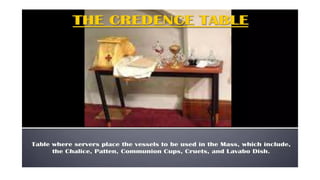
The Credence Table - a place where all
the vessels and linens used during the
mass are placed.
40.
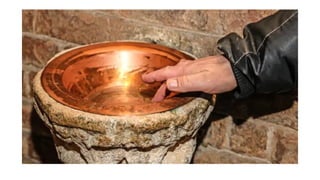
The Sacrarium –a basin or sink, with a
drainpipe directly to the earth for the
disposal of water used for sacred
purpose as when washing the vessels
and linens.
The Sanctuary – the holy place where
the Altar, the Tabernacle, the
Lectern/Ambo, and the Altar Servers
are located.
A.INTRODUCTORY RITES
1.The EntranceSong – opens the
celebration and accompanies the
procession of priest and severs to the
Altar.
2.Veneration of the Altar and greeting of
the People – the presider greets the
assembly which reminds us that we are
one, in the power and grace of God.
44.
3. The PenitentialRite – invites us to be sorry
for our sins, and takes away venial or minor
sins which do not need absolution in private
confession. We come to God in a spirit of
contrition, so that we may celebrate the
Eucharist worthily and grow in grace. The rite
includes ‘I confess and the Lord Have Mercy.’
45.
4. Gloria –it is an ancient hymn of praise
sung or recited in appropriate
celebrations especially on feasts and
solemnities.
5. Opening Prayer (Collect) – is
introduced with an invitation to prayer
and a time of silent prayer. On behalf of
the people, the priest offers this prayer
thus we all respond: “AMEN.”
46.
B. THE LITURGYOF THE WORD
1. The First Scriptural Reading on a Sunday or
Solemnity is usually taken from the Old
Testament.
2. The Responsorial Psalm continues the theme
of the reading or expresses the mood of the
season or occasion.
3. The Second Scriptural Reading on a Sunday or
Solemnity is taken from any portion of the New
Testament which is not a Gospel, especially the
Letters of Paul.
47.
4. The Alleluiaor Gospel Verse should be
sung, our joyful welcome to the Word in
the Gospel.
5. The Gospel is the major reading in the
Liturgy of the Word. We all stand to show
our reverence for the words of Jesus
Christ and the events of his life. Only an
ordained minister may read the Gospel.
48.
6. The Homilyis an explanation and
proclamation of the reading of the
Liturgy.
7. The Profession of Faith or the Creed is
our Act of Faith, our assent to the
teachings of Christ in the Church.
8. The Prayers of the Faithful or General
Intercession offers the petitions of the
community before God.
49.
C. THE LITURGYOF THE EUCHARIST
1. The Preparation of the Gifts (offertory to
Prayer over the gifts).
The Bread and wine which God has
given to us is given back to God from
whom everything comes.
2. The Eucharistic Prayer is a prayer of
thanksgiving, a prayer of consecration, a
priestly prayer of sacrifice.
50.
Various steps inthe Eucharistic Prayer, the
greatest prayer of the Liturgy:
a. In the Preface the priest leads us in offering
thanks to God.
b. In the Sanctus, we all praise the Holy Trinity,
“Holy, holy, holy Lord…” we kneel for the central
words of the Eucharistic prayer.
c. At the epiclesis, the priest extends his hands
over the gifts and asks the Holy Spirit to
change them into the Body and Blood of Christ.
51.
d. The narrativeof institution is the form of
words, taken from the Last Supper, used for
consecration. At this supreme moment of the
mass, the bread and wine are truly changed into
the Real Body and Blood of our Lord Jesus Christ.
e. At the elevation the Priest shows us the Host
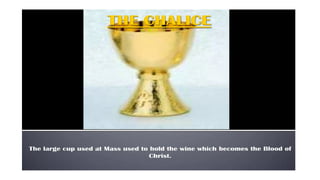
and the Chalice, and we adore our Lord.
f. An Acclamation follows the consecration. We
proclaim the mystery of faith, that we believe in
the real presence of Jesus and His sacrifice, Christ
giving himself up for us.
52.
g. The priestcontinues the Eucharistic
Prayer. In the anamnesis we remember the
saving death and resurrection of our Lord,
made present here and now through the
Eucharist.
h. In the offering, the priest expresses what
is happening, that we offer Christ the victim
to the Father, that we offer ourselves in Him
the true priest, that we become one in
Christ.
53.
i. The intercessions,prayers for others, unite
the Church on earth, in Purgatory and in
heaven to this One sacrifice, offered for the
living and dead, enriched by the prayers of
Our Lady and the Saints.
j. finally, in the doxology (praise of God), the
priest raises the chalice and the paten, the
Body and Blood of Christ, offering “Through
Him, with Him and in Him …” and all the people
respond with the Great Amen.
54.
3. The CommunionRite begins with the
Lord’s Prayer, when we ask for “our daily
bread,” the food for those who have been
forgiven.
In the rite of peace we beg for peace and
unity in the Church and in the world.
We show our love for one another, our
preparation for Communion, by giving a sign
of peace, as a sign of true peace which the
Lord gives us.
55.
While we prayto the Lord as “Lamb of God,” the
priest repeats the action of the Lord at the Last
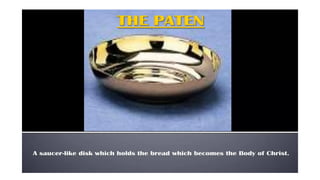
Supper by breaking the Host, so that the Sacred
Food can be shared in Holy Communion.
We who are many partake of the one bread.
(1Cor.10:17)
The Priest places a particle of the Host in the
Chalice, an ancient custom which we may see as
a sign of the unity of the Body and Blood of
Christ who is alive and risen, present with us in
the Eucharist.
56.
After a quietprayer of preparation, the
priest adores the Lord and shows us the
broken Host, “This is the Lamb of God …”
we respond by admitting we are not
worthy to receive Him, but His grace will
heal us.
The short Prayer after Communion
completes the Communion Rite.
Brief announcement may follow.
57.
D. CONCLUDING RITE
1.Thepresider gives the Blessing, which
may take a simple or solemn form.
2.The presider or the deacon in the
Dismissal sends each of us into the
world, loving and serving the Lord,
living out the Eucharist we have
offered and celebrated.
101.
The Three HolyOils
1.Oleum Infirmorum (OI)
Oil for the Sick or Oil for
Healing. Made from olive oil
only. Used for those seriously ill
in body or mind, whether or not
in danger of death. it is
“Blessed” by the bishop.
102.
The Three HolyOils
2. Oleum Catechumenorum (OC)
It is called the “Oil of Exorcism” or
the “Oil of Catechumens” because
it is used to exorcise catechumens
before proceeding to
Baptism/Confirmation which would
be done with the oil of Chrism.
103.
The Three HolyOils
3. Sanctum Chrisma (SC)
Made from olive oil and balsam,
an aromatic gum resin or other
fragrant perfume.
It is also called the “Oil of
Thanksgiving.”
104.
Traditionally used during
Baptism,Confirmation, and Holy
Orders, for the consecration of
churches, altars, and vessels used
during the mass.
119.
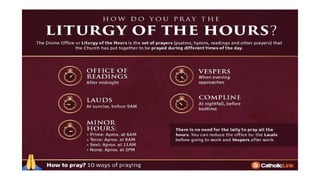
The Liturgy ofthe Hours, also known as the
Divine Office, is a beautiful and ancient
tradition in the Church that is not reserved for
priests and religious, but can also be prayed
by the lay faithful. The Second Vatican
Council highly encouraged the laity to "recite
the divine office, either with the priests, or
among themselves, or even individually" (
Sacrosanctum Concilium, 100).
122.
The Annuario Pontificio,the official directory
of the Holy See, describes the office of the
pope by the following titles: Bishop of Rome,
Vicar of Jesus Christ, Successor of the Prince
of the Apostles, Supreme Pontiff of the
Universal Church, Patriarch of the West,
Primate of Italy, Metropolitan Archbishop of
the Province of Rome, Sovereign of the State
of Vatican City, Servant of the Servants of
God. The title pope or papa (abbreviated PP.)
is officially used only as a less solemn style.
123.
•The hierarchy ofthe Catholic
Church consists of its bishops, priests, and
deacons.[1][2]
In the ecclesiological sense of
the term, "hierarchy" strictly means the "holy
ordering" of the church, the Body of Christ,
so to respect the diversity of gifts and
ministries necessary for genuine unity
124.
•In canonical andgeneral usage, it refers to those
who exercise authority within a Christian church.[3]
In the Catholic Church, authority rests chiefly with
bishops,[4]
while priests and deacons serve as their
assistants, co-workers or helpers.[5]
Accordingly,
"hierarchy of the Catholic Church" is also used to
refer to the bishops alone.[6]
The term "pope" was
still used loosely until the sixth century, being at
times assumed by other bishops.[7]
The term
"hierarchy" became popular only in the sixth
century, due to the writings of Pseudo-Dionysius.[8
Editor's Notes
#28 Before diving into the specifics of liturgical colors, it’s essential to grasp the importance of liturgy in Catholic life. The Catechism of the Catholic Church explains,












![•The hierarchy of the Catholic
Church consists of its bishops, priests, and
deacons.[1][2]
In the ecclesiological sense of
the term, "hierarchy" strictly means the "holy
ordering" of the church, the Body of Christ,
so to respect the diversity of gifts and
ministries necessary for genuine unity](https://image.slidesharecdn.com/altarservers-250317234423-5a1bbd60/85/Altar-Servers-pptxlove-serving-the-lord-123-320.jpg)
![•In canonical and general usage, it refers to those
who exercise authority within a Christian church.[3]
In the Catholic Church, authority rests chiefly with
bishops,[4]
while priests and deacons serve as their
assistants, co-workers or helpers.[5]
Accordingly,
"hierarchy of the Catholic Church" is also used to
refer to the bishops alone.[6]
The term "pope" was
still used loosely until the sixth century, being at
times assumed by other bishops.[7]
The term
"hierarchy" became popular only in the sixth
century, due to the writings of Pseudo-Dionysius.[8](https://image.slidesharecdn.com/altarservers-250317234423-5a1bbd60/85/Altar-Servers-pptxlove-serving-the-lord-124-320.jpg)



![谷歌霸屏推广[ 𝙩𝙤𝙥 𝟮𝟯𝟯. 𝙘 𝙤𝙢 ]](https://cdn.slidesharecdn.com/ss_thumbnails/top233-260130171247-43791db0-thumbnail.jpg?width=640&height=640&fit=bounds)


