A Walk Through the Mass A Step by Step Explanation
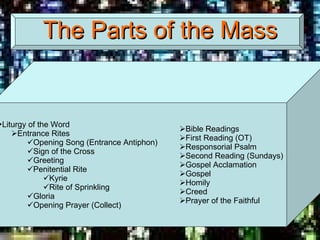
The Parts of the Mass Liturgy of the Word Entrance Rites Opening Song (Entrance Antiphon) Sign of the Cross Greeting Penitential Rite Kyrie Rite of Sprinkling Gloria Opening Prayer (Collect) Bible Readings First Reading (OT) Responsorial Psalm Second Reading (Sundays) Gospel Acclamation Gospel Homily Creed Prayer of the Faithful
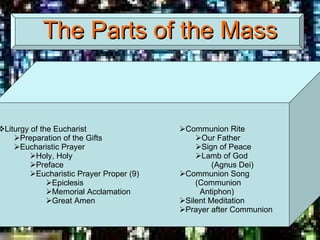
The Parts of the Mass Liturgy of the Eucharist Preparation of the Gifts Eucharistic Prayer Holy, Holy Preface Eucharistic Prayer Proper (9) Epiclesis Memorial Acclamation Great Amen Communion Rite Our Father Sign of Peace Lamb of God (Agnus Dei) Communion Song (Communion Antiphon) Silent Meditation Prayer after Communion
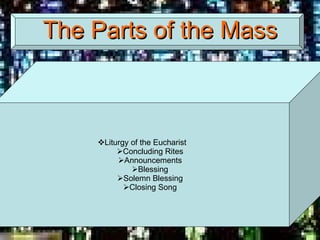
The Parts of the Mass Liturgy of the Eucharist Concluding Rites Announcements Blessing Solemn Blessing Closing Song
What is the Mass? It is the Easter Triduum in One  It is a Meal
Sacrosanctum Concilium The Easter Triduum as One At the Last Supper, on the night when he was betrayed, our Savior instituted the  eucharistic sacrifice  of his body and blood. He did this in order to perpetuate the  sacrifice of the Cross  throughout the centuries until he should  come again  and in this way to entrust to his beloved Bride, the Church, a memorial of his  death  and  resurrection : a sacrament of love, a sign of unity, a bond of charity,  a paschal banquet  ‘ in which Christ is eaten , the heart is filled with grace, and a  pledge of future glory is given to us ” ” ( Sacrosanctum Concilium (Constitution on the Sacred Liturgy) , #42).  Holy Thursday   Good Friday   Easter Sunday
The Basic Shape It is a Meal 1) The basic “shape” of the ritual of the Mass can be described as a meal. This is not to say it is “just another meal” or that we are ignoring the Mass as sacrifice. Not at all. The point is, the shape of the Mass, even when viewed as sacrifice, is that of a meal. For our purposes, we can be greatly helped in our “walk through” the Mass if we remember this basic “meal shape.”   2) When friends gather for a meal, they sit and talk: Eventually they move to the table, say grace, pass the food and eat and drink, and finally take their leave and go home. On our walk through the Mass we will follow this same map: we will see ritual acts of 1) gathering, 2) storytelling, 3) meal sharing and 4) commissioning.
The Basic Shape It is a Sacrifice And yet, “He did this in order to perpetuate the sacrifice of the Cross throughout the centuries ”.  And so, when we celebrate the Mass, we remember (anamnesis   the sacrifice of Jesus on the Cross.  We recall that new life comes out of death.  We have human examples: we eat dead things to stay alive, we “rise” from the death of sleep, and we witness how decaying things enable plants to grow. Think of this quote:  “ Money is like manure; it’s not worth a thing unless it’s spread around encouraging young things to grow .” - Thornton Wilder
Christ is Present Sacrosanctum Concilium 7. To accomplish so great a work, Christ is always present in His Church, especially in her liturgical celebrations. He is present in the sacrifice of the Mass, not only  in the person of His minister , "the same now offering, through the ministry of priests, who formerly offered himself on the cross" [ 20 ],  but especially under the Eucharistic species . By His power He is present in the sacraments, so that when a man baptizes it is really Christ Himself who baptizes [ 21 ].  He is present in His word , since it is He Himself who speaks when the holy scriptures are read in the Church.  He is present, lastly, when the Church prays and sings , for He promised: "Where two or three are gathered together in my name, there am I in the midst of them" (Matt. 18:20) .
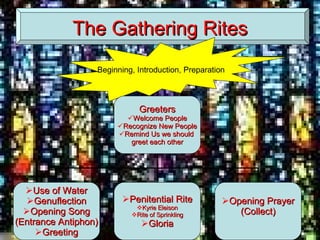
The Gathering Rites Beginning, Introduction, Preparation Greeters Welcome People Recognize New People Remind Us we should  greet each other Use of Water Genuflection Opening Song (Entrance Antiphon) Greeting Penitential Rite Kyrie Eleison Rite of Sprinkling Gloria Opening Prayer (Collect)
The Gloria The Gloria is sung or said on Sundays outside the Seasons of Advent and Lent, on solemnities and feasts, and at special celebrations of a more solemn character.
Opening Prayer.  At the close of this first part of the Mass the priest will ask us to join our minds in prayer, and after a few moments of silence he will collect our intentions into one prayer to which we all respond “Amen,” a Hebrew word for “So be it.”  A Walk Through the Mass.
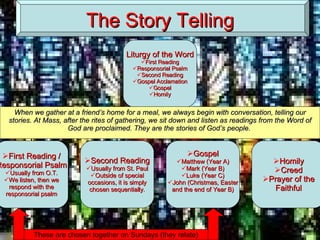
The Story Telling These are chosen together on Sundays (they relate) When we gather at a friend’s home for a meal, we always begin with conversation, telling our stories. At Mass, after the rites of gathering, we sit down and listen as readings from the Word of God are proclaimed. They are the stories of God’s people.  Liturgy of the Word First Reading Responsorial Psalm Second Reading Gospel Acclamation Gospel Homily First Reading / Responsorial Psalm Usually from O.T. We listen, then we respond with the responsorial psalm Second Reading Usually from St. Paul Outside of special occasions, it is simply chosen sequentially. Gospel Matthew (Year A) Mark (Year B) Luke (Year C) John (Christmas, Easter and the end of Year B) Homily Creed Prayer of the Faithful
Responsorial Psalm The Responsorial Psalm fosters meditation on the Word of God.
The Alleluia The Alleluia is sung in every season except Lent.
The Gospel The reading of the Gospel is the high point of the Liturgy of the Word.  The Liturgy itself teaches that great reverence is to be shown to it by setting it off from the other readings with special marks of honor: whether the minister appointed to proclaim it prepares himself by a blessing or prayer; or the faithful, standing as they listen to it being read, through their acclamations acknowledge and confess Christ present and speaking to them; or the very marks of reverence are given to the Book of the Gospels. (GIRM, 60)
The Homily The homily is necessary for the  nurturing of Christian life. It is an exposition of some aspect  of the readings. It should take into account the mystery being  celebrated, and the needs of the listeners.
Posture A common posture, to be observed by all participants, is a sign of the unity of the  members  of the Christian community gathered for the Sacred Liturgy: it both  expresses and  fosters the intention and spiritual attitude of the participants. (GIRM, 42) Sitting Standing Kneeling The Rule: We sit to listen We stand to Pray, We kneel to Worship. First Reading / Responsorial Psalm Second Reading We sit to listen. Gospel  Acclamation We stand to greet Christ. “ The Lord be with you” Small Cross Forehead (Mind) Lips (Proclaim) Heart (Hear) Gospel Concludes with The Gospel of the Lord Praise to  YOU , Lord Jesus Christ [WE GREET CHRIST] Homily We sit to listen. Creed We profess our faith. General Intercessions We pray for the Church, World, Others
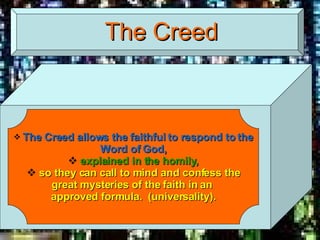
The Creed The Creed allows the faithful to respond to the Word of God, explained in the homily, so they can call to mind and confess the great mysteries of the faith in an  approved formula.  (universality).
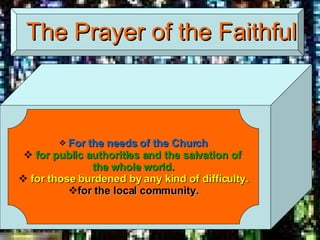
The Prayer of the Faithful For the needs of the Church for public authorities and the salvation of  the whole world. for those burdened by any kind of difficulty. for the local community.
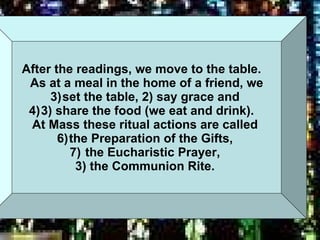
After the readings, we move to the table.  As at a meal in the home of a friend, we set the table, 2) say grace and  3) share the food (we eat and drink).  At Mass these ritual actions are called  the Preparation of the Gifts,  the Eucharistic Prayer,  3) the Communion Rite.
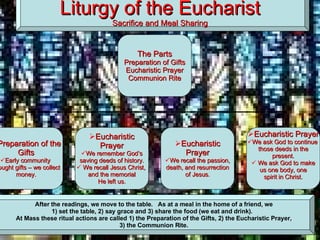
Liturgy of the Eucharist Sacrifice and Meal Sharing After the readings, we move to the table.  As at a meal in the home of a friend, we  1) set the table, 2) say grace and 3) share the food (we eat and drink).  At Mass these ritual actions are called 1) the Preparation of the Gifts, 2) the Eucharistic Prayer,  3) the Communion Rite.   The Parts Preparation of Gifts Eucharistic Prayer Communion Rite Preparation of the Gifts Early community  Brought gifts – we collect money. Eucharistic Prayer We remember God’s saving deeds of history. We recall Jesus Christ,  and the memorial He left us. Eucharistic Prayer We recall the passion, death, and resurrection of Jesus. Eucharistic Prayer We ask God to continue  those deeds in the present. We ask God to make us one body, one spirit in Christ.
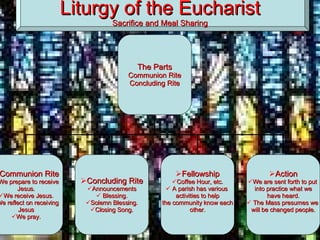
Liturgy of the Eucharist Sacrifice and Meal Sharing The Parts Communion Rite Concluding Rite Communion Rite We prepare to receive Jesus. We receive Jesus. We reflect on receiving  Jesus We pray. Concluding Rite Announcements Blessing. Solemn Blessing. Closing Song. Fellowship Coffee Hour, etc. A parish has various  activities to help the community know each other. Action We are sent forth to put  into practice what we have heard. The Mass presumes we  will be changed people.

A Walk Through The Mass

  • 1.
    A Walk Throughthe Mass A Step by Step Explanation
  • 2.
    The Parts ofthe Mass Liturgy of the Word Entrance Rites Opening Song (Entrance Antiphon) Sign of the Cross Greeting Penitential Rite Kyrie Rite of Sprinkling Gloria Opening Prayer (Collect) Bible Readings First Reading (OT) Responsorial Psalm Second Reading (Sundays) Gospel Acclamation Gospel Homily Creed Prayer of the Faithful
  • 3.
    The Parts ofthe Mass Liturgy of the Eucharist Preparation of the Gifts Eucharistic Prayer Holy, Holy Preface Eucharistic Prayer Proper (9) Epiclesis Memorial Acclamation Great Amen Communion Rite Our Father Sign of Peace Lamb of God (Agnus Dei) Communion Song (Communion Antiphon) Silent Meditation Prayer after Communion
  • 4.
    The Parts ofthe Mass Liturgy of the Eucharist Concluding Rites Announcements Blessing Solemn Blessing Closing Song
  • 5.
    What is theMass? It is the Easter Triduum in One It is a Meal
  • 6.
    Sacrosanctum Concilium TheEaster Triduum as One At the Last Supper, on the night when he was betrayed, our Savior instituted the eucharistic sacrifice of his body and blood. He did this in order to perpetuate the sacrifice of the Cross throughout the centuries until he should come again and in this way to entrust to his beloved Bride, the Church, a memorial of his death and resurrection : a sacrament of love, a sign of unity, a bond of charity, a paschal banquet ‘ in which Christ is eaten , the heart is filled with grace, and a pledge of future glory is given to us ” ” ( Sacrosanctum Concilium (Constitution on the Sacred Liturgy) , #42). Holy Thursday Good Friday Easter Sunday
  • 7.
    The Basic ShapeIt is a Meal 1) The basic “shape” of the ritual of the Mass can be described as a meal. This is not to say it is “just another meal” or that we are ignoring the Mass as sacrifice. Not at all. The point is, the shape of the Mass, even when viewed as sacrifice, is that of a meal. For our purposes, we can be greatly helped in our “walk through” the Mass if we remember this basic “meal shape.” 2) When friends gather for a meal, they sit and talk: Eventually they move to the table, say grace, pass the food and eat and drink, and finally take their leave and go home. On our walk through the Mass we will follow this same map: we will see ritual acts of 1) gathering, 2) storytelling, 3) meal sharing and 4) commissioning.
  • 8.
    The Basic ShapeIt is a Sacrifice And yet, “He did this in order to perpetuate the sacrifice of the Cross throughout the centuries ”. And so, when we celebrate the Mass, we remember (anamnesis  the sacrifice of Jesus on the Cross. We recall that new life comes out of death. We have human examples: we eat dead things to stay alive, we “rise” from the death of sleep, and we witness how decaying things enable plants to grow. Think of this quote: “ Money is like manure; it’s not worth a thing unless it’s spread around encouraging young things to grow .” - Thornton Wilder
  • 9.
    Christ is PresentSacrosanctum Concilium 7. To accomplish so great a work, Christ is always present in His Church, especially in her liturgical celebrations. He is present in the sacrifice of the Mass, not only in the person of His minister , "the same now offering, through the ministry of priests, who formerly offered himself on the cross" [ 20 ], but especially under the Eucharistic species . By His power He is present in the sacraments, so that when a man baptizes it is really Christ Himself who baptizes [ 21 ]. He is present in His word , since it is He Himself who speaks when the holy scriptures are read in the Church. He is present, lastly, when the Church prays and sings , for He promised: "Where two or three are gathered together in my name, there am I in the midst of them" (Matt. 18:20) .
  • 10.
    The Gathering RitesBeginning, Introduction, Preparation Greeters Welcome People Recognize New People Remind Us we should greet each other Use of Water Genuflection Opening Song (Entrance Antiphon) Greeting Penitential Rite Kyrie Eleison Rite of Sprinkling Gloria Opening Prayer (Collect)
  • 11.
    The Gloria TheGloria is sung or said on Sundays outside the Seasons of Advent and Lent, on solemnities and feasts, and at special celebrations of a more solemn character.
  • 12.
    Opening Prayer. At the close of this first part of the Mass the priest will ask us to join our minds in prayer, and after a few moments of silence he will collect our intentions into one prayer to which we all respond “Amen,” a Hebrew word for “So be it.” A Walk Through the Mass.
  • 13.
    The Story TellingThese are chosen together on Sundays (they relate) When we gather at a friend’s home for a meal, we always begin with conversation, telling our stories. At Mass, after the rites of gathering, we sit down and listen as readings from the Word of God are proclaimed. They are the stories of God’s people. Liturgy of the Word First Reading Responsorial Psalm Second Reading Gospel Acclamation Gospel Homily First Reading / Responsorial Psalm Usually from O.T. We listen, then we respond with the responsorial psalm Second Reading Usually from St. Paul Outside of special occasions, it is simply chosen sequentially. Gospel Matthew (Year A) Mark (Year B) Luke (Year C) John (Christmas, Easter and the end of Year B) Homily Creed Prayer of the Faithful
  • 14.
    Responsorial Psalm TheResponsorial Psalm fosters meditation on the Word of God.
  • 15.
    The Alleluia TheAlleluia is sung in every season except Lent.
  • 16.
    The Gospel Thereading of the Gospel is the high point of the Liturgy of the Word. The Liturgy itself teaches that great reverence is to be shown to it by setting it off from the other readings with special marks of honor: whether the minister appointed to proclaim it prepares himself by a blessing or prayer; or the faithful, standing as they listen to it being read, through their acclamations acknowledge and confess Christ present and speaking to them; or the very marks of reverence are given to the Book of the Gospels. (GIRM, 60)
  • 17.
    The Homily Thehomily is necessary for the nurturing of Christian life. It is an exposition of some aspect of the readings. It should take into account the mystery being celebrated, and the needs of the listeners.
  • 18.
    Posture A commonposture, to be observed by all participants, is a sign of the unity of the members of the Christian community gathered for the Sacred Liturgy: it both expresses and fosters the intention and spiritual attitude of the participants. (GIRM, 42) Sitting Standing Kneeling The Rule: We sit to listen We stand to Pray, We kneel to Worship. First Reading / Responsorial Psalm Second Reading We sit to listen. Gospel Acclamation We stand to greet Christ. “ The Lord be with you” Small Cross Forehead (Mind) Lips (Proclaim) Heart (Hear) Gospel Concludes with The Gospel of the Lord Praise to YOU , Lord Jesus Christ [WE GREET CHRIST] Homily We sit to listen. Creed We profess our faith. General Intercessions We pray for the Church, World, Others
  • 19.
    The Creed TheCreed allows the faithful to respond to the Word of God, explained in the homily, so they can call to mind and confess the great mysteries of the faith in an approved formula. (universality).
  • 20.
    The Prayer ofthe Faithful For the needs of the Church for public authorities and the salvation of the whole world. for those burdened by any kind of difficulty. for the local community.
  • 21.
    After the readings,we move to the table. As at a meal in the home of a friend, we set the table, 2) say grace and 3) share the food (we eat and drink). At Mass these ritual actions are called the Preparation of the Gifts, the Eucharistic Prayer, 3) the Communion Rite.
  • 22.
    Liturgy of theEucharist Sacrifice and Meal Sharing After the readings, we move to the table. As at a meal in the home of a friend, we 1) set the table, 2) say grace and 3) share the food (we eat and drink). At Mass these ritual actions are called 1) the Preparation of the Gifts, 2) the Eucharistic Prayer, 3) the Communion Rite. The Parts Preparation of Gifts Eucharistic Prayer Communion Rite Preparation of the Gifts Early community Brought gifts – we collect money. Eucharistic Prayer We remember God’s saving deeds of history. We recall Jesus Christ, and the memorial He left us. Eucharistic Prayer We recall the passion, death, and resurrection of Jesus. Eucharistic Prayer We ask God to continue those deeds in the present. We ask God to make us one body, one spirit in Christ.
  • 23.
    Liturgy of theEucharist Sacrifice and Meal Sharing The Parts Communion Rite Concluding Rite Communion Rite We prepare to receive Jesus. We receive Jesus. We reflect on receiving Jesus We pray. Concluding Rite Announcements Blessing. Solemn Blessing. Closing Song. Fellowship Coffee Hour, etc. A parish has various activities to help the community know each other. Action We are sent forth to put into practice what we have heard. The Mass presumes we will be changed people.