O Just as a typical calendar has twelve months,
  fifty-two weeks, and 365 days that include
  holidays and days that are just "average," the
  Liturgical Year Calendar of the Church uses
  similar terms and measurements.
O The Liturgical Year is also marked by special
  seasons—Advent, Christmas, Lent, The Triduum or
  Three Days, Easter, and Ordinary Time. The
  Liturgical Year begins on the first Sunday of
  Advent, which usually occurs around the
  beginning of December or the end of November,
  and ends on the feast of Christ the King.
O However, the purpose of the Liturgical Year
  Calendar is not to mark the passage of time,
O Liturgies celebrated during the
  different seasons of the liturgical
  year have distinctive music and
  specific readings, prayers, and
  rituals. All of these work together
  to reflect the spirit of the
  particular season. The colors of
  the vestments that the priest wears
  during the liturgy also help
White, the color of joy and victory, is used for
the seasons of Easter and Christmas. It is also
used for the feasts of Our Lord, for feasts of
Mary, the angels, and for saints who are not
martyrs. Gold may also be used on solemn
occasions.
Red (the color of blood) is used on days when we
celebrate the passion of Jesus on Passion Sunday
and Good Friday. It is also used for the birthday
feasts of the apostles and evangelists and for the
celebrations of martyrs. Red (the color of fire)
recalls the Holy Spirit and is used on Pentecost
and for the sacrament of Confirmation.
Green, seen everywhere in plants and trees,
symbolizes life and hope and is used during
Ordinary Time.
The colors violet or purple in Advent help us to
remember that we are preparing for the coming
of Christ. Lent, the season of penance and
renewal, also uses the colors violet or purple.
Rose may be used on the Third Sunday of Advent,
Gaudete Sunday, and on the Fourth Sunday of Lent,
Laetare Sunday. It expresses the joy of
anticipation for Christmas and Easter,
respectively
O   The liturgical cycle divides the year into a series of seasons, each with
    their own mood, theological emphases, and modes of prayer
O   This determines the ff:
     o different ways of decorating churches
     o colors of Paraments and Vestments for clergy
     o scriptural readings
     o themes for preaching and even different traditions and practices
        often observed personally or in the home
     o In churches that follow the liturgical year, the scripture passages
        for each Sunday (and even each day of the year in some traditions)
        are specified by a list called a lectionary.

O   Advent
O   Christmas
O   Ordinary Time or Time after Epiphany
O   Lent
O   Easter Triduum
O   Easter Season
O   Ordinary Time, Time after Pentecost, Time after Trinity, or Kingdomtide
1.) Advent-the time of joyful preparation for the
twofold coming of the Lord; the first in Bethlehem
and the second at the end of the times. Season of
preparation and waiting.
       Color:Violet

2.) Christmas- the time of celebration of the birth of
Jesus. It ends on the feast of the Baptism of Jesus.
       Color: White

3.)a.) Ordinary Time(short)- the Church celebrates the
many feasts of the Saints.
b.)Ordinary time(long)- the time of the liturgical year
that lies outside the seasons of Lent-Easter and
4.) Lenten Season- the time of conversion and preparation for the
Easter by means of 40 days of prayer, fasting and almsgiving. It
begins on the Ash Wednesday.
Lent means spring
        Color: Violet

5.) Easter Triduum- the time of celebration of the Passion, Death
and Resurrection of our Lord. The holiest 3 days of the Church
Year during Holy week. It begins with the Mass of the Lord’s
Supper on Holy Thursday and ends with the Evening Prayer on
Easter Sunday.
a.) Holy Thursday- last meal of Jesus with the Apostles.
                  - washing of the feet of the Apostles by Jesus

b.) Good Friday-the suffering and death of Jesus.
               -the Church initiates new members through the
Sacrament of Baptism, Confirmation and Eucharist
6.) Easter Season- the time of celebration of the
Resurrection and Ascension of the Lord. as well
as the coming of the Holy Spirit and the beginning
of the Church. The season lasts for 50 days, from
Easter Sunday until Pentecost.
       Color:White
Feasts

   and
           Events

             in
     The Liturgical Calendar
Advent Season

 Gaudete Sunday
      Celebrated during the 3rd Sunday of
 Advent
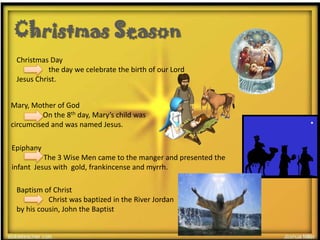
Christmas Season
 Christmas Day
           the day we celebrate the birth of our Lord
 Jesus Christ.


Mary, Mother of God
         On the 8th day, Mary’s child was
circumcised and was named Jesus.

Epiphany
          The 3 Wise Men came to the manger and presented the
infant Jesus with gold, frankincense and myrrh.

 Baptism of Christ
           Christ was baptized in the River Jordan
 by his cousin, John the Baptist
Lenten Season
 Ash Wednesday
         “From dust we are created and to dust we shall be”
Holy Week
Palm Sunday
         The grand entrance of Jesus Christ into Jerusalem


Maundy Thursday
         The celebration of the Last Supper of Christ
with his apostles.
O The Advent wreath is a circular garland of evergreen
  branches representing eternity. On that wreath, five
  candles are typically arranged. Each candle represents
  an aspect of the spiritual preparation for the coming of
  the Lord, Jesus Christ.

O Advent wreaths are used by millions of Christians
  worldwide to mark the passing of the season of Advent
  and to symbolize the many ideas and hopes present in the
  celebration of the birth of Christ.

O The meaning of the Advent wreath involves the light and
  hope that will come with Christmas. The meaning behind
  the lighting of a new candle on the Advent wreath each
  week symbolizes the anticipation of Christians awaiting
  Christ's birth and the salvation He will bring to
  believers.
O Wreath – It is always in     O Evergreens           -These
  the        form         of      branches, as the name
  a circle. Since a circle        indicates,    are    "ever
  has no beginning and no         green" -- ever alive. They
  end, it is a symbol for         are symbolic of Christ,
  God, Who is eternal and         Who died, but Who is alive,
  without beginning or end.       never to die again.
                                         -It also symbolize
                               our soul's
                               immortality. Christ came
                               into the world to give us
                               never-ending life.
O Red holly berries - It          O Violet Candle- represents
  symbolizes the blood shed         repentance.
  by Christ for mankind. They
                                  O Pink Candle- symbolizes
  remind us that Christ came
  into this world to die for us     joy.
  and redeem us. It is through    O Central Candle( Christ
  the shedding of His blood         Candle)- represents
  that we have eternal life.        Christ himself who is
                                    born to save people from
                                    their sins.


O Blue Bowl- It reminds us of
  the Virgin Mary. It should be
  put at the base of each
  candle or in the wreath
  itself.
• First Sunday of Advent -the first purple candle is lit. It is
  typically called the "Prophecy Candle" and it represents
  hope or expectation in anticipation of the coming Messiah.
• Second Sunday of Advent -the second purple candle is lit.
  It is typically called the "Bethlehem Candle" and it
  represents love.
• Third Sunday of Advent -the pink candle is lit. It is
  customarily called the "Shepherds Candle" and it
  represents joy.
• Fourth Sunday of Advent -the last purple candle is lit. It
  oftentimes called the "Angels Candle" and it represents
  peace.

Liturgical calendar

  • 3.
    O Just asa typical calendar has twelve months, fifty-two weeks, and 365 days that include holidays and days that are just "average," the Liturgical Year Calendar of the Church uses similar terms and measurements. O The Liturgical Year is also marked by special seasons—Advent, Christmas, Lent, The Triduum or Three Days, Easter, and Ordinary Time. The Liturgical Year begins on the first Sunday of Advent, which usually occurs around the beginning of December or the end of November, and ends on the feast of Christ the King. O However, the purpose of the Liturgical Year Calendar is not to mark the passage of time,
  • 4.
    O Liturgies celebratedduring the different seasons of the liturgical year have distinctive music and specific readings, prayers, and rituals. All of these work together to reflect the spirit of the particular season. The colors of the vestments that the priest wears during the liturgy also help
  • 5.
    White, the colorof joy and victory, is used for the seasons of Easter and Christmas. It is also used for the feasts of Our Lord, for feasts of Mary, the angels, and for saints who are not martyrs. Gold may also be used on solemn occasions.
  • 6.
    Red (the colorof blood) is used on days when we celebrate the passion of Jesus on Passion Sunday and Good Friday. It is also used for the birthday feasts of the apostles and evangelists and for the celebrations of martyrs. Red (the color of fire) recalls the Holy Spirit and is used on Pentecost and for the sacrament of Confirmation.
  • 7.
    Green, seen everywherein plants and trees, symbolizes life and hope and is used during Ordinary Time.
  • 8.
    The colors violetor purple in Advent help us to remember that we are preparing for the coming of Christ. Lent, the season of penance and renewal, also uses the colors violet or purple.
  • 9.
    Rose may beused on the Third Sunday of Advent, Gaudete Sunday, and on the Fourth Sunday of Lent, Laetare Sunday. It expresses the joy of anticipation for Christmas and Easter, respectively
  • 10.
    O The liturgical cycle divides the year into a series of seasons, each with their own mood, theological emphases, and modes of prayer O This determines the ff: o different ways of decorating churches o colors of Paraments and Vestments for clergy o scriptural readings o themes for preaching and even different traditions and practices often observed personally or in the home o In churches that follow the liturgical year, the scripture passages for each Sunday (and even each day of the year in some traditions) are specified by a list called a lectionary. O Advent O Christmas O Ordinary Time or Time after Epiphany O Lent O Easter Triduum O Easter Season O Ordinary Time, Time after Pentecost, Time after Trinity, or Kingdomtide
  • 11.
    1.) Advent-the timeof joyful preparation for the twofold coming of the Lord; the first in Bethlehem and the second at the end of the times. Season of preparation and waiting. Color:Violet 2.) Christmas- the time of celebration of the birth of Jesus. It ends on the feast of the Baptism of Jesus. Color: White 3.)a.) Ordinary Time(short)- the Church celebrates the many feasts of the Saints. b.)Ordinary time(long)- the time of the liturgical year that lies outside the seasons of Lent-Easter and
  • 12.
    4.) Lenten Season-the time of conversion and preparation for the Easter by means of 40 days of prayer, fasting and almsgiving. It begins on the Ash Wednesday. Lent means spring Color: Violet 5.) Easter Triduum- the time of celebration of the Passion, Death and Resurrection of our Lord. The holiest 3 days of the Church Year during Holy week. It begins with the Mass of the Lord’s Supper on Holy Thursday and ends with the Evening Prayer on Easter Sunday. a.) Holy Thursday- last meal of Jesus with the Apostles. - washing of the feet of the Apostles by Jesus b.) Good Friday-the suffering and death of Jesus. -the Church initiates new members through the Sacrament of Baptism, Confirmation and Eucharist
  • 13.
    6.) Easter Season-the time of celebration of the Resurrection and Ascension of the Lord. as well as the coming of the Holy Spirit and the beginning of the Church. The season lasts for 50 days, from Easter Sunday until Pentecost. Color:White
  • 14.
    Feasts and Events in The Liturgical Calendar
  • 15.
    Advent Season GaudeteSunday Celebrated during the 3rd Sunday of Advent
  • 16.
    Christmas Season ChristmasDay the day we celebrate the birth of our Lord Jesus Christ. Mary, Mother of God On the 8th day, Mary’s child was circumcised and was named Jesus. Epiphany The 3 Wise Men came to the manger and presented the infant Jesus with gold, frankincense and myrrh. Baptism of Christ Christ was baptized in the River Jordan by his cousin, John the Baptist
  • 17.
    Lenten Season AshWednesday “From dust we are created and to dust we shall be”
  • 18.
    Holy Week Palm Sunday The grand entrance of Jesus Christ into Jerusalem Maundy Thursday The celebration of the Last Supper of Christ with his apostles.
  • 19.
    O The Adventwreath is a circular garland of evergreen branches representing eternity. On that wreath, five candles are typically arranged. Each candle represents an aspect of the spiritual preparation for the coming of the Lord, Jesus Christ. O Advent wreaths are used by millions of Christians worldwide to mark the passing of the season of Advent and to symbolize the many ideas and hopes present in the celebration of the birth of Christ. O The meaning of the Advent wreath involves the light and hope that will come with Christmas. The meaning behind the lighting of a new candle on the Advent wreath each week symbolizes the anticipation of Christians awaiting Christ's birth and the salvation He will bring to believers.
  • 20.
    O Wreath –It is always in O Evergreens -These the form of branches, as the name a circle. Since a circle indicates, are "ever has no beginning and no green" -- ever alive. They end, it is a symbol for are symbolic of Christ, God, Who is eternal and Who died, but Who is alive, without beginning or end. never to die again. -It also symbolize our soul's immortality. Christ came into the world to give us never-ending life.
  • 21.
    O Red hollyberries - It O Violet Candle- represents symbolizes the blood shed repentance. by Christ for mankind. They O Pink Candle- symbolizes remind us that Christ came into this world to die for us joy. and redeem us. It is through O Central Candle( Christ the shedding of His blood Candle)- represents that we have eternal life. Christ himself who is born to save people from their sins. O Blue Bowl- It reminds us of the Virgin Mary. It should be put at the base of each candle or in the wreath itself.
  • 22.
    • First Sundayof Advent -the first purple candle is lit. It is typically called the "Prophecy Candle" and it represents hope or expectation in anticipation of the coming Messiah. • Second Sunday of Advent -the second purple candle is lit. It is typically called the "Bethlehem Candle" and it represents love. • Third Sunday of Advent -the pink candle is lit. It is customarily called the "Shepherds Candle" and it represents joy. • Fourth Sunday of Advent -the last purple candle is lit. It oftentimes called the "Angels Candle" and it represents peace.