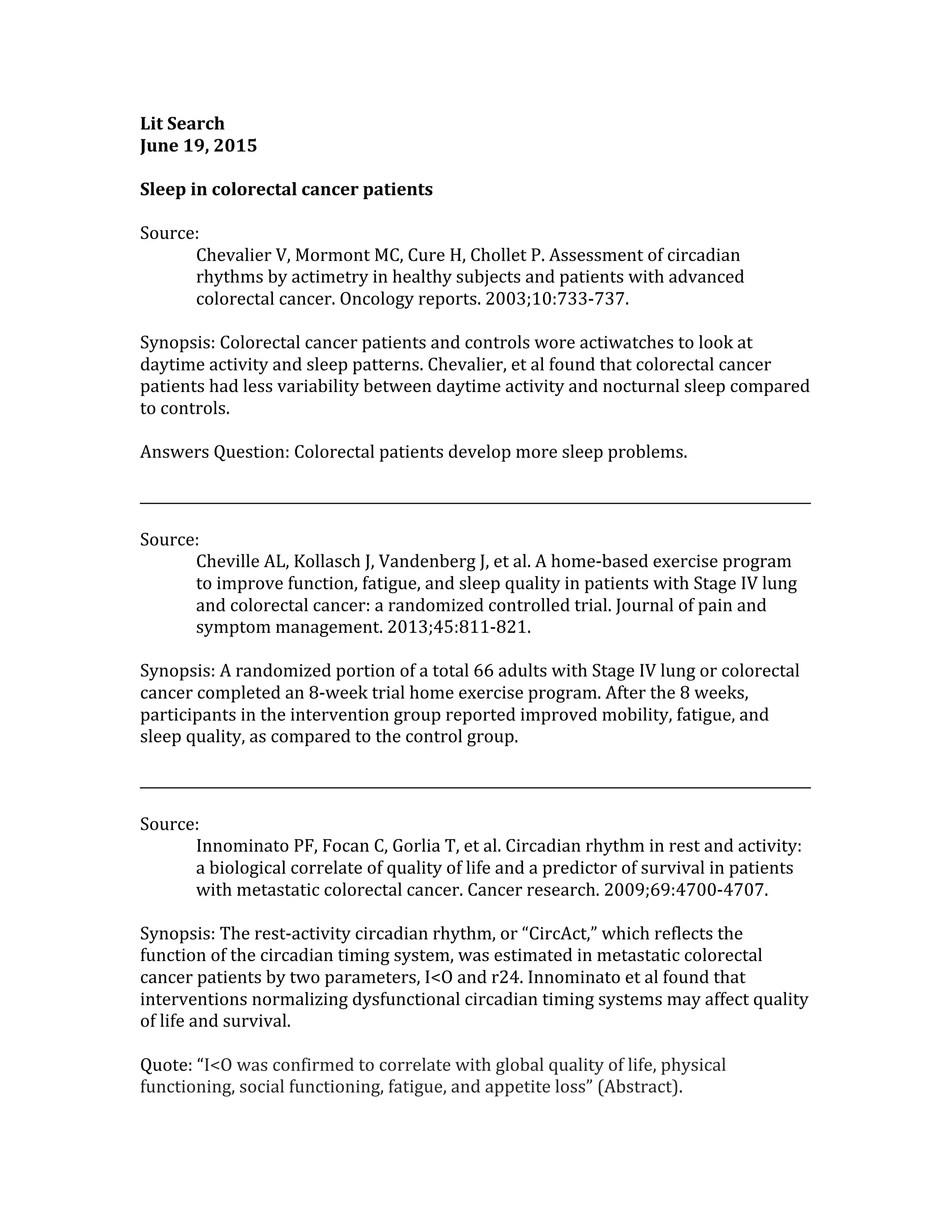
Lit	Search	
June	19,	2015	
	
Sleep	in	colorectal	cancer	patients	
	
Source:		
Chevalier	V,	Mormont	MC,	Cure	H,	Chollet	P.	Assessment	of	circadian	
rhythms	by	actimetry	in	healthy	subjects	and	patients	with	advanced	
colorectal	cancer.	Oncology	reports.	2003;10:733-737.	
	
Synopsis:	Colorectal	cancer	patients	and	controls	wore	actiwatches	to	look	at	
daytime	activity	and	sleep	patterns.	Chevalier,	et	al	found	that	colorectal	cancer	
patients	had	less	variability	between	daytime	activity	and	nocturnal	sleep	compared	
to	controls.		
	
Answers	Question:	Colorectal	patients	develop	more	sleep	problems.		
	
_________________________________________________________________________________________________	
	
Source:		
Cheville	AL,	Kollasch	J,	Vandenberg	J,	et	al.	A	home-based	exercise	program	
to	improve	function,	fatigue,	and	sleep	quality	in	patients	with	Stage	IV	lung	
and	colorectal	cancer:	a	randomized	controlled	trial.	Journal	of	pain	and	
symptom	management.	2013;45:811-821.	
	
Synopsis:	A	randomized	portion	of	a	total	66	adults	with	Stage	IV	lung	or	colorectal	
cancer	completed	an	8-week	trial	home	exercise	program.	After	the	8	weeks,	
participants	in	the	intervention	group	reported	improved	mobility,	fatigue,	and	
sleep	quality,	as	compared	to	the	control	group.		
	
_________________________________________________________________________________________________	
	
Source:	
Innominato	PF,	Focan	C,	Gorlia	T,	et	al.	Circadian	rhythm	in	rest	and	activity:	
a	biological	correlate	of	quality	of	life	and	a	predictor	of	survival	in	patients	
with	metastatic	colorectal	cancer.	Cancer	research.	2009;69:4700-4707.	
	
Synopsis:	The	rest-activity	circadian	rhythm,	or	“CircAct,”	which	reflects	the	
function	of	the	circadian	timing	system,	was	estimated	in	metastatic	colorectal	
cancer	patients	by	two	parameters,	I<O	and	r24.	Innominato	et	al	found	that	
interventions	normalizing	dysfunctional	circadian	timing	systems	may	affect	quality	
of	life	and	survival.		
	
Quote:	“I<O	was	confirmed	to	correlate	with	global	quality	of	life,	physical	
functioning,	social	functioning,	fatigue,	and	appetite	loss”	(Abstract).
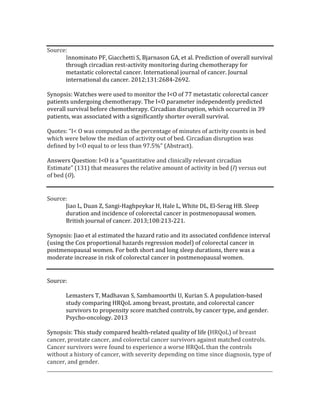
Source:	
Innominato	PF,	Giacchetti	S,	Bjarnason	GA,	et	al.	Prediction	of	overall	survival	
through	circadian	rest-activity	monitoring	during	chemotherapy	for	
metastatic	colorectal	cancer.	International	journal	of	cancer.	Journal	
international	du	cancer.	2012;131:2684-2692.	
	
Synopsis:	Watches	were	used	to	monitor	the	I<O	of	77	metastatic	colorectal	cancer	
patients	undergoing	chemotherapy.	The	I<O	parameter	independently	predicted	
overall	survival	before	chemotherapy.	Circadian	disruption,	which	occurred	in	39	
patients,	was	associated	with	a	significantly	shorter	overall	survival.	
	
Quotes:	“I<	O	was	computed	as	the	percentage	of	minutes	of	activity	counts	in	bed	
which	were	below	the	median	of	activity	out	of	bed.	Circadian	disruption	was	
defined	by	I<O	equal	to	or	less	than	97.5%”	(Abstract).		
	
Answers	Question:	I<O	is	a	“quantitative	and	clinically	relevant	circadian	
Estimate”	(131)	that	measures	the	relative	amount	of	activity	in	bed	(I)	versus	out	
of	bed	(O).		
	
	
Source:		
Jiao	L,	Duan	Z,	Sangi-Haghpeykar	H,	Hale	L,	White	DL,	El-Serag	HB.	Sleep	
duration	and	incidence	of	colorectal	cancer	in	postmenopausal	women.	
British	journal	of	cancer.	2013;108:213-221.	
	
Synopsis:	Jiao	et	al	estimated	the	hazard	ratio	and	its	associated	confidence	interval	
(using	the	Cox	proportional	hazards	regression	model)	of	colorectal	cancer	in	
postmenopausal	women.	For	both	short	and	long	sleep	durations,	there	was	a	
moderate	increase	in	risk	of	colorectal	cancer	in	postmenopausal	women.		
	
	
Source:	
	
Lemasters	T,	Madhavan	S,	Sambamoorthi	U,	Kurian	S.	A	population-based	
study	comparing	HRQoL	among	breast,	prostate,	and	colorectal	cancer	
survivors	to	propensity	score	matched	controls,	by	cancer	type,	and	gender.	
Psycho-oncology.	2013	
	
Synopsis:	This	study	compared	health-related	quality	of	life	(HRQoL)	of	breast	
cancer,	prostate	cancer,	and	colorectal	cancer	survivors	against	matched	controls.	
Cancer	survivors	were	found	to	experience	a	worse	HRQoL	than	the	controls	
without	a	history	of	cancer,	with	severity	depending	on	time	since	diagnosis,	type	of	
cancer,	and	gender.		
_________________________________________________________________________________________________
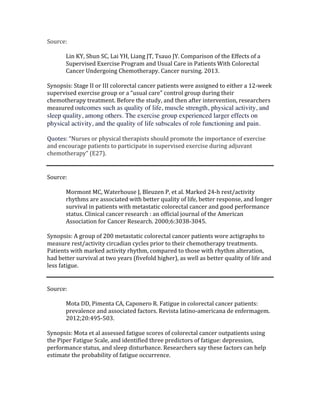
Source:		
	
Lin	KY,	Shun	SC,	Lai	YH,	Liang	JT,	Tsauo	JY.	Comparison	of	the	Effects	of	a	
Supervised	Exercise	Program	and	Usual	Care	in	Patients	With	Colorectal	
Cancer	Undergoing	Chemotherapy.	Cancer	nursing.	2013.	
	
Synopsis:	Stage	II	or	III	colorectal	cancer	patients	were	assigned	to	either	a	12-week	
supervised	exercise	group	or	a	“usual	care”	control	group	during	their	
chemotherapy	treatment.	Before	the	study,	and	then	after	intervention,	researchers	
measured	outcomes such as quality of life, muscle strength, physical activity, and
sleep quality, among others. The exercise group experienced larger effects on
physical activity, and the quality of life subscales of role functioning and pain.
	
Quotes:	“Nurses	or	physical	therapists	should	promote	the	importance	of	exercise	
and	encourage	patients	to	participate	in	supervised	exercise	during	adjuvant	
chemotherapy”	(E27).		
	
Source:		
	
Mormont	MC,	Waterhouse	J,	Bleuzen	P,	et	al.	Marked	24-h	rest/activity	
rhythms	are	associated	with	better	quality	of	life,	better	response,	and	longer	
survival	in	patients	with	metastatic	colorectal	cancer	and	good	performance	
status.	Clinical	cancer	research	:	an	official	journal	of	the	American	
Association	for	Cancer	Research.	2000;6:3038-3045.	
	
Synopsis:	A	group	of	200	metastatic	colorectal	cancer	patients	wore	actigraphs	to	
measure	rest/activity	circadian	cycles	prior	to	their	chemotherapy	treatments.	
Patients	with	marked	activity	rhythm,	compared	to	those	with	rhythm	alteration,	
had	better	survival	at	two	years	(fivefold	higher),	as	well	as	better	quality	of	life	and	
less	fatigue.		
	
	
Source:	
	
Mota	DD,	Pimenta	CA,	Caponero	R.	Fatigue	in	colorectal	cancer	patients:	
prevalence	and	associated	factors.	Revista	latino-americana	de	enfermagem.	
2012;20:495-503.	
	
Synopsis:	Mota	et	al	assessed	fatigue	scores	of	colorectal	cancer	outpatients	using	
the	Piper	Fatigue	Scale,	and	identified	three	predictors	of	fatigue:	depression,	
performance	status,	and	sleep	disturbance.	Researchers	say	these	factors	can	help	
estimate	the	probability	of	fatigue	occurrence.
Quotes:	“The	prevalence	of	fatigue	among	colorectal	cancer	patients	was	26.8%.	
Fatigue	predictors	were	sleep	disturbance,	depression	and	performance	status.	
When	all	factors	were	present,	the	chance	a	patient	had	fatigue	was	80%,	which	
indicated	good	prediction.	When	all	factors	were	absent,	the	chance	a	patient	had	
fatigue	was	8%”	(501).	
	
	
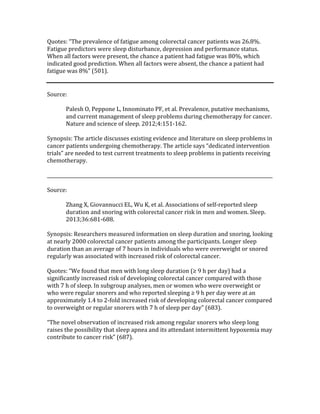
Source:	
	
Palesh	O,	Peppone	L,	Innominato	PF,	et	al.	Prevalence,	putative	mechanisms,	
and	current	management	of	sleep	problems	during	chemotherapy	for	cancer.	
Nature	and	science	of	sleep.	2012;4:151-162.	
	
Synopsis:	The	article	discusses	existing	evidence	and	literature	on	sleep	problems	in	
cancer	patients	undergoing	chemotherapy.	The	article	says	“dedicated	intervention	
trials”	are	needed	to	test	current	treatments	to	sleep	problems	in	patients	receiving	
chemotherapy.		
	
_________________________________________________________________________________________________	
	
Source:	
	
Zhang	X,	Giovannucci	EL,	Wu	K,	et	al.	Associations	of	self-reported	sleep	
duration	and	snoring	with	colorectal	cancer	risk	in	men	and	women.	Sleep.	
2013;36:681-688.	
	
Synopsis:	Researchers	measured	information	on	sleep	duration	and	snoring,	looking	
at	nearly	2000	colorectal	cancer	patients	among	the	participants.	Longer	sleep	
duration	than	an	average	of	7	hours	in	individuals	who	were	overweight	or	snored	
regularly	was	associated	with	increased	risk	of	colorectal	cancer.		
	
Quotes:	“We	found	that	men	with	long	sleep	duration	(≥	9	h	per	day)	had	a	
significantly	increased	risk	of	developing	colorectal	cancer	compared	with	those	
with	7	h	of	sleep.	In	subgroup	analyses,	men	or	women	who	were	overweight	or	
who	were	regular	snorers	and	who	reported	sleeping	≥	9	h	per	day	were	at	an	
approximately	1.4	to	2-fold	increased	risk	of	developing	colorectal	cancer	compared	
to	overweight	or	regular	snorers	with	7	h	of	sleep	per	day”	(683).	
	
“The	novel	observation	of	increased	risk	among	regular	snorers	who	sleep	long	
raises	the	possibility	that	sleep	apnea	and	its	attendant	intermittent	hypoxemia	may	
contribute	to	cancer	risk”	(687).

Literature Search