• RQ1: How are education-based nonprofit organizations
currently usingTwitter?
• RQ2: What visual and media content are used most frequently
by education-based nonprofit organizations?
• RQ3: Which type of messaging, in terms of purpose, used by
educational-based nonprofits onTwitter is the most influential
in creating vocal advocates?
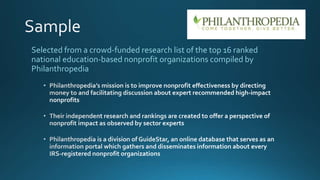
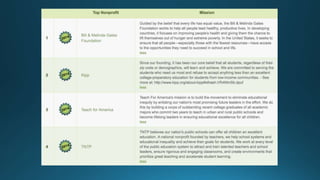
Selected from a crowd-funded research list of the top 16 ranked
national education-based nonprofit organizations compiled by
Philanthropedia
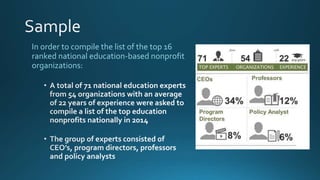
In order to compile the list of the top 16
ranked national education-based nonprofit
organizations:
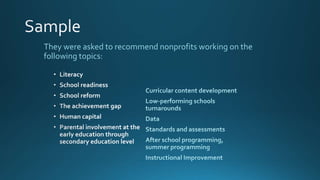
They were asked to recommend nonprofits working on the
following topics:
Content Analysis
• All the top 16 ranked national education-based nonprofit
organizations were found to have existing and activeTwitter
accounts
• ¼ of the sample will be used in the content analysis
• May 1- May 31, 2018
• On each of the days in the sample, all tweets and retweets by
each of the organizations will be archived and analyzed
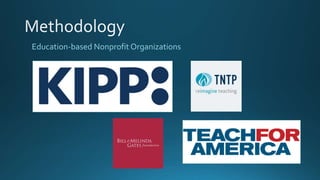
Education-based Nonprofit Organizations
The coding categories used for this study are adapted from previous
research conducted by Guidry,Waters and Saxton. Similar to their
approach, this study implemented aTwitter classification scheme based
on the one developed by Lovejoy and Saxton
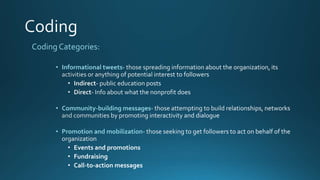
Coding Categories:
• Informational tweets-
• Community-building messages-
• Promotion and mobilization-
• Events and promotions
• Fundraising
• Call-to-action messages
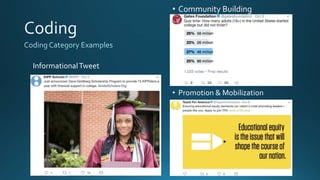
• Community Building
InformationalTweet
• Promotion & Mobilization
All tweets in the sample will be coded for message type and the level
of engagement

Literature review presentation

  • 5.
    • RQ1: Howare education-based nonprofit organizations currently usingTwitter? • RQ2: What visual and media content are used most frequently by education-based nonprofit organizations? • RQ3: Which type of messaging, in terms of purpose, used by educational-based nonprofits onTwitter is the most influential in creating vocal advocates?
  • 18.
    Selected from acrowd-funded research list of the top 16 ranked national education-based nonprofit organizations compiled by Philanthropedia
  • 19.
    In order tocompile the list of the top 16 ranked national education-based nonprofit organizations:
  • 20.
    They were askedto recommend nonprofits working on the following topics:
  • 21.
    Content Analysis • Allthe top 16 ranked national education-based nonprofit organizations were found to have existing and activeTwitter accounts • ¼ of the sample will be used in the content analysis • May 1- May 31, 2018 • On each of the days in the sample, all tweets and retweets by each of the organizations will be archived and analyzed
  • 22.
  • 24.
    The coding categoriesused for this study are adapted from previous research conducted by Guidry,Waters and Saxton. Similar to their approach, this study implemented aTwitter classification scheme based on the one developed by Lovejoy and Saxton
  • 25.
    Coding Categories: • Informationaltweets- • Community-building messages- • Promotion and mobilization- • Events and promotions • Fundraising • Call-to-action messages
  • 26.
  • 27.
    All tweets inthe sample will be coded for message type and the level of engagement

Editor's Notes

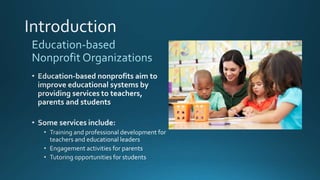
  • #3 Through the use of social media, nonprofit organizations have the opportunity to garner awareness and encourage the public to get involved
  • #7 Many education-based non-profits also place an emphasis on providing services to lower income families and minorities.
  • #8 Startup funding for these organizations comes from members of the organization. These members do not expect to be reimbursed and do not benefit from the profits gained by the organization Additionally, nonprofit organizations are usually granted tax exemptions and donations made to the organization are often tax deductible. Generally, nonprofits prefer that most of the revenue they receive from donations be used to further their overall objective rather than for advertisements. As a result, many nonprofit organizations utilize the reach, communication potential and low cost of creating social media accounts to not only advertise to consumers but also share information with current and future members of their social community.
  • #9 Rather than using public messages to reply to other Twitter users or connecting to others by retweeting messages
  • #10 In contrast to the studies which found that one-way messaging is the most commonly utilized form of messaging by organizations on social media, • which examined what information stakeholders engaged with and shared on Facebook
  • #11 used to examine how individuals can transform into vocal advocates, or active publics as a result, they will be more likely to engage in a conversation about the topic or get involved in the situation. OPR Technology has been recognized as a tool for relationship building since the ‘90s (Saffer, Sommerfeldt & Taylor, 2013). Today, the current focus for public relations practitioners and all organizations is the exploration of relationship building through social media platforms.
  • #12 As a result, this study aims to explore how nonprofits are currently communicating on the micro-blogging service and what messages they are using to motivate users to become active publics. This study builds on previous research surrounding social media use by non-profit organizations and will focus specifically on procuring an in-depth analysis of education-based non-profit organizations’ use of Twitter. This information will be valuable for all nonprofit organizations using social media who wish to increase their active publics. Furthermore, this study is beneficial to any organization interested in learning more about their social media audience and how to develop messages which will best appeal to them.
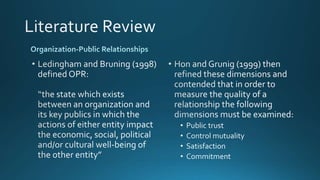
  • #13 The use of social media by brands and organizations has created new opportunities to connect with a variety of audiences. HOW THEY USE TWITTER: Previous research on Twitter usage found that organizations frequently sent out informational messages in attempt to encourage engagement with their followers, but rarely succeeded.
  • #14 Trust is defined as “one party’s level of confidence in and willingness to open oneself to the other party” (Hon & Grunig, 1999). Control mutuality is described as when the public and an organization agree on their mutual influence on each other. “Satisfaction is achieved when the publics favor the organization due to fulfillment of set, positive expectations, commitment to an organization occurs when the publics value the relationship and have an inherent need to maintain and strengthen it,” (Men & Muralidharan, 2016).
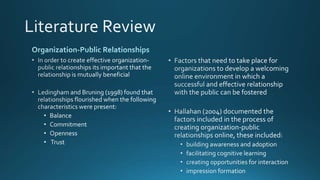
  • #15 FIRST: today, technology has created the opportunity for organizations to develop a more balanced relationship with the public. Through Social media specifically there is a constant flow of direct communication to be shared between organizations and the public daily. END WITH: scholars have found that those who were deeply engaged with an organization on social media displayed a higher degree of trust, satisfaction and commitment to the organization (Bortree, 2011; Bruce & Shelley, 2010; Men & Tsai, 2014).  Men and Tsai (2014) also discovered that publics who are more engaged with organizations on social media perceive those organizations have genuine and transparent characteristics. Social media engagement by the public with education-based nonprofit organizations has the power to develop prosperous organization-public relationships. Organization-public relationships will be used to examine the importance of the relationships between education-based nonprofit organizations and the public as well as inform how these relationships can be developed on social media platforms.
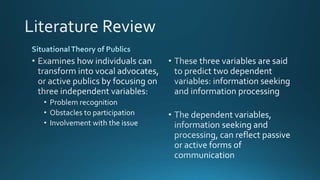
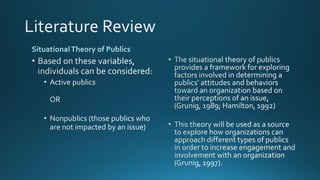
  • #16 problem recognition is defined as the moment when people recognize that something should be done about an issue or situation, and stop and think about what they can do (P.D. Guidry, 2014). Obstacles to participation occurs when people perceive that there may be difficulties in the way of them acting to remedy the problem level of involvement is the extent to which people connect with the issue or situation (Grunig, 1997).  Passive levels of information seeking and processing for example, may be that an individual simply receives or consumes information that is presented to them. Conversely, an example of an active level of information seeking and processing could be when individuals put effort into locating or consuming information about an issue or situation.
  • #19 They provide information about each nonprofit's mission, legitimacy, impact, reputation, finances, programs, transparency and governance.
  • #22 664 tweets National Teacher Appreciation Day annually brings attention to education through the celebration of teachers and their commitment to educating and investing in the futures of children throughout the country.
  • #23 The Knowledge is Power Program is a nationwide network of free open-enrollment college-preparatory schools in under-resourced communities throughout the United States.  TNTP, formerly known as The New Teacher Project, is an organization in the United States with a mission of ensuring that poor and minority students get equal access to effective teachers.  Bill & Melinda Gates Foundation- Seeks to ensure that all people- especially those with the fewest resources- have access to the opportunities they need to succeed in school & in life Teach For America (TFA) is a nonprofit organization whose stated mission is to "enlist, develop, and mobilize as many as possible of our nation's most promising future leaders to grow and strengthen the movement for educational equity and excellence."