Reading Well By Third Grade


Our District 112 Plan to Ensure Student Reading Success
Minnesota Department of Education Requirements
         for District K-12 Literacy Plan

 Minnesota Statutes, section 120B.12, requires all public schools, including charter
 schools, to create and post a local literacy plan by the end of the 2011-12 school year.
 The statute also requires all public schools to submit reading proficiency data for all
 Kindergarten, Grade 1 and Grade 2 students to MDE by July 1.

 Our District Plan includes the following:
  An assessment plan which includes assessment of all students to identify
 those students at risk for not reading well by third grade. An assessment
 plan must include early and regular assessment and an ongoing monitoring
 process.

 Instruction provided to all students that is scientifically research based and includes
 standards driven instruction in general education.

 A strategic plan for students at risk of not reading well by third grade as
  measured by not “meeting” the reading benchmark as measured by the MCA reading
 test by the end of third grade. The plan must include programming that includes
 increasingly intense tiers of intervention. Instruction will include research based
 materials and practices.
Reading Well By Third Grade
A proficient reader is defined as;
  A student who demonstrates proficient performance on the MCAII
  Reading Assessment administered in third grade.
We will use other assessments in addition to the MCAII Reading
  Assessment to examine the multiple factors that support reading
  proficiency in the classroom setting.
Reading proficiency examines a student’s ability to understand and
  apply letter sound associations, blend sounds to create meaning
  from print, reading fluently, comprehend texts at multiple levels,
  and generalize skills to read grade level text with success.

Grade level benchmarks provided later in this plan will allow district
  instructional staff to identify those students at risk for not meeting
  this definition of proficiency.
Eastern Carver County Schools
                     Reading MCA Trend Grade 3 All Students
100.00%

90.00%

80.00%

70.00%

60.00%

50.00%

40.00%

30.00%

20.00%

10.00%

 0.00%
             2006       2007        2008       2009        2010     2011
      All   91.40%     89.50%      87.50%     86.40%      88.40%   88.40%


District112 has a reading proficiency goal as follows:
Through a continuous improvement and assessment model implemented
during the 2012-2013 school year, our goal is to increase the percentage of
students proficient in reading, as measured by the MCAIII reading
assessment, by 2% from the current level of proficiency of 88.40% to 90.40%
across all elementary schools.
ASSESSMENT- EARLY CHILDHOOD
   An assessment plan which includes assessment of all students to identify those students
    at risk for not reading well by third grade. An assessment plan must include early and
    regular assessment and an ongoing monitoring process.
   All district children go through our district’s Early Childhood Screening Program sometime
    between the ages of 3 and 5. The district using the Pearson ESI.P and ESI.R Screening
    tool.
   Referrals are made for students in the areas of Speech or Cognitive Development.
    Students then receive services through our Early Childhood Special Education
    department.
   If a student scores below average or does not qualify for special education
    services, parents are encouraged to enroll their child into one of the 4 types of early
    childhood programs available in District 112.
   Progress for students in our early childhood programs are evaluated using the Work
    Sampling Portfolio approach to assessment. The outcome of the work sampling is shared
    with the Kindergarten program if the child remains in district for Kindergarten.
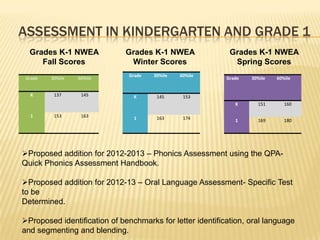
ASSESSMENT IN KINDERGARTEN AND GRADE 1
  Grades K-1 NWEA             Grades K-1 NWEA               Grades K-1 NWEA
     Fall Scores               Winter Scores                 Spring Scores
                               Grade   30%ile   60%ile
 Grade   30%ile   60%ile                                   Grade   30%ile   60%ile


  K       137      145          K       145      153
                                                              K      151       160

  1       153      163           1      163      174          1      169       180


Proposed addition for 2012-2013 – Phonics Assessment using the QPA-
Quick Phonics Assessment Handbook.

Proposed addition for 2012-13 – Oral Language Assessment- Specific Test
to be
Determined.

Proposed identification of benchmarks for letter identification, oral language
and segmenting and blending.
ASSESSMENT IN GRADES 2 AND 3
Grades 2-3 Fall              Grades 2-3 Winter          Grades 2-3 Spring
NWEA Score                     NWEA Score                NWEA Score
 Grade    30%ile    48%ile   Grade    30%ile   48%ile   Grade   30%ile   48%ile


  2        168       175       2       176      183        2      182       189


  3        182       189       3       187      194        3      191       198


Grade 3 MCA:                 Grade 3 MCA:               Grade 3 MCA:
Below 340 Does Not Meet      Below 340 Does Not Meet    Below 340 Does Not Meet
341-350 Partially Meets      341-350 Partially Meets    341-350 Partially Meets


Students identified as “at risk” will be administered monthly running
records to measure growth between standardized measures.
Houghton Mifflin Fluency assessments will be administered 3 times a
year.
A pre and post intervention assessment in phonics using the QPA-
Quick Phonics Assessment will be administered to identified students in
tiered interventions.
ASSESSMENT IN GRADES 4 AND 5
       Grades 4-5 Fall             Grades 4-5 Winter                    Grades 4-5 Spring
 Grade       30%ile      48%ile   Grade    30%ile      48%ile
                                                                Grade       30%ile    48%ile

   4          192         199       4       196         202        4           199          206

   5          199         206       5       202         209        5           205          211


Grade 4 MCA:                      Grade 4 MCA:                    Grade 4 MCA:
Below 440 Does Not Meet           Below 440 Does Not Meet         Below 440 Does Not Meet
441-450 Partially Meets           441-450 Partially Meets         441-450 Partially Meets
Grade 5 MCA:                      Grade 5 MCA:
Below 540 Does Not Meet                                          Grade 5 MCA:
                                  Below 540 Does Not Meet        Below 540 Does Not Meet
541-550 Partially Meets           541-550 Partially Meets        541-550 Partially Meets

 Students who do not achieve a rating of “meets” on the Grade 3 MCAIII Reading
 Test and whose scores do not meet the criteria above, will be identified as “at risk”
 Because they did not meet the benchmark for Reading Well in Third Grade.
 Students identified will receive a tiered intervention that will address specific
 reading needs.
 Monthly running records will be administered to measure growth between NWEA
 Assessments.
 Fluency assessments from the Houghton Mifflin Reading Series will be administered
ASSESSMENT IN GRADES 6 THROUGH 8
Literacy Lab I           6th                             7th                             8th
Spring MAP (RIT)         5th grade MAP Below 200         6th grade MAP Below 203         7th grade MAP Below 207


MCA II (Scale Score)     Below 540                       Below 640                       Below 740
Teacher Recommendation   yes                             yes                             yes


Informal Assessments     observed word identification/   observed word identification/   observed word identification/
                         decoding need                   decoding need                   decoding need


Literacy Lab II          6th                             7th                             8th
Spring MAP (RIT)         5th grade MAP Below 208         6th grade MAP Below 213         7th grade MAP Below 216


MCA II (Scale Score)     Below 550                       Below 650                       Below 750
Teacher Recommendation   yes                             yes                             yes


Informal Assessments     TBD in 2012-2013                TBD in 2012-2013                TBD in 2012-2013
ASSESSMENT IN GRADES 9 THROUGH 12
Literacy Lab I           9th                          10th                             11th and 12th
Spring MAP (RIT)         MAP RIT below 208            MAP RIT below 211                Not Applicable


MCA II (Scale Score)     Below 840 on the 8th grade   Below 840 on the 8th grade MCA   Failed to pass GRAD component
                         MCA in Reading               in Reading
Teacher Recommendation   yes                          yes                              yes


Informal Assessments     TBD during 2012-13           TBD during 2012-13               TBD during 2012-13


Literacy Lab II          9th                          10th                             11th and 12th
Spring MAP (RIT)         MAP RIT below 218            MAP RIT below 221                Not Applicable


MCA II (Scale Score)     Below 850 on the 8th grade   Below 850 on 8th Grade MCA       Failed to pass GRAD component
                         MCA in Reading               Reading
Teacher Recommendation   yes                          yes                              yes


Informal Assessments     TBD during 2012-13           TBD during 2012-13               TBD during 2012-13
READING INSTRUCTION IN PRE-SCHOOL
4 Different types of Early Childhood Programs are currently available in District 112
    in addition to Early Childhood Special Education Programs:
 Taste of Preschool – 2 ½ and 3 ½ year olds

 Preschool Plus – 3-4 year olds and 4-5year olds

 Child-Only Preschool- 3-5 years and 4-5 year olds

 Family Literacy Preschool- 4 year olds

Instruction at the Preschool level includes elements of the Houghton Mifflin
    Storytown curriculum, literacy components from the Early Childhood
    Indicators of Progress and instruction consistent with the Reggio Emilia
    approach to instruction.
Ongoing assessment of early literacy skills is addressed through the use of Work
    Sampling.
READING INSTRUCTION IN GRADES K-5
All students are to receive research based and standards driven
    instruction
In general education. Currently all students in District 112 Elementary
Schools receive general education language arts instruction as follows:
 Students receive daily instruction using the Houghton Mifflin
    Storytown materials appropriate for their grade level.
 Instruction includes phonics, vocabulary development, reading
    fluency and comprehension.
 Teachers differentiate instruction to match each students instructional
    level. Through the continuous progress initiatives at many of the
    elementary schools, students may move out of their grade level for
    individualized instruction.
 Instruction addresses district grade level outcomes in Language Arts.
TIERS OF INTERVENTION
If a student is at risk of not reading well by third grade or has not achieved reading
    proficiency by third grade they are provided with increasingly intense tiers of
    intervention.
 Interventions are research based and specific to the reading challenges of the
    student.
 Embedded in the Tiers of intervention is a continuous monitoring system which
    includes standardized measures such as the NWEA MAP test in Reading and
    the MCA Reading test. In between these administrations, intermittent planned
    assessments are administered that address phonics, vocabulary,
    comprehension and reading fluency. These measures differ significantly based
    on the age of the students.
 We will be identifying periodic assessment measures for Kindergarten, Middle
    School and High School grades 9 and 10.
 Given the diverse nature of pre-school programming we plan to align pre-school
    measures to the Kindergarten measures during the 2012-13 school year.
PRE SCHOOL IDENTIFICATION/INTERVENTION

                   Given the results of the preschool
                      screening students may be
                   assessed in the areas of Speech
                    and Language Development or
                   Cognitive Development or both. –
                      Referral to Early Childhood
                     Special Education may result.

                   Students who are identified as at
                     risk on the Pearson ESI.P or
                       ESI.R screening tools are
                    recommended to attend early
                        childhood programming.

                   All children residing in District 112
                    are expected to complete early
                   childhood screening between the
                             ages of 3 and 5.
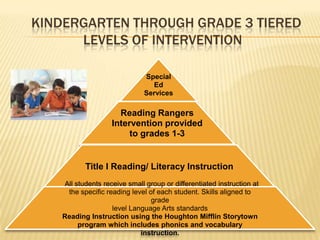
KINDERGARTEN THROUGH GRADE 3 TIERED
      LEVELS OF INTERVENTION

                               Special
                                 Ed
                               Services

                      Reading Rangers
                    Intervention provided
                         to grades 1-3


           Title I Reading/ Literacy Instruction
    All students receive small group or differentiated instruction at
     the specific reading level of each student. Skills aligned to
                                 grade
                    level Language Arts standards
    Reading Instruction using the Houghton Mifflin Storytown
         program which includes phonics and vocabulary
                             instruction.
GRADES 4 THROUGH 5 TIERED INTERVENTION


                     Special Education services-
                  Reading Instruction using research
                  based instruction and materials is
                              provided.


                   Literacy instruction provided that is in
                  addition to the building wide Language
                  Arts instruction provided to all students.
                       Research based materials and
                  assessments specific to student needs.


                     General Education Language Arts
                  Instruction using the Storytown Program
                    by Houghton Mifflin aligned to grade
                    level outcomes and differentiated for
                           student reading ability .
GRADES 6 THROUGH 8 TIERED INTERVENTION


                       Special
                      Education
                       Reading
                       Services

                        Literacy
                      Instruction
                      Specialized
                         for EL
                       students


           Literacy                 Literacy
            Lab I                    Lab II
GRADES 9 THROUGH 12 TIERED INTERVENTION


                        Special
                       Education
                        Reading
                        Services

                         Literacy
                       Instruction
                       Specialized
                          for EL
                        students


            Literacy                 Literacy
             Lab I                    Lab II
WORK TO BE DONE ….
As part of a continuous improvement model, the following work needs to
be completed during the summer of 2012 and during the 2012-2013
school year.

Identify measures and practices that insure identification of preschoolers “at
risk” for not reading well by third grade.

Identify specific benchmarks for the areas of : identifying letter sounds, and
sound blending/segmenting at the Kindergarten level.

Train teaching staff at grades 1 , 2 and 3 to administer the QPA and identify
another measure that will address- blending and segmenting.

Train intervention teachers of students in grades 4 and 5 to consistently
administer running records and fluency measures.

At middle school grades 6,7, and 8 and high school grades 9 and 10, identify
another measure of student reading growth to be administered between NWEA
test administrations.
Reading Well By Third Grade


     Our District 112 Plan to Ensure Student Reading Success


If you would like to read our plan, it can be
   found at http://bit.ly/litplan

Literacy Plan - E Carver County Schools

  • 1.
    Reading Well ByThird Grade Our District 112 Plan to Ensure Student Reading Success
  • 2.
    Minnesota Department ofEducation Requirements for District K-12 Literacy Plan Minnesota Statutes, section 120B.12, requires all public schools, including charter schools, to create and post a local literacy plan by the end of the 2011-12 school year. The statute also requires all public schools to submit reading proficiency data for all Kindergarten, Grade 1 and Grade 2 students to MDE by July 1. Our District Plan includes the following:  An assessment plan which includes assessment of all students to identify those students at risk for not reading well by third grade. An assessment plan must include early and regular assessment and an ongoing monitoring process. Instruction provided to all students that is scientifically research based and includes standards driven instruction in general education. A strategic plan for students at risk of not reading well by third grade as measured by not “meeting” the reading benchmark as measured by the MCA reading test by the end of third grade. The plan must include programming that includes increasingly intense tiers of intervention. Instruction will include research based materials and practices.
  • 3.
    Reading Well ByThird Grade A proficient reader is defined as; A student who demonstrates proficient performance on the MCAII Reading Assessment administered in third grade. We will use other assessments in addition to the MCAII Reading Assessment to examine the multiple factors that support reading proficiency in the classroom setting. Reading proficiency examines a student’s ability to understand and apply letter sound associations, blend sounds to create meaning from print, reading fluently, comprehend texts at multiple levels, and generalize skills to read grade level text with success. Grade level benchmarks provided later in this plan will allow district instructional staff to identify those students at risk for not meeting this definition of proficiency.
  • 4.
    Eastern Carver CountySchools Reading MCA Trend Grade 3 All Students 100.00% 90.00% 80.00% 70.00% 60.00% 50.00% 40.00% 30.00% 20.00% 10.00% 0.00% 2006 2007 2008 2009 2010 2011 All 91.40% 89.50% 87.50% 86.40% 88.40% 88.40% District112 has a reading proficiency goal as follows: Through a continuous improvement and assessment model implemented during the 2012-2013 school year, our goal is to increase the percentage of students proficient in reading, as measured by the MCAIII reading assessment, by 2% from the current level of proficiency of 88.40% to 90.40% across all elementary schools.
  • 5.
    ASSESSMENT- EARLY CHILDHOOD  An assessment plan which includes assessment of all students to identify those students at risk for not reading well by third grade. An assessment plan must include early and regular assessment and an ongoing monitoring process.  All district children go through our district’s Early Childhood Screening Program sometime between the ages of 3 and 5. The district using the Pearson ESI.P and ESI.R Screening tool.  Referrals are made for students in the areas of Speech or Cognitive Development. Students then receive services through our Early Childhood Special Education department.  If a student scores below average or does not qualify for special education services, parents are encouraged to enroll their child into one of the 4 types of early childhood programs available in District 112.  Progress for students in our early childhood programs are evaluated using the Work Sampling Portfolio approach to assessment. The outcome of the work sampling is shared with the Kindergarten program if the child remains in district for Kindergarten.
  • 6.
    ASSESSMENT IN KINDERGARTENAND GRADE 1 Grades K-1 NWEA Grades K-1 NWEA Grades K-1 NWEA Fall Scores Winter Scores Spring Scores Grade 30%ile 60%ile Grade 30%ile 60%ile Grade 30%ile 60%ile K 137 145 K 145 153 K 151 160 1 153 163 1 163 174 1 169 180 Proposed addition for 2012-2013 – Phonics Assessment using the QPA- Quick Phonics Assessment Handbook. Proposed addition for 2012-13 – Oral Language Assessment- Specific Test to be Determined. Proposed identification of benchmarks for letter identification, oral language and segmenting and blending.
  • 7.
    ASSESSMENT IN GRADES2 AND 3 Grades 2-3 Fall Grades 2-3 Winter Grades 2-3 Spring NWEA Score NWEA Score NWEA Score Grade 30%ile 48%ile Grade 30%ile 48%ile Grade 30%ile 48%ile 2 168 175 2 176 183 2 182 189 3 182 189 3 187 194 3 191 198 Grade 3 MCA: Grade 3 MCA: Grade 3 MCA: Below 340 Does Not Meet Below 340 Does Not Meet Below 340 Does Not Meet 341-350 Partially Meets 341-350 Partially Meets 341-350 Partially Meets Students identified as “at risk” will be administered monthly running records to measure growth between standardized measures. Houghton Mifflin Fluency assessments will be administered 3 times a year. A pre and post intervention assessment in phonics using the QPA- Quick Phonics Assessment will be administered to identified students in tiered interventions.
  • 8.
    ASSESSMENT IN GRADES4 AND 5 Grades 4-5 Fall Grades 4-5 Winter Grades 4-5 Spring Grade 30%ile 48%ile Grade 30%ile 48%ile Grade 30%ile 48%ile 4 192 199 4 196 202 4 199 206 5 199 206 5 202 209 5 205 211 Grade 4 MCA: Grade 4 MCA: Grade 4 MCA: Below 440 Does Not Meet Below 440 Does Not Meet Below 440 Does Not Meet 441-450 Partially Meets 441-450 Partially Meets 441-450 Partially Meets Grade 5 MCA: Grade 5 MCA: Below 540 Does Not Meet Grade 5 MCA: Below 540 Does Not Meet Below 540 Does Not Meet 541-550 Partially Meets 541-550 Partially Meets 541-550 Partially Meets Students who do not achieve a rating of “meets” on the Grade 3 MCAIII Reading Test and whose scores do not meet the criteria above, will be identified as “at risk” Because they did not meet the benchmark for Reading Well in Third Grade. Students identified will receive a tiered intervention that will address specific reading needs. Monthly running records will be administered to measure growth between NWEA Assessments. Fluency assessments from the Houghton Mifflin Reading Series will be administered
  • 9.
    ASSESSMENT IN GRADES6 THROUGH 8 Literacy Lab I 6th 7th 8th Spring MAP (RIT) 5th grade MAP Below 200 6th grade MAP Below 203 7th grade MAP Below 207 MCA II (Scale Score) Below 540 Below 640 Below 740 Teacher Recommendation yes yes yes Informal Assessments observed word identification/ observed word identification/ observed word identification/ decoding need decoding need decoding need Literacy Lab II 6th 7th 8th Spring MAP (RIT) 5th grade MAP Below 208 6th grade MAP Below 213 7th grade MAP Below 216 MCA II (Scale Score) Below 550 Below 650 Below 750 Teacher Recommendation yes yes yes Informal Assessments TBD in 2012-2013 TBD in 2012-2013 TBD in 2012-2013
  • 10.
    ASSESSMENT IN GRADES9 THROUGH 12 Literacy Lab I 9th 10th 11th and 12th Spring MAP (RIT) MAP RIT below 208 MAP RIT below 211 Not Applicable MCA II (Scale Score) Below 840 on the 8th grade Below 840 on the 8th grade MCA Failed to pass GRAD component MCA in Reading in Reading Teacher Recommendation yes yes yes Informal Assessments TBD during 2012-13 TBD during 2012-13 TBD during 2012-13 Literacy Lab II 9th 10th 11th and 12th Spring MAP (RIT) MAP RIT below 218 MAP RIT below 221 Not Applicable MCA II (Scale Score) Below 850 on the 8th grade Below 850 on 8th Grade MCA Failed to pass GRAD component MCA in Reading Reading Teacher Recommendation yes yes yes Informal Assessments TBD during 2012-13 TBD during 2012-13 TBD during 2012-13
  • 11.
    READING INSTRUCTION INPRE-SCHOOL 4 Different types of Early Childhood Programs are currently available in District 112 in addition to Early Childhood Special Education Programs:  Taste of Preschool – 2 ½ and 3 ½ year olds  Preschool Plus – 3-4 year olds and 4-5year olds  Child-Only Preschool- 3-5 years and 4-5 year olds  Family Literacy Preschool- 4 year olds Instruction at the Preschool level includes elements of the Houghton Mifflin Storytown curriculum, literacy components from the Early Childhood Indicators of Progress and instruction consistent with the Reggio Emilia approach to instruction. Ongoing assessment of early literacy skills is addressed through the use of Work Sampling.
  • 12.
    READING INSTRUCTION INGRADES K-5 All students are to receive research based and standards driven instruction In general education. Currently all students in District 112 Elementary Schools receive general education language arts instruction as follows:  Students receive daily instruction using the Houghton Mifflin Storytown materials appropriate for their grade level.  Instruction includes phonics, vocabulary development, reading fluency and comprehension.  Teachers differentiate instruction to match each students instructional level. Through the continuous progress initiatives at many of the elementary schools, students may move out of their grade level for individualized instruction.  Instruction addresses district grade level outcomes in Language Arts.
  • 13.
    TIERS OF INTERVENTION Ifa student is at risk of not reading well by third grade or has not achieved reading proficiency by third grade they are provided with increasingly intense tiers of intervention.  Interventions are research based and specific to the reading challenges of the student.  Embedded in the Tiers of intervention is a continuous monitoring system which includes standardized measures such as the NWEA MAP test in Reading and the MCA Reading test. In between these administrations, intermittent planned assessments are administered that address phonics, vocabulary, comprehension and reading fluency. These measures differ significantly based on the age of the students.  We will be identifying periodic assessment measures for Kindergarten, Middle School and High School grades 9 and 10.  Given the diverse nature of pre-school programming we plan to align pre-school measures to the Kindergarten measures during the 2012-13 school year.
  • 14.
    PRE SCHOOL IDENTIFICATION/INTERVENTION Given the results of the preschool screening students may be assessed in the areas of Speech and Language Development or Cognitive Development or both. – Referral to Early Childhood Special Education may result. Students who are identified as at risk on the Pearson ESI.P or ESI.R screening tools are recommended to attend early childhood programming. All children residing in District 112 are expected to complete early childhood screening between the ages of 3 and 5.
  • 15.
    KINDERGARTEN THROUGH GRADE3 TIERED LEVELS OF INTERVENTION Special Ed Services Reading Rangers Intervention provided to grades 1-3 Title I Reading/ Literacy Instruction All students receive small group or differentiated instruction at the specific reading level of each student. Skills aligned to grade level Language Arts standards Reading Instruction using the Houghton Mifflin Storytown program which includes phonics and vocabulary instruction.
  • 16.
    GRADES 4 THROUGH5 TIERED INTERVENTION Special Education services- Reading Instruction using research based instruction and materials is provided. Literacy instruction provided that is in addition to the building wide Language Arts instruction provided to all students. Research based materials and assessments specific to student needs. General Education Language Arts Instruction using the Storytown Program by Houghton Mifflin aligned to grade level outcomes and differentiated for student reading ability .
  • 17.
    GRADES 6 THROUGH8 TIERED INTERVENTION Special Education Reading Services Literacy Instruction Specialized for EL students Literacy Literacy Lab I Lab II
  • 18.
    GRADES 9 THROUGH12 TIERED INTERVENTION Special Education Reading Services Literacy Instruction Specialized for EL students Literacy Literacy Lab I Lab II
  • 19.
    WORK TO BEDONE …. As part of a continuous improvement model, the following work needs to be completed during the summer of 2012 and during the 2012-2013 school year. Identify measures and practices that insure identification of preschoolers “at risk” for not reading well by third grade. Identify specific benchmarks for the areas of : identifying letter sounds, and sound blending/segmenting at the Kindergarten level. Train teaching staff at grades 1 , 2 and 3 to administer the QPA and identify another measure that will address- blending and segmenting. Train intervention teachers of students in grades 4 and 5 to consistently administer running records and fluency measures. At middle school grades 6,7, and 8 and high school grades 9 and 10, identify another measure of student reading growth to be administered between NWEA test administrations.
  • 20.
    Reading Well ByThird Grade Our District 112 Plan to Ensure Student Reading Success If you would like to read our plan, it can be found at http://bit.ly/litplan