Litchfield Middle School
Proposal for 2015-2016 and Beyond
Transition to Middle School Model
Traditional Middle School Traditional Junior High School
 Student-oriented  Subject-centered
 Emphasis is on both cognitive and affective
development
 Emphasis is on cognitive development
 Teachers and students organized in grade-
level interdisciplinary teams
 Teachers organized in subject-based
departments
 Experiential approaches to instruction  Traditional instruction dominates
 Allows for block and flexible scheduling;
Allows for looping
 Six to eight class periods
 Provides exploratory, academic, and
nonacademic classes
 Provides academic classes
 Offers advisor/advisee, teacher/student
opportunities
 Offers study hall and/or homeroom
 Team classrooms in close proximity  Classrooms arranged randomly or by
subject or grade level
Young Adolescents
Young people undergo more rapid and profound
personal changes during the years between 10 and 15
than at any other period of time in their lives.
Intellectually
Physically
Emotionally
Socially
Morally
Roll Out Plan to Faculty and
Board of Education
 May 8th – Middle School Teachers
 May 13th – All Faculty
 May 14th – Curriculum Programs & Personnel Sub-committee
 June 3rd - Presentation to the Board of Education
Work We Will Do To Create
Litchfield Middle School
Mission and
Expectations
• Stakeholder Input
• Decide What We
Stand For
• Develop our core
values and beliefs
Curriculum
Review
• Incorporate
personalized learning
• Project based learning
• Interdisciplinary
Units
• Advisory
Professional
Development
• Middle School
Specific
• Through Team and
Faculty Meeting time
• Critical Attributes
Build a Unique
Experience for
Young
Adolescents
• Student-Centered
• Student Development
• Student Ownership
Separating the Middle School and High School
Explicit leadership – 1 principal for each school
SRBI/Dean of Students – High School
Department Chairs – Middle School High School
Dedicated MS only School Counselor
Separate MS Entrance
$0
$6319
-$6312
Logistical Changes For Next Year
Old Room New Room
Nurse’s Office MS Main Office – with principal and
secretary
Trainer’s Room MS School Counselor
Room 601 MS Lunchroom/Workroom
Room 224 MS Special Education
Room 307 HS Faculty Lunchroom
Room 212 Technology and Robotics
Faculty Lunchroom Nurse and Trainer Office
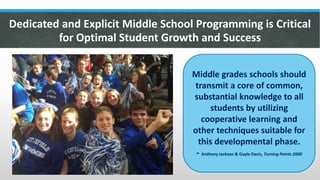
Dedicated and Explicit Middle School Programming is Critical
for Optimal Student Growth and Success
Middle grades schools should
transmit a core of common,
substantial knowledge to all
students by utilizing
cooperative learning and
other techniques suitable for
this developmental phase.
- Anthony Jackson & Gayle Davis, Turning Points 2000

Litchfield Middle School

  • 1.
    Litchfield Middle School Proposalfor 2015-2016 and Beyond
  • 2.
    Transition to MiddleSchool Model Traditional Middle School Traditional Junior High School  Student-oriented  Subject-centered  Emphasis is on both cognitive and affective development  Emphasis is on cognitive development  Teachers and students organized in grade- level interdisciplinary teams  Teachers organized in subject-based departments  Experiential approaches to instruction  Traditional instruction dominates  Allows for block and flexible scheduling; Allows for looping  Six to eight class periods  Provides exploratory, academic, and nonacademic classes  Provides academic classes  Offers advisor/advisee, teacher/student opportunities  Offers study hall and/or homeroom  Team classrooms in close proximity  Classrooms arranged randomly or by subject or grade level
  • 3.
    Young Adolescents Young peopleundergo more rapid and profound personal changes during the years between 10 and 15 than at any other period of time in their lives. Intellectually Physically Emotionally Socially Morally
  • 4.
    Roll Out Planto Faculty and Board of Education  May 8th – Middle School Teachers  May 13th – All Faculty  May 14th – Curriculum Programs & Personnel Sub-committee  June 3rd - Presentation to the Board of Education
  • 5.
    Work We WillDo To Create Litchfield Middle School Mission and Expectations • Stakeholder Input • Decide What We Stand For • Develop our core values and beliefs Curriculum Review • Incorporate personalized learning • Project based learning • Interdisciplinary Units • Advisory Professional Development • Middle School Specific • Through Team and Faculty Meeting time • Critical Attributes Build a Unique Experience for Young Adolescents • Student-Centered • Student Development • Student Ownership
  • 6.
    Separating the MiddleSchool and High School Explicit leadership – 1 principal for each school SRBI/Dean of Students – High School Department Chairs – Middle School High School Dedicated MS only School Counselor Separate MS Entrance $0 $6319 -$6312
  • 7.
    Logistical Changes ForNext Year Old Room New Room Nurse’s Office MS Main Office – with principal and secretary Trainer’s Room MS School Counselor Room 601 MS Lunchroom/Workroom Room 224 MS Special Education Room 307 HS Faculty Lunchroom Room 212 Technology and Robotics Faculty Lunchroom Nurse and Trainer Office
  • 8.
    Dedicated and ExplicitMiddle School Programming is Critical for Optimal Student Growth and Success Middle grades schools should transmit a core of common, substantial knowledge to all students by utilizing cooperative learning and other techniques suitable for this developmental phase. - Anthony Jackson & Gayle Davis, Turning Points 2000

Editor's Notes

  • #3 This chart illustrates the key differences between a junior high school model, in which educators are preparing 7th and 8th graders along subject-area lines for a high school path – in others words a grade 7 to grade 12 departmental configuration … AND a middle school model in which educators place significantly more importance on a grade-level team approach – focusing on student achievement, yes, but also on the cross-curricular connections and themes that are particularly important for this particular age group. So, you would see greater emphasis and planning on interdisciplinary units… you MIGHT see – not immediately, but down the road… the kind of flexible which allows for looping in one subject or several subjects…. You definitely see an extended emphasis on the Advisor program and a more fully developed curriculum… which includes a new decision-making model, CyberSmart lessons, learning-styles inventories, and so on.
  • #4 The educators in a middle school put a deliberate focus what makes a middle school student unique… how are healthy friendships and relationships defined… that decision-making is not the simple black-and-white, yes-no process it appears to be, but that there are shades of gray between making the right decision for the right reasons and making the wrong decision for the wrong reason. Kids need to understand why THEIR real-self and cyber-self need to be the ‘same person’ they are presenting to the world -- , while at the same time recognizing that there are people out there whose cyber-self and real self are dangerously different. These are not content area concepts… nor, are they concepts that can be simply left to some kind of ‘on-the-side curriculum’ or an occasional workshop presenter.
  • #5 In your proposal, which CPP first saw last month, which you’ve had for about a week, there is a lot more theory supporting a middle school model. What the theory does not support and even warns about is grade reconfiguration which does not ultimately achieve the rich programming it is designed to accomplish without making any REAL design changes. In other words, calling it a middle school without really being a middle school… There’s no secret in this plan, that we would need to separate Kristen’s and Stephanie’s role in order to make the model truly work, so from here on out, I’ll use Stephanie’s name because there is no intention to add new administrative staff.
  • #6 Thus, this slide illustrates the multi-year… well, actually ongoing process … required to make Litchfield Middle School, a truly amazing middle school. Right now, Stephanie is working with the stakeholders to create the mission statement and vision. I’m just going to give you one small example, but she’s implemented a simple survey of the kids and every day they are asked, “Was your day a 5 (the highest), 4, 3, 2, or 1?” If the student’s day was anything less than a 5, they are asked to say what would have made it a 5. Kids are providing great information that absolutely can be aligned to the vision and mission and clearly has value to Stephanie and the staff. Kids are saying things such as, “My day would have been better if it was easier to sit with my friends at lunch,” and “My day would have been a 5 if the teachers didn’t talk so much today.” Developing new units of study will be part of this metamorphosis … and extending Advisory to a three-days-a-week program. Also, we’ll need to add middle school clubs and activities and one significant difference will be in the differentiated faculty meetings and professional development…
  • #7 So, the proposal I gave you explains the logistics of how we will do this. The five most significant changes will be these: a principal for each school. There is NO cost for this, because the Middle School Principal would be added to the elementary school principal line which is within the same salary range as the Assistant Principal. In other words, the current high school assistant principal makes the same ‘salary range’ depending upon experience as a current elementary principal. The three positions which we will create to support Kristen at the High School are cost neutral as well. We currently have a ‘SRBI Coordinator’ in the budget. In the plan I am proposing, this would be a high school SRBI position combined with a Dean of Students for attendance and minor discipline. The goal here is to address the time management, tardiness, and attendance issues, as well as the executive functioning issues in SRBI in a way in which the minor discipline issues decrease as students are more successful. In high school, success and the behaviors that add/detract from success such as attendance or inattentiveness are related. One of the Dean of Student responsibilities would be attendance at approximately ½ of the activities. This is a Category A stipend which would cost us less than a $10 more than the savings we would have if we used TWO Department Chairs (one for Language Arts and Social Studies; one for Science and Math) at the high school rather than FOUR curriculum coordinators.
  • #8 The new entry system and a potential Middle School sign would cost money… as would the movement of these rooms listed above and intended to consolidate the middle school students in the area originally intended for them. The new Middle School Office would go into the glass ‘office’ area which is now being used by the nurse. The added advantage here is that moving the nurse to an area between the two schools, makes the nurses area less remote and more centralized.
  • #9 I have given you a new “Dean of Students/ SRBI Coordinator job description. You can see this position would share the afterschool and evening activities with Kristen, but would NOT require attendance at BOE meetings, except by special request. The Dean of Students would help evaluate coaches by reviewing their schedules, rules for practices, and so on, and approving their evaluations. I do not yet have a Department Chair job description because I only this week ‘conferenced with the LEA President about these positions. However, we would write those job descriptions together. Having Department Chairs would give us the complementary evaluators we need throughout the district, as well. I believe in this curricular design, and I believe that we have the leadership to achieve it. But, at this time, your thoughts are very much needed and appreciated.