PROPORTIONAL
REPRESENTATION/ LIST SYSTEM
CONTENTS
 MEANING
 TYPES
 MERITS AND DEMERITS (a brief comparison)
 CONCLUSION
MEANING (PR)
 Proportional representation is an electoral system that
seeks to create a representative body that reflects the
overall distribution of public support for each political
party. Where majority or plurality systems effectively
reward strong parties and penalize weak ones by
providing the representation of a whole constituency to a
single candidate who may have received fewer than half
of the votes cast (as is the case, for example, in the
United States), proportional representation ensures
minority groups a measure of representation
proportionate to their electoral support. Systems of
proportional representation have been adopted in many
countries, including Belgium, Denmark, Finland, Greece,
Hungary, Israel, Italy, Luxembourg, Norway, Russia,
Spain, Sweden, and Switzerland.
MEANING (PARTY – LIST SYSTEM)
 Party – list system is an another variant of Proportional
Representation.
 Under the party-list system, the elector votes not for a single
candidate but for a list of candidates. Each list generally is
submitted by a different party, though an individual can put
forward his own list. District magnitude (i.e., the number of
members per district) varies from country to country; for
example, the Netherlands uses a single national district to
elect the 150 members of its Tweede Kamer (Second
Chamber), and Chile elects members of its legislature by using
two-seat constituencies. The overall proportionality of the
system is dependent upon the district magnitude, with higher
district magnitudes associated with more proportional results.
Each party gets a share of the seats proportional to its share of
the votes.
 There are various alternative rules for achieving this; the two
principal ones are the largest-remainder rule and the highest-
average rule (the latter referred to as the d’Hondt rule, named
after Belgian Victor d’Hondt). Under the largest-remainder
rule a quota is set, and each party is assigned one seat for each
time it meets the quota. These votes are deducted from each
party’s total, and when no party has enough votes remaining
to meet the quota, the remaining seats are assigned on the
basis of whatever votes are left. Under the highest-average
rule, seats are assigned one at a time to the party with the
highest total. After each seat is assigned, the winning party’s
total is adjusted: the original vote total is divided by the
number of seats it has won plus one. Although there are
variations, the seats that a party wins generally are assigned to
its candidates in the order in which they are named in the list.
TYPES
 There are two different types of Party List PR, Closed List and
Open List.
 In both cases parties present lists of candidates and seats are
awarded according to their party’s share of the vote. This is
usually done using an electoral formula or a quota which
prevents too many small parties from winning seats.
 Open List: Voters choose individual candidates from the list
provided by each party. The number of seats a party gets is
determined by how many votes the party's candidates receive,
the seats are filled by the candidates in order of popularity.
 Closed List: Voters vote for the party and therefore the list as
a whole. Candidates are elected in the order they appear on the
list (as decided by the party) until all the seats have been filled.
 Semi-open lists: This gives voters some influence over who
is elected, but most of the candidates will be elected in list
order.
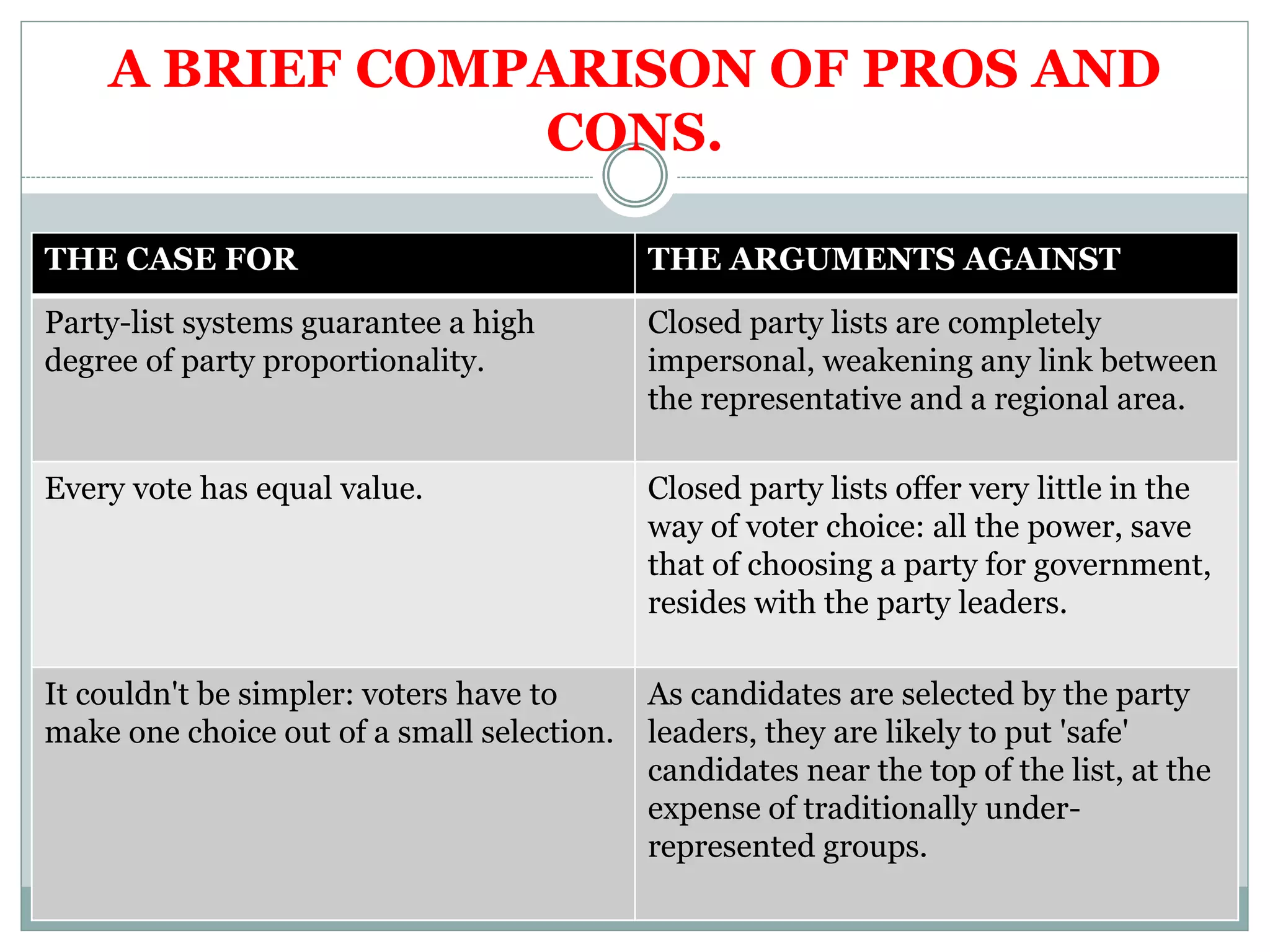
A BRIEF COMPARISON OF PROS AND
CONS.
THE CASE FOR THE ARGUMENTS AGAINST
Party-list systems guarantee a high
degree of party proportionality.
Closed party lists are completely
impersonal, weakening any link between
the representative and a regional area.
Every vote has equal value. Closed party lists offer very little in the
way of voter choice: all the power, save
that of choosing a party for government,
resides with the party leaders.
It couldn't be simpler: voters have to
make one choice out of a small selection.
As candidates are selected by the party
leaders, they are likely to put 'safe'
candidates near the top of the list, at the
expense of traditionally under-
represented groups.
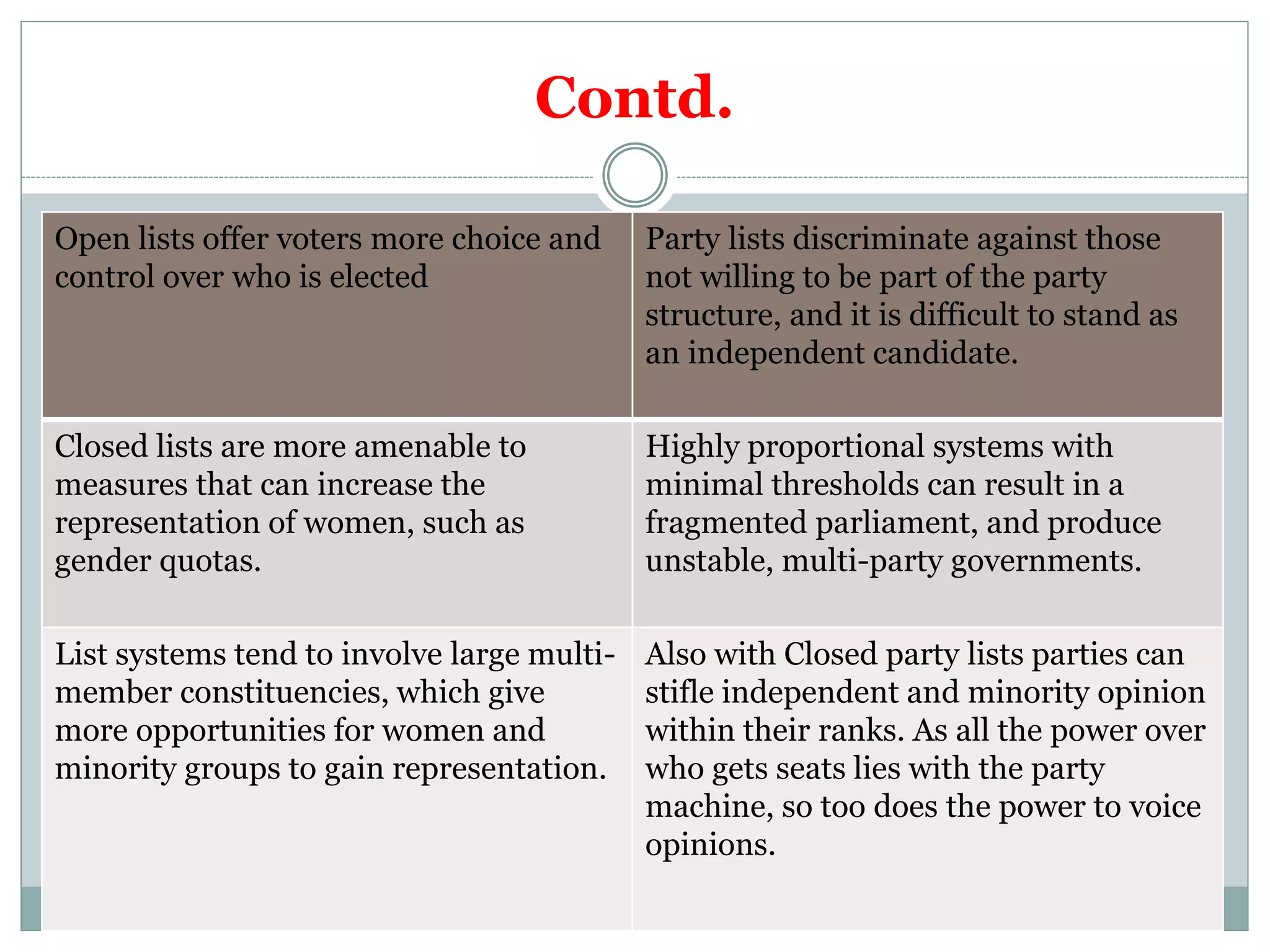
Contd.
Open lists offer voters more choice and
control over who is elected
Party lists discriminate against those
not willing to be part of the party
structure, and it is difficult to stand as
an independent candidate.
Closed lists are more amenable to
measures that can increase the
representation of women, such as
gender quotas.
Highly proportional systems with
minimal thresholds can result in a
fragmented parliament, and produce
unstable, multi-party governments.
List systems tend to involve large multi-
member constituencies, which give
more opportunities for women and
minority groups to gain representation.
Also with Closed party lists parties can
stifle independent and minority opinion
within their ranks. As all the power over
who gets seats lies with the party
machine, so too does the power to voice
opinions.
CONCLUSION
 The list system is exceedingly simple, since the voter need
only select the party he likes and by selecting it the he votes
for the entire list of candidates of the party he likes and by
selecting it he votes for he entire list of candidates of the party
he has selected. But all this amounts to undue importance of
the party leaders. The electorate has nothing to choose and
decide. The strict List system has, accordingly, been subjected
by great deal of criticisms. Recently some modifications have
been offered to it and in thus, making a departure from the
“bound list”. This system is also known as “free list”. Such a
system has recently been adopted in Italy and in certain parts
of Australia. Switzerland had previously given considerable
freedom to its voters, permitting them to substitute the names
on the lists. The Swiss system is another variant of the List
System. It allows the voter to write on the list of candidates an
additional name of its own choice.
THANKYOU

List system

  • 1.
  • 2.
    CONTENTS  MEANING  TYPES MERITS AND DEMERITS (a brief comparison)  CONCLUSION
  • 3.
    MEANING (PR)  Proportionalrepresentation is an electoral system that seeks to create a representative body that reflects the overall distribution of public support for each political party. Where majority or plurality systems effectively reward strong parties and penalize weak ones by providing the representation of a whole constituency to a single candidate who may have received fewer than half of the votes cast (as is the case, for example, in the United States), proportional representation ensures minority groups a measure of representation proportionate to their electoral support. Systems of proportional representation have been adopted in many countries, including Belgium, Denmark, Finland, Greece, Hungary, Israel, Italy, Luxembourg, Norway, Russia, Spain, Sweden, and Switzerland.
  • 4.
    MEANING (PARTY –LIST SYSTEM)  Party – list system is an another variant of Proportional Representation.  Under the party-list system, the elector votes not for a single candidate but for a list of candidates. Each list generally is submitted by a different party, though an individual can put forward his own list. District magnitude (i.e., the number of members per district) varies from country to country; for example, the Netherlands uses a single national district to elect the 150 members of its Tweede Kamer (Second Chamber), and Chile elects members of its legislature by using two-seat constituencies. The overall proportionality of the system is dependent upon the district magnitude, with higher district magnitudes associated with more proportional results. Each party gets a share of the seats proportional to its share of the votes.
  • 5.
     There arevarious alternative rules for achieving this; the two principal ones are the largest-remainder rule and the highest- average rule (the latter referred to as the d’Hondt rule, named after Belgian Victor d’Hondt). Under the largest-remainder rule a quota is set, and each party is assigned one seat for each time it meets the quota. These votes are deducted from each party’s total, and when no party has enough votes remaining to meet the quota, the remaining seats are assigned on the basis of whatever votes are left. Under the highest-average rule, seats are assigned one at a time to the party with the highest total. After each seat is assigned, the winning party’s total is adjusted: the original vote total is divided by the number of seats it has won plus one. Although there are variations, the seats that a party wins generally are assigned to its candidates in the order in which they are named in the list.
  • 6.
    TYPES  There aretwo different types of Party List PR, Closed List and Open List.  In both cases parties present lists of candidates and seats are awarded according to their party’s share of the vote. This is usually done using an electoral formula or a quota which prevents too many small parties from winning seats.  Open List: Voters choose individual candidates from the list provided by each party. The number of seats a party gets is determined by how many votes the party's candidates receive, the seats are filled by the candidates in order of popularity.  Closed List: Voters vote for the party and therefore the list as a whole. Candidates are elected in the order they appear on the list (as decided by the party) until all the seats have been filled.  Semi-open lists: This gives voters some influence over who is elected, but most of the candidates will be elected in list order.
  • 7.
    A BRIEF COMPARISONOF PROS AND CONS. THE CASE FOR THE ARGUMENTS AGAINST Party-list systems guarantee a high degree of party proportionality. Closed party lists are completely impersonal, weakening any link between the representative and a regional area. Every vote has equal value. Closed party lists offer very little in the way of voter choice: all the power, save that of choosing a party for government, resides with the party leaders. It couldn't be simpler: voters have to make one choice out of a small selection. As candidates are selected by the party leaders, they are likely to put 'safe' candidates near the top of the list, at the expense of traditionally under- represented groups.
  • 8.
    Contd. Open lists offervoters more choice and control over who is elected Party lists discriminate against those not willing to be part of the party structure, and it is difficult to stand as an independent candidate. Closed lists are more amenable to measures that can increase the representation of women, such as gender quotas. Highly proportional systems with minimal thresholds can result in a fragmented parliament, and produce unstable, multi-party governments. List systems tend to involve large multi- member constituencies, which give more opportunities for women and minority groups to gain representation. Also with Closed party lists parties can stifle independent and minority opinion within their ranks. As all the power over who gets seats lies with the party machine, so too does the power to voice opinions.
  • 9.
    CONCLUSION  The listsystem is exceedingly simple, since the voter need only select the party he likes and by selecting it the he votes for the entire list of candidates of the party he likes and by selecting it he votes for he entire list of candidates of the party he has selected. But all this amounts to undue importance of the party leaders. The electorate has nothing to choose and decide. The strict List system has, accordingly, been subjected by great deal of criticisms. Recently some modifications have been offered to it and in thus, making a departure from the “bound list”. This system is also known as “free list”. Such a system has recently been adopted in Italy and in certain parts of Australia. Switzerland had previously given considerable freedom to its voters, permitting them to substitute the names on the lists. The Swiss system is another variant of the List System. It allows the voter to write on the list of candidates an additional name of its own choice.
  • 10.