Cultural Linked Open Data
2014-02-06
Lars Marius Garshol, larsga@bouvet.no, http://twitter.com/larsga
1
The importance of data
• Most web sites are data-driven
– if you have the data, you can add functionality
– if you don’t have the data, you’re stuck

• Example: Google Maps
– imagine you have the application, the server
farm, the scaling and monitoring, etc
– but you don’t have the actual map data
– not only are you stuck, but creating the data is
much harder than making the service

2
3
4

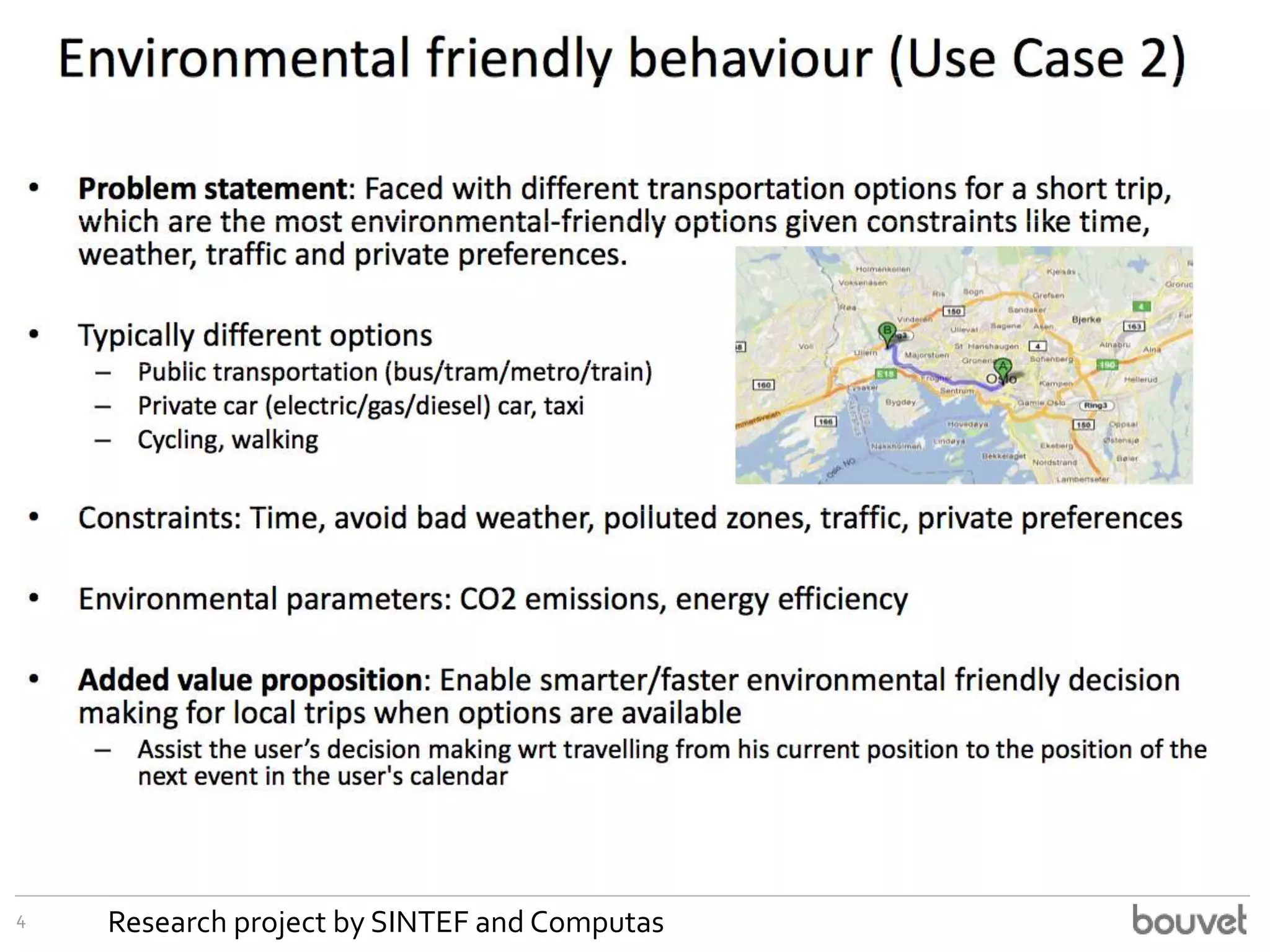
Research project by SINTEF and Computas
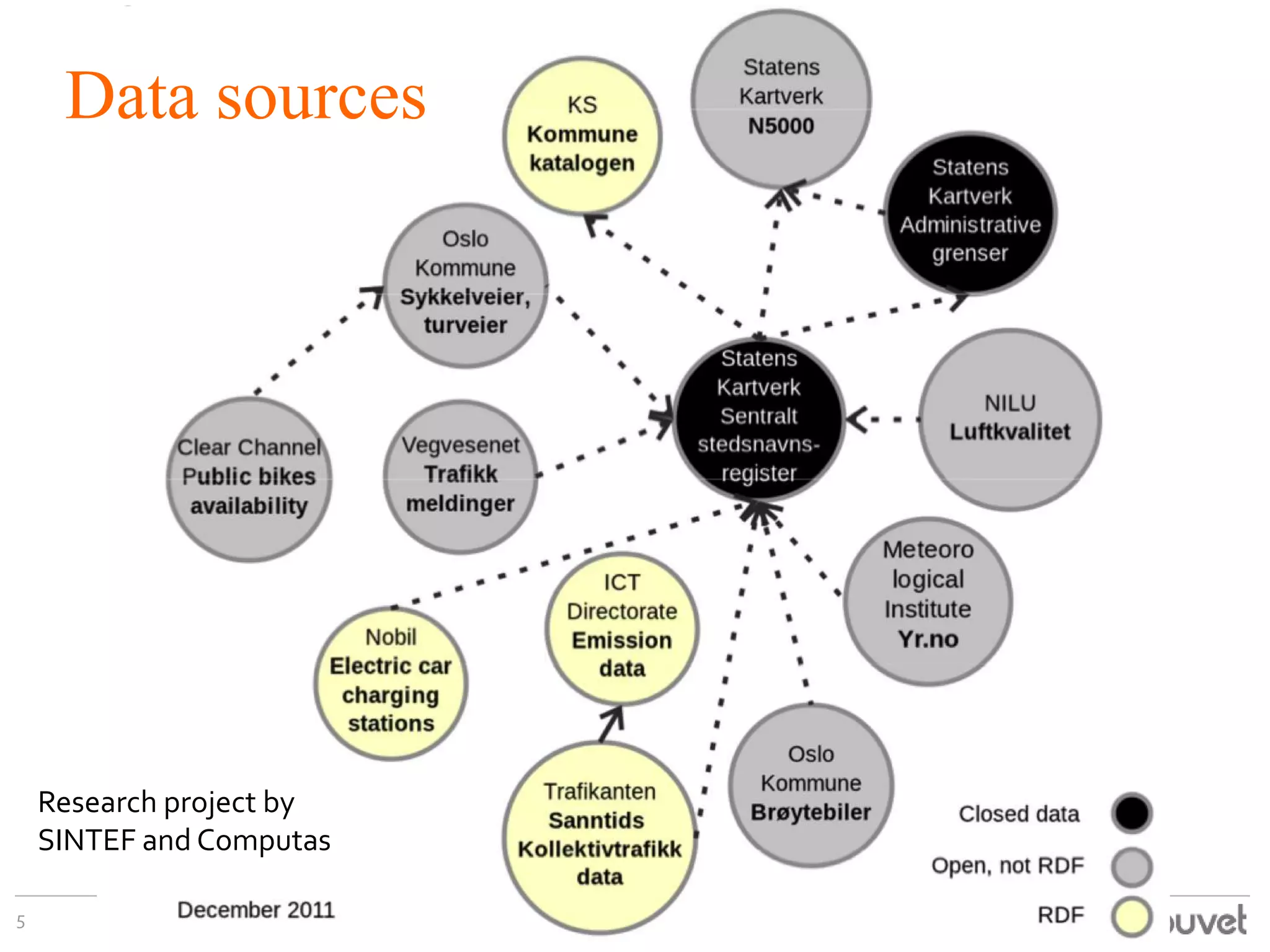
Data sources

Research project by
SINTEF and Computas
5
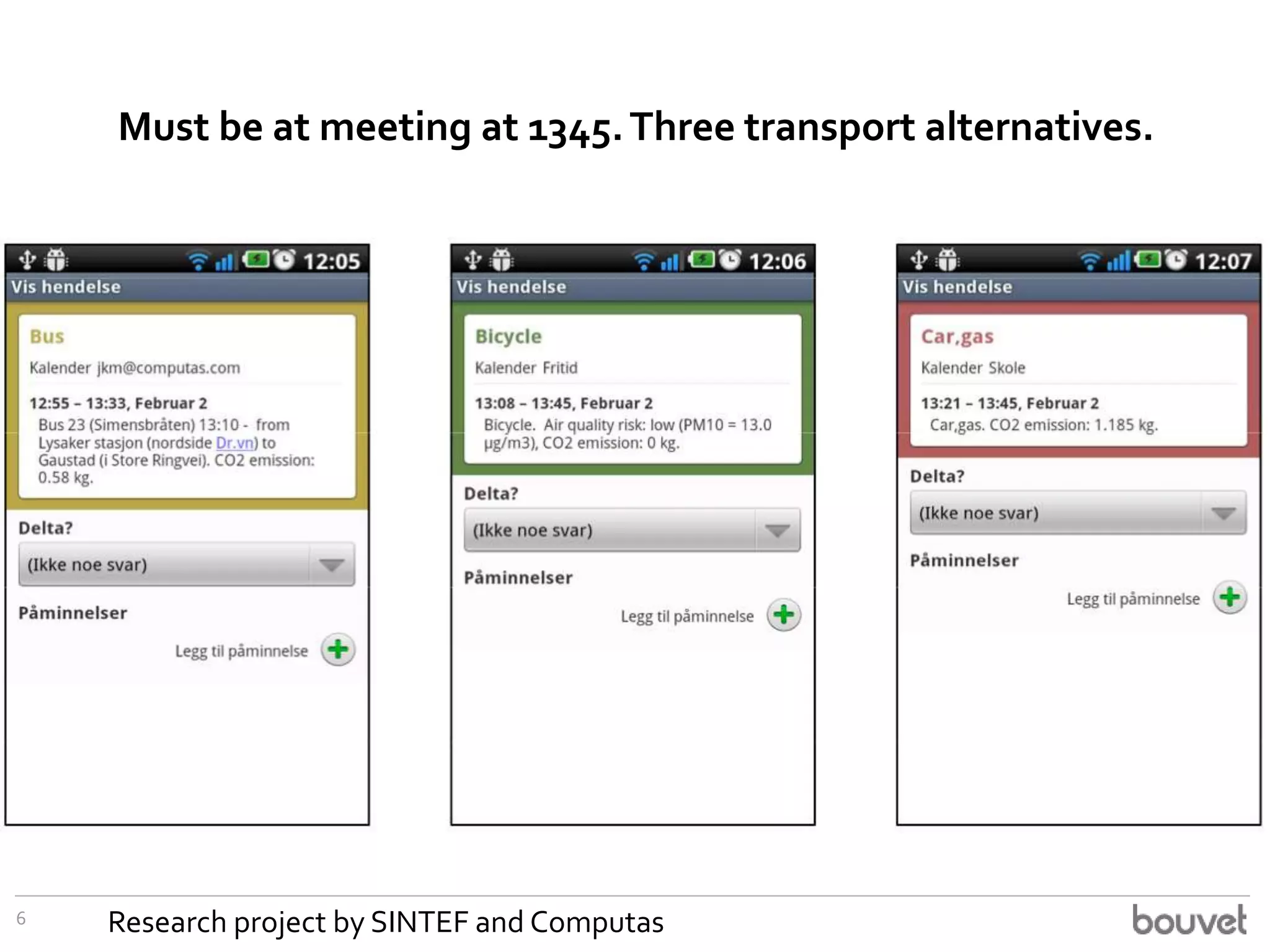
Must be at meeting at 1345. Three transport alternatives.

6

Research project by SINTEF and Computas
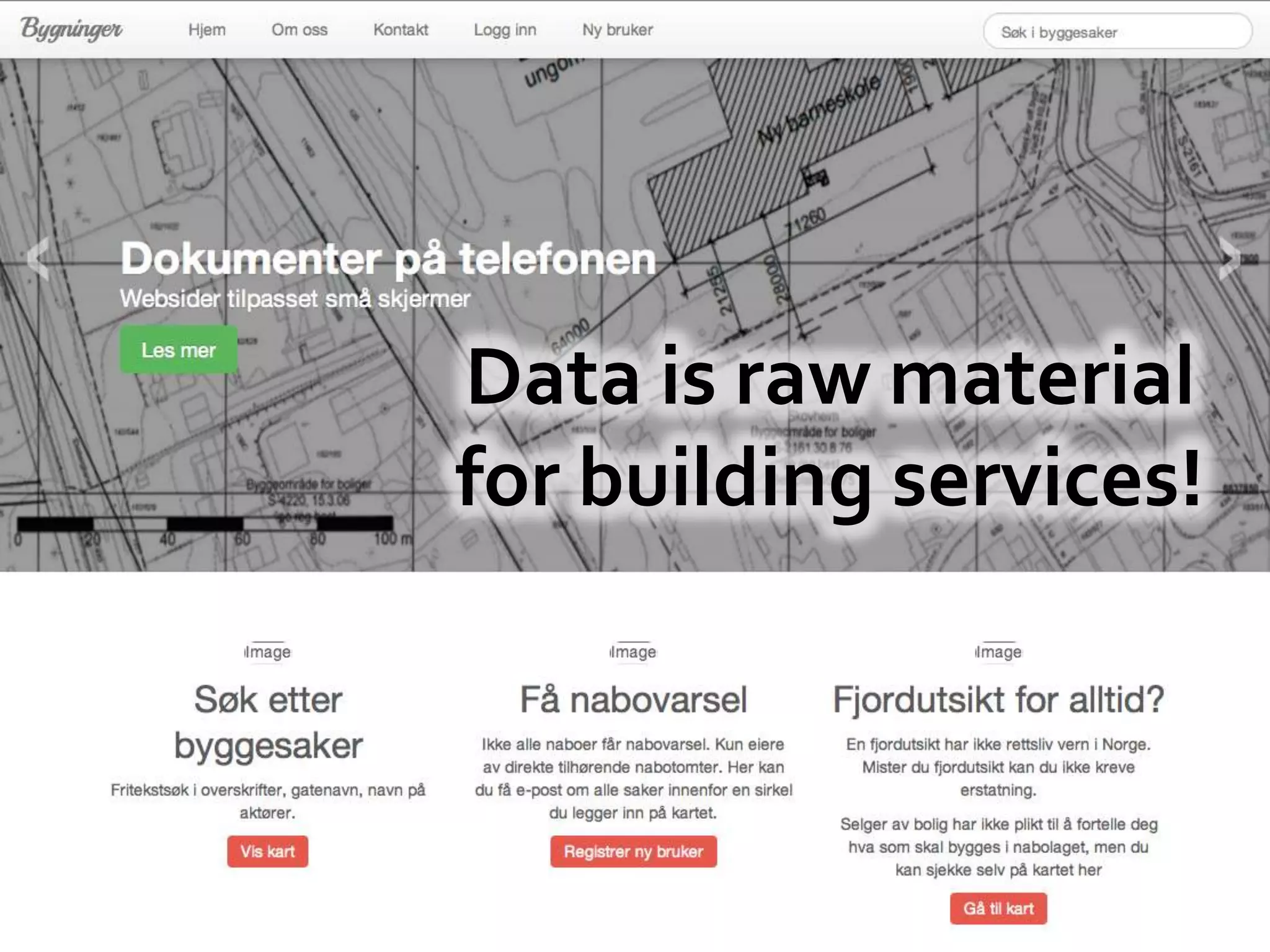
Data is raw material
for building services!

7
Possible users of cultural data
• Any kind of web store
– publishers
– streaming services
– ...

• Travel businesses

– public sector, hotels, tour organizers, event
organizers, ...

• Media

– newspapers, broadcasting, ...

• Lots of public sector uses
– education, ...

• Many things none of us can’t imagine now
8
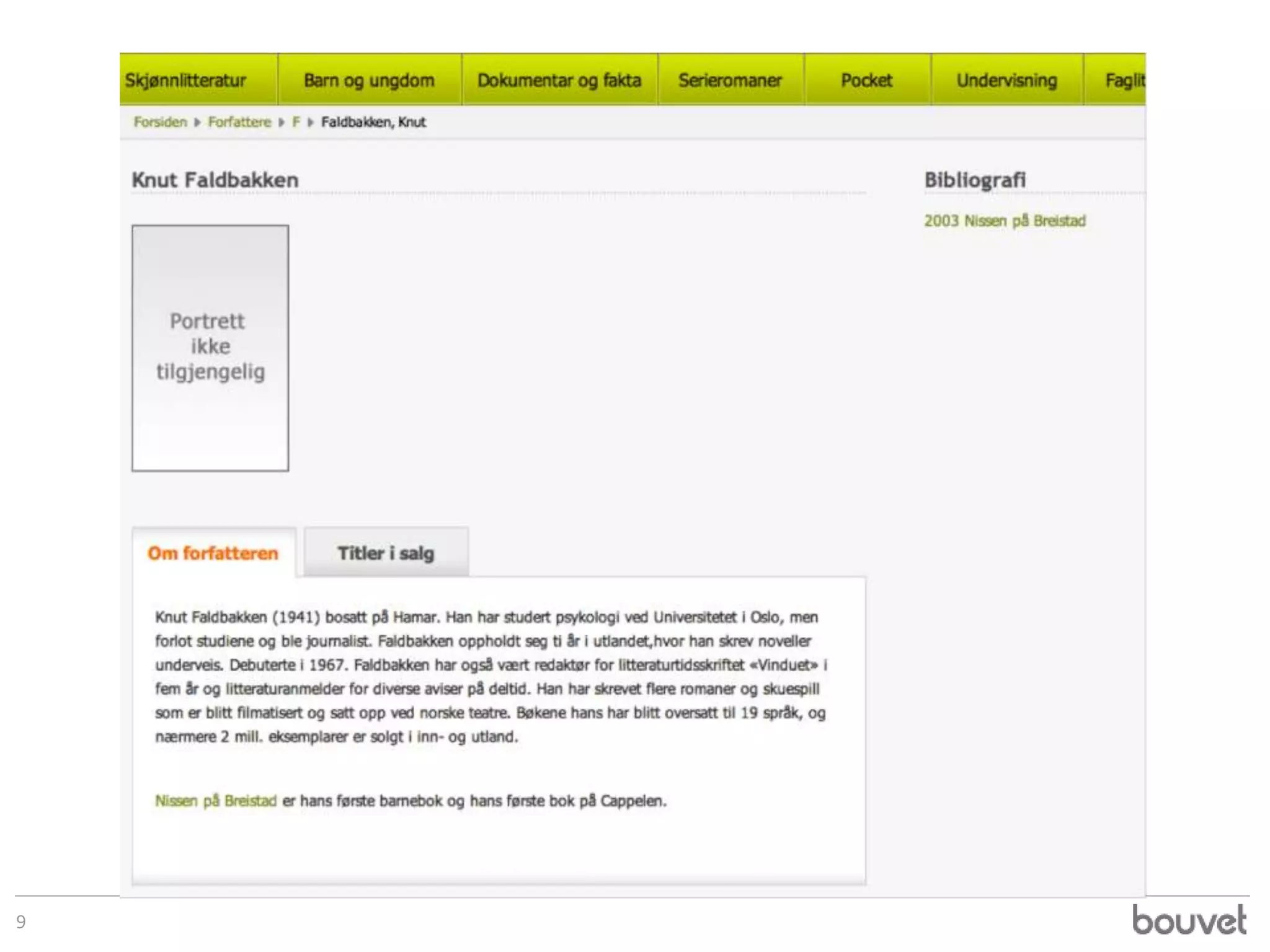
9
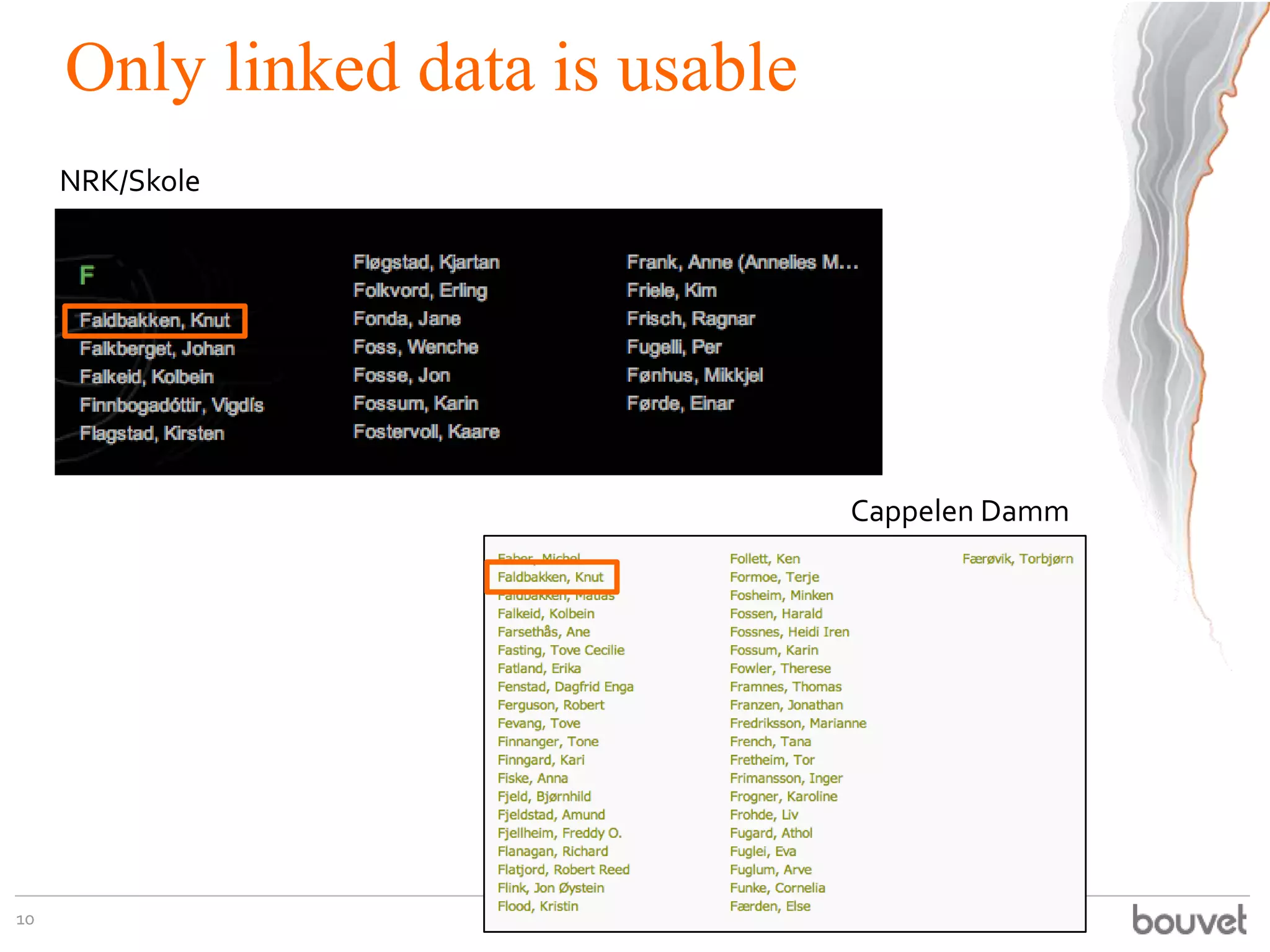
Only linked data is usable
NRK/Skole

Cappelen Damm

10
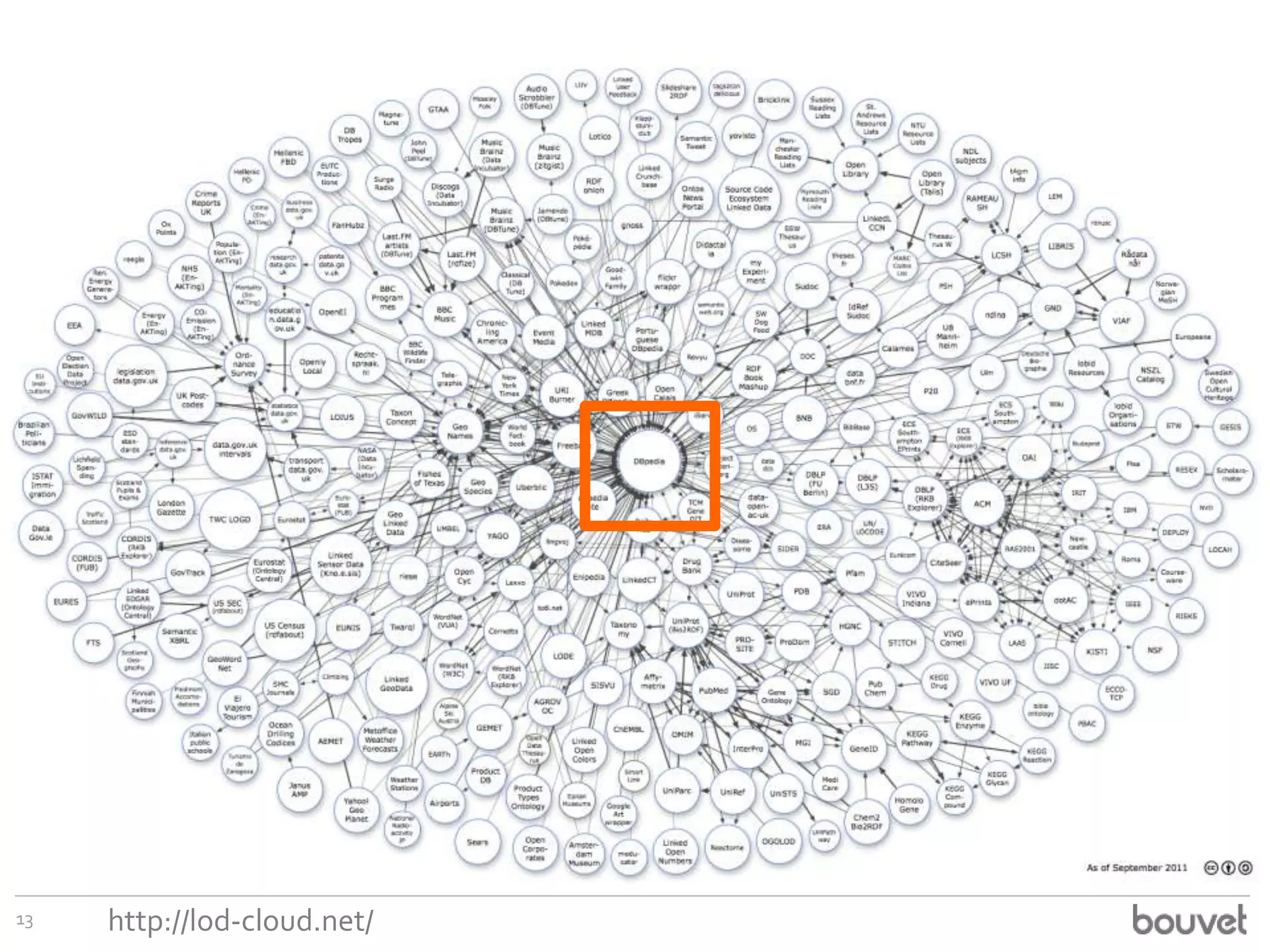
Linked Open Data
• Movement to publish open data online
– in machine-readable form
– linked to other data sets

• Based on some key technologies
– URLs for identifiers
– RDF for data

• Gaining a lot of traction in the cultural sector
–
–
–
–

11

BBC
Europeana
Smithsonian Institution
...
The technology
• Provides simple data representation
–
–
–
–

graph model (RDF)
has ready-made formats (XML, text, JSON, ...)
standard query language (SPARQL)
lots of RDF databases available

• Allows anyone to refer to anything

– a museum can say explicitly that one object in
their collection has a specific relation to an object
in another collection
– liberation from the ID scheme confusion

• Can reuse terminology from other
authorities
– can also easily extend that terminology

12
13

http://lod-cloud.net/
14
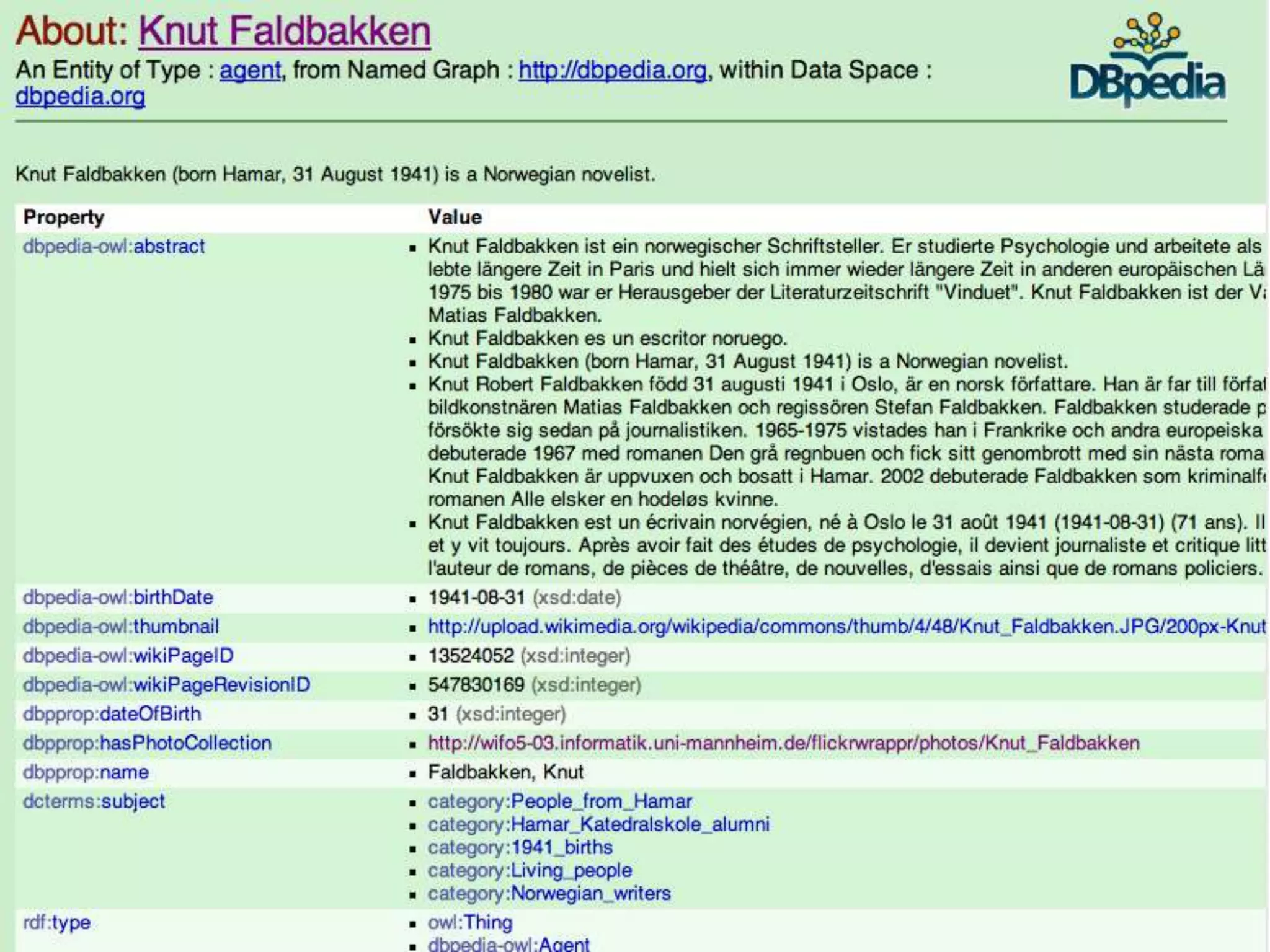
http://dbpedia.org/resource/Knut_Faldbakken
• Globally unique
– across all systems and organizations

• Distributed
– if you have a domain, you can make URIs

• Self-documenting
– just follow the link to find documentation

• Can be used anywhere
– anyone can point at anything
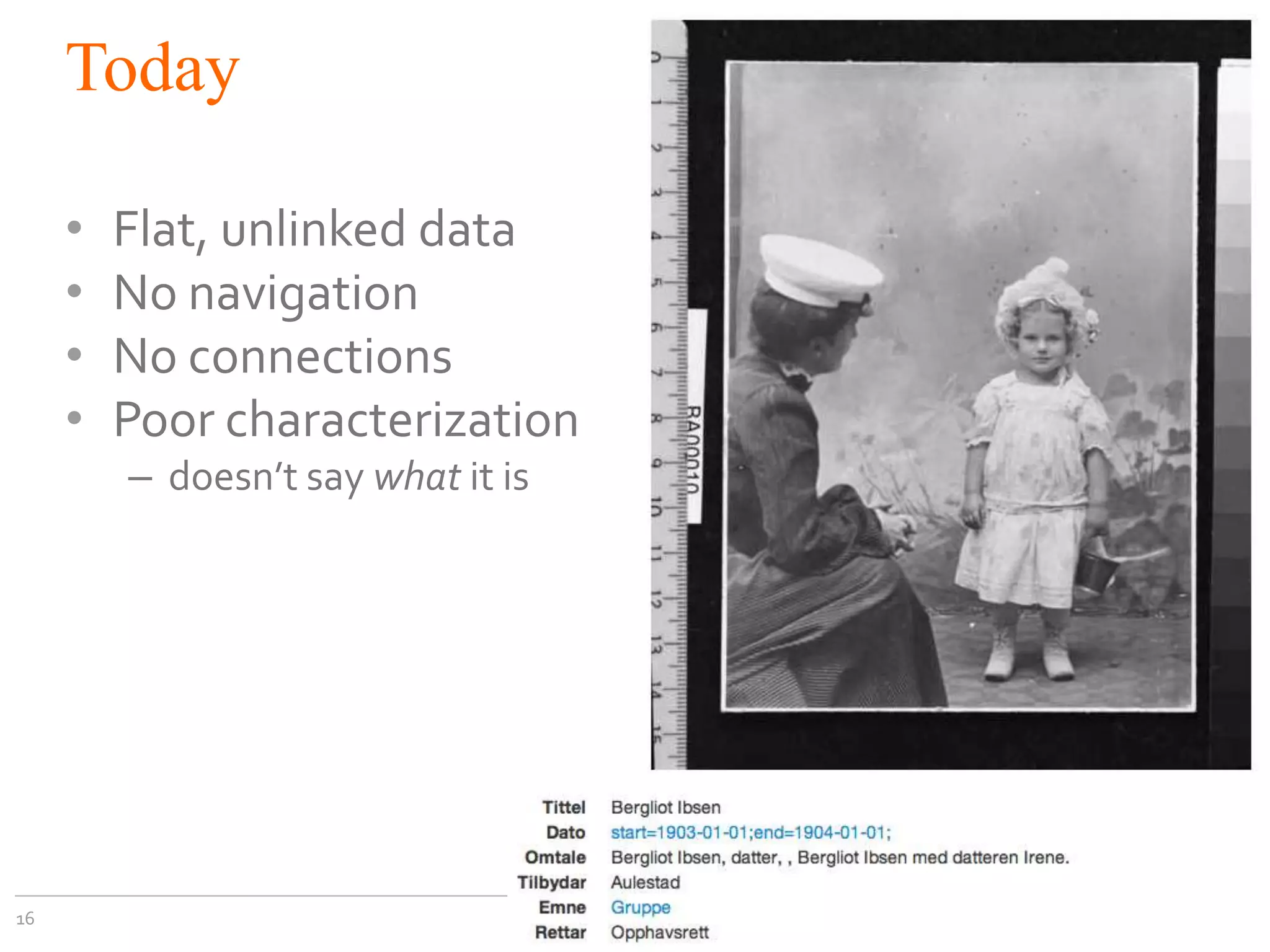
Today
•
•
•
•

Flat, unlinked data
No navigation
No connections
Poor characterization
– doesn’t say what it is

16
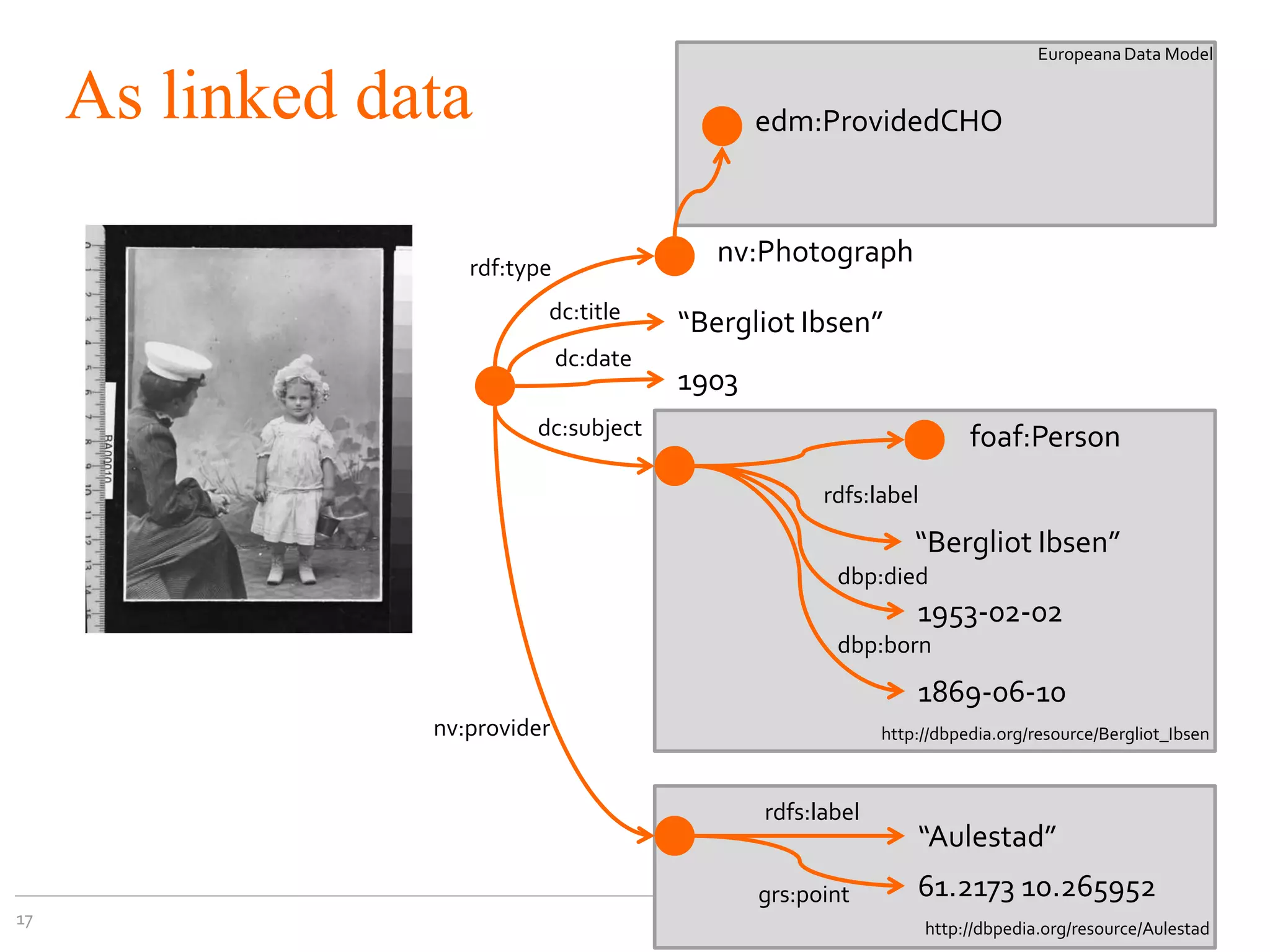
Europeana Data Model

As linked data

edm:ProvidedCHO

nv:Photograph

rdf:type
dc:title
dc:date

“Bergliot Ibsen”
1903

dc:subject

foaf:Person
rdfs:label

“Bergliot Ibsen”
dbp:died

1953-02-02
dbp:born

1869-06-10
nv:provider

http://dbpedia.org/resource/Bergliot_Ibsen

rdfs:label
grs:point
17

“Aulestad”
61.2173 10.265952
http://dbpedia.org/resource/Aulestad
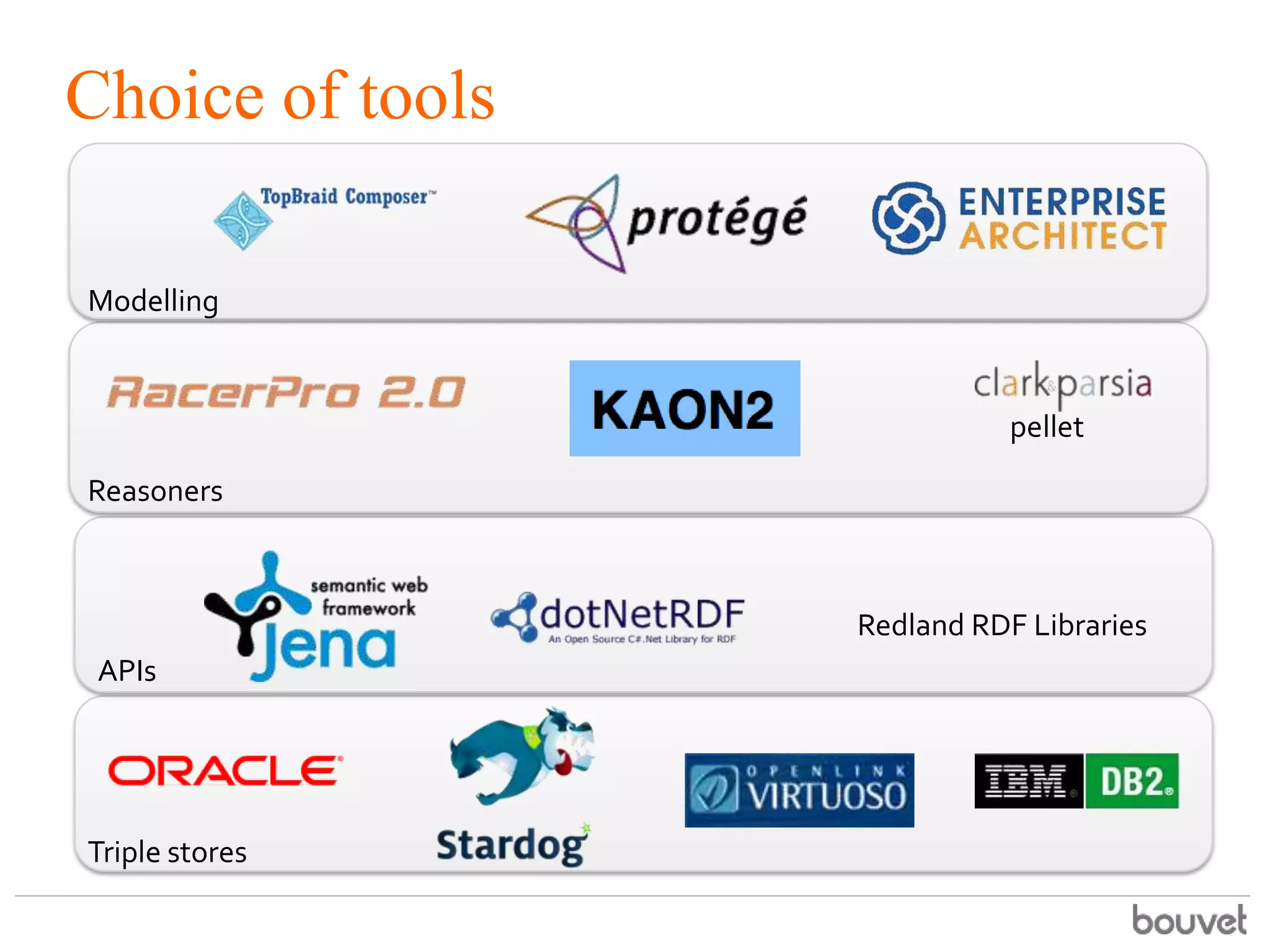
Choice of tools
Modelling

pellet

Reasoners

Redland RDF Libraries
APIs

Triple stores
Great, but how can we actually
link the data?

19
20
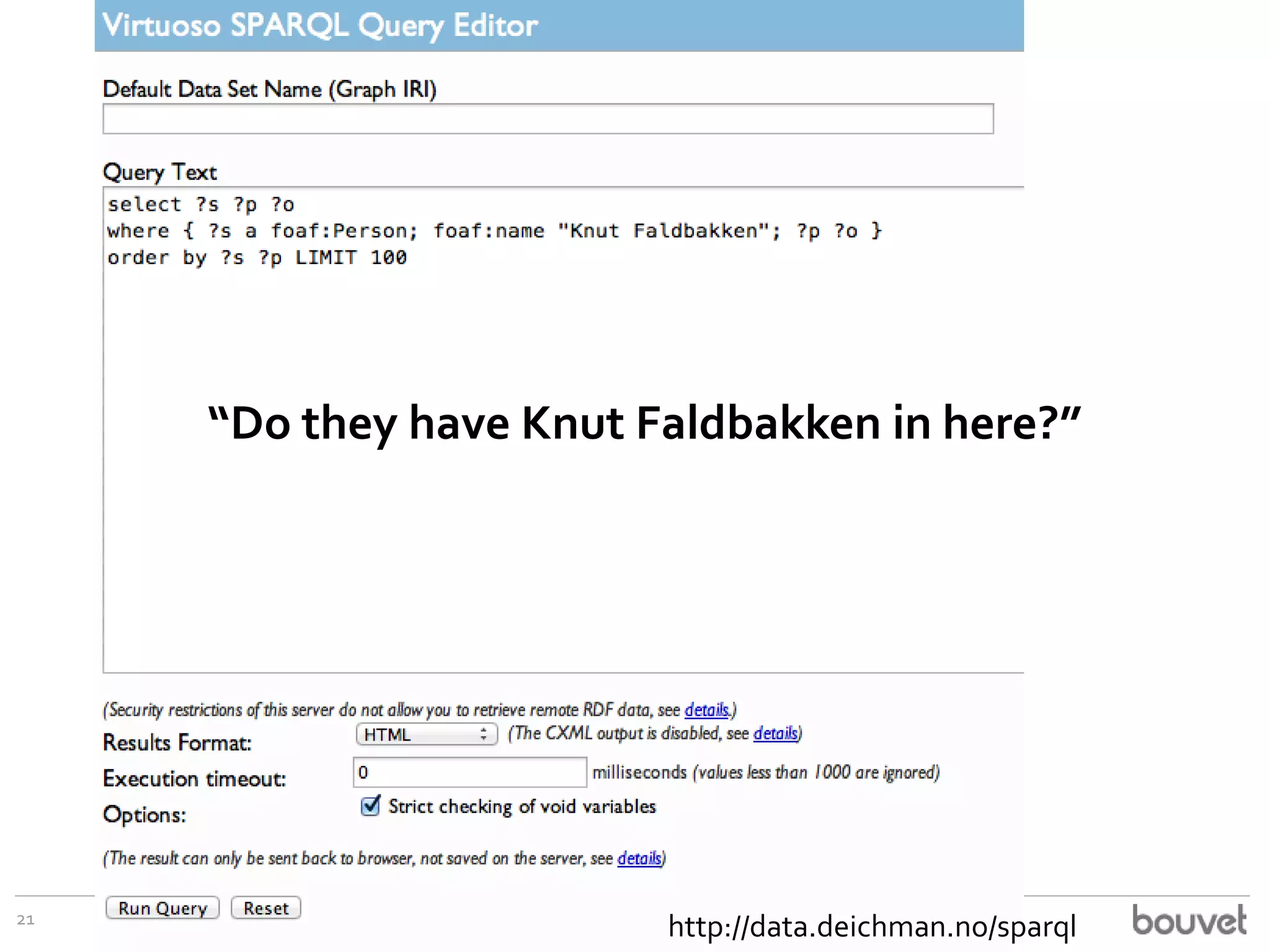
“Do they have Knut Faldbakken in here?”

21

http://data.deichman.no/sparql
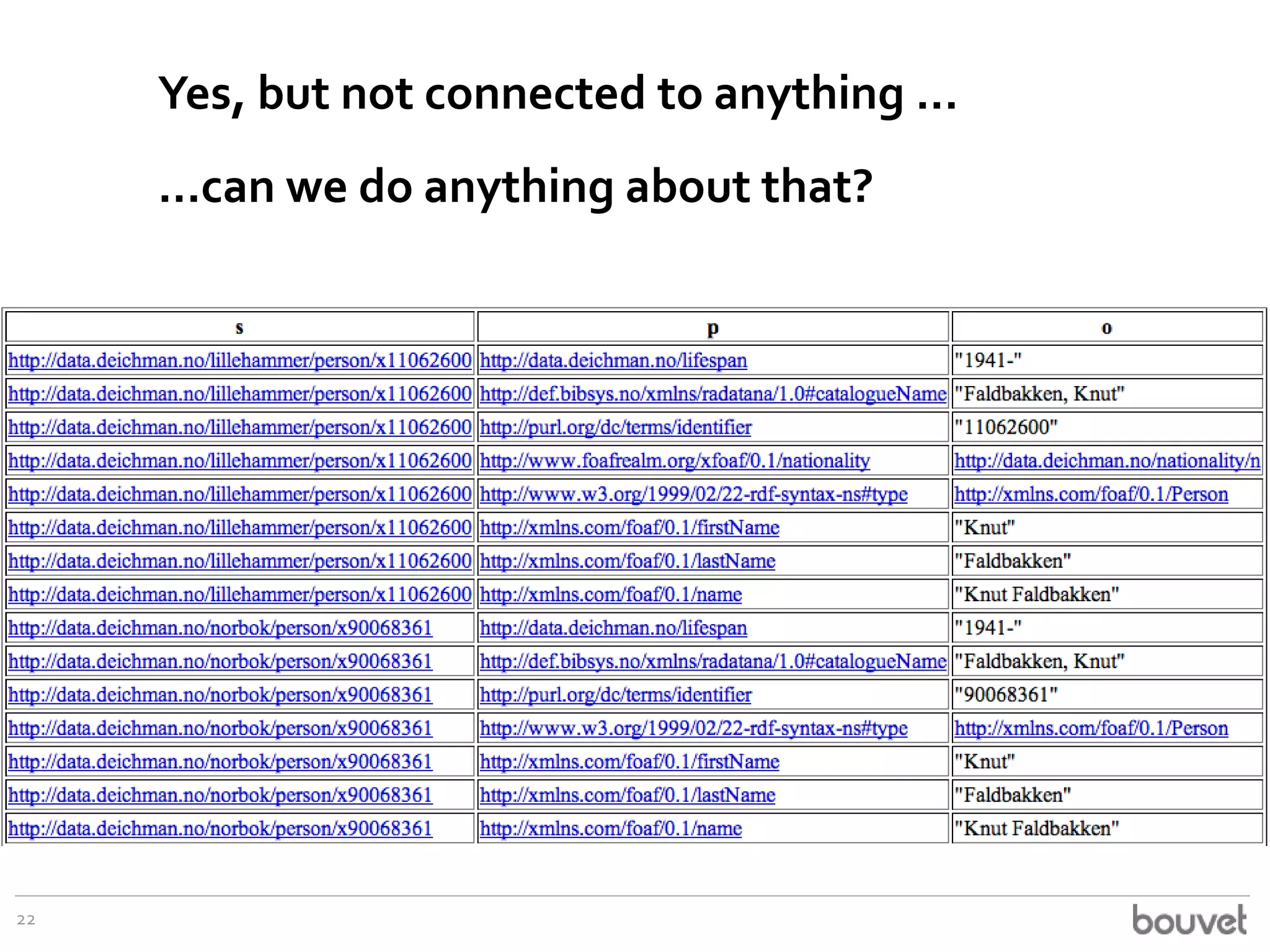
Yes, but not connected to anything ...

...can we do anything about that?

22
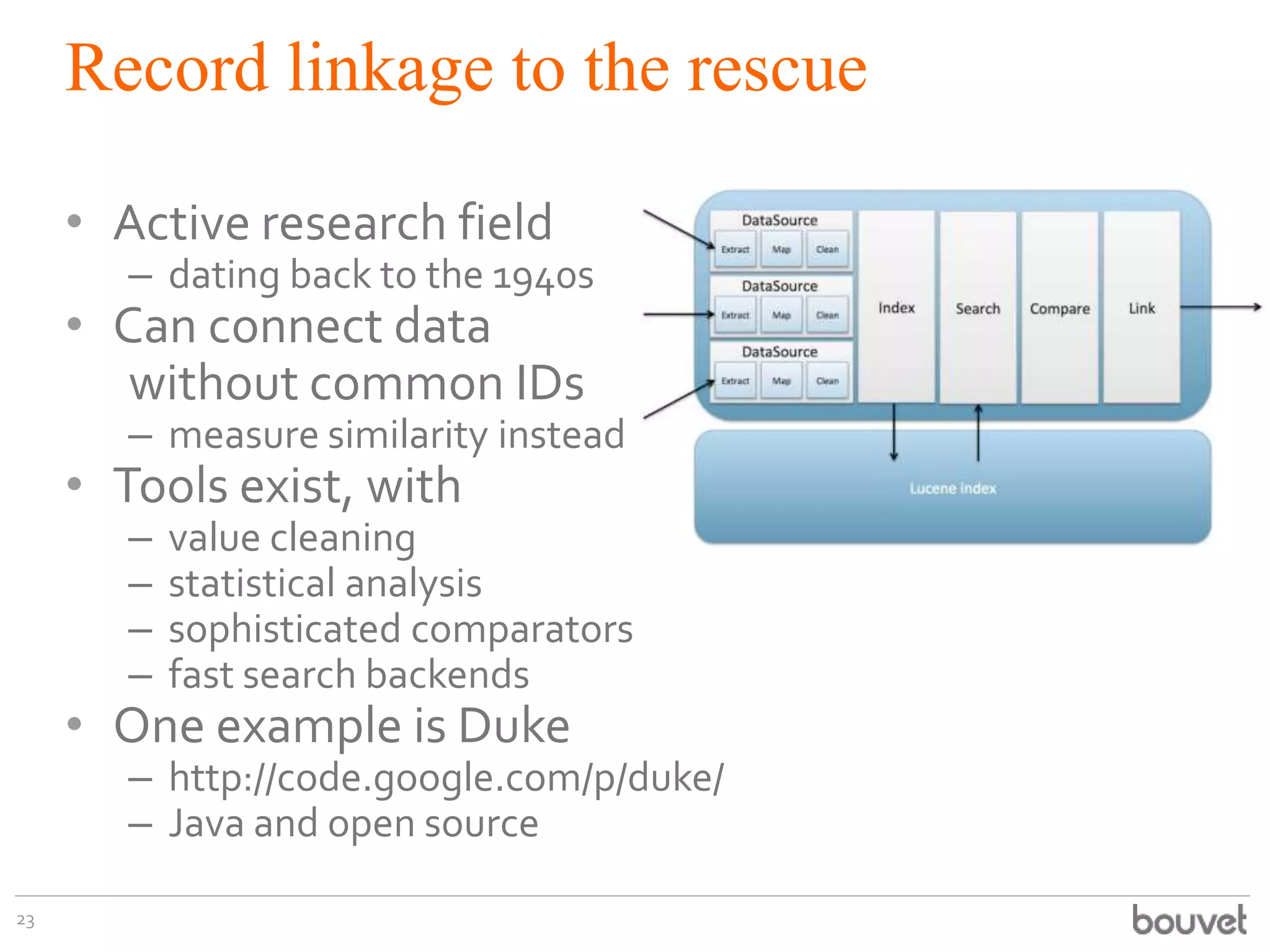
Record linkage to the rescue
• Active research field

– dating back to the 1940s

• Can connect data
without common IDs

– measure similarity instead

• Tools exist, with
–
–
–
–

value cleaning
statistical analysis
sophisticated comparators
fast search backends

• One example is Duke

– http://code.google.com/p/duke/
– Java and open source

23
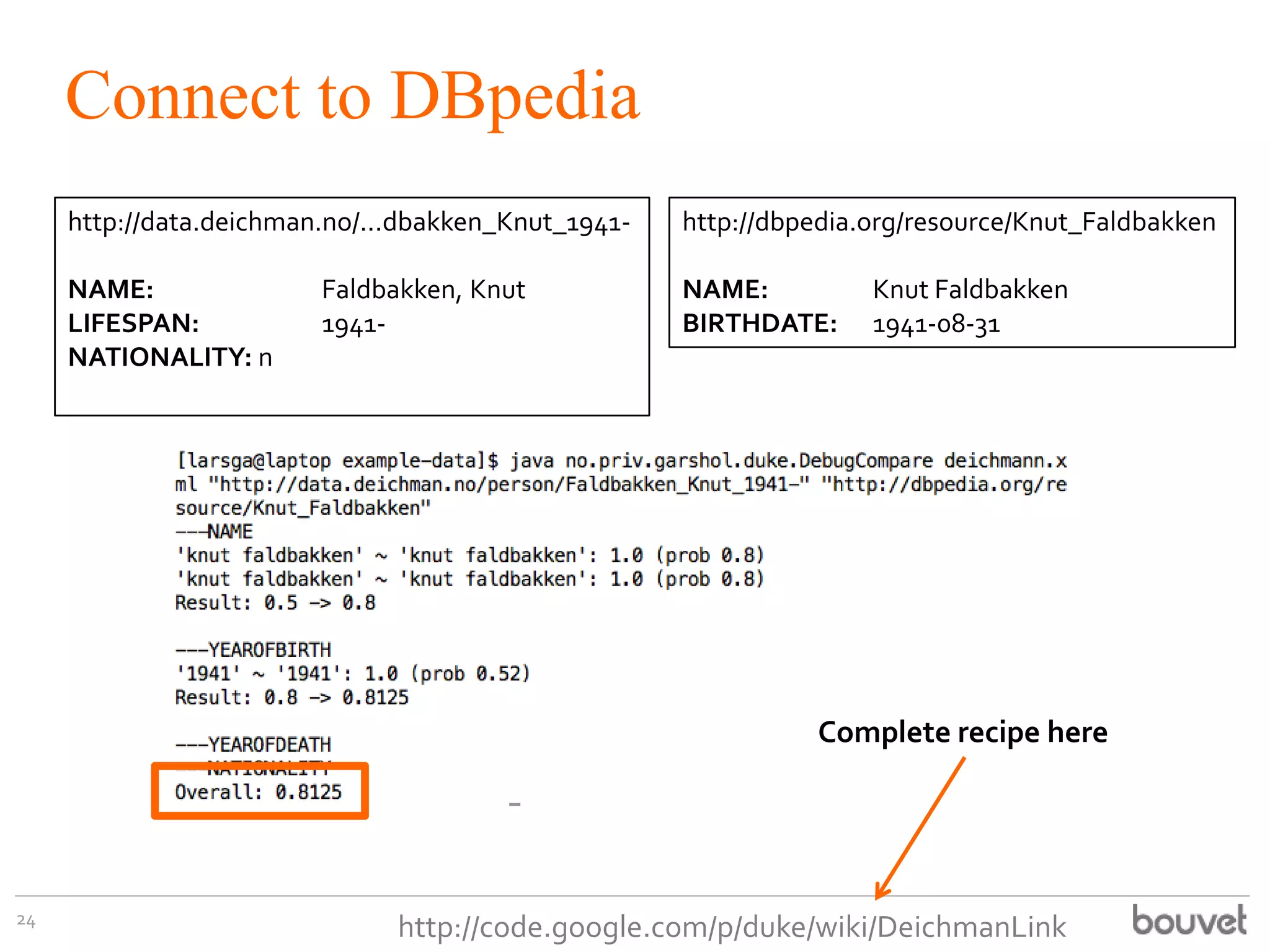
Connect to DBpedia
http://data.deichman.no/...dbakken_Knut_1941-

http://dbpedia.org/resource/Knut_Faldbakken

NAME:
LIFESPAN:
NATIONALITY: n

NAME:
BIRTHDATE:

Faldbakken, Knut
1941-

Knut Faldbakken
1941-08-31

Complete recipe here

24

http://code.google.com/p/duke/wiki/DeichmanLink
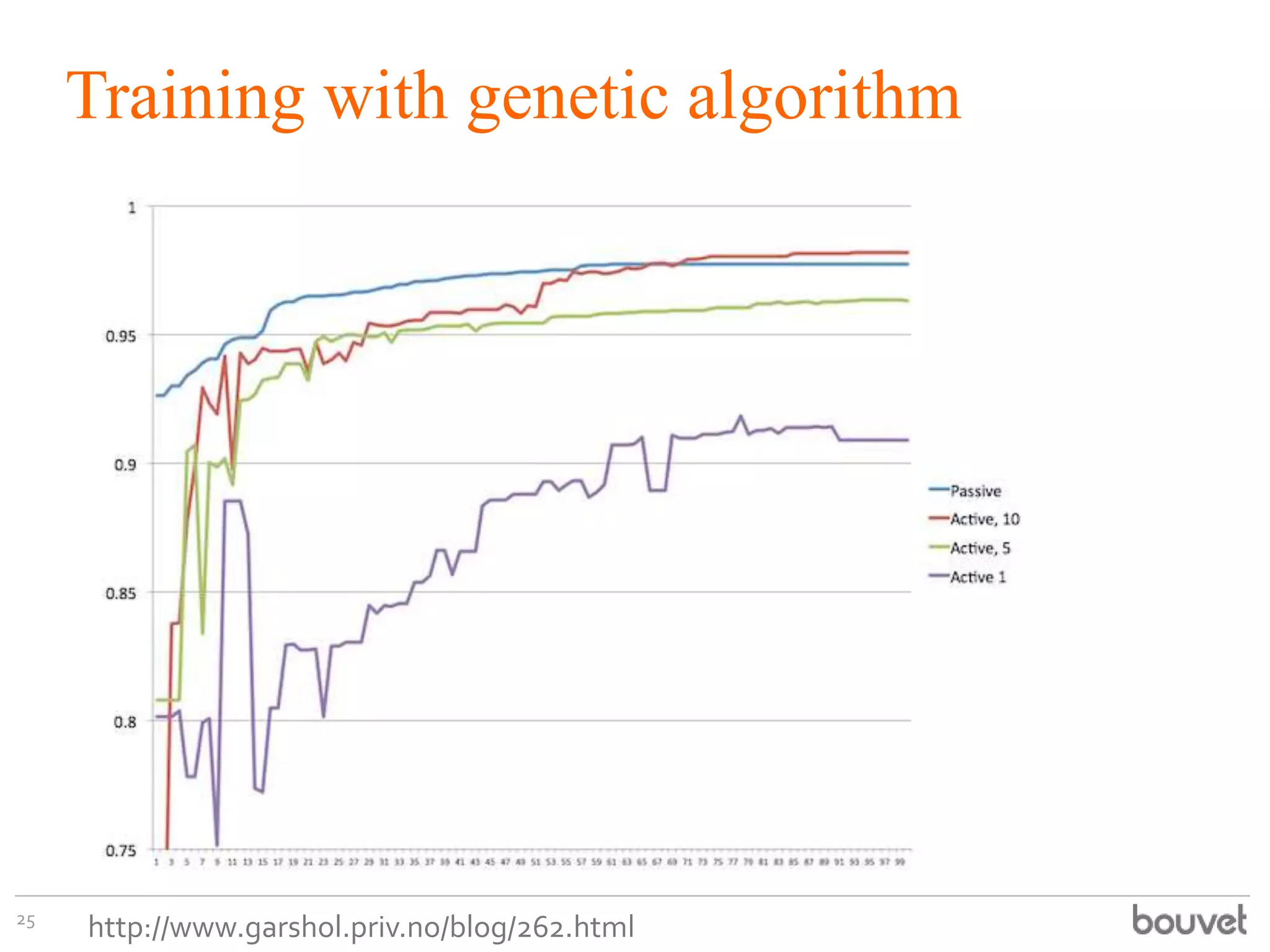
Training with genetic algorithm

25

http://www.garshol.priv.no/blog/262.html
Conclusion
• Linked Open Data has tremendous
potential
– vastly easier reuse of data
– hugely empowering for consumers
– also opens new possibilities for data owners

• Growing use in cultural sector
– both internationally and in Norway

• To learn more
– http://www.slideshare.net/larsga/linked-opendata-14964163
– http://data.norge.no/veiledning
– http://linkeddatabook.com/editions/1.0/
26
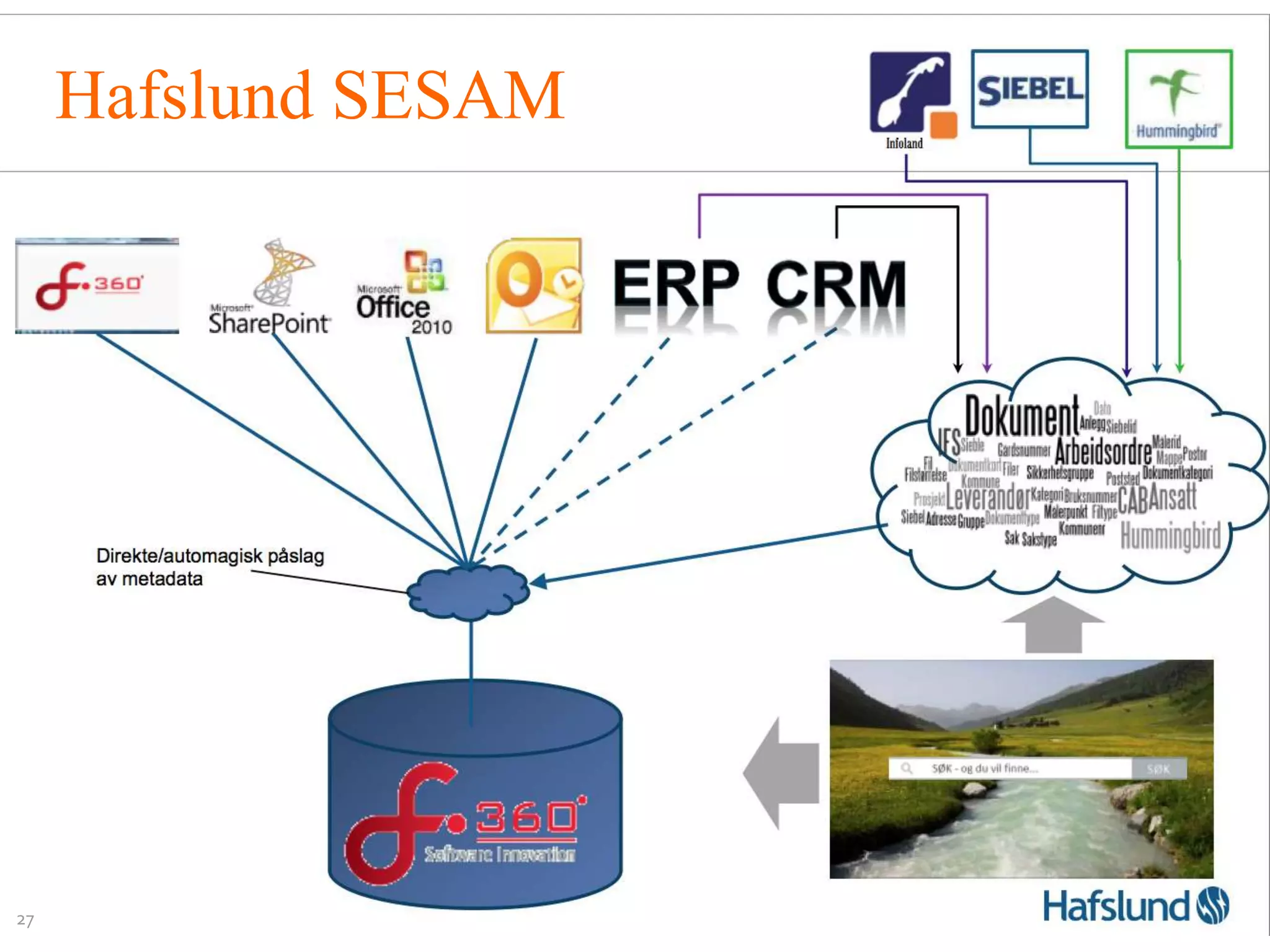
Hafslund SESAM

27

Linked Open Data for the Cultural Sector

  • 1.
    Cultural Linked OpenData 2014-02-06 Lars Marius Garshol, larsga@bouvet.no, http://twitter.com/larsga 1
  • 2.
    The importance ofdata • Most web sites are data-driven – if you have the data, you can add functionality – if you don’t have the data, you’re stuck • Example: Google Maps – imagine you have the application, the server farm, the scaling and monitoring, etc – but you don’t have the actual map data – not only are you stuck, but creating the data is much harder than making the service 2
  • 3.
  • 4.
    4 Research project bySINTEF and Computas
  • 5.
    Data sources Research projectby SINTEF and Computas 5
  • 6.
    Must be atmeeting at 1345. Three transport alternatives. 6 Research project by SINTEF and Computas
  • 7.
    Data is rawmaterial for building services! 7
  • 8.
    Possible users ofcultural data • Any kind of web store – publishers – streaming services – ... • Travel businesses – public sector, hotels, tour organizers, event organizers, ... • Media – newspapers, broadcasting, ... • Lots of public sector uses – education, ... • Many things none of us can’t imagine now 8
  • 9.
  • 10.
    Only linked datais usable NRK/Skole Cappelen Damm 10
  • 11.
    Linked Open Data •Movement to publish open data online – in machine-readable form – linked to other data sets • Based on some key technologies – URLs for identifiers – RDF for data • Gaining a lot of traction in the cultural sector – – – – 11 BBC Europeana Smithsonian Institution ...
  • 12.
    The technology • Providessimple data representation – – – – graph model (RDF) has ready-made formats (XML, text, JSON, ...) standard query language (SPARQL) lots of RDF databases available • Allows anyone to refer to anything – a museum can say explicitly that one object in their collection has a specific relation to an object in another collection – liberation from the ID scheme confusion • Can reuse terminology from other authorities – can also easily extend that terminology 12
  • 13.
  • 14.
  • 15.
    http://dbpedia.org/resource/Knut_Faldbakken • Globally unique –across all systems and organizations • Distributed – if you have a domain, you can make URIs • Self-documenting – just follow the link to find documentation • Can be used anywhere – anyone can point at anything
  • 16.
    Today • • • • Flat, unlinked data Nonavigation No connections Poor characterization – doesn’t say what it is 16
  • 17.
    Europeana Data Model Aslinked data edm:ProvidedCHO nv:Photograph rdf:type dc:title dc:date “Bergliot Ibsen” 1903 dc:subject foaf:Person rdfs:label “Bergliot Ibsen” dbp:died 1953-02-02 dbp:born 1869-06-10 nv:provider http://dbpedia.org/resource/Bergliot_Ibsen rdfs:label grs:point 17 “Aulestad” 61.2173 10.265952 http://dbpedia.org/resource/Aulestad
  • 18.
  • 19.
    Great, but howcan we actually link the data? 19
  • 20.
  • 21.
    “Do they haveKnut Faldbakken in here?” 21 http://data.deichman.no/sparql
  • 22.
    Yes, but notconnected to anything ... ...can we do anything about that? 22
  • 23.
    Record linkage tothe rescue • Active research field – dating back to the 1940s • Can connect data without common IDs – measure similarity instead • Tools exist, with – – – – value cleaning statistical analysis sophisticated comparators fast search backends • One example is Duke – http://code.google.com/p/duke/ – Java and open source 23
  • 24.
    Connect to DBpedia http://data.deichman.no/...dbakken_Knut_1941- http://dbpedia.org/resource/Knut_Faldbakken NAME: LIFESPAN: NATIONALITY:n NAME: BIRTHDATE: Faldbakken, Knut 1941- Knut Faldbakken 1941-08-31 Complete recipe here 24 http://code.google.com/p/duke/wiki/DeichmanLink
  • 25.
    Training with geneticalgorithm 25 http://www.garshol.priv.no/blog/262.html
  • 26.
    Conclusion • Linked OpenData has tremendous potential – vastly easier reuse of data – hugely empowering for consumers – also opens new possibilities for data owners • Growing use in cultural sector – both internationally and in Norway • To learn more – http://www.slideshare.net/larsga/linked-opendata-14964163 – http://data.norge.no/veiledning – http://linkeddatabook.com/editions/1.0/ 26
  • 27.