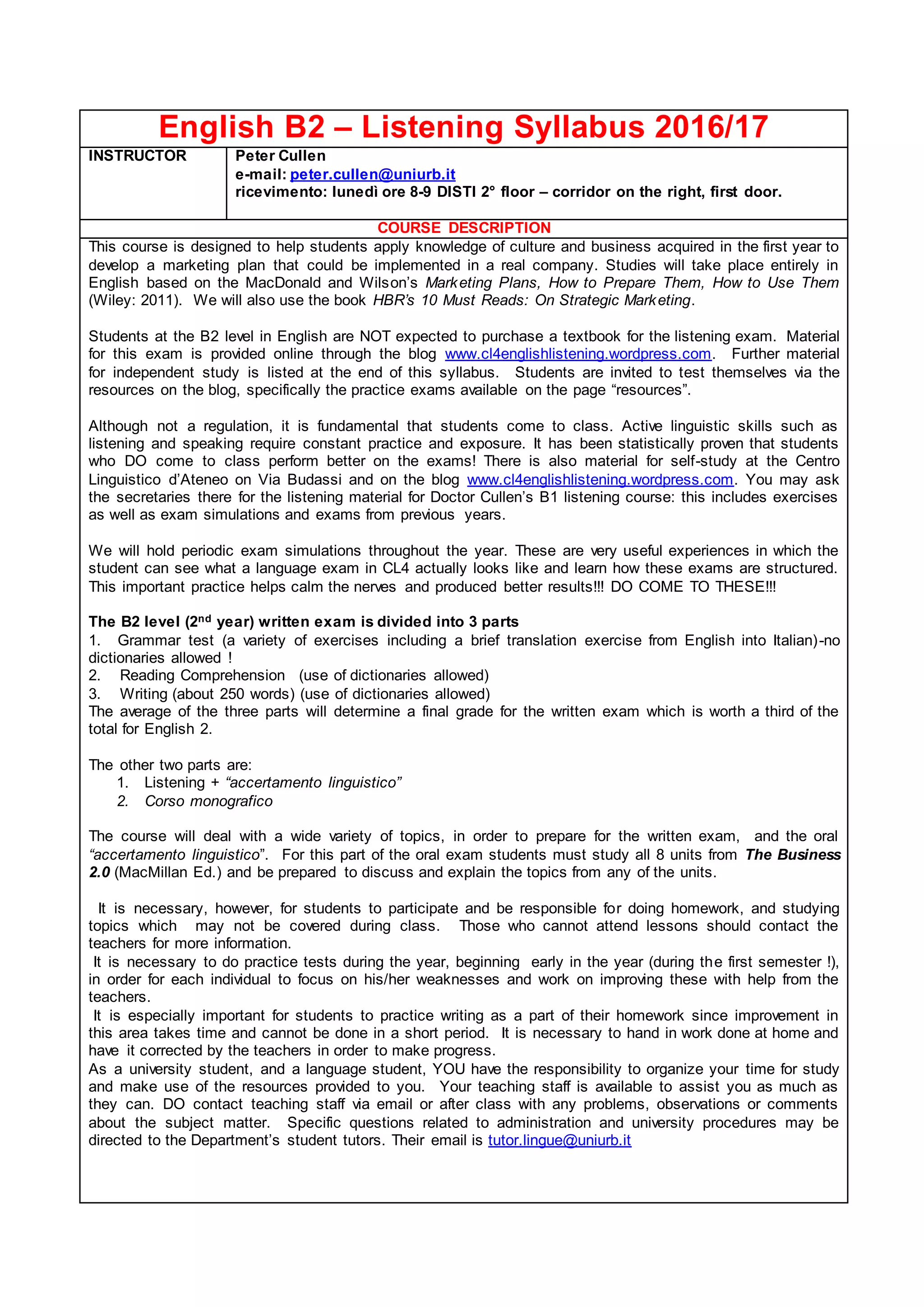
English B2 – Listening Syllabus 2016/17
INSTRUCTOR Peter Cullen
e-mail: peter.cullen@uniurb.it
ricevimento: lunedì ore 8-9 DISTI 2° floor – corridor on the right, first door.
COURSE DESCRIPTION
This course is designed to help students apply knowledge of culture and business acquired in the first year to
develop a marketing plan that could be implemented in a real company. Studies will take place entirely in
English based on the MacDonald and Wilson’s Marketing Plans, How to Prepare Them, How to Use Them
(Wiley: 2011). We will also use the book HBR’s 10 Must Reads: On Strategic Marketing.
Students at the B2 level in English are NOT expected to purchase a textbook for the listening exam. Material
for this exam is provided online through the blog www.cl4englishlistening.wordpress.com. Further material
for independent study is listed at the end of this syllabus. Students are invited to test themselves via the
resources on the blog, specifically the practice exams available on the page “resources”.
Although not a regulation, it is fundamental that students come to class. Active linguistic skills such as
listening and speaking require constant practice and exposure. It has been statistically proven that students
who DO come to class perform better on the exams! There is also material for self-study at the Centro
Linguistico d’Ateneo on Via Budassi and on the blog www.cl4englishlistening.wordpress.com. You may ask
the secretaries there for the listening material for Doctor Cullen’s B1 listening course: this includes exercises
as well as exam simulations and exams from previous years.
We will hold periodic exam simulations throughout the year. These are very useful experiences in which the
student can see what a language exam in CL4 actually looks like and learn how these exams are structured.
This important practice helps calm the nerves and produced better results!!! DO COME TO THESE!!!
The B2 level (2nd year) written exam is divided into 3 parts
1. Grammar test (a variety of exercises including a brief translation exercise from English into Italian)-no
dictionaries allowed !
2. Reading Comprehension (use of dictionaries allowed)
3. Writing (about 250 words) (use of dictionaries allowed)
The average of the three parts will determine a final grade for the written exam which is worth a third of the
total for English 2.
The other two parts are:
1. Listening + “accertamento linguistico”
2. Corso monografico
The course will deal with a wide variety of topics, in order to prepare for the written exam, and the oral
“accertamento linguistico”. For this part of the oral exam students must study all 8 units from The Business
2.0 (MacMillan Ed.) and be prepared to discuss and explain the topics from any of the units.
It is necessary, however, for students to participate and be responsible for doing homework, and studying
topics which may not be covered during class. Those who cannot attend lessons should contact the
teachers for more information.
It is necessary to do practice tests during the year, beginning early in the year (during the first semester !),
in order for each individual to focus on his/her weaknesses and work on improving these with help from the
teachers.
It is especially important for students to practice writing as a part of their homework since improvement in
this area takes time and cannot be done in a short period. It is necessary to hand in work done at home and
have it corrected by the teachers in order to make progress.
As a university student, and a language student, YOU have the responsibility to organize your time for study
and make use of the resources provided to you. Your teaching staff is available to assist you as much as
they can. DO contact teaching staff via email or after class with any problems, observations or comments
about the subject matter. Specific questions related to administration and university procedures may be
directed to the Department’s student tutors. Their email is tutor.lingue@uniurb.it
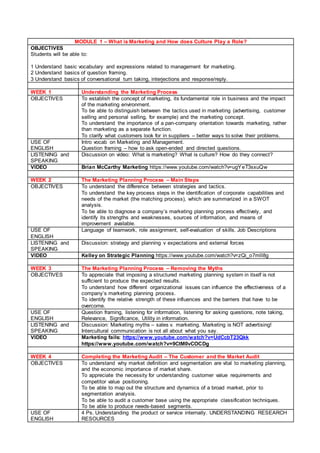
MODULE 1 – What is Marketing and How does Culture Play a Role?
OBJECTIVES
Students will be able to:
1 Understand basic vocabulary and expressions related to management for marketing.
2 Understand basics of question framing.
3 Understand basics of conversational turn taking, interjections and response/reply.
WEEK 1 Understanding the Marketing Process
OBJECTIVES To establish the concept of marketing, its fundamental role in business and the impact
of the marketing environment.
To be able to distinguish between the tactics used in marketing (advertising, customer
selling and personal selling, for example) and the marketing concept.
To understand the importance of a pan-company orientation towards marketing, rather
than marketing as a separate function.
To clarify what customers look for in suppliers – better ways to solve their problems.
USE OF
ENGLISH
Intro vocab on Marketing and Management.
Question framing – how to ask open-ended and directed questions.
LISTENING and
SPEAKING
Discussion on video: What is marketing? What is culture? How do they connect?
VIDEO Brian McCarthy Marketing https://www.youtube.com/watch?v=ugYeT3sxuQw
WEEK 2 The Marketing Planning Process – Main Steps
OBJECTIVES To understand the difference between strategies and tactics.
To understand the key process steps in the identification of corporate capabilities and
needs of the market (the matching process), which are summarized in a SWOT
analysis.
To be able to diagnose a company’s marketing planning process effectively, and
identify its strengths and weaknesses, sources of information, and means of
improvement available.
USE OF
ENGLISH
Language of teamwork, role assignment, self-evaluation of skills. Job Descriptions
LISTENING and
SPEAKING
Discussion: strategy and planning v expectations and external forces
VIDEO Kelley on Strategic Planning https://www.youtube.com/watch?v=zQi_o7mII8g
WEEK 3 The Marketing Planning Process – Removing the Myths
OBJECTIVES To appreciate that imposing a structured marketing planning system in itself is not
sufficient to produce the expected results.
To understand how different organizational issues can influence the effectiveness of a
company’s marketing planning process.
To identify the relative strength of these influences and the barriers that have to be
overcome.
USE OF
ENGLISH
Question framing, listening for information, listening for asking questions, note taking,
Relevance, Significance, Utility in information.
LISTENING and
SPEAKING
Discussion: Marketing myths – sales v. marketing. Marketing is NOT advertising!
Intercultural communication is not all about what you say.
VIDEO Marketing fails: https://www.youtube.com/watch?v=UdCcbT23Qkk
https://www.youtube.com/watch?v=9CtM0vCOCDg
WEEK 4 Completing the Marketing Audit – The Customer and the Market Audit
OBJECTIVES To understand why market definition and segmentation are vital to marketing planning,
and the economic importance of market share.
To appreciate the necessity for understanding customer value requirements and
competitor value positioning.
To be able to map out the structure and dynamics of a broad market, prior to
segmentation analysis.
To be able to audit a customer base using the appropriate classification techniques.
To be able to produce needs-based segments.
USE OF
ENGLISH
4 Ps. Understanding the product or service internally. UNDERSTANDING RESEARCH
RESOURCES
LISTENING and
SPEAKING
Discussion: How do we define a market? How do we define this internationally or
globally?
Video Understanding customers https://www.youtube.com/watch?v=SkbpJ7XkrOA
WEEK 5 Completing the Marketing Audit – The Product Audit
OBJECTIVES To understand the rationale behind the concepts and tools described.
To be able to complete an analysis of a company’s products using the tools.
To be able to interpret the resultant information in relation to setting marketing
objectives and strategies pertinent to the products.
USE OF
ENGLISH
Web search skills, data base skills, cultural approaches, statistical approaches.
LISTENING and
SPEAKING
Discussion: What is a product? What do we use them for and what do they mean to us?
VIDEO Product life cycles: https://www.youtube.com/watch?v=egAV91MefXA Portfolio
management: https://www.youtube.com/watch?v=-kpoITn53mc
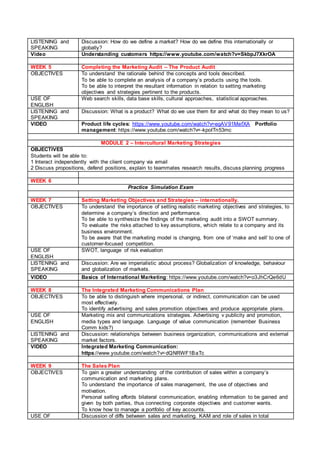
MODULE 2 – Intercultural Marketing Strategies
OBJECTIVES
Students will be able to:
1 Interact independently with the client company via email
2 Discuss propositions, defend positions, explain to teammates research results, discuss planning progress
WEEK 6
Practice Simulation Exam
WEEK 7 Setting Marketing Objectives and Strategies – internationally.
OBJECTIVES To understand the importance of setting realistic marketing objectives and strategies, to
determine a company’s direction and performance.
To be able to synthesize the findings of the marketing audit into a SWOT summary.
To evaluate the risks attached to key assumptions, which relate to a company and its
business environment.
To be aware that the marketing model is changing, from one of ‘make and sell’ to one of
customer-focused competition.
USE OF
ENGLISH
SWOT, language of risk evaluation
LISTENING and
SPEAKING
Discussion: Are we imperialistic about process? Globalization of knowledge, behaviour
and globalization of markets.
VIDEO Basics of International Marketing: https://www.youtube.com/watch?v=o3JhCrQe6dU
WEEK 8 The Integrated Marketing Communications Plan
OBJECTIVES To be able to distinguish where impersonal, or indirect, communication can be used
most effectively.
To identify advertising and sales promotion objectives and produce appropriate plans.
USE OF
ENGLISH
Marketing mix and communications strategies. Advertising v publicity and promotion,
media types and language. Language of value communication (remember Business
Comm kids?)
LISTENING and
SPEAKING
Discussion: relationships between business organization, communications and external
market factors.
VIDEO Integrated Marketing Communication:
https://www.youtube.com/watch?v=dQNRWF1BaTc
WEEK 9 The Sales Plan
OBJECTIVES To gain a greater understanding of the contribution of sales within a company’s
communication and marketing plans.
To understand the importance of sales management, the use of objectives and
motivation.
Personal selling affords bilateral communication, enabling information to be gained and
given by both parties, thus connecting corporate objectives and customer wants.
To know how to manage a portfolio of key accounts.
USE OF Discussion of diffs between sales and marketing. KAM and role of sales in total
ENGLISH marketing objectives.
LISTENING and
SPEAKING
Discussion: relationship between sales and export UNDER marketing management.
VIDEO Export: https://www.youtube.com/watch?v=skX4Af6jpJQ
WEEK 10 The Pricing Plan
OBJECTIVES To understand the difference between ‘price’ and ‘cost’ and the various methods of
pricing, and systems of costing.
To be able to identify key factors that influence pricing options.
To understand how to set realistic prices and prepare a pricing plan.
USE OF
ENGLISH
Reading and discussing graphs and charts
LISTENING and
SPEAKING
Discussion: Culture of money, price and cost.
VIDEO Intercultural Marketing: https://www.youtube.com/watch?v=qyKqEC2iPGg
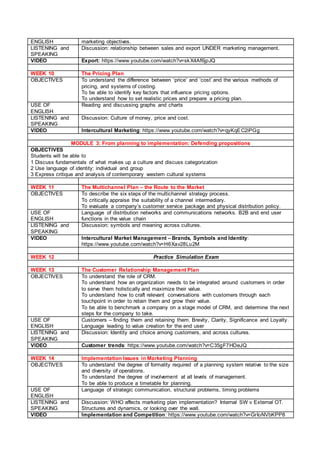
MODULE 3: From planning to implementation: Defending propositions
OBJECTIVES
Students will be able to
1 Discuss fundamentals of what makes up a culture and discuss categorization
2 Use language of identity: individual and group
3 Express critique and analysis of contemporary western cultural systems
WEEK 11 The Multichannel Plan – the Route to the Market
OBJECTIVES To describe the six steps of the multichannel strategy process.
To critically appraise the suitability of a channel intermediary.
To evaluate a company’s customer service package and physical distribution policy.
USE OF
ENGLISH
Language of distribution networks and communications networks. B2B and end user
functions in the value chain
LISTENING and
SPEAKING
Discussion: symbols and meaning across cultures.
VIDEO Intercultural Market Management – Brands, Symbols and Identity:
https://www.youtube.com/watch?v=H6Xav28Lu2M
WEEK 12 Practice Simulation Exam
WEEK 13 The Customer Relationship Management Plan
OBJECTIVES To understand the role of CRM.
To understand how an organization needs to be integrated around customers in order
to serve them holistically and maximize their value.
To understand how to craft relevant conversations with customers through each
touchpoint in order to retain them and grow their value.
To be able to benchmark a company on a stage model of CRM, and determine the next
steps for the company to take.
USE OF
ENGLISH
Customers – finding them and retaining them. Brevity, Clarity, Significance and Loyalty.
Language leading to value creation for the end user
LISTENING and
SPEAKING
Discussion: Identity and choice among customers, and across cultures.
VIDEO Customer trends: https://www.youtube.com/watch?v=C35gF7HDeJQ
WEEK 14 Implementation Issues in Marketing Planning
OBJECTIVES To understand the degree of formality required of a planning system relative to the size
and diversity of operations.
To understand the degree of involvement at all levels of management.
To be able to produce a timetable for planning.
USE OF
ENGLISH
Language of strategic communication, structural problems, timing problems
LISTENING and
SPEAKING
Discussion: WHO affects marketing plan implementation? Internal SW v External OT.
Structures and dynamics, or looking over the wall.
VIDEO Implementation and Competition: https://www.youtube.com/watch?v=GrIoNVbKPP8
WEEK 15 Measuring the Effectiveness of Marketing Planning
OBJECTIVES To spell out the crucial importance of measuring the financial consequences of the
often substantial expenditure of marketers.
To spell out methodologies for the three different levels at which marketing activities
need to be measured.
USE OF
ENGLISH
More on graphs, charts and data analysis. Importance of USING measurement! How
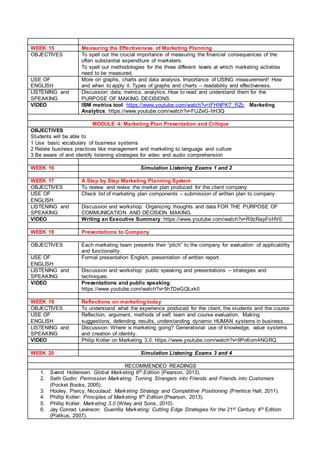
and when to apply it. Types of graphs and charts – readability and effectiveness.
LISTENING and
SPEAKING
Discussion: data, metrics, analytics. How to read and understand them for the
PURPOSE OF MAKING DECISIONS.
VIDEO IBM metrics tool: https://www.youtube.com/watch?v=tFHNPK7_RZc Marketing
Analytics: https://www.youtube.com/watch?v=FlJZeG-hH3Q
MODULE 4: Marketing Plan Presentation and Critique
OBJECTIVES
Students will be able to
1 Use basic vocabulary of business systems
2 Relate business practices like management and marketing to language and culture
3 Be aware of and identify listening strategies for video and audio comprehension
WEEK 16 Simulation Listening Exams 1 and 2
WEEK 17 A Step by Step Marketing Planning System
OBJECTIVES To review and revise the market plan produced for the client company.
USE OF
ENGLISH
Check list of marketing plan components – submission of written plan to company
LISTENING and
SPEAKING
Discussion and workshop: Organizing thoughts and data FOR THE PURPOSE OF
COMMUNICATION AND DECISION MAKING.
VIDEO Writing an Executive Summary: https://www.youtube.com/watch?v=R9zRapFoHV0
WEEK 18 Presentations to Company
OBJECTIVES Each marketing team presents their “pitch” to the company for evaluation of applicability
and functionality.
USE OF
ENGLISH
Formal presentation English, presentation of written report.
LISTENING and
SPEAKING
Discussion and workshop: public speaking and presentations – strategies and
techniques.
VIDEO Presentations and public speaking:
https://www.youtube.com/watch?v=5h7DeGQLxk0
WEEK 19 Reflections on marketing today
OBJECTIVES To understand what the experience produced for the client, the students and the course
USE OF
ENGLISH
Reflection, argument, methods of self, team and course evaluation. Making
suggestions, defending results, understanding dynamic HUMAN systems in business.
LISTENING and
SPEAKING
Discussion: Where is marketing going? Generational use of knowledge, value systems
and creation of identity.
VIDEO Philip Kotler on Marketing 3.0: https://www.youtube.com/watch?v=9Pn6om4NGRQ
WEEK 20 Simulation Listening Exams 3 and 4
RECOMMENDED READINGS
1. Svend Hollensen: Global Marketing 6th Edition (Pearson, 2013).
2. Seth Godin: Permission Marketing: Turning Strangers into Friends and Friends into Customers
(Pocket Books, 2005).
3. Hooley, Piercy, Nicoulaud: Marketing Strategy and Competitive Positioning (Prentice Hall, 2011).
4. Phillip Kotler: Principles of Marketing 6th Edition (Pearson, 2013).
5. Phillip Kotler: Marketing 3.0 (Wiley and Sons, 2010).
6. Jay Conrad Levinson: Guerrilla Marketing: Cutting Edge Strategies for the 21st Century 4th Edition
(Piatkus, 2007).
7. Martin Lindstrom: Buyology: Truth and Lies About Why We Buy (Broadway Business, 2010)
8. Malcolm MacDonald: Marketing Plans – How to Write Them, How to Use Them 7th Edition (Wiley and
Sons, 2011).
RECOMMENDED
DICTIONARIES
BILINGUE: Oxford-Paravia Italian Dictionary / Oxford-Paravia Il Dizionario- English-
Italian, Italian-English (OUP)
MONOLINGUE: Oxford English Dictionary (OUP)
ONLINE
BUSINESS
ENGLISH
DICTIONARY
http://dictionary.cambridge.org/dictionary/business-english
EXAMS
LISTENING This exam consists of a brief (3 - 3.5 min) recorded text. You will listen to the text three
times with a pause of 3 min and 4 min between each listening. The question sheet
consists of 5 open answer questions each worth 6 points. This exam may be taken
during any exam session of the academic year independently of the rest of the rest of
the B2 written exam. All sections of the written exam must be passed by the end of the
academic year in order for the student to register the completed mark.
ORAL EXAM This consists in a brief conversation about basic situations in life and then turns to
specific language, culture and business related topics. Students are expected to read
at least 8 chapters from The Business 2.0 B2 and be able to discuss them. Discussion
means conversation about the topic, not repetition of the content. This is valid for oral
exams with any B2 instructor.
FOR FURTHER READING
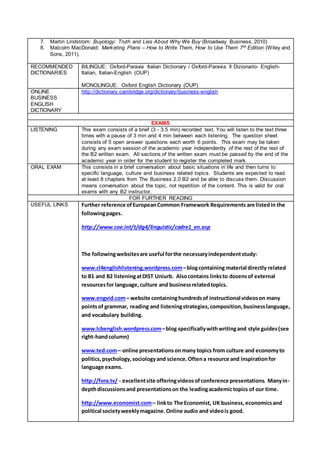
USEFUL LINKS Further reference ofEuropeanCommon Framework Requirements are listedin the
followingpages.
http://www.coe.int/t/dg4/linguistic/cadre1_en.asp
The followingwebsitesare useful forthe necessaryindependentstudy:
www.cl4englishlistening.wordpress.com–blogcontaining material directly related
to B1 and B2 listeningatDIST Uniurb. Alsocontains linksto dozensof external
resourcesfor language,culture and businessrelatedtopics.
www.engvid.com– website containinghundredsof instructional videoson many
pointsof grammar, reading and listeningstrategies,composition,businesslanguage,
and vocabulary building.
www.lcbenglish.wordpress.com–blog specificallywithwritingand style guides(see
right-handcolumn)
www.ted.com– online presentationsonmany topics from culture and economyto
politics,psychology, sociologyand science.Oftena resource and inspirationfor
language exams.
http://fora.tv/ - excellentsite offeringvideosofconference presentations. Manyin-
depthdiscussionsand presentationson the leadingacademictopics of our time.
http://www.economist.com– linkto The Economist, UK business, economicsand
political societyweeklymagazine.Online audio and videois good.
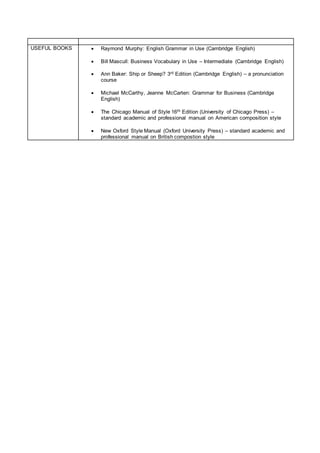
USEFUL BOOKS  Raymond Murphy: English Grammar in Use (Cambridge English)
 Bill Mascull: Business Vocabulary in Use – Intermediate (Cambridge English)
 Ann Baker: Ship or Sheep? 3rd Edition (Cambridge English) – a pronunciation
course
 Michael McCarthy, Jeanne McCarten: Grammar for Business (Cambridge
English)
 The Chicago Manual of Style 16th Edition (University of Chicago Press) –
standard academic and professional manual on American composition style
 New Oxford Style Manual (Oxford University Press) – standard academic and
professional manual on British compostion style

b2-listening-syllabus-2016-2017

  • 1.
    English B2 –Listening Syllabus 2016/17 INSTRUCTOR Peter Cullen e-mail: peter.cullen@uniurb.it ricevimento: lunedì ore 8-9 DISTI 2° floor – corridor on the right, first door. COURSE DESCRIPTION This course is designed to help students apply knowledge of culture and business acquired in the first year to develop a marketing plan that could be implemented in a real company. Studies will take place entirely in English based on the MacDonald and Wilson’s Marketing Plans, How to Prepare Them, How to Use Them (Wiley: 2011). We will also use the book HBR’s 10 Must Reads: On Strategic Marketing. Students at the B2 level in English are NOT expected to purchase a textbook for the listening exam. Material for this exam is provided online through the blog www.cl4englishlistening.wordpress.com. Further material for independent study is listed at the end of this syllabus. Students are invited to test themselves via the resources on the blog, specifically the practice exams available on the page “resources”. Although not a regulation, it is fundamental that students come to class. Active linguistic skills such as listening and speaking require constant practice and exposure. It has been statistically proven that students who DO come to class perform better on the exams! There is also material for self-study at the Centro Linguistico d’Ateneo on Via Budassi and on the blog www.cl4englishlistening.wordpress.com. You may ask the secretaries there for the listening material for Doctor Cullen’s B1 listening course: this includes exercises as well as exam simulations and exams from previous years. We will hold periodic exam simulations throughout the year. These are very useful experiences in which the student can see what a language exam in CL4 actually looks like and learn how these exams are structured. This important practice helps calm the nerves and produced better results!!! DO COME TO THESE!!! The B2 level (2nd year) written exam is divided into 3 parts 1. Grammar test (a variety of exercises including a brief translation exercise from English into Italian)-no dictionaries allowed ! 2. Reading Comprehension (use of dictionaries allowed) 3. Writing (about 250 words) (use of dictionaries allowed) The average of the three parts will determine a final grade for the written exam which is worth a third of the total for English 2. The other two parts are: 1. Listening + “accertamento linguistico” 2. Corso monografico The course will deal with a wide variety of topics, in order to prepare for the written exam, and the oral “accertamento linguistico”. For this part of the oral exam students must study all 8 units from The Business 2.0 (MacMillan Ed.) and be prepared to discuss and explain the topics from any of the units. It is necessary, however, for students to participate and be responsible for doing homework, and studying topics which may not be covered during class. Those who cannot attend lessons should contact the teachers for more information. It is necessary to do practice tests during the year, beginning early in the year (during the first semester !), in order for each individual to focus on his/her weaknesses and work on improving these with help from the teachers. It is especially important for students to practice writing as a part of their homework since improvement in this area takes time and cannot be done in a short period. It is necessary to hand in work done at home and have it corrected by the teachers in order to make progress. As a university student, and a language student, YOU have the responsibility to organize your time for study and make use of the resources provided to you. Your teaching staff is available to assist you as much as they can. DO contact teaching staff via email or after class with any problems, observations or comments about the subject matter. Specific questions related to administration and university procedures may be directed to the Department’s student tutors. Their email is tutor.lingue@uniurb.it
  • 2.
    MODULE 1 –What is Marketing and How does Culture Play a Role? OBJECTIVES Students will be able to: 1 Understand basic vocabulary and expressions related to management for marketing. 2 Understand basics of question framing. 3 Understand basics of conversational turn taking, interjections and response/reply. WEEK 1 Understanding the Marketing Process OBJECTIVES To establish the concept of marketing, its fundamental role in business and the impact of the marketing environment. To be able to distinguish between the tactics used in marketing (advertising, customer selling and personal selling, for example) and the marketing concept. To understand the importance of a pan-company orientation towards marketing, rather than marketing as a separate function. To clarify what customers look for in suppliers – better ways to solve their problems. USE OF ENGLISH Intro vocab on Marketing and Management. Question framing – how to ask open-ended and directed questions. LISTENING and SPEAKING Discussion on video: What is marketing? What is culture? How do they connect? VIDEO Brian McCarthy Marketing https://www.youtube.com/watch?v=ugYeT3sxuQw WEEK 2 The Marketing Planning Process – Main Steps OBJECTIVES To understand the difference between strategies and tactics. To understand the key process steps in the identification of corporate capabilities and needs of the market (the matching process), which are summarized in a SWOT analysis. To be able to diagnose a company’s marketing planning process effectively, and identify its strengths and weaknesses, sources of information, and means of improvement available. USE OF ENGLISH Language of teamwork, role assignment, self-evaluation of skills. Job Descriptions LISTENING and SPEAKING Discussion: strategy and planning v expectations and external forces VIDEO Kelley on Strategic Planning https://www.youtube.com/watch?v=zQi_o7mII8g WEEK 3 The Marketing Planning Process – Removing the Myths OBJECTIVES To appreciate that imposing a structured marketing planning system in itself is not sufficient to produce the expected results. To understand how different organizational issues can influence the effectiveness of a company’s marketing planning process. To identify the relative strength of these influences and the barriers that have to be overcome. USE OF ENGLISH Question framing, listening for information, listening for asking questions, note taking, Relevance, Significance, Utility in information. LISTENING and SPEAKING Discussion: Marketing myths – sales v. marketing. Marketing is NOT advertising! Intercultural communication is not all about what you say. VIDEO Marketing fails: https://www.youtube.com/watch?v=UdCcbT23Qkk https://www.youtube.com/watch?v=9CtM0vCOCDg WEEK 4 Completing the Marketing Audit – The Customer and the Market Audit OBJECTIVES To understand why market definition and segmentation are vital to marketing planning, and the economic importance of market share. To appreciate the necessity for understanding customer value requirements and competitor value positioning. To be able to map out the structure and dynamics of a broad market, prior to segmentation analysis. To be able to audit a customer base using the appropriate classification techniques. To be able to produce needs-based segments. USE OF ENGLISH 4 Ps. Understanding the product or service internally. UNDERSTANDING RESEARCH RESOURCES
  • 3.
    LISTENING and SPEAKING Discussion: Howdo we define a market? How do we define this internationally or globally? Video Understanding customers https://www.youtube.com/watch?v=SkbpJ7XkrOA WEEK 5 Completing the Marketing Audit – The Product Audit OBJECTIVES To understand the rationale behind the concepts and tools described. To be able to complete an analysis of a company’s products using the tools. To be able to interpret the resultant information in relation to setting marketing objectives and strategies pertinent to the products. USE OF ENGLISH Web search skills, data base skills, cultural approaches, statistical approaches. LISTENING and SPEAKING Discussion: What is a product? What do we use them for and what do they mean to us? VIDEO Product life cycles: https://www.youtube.com/watch?v=egAV91MefXA Portfolio management: https://www.youtube.com/watch?v=-kpoITn53mc MODULE 2 – Intercultural Marketing Strategies OBJECTIVES Students will be able to: 1 Interact independently with the client company via email 2 Discuss propositions, defend positions, explain to teammates research results, discuss planning progress WEEK 6 Practice Simulation Exam WEEK 7 Setting Marketing Objectives and Strategies – internationally. OBJECTIVES To understand the importance of setting realistic marketing objectives and strategies, to determine a company’s direction and performance. To be able to synthesize the findings of the marketing audit into a SWOT summary. To evaluate the risks attached to key assumptions, which relate to a company and its business environment. To be aware that the marketing model is changing, from one of ‘make and sell’ to one of customer-focused competition. USE OF ENGLISH SWOT, language of risk evaluation LISTENING and SPEAKING Discussion: Are we imperialistic about process? Globalization of knowledge, behaviour and globalization of markets. VIDEO Basics of International Marketing: https://www.youtube.com/watch?v=o3JhCrQe6dU WEEK 8 The Integrated Marketing Communications Plan OBJECTIVES To be able to distinguish where impersonal, or indirect, communication can be used most effectively. To identify advertising and sales promotion objectives and produce appropriate plans. USE OF ENGLISH Marketing mix and communications strategies. Advertising v publicity and promotion, media types and language. Language of value communication (remember Business Comm kids?) LISTENING and SPEAKING Discussion: relationships between business organization, communications and external market factors. VIDEO Integrated Marketing Communication: https://www.youtube.com/watch?v=dQNRWF1BaTc WEEK 9 The Sales Plan OBJECTIVES To gain a greater understanding of the contribution of sales within a company’s communication and marketing plans. To understand the importance of sales management, the use of objectives and motivation. Personal selling affords bilateral communication, enabling information to be gained and given by both parties, thus connecting corporate objectives and customer wants. To know how to manage a portfolio of key accounts. USE OF Discussion of diffs between sales and marketing. KAM and role of sales in total
  • 4.
    ENGLISH marketing objectives. LISTENINGand SPEAKING Discussion: relationship between sales and export UNDER marketing management. VIDEO Export: https://www.youtube.com/watch?v=skX4Af6jpJQ WEEK 10 The Pricing Plan OBJECTIVES To understand the difference between ‘price’ and ‘cost’ and the various methods of pricing, and systems of costing. To be able to identify key factors that influence pricing options. To understand how to set realistic prices and prepare a pricing plan. USE OF ENGLISH Reading and discussing graphs and charts LISTENING and SPEAKING Discussion: Culture of money, price and cost. VIDEO Intercultural Marketing: https://www.youtube.com/watch?v=qyKqEC2iPGg MODULE 3: From planning to implementation: Defending propositions OBJECTIVES Students will be able to 1 Discuss fundamentals of what makes up a culture and discuss categorization 2 Use language of identity: individual and group 3 Express critique and analysis of contemporary western cultural systems WEEK 11 The Multichannel Plan – the Route to the Market OBJECTIVES To describe the six steps of the multichannel strategy process. To critically appraise the suitability of a channel intermediary. To evaluate a company’s customer service package and physical distribution policy. USE OF ENGLISH Language of distribution networks and communications networks. B2B and end user functions in the value chain LISTENING and SPEAKING Discussion: symbols and meaning across cultures. VIDEO Intercultural Market Management – Brands, Symbols and Identity: https://www.youtube.com/watch?v=H6Xav28Lu2M WEEK 12 Practice Simulation Exam WEEK 13 The Customer Relationship Management Plan OBJECTIVES To understand the role of CRM. To understand how an organization needs to be integrated around customers in order to serve them holistically and maximize their value. To understand how to craft relevant conversations with customers through each touchpoint in order to retain them and grow their value. To be able to benchmark a company on a stage model of CRM, and determine the next steps for the company to take. USE OF ENGLISH Customers – finding them and retaining them. Brevity, Clarity, Significance and Loyalty. Language leading to value creation for the end user LISTENING and SPEAKING Discussion: Identity and choice among customers, and across cultures. VIDEO Customer trends: https://www.youtube.com/watch?v=C35gF7HDeJQ WEEK 14 Implementation Issues in Marketing Planning OBJECTIVES To understand the degree of formality required of a planning system relative to the size and diversity of operations. To understand the degree of involvement at all levels of management. To be able to produce a timetable for planning. USE OF ENGLISH Language of strategic communication, structural problems, timing problems LISTENING and SPEAKING Discussion: WHO affects marketing plan implementation? Internal SW v External OT. Structures and dynamics, or looking over the wall. VIDEO Implementation and Competition: https://www.youtube.com/watch?v=GrIoNVbKPP8
  • 5.
    WEEK 15 Measuringthe Effectiveness of Marketing Planning OBJECTIVES To spell out the crucial importance of measuring the financial consequences of the often substantial expenditure of marketers. To spell out methodologies for the three different levels at which marketing activities need to be measured. USE OF ENGLISH More on graphs, charts and data analysis. Importance of USING measurement! How and when to apply it. Types of graphs and charts – readability and effectiveness. LISTENING and SPEAKING Discussion: data, metrics, analytics. How to read and understand them for the PURPOSE OF MAKING DECISIONS. VIDEO IBM metrics tool: https://www.youtube.com/watch?v=tFHNPK7_RZc Marketing Analytics: https://www.youtube.com/watch?v=FlJZeG-hH3Q MODULE 4: Marketing Plan Presentation and Critique OBJECTIVES Students will be able to 1 Use basic vocabulary of business systems 2 Relate business practices like management and marketing to language and culture 3 Be aware of and identify listening strategies for video and audio comprehension WEEK 16 Simulation Listening Exams 1 and 2 WEEK 17 A Step by Step Marketing Planning System OBJECTIVES To review and revise the market plan produced for the client company. USE OF ENGLISH Check list of marketing plan components – submission of written plan to company LISTENING and SPEAKING Discussion and workshop: Organizing thoughts and data FOR THE PURPOSE OF COMMUNICATION AND DECISION MAKING. VIDEO Writing an Executive Summary: https://www.youtube.com/watch?v=R9zRapFoHV0 WEEK 18 Presentations to Company OBJECTIVES Each marketing team presents their “pitch” to the company for evaluation of applicability and functionality. USE OF ENGLISH Formal presentation English, presentation of written report. LISTENING and SPEAKING Discussion and workshop: public speaking and presentations – strategies and techniques. VIDEO Presentations and public speaking: https://www.youtube.com/watch?v=5h7DeGQLxk0 WEEK 19 Reflections on marketing today OBJECTIVES To understand what the experience produced for the client, the students and the course USE OF ENGLISH Reflection, argument, methods of self, team and course evaluation. Making suggestions, defending results, understanding dynamic HUMAN systems in business. LISTENING and SPEAKING Discussion: Where is marketing going? Generational use of knowledge, value systems and creation of identity. VIDEO Philip Kotler on Marketing 3.0: https://www.youtube.com/watch?v=9Pn6om4NGRQ WEEK 20 Simulation Listening Exams 3 and 4 RECOMMENDED READINGS 1. Svend Hollensen: Global Marketing 6th Edition (Pearson, 2013). 2. Seth Godin: Permission Marketing: Turning Strangers into Friends and Friends into Customers (Pocket Books, 2005). 3. Hooley, Piercy, Nicoulaud: Marketing Strategy and Competitive Positioning (Prentice Hall, 2011). 4. Phillip Kotler: Principles of Marketing 6th Edition (Pearson, 2013). 5. Phillip Kotler: Marketing 3.0 (Wiley and Sons, 2010). 6. Jay Conrad Levinson: Guerrilla Marketing: Cutting Edge Strategies for the 21st Century 4th Edition (Piatkus, 2007).
  • 6.
    7. Martin Lindstrom:Buyology: Truth and Lies About Why We Buy (Broadway Business, 2010) 8. Malcolm MacDonald: Marketing Plans – How to Write Them, How to Use Them 7th Edition (Wiley and Sons, 2011). RECOMMENDED DICTIONARIES BILINGUE: Oxford-Paravia Italian Dictionary / Oxford-Paravia Il Dizionario- English- Italian, Italian-English (OUP) MONOLINGUE: Oxford English Dictionary (OUP) ONLINE BUSINESS ENGLISH DICTIONARY http://dictionary.cambridge.org/dictionary/business-english EXAMS LISTENING This exam consists of a brief (3 - 3.5 min) recorded text. You will listen to the text three times with a pause of 3 min and 4 min between each listening. The question sheet consists of 5 open answer questions each worth 6 points. This exam may be taken during any exam session of the academic year independently of the rest of the rest of the B2 written exam. All sections of the written exam must be passed by the end of the academic year in order for the student to register the completed mark. ORAL EXAM This consists in a brief conversation about basic situations in life and then turns to specific language, culture and business related topics. Students are expected to read at least 8 chapters from The Business 2.0 B2 and be able to discuss them. Discussion means conversation about the topic, not repetition of the content. This is valid for oral exams with any B2 instructor. FOR FURTHER READING USEFUL LINKS Further reference ofEuropeanCommon Framework Requirements are listedin the followingpages. http://www.coe.int/t/dg4/linguistic/cadre1_en.asp The followingwebsitesare useful forthe necessaryindependentstudy: www.cl4englishlistening.wordpress.com–blogcontaining material directly related to B1 and B2 listeningatDIST Uniurb. Alsocontains linksto dozensof external resourcesfor language,culture and businessrelatedtopics. www.engvid.com– website containinghundredsof instructional videoson many pointsof grammar, reading and listeningstrategies,composition,businesslanguage, and vocabulary building. www.lcbenglish.wordpress.com–blog specificallywithwritingand style guides(see right-handcolumn) www.ted.com– online presentationsonmany topics from culture and economyto politics,psychology, sociologyand science.Oftena resource and inspirationfor language exams. http://fora.tv/ - excellentsite offeringvideosofconference presentations. Manyin- depthdiscussionsand presentationson the leadingacademictopics of our time. http://www.economist.com– linkto The Economist, UK business, economicsand political societyweeklymagazine.Online audio and videois good.
  • 7.
    USEFUL BOOKS Raymond Murphy: English Grammar in Use (Cambridge English)  Bill Mascull: Business Vocabulary in Use – Intermediate (Cambridge English)  Ann Baker: Ship or Sheep? 3rd Edition (Cambridge English) – a pronunciation course  Michael McCarthy, Jeanne McCarten: Grammar for Business (Cambridge English)  The Chicago Manual of Style 16th Edition (University of Chicago Press) – standard academic and professional manual on American composition style  New Oxford Style Manual (Oxford University Press) – standard academic and professional manual on British compostion style