Some Solved examples (with step wise detailed solution)
We will show the complete solution for 2 set of questions on linear
arrangement for better understanding of solving the problems
Directions for set 3
• Directions for 11 to 15
• The top 5 students of a class (all are boys) are P, Q, R, S & T (not in any order). They are wearing
shirts of Red, White, Black, Green & Blue colours (not in any order).
• 1. R got better rank then Q who was wearing green shirt.
• 2. T got 1st rank & S got the 5th rank.
• 3. Neither Q nor R got the 2nd best rank among the 5 students.
• 4. The red shirt is worn by S.
• 5. The boy who was wearing black shirt got a rank which is better than at least 3 students.
• 6. At least 1 boy got the better rank than the rank obtained by the boy who is wearing white
shirt.
• 7. A smaller rank is better than larger rank.
• 11. What is the rank obtained by Q?
• (a) 2nd (b) 3rd (c) 4th (d) either 3rd or 4th (e) cannot be determined
• 12. Who is wearing white shirt?
• (a) P (b)R (c) T (d) either P or R (e) cannot be determined
• 13. If R is wearing the White shirt, then what is colour of shirt of T?
• (a) Black (b) Green (c) Blue (d) either Green or Blue (e) cannot be determined
• 14. If black shirt is worn by P, who is wearing blue shirt?
• (a) P (b) R (c) T (d) either P or T (e) cannot be determined
• 15. How many different arrangements are possible?
• (a) 1 (b) 2 (c) 3 (d) 4 (e) more than 4
• General Solution for 11 to 15
• P, Q, R, S & T are arranged in 1st to 5th ranks & wearing shirts of Red, White, Black,
Green & Blue colours. The arrangement must be linear as we will start with rank 1 and
will end with rank 5. This is how we can show the arrangement
Rank 1 2 3 4 5
Name
Colour
• Points 2, 3 and 4
• T got 1st rank & S got the 5th rank.
• Neither Q nor R got the 2nd best rank among the 5 students.
• We know T and S didn’t got 2nd rank. So, P got 2nd rank
• The red shirt is worn by S.
• Using it, the table is modified as-
Rank 1 2 3 4 5
Name
Colour
• Points 2, 3 and 4
• T got 1st rank & S got the 5th rank.
• Neither Q nor R got the 2nd best rank among the 5 students.
• We know T and S didn’t got 2nd rank. So, P got 2nd rank
• The red shirt is worn by S.
• Using it, the table is modified as-
Rank 1 2 3 4 5
Name T P S
Colour Red
• Point 1 (points 2, 3 and 4 are used)
• R got better rank then Q who was wearing green shirt.
• So, R and Q got 3rd and 4th ranks, respectively. Q is wearing green shirt
• Using it, the table is modified as-
Rank 1 2 3 4 5
Name T P S
Colour Red
• Point 1 (points 2, 3 and 4 are used)
• R got better rank then Q who was wearing green shirt.
• So, R and Q got 3rd and 4th ranks, respectively. Q is wearing green shirt
• Using it, the table is modified as-
Rank 1 2 3 4 5
Name T P R Q S
Colour Green Red
• Points 5 and 6 (points 2, 3, 4 and 1 are used)
• The boy who was wearing black shirt got a rank which is better than at least 3
students.
• so his rank is either 1st or 2nd. So, either T or P is wearing black shirt.
• At least 1 boy got the better rank than the rank obtained by the boy who is wearing
white shirt.
• So, T cannot be wearing the white shirt. So, either P or R is wearing black shirt
• Using it, the table is modified as-
Rank 1 2 3 4 5
Name T P R Q S
Colour Green Red
• Points 5 and 6 (points 2, 3, 4 and 1 are used)
• The boy who was wearing black shirt got a rank which is better than at least 3
students.
• so his rank is either 1st or 2nd. So, either T or P is wearing black shirt.
• At least 1 boy got the better rank than the rank obtained by the boy who is wearing
white shirt.
• So, T cannot be wearing the white shirt. So, either P or R is wearing black shirt
• Using it, the table is modified as-
Rank 1 2 3 4 5
Name T P R Q S
Colour Green Red
• Points 5 and 6 (points 2, 3, 4 and 1 are used)
• The boy who was wearing black shirt got a rank which is better than at least 3
students.
• so his rank is either 1st or 2nd. So, either T or P is wearing black shirt.
• At least 1 boy got the better rank than the rank obtained by the boy who is wearing
white shirt.
• So, T cannot be wearing the white shirt. So, either P or R is wearing black shirt
• Using it, the table is modified as-
Rank 1 2 3 4 5
Name T P R Q S
Colour Black/Blue Black/White/Blue White/Blue Green Red
• 11. Q obtained 4th rank. Hence option (c) is the answer
• 12. Either P or R is wearing white shirt. Hence option (d) is the answer
Rank 1 2 3 4 5
Name T P R Q S
Colour Black/Blue Black/White/Blue White/Blue Green Red
• 13. If R is wearing the White shirt, then the arrangement can be modified as-
• So, the colour of shirt which T is wearing is either Black or Blue. So, it cannot be
determined. Hence option (e) is the answer
Rank 1 2 3 4 5
Name T P R Q S
Colour Black/Blue Black/Blue White Green Red
• 14. If black shirt is worn by P, then the arrangement can be modified as-
• T is wearing blue shirt. Hence option (c) is the answer
Rank 1 2 3 4 5
Name T P R Q S
Colour Blue Black White Green Red
• 15. There are 3 possible arrangements
• Hence option (c) is the answer
Rank 1 2 3 4 5
Name T P R Q S
Colour-1 Black White Blue Green Red
Colour-2 Black Blue White Green Red
Colour-3 Blue Black White Green Red
Set 4
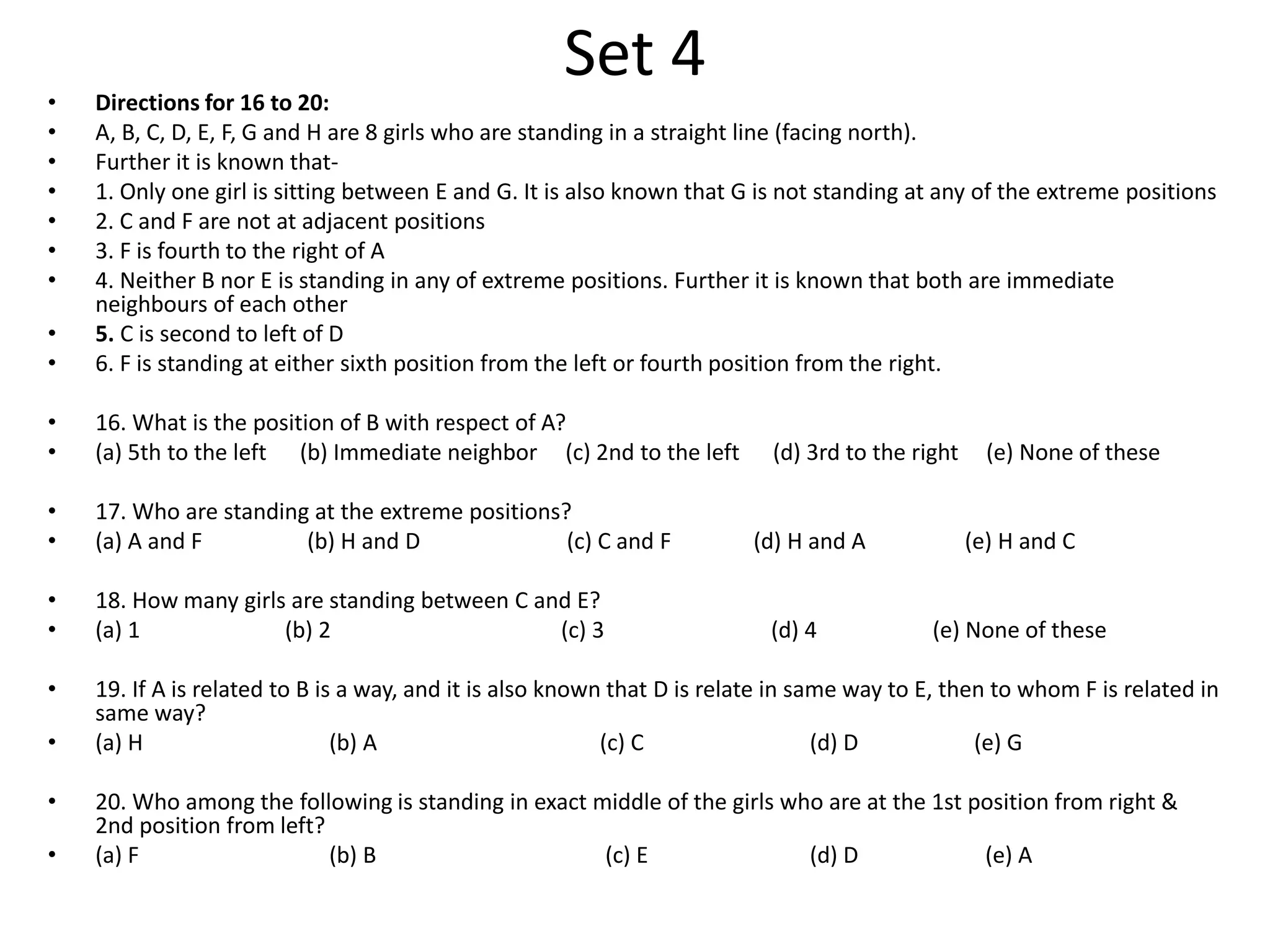
• Directions for 16 to 20:
• A, B, C, D, E, F, G and H are 8 girls who are standing in a straight line (facing north).
• Further it is known that-
• 1. Only one girl is sitting between E and G. It is also known that G is not standing at any of the extreme positions
• 2. C and F are not at adjacent positions
• 3. F is fourth to the right of A
• 4. Neither B nor E is standing in any of extreme positions. Further it is known that both are immediate
neighbours of each other
• 5. C is second to left of D
• 6. F is standing at either sixth position from the left or fourth position from the right.
• 16. What is the position of B with respect of A?
• (a) 5th to the left (b) Immediate neighbor (c) 2nd to the left (d) 3rd to the right (e) None of these
• 17. Who are standing at the extreme positions?
• (a) A and F (b) H and D (c) C and F (d) H and A (e) H and C
• 18. How many girls are standing between C and E?
• (a) 1 (b) 2 (c) 3 (d) 4 (e) None of these
• 19. If A is related to B is a way, and it is also known that D is relate in same way to E, then to whom F is related in
same way?
• (a) H (b) A (c) C (d) D (e) G
• 20. Who among the following is standing in exact middle of the girls who are at the 1st position from right &
2nd position from left?
• (a) F (b) B (c) E (d) D (e) A
• General solution - A, B, C, D, E, F, G and H are
8 girls who are standing in a straight line
(facing north). There are 8 positions which can
be shown from left to right.
• The tabular arrangement is as follows-
Position from left 1 2 3 4 5 6 7 8
Name
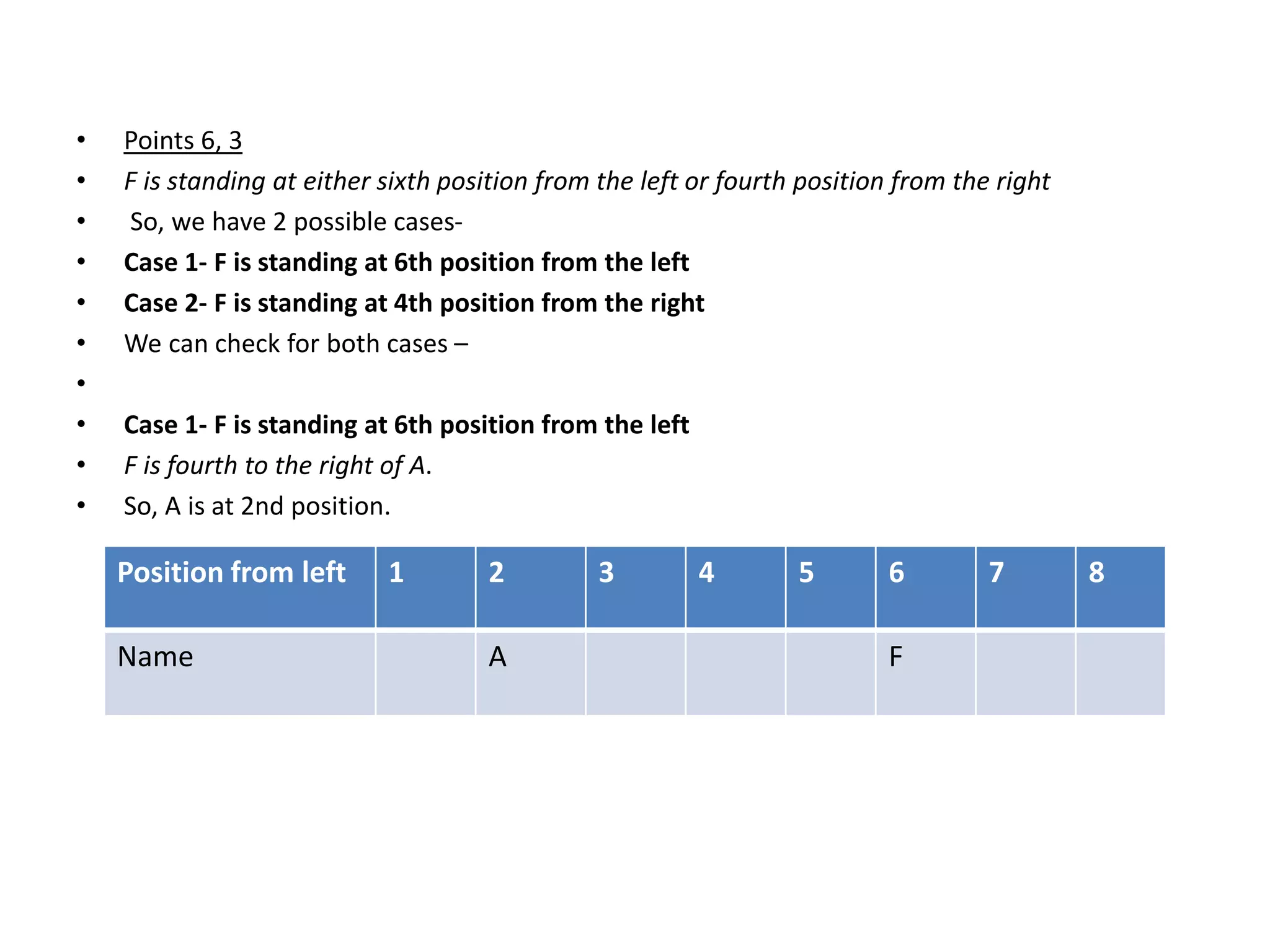
• Points 6, 3
• F is standing at either sixth position from the left or fourth position from the right
• So, we have 2 possible cases-
• Case 1- F is standing at 6th position from the left
• Case 2- F is standing at 4th position from the right
• We can check for both cases –
•
• Case 1- F is standing at 6th position from the left
• F is fourth to the right of A. So, A is at 2nd position.
Position from left 1 2 3 4 5 6 7 8
Name
• Points 6, 3
• F is standing at either sixth position from the left or fourth position from the right
• So, we have 2 possible cases-
• Case 1- F is standing at 6th position from the left
• Case 2- F is standing at 4th position from the right
• We can check for both cases –
•
• Case 1- F is standing at 6th position from the left
• F is fourth to the right of A.
• So, A is at 2nd position.
Position from left 1 2 3 4 5 6 7 8
Name A F
Approach 1
• Points 2,1,4,5 (points 6 and 3 are used)
• C and F are not at adjacent positions
• So, C is neither at 5th nor at 7th position
• Only one girl is sitting between E and G. It is also known that G is not standing at any of the extreme
positions
• Neither B nor E is standing in any of extreme positions. Further it is known that both are immediate
neighbours of each other
• C is second to left of D
• The linear arrangement of case 1 (by looking at all possibilities) can be modified as-
Position from left 1 2 3 4 5 6 7 8
Name A F
Approach 2
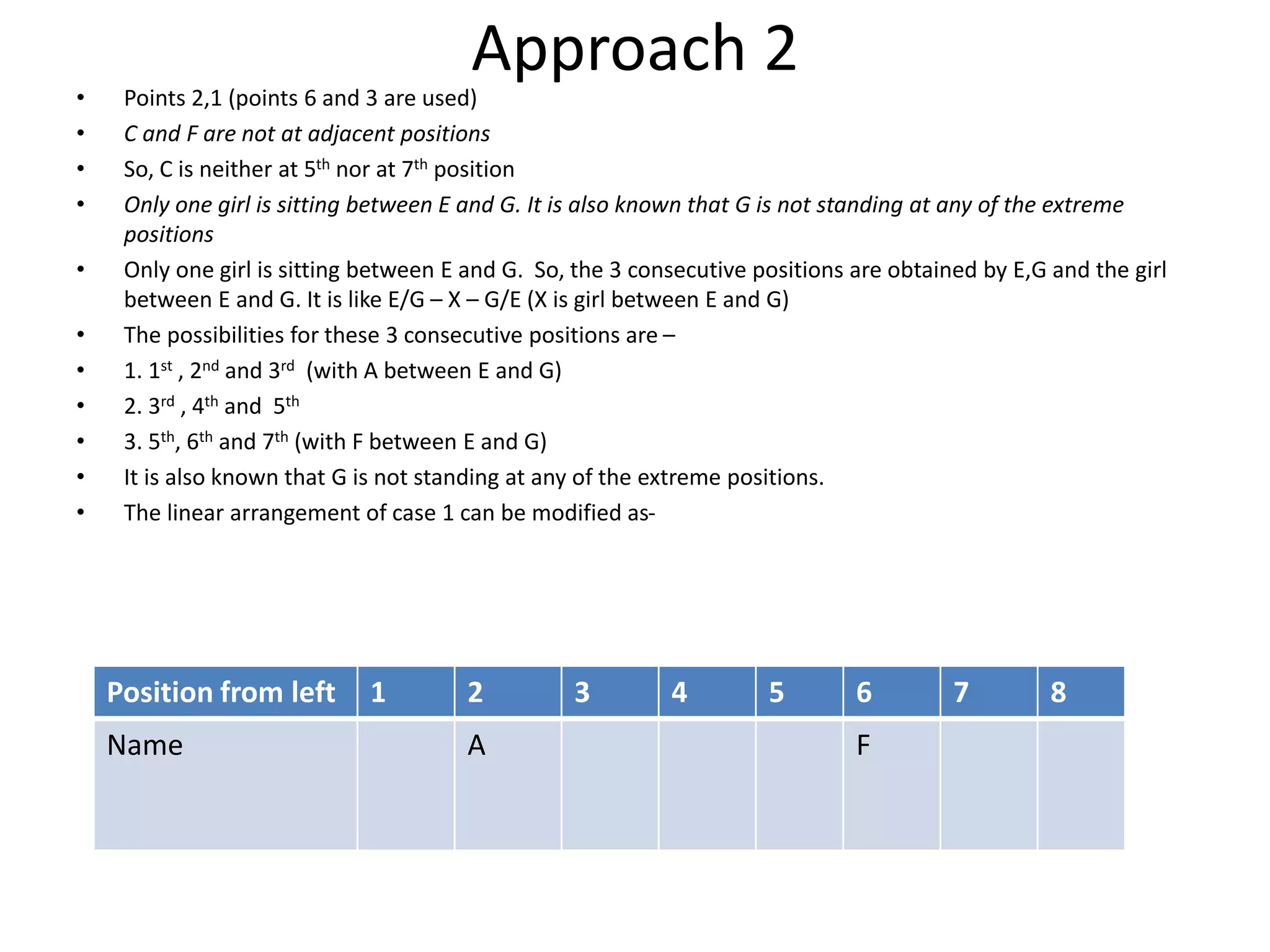
• Points 2,1 (points 6 and 3 are used)
• C and F are not at adjacent positions
• So, C is neither at 5th nor at 7th position
• Only one girl is sitting between E and G. It is also known that G is not standing at any of the extreme
positions
• Only one girl is sitting between E and G. So, the 3 consecutive positions are obtained by E,G and the girl
between E and G. It is like E/G – X – G/E (X is girl between E and G)
• The possibilities for these 3 consecutive positions are –
• 1. 1st , 2nd and 3rd (with A between E and G)
• 2. 3rd , 4th and 5th
• 3. 5th, 6th and 7th (with F between E and G)
• It is also known that G is not standing at any of the extreme positions.
• The linear arrangement of case 1 can be modified as-
Position from left 1 2 3 4 5 6 7 8
Name A F
• Points 2,1 (points 6 and 3 are used)
• C and F are not at adjacent positions
• So, C is neither at 5th nor at 7th position
• Only one girl is sitting between E and G. It is also known that G is not standing at any of the extreme
positions
• Only one girl is sitting between E and G. So, the 3 consecutive positions are obtained by E,G and the girl
between E and G. It is like E/G – X – G/E (X is girl between E and G)
• The possibilities for these 3 consecutive positions are –
• 1. 1st , 2nd and 3rd (with A between E and G)
• 2. 3rd , 4th and 5th
• 3. 5th, 6th and 7th (with F between E and G)
• It is also known that G is not standing at any of the extreme positions.
• The linear arrangement of case 1 can be modified as-
Position from left 1 2 3 4 5 6 7 8
Name xG A xC F xC xG
• Point 4 [points 6, 3, 2 and 1(partially) are used]
• Neither B nor E is standing in any of extreme positions. Further it is known that both are immediate
neighbours of each other
• Neither B nor E is standing in any of extreme positions
B and E are immediate neighbours of each other.
The possibilities for E are-
1. E at position 3 (with B ang G at positions 4 and 5 respectively)
2. E at position 5 (with B ang G at positions 4 and 3/7 respectively)
(E cannot be at position 4 or 7. Why?)
So, B is at potion 4 and E is either at 3rd or 5th position
The linear arrangement of case 1 can be modified as-
Position from left 1 2 3 4 5 6 7 8
Name xG A xC F xC xG
• Point 4 [points 6, 3, 2 and 1(partially) are used]
• Neither B nor E is standing in any of extreme positions. Further it is known that both are immediate
neighbours of each other
• Neither B nor E is standing in any of extreme positions
B and E are immediate neighbours of each other.
The possibilities for E are-
1. E at position 3 (with B ang G at positions 4 and 5 respectively)
2. E at position 5 (with B ang G at positions 4 and 3/7 respectively)
(E cannot be at position 4 or 7. Why?)
So, B is at potion 4 and E is either at 3rd or 5th position
The linear arrangement of case 1 can be modified as-
Position from left 1 2 3 4 5 6 7 8
Name xG
xB
xE
A B xC F xC xG
xB
xE
• Point 5 [points 6, 3, 2, 4 and 1(partially) are used]
C is second to left of D
The only possibility for C and D is -C at position 1 and D at 3 (with E at 5 and G at 7)
(why cant be C at 3?)
Position from left 1 2 3 4 5 6 7 8
Name xG
xB
xE
A B xC F xC xG
xB
xE
• Point 5 [points 6, 3, 2, 4 and 1 are used]
C is second to left of D
The only possibility for C and D is -C at position 1 and D at 3 (with E at 5 and G at 7)
(why can't be C at 3?)
Position from left 1 2 3 4 5 6 7 8
Name C A D B E F G H
• Case 2- F is standing at 4th position from the right
• F is fourth to the right of A. So, A is at 1st position.
Position from left 1 2 3 4 5 6 7 8
Name A F
• Now, B, E and G are not at extreme position. So, B, E or G is not at 8th position. So, we have
now 3 options for 8th position- C, D & H. C is second to left of D. So, C cannot be at 8th
position. If D is at 8th position, C will be at 6th position. But, C and F are not adjacent. So, D is
not at 8th position. So, H must be at 8th position.
• C and F are not at adjacent positions
• The linear arrangement in case 2 can be modified as-
Position from left 1 2 3 4 5 6 7 8
Name A xC F xC H
• C is second to left of D
• So, there are 2 possibilities-
• 1. C and D at positions 2 and 4 respectively
• 2. C and D at positions 4 and 6 respectively. But it is not possible.
• So, C and D are at 2nd and 4th positions respectively.
• The linear arrangement in case 2 can be modified as-
Position from left 1 2 3 4 5 6 7 8
Name A C D F xC H
• Only one girl is sitting between E and G. So, there must be gap of 1 position between
positions of E and G. But, there Is no such possibility in linear arrangement in case 2
• So, this is not feasible arrangement
Position from left 1 2 3 4 5 6 7 8
Name A C D F xC H
So, the final arrangement is as we obtained in case 1 which is shown below-
• 16. B is 2nd to the right of A. Hence option (e) is the answer
• 17. C and H are standing at the extreme positions. Hence option (e) is the answer
• 18. Three girls are standing between C and E. Hence option (c) is the answer
• 19. A is 2nd to the left of B and D is 2nd to the left of E. In a similar way F is 2nd to the left of H.
Hence option (a) is the answer
• 20. E is standing in exact middle of the girls who are at the 1st position from right & 2nd position
from left. Hence option (c) is the answer
Position from left 1 2 3 4 5 6 7 8
Name C A D B E F G H

linear_arrangement_3rd[1].pptx

  • 1.
    Some Solved examples(with step wise detailed solution) We will show the complete solution for 2 set of questions on linear arrangement for better understanding of solving the problems
  • 2.
    Directions for set3 • Directions for 11 to 15 • The top 5 students of a class (all are boys) are P, Q, R, S & T (not in any order). They are wearing shirts of Red, White, Black, Green & Blue colours (not in any order). • 1. R got better rank then Q who was wearing green shirt. • 2. T got 1st rank & S got the 5th rank. • 3. Neither Q nor R got the 2nd best rank among the 5 students. • 4. The red shirt is worn by S. • 5. The boy who was wearing black shirt got a rank which is better than at least 3 students. • 6. At least 1 boy got the better rank than the rank obtained by the boy who is wearing white shirt. • 7. A smaller rank is better than larger rank. • 11. What is the rank obtained by Q? • (a) 2nd (b) 3rd (c) 4th (d) either 3rd or 4th (e) cannot be determined • 12. Who is wearing white shirt? • (a) P (b)R (c) T (d) either P or R (e) cannot be determined • 13. If R is wearing the White shirt, then what is colour of shirt of T? • (a) Black (b) Green (c) Blue (d) either Green or Blue (e) cannot be determined • 14. If black shirt is worn by P, who is wearing blue shirt? • (a) P (b) R (c) T (d) either P or T (e) cannot be determined • 15. How many different arrangements are possible? • (a) 1 (b) 2 (c) 3 (d) 4 (e) more than 4
  • 3.
    • General Solutionfor 11 to 15 • P, Q, R, S & T are arranged in 1st to 5th ranks & wearing shirts of Red, White, Black, Green & Blue colours. The arrangement must be linear as we will start with rank 1 and will end with rank 5. This is how we can show the arrangement Rank 1 2 3 4 5 Name Colour
  • 4.
    • Points 2,3 and 4 • T got 1st rank & S got the 5th rank. • Neither Q nor R got the 2nd best rank among the 5 students. • We know T and S didn’t got 2nd rank. So, P got 2nd rank • The red shirt is worn by S. • Using it, the table is modified as- Rank 1 2 3 4 5 Name Colour
  • 5.
    • Points 2,3 and 4 • T got 1st rank & S got the 5th rank. • Neither Q nor R got the 2nd best rank among the 5 students. • We know T and S didn’t got 2nd rank. So, P got 2nd rank • The red shirt is worn by S. • Using it, the table is modified as- • Using it, the table is modified as- Rank 1 2 3 4 5 Name T P S Colour Red
  • 6.
    • Point 1(points 2, 3 and 4 are used) • R got better rank then Q who was wearing green shirt. • So, R and Q got 3rd and 4th ranks, respectively. Q is wearing green shirt • Using it, the table is modified as- • Using it, the table is modified as- Rank 1 2 3 4 5 Name T P S Colour Red
  • 7.
    • Point 1(points 2, 3 and 4 are used) • R got better rank then Q who was wearing green shirt. • So, R and Q got 3rd and 4th ranks, respectively. Q is wearing green shirt • Using it, the table is modified as- Rank 1 2 3 4 5 Name T P R Q S Colour Green Red
  • 8.
    • Points 5and 6 (points 2, 3, 4 and 1 are used) • The boy who was wearing black shirt got a rank which is better than at least 3 students. • so his rank is either 1st or 2nd. So, either T or P is wearing black shirt. • At least 1 boy got the better rank than the rank obtained by the boy who is wearing white shirt. • So, T cannot be wearing the white shirt. So, either P or R is wearing black shirt • Using it, the table is modified as- Rank 1 2 3 4 5 Name T P R Q S Colour Green Red
  • 9.
    • Points 5and 6 (points 2, 3, 4 and 1 are used) • The boy who was wearing black shirt got a rank which is better than at least 3 students. • so his rank is either 1st or 2nd. So, either T or P is wearing black shirt. • At least 1 boy got the better rank than the rank obtained by the boy who is wearing white shirt. • So, T cannot be wearing the white shirt. So, either P or R is wearing black shirt • Using it, the table is modified as- Rank 1 2 3 4 5 Name T P R Q S Colour Green Red
  • 10.
    • Points 5and 6 (points 2, 3, 4 and 1 are used) • The boy who was wearing black shirt got a rank which is better than at least 3 students. • so his rank is either 1st or 2nd. So, either T or P is wearing black shirt. • At least 1 boy got the better rank than the rank obtained by the boy who is wearing white shirt. • So, T cannot be wearing the white shirt. So, either P or R is wearing black shirt • Using it, the table is modified as- Rank 1 2 3 4 5 Name T P R Q S Colour Black/Blue Black/White/Blue White/Blue Green Red
  • 11.
    • 11. Qobtained 4th rank. Hence option (c) is the answer • 12. Either P or R is wearing white shirt. Hence option (d) is the answer Rank 1 2 3 4 5 Name T P R Q S Colour Black/Blue Black/White/Blue White/Blue Green Red
  • 12.
    • 13. IfR is wearing the White shirt, then the arrangement can be modified as- • So, the colour of shirt which T is wearing is either Black or Blue. So, it cannot be determined. Hence option (e) is the answer Rank 1 2 3 4 5 Name T P R Q S Colour Black/Blue Black/Blue White Green Red
  • 13.
    • 14. Ifblack shirt is worn by P, then the arrangement can be modified as- • T is wearing blue shirt. Hence option (c) is the answer Rank 1 2 3 4 5 Name T P R Q S Colour Blue Black White Green Red
  • 14.
    • 15. Thereare 3 possible arrangements • Hence option (c) is the answer Rank 1 2 3 4 5 Name T P R Q S Colour-1 Black White Blue Green Red Colour-2 Black Blue White Green Red Colour-3 Blue Black White Green Red
  • 15.
    Set 4 • Directionsfor 16 to 20: • A, B, C, D, E, F, G and H are 8 girls who are standing in a straight line (facing north). • Further it is known that- • 1. Only one girl is sitting between E and G. It is also known that G is not standing at any of the extreme positions • 2. C and F are not at adjacent positions • 3. F is fourth to the right of A • 4. Neither B nor E is standing in any of extreme positions. Further it is known that both are immediate neighbours of each other • 5. C is second to left of D • 6. F is standing at either sixth position from the left or fourth position from the right. • 16. What is the position of B with respect of A? • (a) 5th to the left (b) Immediate neighbor (c) 2nd to the left (d) 3rd to the right (e) None of these • 17. Who are standing at the extreme positions? • (a) A and F (b) H and D (c) C and F (d) H and A (e) H and C • 18. How many girls are standing between C and E? • (a) 1 (b) 2 (c) 3 (d) 4 (e) None of these • 19. If A is related to B is a way, and it is also known that D is relate in same way to E, then to whom F is related in same way? • (a) H (b) A (c) C (d) D (e) G • 20. Who among the following is standing in exact middle of the girls who are at the 1st position from right & 2nd position from left? • (a) F (b) B (c) E (d) D (e) A
  • 16.
    • General solution- A, B, C, D, E, F, G and H are 8 girls who are standing in a straight line (facing north). There are 8 positions which can be shown from left to right. • The tabular arrangement is as follows- Position from left 1 2 3 4 5 6 7 8 Name
  • 17.
    • Points 6,3 • F is standing at either sixth position from the left or fourth position from the right • So, we have 2 possible cases- • Case 1- F is standing at 6th position from the left • Case 2- F is standing at 4th position from the right • We can check for both cases – • • Case 1- F is standing at 6th position from the left • F is fourth to the right of A. So, A is at 2nd position. Position from left 1 2 3 4 5 6 7 8 Name
  • 18.
    • Points 6,3 • F is standing at either sixth position from the left or fourth position from the right • So, we have 2 possible cases- • Case 1- F is standing at 6th position from the left • Case 2- F is standing at 4th position from the right • We can check for both cases – • • Case 1- F is standing at 6th position from the left • F is fourth to the right of A. • So, A is at 2nd position. Position from left 1 2 3 4 5 6 7 8 Name A F
  • 19.
    Approach 1 • Points2,1,4,5 (points 6 and 3 are used) • C and F are not at adjacent positions • So, C is neither at 5th nor at 7th position • Only one girl is sitting between E and G. It is also known that G is not standing at any of the extreme positions • Neither B nor E is standing in any of extreme positions. Further it is known that both are immediate neighbours of each other • C is second to left of D • The linear arrangement of case 1 (by looking at all possibilities) can be modified as- Position from left 1 2 3 4 5 6 7 8 Name A F
  • 20.
    Approach 2 • Points2,1 (points 6 and 3 are used) • C and F are not at adjacent positions • So, C is neither at 5th nor at 7th position • Only one girl is sitting between E and G. It is also known that G is not standing at any of the extreme positions • Only one girl is sitting between E and G. So, the 3 consecutive positions are obtained by E,G and the girl between E and G. It is like E/G – X – G/E (X is girl between E and G) • The possibilities for these 3 consecutive positions are – • 1. 1st , 2nd and 3rd (with A between E and G) • 2. 3rd , 4th and 5th • 3. 5th, 6th and 7th (with F between E and G) • It is also known that G is not standing at any of the extreme positions. • The linear arrangement of case 1 can be modified as- Position from left 1 2 3 4 5 6 7 8 Name A F
  • 21.
    • Points 2,1(points 6 and 3 are used) • C and F are not at adjacent positions • So, C is neither at 5th nor at 7th position • Only one girl is sitting between E and G. It is also known that G is not standing at any of the extreme positions • Only one girl is sitting between E and G. So, the 3 consecutive positions are obtained by E,G and the girl between E and G. It is like E/G – X – G/E (X is girl between E and G) • The possibilities for these 3 consecutive positions are – • 1. 1st , 2nd and 3rd (with A between E and G) • 2. 3rd , 4th and 5th • 3. 5th, 6th and 7th (with F between E and G) • It is also known that G is not standing at any of the extreme positions. • The linear arrangement of case 1 can be modified as- Position from left 1 2 3 4 5 6 7 8 Name xG A xC F xC xG
  • 22.
    • Point 4[points 6, 3, 2 and 1(partially) are used] • Neither B nor E is standing in any of extreme positions. Further it is known that both are immediate neighbours of each other • Neither B nor E is standing in any of extreme positions B and E are immediate neighbours of each other. The possibilities for E are- 1. E at position 3 (with B ang G at positions 4 and 5 respectively) 2. E at position 5 (with B ang G at positions 4 and 3/7 respectively) (E cannot be at position 4 or 7. Why?) So, B is at potion 4 and E is either at 3rd or 5th position The linear arrangement of case 1 can be modified as- Position from left 1 2 3 4 5 6 7 8 Name xG A xC F xC xG
  • 23.
    • Point 4[points 6, 3, 2 and 1(partially) are used] • Neither B nor E is standing in any of extreme positions. Further it is known that both are immediate neighbours of each other • Neither B nor E is standing in any of extreme positions B and E are immediate neighbours of each other. The possibilities for E are- 1. E at position 3 (with B ang G at positions 4 and 5 respectively) 2. E at position 5 (with B ang G at positions 4 and 3/7 respectively) (E cannot be at position 4 or 7. Why?) So, B is at potion 4 and E is either at 3rd or 5th position The linear arrangement of case 1 can be modified as- Position from left 1 2 3 4 5 6 7 8 Name xG xB xE A B xC F xC xG xB xE
  • 24.
    • Point 5[points 6, 3, 2, 4 and 1(partially) are used] C is second to left of D The only possibility for C and D is -C at position 1 and D at 3 (with E at 5 and G at 7) (why cant be C at 3?) Position from left 1 2 3 4 5 6 7 8 Name xG xB xE A B xC F xC xG xB xE
  • 25.
    • Point 5[points 6, 3, 2, 4 and 1 are used] C is second to left of D The only possibility for C and D is -C at position 1 and D at 3 (with E at 5 and G at 7) (why can't be C at 3?) Position from left 1 2 3 4 5 6 7 8 Name C A D B E F G H
  • 26.
    • Case 2-F is standing at 4th position from the right • F is fourth to the right of A. So, A is at 1st position. Position from left 1 2 3 4 5 6 7 8 Name A F
  • 27.
    • Now, B,E and G are not at extreme position. So, B, E or G is not at 8th position. So, we have now 3 options for 8th position- C, D & H. C is second to left of D. So, C cannot be at 8th position. If D is at 8th position, C will be at 6th position. But, C and F are not adjacent. So, D is not at 8th position. So, H must be at 8th position. • C and F are not at adjacent positions • The linear arrangement in case 2 can be modified as- Position from left 1 2 3 4 5 6 7 8 Name A xC F xC H
  • 28.
    • C issecond to left of D • So, there are 2 possibilities- • 1. C and D at positions 2 and 4 respectively • 2. C and D at positions 4 and 6 respectively. But it is not possible. • So, C and D are at 2nd and 4th positions respectively. • The linear arrangement in case 2 can be modified as- Position from left 1 2 3 4 5 6 7 8 Name A C D F xC H
  • 29.
    • Only onegirl is sitting between E and G. So, there must be gap of 1 position between positions of E and G. But, there Is no such possibility in linear arrangement in case 2 • So, this is not feasible arrangement Position from left 1 2 3 4 5 6 7 8 Name A C D F xC H
  • 30.
    So, the finalarrangement is as we obtained in case 1 which is shown below- • 16. B is 2nd to the right of A. Hence option (e) is the answer • 17. C and H are standing at the extreme positions. Hence option (e) is the answer • 18. Three girls are standing between C and E. Hence option (c) is the answer • 19. A is 2nd to the left of B and D is 2nd to the left of E. In a similar way F is 2nd to the left of H. Hence option (a) is the answer • 20. E is standing in exact middle of the girls who are at the 1st position from right & 2nd position from left. Hence option (c) is the answer Position from left 1 2 3 4 5 6 7 8 Name C A D B E F G H