REASONING
PRACTICE PAPER-2
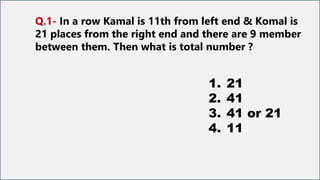
Q.1- In a row Kamal is 11th from left end & Komal is
21 places from the right end and there are 9 member
between them. Then what is total number ?
1. 21
2. 41
3. 41 or 21
4. 11
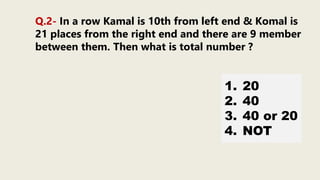
Q.2- In a row Kamal is 10th from left end & Komal is
21 places from the right end and there are 9 member
between them. Then what is total number ?
1. 20
2. 40
3. 40 or 20
4. NOT
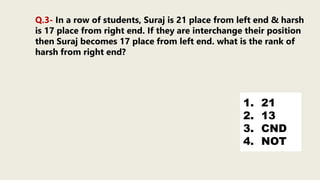
Q.3- In a row of students, Suraj is 21 place from left end & harsh
is 17 place from right end. If they are interchange their position
then Suraj becomes 17 place from left end. what is the rank of
harsh from right end?
1. 21
2. 13
3. CND
4. NOT
Q.4- In a row of children, Bobby is 5th from left end & Mona is
6th from right end. If they are interchange their position then
Bobby becomes 13 place from left end. what is the rank of Mona
from right end?
1. 12
2. 14
3. 04
4. NOT
Q.5-7- Six persons A, B, C, D, E and F are comparing their weights and each of
them is having a different weight. D is heavier than only two persons. E is
heavier than F and lighter than D. C’s weight is less than only B’s weight. The
third heaviest weight is 100kgs and the fifth heaviest weight is 60kgs.
Q.5-What is the possible weight of D?
(1) 60kgs (2) 100kgs
(3) 105kgs (4) 75 kgs
(5) Data inadequate
Q.5-7- Six persons A, B, C, D, E and F are comparing their weights and each of
them is having a different weight. D is heavier than only two persons. E is
heavier than F and lighter than D. C’s weight is less than only B’s weight. The
third heaviest weight is 100kgs and the fifth heaviest weight is 60kgs.
Q.6-Who is the third heaviest?
(1) D (2) E (3) A (4) B
(5) Data inadequate
Q.5-7- Six persons A, B, C, D, E and F are comparing their weights and each of
them is having a different weight. D is heavier than only two persons. E is
heavier than F and lighter than D. C’s weight is less than only B’s weight. The
third heaviest weight is 100kgs and the fifth heaviest weight is 60kgs.
Q.7-If the heaviest weight is 30kgs more than A’s weight, then what is the
possible weight of C?
(1) 130 (2) 100 (3) 115 (4) 90
(5) Data inadequate
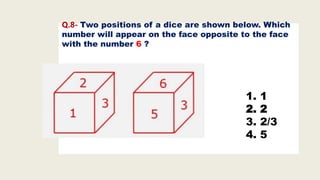
Q.8- Two positions of a dice are shown below. Which
number will appear on the face opposite to the face
with the number 6 ?
1. 1
2. 2
3. 2/3
4. 5
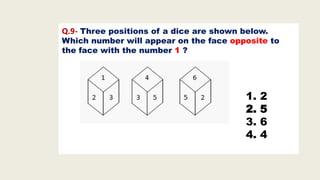
Q.9- Three positions of a dice are shown below.
Which number will appear on the face opposite to
the face with the number 1 ?
1. 2
2. 5
3. 6
4. 4
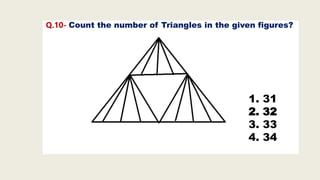
Q.10- Count the number of Triangles in the given figures?
1. 31
2. 32
3. 33
4. 34
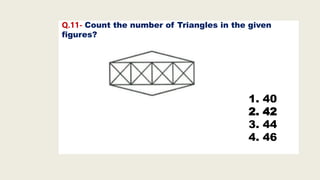
Q.11- Count the number of Triangles in the given
figures?
1. 40
2. 42
3. 44
4. 46
Q.12- Count the number of Triangles in the given
figures?
1. 20
2. 21
3. 24
4. 22
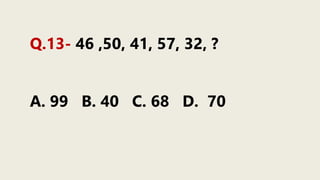
Q.13- 46 ,50, 41, 57, 32, ?
A. 99 B. 40 C. 68 D. 70
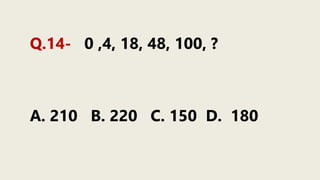
Q.14- 0 ,4, 18, 48, 100, ?
A. 210 B. 220 C. 150 D. 180
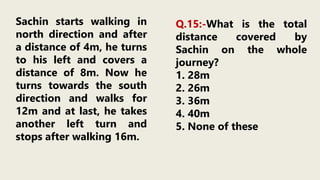
Sachin starts walking in
north direction and after
a distance of 4m, he turns
to his left and covers a
distance of 8m. Now he
turns towards the south
direction and walks for
12m and at last, he takes
another left turn and
stops after walking 16m.
Q.15:-What is the total
distance covered by
Sachin on the whole
journey?
1. 28m
2. 26m
3. 36m
4. 40m
5. None of these
Sachin starts walking in
north direction and after
a distance of 4m, he turns
to his left and covers a
distance of 8m. Now he
turns towards the south
direction and walks for
12m and at last, he takes
another left turn and
stops after walking 16m.
Q.16:-The second turning
point of Sachin is in
which direction to his last
destination?
1. South-East
2. North
3. West
4. North-West
5. None of these
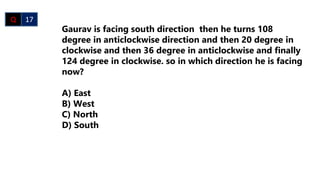
Gaurav is facing south direction then he turns 108
degree in anticlockwise direction and then 20 degree in
clockwise and then 36 degree in anticlockwise and finally
124 degree in clockwise. so in which direction he is facing
now?
A) East
B) West
C) North
D) South
Q 17
A man is facing North . He turns 75° in the clockwise
direction and then another 180° in the same direction
and then 300° in the anti-clockwise direction. Which
direction is he facing now?
Q 18
A) East
B) West
C) North-east
D) North-west
Eight people are sitting around a
square table. Four of them are
sitting at the corners facing
inside and the remaining four
are sitting at the sides of the
table facing outside. K sits
immediate right of O. E sits third
to the right of K. One person sits
between V and E. M sits third to
the right of P, who is not a
neighbor of V. Z sits opposite T,
who does not face outside. T is
not a neighbor of P.
Q.19:-Who sits near T?
1. O
2. K
3. M
4. P
5. None of these
Eight people are sitting around a
square table. Four of them are
sitting at the corners facing
inside and the remaining four
are sitting at the sides of the
table facing outside. K sits
immediate right of O. E sits third
to the right of K. One person sits
between V and E. M sits third to
the right of P, who is not a
neighbor of V. Z sits opposite T,
who does not face outside. T is
not a neighbor of P.
Q.20:-How many people sit
between Z and M?
1. Two
2. Five
3. Three
4. Four
5. None
Eight people are sitting around a
square table. Four of them are
sitting at the corners facing
inside and the remaining four
are sitting at the sides of the
table facing outside. K sits
immediate right of O. E sits third
to the right of K. One person sits
between V and E. M sits third to
the right of P, who is not a
neighbor of V. Z sits opposite T,
who does not face outside. T is
not a neighbor of P.
Q.21:-Who among the
following sits second to
the left of K?
1. Z
2. T
3. P
4. V
5. None of these
Eight people A, B, C, U, V, W, X,
and P live in an eight-story
building but not necessarily in
the same order. The ground
floor is numbered 1 and the top
floor is numbered 8. Three
people live between V and B.
Four people live between B and
A. Two people live between A
and C. Two people live between
C and P. P is neither at the
bottom nor on the top. W lives
above C but not immediately
above. U lives above X.
Q.21:-Who lives on the
ground floor?
1. V
2. W
3. U
4. A
5. None of these
Eight people A, B, C, U, V, W, X,
and P live in an eight-story
building but not necessarily in
the same order. The ground
floor is numbered 1 and the top
floor is numbered 8. Three
people live between V and B.
Four people live between B and
A. Two people live between A
and C. Two people live between
C and P. P is neither at the
bottom nor on the top. W lives
above C but not immediately
above. U lives above X.
Q.22:-Who lives between
P and U?
1. C
2. V
3. X
4. B
5. None of these
Eight people A, B, C, U, V, W, X,
and P live in an eight-story
building but not necessarily in
the same order. The ground
floor is numbered 1 and the top
floor is numbered 8. Three
people live between V and B.
Four people live between B and
A. Two people live between A
and C. Two people live between
C and P. P is neither at the
bottom nor on the top. W lives
above C but not immediately
above. U lives above X.
Q.23:-How many people
live above C?
1. Four
2. Five
3. Three
4. Six
5. None of these
Q.24:-Statements:
Only a few Reasoning are Maths .
All Maths are English.
Only a few English are Account.
Conclusions:
I. Some Reasoning are Account.
II. No Reasoning are Account.
Only I follows
Only II follows
Either I or II follows
Neither I Nor II follows
Both follows
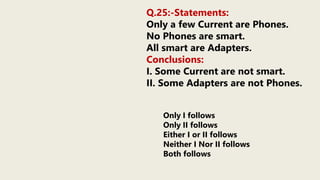
Q.25:-Statements:
Only a few Current are Phones.
No Phones are smart.
All smart are Adapters.
Conclusions:
I. Some Current are not smart.
II. Some Adapters are not Phones.
Only I follows
Only II follows
Either I or II follows
Neither I Nor II follows
Both follows
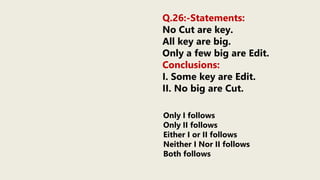
Q.26:-Statements:
No Cut are key.
All key are big.
Only a few big are Edit.
Conclusions:
I. Some key are Edit.
II. No big are Cut.
Only I follows
Only II follows
Either I or II follows
Neither I Nor II follows
Both follows
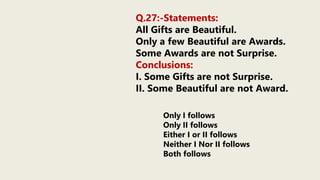
Q.27:-Statements:
All Gifts are Beautiful.
Only a few Beautiful are Awards.
Some Awards are not Surprise.
Conclusions:
I. Some Gifts are not Surprise.
II. Some Beautiful are not Award.
Only I follows
Only II follows
Either I or II follows
Neither I Nor II follows
Both follows
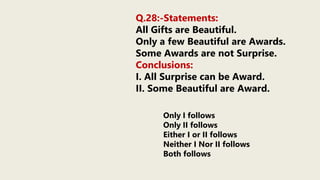
Q.28:-Statements:
All Gifts are Beautiful.
Only a few Beautiful are Awards.
Some Awards are not Surprise.
Conclusions:
I. All Surprise can be Award.
II. Some Beautiful are Award.
Only I follows
Only II follows
Either I or II follows
Neither I Nor II follows
Both follows
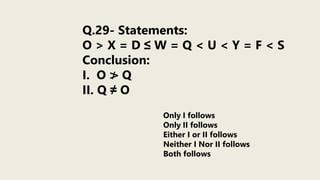
Q.29- Statements:
O > X = D ≤ W = Q < U < Y = F < S
Conclusion:
I. O ≯ Q
II. Q ≠ O
Only I follows
Only II follows
Either I or II follows
Neither I Nor II follows
Both follows
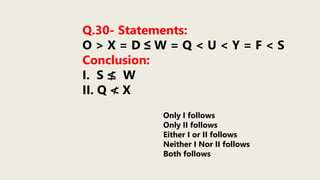
Q.30- Statements:
O > X = D ≤ W = Q < U < Y = F < S
Conclusion:
I. S ≰ W
II. Q ≮ X
Only I follows
Only II follows
Either I or II follows
Neither I Nor II follows
Both follows
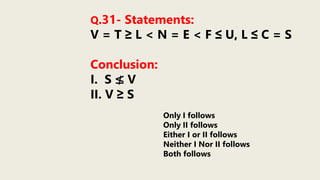
Q.31- Statements:
V = T ≥ L < N = E < F ≤ U, L ≤ C = S
Conclusion:
I. S ≰ V
II. V ≥ S
Only I follows
Only II follows
Either I or II follows
Neither I Nor II follows
Both follows
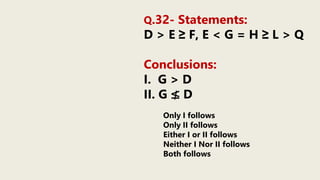
Q.32- Statements:
D > E ≥ F, E < G = H ≥ L > Q
Conclusions:
I. G > D
II. G ≰ D
Only I follows
Only II follows
Either I or II follows
Neither I Nor II follows
Both follows
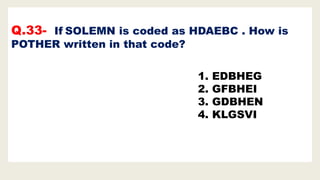
Q.33- If SOLEMN is coded as HDAEBC . How is
POTHER written in that code?
1. EDBHEG
2. GFBHEI
3. GDBHEN
4. KLGSVI
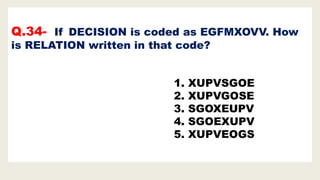
Q.34- If DECISION is coded as EGFMXOVV. How
is RELATION written in that code?
1. XUPVSGOE
2. XUPVGOSE
3. SGOXEUPV
4. SGOEXUPV
5. XUPVEOGS
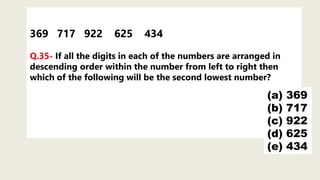
369 717 922 625 434
Q.35- If all the digits in each of the numbers are arranged in
descending order within the number from left to right then
which of the following will be the second lowest number?
(a) 369
(b) 717
(c) 922
(d) 625
(e) 434
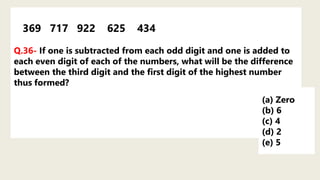
369 717 922 625 434
Q.36- If one is subtracted from each odd digit and one is added to
each even digit of each of the numbers, what will be the difference
between the third digit and the first digit of the highest number
thus formed?
(a) Zero
(b) 6
(c) 4
(d) 2
(e) 5
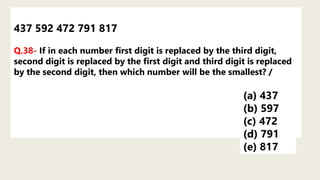
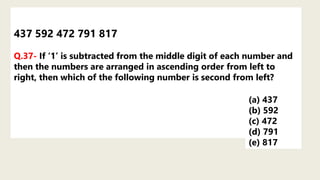
437 592 472 791 817
Q.37- If ‘1’ is subtracted from the middle digit of each number and
then the numbers are arranged in ascending order from left to
right, then which of the following number is second from left?
(a) 437
(b) 592
(c) 472
(d) 791
(e) 817
437 592 472 791 817
Q.38- If in each number first digit is replaced by the third digit,
second digit is replaced by the first digit and third digit is replaced
by the second digit, then which number will be the smallest? /
(a) 437
(b) 597
(c) 472
(d) 791
(e) 817
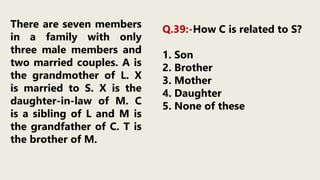
There are seven members
in a family with only
three male members and
two married couples. A is
the grandmother of L. X
is married to S. X is the
daughter-in-law of M. C
is a sibling of L and M is
the grandfather of C. T is
the brother of M.
Q.39:-How C is related to S?
1. Son
2. Brother
3. Mother
4. Daughter
5. None of these
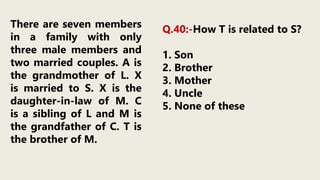
There are seven members
in a family with only
three male members and
two married couples. A is
the grandmother of L. X
is married to S. X is the
daughter-in-law of M. C
is a sibling of L and M is
the grandfather of C. T is
the brother of M.
Q.40:-How T is related to S?
1. Son
2. Brother
3. Mother
4. Uncle
5. None of these
There are seven members
in a family with only
three male members and
two married couples. A is
the grandmother of L. X
is married to S. X is the
daughter-in-law of M. C
is a sibling of L and M is
the grandfather of C. T is
the brother of M.
Q.41:-Who is the mother-in-
law of X?
1. T
2. L
3. A
4. M
5. None of these
Eight persons S, T, U, V, W, X, Y and
Z live in an eight storey building
such that ground floor is numbered
as 1 and the top floor is numbered as
8. X lives on an even numbered floor
below the floor number 6. More than
two persons live between X and S. S
does not live on an odd numbered
floor. The number of person living
above S is the same as the number of
person living below V. Two people
live between Y and T. T lives just
above X. Only one person lives
between U and Z. Z lives on one of
the floors above Y.
Q.42- How many persons live
above Y?
One
Two
Three
Four
More than four
Eight persons S, T, U, V, W, X, Y and
Z live in an eight storey building
such that ground floor is numbered
as 1 and the top floor is numbered as
8. X lives on an even numbered floor
below the floor number 6. More than
two persons live between X and S. S
does not live on an odd numbered
floor. The number of person living
above S is the same as the number of
person living below V. Two people
live between Y and T. T lives just
above X. Only one person lives
between U and Z. Z lives on one of
the floors above Y.
Q.43- How many persons live
between S and V?/
One
Two
Three
Four
More than four
Eight persons S, T, U, V, W, X, Y and
Z live in an eight storey building
such that ground floor is numbered
as 1 and the top floor is numbered as
8. X lives on an even numbered floor
below the floor number 6. More than
two persons live between X and S. S
does not live on an odd numbered
floor. The number of person living
above S is the same as the number of
person living below V. Two people
live between Y and T. T lives just
above X. Only one person lives
between U and Z. Z lives on one of
the floors above Y.
Q.44- Who among the following
lives just below W?
Y
U
T
X
Z
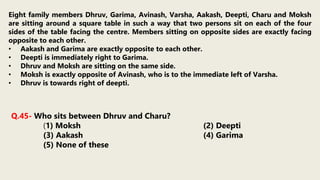
Eight family members Dhruv, Garima, Avinash, Varsha, Aakash, Deepti, Charu and Moksh
are sitting around a square table in such a way that two persons sit on each of the four
sides of the table facing the centre. Members sitting on opposite sides are exactly facing
opposite to each other.
• Aakash and Garima are exactly opposite to each other.
• Deepti is immediately right to Garima.
• Dhruv and Moksh are sitting on the same side.
• Moksh is exactly opposite of Avinash, who is to the immediate left of Varsha.
• Dhruv is towards right of deepti.
Q.45- Who sits between Dhruv and Charu?
(1) Moksh (2) Deepti
(3) Aakash (4) Garima
(5) None of these
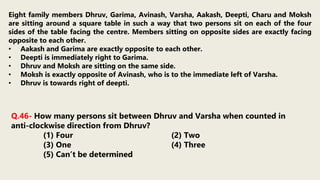
Eight family members Dhruv, Garima, Avinash, Varsha, Aakash, Deepti, Charu and Moksh
are sitting around a square table in such a way that two persons sit on each of the four
sides of the table facing the centre. Members sitting on opposite sides are exactly facing
opposite to each other.
• Aakash and Garima are exactly opposite to each other.
• Deepti is immediately right to Garima.
• Dhruv and Moksh are sitting on the same side.
• Moksh is exactly opposite of Avinash, who is to the immediate left of Varsha.
• Dhruv is towards right of deepti.
Q.46- How many persons sit between Dhruv and Varsha when counted in
anti-clockwise direction from Dhruv?
(1) Four (2) Two
(3) One (4) Three
(5) Can’t be determined
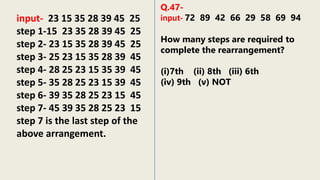
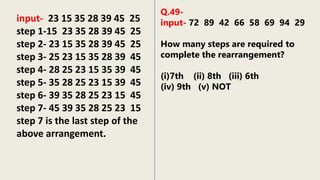
input- 23 15 35 28 39 45 25
step 1-15 23 35 28 39 45 25
step 2- 23 15 35 28 39 45 25
step 3- 25 23 15 35 28 39 45
step 4- 28 25 23 15 35 39 45
step 5- 35 28 25 23 15 39 45
step 6- 39 35 28 25 23 15 45
step 7- 45 39 35 28 25 23 15
step 7 is the last step of the
above arrangement.
Q.47-
input- 72 89 42 66 29 58 69 94
How many steps are required to
complete the rearrangement?
(i)7th (ii) 8th (iii) 6th
(iv) 9th (v) NOT
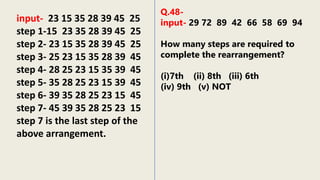
Q.48-
input- 29 72 89 42 66 58 69 94
How many steps are required to
complete the rearrangement?
(i)7th (ii) 8th (iii) 6th
(iv) 9th (v) NOT
input- 23 15 35 28 39 45 25
step 1-15 23 35 28 39 45 25
step 2- 23 15 35 28 39 45 25
step 3- 25 23 15 35 28 39 45
step 4- 28 25 23 15 35 39 45
step 5- 35 28 25 23 15 39 45
step 6- 39 35 28 25 23 15 45
step 7- 45 39 35 28 25 23 15
step 7 is the last step of the
above arrangement.
Q.49-
input- 72 89 42 66 58 69 94 29
How many steps are required to
complete the rearrangement?
(i)7th (ii) 8th (iii) 6th
(iv) 9th (v) NOT
input- 23 15 35 28 39 45 25
step 1-15 23 35 28 39 45 25
step 2- 23 15 35 28 39 45 25
step 3- 25 23 15 35 28 39 45
step 4- 28 25 23 15 35 39 45
step 5- 35 28 25 23 15 39 45
step 6- 39 35 28 25 23 15 45
step 7- 45 39 35 28 25 23 15
step 7 is the last step of the
above arrangement.
Q.50-
input- 29 42 72 89 66 58 69 94
How many steps are required to
complete the rearrangement?
(i)7th (ii) 8th (iii) 6th
(iv) 9th (v) NOT
input- 23 15 35 28 39 45 25
step 1-15 23 35 28 39 45 25
step 2- 23 15 35 28 39 45 25
step 3- 25 23 15 35 28 39 45
step 4- 28 25 23 15 35 39 45
step 5- 35 28 25 23 15 39 45
step 6- 39 35 28 25 23 15 45
step 7- 45 39 35 28 25 23 15
step 7 is the last step of the
above arrangement.
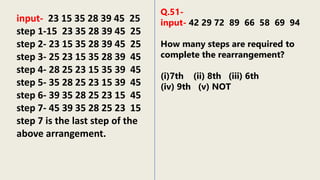
Q.51-
input- 42 29 72 89 66 58 69 94
How many steps are required to
complete the rearrangement?
(i)7th (ii) 8th (iii) 6th
(iv) 9th (v) NOT
input- 23 15 35 28 39 45 25
step 1-15 23 35 28 39 45 25
step 2- 23 15 35 28 39 45 25
step 3- 25 23 15 35 28 39 45
step 4- 28 25 23 15 35 39 45
step 5- 35 28 25 23 15 39 45
step 6- 39 35 28 25 23 15 45
step 7- 45 39 35 28 25 23 15
step 7 is the last step of the
above arrangement.
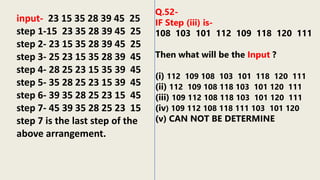
Q.52-
IF Step (iii) is-
108 103 101 112 109 118 120 111
Then what will be the Input ?
(i) 112 109 108 103 101 118 120 111
(ii) 112 109 108 118 103 101 120 111
(iii) 109 112 108 118 103 101 120 111
(iv) 109 112 108 118 111 103 101 120
(v) CAN NOT BE DETERMINE
input- 23 15 35 28 39 45 25
step 1-15 23 35 28 39 45 25
step 2- 23 15 35 28 39 45 25
step 3- 25 23 15 35 28 39 45
step 4- 28 25 23 15 35 39 45
step 5- 35 28 25 23 15 39 45
step 6- 39 35 28 25 23 15 45
step 7- 45 39 35 28 25 23 15
step 7 is the last step of the
above arrangement.
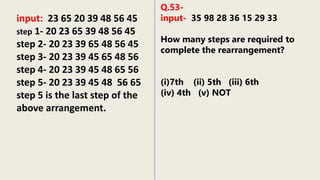
input: 23 65 20 39 48 56 45
step 1- 20 23 65 39 48 56 45
step 2- 20 23 39 65 48 56 45
step 3- 20 23 39 45 65 48 56
step 4- 20 23 39 45 48 65 56
step 5- 20 23 39 45 48 56 65
step 5 is the last step of the
above arrangement.
Q.53-
input- 35 98 28 36 15 29 33
How many steps are required to
complete the rearrangement?
(i)7th (ii) 5th (iii) 6th
(iv) 4th (v) NOT
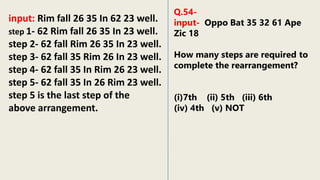
input: Rim fall 26 35 In 62 23 well.
step 1- 62 Rim fall 26 35 In 23 well.
step 2- 62 fall Rim 26 35 In 23 well.
step 3- 62 fall 35 Rim 26 In 23 well.
step 4- 62 fall 35 In Rim 26 23 well.
step 5- 62 fall 35 In 26 Rim 23 well.
step 5 is the last step of the
above arrangement.
Q.54-
input- Oppo Bat 35 32 61 Ape
Zic 18
How many steps are required to
complete the rearrangement?
(i)7th (ii) 5th (iii) 6th
(iv) 4th (v) NOT

Logical reasoning pdf and question to solve

  • 1.
  • 2.
    Q.1- In arow Kamal is 11th from left end & Komal is 21 places from the right end and there are 9 member between them. Then what is total number ? 1. 21 2. 41 3. 41 or 21 4. 11
  • 3.
    Q.2- In arow Kamal is 10th from left end & Komal is 21 places from the right end and there are 9 member between them. Then what is total number ? 1. 20 2. 40 3. 40 or 20 4. NOT
  • 4.
    Q.3- In arow of students, Suraj is 21 place from left end & harsh is 17 place from right end. If they are interchange their position then Suraj becomes 17 place from left end. what is the rank of harsh from right end? 1. 21 2. 13 3. CND 4. NOT
  • 5.
    Q.4- In arow of children, Bobby is 5th from left end & Mona is 6th from right end. If they are interchange their position then Bobby becomes 13 place from left end. what is the rank of Mona from right end? 1. 12 2. 14 3. 04 4. NOT
  • 6.
    Q.5-7- Six personsA, B, C, D, E and F are comparing their weights and each of them is having a different weight. D is heavier than only two persons. E is heavier than F and lighter than D. C’s weight is less than only B’s weight. The third heaviest weight is 100kgs and the fifth heaviest weight is 60kgs. Q.5-What is the possible weight of D? (1) 60kgs (2) 100kgs (3) 105kgs (4) 75 kgs (5) Data inadequate
  • 7.
    Q.5-7- Six personsA, B, C, D, E and F are comparing their weights and each of them is having a different weight. D is heavier than only two persons. E is heavier than F and lighter than D. C’s weight is less than only B’s weight. The third heaviest weight is 100kgs and the fifth heaviest weight is 60kgs. Q.6-Who is the third heaviest? (1) D (2) E (3) A (4) B (5) Data inadequate
  • 8.
    Q.5-7- Six personsA, B, C, D, E and F are comparing their weights and each of them is having a different weight. D is heavier than only two persons. E is heavier than F and lighter than D. C’s weight is less than only B’s weight. The third heaviest weight is 100kgs and the fifth heaviest weight is 60kgs. Q.7-If the heaviest weight is 30kgs more than A’s weight, then what is the possible weight of C? (1) 130 (2) 100 (3) 115 (4) 90 (5) Data inadequate
  • 9.
    Q.8- Two positionsof a dice are shown below. Which number will appear on the face opposite to the face with the number 6 ? 1. 1 2. 2 3. 2/3 4. 5
  • 10.
    Q.9- Three positionsof a dice are shown below. Which number will appear on the face opposite to the face with the number 1 ? 1. 2 2. 5 3. 6 4. 4
  • 11.
    Q.10- Count thenumber of Triangles in the given figures? 1. 31 2. 32 3. 33 4. 34
  • 12.
    Q.11- Count thenumber of Triangles in the given figures? 1. 40 2. 42 3. 44 4. 46
  • 13.
    Q.12- Count thenumber of Triangles in the given figures? 1. 20 2. 21 3. 24 4. 22
  • 14.
    Q.13- 46 ,50,41, 57, 32, ? A. 99 B. 40 C. 68 D. 70
  • 15.
    Q.14- 0 ,4,18, 48, 100, ? A. 210 B. 220 C. 150 D. 180
  • 16.
    Sachin starts walkingin north direction and after a distance of 4m, he turns to his left and covers a distance of 8m. Now he turns towards the south direction and walks for 12m and at last, he takes another left turn and stops after walking 16m. Q.15:-What is the total distance covered by Sachin on the whole journey? 1. 28m 2. 26m 3. 36m 4. 40m 5. None of these
  • 17.
    Sachin starts walkingin north direction and after a distance of 4m, he turns to his left and covers a distance of 8m. Now he turns towards the south direction and walks for 12m and at last, he takes another left turn and stops after walking 16m. Q.16:-The second turning point of Sachin is in which direction to his last destination? 1. South-East 2. North 3. West 4. North-West 5. None of these
  • 18.
    Gaurav is facingsouth direction then he turns 108 degree in anticlockwise direction and then 20 degree in clockwise and then 36 degree in anticlockwise and finally 124 degree in clockwise. so in which direction he is facing now? A) East B) West C) North D) South Q 17
  • 19.
    A man isfacing North . He turns 75° in the clockwise direction and then another 180° in the same direction and then 300° in the anti-clockwise direction. Which direction is he facing now? Q 18 A) East B) West C) North-east D) North-west
  • 20.
    Eight people aresitting around a square table. Four of them are sitting at the corners facing inside and the remaining four are sitting at the sides of the table facing outside. K sits immediate right of O. E sits third to the right of K. One person sits between V and E. M sits third to the right of P, who is not a neighbor of V. Z sits opposite T, who does not face outside. T is not a neighbor of P. Q.19:-Who sits near T? 1. O 2. K 3. M 4. P 5. None of these
  • 21.
    Eight people aresitting around a square table. Four of them are sitting at the corners facing inside and the remaining four are sitting at the sides of the table facing outside. K sits immediate right of O. E sits third to the right of K. One person sits between V and E. M sits third to the right of P, who is not a neighbor of V. Z sits opposite T, who does not face outside. T is not a neighbor of P. Q.20:-How many people sit between Z and M? 1. Two 2. Five 3. Three 4. Four 5. None
  • 22.
    Eight people aresitting around a square table. Four of them are sitting at the corners facing inside and the remaining four are sitting at the sides of the table facing outside. K sits immediate right of O. E sits third to the right of K. One person sits between V and E. M sits third to the right of P, who is not a neighbor of V. Z sits opposite T, who does not face outside. T is not a neighbor of P. Q.21:-Who among the following sits second to the left of K? 1. Z 2. T 3. P 4. V 5. None of these
  • 23.
    Eight people A,B, C, U, V, W, X, and P live in an eight-story building but not necessarily in the same order. The ground floor is numbered 1 and the top floor is numbered 8. Three people live between V and B. Four people live between B and A. Two people live between A and C. Two people live between C and P. P is neither at the bottom nor on the top. W lives above C but not immediately above. U lives above X. Q.21:-Who lives on the ground floor? 1. V 2. W 3. U 4. A 5. None of these
  • 24.
    Eight people A,B, C, U, V, W, X, and P live in an eight-story building but not necessarily in the same order. The ground floor is numbered 1 and the top floor is numbered 8. Three people live between V and B. Four people live between B and A. Two people live between A and C. Two people live between C and P. P is neither at the bottom nor on the top. W lives above C but not immediately above. U lives above X. Q.22:-Who lives between P and U? 1. C 2. V 3. X 4. B 5. None of these
  • 25.
    Eight people A,B, C, U, V, W, X, and P live in an eight-story building but not necessarily in the same order. The ground floor is numbered 1 and the top floor is numbered 8. Three people live between V and B. Four people live between B and A. Two people live between A and C. Two people live between C and P. P is neither at the bottom nor on the top. W lives above C but not immediately above. U lives above X. Q.23:-How many people live above C? 1. Four 2. Five 3. Three 4. Six 5. None of these
  • 26.
    Q.24:-Statements: Only a fewReasoning are Maths . All Maths are English. Only a few English are Account. Conclusions: I. Some Reasoning are Account. II. No Reasoning are Account. Only I follows Only II follows Either I or II follows Neither I Nor II follows Both follows
  • 27.
    Q.25:-Statements: Only a fewCurrent are Phones. No Phones are smart. All smart are Adapters. Conclusions: I. Some Current are not smart. II. Some Adapters are not Phones. Only I follows Only II follows Either I or II follows Neither I Nor II follows Both follows
  • 28.
    Q.26:-Statements: No Cut arekey. All key are big. Only a few big are Edit. Conclusions: I. Some key are Edit. II. No big are Cut. Only I follows Only II follows Either I or II follows Neither I Nor II follows Both follows
  • 29.
    Q.27:-Statements: All Gifts areBeautiful. Only a few Beautiful are Awards. Some Awards are not Surprise. Conclusions: I. Some Gifts are not Surprise. II. Some Beautiful are not Award. Only I follows Only II follows Either I or II follows Neither I Nor II follows Both follows
  • 30.
    Q.28:-Statements: All Gifts areBeautiful. Only a few Beautiful are Awards. Some Awards are not Surprise. Conclusions: I. All Surprise can be Award. II. Some Beautiful are Award. Only I follows Only II follows Either I or II follows Neither I Nor II follows Both follows
  • 31.
    Q.29- Statements: O >X = D ≤ W = Q < U < Y = F < S Conclusion: I. O ≯ Q II. Q ≠ O Only I follows Only II follows Either I or II follows Neither I Nor II follows Both follows
  • 32.
    Q.30- Statements: O >X = D ≤ W = Q < U < Y = F < S Conclusion: I. S ≰ W II. Q ≮ X Only I follows Only II follows Either I or II follows Neither I Nor II follows Both follows
  • 33.
    Q.31- Statements: V =T ≥ L < N = E < F ≤ U, L ≤ C = S Conclusion: I. S ≰ V II. V ≥ S Only I follows Only II follows Either I or II follows Neither I Nor II follows Both follows
  • 34.
    Q.32- Statements: D >E ≥ F, E < G = H ≥ L > Q Conclusions: I. G > D II. G ≰ D Only I follows Only II follows Either I or II follows Neither I Nor II follows Both follows
  • 35.
    Q.33- If SOLEMNis coded as HDAEBC . How is POTHER written in that code? 1. EDBHEG 2. GFBHEI 3. GDBHEN 4. KLGSVI
  • 36.
    Q.34- If DECISIONis coded as EGFMXOVV. How is RELATION written in that code? 1. XUPVSGOE 2. XUPVGOSE 3. SGOXEUPV 4. SGOEXUPV 5. XUPVEOGS
  • 37.
    369 717 922625 434 Q.35- If all the digits in each of the numbers are arranged in descending order within the number from left to right then which of the following will be the second lowest number? (a) 369 (b) 717 (c) 922 (d) 625 (e) 434
  • 38.
    369 717 922625 434 Q.36- If one is subtracted from each odd digit and one is added to each even digit of each of the numbers, what will be the difference between the third digit and the first digit of the highest number thus formed? (a) Zero (b) 6 (c) 4 (d) 2 (e) 5
  • 39.
    437 592 472791 817 Q.37- If ‘1’ is subtracted from the middle digit of each number and then the numbers are arranged in ascending order from left to right, then which of the following number is second from left? (a) 437 (b) 592 (c) 472 (d) 791 (e) 817
  • 40.
    437 592 472791 817 Q.38- If in each number first digit is replaced by the third digit, second digit is replaced by the first digit and third digit is replaced by the second digit, then which number will be the smallest? / (a) 437 (b) 597 (c) 472 (d) 791 (e) 817
  • 41.
    There are sevenmembers in a family with only three male members and two married couples. A is the grandmother of L. X is married to S. X is the daughter-in-law of M. C is a sibling of L and M is the grandfather of C. T is the brother of M. Q.39:-How C is related to S? 1. Son 2. Brother 3. Mother 4. Daughter 5. None of these
  • 42.
    There are sevenmembers in a family with only three male members and two married couples. A is the grandmother of L. X is married to S. X is the daughter-in-law of M. C is a sibling of L and M is the grandfather of C. T is the brother of M. Q.40:-How T is related to S? 1. Son 2. Brother 3. Mother 4. Uncle 5. None of these
  • 43.
    There are sevenmembers in a family with only three male members and two married couples. A is the grandmother of L. X is married to S. X is the daughter-in-law of M. C is a sibling of L and M is the grandfather of C. T is the brother of M. Q.41:-Who is the mother-in- law of X? 1. T 2. L 3. A 4. M 5. None of these
  • 44.
    Eight persons S,T, U, V, W, X, Y and Z live in an eight storey building such that ground floor is numbered as 1 and the top floor is numbered as 8. X lives on an even numbered floor below the floor number 6. More than two persons live between X and S. S does not live on an odd numbered floor. The number of person living above S is the same as the number of person living below V. Two people live between Y and T. T lives just above X. Only one person lives between U and Z. Z lives on one of the floors above Y. Q.42- How many persons live above Y? One Two Three Four More than four
  • 45.
    Eight persons S,T, U, V, W, X, Y and Z live in an eight storey building such that ground floor is numbered as 1 and the top floor is numbered as 8. X lives on an even numbered floor below the floor number 6. More than two persons live between X and S. S does not live on an odd numbered floor. The number of person living above S is the same as the number of person living below V. Two people live between Y and T. T lives just above X. Only one person lives between U and Z. Z lives on one of the floors above Y. Q.43- How many persons live between S and V?/ One Two Three Four More than four
  • 46.
    Eight persons S,T, U, V, W, X, Y and Z live in an eight storey building such that ground floor is numbered as 1 and the top floor is numbered as 8. X lives on an even numbered floor below the floor number 6. More than two persons live between X and S. S does not live on an odd numbered floor. The number of person living above S is the same as the number of person living below V. Two people live between Y and T. T lives just above X. Only one person lives between U and Z. Z lives on one of the floors above Y. Q.44- Who among the following lives just below W? Y U T X Z
  • 47.
    Eight family membersDhruv, Garima, Avinash, Varsha, Aakash, Deepti, Charu and Moksh are sitting around a square table in such a way that two persons sit on each of the four sides of the table facing the centre. Members sitting on opposite sides are exactly facing opposite to each other. • Aakash and Garima are exactly opposite to each other. • Deepti is immediately right to Garima. • Dhruv and Moksh are sitting on the same side. • Moksh is exactly opposite of Avinash, who is to the immediate left of Varsha. • Dhruv is towards right of deepti. Q.45- Who sits between Dhruv and Charu? (1) Moksh (2) Deepti (3) Aakash (4) Garima (5) None of these
  • 48.
    Eight family membersDhruv, Garima, Avinash, Varsha, Aakash, Deepti, Charu and Moksh are sitting around a square table in such a way that two persons sit on each of the four sides of the table facing the centre. Members sitting on opposite sides are exactly facing opposite to each other. • Aakash and Garima are exactly opposite to each other. • Deepti is immediately right to Garima. • Dhruv and Moksh are sitting on the same side. • Moksh is exactly opposite of Avinash, who is to the immediate left of Varsha. • Dhruv is towards right of deepti. Q.46- How many persons sit between Dhruv and Varsha when counted in anti-clockwise direction from Dhruv? (1) Four (2) Two (3) One (4) Three (5) Can’t be determined
  • 49.
    input- 23 1535 28 39 45 25 step 1-15 23 35 28 39 45 25 step 2- 23 15 35 28 39 45 25 step 3- 25 23 15 35 28 39 45 step 4- 28 25 23 15 35 39 45 step 5- 35 28 25 23 15 39 45 step 6- 39 35 28 25 23 15 45 step 7- 45 39 35 28 25 23 15 step 7 is the last step of the above arrangement. Q.47- input- 72 89 42 66 29 58 69 94 How many steps are required to complete the rearrangement? (i)7th (ii) 8th (iii) 6th (iv) 9th (v) NOT
  • 50.
    Q.48- input- 29 7289 42 66 58 69 94 How many steps are required to complete the rearrangement? (i)7th (ii) 8th (iii) 6th (iv) 9th (v) NOT input- 23 15 35 28 39 45 25 step 1-15 23 35 28 39 45 25 step 2- 23 15 35 28 39 45 25 step 3- 25 23 15 35 28 39 45 step 4- 28 25 23 15 35 39 45 step 5- 35 28 25 23 15 39 45 step 6- 39 35 28 25 23 15 45 step 7- 45 39 35 28 25 23 15 step 7 is the last step of the above arrangement.
  • 51.
    Q.49- input- 72 8942 66 58 69 94 29 How many steps are required to complete the rearrangement? (i)7th (ii) 8th (iii) 6th (iv) 9th (v) NOT input- 23 15 35 28 39 45 25 step 1-15 23 35 28 39 45 25 step 2- 23 15 35 28 39 45 25 step 3- 25 23 15 35 28 39 45 step 4- 28 25 23 15 35 39 45 step 5- 35 28 25 23 15 39 45 step 6- 39 35 28 25 23 15 45 step 7- 45 39 35 28 25 23 15 step 7 is the last step of the above arrangement.
  • 52.
    Q.50- input- 29 4272 89 66 58 69 94 How many steps are required to complete the rearrangement? (i)7th (ii) 8th (iii) 6th (iv) 9th (v) NOT input- 23 15 35 28 39 45 25 step 1-15 23 35 28 39 45 25 step 2- 23 15 35 28 39 45 25 step 3- 25 23 15 35 28 39 45 step 4- 28 25 23 15 35 39 45 step 5- 35 28 25 23 15 39 45 step 6- 39 35 28 25 23 15 45 step 7- 45 39 35 28 25 23 15 step 7 is the last step of the above arrangement.
  • 53.
    Q.51- input- 42 2972 89 66 58 69 94 How many steps are required to complete the rearrangement? (i)7th (ii) 8th (iii) 6th (iv) 9th (v) NOT input- 23 15 35 28 39 45 25 step 1-15 23 35 28 39 45 25 step 2- 23 15 35 28 39 45 25 step 3- 25 23 15 35 28 39 45 step 4- 28 25 23 15 35 39 45 step 5- 35 28 25 23 15 39 45 step 6- 39 35 28 25 23 15 45 step 7- 45 39 35 28 25 23 15 step 7 is the last step of the above arrangement.
  • 54.
    Q.52- IF Step (iii)is- 108 103 101 112 109 118 120 111 Then what will be the Input ? (i) 112 109 108 103 101 118 120 111 (ii) 112 109 108 118 103 101 120 111 (iii) 109 112 108 118 103 101 120 111 (iv) 109 112 108 118 111 103 101 120 (v) CAN NOT BE DETERMINE input- 23 15 35 28 39 45 25 step 1-15 23 35 28 39 45 25 step 2- 23 15 35 28 39 45 25 step 3- 25 23 15 35 28 39 45 step 4- 28 25 23 15 35 39 45 step 5- 35 28 25 23 15 39 45 step 6- 39 35 28 25 23 15 45 step 7- 45 39 35 28 25 23 15 step 7 is the last step of the above arrangement.
  • 55.
    input: 23 6520 39 48 56 45 step 1- 20 23 65 39 48 56 45 step 2- 20 23 39 65 48 56 45 step 3- 20 23 39 45 65 48 56 step 4- 20 23 39 45 48 65 56 step 5- 20 23 39 45 48 56 65 step 5 is the last step of the above arrangement. Q.53- input- 35 98 28 36 15 29 33 How many steps are required to complete the rearrangement? (i)7th (ii) 5th (iii) 6th (iv) 4th (v) NOT
  • 56.
    input: Rim fall26 35 In 62 23 well. step 1- 62 Rim fall 26 35 In 23 well. step 2- 62 fall Rim 26 35 In 23 well. step 3- 62 fall 35 Rim 26 In 23 well. step 4- 62 fall 35 In Rim 26 23 well. step 5- 62 fall 35 In 26 Rim 23 well. step 5 is the last step of the above arrangement. Q.54- input- Oppo Bat 35 32 61 Ape Zic 18 How many steps are required to complete the rearrangement? (i)7th (ii) 5th (iii) 6th (iv) 4th (v) NOT