Back In Swedish
Lignosulfonates (updated 2010)
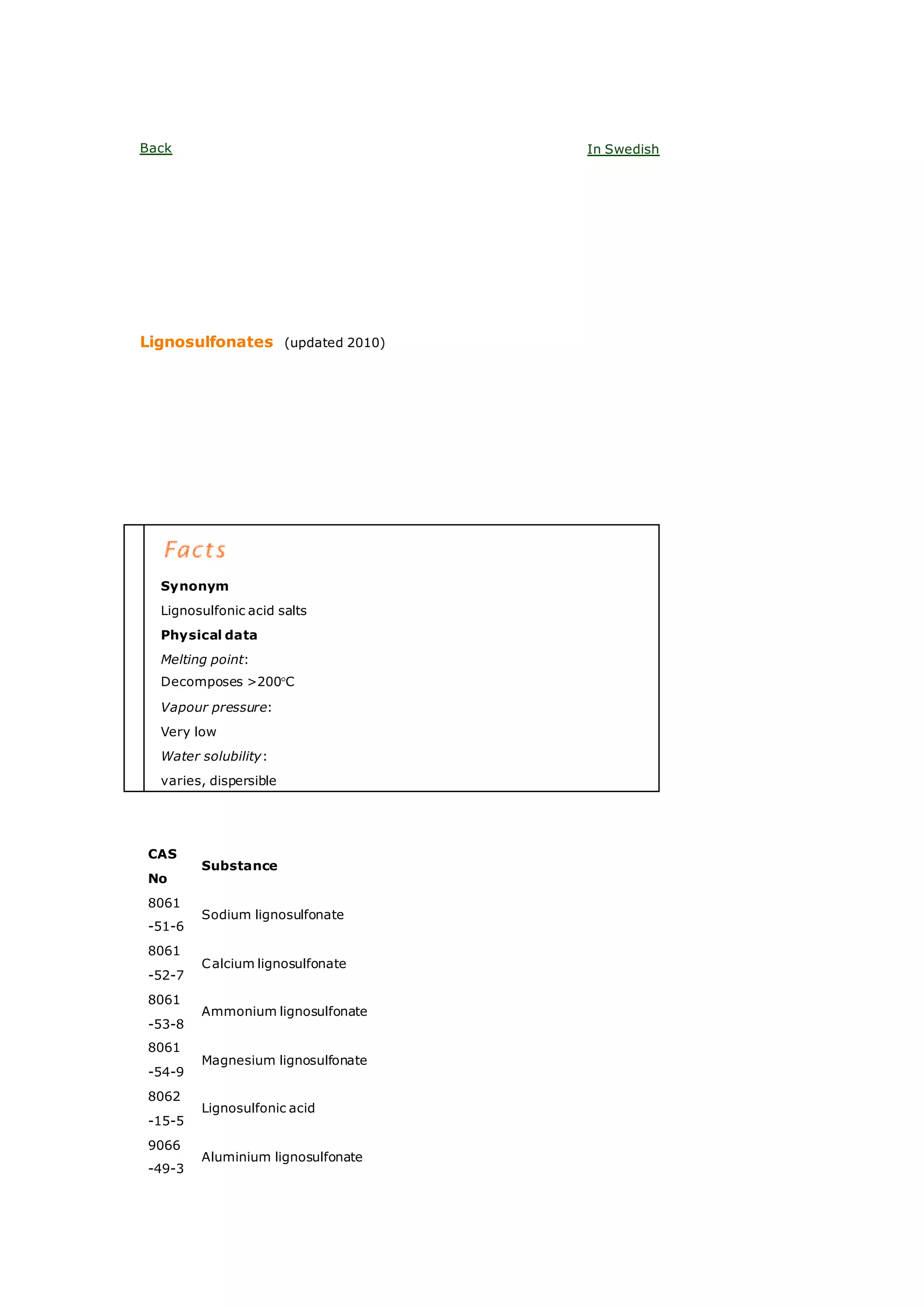
Synonym
Lignosulfonic acid salts
Physical data
Melting point:
Decomposes >200°C
Vapour pressure:
Very low
Water solubility:
varies, dispersible
CAS
No
Substance
8061
-51-6
Sodium lignosulfonate
8061
-52-7
Calcium lignosulfonate
8061
-53-8
Ammonium lignosulfonate
8061
-54-9
Magnesium lignosulfonate
8062
-15-5
Lignosulfonic acid
9066
-49-3
Aluminium lignosulfonate
9066
-50-6
Chromium lignosulfonate
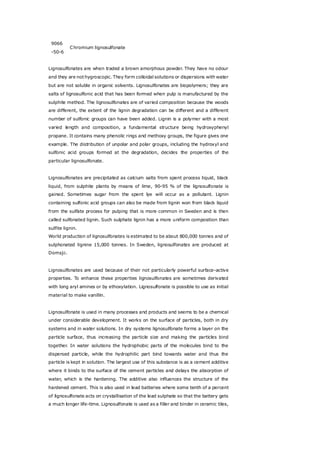
Lignosulfonates are when traded a brown amorphous powder. They have no odour
and they are not hygroscopic. They form colloidal solutions or dispersions with water
but are not soluble in organic solvents. Lignosulfonates are biopolymers; they are
salts of lignosulfonic acid that has been formed when pulp is manufactured by the
sulphite method. The lignosulfonates are of varied composition because the woods
are different, the extent of the lignin degradation can be different and a different
number of sulfonic groups can have been added. Lignin is a polymer with a most
varied length and composition, a fundamental structure being hydroxyphenyl
propane. It contains many phenolic rings and methoxy groups, the figure gives one
example. The distribution of unpolar and polar groups, including the hydroxyl and
sulfonic acid groups formed at the degradation, decides the properties of the
particular lignosulfonate.
Lignosulfonates are precipitated as calcium salts from spent process liquid, black
liquid, from sulphite plants by means of lime, 90-95 % of the lignosulfonate is
gained. Sometimes sugar from the spent lye will occur as a pollutant. Lignin
containing sulfonic acid groups can also be made from lignin won from black liquid
from the sulfate process for pulping that is more common in Sweden and is then
called sulfonated lignin. Such sulphate lignin has a more uniform composition than
sulfite lignin.
World production of lignosulfonates is estimated to be about 800,000 tonnes and of
sulphonated lignine 15,000 tonnes. In Sweden, lignosulfonates are produced at
Domsjö.
Lignosulfonates are used because of their not particularly powerful surface-active
properties. To enhance these properties lignosulfonates are sometimes derivated
with long aryl amines or by ethoxylation. Lignosulfonate is possible to use as initial
material to make vanillin.
Lignosulfonate is used in many processes and products and seems to be a chemical
under considerable development. It works on the surface of particles, both in dry
systems and in water solutions. In dry systems lignosulfonate forms a layer on the
particle surface, thus increasing the particle size and making the particles bind
together. In water solutions the hydrophobic parts of the molecules bind to the
dispersed particle, while the hydrophilic part bind towards water and thus the
particle is kept in solution. The largest use of this substance is as a cement additive
where it binds to the surface of the cement particles and delays the absorption of
water, which is the hardening. The additive also influences the structure of the
hardened cement. This is also used in lead batteries where some tenth of a percent
of lignosulfonate acts on crystallisation of the lead sulphate so that the battery gets
a much longer life-time. Lignosulfonate is used as a filler and binder in ceramic tiles,
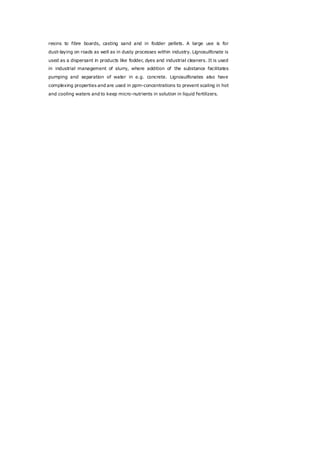
resins to fibre boards, casting sand and in fodder pellets. A large use is for
dust-laying on roads as well as in dusty processes within industry. Lignosulfonate is
used as a dispersant in products like fodder, dyes and industrial cleaners. It is used
in industrial management of slurry, where addition of the substance facilitates
pumping and separation of water in e.g. concrete. Lignosulfonates also have
complexing properties and are used in ppm-concentrations to prevent scaling in hot
and cooling waters and to keep micro-nutrients in solution in liquid fertilizers.

Lignosulfonate

  • 1.
    Back In Swedish Lignosulfonates(updated 2010) Synonym Lignosulfonic acid salts Physical data Melting point: Decomposes >200°C Vapour pressure: Very low Water solubility: varies, dispersible CAS No Substance 8061 -51-6 Sodium lignosulfonate 8061 -52-7 Calcium lignosulfonate 8061 -53-8 Ammonium lignosulfonate 8061 -54-9 Magnesium lignosulfonate 8062 -15-5 Lignosulfonic acid 9066 -49-3 Aluminium lignosulfonate
  • 2.
    9066 -50-6 Chromium lignosulfonate Lignosulfonates arewhen traded a brown amorphous powder. They have no odour and they are not hygroscopic. They form colloidal solutions or dispersions with water but are not soluble in organic solvents. Lignosulfonates are biopolymers; they are salts of lignosulfonic acid that has been formed when pulp is manufactured by the sulphite method. The lignosulfonates are of varied composition because the woods are different, the extent of the lignin degradation can be different and a different number of sulfonic groups can have been added. Lignin is a polymer with a most varied length and composition, a fundamental structure being hydroxyphenyl propane. It contains many phenolic rings and methoxy groups, the figure gives one example. The distribution of unpolar and polar groups, including the hydroxyl and sulfonic acid groups formed at the degradation, decides the properties of the particular lignosulfonate. Lignosulfonates are precipitated as calcium salts from spent process liquid, black liquid, from sulphite plants by means of lime, 90-95 % of the lignosulfonate is gained. Sometimes sugar from the spent lye will occur as a pollutant. Lignin containing sulfonic acid groups can also be made from lignin won from black liquid from the sulfate process for pulping that is more common in Sweden and is then called sulfonated lignin. Such sulphate lignin has a more uniform composition than sulfite lignin. World production of lignosulfonates is estimated to be about 800,000 tonnes and of sulphonated lignine 15,000 tonnes. In Sweden, lignosulfonates are produced at Domsjö. Lignosulfonates are used because of their not particularly powerful surface-active properties. To enhance these properties lignosulfonates are sometimes derivated with long aryl amines or by ethoxylation. Lignosulfonate is possible to use as initial material to make vanillin. Lignosulfonate is used in many processes and products and seems to be a chemical under considerable development. It works on the surface of particles, both in dry systems and in water solutions. In dry systems lignosulfonate forms a layer on the particle surface, thus increasing the particle size and making the particles bind together. In water solutions the hydrophobic parts of the molecules bind to the dispersed particle, while the hydrophilic part bind towards water and thus the particle is kept in solution. The largest use of this substance is as a cement additive where it binds to the surface of the cement particles and delays the absorption of water, which is the hardening. The additive also influences the structure of the hardened cement. This is also used in lead batteries where some tenth of a percent of lignosulfonate acts on crystallisation of the lead sulphate so that the battery gets a much longer life-time. Lignosulfonate is used as a filler and binder in ceramic tiles,
  • 3.
    resins to fibreboards, casting sand and in fodder pellets. A large use is for dust-laying on roads as well as in dusty processes within industry. Lignosulfonate is used as a dispersant in products like fodder, dyes and industrial cleaners. It is used in industrial management of slurry, where addition of the substance facilitates pumping and separation of water in e.g. concrete. Lignosulfonates also have complexing properties and are used in ppm-concentrations to prevent scaling in hot and cooling waters and to keep micro-nutrients in solution in liquid fertilizers.