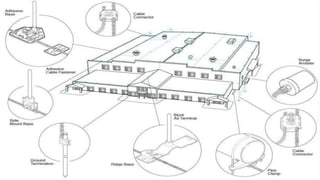
Lightning Kills and Distroy Your ValuableAssests
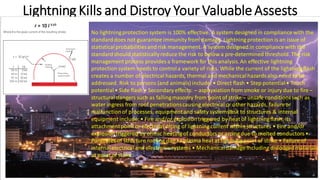
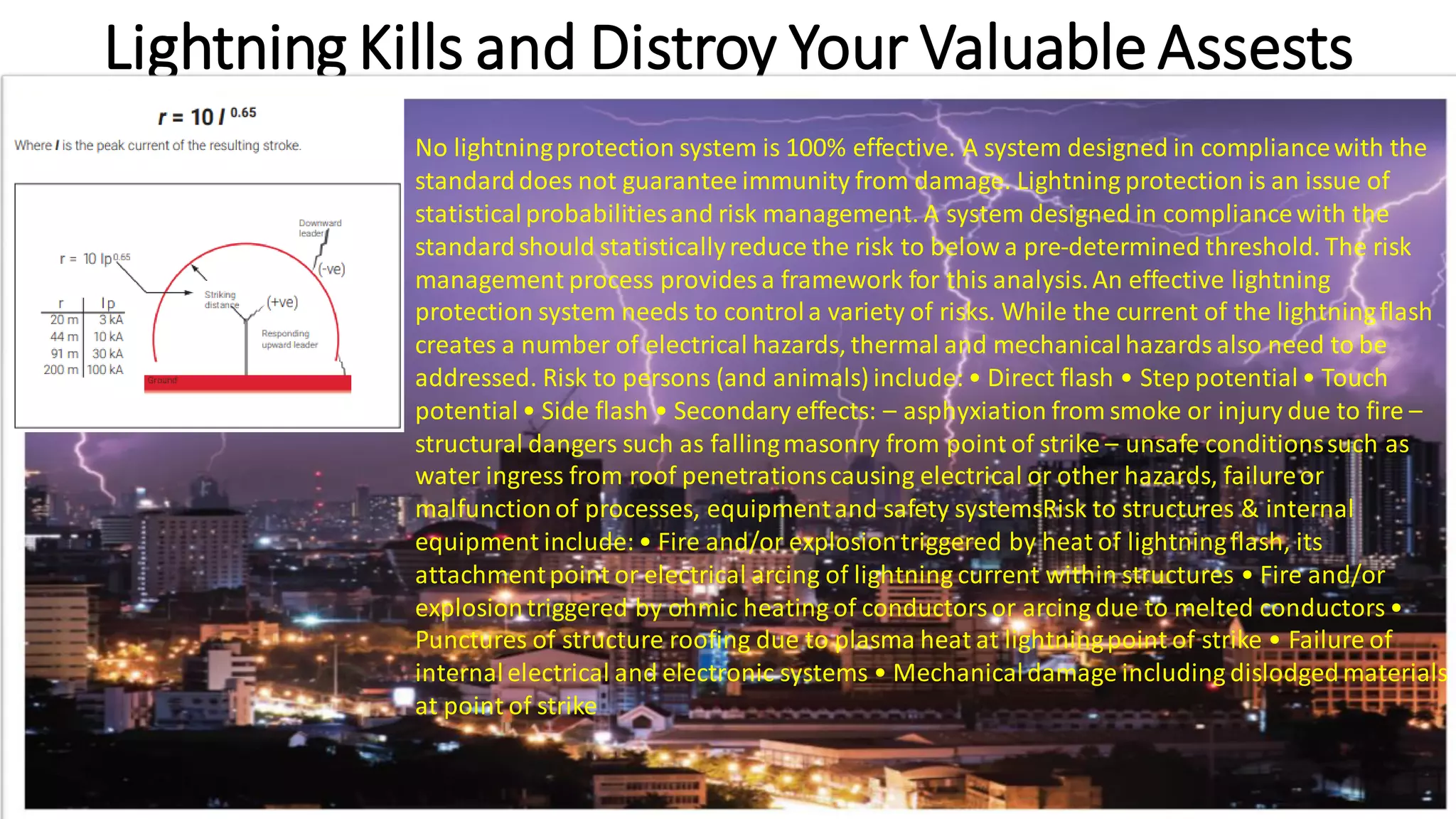
No lightningprotection system is 100% effective. A system designed in compliancewith the
standarddoes not guarantee immunity from damage. Lightning protection is an issue of
statisticalprobabilitiesand risk management. A system designed in compliancewith the
standardshould statisticallyreduce the risk to below a pre-determined threshold. The risk
management process provides a framework for this analysis.An effective lightning
protection system needs to controla variety of risks. While the current of the lightningflash
creates a number of electrical hazards, thermal and mechanicalhazards also need to be
addressed. Risk to persons (and animals) include: • Direct flash • Step potential• Touch
potential• Side flash • Secondary effects: – asphyxiation from smoke or injury due to fire –
structural dangers such as fallingmasonry from point of strike – unsafe conditionssuch as
water ingress from roof penetrationscausing electrical or other hazards, failureor
malfunctionof processes, equipmentand safety systemsRisk to structures & internal
equipment include: • Fire and/or explosiontriggered by heat of lightningflash, its
attachmentpoint or electrical arcing of lightning current within structures • Fire and/or
explosiontriggered by ohmic heating of conductors or arcing due to melted conductors •
Punctures of structure roofing due to plasma heat at lightningpoint of strike • Failure of
internalelectrical and electronic systems • Mechanicaldamage including dislodgedmaterials
at point of strike
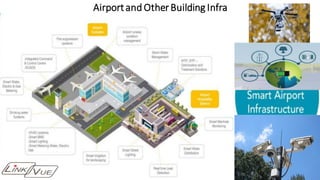
Airportand OtherBuilding Infra
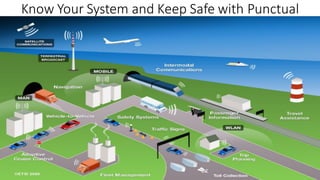
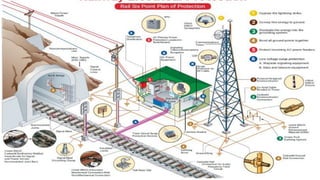
Know Your System and Keep Safe with Punctual
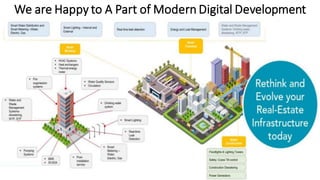
We are Happy to A Part of Modern Digital Development
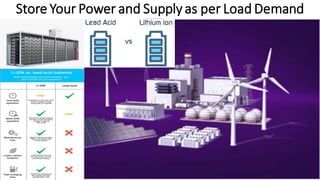
Store Your Power and Supply as per Load Demand
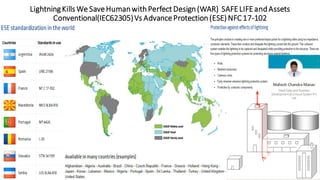
LightningKills We SaveHumanwithPerfect Design(WAR) SAFELIFEandAssets
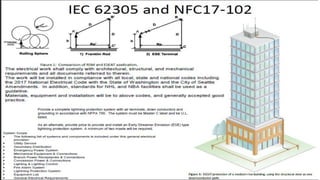
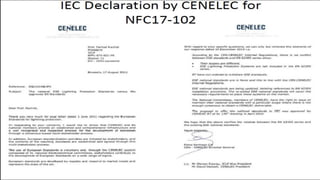
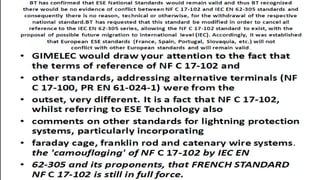
Conventional(IEC62305)Vs AdvanceProtection(ESE) NFC 17-102
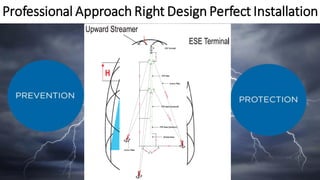
Professional Approach Right Design Perfect Installation
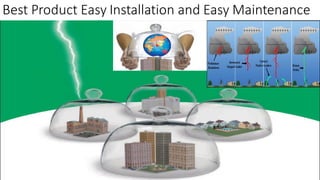
Best Product Easy Installation and Easy Maintenance
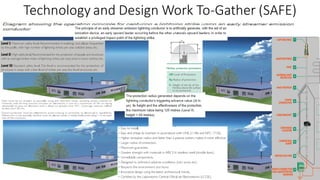
Technology and Design Work To-Gather (SAFE)
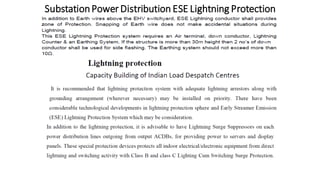
SubstationPowerDistribution ESE Lightning Protection
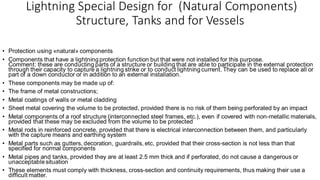
Lightning Special Design for (Natural Components)
Structure, Tanks and for Vessels
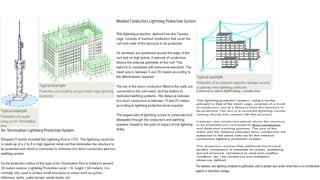
• Protection using «natural» components
• Components that have a lightning protection function but that were not installed for this purpose.
Comment: these are conducting parts of a structure or building that are able to participate in the external protection
through their capacity to capture a lightning strike or to conduct lightning current. They can be used to replace all or
part of a down conductor or in addition to an external installation.
• These components may be made up of:
• The frame of metal constructions;
• Metal coatings of walls or metal cladding
• Sheet metal covering the volume to be protected, provided there is no risk of them being perforated by an impact
• Metal components of a roof structure (interconnected steel frames, etc.), even if covered with non-metallic materials,
provided that these may be excluded from the volume to be protected
• Metal rods in reinforced concrete, provided that there is electrical interconnection between them, and particularly
with the capture means and earthing system
• Metal parts such as gutters, decoration, guardrails, etc, provided that their cross-section is not less than that
specified for normal components
• Metal pipes and tanks, provided they are at least 2.5 mm thick and if perforated, do not cause a dangerous or
unacceptable situation
• These elements must comply with thickness, cross-section and continuity requirements, thus making their use a
difficult matter.
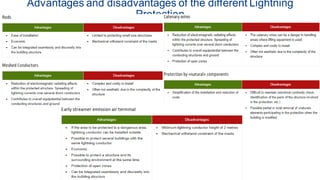
Advantages and disadvantages of the different Lightning
Protection
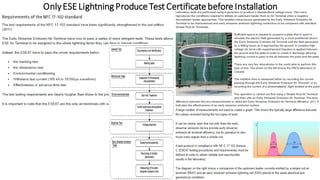
OnlyESE LightningProduceTest CertificatebeforeInstallation
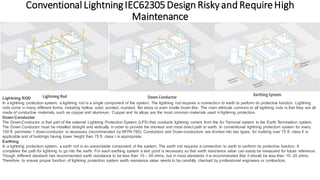
Conventional LightningIEC62305Design Riskyand RequireHigh
Maintenance
Lightning ROD
In a lightning protection system, a lightning rod is a single component of the system. The lightning rod requires a connection to earth to perform its protective function. Lightning
rods come in many different forms, including hollow, solid, pointed, rounded, flat strips or even bristle brush-like. The main attribute common to all lightning rods is that they are all
made of conductive materials, such as copper and aluminum. Copper and its alloys are the most common materials used in lightning protection.
Down Conductor
The Down-Conductor is that part of the external Lightning Protection System (LPS) that conducts lightning current from the Air Terminal system to the Earth Termination system.
The Down Conductor must be installed straight and vertically in order to provide the shortest and most direct path to earth. In conventional lightning protection system for every
100 ft. perimeter 1 down-conductor is necessary (recommended by NFPA 780). Conductors and Down-conductors are divided into two types: for building over 75 ft. class II is
applicable and of buildings having lower height than 75 ft. class I is appropriate.
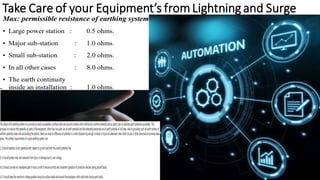
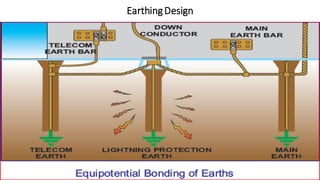
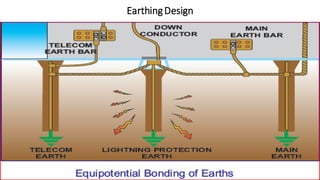
Earthing
In a lightning protection system, a earth rod is an unavoidable component of the system. The earth rod requires a connection to earth to perform its protective function. It
completes the path for lightning to go into the earth. For each earthing system a test point is necessary so that earth resistance value can easily be measured for future reference.
Though different standard has recommended earth resistance to be less than 10 – 50 ohms, but in most standards it is recommended that it should be less than 10- 20 ohms.
Therefore, to ensure proper function of lightning protection system earth resistance value needs to be carefully checked by professional engineers or contractors.
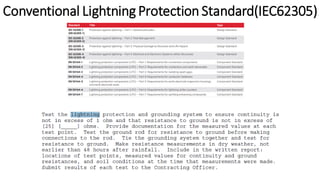
Conventional Lightning Protection Standard(IEC62305)
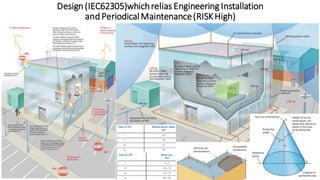
Design(IEC62305)whichrelias EngineeringInstallation
andPeriodicalMaintenance(RISKHigh)
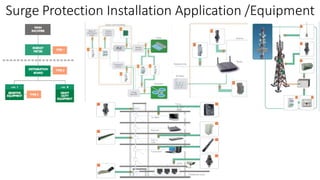
Surge Protection Installation Application /Equipment
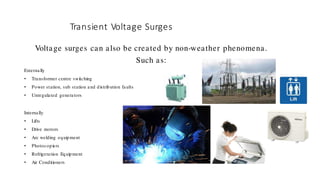
Transient Voltage Surges
Voltage surges can also be created by non-weather phenomena.
Such as:
Externally
• Transformer centre switching
• Power station, sub station and distribution faults
• Unregulated generators
Internally
• Lifts
• Drive motors
• Arc welding equipment
• Photocopiers
• Refrigeration Equipment
• Air Conditioners
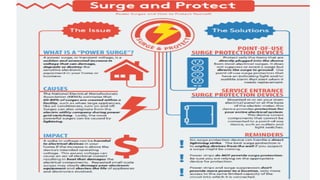
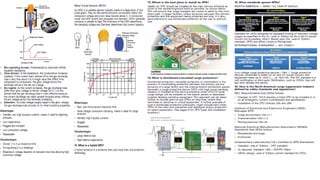
Why do I need surge protection?
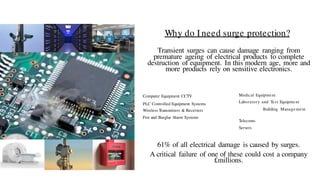
Transient surges can cause damage ranging from
premature ageing of electrical products to complete
destruction of equipment. In this modern age, more and
more products rely on sensitive electronics.
Computer Equipment CCTV
PLC Controlled Equipment Systems
Wireless Transmitters & Receivers
Fire and Burglar Alarm Systems
Medical Equipment
Laboratory and Test Equipment
Building Management
Telecoms
Servers
61% of all electrical damage is caused by surges.
A critical failure of one of these could cost a company
£millions.
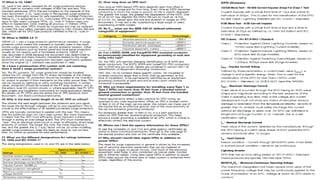
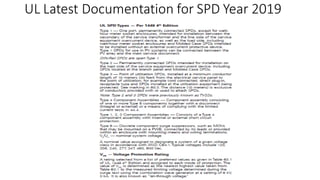
UL Latest Documentation for SPD Year 2019
Your Answerfor Queries of Surge and Lightning
• What is the 10/350 waveform and how is it related to the IEC Class I SPD tests?
• The 10/350 waveform is an electrical impulse produced in a laboratorybya surge impulse generator.The "10" refers to the 10 microseconds it takes the
impulse to reach 90% of its peak current.The "350" refers to the time in microseconds it takes for the impulse to decaydown to 50% of that peak. IEC
standards state that this waveform simulates direct lightningand is based on research findings of CIGRE (International Councilon Large Electrical
Systems - headquarteredin France).As shown elsewhere on this website both of those claims are false.Nevertheless,the IEC Class 1 Test stipulatesthis
waveform be used to test SPDs which are to protect against direct lightning.
• I've read that the 10/350 waveform is much more powerful than the other waveforms currently used in SPD testing such as the 8/20. If that's true
and only spark gaps can pass those tests, then why do you opposethem? Why wouldn't we want a "stronger" SPD protecting our equipment?
• The mistake we've all made is to thinkof the 10/350 waveform as a "powerful"impulse.Far more accurately,it should be thought ofas an "irrelevant"
impulse.A sparkgap protector(because it responds slowlyand is a crowbardevice) can endure a high amplitude 10/350waveformbut doesn't do very
well protectingelectronicequipment from actual lightning.An MOV protectorresponds 1000 times faster and actuallyabsorbs energyin the process of
clampingthe lightningvoltage down to safe levels.MOVs don't do so well with a 10/350 waveform because theyabsorb part of the energy, but they far
more effectivelyprotect electronicequipment from actual lightning.CIGRE's 2013 Technical Brochure 549 has corrected the misconception thatthe
10/350 waveform is the waveform of a lightningfirst stroke--because it isn't.That is why it's accurate to call the 10/350 waveform irrelevant.We do
want stronger SPDs protectingourequipment and that's whywe consider it disingenuous forstandards to treat MOV-based SPDs as second-class
citizens when in fact they are superiorat handlingdirect lightning.
• What is the Lightning Protection Zone system and how is that related to the 10/350 waveform?
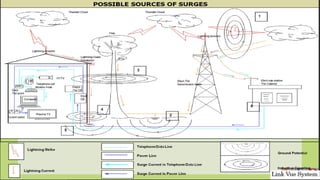
• The LightningProtection Zone (orLPZ) system is a surge protectiveconcept that divides a structure into several "riskzones"nested within each other.
The concept has been around since 1977 when E.F. Vance of the Stanford Research Institute proposedit. Here is a diagram showingVance's risk zones,
extracted from his 1977 paper "Shieldingand GroundingTopologyforInterference Control."By "grounding"the outside ofeach shield to the inside of
the adjacent shield,Vance sought to control the effect of external surges enteringa facility.He also realized the need to limit the surges on the power
and data lines enteringthe structure.Zone 0 was the external environment liable to lightningstrikes.Zone 1 was the area inside the structure.
• Although the purpose ofthe LPZ system is to mitigate the impact of incominglightning,practicallyspeaking,the entire function ofthe IEC LPZ system
has become the regulation ofstructural and surge protectivedevices deemed "proper" foruse in each zone.IEC international lightningprotection
standards adoptedVance's idea, but sabotaged it byinterjectingthe 10/350 waveform.In the IEC 62305 version,direct lightning(Zone 0) must be
represented bya 10/350 waveform, hence onlyspark gap "lightningarrestors"which could pass the 10/350 Class I test were allowed to be used in Zone
Zero or at locations borderingon Zone 1 (service entrance locations.)The problems with this approach are documented throughout this web,namely:1)
the CIGRE 2013 Technical Brochure 549 shows that the 10/350 waveform does not represent actual lightning,and 2) the sparkgap "lightningarrestors"
are intrinsicallyflawed.
• Interestingly,although the IEC-branded LPZ system has been in widespread continuous use forover 20 years,there are apparently no statistical studies
to proveits effectiveness.
• More on the LPZ system can be found here.
Your Answerfor Queries of Surge and Lightning
• We have spark gaps installed but sometimes we've noticed that the downstreamMOV protectors burn out or our electronic control systems get
damaged yet the spark gap hasn't registered a surge. What is that?
• In the first case you mention,what's happeningis the MOV protectors are respondingfaster than the sparkgaps.That is easy to understandsince MOVs
inherentlyreact 3 orders of magnitude faster than sparkgaps.If the dinky"Class II MOV arrestors"are rated too lowto handle lightning(which is always
the case with the ones used together with spark gaps)then they can and do burn out before the sparkgap can react. As to yourequipment burningout,
you need to understand that sparkgaps maynot respond till the voltage level reaches 2.5 kV to 3kV. A transientsurge of 2.3 kV is high enough to fry
yourelectronicequipment but not high enough to trigger the spark gap.
• Was the 10/350 waveform ever a valid lightning parameter?
• Unfortunatelynot.
• Why has it taken so long to correct this situation?
• You'll haveto ask the members of TC 81 about this one.One possible reason is that the 10/350 waveform has always been predominantlya marketing
tool and there were vested interests aroundmakingsure it was promoted and stayed in place.People who knew there was a major problem with it
became afraid ofspeakingout against it.This could be attributedpartlyto the shynature of people and partlyto all the force that was employed to keep
it going. But these are just opinions.
• Does effective surge protection require3 stages as the IEC standards state?
• No. The reason the IEC standards required 3stages was that sparkgaps were unable to clamp overvoltages down to safe levels.They therefore had to be
used together with several extra levels of MOV SPDs. A single properlysized MOV-based SPD can itself clamp overvoltages down to safe levels. That isn't
to say you would never use additionalstages.In critical installations a second stage is typicallyused as a safetyfactor and to handle transient voltages
that are internallycreated (i.e.created within the facilityitself) or appearon the buildinggroundingsteel.The best SPD in the world, if installed at the
buildingentrance, would not be able to forestall damage from the overvoltages ofinternally-createdtransients.
• Exaggerated ground resistancevalues? What does that mean?
• It comes from the predilection ofmanysurge protection companies to The most often heard "excuse"given when sparkgaps failed to protect electronic
equipment was "Your5 ohm ground resistance is too high. You need to get it down to 1 ohm for yoursurge protection to work." This is another urban
legend.Per Ohms law, (even discountingimpedance which can make this situationworse)a 50kA surge goingthrough a 1 ohm circuit will produce a
voltage of 50,000 volts.This is 100 times more than could be withstood byelectronicequipment.This onlysays that no matter howgood your grounding
is, to protect electronicequipment requires fast actingefficient surge protectors (which eliminates sparkgaps.)
•
Take Care of your Equipment’s from Lightning and Surge
EarthingDesign
EarthingDesign
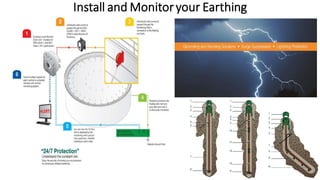
Install and Monitoryour Earthing
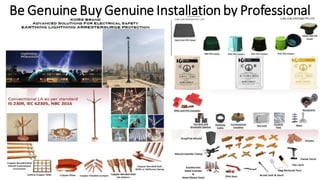
Be Genuine Buy Genuine Installation by Professional
You are in Right Hand We are Right Partner For You
Genuine and Professional DEAL
Contact us India, Singapore and Austrilia
LinkVue System India Pvt Ltd
Head Office: I-19 New Moti Nagar, KMP- New Delhi-15, INDIA
Telephone : 91-11-25105947
Branch: Chandigarh / Dehradun
INT: AUSTRALIA / SINGAPORE
www.linkvuesystem.com
Mr.Manish Khatri Director M- 9811698640
manish@linkvuesystem.com
Mahesh Chandra Manav HEAD Marketing&Sales M-9811247237
Manav.Chandra@linkvuesystem.com
We Prefer Waatsup Call

Lightning kills we save human with perfect design

  • 1.
    Lightning Kills andDistroy Your ValuableAssests No lightningprotection system is 100% effective. A system designed in compliancewith the standarddoes not guarantee immunity from damage. Lightning protection is an issue of statisticalprobabilitiesand risk management. A system designed in compliancewith the standardshould statisticallyreduce the risk to below a pre-determined threshold. The risk management process provides a framework for this analysis.An effective lightning protection system needs to controla variety of risks. While the current of the lightningflash creates a number of electrical hazards, thermal and mechanicalhazards also need to be addressed. Risk to persons (and animals) include: • Direct flash • Step potential• Touch potential• Side flash • Secondary effects: – asphyxiation from smoke or injury due to fire – structural dangers such as fallingmasonry from point of strike – unsafe conditionssuch as water ingress from roof penetrationscausing electrical or other hazards, failureor malfunctionof processes, equipmentand safety systemsRisk to structures & internal equipment include: • Fire and/or explosiontriggered by heat of lightningflash, its attachmentpoint or electrical arcing of lightning current within structures • Fire and/or explosiontriggered by ohmic heating of conductors or arcing due to melted conductors • Punctures of structure roofing due to plasma heat at lightningpoint of strike • Failure of internalelectrical and electronic systems • Mechanicaldamage including dislodgedmaterials at point of strike
  • 5.
  • 6.
    Know Your Systemand Keep Safe with Punctual
  • 7.
    We are Happyto A Part of Modern Digital Development
  • 8.
    Store Your Powerand Supply as per Load Demand
  • 12.
    LightningKills We SaveHumanwithPerfectDesign(WAR) SAFELIFEandAssets Conventional(IEC62305)Vs AdvanceProtection(ESE) NFC 17-102
  • 14.
    Professional Approach RightDesign Perfect Installation
  • 15.
    Best Product EasyInstallation and Easy Maintenance
  • 16.
    Technology and DesignWork To-Gather (SAFE)
  • 20.
  • 22.
    Lightning Special Designfor (Natural Components) Structure, Tanks and for Vessels • Protection using «natural» components • Components that have a lightning protection function but that were not installed for this purpose. Comment: these are conducting parts of a structure or building that are able to participate in the external protection through their capacity to capture a lightning strike or to conduct lightning current. They can be used to replace all or part of a down conductor or in addition to an external installation. • These components may be made up of: • The frame of metal constructions; • Metal coatings of walls or metal cladding • Sheet metal covering the volume to be protected, provided there is no risk of them being perforated by an impact • Metal components of a roof structure (interconnected steel frames, etc.), even if covered with non-metallic materials, provided that these may be excluded from the volume to be protected • Metal rods in reinforced concrete, provided that there is electrical interconnection between them, and particularly with the capture means and earthing system • Metal parts such as gutters, decoration, guardrails, etc, provided that their cross-section is not less than that specified for normal components • Metal pipes and tanks, provided they are at least 2.5 mm thick and if perforated, do not cause a dangerous or unacceptable situation • These elements must comply with thickness, cross-section and continuity requirements, thus making their use a difficult matter.
  • 23.
    Advantages and disadvantagesof the different Lightning Protection
  • 24.
  • 26.
    Conventional LightningIEC62305Design RiskyandRequireHigh Maintenance Lightning ROD In a lightning protection system, a lightning rod is a single component of the system. The lightning rod requires a connection to earth to perform its protective function. Lightning rods come in many different forms, including hollow, solid, pointed, rounded, flat strips or even bristle brush-like. The main attribute common to all lightning rods is that they are all made of conductive materials, such as copper and aluminum. Copper and its alloys are the most common materials used in lightning protection. Down Conductor The Down-Conductor is that part of the external Lightning Protection System (LPS) that conducts lightning current from the Air Terminal system to the Earth Termination system. The Down Conductor must be installed straight and vertically in order to provide the shortest and most direct path to earth. In conventional lightning protection system for every 100 ft. perimeter 1 down-conductor is necessary (recommended by NFPA 780). Conductors and Down-conductors are divided into two types: for building over 75 ft. class II is applicable and of buildings having lower height than 75 ft. class I is appropriate. Earthing In a lightning protection system, a earth rod is an unavoidable component of the system. The earth rod requires a connection to earth to perform its protective function. It completes the path for lightning to go into the earth. For each earthing system a test point is necessary so that earth resistance value can easily be measured for future reference. Though different standard has recommended earth resistance to be less than 10 – 50 ohms, but in most standards it is recommended that it should be less than 10- 20 ohms. Therefore, to ensure proper function of lightning protection system earth resistance value needs to be carefully checked by professional engineers or contractors.
  • 27.
  • 29.
  • 32.
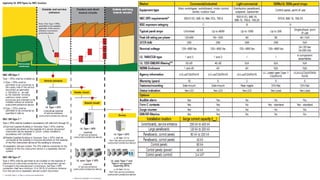
    Surge Protection InstallationApplication /Equipment
  • 33.
    Transient Voltage Surges Voltagesurges can also be created by non-weather phenomena. Such as: Externally • Transformer centre switching • Power station, sub station and distribution faults • Unregulated generators Internally • Lifts • Drive motors • Arc welding equipment • Photocopiers • Refrigeration Equipment • Air Conditioners
  • 37.
    Why do Ineed surge protection? Transient surges can cause damage ranging from premature ageing of electrical products to complete destruction of equipment. In this modern age, more and more products rely on sensitive electronics. Computer Equipment CCTV PLC Controlled Equipment Systems Wireless Transmitters & Receivers Fire and Burglar Alarm Systems Medical Equipment Laboratory and Test Equipment Building Management Telecoms Servers 61% of all electrical damage is caused by surges. A critical failure of one of these could cost a company £millions.
  • 42.
    UL Latest Documentationfor SPD Year 2019
  • 43.
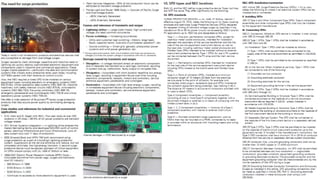
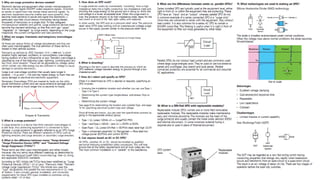
    Your Answerfor Queriesof Surge and Lightning • What is the 10/350 waveform and how is it related to the IEC Class I SPD tests? • The 10/350 waveform is an electrical impulse produced in a laboratorybya surge impulse generator.The "10" refers to the 10 microseconds it takes the impulse to reach 90% of its peak current.The "350" refers to the time in microseconds it takes for the impulse to decaydown to 50% of that peak. IEC standards state that this waveform simulates direct lightningand is based on research findings of CIGRE (International Councilon Large Electrical Systems - headquarteredin France).As shown elsewhere on this website both of those claims are false.Nevertheless,the IEC Class 1 Test stipulatesthis waveform be used to test SPDs which are to protect against direct lightning. • I've read that the 10/350 waveform is much more powerful than the other waveforms currently used in SPD testing such as the 8/20. If that's true and only spark gaps can pass those tests, then why do you opposethem? Why wouldn't we want a "stronger" SPD protecting our equipment? • The mistake we've all made is to thinkof the 10/350 waveform as a "powerful"impulse.Far more accurately,it should be thought ofas an "irrelevant" impulse.A sparkgap protector(because it responds slowlyand is a crowbardevice) can endure a high amplitude 10/350waveformbut doesn't do very well protectingelectronicequipment from actual lightning.An MOV protectorresponds 1000 times faster and actuallyabsorbs energyin the process of clampingthe lightningvoltage down to safe levels.MOVs don't do so well with a 10/350 waveform because theyabsorb part of the energy, but they far more effectivelyprotect electronicequipment from actual lightning.CIGRE's 2013 Technical Brochure 549 has corrected the misconception thatthe 10/350 waveform is the waveform of a lightningfirst stroke--because it isn't.That is why it's accurate to call the 10/350 waveform irrelevant.We do want stronger SPDs protectingourequipment and that's whywe consider it disingenuous forstandards to treat MOV-based SPDs as second-class citizens when in fact they are superiorat handlingdirect lightning. • What is the Lightning Protection Zone system and how is that related to the 10/350 waveform? • The LightningProtection Zone (orLPZ) system is a surge protectiveconcept that divides a structure into several "riskzones"nested within each other. The concept has been around since 1977 when E.F. Vance of the Stanford Research Institute proposedit. Here is a diagram showingVance's risk zones, extracted from his 1977 paper "Shieldingand GroundingTopologyforInterference Control."By "grounding"the outside ofeach shield to the inside of the adjacent shield,Vance sought to control the effect of external surges enteringa facility.He also realized the need to limit the surges on the power and data lines enteringthe structure.Zone 0 was the external environment liable to lightningstrikes.Zone 1 was the area inside the structure. • Although the purpose ofthe LPZ system is to mitigate the impact of incominglightning,practicallyspeaking,the entire function ofthe IEC LPZ system has become the regulation ofstructural and surge protectivedevices deemed "proper" foruse in each zone.IEC international lightningprotection standards adoptedVance's idea, but sabotaged it byinterjectingthe 10/350 waveform.In the IEC 62305 version,direct lightning(Zone 0) must be represented bya 10/350 waveform, hence onlyspark gap "lightningarrestors"which could pass the 10/350 Class I test were allowed to be used in Zone Zero or at locations borderingon Zone 1 (service entrance locations.)The problems with this approach are documented throughout this web,namely:1) the CIGRE 2013 Technical Brochure 549 shows that the 10/350 waveform does not represent actual lightning,and 2) the sparkgap "lightningarrestors" are intrinsicallyflawed. • Interestingly,although the IEC-branded LPZ system has been in widespread continuous use forover 20 years,there are apparently no statistical studies to proveits effectiveness. • More on the LPZ system can be found here.
  • 44.
    Your Answerfor Queriesof Surge and Lightning • We have spark gaps installed but sometimes we've noticed that the downstreamMOV protectors burn out or our electronic control systems get damaged yet the spark gap hasn't registered a surge. What is that? • In the first case you mention,what's happeningis the MOV protectors are respondingfaster than the sparkgaps.That is easy to understandsince MOVs inherentlyreact 3 orders of magnitude faster than sparkgaps.If the dinky"Class II MOV arrestors"are rated too lowto handle lightning(which is always the case with the ones used together with spark gaps)then they can and do burn out before the sparkgap can react. As to yourequipment burningout, you need to understand that sparkgaps maynot respond till the voltage level reaches 2.5 kV to 3kV. A transientsurge of 2.3 kV is high enough to fry yourelectronicequipment but not high enough to trigger the spark gap. • Was the 10/350 waveform ever a valid lightning parameter? • Unfortunatelynot. • Why has it taken so long to correct this situation? • You'll haveto ask the members of TC 81 about this one.One possible reason is that the 10/350 waveform has always been predominantlya marketing tool and there were vested interests aroundmakingsure it was promoted and stayed in place.People who knew there was a major problem with it became afraid ofspeakingout against it.This could be attributedpartlyto the shynature of people and partlyto all the force that was employed to keep it going. But these are just opinions. • Does effective surge protection require3 stages as the IEC standards state? • No. The reason the IEC standards required 3stages was that sparkgaps were unable to clamp overvoltages down to safe levels.They therefore had to be used together with several extra levels of MOV SPDs. A single properlysized MOV-based SPD can itself clamp overvoltages down to safe levels. That isn't to say you would never use additionalstages.In critical installations a second stage is typicallyused as a safetyfactor and to handle transient voltages that are internallycreated (i.e.created within the facilityitself) or appearon the buildinggroundingsteel.The best SPD in the world, if installed at the buildingentrance, would not be able to forestall damage from the overvoltages ofinternally-createdtransients. • Exaggerated ground resistancevalues? What does that mean? • It comes from the predilection ofmanysurge protection companies to The most often heard "excuse"given when sparkgaps failed to protect electronic equipment was "Your5 ohm ground resistance is too high. You need to get it down to 1 ohm for yoursurge protection to work." This is another urban legend.Per Ohms law, (even discountingimpedance which can make this situationworse)a 50kA surge goingthrough a 1 ohm circuit will produce a voltage of 50,000 volts.This is 100 times more than could be withstood byelectronicequipment.This onlysays that no matter howgood your grounding is, to protect electronicequipment requires fast actingefficient surge protectors (which eliminates sparkgaps.) •
  • 45.
    Take Care ofyour Equipment’s from Lightning and Surge
  • 46.
  • 47.
  • 48.
  • 49.
    Be Genuine BuyGenuine Installation by Professional
  • 50.
    You are inRight Hand We are Right Partner For You Genuine and Professional DEAL
  • 51.
    Contact us India,Singapore and Austrilia LinkVue System India Pvt Ltd Head Office: I-19 New Moti Nagar, KMP- New Delhi-15, INDIA Telephone : 91-11-25105947 Branch: Chandigarh / Dehradun INT: AUSTRALIA / SINGAPORE www.linkvuesystem.com Mr.Manish Khatri Director M- 9811698640 manish@linkvuesystem.com Mahesh Chandra Manav HEAD Marketing&Sales M-9811247237 Manav.Chandra@linkvuesystem.com We Prefer Waatsup Call