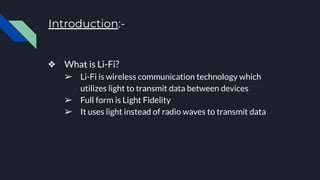
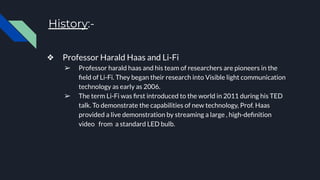
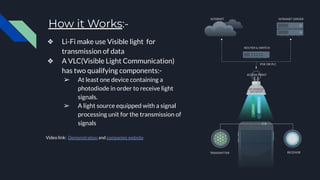
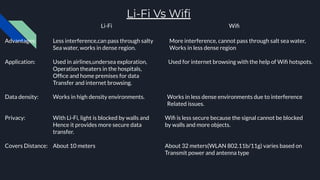
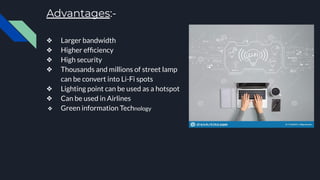
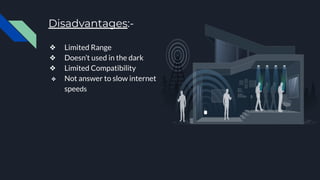
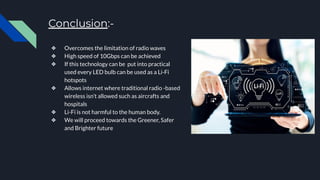
Li-Fi technology uses visible light communication to transmit data wirelessly using LED bulbs and photodiodes. Professor Harald Haas pioneered Li-Fi research in 2006 and first introduced the term in 2011 by demonstrating high-definition video streaming from an LED bulb. Li-Fi uses LED bulbs modulated at high speeds to transmit data to photodiodes, allowing for wireless connectivity. It has advantages over Wi-Fi like better security, higher speed, and ability to be used in places where radio waves cannot be used. Potential applications include use in airplanes, hospitals, and underwater exploration. While Li-Fi has a limited range and cannot be used in the dark, it provides a more energy efficient and secure alternative to






![Rejuvenation of wireless technology [li fi]](https://cdn.slidesharecdn.com/ss_thumbnails/rejuvenationofwirelesstechnologyli-fi-160407085339-thumbnail.jpg?width=640&height=640&fit=bounds)


![[Deck] What's New in Spark-Iceberg Integration via DSV2.pptx](https://cdn.slidesharecdn.com/ss_thumbnails/deckwhatsnewinspark-icebergintegrationviadsv2-260210005337-25955b12-thumbnail.jpg?width=640&height=640&fit=bounds)


