Quality Learning though
Life Skills in MENA
Purpose of the Initiative
Overall objective is to support MENA countries in
institutionalizing life skills education within their
national education systems (both for formal and non-
formal education), and within the workplace.
More specifically, it aims to:
• Develop a conceptual framework for life skills
education that is relevant for the MENA context.
• Provide clear programmatic guidelines for life skills
programming in MENA countries.
• Introduce a life skills M&E framework in MENA that
includes the measurement of learning outcomes.
Vision and working definition of life skills
• Despite the increased emphasis on the development of life skills
as a mean to enhance the quality of education, as well as
prepare young people for successful employment in a rapidly
challenging and globalized world, there is still no common
definition.
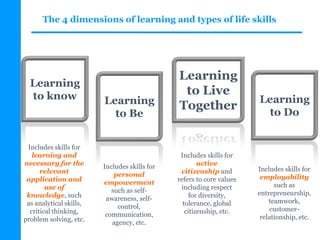
• The proposed AM/CPF is anchored through the UNESCO
Delors Report which has defined the essential functions of life
skills as back as 1996 through four pillars of education:
‘learning to know’, ‘learning to be’, ‘learning to live
together’ and ‘learning to do’.
• Partners in this initiative include: UNESCO, World Bank,
UNRWA, ILO, UNHCR, and UNFPA
MEdNet Meeting, Amman November 2015.
• The MEdNet meeting: periodically organized by the UNICEF
MENA Regional Office (MENARO) to engage with government
counterparts from ministries of education, education partners
and experts on education programmatic directions and
initiatives relevant to the MENA region
• MEdNet meeting 2015:
• Focused on Life skills as a key pillar of quality learning in
MENA
• Provided a High-level platform for exchange and dialogue
for more than one hundred and fifty participants who
actively contributed to the meeting, including country
delegations from fifteen MENA countries
• Started the process of rethinking education that is
contextual to MENA
The 4 dimensions of learning and types of life skills
Learning
to know Learning
to Be
Learning
to Do
Learning
to Live
Together
Includes skills for
learning and
necessary for the
relevant
application and
use of
knowledge, such
as analytical skills,
critical thinking,
problem solving, etc.
Includes skills for
personal
empowerment
such as self-
awareness, self-
control,
communication,
agency, etc.
Includes skills for
active
citizenship and
refers to core values
including respect
for diversity,
tolerance, global
citizenship, etc.
Includes skills for
employability
such as
entrepreneurship,
teamwork,
customer-
relationship, etc.
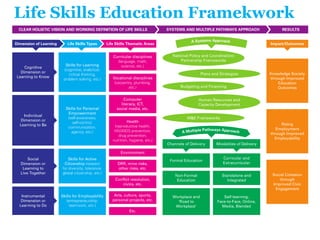
Life Skills Education Framekwork
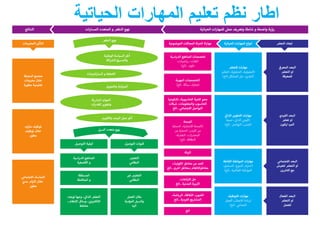
‫ﺍﻁﺎﺭ‬‫ﺍﻟﺣﻳﺎﺗﻳﺔ‬ ‫ﺍﻟﻣﻬﺎﺭﺍﺕ‬ ‫ﺗﻌﻠﻳﻡ‬ ‫ﻧﻅﻡ‬
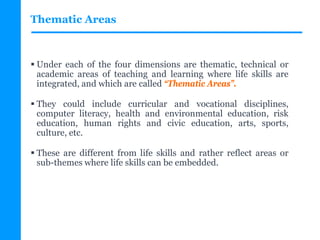
Thematic Areas
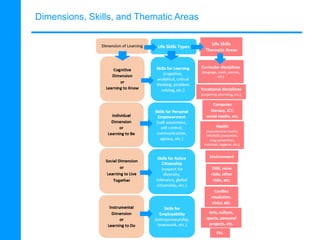
 Under each of the four dimensions are thematic, technical or
academic areas of teaching and learning where life skills are
integrated, and which are called “Thematic Areas”.
 They could include curricular and vocational disciplines,
computer literacy, health and environmental education, risk
education, human rights and civic education, arts, sports,
culture, etc.
 These are different from life skills and rather reflect areas or
sub-themes where life skills can be embedded.
Dimensions, Skills, and Thematic Areas
A systems approach to life skills programming
• Referred to as programming that is anchored with Ministries of
Education and within education systems – as a means to maximize
the impact of learning opportunities available to children and young
people.
Impossible d'afficher l'image. Votre ordinateur manque peut-être de mémoire pour ouvrir l'image ou l'image est endommagée. Redémarrez l'ordinateur, puis ouvrez à nouveau le fichier. Si le x rouge est toujours affiché, vous devrez peut-être supprimer l'image avant de la réinsérer.
 The systems approach to
life skills programming
includes five key aspects.
A multiple pathway approach to life skills
programming
• Life skills education is delivered
through various
channels/pathways in the
education system to include 1)
formal and 2) non-formal
education, 3) workplace and
road to workplace.
• There are various modalities
and ways of delivering life
skills to beneficiaries
(curricular & extracurricular,
standalone and integrated, self-
learning, etc.
Impossible d'afficher l'image. Votre ordinateur manque peut-être de mémoire pour ouvrir l'image ou l'image est endommagée. Redémarrez l'ordinateur, puis ouvrez à nouveau le fichier. Si le x rouge est toujours affiché, vous devrez peut-être supprimer l'image avant de la réinsérer.
Towards a Definition of Citizenship Education in MENA
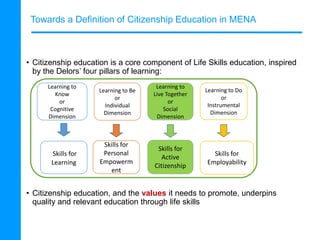
• Citizenship education is a core component of Life Skills education, inspired
by the Delors’ four pillars of learning:
• Citizenship education, and the values it needs to promote, underpins
quality and relevant education through life skills
Learning to
Know
or
Cognitive
Dimension
Learning to Be
or
Individual
Dimension
Learning to
Live Together
or
Social
Dimension
Learning to Do
or
Instrumental
Dimension
Skills for
Learning
Skills for
Personal
Empowerm
ent
Skills for
Active
Citizenship
Skills for
Employability
Towards a Definition of Citizenship Education in MENA
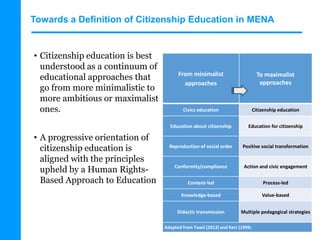
• Citizenship education is best
understood as a continuum of
educational approaches that
go from more minimalistic to
more ambitious or maximalist
ones.
• A progressive orientation of
citizenship education is
aligned with the principles
upheld by a Human Rights-
Based Approach to Education
From minimalist
approaches
To maximalist
approaches
Civics education Citizenship education
Education about citizenship Education for citizenship
Reproduction of social order Positive social transformation
Conformity/compliance Action and civic engagement
Content-led Process-led
Knowledge-based Value-based
Didactic transmission Multiple pedagogical strategies
Adapted from Tawil (2013) and Kerr (1999)
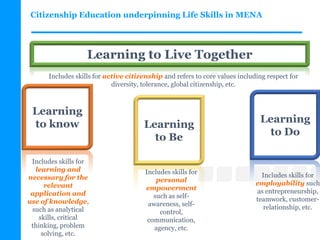
Citizenship Education underpinning Life Skills in MENA
Learning
to know Learning
to Be
Learning
to Do
Learning to Live Together
Includes skills for
learning and
necessary for the
relevant
application and
use of knowledge,
such as analytical
skills, critical
thinking, problem
solving, etc.
Includes skills for
personal
empowerment
such as self-
awareness, self-
control,
communication,
agency, etc.
Includes skills for active citizenship and refers to core values including respect for
diversity, tolerance, global citizenship, etc.
Includes skills for
employability such
as entrepreneurship,
teamwork, customer-
relationship, etc.
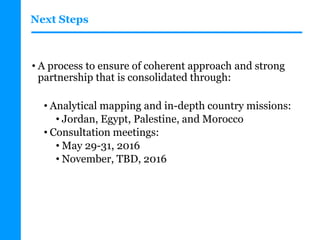
Next Steps
• A process to ensure of coherent approach and strong
partnership that is consolidated through:
• Analytical mapping and in-depth country missions:
• Jordan, Egypt, Palestine, and Morocco
• Consultation meetings:
• May 29-31, 2016
• November, TBD, 2016
Q&A
For more information, please contact
Name: Dina Craissati
Title Regional Education Advisor
Email dcraissati@unicef.org
UNICEF Middle East & North Africa Regional Office
P.O. Box 1551
Amman 11821
Jordan
Tel: +962-6-550-2400
© UNICEF MENARO 2015
Cover photo © credit goes here

Life skills aihr presentation_draft_4

  • 1.
  • 2.
    Purpose of theInitiative Overall objective is to support MENA countries in institutionalizing life skills education within their national education systems (both for formal and non- formal education), and within the workplace. More specifically, it aims to: • Develop a conceptual framework for life skills education that is relevant for the MENA context. • Provide clear programmatic guidelines for life skills programming in MENA countries. • Introduce a life skills M&E framework in MENA that includes the measurement of learning outcomes.
  • 3.
    Vision and workingdefinition of life skills • Despite the increased emphasis on the development of life skills as a mean to enhance the quality of education, as well as prepare young people for successful employment in a rapidly challenging and globalized world, there is still no common definition. • The proposed AM/CPF is anchored through the UNESCO Delors Report which has defined the essential functions of life skills as back as 1996 through four pillars of education: ‘learning to know’, ‘learning to be’, ‘learning to live together’ and ‘learning to do’. • Partners in this initiative include: UNESCO, World Bank, UNRWA, ILO, UNHCR, and UNFPA
  • 4.
    MEdNet Meeting, AmmanNovember 2015. • The MEdNet meeting: periodically organized by the UNICEF MENA Regional Office (MENARO) to engage with government counterparts from ministries of education, education partners and experts on education programmatic directions and initiatives relevant to the MENA region • MEdNet meeting 2015: • Focused on Life skills as a key pillar of quality learning in MENA • Provided a High-level platform for exchange and dialogue for more than one hundred and fifty participants who actively contributed to the meeting, including country delegations from fifteen MENA countries • Started the process of rethinking education that is contextual to MENA
  • 5.
    The 4 dimensionsof learning and types of life skills Learning to know Learning to Be Learning to Do Learning to Live Together Includes skills for learning and necessary for the relevant application and use of knowledge, such as analytical skills, critical thinking, problem solving, etc. Includes skills for personal empowerment such as self- awareness, self- control, communication, agency, etc. Includes skills for active citizenship and refers to core values including respect for diversity, tolerance, global citizenship, etc. Includes skills for employability such as entrepreneurship, teamwork, customer- relationship, etc.
  • 6.
  • 7.
  • 8.
    Thematic Areas  Undereach of the four dimensions are thematic, technical or academic areas of teaching and learning where life skills are integrated, and which are called “Thematic Areas”.  They could include curricular and vocational disciplines, computer literacy, health and environmental education, risk education, human rights and civic education, arts, sports, culture, etc.  These are different from life skills and rather reflect areas or sub-themes where life skills can be embedded.
  • 9.
  • 10.
    A systems approachto life skills programming • Referred to as programming that is anchored with Ministries of Education and within education systems – as a means to maximize the impact of learning opportunities available to children and young people. Impossible d'afficher l'image. Votre ordinateur manque peut-être de mémoire pour ouvrir l'image ou l'image est endommagée. Redémarrez l'ordinateur, puis ouvrez à nouveau le fichier. Si le x rouge est toujours affiché, vous devrez peut-être supprimer l'image avant de la réinsérer.  The systems approach to life skills programming includes five key aspects.
  • 11.
    A multiple pathwayapproach to life skills programming • Life skills education is delivered through various channels/pathways in the education system to include 1) formal and 2) non-formal education, 3) workplace and road to workplace. • There are various modalities and ways of delivering life skills to beneficiaries (curricular & extracurricular, standalone and integrated, self- learning, etc. Impossible d'afficher l'image. Votre ordinateur manque peut-être de mémoire pour ouvrir l'image ou l'image est endommagée. Redémarrez l'ordinateur, puis ouvrez à nouveau le fichier. Si le x rouge est toujours affiché, vous devrez peut-être supprimer l'image avant de la réinsérer.
  • 12.
    Towards a Definitionof Citizenship Education in MENA • Citizenship education is a core component of Life Skills education, inspired by the Delors’ four pillars of learning: • Citizenship education, and the values it needs to promote, underpins quality and relevant education through life skills Learning to Know or Cognitive Dimension Learning to Be or Individual Dimension Learning to Live Together or Social Dimension Learning to Do or Instrumental Dimension Skills for Learning Skills for Personal Empowerm ent Skills for Active Citizenship Skills for Employability
  • 13.
    Towards a Definitionof Citizenship Education in MENA • Citizenship education is best understood as a continuum of educational approaches that go from more minimalistic to more ambitious or maximalist ones. • A progressive orientation of citizenship education is aligned with the principles upheld by a Human Rights- Based Approach to Education From minimalist approaches To maximalist approaches Civics education Citizenship education Education about citizenship Education for citizenship Reproduction of social order Positive social transformation Conformity/compliance Action and civic engagement Content-led Process-led Knowledge-based Value-based Didactic transmission Multiple pedagogical strategies Adapted from Tawil (2013) and Kerr (1999)
  • 14.
    Citizenship Education underpinningLife Skills in MENA Learning to know Learning to Be Learning to Do Learning to Live Together Includes skills for learning and necessary for the relevant application and use of knowledge, such as analytical skills, critical thinking, problem solving, etc. Includes skills for personal empowerment such as self- awareness, self- control, communication, agency, etc. Includes skills for active citizenship and refers to core values including respect for diversity, tolerance, global citizenship, etc. Includes skills for employability such as entrepreneurship, teamwork, customer- relationship, etc.
  • 15.
    Next Steps • Aprocess to ensure of coherent approach and strong partnership that is consolidated through: • Analytical mapping and in-depth country missions: • Jordan, Egypt, Palestine, and Morocco • Consultation meetings: • May 29-31, 2016 • November, TBD, 2016
  • 16.
  • 17.
    For more information,please contact Name: Dina Craissati Title Regional Education Advisor Email dcraissati@unicef.org UNICEF Middle East & North Africa Regional Office P.O. Box 1551 Amman 11821 Jordan Tel: +962-6-550-2400 © UNICEF MENARO 2015 Cover photo © credit goes here