
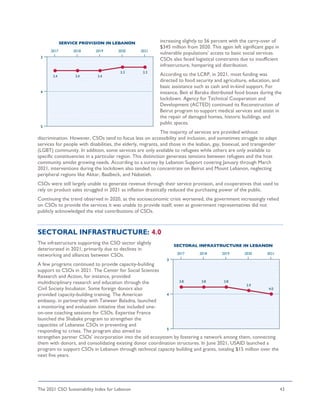
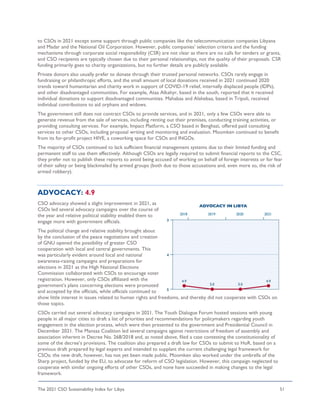
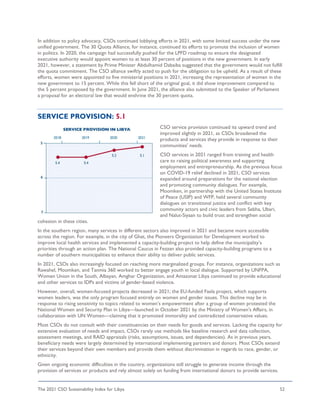
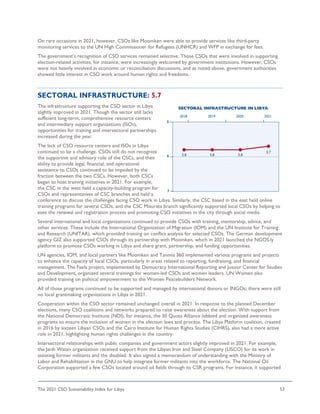
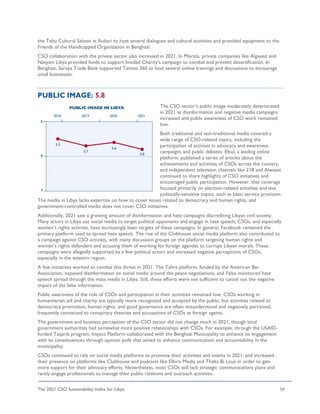
2021 CIVIL SOCIETY ORGANIZATION
SUSTAINABILITY INDEX
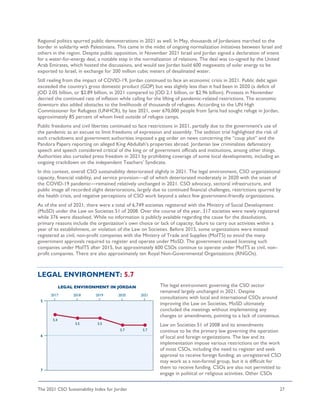
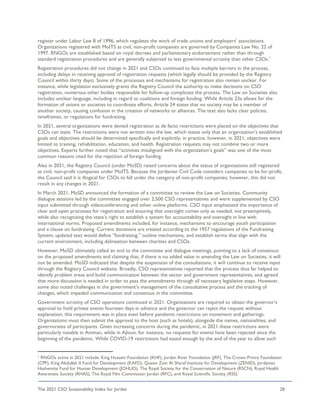
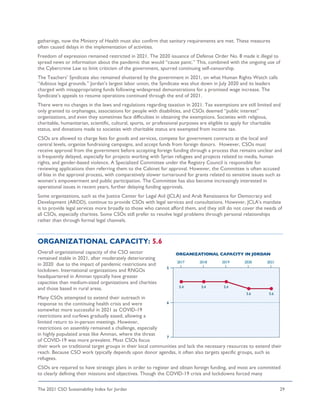
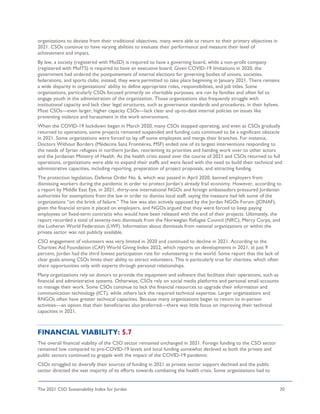
FOR THE MIDDLE EAST AND NORTH AFRICA
10th EDITION – DECEMBER 2022
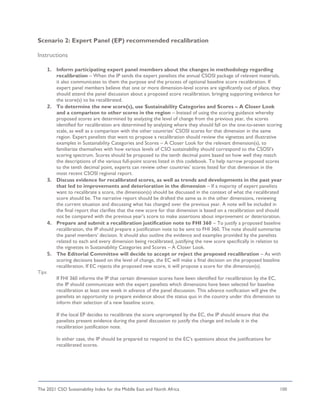
STRENGTHENING
CIVIL SOCIETY
GLOBALLY
STRENGTHENING
CIVIL SOCIETY
GLOBALLY
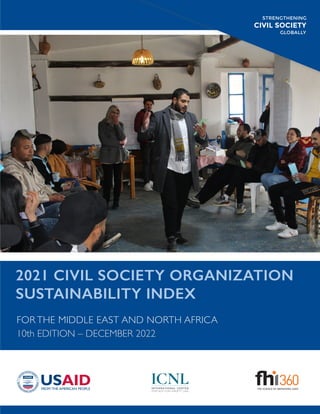
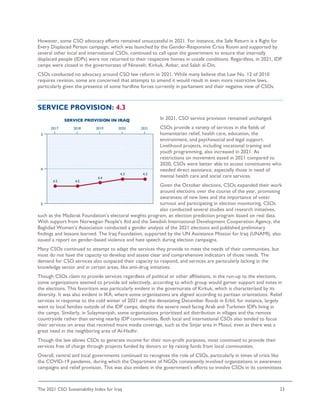
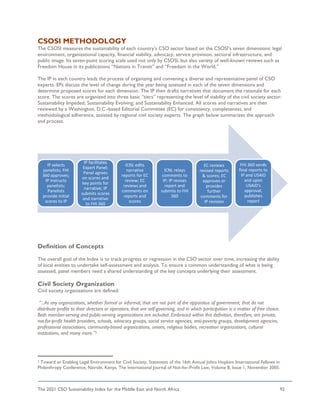
Cover Photo: Young Moroccans participate in a training session for leaders of artistic and cultural clubs on the
topic of “sociocultural revitalization” in March 2022. In the north of Morocco, youth lack the resources and
support, becoming vulnerable to crime, irregular migration, and exposure to violent extremist rhetoric and
recruitment, all of which imperil Morocco’s peaceful reform agenda.The Morocco Community Resilience activity
(MCRA) works to reduce vulnerability among at-risk youth by addressing the drivers of violent extremism.The
activity also focuses on building capacity of local civil society organizations to provide improved socio-economic
services to at-risk youth within their communities.
Photo Credit: Achraf Fetouhi, Chifae Association
2021 CIVIL SOCIETY ORGANIZATION
SUSTAINABILITY INDEX
FORTHE MIDDLE EAST AND NORTH AFRICA
10th EDITION – DECEMBER 2022
Developed by:
United States Agency for International Development
Bureau for Democracy, Conflict and Humanitarian Assistance
Center of Excellence on Democracy, Human Rights and Governance
Acknowledgment: This publication was made possible through support provided by the United States Agency for
International Development (USAID) under Cooperative Agreement No. AID-OAA-LA-17-00003.
Disclaimer: The opinions expressed herein are those of the panelists and other project researchers and
do not necessarily reflect the views of USAID or FHI 360.
The 2021 CSO Sustainability Index for the Middle East and North Africa
TABLE OF CONTENTS
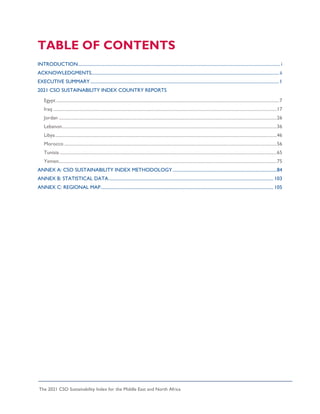
INTRODUCTION................................................................................................................................................................................... i
ACKNOWLEDGMENTS...................................................................................................................................................................... ii
EXECUTIVE SUMMARY.......................................................................................................................................................................1
2021 CSO SUSTAINABILITY INDEX COUNTRY REPORTS
Egypt .....................................................................................................................................................................................................7
Iraq ......................................................................................................................................................................................................17
Jordan .................................................................................................................................................................................................26
Lebanon..............................................................................................................................................................................................36
Libya....................................................................................................................................................................................................46
Morocco ............................................................................................................................................................................................56
Tunisia ................................................................................................................................................................................................65
Yemen.................................................................................................................................................................................................75
ANNEX A: CSO SUSTAINABILITY INDEX METHODOLOGY ............................................................................................84
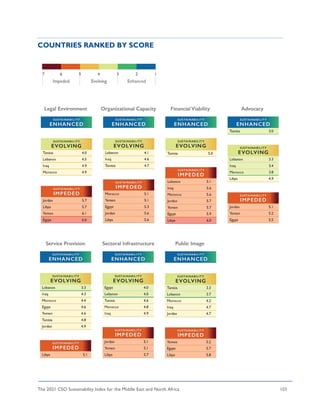
ANNEX B: STATISTICAL DATA.................................................................................................................................................. 103
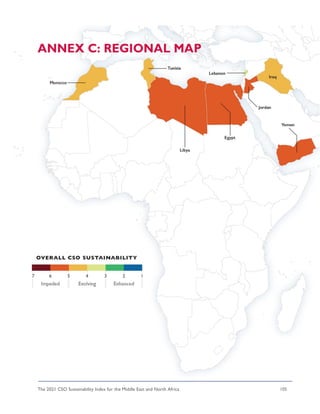
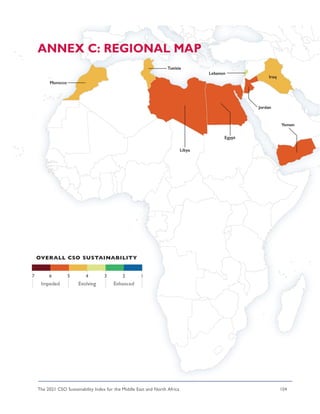
ANNEX C: REGIONAL MAP......................................................................................................................................................... 105
The 2021 CSO Sustainability Index for the Middle East and North Africa i
INTRODUCTION
The United States Agency for International Development (USAID) is pleased to present the tenth edition of the
Civil Society Organization (CSO) Sustainability Index for the Middle East and North Africa, covering developments in
2021. This year’s Index reports on the state of CSO sectors in eight countries in the region: Egypt, Iraq, Jordan,
Lebanon, Libya, Morocco, Tunisia, and Yemen.
The Index addresses advances and setbacks in seven key components or “dimensions” of the sustainability of the
civil society sector: legal environment, organizational capacity, financial viability, advocacy, service provision,
sectoral infrastructure, and public image. The Index is intended to be a useful source of information for local
CSOs, governments, donors, academics, and others who want to better understand and monitor key aspects of
sustainability in the CSO sector.
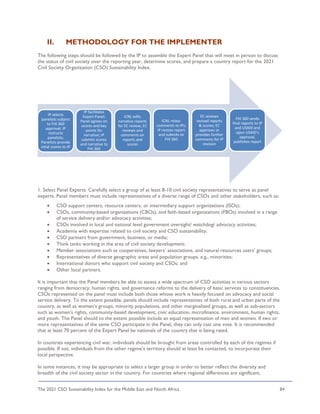
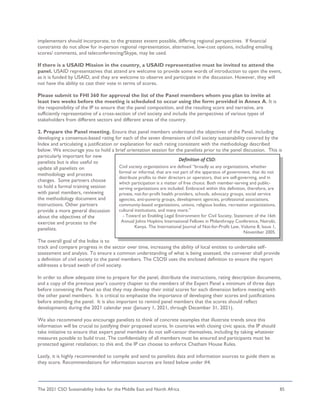
The Index’s methodology relies on CSO practitioners and researchers in each country covered. These teams form
expert panels to assess and rate these dimensions of CSO sustainability during the year. The panels agree on
scores for each dimension, which range from 1 (the most enhanced level of sustainability) to 7 (the most impeded).
The dimension scores are then averaged to produce an overall sustainability score for the CSO sector of a given
country. An international editorial committee composed of technical and regional experts reviews each panel’s
scores and the corresponding narrative reports, with the aim of maintaining consistent approaches and standards
to facilitate cross-country comparisons. Further details about the methodology used to calculate scores and
produce narrative reports are provided in Annex A.
The CSO Sustainability Index for the Middle East and North Africa complements similar publications covering other
regions. The various regional editions of the 2021 CSO Sustainability Index assess the civil society sectors in seventy-
three countries, including thirty-two in Sub-Saharan Africa, twenty-four in Central and Eastern Europe and Eurasia,
eight in Asia, and Mexico.
A publication of this type would not be possible without the contributions of many individuals and organizations.
We are especially grateful to our local implementing partners, who play the critical role of facilitating the expert
panel meetings and writing the country reports. We would also like to thank the many CSO representatives and
experts, USAID partners, and international donors who participate in the expert panels in each country. Their
knowledge, perceptions, insights, and contributions are the foundation upon which this Index is based.
In addition, special thanks goes to Eka Imerlishvili from FHI 360, the project manager; Kate Musgrave and Jennifer
Stuart from ICNL, the report's editors; and Milad Abraham and Christina Del Castillo from USAID. A full list of
acknowledgements can be found on page ii.
Happy reading,
Michael Kott
Director, Civil Society and Peace Building Department, FHI 360
December 14, 2022
The 2021 CSO Sustainability Index for the Middle East and North Africa ii
ACKNOWLEDGMENTS
EGYPT Sarah El Sweify, Amina Lotfy, Batoul El-Adawi, and Sandra Ramzy, Center for Development
Services (CDS)
IRAQ Alyaa Alansari, Yass Erdawi, and Hussain Abdullah, Bent AL-Rafedain Organization (BROB)
JORDAN Aida Essaid and Ayed Tayyem, Information and Research Center/King Hussein Foundation
LEBANON Mia Crochot, Layal Bahnam, and Roula Mikhael, Maharat Foundation
LIBYA Hala Bugaighis and Nouria Bugaighis, Jusoor
MOROCCO Yassin Bazzaz and Zineb El Jouak, Prometheus Institute for Democracy and Human Rights
TUNISIA Olfa Dardouri, Kaouther Mokaddem, and Sofien Asta, Jamaity
YEMEN Maher Othman, Resonate! Yemen
The 2021 CSO Sustainability Index for the Middle East and North Africa iii
PROJECT MANAGERS
FHI 360
Michael Kott
Eka Imerlishvili
Alex Nejadian
William Daley
INTERNATIONAL CENTER FOR NOT-FOR-PROFIT LAW (ICNL)
Kate Musgrave
Jennifer Stuart
EDITORIAL COMMITTEE
Milad Abraham (USAID), Stephen Brager (USAID), Obed Diener (FHI360), Kristen McGeeney (ICNL), and Amy
Hawthorne (Regional Expert)
The 2021 CSO Sustainability Index for the Middle East and North Africa 1
EXECUTIVE SUMMARY
In 2021, countries in the Middle East and North Africa (MENA) began to chart their path toward recovery from
the myriad impacts of the COVID-19 pandemic. Yet, the process of recovery—social, economic, and political—
proved to be both gradual and halting. Over the course of the year, CSOs in the region faced not only the ongoing
impact of the pandemic, but also political unrest and financial uncertainty, yet continued to adapt to the difficult
and shifting environment. The 2021 CSO Sustainability Index for MENA, which reports on the state of CSO sectors
in Egypt, Iraq, Jordan, Lebanon, Libya, Morocco, Tunisia, and Yemen, outlines CSOs’ successes and obstacles in
carrying out their missions.
FRAGILE ENVIRONMENTS
When the COVID-19 virus started to spread rapidly around the globe in 2020, governments in the MENA region
swiftly joined the rest of the world in instituting policies to limit its transmission. The region recorded relatively
low numbers of fatalities from COVID-19 in 2020 compared with other regions. Subsequent waves of infections,
however, caused several countries in MENA to record significantly higher numbers of COVID-19 cases in 2021
than they had in the first year of the pandemic, even as they proactively distributed vaccines. Egypt, for instance,
reported significantly higher numbers of both cases and deaths due to COVID-19 in 2021, and according to the
World Bank, even those are likely to be underreported.
Most countries reimposed and eased COVID-19 precautions in accordance with the changing health risks over the
course of the year, significantly impacting CSO operations. In Lebanon, for example, the mid-January spike in cases
spurred the imposition of a 24-hour curfew until February 22, one of the strictest lockdowns in the world;
restrictions were gradually eased in stages before being completely lifted in March. In other countries, such as Iraq,
Jordan, and Morocco, partial closures or restrictions, typically including evening and weekend curfews, limits on
public gatherings, and restrictions on non-essential travel within the country, were imposed for part or all of the
year.
Though governments largely moved away from the strict emergency decrees that had been levied in 2020, the ad
hoc reimposition of restrictions on movement and assembly under the banner of pandemic precautions continued
to raise concerns and impede civil society. Egypt, for instance, has been under a state of emergency for much of
the past several decades, and in 2020 extended its most recent state of emergency (in effect since April 2017).
Although international and domestic pressure succeeded in lifting that state of emergency in October 2021, the
government had by then attached emergency decree provisions to other laws and continued to restrict movement
and critical voices.
In Tunisia, a spike in COVID-19 cases, together with a continued political standoff between the president and
prime minister, sparked widespread anti-government protests that involved violent clashes between police and
demonstrators. Citing the health crisis, President Kais Saied invoked emergency powers on July 25, dismissing the
prime minister and his government and freezing parliament for a period of thirty days; the freeze was later
extended indefinitely, leaving Saied to rule by decree for the remainder of the year. Though a new government was
at last formed in October, a presidential decree issued in September maintained the concentration of power under
the executive office.
The region also continued to face a number of political shifts and uncertainties in 2021. Peace talks facilitated by
the United Nations (UN) concluded in Libya in February 2021, establishing a unified executive authority in the
country for the first time since 2014. In Yemen, however, the internal conflicts that have raged since 2014
continued, leaving over 4,000,000 people internally displaced as the UN Human Rights Council documented
consistent violations of international humanitarian and human rights laws committed by all parties to the conflict.
In Iraq, the temporary government established in May 2020 finally held elections in October 2021 under a newly
established single non-transferable vote system and new voting districts. Recording the lowest participation rate in
the post-2003 period, the elections ushered in unexpected wins for two newly established parties and losses for
traditional political elites. Morocco also held elections in 2021. After a decade in power, the Islamist Justice and
Development Party suffered a resounding defeat, highlighting its loss of credibility with the public in the midst of
increasing dissatisfaction and restrictions on the freedom of expression.
The 2021 CSO Sustainability Index for the Middle East and North Africa 2
Restrictions on the freedoms of expression and assembly continued in Jordan as well, where criticism of the
government’s mismanagement of the health crisis spurred public demonstrations and palace fears of a planned
“coup.” In April, authorities arrested nineteen people, including King Abdullah II’s half-brother, Prince Hamzah bin
al-Hussein, after he criticized the king’s pandemic response in a meeting with tribal leaders. While no charges were
brought against Prince Hamzah, a former royal court chief and a cousin of the king were both tried for sedition
and sentenced to fifteen years in prison for allegedly trying to destabilize the kingdom. The trial, combined with
pandemic restrictions, further cultivated a climate of censorship.
In Lebanon, civil society continued to step in where the weak and deadlocked government frequently failed to take
action. No authorities have yet been held accountable in the ongoing investigation of the deadly Beirut port
explosion of August 2020, while basic infrastructure in Beirut continued to be heavily impaired, compounded by
electricity shortages and the ongoing economic collapse. According to the UN Office for the Coordination of
Humanitarian Affairs (UN OCHA), in 2021, 78 percent of the Lebanese population was estimated to be living
below the poverty line, and extreme poverty reached 36 percent.
CSOs across the region continued to adapt as best they could to these difficult and divisive environments, often
continuing to learn from the flexibility and innovations that had been forced upon them with the first lockdowns in
2020. As they faced increasing restrictions on civic space and, in some cases, rising levels of disinformation and
smear campaigns from government authorities, CSOs in the region managed to maintain and even improve their
organizational capacity and service provision to meet the growing needs of their communities.
FURTHER CLOSING OF CIVIC SPACE
The closing of civic space in the MENA region over the past several years has been well documented, including in
the CSO Sustainability Index. This trend continued in 2021, with the legal environment governing CSOs deteriorating
in four out of the eight countries covered in this edition of the Index: Iraq, Lebanon, Libya, and Yemen. Though
Egypt did not record a deterioration in its legal environment, Egyptian CSOs continued to operate under the most
restrictive legal environment in the region, and one of the most restrictive of any country covered in any edition of
the Index. In addition to Egypt, Jordan, Libya, and Yemen continue to have scores for the legal environment
dimension that fall in Sustainability Impeded, the lowest category of sustainability according to the Index’s
methodology, demonstrating the restricted civic space under which CSOs in the region operate.
In 2020, civic space had constricted as governments across the region imposed restrictions in response to the
pandemic that limited civil liberties. In 2021, there tended to be fewer pandemic restrictions. Instead, increasing
bureaucratic hurdles and shrinking space for opposition voices drove the deterioration in the legal environment in
2021, in line with trends recorded before the onset of the health crisis.
The worsening impact of regulatory and bureaucratic hurdles on CSOs in 2021 was most pronounced in Yemen,
which already had one of the most restrictive legal environments in the region. Strict bureaucratic procedures and
requirements for CSOs to obtain work permits for every project (the approval of which was sometimes delayed
or selective) were compounded by harassment and extortion by both government authorities and military actors.
The battle for power in the country created complexities and inconsistencies in the regulatory environment for
CSOs, with those operating in areas controlled by the Ansar Allah Houthi rebel group facing increased restrictions
and selective approval of permit requests. Beyond bureaucratic harassment, CSOs and their staff regularly faced
the risk of detention, physical threats, and worse, and at least two CSO staff were killed in 2021 by indirect gunfire
or while on duty.
In Libya, the ceasefire and relative political stability in 2021 failed to prevent continued threats against activists and
CSO staff from militias and armed groups across the country. In addition, the October 2021 passage of a new
cybercrime law further restricted freedom of expression online, adding to several provisions in existing laws that
levied criminal penalties for defaming officials, the Libyan nation, or the flag, or for insulting religion.
In other cases, cumbersome bureaucratic hurdles and delays impeded CSO operations. In Iraq, for instance,
complying with increasingly difficult registration procedures and government oversight sometimes required legal
assistance, with CSOs incurring up to $7,000 in legal fees to complete the registration process. In Lebanon, while
CSOs do not face significant legal barriers to registration on paper, in practice, the process is frequently delayed,
especially for those working on politically sensitive matters, and the full registration process can take more than a
The 2021 CSO Sustainability Index for the Middle East and North Africa 3
year to complete. This delay impacts CSOs’ ability to operate, including their ability to open bank accounts and
obtain international funding. The delay increased in 2021 as the government grappled with economic collapse and a
lack of basic supplies, frequent power outages, and limited human resources as public servants left for better
paying jobs outside of the public sector.
Though Egypt recorded no deterioration in the legal environment governing the CSO sector in 2021, it maintained
the most challenging legal environment in the region and encapsulates a number of these trends. In January 2021,
the government issued long-awaited bylaws, or “Executive Regulations,” clarifying elements of 2019 Law 149
Regulating the Exercise of Civil Work. While some CSOs reported positive developments coming out of these
bylaws, other aspects of the law remained cumbersome and somewhat restrictive for CSOs, particularly regarding
access to foreign funding. The law also enables government authorities to interfere in CSO work, activities, and
funding, and outlines extensive restrictions on the nature of activities that civil society may undertake. Human
rights activists were especially subject to significant state control and harassment, and in September 2021, for
instance, a mass trial began against the director of the Egyptian Coordination for Rights and Freedoms and about
two dozen activists that authorities linked to the group. The accused face criminal charges of joining and financing
an unlawful group as well as “spreading false news.”
Deteriorations in the legal environment for CSOs often track closely with deteriorations in CSO advocacy,
signifying a broader culture of harassment, censorship, and self-censorship. Sometimes this is subtle, taking place
largely through bureaucratic delays or regulations; in other cases, government crackdowns on critical voices are
more blatant. In Lebanon, freedom of expression and of the press dropped significantly in 2021 as the Cybercrime
Bureau increasingly summoned activists for criticizing the ruling elite, while CSOs operating in peripheral regions
faced harassment from traditional parties like Hezbollah. CSO advocacy deteriorated in this increasingly hostile
environment, with CSOs carrying out less advocacy work over the course of the year. Other CSOs limited their
advocacy initiatives to prioritize more urgent service provision and emergency assistance, recognizing their limited
resources.
Advocacy efforts also deteriorated elsewhere in the region as CSOs struggled to adapt their advocacy strategies to
complex and shifting environments. Faced with political upheaval in July, Tunisian CSOs failed to take a strong
stance in response to the freezing of parliament and concentration of power, and subsequently had little if any
access to decision-makers. Jordanian CSOs similarly struggled to adapt their advocacy tactics to the evolving
environment and lacked access to decision-makers especially due to pandemic restrictions on in-person gatherings.
GROWING DISINFORMATION AND HATE SPEECH
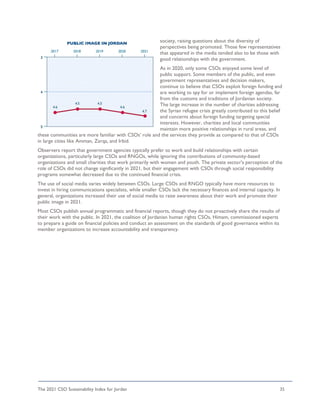
Across the region, the hostility evident in the closing of civic space was similarly reflected in the public image of
CSOs, which recorded slight deteriorations in four out of eight countries: Jordan, Lebanon, Libya, and Yemen.
CSOs in Lebanon, Libya, and Yemen were the targets of proactive smear campaigns, hate speech, and targeted
disinformation. Despite the relative political stability ushered in in early 2021, Libyan CSOs were met with
increasing hate campaigns, disinformation, and harassment that drove a moderate deterioration in the public image
of the sector, surpassing Egypt for the lowest score in the region. Social media platforms like Facebook and
Clubhouse enabled the rapid spread of hate speech targeting political opponents and activists, especially human
rights and women’s rights defenders. The smear campaigns and disinformation frequently alleged that the activists
or groups were promoting foreign agendas to corrupt Libyan morals and were especially prevalent and successful
in fostering negative perceptions of CSOs in the western region of the country.
Allegations of serving foreign agendas were also an issue in Yemen in 2021, where the public perception of CSOs
grew increasingly negative as local leaders publicly accused CSOs of carrying out foreign intelligence work. This
was particularly true in areas controlled by Ansar Allah, where media coverage was heavily censored. In one
instance, the Grand Mufti (an important Muslim legal scholar) accused CSOs of distributing toxic food, spreading
diseases, and being used as intelligence tools in a sermon that was broadcast live then went viral on social media.
CSOs in Lebanon also suffered from continued accusations of foreign bias or affiliations, and some political parties
and media accused them of corruption, especially in regard to the management of aid following the Beirut blast.
The newspaper Al-Akhbar launched a smear campaign against foreign-funded CSOs, presenting them as agents of
the West and demonizing their role in society, while the government and business sector alike continued to
The 2021 CSO Sustainability Index for the Middle East and North Africa 4
negatively perceive and portray CSOs as competitors for limited resources and international support. Similar
accusations of serving foreign interests were also recorded in Tunisia, particularly targeting human rights
defenders, though the negative coverage was somewhat offset by positive reporting on CSOs’ COVID-19 relief
efforts.
In other cases, media coverage of CSOs was limited to those aligned with or working alongside the government,
while a culture of censorship muted conversation or awareness around those working on more sensitive topics or
vocally critical of the government. In Jordan, for instance, the state television broadcaster hosted four to five
organizations every week—but it and other outlets consistently invited the same select few representatives from
civil society, drawing from those relatively close to the government. Similarly, in Egypt, CSOs working alongside
the government on the Hayah Karima initiative enjoyed notably positive media coverage, while coverage of CSO
activities not aligned with government goals was non-existent.
CSOS DEMONSTRATE THEIR RESILIENCE AND ADAPTABILITY
Despite the increasingly challenging environments across the region, civil society persevered in maintaining—and
even improving—its capacity and service provision to meet the needs of their communities. Four out of eight
countries covered in this edition of the Index (Libya, Morocco, Tunisia, and Yemen) recorded slight improvements
in CSO service provision, while three (Egypt, Iraq, and Tunisia) recorded improved organizational capacity.
Recalling the incredibly difficult and complex environments that many of these organizations operate in, maintaining
operations at an even level is itself a remarkable accomplishment; these improvements, therefore, speak to the
monumental efforts of CSOs in the region despite increasingly challenging circumstances. These strides forward
are all the more noteworthy given not just the difficult environments described above, but also the stagnation of
financial viability scores and available resources in the region in seven out of eight countries.
In MENA, and across the globe, pandemic lockdowns in 2020 forced organizations and workers to shift to online
platforms wherever possible. While far from easy or universally accessible, 2021 trends suggest that this necessary
innovation spurred longer term improvements in CSOs’ internal capacities and outreach. CSOs with internet
access were also able to benefit from online training. This growing accessibility of training particularly benefited
CSOs based in secondary cities, as was reported in Egypt. In Tunisia, CSOs significantly increased their internal
technical capacities in 2021, while in Iraq and Libya, international support enabled capacity-building programs on
topics ranging from internal management and strategic planning to conflict analysis. Egyptian CSOs also reported a
slight improvement in organizational capacity in the sector as the required re-registration spurred the majority of
active CSOs to reexamine and update their bylaws and strategic plans, increasingly engaging their boards of
directors in the process.
CSOs in the region continued to play an active role in providing essential services and emergency relief in 2021.
Tunisian CSOs, for instance, played a pivotal role in responding to the COVID-19 pandemic and promoting
vaccination and awareness campaigns. In August, Tunisia held two national days for vaccinations involving 400
centers across the country largely managed by civil society; on August 8 alone, 540,000 individuals were
vaccinated.
The second year of the pandemic also saw CSOs begin to return their attention and resources to a wider array of
services. In Libya, CSOs shifted their attention to new initiatives in preparation for the upcoming national election
and worked to promote community dialogues on transitional justice and conflict, while in Morocco, civil society
has increasingly worked to engage on and raise public awareness around climate change in recent years.
REGIONAL TRENDS IN CSO SUSTAINABILITY
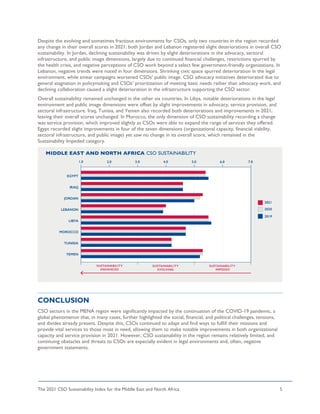
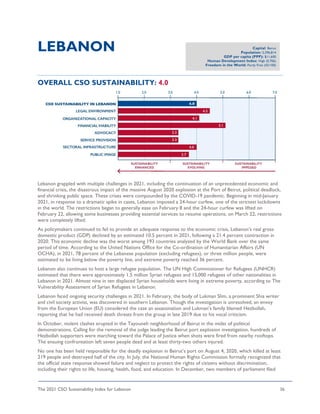
As in 2020, half of the countries covered in this regional edition of the CSO Sustainability Index—Egypt, Jordan,
Libya, and Yemen—had overall CSO sustainability scores in 2021 that fell in the Sustainability Impeded range, the
lowest category of sustainability. The remaining four—Iraq, Lebanon, Morocco, and Tunisia—ranked in the middle
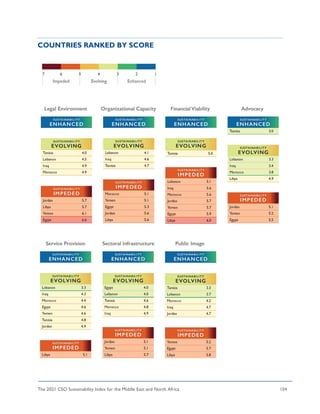
category, Sustainability Evolving, and all are in the lower half of that category. Libya, closely followed by Egypt,
continued to have the lowest level of CSO sustainability in the region, while Lebanon maintained the highest level
of CSO sustainability in the region, followed by Tunisia.
The 2021 CSO Sustainability Index for the Middle East and North Africa 5
Despite the evolving and sometimes fractious environments for CSOs, only two countries in the region recorded
any change in their overall scores in 2021: both Jordan and Lebanon registered slight deteriorations in overall CSO
sustainability. In Jordan, declining sustainability was driven by slight deteriorations in the advocacy, sectoral
infrastructure, and public image dimensions, largely due to continued financial challenges, restrictions spurred by
the health crisis, and negative perceptions of CSO work beyond a select few government-friendly organizations. In
Lebanon, negative trends were noted in four dimensions. Shrinking civic space spurred deterioration in the legal
environment, while smear campaigns worsened CSOs’ public image. CSO advocacy initiatives deteriorated due to
general stagnation in policymaking and CSOs’ prioritization of meeting basic needs rather than advocacy work, and
declining collaboration caused a slight deterioration in the infrastructure supporting the CSO sector.
Overall sustainability remained unchanged in the other six countries. In Libya, notable deteriorations in the legal
environment and public image dimensions were offset by slight improvements in advocacy, service provision, and
sectoral infrastructure. Iraq, Tunisia, and Yemen also recorded both deteriorations and improvements in 2021,
leaving their overall scores unchanged. In Morocco, the only dimension of CSO sustainability recording a change
was service provision, which improved slightly as CSOs were able to expand the range of services they offered.
Egypt recorded slight improvements in four of the seven dimensions (organizational capacity, financial viability,
sectoral infrastructure, and public image) yet saw no change in its overall score, which remained in the
Sustainability Impeded category.
CONCLUSION
CSO sectors in the MENA region were significantly impacted by the continuation of the COVID-19 pandemic, a
global phenomenon that, in many cases, further highlighted the social, financial, and political challenges, tensions,
and divides already present. Despite this, CSOs continued to adapt and find ways to fulfill their missions and
provide vital services to those most in need, allowing them to make notable improvements in both organizational
capacity and service provision in 2021. However, CSO sustainability in the region remains relatively limited, and
continuing obstacles and threats to CSOs are especially evident in legal environments and, often, negative
government statements.
The 2021 CSO Sustainability Index for the Middle East and North Africa 6
The country reports that follow provide an in-depth analysis of these trends and the state of CSO sectors in eight
countries in the MENA region. We hope that this annual survey continues to capture useful trends for CSOs,
governments, donors, and researchers supporting the advancement of CSO sectors.
The 2021 CSO Sustainability Index for Egypt 7
EGYPT
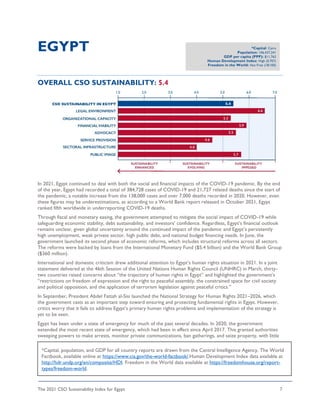
OVERALL CSO SUSTAINABILITY: 5.4
In 2021, Egypt continued to deal with both the social and financial impacts of the COVID-19 pandemic. By the end
of the year, Egypt had recorded a total of 384,728 cases of COVID-19 and 21,727 related deaths since the start of
the pandemic, a notable increase from the 138,000 cases and over 7,000 deaths recorded in 2020. However, even
these figures may be underestimations, as according to a World Bank report released in October 2021, Egypt
ranked fifth worldwide in underreporting COVID-19 deaths.
Through fiscal and monetary easing, the government attempted to mitigate the social impact of COVID-19 while
safeguarding economic stability, debt sustainability, and investors’ confidence. Regardless, Egypt’s financial outlook
remains unclear, given global uncertainty around the continued impact of the pandemic and Egypt’s persistently
high unemployment, weak private sector, high public debt, and national budget financing needs. In June, the
government launched its second phase of economic reforms, which includes structural reforms across all sectors.
The reforms were backed by loans from the International Monetary Fund ($5.4 billion) and the World Bank Group
($360 million).
International and domestic criticism drew additional attention to Egypt’s human rights situation in 2021. In a joint
statement delivered at the 46th Session of the United Nations Human Rights Council (UNHRC) in March, thirty-
two countries raised concerns about “the trajectory of human rights in Egypt” and highlighted the government’s
“restrictions on freedom of expression and the right to peaceful assembly, the constrained space for civil society
and political opposition, and the application of terrorism legislation against peaceful critics.”
In September, President Abdel Fattah al-Sisi launched the National Strategy for Human Rights 2021–2026, which
the government casts as an important step toward ensuring and protecting fundamental rights in Egypt. However,
critics worry that it fails to address Egypt’s primary human rights problems and implementation of the strategy is
yet to be seen.
Egypt has been under a state of emergency for much of the past several decades. In 2020, the government
extended the most recent state of emergency, which had been in effect since April 2017. This granted authorities
sweeping powers to make arrests, monitor private communications, ban gatherings, and seize property, with little
*Capital: Cairo
Population: 106,437,241
GDP per capita (PPP): $11,763
Human Development Index: High (0.707)
Freedom in the World: Not Free (18/100)
*Capital, population, and GDP for all country reports are drawn from the Central Intelligence Agency, The World
Factbook, available online at https://www.cia.gov/the-world-factbook/.Human Development Index data available at
http://hdr.undp.org/en/composite/HDI. Freedom in the World data available at https://freedomhouse.org/report-
types/freedom-world.
The 2021 CSO Sustainability Index for Egypt 8
or no judicial review. In October 2021, in response to calls from both international and domestic CSOs, the state
of emergency was lifted. However, the government attached emergency decree provisions to other laws and
Emergency State Security Courts continued to prosecute political activists. The space for critical voices remained
limited in 2021, and though the authorities released several journalists, others were detained. For instance, on
February 22, National Security officers arrested journalist Gamal al-Gamal and held him incommunicado for five
days upon his return from Turkey; he was released without trial in July.
In October, for the first time in the country’s history, ninety-eight women were sworn in as judges in Egypt’s State
Council, one of the country’s primary judicial bodies. This decision was applauded by some women's rights
activists, hopeful that it signifies a turn in increasing women’s representation.
In January 2021, the government announced the second phase of a national initiative, Hayah Karima (Decent Life).
The rural-focused initiative, in cooperation with numerous CSOs, will work on seven areas: housing infrastructure,
medical services, education, economic empowerment, social interventions, human development, and
environmental interventions. A dedicated fund has acquired investments totaling EGP 700 billion (approximately
$35 billion) through donations from the private sector and individuals. The initiative targets 4,658 villages across
the country, home to 58 percent of Egypt’s population of 102 million. The initiative was expanded from its initial
goals in 2019 to include additional villages within the framework of the Sustainable Development Strategy: Egypt’s
Vision 2030.
Overall CSO sustainability in Egypt remained unchanged in 2021. Four of the seven dimensions recorded slight
improvements, while three—legal environment, advocacy, and service provision—remained unchanged overall.
Though the legal environment for CSOs was somewhat clarified by the issuance of bylaws, a number of challenges
remain. The required process for re-registration, however, spurred CSOs to update their strategic plans and
encouraged greater board engagement, thereby driving an improvement in organizational capacities. The financial
viability of CSOs also slightly improved in 2021 as foreign and local funding increased, and increasing knowledge
exchange and cooperation within the sector resulted in improvements in the infrastructure that supports the
sector. Some CSOs’ increasing cooperation with government initiatives such as Hayah Karima also drove greater
media coverage and improved the public image of the sector overall. At the same time, CSO service provision
remained largely unchanged, as did advocacy, as CSOs continued to face challenges in influencing government
decision-making processes.
Of the 55,000 NGOs registered with the Ministry of Social Solidarity (MoSS) in 2020, more than 32,000
successfully registered through the new online portal in 2021. More than 20,000 associations and foundations that
had not yet begun the process have until January 2023 to do so, or they will be considered inactive or lacking the
capacity and/or willingness to continue operations.
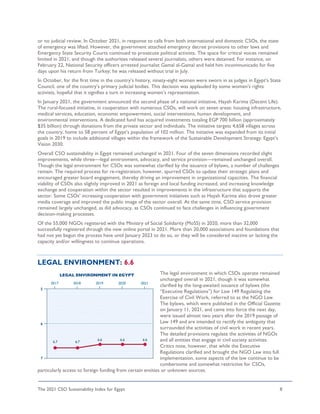
LEGAL ENVIRONMENT: 6.6
The legal environment in which CSOs operate remained
unchanged overall in 2021, though it was somewhat
clarified by the long-awaited issuance of bylaws (the
“Executive Regulations”) for Law 149 Regulating the
Exercise of Civil Work, referred to as the NGO Law.
The bylaws, which were published in the Official Gazette
on January 11, 2021, and came into force the next day,
were issued almost two years after the 2019 passage of
Law 149 and are intended to rectify the ambiguity that
surrounded the activities of civil work in recent years.
The detailed provisions regulate the activities of NGOs
and all entities that engage in civil society activities.
Critics note, however, that while the Executive
Regulations clarified and brought the NGO Law into full
implementation, some aspects of the law continue to be
cumbersome and somewhat restrictive for CSOs,
particularly access to foreign funding from certain entities or unknown sources.
The 2021 CSO Sustainability Index for Egypt 9
Registration now happens through an online process that takes approximately two months to complete. The
regulations additionally require that all registered entities regularize their status (re-register) with MoSS through
the online portal within one year; in early 2022, the Egyptian Cabinet extended that requirement for an additional
year, allowing organizations until January 11, 2023. This re-registration process entails the same conditions outlined
for registration, including that organizations must be engaged in a development-oriented activity that conforms to
the government’s development plan and meets the needs of society.
According to MoSS, of the 32,000 applications for status readjustment through the online portal in 2021, 28,000
NGOs have submitted all documentation and received confirmation of approval from MoSS. Organizations
reported a quick response rate from MoSS when problems arose, but some stated that the portal often lagged,
making it burdensome to upload extensive documentation like registration documents, organizational bylaws, and
personal information.
The registration process for international organizations is extremely complex and can take years. Foreign CSOs
must receive prior approval from MoSS in order to register and they are prohibited from engaging in any activities
before receiving the necessary license. The law and its implementing regulations require a foreign organization
seeking registration to submit its papers to the Foreign Ministry, which considers the licensing request. Neither the
law nor its regulations set a deadline for the ministry’s consideration of the application, and the Foreign Ministry is
not required to formally acknowledge the filing of the application and supporting documentation.
The Executive Regulations issued in 2021 somewhat lessened the severity of the law in terms of license
suspension, as the Central Unit is required to first notify the offending organization of a violation. If it fails to
rectify the situation, the organization may be suspended or have its license revoked through a judicial ruling. In the
latter case, the organization’s assets are to be liquidated within thirty working days.
The law, further clarified through the Executive Regulations, allows CSOs to engage in any activity that enables
them to fulfill the objectives listed in their statutes, provided they take into consideration national development
plans and the communities served. The law also encourages CSOs to expand the scope of their activities while
coordinating their efforts with other local and foreign organizations. CSOs are permitted to establish branch
offices in any governorate after notifying MoSS.
The NGO Law enables MoSS to interfere in CSO work, activities, and funding. For example, authorities may enter
CSOs’ premises without prior notice, inspect documents, challenge organizational decisions, and alter
organizational structures. There are also extensive restrictions on the nature of activities undertaken by civil
society. Article 14 specifies that associations will “exclusively work in the fields of social development defined in
their respective articles of association, while observing State development plans and society’s needs,” but “social
development” is not defined, allowing for various interpretations. Foreign organizations are subject to the same
vague stipulation.
In 2020, Law 149 repealed the use of imprisonment penalties but maintained the threat of substantial fines
between EGP 100,000 and EGP 1 million (approximately $5,000 to $50,000) for several offenses, such as
obstructing the law. Other penalties include the closure of premises, prohibiting donations, and banning activities
for up to a year. Failure to pay fines can also result in imprisonment, according to the Penal Code. Dissolutions and
suspensions have been limited as they are only permissible through judicial rulings; there was no available
information on closures or suspensions of CSOs in 2021.
Human rights activists in Egypt continued to be subject to significant state control and harassment. Though the
nationwide state of emergency was lifted in October 2021, the government attached emergency decree provisions
to other laws, and Emergency State Security Courts continued to prosecute political activists. In September 2021,
for instance, a mass trial began before an Emergency State Security Court against the director of the Egyptian
Coordination for Rights and Freedoms and about two dozen activists that authorities linked to the group. The
accused face criminal charges of joining and financing an unlawful group as well as “spreading false news.”
In 2021, the judiciary ended criminal investigations of many critical organizations and democracy and rights
defenders in the decade-old Case 173 of 2011, in which some 200 individuals and a number of NGOs were
investigated for receiving foreign funds “with the aim of destabilizing national security.” However, punitive travel
bans and asset freezes have not been lifted, despite judicial orders in August and September to do so. Several
other organizations and staff members, including the directors of the Arab Network for Human Rights Information
and the Egyptian Initiative for Personal Rights, remain under criminal investigation in the case.
The 2021 CSO Sustainability Index for Egypt 10
The Executive Regulations did not change the tax framework for CSOs. Once CSOs are registered, they are
eligible for several benefits, including exemptions from registration fees on contracts, stamp duties on documents,
taxes on documents, real estate taxes, and customs taxes. Corporate donors that fund CSOs receive deductions
of up to 10 percent of their taxable income.
The NGO Law and the Executive Regulations enable CSOs to receive various sources of funding to fulfill their
objectives. All registered civil associations are legally permitted to collect funds, grants, and donations from
Egyptian or foreign natural or legal persons licensed to work in Egypt; however, as described further below, a
number of conditions continue to impede CSOs’ access to foreign funding.
Some legal entities provide legal assistance to CSOs and CSOs specializing in legal matters offer legal awareness
training on specific issues impacting the sector. However, legal experts are still studying the Executive Regulations
in order to provide the necessary assistance.
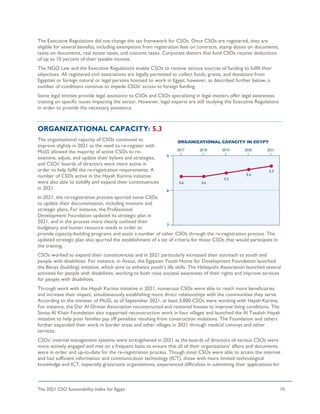
ORGANIZATIONAL CAPACITY: 5.3
The organizational capacity of CSOs continued to
improve slightly in 2021 as the need to re-register with
MoSS allowed the majority of active CSOs to re-
examine, adjust, and update their bylaws and strategies,
and CSOs’ boards of directors were more active in
order to help fulfill the re-registration requirements. A
number of CSOs active in the Hayah Karima initiative
were also able to solidify and expand their constituencies
in 2021.
In 2021, the re-registration process spurred some CSOs
to update their documentation, including missions and
strategic plans. For instance, the Professional
Development Foundation updated its strategic plan in
2021, and in the process more clearly outlined their
budgetary and human resource needs in order to
provide capacity-building programs and assist a number of other CSOs through the re-registration process. The
updated strategic plan also spurred the establishment of a set of criteria for those CSOs that would participate in
the training.
CSOs worked to expand their constituencies and in 2021 particularly increased their outreach to youth and
people with disabilities. For instance, in Assiut, the Egyptian Youth Home for Development Foundation launched
the Benya (building) initiative, which aims to enhance youth’s life skills. The Heliopolis Association launched several
activities for people with disabilities, working to both raise societal awareness of their rights and improve services
for people with disabilities.
Through work with the Hayah Karima initiative in 2021, numerous CSOs were able to reach more beneficiaries
and increase their impact, simultaneously establishing more direct relationships with the communities they serve.
According to the minister of MoSS, as of September 2021, at least 3,000 CSOs were working with Hayah Karima.
For instance, the Dar Al Orman Association reconstructed and restored houses to improve living conditions. The
Sonaa Al Khair Foundation also supported reconstruction work in four villages and launched the Al Tasaloh Hayah
initiative to help poor families pay off penalties resulting from construction violations. The Foundation and others
further expanded their work in border areas and other villages in 2021 through medical convoys and other
services.
CSOs’ internal management systems were strengthened in 2021 as the boards of directors of various CSOs were
more actively engaged and met on a frequent basis to ensure that all of their organizations’ affairs and documents
were in order and up-to-date for the re-registration process. Though most CSOs were able to access the internet
and had sufficient information and communication technology (ICT), those with more limited technological
knowledge and ICT, especially grassroots organizations, experienced difficulties in submitting their applications for
The 2021 CSO Sustainability Index for Egypt 11
status re-adjustment. In some cases, such as in Port Said and rural areas of the Giza governate, MoSS
administration staff provided some technical support to assist those CSOs in the re-registration process.
CSO staffing slightly improved in 2021, after financial challenges in 2020 made it difficult to retain paid staff. As
these financial challenges and COVID-19 restrictions began to ease in 2021, CSOs enjoyed an increase in funding
and projects, and thereby were able to increase and retain more full-time, paid staff. The Executive Regulations
issued in 2021 also set regulations for volunteer work to ensure volunteer rights, any necessary training, and the
provision of a certificate at the end of the volunteer’s work, among other things. This aimed to encourage
members of society to participate in various CSO activities with CSOs and promote a culture of volunteerism.
While the impact of this was not yet clear in 2021, these regulations and a draft national strategy for volunteer
work aim to encourage more volunteerism in the coming years.
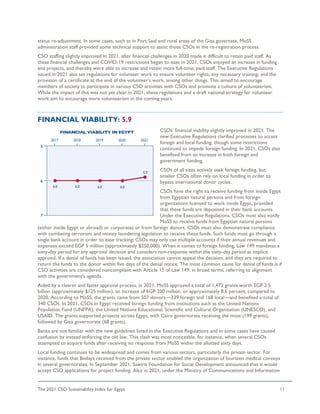
FINANCIAL VIABILITY: 5.9
CSOs’ financial viability slightly improved in 2021. The
new Executive Regulations clarified processes to access
foreign and local funding, though some restrictions
continued to impede foreign funding. In 2021, CSOs also
benefited from an increase in both foreign and
government funding.
CSOs of all sizes actively seek foreign funding, but
smaller CSOs often rely on local funding in order to
bypass international donor cycles.
CSOs have the right to receive funding from inside Egypt
from Egyptian natural persons and from foreign
organizations licensed to work inside Egypt, provided
that these funds are deposited in their bank accounts.
Under the Executive Regulations, CSOs must also notify
MoSS to receive funds from Egyptian natural persons
(either inside Egypt or abroad) or corporates or from foreign donors. CSOs must also demonstrate compliance
with combating terrorism and money laundering legislation to receive these funds. Such funds must go through a
single bank account in order to ease tracking; CSOs may only use multiple accounts if their annual revenues and
expenses exceed EGP 5 million (approximately $250,000). When it comes to foreign funding, Law 149 mandates a
sixty-day period for any approval decision and considers non-response within the sixty-day period as implicit
approval. If a denial of funds has been issued, the association cannot appeal the decision, and they are required to
return the funds to the donor within five days of the denial notice. The most common cause for denial of funds is if
CSO activities are considered noncompliant with Article 15 of Law 149, in broad terms, referring to alignment
with the government’s agenda.
Aided by a clearer and faster approval process, in 2021, MoSS approved a total of 1,472 grants worth EGP 2.5
billion (approximately $125 million), an increase of EGP 200 million, or approximately 8.6 percent, compared to
2020. According to MoSS, the grants came from 507 donors—339 foreign and 168 local—and benefited a total of
340 CSOs. In 2021, CSOs in Egypt received foreign funding from institutions such as the United Nations
Population Fund (UNFPA), the United Nations Educational, Scientific and Cultural Organisation (UNESCO), and
USAID. The grants supported projects across Egypt, with Cairo governorate receiving the most (199 grants),
followed by Giza governorate (68 grants).
Banks are not familiar with the new guidelines listed in the Executive Regulations and in some cases have caused
confusion by instead enforcing the old law. This clash was most noticeable, for instance, when several CSOs
attempted to acquire funds after receiving no response from MoSS within the allotted sixty days.
Local funding continues to be widespread and comes from various sectors, particularly the private sector. For
instance, funds that Bedaya received from the private sector enabled the organization of fourteen medical convoys
in several governorates. In September 2021, Sawiris Foundation for Social Development announced that it would
accept CSO applications for project funding. Also in 2021, under the Ministry of Communications and Information
The 2021 CSO Sustainability Index for Egypt 12
Technology, the Information Technology Industry Development Agency (ITIDA) signed protocols of cooperation
with three CSOs specializing in information technology (IT). In cooperation with the private sector, the ITIDA will
provide the CSOs with approximately EGP 50 million (approximately $2.5 million) over three years, in addition to
administrative and technical support, to improve the growth and development of the IT industry in Egypt.
CSOs demonstrated increased capacity to raise funds in 2021, both through the acceptance of donations from
licensed entities and other fundraising activities. For instance, in 2021, Hayah Karima launched a donation campaign
aimed at the Egyptian diaspora. As of October 2021, Egyptians abroad had donated approximately $362,000 to the
initiative, demonstrating the potential of international fundraising. CSO fundraising activities, which typically
coincide with Muslim holidays like Ramadan and Eid, also included exhibitions, charitable markets, and sporting
events in 2021. For instance, in November, Cairo Festival City (CFC) hosted the Run for a Heart marathon, in
cooperation with Ignite Egypt and Magdi Yacoub Heart Foundation (MYHF) and sponsored by Allianz Egypt. All
proceeds from the marathon supported MYHF. The use of online donation platforms also continued to increase in
2021, and several CSOs, such as Ahl Masr Foundation and MYHF, directly link to donation platforms on their
websites.
CSOs are also permitted to engage in other activities to increase their financial resources. For instance, funds may
be generated through the establishment of companies and charitable investment funds relevant to their activities.
There were no concrete examples of CSOs generating funds in this manner in 2021.
CSOs are required to maintain proper accounts and financial systems, as was reaffirmed in the Executive
Regulations. They must disclose their funding sources, the names of their members, and their annual donations.
CSOs must keep both electronic and hard copies of financial records, bank books, and registers of revenues and
expenses, fixed assets, cash and in-kind donations, and domestic and foreign funds. They are also committed to
following the rules of good governance and management and having a code of conduct. However, many CSOs still
lack the capacity to meet these relatively new requirements.
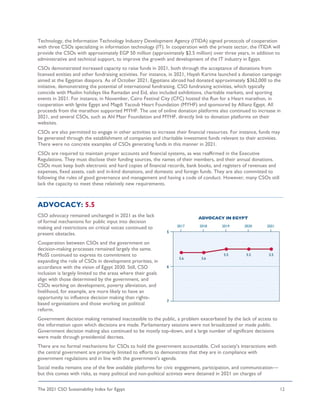
ADVOCACY: 5.5
CSO advocacy remained unchanged in 2021 as the lack
of formal mechanisms for public input into decision
making and restrictions on critical voices continued to
present obstacles.
Cooperation between CSOs and the government on
decision-making processes remained largely the same.
MoSS continued to express its commitment to
expanding the role of CSOs in development priorities, in
accordance with the vision of Egypt 2030. Still, CSO
inclusion is largely limited to the areas where their goals
align with those determined by the government, and
CSOs working on development, poverty alleviation, and
livelihood, for example, are more likely to have an
opportunity to influence decision making than rights-
based organizations and those working on political
reform.
Government decision making remained inaccessible to the public, a problem exacerbated by the lack of access to
the information upon which decisions are made. Parliamentary sessions were not broadcasted or made public.
Government decision making also continued to be mostly top-down, and a large number of significant decisions
were made through presidential decrees.
There are no formal mechanisms for CSOs to hold the government accountable. Civil society’s interactions with
the central government are primarily limited to efforts to demonstrate that they are in compliance with
government regulations and in line with the government’s agenda.
Social media remains one of the few available platforms for civic engagement, participation, and communication—
but this comes with risks, as many political and non-political activists were detained in 2021 on charges of
The 2021 CSO Sustainability Index for Egypt 13
spreading false news on social media, among other platforms, especially regarding the government’s management of
COVID-19 and the extent of its impact. For instance, human rights activist Sanaa Seif, first detained in 2020, was
sentenced in March 2021 to eighteen months in prison for spurious charges of “spreading false news,” “misusing
social media,” and insulting a police officer on duty after expressing concerns about the health standards and the
lack of virus protection in Egyptian prisons.
Some CSOs continue to conduct advocacy campaigns but there are few examples of campaigns that really
challenge social norms, and even fewer that challenge the government’s actions or make specific demands. The
latter are limited to informal social movements or collective action, such as the July 2021 hunger strike led by
several independent public figures in solidarity with political prisoners. The strike included, for instance, activist and
professor Laila Soueif, lawyer Ragia Omran, and Mohamed Abdel Salam, director of the Arab Initiative for Freedom
of Thought and Expression.
Both CSOs and informal social actors also engage in advocacy when specific laws are proposed that relate to their
issues of concern. For example, the online campaign for women’s rights to guardianship, #GuardianshipIsMyRight,
expressed opposition to a proposed Personal Status Law in 2021. In general, advocacy on these issues expanded
and became more normalized in 2021, with several developments related to women’s rights. Women’s rights
organizations continued to use international days or events like the 16 Days of Activism against Violence against
Women to advocate for their causes.
Some CSOs also seized opportunities to advocate at an international level where possible. In September, the Cairo
Institute for Human Rights Studies joined Amnesty International and Human Rights Watch in publishing a joint
letter to protest the contents of the United Nations Development Programme (UNDP)’s Human Development
Report on Egypt, which they claimed overlooked several human rights concerns in the country. However, this kind
of expression is high risk and directly discouraged by the government. Vocal criticism of the government is often
met with swift censorship or even imprisonment, and in 2021, the Committee to Protect Journalists ranked Egypt
the world’s third worst jailor of journalists.
Engagement to influence legislative and policy processes remains limited and most often occurs indirectly—through
independent initiatives, petitions, or campaigns—rather than through direct engagement with lawmakers. For
instance, through their website and social media platforms, the Arabic Network for Human Rights Information
(ANHRI) launched an awareness-raising campaign on behalf of thirty-four journalists and media professionals being
held in pretrial detention as candidates ran for Journalist Syndicate council seats in March 2021.
Perhaps one of the most successful examples of lobbying in 2021 was in regard to women’s rights. Many NGOs
joined an initiative and petition to lobby for women’s appointments as judges and prosecutors to the
Administrative Judiciary (also known as the State Council) and the Public Prosecution Authority (PPA). The
Egyptian Supreme Council of Judicial Body ultimately approved the appointments in October 2021, which some
perceived as a promising step toward women’s empowerment in the judiciary. Others, however, saw it as a
perpetuation of the status quo if the appointments are made only on an exceptional basis through political rather
than legislative routes; the PPA still has no concrete policy regarding the appointment of women as public
prosecutors.
CSOs did not engage in any significant advocacy efforts in 2021 around CSO law reform as they were focused on
adapting to and navigating the new Executive Regulations.
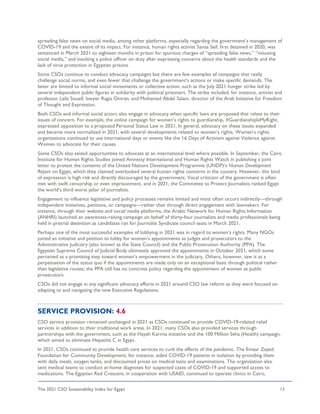
SERVICE PROVISION: 4.6
CSO service provision remained unchanged in 2021 as CSOs continued to provide COVID-19-related relief
services in addition to their traditional work areas. In 2021, many CSOs also provided services through
partnerships with the government, such as the Hayah Karima initiative and the 100 Million Seha (Health) campaign,
which aimed to eliminate Hepatitis C in Egypt.
In 2021, CSOs continued to provide health care services to curb the effects of the pandemic. The Emaar Zayed
Foundation for Community Development, for instance, aided COVID-19 patients in isolation by providing them
with daily meals, oxygen tanks, and discounted prices on medical tests and examinations. The organization also
sent medical teams to conduct at-home diagnoses for suspected cases of COVID-19 and supported access to
medications. The Egyptian Red Crescent, in cooperation with USAID, continued to operate clinics in Cairo,
The 2021 CSO Sustainability Index for Egypt 14
Alexandria, Sohag, and Qena. In addition to raising local
awareness of the virus, over the span of just four
months, the clinics examined a total of 42,000 patients
for COVID-19 symptoms and distributed 30,000
personal hygiene kits. Bedaya provided the governorates
of Sharqiya, Qaloubiya, and Gharbiya with fourteen
medical convoys with seven different areas of
specialization.
CSOs also provided services beyond the immediately
necessary medical assistance, including direct support and
goods, skill building, employment assistance, and more.
For instance, a CSO in Suez implemented awareness-
raising activities related to employment and held a job
fair. As mentioned previously, CSOs involved in Hayah
Karima also provided the initiative’s beneficiaries with a
wide range of services, such as expanding the establishment, development, and efficiency of nursery schools, and
identifying and integrating people with disabilities into society and providing rehabilitation services.
The services that CSOs provide continue to reflect the needs and priorities of their constituencies, which CSOs
identify through their presence on the ground and direct communication with local communities. CSO services are
generally provided without discrimination with regards to race, gender, religion, or ethnicity.
CSOs that rely on income-generating activities experienced some improvements in 2021 due to the easing of
COVID-19 restrictions, which allowed for more in-person activities. For instance, Tawasol Egypt was able to
display a variety of handmade products in bazaars and markets. Their products were also made available online and
in shops and boutiques. In October 2021, the Medium, Small, and Micro Enterprises Development Authority
(MSMEDA) hosted the Our Heritage Exhibition, which featured 1,500 CSOs and small and mid-sized enterprises
(SMEs) working in handicraft production.
In 2021, the Egyptian government continued to strengthen its relationship with large-scale CSOs that aligned with
its agenda. This was particularly true of CSOs aiming to reach the most vulnerable groups. For instance, MoSS
signed eighteen cooperation protocols with CSOs under the Forsa program for economic empowerment.
Cooperation through Hayah Karima, noted above, also demonstrated government recognition of CSO work.
However, those CSOs with missions not aligned with the government agenda continue to lack government
recognition and face impediments in their work.
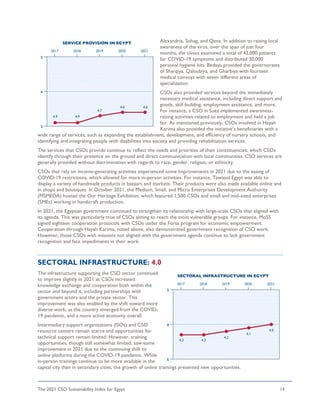
SECTORAL INFRASTRUCTURE: 4.0
The infrastructure supporting the CSO sector continued
to improve slightly in 2021 as CSOs increased
knowledge exchange and cooperation both within the
sector and beyond it, including partnerships with
government actors and the private sector. This
improvement was also enabled by the shift toward more
diverse work, as the country emerged from the COVID-
19 pandemic, and a more active economy overall.
Intermediary support organizations (ISOs) and CSO
resource centers remain scarce and opportunities for
technical support remain limited. However, training
opportunities, though still somewhat limited, saw some
improvement in 2021 due to the continuing shift to
online platforms during the COVID-19 pandemic. While
in-person trainings continue to be more available in the
capital city than in secondary cities, the growth of online trainings presented new opportunities.
The 2021 CSO Sustainability Index for Egypt 15
Grant and proposal writing, in addition to general CSO capacity building, are the most commonly offered training
workshops, but they are not consistently available. In 2021, Beit Al Karma organized at least two online workshops
for development practitioners and CSOs on proposal strategies and planning, monitoring, and evaluation. The Civil
Society Support Center launched two rounds of its annual CSO capacity-building program on management
systems, sustainability, and managing financial and human resources. In partnership with the British Council, Al
Moltaqa offered civil society and academic leaders a free course on gender equality. More specialized trainings are
also available and respond to the specific needs of CSOs, even corresponding to specific projects or initiatives. For
example, in 2021 the Friedrich Naumann Foundation, in cooperation with the Egyptian Youth Council for
Development, held a workshop titled Towards Efficient Women Leadership in Civil Society, attended by twenty-
four women representing CSOs.
Local funding for CSOs somewhat increased in 2021 and was directed toward a variety of issues as health was no
longer the sole priority, particularly expanding in the fields of trade reform and SME development, financial
inclusion, climate change, and social protection. Among the few local funding organizations, the Sawiris Foundation
for Social Development opened applications in mid-2021 for CSOs seeking funding to implement projects as part
of the Foundation’s next five-year plan. Al Madad Foundation also launched an annual grant program in 2021 to
support civil society institutions and schools in delivering creative and innovative solutions to problems facing
refugee children.
CSO cooperation somewhat increased in 2021. For instance, Misr El Kheir Foundation signed thirty-six
cooperation protocols with NGOs to support their internal capacity building and development and facilitate
knowledge exchange. In collaboration with the Abdul Latif Jameel Poverty Action Lab Middle East and North
Africa, the Sawiris Foundation for Social Development hosted a seminar to discuss new findings on the effects of
loans and grants on micro-enterprises’ performance and poverty alleviation.
CSOs also acknowledged the value of cooperation in strengthening advocacy initiatives. In April 2021, over
twenty-five CSOs addressed a letter to the European Bank for Reconstruction and Development (EBRD), urging it
to put human rights issues at the top of the agenda when discussing the next country strategy for Egypt. EBRD’s
three priorities in Egypt, announced in 2022, ultimately did not highlight human rights concerns. Also in 2021,
Tadwein Center for Gender Studies launched the Her Body Not Yours advocacy campaign against female genital
mutilation (FGM) in Egypt, in collaboration with Speak Up, a youth-led digital initiative that supports victims of
violence.
Overall, intersectoral partnerships in the country slightly increased in 2021, particularly spurred by a joint
coordination platform launched by the Ministry of Finance and Ministry of International Cooperation to stimulate
the participation of the private sector in national development initiatives. CSOs also increasingly sought out
partnerships with the government and private sector to facilitate greater access to financial and other strategic
resources, ease implementation processes, and increase recognition in the sector. For example, in 2021 the
Egyptian German Technical Academy cooperated with El-Swedy Technical Academy-STA and the Sawiris
Foundation for Social Development to launch the second phase of the Training for Employment program to
support youth employability.
PUBLIC IMAGE: 5.7
Overall, the public image of CSOs improved slightly in 2021, as the news media increasingly covered CSO work,
especially when done in cooperation with government initiatives. The government also showed an increasingly
positive perception of those CSOs that worked in line with the government priorities, in turn spurring more media
coverage and positive public perceptions of CSOs.
In 2021, the government’s perceptions of CSOs that support its development efforts continued to improve, and
the media continued to provide positive coverage of initiatives endorsed by government officials. In particular,
there were several publications and news posts around the Hayah Karima initiative, which worked with numerous
CSOs. The Minister of Planning and Economic Development praised CSO involvement in the first phase of the
initiative, specifically acknowledging their ability to communicate with villagers across the nation and determine
actual needs.
The 2021 CSO Sustainability Index for Egypt 16
Cooperation between the government and CSOs also
spurred the continued and increasing positive media
coverage of CSOs that are endorsed by or in line with
the government’s agenda. These CSOs’ presence in the
media and on the ground thereby also improved the
overall public image of the CSO sector.
News outlets positively covered the efforts of several
CSOs over the course of 2021. In September, Al-Ahram
reported on the Atta Charity Fund’s campaign to raise
awareness around special needs education and
accessibility. A prominent online news outlet,
ScoopEmpire, also wrote an article which highly praised
five CSOs working to support disadvantaged children in
Egypt, highlighting the work of each organization and
their social media pages to enable viewers to learn more
and support them in their ongoing efforts. During the Aswan flooding in November, CSOs were praised by Egypt
Today and others for their cooperation with the government in providing aid to affected areas. However, media
coverage was limited to those CSOs aligned with government initiatives, particularly those working in community
development and relief; those working on rights and political reform received no media coverage.
CSOs continued to promote their work and organizational image in 2021 through online campaigns,
advertisements, and promoting their initiatives on social media. Law 149 requires CSOs to publish data about their
activities, thereby increasing CSO transparency.
The 2021 CSO Sustainability Index for Iraq 17
IRAQ
OVERALL CSO SUSTAINABILITY: 4.6
After large-scale protests across Iraq in November 2019 prompted the resignation of the prime minister, the
temporary government established in May 2020 and led by Prime Minister Mustafa Al-Kadhimi promised to hold
elections by early 2021. On October 10, 2021, those elections finally took place. In response to the protests, Iraq’s
parliament had approved significant changes to the election law in 2020, including the introduction of the single
non-transferable vote system and a new redistricting plan that divided the country’s eighteen governorates into
eighty-three electoral districts, with parliament’s 329 seats allocated among them. Revisions to the law also
allowed for the election of independent candidates—while candidates may be party members, they would compete
as individuals and could not transfer votes to other candidates in their party.
Coming on the heels of the widespread demonstrations in 2019 and 2020, which the Carnegie Middle East Center
had considered “the largest grassroots movement in Iraq’s modern history,” the October 2021 elections recorded
the lowest participation rate in the post-2003 period according to the Independent High Electoral Commission.
This was largely attributed to broad and continuing frustrations with the political system, compounded by
recollections of violent responses to the earlier demonstrations. The most generous estimates suggest
approximately 44 percent of registered voters, or just 36 percent of eligible voters, participated in the election.
The election results surprised citizens, monitors, and political elites. An unexpected nine parliamentary seats went
to Emtidad, a newly established political party with roots in the protest movement that had led to early elections.
Ishraqat Kanon, another new party, won six seats, and forty-three independent candidates won seats. At the same
time, some of the most active traditional political elites, including the Al-Fateh Alliance and the National State
Forces Alliance, incurred losses.
CSOs played a positive role in the parliamentary elections as they participated in observing, monitoring, and raising
awareness regarding the electoral laws. Their election monitoring and reports on the election helped ensure
confidence in the election process.
After preliminary results were announced, supporters of the Islamic Fatah Movement, which lost seats it had won
in the last elections, claimed that fraud had affected the results in favor of the Sadrist movement and organized
demonstrations in Baghdad. The losing blocs also submitted appeals to the Federal Supreme Court questioning the
validity of the results announced by the Independent High Electoral Commission; the Court ratified the results
without making any significant changes.
The COVID-19 pandemic continued to impact and exacerbate socio-economic challenges in the country in 2021.
Iraq experienced two waves of infection in 2021, first in March and April then again in July and August. By early
November, the country had recorded over two million cases of COVID-19 and 23,344 deaths. Though the
Capital: Baghdad
Population: 40,462,701
GDP per capita (PPP): $9,300
Human Development Index: Medium (0.686)
Freedom in the World: Not free (29/100)
The 2021 CSO Sustainability Index for Iraq 18
government did not reimpose the full, nationwide lockdown that marked 2020, the entire country remained in
partial closure for all of 2021, with public gatherings largely restricted and an evening curfew remaining in place.
The Iraqi economy also suffered in 2021, impacted by the COVID-19 pandemic, the decline in oil prices, and the
global economic downturn. Government policies to mitigate the effects of the pandemic were weak and
unorganized, and despite multiple promises to reinvigorate the food ration program—a government aid program
that had previously distributed monthly assistance but saw numerous cuts in recent years—no such assistance was
provided in 2021. Families continued to adapt as best they could, borrowing or shifting priorities to meet their
basic needs. The continued deterioration of the economy similarly impacted CSOs, which saw their already-limited
local funding further diminished.
The Iraqi Kurdistan Region (IKR) is an autonomous region within Iraq governed by the Kurdistan Regional
Government (KRG). As in the rest of the country, IKR was affected by the economic downturn and the pandemic-
induced recession. Further difficulties ensued from KRG’s inability to regularly pay employee salaries due to its
ongoing financial deficit, a result of the central government’s refusal to disburse the region’s budget allocation in
2020 after KRG authorities failed to pay a share of locally-generated oil revenue to the central government. In
2021, KRG agreed to deliver 250,000 barrels of oil to the Federal Ministry of Oil in exchange for the region’s
budget allocation, but the central government claimed that KRG failed to abide by the agreement and continued to
withhold payments. In October and December 2021, IKR faced additional difficulties when heavy rain caused flash
flooding after one of the driest years in decades. The flooding killed at least twelve people in the region and caused
widespread damage to houses and infrastructure.
The overall sustainability of CSOs in Iraq remained unchanged, and just three dimensions recorded any change in
2021. The legal environment for CSOs slightly deteriorated due to burdensome and complicated registration
processes, together with impediments to normal CSO operations. Organizational capacity and sectoral
infrastructure, however, saw slight improvements as CSOs increased their engagement with both constituents and
volunteers and harnessed opportunities that came with new knowledge resources and increased cooperation in
the sector.
Registered non-governmental organizations (NGOs) constitute the majority of entities within Iraq’s civil society
sector, which also includes trade unions and research centers. As of the end of 2021, 5,045 NGOs were registered
with the NGO Directorate in the federal government, 425 of which were newly registered during the year. In IKR,
approximately 5,600 NGOs are registered, 299 of which were newly registered in 2021. However, most
registered organizations in both federal Iraq and IKR are thought to be inactive and have little impact on the
ground. Unregistered youth entities and coalitions continue to constitute an active and important part of Iraqi civil
society, providing small-scale relief efforts at the community level, often with funding from local groups. Some lack
the institutional capacity to establish formal organizations, while others have not registered in order to avoid the
bureaucratic procedures it requires.
LEGAL ENVIRONMENT: 4.9
The legal environment governing CSOs remained
challenging and recorded a slight deterioration in 2021
due to increasingly cumbersome registration procedures
and government oversight of some CSO operations.
Organizations’ freedom of movement and operations
were also limited by official governmental letters. Official
letters are executive directives that, though not law, are
adhered to by all state agencies and difficult to challenge
through the courts.
Article 39/1 of the Iraqi Constitution guarantees the right
to form associations. Law No. 12 of 2010 and its
implementing instructions remained unchanged in 2020
and provide the basic legal framework for CSO
operations in the country. At the federal level, the NGO
Directorate in the Council of Ministers General
The 2021 CSO Sustainability Index for Iraq 19
Secretariat (COMSEC) continues to oversee the implementation of Law No. 12, as well as the registration
procedures and relations between CSOs and the government. However, as in previous years, employees of the
NGO Directorate sometimes adopt and impose additional requirements for CSOs, beyond those set forth by Law
No. 12. In IKR, the Law on NGOs (Law 1 of 2011) continues to govern NGOs operating in areas under KRG
control. The Kurdish NGO Directorate implements the law.
Organizations are required to formally register in order to operate and must provide the NGO Directorate with
narrative and financial reports on an annual basis. The registration process became increasingly burdensome and
time consuming in 2021. Some organizations are forced to hire a lawyer, paying up to $7,000 in legal fees, to
complete the registration process, which is often well beyond their financial ability.
Registration procedures were increasingly delayed in 2021 because of the process of obtaining approval for the
organization's headquarters, which must go through security authorities like the National Security Service before it
is passed on to the NGO Directorate for final approval. Further delays arise in the process of verifying that no
organization already registered has a similar name. This verification process is time consuming, and in 2021 the
NGO Directorate did not provide a public list of registered organizations for organizations to cross-reference
before submitting their official papers, making the process even more difficult and burdensome. For instance, a
network originally named the Coalition of Resolution 1325 struggled to confirm that there were no similarly
named organizations and, after a lengthy official correspondence, ultimately registered as the Women's Network
for Peace. Another organization attempted to register three times, facing delays and difficulties in verifying its name
each time, and ultimately modified it from Programming Association for Iraq to the Al-Khwarizmi Foundation.
The logistics of submitting required papers also remained difficult and burdensome for all CSOs. Though there is
an electronic mechanism for submission, organizations reported that responses were either significantly delayed or
never received, and government authorities sometimes refused to accept electronic signatures.
Coordination is still lacking between the NGO Directorate in Baghdad and the NGO Directorate in IKR. Though
in principle NGOs registered in Baghdad (federally) should be automatically considered registered and have the
right to work anywhere in the country, for them to operate in IKR, organizations must notify the local NGO
Directorate and complete a process that is essentially the same as the registration process. The process of
obtaining a license to operate in IKR is often delayed, and some organizations have been subject to interrogation
by the security authorities in the region before they are granted the license.
In general, international organizations face even more complications than local organizations, and in 2021, the
federal Integrity Commission caught an office manager of the NGO Directorate asking for bribes from an
international organization to facilitate some procedures. The employee was taken to court and convicted, but
experts suggest that there have been other unreported cases of extortion, particularly of international
organizations, as CSOs attempted to navigate bureaucratic procedures. While this issue was not new in 2021, the
case highlighted the issue.
Official letters issued in 2021 further threatened and impeded CSO operations. In November, the NGO
Directorate issued official letter No. 34766 to all local and foreign organizations asking that they submit all
questionnaire forms for government approval before distribution. If an organization is found to conduct a survey
without prior government approval, it will be considered to have violated regulations and be dissolved. This posed
a significant restriction on organizations’ ability to implement programs that suit the most urgent needs of their
communities.
In early December, the General Secretariat of the Council of Ministers issued official letter No. 2923 to all
ministries and other government departments, calling for a list of all the activities carried out by CSOs and how
useful or supportive those activities were to government institutions. Though CSOs were not under direct threat
from this new initiative, some CSO representatives worry that the move aims to ultimately obstruct CSO
operations that are not directly beneficial to the government.
Some organizations also faced bureaucratic difficulties and restrictions on activities in 2021. For example, when the
Iraqi Social Forum requested permission to hold a festival in the Abu Nawas area in Baghdad, it required the
approval of the municipality, security controls in the Abu Nawas area, and the security authorities in the region.
While security concerns remain prevalent in the country, CSO activities faced fewer obstructions from
government security services in 2021 than they had the previous year.
The 2021 CSO Sustainability Index for Iraq 20
NGOs are allowed to compete for government contracts, receive foreign funding, and engage in fundraising
campaigns. However, neither Federal Law No. 12 nor Kurdish Law No. 1 clearly specify whether NGOs can
generate income for nonprofit purposes. In practice, NGOs are not prevented from generating income, although
few do so, although they are often treated as profitable companies regarding taxes, social security, and banking
transactions due to gaps in some laws.
In federal Iraq, only NGOs with a “public utility” purpose are exempt from income tax, value added tax (VAT),
customs duties, and sales tax. NGOs must apply to the Council of Ministers to obtain public utility status. Still, tax
collection is not strictly enforced and most organizations operating in Iraq do not pay taxes or social security for
their employees. NGOs in IKR are not required to pay tax on their income or property, but most organizations
pay income tax for their employees (5 percent of the salary if that salary is more than one million Iraqi dinars, or
approximately $685, a month).
Local organizations still do not have access to legal experts or lawyers trained in the laws that affect them. Most
CSOs lack sufficient legal knowledge or are too afraid to file complaints against the NGO Directorate, fearing the
potential impact on their registration and funding.
ORGANIZATIONAL CAPACITY: 4.6
The organizational capacity of CSOs improved slightly in
2021 as they increased their engagement with
constituencies and successfully recruited more
volunteers to bolster their work.
Given the fraught political context and other possible
challenges surrounding the election, CSOs working on
political and electoral affairs systematically targeted their
audiences and increased constituent engagement in 2021,
urging participation in the elections and raising
awareness of the updated electoral law. More broadly,
CSOs continued to communicate with their target
audiences and constituencies to clearly assess their
needs. This was also valuable for its impact on CSOs’
resulting project proposals, as stronger needs
assessments improved the organization’s chances in
competing for grants.
Only a few CSOs in Iraq have clear strategic plans, advanced capacity to implement projects, and systematic
approaches to institutional development. The Iraqi Al-Amal Association, the Public Aid Organization (PAO), and
Madarak Foundation are among the few with strong strategic plans.
CSOs—particularly those that work on humanitarian aid—participated in capacity-building opportunities and
developed their internal capacities in 2021 in order to meet the requirements raised in periodic evaluations and
audits conducted by United Nations (UN) agencies and international organizations. Those CSOs that were actively
involved in the humanitarian response following the conflict with Daesh in 2014 benefited from increased
partnerships with international organizations and have therefore been able to better develop their internal capacity
and management. Meanwhile, smaller organizations continued to struggle to build effective operational plans.
Most CSOs that receive foreign funding continued to adjust their activities according to the shifting priorities of
donors or the most urgent needs facing local communities. In IKR, for instance, numerous international and local
organizations amended their strategic plans or established new plans to address the issue of floods and droughts.
These included Civil Development Organization (CDO), Rwanga Foundation, People Development Organization
(PDO), the Lotus Flower, Water Keepers, and Vim Foundation.
Most national and local organizations continued to lack specific and clear democratic governance structures. There
is still confusion between the roles of administrative and governing bodies, and many organizations lack financial
and human resources policies or internal rules and regulations.
The 2021 CSO Sustainability Index for Iraq 21
Many CSOs continued to rely on funding from international donors to support staff salaries, and therefore
struggled to maintain permanent staff due to declining funding. In some cases, local organizations also lost
employees to international organizations, which typically offer their staff higher and more stable pay.
In 2021, CSOs successfully recruited increasing numbers of volunteers. This was possible in part because CSOs’
experience working with communities in response to the COVID-19 pandemic demonstrated to the public the
importance of CSOs. For instance, when the Iraqi Parliamentary Observatory called for volunteers for one of its
education programs, it received three times the number of requests to volunteer than were actually needed;
volunteers were unpaid but received a small transportation allowance. The upward trend in volunteering was also
boosted by the early December 2021 launch of the National Youth Volunteering Platform, announced by the
Ministry of Youth and Sports in federal Iraq, the Ministry of Culture and Youth in IKR, and the UN Children’s Fund
(UNICEF).
Internet use in the country continues to grow and CSOs actively used technology and social media platforms to
promote their activities in 2021. Some also organized virtual activities through platforms like Zoom and Microsoft
Teams. However, rising prices of information communication technology (ICT) equipment presented an obstacle
for some organizations in 2021. To counteract that, some CSOs were able to benefit from external support. For
instance, several non-profit organizations, such as Iraqi Al-Amal Association and Bent Al-Rafedain Organization
(BROB), coordinated with Microsoft to receive free Windows Office packages that otherwise would have been
beyond their budgets.
FINANCIAL VIABILITY: 5.6
CSOs’ financial viability remained unchanged in 2021.
Foreign funding declined and the Iraqi economic situation
continued to deteriorate, reducing the opportunities for
both domestic and foreign funding. However, CSOs
actively improved their financial management as they
continued to face this challenging environment, and a few
were able to generate income in 202 .
Most CSOs continue to rely heavily on foreign support
and lack any substantial diversification of funding sources.
This presents a particular challenge for smaller
organizations that struggle to compete for limited
funding. As in 2020, neither the federal government nor
KRG provided CSOs with funding in 2021, and few
organizations have commercial projects that are able to
reliably contribute to their activities or programs.
According to the UN Office for the Coordination of Humanitarian Affairs (OCHA), funding for the 2021
Humanitarian Response Plan decreased by nearly 35 percent compared to 2020, from $612.5 million to $398.2
million in 2021, substantially increasing the funding gap despite ongoing needs. Much, though not all, of this funding
goes to CSOs; no consolidated information is available for funding outside of the humanitarian aid sector.
CSOs continued to rely primarily on volunteer work and non-cash donations. Though there is no publicly available
data on fundraising, experts report that individual donors such as businessmen, clerics, and politicians continued to
provide support for CSOs in 2021.
A few CSOs were able to generate income in 2021, but those funding sources are often unreliable. For instance,
the Station initiative in Baghdad rented out its halls and workspaces, and the Iraqi Center for Media Studies and
Research in Karbala offered courses for a fee. In Kirkuk, the Kokar Foundation established The English Zone
Institute in 2021 and offered English lessons for a fee. Also in 2021, the National Institute for Human Rights
established two kindergartens to finance some of its activities.
Though many national and local CSOs still have weak financial management capacities, there was some
development in this area in 2021 as CSOs were increasingly aware of the need and worked to make financial
management systems fully electronic. One survey of twenty local organizations in 2021, conducted by a professor
The 2021 CSO Sustainability Index for Iraq 22
at Baghdad University, found that 70 percent had developed or were in the process of developing their financial
systems. The survey, though somewhat small, included both medium and large CSOs and is thought to accurately
represent wider trends in the sector.
ADVOCACY: 3.4
CSO advocacy remained generally unchanged in 2021.
Though some organizations led several large campaigns
with mixed success and benefited from increasing access
to parliamentarians, overall, CSOs’ use of technology to
engage beneficiaries and the public in campaigns was
weak.
Cooperation with local and central governments and
CSO involvement in decision making remained mixed. In
general, CSOs benefit from more access to
parliamentarians and local authorities than to executive
decision makers. In 2021, the Legislation Department of
the Iraqi parliament signed memorandums with several
organizations and research centers, such as Madarak
Foundation and the Al-Baidar Center for Studies and
Planning, to involve them in the development of draft
laws before they go to parliament for approval. Some government institutions also reached out to organizations
for their input in response to advocacy campaigns in 2021. For instance, after the Tawasoul Organization for Youth
Empowerment issued a report on the government’s plan for the election cycle, the General Secretariat for the
Council of Ministers followed up with the organization for its input.
However, in several instances in 2021, the government launched policies and plans with little to no input or space
for CSO involvement. The 150-page National Human Rights Plan, for instance, allowed for only very limited
contributions from CSOs. Similarly, the government’s COVID-19 response and recovery plan refers to the
involvement of civil society, but experts and CSO representatives report that, in practice, the plan allows for little
to no space for CSO engagement. CSO advocacy efforts in 2021 regarding government policies to mitigate the
effects of the pandemic or human rights violations during the lockdown were also weak or non-existent.
CSOs led several large campaigns in 2021 and actively encouraged community participation, including through the
use of social media platforms. The National Campaign to End Impunity in Iraq, for instance, used Facebook and
Twitter to engage the public in 2021 as it pressed the government to hold accountable all those responsible for
killing demonstrators and activists in 2020. Though the campaign did not achieve direct results, it did successfully
shine the spotlight on the issue and continued through the end of the year. Women’s organizations and the Iraqi
Women’s Network carried out demonstrations, collected signatures, and issued statements opposing the
amendment of Article 57 of the Personal Status Law, concerning the mother’s right to custody, successfully
preventing the amendment. CSOs such as BROB campaigned for amendments to the Juvenile Welfare Law No. 76
of 1983 to improve the conditions for homeless girls and boys; the amendments were submitted to the Ministry of
Labor and Social Affairs and the campaign was ongoing as of the end of the year.
Also in 2021, several CSOs continued to campaign against a new draft information crimes law, including through
joint sessions with the Council of Ministers' advisors. In 2020, under the leadership of the Iraqi Human Rights
Watch Association, CSOs had successfully argued that a draft cybercrimes law posed a threat to freedom of
expression and the bill was withdrawn. Another draft was presented in 2021 but was withdrawn from the
parliamentary voting agenda following the CSO campaign; discussions continued through the end of the year.
Environmental advocacy also increased in 2021, drawing national and international attention to the impact of
climate change through sharing stories and social media campaigns. For example, the Tigris Guards brought
attention to the risks of drought and desertification and held conferences on climate and water issues.
In IKR, CSOs successfully campaigned in 2021 to add the Horman area to the World Heritage List in order to
recognize and safeguard its historical and cultural importance.
The 2021 CSO Sustainability Index for Iraq 23
However, some CSO advocacy efforts remained unsuccessful in 2021. For instance, the Safe Return is a Right for
Every Displaced Person campaign, which was launched by the Gender-Responsive Crisis Room and supported by
several other local and international CSOs, continued to call upon the government to ensure that internally
displaced people (IDPs) were not returned to their respective homes in unsafe conditions. Regardless, in 2021, IDP
camps were closed in the governorates of Nineveh, Kirkuk, Anbar, and Salah al-Din.
CSOs conducted no advocacy around CSO law reform in 2021. While many believe that Law No. 12 of 2010
requires revision, some are concerned that attempts to amend it would result in even more restrictive laws,
particularly given the presence of some hardline forces currently in parliament and their negative view of CSOs.
SERVICE PROVISION: 4.3
In 2021, CSO service provision remained unchanged.
CSOs provide a variety of services in the fields of
humanitarian relief, health care, education, the
environment, and psychosocial and legal support.
Livelihood projects, including vocational training and
youth programming, also increased in 2021. As
restrictions on movement eased in 2021 compared to
2020, CSOs were better able to access constituents who
needed direct assistance, especially those in need of
mental health care and social care services.
Given the October elections, CSOs expanded their work
around elections over the course of the year, promoting
awareness of new laws and the importance of voter
turnout and participating in election monitoring. CSOs
also conducted several studies and research initiatives,
such as the Madarak Foundation’s electoral weights program, an election prediction program based on real data.
With support from Norwegian People’s Aid and the Swedish International Development Cooperation Agency, the
Baghdad Women's Association conducted a gender analysis of the 2021 elections and published preliminary
findings and lessons learned. The Iraq Foundation, supported by the UN Assistance Mission for Iraq (UNAMI), also
issued a report on gender-based violence and hate speech during election campaigns.
Many CSOs continued to attempt to adapt the services they provide to meet the needs of their communities, but
most do not have the capacity to develop and assess clear and comprehensive indicators of those needs. The
demand for CSO services also outpaced their capacity to respond, and services are particularly lacking in the
knowledge sector and in certain areas, like anti-drug initiatives.
Though CSOs claim to provide services regardless of political or other affiliations, in the run-up to the elections,
some organizations seemed to provide aid selectively, according to which group would garner support and votes in
the elections. This favoritism was particularly evident in the governorate of Kirkuk, which is characterized by its
diversity. It was also evident in IKR, where some organizations are aligned according to partisan orientations. Relief
services in response to the cold winter of 2021 and the devastating December floods in Erbil, for instance, largely
went to local families outside of the IDP camps, despite the severe need facing Arab and Turkmen IDPs living in
the camps. Similarly, in Sulaymaniyah, some organizations prioritized aid distribution in villages and the remote
countryside rather than serving nearby IDP communities. Both local and international CSOs also tended to focus
their services on areas that received more media coverage, such as the Sinjar area in Mosul, even as there was a
great need in the neighboring area of Al-Hadhr.
Though the law allows CSOs to generate income for their non-profit purposes, most continued to provide their
services free of charge through projects funded by donors or by raising funds from local communities.
Overall, central and local governments continued to recognize the role of CSOs, particularly in times of crisis like
the COVID-19 pandemic, during which the Department of NGOs consistently involved organizations in awareness
campaigns and relief provision. This was also evident in the government’s efforts to involve CSOs in its committees
The 2021 CSO Sustainability Index for Iraq 24
and commissions, such as the committees to confront violent extremism established in Baghdad and other
governorates.
SECTORAL INFRASTRUCTURE: 4.9
In 2021, the infrastructure supporting the CSO sector
improved slightly with the development of an additional
intermediary support organization (ISO), local
grantmaking opportunities, and knowledge exchange and
cooperation within the sector.
The Non-Governmental Coordination Committee for
Iraq (NCCI) continued to be the most important ISO in
the country. Following its launch in late 2020, in 2021
the Civil Society Services Center, managed by Al-Mesalla
Organization and supported by the Italian humanitarian
organization Un Ponte Per (UPP), emerged as another
ISO for civil society. The Center has offices in Erbil,
Basra, and Mosul, and works to promote CSO capacities
in the areas of managing, designing, and building projects,
and improving project effectiveness. It also offers a
platform for dialogue within the sector, legal and administrative consulting and training on project management,
good governance, strategic planning, and fundraising.
As in previous years, some organizations used foreign funding to provide grants to local CSOs. The new Civil
Society Services Center, for instance, used funding from UPP to provide fourteen grants in 2021, distributing
$53,000 per grant to large organizations and $24,000 per grant to medium and small organizations. The Kurdistan
Organization for Human Rights Watch (KOHRW) sub-granted funding from the UN Development Programme
(UNDP) to ten other organizations.
The CSO sector in 2021 also continued to benefit from knowledge exchange and cooperation. REACH Iraq
(Rehabilitation, Education, and Community Health) periodically carried out a multi-sector assessment and
presented its results to improve sector outputs, and PAO provided a periodic bulletin of opportunities available to
CSOs. Local CSOs also benefited from working alongside international organizations on advocacy campaigns and
other joint efforts. Initiatives led by Save the Children and Oxfam worked to promote localization, build the
capacities of Iraqi CSOs, and provide a platform for local CSOs to coordinate with donor organizations.
The elections also spurred increased information exchange and cooperation within the sector in 2021.
Organizations involved in election monitoring formed large alliances to more easily and quickly share information
and issued joint reports on their findings.
CSOs continued to have some access to specialized training. For instance, the Iraqi Al-Amal Association provided
training for many organizations on administration and human resources. In 2021, UNICEF began to hire more local
trainers rather than relying upon foreign trainers, recognizing the development of local capacities in this respect
and promising more effective training and opportunities for the trainers and participating organizations alike. Still,
training opportunities are lacking in areas like strategic and financial management. In IKR, training opportunities are
available but limited, and training materials are often available only in English and Arabic, not in Kurdish or the
several dialects in the region.
Intersectoral partnerships improved in 2021 as CSOs increasingly worked with the government, the private sector,
and educational institutions. Several partnership agreements were signed between CSOs and government actors,
particularly including the Ministries of Interior, Labor and Social Affairs, and Youth and Sports. CSOs, academia,
and government departments increasingly cooperated on gender issues and raising awareness of issues related to
COVID-19 in 2021. CSOs also benefited from private sector support to implement some activities. The internet
service provider Earthlink, for instance, supported programming through the Tawasoul Organization for Youth
Empowerment. CSO partnerships with companies are still relatively limited, though they are more common in IKR
than in federal Iraq. There, companies have more actively allocated funds to CSO activities and supported
The 2021 CSO Sustainability Index for Iraq 25
organizations like Rawanga Foundation and Kokar Foundation. Universities such as Kirkuk University and Babylon
University also developed their partnerships with CSOs in 2021, and the Iraqi Al-Amal Association has
partnerships with several universities.
PUBLIC IMAGE: 4.7
The public image of CSOs remained largely unchanged in
2021.
CSOs were able to continue to build upon the positive
relationships they had built with the media in 2020, and
outlets regularly invited CSO representatives and
activists to speak. The public channel, Al-Iraqiya,
increasingly featured CSOs and their work; this
improvement was particularly enabled by its own change
in management following the change in government in
November 2019. In 2021, the channel regularly hosted
activists and CSO representatives on several programs,
such as the program “Sheherazade Spoke,” which invited
female civil activists to speak on gender and societal
issues. Other channels, like Al-Hurra Iraq, also frequently
featured CSO representatives, and a number of media
professionals are themselves activists as well.
The public perception of CSOs was unchanged in 2021. Organizations continued to enjoy the positive public image
that they fostered in 2020, particularly due to the visibility of their COVID-19 relief services and the involvement
of some CSOs in political demonstrations at the time. This positive perception persisted even after the
demonstrations, as some organizations continued to implement campaigns related to issues raised then or directly
resulting from the demonstrations, such as the impunity campaign.
Government perceptions of CSOs continued to be largely positive, and local and central government institutions
communicated with CSOs regularly and invited cooperation through memoranda of understanding and
partnerships. Government authorities view CSOs as a resource for society, and civil society’s expertise and value
added have been well demonstrated over the past several years. In a few cases, however, government authorities
seemed to consider CSOs to be of a lower administrative rank and, for instance, balked at giving CSO
representatives proper attribution on co-created projects and documents.
The private sector’s perception of civil society remained positive, though its relationship with the CSO sector is
relatively limited, as in previous years.
In 2021, CSOs continued to actively promote their work and activities, heavily relying on social media platforms,
especially Facebook. Some organizations—including BROB, Iraqi Al-Amal Association, PAO, Tawasoul
Organization for Youth Empowerment, and others—further expanded their reach on the platform in 2021 through
paid posts to advertise their activities. CSOs also used Facebook extensively to publish awareness campaigns
during the Iraqi elections.
Larger, more experienced organizations have codes of conduct and publish annual reports about their programs
and activities. For the most part, however, these CSOs only make financial reports available internally and to their
donors. Smaller CSOs generally take part in community accountability activities only when they are part of a larger
coalition of organizations.
The 2021 CSO Sustainability Index for Jordan 26
JORDAN
OVERALL CSO SUSTAINABILITY: 5.3
Jordan was heavily impacted by political and economic turmoil in 2021. As the country continued to deal with the
impact of COVID-19, both public and state officials raised concerns about the government’s management of the
health crisis. Following the earliest cases of COVID-19 in the country, Jordan announced a state of emergency in
March 2020, which continued to be in effect through 2021. The state of emergency activated Defense Law 13,
which provided the government with sweeping powers to pass further measures (known as Defense Orders), such
as prohibitions on movement and travel, bans on social gatherings, and punishment for spreading information about
the pandemic that would “cause panic.” Though many of these restrictions were slowly eased by late August 2020,
the state of emergency remained in place throughout 2021 and upticks in cases in March 2021 spurred the
reimposition of nightly and weekend curfews and penalties for social gatherings. At the end of April, the weekend
curfew was lifted but the nightly curfew remained in place. By the end of the year, Jordan had recorded a total of
roughly 1,100,000 cases of COVID-19, and just over 40 percent of the population was vaccinated. The government
also worked to ensure vaccination of the large refugee population living in Jordan, and over half of adult refugees in
the country were vaccinated by early 2022.
In March, protests erupted across the country after a state hospital ran out of oxygen, leading to the deaths of at
least seven COVID-19 patients. The Minister of Health submitted his resignation while demonstrators decried the
government’s response to the crisis, worsening economic conditions, and the restrictions and emergency powers
that had been re-instituted through the Defense Law.
In April, in a rare public split in the royal family, Jordanian authorities arrested nineteen people, including King
Abdullah II’s half-brother, Prince Hamzah bin al-Hussein, who was placed under house arrest. The arrests were
reportedly triggered by palace fears of a planned “coup” after Prince Hamzah criticized the King’s pandemic
response in a meeting with tribal leaders. While no charges were brought against Prince Hamzah, a former royal
court chief and another man were tried for sedition and sentenced to fifteen years in prison for allegedly trying to
destabilize the kingdom; an appeals court upheld that verdict in September.
In June, King Abdullah II appointed a committee to modernize the political system, headed by former Prime
Minister Samir al-Rifai and made up of ninety-two public figures from different sects. In October, the committee
put forward recommendations and constitutional amendments on electoral laws, political parties, and
decentralization. The proposals also include establishing a National Security Council headed by King Abdullah II.
While CSOs were involved in the drafting of the report, the committee’s findings did not address civil society
directly. The full impact of the recommendations remains to be seen.
Capital: Amman
Population: 10,998,531
GDP per capita (PPP): $9,800
Human Development Index: High (0.720)
Freedom in the World: Not Free (33/100)
The 2021 CSO Sustainability Index for Jordan 27
Regional politics spurred public demonstrations in 2021 as well. In May, thousands of Jordanians marched to the
border in solidarity with Palestinians. This came in the midst of ongoing normalization initiatives between Israel and
others in the region. Despite public opposition, in November 2021 Israel and Jordan signed a declaration of intent
for a water-for-energy deal, a notable step in the normalization of relations. The deal was co-signed by the United
Arab Emirates, which hosted the discussions, and would see Jordan build 600 megawatts of solar energy to be
exported to Israel, in exchange for 200 million cubic meters of desalinated water.
Still reeling from the impact of COVID-19, Jordan continued to face an economic crisis in 2021. Public debt again
exceeded the country’s gross domestic product (GDP) but was slightly less than it had been in 2020 (a deficit of
JOD 2.05 billion, or $2.89 billion, in 2021 compared to JOD 2.1 billion, or $2.96 billion). Protests in November
decried the continued rate of inflation while calling for the lifting of pandemic-related restrictions. The economic
downturn also added obstacles to the livelihoods of thousands of refugees. According to the UN High
Commissioner for Refugees (UNHCR), by late 2021, over 670,000 people from Syria had sought refuge in Jordan,
approximately 85 percent of whom lived outside of refugee camps.
Public freedoms and civil liberties continued to face restrictions in 2021, partially due to the government’s use of
the pandemic as an excuse to limit freedoms of expression and assembly. The sedition trial highlighted the risk of
such crackdowns and government authorities imposed a gag order on news concerning the “coup plot” and the
Pandora Papers reporting on alleged King Abdullah’s properties abroad. Jordanian law criminalizes defamatory
speech and speech considered critical of the king or of government officials and institutions, among other things.
Authorities also curtailed press freedom in 2021 by prohibiting coverage of some local developments, including an
ongoing crackdown on the independent Teachers’ Syndicate.
In this context, overall CSO sustainability deteriorated slightly in 2021. The legal environment, CSO organizational
capacity, financial viability, and service provision—all of which deteriorated moderately in 2020 with the onset of
the COVID-19 pandemic—remained relatively unchanged in 2021. CSO advocacy, sectoral infrastructure, and
public image all recorded slight deteriorations, largely due to continued financial challenges, restrictions spurred by
the health crisis, and negative perceptions of CSO work beyond a select few government-friendly organizations.
As of the end of 2021, there were a total of 6,749 societies registered with the Ministry of Social Development
(MoSD) under the Law on Societies 51 of 2008. Over the course of the year, 317 societies were newly registered
while 376 were dissolved. While no information is publicly available regarding the cause for the dissolutions,
primary reasons include the organization’s own choice or lack of capacity, failure to carry out activities within a
year of its establishment, or violation of the Law on Societies. Before 2015, some organizations were instead
registered as civil, non-profit companies with the Ministry of Trade and Supplies (MoITS) to avoid the many
government approvals required to register and operate under MoSD. The government ceased licensing such
companies under MoITS after 2015, but approximately 600 CSOs continue to operate under MoITS as civil, non-
profit companies. There are also approximately ten Royal Non-Governmental Organizations (RNGOs).
LEGAL ENVIRONMENT: 5.7
The legal environment governing the CSO sector
remained largely unchanged in 2021. Despite
consultations with local and international CSOs around
improving the Law on Societies, MoSD ultimately
concluded the meetings without implementing any
changes or amendments, pointing to a lack of consensus.
Law on Societies 51 of 2008 and its amendments
continue to be the primary law governing the operation
of local and foreign organizations. The law and its
implementation impose various restrictions on the work
of most CSOs, including the need to register and seek
approval to receive foreign funding; an unregistered CSO
may work as a non-formal group, but it is difficult for
them to receive funding. CSOs are also not permitted to
engage in political or religious activities. Other CSOs
The 2021 CSO Sustainability Index for Jordan 28
register under Labor Law 8 of 1996, which regulates the work of trade unions and employers’ associations.
Organizations registered with MoITS as civil, non-profit companies are governed by Companies Law No. 22 of
1997. RNGOs are established based on royal decrees and parliamentary endorsement rather than through
standard registration procedures and are generally subjected to less governmental scrutiny than other CSOs.1
Registration procedures did not change in 2021 and CSOs continued to face multiple barriers in the process,
including delays in receiving approval of registration requests (which legally should be provided by the Registry
Council within thirty days). Some of the processes and mechanisms for registration also remain unclear. For
instance, while legislation exclusively grants the Registry Council the authority to make decisions on CSO
registration, numerous other bodies responsible for follow-up complicate the process. The Law on Societies also
includes unclear language, including in regard to coalitions and foreign funding. While Article 23a allows for the
formation of unions or societies to coordinate efforts, Article 24 states that no society may be a member of
another society, causing confusion in the creation of networks or alliances. The text also lacks clear policies,
timeframes, or regulations for fundraising.
In 2021, several organizations were denied registration as de facto restrictions were placed on the objectives that
CSOs can state. The restrictions were not written into the law, which states only that an organization’s established
goals and objectives should be determined specifically and explicitly; in practice, however, in 2021, objectives were
limited to training, rehabilitation, education, and health. Registration requests may not combine two or more
objectives. Experts further noted that “activities misaligned with the organization’s goals” was one of the most
common reasons cited for the rejection of foreign funding.
Also in 2021, the Registry Council (under MoSD) raised concerns about the status of organizations still registered
as civil, non-profit companies under MoITS. Because the Jordanian Civil Code considers companies to be for-profit,
the Council said it is illogical for CSOs to fall under the category of non-profit companies; however, this did not
result in any changes in 2021.
In March 2021, MoSD announced the formation of a committee to review the Law on Societies. Community
dialogue sessions led by the committee engaged over 2,500 CSO representatives and were supplemented by CSO
input submitted through videoconferencing and other online platforms. CSO input emphasized the importance of
clear and open processes for registration and ensuring that oversight comes only as needed, not preemptively,
while also recognizing the state’s right to establish a system for accountability and oversight in line with
international norms. Proposed amendments included, for instance, mechanisms to encourage youth participation
and a clause on fundraising. Current donations are treated according to the 1957 regulations of the Fundraising
System; updated text would define “fundraising,” outline mechanisms, and establish terms that align with the
current environment, including delineation between charities and CSOs.
However, MoSD ultimately called an end to the committee and dialogue meetings, pointing to a lack of consensus
on the proposed amendments and claiming that, if there is no added value in amending the Law on Societies, it will
not be amended. MoSD indicated that despite the suspension of the consultations, it will continue to receive input
through the Registry Council website. Broadly, CSO representatives reported that the process thus far helped to
identify problem areas and build communication between the sector and government representatives, and agreed
that more discussion is needed in order to pass the amendments through all necessary legislative steps. However,
some also noted challenges in the government’s management of the consultative process and the tracking of
changes, which impeded communication and consensus in the committee.
Government scrutiny of CSO operations continued in 2021. Organizations are required to obtain the governor’s
approval to hold private events fourteen days in advance and the governor can reject the request without
explanation; this requirement was in place even before pandemic restrictions on movement and gatherings.
Organizations must then submit the approval to the host (such as hotels), alongside the names, nationalities, and
governorates of participants. Given increasing concerns during the pandemic, in 2021 these restrictions were
particularly notable in Amman, while in Ajloun, for instance, no requests for events have been rejected since the
beginning of the pandemic. While COVID-19 restrictions had eased enough by the end of the year to allow such
1 RNGOs active in 2021 include: King Hussein Foundation (KHF), Jordan River Foundation (JRF), The Crown Prince Foundation
(CPF), King Abdullah II Fund for Development (KAFD), Queen Zein Al Sharaf Institute for Development (ZENID), Jordanian
Hashemite Fund for Human Development (JOHUD), The Royal Society for the Conservation of Nature (RSCN), Royal Health
Awareness Society (RHAS), The Royal Film Commission Jordan (RFC), and Royal Scientific Society (RSS).
The 2021 CSO Sustainability Index for Jordan 29
gatherings, now the Ministry of Health must also confirm that sanitary requirements are met. These measures
often caused delays in the implementation of activities.
Freedom of expression remained restricted in 2021. The 2020 issuance of Defense Order No. 8 made it illegal to
spread news or information about the pandemic that would “cause panic.” This, combined with the ongoing use of
the Cybercrime Law to limit criticism of the government, spurred continuing self-censorship.
The Teachers’ Syndicate also remained shuttered by the government in 2021, on what Human Rights Watch calls
“dubious legal grounds.” Jordan’s largest labor union, the Syndicate was shut down in July 2020 and its leaders
charged with misappropriating funds following widespread demonstrations for a promised wage increase. The
Syndicate’s appeals to resume operations continued through the end of 2021.
There were no changes in the laws and regulations regarding taxation in 2021. Tax exemptions are still limited and
only granted to orphanages, associations for people with disabilities, and CSOs deemed “public interest”
organizations, and even they sometimes face difficulties in obtaining the exemptions. Societies with religious,
charitable, humanitarian, scientific, cultural, sports, or professional purposes are eligible to apply for charitable
status, and donations made to societies with charitable status are exempted from income tax.
CSOs are allowed to charge fees for goods and services, compete for government contracts at the local and
central levels, organize fundraising campaigns, and accept funds from foreign donors. However, CSOs must
receive approval from the government before accepting foreign funding through a process that remains unclear and
is frequently delayed, especially for projects working with Syrian refugees and projects related to media, human
rights, and gender-based violence. A Specialized Committee under the Registry Council is responsible for
reviewing applications then referring them to the Cabinet for approval. However, the Committee is often accused
of bias in the approval process, with comparatively slower turnaround for grants related to sensitive issues such as
women’s empowerment and public participation. The Committee has also become increasingly interested in
operational issues in recent years, further delaying funding approvals.
Some organizations, such as the Justice Center for Legal Aid (JCLA) and Arab Renaissance for Democracy and
Development (ARDD), continue to provide CSOs with legal services and consultations. However, JCLA’s mandate
is to provide legal services more broadly to those who cannot afford them, and they still do not cover the needs of
all CSOs, especially charities. Some CSOs still prefer to resolve legal problems through personal relationships
rather than through formal legal channels.
ORGANIZATIONAL CAPACITY: 5.6
Overall organizational capacity of the CSO sector
remained stable in 2021, after moderately deteriorating
in 2020 due to the impact of pandemic restrictions and
lockdown. International organizations and RNGOs
headquartered in Amman typically have greater
capacities than medium-sized organizations and charities
and those based in rural areas.
Many CSOs attempted to extend their outreach in
response to the continuing health crisis and were
somewhat more successful in 2021 as COVID-19
restrictions and curfews gradually eased, allowing a
limited return to in-person meetings. However,
restrictions on assembly remained a challenge, especially
in highly populated areas like Amman, where the threat
of COVID-19 was more prevalent. Most CSOs focus
their work on traditional target groups in their local communities and lack the necessary resources to extend their
reach. Because CSO work typically depends upon donor agendas, it often also targets specific groups, such as
refugees.
CSOs are required to have strategic plans in order to register and obtain foreign funding, and most are committed
to clearly defining their missions and objectives. Though the COVID-19 crisis and lockdowns forced many
The 2021 CSO Sustainability Index for Jordan 30
organizations to deviate from their traditional objectives, many were able to return to their primary objectives in
2021. CSOs continue to have varying abilities to evaluate their performance and measure their level of
achievement and impact.
By law, a society (registered with MoSD) is required to have a governing board, while a non-profit company
(registered with MoITS) is required to have an executive board. Given COVID-19 limitations in 2020, the
government had ordered the postponement of internal elections for governing bodies of unions, societies,
federations, and sports clubs; instead, they were permitted to take place beginning in January 2021. There remains
a wide disparity in organizations’ ability to define appropriate roles, responsibilities, and job titles. Some
organizations, particularly CSOs focused primarily on charitable purposes, are run by families and often fail to
engage youth in the administration of the organization. Those organizations also frequently struggle with
institutional capacity and lack clear legal structures, such as governance standards and procedures, in their bylaws.
Most CSOs—even larger, higher capacity CSOs—lack clear and up-to-date internal policies on issues like
preventing violence and harassment in the work environment.
When the COVID-19 lockdown began in March 2020, many CSOs stopped operating, and even as CSOs gradually
returned to operations, some projects remained suspended and funding cuts continued to be a significant obstacle
in 2021. Some organizations were forced to lay off some employees and merge their branches. For instance,
Doctors Without Borders (Médecins Sans Frontières, MSF) ended one of its largest interventions responding to
the needs of Syrian refugees in northern Jordan, reorienting its priorities and handing work over to other actors
and the Jordanian Ministry of Health. As the health crisis eased over the course of 2021 and CSOs returned to full
operations, organizations were able to expand their staffs and were faced with the need to build their technical and
administrative capacities, including reporting, preparation of project proposals, and attracting funding.
The protection legislation, Defense Order No. 6, which was passed in April 2020, banned employers from
dismissing workers during the pandemic in order to protect Jordan’s already frail economy. However, according to
a report by Middle East Eye, in 2021, thirty-one international NGOs and foreign ambassadors pressured Jordanian
authorities for exemptions from the law in order to dismiss local staff, saying the measure had left some of the
organizations “on the brink of failure.” The law was also actively opposed by the Jordan NGOs Forum (JONAF),
given the financial strains it placed on employers, and NGOs argued that they were forced to keep paying
employees on fixed-term contracts who would have been released with the end of their projects. Ultimately, the
report recorded a total of seventy-two dismissals from the Norwegian Refugee Council (NRC), Mercy Corps, and
the Lutheran World Federation (LWF). Information about dismissals from national organizations or within the
private sector was not publicly available.
CSO engagement of volunteers was very limited in 2020 and continued to decline in 2021. According to the
Charities Aid Foundation (CAF) World Giving Index 2022, which reports on developments in 2021, at just 9
percent, Jordan had the third lowest participation rate for volunteering in the world. Some report that the lack of
clear goals among CSOs limits their ability to attract volunteers. This is particularly true for charities, which often
share opportunities only with experts through personal relationships.
Many organizations rely on donors to provide the equipment and software that facilitate their operations, such as
financial and administrative systems. Otherwise, CSOs rely on social media platforms and personal email accounts
to manage their work. Some CSOs continue to lack the financial resources to upgrade their information and
communication technology (ICT), while others lack the required technical expertise. Larger organizations and
RNGOs often have greater technical capacities. Because many organizations began to return to in-person
activities—an option that their beneficiaries also preferred—there was little focus on improving their technical
capacities in 2021.
FINANCIAL VIABILITY: 5.7
The overall financial viability of the CSO sector remained unchanged in 2021. Foreign funding to the CSO sector
remained low compared to pre-COVID-19 levels and local funding somewhat declined as both the private and
public sectors continued to grapple with the impact of the COVID-19 pandemic.
CSOs struggled to diversify their sources of funding in 2021 as private sector support declined and the public
sector directed the vast majority of its efforts towards combating the health crisis. Some organizations had to
The 2021 CSO Sustainability Index for Jordan 31
merge their branches, suspend projects or programs, or
close operations entirely due to their dependence on
local funding sources, such as grants from ministries and
the private sector. Projects working with refugees were
particularly impacted by this decline in 2021.
Large organizations and RNGOs receive the largest share
of local support, whether from the private sector or
from ministries and official bodies. RNGOs often receive
much of this funding, given that they do not need to
obtain as many official approvals, are able to reach
different groups in most regions of the country, and
enjoy a positive reputation among local communities.
These larger organizations also tend to have more
qualified staff. Smaller organizations and charities
therefore work to build partnerships with them to obtain
a portion of the funding. These factors similarly apply to competition among CSOs for foreign funding, with smaller
organizations and charities face added obstacles in writing project proposals in English.
Foreign funding to CSOs remained low compared to pre-COVID-19 levels. According to the Registry Council, 192
foreign funding requests were approved in 2021 (data for 2020 approvals is not available, due to the lack of official
reporting during the lockdown). Major donors in 2021 included USAID and the European Union (EU), but data on
the total amount of funding approved in the year is not publicly available. As discussed above, delays in the
approval of foreign funding particularly impeded those CSOs working in areas like human rights and gender-based
violence, and some reported that the government tended to reject foreign grants for projects it considered
primarily under the government purview.
CSOs improved their fundraising capacity in 2021 as they worked to collect donations online, given continued
restrictions on in-person activities. The Naua online platform was particularly impactful in helping CSOs and
voluntary initiatives collect donations. An initiative of the Crown Prince Foundation, Naua aims to promote
philanthropy and develop a sense of social responsibility through networking between CSOs like the Jordan
Hashemite Charity Organization and individual and corporate donors; the platform is open to all organizations and
individuals. CSOs like the King Hussein Cancer Center and Al-Aman Fund for the Future of Orphans also collected
donations through the eFAWATEER.com platform of the Central Bank of Jordan. Still, individual giving remained
limited, and according to the CAF World Giving Index 2022, only 14 percent of survey respondents had donated
money in the previous month, placing Jordan in the bottom ten of the countries surveyed.
Few CSOs have been able to generate income through the provision of products and services since the start of the
pandemic. This was especially true for smaller organizations and charities. For example, for-profit kitchens run by
some societies were notably impacted by the nationwide lockdowns and curfews. Income from renting halls and
facilities also declined as events were postponed or shifted to online platforms. The government contracts some
CSOs to provide care services for orphans, those deprived of family ties, and juveniles.
In 2021, there was no change in CSOs’ financial management systems, operations, or procedures. Societies are
legally required to submit annual financial and administrative reports, but financial capacities vary widely. Larger
institutions and RNGOs are more likely to have qualified staff, strong financial systems, and a higher level of
governance compared to medium and small organizations. Partnerships between large and small organizations can
be beneficial in knowledge sharing, particularly in regard to financial management, meeting donor requirements,
and carrying out internal financial audit procedures.
ADVOCACY: 5.1
CSO advocacy slightly deteriorated in 2021 as CSOs struggled to adapt their tactics to communicate with or lobby
the government in the midst of pandemic restrictions.
Civil society’s ability to influence government decision making was limited in 2021, even as some coordination was
evident in consultations around the Law on Societies. The second wave of the COVID-19 pandemic and the
The 2021 CSO Sustainability Index for Jordan 32
economic recession affected the quantity and types of
advocacy efforts made by CSOs due to limitations on in-
person meetings or demonstrations and CSOs’ available
funding for such initiatives. In 2021, CSOs still depended
heavily on traditional methods of advocacy and there
were few attempts to shift to new tactics, such as using
social media and digital tools to influence decision
makers.
Some CSO involvement in government decision making
was evident in their engagement with the Royal
Committee to Modernize the Political System.
Appointed in 2021, the Committee included
representatives of CSOs and parties and drafted a new
Political Parties Law (passed in early 2022). It reviewed
the existing law, considered international and Arab best
practices, and conducted nearly ninety dialogues with a wide range of political and partisan representatives. CSO
input was evident in the new law, particularly in strengthening the roles and rights of women, youth, and people
with disabilities in party and public life.
Government decisions rarely took into account input or advocacy campaigns from CSOs in 2021. For instance, the
government enabled the Ministry of Environment to reset the boundaries of the Dana Biosphere Reserve to start
copper mining operations in the nature reserve. This decision was made without consulting the Royal Society for
the Conservation of Nature (RSCN), which oversees the reserve and strongly opposed the move through online
campaigns.
In Amman, protests in March and November called for the repeal of the Defense Law and expressed frustration
with the government’s handling of the economic and health crises. The Defense Law, activated for the first time in
March 2020 in response to the COVID-19 pandemic, granted the government with sweeping and relatively
unrestricted powers. By November, the continuing economic crisis and impact of inflation spurred further
demonstrations. Throughout the year, the Amman Chamber of Commerce (ACC) and other business associations
actively voiced concerns about the impact of the Defense Law on small and medium enterprises, both through
public statements and through meetings with government authorities. The head of the ACC, for instance, publicly
described the government’s measures as “unjustified” and stressed the resulting lack of trust between the public
and the government, heightened by the government’s failure to consult with the private sector before issuing the
regulations.
Jordanian journalists called for the rejection of proposed amendments to media regulations, especially in regard to
licensing fees for news websites, the licensing and monitoring of audio-visual works, broadcasting licenses, and
radio and television re-broadcasting. The Center for Defending Freedom of Journalists (CDFJ) also highlighted the
potential impact of the proposed amendments and the restrictions they would place on activists on social media.
The amendments were seen as a threat to media independence and would significantly increase annual fees, adding
to the financial crisis already facing independent news media in the country; they remained under discussion and
not yet approved as of the end of 2021.
Also in 2021, women’s organizations, including the Jordanian National Commission for Women (JCNW),
organized a demonstration in front of Parliament to call for the approval of an amendment to Article Six of the
Constitution. The amendment would add “sex” to the Article, which currently only ban discrimination based on
“race, language, and religion.” The women’s movement in Jordan has been active for over three decades and used
the opportunity to call attention to wider demands, with the slogan “Equality is a right.” Opponents to the
amendment fear long-term repercussions on Jordan’s family affairs laws, which are based on Islamic legal teachings.
Discussions around the proposed amendment continued into 2022.
In 2021, advocacy for CSO law reform showed some promise of MoSD consulted with CSOs and created a
committee to review the Law on Societies. More than 2,500 CSO representatives participated in the consultations
and CSOs provided additional input online. MoSD later ended meetings of the committee and consultations,
pointing to a lack of consensus, but remained open to suggestions submitted through the Registry Council website.
The 2021 CSO Sustainability Index for Jordan 33
Though some CSOs saw the existence of these channels for dialogue as an important step, others were
disappointed by the lack of tangible outcome thus far.
SERVICE PROVISION: 4.9
CSO service provision remained unchanged overall in
2021 as CSOs continued to adapt to limited funding and
ongoing COVID-19 restrictions.
Traditionally, local and international CSOs operating in
Jordan offer a wide variety of services in areas including
law, education, health, training, rehabilitation, women’s
rights, and more. However, CSO service provision
continued to be impacted by the COVID-19 crisis,
particularly due to ongoing restrictions on in-person
activities; even as some restrictions were lifted, some
buildings and services were limited to those who had
been vaccinated. CSOs continued to try to adapt their
services to this challenging environment, for instance, by
providing psychological counseling for survivors of
gender-based violence over the phone or online rather
than in person. Still, organizations struggled to use technology to adequately provide their usual services given lack
of ICT, limited staff capacity, or the beneficiaries’ limited access to technology.
CSO services benefit various segments of the Jordanian society, including women, youth and children, and people
with disabilities, as well as the refugee population, without discrimination. Often, however, services provided to
local communities are based on the action plans and agendas of foreign donors, rather than on local needs
assessments.
The various orders issued under the Defense Law, including limitations on public gatherings (Defense Order No.
3), continued to negatively impact CSO operations in 2021. Defense Order No. 5 suspended the normal process
of litigation, in turn suspending some legal services and affecting issues related to child labor and juveniles. Small
organizations were further impacted by the application of the Social Security Law, which required employers to
include all employees in social security, thereby imposing a financial burden on already-struggling organizations.
CSO services in 2021 also remained limited due to wider funding challenges. Some CSOs reported, for example,
that refugee relief work was not effective due to a lack of foreign funding allocated to that area, and the World
Food Program (WFP) warned of “severe underfunding,” threatening its ability to provide food assistance to more
than 500,000 beneficiaries per month.
CSOs remained unable to recover the costs of their services in 2021 by charging nominal fees, renting their halls,
or providing certain products, for instance through for-profit kitchens. Some organizations had previously collected
nominal fees for training services, but ongoing restrictions on gatherings significantly impacted these opportunities.
The government recognizes CSOs’ value added in some areas and contracts them to provide select services.
MoSD, for example, contracts CSOs to provide care for orphans and juveniles. On the whole, however, the
government did little to acknowledge the services provided by CSOs in 2021.
SECTORAL INFRASTRUCTURE: 5.1
The infrastructure supporting the CSO sector slightly deteriorated in 2021 as intermediary support organizations
(ISOs) struggled to meet the increased need for support and training opportunities were limited.
ISOs continued to be severely impacted by limited funding, which affected the size and nature of services that they
offered to CSOs. At the same time, the need for ISO services like training and technical support increased. This
need was especially evident among small community organizations. In 2021, ISOs such as the Abdul Hameed
The 2021 CSO Sustainability Index for Jordan 34
Shoman Foundation, the Jordan Hashemite Fund for
Human Development (JOHUD), and the Crown Prince
Foundation provided services to CSOs including training,
technical support, and consultancies to help develop
missions and strategic plans.
In general, ISO services are available in most
governorates. ISOs, including RNGOs such as the King
Hussein Foundation and the King Abdullah Fund for
Development, serve as local grant makers by sub-
granting international donor funds to meet locally
identified needs and projects. This system of grant
making is also more efficient for foreign donors because
those ISOs are not required to obtain approvals for
foreign funding. Local sub-granting increased in 2021 but
remained below pre-pandemic levels and was not
enough to overcome other declines in local funding.
Foreign donors also encourage coalitions and partnerships to achieve specific development objectives and build
alliances among CSOs, but the legal environment does not encourage collective work between CSOs, as discussed
above. However, some CSO coalitions were active in 2021. The King Hussein Foundation (KHF), for instance, led
a consortium of several organizations under the three-year “You have a right, a choice.. claim it!” project,
supported by the Netherlands, to improve national and local responses to gender-based violence. The consortium
also addressed the rights of women with disabilities and worked to enhance women’s rights in marriage contracts.
CSO training opportunities are available in Amman and in the governorates, primarily in Arabic, and gradually
began to return to in-person sessions in 2021. However, available programs are not based on on-the-ground needs
assessments so do not necessarily meet the needs of CSOs or activists in local communities. CSOs lack
opportunities for training in proposal writing and attracting funding, non-profit financial management, and
conducting advocacy campaigns.
Intersectoral partnerships remained limited in 2021 as the public sector focused on mitigating the effects of the
pandemic and the private sector continued to struggle with financial difficulties. Social responsibility programs
offered by private sector institutions also declined. There were, however, some prominent examples of
partnerships with large, well-known CSOs. The Jordanian branch of the Orange telecommunications company, for
instance, continued to work alongside JOHUD, a partnership that began in 2001. In 2021, Orange supported
JOHUD’s mobile clinic as part of the Goodwill Campaign, which raised awareness of preventive measures to
reduce the spread of COVID-19 and provided health care to those in need. Orange also signed an agreement to
support the establishment of three new sites under the umbrella of the Women’s Digital Center program,
implemented in partnership with JOHUD. The new sites will fall under a three-year program co-funded by Orange
and the EU called Innovation for Enterprise Growth and Jobs.
PUBLIC IMAGE: 4.7
The public image of the CSO sector slightly deteriorated in 2021 due to the selectivity of media coverage and
negative statements from some government officials and members of the public regarding CSOs’ missions and
objectives.
While the COVID-19 crisis continued to receive the largest share of media coverage, traditional public media and
private media dedicated notably more attention to CSO activities in 2021. The Jordanian state television
broadcaster, for instance, hosted four to five organizations every week in order to spread awareness about the
activities and roles of CSOs within Jordanian society. While this was spurred primarily by the media’s drive to
increase viewership, not necessarily by CSO outreach, it did increase visibility for some. Civil society
representatives were also widely present in popular programs on Al-Mamlaka TV and Roya TV to discuss topics
like education and workers’ rights in light of the COVID-19 pandemic and evaluating the government’s handling of
the crisis. Some critics, however, noted that programs featured the same select few representatives from civil
The 2021 CSO Sustainability Index for Jordan 35
society, raising questions about the diversity of
perspectives being promoted. Those few representatives
that appeared in the media tended also to be those with
good relationships with the government.
As in 2020, only some CSOs enjoyed some level of
public support. Some members of the public, and even
government representatives and decision makers,
continue to believe that CSOs exploit foreign funding and
are working to spy for or implement foreign agendas, far
from the customs and traditions of Jordanian society.
The large increase in the number of charities addressing
the Syrian refugee crisis greatly contributed to this belief
and concerns about foreign funding targeting special
interests. However, charities and local communities
maintain more positive relationships in rural areas, and
these communities are more familiar with CSOs’ role and the services they provide as compared to that of CSOs
in large cities like Amman, Zarqa, and Irbid.
Observers report that government agencies typically prefer to work and build relationships with certain
organizations, particularly large CSOs and RNGOs, while ignoring the contributions of community-based
organizations and small charities that work primarily with women and youth. The private sector's perception of the
role of CSOs did not change significantly in 2021, but their engagement with CSOs through social responsibility
programs somewhat decreased due to the continued financial crisis.
The use of social media varies widely between CSOs. Large CSOs and RNGO typically have more resources to
invest in hiring communications specialists, while smaller CSOs lack the necessary finances and internal capacity. In
general, organizations increased their use of social media to raise awareness about their work and promote their
public image in 2021.
Most CSOs publish annual programmatic and financial reports, though they do not proactively share the results of
their work with the public. In 2021, the coalition of Jordanian human rights CSOs, Himam, commissioned experts
to prepare a guide on financial policies and conduct an assessment on the standards of good governance within its
member organizations to increase accountability and transparency.
The 2021 CSO Sustainability Index for Lebanon 36
LEBANON
OVERALL CSO SUSTAINABILITY: 4.0
Lebanon grappled with multiple challenges in 2021, including the continuation of an unprecedented economic and
financial crisis, the disastrous impact of the massive August 2020 explosion at the Port of Beirut, political deadlock,
and shrinking public space. These crises were compounded by the COVID-19 pandemic. Beginning in mid-January
2021, in response to a dramatic spike in cases, Lebanon imposed a 24-hour curfew, one of the strictest lockdowns
in the world. The restrictions began to generally ease on February 8 and the 24-hour curfew was lifted on
February 22, allowing some businesses providing essential services to resume operations; on March 22, restrictions
were completely lifted.
As policymakers continued to fail to provide an adequate response to the economic crisis, Lebanon’s real gross
domestic product (GDP) declined by an estimated 10.5 percent in 2021, following a 21.4 percent contraction in
2020. This economic decline was the worst among 193 countries analyzed by the World Bank over the same
period of time. According to the United Nations Office for the Co-ordination of Humanitarian Affairs (UN
OCHA), in 2021, 78 percent of the Lebanese population (excluding refugees), or three million people, were
estimated to be living below the poverty line, and extreme poverty reached 36 percent.
Lebanon also continues to host a large refugee population. The UN High Commissioner for Refugees (UNHCR)
estimated that there were approximately 1.5 million Syrian refugees and 15,000 refugees of other nationalities in
Lebanon in 2021. Almost nine in ten displaced Syrian households were living in extreme poverty, according to The
Vulnerability Assessment of Syrian Refugees in Lebanon.
Lebanon faced ongoing security challenges in 2021. In February, the body of Lukman Slim, a prominent Shia writer
and civil society activist, was discovered in southern Lebanon. Though the investigation is unresolved, an envoy
from the European Union (EU) considered the case an assassination and Lukman’s family blamed Hezbollah,
reporting that he had received death threats from the group in late 2019 due to his vocal criticism.
In October, violent clashes erupted in the Tayouneh neighborhood of Beirut in the midst of political
demonstrations. Calling for the removal of the judge leading the Beirut port explosion investigation, hundreds of
Hezbollah supporters were marching toward the Palace of Justice when shots were fired from nearby rooftops.
The ensuing confrontation left seven people dead and at least thirty-two others injured.
No one has been held responsible for the deadly explosion in Beirut’s port on August 4, 2020, which killed at least
219 people and destroyed half of the city. In July, the National Human Rights Commission formally recognized that
the official state response showed failure and neglect to protect the rights of citizens without discrimination,
including their rights to life, housing, health, food, and education. In December, two members of parliament filed
Capital: Beirut
Population: 5,296,814
GDP per capita (PPP): $11,600
Human Development Index: High (0.706)
Freedom in the World: Partly Free (42/100)
The 2021 CSO Sustainability Index for Lebanon 37
complaints against the leading judge, prompting the fourth suspension of the investigation in 2021; the case was
ongoing at the end of the year. This continuing political inertia has aggravated the blast’s largely unresolved impact
on vital infrastructure in Beirut, including the port, hospitals, and businesses, compounded by the country’s
economic collapse and electricity shortages. Much remains to be done in the reconstruction of Beirut’s damaged
infrastructure.
Parliamentary elections were scheduled for May 2022 but political stagnation and the lack of an approved national
budget hampered administrative and logistical preparations. This, combined with the ongoing lack of trust in public
administration in the country, prompted CSOs working on electoral reforms to form a coalition in August 2021
demanding timely, fair, and inclusive elections. In response to this advocacy and international pressure, parliament
adopted a reform of the applicable electoral law to amend legal deadlines in order to conduct the elections on
time.
In spite of the significant challenges facing Lebanon in 2021, CSOs showed remarkable resilience, offsetting what
otherwise might have been disastrous circumstances. The overall sustainability of the CSO sector in Lebanon
deteriorated slightly in 2021, with slight deteriorations in four dimensions while the remaining three remained
unchanged overall. Shrinking civic space spurred deterioration in the legal environment, while smear campaigns
worsened CSOs’ public image. CSO advocacy initiatives also deteriorated in 2021 due to general stagnation in
policymaking and CSOs’ prioritization of meeting basic needs rather than advocacy work. Declining collaboration
caused a slight deterioration in the infrastructure supporting the CSO sector. Though the need continues to
outpace available resources, financial viability of CSOs remained unchanged overall in 2021 as they better adapted
to the changing banking system. Organizational capacity and service provision also remained unchanged, with CSOs
continuing to fill the role of the Lebanese state in providing basic services to the public.
Most CSOs in Lebanon are registered as associations. According to the Ministry of Interior, at least 8,500
associations were registered as of the end of 2021, including at least 200 branches of international non-
governmental organizations (INGOs). However, reliable data is limited and sometimes conflicting, and experts
estimate that the actual number of CSOs is higher. The CSO sector in Lebanon continued to respond quickly to
community demands in 2021 and has taken on increasing responsibility in providing and ensuring the public’s basic
needs. Informal social and political movements and collective civic actions protesting the government also
continued to be an important part of the civil society landscape in 2021.
LEGAL ENVIRONMENT: 4.5
The legal environment governing CSOs slightly
deteriorated in 2021 due to the ongoing shrinking of civic
space, as well as logistical difficulties and obstacles in the
public sector and the banking system.
The registration procedures for CSOs remained
unchanged in 2021. According to the 1909 Law on
Nonprofit Organizations, CSOs are able to register by
notifying the government of their establishment. While
most CSOs notify the Ministry of the Interior, others
notify the Ministry of Social Affairs or the Ministry of
Youth and Sports. The respective ministry must then
deliver a registration receipt to CSOs in order for them
to enjoy legal capacity and operate in Lebanon. The
receipt is also necessary to open a bank account and
obtain international funding. Registered CSOs must also
annually submit the previous year’s budget and a financial forecast for the following year to the Ministry of Interior
and Ministry of Finance.
Though CSOs do not face significant legal barriers to registration, in practice, obtaining a registration receipt
continues to be difficult at times for those working on sensitive matters such as human rights. For example, the
Lebanese Monitor for Human Rights has yet to receive its receipt of notification, which has likely faced delays
because the organization’s founders are political activists who typically clash with the current government.
The 2021 CSO Sustainability Index for Lebanon 38
Organizations working on Syrian issues and those managed and staffed by Syrian refugees are particularly
vulnerable to interference in both their registration and operation.
In 2021, registration procedures were also delayed by increasing logistical problems affecting the public
administration: many public servants quit because of the devaluation of the Lebanese currency, in turn seeking
better paid employment outside of the public sector, and administrative offices experienced higher degrees of
absenteeism. Work in public administration offices was also hampered by power outages and a lack of basic
supplies like paper and ink. The resulting delays mean that the registration process can take more than a year.
While the legal framework that governs associations does not restrict CSO operations, CSOs’ margin of freedom
also depends heavily on the administration’s practices in implementing that framework. Human Rights Watch and
others have expressed grave concern about the shrinking of civic space and regression of freedom of expression
on the ground, and in 2021, Lebanon dropped twenty-three places in Reporters Without Borders’ freedom of
expression index, to 107 out of 180 countries. The increasing restrictions had a negative impact on CSOs and
activists, many of whom were summoned to the Cybercrime Bureau for investigations after criticizing the ruling
elite over the course of the year.
Some CSOs operating in peripheral regions were victims of harassment by political actors affiliated with traditional
parties like Hezbollah, and many CSOs were unable to operate in certain areas because some political parties
sought to monopolize aid distribution in order to consolidate their dominance. This was especially true ahead of
the upcoming parliamentary elections. In order for CSOs to operate freely in such regions, they have to build
strong connections with members of the party in power. Through bureaucratic complications and delays,
municipalities can make the work of CSOs at the local level difficult if the organization is not in line with their
political affiliation or if the municipality’s own financial interests are not involved.
Public actors also increasingly questioned CSOs’ work as CSOs competed with governmental bodies for
international funds. For instance, in a tweet on October 16, the leader of the Free Patriotic Movement blamed
CSOs, embassies, and foreign funding for Lebanon’s economic collapse, and accused them and their allies of
manipulating the electoral law in their own interests.
As in 2020, freedom of assembly was again breached in 2021 when security forces confronted several protests. At
a January demonstration in Tripoli against the extension of COVID-19 restrictions, numerous protesters were
injured and at least one killed, while at least thirty-five participants were arrested and charged with terrorism in
military courts. In August, police clashed with demonstrators demanding accountability for the Beirut port
explosion. Throughout the year, supporters of various political parties assaulted demonstrators or attacked their
encampments.
CSOs and organizations registered as civic companies in Lebanon are exempt from taxes because they do not
make a profit. Although these organizations are required to declare their employees and enroll them for social
security benefits, many CSOs do not comply with these regulations due to negligence, lack of resources, or the
lack of a culture of paying taxes. The collapse of public administrations in 2021, including the National Social
Security Fund, and a lack of trust in state institutions due to corruption and mismanagement of taxpayer money
further disincentivized compliance.
CSOs face no legal limitations on fundraising or receiving foreign funds. However, due to strict banking
requirements imposed in October 2019, CSOs continued to face difficulties when opening bank accounts. In some
cases, CSOs must rely on personal connections to facilitate the opening of an account. This has a dire impact on
CSOs dependent on foreign support, which requires transferring funds through a bank account. Restrictions also
include procedures that limit account holders’ access to their foreign currency accounts, impose additional fees on
transfers and withdrawals, and only permit withdrawals of amounts in foreign currency at a depreciated rate and in
Lebanese pounds. The complicated financial procedures prompted a few organizations to move to Dubai and
Cyprus and to seek to open bank accounts abroad, though this is not easy.
In the last three years, since the widespread October 2019 protests, lawyers have shown notably more interest in
supporting activists and CSOs. A large number of volunteer lawyers have started to defend CSOs pro bono.
The 2021 CSO Sustainability Index for Lebanon 39
ORGANIZATIONAL CAPACITY: 4.1
The organizational capacity of CSOs remained
unchanged in 2021. Despite increased challenges—
including the growing and urgent needs of constituencies,
the unpredictable economic and political situation in the
country, and significantly impeded infrastructure—CSOs
demonstrated resilience in 2021 through targeted
responses, allowing them to offset challenges and
maintain steady overall capacity.
The ongoing social, political, and economic crises
spurred both CSOs and donors to prioritize
humanitarian assistance and relief, and CSOs continued
to focus less on building their constituencies and more
on addressing urgent community needs and following the
flow of funding. CSOs continued to struggle to
coordinate with one another to ensure that all
communities were supported, inevitably leaving some beneficiaries behind. Due to COVID-19 restrictions,
especially early in the year, some CSOs also struggled to reach their primary constituents; this challenge was
particularly reported by CSOs working with people with disabilities. CSOs required permits to go to their offices,
suppliers, or beneficiaries during the lockdown, and the Ministry of Interior requested personal information on aid
recipients in order to approve those permits. The Catholic Near East Welfare Association (CNEWA), for
instance, was forced to suspend its food distribution because it lacked the necessary permit. The process of
applying for a permit could be so burdensome that some CSOs did not even initiate it. Regardless, in areas like
health and relief, CSOs continued to respond to urgent needs that otherwise should have been met by the state.
Most CSOs have flexible mission statements that allow them to respond to immediate needs or shift their focuses
based on donor priorities. For example, while the majority of CSOs continued to focus on humanitarian relief and
the urgent needs of their constituents, many also began projects tied to the 2022 parliamentary elections in order
to benefit from the funds dedicated to that work.
CSOs often lack long-term visions or strategic plans, or simply do not follow their stated missions and goals.
Projects are often driven by immediate needs and are more concerned with relief and humanitarian aid than with
development. Small, local organizations struggle to write proposals that can attract foreign funding. The
unpredictability of the economic situation in the country also makes it very difficult to plan for projects in the long
term, and some CSOs continue to follow donor priorities. Still, some CSOs that had shifted to humanitarian and
relief activities after the Beirut blast have since refocused on their long-term objectives. For example, in
impoverished areas like Akkar or in areas of Beirut affected by the blast, most CSOs in 2020 focused on
humanitarian aid. In 2021, however, some began to return to their previous focuses on vocational training and
developing skills for entrepreneurships.
There are many disparities between CSOs’ organizational capacities, particularly regarding internal management.
Larger CSOs are more likely to have clearly defined structures and boards actively engaged in internal governance,
with tasks and responsibilities allocated based on competencies. Others, however, often lack the resources or
capacity to proactively develop these internal management structures. In the Akkar region, for example, there are
about 800 or 900 active CSOs, 70 to 80 percent of which work in a temporary capacity—entirely ceasing
operations between projects—and are primarily focused on emergency relief. The compounded crises of 2020
prevented CSOs from focusing on internal management, but in 2021, some larger CSOs were able to better cope
with the challenging environment and gave greater attention to their strategies and internal procedures. This
included, for instance, improving their procurement policies or engaging with their boards to increase their
transparency in the shift to a cash economy.
The severe economic crisis affecting Lebanon has resulted in a brain drain, depriving the country of qualified human
resources and making it difficult for the non-profit sector to retain skilled staff. Some CSOs that lacked internal
expertise hired assistance from the dwindling pool of local consultants. Staff retention is particularly difficult for
organizations that are unable to pay competitive salaries. Those CSOs that are able to pay salaries in USD offer
The 2021 CSO Sustainability Index for Lebanon 40
attractive work opportunities; on the whole, however, CSOs struggle to retain skilled staff who can seek more
competitive salaries elsewhere. Some CSOs also worry that, given the economic environment, some individuals
seeking work in the sector are primarily looking for the most competitive salary and are less committed to the
mission. Many CSOs offer capacity building for their personnel, but this is sometimes dependent on donors’
financial capacity and the availability of relevant training opportunities. Though CSOs continued to engage
volunteers where possible, the economic crisis has pushed most individuals to seek paid work. According to the
Charities Aid Foundation World Giving Index 2022, which covers 2021 developments, Lebanon recorded a clear
drop in the Index in 2021 (which covers both giving and volunteerism), and only 9 percent of people in Lebanon
reported volunteering in the previous month, one of the lowest rates of volunteering in the world.
COVID-19 continued to force CSOs to increase their use of technology, although the situation did not change
significantly in 2021. While many have access to the necessary information communication technology (ICT), some
CSOs remained limited by financial constraints or lacked digital literacy skills and internal ICT expertise.
FINANCIAL VIABILITY: 5.1
The financial viability of CSOs remained unchanged
overall in 2021. Most CSOs no longer had money locked
up in banks, and CSOs became more familiar with the
new banking procedures. Financial transfers from abroad
were delivered in USD rather than in the failing and
volatile Lebanese pound. However, these improvements
were offset by ongoing economic challenges, and
uncertainty remained high regarding potential future
restrictions on depositors’ foreign currency accounts.
Small, volunteer-based CSOs and grassroots
organizations typically have less access to diversified
funding resources than larger CSOs. The CSO sector
continued to rely heavily on international funding,
especially because local funding and state support remain
limited. Foreign funding is typically tied to specific
projects with limited timespans rather than providing core support, further endangering CSOs’ long-term
sustainability.
In 2021, however, private donations continued to increase in response to the ongoing economic crisis and
expatriates emerged as a major source of financial support for families and CSOs. For example, Medonations, an
NGO that provides medicine and covers the cost of hospitalization and education for people in need, received
significant cash transfers from expatriates in 2021. Funding from the diaspora has been integral in providing
medicine, hygiene supplies, and cash as shortages intensify in Lebanon.
Support from local individuals, businesses, and philanthropic organizations, however, became nearly non-existent as
the economic situation impacted all local sources. The Ministry of Social Affairs no longer has funds to support
CSO work, particularly impacting CSOs that provide special services to people with disabilities. Any funding
provided by the public sector is in the Lebanese currency, which has dramatically decreased in value. There is no
dedicated public fund for NGOs. Discussions began around a circular that would create a category of public
benefit organizations and allow them to receive support from the Ministry of Public Affairs, but the criteria seemed
vague and non-transparent.
Though international funding increased substantially in 2020 in response to the various crises confronting Lebanon,
the global economic impact of COVID-19 notably weakened international support in 2021. The Lebanon Crisis
Response Plan (LCRP)—a multi-stakeholder response co-led by the government and the UN, which channels funds
to CSOs—received approximately $1.19 billion in 2021 from a wide range of donors, compared to $1.44 billion in
2020, meeting just 43 percent of the anticipated need. CSOs working on relief and humanitarian assistance
remained more likely to secure funding than those working on democratization, social cohesion, and peacebuilding,
and donor priorities did not necessarily always coincide with community needs. Nevertheless, foreign funding
patterns began to shift in 2021, allowing for greater focus on development, gender equality, and democratization
The 2021 CSO Sustainability Index for Lebanon 41
and the upcoming elections rather than only relief and humanitarian aid. A number of new non-professional CSOs
that emerged after the Beirut blast (including unofficially registered groups and registered CSOs lacking formal
structure) also attracted some funding away from more established organizations in 2021, simultaneously sparking
concerns about the lack of transparency or monitoring of their use of foreign funds.
Crowdfunding remained a popular method of raising funds, particularly from the diaspora community, in 2021. For
instance, the NGO IMPACT allocates funds received from the Lebanese diaspora or through fundraisers (mostly
locally raised) to Lebanese CSOs; in 2021, it allocated $376,630 to Baytna Baytak for four rehabilitation projects,
with funds received from the Beirut Disaster Relief Fund. Live Love Beirut also supported urgent needs and
environmental and social initiatives in Lebanon in 2021 through its fundraising platform Live Love Fundraising;
individual donors select which cause to support through the platform, such as the Lebanon Medical Supplies Fund
and the My Education, My Future Fund. However, fundraising alone provides insufficient support, and some CSOs
that rely largely on private donations struggle to sustain themselves.
Only a few CSOs try to generate their own revenues, and revenues generated from the sale of products and
services continued to decline in 2021 as it became increasingly difficult for local communities to afford them. The
cooperatives that used to sell products had difficulties sustaining sales due to the decrease in local purchasing
power, but some have begun to export their products.
Some CSOs are now accustomed to the new banking procedures and have adjusted their financial practices
accordingly, but others continued to face hardships and were unable to operate due to bank restrictions and their
inability to open new bank accounts or issue withdrawal letters. CSOs working with vulnerable communities such
as Syrian refugees were particularly likely to face obstacles in opening new bank accounts. The shift to a cash
economy also reduced the transparency of CSO financial management, and numerous allegations of corruption
among CSOs have surfaced from those already critical of CSO missions. Donors and CSOs have largely agreed
upon best practices and attempted to increase transparency as much as possible, and there have been no formal
investigations of corruption.
ADVOCACY: 3.3
CSO advocacy slightly deteriorated in 2021 as CSOs
prioritized the provision of emergency assistance and
humanitarian services, stepping in where the state failed.
In this context, many CSOs considered advocacy to
influence public policy and legislative processes of
secondary importance.
CSO cooperation with local and the central government
remained relatively unchanged in 2021. Government
actors at every level increasingly rely on research and
data analysis produced by civil society. For instance, the
Ministry of Interior requested data from the Lebanese
Union for People with Disabilities (LUPD), which LUPD
had compiled in lobbying for accessible polling stations in
the upcoming elections. However, political and legislative
stagnation continued to make policy advocacy and
lobbying relatively ineffective, spurring most CSOs to focus their limited resources on other, more impactful areas
of work.
The government still does not consider public opinion when developing policy, and the absence of policy responses
to the multiple unfolding crises inevitably limited CSOs’ opportunities to cooperate with policymakers or influence
public policy. CSO representatives were, however, engaged in several initiatives with the central government in
2021. CSOs and unions were included in the Independence of the Judiciary Coalition, formed in 2021 under the
leadership of the NGO Legal Agenda to advocate for an independent judiciary. In mid-December, the
Administration and Justice Committee adopted an amended version of a bill on the independence and transparency
of the judiciary drafted by Legal Agenda. However, Legal Agenda considered the amended version insufficient to
The 2021 CSO Sustainability Index for Lebanon 42
ensure judicial independence and denounced the secretive approach of the Administration and Justice Committee,
whose debates were not open to the public.
Three CSOs—Maharat Foundation, the Lebanese Transparency Association (LTA), and Kulluna Irada—are
represented in the Independent Oversight Board, which oversees the implementation and financing of Lebanon’s
Reform, Recovery and Reconstruction Framework (3RF) and holds the government, development partners, and
implementing organizations accountable for overall progress. All three joined the Board in late 2020 and remained
active throughout 2021. In August 2021, Maharat Foundation, LTA, LUPD, and the Lebanese Association for
Democratic Elections (LADE) launched a consortium to lobby for timely elections that would be fair, democratic,
and inclusive, and advocated accordingly through ongoing meetings with relevant ministries like the Ministry of
Interior and the Ministry of Foreign Affairs.
Though advocacy directed at government representatives constitutes the only formal leverage to change public
policies, its impact remained limited in 2021 due to the lack of political will to enact change. Policy advocacy
initiatives during the year were selective and CSOs prioritized attention to some laws over others. Some CSOs
also only advocate for changes in laws that directly affect them, so because many CSOs no longer had funds held in
their previous bank accounts, for instance, they no longer pursued advocacy efforts around the capital control law.
While CSOs actively used social media in 2021 to raise awareness on issues like women’s rights and domestic
workers’ rights, such platforms were more likely to reach the educated urban population, and advocacy campaigns
often failed to actively engage with marginalized and more rural communities. CSO campaigns related to
accountability mechanisms and the right to information, for example, struggled to reach grassroots communities
beyond Beirut.
Lobbying efforts also somewhat declined in 2021. Some CSOs are reluctant to collaborate or interact with the
government through lobbying because they consider decision makers at this level to be corrupt; instead, they
prefer a more confrontational approach through activism. Similarly, some CSOs hold that real social change can
only be achieved through a bottom-up approach, and hence argue that advocacy initiatives should target local
communities, not just decision makers.
The disorganization of advocacy initiatives also hampered CSO lobbying. For instance, in lobbying for women’s
rights, different CSOs led the conversation on different issues, ranging from violence against women to political
participation and child custody. The disconnected fronts of the movement therefore resulted in an overall lack of
harmonization. Limited visibility further hampered such campaigns as organizations often lacked the capacity to
provide regular updates of their actions to demonstrate follow-up. Recognizing this challenge, some in the feminist
movement have begun to focus instead on creating solidarity platforms and networks to promote change.
CSOs did not actively advocate for a more favorable legal framework for the sector in 2021. However, after an
article in the newspaper Al-Akhbar demonized CSOs and suggested modifications to the law of associations to
restrict them, CSOs began discussing the need to counter any future attempts to introduce legal restrictions.
SERVICE PROVISION: 3.3
CSO service provision remained unchanged in 2021 as CSOs continued primarily to meet the basic needs of the
population. Given the lack of resources and extent of the need, however, services were still not adequate to meet
demand, and those working on low-priority issues like social cohesion and peacebuilding especially lacked the
needed resources to continue operations.
CSOs offer a wide range of services, including housing, education, and health. Often, CSOs do not conduct needs
assessments prior to implementing activities (which are frequently based on donor priorities), and during the
lockdown period especially, some initiatives were carried out quickly without allowing for adequate coordination,
mapping, and assessments.
The LCRP—made possible by donor contributions and implemented by humanitarian, government, and
development partners—aims to address immediate and medium-term needs in the country, and thus reflects an
assessment of the operational environment in Lebanon and its impact on service delivery and protection risks.
LCRP partners use the assessment to adapt their interventions and seek adequate funding to address the identified
needs. According to the LCRP, in 2021, funds covered 43 percent of the $2.75 billion needs-based appeal,
The 2021 CSO Sustainability Index for Lebanon 43
increasing slightly to 56 percent with the carry-over of
$345 million from 2020. This again left significant gaps in
vulnerable populations’ access to basic social services.
CSOs also faced logistical constraints due to insufficient
infrastructure, hampering aid distribution.
According to the LCRP, in 2021, most funding was
directed to food security and agriculture, education, and
basic assistance such as cash and in-kind support. For
instance, Beit el Baraka distributed food boxes during the
lockdown. Agency for Technical Cooperation and
Development (ACTED) continued its Reconstruction of
Beirut program to support medical services and assist in
the repair of damaged homes, historic buildings, and
public spaces.
The majority of services are provided without
discrimination. However, CSOs tend to focus less on accessibility and inclusion, and sometimes struggle to adapt
services for people with disabilities, the elderly, migrants, and those in the lesbian, gay, bisexual, and transgender
(LGBT) community. In addition, some services are only available to refugees while others are only available to
specific constituencies in a particular region. This distinction generates tensions between refugees and the host
community amidst growing needs. According to a survey by Lebanon Support covering January through March
2021, interventions during the lockdown also tended to concentrate on Beirut and Mount Lebanon, neglecting
peripheral regions like Akkar, Baalbeck, and Nabatieh.
CSOs were still largely unable to generate revenue through their service provision, and cooperatives that used to
rely on product sales struggled in 2021 as inflation drastically reduced the purchasing power of the public.
Continuing the trend observed in 2020, as the socioeconomic crisis worsened, the government increasingly relied
on CSOs to provide the services it was unable to provide itself, even as government representatives did not
publicly acknowledged the vital contributions of CSOs.
SECTORAL INFRASTRUCTURE: 4.0
The infrastructure supporting the CSO sector slightly
deteriorated in 2021, primarily due to declines in
networking and alliances between CSOs.
A few programs continued to provide capacity-building
support to CSOs in 2021. The Center for Social Sciences
Research and Action, for instance, provided
multidisciplinary research and education through the
Civil Society Incubator. Some foreign donors also
provided capacity-building training. The American
embassy, in partnership with Tatweer Baladna, launched
a monitoring and evaluation initiative that included one-
on-one coaching sessions for CSOs. Expertise France
launched the Shabake program to strengthen the
capacities of Lebanese CSOs in preventing and
responding to crises. The program also aimed to
strengthen partner CSOs’ incorporation into the aid ecosystem by fostering a network among them, connecting
them with donors, and consolidating existing donor coordination structures. In June 2021, USAID launched a
program to support CSOs in Lebanon through technical capacity building and grants, totaling $15 million over the
next five years.
The 2021 CSO Sustainability Index for Lebanon 44
Local grantmaking organizations remained limited in 2021. IMPACT, an NGO registered in the United Kingdom by
members of the Lebanese diaspora, supported local CSOs with funds received from the diaspora and through local
fundraisers, as discussed above.
CSO networking and coalition-building efforts declined overall in 2021 as CSOs adopted a more competitive
attitude, vying for limited resources. Frictions within the sector also increased somewhat due to lack of consensus
about possible alternative political leaders. At the same time, advocacy groups like Kulluna Irada, though not
intending to position themselves politically, were accused of acting as political parties because they worked on
political reforms.
Because CSOs often do not share information with each other or collaborate, they miss opportunities to further
common goals and sometimes programs are unnecessarily duplicated. What coalitions do exist tend to be short-
term and limited to the lifespan of funded projects. Still, some CSOs have formed organic coalitions, which then
became the main drivers for change in fields like judicial independence, freedom of expression, and electoral
reforms. For instance, one coalition lobbied for the continuation of the investigation of the Beirut port explosion
and provided legal arguments to support the investigation, while another coalition called for the transparent
investigation of the death of Lukman Slim, demanding an end to impunity for crimes related to freedom of
expression.
While donors offered a number of training and capacity-building opportunities, those opportunities were
frequently overlooked by CSOs, which were instead primarily interested in funding for project implementation.
The majority of available training sessions focused on proposal writing and were provided for grassroots
organizations and CSOs in peripheral regions. Others, like the EU-funded Safir project, aim to strengthen CSO
advocacy capacities.
Intersectoral partnerships increased in 2021, particularly between CSOs and alternative media platforms, which
helped to build an independent, alternative narrative and regularly highlighted CSO data and resources. CSO
partnerships with the private sector remained somewhat limited, though some collaboration is ongoing in projects
like the USAID-funded Community Support Program (CSP). CSP uses a participatory design approach, including
local governments, CSOs, and the private sector, to improve the delivery of essential services.
PUBLIC IMAGE: 3.7
The public image of CSOs slightly deteriorated in 2021.
CSOs were sometimes presented in the media as being
affiliated with Western embassies, and some traditional
political parties and media accused CSOs of corruption,
especially in regard to the management of aid following
the Beirut blast. The new tendency of some civil society
actors to position themselves as political alternatives
rather than development actors also had a negative
impact on the public image of the sector.
Some media outlets continued to reference CSO
expertise and covered CSO work and conferences.
Alternative media, such as Megaphone News and Naked
Politics, were active allies of CSOs. However, the anti-
Western editorial line of other, more traditional media
generated greater hostility toward CSOs. For instance,
the newspaper Al-Akhbar launched a smear campaign against foreign-funded CSOs, presenting them as agents of the
West and demonizing their role in society. Media also accused some newly established CSOs of fraud and
corruption after they received funds for the Beirut blast and accused others of being politically connected. This
accusation was compounded by the fact that some CSOs had become somewhat involved in the political arena,
further hampering the perception of CSOs overall. Those outlets willing to cover CSO work also lacked the
bandwidth to send reporters, given the economic crisis and fuel shortages.
The 2021 CSO Sustainability Index for Lebanon 45
Though negative media coverage threatened to impact the public’s perception of CSOs, it was largely offset by
CSOs’ pivotal role in providing necessary services and relief in 2021. These contributions in various areas were
acknowledged by the public, and because CSOs continued to provide services and take on the responsibilities of
the state, Lebanon was increasingly perceived by the public as a “Republic of NGOs.” However, transparency of
CSO spending remained a growing concern for the public.
Government perception of CSOs continued to decline in 2021 at both central and local levels, and the state
increasingly saw them as competitors for international support. As a result, government representatives leveled
numerous allegations at CSOs, accusing them of acting as foreign agents. The business sector also continued to
negatively perceive CSOs, a trend that began in 2020 as the private sector began to see them as competitors for
limited resources.
CSOs recognize the value of working with journalists and media professionals. Well-established CSOs that
document human rights and transparency issues, in addition to providing evidence-based resources, are frequently
cited by journalists and influential figures on social media. These CSOs effectively use social media to increase their
outreach and visibility.
Leading CSOs in Lebanon have not adopted a common code of conduct. However, after the campaign launched by
Al-Akhbar, some CSOs began discussions both internally and alongside other CSOs about the need to counter the
smear campaign by increasing transparency and publishing annual reports that would include all donors’ names.
Some CSOs, such as Himaya and Arcenciel, publish annual reports.
The 2021 CSO Sustainability Index for Libya 46
LIBYA
OVERALL CSO SUSTAINABILITY: 5.5
CSOs in Libya continued to face a barrage of challenges in 2021, operating in an environment of political
uncertainty and increased repression by both government actors and their affiliated armed groups. This difficult
political environment was compounded by a struggling economy and the continuation of the COVID-19 pandemic.
From April 2019 until June 2020, rival armed forces and governments were locked in conflict in the capital, Tripoli,
after forces from the Libyan Arab Armed Forces (LAAF), in conjunction with the Interim Government based in the
eastern city of Al Bayda, began a campaign to capture the western region of the country from the internationally
recognized Government of National Accord (GNA). By June 2020, GNA-linked armed groups had pushed LAAF
forces back into central Libya, and in October, the parties signed a ceasefire brokered by the United Nations
(UN).
The February 2021 conclusion of the ensuing UN-facilitated peace talks, which had begun in November 2020,
marked the first time Libya had a unified executive authority since 2014. Through the Libyan Political Dialogue
Forum (LPDF), seventy-five Libyan stakeholders agreed on a new government and presidential council on February
5, 2021, which was then approved by the House of Representatives (HoR) on March 10, 2021. The new
Government of National Unity (GNU) replaced the previous GNA and the Interim Government in eastern Libya
and was mandated to implement the ceasefire agreement and organize presidential and parliamentary elections on
December 24, 2021.
CSOs were actively involved over the course of the year in promoting voter registration and raising awareness of
the importance of political inclusion. However, disagreements over the eligibility of candidates and failure to adopt
a legislative framework for elections—particularly due to disagreement between HoR and the High Council of
State—prompted the High National Elections Commission to announce the postponement of the elections just
two days before they were scheduled to take place.
The transitional roadmap produced by LPDF also prioritized the protection of human rights and freedom of
association in the country, but 2021 saw no improvement in those areas. Several provisions in Libyan laws
continued to restrict freedom of speech and expression, including criminal penalties for defaming officials, the
Libyan nation, or the flag, and insulting religion. Freedom of expression online was further threatened in October
2021 with the passage of a new cybercrime law. According to a report by Human Rights Watch, the law’s vague
and overbroad provisions allow for increased government censorship and “draconian punishments,” including fines
and imprisonment for the dissemination of content deemed “immoral.”
Capital: Tripoli
Population: 7,137,931
GDP per capita (PPP): $10,300
Human Development Index: High (0.718)
Freedom in the World: Not Free (9/100)
The 2021 CSO Sustainability Index for Libya 47
Despite the ceasefire and the newly unified government, militias and armed groups across the country continued
to threaten and arbitrarily detain thousands of individuals and activists in 2021. According to Amnesty
International, this included dozens of journalists, politicians, and civil society activists who were abducted, forcibly
disappeared, and tortured or otherwise ill-treated on the basis of their actual or perceived political, regional, or
tribal affiliations, or their activism around and involvement in the planned elections. Additionally, 2021 saw an
increasing amount of disinformation and hate campaigns in social media discrediting Libyan civil society, especially
targeting human rights and women’s rights defenders.
In 2020, the combination of military escalation, the suspension of oil production, and the COVID-19 pandemic had
notably deepened Libya’s economic difficulties. The reopening of the oil fields and relative political stability in 2021
therefore allowed for some limited economic recovery. However, much of the population continued to struggle
with food insecurity and poor public services. According to a World Bank survey, more than half of households
reported that their household income could not cover basic expenses, while at least 14 percent of Libyans faced
inadequate food consumption.
The humanitarian crisis was further worsened by the continuation of the COVID-19 pandemic. Though a
vaccination campaign began in April 2021, the infection rate spiked in July. That month, the GNU allocated LYD
500 million (approximately $101 million) to address a number of COVID-19 measures, such as equipping medical
centers, paying workers’ salaries, and securing vaccines. Yet, CSOs and the public were unable to track or monitor
the spending of these funds, and the government failed to enact other policies to deal with the socio-economic
impact of the crisis. The government then imposed a strict lockdown for three days in early August, followed by a
partial lockdown during which all public and government agencies were required to operate a reduced work
schedule. All measures were lifted by the end of August and CSOs resumed their operations on the ground.
In this context, overall CSO sustainability remained unchanged in 2021, recording deteriorations in some
dimensions but improvements in others. The legal environment for and public image of CSOs declined as
organizations faced increased restrictions, harassment, and rising levels of hate speech and misinformation. Despite
this, advocacy, service provision, and the infrastructure supporting the sector all improved slightly over the course
of 2021 due to increased training opportunities, cooperation within the sector (especially on advocacy campaigns),
and slightly expanded outreach and services. Organizational capacity and the financial viability of CSOs remained
unchanged overall.
Due to the political divisions in the country prior to the 2021 peace agreement, CSOs in different parts of Libya
have been overseen by separate Civil Society Commissions (CSCs). The CSC in Benghazi governs CSOs in the
east and its counterpart in Tripoli governs CSOs operating in the west; CSOs in the south must report to both
CSCs. As in previous years, given this complexity, there is no recent data on the number of registered CSOs
operating in the country. According to press releases and interviews with the CSCs, the majority of registered
CSOs are not active and exist in name only. Some international CSOs continued to operate in Libya in 2021, but
no publicly available data tracks the number of organizations active in the country.
LEGAL ENVIRONMENT: 5.7
The legal environment governing CSOs in Libya deteriorated slightly in 2021 as organizations faced increased
restrictions and harassment from government authorities and complications in the registration process.
The lack of clear and consistent legislation governing the registration and operation of CSOs remains a key
obstacle facing the sector. The 2011 Constitutional Declaration guaranteed the freedom to form CSOs, effectively
annulling the restrictive provisions of Law 19/2001 that had previously regulated CSOs’ formation and registration.
However, due to the broad lack of legislation governing the sector, in practice, many of the provisions of Law
19/2001 have remained in place, and when there are conflicts between other regulations and the provisions of Law
19/2001, the law prevails.
As in 2020, the GNA’s Decree No. 286/2018 continued to be an additional source of confusion for the sector, as
it imposes many restrictions that contradict the Constitutional Declaration and impede the operation of CSOs.
Despite the newly unified government, Decree No. 286/2018 remained in effect in the west while authorities in
the east continued to operate based only on Decree No. 12/2012.
The 2021 CSO Sustainability Index for Libya 48
The legal framework for CSO registration remained
largely unchanged in 2021, divided between the two
CSCs. In the west, authorities increasingly enforced the
need for CSOs registered before 2018 to have ten
founding members rather than three, and affected CSOs
were required to re-register in order to renew their
licenses. This posed a costly and time-consuming burden,
in addition to other restrictions on choosing the
organization's name. On the other hand, the CSO
registration process in the eastern region was more
accessible. As of 2021, CSOs were permitted to register
with either CSC; given the complexities caused by the
enforcement of Decree No. 286/2018 in the west, more
organizations from the west chose to register and update
their files in the eastern-based CSC.
Further complicating registration procedures for some CSOs, in 2021 both CSCs stopped registering organizations
online, particularly impeding the registration of CSOs based in distant places.
Though the GNU made an effort to reform the legal regulations governing CSOs and invited CSOs to a
consultation meeting in 2021, the government did not issue a new decree. Instead, the Presidential Council issued
Decree No. 42/2021 to transfer the subordination of the CSC from the GNU to the Presidential Council. In
October 2021, a number of CSOs, human rights defenders, and Libyan legal experts proposed a draft law to
govern civil society work in Libya, which was intended to replace the current laws. The draft law was submitted to
the parliament but due to the ongoing political instability, no further discussions were held on the issue in 2021.
Also in 2021, on behalf of the Mansaa Coalition—a group of thirteen CSOs founded in 2016 and dedicated to
improving coordination among Libyan CSOs and enabling their active role in promoting human rights—the
organization Justice for All filed a case against Decree No. 286/2018 contesting the constitutionality of some of the
decree’s provisions. The case remained pending at a Tripoli administrative court at the end of 2021.
In October 2021, HoR passed the Cybercrime Law, under which the National Information Security and Safety
Authority is authorized to block websites and “unwanted” content. Generalized language in the law’s articles also
provides judges with room for interpretation and broad discretionary power in levying fines and imprisonment for
those found guilty. The law’s scope includes crimes committed outside the country “if their impact and
consequences extend to Libya,” threatening to increase self-censorship even among citizens outside of Libya if they
plan to return to the country. The Libyan Organization for Information and Communication Technology, among
others, raised concerns that the law was overly vague and repressive and thereby a threat to freedom of
expression online, and led an online campaign to condemn the new law. Though the law has not yet led to any
charges, the threat of it—particularly in advance of elections—has increased self-censorship among activists and
others. This adds to existing provisions in Libyan laws that restrict freedom of speech, including criminal penalties
for defamation of officials, the Libyan nation, or flag, and insulting religion.
Activists continued to be subject to state harassment in 2021, in addition to threats and harassment from militias
and armed groups. For instance, according to Human Rights Watch, in December 2020 and February 2021,
Mansour Mohamed Atti al-Maghribi, a civic activist and head of the Red Crescent Society in the eastern town of
Ajdabiya, was summoned for questioning by the Internal Security Agency (ISA) and briefly arrested in April for
“promoting foreign agendas.” He has been missing since June 3, 2021, when unidentified armed men seized him
while he was driving in town. Such threats and harassment were also echoed and spread through hate campaigns
on social media like Facebook, particularly targeting human rights defenders.
There were no changes made to the taxation of CSOs in 2021, and CSOs continue to be exempt from income tax
and other governmental duties, such as stamp and customs duties. CSOs are legally permitted to earn income
from the provision of goods and services, to engage in fundraising, and to accept funds from foreign donors.
However, as further discussed below, all donors must be registered with the Ministry of Foreign Affairs, and CSOs
registered with the CSC in Tripoli must request approval before receiving any grants or donations or organizing
fundraisers.
The 2021 CSO Sustainability Index for Libya 49
Local legal capacity also remained unchanged in 2021. Only a few lawyers specialize in the work of CSOs, and they
are typically expensive to engage and work primarily with international non-governmental organizations (INGOs).
There are no formal platforms or programs dedicated to providing legal guidance and support to Libyan CSOs.
ORGANIZATIONAL CAPACITY: 5.6
The organizational capacity of CSOs remained largely
unchanged in 2021. The organizational capacity of many
CSOs remains weak. Organizations that collaborate with
or receive funding from INGOs or other foreign funders
generally demonstrate the greatest capacities, as they
often benefit from mentorship or capacity-building
activities. In 2021, well-established, urban-based CSOs
focusing on humanitarian aid and election support, as
well as democracy and governance more broadly—such
as Nana Marin, Dihya for Development, FezzanLibya
Group, and Moomken—tended to have greater
organizational capacities. By contrast, organizations
working on issues like economic development, human
rights, and environmental causes generally had less
funding and lower capacities.
Continuing positive trends from 2020, CSOs increasingly used digital tools in their work in 2021 and were
therefore able to develop their outreach and communication with their constituencies, including women and
youth. For example, the Youth Dialogue Forum conducted extensive outreach activities and held sessions with
youth across the country to encourage their participation in the upcoming election and convey their policy
requests to government authorities. CSOs like Zaikum Zaina particularly reached out to people with disabilities
through awareness-raising activities on the planned upcoming elections. Several local CSOs in areas like Nafousa
Mountain and western coastal cities also increased their constituency outreach in 2021 to encourage voter
awareness and registration during the election campaigns.
Most CSOs in Libya still do not follow their mission statements, and instead shift priorities based on changes and
immediate needs on the ground and the priorities of their foreign funders. Though more experienced CSOs
engage in strategic planning, because most are dependent upon foreign donors, they primarily respond to funder
priorities rather than their own assessments of needs. As in previous years, the majority of CSOs did not develop
or make use of evaluation tools to assess the implementation or impact of their activities.
Newly established CSOs lack strong administrative structures and clear divisions of responsibilities between their
boards of directors and executive officers, though they are legally required to define the roles of their boards in
their articles of association. In practice, CSOs are often managed only by their director. Most CSOs in Libya do
not regularly organize general assembly meetings to make decisions or monitor their activities, which limits
transparency and access to information about funding and activities. CSOs generally do not have written policies to
govern their internal operations.
CSOs continued to struggle to retain permanent staff and recruit volunteers, and human resource practices such
as employment contracts, job descriptions, payroll, and personnel policies are not common in the sector. As in
previous years, staff turnover remained high as employees left for the better salaries and benefits provided by
INGOs that pay in foreign currencies, or for long-term employment contracts. In contrast, CSO staff are typically
hired on a short-term basis in line with available project funding. CSOs generally cannot afford the cost of
professional services of accountants, information technology (IT) experts, or lawyers.
As in 2020, volunteerism was quite common in CSOs engaged in providing charity, relief, and aid, and CSOs like
Tanmia 360, Moomken, and Imdad actively engaged volunteers in their projects in 2021.
Continuing the growth recorded in 2020, in 2021, some CSOs were able to increase their use of technology,
despite ongoing infrastructural challenges in the country. According to a report by We Are Social and Hootsuite,
the number of internet users in Libya increased by 18 percent between 2020 and 2021, for a total internet
The 2021 CSO Sustainability Index for Libya 50
penetration of 46.2 percent in January 2021. This increase was evident across the country and particularly
benefited CSOs based in southern Libya, which generally have more limited connectivity. It has become
increasingly common for CSOs to use applications like Zoom, Google Meet, and Microsoft Teams to host
meetings and workshops. In 2021, CSOs also used mobile phones and applications like WhatsApp and Viber to
reach their beneficiaries.
FINANCIAL VIABILITY: 6.0
The financial viability of CSOs continued to be weak and
remained unchanged overall in 2021. As in previous
years, there was no consolidated information available on
the amount of funding CSOs received in 2021.
CSOs continued to rely on foreign funding as their main
source of financial support, and neither the government
nor the private sector provided any significant funding to
CSOs in 2021. Most organizations do not have the
capacity to run commercial activities to support their
activities or programs.
Despite the unification of the government in early 2021,
restrictions imposed by both the CSC in Benghazi and
the CSC in Tripoli continued to complicate the receipt of
both foreign and local funding. In 2021, as in 2020, the
CSC in Tripoli issued a list of CSOs eligible to receive
and withdraw any funds; the regulations were still unclear about the conditions for refusal or the appeal process.
CSOs in the western region must also get approval from the CSC before receiving any grants and donations and
before organizing fundraising events; the penalty for not receiving this approval is not clear. All donors must be
registered with the Ministry of Foreign Affairs and both CSCs.
The banking system also continued to complicate CSOs’ receipt of funds in 2021, as recommendations from the
Compliance and Oversight Department in the Central Bank of Libya instructed all banks to require that CSOs
provide extensive documentation and pass the Know Your Customer requirements before opening new accounts.
These instructions inevitably delayed CSOs’ ability to open bank accounts and therefore to receive funds.
Challenges in conducting banking transactions also persisted in 2021, spurring some CSOs to retain foreign bank
accounts in Tunisia or Turkey. These parallel transactions, however, contributed to the government’s negative
perceptions of CSOs’ lack of transparency and unlawful enrichment.
The main foreign donors providing assistance to CSOs in Libya include the European Union (EU), the United State
Agency for International Development (USAID), and the embassies of the Netherlands and Germany. UN agencies
and INGOs continued to receive direct support from diplomatic missions to Libya, including those from the
United Kingdom, Canada, Italy, Finland, Sweden, Japan, and France. Through this support, many CSOs received
small grants from INGOs like the World Food Program (WFP), the International Organization for Migration, UN
Women, the UN Development Programme (UNDP), and the UN Population Fund (UNFPA) to support their
service delivery.
Donors like USAID also continued their support of CSOs through projects like Taqarib, which aims to link service
delivery at the municipal level with related national efforts in order to improve local services and strengthen
governance through decentralization. Implemented by DAI, the project continued to distribute small grants to a
few Libyan CSOs to support service delivery in their municipalities. Also with USAID funding, the International
Foundation for Electoral Systems (IFES) awarded small grants to CSOs to run public awareness campaigns in their
local communities; while in 2020, those campaigns focused on the pandemic, in 2021, campaigns shifted to the
planned December elections.
Local funding from private and public companies continued to be marginal in 2021 and mainly targeted
humanitarian and charity activities; with the exception of a few vocational training activities, there is no local
funding for development or democracy promotion activities. As in 2020, the government did not offer any funding
The 2021 CSO Sustainability Index for Libya 51
to CSOs in 2021 except some support through public companies like the telecommunication companies Libyana
and Madar and the National Oil Corporation. However, public companies’ selection criteria and the funding
mechanisms through corporate social responsibility (CSR) are not clear as there are no calls for tenders or grants,
and CSO recipients are typically chosen due to their personal relationships, not the quality of their proposals. CSR
funding primarily goes to charity organizations, but no further details are publicly available.
Private donors also usually prefer to donate through their trusted personal networks. CSOs rarely engage in
fundraising or philanthropic efforts, and the small amount of local donations received in 2021 continued 2020
trends toward humanitarian and charity work in support of COVID-19 relief, internally displaced people (IDPs),
and other disadvantaged communities. For example, Ataa Alkahyr, based in the south, reported that it received
individual donations to support disadvantaged communities. Mahabaa and Alahebaa, based in Tripoli, received
individual contributions to aid orphans and widows.
The government still does not contract CSOs to provide services, and in 2021, only a few CSOs were able to
generate revenue from the sale of services, including renting out their premises, conducting training activities, or
providing consulting services. For example, Impact Platform, a CSO based in Benghazi, offered paid consulting
services to other CSOs, including proposal writing and monitoring and evaluation. Moomken continued to benefit
from its for-profit project HIVE, a coworking space for CSOs and INGOs.
The majority of CSOs continued to lack sufficient financial management systems due to their limited funding and
permanent staff to use them effectively. Although CSOs are legally required to submit financial reports to the CSC,
they prefer not to publish these reports to avoid being accused of working on behalf of foreign interests or for fear
of their safety or being blackmailed by armed groups (both due to those accusations and, even more so, the risk of
armed robbery).
ADVOCACY: 4.9
CSO advocacy showed a slight improvement in 2021, as
CSOs led several advocacy campaigns over the course of
the year and relative political stability enabled them to
engage more with government officials.
The political change and relative stability brought about
by the conclusion of the peace negotiations and creation
of GNU opened the possibility of greater CSO
cooperation with local and central governments. This
was particularly evident around local and national
awareness-raising campaigns and preparations for
elections in 2021 as the High National Elections
Commission collaborated with CSOs to encourage voter
registration. However, only CSOs affiliated with the
government’s plans concerning elections were promoted
and accepted by the officials, while officials continued to
show little interest in issues related to human rights and freedoms, and thereby did not cooperate with CSOs on
those topics.
CSOs carried out several advocacy campaigns in 2021. The Youth Dialogue Forum hosted sessions with young
people in all major cities to draft a list of priorities and recommendations for policymakers regarding youth
engagement in the election process, which were then presented to the government and Presidential Council in
December 2021. The Mansaa Coalition led several campaigns against restrictions of freedom of assembly and
association inherent in Decree No. 268/2018 and, as noted above, filed a case contesting the constitutionality of
some of the decree’s provisions. The coalition also prepared a draft law for CSOs to submit to HoR, based on a
previous draft prepared by legal experts and intended to supplant the current challenging legal framework for
CSOs; the new draft, however, has not yet been made public. Moomken also worked under the umbrella of the
Sharp project, funded by the EU, to advocate for reform of CSO legislation. However, this campaign neglected to
cooperate with similar ongoing efforts of other CSOs, and none have succeeded in making changes to the legal
framework.
The 2021 CSO Sustainability Index for Libya 52
In addition to policy advocacy, CSOs continued lobbying efforts in 2021, with some limited success under the new
unified government. The 30 Quota Alliance, for instance, continued its efforts to promote the inclusion of women
in politics. In 2020, the campaign had successfully pushed for the LPFD roadmap to ensure the designated
executive authority would appoint women to at least 30 percent of positions in the new government. In early
2021, however, a statement by Prime Minister Abdulhamid Dabaiba suggested that the government would not fulfill
the quota commitment. The CSO alliance swiftly acted to push for the obligation to be upheld. As a result of these
efforts, women were appointed to five ministerial positions in 2021, increasing the representation of women in the
new government to 15 percent. While this fell short of the original goal, it did show improvement compared to
the 5 percent proposed by the government. In June 2021, the alliance also submitted to the Speaker of Parliament
a proposal for an electoral law that would enshrine the 30 percent quota.
SERVICE PROVISION: 5.1
CSO service provision continued its upward trend and
improved slightly in 2021, as CSOs broadened the
products and services they provide in response to their
communities' needs.
CSO services in 2021 ranged from training and health
care to raising political awareness and supporting
employment and entrepreneurship. As the previous focus
on COVID-19 relief declined in 2021, CSO services
expanded around preparations for the national election
and promoting community dialogues. For example,
Moomken, in partnership with the United States Institute
of Peace (USIP) and WFP, held several community
dialogues on transitional justice and conflict with key
community actors and civic leaders from Sebha, Ubari,
and Nalut-Siyaan to build trust and strengthen social
cohesion in these cities.
In the southern region, many services in different sectors also improved in 2021 and became more accessible
across the region. For example, in the city of Ghat, the Pioneers Organization for Development worked to
improve local health services and implemented a capacity-building project to help define the municipality’s
priorities through an action plan. The National Caucus in Fezzan also provided capacity-building programs to a
number of southern municipalities to enhance their ability to deliver public services.
In 2021, CSOs also increasingly focused on reaching more marginalized groups. For instance, organizations such as
Rawahel, Moomken, and Tanmia 360 worked to better engage youth in local dialogue. Supported by UNFPA,
Women Union in the South, ِAlbayan, Amghar Organization, and Amazonat Libya continued to provide educational
and other services to IDPs and victims of gender-based violence.
However, overall, women-focused projects decreased in 2021; the EU-funded Faela project, which supports
women leaders, was the only program focused entirely on women and gender issues. This decline may be in
response to rising sensitivity to topics related to women’s empowerment after a group of women protested the
National Women and Security Plan in Libya—launched in October 2021 by the Ministry of Women's Affairs, in
collaboration with UN Women—claiming that it promoted immorality and contradicted conservative values.
Most CSOs do not consult with their constituencies on their needs for goods and services. Lacking the capacity for
extensive evaluation of needs and impact, CSOs rarely use methods like baseline research and data collection,
assessment meetings, and RAID appraisals (risks, assumptions, issues, and dependencies). As in previous years,
beneficiary needs were largely determined by international implementing partners and donors. Most CSOs extend
their services beyond their own members and provide them without discrimination in regards to race, gender, or
ethnicity.
Given ongoing economic difficulties in the country, organizations still struggle to generate income through the
provision of services or products and rely almost solely on funding from international donors to provide services.
The 2021 CSO Sustainability Index for Libya 53
On rare occasions in 2021, however, CSOs like Moomken were able to provide services like third-party
monitoring services to the UN High Commissioner for Refugees (UNHCR) and WFP in exchange for fees.
The government's recognition of CSO services remained selective. Those CSOs that were involved in supporting
election-related activities, for instance, were increasingly welcomed by government institutions. However, CSOs
were not heavily involved in economic or reconciliation discussions, and as noted above, government authorities
showed little interest in CSO work around human rights and freedoms.
SECTORAL INFRASTRUCTURE: 5.7
The infrastructure supporting the CSO sector in Libya
slightly improved in 2021. Though the sector still lacks
sufficient long-term, comprehensive resource centers
and intermediary support organizations (ISOs),
opportunities for training and intersectoral partnerships
increased during the year.
The lack of CSO resource centers and ISOs in Libya
continued to be a challenge. CSOs still do not recognize
the supportive and advisory role of the CSCs, and their
ability to provide legal, financial, and operational
assistance to CSOs continued to be impeded by the
fraction between the two CSCs. However, both CSCs
began to host training initiatives in 2021. For example,
the CSC in the west held a capacity-building program for
CSOs and representatives of CSC branches and held a
conference to discuss the challenges facing CSO work in Libya. Similarly, the CSC based in the east held online
training programs for several CSOs, and the CSC Misurata branch significantly supported local CSOs by helping to
ease the renewal and registration process and promoting CSO initiatives in the city through social media.
Several international and local organizations continued to provide CSOs with training, mentorship, advice, and
other services. These include the International Organization of Migration (IOM) and the UN Institute for Training
and Research (UNITAR), which provided training on conflict analysis for selected CSOs. The German development
agency GIZ also supported CSOs through its partnership with Moomken, which in 2021 launched the NGOS.ly
platform to promote CSOs working in Libya and share grant, partnership, and funding opportunities.
UN agencies, IOM, and local partners like Moomken and Tanmia 360 implemented various programs and projects
to enhance the capacity of local CSOs, particularly in areas related to reporting, fundraising, and financial
management. The Faela project, implemented by Democracy International Reporting and Jusoor Center for Studies
and Development, organized several trainings for women-led CSOs and women leaders. UN Women also
provided training on political empowerment to the Women Peacebuilders Network.
All of those programs continued to be supported and managed by international donors or INGOs; there were still
no local grantmaking organizations in Libya in 2021.
Cooperation within the CSO sector remained unchanged overall in 2021. In response to the planned December
elections, many CSO coalitions and networks prepared to raise awareness about the election. With support from
the National Democratic Institute (NDI), for instance, the 30 Quota Alliance lobbied and organized awareness
programs to ensure the inclusion of women in the election laws and process. The Libya Platform coalition, created
in 2016 by sixteen Libyan CSOs and the Cairo Institute for Human Rights Studies (CIHRS), also had a more active
role in 2021, highlighting human rights challenges in the country.
Intersectoral relationships with public companies and government actors slightly improved in 2021. For example,
the Jarih Watan organization received support from the Libyan Iron and Steel Company (LISCO) for its work in
assisting former militants and the disabled. It also signed a memorandum of understanding with the Ministry of
Labor and Rehabilitation in the GNU to help integrate former militants into the workforce. The National Oil
Corporation supported a few CSOs located around oil fields through its CSR programs. For instance, it supported
The 2021 CSO Sustainability Index for Libya 54
the Tebu Cultural Saloon in Aubari to host several dialogues and cultural activities and provided equipment to the
Friends of the Handicapped Organization in Benghazi.
CSO collaboration with the private sector also increased in 2021. In Misrata, private companies like Algaeed and
Nasyam Libya provided funds to support Imadad Charity’s campaign to combat and prevent desertification. In
Benghazi, Saraya Trade Bank supported Tanmia 360 to host several online trainings and discussions to encourage
small businesses.
PUBLIC IMAGE: 5.8
The CSO sector’s public image moderately deteriorated
in 2021 as disinformation and negative media campaigns
increased and public awareness of CSO work remained
low.
Both traditional and non-traditional media covered a
wide range of CSO-related topics, including the
participation of activists in advocacy and awareness
campaigns and public debates. Elkul, a leading online
platform, published a series of articles about the
achievements and activities of CSOs across the country,
and independent television channels like 218 and Alwasat
continued to share highlights of CSO initiatives and
encouraged public participation. However, that coverage
focused primarily on election-related activities and less
politically-sensitive topics, such as basic service provision.
The media in Libya lacks expertise on how to cover issues related to democracy and human rights, and
government-controlled media does not cover CSO initiatives.
Additionally, 2021 saw a growing amount of disinformation and hate campaigns discrediting Libyan civil society.
Many actors in Libya use social media to target political opponents and engage in hate speech; CSOs, and especially
women’s rights activists, have increasingly been targets of these campaigns. In general, Facebook remained the
primary platform used to spread hate speech. The rise of the Clubhouse social media platform also contributed to
a campaign against CSO activists, with many discussion groups on the platform targeting human rights and
women’s rights defenders and accusing them of working for foreign agendas to corrupt Libyan morals. These
campaigns were allegedly supported by a few political actors and increased negative perceptions of CSOs,
especially in the western region.
A few initiatives worked to combat this threat in 2021. The Tahra platform, funded by the American Bar
Association, exposed disinformation on social media around the peace negotiations, and Falso monitored hate
speech spread through the mass media in Libya. Still, these efforts were not sufficient to cancel out the negative
impact of the false information.
Public awareness of the role of CSOs and participation in their activities remained low. CSOs working in
humanitarian aid and charity are typically more recognized and accepted by the public, but activities related to
democracy promotion, human rights, and good governance are often misunderstood and negatively perceived,
frequently connected to conspiracy theories and accusations of CSOs as foreign agents.
The government and business perception of the CSO sector did not change much in 2021, though local
government authorities had somewhat more positive relationships with CSOs. For example, through the USAID-
funded Taqarib program, Impact Platform collaborated with the Benghazi Municipality to enhance its engagement
with its constituencies through opinion polls that aimed to enhance communication and accountability in the
municipality.
CSOs continued to rely on social media platforms to promote their activities and events in 2021, and increased
their presence on platforms like Clubhouse and podcasts like Elbiro Media and Thalta Bi Louz in order to gain
more support for their advocacy efforts. Nevertheless, most CSOs still lack strategic communications plans and
rarely engage professionals to manage their public relations and outreach activities.
The 2021 CSO Sustainability Index for Libya 55
The threats and hate campaigns targeting CSOs spurred them to operate with low visibility and less transparency
in 2021, and though CSOs are required to submit reports to the CSCs, as in 2020, only a few published annual
reports and no organizations published financial statements. However, the CSC based in Benghazi led talks about a
code of ethics for CSOs, and there were attempts to draft one in 2021 after several consultations with CSOs; the
final draft had not yet been published or adopted by the end of the year.
The 2021 CSO Sustainability Index for Morocco 56
MOROCCO
OVERALL CSO SUSTAINABILITY: 4.7
In 2021, Morocco continued to feel the social and economic impacts of the COVID-19 pandemic but began to
gradually recover on both fronts as the economy slowly rebounded and vaccines were distributed. The year also
saw several political developments, and in September Morocco held three simultaneous elections: parliamentary,
regional, and municipal. After a decade in power, the Islamist Justice and Development Party (PJD) suffered a
resounding defeat, highlighting its loss of credibility with the public as it won 13 seats out of a total 395 in the
lower house of the Moroccan parliament—a loss of 90 percent of the seats it held previously. At the same time,
the National Rally of Independents (RNI) gained 65 seats to win a total of 102, and party leader Aziz Akhannouch
took office as head of government in October.
The COVID-19 health crisis continued to have a notable impact on daily life in 2021. Though Morocco’s national
vaccination campaign began in January and over 50 million doses had been distributed by December, the country
experienced another wave of the virus in July and August. By the end of 2021, the total number of deaths since the
start of the pandemic had risen to 14,849.
The state of health emergency declared in 2020 was extended through 2021, as was the nationwide mandatory
curfew, which started two hours earlier in the evening. The government also maintained internal travel restrictions
to and from Casablanca, Marrakesh, and Agadir, with exceptions for medical or work requirements. Large public
gatherings were banned, public transportation and restaurants were limited to 50 percent capacity, and
international commercial flights from select countries were temporarily banned in response to rising cases
elsewhere. In late November, the government suspended all direct passenger flights to Morocco for two weeks;
the ban was later extended through the end of the year.
To mitigate the ongoing financial impact of COVID-19, the government announced the Awrach program in 2021 to
support those who had lost jobs as part of the government’s 2021–2026 national plan. With a budget of MAD 2.25
billion (approximately $206.5 million), the program is expected to benefit nearly 250,000; implementation will
begin in 2022 in partnership with public institutions, CSOs, local cooperatives, the private sector, and local
communities. CSOs and others will be engaged on short-term projects in municipalities and prefectures, and civil
society will be further called upon to recruit and train youth in implementing public projects like infrastructure
development, primary education, and providing services for the elderly.
Despite ongoing uncertainties around the COVID-19 pandemic, the Moroccan economy began to recover in 2021,
thanks in part to the success of the vaccination campaign and an exceptional agricultural crop after two years of
drought. According to the World Bank, the gross domestic product (GDP) grew by 7.4 percent in 2021 after
contracting by 6.3 percent in 2020. The International Monetary Fund echoed this positive outlook, noting that the
Capital: Rabat
Population: 36,738,229
GDP per capita (PPP): $6,900
Human Development Index: Medium (0.683)
Freedom in the World: Partly Free (37/100)
The 2021 CSO Sustainability Index for Morocco 57
Moroccan economy was almost back to its pre-pandemic levels after experiencing the strongest growth in the
region in 2021.
In 2021, after two years of work and consultations led by the Special Commission on the Development Model
(CSMD), Morocco published its New Development Model (NMD), a series of recommendations intended to spur
development and address the fields of education, agriculture, health, investment, and taxation. Civil society
representatives, as well as political parties, economic actors, and citizens more broadly, were invited to provide
input on both their assessment of development needs and their recommendations. The NMD was not yet
operationalized in 2021 and will be presented to the king in 2022. Civil society’s role in implementing it will be
significant, but the initiative gave limited attention to human rights issues, and the bulk of the recommendations are
economic.
Despite public demonstrations in 2020 opposing Morocco’s normalization of relations with Israel, the government
took several additional steps in 2021 to re-establish diplomatic relations, including the reopening of liaison offices,
trade agreements, and an unprecedented defense cooperation agreement. In May 2021, following diplomatic
disagreements, Morocco recalled its ambassador from Berlin and ordered all government departments and
ministries to break off relations with the German embassy in Rabat. Though reconciliation of the governments
began in December 2021, the government’s decision to suspend all contact with the Germany embassy hampered
CSOs that receive funds from the German development agency (GIZ) and foundations like Friedrich-Ebert-Stiftung
(FES) and the Heinrich Böll Foundation, among others.
Freedom of expression continued to be restricted. In 2021, Reporters Without Borders ranked Morocco’s
freedom of the press 135 out of 180 countries. Both traditional news outlets and content on social media faced
restrictions and journalists were harassed. Legal prosecutions often result in heavy prison sentences and/or fines,
further cultivating a climate of fear and self-censorship.
The overall sustainability of CSOs in Morocco remained relatively unchanged in 2021. The only dimension of CSO
sustainability recording a change was service provision, which improved slightly as CSOs were able to expand the
range of services they offered. Authorities continued to harass CSOs, especially those critical of the government
or working on human rights, and CSO advocacy efforts remained somewhat hampered by self-censorship and
restrictions on freedom of expression. Still, the state continued to be the primary donor to CSOs and financial
viability remained unchanged, as did the organizational capacity of most organizations. While capacity-building
opportunities were widely available, collaboration within and beyond the sector remained somewhat limited. Civil
society continued to face multifaceted challenges that prevent them from fully playing their role as levers for
change and good governance.
According to the most recent available data, an April 2020 government statement, Morocco hosts approximately
220,000 associations, the majority of which work on social, cultural, and environmental issues and operate at the
local level. Only about 1.4 percent of them work in the field of human rights. Additionally, as of June 2020, 34,515
cooperatives were registered with the Office of Cooperation Development.
LEGAL ENVIRONMENT: 4.9
The legal environment governing CSOs remained unchanged in 2021 as state harassment continued to present
challenges, particularly for CSOs working to defend human rights.
Associations and foundations continue to be regulated by the Dahir (royal decree) on the Right to Establish
Associations (No. 1-58-376 of 1958) and by the Application Decree (No. 2-04-969 of 2005) on the Implementation
of Decree No. 1-58-376 governing the formation of CSOs. Cooperatives are governed by Law No. 112-12, while
the Dahir of July 16, 1957, governs professional unions. The Ministry of Interior oversees all CSOs.
To obtain legal status, CSOs must formally declare their establishment to the authorities. In principle, this
procedure is relatively simple and associations should receive a registration receipt immediately. In practice,
however, authorities must formally approve the registration and issue a final receipt, which can take several weeks
or months. There is no legal time limit within which authorities must approve the registration, so simply by
refusing to provide one, the authorities can prevent the legal constitution of an association.
The 2021 CSO Sustainability Index for Morocco 58
Public authorities were increasingly suspicious of
associations, and in 2021, as in recent years, few
associations were created that were not controlled,
directly or indirectly, by the state. Government
authorities frequently carry out police investigations of
associations when they first submit applications for
registration, and an association cannot be established if it
is based on a cause or for an object that is unlawful,
contrary to the law, contrary to morality, or whose
purpose is to undermine the Islamic religion, the integrity
of the national territory, the monarchical regime, or to
call for discrimination. Various government entities
continued to impose different requirements not
mentioned in the legislation, such as the number of
application copies and supporting documents submitted.
Associations that focus on advocacy and human rights continued to have problems with registration in 2021.
Morocco’s largest human rights group, the Moroccan Association for Human Rights (Association Marocaine des
Droits Humains, AMDH), remained a particular target and state authorities actively impeded its operations.
According to AMDH, as of September 15, 2021, the authorities had refused to approve requests from eighty-four
of its ninety-nine local branches, ranging from registration receipts to necessary approvals for organizing activities.
This notably limited its ability to carry out basic procedures like opening bank accounts or renting rooms.
In 2021, state authorities increasingly harassed CSOs and activists, particularly those working to defend human
rights. According to AMDH, there were 170 imprisonments of or government lawsuits filed against journalists,
bloggers, and social activists over the course of the year. For instance, in June, an activist was arrested for
participating in a sit-in on the sidelines of the trial of three journalists; he was later sentenced to two years in
prison for “insulting constitutional institutions, insulting a constituted body, and incitement to commit a crime.”
Freedom of assembly continued to be impacted in 2021 by COVID-19 restrictions, and numerous sit-ins and
marches—as many as 140 demonstrations total, according to AMDH—were banned over the course of the year.
In April, for instance, a group of thirty-three teachers demonstrating for better working conditions was arrested
for taking part in an “unauthorized gathering” and violating the health emergency law.
Dahir No. 1-58-376 stipulates that CSOs may earn income from public subsidies, membership fees and annual
contributions from its members, and aid from the private sector or from a foreign donor. The receipt of foreign
funds must be declared to the General Secretariat of the Government (GSG) within thirty days; failure to declare
receipt of foreign funds within thirty days could lead to the dissolution of the CSO.
The Dahir also states that CSOs may apply for public benefit status in order to receive tax benefits and qualify for
government funding. However, the application procedures remain complicated and require that CSOs provide a
number of certified documents. Authorities also generally grant this status at their own discretion, so only a few
CSOs—usually those with political connections—have successfully obtained this status. According to a list from
GSG published in March 2022, 236 associations (five of which are foreign) have public benefit status, but only three
were newly granted that status in 2021, a very slight increase from just two in 2020.
Draft law 18.18, presented in 2021 and approved by the House of Representatives in 2022, would provide new
rules for associations to encourage transparency in public fundraising. However, toward that end, it would also
impose significant requirements on organizations that wish to conduct public fundraising. The draft law requires a
license before collecting donations from the public, which must be obtained thirty days before inviting donations;
entities collecting donations must also provide details on the planned fundraising process, financial information, and
how the funds were used.
CSOs are eligible for reduced income (profit) tax. All CSOs are required to keep accounting records and submit
annual financial reports to the Moroccan General Tax Directorate. Like all employers, CSOs must withhold taxes
on staff salaries or compensation paid to third parties, such as experts and trainers. Taxes paid late are subject to
financial penalties. Only services provided by nonprofit associations with public benefit status are exempt from the
value-added tax (VAT). Despite advocacy efforts, CSOs continue to be taxed at the same rate as the private
sector.
The 2021 CSO Sustainability Index for Morocco 59
The legal framework remains poorly adapted to the realities and needs of associative activity, and lacks a specific
status for foundations and accounting, fiscal, and financial frameworks specific to civil society.
In its 2021 report, the Court of Auditors recommended updating the legislation relating to associations, citing the
need to make legal regulations conform with the provisions of the Constitution. Toward that end, the report
called for a legal framework that would define and identify associations that are “interested in public affairs,” as
well as the methods for managing support, disbursing funds, and other general rules concerning this support.
Also in 2021, the Minister of State recommended the adoption of draft law 18.06, which would encourage youth
participation and civic engagement by specifying the conditions for contract volunteerism, regulating the parties’
rights and duties, establishing oversight mechanisms, and creating a national contract volunteer registry. It
remained under discussion at the end of the year.
Many CSOs remain unaware of their legal rights and obligations and training on these issues is limited. Most CSOs
also struggle to access competent lawyers or legal expertise.
ORGANIZATIONAL CAPACITY: 5.1
The organizational capacity of CSOs remained
unchanged overall in 2021.
The growth in the number and geographic spread of
CSOs has been accompanied by growth in their thematic
diversity and focuses, as well as their competence and
influence. In general, however, the majority of
associations are small, operate on a local scale, and lack
both the skills and means to make a real and lasting
difference in their field. Most Moroccan CSOs remain
institutionally fragile and many registered organizations
exist only on paper. CSOs often have inadequate offices,
moderately qualified staff, and insufficient
communications capacity.
Most CSOs work with different interest groups such as
children and youth or women to address local issues,
generally defining their targets on a project basis. Many CSOs conduct integrated community needs assessments.
Many CSOs also ensure that they are open to all stakeholders and involve their beneficiaries in all phases of the
project, from design to evaluation, in a participatory manner.
As in previous years, very few CSOs have clear strategic visions to which they adhere, and most lack specialization
or sufficient expertise in their areas of work. Many CSOs either work on local, time-sensitive issues that are not
planned in advance or prioritize donor-funded projects over their own strategic plans. The search for funding leads
many organizations to engage in projects that are, in some cases, far removed from their initial missions and
objectives. Some organizations struggle to assert their identity as they spread themselves across different themes
in order to pursue every funding opportunity.
Internal governance and management also continue to be weak in most CSOs, and many operate solely on the
support of their founders and volunteers. According to the High Commission for Planning (HCP), in 2017 only 1.1
percent of CSOs had a board of directors elected by a regular assembly, and only 3 percent had an executive
committee and a board of directors; no more recent data is available. While some Moroccan CSOs have
strengthened their internal and project management in recent years, particularly as they learn from national and
international partners, many rural CSOs need customized technical assistance to improve their management
systems and procedures.
CSOs continued to struggle to acquire and maintain technical skills in their areas of work, and many have reported
difficulties in recruiting and retaining skilled employees or lack the resources to build their internal capacities. The
initial findings from a 2021 survey by the Moroccan Association for Social Development suggest that 40 percent of
The 2021 CSO Sustainability Index for Morocco 60
the 365 CSOs surveyed had no full-time employees, while 54 percent employed between one and nine permanent
staff; the remainder employed ten or more permanent staff.
Because CSOs face limited resources and foreign donors rarely support operational costs, staff salaries remain
meager and turnover is high as employees seek better paying and more stable jobs elsewhere. In order to
encourage the integration of first-time workers, beginning in 2021, the Finance Act allowed for income tax
exemption for the first 36 months of a first-time worker’s employment with a company, association, or
cooperative. While this new exemption is promising, it is too early to evaluate its potential impact on CSO staffing.
CSOs continue to rely heavily on volunteers, but volunteers require more time to train and reduce the
effectiveness of CSOs’ work. Volunteers also lack social protections like pensions and health insurance and have
no formal legal status. While CSOs hope the provisions of draft law 18.06 on volunteerism will encourage an
increase in volunteering and civic engagement, they are concerned about the slow pace of its passage through the
legislature.
CSOs generally have offices and access to the internet, but they do not systematically upgrade their offices or
computer equipment. They use social networks for communication about their activities, rather than for advocacy
or the creation of compelling digital content about current issues and events. Still, as in 2020, pandemic
restrictions continued to spur some CSOs to improve their technological skills in 2021.
FINANCIAL VIABILITY: 5.6
CSOs’ financial viability remained relatively unchanged in
2021.
The state remained the primary donor for most CSOs,
and diversification of funding sources continues to be
relatively limited. The vast majority of CSOs report
having no more than two sources of funding.
The Ministry of Interior's National Initiative for Human
Development (INDH) remains one of the largest
distributors of public funds in Morocco. In its third phase
of activity between 2019 and 2023, it had a budget of
MAD 18 billion (about $1.88 billion) for support to civil
society, including MAD 4 billion (about $387 million) for
infrastructure and basic services in the most
disadvantaged areas. However, as in 2020, INDH
continued to be criticized for its lack of transparency in
selecting CSO recipients and lack of clarity in its oversight of the administrative and financial management of
projects and final evaluation requirements. No data specific to disbursement of funds in 2021 is publicly available.
Numerous ministerial departments also continued to grant substantial subsidies to foundations and associations for
social works—one article reported at least MAD 5.1 billion ($495 million) in subsidies granted to CSOs from 2017
through 2020—but data is often unclear and difficult to access publicly. In its 2021 report, the Court of Auditors
called on ministerial departments to harmonize their efforts in this area. Their lack of coordination is compounded
by the government’s lack of systematic information on active CSOs and their focus areas. Public funding still does
not meet demand or ensure long-term sustainability.
According to GSG, in 2021, more than 255 Moroccan CSOs received a total of MAD 310 million (nearly $33
million) in foreign funding, approximately the same total amount that was distributed to 273 CSOs in 2020. The
European Union (EU), for instance, supported Moroccan CSOs through several instruments and programs in 2021,
including the European Instrument for Democracy and Human Rights, the CSO-Local Authorities program, the
Civil Society Facility project, Investing in People, and the continuation of the Moucharaka Mouwatina program.
Also in 2021, the EU launched a call for proposals as part of the Moussawat Program in Morocco to promote
women’s equality and empowerment with a budget of EUR 3.8 million.
The 2021 CSO Sustainability Index for Morocco 61
In 2021, the EU validated a roadmap specifying its commitment to civil society for 2021–2027. The roadmap aims
to build bridges between the government and CSOs; improve the quality of public services, the quality of life and
the creation of economic opportunities through the effective involvement of civil society; and improve the
capacities of Moroccan associations so that they act as actors of change and development. Data on additional
funding to CSOs through the implementation of this roadmap is not yet publicly available.
CSOs generally respond to donor calls for projects, but some also proactively contact embassies, international
organizations, or businesses to ask for funding. The use of crowdfunding remained almost nonexistent in Morocco.
As noted earlier, draft law 18.18, approved by the House of Representatives in 2022, may make the process of
public fundraising more cumbersome for CSOs, but it did not have an impact in 2021.
Associations are not able to generate income through their activities, while cooperatives are legally permitted to
do so.
CSOs generally maintain simple accounting records and do not have sophisticated financial management systems in
place. Government oversight bodies and donors sometimes order audits of programs they fund.
ADVOCACY: 3.8
CSO advocacy remained largely unchanged in 2021 and
continued to be hampered by restrictions on freedoms
of assembly and expression.
The 2011 constitution recognizes the role of civil society
and provides for its participation in the development and
monitoring of public policies. According to Article 12,
CSOs may be created, work freely, and contribute to
the preparation, implementation, and evaluation of
policies. Civic participation in decision-making processes
is also guaranteed through participation in consultative
bodies (Article 13), the right to present motions to
parliament (Article 14), the right to petition (Article 15),
and the right to present petitions to local governments
(Article 139), among other participatory mechanisms for
dialogue.
Petitions require 5,000 signatures from registered voters for presentation to local governments or parliament. In
2021, only one petition was filed (as compared to two in 2020). Supported by the Democratic Association of
Moroccan Women and signed by 20,000 people, the petition addressed regulations concerning administrative
guardianship over the Soulaliyat communities—tribal women in Morocco who live on collective land—and the
management of their property. Specifically, the petition called for the repeal of Law No. 62-17’s residence
requirement for confirming that an individual is a member of the ethnic group; in practice, this requirement could
be used to deprive large social groups of their right to benefit from collective lands. The petition was approved but
conversation around the regulation of the lands continued through the end of the year.
Ongoing restrictions on freedom of expression notably limited CSO advocacy efforts in 2021, and multiple lawsuits
filed against journalists, human rights defenders, and others contributed to a general climate of self-censorship.
Regardless, some CSOs persevered in carrying out effective advocacy campaigns in 2021. For instance, CSO public
awareness and education campaigns targeting young people through social media and fliers proved to be very
effective in mobilizing them to participate in political life and to go to the polls in September. Youth associations
such as MOGA Jeunes, Moga Mouja Surf, Kech'Jeunesse, Les 109, Hip-Hop Family, Acti'Fes, Rihla, Crescendo, and
Champions of the City all participated in the campaign.
Since August 2018, Morocco has been a member of the Open Government Partnership (OGP), an international
platform aimed at strengthening transparency, fairness, integrity, and participatory democracy. Morocco’s first
action plan was based on eighteen commitments and covered the period of August 2018 to August 2020. CSOs
participate throughout the process through an intermediary forum that allows them to take part in discussions,
The 2021 CSO Sustainability Index for Morocco 62
make recommendations, and propose solutions for the implementation of the action plan, while conducting their
own evaluation of the action plan in parallel.
In 2021, Morocco prepared and adopted a second national action plan for open government for the period 2021–
2023, based on a participatory methodology with civil society and published on the National Open Government
Portal and the OGP portal. This new plan includes twenty-two commitments in the areas of transparency, quality
of public services, citizen participation, open justice, equality and inclusion, and open local government. Civil
society was actively involved in preparing the action plan, and the Kingdom of Morocco was elected as a member
of the OGP Steering Committee for a three-year term beginning October 1, 2021, tacit recognition of Morocco’s
achievements through the OGP as it became the first country in the MENA region and Francophone Africa to be a
member of the committee.
Also in 2021, the Prometheus Institute for Democracy and Human Rights joined international efforts in calling for
greater attention and commitments to a healthy environment. In March, it joined more than 1,000 CSOs in issuing
a statement to the United Nations Human Rights Council (UN HRC) calling for formal recognition of the right to a
safe, clean, healthy, and sustainable environment; these efforts successfully brought the approval of a resolution in
October 2021. At the UN Climate Change Conference (COP26) in early November, the Prometheus Institute
again joined an international coalition of CSOs in calling for governments to address human rights in the context of
the climate crisis.
In 2021, CSOs continued to advocate for changes to the finance law, specifically focused on reducing the taxes and
duties imposed on CSOs. The president of the Forum of Alternatives Morocco (FMAS) made several public
statements, stating that the debate on CSO taxation dates back to 2002 and has remained unresolved ever since.
In his opinion, it is inconceivable to treat associations in the same way as the profit seeking private operators as
“associations are all public interest actors, not private actors.”
SERVICE PROVISION: 4.4
CSO service provision slightly improved in 2021 as the
range of services they offered continued to expand.
CSOs provide a variety of services in various fields,
including culture, art, politics, human rights, sports,
health, and education. This range of services has grown
over the past decade as the number of CSOs and
associations has increased dramatically.
Environmental services, for instance, have become more
prominent in recent years. Particularly in light of the
COVID-19 crisis, in 2021 the Association of Life and
Earth Sciences Teachers (Association des Enseignants de
la Science de la Vie et de la Terre, AESVT) committed to
organizing online trainings to support environmental
CSOs in setting up projects and advocating for health
issues. It also coordinated numerous online conferences
on environmental topics, and organized a national Green Week in March 2021 to raise awareness about the
importance of preserving public green spaces.
With INDH funding, in 2021, great progress was also made in the reach of preschool education in rural areas. The
partnership between INDH and the Ministry of National Education, Preschool and Sports—implemented by CSOs
like the Rihane Association, the Aman Sustainable Development Association, and the Moroccan Foundation for the
Promotion of Preschool Education (Fondation Marocaine pour la Promotion de l’Enseignement Préscolaire, FMPS)
at the municipal level—enabled an increase in the schooling rate for children, from 47 percent in 2018 to 73
percent in 2021.
In preparation for the 2021 elections, the Tafra association launched a new initiative called Nkhtar 2021 to allow
voters—especially young voters—to get to know the candidates and political parties. The association aims to
The 2021 CSO Sustainability Index for Morocco 63
facilitate access to information on Moroccan political institutions and designed the non-partisan platform as a
forum dedicated to voter education and engagement.
As COVID-19 cases fluctuated over the course of the year, some CSOs continued to raise awareness of the
importance of containment and social distancing measures, and others provided the homeless with food and
shelter. Overall, however, CSOs were still not able to provide all necessary services during the crisis.
Most service-providing CSOs are local organizations formed to respond to clearly defined needs. At the same
time, Moroccan civil society has become increasingly aware of the need for social impact assessments, and some
CSOs have developed and distributed questionnaires and created monitoring reports and dashboards to assess the
impact of their activities. These evaluations are required by some donors and help identify necessary corrective
actions to be taken on the ground and capitalize on the experience gained in order to replicate it elsewhere.
However, most CSOs continued to lack the human or financial resources to conduct such evaluations in 2021,
even as they recognize the potential value.
Most CSO services are provided for free, paid for primarily by donor support and members’ dues. Though their
not-for-profit status prohibits them from earning profits, a small number of associations—particularly in the areas
of health, vocational training, and preschool education—charge for goods and services to cover the cost to their
members. Some associations, such as microcredit associations and resource centers like Tanmia, also earn limited
income to help cover the cost of services.
As in 2020, and as emphasized in examples like the expansion of preschool education, the government and local
authorities continued to coordinate some campaigns and public efforts with CSOs, tacitly recognizing CSO
contributions in providing public services. In previous years, the government also awarded “civil society prizes” to
recognize creative CSO initiatives, but these awards have been on hold since the start of the COVID-19 pandemic.
SECTORAL INFRASTRUCTURE: 4.8
The infrastructure supporting the CSO sector remained
relatively unchanged in 2021.
CSOs have access to a number of capacity-building
programs both online and offline. As in previous years,
the French Embassy continued to support a program in
partnership with the Association Intersection (Carrefour
Associatif) that aims to strengthen the capacities of
CSOs through training in administrative and financial
management. The EU’s Moucharaka Mouwatina program
also continued to train a large number of CSOs in 2021.
Networking in Morocco remains very limited. Networks
are typically informal and CSOs struggle to define joint
objectives and strategies to achieve them. However,
some cross-sector dialogue and knowledge exchange
was enabled through the EU-funded Majalat project,
initiated and implemented by six civil society networks of the Euro-Mediterranean region: the Arab NGO
Network for Development (ANND), the Arab Trade Union Confederation (ATUC), FMAS, The Euromed Rights
network, the Euromed France network, and the European network SOLIDAR. Majalat offers CSOs from partner
countries a platform for dialogue with the EU through an annual cycle of meetings, and in 2021 continued to foster
knowledge exchange among Moroccan CSOs and others in the region. Majalat’s online Civil Society Forum 2021
provided an overview of the New Agenda for the Mediterranean and the EU and civil society visions for the region
and included a digital platform of resources and interactive learning and on-the-ground meetings.
Numerous consultations and workshops between CSOs and the EU delegation were also held in advance of the
redefinition of the priorities of the EU’s 2021–2027 roadmap. Among the three pillars of its plan, as discussed
above, the roadmap will work toward improving the capacities of Moroccan associations so that they can be actors
of change and development.
The 2021 CSO Sustainability Index for Morocco 64
As part of Morocco’s national action plan within the OGP, associations have access to a national portal offering
online training modules in several topics related to associations and citizen participation. In line with a commitment
for 2021–2023, the portal will soon also offer a training module on participatory democracy, informed by previous
face-to-face trainings. Modules will cover issues like strategic planning and project management, advocacy
techniques, and administrative and financial management.
CSOs partnered with state actors on several initiatives in 2021, particularly around education, as mentioned above
with INDH funding, and children’s rights. The Ministry of State is also conducting a study on the promotion of the
role of CSOs in the achievement of the 2030 Sustainable Development Goals (SDGs), including through the
monitoring and evaluation of national and international strategies in the field of sustainable development.
PUBLIC IMAGE: 4.2
The public image of CSOs was unchanged overall in
2021.
CSOs continued to receive coverage in public media and
on influential websites about their efforts to raise
awareness about COVID-19 and provide humanitarian
assistance to the most vulnerable members of society.
Authorities collaborated with CSOs in 2021 and
continued to consider them reliable partners in raising
public awareness around COVID-19. This work was
done primarily on the ground and at the local level; as a
result, particularly in 2020, communities more clearly
saw the importance of CSO work during lockdowns.
This was somewhat less evident in 2021, however, as the
health crisis began to abate. Authorities and the public
also continued to hold negative views of human rights
CSOs.
The corporate sector's perception of CSOs overall did not change in 2021 and there was little collaboration
between the two sectors, especially as the private sector continued to recover from the impact of the pandemic.
Though 2021 saw fewer pandemic restrictions, CSOs were able to build on the technical skills they had turned to
during the 2020 lockdown and continued to better publicize their activities on social networks—primarily
Facebook and Instagram—over the course of the year. This particularly increased their visibility among youth.
CSOs continue to lack transparency. The majority of CSOs do not hold general assemblies and are not
accountable to either their members or the public. This problem is exacerbated by a lack of training, capacity, and
awareness of the importance of effectively promoting their activities to the media and the public, although the
situation is gradually improving.
The 2021 CSO Sustainability Index for Tunisia 65
TUNISIA
OVERALL CSO SUSTAINABILITY: 4.2
In 2021, the Tunisian government underwent numerous significant political upsets, ultimately resulting in the
formation of a new government in October following President Kais Saied’s invocation of emergency powers on
July 25. The instability over the course of the year, alongside the continued impact of the COVID-19 pandemic,
spurred numerous challenges.
Following three changes of government in 2020 alone, political unrest continued into January 2021, when Prime
Minister Hisham Mechichi dismissed the minister of interior and temporarily took over as the head of this ministry.
Two weeks later, Mechichi announced a cabinet reshuffle that abolished one ministry and named eleven new
ministers, while hundreds of protesters demonstrated outside the parliament over social inequality and police
abuses. Though Mechichi claimed the appointments would bring new voices to the government, President Saied
rejected the reshuffle, stating simply that some likely new cabinet members may have conflicts of interest and
condemning the absence of women among the new ministers, and refused to swear in the new ministers, despite
parliamentary approval. A political stand-off between the prime minister, president, and a fragmented parliament
continued through the first half of the year—ten years after the country’s democratic transition following the 2011
uprisings.
The stand-off came to a swift and resounding conclusion on July 25, further spurred by the increasing health
emergency. Violent anti-government protests had erupted in several cities, calling for Mechichi to step down as
COVID-19 cases had spiked and the government remained seemingly unable to manage the crisis. That day, citing
the health crisis, Saied invoked emergency powers to dismiss Mechichi and his government and freeze the
parliament for a period of thirty days. The freeze was then extended indefinitely, labeled a coup by his opponents
and leaving Saied to rule by decree. Parliamentary members no longer received their salaries and were stripped of
immunity from prosecution. Saied argued that the move was necessary to end the ongoing political paralysis and
establish a “true democracy.” His decision was met with protests across the country—despite a heavy police
presence to limit movement—and criticized by most political parties and a few CSOs that worked on human rights
issues, while most CSOs remained silent. In fact, the Tunisian General Labor Union (Union Générale Tunisienne du
Travail, UGTT), for instance, initially expressed its unconditional support for the president, and on July 26 launched
an appeal for the adoption of a roadmap in accordance with the constitution.
Power remained concentrated in the hands of the president and on September 22, Saied issued Presidential
Decree 2021-117, which suspended most of Tunisia’s constitution, granted the president the exclusive right to
enact laws by decree, and dissolved a temporary body to vet the constitutionality of laws. This spurred statements
of disappointment and concern from UGTT and other CSOs like the Tunisian Association of Democratic Women
Capital: Tunis
Population: 11,896,972
GDP per capita (PPP): $9,700
Human Development Index: High (0.731)
Freedom in the World: Free (64/100)
The 2021 CSO Sustainability Index for Tunisia 66
(Association Tunisienne des Femmes Démocrates, ATDF) and EuroMed Rights. Finally, on September 29, Saied
nominated Najlaa Bouden to form a new government, which she did in October, becoming the first female prime
minister in Tunisia and the Arab world. However, the roles of the prime minister and government remained
substantially reduced to advisory functions at best, particularly due to the concentration of power through Decree
2021-117.
At the same time, the COVID-19 pandemic continued to impact all levels of government, society, and the
economy in Tunisia over the course of the year. On July 26, the government imposed a comprehensive set of
measures aimed at slowing the progression of the virus. The government banned public gatherings, closed
mosques, imposed mandatory quarantines and nightly curfews, shut down some schools and businesses, and
requested that non-essential workers work from home. By the last week of July 2021, COVID-19 accounted for
200 deaths per day, one of the highest COVID-19 death rates per capita in the world. The restrictions and the
acceleration of a vaccination campaign successfully slowed the spread in August. In just one day, August 8, more
than 500,000 Tunisians received vaccinations; 52 percent of the population was vaccinated as of the end of
December 2021, largely facilitated by the deployment of military medical staff. By the end of the year, Tunisia had
recorded 739,362 cases and more than 25,500 related deaths since the start of the pandemic.
Even with this difficult context, the overall sustainability of the CSO sector did not change in 2021; four
dimensions recorded no change overall and improvements in organizational capacity and service provision offset
deterioration in advocacy. The legal environment governing the CSO sector remained unchanged in 2021, though
CSOs continued to face difficulties in bureaucratic procedures and navigate political instability—a development
which also spurred slight deterioration in CSO advocacy capacity. Financial viability also remained unchanged
overall in 2021 as a slight increase in opportunities for foreign funding was offset by the ongoing impact of COVID-
19 and decreases in the already limited public funding for the sector. At the same time, however, organizational
capacity improved slightly as CSOs worked to better identify and follow their missions and significantly increased
their technical capacities. Service provision also improved slightly, particularly due to CSO involvement in COVID-
19 response and vaccination efforts. The infrastructure supporting the CSO sector remained unchanged, as did the
public image of the sector, which improved among some segments of the population even while it declined in
others.
According to the Center for Information, Training, Studies, and Documentation on Associations (Centre
d’Information, de Formation, d’Études et de Documentation sur les Associations, IFEDA), a total of 23,867 CSOs
were registered in Tunisia as of the end of 2021; 2,068 of these were active in 2021, according to Jamaity. Of
these, 437 were newly registered during the year.
LEGAL ENVIRONMENT: 4.0
The legal environment governing the CSO sector
remained largely unchanged in 2021, with CSOs
continuing to face difficulties in bureaucratic procedures
and navigate ongoing political instability.
There were no remarkable changes in the legal
framework in 2021, and Decree 2011-88 remained the
primary legal instrument governing CSOs. All CSOs, both
Tunisian and international, are required to obtain legal
status to operate. The most common type of CSOs are
associations. In principle, Decree 2011-88 enables CSOs
to gain legal status simply by declaring their existence,
but in practice, each CSO needs a receipt acknowledging
its formation in order to open a bank account and
operate fully. As in previous years, however, these
receipts can be difficult to acquire in practice, impacting
CSOs across the sector. Law No. 52 of 2018 also requires CSOs to register with the National Registry of
Associations; failure to register may result in imprisonment and a fine of $4,000. Associations must also publish
The 2021 CSO Sustainability Index for Tunisia 67
their registration in the Official Journal of the Republic of Tunisia (JORT), but this typically requires a registration
receipt. CSOs are additionally required to register in the National Registry of Enterprises.
CSOs continued to face challenges in the registration process in 2021, primarily due to bureaucratic difficulties and
delays. Before a CSO can be registered, the General Direction of Associations, under the Presidency of the
Government, must give its opinion on the organization’s constitution. In some cases, the administration has
refused registration because the name of the organization was not Arabic; in other cases, it has asked the
organization to change its objectives.
CSOs also continued to have difficulties opening bank accounts, which involves a time-consuming process. In
previous years, the government had requested that all banks refuse to open accounts for CSOs because they may
enable money laundering. Some banks still refuse to work with CSOs based on this reasoning, and both local CSOs
and international organizations such as CIDEAL Foundation have reported difficulties opening accounts in recent
years. Other banks will open accounts for CSOs with conditions about how much money the CSOs will invest in
the account. Banks also permit withdrawals of just TND 500 (approximately $160) in cash per day.
The government had a hostile attitude toward CSOs in 2021. Many activists, especially those working on issues
involving gender and sexual minorities and migrants, faced state harassment. A Human Rights Watch report issued
in late February 2021, for instance, noted that activists working on behalf of the lesbian, gay, bisexual, and
transgender (LGBT) community were particularly targeted by police at public demonstrations early in the year,
with activists reporting being harassed by the police with homophobic chants, threatened with violence, physically
abused, and being placed in arbitrary detention. Also in 2021, a number of associations were dissolved by court
decision following investigation; as in 2020, the procedure of dissolving associations is not transparent, and no
explanation was given. Similarly, in April 2021, after the release of the report of the Court of Accounts, the
government froze the assets of 129 individuals (including foreigners) and associations for “dubious” activities and
suspected links to funding terrorism.
Beginning in late July, the government imposed a number of COVID-19 restrictions that directly impacted CSO
operations. All government administrative work, at both central and local levels, was suspended for two days, and
an evening curfew was issued for July 26 through August 27, banning movement from 7 p.m. to 6 a.m. During this
time, all CSO activities in the country, such as cultural activities, festivals, and trainings, were suspended,
coworking spaces were closed, and meetings and work were limited to virtual platforms.
Decree 2011-88 specifies four types of financial resources accessible to associations: membership fees; public
funding; donations and legacies from Tunisian or foreign sources; and income from property, activities, and
projects. An association must publish information regarding the source, value, and purpose of any donations or
grants received from foreign sources in print media and on its website, if it has one, within a month of the decision
to request or accept funding. In addition, it must inform the secretary general of the government by registered
letter in the same timeframe.
In 2020, parliament adopted two new laws relevant to civil society: Law No. 2020-30 outlining a “social and
solidarity economy” (SSE), including certain kinds of cooperatives and development groups; and Law No. 2020-37
on crowdfunding, allowing a new source of funding for CSOs. However, because governmental decrees and
procedures have been delayed, the laws were not implemented in 2021.
CSOs are eligible for tax exemptions and deductions on income from grants, but the exemption document takes a
long time to be approved and is hard to obtain, even with support letters from donors. This delay is an additional
challenge for CSOs, especially those that have projects funded by foreign donors that require the exemption.
Local legal capacity remains limited, and CSOs struggle to find lawyers who are sufficiently familiar with CSO-
related laws.
ORGANIZATIONAL CAPACITY: 4.7
Organizational capacity within the CSO sector improved slightly in 2021, as CSOs somewhat improved their ability
to identify and follow their missions and significantly increased their internal technical capacities and use of
information communication technology (ICT).
The 2021 CSO Sustainability Index for Tunisia 68
CSOs generally have clearly defined constituencies and
engage with their target communities in project planning
discussions, especially when this is recommended or
required by a donor. Typically, CSOs prepare their
project proposals with the help of expert consultants.
As in previous years, the organizational capacity and
extent of strategic planning in each CSO is largely
dependent upon its size and access to donor support.
Smaller organizations typically only have general mission
statements and are less likely than larger CSOs to define
clear objectives. The COVID-19 crisis exposed many
weaknesses in CSO capacities in 2020, particularly in
strategic planning, financial management, and adaptability.
In response, in 2021, CSOs actively worked to improve
their strategic plans, and many associations called on
experts to help revise their strategies. Most, however, still need technical training to help more clearly define their
objectives and strategic plans, and CSO visions and strategies are typically driven by donor requests. Recognizing
the value of following their mission statements and aligning their funding strategies accordingly, several CSOs in
2021 also began to actively seek out funding opportunities that better suited their objectives. For instance, the
Tunisian Association in Support of Women’s Empowerment (ATAAF) dedicated 2021 to reinforcing its internal
capacities and requested assistance from Jamaity to improve its strategies. Similarly, the El Space CSO issued a call
for experts in fundraising to lead capacity-building trainings and help improve its strategies in the coming years.
In 2021, CSOs continued to struggle with internal management issues, and often lacked the training and
resources to improve their governance and leadership structures. Though many donors ask CSOs to develop
internal procedures, the process is time consuming and, as in their strategic planning, CSOs rely largely on
guidance and requests from donors rather than developing their own guidelines. Still, most boards continue to try
to actively engage in the governance of CSOs and operate in an open and transparent manner. In several cases,
board engagement notably increased in 2021, and CSOs were more attentive to issues of internal governance. For
instance, the Social and Solidarity Economy Laboratory (Lab’ess) issued a call for a consultant to evaluate its
internal management and draft recommendations for its administrative and financial departments, and the Support
for Initiatives in the Agricultural Sector Association created a new position for a person in charge of administrative
procedures and legal compliance. Only large CSOs use professional services such as accountants, information
technology managers, or lawyers, while smaller organizations lack budgets for such services.
In 2021, CSOs continued to struggle to retain trained and competent staff, given their ongoing lack of resources.
Young and competent staff often leave small CSOs to work in public service and big organizations, where they are
guaranteed better salaries and greater job security. Similarly, associations struggle to recruit young volunteers,
especially men, in their activities.
Many CSOs started to grow their technological capacities with the start of COVID-19 lockdowns in 2020; in 2021,
CSO flexibility in response to the restrictions and use of technology continued to increase significantly. More
CSOs turned to free online platforms like Google Meet and many associations moved their activities online,
including both meetings and advocacy campaigns launched primarily through social media. CSOs also increased
their use of online tools in their service provision. In September 2021, for instance, environmental activists
developed a Carbon Converter mobile application to allow users to calculate their carbon dioxide emissions and
offset them by buying trees. Some activists and CSOs also improved their cybersecurity in 2021, using tools
promoted by groups like Access Now. However, some CSOs in rural areas continue to lack reliable access to the
internet, and those with fewer in-house technical skills struggle to take full advantage of social media and online
platforms. According to Internet World Stats, in 2021, approximately 68 percent of the population had access to
the internet; of them, approximately 93 percent used Facebook.
The 2021 CSO Sustainability Index for Tunisia 69
FINANCIAL VIABILITY: 5.0
Financial viability remained unchanged overall in 2021.
Though opportunities for foreign funding slightly
increased in 2021, this was offset by the ongoing impact
of COVID-19 and the drop in the already limited public
funding. CSOs continued to depend primarily on foreign
donors, especially given the lack of public and private
funding.
In 2021, CSOs were significantly affected by the ongoing
impact of the COVID-19 pandemic, forcing many to
continue to direct their efforts and activities to mitigation
and relief. Civil society was able to mobilize some local
support in response to the health crisis over the course
of the year, primarily from businessmen and private
companies. However, these donations were typically
earmarked for very specific activities and periods of time,
all tied to pandemic relief.
In the past, the state offered little support to CSOs, and this support was further cut in 2021 as the government
shifted tactics and priorities during the year. For instance, according to the Association Théâtre Sans Frontières
Sfax, TND 100,000 (approximately $32,500) in public funding was allocated to sixty cultural associations in Sfax in
2021; however, only TND 53,250 ($17,300) was delivered to those associations. Further detailed data on public
funding was not available in 2021.
For the few opportunities for public funding that exist, CSOs must follow a lengthy and complicated process,
positioning smaller CSOs with limited capacity at a greater disadvantage. The decision-making process in allocating
those funds is not transparent, and often CSOs that are well-connected or better informed have a greater chance
of accessing government funding. Moreover, even for those that are awarded public funding, the fairly limited
amounts provided typically do not cover project expenses, forcing CSOs to continue to look for additional
sources of funding.
Although there is no data on overall levels of foreign funding, foreign aid programs continued to be the most
significant source of funding for CSOs in Tunisia, and opportunities slightly increased in 2021. For instance, fifty-six
foreign-funded, project-based funding opportunities were published on Jamaity’s platform in 2021, covering a range
of issue areas, as compared to fifty opportunities published in 2020. More than 200 international NGOs operate in
the country, over half of which provide some sort of funding to local CSOs.
In 2021, CSOs benefited from several programs supported by international donors. For instance, the European
Union (EU) allocated EUR 9 million for the Reinforcement of Emerging Civil Society, a five-year program launched
in 2021 to support Tunisian CSOs in all twenty-four governorates and consolidate rule of law through empowering
civil society. The project is led by a consortium of Oxfam, Lawyers Without Borders (Avocats Sans Frontières,
ASF), the Tunisian Forum for Economic and Social Rights (Forum Tunisien pour les Droits Economiques et
Sociaux, FTDES), and Jamaity. Also in 2021, the FAST project to support women's entrepreneurship, financed by
the EU and implemented by the Tunisian Caisse des Dépôts et Consignations and Expertise France, awarded CSOs
grants between EUR 150,000 and EUR 300,000. Additionally, the Center for Mediterranean Cooperation at the
International Union for the Conservation of Nature (IUCN-Med) launched a EUR 60,000 program for CSOs in the
Maghreb that will support environmental projects of up to EUR 10,000 between September 2021 and August 2022;
four of the six funded projects are being implemented by Tunisian CSOs. Also in 2021, the French Embassy in
Tunisia supported forty-five CSO projects in a range of issue areas, including employment, environmental
protection, gender equality, and the rights of persons with disabilities. Through its Political Transitions Project
(PTP), USAID continued to support more than ten CSOs to conduct advocacy for legal reform and voter and civic
education nationwide, mainly in Tunisia’s most underprivileged areas and targeting women, youth, and persons
with disabilities.
Despite this diversity of support opportunities, foreign funding presented several ongoing challenges for CSOs in
2021. Typically, only larger CSOs had the capacity to reply to calls for projects and manage the funds, leaving
The 2021 CSO Sustainability Index for Tunisia 70
behind smaller and more rural CSOs with limited financial and managerial capacities. To offset this, in some cases,
donors have attempted to decentralize funding by empowering an intermediary CSO to then distribute or re-grant
support to local CSOs. However, CSOs report that this still results in insufficient funding for smaller CSOs and,
because it limits their direct contact with the funder, does not provide them with the necessary experience to
better develop their own procedures.
Recognizing the need to diversify their sources of funding, CSOs continued to try to raise funds locally or generate
income through business initiatives. As noted above, Law No. 2020-37 on crowdfunding is not yet formally in
force, but as in 2020, some CSOs were able to receive permits to engage in crowdfunding activities. In 2021, the
most active crowdfunding platforms were the Fly’Yes platform for financing solidarity actions and the Cha9a9a.tn
online donation platform, which enables associations to collect donations for their own campaigns and projects.
The Ibsar association, for instance, used Cha9a9a.tn to fund books in braille for visually impaired students. Some
donors also actively promoted fundraising opportunities, and in April, USAID’s Tunisia JOBS project launched a call
for expressions of interest in a partnership to develop crowdfunding platforms.
Several CSOs earned some income in 2021 through the sale of products and services. For example, the
Association of Friends of the Belvedere organized hikes and agricultural workshops for a set fee in order to finance
certain activities, and the association Tunisie Ecologie organized island visits. Similarly, Djerba Insolite organized
guided bicycle tours in Djerba, in addition to selling handicrafts at fairs. Typically, however, associations do not
have the capacity to manage economic projects and focus on social impact activities instead.
Financial management remains a weakness in the CSO sector, and only a few CSOs have effective financial
management systems in place. Because of limited capacities, CSOs continue to struggle to meet both legal and
donor requirements. According to the 2020 annual report of the Court of Auditors, of twenty-two associations
that responded to a questionnaire, ten do not keep a register of aid, gifts, donations, and legacies, and many CSOs
do not publish their financial reports.
ADVOCACY: 3.0
CSO advocacy deteriorated slightly in 2021, as
demonstrated by CSOs’ limited responses to the
political upheaval following the July suspension of
parliament and inevitable limitations on their
cooperation with or access to government
representatives and decision makers.
In the first half of the year, some CSOs continued to play
a somewhat influential role in ensuring a successful
democratic transformation since the 2011 revolution and
were able to influence the drafting and adoption of
certain laws. In April 2021, for instance, the government
passed Decree No. 2021-203 for the creation of the
National Commission for the Fight against Racial
Discrimination, a twenty-five member body which is to
include five CSO representatives elected on the basis of
their track record in fighting racial discrimination. The creation of the Commission is a positive step after much
advocacy from the UN Office of the United Nations High Commissioner for Human Rights (OHCHR) and CSOs
like Minority Rights Group International and Mnemty. The Commission will be responsible for suggesting strategies
and public policies to deal with issues related to racial discrimination.
Following July 25, however, CSOs had little if any access to political decision makers, whether at the local or
national level, as decision making fell solely to the president. In fact, from that time to the end of 2021, no bill was
made public or debated in parliament. Under a presidential decree issued on September 22, all legislative texts
would be promulgated by the president in the form of decree-laws, effectively ending government communication
with CSOs. Feminist CSO Aswat Nisaa reported that since the July 25 suspension of parliament, it had not
received any replies to its access to information requests.
The 2021 CSO Sustainability Index for Tunisia 71
Furthermore, few CSOs openly voiced their concerns about the shift in power until the issuance of Presidential
Decree 2021-117 in late September. Instead, in July, several voiced their support for the president and agreed that
the ongoing issues in the country and government called for drastic measures. When invited to speak with the
president on July 28, CSOs like the Tunisian Human Rights League, the National Union of Tunisian Journalists, and
the Tunisian Association of Democratic Women agreed with the measures and stressed only the need to preserve
fundamental rights and ensure that those measures were temporary, not to exceed thirty days.
Faced with this challenging environment, CSOs adjusted their advocacy strategies in 2021, more frequently
leveraging social media platforms and studies to bolster their campaigns. CSOs successfully led several advocacy
campaigns to raise awareness among both the government and the public. For instance, five associations mobilized
under the Hel Chantier campaign, which aimed to initiate comprehensive, in-depth, and participatory reforms of the
electoral system. These included the Awfiya coalition, the Tunisian Mediterranean Center, the Mourakiboun
network, the Chahed Observatory, and the Youth Without Borders Association.
In 2021, environmental associations played a significant role in demanding the return to Italy of 7,900 tons of
household waste exported illegally to Tunisia between May and June 2020—an issue that gained momentum and
widespread mobilization in 2021. After the story was made public in November 2020 by the Tunisian investigative
program The Four Truths, activists camped near the site of the 282 containers in the port of Sousse for over a
month. In April 2021, several dozen activists also protested in front of the Italian embassy in Tunis, and activists
were joined by CSOs and the nonprofit media group Inkyfada in contacting several ministries in July to press for a
resolution to the problem. An investigation was opened in November 2021 and was ongoing through the end of
the year.
In late December, many CSOs and activists joined an advocacy event and rally to demand the development of
environmental policies in Tunisia and urge the creation of an independent structure to oversee water management,
carry out a study of biodiversity in the country, and revise the national renewable energy plan.
Support from donors like the National Endowment for Democracy (NED) also aided CSO advocacy efforts in
2021. A $30,000 grant from NED supported the Tunisian Association for Rights and Freedoms (Association
Tunisienne pour les Droits et les Libertes, ADL) to promote transparency and accountability in Tunisia’s education
sector through advocacy activities. Another NED grant, totaling $27,000, supported the Association for the
Dignity of Political Prisoners (Association de la Dignité pour le Prisonnier Politique, ADPP) to strengthen a nascent
civil society coalition focused on promoting transitional justice in Tunisia; this includes building the capacity of CSO
partners to lead advocacy and awareness-raising initiatives.
CSOs did not advocate for any reforms to the legislation or regulations governing the sector in 2021.
SERVICE PROVISION: 4.8
CSOs’ service provision slightly improved in 2021,
particularly due to their pivotal role in responding to the
COVID-19 pandemic and promoting vaccination and
awareness campaigns.
Tunisian CSOs provide services in a wide range of areas,
from health care and food provision to reforestation and
agriculture. For instance, the Soli and Green association
has organized reforestation campaigns every weekend
since 2019, and the Association of Permaculture works
to support peasant agriculture in Bizerte by organizing
direct sales from producers to consumers. Many other
CSOs aid the poor and provide food and basic supplies,
especially during Ramadan and other holidays. In 2021,
CSOs’ provision of charitable services decreased, while
services related to health—especially COVID-19—
increased significantly. CSOs also continued to engage in environmental work and forest protection over the
The 2021 CSO Sustainability Index for Tunisia 72
course of the year, despite ongoing threats from individuals targeting environmental associations like Tunisie
Ecologie for their investigations into the killing of protected animals in the Tunisian Sahara.
Supported by l’Agence Française de Développement (AFD), the Soyons Actifs/Actives program mobilized Solidarité
Laïque and seventy other CSOs to support the most fragile and marginalized communities in the country, and in
2021 provided services ranging from the distribution of food and sanitary supplies to awareness raising. In August,
Tunisia held two national days for COVID-19 vaccinations, involving 400 centers across the country. The centers
were largely managed by civil society, including local associations, the Red Crescent, Scouts, and others, and on
August 8 alone 540,000 individuals were vaccinated.
CSO promotion of women’s rights grew in 2021 with the launch of several new projects. In August, the Tunisian
Association for Management and Social Stability (TAMSS) launched the Kifi-Kifik digital platform in five
governorates—Gafsa, Kairouan, Kef, Tataouine, and Tunis—before making it more widely available; the platform
allows users to file complaints related to gender-based violence or violations of gender equality. Also in August,
the El Kef Women and Citizenship Association (Association Femme et Citoyenneté El Kef, AFC), with support
from the EU and the Council of Europe, launched a new mobile application that provides legal support to women
and girls who are victims of violence; the platform allows any user (as a victim or witness) to report an issue or ask
about their rights and summarizes key information, including definitions of the types of violence, legal texts, and
procedures.
CSOs were able to improve their responsiveness to the community in 2021, and several associations actively
surveyed their target populations to define needs, then prepared their action plans accordingly. The Fondation de
France supported local associations to carry out such surveys and develop projects based on the identified local
needs. For instance, a Voice of the Youth of Beja project, Vagabio Expert, supported both environmental work and
local income generation by collecting agricultural waste and training select individuals to transform that waste into
fertilizer, which was then sold to local farmers for a small profit. Some CSOs, however, still do not have the
resources to carry out studies on community needs.
Some CSOs provide services to members and non-members alike. Vélorution Tunisie, for example, aims to
promote cycling as an alternative mode of transportation, and provides tours, workshops, and an incubator for
professional cycle tourism projects to create jobs and promote sustainable tourism in the country. CSOs generally
provide their services without discrimination in regard to race, gender, or ethnicity.
In general, services offered by CSOs are provided free-of-charge, but some CSOs implement income-generating
activities to diversify their funding sources. For instance, Jamaity offers some paid consultation services and rents
out an office space, and the Union of Independent Tunisians for Freedom (Union des Tunisiens Indépendants pour
la Liberté, UTIL) gained some sponsorship from the private sector for its local radio station. Other CSOs offer
professional training in communications, graphic design, or other such services for a fee. Most CSOs are still
not able to maintain profitable activities, given their limited capacities.
Several public authorities continued to recognize the value of CSO services in 2021 and collaborate with CSOs on
projects relating to peace, crisis management, human rights, and gender equality. This is particularly evident at the
municipal level; for instance, CSO representatives participated in a workshop organized in Tunis in June 2021 as
part of a master plan on decentralization prepared by the Ministry of Local Affairs and the Environment. Broadly,
however, government support for CSO work declined in 2021, as evidenced in the declining financial support
described above.
SECTORAL INFRASTRUCTURE: 4.6
The infrastructure supporting the CSO sector remained largely unchanged in 2021.
CSOs continue to struggle to capitalize on their experiences and share knowledge, and especially in the first half of
the year, fewer training opportunities were available due to COVID-19 restrictions on in-person gatherings.
However, the quality of the available training has improved, including more specialized and technical training on
topics such as project management and human resources management. Once COVID-19 restrictions began to
ease, CSOs enjoyed more training opportunities; in 2021, those programs also better engaged with and recognized
the value of local expertise.
The 2021 CSO Sustainability Index for Tunisia 73
Intermediary support organizations (ISOs) were able to
largely resume regular operations in 2021 as COVID-19
restrictions eased. Organizations like IFEDA also
provided basic training for local associations. According
to the 2020 annual report of the Court of Auditors,
however, IFEDA’s training activities do not fully meet
CSO needs or cover the issue areas in which they
require training. This is particularly true as CSOs evolve
and require more technical training to better seize
funding opportunities offered within the framework of
international cooperation.
Also in 2021, Jamaity and CIDEAL Foundation
collaborated to boost the capacities of networks,
platforms, and other collectives working to promote
human rights and fundamental freedoms in Tunisia
through training and knowledge exchange. Jamaity also opened its premises to civil society actors to create a space
for networking and knowledge exchange. In some cases, Jamaity collected fees for use of the space to support its
own sustainability, but some smaller CSOs with limited resources were also permitted to use the space free of
charge. Through its X-change project, Jamaity also facilitated knowledge exchange workshops with ten associations
in 2021. These workshops focused on project design, management of human resources, and accounting. In
addition, through its online platform, Jamaity promoted over two hundred events led by or of interest to CSOs
and disseminated over forty relevant news articles. The platform also highlighted 2,571 opportunities shared
among CSOs, including job or internship openings, calls for proposals, and training opportunities.
Several organizations sub-granted funds to local associations in 2021 to address specific local needs. For instance,
the Tunisian Solidarity Bank provided funds to UTIL through the Isnad Program, which then sub-granted funds to
other national CSOs and local associations. Oxfam sub-granted EU funding for a five-year program aimed at
reinforcing emerging civil society in the country, as discussed above. ASF, FTDES, and Jamaity joined Oxfam in the
consortium implementing the program.
Cooperation within the CSO sector remained unchanged in 2021. CSOs continued to cooperate through informal
networks and coalitions to counter the spread of COVID-19. Toward that end, they organized coordination
meetings in 2021, and collaboration across the sector encouraged smaller CSOs to learn from the experience and
guidance of their larger partners. Several coalitions were also created around advocacy campaigns on
environmental issues. For example, World Wildlife Fund (WWF) Tunisia, Tunisie Recyclage, Abysse Plongée, and
Tounes CleanUp, in partnership with the municipality of Kerkennah, organized a joint project to clean up the
Kerkennah wetlands. At the municipal level, the Tunisian Association for the Support of Minorities (L’Association
Tunisienne de Soutien des Minorités, ATSM) partnered with the Arab Institute for Human Rights (AIHR) to
organize a roundtable on advocacy in support of migrants. Also, as part of a project on improving the gender
approach in public policies in the cities of Béja and Médenine, the Aswat Nissa association partnered with Cities
Alliance and Heinrich-Böll Stiftung to conduct an analysis of municipal budgets from a gender perspective.
However, many of these coalitions were created among CSOs based in Tunis and a few other regions, and most
associations do not share information or collaborate toward common aims. In Gabès, for example, associations
funded by the same donor and working on the same issue do not collaborate, perceiving each other as
competitors rather than partners.
CSOs also continued to form coalitions and partnerships with the public and the private sectors. For instance,
UTIL provided support to the National Commission for the Fight against Extremism through a series of trainings
regarding the national strategy against extremism and technical support for the creation of a national online
platform on the issue. CSOs also worked with government authorities at the municipal level to encourage the
inclusion of women in local decision making and public life. In 2021, the Femmedina project launched by USAID
and Cities Alliance, in collaboration with the City of Tunis, trained stakeholders in gender-sensitive approaches to
urban planning. With support from NED, the Institut Arabe Pour la Democratie organized a series of trainings on
conflict management for mayors of municipalities to enable more effective and responsive governance.
The 2021 CSO Sustainability Index for Tunisia 74
PUBLIC IMAGE: 3.3
The public image of the CSO sector remained mostly
unchanged in 2021, improving among some segments of
the population even as it declined among others.
Both mainstream media and local radio continued to
cover CSO activities, a relationship that had improved in
2020 as news programs increasingly covered CSOs’
COVID-19 relief efforts. By 2021, national channels
regularly presented brief recaps of key CSO events or
activities in the last minutes of their programs,
highlighting a relatively wide variety of CSOs in the
process. CSO representatives were also frequently
invited to speak on talk shows. After the president’s July
25 speech, however, some columnists demonstrated an
aggressive attitude toward activists, particularly human
rights defenders.
Similarly, the public perception of CSOs improved among well-informed Tunisians, primarily due to the promotion
of CSO activities at seminars and press conferences. In some regions, local CSOs are perceived positively thanks
to their clear and lasting impact. CSOs’ COVID-19 relief efforts particularly showed that they are effective and
actively engaging with young people and the local community.
Despite this, especially after July 25, many Tunisians adopted the more negative discourse of the media, which
sometimes demonized civil society and echoed Saied’s negative remarks about CSOs, accusing them of serving
foreign interests and meddling in Tunisian politics. Populist groups denigrated and attacked CSOs that provided
legal aid for victims of human rights violations, and accused those CSOs of ties to terrorist agendas and hindering
the security of citizens. Such groups also criticized CSOs financed by foreign donors and accused them of money
laundering.
The government’s perception of CSOs in 2021, as with the media and the public, was also divided. On many
occasions, government authorities were very hostile to CSOs, particularly those working on human rights that
receive foreign funding. Those organizations focused on providing social assistance, however, received positive
recognition in various speeches and remarks of government representatives.
CSOs continued to actively promote their activities and work online through social media platforms and their
websites, in addition to local radio stations and their own media outlets. CSOs directed more effort toward digital
and alternative media in 2021, particularly as some traditional outlets took a less positive stance on civil society.
For example, UTIL launched an online radio show to promote its activities and those of local associations, and
Radio ML, the first community radio for people with disabilities in Africa and the Arab world, hosts shows that
tackle corruption and other salient issues. Jamaity also used the radio show Point Jamaity in 2021 to promote the
role and activities of CSOs in the country.
Most CSOs prepare annual reports only when required because they lack the financial resources to pay staff for
the work. Though CSOs promote their activities online, most do not publish their annual reports online,
somewhat adding to the accusations of non-transparency from some members of the public. Some CSOs have
internal policies that may include codes of conduct, but this is more common in larger organizations.
The 2021 CSO Sustainability Index for Yemen 75
YEMEN
OVERALL CSO SUSTAINABILITY: 5.3
Yemen continued to be plagued by war and significant political, economic, and security challenges in 2021.
Since 2014, the country has been engaged in fierce internal armed conflicts between the internationally recognized
government of Yemen (IRGY), which is backed by a Saudi-led coalition, and the Ansar Allah rebel group
(“Houthis”), which is backed by Iran. According to Human Rights Watch (HRW), over the course of 2021, conflict
intensified in forty-nine districts, compared to thirty-five areas the previous year, and over 4,000,000 people
remained internally displaced. The country continued to be divided between the parties to the conflict: in 2021,
IRGY controlled only a few cities like Marib and part of Taiz, while the Southern Transitional Council (STC)1
controlled most of the southern cities of Yemen, including Aden, Hadramout, and Al-Dalea. Ansar Allah continued
to have control over most of the northern cities, including Sana'a, Ibb, and Hajjah.
COVID-19 exacerbated the humanitarian crisis. According to HRW, by August 2021, 8,265 confirmed cases and
3,252 deaths had been reported in the country since the start of the pandemic. The lack of testing, however,
suggests that the actual numbers are likely higher. The spread of the virus was inevitably worsened by ongoing
human displacement and limited access to safe water and sanitation. According to Oxfam, although the COVID-19
Vaccines Global Access Program (COVAX) had promised 4.2 million vaccine doses to Yemen, by mid-2021 only
511,000 had been delivered, and only 322,934 had been administered by September. Ansar Allah authorities also
restricted information about the danger and impact of COVID-19 and undermined international efforts to deliver
vaccines to areas under their control.
Already-difficult conditions worsened in May 2021 as torrential rainfall and floods killed dozens of people and
damaged houses and infrastructure in most of the country.
In September, the Group of Eminent Experts (GEE) on Yemen presented its fourth report to the United Nations
(UN) Human Rights Council, detailing violations of international humanitarian and human rights law—including
indiscriminate attacks on citizens, starvation as a method of warfare, and gender-based violence—being committed
by all parties to the conflict. Regardless, the Human Rights Council narrowly voted to end the GEE's mandate in
October, a decision that was met with significant concern. An open letter by international and Yemeni rights and
relief groups considered the decision “a historic failure by the international community to uphold international law
and to provide the necessary tools to protect the civilian population in Yemen.” A following statement at the UN
1 The STC had declared self-governance for three months in 2020 but is now acting under IRGY.
Capital: Sana'a
Population: 30,984,689
GDP per capita (PPP): $2,500
Human Development Index: Low (0.455)
Freedom in the World: Not Free (9/100)
The 2021 CSO Sustainability Index for Yemen 76
General Assembly called for the international community to “actively explore further alternative methods to
monitor the human rights situation in Yemen.”
The overall sustainability of CSOs in Yemen remained unchanged in 2021, though CSOs faced numerous challenges
that crippled their ability to contribute effectively to economic and social development. Both the legal environment
and public image of CSOs recorded deteriorations in 2021. Over the course of the year, authorities and armed
groups continued to impose restrictions on domestic and international CSOs, impacting their activities and
mobility. Many CSO staff across the country faced harassment, arrests, and even physical attacks. CSOs were also
met with smear campaigns that distorted their public image. In the midst of these challenges, CSO organizational
capacity, financial viability, advocacy, and sectoral infrastructure remained unchanged. Some CSOs were able to
offer some new services in 2021, thereby recording a slight improvement in service provision.
There are no up-to-date official statistics on the number of CSOs in Yemen. In late 2018, the Ministry of Social
Affairs and Labor (MOSAL) estimated that there were 13,200 registered CSOs across the country, including both
active and inactive organizations. While CSOs are located across the country, the majority are based in the major
cities.
LEGAL ENVIRONMENT: 6.1
The legal environment governing CSOs in Yemen
moderately deteriorated in 2021 as CSOs faced
increasingly strict bureaucratic procedures and
requirements to obtain work permits, in addition to
harassment, extortion, and intervention by authorities
and military actors.
Law 1 of 2001 on Associations and Foundations and
Executive Regulations 129 of 2004 are the primary legal
instruments governing CSOs in Yemen; issued prior to
the current conflict, they remain in place across the
country. Their implementation is overseen by MOSAL,
which supervises the work of local organizations.
Ministerial Resolution 211 of 2011 regulates cooperation
between the government and all international
organizations and agencies operating in Yemen, including
the UN. The resolution is enforced by the Ministry of Planning and International Cooperation (MOPIC). Both
MOSAL and MOPIC have branch offices in all governorates to facilitate their operations. There are MOSAL offices
in both Aden and Sana’a, each of which supervises the offices in cities under their control; while they govern by the
same law and regulations, the two follow somewhat different procedures and levels of bureaucracy in providing
services.
Typically, all newly established domestic CSOs should receive a license from MOSAL in order to begin their
activities. This license must be renewed annually. CSOs must also receive a work permit for each project.
The overlap and inconsistencies of different authorities continued to complicate CSO registration and operation.
Beginning in the second half of 2021, MOSAL stopped issuing licenses to new CSOs or those relocated from areas
controlled by Ansar Allah. The opaque system of authorization also allowed more opportunities for extortion. The
relationship between the MOSAL offices also became more complicated in 2021, posing further impediments to
CSOs attempting to renew their licenses or get project permits. The MOSAL Aden office amended registration
procedures in contravention of the law, while MOSAL offices in Marib and Taiz denied some licenses that had been
issued by the head office and required CSOs to re-register with them. The MOSAL Marib office further required
that CSO branch offices be independent from their head offices in terms of payroll and project management, which
is a difficult requirement to meet.
In areas controlled by Ansar Allah, the Supreme Council for the Management and Coordination of Humanitarian
Affairs and International Cooperation (SCMCHA) continued to tighten its grip on CSO activities. In 2020,
SCMCHA began to require additional data and materials for work permits, slowing the process of approval.
The 2021 CSO Sustainability Index for Yemen 77
Beginning in 2021, CSOs were required to submit those permit requests through SCMCHA’s e-platform.
However, the procedure was impractical and resulted in further delays in issuing work permits, sometimes lasting
months, by which time the period envisaged for the project may have ended. In Hudaydah, authorities suspended
all activities that had not received permits from the Ministry of Youth and Sports. Further restricting CSO
operations, by selectively approving permit requests, SCMCHA continued to limit the number of domestic CSOs
that international and UN bodies could work with, and to guide the projects of some new CSOs run by individuals
affiliated with Ansar Allah, such as Bonyan Foundation and the Multipurpose Agricultural Cooperative.
CSOs continued to struggle with the lack of coordination between multiple supervisory agencies. In 2021, the pro-
government Joint Forces on the western coast of Yemen established the Humanitarian Affairs Coordination Office,
which actively pressured all CSOs to coordinate with it or risk suspension. After suspending one CSO for a week,
in September 2021, staffers from the Humanitarian Affairs Coordination Office stormed several other CSOs,
including Nahda Makers, to press them into coordinating all activities with the office, while simultaneously
requesting information about their projects, staff names, and vehicles and licenses. In Aden, the STC introduced
community committees to supervise CSO activities within neighborhoods, alongside the existing supervisory
activities conducted by District Directors, increasing the administrative burden for CSOs.
Coordination between SCMCHA governorate offices was also poor, and as a result CSOs were often required to
obtain multiple project and activity permits. Technical ministries also required CSOs to register with them to
implement their projects. For instance, the I Am for My Country Foundation was required to register with the
Ministry of Education to obtain a project permit and Khadija Foundation had to do so with the Ministry of Health,
though both foundations were already registered with MOSAL and SCMCHA. Similarly, CSOs can only register
with the MOSAL Hudaydah office after registering with the MOSAL head office in Sana’a.
In Taiz governorate, CSO operations were complicated by poor relations between MOSAL and MOPIC as each
office—led by individuals affiliated with conflicting political parties—vied for greater control over CSOs. Also in
Taiz, the General Authority of Social Security and Pensions (GASSP) placed pressure on CSOs to have insurance
for short-term contracts, in contravention of the law.
Many CSOs encountered obstacles to the implementation of relief and development projects. According to the
UN Office for the Coordination of Humanitarian Affairs (OCHA), only eighty-seven humanitarian projects were
implemented in 2021 due to lack of approvals from IRGY and Ansar Allah authorities; data on denied project
requests is not publicly available. CSOs operating in Ansar Allah-controlled areas faced challenges designing
projects that would satisfy both SCMCHA and the additional parties and ministries involved in approvals. In some
cases, SCMCHA actively impeded project implementation by CSOs not directly affiliated with Ansar Allah-affiliated
leaders.
In early 2021, SCMCHA required CSOs to obtain permits even to hold Zoom virtual meetings. In Aden, Partners
Yemen Organization could not conduct an assessment for one of its projects because it lacked a permit to hold
meetings with beneficiaries, while Gusoor Foundation relocated its economic empowerment project to Aden due
to permit delays in Sana’a.
In response to requests from UN bodies and domestic CSOs, SCMCHA held a meeting with humanitarian actors,
stressing the need to reduce operating expenses and focus on service projects. SCMCHA also held the First
Meeting of Domestic CSOs to build strategic partnerships and strengthen CSO accountability and transparency.
Though these meetings were a positive development in SCMCHA’s communication with humanitarian and
development action partners, some of SCMCHA’s other policies continued to impede CSO work.
CSOs and their staff continued to face harassment and a dangerous environment in 2021. Indirect gunfire killed
one Oxfam staff member and injured another; Doctors Without Borders also lost one of its staff who was on duty
in Lahj governorate. Authorities in Sana’a placed restrictions on staff from UN and international organizations and
domestic CSOs. Social Fund for Development (SFD) staff were detained in Hajjah City for working for an
organization that receives foreign funds. In Dhamar governorate, security authorities suspended a training
conducted by Political Development Forum (PDF-Yemen) though it had been permitted by the governor, and
some PDF-Yemen staff were detained. Tamdeen Youth Foundation (TYF) staff were detained for two weeks by
Ansar Allah authorities in Maqbana.
CSO staff were also exposed to harassment and threats in IRGY-controlled areas. For example, the STC local
authorities banned Islah Charity activities in Dar Saad district, Aden, forcing it to close its office in the district. Staff
The 2021 CSO Sustainability Index for Yemen 78
from several CSOs, including Youth Without Borders (YWB) and SFD, were detained at checkpoints after
traveling. Authorities in Hadramout also harassed Al-Amal Foundation and asked that it suspend activities and
vacate its head office, which was being built on land that had been granted to it by the previous governor.
Non-governmental actors also posed a regular threat to CSO staff: in Taiz, YWB was extorted by gunmen, and
stores run by Nahda Makers were looted by a gang of thugs. In Tor Al-Baha, Lahj, gunmen looted three vehicles
that belonged to several organizations, including the Red Cross.
The Law on Associations and Foundations exempts CSOs from income taxes but not from payroll taxes. Ansar
Allah authorities continued to impose strict tax collection procedures on international and domestic organizations,
and in 2021 even collected income taxes from previous years. In IRGY-controlled areas, taxation procedures were
not strict, but many CSOs paid taxes in 2021. The complication of numerous authorities was also evident in tax
collection, and in Aden, for instance, STC authorities asked one international organization to pay 20 percent of its
taxes due to the Tax Authority to them.
According to the Law on Associations and Foundations, CSOs can conduct commercial activities to support their
operations and collect donations after coordinating with the relevant authorities. There are no restrictions on
CSOs’ access to foreign funds beyond the requirements for permits described above. However, in 2021, at least
one CSO was informed by some banks that individuals, groups, or institutions were banned from holding
fundraising activities outside Yemen. The banks stated that this was in accordance with UN Security Council
provisions issued under Chapter VII of the UN Charter, but experts in the field were unable to confirm that these
international restrictions in fact applied. Instead, the banks advised the CSO to establish an office outside of Yemen
to conduct foreign fundraising activities, then send the funds back into the country as a donor. This case highlights
the challenges and restrictions that remain on funds flowing into Yemen, even through official banks. IRGY
continued to limit government tenders and contracts to only the private sector, excluding CSOs.
There is limited legal capacity to support domestic CSOs, and that is primarily available in major cities like Sana’a
and, increasingly, in Aden.
ORGANIZATIONAL CAPACITY: 5.1
CSO organizational capacity remained unchanged in
2021. Many CSOs focused on restoring their activities
and building back from the funding deficit that came with
the onset of the COVID-19 pandemic in 2020.
CSOs continued to engage with their target communities
and engage in constituency-building efforts to identify
their needs. YWB and Improve Your Society
Organization (IYSO) worked with their key
constituencies in designing their interventions in 2021, as
did others like Partners Yemen, Generations Without
Qat (GWQ), Sustainable Development Foundation
(SDF), and SFD. Resonate! Yemen also expanded its
reach in 2021 by assisting local authorities to draft
development plans for some districts in Aden, Taiz,
Mukalla, and Marib.
In 2021, there was no observable improvement concerning CSOs’ strategic planning. Using donor funding, some
CSOs, such as Sheba Youth Foundation (SYF) and Wasl for Peace Organization (WPO), developed overall
strategic plans, while TYF developed a strategic plan specifically for its economic empowerment program.
However, many CSOs still did not have clearly defined missions, and most of their work focused on donor-driven
requests rather than their own strategic plans.
With donor funding, some CSOs, such as Childhood and Peace Association, Ataa Foundation, and Safa Foundation
in Aden, were able to improve their in-house capacity, including both staff training and information and
communications technology (ICT). Several CSOs also improved their overall operational capacity in 2021. For
instance, Al-Amal Foundation developed a program to manage the humanitarian assistance it provides and Nahda
The 2021 CSO Sustainability Index for Yemen 79
Makers improved some of its work processes by making them electronic. Nahda Makers also obtained ISO
certification in 2021. National Foundation for Development and Humanitarian Response (NFDHR) and Peace
Initiative Foundation were granted special consultative status by the UN Economic and Social Council (ECOSOC),
suggesting some improved capacity on their part. Still, CSOs faced persistent challenges, particularly due to cost
cutting and financial limitations.
Yemeni CSOs generally have two governing bodies. In foundations, the board of trustees is the main governing
body, while an executive body under the board runs the organization’s activities. In community-based organizations
(CBOs), the general assembly is the primary governing body, followed by the executive committee. Boards of
trustees formally exist in most CSOs but many remain ineffective at enhancing organizational governance and
managing funds.
CSOs continued to struggle with high turnover rates among qualified staff. In most cases, qualified staff left
domestic CSOs for international organizations that were able to provide higher salaries. As in 2020, CSOs often
engaged volunteers in short-term projects and maintained lists of volunteer contacts who they could reach out to
as needed.
Many CSOs were forced to improve their technical capacity in 2020, given the precautions and closures around
the COVID-19 pandemic, and in 2021, several continued to shift their activities online where possible. However,
internet connectivity remained an issue in the country, and some CSOs, with donor support, have turned to
satellite internet. Some CSOs continued to leverage social media platforms such as Facebook and LinkedIn to
promote their activities.
FINANCIAL VIABILITY: 5.7
The CSO sector’s overall financial viability remained
unchanged in 2021. Though foreign funds committed to
Yemen slightly increased in 2021, support has not yet
returned to pre-pandemic levels and the need for
support continues to outpace available funds.
CSOs continued to depend almost entirely on foreign
funding, rendering their ability to provide services
unstable and volatile. According to UN OCHA, in 2021,
Yemen received a total of $3.27 billion in humanitarian
assistance and development; roughly 75 percent of this
was provided through the Yemen Humanitarian
Response Plan. Details on the amount of this support
going directly to Yemeni CSOs are not publicly available;
most CSOs benefit from the funding as implementing
partners for international NGOs (INGOs) and UN
agencies. Major donors in 2021 included the United States, Saudi Arabia, Germany, the United Arab Emirates, the
European Commission, and the World Bank.
Though 2021 support represented a clear increase from the $2.25 billion received in 2020, it still fell notably short
of the determined needs. Foreign support also remained much lower than pre-pandemic levels, which were over
$4 billion in 2019 and $5.2 billion in 2018. As a result, many international organizations and CSOs suspended
projects. As in past years, some CSOs also worked alongside partners to solicit joint funding. For example, the
Yemen Polling Center and Chemonics International acquired funding from the United Kingdom’s Foreign,
Commonwealth and Development Office.
CSOs receive very little financial support from local sources like government authorities and the private sector.
However, some CSOs continued to conduct fundraising activities at the domestic level. For instance, National
Cancer Control Foundation (NCCF), Productive Families Association (PFA), Lamsat Khair Society, and Yemeni
Women’s Union held several bazaars during the year to sell food, clothes, and other handicrafts. Khadija
Foundation also held a bazaar in 2021 to support renal failure patients. These fundraising activities were somewhat
more limited in Ansar Allah-controlled areas, limited to only a few CSOs or those affiliated with Ansar Allah.
The 2021 CSO Sustainability Index for Yemen 80
Some CSOs have tried to establish sustainable income-generating activities to secure their operating costs. For
example, SOUL for Development provides a variety of paid training courses at a community training center in
Sana’a, covering basic computer skills, business management, and the production of handicrafts and perfumes.
Khadija Foundation has a Handicapped Rehabilitation Center in Ibb and Al-Amal Foundation has a profitable
training center in Hadramout. In Taiz, YWB rents out training halls. Most of these revenue-generating projects,
however, faced survival challenges in a market experiencing acute economic turmoil, largely due to both the rising
exchange rate and inflation and the ongoing conflict.
In 2021, CSOs’ ability to adopt financial systems and software to manage grants remained unchanged. Large
domestic CSOs have advanced financial systems and software comparable to those of international organizations.
Financial management services are also available in larger cities like Sana’a, Taiz, and Aden, but many CSOs in other
cities lack access to such services. The law stresses commitment to principles of financial transparency and
auditing. Many CSOs undergo external audits of their financial and administrative processes, typically contracted by
donors to ensure proper project implementation.
ADVOCACY: 5.2
CSOs’ ability to advocate for development, humanitarian,
or service issues in Yemen remained unchanged in 2021.
Yemen’s legal system formally guarantees engagement of
CSOs in public policymaking and requires state
institutions to operate in a transparent manner. In
reality, however, the space for CSOs to advocate for
community and development issues is minimal. In 2021,
international and UN organizations usually designed
humanitarian and development projects and determined
interventions in liaison with MOPIC in Aden and
SCMCHA in Sana’a. CSOs, however, were not actively
engaged at the planning level of these interventions.
CSOs continued to face communication challenges with
state institutions on public policy issues, and there were
few clear official avenues for engagement. Although
IRGY returned to Aden in 2021 after operating in exile for most of 2020, public institutions’ interactions with
CSOs were very limited. In Sana’a, CSO engagement in public policymaking was limited to those organizations that
had connections with officials and some political loyalty, like Bonyan Foundation and Altakuful Foundation.
Consultative meetings held by SCMCHA largely focused on newly established CSOs that received special attention
from SCMCHA leaders. In Mahara, Partners Yemen held a meeting with local authorities and CSOs to discuss joint
action mechanisms in 2021; this yielded some success, as later in the year, the local authorities granted funds to
some CSOs to implement projects like street lighting.
In 2021, CSOs continued to avoid advocacy campaigns addressing issues sensitive to warring parties, given
significant restrictions on freedom of expression in the fragile space. As a result, issues like humanitarian law
violations, the opening of airports and major roads, and the interruption of public servants’ salaries were not
adequately addressed, either by international or domestic CSOs, except in rare indirect cases—such as social
media campaigns implemented by activists or broad social movements—to avoid targeted harassment by the
warring parties.
These limitations on CSO advocacy efforts applied nationwide. In areas controlled by Ansar Allah, CSOs did not
actively speak against violations like setting fire to Ethiopian refugees, the execution of a number of locals from
Hudaydah, and an official decision to ban family planning methods and the employment of women at restaurants.
CSOs in IRGY-controlled areas also did not carry out advocacy on such issues in a systematic manner. In Mukalla,
for instance, security forces detained several activists, yet CSOs did not play any role in protecting them.
Still, some CSOs, including TYF, Hodeidah Girls Foundation, Sheba Youth, and Civic Alliance for Peace, conducted
advocacy campaigns to address issues like the nationalization of humanitarian action. They also advocated for
The 2021 CSO Sustainability Index for Yemen 81
youth-related issues and the role of youth in public life. However, given fears of reprisal, only one domestic CSO
(Mwatana Organization) participated in the call made by sixty non-local organizations urging Amnesty International,
HRW, and the UN to establish an investigative mechanism in response to ongoing war crimes.
CSOs did not exert pressure on legislators to change legislation in 2021, particularly given that the Yemeni
parliament has been largely paralyzed for several years. CSOs did not advocate for improvements in the broader
legal environment affecting CSOs or changes in MOSAL or SCMCHA policies.
SERVICE PROVISION: 4.6
CSO service provision improved slightly in 2021 as CSOs
introduced several new services, despite the major
challenges caused by funding cutbacks. Contributions to
building the capacity and institutional resources of the
public sector, not just supporting daily operations,
particularly drove this improvement. CSOs also
increasingly cooperated with local authorities to identify
target beneficiaries, and government recognition of CSO
services somewhat improved over the course of the
year.
International and domestic CSOs provided a notably
broader range of services in 2021, responding to the
needs of the public sector, as well as youth and women.
YWB helped the Ministry of Youth and Sports develop a
sectoral strategy for supporting and building youth
capacities and established a youth center in Aden under the Ministry. YWB also established a youth services center
in Taiz, providing vocational training, psychological support, and a safe space for youth. Education for Employment
Yemen (EFE) and the Rowad Foundation in Sana’a and Al-Amal Foundation in Hadramout implemented several
projects to support young entrepreneurs. CSOs such as TYF, SDF, and Nahda Makers built and restored schools
in Taiz, Aden, Hajjah, and elsewhere. In Sana’a, For All Foundation set up a workshop for women to produce
masks to be sold for a small profit and help prevent the spread of COVID-19.
CSOs also worked to build the capacities of and assist local authorities. In Hadramout, Peace and Building
Foundation provided security cameras for the community police, and GWQ did the same in Taiz. Resonate!
Yemen helped local authorities draft development plans for some governorates, and Rescue Foundation for Human
Development conducted capacity-building training for community committees in Mukalla.
In addition to these services, CSOs continued to support economic empowerment in 2021. In Western Coast,
Nahda Makers supported locals to manufacture solar cookers and dryers to sell in local markets. Abs Foundation
implemented a fish farming project in Al-Mukha and Khokha using modern methods, while Youth Leadership
Development Foundation (YLDF) provided fishing boats to fishermen in Hadramout.
CSOs also continued to provide traditional services, including relief and development services, to citizens across all
governorates. Other CSOs, including Partners Yemen, Search for Common Ground, and Sheba Youth,
implemented community-based conflict resolution and peacebuilding activities in Taiz, Aden, and Hadramout.
Relief and development services provided by international and domestic CSOs largely addressed citizens’ needs.
Although much of the focus has been on relief, there was growing demand from beneficiaries for development
services, and in some cases, beneficiaries that received more food assistance than was necessary in turn sold it in
local markets.
Generally, in 2021, CSOs identified target beneficiaries in coordination with local authorities, which had previously
received capacity-building training from CSOs in order to play that role effectively. This showed a clear
improvement compared to past years, when CSOs identified beneficiaries without input from local authorities,
providing both additional insight and the benefit of the partnership in meeting local needs. While some associations
only provide services to their members, most domestic CSOs have open membership and provide services to all
without discrimination.
The 2021 CSO Sustainability Index for Yemen 82
Most CSOs continue to rely on foreign funding to provide services, and there is limited to no opportunity for
CSOs to recover costs or generate revenue through service provision.
Public sector recognition of international and domestic CSOs’ work somewhat improved in 2021. However, that
appreciation was primarily for CSOs with ties to authorities. In areas controlled by Ansar Allah, pro-Houthi CSOs
received recognition from authorities through statements on television or during events, while others received
none. Generally, CSOs operating in IRGY-controlled areas received relatively more verbal recognition for their
work than those operating elsewhere.
SECTORAL INFRASTRUCTURE: 5.1
The infrastructure supporting the CSO sector remained
largely unchanged in 2021.
Intermediary support organizations (ISOs) remained
limited to major cities, primarily Sana’a and Taiz.
Typically, CSOs have to hire consultants from Sana’a to
conduct training to improve their administrative and
financial systems or to help them with monitoring and
evaluation of their projects and processes. In 2021, some
consultants and firms relocated to Aden, slightly
improving the availability of those services, but they still
remained insufficient. CSOs in Hudaydah suffered from a
severe scarcity of ISOs or centers that provide capacity-
building services, worsened by the strict security
situation in the area. Travel to Hadramout and Marib
remained challenging, essentially cutting off CSOs there
from services based elsewhere.
In 2020, the pandemic forced training opportunities to be held online through Zoom and other platforms, and this
trend continued in 2021. CSOs and activists enjoy better access to the internet than the population at large,
generally enabling them to take advantage of those opportunities.
Many networks and unions have ceased providing support and development services to their member CSOs due
to lack of funds, even as they continue to operate and provide relief services. The Yemeni Development Network
for NGOs (YDN), for instance, has not been able to provide CSO capacity-building activities since 2018, though it
has continued to implement other programs as requested by donors. A few CSOs and networks were able to
provide technical support services to partners. Yemen Microfinance Network (YMN), for instance, provides
support to microfinance institutions across all governorates, and Partners Yemen provided technical and
administrative capacity building to partner CSOs. GWQ also implemented training for CSOs and women-led
initiatives on project proposal development in Taiz.
CSOs continued to struggle to form coalitions or implement joint activities both within the sector and beyond it,
with no notable improvement in 2021. However, some temporary partnerships formed to implement certain
activities. For instance, Afak Shababiah Foundation collaborated with TYF in advocating for an enhanced role for
national CSOs in responding to humanitarian needs in the country. Nahda Makers collaborated with Abs
Development for Women and Children in the implementation of some youth programs in 2021.
PUBLIC IMAGE: 5.2
The CSO sector’s public image slightly deteriorated in 2021 as smear campaigns continued to target organizations,
especially in areas controlled by Ansar Allah.
In general, the public perception of CSOs is negative, with some believing that CSOs serve foreign agendas and
perform intelligence activities. Others have accused CSOs of financial and moral corruption.
The 2021 CSO Sustainability Index for Yemen 83
In 2021, this negative perception was particularly
pronounced in areas controlled by Ansar Allah, where
some local leaders continued to publicly accuse CSOs of
carrying out intelligence work. In those areas, media
coverage remained negative and outlets were largely
controlled or censored by Ansar Allah, spurring
distorted coverage of CSOs’ work and missions. CSOs
operating in areas controlled by IRGY, however,
benefited from some positive media coverage, both from
government media and from independent media. For
instance, several television stations covered YWB
activities in Taiz and Aden, and Al-Sahat TV covered
some TYF activities in Al-dalea.
As in 2020, the SCMCHA director added to the negative
rhetoric and smear campaigns about CSOs. In one
statement in 2021, he described donors’ role as negative and failing to cover key sectors, concluding that the work
of CSOs and the UN was insufficient. In another official conference, he accused the World Food Programme
(WFP) of reducing assistance—in effect, aiding military aggressors in Yemen—and added that UN organizations
distributed nearly-expired food assistance. In 2021, UNICEF was also forced to submit an official apology to
SCMCHA for a shipment of unauthorized aid, including educational materials that showed maps with the name of
Israel and jackets and hats with a United Kingdom logo, both of which spurred SCMCHA to lead a media campaign
accusing UNICEF of serving anti-Yemen agendas.
In a sermon, the Grand Mufti (a major Muslim legal scholar) of Yemen in areas controlled by Ansar Allah further
smeared CSOs, stating that they distributed toxic food, spread diseases, and were intelligence tools. This sermon
was broadcast live on Houthi-run Al-Masirah channel, then went viral on social media. This negative perception of
CSOs in Ansar Allah-controlled areas was also reflected in increasing harassment and detentions of CSO activists
and other critical voices in 2021, including the detention of UN staffers.
SCMCHA also restricted CSO branding and outreach by preventing some organizations from displaying their logos
on banners during project implementation, allowing only the SCMCHA logo. In one case, SCMCHA documented
and promoted a project run by the World Health Organization (WHO) as its own.
In IRGY-controlled areas, CSOs were not exposed to smear campaigns by authorities, but religious and armed
groups continued to lead such campaigns against them and make negative statements. CSOs affiliated with the Islah
Party were harassed and smeared by STC leaders in Aden.
International and domestic CSOs did not actively work to enhance their public image with the government and
communities, and CSOs operating in areas controlled by Ansar Allah continued to avoid sharing their activities
through social media or other platforms to avoid harassment by authorities or possible blackmail. However, CSOs
operating in IRGY-controlled areas enjoyed better access to journalists who report on their activities and role in
society, and there was improvement in cooperation between CSOs and media personnel in this regard.
CSOs continued to lack a sector-wide code of ethics, but some had individual codes of ethics. Most CSOs still did
not publish information about their financial and administrative performance to avoid harassment or extortion by
authorities or armed groups, and CSOs published annual reports containing only general information about their
implemented activities.
The 2021 CSO Sustainability Index for the Middle East and North Africa 84
ANNEX A: CSO SUSTAINABILITY
INDEX METHODOLOGY
INSTRUCTIONS FOR CSOSI IMPLEMENTING PARTNERS
I. INTRODUCTION
USAID’s Civil Society Organization Sustainability Index (the Index or CSOSI) reports annually on the strength and
overall viability of CSO sectors in Africa, the Middle East and North Africa (MENA), Central and Eastern Europe
and Eurasia, and Mexico. The CSO Sustainability Index is a tool developed by USAID to assess the strength and
overall viability of CSO sectors in countries around the world. By analyzing seven dimensions that are critical to
sectoral sustainability, the Index highlights both strengths and constraints in CSO development. The Index allows
for comparisons both across countries and over time. Initially developed in 1997 for Central and Eastern Europe
and Eurasia, the CSOSI is a valued tool and methodology used by non-governmental organizations (NGOs),
governments, donors, academics, and others to better understand the sustainability of the civil society sector.
USAID is continually striving to ensure the cross-national comparability of the Index scores and to improve the
reliability and validity of measurements, adequate standardization of units and definitions, local ownership of the
Index, transparency of the process of Index compilation, and representative composition of panels delivering the
scores.
Beginning with the 2017 Index and for the following four years, FHI 360 and the International Center for Not-for-
Profit Law (ICNL) are managing the coordination and editing of the CSOSI. A senior staff member from both FHI
360 and ICNL will serve on the Editorial Committee as will one or more senior USAID/Washington officials. FHI
360 will provide small grants to local CSOs to implement the CSOSI methodology in the country, while ICNL will
be primarily responsible for editing the reports. Local Implementing Partners (IPs) play an essential role in
developing the CSO SI and need a combination of research, convening, and advocacy skills for carrying out a high-
quality CSOSI.
Local Implementing Partners should please remember:
• Panels must include a diverse range of civil society representatives.
• Panelists should formulate initial scores for dimensions and justifications individually and in advance of the
Panel Meeting.
• Discuss each indicator and dimension at the Panel Meeting and provide justification for the proposed score
for each dimension.
• Compare the score for each dimension with last year’s score to ensure that the direction of change reflects
developments during the year being assessed.
• Note changes to any indicators and dimensions in the country report to justify proposed score changes.
• The Editorial Committee will request additional information if the scores are not supported by the report. If
adequate information is not provided, the EC has the right to adjust the scores accordingly.
The 2021 CSO Sustainability Index for the Middle East and North Africa 85
II. METHODOLOGY FOR THE IMPLEMENTER
The following steps should be followed by the IP to assemble the Expert Panel that will meet in person to discuss
the status of civil society over the reporting year, determine scores, and prepare a country report for the 2021
Civil Society Organization (CSO) Sustainability Index.
1. Select Panel Experts. Carefully select a group of at least 8-10 civil society representatives to serve as panel
experts. Panel members must include representatives of a diverse range of CSOs and other stakeholders, such as:
• CSO support centers, resource centers, or intermediary support organizations (ISOs);
• CSOs, community-based organizations (CBOs), and faith-based organizations (FBOs) involved in a range
of service delivery and/or advocacy activities;
• CSOs involved in local and national level government oversight/ watchdog/ advocacy activities;
• Academia with expertise related to civil society and CSO sustainability;
• CSO partners from government, business, or media;
• Think tanks working in the area of civil society development;
• Member associations such as cooperatives, lawyers’ associations, and natural resources users’ groups;
• Representatives of diverse geographic areas and population groups, e.g., minorities;
• International donors who support civil society and CSOs; and
• Other local partners.
It is important that the Panel members be able to assess a wide spectrum of CSO activities in various sectors
ranging from democracy, human rights, and governance reforms to the delivery of basic services to constituencies.
CSOs represented on the panel must include both those whose work is heavily focused on advocacy and social
service delivery. To the extent possible, panels should include representatives of both rural and urban parts of the
country, as well as women’s groups, minority populations, and other marginalized groups, as well as sub-sectors
such as women's rights, community-based development, civic education, microfinance, environment, human rights,
and youth. The Panel should to the extent possible include an equal representation of men and women. If two or
more representatives of the same CSO participate in the Panel, they can only cast one vote. It is recommended
that at least 70 percent of the Expert Panel be nationals of the country that is being rated.
In countries experiencing civil war, individuals should be brought from areas controlled by each of the regimes if
possible. If not, individuals from the other regime’s territory should at least be contacted, to incorporate their
local perspective.
In some instances, it may be appropriate to select a larger group in order to better reflect the diversity and
breadth of the civil society sector in the country. For countries where regional differences are significant,
IP selects
panelists subject
to FHI 360
approval; IP
instructs
panelists;
Panelists provide
intial scores to IP
IP facilitates
Expert Panel;
Panel agrees on
scores and key
points for
narrative; IP
submits scores
and narrative to
FHI 360
ICNL edits
narrative reports
for EC review; EC
reviews and
comments on
reports and
scores
ICNL relays
comments to IPs;
IP revises report
and submits to
FHI 360
EC reviews
revised reports
& scores; EC
approves or
provides further
comments for IP
revision
FHI 360 sends
final reports to IP
and USAID and
upon USAID's
approval,
publishes report
The 2021 CSO Sustainability Index for the Middle East and North Africa 86
implementers should incorporate, to the greatest extent possible, differing regional perspectives. If financial
constraints do not allow for in-person regional representation, alternative, low-cost options, including emailing
scores/ comments, and teleconferencing/Skype, may be used.
If there is a USAID Mission in the country, a USAID representative must be invited to attend the
panel. USAID representatives that attend are welcome to provide some words of introduction to open the event,
as it is funded by USAID, and they are welcome to observe and participate in the discussion. However, they will
not have the ability to cast their vote in terms of scores.
Please submit to FHI 360 for approval the list of the Panel members whom you plan to invite at
least two weeks before the meeting is scheduled to occur using the form provided in Annex A. It is
the responsibility of the IP to ensure that the panel composition, and the resulting score and narrative, are
sufficiently representative of a cross-section of civil society and include the perspectives of various types of
stakeholders from different sectors and different areas of the country.
2. Prepare the Panel meeting. Ensure that panel members understand the objectives of the Panel, including
developing a consensus-based rating for each of the seven dimensions of civil society sustainability covered by the
Index and articulating a justification or explanation for each rating consistent with the methodology described
below. We encourage you to hold a brief orientation session for the panelists prior to the panel discussion. This is
particularly important for new
panelists but is also useful to
update all panelists on
methodology and process
changes. Some partners choose
to hold a formal training session
with panel members, reviewing
the methodology document and
instructions. Other partners
provide a more general discussion
about the objectives of the
exercise and process to the
panelists.
The overall goal of the Index is to
track and compare progress in the sector over time, increasing the ability of local entities to undertake self-
assessment and analysis. To ensure a common understanding of what is being assessed, the convener shall provide
a definition of civil society to the panel members. The CSOSI uses the enclosed definition to ensure the report
addresses a broad swath of civil society.
In order to allow adequate time to prepare for the panel, distribute the instructions, rating description documents,
and a copy of the previous year’s country chapter to the members of the Expert Panel a minimum of three days
before convening the Panel so that they may develop their initial scores for each dimension before meeting with
the other panel members. It is critical to emphasize the importance of developing their scores and justifications
before attending the panel. It is also important to remind panel members that the scores should reflect
developments during the 2021 calendar year (January 1, 2021, through December 31, 2021).
We also recommend you encourage panelists to think of concrete examples that illustrate trends since this
information will be crucial to justifying their proposed scores. In countries with closing civic space, the IP should
take initiative to ensure that expert panel members do not self-censor themselves, including by taking whatever
measures possible to build trust. The confidentiality of all members must be ensured and participants must be
protected against retaliation; to this end, the IP can choose to enforce Chatham House Rules.
Lastly, it is highly recommended to compile and send to panelists data and information sources to guide them as
they score. Recommendations for information sources are listed below under #4.
Definition of CSO:
Civil society organizations are defined “broadly as any organizations, whether
formal or informal, that are not part of the apparatus of government, that do not
distribute profits to their directors or operators, that are self-governing, and in
which participation is a matter of free choice. Both member-serving and public-
serving organizations are included. Embraced within this definition, therefore, are
private, not-for-profit health providers, schools, advocacy groups, social service
agencies, anti-poverty groups, development agencies, professional associations,
community-based organizations, unions, religious bodies, recreation organizations,
cultural institutions, and many more.”
- Toward an Enabling Legal Environment for Civil Society, Statement of the 16th
Annual Johns Hopkins International Fellows in Philanthropy Conference, Nairobi,
Kenya. The International Journal of Not-for-Profit Law, Volume 8, Issue 1,
November 2005.
The 2021 CSO Sustainability Index for the Middle East and North Africa 87
We are very interested in using the preparation of this year’s Index to track lessons learned for use in improving
the monitoring process in upcoming years. We would appreciate implementers recording and submitting any
observations they might have that will increase the usefulness of this important tool. In addition, we will solicit
feedback through regional debriefs and will continue to maintain an online forum where IPs can share best
practices, ask questions, and submit their comments or suggestions. These methods will be supplemented by brief
satisfaction surveys that will be used to help evaluate the success of methodological and process innovations.
3. Convene a meeting of the CSO Expert Panel.
3.a. We do not require panelists to score individual indicators but only overall dimensions. For each dimension,
allow each panel member to share his or her initial score and justification with the rest of the group. (Note: If two
or more representatives of the same CSO participate in the Panel, only one vote can be cast on their behalf.)
Although scoring will not take place at the indicator level, please be sure that panel members discuss each
indicator within each dimension of the CSOSI and provide evidence-based, country-relevant examples of recent or
historical conditions, policies, and events within each of the dimension narratives. Please take notes on the
discussion of each indicator and dimension, detailing the justification for all dimension scores, in the template
provided. These notes must be submitted to FHI 360 with the first draft of the narratives (they do not have to be
translated into English if not originally written in English).
At the end of the discussion of each dimension, allow panel members to adjust their scores if desired. Then, for
each dimension, eliminate the highest score and the lowest score (if there are two or more of the highest or
lowest scores, only eliminate one of them) and average the remaining scores together to come up with a single
score for each dimension. Calculate the average or arithmetic mean1
of these scores for a preliminary score for
the dimension. Please keep all scores on record, making sure that personal attribution cannot be made to
individual panel members. Use a table similar to the one provided below to track panel members’ scores without
personal attribution.
Panel
Member
Legal
Environment
Organizational
Capacity
Financial
Viability
Advocacy Service
Provision
Sectoral
Infrastructure
Public
Image
1
2
3
3. b. Once a score is determined for a dimension, please have panel members compare the proposed
score with last year’s score to ensure that the direction and magnitude of the change reflect developments during
the year. For example, if an improved score is proposed, this should be based on concrete positive developments
during the year that are noted in the report. On the other hand, if the situation worsened during the year, this
should be reflected in a worse score (i.e., a higher number on the 1-7 scale).
Please note that for countries where a democratic revolution took place in the previous year, the panelists should
be conscious to avoid scoring based on post-revolution euphoria. The score-change framework should be closely
followed to avoid panelists scoring based on anticipated changes, rather than the actual level of change thus far.
A change of 0.1 should generally be used to reflect modest changes in a dimension. Larger differences may be
warranted if there are more significant changes in the sector. The evidence to support the scoring change must
always be discussed by the panel and documented in the dimension narrative. See CSOSI Codebook –
Instructions for Expert Panel Members for more details about this scoring scale.
In addition, for each dimension score, review the relevant description of that dimension in “CSOSI Codebook –
Tiers and Scores: A Closer Look.” Discuss with the group whether the score for a country matches that rating
description. For example, a score of 2.3 in organizational capacity would mean that the civil society sector is in the
“Sustainability Enhanced” phase. Please read the “Sustainability Enhanced” section for Organizational Capacity in
“Ratings: A Closer Look” to ensure that this accurately describes the civil society environment.
If the panel does not feel that the proposed score is accurate after these two reviews, please note this when
submitting proposed scores in your narrative report, and the Editorial Committee will discuss whether one or
1 Arithmetic mean is the sum of all scores divided by the total number of scores.
The 2021 CSO Sustainability Index for the Middle East and North Africa 88
more scores need to be reset with a new baseline. Ultimately, each score should reflect a consensus among group
members.
3. c. Discuss each of the seven dimensions of the Index and score them in a similar manner. Once all
seven dimensions have been scored, average the final dimension scores together to get the overall CSO
sustainability score. Please submit the table with the scores from the individual panelists together with the
narrative report. Panelists should be designated numerically.
3. d. Please remind the group at this stage that reports will be reviewed by an Editorial Committee
(EC). The Editorial Committee will ensure that all scores are adequately supported and may ask for additional
evidence to support a score. If adequate information is not provided, the EC may adjust the scores.
4. Prepare a draft country report. The report should focus on developments over the calendar year 2021
(January 1, 2021, through December 31, 2021).
The draft report should begin with an overview statement and a brief discussion of the current state of
sustainability of the civil society sector with regard to each dimension. In the overview statement, please include an
estimated number of registered and active CSOs, as well as a description of the primary fields and geographic
areas in which CSOs operate. Also include a brief overview of any key political, economic, or social developments
in the country that impacted the CSO sector during the year. If this information is not provided, the editor will
request it in subsequent rounds, which will require additional work from you.
The report should then include sections on each dimension. Each of these sections should begin with a summary of
the reasons for any score changes during the year. For example, if a better score is proposed, the basis for this
improvement should be clearly stated upfront. These sections should include a discussion of both accomplishments
and strengths in that dimension, as well as obstacles to sustainability and weaknesses that impact the operations of
a broad range of CSOs. Each indicator within each dimension should be addressed in the report.
The report should be written based on the Panel members’ discussion and input, as well as a review of other
sources of information about the CSO sector including but not limited to analytical studies of the sector, statistical
data, public opinion polls, and other relevant third-party data. Some international sources of information and data
that should be considered include the following:
• CIVICUS State of Civil Society Report - https://www.civicus.org/index.php/media-center/reports-
publications/socs-reports
• CIVICUS Monitor - https://monitor.civicus.org/
• World Giving Index - https://www.cafonline.org/about-us/publications
• Varieties of Democracy (V-Dem) - https://www.v-dem.net/
• Media Sustainability Index - https://www.irex.org/projects/media-sustainability-index-msi
• Nations in Transit - https://freedomhouse.org/report-types/nations-transit#.VdugbqSFOh1
• Freedom in the World - https://freedomhouse.org/report/freedom-world
• Freedom of the Press - https://freedomhouse.org/report-types/freedom-press
• ITUC Global Rights Index - https://www.globalrightsindex.org/en/2021
• ITUC Survey of Violations of Trade Union Rights - https://survey.ituc-csi.org/?lang=en
• U.S. Department of State Human Rights Report - https://www.state.gov/j/drl/rls/hrrpt/
• ICNL Civic Freedom Monitor - https://www.icnl.org/resources/civic-freedom-monitor
• Carnegie Endowment for International Peace - https://carnegieendowment.org/regions
• Afro-Barometer - http://www.afrobarometer.org/
Please limit the draft reports to a maximum of ten pages in English. Please keep in mind that we rely on
implementers to ensure that reports are an appropriate length and are well written.
While the individual country reports for the 2021 CSO Sustainability Index must be brief, implementers may write
longer reports for their own use to more fully describe the substance of the panel meetings. Longer reports may
The 2021 CSO Sustainability Index for the Middle East and North Africa 89
include additional country context information or examples and could be used for a variety of purposes, including
advocacy initiatives, research, informing project designs, etc.
Please include a list of the experts who served on the panel using the form provided. This will be for our reference
only and will not be made public. Also, please remember to provide the individual panelists’ ratings for
each dimension (with the names replaced by numbers).
Submit the draft country reports with rankings via email to FHI 360 by the date indicated in your grant’s
Project Description.
5. Initial edits of the country report. Within a few weeks of receiving your draft report, FHI 360 and its
partner, ICNL, will send you a revised version of your report that has been edited for grammar, style, and content.
As necessary, the editors will request additional information to ensure that the report is complete and/or to clarify
statements in the report. Please request any clarification needed from the editor as soon as possible, then submit
your revised report by the deadline indicated.
6. Editorial Committee review. In Washington, an Editorial Committee (EC) will review the scores and
revised draft country reports. The EC consists of representatives from USAID, FHI 360, ICNL, and at least one
regional expert well-versed in the issues and dynamics affecting civil society in the region. A USAID representative
chairs the EC. If the EC determines that the panel’s scores are not adequately supported by the country report,
particularly in comparison to the previous year’s scores and the scores and reports of other countries in the
region, the EC may request that the scores be adjusted, thereby ensuring comparability over time
and among countries, or request that additional information be provided to support the panel’s
scores. Further description of the EC is included in the following section, “The Role of the Editorial Committee.”
7. Additional report revision. After the EC meets, the editor will send a revised report that indicates the EC’s
recommended scores, and where further supporting evidence or clarification is required. Within the draft, boxes
will be added where you will note whether you accept the revised scores or where you can provide further
evidence to support the original proposed score.
The report should be revised and returned to the editor within the allotted timeframe. The project editor will
continue to be in contact with you to discuss any outstanding questions and clarifications regarding the scoring and
the report’s content. Your organization will be responsible for responding to all outstanding comments from the
EC, as communicated by the project editor until the report is approved and accepted by USAID.
8. Dissemination and promotion of the final reports. After the reports are approved by USAID and final
formatting is conducted, the country reports will be grouped into regional reports. Each Implementing Partner will
be responsible for promoting both the final, published country report and the regional report. Your organization
will conduct activities to promote the Index’s use and visibility. This may include organizing a local public event,
panel discussion, or workshop and making the report available electronically by web posting or creating a social
network page for the country report and through the other methods described in your Use and Visibility Plan.
Documentation that you have conducted these activities as described in that Plan must be submitted to FHI 360
before it will authorize the final payment.
The 2021 CSO Sustainability Index for the Middle East and North Africa 90
III. THE ROLE OF THE EDITORIAL COMMITTEE
As an important step in the CSO Sustainability Index process, all country reports are reviewed and discussed by an
Editorial Committee composed of regional and sector experts in Washington, DC, and an expert based in the
region. This committee is chaired by a USAID Democracy Specialist and includes rotating members from USAID
(past members have included experts from regional bureaus, the USAID Bureau for Democracy, Conflict and
Humanitarian Assistance’s Center of Excellence on Democracy, Human Rights and Governance (DCHA/DRG), the
USAID Bureau for Economic Growth, Education and the Environment’s Local Solutions Office, and USAID
Democracy, Human Rights and Governance foreign service officers). The committee also includes civil society
experts from FHI 360 and ICNL.
The Editorial Committee has three main roles. It reviews all reports and scores to ensure that narratives are
adequate and compelling from the standpoint of supporting the proposed score and to determine if the proposed
change in score is supported by the narrative. A compelling narrative demonstrates that a score results from the
evidence of systematic and widespread cases and is not based on one or two individual cases. For example, a
country environment characterized by a growing number of CSOs with strong financial management systems that
raise funds locally from diverse sources is a compelling justification for an elevated financial viability score. A
country in which one or two large CSOs now have the ability to raise funds from diverse sources is not. The
Editorial Committee also checks that scores for each dimension meet the criteria described in “Ratings: A Closer
Look,” to ensure that scores and narratives accurately reflect the actual stage of CSO sector development. Finally,
the Editorial Committee considers a country’s score in relation to the proposed scores in other countries,
providing a regional perspective that ensures comparability of scores across all countries.
CSOs are encouraged to remind their panels from the outset that the Editorial Committee may ask for further
clarification of scores and may modify scores, where appropriate. While implementing partners will have
the chance to dispute these modifications by providing more evidence for the scores the panel
proposed, the USAID Chair of the EC will ultimately have the final say on all scores. However, by
asking panels to compare their scores with last year’s scores and “Ratings: A Closer Look” (which is essentially
what the Editorial Committee does), it is hoped that there will be few differences between proposed scores and
final scores. Ensuring that the narrative section for each dimension includes adequate explanations for all scores
will also limit the need for the Editorial Committee to ask for further clarification.
The 2021 CSO Sustainability Index for the Middle East and North Africa 91
INSTRUCTIONS FOR CSOSI EXPERT PANEL MEMBERS
INTRODUCTION
USAID’s Civil Society Organization Sustainability Index (the Index or CSOSI) is a tool developed by USAID to
assess overall viability of civil society organizations (CSOs) in a particular country. By analyzing seven dimensions
that are critical to sectoral sustainability on an annual basis, the Index highlights both strengths and constraints in
CSO development.
The Index allows for comparisons both across countries and over time. Initially developed in 1997 for Central and
Eastern Europe and Eurasia, the CSOSI is a valued tool and methodology used by CSOs, governments, donors,
academics, and others to better understand the opportunities, challenges, and sustainability of the civil society
sector in a particular country or region. In 2021 the CSOSI was implemented in 73 countries.
For the period of 2017-2022, FHI 360 and the International Center for Not-for-Profit Law (ICNL) are managing
the coordination and editing of the CSOSI. To develop the Index each year, FHI 360 provides small grants and
technical support to local CSOs who serve as Implementing Partners (IPs) responsible for leading the in-country
process to prepare the annual country report, using the CSOSI methodology. ICNL oversees the editing of the
country reports once they are drafted by IPs. A senior staff member from both FHI 360 and ICNL serves on an
Editorial Committee that reviews all reports, as do one or more senior USAID/Washington officials.
The Expert Panel (EP) members for whom this Codebook is designed participate in in-country panel discussions on
the seven dimensions of sustainability covered by the Index. The IP convenes these panel discussions annually to
assess the situation of civil society in their countries and determine scores based on an objective analysis of the
factual evidence.
The CSOSI management team is continually striving to ensure the cross-country and cross-year comparability of
the Index’s scores, as well as to improve the reliability and validity of measurements, standardization of definitions,
local ownership of the Index, and transparency of the Index’s methodology and processes.
Therefore, FHI 360 has created this Codebook to inform and guide expert panel members through the scoring
process. The Codebook provides definitions of the key concepts used to assess the overall strength and
sustainability of the civil society sector in a given country, explains the scoring process, and standardizes the scale
to be used when proposing score changes.
This document is the first part of the Codebook, providing an overview of the concepts and processes that guide
the expert panel members’ role in the CSOSI’s methodology. The second part of the Codebook provides
descriptions, or vignettes, of each score for each dimension, to standardize expert panel members’ understanding
of the scoring scale and to assist them in ensuring that scores are accurate.
The 2021 CSO Sustainability Index for the Middle East and North Africa 92
CSOSI METHODOLOGY
The CSOSI measures the sustainability of each country’s CSO sector based on the CSOSI’s seven dimensions: legal
environment, organizational capacity, financial viability, advocacy, service provision, sectoral infrastructure, and
public image. Its seven-point scoring scale used not only by CSOSI, but also variety of well-known reviews such as
Freedom House in its publications “Nations in Transit” and “Freedom in the World.”
The IP in each country leads the process of organizing and convening a diverse and representative panel of CSO
experts. EPs discuss the level of change during the year being assessed in each of the seven dimensions and
determine proposed scores for each dimension. The IP then drafts narratives that document the rationale for each
score. The scores are organized into three basic “tiers” representing the level of viability of the civil society sector:
Sustainability Impeded; Sustainability Evolving; and Sustainability Enhanced. All scores and narratives are then
reviewed by a Washington, D.C.-based Editorial Committee (EC) for consistency, completeness, and
methodological adherence, assisted by regional civil society experts. The graph below summarizes the approach
and process.
Definition of Concepts
The overall goal of the Index is to track progress or regression in the CSO sector over time, increasing the ability
of local entities to undertake self-assessment and analysis. To ensure a common understanding of what is being
assessed, panel members need a shared understanding of the key concepts underlying their assessment.
Civil Society Organization
Civil society organizations are defined:
“...As any organizations, whether formal or informal, that are not part of the apparatus of government, that do not
distribute profits to their directors or operators, that are self-governing, and in which participation is a matter of free choice.
Both member-serving and public-serving organizations are included. Embraced within this definition, therefore, are private,
not-for-profit health providers, schools, advocacy groups, social service agencies, anti-poverty groups, development agencies,
professional associations, community-based organizations, unions, religious bodies, recreation organizations, cultural
institutions, and many more.”2
2 Toward an Enabling Legal Environment for Civil Society, Statement of the 16th Annual Johns Hopkins International Fellows in
Philanthropy Conference, Nairobi, Kenya. The International Journal of Not-for-Profit Law, Volume 8, Issue 1, November 2005.
IP selects
panelists; FHI
360 approves;
IP instructs
panelists;
Panelists
provide initial
scores to IP
IP facilitates
Expert Panel;
Panel agrees
on scores and
key points for
narrative; IP
submits scores
and narrative
to FHI 360
ICNL edits
narrative
reports for EC
review; EC
reviews and
comments on
reports and
scores
ICNL relays
comments to
IP; IP revises
report and
submits to FHI
360
EC reviews
revised reports
& scores; EC
approves or
provides
further
comments for
IP revision
FHI 360 sends
final reports to
IP and USAID
and upon
USAID's
approval,
publishes
report
The 2021 CSO Sustainability Index for the Middle East and North Africa 93
This definition of CSO includes informal, unregistered groups and movements, but to be included in the CSOSI,
the movement must possess the structure and continuity to be distinguished from a single gathering of individuals
and from personal or family relationships. In many countries political parties and private companies establish and
support CSOs, but these entities are usually either public, for-profit, or not self-governing.
Civil Society Sector
The CSOSI defines the CSO sector to include all of the following: non-governmental organizations (focused on
advocacy, oversight, or service provision), social movements, community-based organizations and faith-based
organizations, trade and labor unions, women’s groups, youth groups, resource centers and intermediary support
organizations, research institutes and think tanks, professional associations, cooperatives, and natural resource
users’ groups, recreational organizations, cultural institutions, social enterprises, and informal movements,
networks, and campaigns.
Throughout the report, please address differences between these different types of CSOs and note where trends
and developments have affected specific types of CSOs.
Seven Dimensions of Sustainability
The CSOSI measures sustainability across seven dimensions by analyzing a series of indicators related to each
dimension. (see Scoring: Dimensions and Indicators, provided as Annex A, for the full list of questions
to guide your analysis of each indicator):
1- LEGAL ENVIRONMENT: The legal and regulatory environment governing the CSO sector and its
implementation.
2- ORGANIZATIONAL CAPACITY: The internal capacity of the CSO sector to pursue its goals
Constituency Building – Relationships with individuals or groups affected by or interested in issues on which CSOs work
Strategic Planning – Organizational goals and priorities for a set timeframe
Internal Management – Structures and processes to guide the work of CSOs
CSO Staffing – Quality and management of human resources
Technical Advancement – Access to and use of technology
3- FINANCIAL VIABILITY: The CSO sector’s access to various sources of financial support
Diversification – Access to multiple sources of funding
Local Support - Domestic sources of funding and resources
Foreign Support – Foreign sources of funding and resources
Fundraising – CSOs’ capacity to raise funds
Earned Income – Revenue generated from the sale of products and services
Financial Management Systems – Processes, procedures and tools to manage financial resources and operations.
4- ADVOCACY: The CSO sector’s ability to influence public opinion and public policy
Registration – Legal procedures to formalize the existence of a CSO
Operation – The enforcement of the laws and its effects on CSOs
State Harassment – Abuses committed against CSOs and their members by state institutions and groups acting on behalf
of the state
Taxation – Tax policies that affect CSOs
Access to Resources – Legal opportunities for CSOs to mobilize financial resources
Local Legal Capacity – Availability and quality of legal expertise for CSOs
Cooperation with Local and Central Government – Access to government decision-making processes
Policy Advocacy Initiatives – Initiatives to shape the public agenda, public opinion, or legislation
Lobbying Efforts – Engagement with lawmakers to directly influence the legislative process
Advocacy for CSO Law Reform – Initiatives to promote a more favorable legal and regulatory framework for the CSO
sector
The 2021 CSO Sustainability Index for the Middle East and North Africa 94
5- SERVICE PROVISION: The CSO sector’s ability to provide goods and services
6- SECTORAL INFRASTRUCTURE: Support services available to the CSO sector
7- PUBLIC IMAGE: Society’s perception of the CSO sector
How to Score
The CSO Sustainability Index uses a seven-point scale from 1 to 7. Lower numbers indicate more robust
levels of CSO sustainability. These characteristics and levels are drawn from empirical observations of the
sector's development in the country, rather than a causal theory of development. Given the complex nature of civil
society sectors, many contradictory developments may be taking place simultaneously. The levels of sustainability
are organized into three broad clusters:
Sustainability Enhanced (1 to 3) - the highest level of sustainability, corresponds to a score between 1.0 and 3.0;
Sustainability Evolving3 (3.1 to 5) - corresponds to a score between 3.1 and 5.0;
Sustainability Impeded (5.1 to 7) – the lowest level of sustainability, corresponds to a score between 5.1 and 7.0.
Sustainability
Enhanced
Sustainability Evolving Sustainability Impeded
1.0 – 3.0 3.1 –5.0 5.1 –7.0
Scoring Process4
The primary role of the EP is to provide an assessment of the CSO environment based on the seven dimensions
mentioned above. During the panel discussion, panel members are tasked with analyzing each dimension and any
recent developments, identifying and discussing initial scores for each dimension, including their evidence for these
scores, and determining their final proposed scores for each dimension. The overall score for the country will be
an average of these seven scores.
3 The ‘Sustainability Evolving’ categorization does not assume a direct or forward trajectory. Dimension and Overall
Sustainability scores that fall within this category may represent both improvements and regressions.
4 NOTE: For countries in which the CSOSI is being implemented for the first time, the below scoring process does not apply.
Instead, please refer to the document Scoring Process for Setting Country Baselines. For countries discussing baseline score
recalibration, please use the Recalibration Guidance Sheet.
Range of Goods and Services – Variety of goods and services offered
Responsiveness to the Community – Extent to which goods and services address local needs
Clientele and beneficiaries – People, organizations and communities who utilize or benefit from CSOs’ services and goods
Cost Recovery – Capacity to generate revenue through service provision
Government Recognition and Support – Government appreciation for CSO service provision
Intermediary Support Organizations (ISOs) and CSO Resource Centers – Organizations and programs that provide CSOs
with training and other support services
Local Grant-Making Organizations – Local institutions, organizations, or programs providing financial resources to CSOs
CSO Networks and Coalitions – Cooperation within the CSO sector
Training – Training opportunities available to CSOs
Intersectoral Partnerships – Collaboration between CSOs and other sectors
Media Coverage – Presence of CSOs and their activities in the media (print, television, radio, and online)
Public Perception of CSOs – Reputation among the larger population
Government/Business Perception of CSOs – Reputation with the government and business sector
Public Relations – Efforts to promote organizational image and activities
Self-Regulation – Actions taken to increase accountability and transparency
The 2021 CSO Sustainability Index for the Middle East and North Africa 95
Each expert panel member is asked to follow the steps below:
Step 1: Please start by reviewing last year’s report and other sources of information about sectoral developments
from the last year of which you are aware related to each dimension and its indicators. Then, based on the
evidence, rate each dimension on the scale from 1 to 7, with a score of 1 indicating a very advanced civil society
sector with a high level of sustainability, and a score of 7 indicating a fragile, unsustainable sector with a low level of
development. Fractional scores to one decimal place are encouraged. See “Scoring based on Level of Change” on
page 6 below for guidance on how to determine proposed scores.
When rating each dimension, please remember to consider each indicator carefully and make note of any specific,
country-relevant examples of recent or historical conditions, policies, or events that you used as a basis for
determining this score.
Step 2: Review your proposed score for each dimension to ensure that it makes sense in comparison to last
year’s score and narrative. Please carefully consider the importance of any developments and weigh more heavily
those changes that have had an impact at the sector level, especially in cases when there have been both positive
and negative changes. In determining the level of change, including the incremental change over the past year, look
at the evidence of change, the various factors over the year being assessed that led to those changes (events,
policies, laws, etc.), the durability of the change and the extent to which the change impacts the sector as a whole.
Step 3: Once you have scores for each dimension, average these seven scores together to arrive at an overall
CSO sustainability score and provide all these scores to the IP before you attend the expert panel discussion.
Step 4: Attend the EP discussion. Listen to other experts describe the justification for their scores. After
discussing each indicator in a dimension, you will have the opportunity to revise your proposed score. Should the
panel achieve consensus regarding the scores, the consensus scores will be the panel’s final proposed scores. If
consensus is not reached among the panelists, the IP will average the panelists’ scores, removing one instance of
the highest and lowest scores each, to arrive at the final scores that will be proposed to the EC.
It is very important that the discussion includes specific examples and information that can be used to justify the
Expert Panelist’s scores. Therefore, please come prepared to share specific evidence to support trends you have
noted during the year. If adequate supporting information is not provided, the EC has the right to adjust the scores
accordingly, to ensure objectivity and methodological consistency in scoring.
The 2021 CSO Sustainability Index for the Middle East and North Africa 96
Scoring Based on Level of Change
The level of change in a dimension from one year to the next is determined by assessing the impact of multiple
factors including new policies and laws, changes in implementation of existing policies and laws, various
organization-level achievements and setbacks, changes in funding levels and patterns, as well as contextual political,
economic, and social developments. While individual examples may seem impactful on their own, ultimately a
sector’s long-term sustainability only changes gradually over time as the implications of these positive or negative
developments begin to be felt and their long-term effects take hold. Therefore, dimension-level score changes each
year should not in normal circumstances exceed a 0.5-point change from the previous year.5
When determining what weight to give different trends and developments in how they affect the scores, consider
the relative scope of the changes and the duration of their impacts. Those trends and developments that will have
larger and longer-term impacts on the sector as a whole should be weighted more heavily compared to those that
affect only limited parts of the sector and are more likely to change from year to year. For example, a
demonstrated increased capability to mobilize domestic resources (e.g through corporate philanthropy or
crowdfunding) broadly witnessed throughout the sector, or a new mechanism for long-term funding of CSOs (e.g.
through a basket fund or a tax designation mechanism) would signal a longer-term change in a sector’s financial
viability than a one-year increase in donor funding to CSOs such as during a year of national elections or following
an emergency.
In determining how the level of change in the dimension of sustainability should translate into a change in score,
the following scale can be used to assist expert panel members’ decision-making:
5 Note: This scale has been adjusted for the 2018 CSOSI to more accurately reflect the scale at which trends and developments
should impact a score given the definitions of the scoring scale above.
Important Note: In countries with disputed territories or areas (e.g., self-declared states, breakaway states,
partially recognized states, declared people’s republics, proto-states, or territories annexed by another country’s
government), panelists should score based only on the area under the national government’s control. However,
these territories’ contexts should be discussed, to be referenced briefly in the introduction of the country report.
In countries experiencing civil war (political and armed movements that administer parts of the country, regions
governed by alternative ruling bodies), panelists should balance the situation in each of the territories when
determining all scores and discuss trends and developments under each regime.
In countries where a great deal of regional autonomy is recognized (e.g., Iraqi Kurdistan), expert panelists should
take those areas into account when scoring and compiling examples, and IPs should ensure the situation in these
areas are well-integrated into the scoring decisions and narrative report.
For countries with closing civic space, sufficient data and information sources should be discussed to both
acknowledge the changes in civic space and consider its impacts on dimensions. The panelists should respond to
published sources and present their evidence to ensure the balance between positive and negative developments
affecting civil society in their country. To avoid self-censorship and ensure the confidentiality of and non-
retaliation against any expert panel member, the IP could choose to enforce the Chatham House Rule. When a
meeting, or part thereof, is held under the Chatham House Rule, participants are free to use the information
received, but neither the identity nor the affiliation of the speaker(s), nor that of any other participant, may be
revealed.
In countries where a democratic revolution took place in the previous year, the panelists should still closely
follow the score-change framework when determining the new dimension-level scores to justify the changes,
avoiding exaggerated score increases that may be due to a post-revolution feeling of euphoria. The proposed
scores should always measure the actual changes thus far and not anticipated impacts in the near future.
The 2021 CSO Sustainability Index for the Middle East and North Africa 97
What was the overall impact of the change(s) on the dimension?
Deterioration
Cataclysmic deterioration: Trends and developments have had a completely
transformative negative effect on at least one or two indicators in the
dimension and significantly affected other dimensions as well.
Example: Legal Environment – A law has banned all international CSOs and
their affiliates from the country, as part of the government’s systematic
crackdown on civil society organizations.
0.5 or
greater
Extreme deterioration: Trends and developments have had very important
negative effects on at least one or two indicators in the dimension.
Example: Organizational Capacity – Economic depression and instability have
led donor basket funds to close abruptly, leaving many major CSOs without
funding for their activities. Outreach efforts to constituencies have been halted
due to funding shortages and many major CSOs have lost their well-qualified
staff members.
0.4
Significant deterioration: Trends and developments have had important
negative effects on at least one or two indicators in the dimension.
Example: Public Image – The government conducts a relentless media campaign
to discredit the image of CSOs by calling them agents of foreign actors seeking
to destabilize the country. At the same, the government intimidates media
outlets and threatens them with retaliation should they partner with or cover
CSO activities without prior approval by the government.
0.3
Moderate deterioration: Trends and developments have had a somewhat
negative impact in at least one or two indicators in the dimension.
Example: Legal Environment – In an effort to increase public revenue, the
government has decided to increase fees by 100% for some types of
government services, including CSO registration renewal fees, which were
already very high according to many CSOs. As a result, some CSOs, particularly
community-based organizations (CBOs), had to delay or suspend their activities.
0.2
Slight deterioration: Trends or developments have had a slightly negative impact
on at least one or two indicators in the dimension.
Example: Legal Environment – The government has decided that CSOs should
submit their financial statement and annual activity report to the registration
agency every year. This may have a long-term positive effect but in the short
term, it has increased bureaucratic hurdles and the possibility of harassment by
overzealous government officials.
0.1
No Change
The country has not encountered any significant trends or developments in the
dimension or developments have been both positive and negative in equal
measure.
0
Slight improvement: Trends or developments have had a slightly positive
impact on at least one or two indicators in the dimension.
Example: Legal Environment – To facilitate CSO registration, particularly for
those in rural areas, the government has decided its registration agency will
allow the agency to take applications locally and process registration directly at
the district level. Now, CSOs in rural areas are not required to travel to the
capital to apply. However, this measure is accompanied with a small increase in
the registration fee.
0.1
The 2021 CSO Sustainability Index for the Middle East and North Africa 98
Improvement
Moderate improvement: Trends and developments have had a somewhat
positive impact in at least one or two indicators in the dimension.
Example: Service Provision – To improve the effectiveness of public service
delivery, the central government has decided that at least 10% of local
government contracts for basic service delivery will be set aside for CSOs. The
law is lacking in specificity, particularly around the application process, but it
reinforces CSOs’ image as credible partners.
0.2
Significant improvement: Trends and developments have had important
positive effects on at least one or two indicators in the dimension.
Example: Public Image – There has been a net increase of CSO partnerships
with businesses. CSOs have also agreed to and published a general code of
conduct for the sector, reinforcing a positive trend of greater transparency and
accountability.
0.3
Extreme improvement: Trends and developments have had very important
positive effects on several indicators in the dimension.
Example: Organizational Capacity – The government and international donors
have launched a five-year multi-million-dollar basket fund to support CSO-led
activities and to strengthen CSO capacity, with a special focus on skills training
for CSO staff members, particularly those from CBOs.
0.4
Transformative improvement: Trends and developments have had a
completely transformative positive effect on at least one or two indicators in
the dimension and will potentially affect other dimensions as well.
Example: Legal Environment – A nonviolent revolution that toppled an
authoritarian regime and installed a more democratic regime has produced
sudden political and legal changes that will protect basic freedoms and human
rights.
0.5 or
greater
The 2021 CSO Sustainability Index for the Middle East and North Africa 99
INSTRUCTIONS FOR BASELINE RECALIBRATION
BACKGROUND
To enhance its methodology, the Civil Society Organization Sustainability Index (CSOSI) incorporated several
activities into its annual process. These activities respond directly to the methodological issues identified through
consultations conducted with stakeholders in 2018 and 2019.
One of these activities to strengthen the CSOSI methodology is to reset dimension-level scores which are not
accurate, either because their baseline scores were inaccurate or because they have not moved significantly
enough over time to reflect structural changes in the sector’s sustainability. The goal of resetting these scores is to
improve the cross-country comparability of scores and to increase the analytical usefulness of the CSOSI to its
target audiences.
There are two scenarios in which a score can be recalibrated:
• Scenario 1 - FHI 360 informs the Implementing Partner (IP) about the dimension score(s) that the
Editorial Committee (EC) has flagged for needing recalibration
• Scenario 2 - A majority of expert panelists flag the score for recalibration at the panel discussion.
Scenario 1: EC recommended recalibration
Instructions
1. Inform participating expert panel members about the scores flagged for recalibration –
When the IP sends the expert panelists the annual CSOSI package of relevant materials, it also
communicates to them the purpose of baseline score recalibration and the dimension scores that have
been selected by the EC, in consultation with regional experts, for recalibration.
2. To determine the new score(s), use Sustainability Categories and Scores – A Closer Look
and a comparison to other scores in the region – Instead of using the scoring guidance whereby
proposed scores are determined by analyzing the level of change from the previous year, the scores
identified for recalibration are determined by analyzing where they should fall on the one-to-seven scoring
scale, as well as a comparison with the other countries’ CSOSI scores for that dimension in the same
region. The expert panelists should review the vignettes and illustrative examples in Sustainability
Categories and Scores – A Closer Look to familiarize themselves with how various levels of CSO
sustainability should correspond to the CSOSI’s scoring spectrum. Scores should be proposed to the
tenth decimal point based on how well they match the descriptions of the various full-point scores listed
in this codebook. To help narrow proposed scores to the tenth decimal point, experts can review other
countries’ scores listed for that dimension in the most recent CSOSI regional report.
3. Discuss evidence for recalibrated scores, as well as trends and developments in the past year
that led to improvements and deterioration in the dimension – The narrative report should be
drafted the same as in the other dimensions, reviewing the current situation and discussing what has
changed over the previous year. A note will be included in the final report that clarifies that the new
score for that dimension is based on a recalibration and should not be compared with the previous year’s
score to make assertions about improvement or deterioration.
4. Prepare and submit a recalibration justification note to FHI 360 – To justify a proposed baseline
recalibration, or to disagree with the EC’s recommendation to recalibrate a score, the IP should prepare a
justification note to be sent to FHI 360. The note should summarize the panel members’ decision to
accept or reject a requested recalibration. It should also outline the evidence and examples provided by
the panelists related to each and every dimension being recalibrated, justifying the new score specifically in
relation to the vignettes in Sustainability Categories and Scores – A Closer Look.
5. The Editorial Committee will decide to accept or reject the proposed score – As with scoring
decisions based on the level of change, the EC will make a final decision on the proposed baseline
recalibration. If EC rejects the proposed new score, it will propose an alternative score for the dimension.
The 2021 CSO Sustainability Index for the Middle East and North Africa 100
Scenario 2: Expert Panel (EP) recommended recalibration
Instructions
1. Inform participating expert panel members about the changes in methodology regarding
recalibration – When the IP sends the expert panelists the annual CSOSI package of relevant materials,
it also communicates to them the purpose and the process of optional baseline score recalibration. If
expert panel members believe that one or more dimension-level scores are significantly out of place, they
should attend the panel discussion about a proposed score recalibration, bringing supporting evidence for
the score(s) to be recalibrated.
2. To determine the new score(s), use Sustainability Categories and Scores – A Closer Look
and a comparison to other scores in the region – Instead of using the scoring guidance whereby
proposed scores are determined by analyzing the level of change from the previous year, the scores
identified for recalibration are determined by analyzing where they should fall on the one-to-seven scoring
scale, as well as a comparison with the other countries’ CSOSI scores for that dimension in the same
region. Expert panelists that want to propose a recalibration should review the vignettes and illustrative
examples in Sustainability Categories and Scores – A Closer Look for the relevant dimension(s), to
familiarize themselves with how various levels of CSO sustainability should correspond to the CSOSI’s
scoring spectrum. Scores should be proposed to the tenth decimal point based on how well they match
the descriptions of the various full-point scores listed in this codebook. To help narrow proposed scores
to the tenth decimal point, experts can review other countries’ scores listed for that dimension in the
most recent CSOSI regional report.
3. Discuss evidence for recalibrated scores, as well as trends and developments in the past year
that led to improvements and deterioration in the dimension – If a majority of expert panelists
want to recalibrate a score, the dimension(s) should be discussed in the context of what the recalibrated
score should be. The narrative report should be drafted the same as in the other dimensions, reviewing
the current situation and discussing what has changed over the previous year. A note will be included in
the final report that clarifies that the new score for that dimension is based on a recalibration and should
not be compared with the previous year’s score to make assertions about improvement or deterioration.
4. Prepare and submit a recalibration justification note to FHI 360 – To justify a proposed baseline
recalibration, the IP should prepare a justification note to be sent to FHI 360. The note should summarize
the panel members’ decision. It should also outline the evidence and examples provided by the panelists
related to each and every dimension being recalibrated, justifying the new score specifically in relation to
the vignettes in Sustainability Categories and Scores – A Closer Look.
5. The Editorial Committee will decide to accept or reject the proposed recalibration – As with
scoring decisions based on the level of change, the EC will make a final decision on the proposed baseline
recalibration. If EC rejects the proposed new score, it will propose a score for the dimension(s).
Tips
If FHI 360 informs the IP that certain dimension scores have been identified for recalibration by the EC,
the IP should communicate with the expert panelists which dimensions have been selected for baseline
recalibration at least one week in advance of the panel discussion. This advance notification will give the
panelists an opportunity to prepare evidence about the status quo in the country under this dimension to
inform their selection of a new baseline score.
If the local EP decides to recalibrate the score unprompted by the EC, the IP should ensure that the
panelists present evidence during the panel discussion to justify the change and include it in the
recalibration justification note.
In either case, the IP should be prepared to respond to the EC’s questions about the justifications for
recalibrated scores.
The 2021 CSO Sustainability Index for the Middle East and North Africa 101
INSTRUCTIONS FOR ELECTRONIC QUESTIONNAIRE
BACKGROUND
To enhance its methodology, the Civil Society Organization Sustainability Index (CSOSI) has incorporated several
activities into its annual process. These activities respond directly to the methodological issues identified through
the feedback and consultation process conducted with project stakeholders in 2018 and 2019.
One of these activities to enhance the methodology’s implementation is to disseminate an electronic questionnaire
or e-questionnaire to a larger group of individuals. The questionnaire allows a larger, more diverse group of
individuals to contribute their perspectives and insights on the CSOSI dimensions, strengthening the
representativeness and inclusiveness of the process and data, enhancing Expert Panel (EP) deliberations, and
providing Implementing Partners (IPs) more evidence to improve report quality. Dissemination of the
questionnaire also helps to improve the visibility of the IP and Index and foster engagement with stakeholders who
are the most likely to subsequently use the Index when completed.
Instructions
• Identify approximately 50 participants to whom to send the questionnaire – The IP selects
individuals who will expand the scope and diversity of inputs into the process. The selected individuals
should include representatives of or specialists in specific sub-sectors of civil society organizations
(CSOs), such as labor unions, capacity-building organizations, organizations representing marginalized and
vulnerable groups, informal movements, community-based organizations, faith-based organizations,
intermediary support organizations, resource centers, and research institutes. Emphasis should be placed
on selecting individuals who are in other localities of the country and those located in rural areas. The
objective is for the IP to select a group of people who would add new perspectives on various aspects of
the sector on which the in-person panelists might not have deep expertise, as well as individuals who have
broad knowledge but would be unable or available to attend the in-person panel discussion. FHI 360 and
the local USAID Mission may request additions to the list of questionnaire recipients from their own
network of contacts.
• Design your e-questionnaire – Look at the mandatory and optional questions shared by FHI 360 to
design an e-questionnaire that best responds to the needs of the civil society sector in your country. You
can translate the e-questionnaire into the principal local language(s) of the country. The country-specific
questionnaire should be brief and should take no more than 10-15 minutes to complete.
• Disseminate the electronic questionnaire to your selected additional participants – The IPs
can disseminate the electronic questionnaire on the online platforms of their choice or consult with FHI
360 on setting up the e-questionnaire on SurveyMonkey, to be distributed to the IP’s selected additional
participants. The IP can use snowball sampling to disseminate the questionnaire to both increase the
number of responses as well as to diversify them. To reach larger audiences, the IP can work with local
CSO umbrella organizations to tap into their mailing lists, social media pages, and other sector-specific
online platforms to share the questionnaire link. The IP should ask the additional participants to complete
the questionnaire within a period of two weeks or less.
• Compile analysis of the questionnaire’s results – After the e-questionnaire deadline that the IP
identified has expired, the IP compiles the quantitative and qualitative data received. In cases when FHI
360 supported the IPs to set up the e-questionnaire on SurveyMonkey’s CSOSI account, FHI 360 collects
the electronic questionnaire results and submits them to the IP.
• Incorporate the findings into the panel discussion – Statistics and examples that are raised through
the questionnaire responses should be presented to the in-person panel to serve as an additional data
source for the scoring process and the discussion around the relevant indicators. When responses are
not conclusive or do not align with the experts’ opinions, the IP should still present them at the panel
discussion for the panelists’ consideration.
• Write the conclusions reached into the narrative report – While panels should analyze the
questionnaire results and use them to inform their discussions, the e-questionnaire responses do not
directly translate into scoring decisions. The data received from the electronic questionnaire should be
incorporated into the narrative report in the same way that the expert panelists’ insights are incorporated
The 2021 CSO Sustainability Index for the Middle East and North Africa 102
-- justifying scores, sharing without attribution to a particular individual, or reference to the questionnaire.
Instead, the inputs should simply be mentioned where relevant as evidence of what has changed positively
or negatively in ways that affected the sustainability of the CSO sector in the relevant year. Anecdotal
evidence, specific examples, and references to events through open-ended questions may provide IPs
necessary data to strengthen their narrative reports.
Tips
• When selecting additional participants, please keep the following points in mind:
o Sending the e-questionnaire to people with whom you already have a working relationship may
increase the response rate, so consider sharing it with organizations and individuals in other
areas of the country with whom you have worked;
o Sharing the e-questionnaire with donor agencies operating in your country and allowing them to
propose individuals to receive the e-questionnaire can be a useful way of reaching new experts
and perspectives outside of your own organization’s network;
o Sharing the e-questionnaire with civil society networks and allowing them to forward it to their
member organizations’ leaders, or other experts with whom they work, is a useful way of
maximizing circulation outside of your network;
o When sending out the e-questionnaire, it may be useful to commit to sending participants a copy
of last year’s final country and regional reports, so they feel a sense of participation in the larger
process of developing the CSOSI;
o When preparing your distribution list, consider whether the situation in the country is such that
individuals may try to manipulate the e-questionnaire results. If that is a possibility, consider steps
to target distribution, and establish specific time frames or other measures to address the
concern.
• When disseminating an e-questionnaire, inform your audience about the survey deadline, and send a
reminder a few days before the last day.
• As a best practice, the IP can compile a written overview of the conclusions and evidence of the additional
participants and send it to the EP members before the panel discussion, so they can review it. If a written
overview is sent out before the panel discussion, the IP can ask the expert panelists at the discussion
which findings stood out most to them, to spur discussion.
• When e-questionnaire findings are not conclusive, the IP should ask the expert panelists to analyze the
results to better understand the data.
• Pay special attention to geography – if your country has breakaway regions, is experiencing a civil war, or
has regions’ that may be unrepresented or marginalized, make extra efforts to reach people in all the
relevant areas.
• Convincing the participants that their inputs are confidential is key to obtaining a high participation rate
and meaningful findings. Especially in countries where self-censorship might be an issue, be very clear that
only your organization and FHI 360 will see their inputs, and no comments made will be personally
attributed under any circumstances.
• The IPs can use any online platform of their choice to disseminate the electronic questionnaire. In the
past, FHI 360 used SurveyMonkey while some other IPs reported using Google Forms.
The IPs should take relevant measures to ensure data privacy.
The 2021 CSO Sustainability Index for the Middle East and North Africa 103
ANNEX B: STATISTICAL DATA
2021 MIDDLE EAST AND NORTH AFRICA SCORES
To further explore CSOSI’s historical data and past reports, please visit - www.csosi.org.
The 2021 CSO Sustainability Index for the Middle East and North Africa 104
COUNTRIES RANKED BY SCORE
The 2021 CSO Sustainability Index for the Middle East and North Africa 105
ANNEX C: REGIONAL MAP
The 2021 CSO Sustainability Index for the Middle East and North Africa 83
ANNEX A: CSO SUSTAINABILITY
INDEX METHODOLOGY
INSTRUCTIONS FOR CSOSI IMPLEMENTING PARTNERS
I. INTRODUCTION
USAID’s Civil Society Organization Sustainability Index (the Index or CSOSI) reports annually on the strength and
overall viability of CSO sectors in Africa, the Middle East and North Africa (MENA), Central and Eastern Europe
and Eurasia, and Mexico. The CSO Sustainability Index is a tool developed by USAID to assess the strength and
overall viability of CSO sectors in countries around the world. By analyzing seven dimensions that are critical to
sectoral sustainability, the Index highlights both strengths and constraints in CSO development. The Index allows
for comparisons both across countries and over time. Initially developed in 1997 for Central and Eastern Europe
and Eurasia, the CSOSI is a valued tool and methodology used by non-governmental organizations (NGOs),
governments, donors, academics, and others to better understand the sustainability of the civil society sector.
USAID is continually striving to ensure the cross-national comparability of the Index scores and to improve the
reliability and validity of measurements, adequate standardization of units and definitions, local ownership of the
Index, transparency of the process of Index compilation, and representative composition of panels delivering the
scores.
Beginning with the 2017 Index and for the following four years, FHI 360 and the International Center for Not-for-
Profit Law (ICNL) are managing the coordination and editing of the CSOSI. A senior staff member from both FHI
360 and ICNL will serve on the Editorial Committee as will one or more senior USAID/Washington officials. FHI
360 will provide small grants to local CSOs to implement the CSOSI methodology in the country, while ICNL will
be primarily responsible for editing the reports. Local Implementing Partners (IPs) play an essential role in
developing the CSO SI and need a combination of research, convening, and advocacy skills for carrying out a high-
quality CSOSI.
Local Implementing Partners should please remember:
• Panels must include a diverse range of civil society representatives.
• Panelists should formulate initial scores for dimensions and justifications individually and in advance of the
Panel Meeting.
• Discuss each indicator and dimension at the Panel Meeting and provide justification for the proposed score
for each dimension.
• Compare the score for each dimension with last year’s score to ensure that the direction of change reflects
developments during the year being assessed.
• Note changes to any indicators and dimensions in the country report to justify proposed score changes.
• The Editorial Committee will request additional information if the scores are not supported by the report. If
adequate information is not provided, the EC has the right to adjust the scores accordingly.
The 2021 CSO Sustainability Index for the Middle East and North Africa 84
II. METHODOLOGY FOR THE IMPLEMENTER
The following steps should be followed by the IP to assemble the Expert Panel that will meet in person to discuss
the status of civil society over the reporting year, determine scores, and prepare a country report for the 2021
Civil Society Organization (CSO) Sustainability Index.
1. Select Panel Experts. Carefully select a group of at least 8-10 civil society representatives to serve as panel
experts. Panel members must include representatives of a diverse range of CSOs and other stakeholders, such as:
• CSO support centers, resource centers, or intermediary support organizations (ISOs);
• CSOs, community-based organizations (CBOs), and faith-based organizations (FBOs) involved in a range
of service delivery and/or advocacy activities;
• CSOs involved in local and national level government oversight/ watchdog/ advocacy activities;
• Academia with expertise related to civil society and CSO sustainability;
• CSO partners from government, business, or media;
• Think tanks working in the area of civil society development;
• Member associations such as cooperatives, lawyers’ associations, and natural resources users’ groups;
• Representatives of diverse geographic areas and population groups, e.g., minorities;
• International donors who support civil society and CSOs; and
• Other local partners.
It is important that the Panel members be able to assess a wide spectrum of CSO activities in various sectors
ranging from democracy, human rights, and governance reforms to the delivery of basic services to constituencies.
CSOs represented on the panel must include both those whose work is heavily focused on advocacy and social
service delivery. To the extent possible, panels should include representatives of both rural and urban parts of the
country, as well as women’s groups, minority populations, and other marginalized groups, as well as sub-sectors
such as women's rights, community-based development, civic education, microfinance, environment, human rights,
and youth. The Panel should to the extent possible include an equal representation of men and women. If two or
more representatives of the same CSO participate in the Panel, they can only cast one vote. It is recommended
that at least 70 percent of the Expert Panel be nationals of the country that is being rated.
In countries experiencing civil war, individuals should be brought from areas controlled by each of the regimes if
possible. If not, individuals from the other regime’s territory should at least be contacted, to incorporate their
local perspective.
In some instances, it may be appropriate to select a larger group in order to better reflect the diversity and
breadth of the civil society sector in the country. For countries where regional differences are significant,
IP selects
panelists subject
to FHI 360
approval; IP
instructs
panelists;
Panelists provide
intial scores to IP
IP facilitates
Expert Panel;
Panel agrees on
scores and key
points for
narrative; IP
submits scores
and narrative to
FHI 360
ICNL edits
narrative reports
for EC review; EC
reviews and
comments on
reports and
scores
ICNL relays
comments to IPs;
IP revises report
and submits to
FHI 360
EC reviews
revised reports
& scores; EC
approves or
provides further
comments for IP
revision
FHI 360 sends
final reports to IP
and USAID and
upon USAID's
approval,
publishes report
The 2021 CSO Sustainability Index for the Middle East and North Africa 85
implementers should incorporate, to the greatest extent possible, differing regional perspectives. If financial
constraints do not allow for in-person regional representation, alternative, low-cost options, including emailing
scores/ comments, and teleconferencing/Skype, may be used.
If there is a USAID Mission in the country, a USAID representative must be invited to attend the
panel. USAID representatives that attend are welcome to provide some words of introduction to open the event,
as it is funded by USAID, and they are welcome to observe and participate in the discussion. However, they will
not have the ability to cast their vote in terms of scores.
Please submit to FHI 360 for approval the list of the Panel members whom you plan to invite at
least two weeks before the meeting is scheduled to occur using the form provided in Annex A. It is
the responsibility of the IP to ensure that the panel composition, and the resulting score and narrative, are
sufficiently representative of a cross-section of civil society and include the perspectives of various types of
stakeholders from different sectors and different areas of the country.
2. Prepare the Panel meeting. Ensure that panel members understand the objectives of the Panel, including
developing a consensus-based rating for each of the seven dimensions of civil society sustainability covered by the
Index and articulating a justification or explanation for each rating consistent with the methodology described
below. We encourage you to hold a brief orientation session for the panelists prior to the panel discussion. This is
particularly important for new
panelists but is also useful to
update all panelists on
methodology and process
changes. Some partners choose
to hold a formal training session
with panel members, reviewing
the methodology document and
instructions. Other partners
provide a more general discussion
about the objectives of the
exercise and process to the
panelists.
The overall goal of the Index is to
track and compare progress in the sector over time, increasing the ability of local entities to undertake self-
assessment and analysis. To ensure a common understanding of what is being assessed, the convener shall provide
a definition of civil society to the panel members. The CSOSI uses the enclosed definition to ensure the report
addresses a broad swath of civil society.
In order to allow adequate time to prepare for the panel, distribute the instructions, rating description documents,
and a copy of the previous year’s country chapter to the members of the Expert Panel a minimum of three days
before convening the Panel so that they may develop their initial scores for each dimension before meeting with
the other panel members. It is critical to emphasize the importance of developing their scores and justifications
before attending the panel. It is also important to remind panel members that the scores should reflect
developments during the 2021 calendar year (January 1, 2021, through December 31, 2021).
We also recommend you encourage panelists to think of concrete examples that illustrate trends since this
information will be crucial to justifying their proposed scores. In countries with closing civic space, the IP should
take initiative to ensure that expert panel members do not self-censor themselves, including by taking whatever
measures possible to build trust. The confidentiality of all members must be ensured and participants must be
protected against retaliation; to this end, the IP can choose to enforce Chatham House Rules.
Lastly, it is highly recommended to compile and send to panelists data and information sources to guide them as
they score. Recommendations for information sources are listed below under #4.
Definition of CSO:
Civil society organizations are defined “broadly as any organizations, whether
formal or informal, that are not part of the apparatus of government, that do not
distribute profits to their directors or operators, that are self-governing, and in
which participation is a matter of free choice. Both member-serving and public-
serving organizations are included. Embraced within this definition, therefore, are
private, not-for-profit health providers, schools, advocacy groups, social service
agencies, anti-poverty groups, development agencies, professional associations,
community-based organizations, unions, religious bodies, recreation organizations,
cultural institutions, and many more.”
- Toward an Enabling Legal Environment for Civil Society, Statement of the 16th
Annual Johns Hopkins International Fellows in Philanthropy Conference, Nairobi,
Kenya. The International Journal of Not-for-Profit Law, Volume 8, Issue 1,
November 2005.
The 2021 CSO Sustainability Index for the Middle East and North Africa 86
We are very interested in using the preparation of this year’s Index to track lessons learned for use in improving
the monitoring process in upcoming years. We would appreciate implementers recording and submitting any
observations they might have that will increase the usefulness of this important tool. In addition, we will solicit
feedback through regional debriefs and will continue to maintain an online forum where IPs can share best
practices, ask questions, and submit their comments or suggestions. These methods will be supplemented by brief
satisfaction surveys that will be used to help evaluate the success of methodological and process innovations.
3. Convene a meeting of the CSO Expert Panel.
3.a. We do not require panelists to score individual indicators but only overall dimensions. For each dimension,
allow each panel member to share his or her initial score and justification with the rest of the group. (Note: If two
or more representatives of the same CSO participate in the Panel, only one vote can be cast on their behalf.)
Although scoring will not take place at the indicator level, please be sure that panel members discuss each
indicator within each dimension of the CSOSI and provide evidence-based, country-relevant examples of recent or
historical conditions, policies, and events within each of the dimension narratives. Please take notes on the
discussion of each indicator and dimension, detailing the justification for all dimension scores, in the template
provided. These notes must be submitted to FHI 360 with the first draft of the narratives (they do not have to be
translated into English if not originally written in English).
At the end of the discussion of each dimension, allow panel members to adjust their scores if desired. Then, for
each dimension, eliminate the highest score and the lowest score (if there are two or more of the highest or
lowest scores, only eliminate one of them) and average the remaining scores together to come up with a single
score for each dimension. Calculate the average or arithmetic mean3 of these scores for a preliminary score for
the dimension. Please keep all scores on record, making sure that personal attribution cannot be made to
individual panel members. Use a table similar to the one provided below to track panel members’ scores without
personal attribution.
Panel
Member
Legal
Environment
Organizational
Capacity
Financial
Viability
Advocacy Service
Provision
Sectoral
Infrastructure
Public
Image
1
2
3
3. b. Once a score is determined for a dimension, please have panel members compare the proposed
score with last year’s score to ensure that the direction and magnitude of the change reflect developments during
the year. For example, if an improved score is proposed, this should be based on concrete positive developments
during the year that are noted in the report. On the other hand, if the situation worsened during the year, this
should be reflected in a worse score (i.e., a higher number on the 1-7 scale).
Please note that for countries where a democratic revolution took place in the previous year, the panelists should
be conscious to avoid scoring based on post-revolution euphoria. The score-change framework should be closely
followed to avoid panelists scoring based on anticipated changes, rather than the actual level of change thus far.
A change of 0.1 should generally be used to reflect modest changes in a dimension. Larger differences may be
warranted if there are more significant changes in the sector. The evidence to support the scoring change must
always be discussed by the panel and documented in the dimension narrative. See CSOSI Codebook –
Instructions for Expert Panel Members for more details about this scoring scale.
In addition, for each dimension score, review the relevant description of that dimension in “CSOSI Codebook –
Tiers and Scores: A Closer Look.” Discuss with the group whether the score for a country matches that rating
description. For example, a score of 2.3 in organizational capacity would mean that the civil society sector is in the
“Sustainability Enhanced” phase. Please read the “Sustainability Enhanced” section for Organizational Capacity in
“Ratings: A Closer Look” to ensure that this accurately describes the civil society environment.
3
Arithmetic mean is the sum of all scores divided by the total number of scores.
The 2021 CSO Sustainability Index for the Middle East and North Africa 87
If the panel does not feel that the proposed score is accurate after these two reviews, please note this when
submitting proposed scores in your narrative report, and the Editorial Committee will discuss whether one or
more scores need to be reset with a new baseline. Ultimately, each score should reflect a consensus among group
members.
3. c. Discuss each of the seven dimensions of the Index and score them in a similar manner. Once all
seven dimensions have been scored, average the final dimension scores together to get the overall CSO
sustainability score. Please submit the table with the scores from the individual panelists together with the
narrative report. Panelists should be designated numerically.
3. d. Please remind the group at this stage that reports will be reviewed by an Editorial Committee
(EC). The Editorial Committee will ensure that all scores are adequately supported and may ask for additional
evidence to support a score. If adequate information is not provided, the EC may adjust the scores.
4. Prepare a draft country report. The report should focus on developments over the calendar year 2021
(January 1, 2021, through December 31, 2021).
The draft report should begin with an overview statement and a brief discussion of the current state of
sustainability of the civil society sector with regard to each dimension. In the overview statement, please include an
estimated number of registered and active CSOs, as well as a description of the primary fields and geographic
areas in which CSOs operate. Also include a brief overview of any key political, economic, or social developments
in the country that impacted the CSO sector during the year. If this information is not provided, the editor will
request it in subsequent rounds, which will require additional work from you.
The report should then include sections on each dimension. Each of these sections should begin with a summary of
the reasons for any score changes during the year. For example, if a better score is proposed, the basis for this
improvement should be clearly stated upfront. These sections should include a discussion of both accomplishments
and strengths in that dimension, as well as obstacles to sustainability and weaknesses that impact the operations of
a broad range of CSOs. Each indicator within each dimension should be addressed in the report.
The report should be written based on the Panel members’ discussion and input, as well as a review of other
sources of information about the CSO sector including but not limited to analytical studies of the sector, statistical
data, public opinion polls, and other relevant third-party data. Some international sources of information and data
that should be considered include the following:
• CIVICUS State of Civil Society Report - https://www.civicus.org/index.php/media-center/reports-
publications/socs-reports
• CIVICUS Monitor - https://monitor.civicus.org/
• World Giving Index - https://www.cafonline.org/about-us/publications
• Varieties of Democracy (V-Dem) - https://www.v-dem.net/
• Media Sustainability Index - https://www.irex.org/projects/media-sustainability-index-msi
• Nations in Transit - https://freedomhouse.org/report-types/nations-transit#.VdugbqSFOh1
• Freedom in the World - https://freedomhouse.org/report/freedom-world
• Freedom of the Press - https://freedomhouse.org/report-types/freedom-press
• ITUC Global Rights Index - https://www.globalrightsindex.org/en/2021
• ITUC Survey of Violations of Trade Union Rights - https://survey.ituc-csi.org/?lang=en
• U.S. Department of State Human Rights Report - https://www.state.gov/j/drl/rls/hrrpt/
• ICNL Civic Freedom Monitor - https://www.icnl.org/resources/civic-freedom-monitor
• Carnegie Endowment for International Peace - https://carnegieendowment.org/regions
• Afro-Barometer - http://www.afrobarometer.org/
Please limit the draft reports to a maximum of ten pages in English. Please keep in mind that we rely on
implementers to ensure that reports are an appropriate length and are well written.
The 2021 CSO Sustainability Index for the Middle East and North Africa 88
While the individual country reports for the 2021 CSO Sustainability Index must be brief, implementers may write
longer reports for their own use to more fully describe the substance of the panel meetings. Longer reports may
include additional country context information or examples and could be used for a variety of purposes, including
advocacy initiatives, research, informing project designs, etc.
Please include a list of the experts who served on the panel using the form provided. This will be for our reference
only and will not be made public. Also, please remember to provide the individual panelists’ ratings for
each dimension (with the names replaced by numbers).
Submit the draft country reports with rankings via email to FHI 360 by the date indicated in your grant’s
Project Description.
5. Initial edits of the country report. Within a few weeks of receiving your draft report, FHI 360 and its
partner, ICNL, will send you a revised version of your report that has been edited for grammar, style, and content.
As necessary, the editors will request additional information to ensure that the report is complete and/or to clarify
statements in the report. Please request any clarification needed from the editor as soon as possible, then submit
your revised report by the deadline indicated.
6. Editorial Committee review. In Washington, an Editorial Committee (EC) will review the scores and
revised draft country reports. The EC consists of representatives from USAID, FHI 360, ICNL, and at least one
regional expert well-versed in the issues and dynamics affecting civil society in the region. A USAID representative
chairs the EC. If the EC determines that the panel’s scores are not adequately supported by the country report,
particularly in comparison to the previous year’s scores and the scores and reports of other countries in the
region, the EC may request that the scores be adjusted, thereby ensuring comparability over time
and among countries, or request that additional information be provided to support the panel’s
scores. Further description of the EC is included in the following section, “The Role of the Editorial Committee.”
7. Additional report revision. After the EC meets, the editor will send a revised report that indicates the EC’s
recommended scores, and where further supporting evidence or clarification is required. Within the draft, boxes
will be added where you will note whether you accept the revised scores or where you can provide further
evidence to support the original proposed score.
The report should be revised and returned to the editor within the allotted timeframe. The project editor will
continue to be in contact with you to discuss any outstanding questions and clarifications regarding the scoring and
the report’s content. Your organization will be responsible for responding to all outstanding comments from the
EC, as communicated by the project editor until the report is approved and accepted by USAID.
8. Dissemination and promotion of the final reports. After the reports are approved by USAID and final
formatting is conducted, the country reports will be grouped into regional reports. Each Implementing Partner will
be responsible for promoting both the final, published country report and the regional report. Your organization
will conduct activities to promote the Index’s use and visibility. This may include organizing a local public event,
panel discussion, or workshop and making the report available electronically by web posting or creating a social
network page for the country report and through the other methods described in your Use and Visibility Plan.
Documentation that you have conducted these activities as described in that Plan must be submitted to FHI 360
before it will authorize the final payment.
The 2021 CSO Sustainability Index for the Middle East and North Africa 89
III. THE ROLE OF THE EDITORIAL COMMITTEE
As an important step in the CSO Sustainability Index process, all country reports are reviewed and discussed by an
Editorial Committee composed of regional and sector experts in Washington, DC, and an expert based in the
region. This committee is chaired by a USAID Democracy Specialist and includes rotating members from USAID
(past members have included experts from regional bureaus, the USAID Bureau for Democracy, Conflict and
Humanitarian Assistance’s Center of Excellence on Democracy, Human Rights and Governance (DCHA/DRG), the
USAID Bureau for Economic Growth, Education and the Environment’s Local Solutions Office, and USAID
Democracy, Human Rights and Governance foreign service officers). The committee also includes civil society
experts from FHI 360 and ICNL.
The Editorial Committee has three main roles. It reviews all reports and scores to ensure that narratives are
adequate and compelling from the standpoint of supporting the proposed score and to determine if the proposed
change in score is supported by the narrative. A compelling narrative demonstrates that a score results from the
evidence of systematic and widespread cases and is not based on one or two individual cases. For example, a
country environment characterized by a growing number of CSOs with strong financial management systems that
raise funds locally from diverse sources is a compelling justification for an elevated financial viability score. A
country in which one or two large CSOs now have the ability to raise funds from diverse sources is not. The
Editorial Committee also checks that scores for each dimension meet the criteria described in “Ratings: A Closer
Look,” to ensure that scores and narratives accurately reflect the actual stage of CSO sector development. Finally,
the Editorial Committee considers a country’s score in relation to the proposed scores in other countries,
providing a regional perspective that ensures comparability of scores across all countries.
CSOs are encouraged to remind their panels from the outset that the Editorial Committee may ask for further
clarification of scores and may modify scores, where appropriate. While implementing partners will have
the chance to dispute these modifications by providing more evidence for the scores the panel
proposed, the USAID Chair of the EC will ultimately have the final say on all scores. However, by
asking panels to compare their scores with last year’s scores and “Ratings: A Closer Look” (which is essentially
what the Editorial Committee does), it is hoped that there will be few differences between proposed scores and
final scores. Ensuring that the narrative section for each dimension includes adequate explanations for all scores
will also limit the need for the Editorial Committee to ask for further clarification.
The 2021 CSO Sustainability Index for the Middle East and North Africa 90
INSTRUCTIONS FOR CSOSI EXPERT PANEL MEMBERS
INTRODUCTION
USAID’s Civil Society Organization Sustainability Index (the Index or CSOSI) is a tool developed by USAID to
assess overall viability of civil society organizations (CSOs) in a particular country. By analyzing seven dimensions
that are critical to sectoral sustainability on an annual basis, the Index highlights both strengths and constraints in
CSO development.
The Index allows for comparisons both across countries and over time. Initially developed in 1997 for Central and
Eastern Europe and Eurasia, the CSOSI is a valued tool and methodology used by CSOs, governments, donors,
academics, and others to better understand the opportunities, challenges, and sustainability of the civil society
sector in a particular country or region. In 2021 the CSOSI was implemented in 73 countries.
For the period of 2017-2022, FHI 360 and the International Center for Not-for-Profit Law (ICNL) are managing
the coordination and editing of the CSOSI. To develop the Index each year, FHI 360 provides small grants and
technical support to local CSOs who serve as Implementing Partners (IPs) responsible for leading the in-country
process to prepare the annual country report, using the CSOSI methodology. ICNL oversees the editing of the
country reports once they are drafted by IPs. A senior staff member from both FHI 360 and ICNL serves on an
Editorial Committee that reviews all reports, as do one or more senior USAID/Washington officials.
The Expert Panel (EP) members for whom this Codebook is designed participate in in-country panel discussions on
the seven dimensions of sustainability covered by the Index. The IP convenes these panel discussions annually to
assess the situation of civil society in their countries and determine scores based on an objective analysis of the
factual evidence.
The CSOSI management team is continually striving to ensure the cross-country and cross-year comparability of
the Index’s scores, as well as to improve the reliability and validity of measurements, standardization of definitions,
local ownership of the Index, and transparency of the Index’s methodology and processes.
Therefore, FHI 360 has created this Codebook to inform and guide expert panel members through the scoring
process. The Codebook provides definitions of the key concepts used to assess the overall strength and
sustainability of the civil society sector in a given country, explains the scoring process, and standardizes the scale
to be used when proposing score changes.
This document is the first part of the Codebook, providing an overview of the concepts and processes that guide
the expert panel members’ role in the CSOSI’s methodology. The second part of the Codebook provides
descriptions, or vignettes, of each score for each dimension, to standardize expert panel members’ understanding
of the scoring scale and to assist them in ensuring that scores are accurate.
The 2021 CSO Sustainability Index for the Middle East and North Africa 91
CSOSI METHODOLOGY
The CSOSI measures the sustainability of each country’s CSO sector based on the CSOSI’s seven dimensions: legal
environment, organizational capacity, financial viability, advocacy, service provision, sectoral infrastructure, and
public image. Its seven-point scoring scale used not only by CSOSI, but also variety of well-known reviews such as
Freedom House in its publications “Nations in Transit” and “Freedom in the World.”
The IP in each country leads the process of organizing and convening a diverse and representative panel of CSO
experts. EPs discuss the level of change during the year being assessed in each of the seven dimensions and
determine proposed scores for each dimension. The IP then drafts narratives that document the rationale for each
score. The scores are organized into three basic “tiers” representing the level of viability of the civil society sector:
Sustainability Impeded; Sustainability Evolving; and Sustainability Enhanced. All scores and narratives are then
reviewed by a Washington, D.C.-based Editorial Committee (EC) for consistency, completeness, and
methodological adherence, assisted by regional civil society experts. The graph below summarizes the approach
and process.
Definition of Concepts
The overall goal of the Index is to track progress or regression in the CSO sector over time, increasing the ability
of local entities to undertake self-assessment and analysis. To ensure a common understanding of what is being
assessed, panel members need a shared understanding of the key concepts underlying their assessment.
Civil Society Organization
Civil society organizations are defined:
“...As any organizations, whether formal or informal, that are not part of the apparatus of government, that do not
distribute profits to their directors or operators, that are self-governing, and in which participation is a matter of free choice.
Both member-serving and public-serving organizations are included. Embraced within this definition, therefore, are private,
not-for-profit health providers, schools, advocacy groups, social service agencies, anti-poverty groups, development agencies,
professional associations, community-based organizations, unions, religious bodies, recreation organizations, cultural
institutions, and many more.”1
1 Toward an Enabling Legal Environment for Civil Society, Statement of the 16th Annual Johns Hopkins International Fellows in Philanthropy
Conference, Nairobi, Kenya. The International Journal of Not-for-Profit Law, Volume 8, Issue 1, November 2005.
IP selects
panelists; FHI
360 approves;
IP instructs
panelists;
Panelists
provide initial
scores to IP
IP facilitates
Expert Panel;
Panel agrees
on scores and
key points for
narrative; IP
submits scores
and narrative
to FHI 360
ICNL edits
narrative
reports for EC
review; EC
reviews and
comments on
reports and
scores
ICNL relays
comments to
IP; IP revises
report and
submits to FHI
360
EC reviews
revised reports
& scores; EC
approves or
provides
further
comments for
IP revision
FHI 360 sends
final reports to
IP and USAID
and upon
USAID's
approval,
publishes
report
The 2021 CSO Sustainability Index for the Middle East and North Africa 92
This definition of CSO includes informal, unregistered groups and movements, but to be included in the CSOSI,
the movement must possess the structure and continuity to be distinguished from a single gathering of individuals
and from personal or family relationships. In many countries political parties and private companies establish and
support CSOs, but these entities are usually either public, for-profit, or not self-governing.
Civil Society Sector
The CSOSI defines the CSO sector to include all of the following: non-governmental organizations (focused on
advocacy, oversight, or service provision), social movements, community-based organizations and faith-based
organizations, trade and labor unions, women’s groups, youth groups, resource centers and intermediary support
organizations, research institutes and think tanks, professional associations, cooperatives, and natural resource
users’ groups, recreational organizations, cultural institutions, social enterprises, and informal movements,
networks, and campaigns.
Throughout the report, please address differences between these different types of CSOs and note where trends
and developments have affected specific types of CSOs.
Seven Dimensions of Sustainability
The CSOSI measures sustainability across seven dimensions by analyzing a series of indicators related to each
dimension. (see Scoring: Dimensions and Indicators, provided as Annex A, for the full list of questions
to guide your analysis of each indicator):
1- LEGAL ENVIRONMENT: The legal and regulatory environment governing the CSO sector and its
implementation.
2- ORGANIZATIONAL CAPACITY: The internal capacity of the CSO sector to pursue its goals
Constituency Building – Relationships with individuals or groups affected by or interested in issues on which CSOs work
Strategic Planning – Organizational goals and priorities for a set timeframe
Internal Management – Structures and processes to guide the work of CSOs
CSO Staffing – Quality and management of human resources
Technical Advancement – Access to and use of technology
3- FINANCIAL VIABILITY: The CSO sector’s access to various sources of financial support
Diversification – Access to multiple sources of funding
Local Support - Domestic sources of funding and resources
Foreign Support – Foreign sources of funding and resources
Fundraising – CSOs’ capacity to raise funds
Earned Income – Revenue generated from the sale of products and services
Financial Management Systems – Processes, procedures and tools to manage financial resources and operations.
4- ADVOCACY: The CSO sector’s ability to influence public opinion and public policy
Registration – Legal procedures to formalize the existence of a CSO
Operation – The enforcement of the laws and its effects on CSOs
State Harassment – Abuses committed against CSOs and their members by state institutions and groups acting on behalf
of the state
Taxation – Tax policies that affect CSOs
Access to Resources – Legal opportunities for CSOs to mobilize financial resources
Local Legal Capacity – Availability and quality of legal expertise for CSOs
Cooperation with Local and Central Government – Access to government decision-making processes
Policy Advocacy Initiatives – Initiatives to shape the public agenda, public opinion, or legislation
Lobbying Efforts – Engagement with lawmakers to directly influence the legislative process
Advocacy for CSO Law Reform – Initiatives to promote a more favorable legal and regulatory framework for the CSO
sector
The 2021 CSO Sustainability Index for the Middle East and North Africa 93
5- SERVICE PROVISION: The CSO sector’s ability to provide goods and services
6- SECTORAL INFRASTRUCTURE: Support services available to the CSO sector
7- PUBLIC IMAGE: Society’s perception of the CSO sector
How to Score
The CSO Sustainability Index uses a seven-point scale from 1 to 7. Lower numbers indicate more robust
levels of CSO sustainability. These characteristics and levels are drawn from empirical observations of the
sector's development in the country, rather than a causal theory of development. Given the complex nature of civil
society sectors, many contradictory developments may be taking place simultaneously. The levels of sustainability
are organized into three broad clusters:
Sustainability Enhanced (1 to 3) - the highest level of sustainability, corresponds to a score between 1.0 and 3.0;
Sustainability Evolving
2
(3.1 to 5) - corresponds to a score between 3.1 and 5.0;
Sustainability Impeded (5.1 to 7) – the lowest level of sustainability, corresponds to a score between 5.1 and 7.0.
Sustainability
Enhanced
Sustainability Evolving Sustainability Impeded
1.0 – 3.0 3.1 –5.0 5.1 –7.0
Scoring Process3
The primary role of the EP is to provide an assessment of the CSO environment based on the seven dimensions
mentioned above. During the panel discussion, panel members are tasked with analyzing each dimension and any
recent developments, identifying and discussing initial scores for each dimension, including their evidence for these
scores, and determining their final proposed scores for each dimension. The overall score for the country will be
an average of these seven scores.
2
The ‘Sustainability Evolving’ categorization does not assume a direct or forward trajectory. Dimension and Overall Sustainability scores that
fall within this category may represent both improvements and regressions.
3 NOTE: For countries in which the CSOSI is being implemented for the first time, the below scoring process does not apply. Instead, please
refer to the document Scoring Process for Setting Country Baselines. For countries discussing baseline score recalibration, please use the
Recalibration Guidance Sheet.
Range of Goods and Services – Variety of goods and services offered
Responsiveness to the Community – Extent to which goods and services address local needs
Clientele and beneficiaries – People, organizations and communities who utilize or benefit from CSOs’ services and goods
Cost Recovery – Capacity to generate revenue through service provision
Government Recognition and Support – Government appreciation for CSO service provision
Intermediary Support Organizations (ISOs) and CSO Resource Centers – Organizations and programs that provide CSOs
with training and other support services
Local Grant-Making Organizations – Local institutions, organizations, or programs providing financial resources to CSOs
CSO Networks and Coalitions – Cooperation within the CSO sector
Training – Training opportunities available to CSOs
Intersectoral Partnerships – Collaboration between CSOs and other sectors
Media Coverage – Presence of CSOs and their activities in the media (print, television, radio, and online)
Public Perception of CSOs – Reputation among the larger population
Government/Business Perception of CSOs – Reputation with the government and business sector
Public Relations – Efforts to promote organizational image and activities
Self-Regulation – Actions taken to increase accountability and transparency
The 2021 CSO Sustainability Index for the Middle East and North Africa 94
Each expert panel member is asked to follow the steps below:
Step 1: Please start by reviewing last year’s report and other sources of information about sectoral developments
from the last year of which you are aware related to each dimension and its indicators. Then, based on the
evidence, rate each dimension on the scale from 1 to 7, with a score of 1 indicating a very advanced civil society
sector with a high level of sustainability, and a score of 7 indicating a fragile, unsustainable sector with a low level of
development. Fractional scores to one decimal place are encouraged. See “Scoring based on Level of Change” on
page 6 below for guidance on how to determine proposed scores.
When rating each dimension, please remember to consider each indicator carefully and make note of any specific,
country-relevant examples of recent or historical conditions, policies, or events that you used as a basis for
determining this score.
Step 2: Review your proposed score for each dimension to ensure that it makes sense in comparison to last
year’s score and narrative. Please carefully consider the importance of any developments and weigh more heavily
those changes that have had an impact at the sector level, especially in cases when there have been both positive
and negative changes. In determining the level of change, including the incremental change over the past year, look
at the evidence of change, the various factors over the year being assessed that led to those changes (events,
policies, laws, etc.), the durability of the change and the extent to which the change impacts the sector as a whole.
Step 3: Once you have scores for each dimension, average these seven scores together to arrive at an overall
CSO sustainability score and provide all these scores to the IP before you attend the expert panel discussion.
Step 4: Attend the EP discussion. Listen to other experts describe the justification for their scores. After
discussing each indicator in a dimension, you will have the opportunity to revise your proposed score. Should the
panel achieve consensus regarding the scores, the consensus scores will be the panel’s final proposed scores. If
consensus is not reached among the panelists, the IP will average the panelists’ scores, removing one instance of
the highest and lowest scores each, to arrive at the final scores that will be proposed to the EC.
It is very important that the discussion includes specific examples and information that can be used to justify the
Expert Panelist’s scores. Therefore, please come prepared to share specific evidence to support trends you have
noted during the year. If adequate supporting information is not provided, the EC has the right to
adjust the scores accordingly, to ensure objectivity and methodological consistency in scoring.
The 2021 CSO Sustainability Index for the Middle East and North Africa 95
Scoring Based on Level of Change
The level of change in a dimension from one year to the next is determined by assessing the impact of multiple
factors including new policies and laws, changes in implementation of existing policies and laws, various
organization-level achievements and setbacks, changes in funding levels and patterns, as well as contextual political,
economic, and social developments. While individual examples may seem impactful on their own, ultimately a
sector’s long-term sustainability only changes gradually over time as the implications of these positive or negative
developments begin to be felt and their long-term effects take hold. Therefore, dimension-level score changes each
year should not in normal circumstances exceed a 0.5-point change from the previous year
4
.
When determining what weight to give different trends and developments in how they affect the scores, consider
the relative scope of the changes and the duration of their impacts. Those trends and developments that will have
larger and longer-term impacts on the sector as a whole should be weighted more heavily compared to those that
affect only limited parts of the sector and are more likely to change from year to year. For example, a
demonstrated increased capability to mobilize domestic resources (e.g through corporate philanthropy or
crowdfunding) broadly witnessed throughout the sector, or a new mechanism for long-term funding of CSOs (e.g.
through a basket fund or a tax designation mechanism) would signal a longer-term change in a sector’s financial
viability than a one-year increase in donor funding to CSOs such as during a year of national elections or following
an emergency.
In determining how the level of change in the dimension of sustainability should translate into a change in score,
the following scale can be used to assist expert panel members’ decision-making:
4
Note: This scale has been adjusted for the 2018 CSOSI to more accurately reflect the scale at which trends and developments should impact
a score given the definitions of the scoring scale above.
Important Note: In countries with disputed territories or areas (e.g., self-declared states, breakaway states,
partially recognized states, declared people’s republics, proto-states, or territories annexed by another country’s
government), panelists should score based only on the area under the national government’s control. However,
these territories’ contexts should be discussed, to be referenced briefly in the introduction of the country report.
In countries experiencing civil war (political and armed movements that administer parts of the country, regions
governed by alternative ruling bodies), panelists should balance the situation in each of the territories when
determining all scores and discuss trends and developments under each regime.
In countries where a great deal of regional autonomy is recognized (e.g., Iraqi Kurdistan), expert panelists should
take those areas into account when scoring and compiling examples, and IPs should ensure the situation in these
areas are well-integrated into the scoring decisions and narrative report.
For countries with closing civic space, sufficient data and information sources should be discussed to both
acknowledge the changes in civic space and consider its impacts on dimensions. The panelists should respond to
published sources and present their evidence to ensure the balance between positive and negative developments
affecting civil society in their country. To avoid self-censorship and ensure the confidentiality of and non-
retaliation against any expert panel member, the IP could choose to enforce the Chatham House Rule. When a
meeting, or part thereof, is held under the Chatham House Rule, participants are free to use the information
received, but neither the identity nor the affiliation of the speaker(s), nor that of any other participant, may be
revealed.
In countries where a democratic revolution took place in the previous year, the panelists should still closely
follow the score-change framework when determining the new dimension-level scores to justify the changes,
avoiding exaggerated score increases that may be due to a post-revolution feeling of euphoria. The proposed
scores should always measure the actual changes thus far and not anticipated impacts in the near future.
The 2021 CSO Sustainability Index for the Middle East and North Africa 96
What was the overall impact of the change(s) on the dimension?
Deterioration
Cataclysmic deterioration: Trends and developments have had a completely
transformative negative effect on at least one or two indicators in the
dimension and significantly affected other dimensions as well.
Example: Legal Environment – A law has banned all international CSOs and
their affiliates from the country, as part of the government’s systematic
crackdown on civil society organizations.
0.5 or
greater
Extreme deterioration: Trends and developments have had very important
negative effects on at least one or two indicators in the dimension.
Example: Organizational Capacity – Economic depression and instability have
led donor basket funds to close abruptly, leaving many major CSOs without
funding for their activities. Outreach efforts to constituencies have been halted
due to funding shortages and many major CSOs have lost their well-qualified
staff members.
0.4
Significant deterioration: Trends and developments have had important
negative effects on at least one or two indicators in the dimension.
Example: Public Image – The government conducts a relentless media campaign
to discredit the image of CSOs by calling them agents of foreign actors seeking
to destabilize the country. At the same, the government intimidates media
outlets and threatens them with retaliation should they partner with or cover
CSO activities without prior approval by the government.
0.3
Moderate deterioration: Trends and developments have had a somewhat
negative impact in at least one or two indicators in the dimension.
Example: Legal Environment – In an effort to increase public revenue, the
government has decided to increase fees by 100% for some types of
government services, including CSO registration renewal fees, which were
already very high according to many CSOs. As a result, some CSOs, particularly
community-based organizations (CBOs), had to delay or suspend their activities.
0.2
Slight deterioration: Trends or developments have had a slightly negative impact
on at least one or two indicators in the dimension.
Example: Legal Environment – The government has decided that CSOs should
submit their financial statement and annual activity report to the registration
agency every year. This may have a long-term positive effect but in the short
term, it has increased bureaucratic hurdles and the possibility of harassment by
overzealous government officials.
0.1
No Change
The country has not encountered any significant trends or developments in the
dimension or developments have been both positive and negative in equal
measure.
0
Slight improvement: Trends or developments have had a slightly positive
impact on at least one or two indicators in the dimension.
Example: Legal Environment – To facilitate CSO registration, particularly for
those in rural areas, the government has decided its registration agency will
allow the agency to take applications locally and process registration directly at
the district level. Now, CSOs in rural areas are not required to travel to the
capital to apply. However, this measure is accompanied with a small increase in
the registration fee.
0.1
The 2021 CSO Sustainability Index for the Middle East and North Africa 97
Improvement
Moderate improvement: Trends and developments have had a somewhat
positive impact in at least one or two indicators in the dimension.
Example: Service Provision – To improve the effectiveness of public service
delivery, the central government has decided that at least 10% of local
government contracts for basic service delivery will be set aside for CSOs. The
law is lacking in specificity, particularly around the application process, but it
reinforces CSOs’ image as credible partners.
0.2
Significant improvement: Trends and developments have had important
positive effects on at least one or two indicators in the dimension.
Example: Public Image – There has been a net increase of CSO partnerships
with businesses. CSOs have also agreed to and published a general code of
conduct for the sector, reinforcing a positive trend of greater transparency and
accountability.
0.3
Extreme improvement: Trends and developments have had very important
positive effects on several indicators in the dimension.
Example: Organizational Capacity – The government and international donors
have launched a five-year multi-million-dollar basket fund to support CSO-led
activities and to strengthen CSO capacity, with a special focus on skills training
for CSO staff members, particularly those from CBOs.
0.4
Transformative improvement: Trends and developments have had a
completely transformative positive effect on at least one or two indicators in
the dimension and will potentially affect other dimensions as well.
Example: Legal Environment – A nonviolent revolution that toppled an
authoritarian regime and installed a more democratic regime has produced
sudden political and legal changes that will protect basic freedoms and human
rights.
0.5 or
greater
The 2021 CSO Sustainability Index for the Middle East and North Africa 98
INSTRUCTIONS FOR BASELINE RECALIBRATION
BACKGROUND
To enhance its methodology, the Civil Society Organization Sustainability Index (CSOSI) incorporated several
activities into its annual process. These activities respond directly to the methodological issues identified through
consultations conducted with stakeholders in 2018 and 2019.
One of these activities to strengthen the CSOSI methodology is to reset dimension-level scores which are not
accurate, either because their baseline scores were inaccurate or because they have not moved significantly
enough over time to reflect structural changes in the sector’s sustainability. The goal of resetting these scores is to
improve the cross-country comparability of scores and to increase the analytical usefulness of the CSOSI to its
target audiences.
There are two scenarios in which a score can be recalibrated:
• Scenario 1 - FHI 360 informs the Implementing Partner (IP) about the dimension score(s) that the
Editorial Committee (EC) has flagged for needing recalibration
• Scenario 2 - A majority of expert panelists flag the score for recalibration at the panel discussion.
Scenario 1: EC recommended recalibration
Instructions
1. Inform participating expert panel members about the scores flagged for recalibration –
When the IP sends the expert panelists the annual CSOSI package of relevant materials, it also
communicates to them the purpose of baseline score recalibration and the dimension scores that have
been selected by the EC, in consultation with regional experts, for recalibration.
2. To determine the new score(s), use Sustainability Categories and Scores – A Closer Look
and a comparison to other scores in the region – Instead of using the scoring guidance whereby
proposed scores are determined by analyzing the level of change from the previous year, the scores
identified for recalibration are determined by analyzing where they should fall on the one-to-seven scoring
scale, as well as a comparison with the other countries’ CSOSI scores for that dimension in the same
region. The expert panelists should review the vignettes and illustrative examples in Sustainability
Categories and Scores – A Closer Look to familiarize themselves with how various levels of CSO
sustainability should correspond to the CSOSI’s scoring spectrum. Scores should be proposed to the
tenth decimal point based on how well they match the descriptions of the various full-point scores listed
in this codebook. To help narrow proposed scores to the tenth decimal point, experts can review other
countries’ scores listed for that dimension in the most recent CSOSI regional report.
3. Discuss evidence for recalibrated scores, as well as trends and developments in the past year
that led to improvements and deterioration in the dimension – The narrative report should be
drafted the same as in the other dimensions, reviewing the current situation and discussing what has
changed over the previous year. A note will be included in the final report that clarifies that the new
score for that dimension is based on a recalibration and should not be compared with the previous year’s
score to make assertions about improvement or deterioration.
4. Prepare and submit a recalibration justification note to FHI 360 – To justify a proposed baseline
recalibration, or to disagree with the EC’s recommendation to recalibrate a score, the IP should prepare a
justification note to be sent to FHI 360. The note should summarize the panel members’ decision to
accept or reject a requested recalibration. It should also outline the evidence and examples provided by
the panelists related to each and every dimension being recalibrated, justifying the new score specifically in
relation to the vignettes in Sustainability Categories and Scores – A Closer Look.
5. The Editorial Committee will decide to accept or reject the proposed score – As with scoring
decisions based on the level of change, the EC will make a final decision on the proposed baseline
recalibration. If EC rejects the proposed new score, it will propose an alternative score for the dimension.
The 2021 CSO Sustainability Index for the Middle East and North Africa 99
Scenario 2: Expert Panel (EP) recommended recalibration
Instructions
1. Inform participating expert panel members about the changes in methodology regarding
recalibration – When the IP sends the expert panelists the annual CSOSI package of relevant materials,
it also communicates to them the purpose and the process of optional baseline score recalibration. If
expert panel members believe that one or more dimension-level scores are significantly out of place, they
should attend the panel discussion about a proposed score recalibration, bringing supporting evidence for
the score(s) to be recalibrated.
2. To determine the new score(s), use Sustainability Categories and Scores – A Closer Look
and a comparison to other scores in the region – Instead of using the scoring guidance whereby
proposed scores are determined by analyzing the level of change from the previous year, the scores
identified for recalibration are determined by analyzing where they should fall on the one-to-seven scoring
scale, as well as a comparison with the other countries’ CSOSI scores for that dimension in the same
region. Expert panelists that want to propose a recalibration should review the vignettes and illustrative
examples in Sustainability Categories and Scores – A Closer Look for the relevant dimension(s), to
familiarize themselves with how various levels of CSO sustainability should correspond to the CSOSI’s
scoring spectrum. Scores should be proposed to the tenth decimal point based on how well they match
the descriptions of the various full-point scores listed in this codebook. To help narrow proposed scores
to the tenth decimal point, experts can review other countries’ scores listed for that dimension in the
most recent CSOSI regional report.
3. Discuss evidence for recalibrated scores, as well as trends and developments in the past year
that led to improvements and deterioration in the dimension – If a majority of expert panelists
want to recalibrate a score, the dimension(s) should be discussed in the context of what the recalibrated
score should be. The narrative report should be drafted the same as in the other dimensions, reviewing
the current situation and discussing what has changed over the previous year. A note will be included in
the final report that clarifies that the new score for that dimension is based on a recalibration and should
not be compared with the previous year’s score to make assertions about improvement or deterioration.
4. Prepare and submit a recalibration justification note to FHI 360 – To justify a proposed baseline
recalibration, the IP should prepare a justification note to be sent to FHI 360. The note should summarize
the panel members’ decision. It should also outline the evidence and examples provided by the panelists
related to each and every dimension being recalibrated, justifying the new score specifically in relation to
the vignettes in Sustainability Categories and Scores – A Closer Look.
5. The Editorial Committee will decide to accept or reject the proposed recalibration – As with
scoring decisions based on the level of change, the EC will make a final decision on the proposed baseline
recalibration. If EC rejects the proposed new score, it will propose a score for the dimension(s).
Tips
If FHI 360 informs the IP that certain dimension scores have been identified for recalibration by the EC,
the IP should communicate with the expert panelists which dimensions have been selected for baseline
recalibration at least one week in advance of the panel discussion. This advance notification will give the
panelists an opportunity to prepare evidence about the status quo in the country under this dimension to
inform their selection of a new baseline score.
If the local EP decides to recalibrate the score unprompted by the EC, the IP should ensure that the
panelists present evidence during the panel discussion to justify the change and include it in the
recalibration justification note.
In either case, the IP should be prepared to respond to the EC’s questions about the justifications for
recalibrated scores.
The 2021 CSO Sustainability Index for the Middle East and North Africa 100
INSTRUCTIONS FOR ELECTRONIC QUESTIONNAIRE
BACKGROUND
To enhance its methodology, the Civil Society Organization Sustainability Index (CSOSI) has incorporated several
activities into its annual process. These activities respond directly to the methodological issues identified through
the feedback and consultation process conducted with project stakeholders in 2018 and 2019.
One of these activities to enhance the methodology’s implementation is to disseminate an electronic questionnaire
or e-questionnaire to a larger group of individuals. The questionnaire allows a larger, more diverse group of
individuals to contribute their perspectives and insights on the CSOSI dimensions, strengthening the
representativeness and inclusiveness of the process and data, enhancing Expert Panel (EP) deliberations, and
providing Implementing Partners (IPs) more evidence to improve report quality. Dissemination of the
questionnaire also helps to improve the visibility of the IP and Index and foster engagement with stakeholders who
are the most likely to subsequently use the Index when completed.
Instructions
• Identify approximately 50 participants to whom to send the questionnaire – The IP selects
individuals who will expand the scope and diversity of inputs into the process. The selected individuals
should include representatives of or specialists in specific sub-sectors of civil society organizations
(CSOs), such as labor unions, capacity-building organizations, organizations representing marginalized and
vulnerable groups, informal movements, community-based organizations, faith-based organizations,
intermediary support organizations, resource centers, and research institutes. Emphasis should be placed
on selecting individuals who are in other localities of the country and those located in rural areas. The
objective is for the IP to select a group of people who would add new perspectives on various aspects of
the sector on which the in-person panelists might not have deep expertise, as well as individuals who have
broad knowledge but would be unable or available to attend the in-person panel discussion. FHI 360 and
the local USAID Mission may request additions to the list of questionnaire recipients from their own
network of contacts.
• Design your e-questionnaire – Look at the mandatory and optional questions shared by FHI 360 to
design an e-questionnaire that best responds to the needs of the civil society sector in your country. You
can translate the e-questionnaire into the principal local language(s) of the country. The country-specific
questionnaire should be brief and should take no more than 10-15 minutes to complete.
• Disseminate the electronic questionnaire to your selected additional participants – The IPs
can disseminate the electronic questionnaire on the online platforms of their choice or consult with FHI
360 on setting up the e-questionnaire on SurveyMonkey, to be distributed to the IP’s selected additional
participants. The IP can use snowball sampling to disseminate the questionnaire to both increase the
number of responses as well as to diversify them. To reach larger audiences, the IP can work with local
CSO umbrella organizations to tap into their mailing lists, social media pages, and other sector-specific
online platforms to share the questionnaire link. The IP should ask the additional participants to complete
the questionnaire within a period of two weeks or less.
• Compile analysis of the questionnaire’s results – After the e-questionnaire deadline that the IP
identified has expired, the IP compiles the quantitative and qualitative data received. In cases when FHI
360 supported the IPs to set up the e-questionnaire on SurveyMonkey’s CSOSI account, FHI 360 collects
the electronic questionnaire results and submits them to the IP.
• Incorporate the findings into the panel discussion – Statistics and examples that are raised through
the questionnaire responses should be presented to the in-person panel to serve as an additional data
source for the scoring process and the discussion around the relevant indicators. When responses are
not conclusive or do not align with the experts’ opinions, the IP should still present them at the panel
discussion for the panelists’ consideration.
• Write the conclusions reached into the narrative report – While panels should analyze the
questionnaire results and use them to inform their discussions, the e-questionnaire responses do not
directly translate into scoring decisions. The data received from the electronic questionnaire should be
incorporated into the narrative report in the same way that the expert panelists’ insights are incorporated
The 2021 CSO Sustainability Index for the Middle East and North Africa 101
-- justifying scores, sharing without attribution to a particular individual, or reference to the questionnaire.
Instead, the inputs should simply be mentioned where relevant as evidence of what has changed positively
or negatively in ways that affected the sustainability of the CSO sector in the relevant year. Anecdotal
evidence, specific examples, and references to events through open-ended questions may provide IPs
necessary data to strengthen their narrative reports.
Tips
• When selecting additional participants, please keep the following points in mind:
o Sending the e-questionnaire to people with whom you already have a working relationship may
increase the response rate, so consider sharing it with organizations and individuals in other
areas of the country with whom you have worked;
o Sharing the e-questionnaire with donor agencies operating in your country and allowing them to
propose individuals to receive the e-questionnaire can be a useful way of reaching new experts
and perspectives outside of your own organization’s network;
o Sharing the e-questionnaire with civil society networks and allowing them to forward it to their
member organizations’ leaders, or other experts with whom they work, is a useful way of
maximizing circulation outside of your network;
o When sending out the e-questionnaire, it may be useful to commit to sending participants a copy
of last year’s final country and regional reports, so they feel a sense of participation in the larger
process of developing the CSOSI;
o When preparing your distribution list, consider whether the situation in the country is such that
individuals may try to manipulate the e-questionnaire results. If that is a possibility, consider steps
to target distribution, and establish specific time frames or other measures to address the
concern.
• When disseminating an e-questionnaire, inform your audience about the survey deadline, and send a
reminder a few days before the last day.
• As a best practice, the IP can compile a written overview of the conclusions and evidence of the additional
participants and send it to the EP members before the panel discussion, so they can review it. If a written
overview is sent out before the panel discussion, the IP can ask the expert panelists at the discussion
which findings stood out most to them, to spur discussion.
• When e-questionnaire findings are not conclusive, the IP should ask the expert panelists to analyze the
results to better understand the data.
• Pay special attention to geography – if your country has breakaway regions, is experiencing a civil war, or
has regions’ that may be unrepresented or marginalized, make extra efforts to reach people in all the
relevant areas.
• Convincing the participants that their inputs are confidential is key to obtaining a high participation rate
and meaningful findings. Especially in countries where self-censorship might be an issue, be very clear that
only your organization and FHI 360 will see their inputs, and no comments made will be personally
attributed under any circumstances.
• The IPs can use any online platform of their choice to disseminate the electronic questionnaire. In the
past, FHI 360 used SurveyMonkey while some other IPs reported using Google Forms.
The IPs should take relevant measures to ensure data privacy.
The 2021 CSO Sustainability Index for the Middle East and North Africa 102
ANNEX B: STATISTICAL DATA
2021 MIDDLE EAST AND NORTH AFRICA SCORES
To further explore CSOSI’s historical data and past reports, please visit - www.csosi.org.
The 2021 CSO Sustainability Index for the Middle East and North Africa 103
COUNTRIES RANKED BY SCORE
The 2021 CSO Sustainability Index for the Middle East and North Africa 104
ANNEX C: REGIONAL MAP
U.S. Agency for International Development
1300 Pennsylvania Avenue, NW
Washington, DC 20523
Tel: (202) 712-0000
Fax: (202) 216-3524
www.usaid.gov

2021 CIVIL SOCIETY ORGANIZATION SUSTAINABILITY INDEX (ENG)

  • 1.
    2021 CIVIL SOCIETYORGANIZATION SUSTAINABILITY INDEX FOR THE MIDDLE EAST AND NORTH AFRICA 10th EDITION – DECEMBER 2022 STRENGTHENING CIVIL SOCIETY GLOBALLY STRENGTHENING CIVIL SOCIETY GLOBALLY
  • 2.
    Cover Photo: YoungMoroccans participate in a training session for leaders of artistic and cultural clubs on the topic of “sociocultural revitalization” in March 2022. In the north of Morocco, youth lack the resources and support, becoming vulnerable to crime, irregular migration, and exposure to violent extremist rhetoric and recruitment, all of which imperil Morocco’s peaceful reform agenda.The Morocco Community Resilience activity (MCRA) works to reduce vulnerability among at-risk youth by addressing the drivers of violent extremism.The activity also focuses on building capacity of local civil society organizations to provide improved socio-economic services to at-risk youth within their communities. Photo Credit: Achraf Fetouhi, Chifae Association
  • 3.
    2021 CIVIL SOCIETYORGANIZATION SUSTAINABILITY INDEX FORTHE MIDDLE EAST AND NORTH AFRICA 10th EDITION – DECEMBER 2022 Developed by: United States Agency for International Development Bureau for Democracy, Conflict and Humanitarian Assistance Center of Excellence on Democracy, Human Rights and Governance Acknowledgment: This publication was made possible through support provided by the United States Agency for International Development (USAID) under Cooperative Agreement No. AID-OAA-LA-17-00003. Disclaimer: The opinions expressed herein are those of the panelists and other project researchers and do not necessarily reflect the views of USAID or FHI 360.
  • 4.
    The 2021 CSOSustainability Index for the Middle East and North Africa TABLE OF CONTENTS INTRODUCTION................................................................................................................................................................................... i ACKNOWLEDGMENTS...................................................................................................................................................................... ii EXECUTIVE SUMMARY.......................................................................................................................................................................1 2021 CSO SUSTAINABILITY INDEX COUNTRY REPORTS Egypt .....................................................................................................................................................................................................7 Iraq ......................................................................................................................................................................................................17 Jordan .................................................................................................................................................................................................26 Lebanon..............................................................................................................................................................................................36 Libya....................................................................................................................................................................................................46 Morocco ............................................................................................................................................................................................56 Tunisia ................................................................................................................................................................................................65 Yemen.................................................................................................................................................................................................75 ANNEX A: CSO SUSTAINABILITY INDEX METHODOLOGY ............................................................................................84 ANNEX B: STATISTICAL DATA.................................................................................................................................................. 103 ANNEX C: REGIONAL MAP......................................................................................................................................................... 105
  • 6.
    The 2021 CSOSustainability Index for the Middle East and North Africa i INTRODUCTION The United States Agency for International Development (USAID) is pleased to present the tenth edition of the Civil Society Organization (CSO) Sustainability Index for the Middle East and North Africa, covering developments in 2021. This year’s Index reports on the state of CSO sectors in eight countries in the region: Egypt, Iraq, Jordan, Lebanon, Libya, Morocco, Tunisia, and Yemen. The Index addresses advances and setbacks in seven key components or “dimensions” of the sustainability of the civil society sector: legal environment, organizational capacity, financial viability, advocacy, service provision, sectoral infrastructure, and public image. The Index is intended to be a useful source of information for local CSOs, governments, donors, academics, and others who want to better understand and monitor key aspects of sustainability in the CSO sector. The Index’s methodology relies on CSO practitioners and researchers in each country covered. These teams form expert panels to assess and rate these dimensions of CSO sustainability during the year. The panels agree on scores for each dimension, which range from 1 (the most enhanced level of sustainability) to 7 (the most impeded). The dimension scores are then averaged to produce an overall sustainability score for the CSO sector of a given country. An international editorial committee composed of technical and regional experts reviews each panel’s scores and the corresponding narrative reports, with the aim of maintaining consistent approaches and standards to facilitate cross-country comparisons. Further details about the methodology used to calculate scores and produce narrative reports are provided in Annex A. The CSO Sustainability Index for the Middle East and North Africa complements similar publications covering other regions. The various regional editions of the 2021 CSO Sustainability Index assess the civil society sectors in seventy- three countries, including thirty-two in Sub-Saharan Africa, twenty-four in Central and Eastern Europe and Eurasia, eight in Asia, and Mexico. A publication of this type would not be possible without the contributions of many individuals and organizations. We are especially grateful to our local implementing partners, who play the critical role of facilitating the expert panel meetings and writing the country reports. We would also like to thank the many CSO representatives and experts, USAID partners, and international donors who participate in the expert panels in each country. Their knowledge, perceptions, insights, and contributions are the foundation upon which this Index is based. In addition, special thanks goes to Eka Imerlishvili from FHI 360, the project manager; Kate Musgrave and Jennifer Stuart from ICNL, the report's editors; and Milad Abraham and Christina Del Castillo from USAID. A full list of acknowledgements can be found on page ii. Happy reading, Michael Kott Director, Civil Society and Peace Building Department, FHI 360 December 14, 2022
  • 7.
    The 2021 CSOSustainability Index for the Middle East and North Africa ii ACKNOWLEDGMENTS EGYPT Sarah El Sweify, Amina Lotfy, Batoul El-Adawi, and Sandra Ramzy, Center for Development Services (CDS) IRAQ Alyaa Alansari, Yass Erdawi, and Hussain Abdullah, Bent AL-Rafedain Organization (BROB) JORDAN Aida Essaid and Ayed Tayyem, Information and Research Center/King Hussein Foundation LEBANON Mia Crochot, Layal Bahnam, and Roula Mikhael, Maharat Foundation LIBYA Hala Bugaighis and Nouria Bugaighis, Jusoor MOROCCO Yassin Bazzaz and Zineb El Jouak, Prometheus Institute for Democracy and Human Rights TUNISIA Olfa Dardouri, Kaouther Mokaddem, and Sofien Asta, Jamaity YEMEN Maher Othman, Resonate! Yemen
  • 8.
    The 2021 CSOSustainability Index for the Middle East and North Africa iii PROJECT MANAGERS FHI 360 Michael Kott Eka Imerlishvili Alex Nejadian William Daley INTERNATIONAL CENTER FOR NOT-FOR-PROFIT LAW (ICNL) Kate Musgrave Jennifer Stuart EDITORIAL COMMITTEE Milad Abraham (USAID), Stephen Brager (USAID), Obed Diener (FHI360), Kristen McGeeney (ICNL), and Amy Hawthorne (Regional Expert)
  • 9.
    The 2021 CSOSustainability Index for the Middle East and North Africa 1 EXECUTIVE SUMMARY In 2021, countries in the Middle East and North Africa (MENA) began to chart their path toward recovery from the myriad impacts of the COVID-19 pandemic. Yet, the process of recovery—social, economic, and political— proved to be both gradual and halting. Over the course of the year, CSOs in the region faced not only the ongoing impact of the pandemic, but also political unrest and financial uncertainty, yet continued to adapt to the difficult and shifting environment. The 2021 CSO Sustainability Index for MENA, which reports on the state of CSO sectors in Egypt, Iraq, Jordan, Lebanon, Libya, Morocco, Tunisia, and Yemen, outlines CSOs’ successes and obstacles in carrying out their missions. FRAGILE ENVIRONMENTS When the COVID-19 virus started to spread rapidly around the globe in 2020, governments in the MENA region swiftly joined the rest of the world in instituting policies to limit its transmission. The region recorded relatively low numbers of fatalities from COVID-19 in 2020 compared with other regions. Subsequent waves of infections, however, caused several countries in MENA to record significantly higher numbers of COVID-19 cases in 2021 than they had in the first year of the pandemic, even as they proactively distributed vaccines. Egypt, for instance, reported significantly higher numbers of both cases and deaths due to COVID-19 in 2021, and according to the World Bank, even those are likely to be underreported. Most countries reimposed and eased COVID-19 precautions in accordance with the changing health risks over the course of the year, significantly impacting CSO operations. In Lebanon, for example, the mid-January spike in cases spurred the imposition of a 24-hour curfew until February 22, one of the strictest lockdowns in the world; restrictions were gradually eased in stages before being completely lifted in March. In other countries, such as Iraq, Jordan, and Morocco, partial closures or restrictions, typically including evening and weekend curfews, limits on public gatherings, and restrictions on non-essential travel within the country, were imposed for part or all of the year. Though governments largely moved away from the strict emergency decrees that had been levied in 2020, the ad hoc reimposition of restrictions on movement and assembly under the banner of pandemic precautions continued to raise concerns and impede civil society. Egypt, for instance, has been under a state of emergency for much of the past several decades, and in 2020 extended its most recent state of emergency (in effect since April 2017). Although international and domestic pressure succeeded in lifting that state of emergency in October 2021, the government had by then attached emergency decree provisions to other laws and continued to restrict movement and critical voices. In Tunisia, a spike in COVID-19 cases, together with a continued political standoff between the president and prime minister, sparked widespread anti-government protests that involved violent clashes between police and demonstrators. Citing the health crisis, President Kais Saied invoked emergency powers on July 25, dismissing the prime minister and his government and freezing parliament for a period of thirty days; the freeze was later extended indefinitely, leaving Saied to rule by decree for the remainder of the year. Though a new government was at last formed in October, a presidential decree issued in September maintained the concentration of power under the executive office. The region also continued to face a number of political shifts and uncertainties in 2021. Peace talks facilitated by the United Nations (UN) concluded in Libya in February 2021, establishing a unified executive authority in the country for the first time since 2014. In Yemen, however, the internal conflicts that have raged since 2014 continued, leaving over 4,000,000 people internally displaced as the UN Human Rights Council documented consistent violations of international humanitarian and human rights laws committed by all parties to the conflict. In Iraq, the temporary government established in May 2020 finally held elections in October 2021 under a newly established single non-transferable vote system and new voting districts. Recording the lowest participation rate in the post-2003 period, the elections ushered in unexpected wins for two newly established parties and losses for traditional political elites. Morocco also held elections in 2021. After a decade in power, the Islamist Justice and Development Party suffered a resounding defeat, highlighting its loss of credibility with the public in the midst of increasing dissatisfaction and restrictions on the freedom of expression.
  • 10.
    The 2021 CSOSustainability Index for the Middle East and North Africa 2 Restrictions on the freedoms of expression and assembly continued in Jordan as well, where criticism of the government’s mismanagement of the health crisis spurred public demonstrations and palace fears of a planned “coup.” In April, authorities arrested nineteen people, including King Abdullah II’s half-brother, Prince Hamzah bin al-Hussein, after he criticized the king’s pandemic response in a meeting with tribal leaders. While no charges were brought against Prince Hamzah, a former royal court chief and a cousin of the king were both tried for sedition and sentenced to fifteen years in prison for allegedly trying to destabilize the kingdom. The trial, combined with pandemic restrictions, further cultivated a climate of censorship. In Lebanon, civil society continued to step in where the weak and deadlocked government frequently failed to take action. No authorities have yet been held accountable in the ongoing investigation of the deadly Beirut port explosion of August 2020, while basic infrastructure in Beirut continued to be heavily impaired, compounded by electricity shortages and the ongoing economic collapse. According to the UN Office for the Coordination of Humanitarian Affairs (UN OCHA), in 2021, 78 percent of the Lebanese population was estimated to be living below the poverty line, and extreme poverty reached 36 percent. CSOs across the region continued to adapt as best they could to these difficult and divisive environments, often continuing to learn from the flexibility and innovations that had been forced upon them with the first lockdowns in 2020. As they faced increasing restrictions on civic space and, in some cases, rising levels of disinformation and smear campaigns from government authorities, CSOs in the region managed to maintain and even improve their organizational capacity and service provision to meet the growing needs of their communities. FURTHER CLOSING OF CIVIC SPACE The closing of civic space in the MENA region over the past several years has been well documented, including in the CSO Sustainability Index. This trend continued in 2021, with the legal environment governing CSOs deteriorating in four out of the eight countries covered in this edition of the Index: Iraq, Lebanon, Libya, and Yemen. Though Egypt did not record a deterioration in its legal environment, Egyptian CSOs continued to operate under the most restrictive legal environment in the region, and one of the most restrictive of any country covered in any edition of the Index. In addition to Egypt, Jordan, Libya, and Yemen continue to have scores for the legal environment dimension that fall in Sustainability Impeded, the lowest category of sustainability according to the Index’s methodology, demonstrating the restricted civic space under which CSOs in the region operate. In 2020, civic space had constricted as governments across the region imposed restrictions in response to the pandemic that limited civil liberties. In 2021, there tended to be fewer pandemic restrictions. Instead, increasing bureaucratic hurdles and shrinking space for opposition voices drove the deterioration in the legal environment in 2021, in line with trends recorded before the onset of the health crisis. The worsening impact of regulatory and bureaucratic hurdles on CSOs in 2021 was most pronounced in Yemen, which already had one of the most restrictive legal environments in the region. Strict bureaucratic procedures and requirements for CSOs to obtain work permits for every project (the approval of which was sometimes delayed or selective) were compounded by harassment and extortion by both government authorities and military actors. The battle for power in the country created complexities and inconsistencies in the regulatory environment for CSOs, with those operating in areas controlled by the Ansar Allah Houthi rebel group facing increased restrictions and selective approval of permit requests. Beyond bureaucratic harassment, CSOs and their staff regularly faced the risk of detention, physical threats, and worse, and at least two CSO staff were killed in 2021 by indirect gunfire or while on duty. In Libya, the ceasefire and relative political stability in 2021 failed to prevent continued threats against activists and CSO staff from militias and armed groups across the country. In addition, the October 2021 passage of a new cybercrime law further restricted freedom of expression online, adding to several provisions in existing laws that levied criminal penalties for defaming officials, the Libyan nation, or the flag, or for insulting religion. In other cases, cumbersome bureaucratic hurdles and delays impeded CSO operations. In Iraq, for instance, complying with increasingly difficult registration procedures and government oversight sometimes required legal assistance, with CSOs incurring up to $7,000 in legal fees to complete the registration process. In Lebanon, while CSOs do not face significant legal barriers to registration on paper, in practice, the process is frequently delayed, especially for those working on politically sensitive matters, and the full registration process can take more than a
  • 11.
    The 2021 CSOSustainability Index for the Middle East and North Africa 3 year to complete. This delay impacts CSOs’ ability to operate, including their ability to open bank accounts and obtain international funding. The delay increased in 2021 as the government grappled with economic collapse and a lack of basic supplies, frequent power outages, and limited human resources as public servants left for better paying jobs outside of the public sector. Though Egypt recorded no deterioration in the legal environment governing the CSO sector in 2021, it maintained the most challenging legal environment in the region and encapsulates a number of these trends. In January 2021, the government issued long-awaited bylaws, or “Executive Regulations,” clarifying elements of 2019 Law 149 Regulating the Exercise of Civil Work. While some CSOs reported positive developments coming out of these bylaws, other aspects of the law remained cumbersome and somewhat restrictive for CSOs, particularly regarding access to foreign funding. The law also enables government authorities to interfere in CSO work, activities, and funding, and outlines extensive restrictions on the nature of activities that civil society may undertake. Human rights activists were especially subject to significant state control and harassment, and in September 2021, for instance, a mass trial began against the director of the Egyptian Coordination for Rights and Freedoms and about two dozen activists that authorities linked to the group. The accused face criminal charges of joining and financing an unlawful group as well as “spreading false news.” Deteriorations in the legal environment for CSOs often track closely with deteriorations in CSO advocacy, signifying a broader culture of harassment, censorship, and self-censorship. Sometimes this is subtle, taking place largely through bureaucratic delays or regulations; in other cases, government crackdowns on critical voices are more blatant. In Lebanon, freedom of expression and of the press dropped significantly in 2021 as the Cybercrime Bureau increasingly summoned activists for criticizing the ruling elite, while CSOs operating in peripheral regions faced harassment from traditional parties like Hezbollah. CSO advocacy deteriorated in this increasingly hostile environment, with CSOs carrying out less advocacy work over the course of the year. Other CSOs limited their advocacy initiatives to prioritize more urgent service provision and emergency assistance, recognizing their limited resources. Advocacy efforts also deteriorated elsewhere in the region as CSOs struggled to adapt their advocacy strategies to complex and shifting environments. Faced with political upheaval in July, Tunisian CSOs failed to take a strong stance in response to the freezing of parliament and concentration of power, and subsequently had little if any access to decision-makers. Jordanian CSOs similarly struggled to adapt their advocacy tactics to the evolving environment and lacked access to decision-makers especially due to pandemic restrictions on in-person gatherings. GROWING DISINFORMATION AND HATE SPEECH Across the region, the hostility evident in the closing of civic space was similarly reflected in the public image of CSOs, which recorded slight deteriorations in four out of eight countries: Jordan, Lebanon, Libya, and Yemen. CSOs in Lebanon, Libya, and Yemen were the targets of proactive smear campaigns, hate speech, and targeted disinformation. Despite the relative political stability ushered in in early 2021, Libyan CSOs were met with increasing hate campaigns, disinformation, and harassment that drove a moderate deterioration in the public image of the sector, surpassing Egypt for the lowest score in the region. Social media platforms like Facebook and Clubhouse enabled the rapid spread of hate speech targeting political opponents and activists, especially human rights and women’s rights defenders. The smear campaigns and disinformation frequently alleged that the activists or groups were promoting foreign agendas to corrupt Libyan morals and were especially prevalent and successful in fostering negative perceptions of CSOs in the western region of the country. Allegations of serving foreign agendas were also an issue in Yemen in 2021, where the public perception of CSOs grew increasingly negative as local leaders publicly accused CSOs of carrying out foreign intelligence work. This was particularly true in areas controlled by Ansar Allah, where media coverage was heavily censored. In one instance, the Grand Mufti (an important Muslim legal scholar) accused CSOs of distributing toxic food, spreading diseases, and being used as intelligence tools in a sermon that was broadcast live then went viral on social media. CSOs in Lebanon also suffered from continued accusations of foreign bias or affiliations, and some political parties and media accused them of corruption, especially in regard to the management of aid following the Beirut blast. The newspaper Al-Akhbar launched a smear campaign against foreign-funded CSOs, presenting them as agents of the West and demonizing their role in society, while the government and business sector alike continued to
  • 12.
    The 2021 CSOSustainability Index for the Middle East and North Africa 4 negatively perceive and portray CSOs as competitors for limited resources and international support. Similar accusations of serving foreign interests were also recorded in Tunisia, particularly targeting human rights defenders, though the negative coverage was somewhat offset by positive reporting on CSOs’ COVID-19 relief efforts. In other cases, media coverage of CSOs was limited to those aligned with or working alongside the government, while a culture of censorship muted conversation or awareness around those working on more sensitive topics or vocally critical of the government. In Jordan, for instance, the state television broadcaster hosted four to five organizations every week—but it and other outlets consistently invited the same select few representatives from civil society, drawing from those relatively close to the government. Similarly, in Egypt, CSOs working alongside the government on the Hayah Karima initiative enjoyed notably positive media coverage, while coverage of CSO activities not aligned with government goals was non-existent. CSOS DEMONSTRATE THEIR RESILIENCE AND ADAPTABILITY Despite the increasingly challenging environments across the region, civil society persevered in maintaining—and even improving—its capacity and service provision to meet the needs of their communities. Four out of eight countries covered in this edition of the Index (Libya, Morocco, Tunisia, and Yemen) recorded slight improvements in CSO service provision, while three (Egypt, Iraq, and Tunisia) recorded improved organizational capacity. Recalling the incredibly difficult and complex environments that many of these organizations operate in, maintaining operations at an even level is itself a remarkable accomplishment; these improvements, therefore, speak to the monumental efforts of CSOs in the region despite increasingly challenging circumstances. These strides forward are all the more noteworthy given not just the difficult environments described above, but also the stagnation of financial viability scores and available resources in the region in seven out of eight countries. In MENA, and across the globe, pandemic lockdowns in 2020 forced organizations and workers to shift to online platforms wherever possible. While far from easy or universally accessible, 2021 trends suggest that this necessary innovation spurred longer term improvements in CSOs’ internal capacities and outreach. CSOs with internet access were also able to benefit from online training. This growing accessibility of training particularly benefited CSOs based in secondary cities, as was reported in Egypt. In Tunisia, CSOs significantly increased their internal technical capacities in 2021, while in Iraq and Libya, international support enabled capacity-building programs on topics ranging from internal management and strategic planning to conflict analysis. Egyptian CSOs also reported a slight improvement in organizational capacity in the sector as the required re-registration spurred the majority of active CSOs to reexamine and update their bylaws and strategic plans, increasingly engaging their boards of directors in the process. CSOs in the region continued to play an active role in providing essential services and emergency relief in 2021. Tunisian CSOs, for instance, played a pivotal role in responding to the COVID-19 pandemic and promoting vaccination and awareness campaigns. In August, Tunisia held two national days for vaccinations involving 400 centers across the country largely managed by civil society; on August 8 alone, 540,000 individuals were vaccinated. The second year of the pandemic also saw CSOs begin to return their attention and resources to a wider array of services. In Libya, CSOs shifted their attention to new initiatives in preparation for the upcoming national election and worked to promote community dialogues on transitional justice and conflict, while in Morocco, civil society has increasingly worked to engage on and raise public awareness around climate change in recent years. REGIONAL TRENDS IN CSO SUSTAINABILITY As in 2020, half of the countries covered in this regional edition of the CSO Sustainability Index—Egypt, Jordan, Libya, and Yemen—had overall CSO sustainability scores in 2021 that fell in the Sustainability Impeded range, the lowest category of sustainability. The remaining four—Iraq, Lebanon, Morocco, and Tunisia—ranked in the middle category, Sustainability Evolving, and all are in the lower half of that category. Libya, closely followed by Egypt, continued to have the lowest level of CSO sustainability in the region, while Lebanon maintained the highest level of CSO sustainability in the region, followed by Tunisia.
  • 13.
    The 2021 CSOSustainability Index for the Middle East and North Africa 5 Despite the evolving and sometimes fractious environments for CSOs, only two countries in the region recorded any change in their overall scores in 2021: both Jordan and Lebanon registered slight deteriorations in overall CSO sustainability. In Jordan, declining sustainability was driven by slight deteriorations in the advocacy, sectoral infrastructure, and public image dimensions, largely due to continued financial challenges, restrictions spurred by the health crisis, and negative perceptions of CSO work beyond a select few government-friendly organizations. In Lebanon, negative trends were noted in four dimensions. Shrinking civic space spurred deterioration in the legal environment, while smear campaigns worsened CSOs’ public image. CSO advocacy initiatives deteriorated due to general stagnation in policymaking and CSOs’ prioritization of meeting basic needs rather than advocacy work, and declining collaboration caused a slight deterioration in the infrastructure supporting the CSO sector. Overall sustainability remained unchanged in the other six countries. In Libya, notable deteriorations in the legal environment and public image dimensions were offset by slight improvements in advocacy, service provision, and sectoral infrastructure. Iraq, Tunisia, and Yemen also recorded both deteriorations and improvements in 2021, leaving their overall scores unchanged. In Morocco, the only dimension of CSO sustainability recording a change was service provision, which improved slightly as CSOs were able to expand the range of services they offered. Egypt recorded slight improvements in four of the seven dimensions (organizational capacity, financial viability, sectoral infrastructure, and public image) yet saw no change in its overall score, which remained in the Sustainability Impeded category. CONCLUSION CSO sectors in the MENA region were significantly impacted by the continuation of the COVID-19 pandemic, a global phenomenon that, in many cases, further highlighted the social, financial, and political challenges, tensions, and divides already present. Despite this, CSOs continued to adapt and find ways to fulfill their missions and provide vital services to those most in need, allowing them to make notable improvements in both organizational capacity and service provision in 2021. However, CSO sustainability in the region remains relatively limited, and continuing obstacles and threats to CSOs are especially evident in legal environments and, often, negative government statements.
  • 14.
    The 2021 CSOSustainability Index for the Middle East and North Africa 6 The country reports that follow provide an in-depth analysis of these trends and the state of CSO sectors in eight countries in the MENA region. We hope that this annual survey continues to capture useful trends for CSOs, governments, donors, and researchers supporting the advancement of CSO sectors.
  • 15.
    The 2021 CSOSustainability Index for Egypt 7 EGYPT OVERALL CSO SUSTAINABILITY: 5.4 In 2021, Egypt continued to deal with both the social and financial impacts of the COVID-19 pandemic. By the end of the year, Egypt had recorded a total of 384,728 cases of COVID-19 and 21,727 related deaths since the start of the pandemic, a notable increase from the 138,000 cases and over 7,000 deaths recorded in 2020. However, even these figures may be underestimations, as according to a World Bank report released in October 2021, Egypt ranked fifth worldwide in underreporting COVID-19 deaths. Through fiscal and monetary easing, the government attempted to mitigate the social impact of COVID-19 while safeguarding economic stability, debt sustainability, and investors’ confidence. Regardless, Egypt’s financial outlook remains unclear, given global uncertainty around the continued impact of the pandemic and Egypt’s persistently high unemployment, weak private sector, high public debt, and national budget financing needs. In June, the government launched its second phase of economic reforms, which includes structural reforms across all sectors. The reforms were backed by loans from the International Monetary Fund ($5.4 billion) and the World Bank Group ($360 million). International and domestic criticism drew additional attention to Egypt’s human rights situation in 2021. In a joint statement delivered at the 46th Session of the United Nations Human Rights Council (UNHRC) in March, thirty- two countries raised concerns about “the trajectory of human rights in Egypt” and highlighted the government’s “restrictions on freedom of expression and the right to peaceful assembly, the constrained space for civil society and political opposition, and the application of terrorism legislation against peaceful critics.” In September, President Abdel Fattah al-Sisi launched the National Strategy for Human Rights 2021–2026, which the government casts as an important step toward ensuring and protecting fundamental rights in Egypt. However, critics worry that it fails to address Egypt’s primary human rights problems and implementation of the strategy is yet to be seen. Egypt has been under a state of emergency for much of the past several decades. In 2020, the government extended the most recent state of emergency, which had been in effect since April 2017. This granted authorities sweeping powers to make arrests, monitor private communications, ban gatherings, and seize property, with little *Capital: Cairo Population: 106,437,241 GDP per capita (PPP): $11,763 Human Development Index: High (0.707) Freedom in the World: Not Free (18/100) *Capital, population, and GDP for all country reports are drawn from the Central Intelligence Agency, The World Factbook, available online at https://www.cia.gov/the-world-factbook/.Human Development Index data available at http://hdr.undp.org/en/composite/HDI. Freedom in the World data available at https://freedomhouse.org/report- types/freedom-world.
  • 16.
    The 2021 CSOSustainability Index for Egypt 8 or no judicial review. In October 2021, in response to calls from both international and domestic CSOs, the state of emergency was lifted. However, the government attached emergency decree provisions to other laws and Emergency State Security Courts continued to prosecute political activists. The space for critical voices remained limited in 2021, and though the authorities released several journalists, others were detained. For instance, on February 22, National Security officers arrested journalist Gamal al-Gamal and held him incommunicado for five days upon his return from Turkey; he was released without trial in July. In October, for the first time in the country’s history, ninety-eight women were sworn in as judges in Egypt’s State Council, one of the country’s primary judicial bodies. This decision was applauded by some women's rights activists, hopeful that it signifies a turn in increasing women’s representation. In January 2021, the government announced the second phase of a national initiative, Hayah Karima (Decent Life). The rural-focused initiative, in cooperation with numerous CSOs, will work on seven areas: housing infrastructure, medical services, education, economic empowerment, social interventions, human development, and environmental interventions. A dedicated fund has acquired investments totaling EGP 700 billion (approximately $35 billion) through donations from the private sector and individuals. The initiative targets 4,658 villages across the country, home to 58 percent of Egypt’s population of 102 million. The initiative was expanded from its initial goals in 2019 to include additional villages within the framework of the Sustainable Development Strategy: Egypt’s Vision 2030. Overall CSO sustainability in Egypt remained unchanged in 2021. Four of the seven dimensions recorded slight improvements, while three—legal environment, advocacy, and service provision—remained unchanged overall. Though the legal environment for CSOs was somewhat clarified by the issuance of bylaws, a number of challenges remain. The required process for re-registration, however, spurred CSOs to update their strategic plans and encouraged greater board engagement, thereby driving an improvement in organizational capacities. The financial viability of CSOs also slightly improved in 2021 as foreign and local funding increased, and increasing knowledge exchange and cooperation within the sector resulted in improvements in the infrastructure that supports the sector. Some CSOs’ increasing cooperation with government initiatives such as Hayah Karima also drove greater media coverage and improved the public image of the sector overall. At the same time, CSO service provision remained largely unchanged, as did advocacy, as CSOs continued to face challenges in influencing government decision-making processes. Of the 55,000 NGOs registered with the Ministry of Social Solidarity (MoSS) in 2020, more than 32,000 successfully registered through the new online portal in 2021. More than 20,000 associations and foundations that had not yet begun the process have until January 2023 to do so, or they will be considered inactive or lacking the capacity and/or willingness to continue operations. LEGAL ENVIRONMENT: 6.6 The legal environment in which CSOs operate remained unchanged overall in 2021, though it was somewhat clarified by the long-awaited issuance of bylaws (the “Executive Regulations”) for Law 149 Regulating the Exercise of Civil Work, referred to as the NGO Law. The bylaws, which were published in the Official Gazette on January 11, 2021, and came into force the next day, were issued almost two years after the 2019 passage of Law 149 and are intended to rectify the ambiguity that surrounded the activities of civil work in recent years. The detailed provisions regulate the activities of NGOs and all entities that engage in civil society activities. Critics note, however, that while the Executive Regulations clarified and brought the NGO Law into full implementation, some aspects of the law continue to be cumbersome and somewhat restrictive for CSOs, particularly access to foreign funding from certain entities or unknown sources.
  • 17.
    The 2021 CSOSustainability Index for Egypt 9 Registration now happens through an online process that takes approximately two months to complete. The regulations additionally require that all registered entities regularize their status (re-register) with MoSS through the online portal within one year; in early 2022, the Egyptian Cabinet extended that requirement for an additional year, allowing organizations until January 11, 2023. This re-registration process entails the same conditions outlined for registration, including that organizations must be engaged in a development-oriented activity that conforms to the government’s development plan and meets the needs of society. According to MoSS, of the 32,000 applications for status readjustment through the online portal in 2021, 28,000 NGOs have submitted all documentation and received confirmation of approval from MoSS. Organizations reported a quick response rate from MoSS when problems arose, but some stated that the portal often lagged, making it burdensome to upload extensive documentation like registration documents, organizational bylaws, and personal information. The registration process for international organizations is extremely complex and can take years. Foreign CSOs must receive prior approval from MoSS in order to register and they are prohibited from engaging in any activities before receiving the necessary license. The law and its implementing regulations require a foreign organization seeking registration to submit its papers to the Foreign Ministry, which considers the licensing request. Neither the law nor its regulations set a deadline for the ministry’s consideration of the application, and the Foreign Ministry is not required to formally acknowledge the filing of the application and supporting documentation. The Executive Regulations issued in 2021 somewhat lessened the severity of the law in terms of license suspension, as the Central Unit is required to first notify the offending organization of a violation. If it fails to rectify the situation, the organization may be suspended or have its license revoked through a judicial ruling. In the latter case, the organization’s assets are to be liquidated within thirty working days. The law, further clarified through the Executive Regulations, allows CSOs to engage in any activity that enables them to fulfill the objectives listed in their statutes, provided they take into consideration national development plans and the communities served. The law also encourages CSOs to expand the scope of their activities while coordinating their efforts with other local and foreign organizations. CSOs are permitted to establish branch offices in any governorate after notifying MoSS. The NGO Law enables MoSS to interfere in CSO work, activities, and funding. For example, authorities may enter CSOs’ premises without prior notice, inspect documents, challenge organizational decisions, and alter organizational structures. There are also extensive restrictions on the nature of activities undertaken by civil society. Article 14 specifies that associations will “exclusively work in the fields of social development defined in their respective articles of association, while observing State development plans and society’s needs,” but “social development” is not defined, allowing for various interpretations. Foreign organizations are subject to the same vague stipulation. In 2020, Law 149 repealed the use of imprisonment penalties but maintained the threat of substantial fines between EGP 100,000 and EGP 1 million (approximately $5,000 to $50,000) for several offenses, such as obstructing the law. Other penalties include the closure of premises, prohibiting donations, and banning activities for up to a year. Failure to pay fines can also result in imprisonment, according to the Penal Code. Dissolutions and suspensions have been limited as they are only permissible through judicial rulings; there was no available information on closures or suspensions of CSOs in 2021. Human rights activists in Egypt continued to be subject to significant state control and harassment. Though the nationwide state of emergency was lifted in October 2021, the government attached emergency decree provisions to other laws, and Emergency State Security Courts continued to prosecute political activists. In September 2021, for instance, a mass trial began before an Emergency State Security Court against the director of the Egyptian Coordination for Rights and Freedoms and about two dozen activists that authorities linked to the group. The accused face criminal charges of joining and financing an unlawful group as well as “spreading false news.” In 2021, the judiciary ended criminal investigations of many critical organizations and democracy and rights defenders in the decade-old Case 173 of 2011, in which some 200 individuals and a number of NGOs were investigated for receiving foreign funds “with the aim of destabilizing national security.” However, punitive travel bans and asset freezes have not been lifted, despite judicial orders in August and September to do so. Several other organizations and staff members, including the directors of the Arab Network for Human Rights Information and the Egyptian Initiative for Personal Rights, remain under criminal investigation in the case.
  • 18.
    The 2021 CSOSustainability Index for Egypt 10 The Executive Regulations did not change the tax framework for CSOs. Once CSOs are registered, they are eligible for several benefits, including exemptions from registration fees on contracts, stamp duties on documents, taxes on documents, real estate taxes, and customs taxes. Corporate donors that fund CSOs receive deductions of up to 10 percent of their taxable income. The NGO Law and the Executive Regulations enable CSOs to receive various sources of funding to fulfill their objectives. All registered civil associations are legally permitted to collect funds, grants, and donations from Egyptian or foreign natural or legal persons licensed to work in Egypt; however, as described further below, a number of conditions continue to impede CSOs’ access to foreign funding. Some legal entities provide legal assistance to CSOs and CSOs specializing in legal matters offer legal awareness training on specific issues impacting the sector. However, legal experts are still studying the Executive Regulations in order to provide the necessary assistance. ORGANIZATIONAL CAPACITY: 5.3 The organizational capacity of CSOs continued to improve slightly in 2021 as the need to re-register with MoSS allowed the majority of active CSOs to re- examine, adjust, and update their bylaws and strategies, and CSOs’ boards of directors were more active in order to help fulfill the re-registration requirements. A number of CSOs active in the Hayah Karima initiative were also able to solidify and expand their constituencies in 2021. In 2021, the re-registration process spurred some CSOs to update their documentation, including missions and strategic plans. For instance, the Professional Development Foundation updated its strategic plan in 2021, and in the process more clearly outlined their budgetary and human resource needs in order to provide capacity-building programs and assist a number of other CSOs through the re-registration process. The updated strategic plan also spurred the establishment of a set of criteria for those CSOs that would participate in the training. CSOs worked to expand their constituencies and in 2021 particularly increased their outreach to youth and people with disabilities. For instance, in Assiut, the Egyptian Youth Home for Development Foundation launched the Benya (building) initiative, which aims to enhance youth’s life skills. The Heliopolis Association launched several activities for people with disabilities, working to both raise societal awareness of their rights and improve services for people with disabilities. Through work with the Hayah Karima initiative in 2021, numerous CSOs were able to reach more beneficiaries and increase their impact, simultaneously establishing more direct relationships with the communities they serve. According to the minister of MoSS, as of September 2021, at least 3,000 CSOs were working with Hayah Karima. For instance, the Dar Al Orman Association reconstructed and restored houses to improve living conditions. The Sonaa Al Khair Foundation also supported reconstruction work in four villages and launched the Al Tasaloh Hayah initiative to help poor families pay off penalties resulting from construction violations. The Foundation and others further expanded their work in border areas and other villages in 2021 through medical convoys and other services. CSOs’ internal management systems were strengthened in 2021 as the boards of directors of various CSOs were more actively engaged and met on a frequent basis to ensure that all of their organizations’ affairs and documents were in order and up-to-date for the re-registration process. Though most CSOs were able to access the internet and had sufficient information and communication technology (ICT), those with more limited technological knowledge and ICT, especially grassroots organizations, experienced difficulties in submitting their applications for
  • 19.
    The 2021 CSOSustainability Index for Egypt 11 status re-adjustment. In some cases, such as in Port Said and rural areas of the Giza governate, MoSS administration staff provided some technical support to assist those CSOs in the re-registration process. CSO staffing slightly improved in 2021, after financial challenges in 2020 made it difficult to retain paid staff. As these financial challenges and COVID-19 restrictions began to ease in 2021, CSOs enjoyed an increase in funding and projects, and thereby were able to increase and retain more full-time, paid staff. The Executive Regulations issued in 2021 also set regulations for volunteer work to ensure volunteer rights, any necessary training, and the provision of a certificate at the end of the volunteer’s work, among other things. This aimed to encourage members of society to participate in various CSO activities with CSOs and promote a culture of volunteerism. While the impact of this was not yet clear in 2021, these regulations and a draft national strategy for volunteer work aim to encourage more volunteerism in the coming years. FINANCIAL VIABILITY: 5.9 CSOs’ financial viability slightly improved in 2021. The new Executive Regulations clarified processes to access foreign and local funding, though some restrictions continued to impede foreign funding. In 2021, CSOs also benefited from an increase in both foreign and government funding. CSOs of all sizes actively seek foreign funding, but smaller CSOs often rely on local funding in order to bypass international donor cycles. CSOs have the right to receive funding from inside Egypt from Egyptian natural persons and from foreign organizations licensed to work inside Egypt, provided that these funds are deposited in their bank accounts. Under the Executive Regulations, CSOs must also notify MoSS to receive funds from Egyptian natural persons (either inside Egypt or abroad) or corporates or from foreign donors. CSOs must also demonstrate compliance with combating terrorism and money laundering legislation to receive these funds. Such funds must go through a single bank account in order to ease tracking; CSOs may only use multiple accounts if their annual revenues and expenses exceed EGP 5 million (approximately $250,000). When it comes to foreign funding, Law 149 mandates a sixty-day period for any approval decision and considers non-response within the sixty-day period as implicit approval. If a denial of funds has been issued, the association cannot appeal the decision, and they are required to return the funds to the donor within five days of the denial notice. The most common cause for denial of funds is if CSO activities are considered noncompliant with Article 15 of Law 149, in broad terms, referring to alignment with the government’s agenda. Aided by a clearer and faster approval process, in 2021, MoSS approved a total of 1,472 grants worth EGP 2.5 billion (approximately $125 million), an increase of EGP 200 million, or approximately 8.6 percent, compared to 2020. According to MoSS, the grants came from 507 donors—339 foreign and 168 local—and benefited a total of 340 CSOs. In 2021, CSOs in Egypt received foreign funding from institutions such as the United Nations Population Fund (UNFPA), the United Nations Educational, Scientific and Cultural Organisation (UNESCO), and USAID. The grants supported projects across Egypt, with Cairo governorate receiving the most (199 grants), followed by Giza governorate (68 grants). Banks are not familiar with the new guidelines listed in the Executive Regulations and in some cases have caused confusion by instead enforcing the old law. This clash was most noticeable, for instance, when several CSOs attempted to acquire funds after receiving no response from MoSS within the allotted sixty days. Local funding continues to be widespread and comes from various sectors, particularly the private sector. For instance, funds that Bedaya received from the private sector enabled the organization of fourteen medical convoys in several governorates. In September 2021, Sawiris Foundation for Social Development announced that it would accept CSO applications for project funding. Also in 2021, under the Ministry of Communications and Information
  • 20.
    The 2021 CSOSustainability Index for Egypt 12 Technology, the Information Technology Industry Development Agency (ITIDA) signed protocols of cooperation with three CSOs specializing in information technology (IT). In cooperation with the private sector, the ITIDA will provide the CSOs with approximately EGP 50 million (approximately $2.5 million) over three years, in addition to administrative and technical support, to improve the growth and development of the IT industry in Egypt. CSOs demonstrated increased capacity to raise funds in 2021, both through the acceptance of donations from licensed entities and other fundraising activities. For instance, in 2021, Hayah Karima launched a donation campaign aimed at the Egyptian diaspora. As of October 2021, Egyptians abroad had donated approximately $362,000 to the initiative, demonstrating the potential of international fundraising. CSO fundraising activities, which typically coincide with Muslim holidays like Ramadan and Eid, also included exhibitions, charitable markets, and sporting events in 2021. For instance, in November, Cairo Festival City (CFC) hosted the Run for a Heart marathon, in cooperation with Ignite Egypt and Magdi Yacoub Heart Foundation (MYHF) and sponsored by Allianz Egypt. All proceeds from the marathon supported MYHF. The use of online donation platforms also continued to increase in 2021, and several CSOs, such as Ahl Masr Foundation and MYHF, directly link to donation platforms on their websites. CSOs are also permitted to engage in other activities to increase their financial resources. For instance, funds may be generated through the establishment of companies and charitable investment funds relevant to their activities. There were no concrete examples of CSOs generating funds in this manner in 2021. CSOs are required to maintain proper accounts and financial systems, as was reaffirmed in the Executive Regulations. They must disclose their funding sources, the names of their members, and their annual donations. CSOs must keep both electronic and hard copies of financial records, bank books, and registers of revenues and expenses, fixed assets, cash and in-kind donations, and domestic and foreign funds. They are also committed to following the rules of good governance and management and having a code of conduct. However, many CSOs still lack the capacity to meet these relatively new requirements. ADVOCACY: 5.5 CSO advocacy remained unchanged in 2021 as the lack of formal mechanisms for public input into decision making and restrictions on critical voices continued to present obstacles. Cooperation between CSOs and the government on decision-making processes remained largely the same. MoSS continued to express its commitment to expanding the role of CSOs in development priorities, in accordance with the vision of Egypt 2030. Still, CSO inclusion is largely limited to the areas where their goals align with those determined by the government, and CSOs working on development, poverty alleviation, and livelihood, for example, are more likely to have an opportunity to influence decision making than rights- based organizations and those working on political reform. Government decision making remained inaccessible to the public, a problem exacerbated by the lack of access to the information upon which decisions are made. Parliamentary sessions were not broadcasted or made public. Government decision making also continued to be mostly top-down, and a large number of significant decisions were made through presidential decrees. There are no formal mechanisms for CSOs to hold the government accountable. Civil society’s interactions with the central government are primarily limited to efforts to demonstrate that they are in compliance with government regulations and in line with the government’s agenda. Social media remains one of the few available platforms for civic engagement, participation, and communication— but this comes with risks, as many political and non-political activists were detained in 2021 on charges of
  • 21.
    The 2021 CSOSustainability Index for Egypt 13 spreading false news on social media, among other platforms, especially regarding the government’s management of COVID-19 and the extent of its impact. For instance, human rights activist Sanaa Seif, first detained in 2020, was sentenced in March 2021 to eighteen months in prison for spurious charges of “spreading false news,” “misusing social media,” and insulting a police officer on duty after expressing concerns about the health standards and the lack of virus protection in Egyptian prisons. Some CSOs continue to conduct advocacy campaigns but there are few examples of campaigns that really challenge social norms, and even fewer that challenge the government’s actions or make specific demands. The latter are limited to informal social movements or collective action, such as the July 2021 hunger strike led by several independent public figures in solidarity with political prisoners. The strike included, for instance, activist and professor Laila Soueif, lawyer Ragia Omran, and Mohamed Abdel Salam, director of the Arab Initiative for Freedom of Thought and Expression. Both CSOs and informal social actors also engage in advocacy when specific laws are proposed that relate to their issues of concern. For example, the online campaign for women’s rights to guardianship, #GuardianshipIsMyRight, expressed opposition to a proposed Personal Status Law in 2021. In general, advocacy on these issues expanded and became more normalized in 2021, with several developments related to women’s rights. Women’s rights organizations continued to use international days or events like the 16 Days of Activism against Violence against Women to advocate for their causes. Some CSOs also seized opportunities to advocate at an international level where possible. In September, the Cairo Institute for Human Rights Studies joined Amnesty International and Human Rights Watch in publishing a joint letter to protest the contents of the United Nations Development Programme (UNDP)’s Human Development Report on Egypt, which they claimed overlooked several human rights concerns in the country. However, this kind of expression is high risk and directly discouraged by the government. Vocal criticism of the government is often met with swift censorship or even imprisonment, and in 2021, the Committee to Protect Journalists ranked Egypt the world’s third worst jailor of journalists. Engagement to influence legislative and policy processes remains limited and most often occurs indirectly—through independent initiatives, petitions, or campaigns—rather than through direct engagement with lawmakers. For instance, through their website and social media platforms, the Arabic Network for Human Rights Information (ANHRI) launched an awareness-raising campaign on behalf of thirty-four journalists and media professionals being held in pretrial detention as candidates ran for Journalist Syndicate council seats in March 2021. Perhaps one of the most successful examples of lobbying in 2021 was in regard to women’s rights. Many NGOs joined an initiative and petition to lobby for women’s appointments as judges and prosecutors to the Administrative Judiciary (also known as the State Council) and the Public Prosecution Authority (PPA). The Egyptian Supreme Council of Judicial Body ultimately approved the appointments in October 2021, which some perceived as a promising step toward women’s empowerment in the judiciary. Others, however, saw it as a perpetuation of the status quo if the appointments are made only on an exceptional basis through political rather than legislative routes; the PPA still has no concrete policy regarding the appointment of women as public prosecutors. CSOs did not engage in any significant advocacy efforts in 2021 around CSO law reform as they were focused on adapting to and navigating the new Executive Regulations. SERVICE PROVISION: 4.6 CSO service provision remained unchanged in 2021 as CSOs continued to provide COVID-19-related relief services in addition to their traditional work areas. In 2021, many CSOs also provided services through partnerships with the government, such as the Hayah Karima initiative and the 100 Million Seha (Health) campaign, which aimed to eliminate Hepatitis C in Egypt. In 2021, CSOs continued to provide health care services to curb the effects of the pandemic. The Emaar Zayed Foundation for Community Development, for instance, aided COVID-19 patients in isolation by providing them with daily meals, oxygen tanks, and discounted prices on medical tests and examinations. The organization also sent medical teams to conduct at-home diagnoses for suspected cases of COVID-19 and supported access to medications. The Egyptian Red Crescent, in cooperation with USAID, continued to operate clinics in Cairo,
  • 22.
    The 2021 CSOSustainability Index for Egypt 14 Alexandria, Sohag, and Qena. In addition to raising local awareness of the virus, over the span of just four months, the clinics examined a total of 42,000 patients for COVID-19 symptoms and distributed 30,000 personal hygiene kits. Bedaya provided the governorates of Sharqiya, Qaloubiya, and Gharbiya with fourteen medical convoys with seven different areas of specialization. CSOs also provided services beyond the immediately necessary medical assistance, including direct support and goods, skill building, employment assistance, and more. For instance, a CSO in Suez implemented awareness- raising activities related to employment and held a job fair. As mentioned previously, CSOs involved in Hayah Karima also provided the initiative’s beneficiaries with a wide range of services, such as expanding the establishment, development, and efficiency of nursery schools, and identifying and integrating people with disabilities into society and providing rehabilitation services. The services that CSOs provide continue to reflect the needs and priorities of their constituencies, which CSOs identify through their presence on the ground and direct communication with local communities. CSO services are generally provided without discrimination with regards to race, gender, religion, or ethnicity. CSOs that rely on income-generating activities experienced some improvements in 2021 due to the easing of COVID-19 restrictions, which allowed for more in-person activities. For instance, Tawasol Egypt was able to display a variety of handmade products in bazaars and markets. Their products were also made available online and in shops and boutiques. In October 2021, the Medium, Small, and Micro Enterprises Development Authority (MSMEDA) hosted the Our Heritage Exhibition, which featured 1,500 CSOs and small and mid-sized enterprises (SMEs) working in handicraft production. In 2021, the Egyptian government continued to strengthen its relationship with large-scale CSOs that aligned with its agenda. This was particularly true of CSOs aiming to reach the most vulnerable groups. For instance, MoSS signed eighteen cooperation protocols with CSOs under the Forsa program for economic empowerment. Cooperation through Hayah Karima, noted above, also demonstrated government recognition of CSO work. However, those CSOs with missions not aligned with the government agenda continue to lack government recognition and face impediments in their work. SECTORAL INFRASTRUCTURE: 4.0 The infrastructure supporting the CSO sector continued to improve slightly in 2021 as CSOs increased knowledge exchange and cooperation both within the sector and beyond it, including partnerships with government actors and the private sector. This improvement was also enabled by the shift toward more diverse work, as the country emerged from the COVID- 19 pandemic, and a more active economy overall. Intermediary support organizations (ISOs) and CSO resource centers remain scarce and opportunities for technical support remain limited. However, training opportunities, though still somewhat limited, saw some improvement in 2021 due to the continuing shift to online platforms during the COVID-19 pandemic. While in-person trainings continue to be more available in the capital city than in secondary cities, the growth of online trainings presented new opportunities.
  • 23.
    The 2021 CSOSustainability Index for Egypt 15 Grant and proposal writing, in addition to general CSO capacity building, are the most commonly offered training workshops, but they are not consistently available. In 2021, Beit Al Karma organized at least two online workshops for development practitioners and CSOs on proposal strategies and planning, monitoring, and evaluation. The Civil Society Support Center launched two rounds of its annual CSO capacity-building program on management systems, sustainability, and managing financial and human resources. In partnership with the British Council, Al Moltaqa offered civil society and academic leaders a free course on gender equality. More specialized trainings are also available and respond to the specific needs of CSOs, even corresponding to specific projects or initiatives. For example, in 2021 the Friedrich Naumann Foundation, in cooperation with the Egyptian Youth Council for Development, held a workshop titled Towards Efficient Women Leadership in Civil Society, attended by twenty- four women representing CSOs. Local funding for CSOs somewhat increased in 2021 and was directed toward a variety of issues as health was no longer the sole priority, particularly expanding in the fields of trade reform and SME development, financial inclusion, climate change, and social protection. Among the few local funding organizations, the Sawiris Foundation for Social Development opened applications in mid-2021 for CSOs seeking funding to implement projects as part of the Foundation’s next five-year plan. Al Madad Foundation also launched an annual grant program in 2021 to support civil society institutions and schools in delivering creative and innovative solutions to problems facing refugee children. CSO cooperation somewhat increased in 2021. For instance, Misr El Kheir Foundation signed thirty-six cooperation protocols with NGOs to support their internal capacity building and development and facilitate knowledge exchange. In collaboration with the Abdul Latif Jameel Poverty Action Lab Middle East and North Africa, the Sawiris Foundation for Social Development hosted a seminar to discuss new findings on the effects of loans and grants on micro-enterprises’ performance and poverty alleviation. CSOs also acknowledged the value of cooperation in strengthening advocacy initiatives. In April 2021, over twenty-five CSOs addressed a letter to the European Bank for Reconstruction and Development (EBRD), urging it to put human rights issues at the top of the agenda when discussing the next country strategy for Egypt. EBRD’s three priorities in Egypt, announced in 2022, ultimately did not highlight human rights concerns. Also in 2021, Tadwein Center for Gender Studies launched the Her Body Not Yours advocacy campaign against female genital mutilation (FGM) in Egypt, in collaboration with Speak Up, a youth-led digital initiative that supports victims of violence. Overall, intersectoral partnerships in the country slightly increased in 2021, particularly spurred by a joint coordination platform launched by the Ministry of Finance and Ministry of International Cooperation to stimulate the participation of the private sector in national development initiatives. CSOs also increasingly sought out partnerships with the government and private sector to facilitate greater access to financial and other strategic resources, ease implementation processes, and increase recognition in the sector. For example, in 2021 the Egyptian German Technical Academy cooperated with El-Swedy Technical Academy-STA and the Sawiris Foundation for Social Development to launch the second phase of the Training for Employment program to support youth employability. PUBLIC IMAGE: 5.7 Overall, the public image of CSOs improved slightly in 2021, as the news media increasingly covered CSO work, especially when done in cooperation with government initiatives. The government also showed an increasingly positive perception of those CSOs that worked in line with the government priorities, in turn spurring more media coverage and positive public perceptions of CSOs. In 2021, the government’s perceptions of CSOs that support its development efforts continued to improve, and the media continued to provide positive coverage of initiatives endorsed by government officials. In particular, there were several publications and news posts around the Hayah Karima initiative, which worked with numerous CSOs. The Minister of Planning and Economic Development praised CSO involvement in the first phase of the initiative, specifically acknowledging their ability to communicate with villagers across the nation and determine actual needs.
  • 24.
    The 2021 CSOSustainability Index for Egypt 16 Cooperation between the government and CSOs also spurred the continued and increasing positive media coverage of CSOs that are endorsed by or in line with the government’s agenda. These CSOs’ presence in the media and on the ground thereby also improved the overall public image of the CSO sector. News outlets positively covered the efforts of several CSOs over the course of 2021. In September, Al-Ahram reported on the Atta Charity Fund’s campaign to raise awareness around special needs education and accessibility. A prominent online news outlet, ScoopEmpire, also wrote an article which highly praised five CSOs working to support disadvantaged children in Egypt, highlighting the work of each organization and their social media pages to enable viewers to learn more and support them in their ongoing efforts. During the Aswan flooding in November, CSOs were praised by Egypt Today and others for their cooperation with the government in providing aid to affected areas. However, media coverage was limited to those CSOs aligned with government initiatives, particularly those working in community development and relief; those working on rights and political reform received no media coverage. CSOs continued to promote their work and organizational image in 2021 through online campaigns, advertisements, and promoting their initiatives on social media. Law 149 requires CSOs to publish data about their activities, thereby increasing CSO transparency.
  • 25.
    The 2021 CSOSustainability Index for Iraq 17 IRAQ OVERALL CSO SUSTAINABILITY: 4.6 After large-scale protests across Iraq in November 2019 prompted the resignation of the prime minister, the temporary government established in May 2020 and led by Prime Minister Mustafa Al-Kadhimi promised to hold elections by early 2021. On October 10, 2021, those elections finally took place. In response to the protests, Iraq’s parliament had approved significant changes to the election law in 2020, including the introduction of the single non-transferable vote system and a new redistricting plan that divided the country’s eighteen governorates into eighty-three electoral districts, with parliament’s 329 seats allocated among them. Revisions to the law also allowed for the election of independent candidates—while candidates may be party members, they would compete as individuals and could not transfer votes to other candidates in their party. Coming on the heels of the widespread demonstrations in 2019 and 2020, which the Carnegie Middle East Center had considered “the largest grassroots movement in Iraq’s modern history,” the October 2021 elections recorded the lowest participation rate in the post-2003 period according to the Independent High Electoral Commission. This was largely attributed to broad and continuing frustrations with the political system, compounded by recollections of violent responses to the earlier demonstrations. The most generous estimates suggest approximately 44 percent of registered voters, or just 36 percent of eligible voters, participated in the election. The election results surprised citizens, monitors, and political elites. An unexpected nine parliamentary seats went to Emtidad, a newly established political party with roots in the protest movement that had led to early elections. Ishraqat Kanon, another new party, won six seats, and forty-three independent candidates won seats. At the same time, some of the most active traditional political elites, including the Al-Fateh Alliance and the National State Forces Alliance, incurred losses. CSOs played a positive role in the parliamentary elections as they participated in observing, monitoring, and raising awareness regarding the electoral laws. Their election monitoring and reports on the election helped ensure confidence in the election process. After preliminary results were announced, supporters of the Islamic Fatah Movement, which lost seats it had won in the last elections, claimed that fraud had affected the results in favor of the Sadrist movement and organized demonstrations in Baghdad. The losing blocs also submitted appeals to the Federal Supreme Court questioning the validity of the results announced by the Independent High Electoral Commission; the Court ratified the results without making any significant changes. The COVID-19 pandemic continued to impact and exacerbate socio-economic challenges in the country in 2021. Iraq experienced two waves of infection in 2021, first in March and April then again in July and August. By early November, the country had recorded over two million cases of COVID-19 and 23,344 deaths. Though the Capital: Baghdad Population: 40,462,701 GDP per capita (PPP): $9,300 Human Development Index: Medium (0.686) Freedom in the World: Not free (29/100)
  • 26.
    The 2021 CSOSustainability Index for Iraq 18 government did not reimpose the full, nationwide lockdown that marked 2020, the entire country remained in partial closure for all of 2021, with public gatherings largely restricted and an evening curfew remaining in place. The Iraqi economy also suffered in 2021, impacted by the COVID-19 pandemic, the decline in oil prices, and the global economic downturn. Government policies to mitigate the effects of the pandemic were weak and unorganized, and despite multiple promises to reinvigorate the food ration program—a government aid program that had previously distributed monthly assistance but saw numerous cuts in recent years—no such assistance was provided in 2021. Families continued to adapt as best they could, borrowing or shifting priorities to meet their basic needs. The continued deterioration of the economy similarly impacted CSOs, which saw their already-limited local funding further diminished. The Iraqi Kurdistan Region (IKR) is an autonomous region within Iraq governed by the Kurdistan Regional Government (KRG). As in the rest of the country, IKR was affected by the economic downturn and the pandemic- induced recession. Further difficulties ensued from KRG’s inability to regularly pay employee salaries due to its ongoing financial deficit, a result of the central government’s refusal to disburse the region’s budget allocation in 2020 after KRG authorities failed to pay a share of locally-generated oil revenue to the central government. In 2021, KRG agreed to deliver 250,000 barrels of oil to the Federal Ministry of Oil in exchange for the region’s budget allocation, but the central government claimed that KRG failed to abide by the agreement and continued to withhold payments. In October and December 2021, IKR faced additional difficulties when heavy rain caused flash flooding after one of the driest years in decades. The flooding killed at least twelve people in the region and caused widespread damage to houses and infrastructure. The overall sustainability of CSOs in Iraq remained unchanged, and just three dimensions recorded any change in 2021. The legal environment for CSOs slightly deteriorated due to burdensome and complicated registration processes, together with impediments to normal CSO operations. Organizational capacity and sectoral infrastructure, however, saw slight improvements as CSOs increased their engagement with both constituents and volunteers and harnessed opportunities that came with new knowledge resources and increased cooperation in the sector. Registered non-governmental organizations (NGOs) constitute the majority of entities within Iraq’s civil society sector, which also includes trade unions and research centers. As of the end of 2021, 5,045 NGOs were registered with the NGO Directorate in the federal government, 425 of which were newly registered during the year. In IKR, approximately 5,600 NGOs are registered, 299 of which were newly registered in 2021. However, most registered organizations in both federal Iraq and IKR are thought to be inactive and have little impact on the ground. Unregistered youth entities and coalitions continue to constitute an active and important part of Iraqi civil society, providing small-scale relief efforts at the community level, often with funding from local groups. Some lack the institutional capacity to establish formal organizations, while others have not registered in order to avoid the bureaucratic procedures it requires. LEGAL ENVIRONMENT: 4.9 The legal environment governing CSOs remained challenging and recorded a slight deterioration in 2021 due to increasingly cumbersome registration procedures and government oversight of some CSO operations. Organizations’ freedom of movement and operations were also limited by official governmental letters. Official letters are executive directives that, though not law, are adhered to by all state agencies and difficult to challenge through the courts. Article 39/1 of the Iraqi Constitution guarantees the right to form associations. Law No. 12 of 2010 and its implementing instructions remained unchanged in 2020 and provide the basic legal framework for CSO operations in the country. At the federal level, the NGO Directorate in the Council of Ministers General
  • 27.
    The 2021 CSOSustainability Index for Iraq 19 Secretariat (COMSEC) continues to oversee the implementation of Law No. 12, as well as the registration procedures and relations between CSOs and the government. However, as in previous years, employees of the NGO Directorate sometimes adopt and impose additional requirements for CSOs, beyond those set forth by Law No. 12. In IKR, the Law on NGOs (Law 1 of 2011) continues to govern NGOs operating in areas under KRG control. The Kurdish NGO Directorate implements the law. Organizations are required to formally register in order to operate and must provide the NGO Directorate with narrative and financial reports on an annual basis. The registration process became increasingly burdensome and time consuming in 2021. Some organizations are forced to hire a lawyer, paying up to $7,000 in legal fees, to complete the registration process, which is often well beyond their financial ability. Registration procedures were increasingly delayed in 2021 because of the process of obtaining approval for the organization's headquarters, which must go through security authorities like the National Security Service before it is passed on to the NGO Directorate for final approval. Further delays arise in the process of verifying that no organization already registered has a similar name. This verification process is time consuming, and in 2021 the NGO Directorate did not provide a public list of registered organizations for organizations to cross-reference before submitting their official papers, making the process even more difficult and burdensome. For instance, a network originally named the Coalition of Resolution 1325 struggled to confirm that there were no similarly named organizations and, after a lengthy official correspondence, ultimately registered as the Women's Network for Peace. Another organization attempted to register three times, facing delays and difficulties in verifying its name each time, and ultimately modified it from Programming Association for Iraq to the Al-Khwarizmi Foundation. The logistics of submitting required papers also remained difficult and burdensome for all CSOs. Though there is an electronic mechanism for submission, organizations reported that responses were either significantly delayed or never received, and government authorities sometimes refused to accept electronic signatures. Coordination is still lacking between the NGO Directorate in Baghdad and the NGO Directorate in IKR. Though in principle NGOs registered in Baghdad (federally) should be automatically considered registered and have the right to work anywhere in the country, for them to operate in IKR, organizations must notify the local NGO Directorate and complete a process that is essentially the same as the registration process. The process of obtaining a license to operate in IKR is often delayed, and some organizations have been subject to interrogation by the security authorities in the region before they are granted the license. In general, international organizations face even more complications than local organizations, and in 2021, the federal Integrity Commission caught an office manager of the NGO Directorate asking for bribes from an international organization to facilitate some procedures. The employee was taken to court and convicted, but experts suggest that there have been other unreported cases of extortion, particularly of international organizations, as CSOs attempted to navigate bureaucratic procedures. While this issue was not new in 2021, the case highlighted the issue. Official letters issued in 2021 further threatened and impeded CSO operations. In November, the NGO Directorate issued official letter No. 34766 to all local and foreign organizations asking that they submit all questionnaire forms for government approval before distribution. If an organization is found to conduct a survey without prior government approval, it will be considered to have violated regulations and be dissolved. This posed a significant restriction on organizations’ ability to implement programs that suit the most urgent needs of their communities. In early December, the General Secretariat of the Council of Ministers issued official letter No. 2923 to all ministries and other government departments, calling for a list of all the activities carried out by CSOs and how useful or supportive those activities were to government institutions. Though CSOs were not under direct threat from this new initiative, some CSO representatives worry that the move aims to ultimately obstruct CSO operations that are not directly beneficial to the government. Some organizations also faced bureaucratic difficulties and restrictions on activities in 2021. For example, when the Iraqi Social Forum requested permission to hold a festival in the Abu Nawas area in Baghdad, it required the approval of the municipality, security controls in the Abu Nawas area, and the security authorities in the region. While security concerns remain prevalent in the country, CSO activities faced fewer obstructions from government security services in 2021 than they had the previous year.
  • 28.
    The 2021 CSOSustainability Index for Iraq 20 NGOs are allowed to compete for government contracts, receive foreign funding, and engage in fundraising campaigns. However, neither Federal Law No. 12 nor Kurdish Law No. 1 clearly specify whether NGOs can generate income for nonprofit purposes. In practice, NGOs are not prevented from generating income, although few do so, although they are often treated as profitable companies regarding taxes, social security, and banking transactions due to gaps in some laws. In federal Iraq, only NGOs with a “public utility” purpose are exempt from income tax, value added tax (VAT), customs duties, and sales tax. NGOs must apply to the Council of Ministers to obtain public utility status. Still, tax collection is not strictly enforced and most organizations operating in Iraq do not pay taxes or social security for their employees. NGOs in IKR are not required to pay tax on their income or property, but most organizations pay income tax for their employees (5 percent of the salary if that salary is more than one million Iraqi dinars, or approximately $685, a month). Local organizations still do not have access to legal experts or lawyers trained in the laws that affect them. Most CSOs lack sufficient legal knowledge or are too afraid to file complaints against the NGO Directorate, fearing the potential impact on their registration and funding. ORGANIZATIONAL CAPACITY: 4.6 The organizational capacity of CSOs improved slightly in 2021 as they increased their engagement with constituencies and successfully recruited more volunteers to bolster their work. Given the fraught political context and other possible challenges surrounding the election, CSOs working on political and electoral affairs systematically targeted their audiences and increased constituent engagement in 2021, urging participation in the elections and raising awareness of the updated electoral law. More broadly, CSOs continued to communicate with their target audiences and constituencies to clearly assess their needs. This was also valuable for its impact on CSOs’ resulting project proposals, as stronger needs assessments improved the organization’s chances in competing for grants. Only a few CSOs in Iraq have clear strategic plans, advanced capacity to implement projects, and systematic approaches to institutional development. The Iraqi Al-Amal Association, the Public Aid Organization (PAO), and Madarak Foundation are among the few with strong strategic plans. CSOs—particularly those that work on humanitarian aid—participated in capacity-building opportunities and developed their internal capacities in 2021 in order to meet the requirements raised in periodic evaluations and audits conducted by United Nations (UN) agencies and international organizations. Those CSOs that were actively involved in the humanitarian response following the conflict with Daesh in 2014 benefited from increased partnerships with international organizations and have therefore been able to better develop their internal capacity and management. Meanwhile, smaller organizations continued to struggle to build effective operational plans. Most CSOs that receive foreign funding continued to adjust their activities according to the shifting priorities of donors or the most urgent needs facing local communities. In IKR, for instance, numerous international and local organizations amended their strategic plans or established new plans to address the issue of floods and droughts. These included Civil Development Organization (CDO), Rwanga Foundation, People Development Organization (PDO), the Lotus Flower, Water Keepers, and Vim Foundation. Most national and local organizations continued to lack specific and clear democratic governance structures. There is still confusion between the roles of administrative and governing bodies, and many organizations lack financial and human resources policies or internal rules and regulations.
  • 29.
    The 2021 CSOSustainability Index for Iraq 21 Many CSOs continued to rely on funding from international donors to support staff salaries, and therefore struggled to maintain permanent staff due to declining funding. In some cases, local organizations also lost employees to international organizations, which typically offer their staff higher and more stable pay. In 2021, CSOs successfully recruited increasing numbers of volunteers. This was possible in part because CSOs’ experience working with communities in response to the COVID-19 pandemic demonstrated to the public the importance of CSOs. For instance, when the Iraqi Parliamentary Observatory called for volunteers for one of its education programs, it received three times the number of requests to volunteer than were actually needed; volunteers were unpaid but received a small transportation allowance. The upward trend in volunteering was also boosted by the early December 2021 launch of the National Youth Volunteering Platform, announced by the Ministry of Youth and Sports in federal Iraq, the Ministry of Culture and Youth in IKR, and the UN Children’s Fund (UNICEF). Internet use in the country continues to grow and CSOs actively used technology and social media platforms to promote their activities in 2021. Some also organized virtual activities through platforms like Zoom and Microsoft Teams. However, rising prices of information communication technology (ICT) equipment presented an obstacle for some organizations in 2021. To counteract that, some CSOs were able to benefit from external support. For instance, several non-profit organizations, such as Iraqi Al-Amal Association and Bent Al-Rafedain Organization (BROB), coordinated with Microsoft to receive free Windows Office packages that otherwise would have been beyond their budgets. FINANCIAL VIABILITY: 5.6 CSOs’ financial viability remained unchanged in 2021. Foreign funding declined and the Iraqi economic situation continued to deteriorate, reducing the opportunities for both domestic and foreign funding. However, CSOs actively improved their financial management as they continued to face this challenging environment, and a few were able to generate income in 202 . Most CSOs continue to rely heavily on foreign support and lack any substantial diversification of funding sources. This presents a particular challenge for smaller organizations that struggle to compete for limited funding. As in 2020, neither the federal government nor KRG provided CSOs with funding in 2021, and few organizations have commercial projects that are able to reliably contribute to their activities or programs. According to the UN Office for the Coordination of Humanitarian Affairs (OCHA), funding for the 2021 Humanitarian Response Plan decreased by nearly 35 percent compared to 2020, from $612.5 million to $398.2 million in 2021, substantially increasing the funding gap despite ongoing needs. Much, though not all, of this funding goes to CSOs; no consolidated information is available for funding outside of the humanitarian aid sector. CSOs continued to rely primarily on volunteer work and non-cash donations. Though there is no publicly available data on fundraising, experts report that individual donors such as businessmen, clerics, and politicians continued to provide support for CSOs in 2021. A few CSOs were able to generate income in 2021, but those funding sources are often unreliable. For instance, the Station initiative in Baghdad rented out its halls and workspaces, and the Iraqi Center for Media Studies and Research in Karbala offered courses for a fee. In Kirkuk, the Kokar Foundation established The English Zone Institute in 2021 and offered English lessons for a fee. Also in 2021, the National Institute for Human Rights established two kindergartens to finance some of its activities. Though many national and local CSOs still have weak financial management capacities, there was some development in this area in 2021 as CSOs were increasingly aware of the need and worked to make financial management systems fully electronic. One survey of twenty local organizations in 2021, conducted by a professor
  • 30.
    The 2021 CSOSustainability Index for Iraq 22 at Baghdad University, found that 70 percent had developed or were in the process of developing their financial systems. The survey, though somewhat small, included both medium and large CSOs and is thought to accurately represent wider trends in the sector. ADVOCACY: 3.4 CSO advocacy remained generally unchanged in 2021. Though some organizations led several large campaigns with mixed success and benefited from increasing access to parliamentarians, overall, CSOs’ use of technology to engage beneficiaries and the public in campaigns was weak. Cooperation with local and central governments and CSO involvement in decision making remained mixed. In general, CSOs benefit from more access to parliamentarians and local authorities than to executive decision makers. In 2021, the Legislation Department of the Iraqi parliament signed memorandums with several organizations and research centers, such as Madarak Foundation and the Al-Baidar Center for Studies and Planning, to involve them in the development of draft laws before they go to parliament for approval. Some government institutions also reached out to organizations for their input in response to advocacy campaigns in 2021. For instance, after the Tawasoul Organization for Youth Empowerment issued a report on the government’s plan for the election cycle, the General Secretariat for the Council of Ministers followed up with the organization for its input. However, in several instances in 2021, the government launched policies and plans with little to no input or space for CSO involvement. The 150-page National Human Rights Plan, for instance, allowed for only very limited contributions from CSOs. Similarly, the government’s COVID-19 response and recovery plan refers to the involvement of civil society, but experts and CSO representatives report that, in practice, the plan allows for little to no space for CSO engagement. CSO advocacy efforts in 2021 regarding government policies to mitigate the effects of the pandemic or human rights violations during the lockdown were also weak or non-existent. CSOs led several large campaigns in 2021 and actively encouraged community participation, including through the use of social media platforms. The National Campaign to End Impunity in Iraq, for instance, used Facebook and Twitter to engage the public in 2021 as it pressed the government to hold accountable all those responsible for killing demonstrators and activists in 2020. Though the campaign did not achieve direct results, it did successfully shine the spotlight on the issue and continued through the end of the year. Women’s organizations and the Iraqi Women’s Network carried out demonstrations, collected signatures, and issued statements opposing the amendment of Article 57 of the Personal Status Law, concerning the mother’s right to custody, successfully preventing the amendment. CSOs such as BROB campaigned for amendments to the Juvenile Welfare Law No. 76 of 1983 to improve the conditions for homeless girls and boys; the amendments were submitted to the Ministry of Labor and Social Affairs and the campaign was ongoing as of the end of the year. Also in 2021, several CSOs continued to campaign against a new draft information crimes law, including through joint sessions with the Council of Ministers' advisors. In 2020, under the leadership of the Iraqi Human Rights Watch Association, CSOs had successfully argued that a draft cybercrimes law posed a threat to freedom of expression and the bill was withdrawn. Another draft was presented in 2021 but was withdrawn from the parliamentary voting agenda following the CSO campaign; discussions continued through the end of the year. Environmental advocacy also increased in 2021, drawing national and international attention to the impact of climate change through sharing stories and social media campaigns. For example, the Tigris Guards brought attention to the risks of drought and desertification and held conferences on climate and water issues. In IKR, CSOs successfully campaigned in 2021 to add the Horman area to the World Heritage List in order to recognize and safeguard its historical and cultural importance.
  • 31.
    The 2021 CSOSustainability Index for Iraq 23 However, some CSO advocacy efforts remained unsuccessful in 2021. For instance, the Safe Return is a Right for Every Displaced Person campaign, which was launched by the Gender-Responsive Crisis Room and supported by several other local and international CSOs, continued to call upon the government to ensure that internally displaced people (IDPs) were not returned to their respective homes in unsafe conditions. Regardless, in 2021, IDP camps were closed in the governorates of Nineveh, Kirkuk, Anbar, and Salah al-Din. CSOs conducted no advocacy around CSO law reform in 2021. While many believe that Law No. 12 of 2010 requires revision, some are concerned that attempts to amend it would result in even more restrictive laws, particularly given the presence of some hardline forces currently in parliament and their negative view of CSOs. SERVICE PROVISION: 4.3 In 2021, CSO service provision remained unchanged. CSOs provide a variety of services in the fields of humanitarian relief, health care, education, the environment, and psychosocial and legal support. Livelihood projects, including vocational training and youth programming, also increased in 2021. As restrictions on movement eased in 2021 compared to 2020, CSOs were better able to access constituents who needed direct assistance, especially those in need of mental health care and social care services. Given the October elections, CSOs expanded their work around elections over the course of the year, promoting awareness of new laws and the importance of voter turnout and participating in election monitoring. CSOs also conducted several studies and research initiatives, such as the Madarak Foundation’s electoral weights program, an election prediction program based on real data. With support from Norwegian People’s Aid and the Swedish International Development Cooperation Agency, the Baghdad Women's Association conducted a gender analysis of the 2021 elections and published preliminary findings and lessons learned. The Iraq Foundation, supported by the UN Assistance Mission for Iraq (UNAMI), also issued a report on gender-based violence and hate speech during election campaigns. Many CSOs continued to attempt to adapt the services they provide to meet the needs of their communities, but most do not have the capacity to develop and assess clear and comprehensive indicators of those needs. The demand for CSO services also outpaced their capacity to respond, and services are particularly lacking in the knowledge sector and in certain areas, like anti-drug initiatives. Though CSOs claim to provide services regardless of political or other affiliations, in the run-up to the elections, some organizations seemed to provide aid selectively, according to which group would garner support and votes in the elections. This favoritism was particularly evident in the governorate of Kirkuk, which is characterized by its diversity. It was also evident in IKR, where some organizations are aligned according to partisan orientations. Relief services in response to the cold winter of 2021 and the devastating December floods in Erbil, for instance, largely went to local families outside of the IDP camps, despite the severe need facing Arab and Turkmen IDPs living in the camps. Similarly, in Sulaymaniyah, some organizations prioritized aid distribution in villages and the remote countryside rather than serving nearby IDP communities. Both local and international CSOs also tended to focus their services on areas that received more media coverage, such as the Sinjar area in Mosul, even as there was a great need in the neighboring area of Al-Hadhr. Though the law allows CSOs to generate income for their non-profit purposes, most continued to provide their services free of charge through projects funded by donors or by raising funds from local communities. Overall, central and local governments continued to recognize the role of CSOs, particularly in times of crisis like the COVID-19 pandemic, during which the Department of NGOs consistently involved organizations in awareness campaigns and relief provision. This was also evident in the government’s efforts to involve CSOs in its committees
  • 32.
    The 2021 CSOSustainability Index for Iraq 24 and commissions, such as the committees to confront violent extremism established in Baghdad and other governorates. SECTORAL INFRASTRUCTURE: 4.9 In 2021, the infrastructure supporting the CSO sector improved slightly with the development of an additional intermediary support organization (ISO), local grantmaking opportunities, and knowledge exchange and cooperation within the sector. The Non-Governmental Coordination Committee for Iraq (NCCI) continued to be the most important ISO in the country. Following its launch in late 2020, in 2021 the Civil Society Services Center, managed by Al-Mesalla Organization and supported by the Italian humanitarian organization Un Ponte Per (UPP), emerged as another ISO for civil society. The Center has offices in Erbil, Basra, and Mosul, and works to promote CSO capacities in the areas of managing, designing, and building projects, and improving project effectiveness. It also offers a platform for dialogue within the sector, legal and administrative consulting and training on project management, good governance, strategic planning, and fundraising. As in previous years, some organizations used foreign funding to provide grants to local CSOs. The new Civil Society Services Center, for instance, used funding from UPP to provide fourteen grants in 2021, distributing $53,000 per grant to large organizations and $24,000 per grant to medium and small organizations. The Kurdistan Organization for Human Rights Watch (KOHRW) sub-granted funding from the UN Development Programme (UNDP) to ten other organizations. The CSO sector in 2021 also continued to benefit from knowledge exchange and cooperation. REACH Iraq (Rehabilitation, Education, and Community Health) periodically carried out a multi-sector assessment and presented its results to improve sector outputs, and PAO provided a periodic bulletin of opportunities available to CSOs. Local CSOs also benefited from working alongside international organizations on advocacy campaigns and other joint efforts. Initiatives led by Save the Children and Oxfam worked to promote localization, build the capacities of Iraqi CSOs, and provide a platform for local CSOs to coordinate with donor organizations. The elections also spurred increased information exchange and cooperation within the sector in 2021. Organizations involved in election monitoring formed large alliances to more easily and quickly share information and issued joint reports on their findings. CSOs continued to have some access to specialized training. For instance, the Iraqi Al-Amal Association provided training for many organizations on administration and human resources. In 2021, UNICEF began to hire more local trainers rather than relying upon foreign trainers, recognizing the development of local capacities in this respect and promising more effective training and opportunities for the trainers and participating organizations alike. Still, training opportunities are lacking in areas like strategic and financial management. In IKR, training opportunities are available but limited, and training materials are often available only in English and Arabic, not in Kurdish or the several dialects in the region. Intersectoral partnerships improved in 2021 as CSOs increasingly worked with the government, the private sector, and educational institutions. Several partnership agreements were signed between CSOs and government actors, particularly including the Ministries of Interior, Labor and Social Affairs, and Youth and Sports. CSOs, academia, and government departments increasingly cooperated on gender issues and raising awareness of issues related to COVID-19 in 2021. CSOs also benefited from private sector support to implement some activities. The internet service provider Earthlink, for instance, supported programming through the Tawasoul Organization for Youth Empowerment. CSO partnerships with companies are still relatively limited, though they are more common in IKR than in federal Iraq. There, companies have more actively allocated funds to CSO activities and supported
  • 33.
    The 2021 CSOSustainability Index for Iraq 25 organizations like Rawanga Foundation and Kokar Foundation. Universities such as Kirkuk University and Babylon University also developed their partnerships with CSOs in 2021, and the Iraqi Al-Amal Association has partnerships with several universities. PUBLIC IMAGE: 4.7 The public image of CSOs remained largely unchanged in 2021. CSOs were able to continue to build upon the positive relationships they had built with the media in 2020, and outlets regularly invited CSO representatives and activists to speak. The public channel, Al-Iraqiya, increasingly featured CSOs and their work; this improvement was particularly enabled by its own change in management following the change in government in November 2019. In 2021, the channel regularly hosted activists and CSO representatives on several programs, such as the program “Sheherazade Spoke,” which invited female civil activists to speak on gender and societal issues. Other channels, like Al-Hurra Iraq, also frequently featured CSO representatives, and a number of media professionals are themselves activists as well. The public perception of CSOs was unchanged in 2021. Organizations continued to enjoy the positive public image that they fostered in 2020, particularly due to the visibility of their COVID-19 relief services and the involvement of some CSOs in political demonstrations at the time. This positive perception persisted even after the demonstrations, as some organizations continued to implement campaigns related to issues raised then or directly resulting from the demonstrations, such as the impunity campaign. Government perceptions of CSOs continued to be largely positive, and local and central government institutions communicated with CSOs regularly and invited cooperation through memoranda of understanding and partnerships. Government authorities view CSOs as a resource for society, and civil society’s expertise and value added have been well demonstrated over the past several years. In a few cases, however, government authorities seemed to consider CSOs to be of a lower administrative rank and, for instance, balked at giving CSO representatives proper attribution on co-created projects and documents. The private sector’s perception of civil society remained positive, though its relationship with the CSO sector is relatively limited, as in previous years. In 2021, CSOs continued to actively promote their work and activities, heavily relying on social media platforms, especially Facebook. Some organizations—including BROB, Iraqi Al-Amal Association, PAO, Tawasoul Organization for Youth Empowerment, and others—further expanded their reach on the platform in 2021 through paid posts to advertise their activities. CSOs also used Facebook extensively to publish awareness campaigns during the Iraqi elections. Larger, more experienced organizations have codes of conduct and publish annual reports about their programs and activities. For the most part, however, these CSOs only make financial reports available internally and to their donors. Smaller CSOs generally take part in community accountability activities only when they are part of a larger coalition of organizations.
  • 34.
    The 2021 CSOSustainability Index for Jordan 26 JORDAN OVERALL CSO SUSTAINABILITY: 5.3 Jordan was heavily impacted by political and economic turmoil in 2021. As the country continued to deal with the impact of COVID-19, both public and state officials raised concerns about the government’s management of the health crisis. Following the earliest cases of COVID-19 in the country, Jordan announced a state of emergency in March 2020, which continued to be in effect through 2021. The state of emergency activated Defense Law 13, which provided the government with sweeping powers to pass further measures (known as Defense Orders), such as prohibitions on movement and travel, bans on social gatherings, and punishment for spreading information about the pandemic that would “cause panic.” Though many of these restrictions were slowly eased by late August 2020, the state of emergency remained in place throughout 2021 and upticks in cases in March 2021 spurred the reimposition of nightly and weekend curfews and penalties for social gatherings. At the end of April, the weekend curfew was lifted but the nightly curfew remained in place. By the end of the year, Jordan had recorded a total of roughly 1,100,000 cases of COVID-19, and just over 40 percent of the population was vaccinated. The government also worked to ensure vaccination of the large refugee population living in Jordan, and over half of adult refugees in the country were vaccinated by early 2022. In March, protests erupted across the country after a state hospital ran out of oxygen, leading to the deaths of at least seven COVID-19 patients. The Minister of Health submitted his resignation while demonstrators decried the government’s response to the crisis, worsening economic conditions, and the restrictions and emergency powers that had been re-instituted through the Defense Law. In April, in a rare public split in the royal family, Jordanian authorities arrested nineteen people, including King Abdullah II’s half-brother, Prince Hamzah bin al-Hussein, who was placed under house arrest. The arrests were reportedly triggered by palace fears of a planned “coup” after Prince Hamzah criticized the King’s pandemic response in a meeting with tribal leaders. While no charges were brought against Prince Hamzah, a former royal court chief and another man were tried for sedition and sentenced to fifteen years in prison for allegedly trying to destabilize the kingdom; an appeals court upheld that verdict in September. In June, King Abdullah II appointed a committee to modernize the political system, headed by former Prime Minister Samir al-Rifai and made up of ninety-two public figures from different sects. In October, the committee put forward recommendations and constitutional amendments on electoral laws, political parties, and decentralization. The proposals also include establishing a National Security Council headed by King Abdullah II. While CSOs were involved in the drafting of the report, the committee’s findings did not address civil society directly. The full impact of the recommendations remains to be seen. Capital: Amman Population: 10,998,531 GDP per capita (PPP): $9,800 Human Development Index: High (0.720) Freedom in the World: Not Free (33/100)
  • 35.
    The 2021 CSOSustainability Index for Jordan 27 Regional politics spurred public demonstrations in 2021 as well. In May, thousands of Jordanians marched to the border in solidarity with Palestinians. This came in the midst of ongoing normalization initiatives between Israel and others in the region. Despite public opposition, in November 2021 Israel and Jordan signed a declaration of intent for a water-for-energy deal, a notable step in the normalization of relations. The deal was co-signed by the United Arab Emirates, which hosted the discussions, and would see Jordan build 600 megawatts of solar energy to be exported to Israel, in exchange for 200 million cubic meters of desalinated water. Still reeling from the impact of COVID-19, Jordan continued to face an economic crisis in 2021. Public debt again exceeded the country’s gross domestic product (GDP) but was slightly less than it had been in 2020 (a deficit of JOD 2.05 billion, or $2.89 billion, in 2021 compared to JOD 2.1 billion, or $2.96 billion). Protests in November decried the continued rate of inflation while calling for the lifting of pandemic-related restrictions. The economic downturn also added obstacles to the livelihoods of thousands of refugees. According to the UN High Commissioner for Refugees (UNHCR), by late 2021, over 670,000 people from Syria had sought refuge in Jordan, approximately 85 percent of whom lived outside of refugee camps. Public freedoms and civil liberties continued to face restrictions in 2021, partially due to the government’s use of the pandemic as an excuse to limit freedoms of expression and assembly. The sedition trial highlighted the risk of such crackdowns and government authorities imposed a gag order on news concerning the “coup plot” and the Pandora Papers reporting on alleged King Abdullah’s properties abroad. Jordanian law criminalizes defamatory speech and speech considered critical of the king or of government officials and institutions, among other things. Authorities also curtailed press freedom in 2021 by prohibiting coverage of some local developments, including an ongoing crackdown on the independent Teachers’ Syndicate. In this context, overall CSO sustainability deteriorated slightly in 2021. The legal environment, CSO organizational capacity, financial viability, and service provision—all of which deteriorated moderately in 2020 with the onset of the COVID-19 pandemic—remained relatively unchanged in 2021. CSO advocacy, sectoral infrastructure, and public image all recorded slight deteriorations, largely due to continued financial challenges, restrictions spurred by the health crisis, and negative perceptions of CSO work beyond a select few government-friendly organizations. As of the end of 2021, there were a total of 6,749 societies registered with the Ministry of Social Development (MoSD) under the Law on Societies 51 of 2008. Over the course of the year, 317 societies were newly registered while 376 were dissolved. While no information is publicly available regarding the cause for the dissolutions, primary reasons include the organization’s own choice or lack of capacity, failure to carry out activities within a year of its establishment, or violation of the Law on Societies. Before 2015, some organizations were instead registered as civil, non-profit companies with the Ministry of Trade and Supplies (MoITS) to avoid the many government approvals required to register and operate under MoSD. The government ceased licensing such companies under MoITS after 2015, but approximately 600 CSOs continue to operate under MoITS as civil, non- profit companies. There are also approximately ten Royal Non-Governmental Organizations (RNGOs). LEGAL ENVIRONMENT: 5.7 The legal environment governing the CSO sector remained largely unchanged in 2021. Despite consultations with local and international CSOs around improving the Law on Societies, MoSD ultimately concluded the meetings without implementing any changes or amendments, pointing to a lack of consensus. Law on Societies 51 of 2008 and its amendments continue to be the primary law governing the operation of local and foreign organizations. The law and its implementation impose various restrictions on the work of most CSOs, including the need to register and seek approval to receive foreign funding; an unregistered CSO may work as a non-formal group, but it is difficult for them to receive funding. CSOs are also not permitted to engage in political or religious activities. Other CSOs
  • 36.
    The 2021 CSOSustainability Index for Jordan 28 register under Labor Law 8 of 1996, which regulates the work of trade unions and employers’ associations. Organizations registered with MoITS as civil, non-profit companies are governed by Companies Law No. 22 of 1997. RNGOs are established based on royal decrees and parliamentary endorsement rather than through standard registration procedures and are generally subjected to less governmental scrutiny than other CSOs.1 Registration procedures did not change in 2021 and CSOs continued to face multiple barriers in the process, including delays in receiving approval of registration requests (which legally should be provided by the Registry Council within thirty days). Some of the processes and mechanisms for registration also remain unclear. For instance, while legislation exclusively grants the Registry Council the authority to make decisions on CSO registration, numerous other bodies responsible for follow-up complicate the process. The Law on Societies also includes unclear language, including in regard to coalitions and foreign funding. While Article 23a allows for the formation of unions or societies to coordinate efforts, Article 24 states that no society may be a member of another society, causing confusion in the creation of networks or alliances. The text also lacks clear policies, timeframes, or regulations for fundraising. In 2021, several organizations were denied registration as de facto restrictions were placed on the objectives that CSOs can state. The restrictions were not written into the law, which states only that an organization’s established goals and objectives should be determined specifically and explicitly; in practice, however, in 2021, objectives were limited to training, rehabilitation, education, and health. Registration requests may not combine two or more objectives. Experts further noted that “activities misaligned with the organization’s goals” was one of the most common reasons cited for the rejection of foreign funding. Also in 2021, the Registry Council (under MoSD) raised concerns about the status of organizations still registered as civil, non-profit companies under MoITS. Because the Jordanian Civil Code considers companies to be for-profit, the Council said it is illogical for CSOs to fall under the category of non-profit companies; however, this did not result in any changes in 2021. In March 2021, MoSD announced the formation of a committee to review the Law on Societies. Community dialogue sessions led by the committee engaged over 2,500 CSO representatives and were supplemented by CSO input submitted through videoconferencing and other online platforms. CSO input emphasized the importance of clear and open processes for registration and ensuring that oversight comes only as needed, not preemptively, while also recognizing the state’s right to establish a system for accountability and oversight in line with international norms. Proposed amendments included, for instance, mechanisms to encourage youth participation and a clause on fundraising. Current donations are treated according to the 1957 regulations of the Fundraising System; updated text would define “fundraising,” outline mechanisms, and establish terms that align with the current environment, including delineation between charities and CSOs. However, MoSD ultimately called an end to the committee and dialogue meetings, pointing to a lack of consensus on the proposed amendments and claiming that, if there is no added value in amending the Law on Societies, it will not be amended. MoSD indicated that despite the suspension of the consultations, it will continue to receive input through the Registry Council website. Broadly, CSO representatives reported that the process thus far helped to identify problem areas and build communication between the sector and government representatives, and agreed that more discussion is needed in order to pass the amendments through all necessary legislative steps. However, some also noted challenges in the government’s management of the consultative process and the tracking of changes, which impeded communication and consensus in the committee. Government scrutiny of CSO operations continued in 2021. Organizations are required to obtain the governor’s approval to hold private events fourteen days in advance and the governor can reject the request without explanation; this requirement was in place even before pandemic restrictions on movement and gatherings. Organizations must then submit the approval to the host (such as hotels), alongside the names, nationalities, and governorates of participants. Given increasing concerns during the pandemic, in 2021 these restrictions were particularly notable in Amman, while in Ajloun, for instance, no requests for events have been rejected since the beginning of the pandemic. While COVID-19 restrictions had eased enough by the end of the year to allow such 1 RNGOs active in 2021 include: King Hussein Foundation (KHF), Jordan River Foundation (JRF), The Crown Prince Foundation (CPF), King Abdullah II Fund for Development (KAFD), Queen Zein Al Sharaf Institute for Development (ZENID), Jordanian Hashemite Fund for Human Development (JOHUD), The Royal Society for the Conservation of Nature (RSCN), Royal Health Awareness Society (RHAS), The Royal Film Commission Jordan (RFC), and Royal Scientific Society (RSS).
  • 37.
    The 2021 CSOSustainability Index for Jordan 29 gatherings, now the Ministry of Health must also confirm that sanitary requirements are met. These measures often caused delays in the implementation of activities. Freedom of expression remained restricted in 2021. The 2020 issuance of Defense Order No. 8 made it illegal to spread news or information about the pandemic that would “cause panic.” This, combined with the ongoing use of the Cybercrime Law to limit criticism of the government, spurred continuing self-censorship. The Teachers’ Syndicate also remained shuttered by the government in 2021, on what Human Rights Watch calls “dubious legal grounds.” Jordan’s largest labor union, the Syndicate was shut down in July 2020 and its leaders charged with misappropriating funds following widespread demonstrations for a promised wage increase. The Syndicate’s appeals to resume operations continued through the end of 2021. There were no changes in the laws and regulations regarding taxation in 2021. Tax exemptions are still limited and only granted to orphanages, associations for people with disabilities, and CSOs deemed “public interest” organizations, and even they sometimes face difficulties in obtaining the exemptions. Societies with religious, charitable, humanitarian, scientific, cultural, sports, or professional purposes are eligible to apply for charitable status, and donations made to societies with charitable status are exempted from income tax. CSOs are allowed to charge fees for goods and services, compete for government contracts at the local and central levels, organize fundraising campaigns, and accept funds from foreign donors. However, CSOs must receive approval from the government before accepting foreign funding through a process that remains unclear and is frequently delayed, especially for projects working with Syrian refugees and projects related to media, human rights, and gender-based violence. A Specialized Committee under the Registry Council is responsible for reviewing applications then referring them to the Cabinet for approval. However, the Committee is often accused of bias in the approval process, with comparatively slower turnaround for grants related to sensitive issues such as women’s empowerment and public participation. The Committee has also become increasingly interested in operational issues in recent years, further delaying funding approvals. Some organizations, such as the Justice Center for Legal Aid (JCLA) and Arab Renaissance for Democracy and Development (ARDD), continue to provide CSOs with legal services and consultations. However, JCLA’s mandate is to provide legal services more broadly to those who cannot afford them, and they still do not cover the needs of all CSOs, especially charities. Some CSOs still prefer to resolve legal problems through personal relationships rather than through formal legal channels. ORGANIZATIONAL CAPACITY: 5.6 Overall organizational capacity of the CSO sector remained stable in 2021, after moderately deteriorating in 2020 due to the impact of pandemic restrictions and lockdown. International organizations and RNGOs headquartered in Amman typically have greater capacities than medium-sized organizations and charities and those based in rural areas. Many CSOs attempted to extend their outreach in response to the continuing health crisis and were somewhat more successful in 2021 as COVID-19 restrictions and curfews gradually eased, allowing a limited return to in-person meetings. However, restrictions on assembly remained a challenge, especially in highly populated areas like Amman, where the threat of COVID-19 was more prevalent. Most CSOs focus their work on traditional target groups in their local communities and lack the necessary resources to extend their reach. Because CSO work typically depends upon donor agendas, it often also targets specific groups, such as refugees. CSOs are required to have strategic plans in order to register and obtain foreign funding, and most are committed to clearly defining their missions and objectives. Though the COVID-19 crisis and lockdowns forced many
  • 38.
    The 2021 CSOSustainability Index for Jordan 30 organizations to deviate from their traditional objectives, many were able to return to their primary objectives in 2021. CSOs continue to have varying abilities to evaluate their performance and measure their level of achievement and impact. By law, a society (registered with MoSD) is required to have a governing board, while a non-profit company (registered with MoITS) is required to have an executive board. Given COVID-19 limitations in 2020, the government had ordered the postponement of internal elections for governing bodies of unions, societies, federations, and sports clubs; instead, they were permitted to take place beginning in January 2021. There remains a wide disparity in organizations’ ability to define appropriate roles, responsibilities, and job titles. Some organizations, particularly CSOs focused primarily on charitable purposes, are run by families and often fail to engage youth in the administration of the organization. Those organizations also frequently struggle with institutional capacity and lack clear legal structures, such as governance standards and procedures, in their bylaws. Most CSOs—even larger, higher capacity CSOs—lack clear and up-to-date internal policies on issues like preventing violence and harassment in the work environment. When the COVID-19 lockdown began in March 2020, many CSOs stopped operating, and even as CSOs gradually returned to operations, some projects remained suspended and funding cuts continued to be a significant obstacle in 2021. Some organizations were forced to lay off some employees and merge their branches. For instance, Doctors Without Borders (Médecins Sans Frontières, MSF) ended one of its largest interventions responding to the needs of Syrian refugees in northern Jordan, reorienting its priorities and handing work over to other actors and the Jordanian Ministry of Health. As the health crisis eased over the course of 2021 and CSOs returned to full operations, organizations were able to expand their staffs and were faced with the need to build their technical and administrative capacities, including reporting, preparation of project proposals, and attracting funding. The protection legislation, Defense Order No. 6, which was passed in April 2020, banned employers from dismissing workers during the pandemic in order to protect Jordan’s already frail economy. However, according to a report by Middle East Eye, in 2021, thirty-one international NGOs and foreign ambassadors pressured Jordanian authorities for exemptions from the law in order to dismiss local staff, saying the measure had left some of the organizations “on the brink of failure.” The law was also actively opposed by the Jordan NGOs Forum (JONAF), given the financial strains it placed on employers, and NGOs argued that they were forced to keep paying employees on fixed-term contracts who would have been released with the end of their projects. Ultimately, the report recorded a total of seventy-two dismissals from the Norwegian Refugee Council (NRC), Mercy Corps, and the Lutheran World Federation (LWF). Information about dismissals from national organizations or within the private sector was not publicly available. CSO engagement of volunteers was very limited in 2020 and continued to decline in 2021. According to the Charities Aid Foundation (CAF) World Giving Index 2022, which reports on developments in 2021, at just 9 percent, Jordan had the third lowest participation rate for volunteering in the world. Some report that the lack of clear goals among CSOs limits their ability to attract volunteers. This is particularly true for charities, which often share opportunities only with experts through personal relationships. Many organizations rely on donors to provide the equipment and software that facilitate their operations, such as financial and administrative systems. Otherwise, CSOs rely on social media platforms and personal email accounts to manage their work. Some CSOs continue to lack the financial resources to upgrade their information and communication technology (ICT), while others lack the required technical expertise. Larger organizations and RNGOs often have greater technical capacities. Because many organizations began to return to in-person activities—an option that their beneficiaries also preferred—there was little focus on improving their technical capacities in 2021. FINANCIAL VIABILITY: 5.7 The overall financial viability of the CSO sector remained unchanged in 2021. Foreign funding to the CSO sector remained low compared to pre-COVID-19 levels and local funding somewhat declined as both the private and public sectors continued to grapple with the impact of the COVID-19 pandemic. CSOs struggled to diversify their sources of funding in 2021 as private sector support declined and the public sector directed the vast majority of its efforts towards combating the health crisis. Some organizations had to
  • 39.
    The 2021 CSOSustainability Index for Jordan 31 merge their branches, suspend projects or programs, or close operations entirely due to their dependence on local funding sources, such as grants from ministries and the private sector. Projects working with refugees were particularly impacted by this decline in 2021. Large organizations and RNGOs receive the largest share of local support, whether from the private sector or from ministries and official bodies. RNGOs often receive much of this funding, given that they do not need to obtain as many official approvals, are able to reach different groups in most regions of the country, and enjoy a positive reputation among local communities. These larger organizations also tend to have more qualified staff. Smaller organizations and charities therefore work to build partnerships with them to obtain a portion of the funding. These factors similarly apply to competition among CSOs for foreign funding, with smaller organizations and charities face added obstacles in writing project proposals in English. Foreign funding to CSOs remained low compared to pre-COVID-19 levels. According to the Registry Council, 192 foreign funding requests were approved in 2021 (data for 2020 approvals is not available, due to the lack of official reporting during the lockdown). Major donors in 2021 included USAID and the European Union (EU), but data on the total amount of funding approved in the year is not publicly available. As discussed above, delays in the approval of foreign funding particularly impeded those CSOs working in areas like human rights and gender-based violence, and some reported that the government tended to reject foreign grants for projects it considered primarily under the government purview. CSOs improved their fundraising capacity in 2021 as they worked to collect donations online, given continued restrictions on in-person activities. The Naua online platform was particularly impactful in helping CSOs and voluntary initiatives collect donations. An initiative of the Crown Prince Foundation, Naua aims to promote philanthropy and develop a sense of social responsibility through networking between CSOs like the Jordan Hashemite Charity Organization and individual and corporate donors; the platform is open to all organizations and individuals. CSOs like the King Hussein Cancer Center and Al-Aman Fund for the Future of Orphans also collected donations through the eFAWATEER.com platform of the Central Bank of Jordan. Still, individual giving remained limited, and according to the CAF World Giving Index 2022, only 14 percent of survey respondents had donated money in the previous month, placing Jordan in the bottom ten of the countries surveyed. Few CSOs have been able to generate income through the provision of products and services since the start of the pandemic. This was especially true for smaller organizations and charities. For example, for-profit kitchens run by some societies were notably impacted by the nationwide lockdowns and curfews. Income from renting halls and facilities also declined as events were postponed or shifted to online platforms. The government contracts some CSOs to provide care services for orphans, those deprived of family ties, and juveniles. In 2021, there was no change in CSOs’ financial management systems, operations, or procedures. Societies are legally required to submit annual financial and administrative reports, but financial capacities vary widely. Larger institutions and RNGOs are more likely to have qualified staff, strong financial systems, and a higher level of governance compared to medium and small organizations. Partnerships between large and small organizations can be beneficial in knowledge sharing, particularly in regard to financial management, meeting donor requirements, and carrying out internal financial audit procedures. ADVOCACY: 5.1 CSO advocacy slightly deteriorated in 2021 as CSOs struggled to adapt their tactics to communicate with or lobby the government in the midst of pandemic restrictions. Civil society’s ability to influence government decision making was limited in 2021, even as some coordination was evident in consultations around the Law on Societies. The second wave of the COVID-19 pandemic and the
  • 40.
    The 2021 CSOSustainability Index for Jordan 32 economic recession affected the quantity and types of advocacy efforts made by CSOs due to limitations on in- person meetings or demonstrations and CSOs’ available funding for such initiatives. In 2021, CSOs still depended heavily on traditional methods of advocacy and there were few attempts to shift to new tactics, such as using social media and digital tools to influence decision makers. Some CSO involvement in government decision making was evident in their engagement with the Royal Committee to Modernize the Political System. Appointed in 2021, the Committee included representatives of CSOs and parties and drafted a new Political Parties Law (passed in early 2022). It reviewed the existing law, considered international and Arab best practices, and conducted nearly ninety dialogues with a wide range of political and partisan representatives. CSO input was evident in the new law, particularly in strengthening the roles and rights of women, youth, and people with disabilities in party and public life. Government decisions rarely took into account input or advocacy campaigns from CSOs in 2021. For instance, the government enabled the Ministry of Environment to reset the boundaries of the Dana Biosphere Reserve to start copper mining operations in the nature reserve. This decision was made without consulting the Royal Society for the Conservation of Nature (RSCN), which oversees the reserve and strongly opposed the move through online campaigns. In Amman, protests in March and November called for the repeal of the Defense Law and expressed frustration with the government’s handling of the economic and health crises. The Defense Law, activated for the first time in March 2020 in response to the COVID-19 pandemic, granted the government with sweeping and relatively unrestricted powers. By November, the continuing economic crisis and impact of inflation spurred further demonstrations. Throughout the year, the Amman Chamber of Commerce (ACC) and other business associations actively voiced concerns about the impact of the Defense Law on small and medium enterprises, both through public statements and through meetings with government authorities. The head of the ACC, for instance, publicly described the government’s measures as “unjustified” and stressed the resulting lack of trust between the public and the government, heightened by the government’s failure to consult with the private sector before issuing the regulations. Jordanian journalists called for the rejection of proposed amendments to media regulations, especially in regard to licensing fees for news websites, the licensing and monitoring of audio-visual works, broadcasting licenses, and radio and television re-broadcasting. The Center for Defending Freedom of Journalists (CDFJ) also highlighted the potential impact of the proposed amendments and the restrictions they would place on activists on social media. The amendments were seen as a threat to media independence and would significantly increase annual fees, adding to the financial crisis already facing independent news media in the country; they remained under discussion and not yet approved as of the end of 2021. Also in 2021, women’s organizations, including the Jordanian National Commission for Women (JCNW), organized a demonstration in front of Parliament to call for the approval of an amendment to Article Six of the Constitution. The amendment would add “sex” to the Article, which currently only ban discrimination based on “race, language, and religion.” The women’s movement in Jordan has been active for over three decades and used the opportunity to call attention to wider demands, with the slogan “Equality is a right.” Opponents to the amendment fear long-term repercussions on Jordan’s family affairs laws, which are based on Islamic legal teachings. Discussions around the proposed amendment continued into 2022. In 2021, advocacy for CSO law reform showed some promise of MoSD consulted with CSOs and created a committee to review the Law on Societies. More than 2,500 CSO representatives participated in the consultations and CSOs provided additional input online. MoSD later ended meetings of the committee and consultations, pointing to a lack of consensus, but remained open to suggestions submitted through the Registry Council website.
  • 41.
    The 2021 CSOSustainability Index for Jordan 33 Though some CSOs saw the existence of these channels for dialogue as an important step, others were disappointed by the lack of tangible outcome thus far. SERVICE PROVISION: 4.9 CSO service provision remained unchanged overall in 2021 as CSOs continued to adapt to limited funding and ongoing COVID-19 restrictions. Traditionally, local and international CSOs operating in Jordan offer a wide variety of services in areas including law, education, health, training, rehabilitation, women’s rights, and more. However, CSO service provision continued to be impacted by the COVID-19 crisis, particularly due to ongoing restrictions on in-person activities; even as some restrictions were lifted, some buildings and services were limited to those who had been vaccinated. CSOs continued to try to adapt their services to this challenging environment, for instance, by providing psychological counseling for survivors of gender-based violence over the phone or online rather than in person. Still, organizations struggled to use technology to adequately provide their usual services given lack of ICT, limited staff capacity, or the beneficiaries’ limited access to technology. CSO services benefit various segments of the Jordanian society, including women, youth and children, and people with disabilities, as well as the refugee population, without discrimination. Often, however, services provided to local communities are based on the action plans and agendas of foreign donors, rather than on local needs assessments. The various orders issued under the Defense Law, including limitations on public gatherings (Defense Order No. 3), continued to negatively impact CSO operations in 2021. Defense Order No. 5 suspended the normal process of litigation, in turn suspending some legal services and affecting issues related to child labor and juveniles. Small organizations were further impacted by the application of the Social Security Law, which required employers to include all employees in social security, thereby imposing a financial burden on already-struggling organizations. CSO services in 2021 also remained limited due to wider funding challenges. Some CSOs reported, for example, that refugee relief work was not effective due to a lack of foreign funding allocated to that area, and the World Food Program (WFP) warned of “severe underfunding,” threatening its ability to provide food assistance to more than 500,000 beneficiaries per month. CSOs remained unable to recover the costs of their services in 2021 by charging nominal fees, renting their halls, or providing certain products, for instance through for-profit kitchens. Some organizations had previously collected nominal fees for training services, but ongoing restrictions on gatherings significantly impacted these opportunities. The government recognizes CSOs’ value added in some areas and contracts them to provide select services. MoSD, for example, contracts CSOs to provide care for orphans and juveniles. On the whole, however, the government did little to acknowledge the services provided by CSOs in 2021. SECTORAL INFRASTRUCTURE: 5.1 The infrastructure supporting the CSO sector slightly deteriorated in 2021 as intermediary support organizations (ISOs) struggled to meet the increased need for support and training opportunities were limited. ISOs continued to be severely impacted by limited funding, which affected the size and nature of services that they offered to CSOs. At the same time, the need for ISO services like training and technical support increased. This need was especially evident among small community organizations. In 2021, ISOs such as the Abdul Hameed
  • 42.
    The 2021 CSOSustainability Index for Jordan 34 Shoman Foundation, the Jordan Hashemite Fund for Human Development (JOHUD), and the Crown Prince Foundation provided services to CSOs including training, technical support, and consultancies to help develop missions and strategic plans. In general, ISO services are available in most governorates. ISOs, including RNGOs such as the King Hussein Foundation and the King Abdullah Fund for Development, serve as local grant makers by sub- granting international donor funds to meet locally identified needs and projects. This system of grant making is also more efficient for foreign donors because those ISOs are not required to obtain approvals for foreign funding. Local sub-granting increased in 2021 but remained below pre-pandemic levels and was not enough to overcome other declines in local funding. Foreign donors also encourage coalitions and partnerships to achieve specific development objectives and build alliances among CSOs, but the legal environment does not encourage collective work between CSOs, as discussed above. However, some CSO coalitions were active in 2021. The King Hussein Foundation (KHF), for instance, led a consortium of several organizations under the three-year “You have a right, a choice.. claim it!” project, supported by the Netherlands, to improve national and local responses to gender-based violence. The consortium also addressed the rights of women with disabilities and worked to enhance women’s rights in marriage contracts. CSO training opportunities are available in Amman and in the governorates, primarily in Arabic, and gradually began to return to in-person sessions in 2021. However, available programs are not based on on-the-ground needs assessments so do not necessarily meet the needs of CSOs or activists in local communities. CSOs lack opportunities for training in proposal writing and attracting funding, non-profit financial management, and conducting advocacy campaigns. Intersectoral partnerships remained limited in 2021 as the public sector focused on mitigating the effects of the pandemic and the private sector continued to struggle with financial difficulties. Social responsibility programs offered by private sector institutions also declined. There were, however, some prominent examples of partnerships with large, well-known CSOs. The Jordanian branch of the Orange telecommunications company, for instance, continued to work alongside JOHUD, a partnership that began in 2001. In 2021, Orange supported JOHUD’s mobile clinic as part of the Goodwill Campaign, which raised awareness of preventive measures to reduce the spread of COVID-19 and provided health care to those in need. Orange also signed an agreement to support the establishment of three new sites under the umbrella of the Women’s Digital Center program, implemented in partnership with JOHUD. The new sites will fall under a three-year program co-funded by Orange and the EU called Innovation for Enterprise Growth and Jobs. PUBLIC IMAGE: 4.7 The public image of the CSO sector slightly deteriorated in 2021 due to the selectivity of media coverage and negative statements from some government officials and members of the public regarding CSOs’ missions and objectives. While the COVID-19 crisis continued to receive the largest share of media coverage, traditional public media and private media dedicated notably more attention to CSO activities in 2021. The Jordanian state television broadcaster, for instance, hosted four to five organizations every week in order to spread awareness about the activities and roles of CSOs within Jordanian society. While this was spurred primarily by the media’s drive to increase viewership, not necessarily by CSO outreach, it did increase visibility for some. Civil society representatives were also widely present in popular programs on Al-Mamlaka TV and Roya TV to discuss topics like education and workers’ rights in light of the COVID-19 pandemic and evaluating the government’s handling of the crisis. Some critics, however, noted that programs featured the same select few representatives from civil
  • 43.
    The 2021 CSOSustainability Index for Jordan 35 society, raising questions about the diversity of perspectives being promoted. Those few representatives that appeared in the media tended also to be those with good relationships with the government. As in 2020, only some CSOs enjoyed some level of public support. Some members of the public, and even government representatives and decision makers, continue to believe that CSOs exploit foreign funding and are working to spy for or implement foreign agendas, far from the customs and traditions of Jordanian society. The large increase in the number of charities addressing the Syrian refugee crisis greatly contributed to this belief and concerns about foreign funding targeting special interests. However, charities and local communities maintain more positive relationships in rural areas, and these communities are more familiar with CSOs’ role and the services they provide as compared to that of CSOs in large cities like Amman, Zarqa, and Irbid. Observers report that government agencies typically prefer to work and build relationships with certain organizations, particularly large CSOs and RNGOs, while ignoring the contributions of community-based organizations and small charities that work primarily with women and youth. The private sector's perception of the role of CSOs did not change significantly in 2021, but their engagement with CSOs through social responsibility programs somewhat decreased due to the continued financial crisis. The use of social media varies widely between CSOs. Large CSOs and RNGO typically have more resources to invest in hiring communications specialists, while smaller CSOs lack the necessary finances and internal capacity. In general, organizations increased their use of social media to raise awareness about their work and promote their public image in 2021. Most CSOs publish annual programmatic and financial reports, though they do not proactively share the results of their work with the public. In 2021, the coalition of Jordanian human rights CSOs, Himam, commissioned experts to prepare a guide on financial policies and conduct an assessment on the standards of good governance within its member organizations to increase accountability and transparency.
  • 44.
    The 2021 CSOSustainability Index for Lebanon 36 LEBANON OVERALL CSO SUSTAINABILITY: 4.0 Lebanon grappled with multiple challenges in 2021, including the continuation of an unprecedented economic and financial crisis, the disastrous impact of the massive August 2020 explosion at the Port of Beirut, political deadlock, and shrinking public space. These crises were compounded by the COVID-19 pandemic. Beginning in mid-January 2021, in response to a dramatic spike in cases, Lebanon imposed a 24-hour curfew, one of the strictest lockdowns in the world. The restrictions began to generally ease on February 8 and the 24-hour curfew was lifted on February 22, allowing some businesses providing essential services to resume operations; on March 22, restrictions were completely lifted. As policymakers continued to fail to provide an adequate response to the economic crisis, Lebanon’s real gross domestic product (GDP) declined by an estimated 10.5 percent in 2021, following a 21.4 percent contraction in 2020. This economic decline was the worst among 193 countries analyzed by the World Bank over the same period of time. According to the United Nations Office for the Co-ordination of Humanitarian Affairs (UN OCHA), in 2021, 78 percent of the Lebanese population (excluding refugees), or three million people, were estimated to be living below the poverty line, and extreme poverty reached 36 percent. Lebanon also continues to host a large refugee population. The UN High Commissioner for Refugees (UNHCR) estimated that there were approximately 1.5 million Syrian refugees and 15,000 refugees of other nationalities in Lebanon in 2021. Almost nine in ten displaced Syrian households were living in extreme poverty, according to The Vulnerability Assessment of Syrian Refugees in Lebanon. Lebanon faced ongoing security challenges in 2021. In February, the body of Lukman Slim, a prominent Shia writer and civil society activist, was discovered in southern Lebanon. Though the investigation is unresolved, an envoy from the European Union (EU) considered the case an assassination and Lukman’s family blamed Hezbollah, reporting that he had received death threats from the group in late 2019 due to his vocal criticism. In October, violent clashes erupted in the Tayouneh neighborhood of Beirut in the midst of political demonstrations. Calling for the removal of the judge leading the Beirut port explosion investigation, hundreds of Hezbollah supporters were marching toward the Palace of Justice when shots were fired from nearby rooftops. The ensuing confrontation left seven people dead and at least thirty-two others injured. No one has been held responsible for the deadly explosion in Beirut’s port on August 4, 2020, which killed at least 219 people and destroyed half of the city. In July, the National Human Rights Commission formally recognized that the official state response showed failure and neglect to protect the rights of citizens without discrimination, including their rights to life, housing, health, food, and education. In December, two members of parliament filed Capital: Beirut Population: 5,296,814 GDP per capita (PPP): $11,600 Human Development Index: High (0.706) Freedom in the World: Partly Free (42/100)
  • 45.
    The 2021 CSOSustainability Index for Lebanon 37 complaints against the leading judge, prompting the fourth suspension of the investigation in 2021; the case was ongoing at the end of the year. This continuing political inertia has aggravated the blast’s largely unresolved impact on vital infrastructure in Beirut, including the port, hospitals, and businesses, compounded by the country’s economic collapse and electricity shortages. Much remains to be done in the reconstruction of Beirut’s damaged infrastructure. Parliamentary elections were scheduled for May 2022 but political stagnation and the lack of an approved national budget hampered administrative and logistical preparations. This, combined with the ongoing lack of trust in public administration in the country, prompted CSOs working on electoral reforms to form a coalition in August 2021 demanding timely, fair, and inclusive elections. In response to this advocacy and international pressure, parliament adopted a reform of the applicable electoral law to amend legal deadlines in order to conduct the elections on time. In spite of the significant challenges facing Lebanon in 2021, CSOs showed remarkable resilience, offsetting what otherwise might have been disastrous circumstances. The overall sustainability of the CSO sector in Lebanon deteriorated slightly in 2021, with slight deteriorations in four dimensions while the remaining three remained unchanged overall. Shrinking civic space spurred deterioration in the legal environment, while smear campaigns worsened CSOs’ public image. CSO advocacy initiatives also deteriorated in 2021 due to general stagnation in policymaking and CSOs’ prioritization of meeting basic needs rather than advocacy work. Declining collaboration caused a slight deterioration in the infrastructure supporting the CSO sector. Though the need continues to outpace available resources, financial viability of CSOs remained unchanged overall in 2021 as they better adapted to the changing banking system. Organizational capacity and service provision also remained unchanged, with CSOs continuing to fill the role of the Lebanese state in providing basic services to the public. Most CSOs in Lebanon are registered as associations. According to the Ministry of Interior, at least 8,500 associations were registered as of the end of 2021, including at least 200 branches of international non- governmental organizations (INGOs). However, reliable data is limited and sometimes conflicting, and experts estimate that the actual number of CSOs is higher. The CSO sector in Lebanon continued to respond quickly to community demands in 2021 and has taken on increasing responsibility in providing and ensuring the public’s basic needs. Informal social and political movements and collective civic actions protesting the government also continued to be an important part of the civil society landscape in 2021. LEGAL ENVIRONMENT: 4.5 The legal environment governing CSOs slightly deteriorated in 2021 due to the ongoing shrinking of civic space, as well as logistical difficulties and obstacles in the public sector and the banking system. The registration procedures for CSOs remained unchanged in 2021. According to the 1909 Law on Nonprofit Organizations, CSOs are able to register by notifying the government of their establishment. While most CSOs notify the Ministry of the Interior, others notify the Ministry of Social Affairs or the Ministry of Youth and Sports. The respective ministry must then deliver a registration receipt to CSOs in order for them to enjoy legal capacity and operate in Lebanon. The receipt is also necessary to open a bank account and obtain international funding. Registered CSOs must also annually submit the previous year’s budget and a financial forecast for the following year to the Ministry of Interior and Ministry of Finance. Though CSOs do not face significant legal barriers to registration, in practice, obtaining a registration receipt continues to be difficult at times for those working on sensitive matters such as human rights. For example, the Lebanese Monitor for Human Rights has yet to receive its receipt of notification, which has likely faced delays because the organization’s founders are political activists who typically clash with the current government.
  • 46.
    The 2021 CSOSustainability Index for Lebanon 38 Organizations working on Syrian issues and those managed and staffed by Syrian refugees are particularly vulnerable to interference in both their registration and operation. In 2021, registration procedures were also delayed by increasing logistical problems affecting the public administration: many public servants quit because of the devaluation of the Lebanese currency, in turn seeking better paid employment outside of the public sector, and administrative offices experienced higher degrees of absenteeism. Work in public administration offices was also hampered by power outages and a lack of basic supplies like paper and ink. The resulting delays mean that the registration process can take more than a year. While the legal framework that governs associations does not restrict CSO operations, CSOs’ margin of freedom also depends heavily on the administration’s practices in implementing that framework. Human Rights Watch and others have expressed grave concern about the shrinking of civic space and regression of freedom of expression on the ground, and in 2021, Lebanon dropped twenty-three places in Reporters Without Borders’ freedom of expression index, to 107 out of 180 countries. The increasing restrictions had a negative impact on CSOs and activists, many of whom were summoned to the Cybercrime Bureau for investigations after criticizing the ruling elite over the course of the year. Some CSOs operating in peripheral regions were victims of harassment by political actors affiliated with traditional parties like Hezbollah, and many CSOs were unable to operate in certain areas because some political parties sought to monopolize aid distribution in order to consolidate their dominance. This was especially true ahead of the upcoming parliamentary elections. In order for CSOs to operate freely in such regions, they have to build strong connections with members of the party in power. Through bureaucratic complications and delays, municipalities can make the work of CSOs at the local level difficult if the organization is not in line with their political affiliation or if the municipality’s own financial interests are not involved. Public actors also increasingly questioned CSOs’ work as CSOs competed with governmental bodies for international funds. For instance, in a tweet on October 16, the leader of the Free Patriotic Movement blamed CSOs, embassies, and foreign funding for Lebanon’s economic collapse, and accused them and their allies of manipulating the electoral law in their own interests. As in 2020, freedom of assembly was again breached in 2021 when security forces confronted several protests. At a January demonstration in Tripoli against the extension of COVID-19 restrictions, numerous protesters were injured and at least one killed, while at least thirty-five participants were arrested and charged with terrorism in military courts. In August, police clashed with demonstrators demanding accountability for the Beirut port explosion. Throughout the year, supporters of various political parties assaulted demonstrators or attacked their encampments. CSOs and organizations registered as civic companies in Lebanon are exempt from taxes because they do not make a profit. Although these organizations are required to declare their employees and enroll them for social security benefits, many CSOs do not comply with these regulations due to negligence, lack of resources, or the lack of a culture of paying taxes. The collapse of public administrations in 2021, including the National Social Security Fund, and a lack of trust in state institutions due to corruption and mismanagement of taxpayer money further disincentivized compliance. CSOs face no legal limitations on fundraising or receiving foreign funds. However, due to strict banking requirements imposed in October 2019, CSOs continued to face difficulties when opening bank accounts. In some cases, CSOs must rely on personal connections to facilitate the opening of an account. This has a dire impact on CSOs dependent on foreign support, which requires transferring funds through a bank account. Restrictions also include procedures that limit account holders’ access to their foreign currency accounts, impose additional fees on transfers and withdrawals, and only permit withdrawals of amounts in foreign currency at a depreciated rate and in Lebanese pounds. The complicated financial procedures prompted a few organizations to move to Dubai and Cyprus and to seek to open bank accounts abroad, though this is not easy. In the last three years, since the widespread October 2019 protests, lawyers have shown notably more interest in supporting activists and CSOs. A large number of volunteer lawyers have started to defend CSOs pro bono.
  • 47.
    The 2021 CSOSustainability Index for Lebanon 39 ORGANIZATIONAL CAPACITY: 4.1 The organizational capacity of CSOs remained unchanged in 2021. Despite increased challenges— including the growing and urgent needs of constituencies, the unpredictable economic and political situation in the country, and significantly impeded infrastructure—CSOs demonstrated resilience in 2021 through targeted responses, allowing them to offset challenges and maintain steady overall capacity. The ongoing social, political, and economic crises spurred both CSOs and donors to prioritize humanitarian assistance and relief, and CSOs continued to focus less on building their constituencies and more on addressing urgent community needs and following the flow of funding. CSOs continued to struggle to coordinate with one another to ensure that all communities were supported, inevitably leaving some beneficiaries behind. Due to COVID-19 restrictions, especially early in the year, some CSOs also struggled to reach their primary constituents; this challenge was particularly reported by CSOs working with people with disabilities. CSOs required permits to go to their offices, suppliers, or beneficiaries during the lockdown, and the Ministry of Interior requested personal information on aid recipients in order to approve those permits. The Catholic Near East Welfare Association (CNEWA), for instance, was forced to suspend its food distribution because it lacked the necessary permit. The process of applying for a permit could be so burdensome that some CSOs did not even initiate it. Regardless, in areas like health and relief, CSOs continued to respond to urgent needs that otherwise should have been met by the state. Most CSOs have flexible mission statements that allow them to respond to immediate needs or shift their focuses based on donor priorities. For example, while the majority of CSOs continued to focus on humanitarian relief and the urgent needs of their constituents, many also began projects tied to the 2022 parliamentary elections in order to benefit from the funds dedicated to that work. CSOs often lack long-term visions or strategic plans, or simply do not follow their stated missions and goals. Projects are often driven by immediate needs and are more concerned with relief and humanitarian aid than with development. Small, local organizations struggle to write proposals that can attract foreign funding. The unpredictability of the economic situation in the country also makes it very difficult to plan for projects in the long term, and some CSOs continue to follow donor priorities. Still, some CSOs that had shifted to humanitarian and relief activities after the Beirut blast have since refocused on their long-term objectives. For example, in impoverished areas like Akkar or in areas of Beirut affected by the blast, most CSOs in 2020 focused on humanitarian aid. In 2021, however, some began to return to their previous focuses on vocational training and developing skills for entrepreneurships. There are many disparities between CSOs’ organizational capacities, particularly regarding internal management. Larger CSOs are more likely to have clearly defined structures and boards actively engaged in internal governance, with tasks and responsibilities allocated based on competencies. Others, however, often lack the resources or capacity to proactively develop these internal management structures. In the Akkar region, for example, there are about 800 or 900 active CSOs, 70 to 80 percent of which work in a temporary capacity—entirely ceasing operations between projects—and are primarily focused on emergency relief. The compounded crises of 2020 prevented CSOs from focusing on internal management, but in 2021, some larger CSOs were able to better cope with the challenging environment and gave greater attention to their strategies and internal procedures. This included, for instance, improving their procurement policies or engaging with their boards to increase their transparency in the shift to a cash economy. The severe economic crisis affecting Lebanon has resulted in a brain drain, depriving the country of qualified human resources and making it difficult for the non-profit sector to retain skilled staff. Some CSOs that lacked internal expertise hired assistance from the dwindling pool of local consultants. Staff retention is particularly difficult for organizations that are unable to pay competitive salaries. Those CSOs that are able to pay salaries in USD offer
  • 48.
    The 2021 CSOSustainability Index for Lebanon 40 attractive work opportunities; on the whole, however, CSOs struggle to retain skilled staff who can seek more competitive salaries elsewhere. Some CSOs also worry that, given the economic environment, some individuals seeking work in the sector are primarily looking for the most competitive salary and are less committed to the mission. Many CSOs offer capacity building for their personnel, but this is sometimes dependent on donors’ financial capacity and the availability of relevant training opportunities. Though CSOs continued to engage volunteers where possible, the economic crisis has pushed most individuals to seek paid work. According to the Charities Aid Foundation World Giving Index 2022, which covers 2021 developments, Lebanon recorded a clear drop in the Index in 2021 (which covers both giving and volunteerism), and only 9 percent of people in Lebanon reported volunteering in the previous month, one of the lowest rates of volunteering in the world. COVID-19 continued to force CSOs to increase their use of technology, although the situation did not change significantly in 2021. While many have access to the necessary information communication technology (ICT), some CSOs remained limited by financial constraints or lacked digital literacy skills and internal ICT expertise. FINANCIAL VIABILITY: 5.1 The financial viability of CSOs remained unchanged overall in 2021. Most CSOs no longer had money locked up in banks, and CSOs became more familiar with the new banking procedures. Financial transfers from abroad were delivered in USD rather than in the failing and volatile Lebanese pound. However, these improvements were offset by ongoing economic challenges, and uncertainty remained high regarding potential future restrictions on depositors’ foreign currency accounts. Small, volunteer-based CSOs and grassroots organizations typically have less access to diversified funding resources than larger CSOs. The CSO sector continued to rely heavily on international funding, especially because local funding and state support remain limited. Foreign funding is typically tied to specific projects with limited timespans rather than providing core support, further endangering CSOs’ long-term sustainability. In 2021, however, private donations continued to increase in response to the ongoing economic crisis and expatriates emerged as a major source of financial support for families and CSOs. For example, Medonations, an NGO that provides medicine and covers the cost of hospitalization and education for people in need, received significant cash transfers from expatriates in 2021. Funding from the diaspora has been integral in providing medicine, hygiene supplies, and cash as shortages intensify in Lebanon. Support from local individuals, businesses, and philanthropic organizations, however, became nearly non-existent as the economic situation impacted all local sources. The Ministry of Social Affairs no longer has funds to support CSO work, particularly impacting CSOs that provide special services to people with disabilities. Any funding provided by the public sector is in the Lebanese currency, which has dramatically decreased in value. There is no dedicated public fund for NGOs. Discussions began around a circular that would create a category of public benefit organizations and allow them to receive support from the Ministry of Public Affairs, but the criteria seemed vague and non-transparent. Though international funding increased substantially in 2020 in response to the various crises confronting Lebanon, the global economic impact of COVID-19 notably weakened international support in 2021. The Lebanon Crisis Response Plan (LCRP)—a multi-stakeholder response co-led by the government and the UN, which channels funds to CSOs—received approximately $1.19 billion in 2021 from a wide range of donors, compared to $1.44 billion in 2020, meeting just 43 percent of the anticipated need. CSOs working on relief and humanitarian assistance remained more likely to secure funding than those working on democratization, social cohesion, and peacebuilding, and donor priorities did not necessarily always coincide with community needs. Nevertheless, foreign funding patterns began to shift in 2021, allowing for greater focus on development, gender equality, and democratization
  • 49.
    The 2021 CSOSustainability Index for Lebanon 41 and the upcoming elections rather than only relief and humanitarian aid. A number of new non-professional CSOs that emerged after the Beirut blast (including unofficially registered groups and registered CSOs lacking formal structure) also attracted some funding away from more established organizations in 2021, simultaneously sparking concerns about the lack of transparency or monitoring of their use of foreign funds. Crowdfunding remained a popular method of raising funds, particularly from the diaspora community, in 2021. For instance, the NGO IMPACT allocates funds received from the Lebanese diaspora or through fundraisers (mostly locally raised) to Lebanese CSOs; in 2021, it allocated $376,630 to Baytna Baytak for four rehabilitation projects, with funds received from the Beirut Disaster Relief Fund. Live Love Beirut also supported urgent needs and environmental and social initiatives in Lebanon in 2021 through its fundraising platform Live Love Fundraising; individual donors select which cause to support through the platform, such as the Lebanon Medical Supplies Fund and the My Education, My Future Fund. However, fundraising alone provides insufficient support, and some CSOs that rely largely on private donations struggle to sustain themselves. Only a few CSOs try to generate their own revenues, and revenues generated from the sale of products and services continued to decline in 2021 as it became increasingly difficult for local communities to afford them. The cooperatives that used to sell products had difficulties sustaining sales due to the decrease in local purchasing power, but some have begun to export their products. Some CSOs are now accustomed to the new banking procedures and have adjusted their financial practices accordingly, but others continued to face hardships and were unable to operate due to bank restrictions and their inability to open new bank accounts or issue withdrawal letters. CSOs working with vulnerable communities such as Syrian refugees were particularly likely to face obstacles in opening new bank accounts. The shift to a cash economy also reduced the transparency of CSO financial management, and numerous allegations of corruption among CSOs have surfaced from those already critical of CSO missions. Donors and CSOs have largely agreed upon best practices and attempted to increase transparency as much as possible, and there have been no formal investigations of corruption. ADVOCACY: 3.3 CSO advocacy slightly deteriorated in 2021 as CSOs prioritized the provision of emergency assistance and humanitarian services, stepping in where the state failed. In this context, many CSOs considered advocacy to influence public policy and legislative processes of secondary importance. CSO cooperation with local and the central government remained relatively unchanged in 2021. Government actors at every level increasingly rely on research and data analysis produced by civil society. For instance, the Ministry of Interior requested data from the Lebanese Union for People with Disabilities (LUPD), which LUPD had compiled in lobbying for accessible polling stations in the upcoming elections. However, political and legislative stagnation continued to make policy advocacy and lobbying relatively ineffective, spurring most CSOs to focus their limited resources on other, more impactful areas of work. The government still does not consider public opinion when developing policy, and the absence of policy responses to the multiple unfolding crises inevitably limited CSOs’ opportunities to cooperate with policymakers or influence public policy. CSO representatives were, however, engaged in several initiatives with the central government in 2021. CSOs and unions were included in the Independence of the Judiciary Coalition, formed in 2021 under the leadership of the NGO Legal Agenda to advocate for an independent judiciary. In mid-December, the Administration and Justice Committee adopted an amended version of a bill on the independence and transparency of the judiciary drafted by Legal Agenda. However, Legal Agenda considered the amended version insufficient to
  • 50.
    The 2021 CSOSustainability Index for Lebanon 42 ensure judicial independence and denounced the secretive approach of the Administration and Justice Committee, whose debates were not open to the public. Three CSOs—Maharat Foundation, the Lebanese Transparency Association (LTA), and Kulluna Irada—are represented in the Independent Oversight Board, which oversees the implementation and financing of Lebanon’s Reform, Recovery and Reconstruction Framework (3RF) and holds the government, development partners, and implementing organizations accountable for overall progress. All three joined the Board in late 2020 and remained active throughout 2021. In August 2021, Maharat Foundation, LTA, LUPD, and the Lebanese Association for Democratic Elections (LADE) launched a consortium to lobby for timely elections that would be fair, democratic, and inclusive, and advocated accordingly through ongoing meetings with relevant ministries like the Ministry of Interior and the Ministry of Foreign Affairs. Though advocacy directed at government representatives constitutes the only formal leverage to change public policies, its impact remained limited in 2021 due to the lack of political will to enact change. Policy advocacy initiatives during the year were selective and CSOs prioritized attention to some laws over others. Some CSOs also only advocate for changes in laws that directly affect them, so because many CSOs no longer had funds held in their previous bank accounts, for instance, they no longer pursued advocacy efforts around the capital control law. While CSOs actively used social media in 2021 to raise awareness on issues like women’s rights and domestic workers’ rights, such platforms were more likely to reach the educated urban population, and advocacy campaigns often failed to actively engage with marginalized and more rural communities. CSO campaigns related to accountability mechanisms and the right to information, for example, struggled to reach grassroots communities beyond Beirut. Lobbying efforts also somewhat declined in 2021. Some CSOs are reluctant to collaborate or interact with the government through lobbying because they consider decision makers at this level to be corrupt; instead, they prefer a more confrontational approach through activism. Similarly, some CSOs hold that real social change can only be achieved through a bottom-up approach, and hence argue that advocacy initiatives should target local communities, not just decision makers. The disorganization of advocacy initiatives also hampered CSO lobbying. For instance, in lobbying for women’s rights, different CSOs led the conversation on different issues, ranging from violence against women to political participation and child custody. The disconnected fronts of the movement therefore resulted in an overall lack of harmonization. Limited visibility further hampered such campaigns as organizations often lacked the capacity to provide regular updates of their actions to demonstrate follow-up. Recognizing this challenge, some in the feminist movement have begun to focus instead on creating solidarity platforms and networks to promote change. CSOs did not actively advocate for a more favorable legal framework for the sector in 2021. However, after an article in the newspaper Al-Akhbar demonized CSOs and suggested modifications to the law of associations to restrict them, CSOs began discussing the need to counter any future attempts to introduce legal restrictions. SERVICE PROVISION: 3.3 CSO service provision remained unchanged in 2021 as CSOs continued primarily to meet the basic needs of the population. Given the lack of resources and extent of the need, however, services were still not adequate to meet demand, and those working on low-priority issues like social cohesion and peacebuilding especially lacked the needed resources to continue operations. CSOs offer a wide range of services, including housing, education, and health. Often, CSOs do not conduct needs assessments prior to implementing activities (which are frequently based on donor priorities), and during the lockdown period especially, some initiatives were carried out quickly without allowing for adequate coordination, mapping, and assessments. The LCRP—made possible by donor contributions and implemented by humanitarian, government, and development partners—aims to address immediate and medium-term needs in the country, and thus reflects an assessment of the operational environment in Lebanon and its impact on service delivery and protection risks. LCRP partners use the assessment to adapt their interventions and seek adequate funding to address the identified needs. According to the LCRP, in 2021, funds covered 43 percent of the $2.75 billion needs-based appeal,
  • 51.
    The 2021 CSOSustainability Index for Lebanon 43 increasing slightly to 56 percent with the carry-over of $345 million from 2020. This again left significant gaps in vulnerable populations’ access to basic social services. CSOs also faced logistical constraints due to insufficient infrastructure, hampering aid distribution. According to the LCRP, in 2021, most funding was directed to food security and agriculture, education, and basic assistance such as cash and in-kind support. For instance, Beit el Baraka distributed food boxes during the lockdown. Agency for Technical Cooperation and Development (ACTED) continued its Reconstruction of Beirut program to support medical services and assist in the repair of damaged homes, historic buildings, and public spaces. The majority of services are provided without discrimination. However, CSOs tend to focus less on accessibility and inclusion, and sometimes struggle to adapt services for people with disabilities, the elderly, migrants, and those in the lesbian, gay, bisexual, and transgender (LGBT) community. In addition, some services are only available to refugees while others are only available to specific constituencies in a particular region. This distinction generates tensions between refugees and the host community amidst growing needs. According to a survey by Lebanon Support covering January through March 2021, interventions during the lockdown also tended to concentrate on Beirut and Mount Lebanon, neglecting peripheral regions like Akkar, Baalbeck, and Nabatieh. CSOs were still largely unable to generate revenue through their service provision, and cooperatives that used to rely on product sales struggled in 2021 as inflation drastically reduced the purchasing power of the public. Continuing the trend observed in 2020, as the socioeconomic crisis worsened, the government increasingly relied on CSOs to provide the services it was unable to provide itself, even as government representatives did not publicly acknowledged the vital contributions of CSOs. SECTORAL INFRASTRUCTURE: 4.0 The infrastructure supporting the CSO sector slightly deteriorated in 2021, primarily due to declines in networking and alliances between CSOs. A few programs continued to provide capacity-building support to CSOs in 2021. The Center for Social Sciences Research and Action, for instance, provided multidisciplinary research and education through the Civil Society Incubator. Some foreign donors also provided capacity-building training. The American embassy, in partnership with Tatweer Baladna, launched a monitoring and evaluation initiative that included one- on-one coaching sessions for CSOs. Expertise France launched the Shabake program to strengthen the capacities of Lebanese CSOs in preventing and responding to crises. The program also aimed to strengthen partner CSOs’ incorporation into the aid ecosystem by fostering a network among them, connecting them with donors, and consolidating existing donor coordination structures. In June 2021, USAID launched a program to support CSOs in Lebanon through technical capacity building and grants, totaling $15 million over the next five years.
  • 52.
    The 2021 CSOSustainability Index for Lebanon 44 Local grantmaking organizations remained limited in 2021. IMPACT, an NGO registered in the United Kingdom by members of the Lebanese diaspora, supported local CSOs with funds received from the diaspora and through local fundraisers, as discussed above. CSO networking and coalition-building efforts declined overall in 2021 as CSOs adopted a more competitive attitude, vying for limited resources. Frictions within the sector also increased somewhat due to lack of consensus about possible alternative political leaders. At the same time, advocacy groups like Kulluna Irada, though not intending to position themselves politically, were accused of acting as political parties because they worked on political reforms. Because CSOs often do not share information with each other or collaborate, they miss opportunities to further common goals and sometimes programs are unnecessarily duplicated. What coalitions do exist tend to be short- term and limited to the lifespan of funded projects. Still, some CSOs have formed organic coalitions, which then became the main drivers for change in fields like judicial independence, freedom of expression, and electoral reforms. For instance, one coalition lobbied for the continuation of the investigation of the Beirut port explosion and provided legal arguments to support the investigation, while another coalition called for the transparent investigation of the death of Lukman Slim, demanding an end to impunity for crimes related to freedom of expression. While donors offered a number of training and capacity-building opportunities, those opportunities were frequently overlooked by CSOs, which were instead primarily interested in funding for project implementation. The majority of available training sessions focused on proposal writing and were provided for grassroots organizations and CSOs in peripheral regions. Others, like the EU-funded Safir project, aim to strengthen CSO advocacy capacities. Intersectoral partnerships increased in 2021, particularly between CSOs and alternative media platforms, which helped to build an independent, alternative narrative and regularly highlighted CSO data and resources. CSO partnerships with the private sector remained somewhat limited, though some collaboration is ongoing in projects like the USAID-funded Community Support Program (CSP). CSP uses a participatory design approach, including local governments, CSOs, and the private sector, to improve the delivery of essential services. PUBLIC IMAGE: 3.7 The public image of CSOs slightly deteriorated in 2021. CSOs were sometimes presented in the media as being affiliated with Western embassies, and some traditional political parties and media accused CSOs of corruption, especially in regard to the management of aid following the Beirut blast. The new tendency of some civil society actors to position themselves as political alternatives rather than development actors also had a negative impact on the public image of the sector. Some media outlets continued to reference CSO expertise and covered CSO work and conferences. Alternative media, such as Megaphone News and Naked Politics, were active allies of CSOs. However, the anti- Western editorial line of other, more traditional media generated greater hostility toward CSOs. For instance, the newspaper Al-Akhbar launched a smear campaign against foreign-funded CSOs, presenting them as agents of the West and demonizing their role in society. Media also accused some newly established CSOs of fraud and corruption after they received funds for the Beirut blast and accused others of being politically connected. This accusation was compounded by the fact that some CSOs had become somewhat involved in the political arena, further hampering the perception of CSOs overall. Those outlets willing to cover CSO work also lacked the bandwidth to send reporters, given the economic crisis and fuel shortages.
  • 53.
    The 2021 CSOSustainability Index for Lebanon 45 Though negative media coverage threatened to impact the public’s perception of CSOs, it was largely offset by CSOs’ pivotal role in providing necessary services and relief in 2021. These contributions in various areas were acknowledged by the public, and because CSOs continued to provide services and take on the responsibilities of the state, Lebanon was increasingly perceived by the public as a “Republic of NGOs.” However, transparency of CSO spending remained a growing concern for the public. Government perception of CSOs continued to decline in 2021 at both central and local levels, and the state increasingly saw them as competitors for international support. As a result, government representatives leveled numerous allegations at CSOs, accusing them of acting as foreign agents. The business sector also continued to negatively perceive CSOs, a trend that began in 2020 as the private sector began to see them as competitors for limited resources. CSOs recognize the value of working with journalists and media professionals. Well-established CSOs that document human rights and transparency issues, in addition to providing evidence-based resources, are frequently cited by journalists and influential figures on social media. These CSOs effectively use social media to increase their outreach and visibility. Leading CSOs in Lebanon have not adopted a common code of conduct. However, after the campaign launched by Al-Akhbar, some CSOs began discussions both internally and alongside other CSOs about the need to counter the smear campaign by increasing transparency and publishing annual reports that would include all donors’ names. Some CSOs, such as Himaya and Arcenciel, publish annual reports.
  • 54.
    The 2021 CSOSustainability Index for Libya 46 LIBYA OVERALL CSO SUSTAINABILITY: 5.5 CSOs in Libya continued to face a barrage of challenges in 2021, operating in an environment of political uncertainty and increased repression by both government actors and their affiliated armed groups. This difficult political environment was compounded by a struggling economy and the continuation of the COVID-19 pandemic. From April 2019 until June 2020, rival armed forces and governments were locked in conflict in the capital, Tripoli, after forces from the Libyan Arab Armed Forces (LAAF), in conjunction with the Interim Government based in the eastern city of Al Bayda, began a campaign to capture the western region of the country from the internationally recognized Government of National Accord (GNA). By June 2020, GNA-linked armed groups had pushed LAAF forces back into central Libya, and in October, the parties signed a ceasefire brokered by the United Nations (UN). The February 2021 conclusion of the ensuing UN-facilitated peace talks, which had begun in November 2020, marked the first time Libya had a unified executive authority since 2014. Through the Libyan Political Dialogue Forum (LPDF), seventy-five Libyan stakeholders agreed on a new government and presidential council on February 5, 2021, which was then approved by the House of Representatives (HoR) on March 10, 2021. The new Government of National Unity (GNU) replaced the previous GNA and the Interim Government in eastern Libya and was mandated to implement the ceasefire agreement and organize presidential and parliamentary elections on December 24, 2021. CSOs were actively involved over the course of the year in promoting voter registration and raising awareness of the importance of political inclusion. However, disagreements over the eligibility of candidates and failure to adopt a legislative framework for elections—particularly due to disagreement between HoR and the High Council of State—prompted the High National Elections Commission to announce the postponement of the elections just two days before they were scheduled to take place. The transitional roadmap produced by LPDF also prioritized the protection of human rights and freedom of association in the country, but 2021 saw no improvement in those areas. Several provisions in Libyan laws continued to restrict freedom of speech and expression, including criminal penalties for defaming officials, the Libyan nation, or the flag, and insulting religion. Freedom of expression online was further threatened in October 2021 with the passage of a new cybercrime law. According to a report by Human Rights Watch, the law’s vague and overbroad provisions allow for increased government censorship and “draconian punishments,” including fines and imprisonment for the dissemination of content deemed “immoral.” Capital: Tripoli Population: 7,137,931 GDP per capita (PPP): $10,300 Human Development Index: High (0.718) Freedom in the World: Not Free (9/100)
  • 55.
    The 2021 CSOSustainability Index for Libya 47 Despite the ceasefire and the newly unified government, militias and armed groups across the country continued to threaten and arbitrarily detain thousands of individuals and activists in 2021. According to Amnesty International, this included dozens of journalists, politicians, and civil society activists who were abducted, forcibly disappeared, and tortured or otherwise ill-treated on the basis of their actual or perceived political, regional, or tribal affiliations, or their activism around and involvement in the planned elections. Additionally, 2021 saw an increasing amount of disinformation and hate campaigns in social media discrediting Libyan civil society, especially targeting human rights and women’s rights defenders. In 2020, the combination of military escalation, the suspension of oil production, and the COVID-19 pandemic had notably deepened Libya’s economic difficulties. The reopening of the oil fields and relative political stability in 2021 therefore allowed for some limited economic recovery. However, much of the population continued to struggle with food insecurity and poor public services. According to a World Bank survey, more than half of households reported that their household income could not cover basic expenses, while at least 14 percent of Libyans faced inadequate food consumption. The humanitarian crisis was further worsened by the continuation of the COVID-19 pandemic. Though a vaccination campaign began in April 2021, the infection rate spiked in July. That month, the GNU allocated LYD 500 million (approximately $101 million) to address a number of COVID-19 measures, such as equipping medical centers, paying workers’ salaries, and securing vaccines. Yet, CSOs and the public were unable to track or monitor the spending of these funds, and the government failed to enact other policies to deal with the socio-economic impact of the crisis. The government then imposed a strict lockdown for three days in early August, followed by a partial lockdown during which all public and government agencies were required to operate a reduced work schedule. All measures were lifted by the end of August and CSOs resumed their operations on the ground. In this context, overall CSO sustainability remained unchanged in 2021, recording deteriorations in some dimensions but improvements in others. The legal environment for and public image of CSOs declined as organizations faced increased restrictions, harassment, and rising levels of hate speech and misinformation. Despite this, advocacy, service provision, and the infrastructure supporting the sector all improved slightly over the course of 2021 due to increased training opportunities, cooperation within the sector (especially on advocacy campaigns), and slightly expanded outreach and services. Organizational capacity and the financial viability of CSOs remained unchanged overall. Due to the political divisions in the country prior to the 2021 peace agreement, CSOs in different parts of Libya have been overseen by separate Civil Society Commissions (CSCs). The CSC in Benghazi governs CSOs in the east and its counterpart in Tripoli governs CSOs operating in the west; CSOs in the south must report to both CSCs. As in previous years, given this complexity, there is no recent data on the number of registered CSOs operating in the country. According to press releases and interviews with the CSCs, the majority of registered CSOs are not active and exist in name only. Some international CSOs continued to operate in Libya in 2021, but no publicly available data tracks the number of organizations active in the country. LEGAL ENVIRONMENT: 5.7 The legal environment governing CSOs in Libya deteriorated slightly in 2021 as organizations faced increased restrictions and harassment from government authorities and complications in the registration process. The lack of clear and consistent legislation governing the registration and operation of CSOs remains a key obstacle facing the sector. The 2011 Constitutional Declaration guaranteed the freedom to form CSOs, effectively annulling the restrictive provisions of Law 19/2001 that had previously regulated CSOs’ formation and registration. However, due to the broad lack of legislation governing the sector, in practice, many of the provisions of Law 19/2001 have remained in place, and when there are conflicts between other regulations and the provisions of Law 19/2001, the law prevails. As in 2020, the GNA’s Decree No. 286/2018 continued to be an additional source of confusion for the sector, as it imposes many restrictions that contradict the Constitutional Declaration and impede the operation of CSOs. Despite the newly unified government, Decree No. 286/2018 remained in effect in the west while authorities in the east continued to operate based only on Decree No. 12/2012.
  • 56.
    The 2021 CSOSustainability Index for Libya 48 The legal framework for CSO registration remained largely unchanged in 2021, divided between the two CSCs. In the west, authorities increasingly enforced the need for CSOs registered before 2018 to have ten founding members rather than three, and affected CSOs were required to re-register in order to renew their licenses. This posed a costly and time-consuming burden, in addition to other restrictions on choosing the organization's name. On the other hand, the CSO registration process in the eastern region was more accessible. As of 2021, CSOs were permitted to register with either CSC; given the complexities caused by the enforcement of Decree No. 286/2018 in the west, more organizations from the west chose to register and update their files in the eastern-based CSC. Further complicating registration procedures for some CSOs, in 2021 both CSCs stopped registering organizations online, particularly impeding the registration of CSOs based in distant places. Though the GNU made an effort to reform the legal regulations governing CSOs and invited CSOs to a consultation meeting in 2021, the government did not issue a new decree. Instead, the Presidential Council issued Decree No. 42/2021 to transfer the subordination of the CSC from the GNU to the Presidential Council. In October 2021, a number of CSOs, human rights defenders, and Libyan legal experts proposed a draft law to govern civil society work in Libya, which was intended to replace the current laws. The draft law was submitted to the parliament but due to the ongoing political instability, no further discussions were held on the issue in 2021. Also in 2021, on behalf of the Mansaa Coalition—a group of thirteen CSOs founded in 2016 and dedicated to improving coordination among Libyan CSOs and enabling their active role in promoting human rights—the organization Justice for All filed a case against Decree No. 286/2018 contesting the constitutionality of some of the decree’s provisions. The case remained pending at a Tripoli administrative court at the end of 2021. In October 2021, HoR passed the Cybercrime Law, under which the National Information Security and Safety Authority is authorized to block websites and “unwanted” content. Generalized language in the law’s articles also provides judges with room for interpretation and broad discretionary power in levying fines and imprisonment for those found guilty. The law’s scope includes crimes committed outside the country “if their impact and consequences extend to Libya,” threatening to increase self-censorship even among citizens outside of Libya if they plan to return to the country. The Libyan Organization for Information and Communication Technology, among others, raised concerns that the law was overly vague and repressive and thereby a threat to freedom of expression online, and led an online campaign to condemn the new law. Though the law has not yet led to any charges, the threat of it—particularly in advance of elections—has increased self-censorship among activists and others. This adds to existing provisions in Libyan laws that restrict freedom of speech, including criminal penalties for defamation of officials, the Libyan nation, or flag, and insulting religion. Activists continued to be subject to state harassment in 2021, in addition to threats and harassment from militias and armed groups. For instance, according to Human Rights Watch, in December 2020 and February 2021, Mansour Mohamed Atti al-Maghribi, a civic activist and head of the Red Crescent Society in the eastern town of Ajdabiya, was summoned for questioning by the Internal Security Agency (ISA) and briefly arrested in April for “promoting foreign agendas.” He has been missing since June 3, 2021, when unidentified armed men seized him while he was driving in town. Such threats and harassment were also echoed and spread through hate campaigns on social media like Facebook, particularly targeting human rights defenders. There were no changes made to the taxation of CSOs in 2021, and CSOs continue to be exempt from income tax and other governmental duties, such as stamp and customs duties. CSOs are legally permitted to earn income from the provision of goods and services, to engage in fundraising, and to accept funds from foreign donors. However, as further discussed below, all donors must be registered with the Ministry of Foreign Affairs, and CSOs registered with the CSC in Tripoli must request approval before receiving any grants or donations or organizing fundraisers.
  • 57.
    The 2021 CSOSustainability Index for Libya 49 Local legal capacity also remained unchanged in 2021. Only a few lawyers specialize in the work of CSOs, and they are typically expensive to engage and work primarily with international non-governmental organizations (INGOs). There are no formal platforms or programs dedicated to providing legal guidance and support to Libyan CSOs. ORGANIZATIONAL CAPACITY: 5.6 The organizational capacity of CSOs remained largely unchanged in 2021. The organizational capacity of many CSOs remains weak. Organizations that collaborate with or receive funding from INGOs or other foreign funders generally demonstrate the greatest capacities, as they often benefit from mentorship or capacity-building activities. In 2021, well-established, urban-based CSOs focusing on humanitarian aid and election support, as well as democracy and governance more broadly—such as Nana Marin, Dihya for Development, FezzanLibya Group, and Moomken—tended to have greater organizational capacities. By contrast, organizations working on issues like economic development, human rights, and environmental causes generally had less funding and lower capacities. Continuing positive trends from 2020, CSOs increasingly used digital tools in their work in 2021 and were therefore able to develop their outreach and communication with their constituencies, including women and youth. For example, the Youth Dialogue Forum conducted extensive outreach activities and held sessions with youth across the country to encourage their participation in the upcoming election and convey their policy requests to government authorities. CSOs like Zaikum Zaina particularly reached out to people with disabilities through awareness-raising activities on the planned upcoming elections. Several local CSOs in areas like Nafousa Mountain and western coastal cities also increased their constituency outreach in 2021 to encourage voter awareness and registration during the election campaigns. Most CSOs in Libya still do not follow their mission statements, and instead shift priorities based on changes and immediate needs on the ground and the priorities of their foreign funders. Though more experienced CSOs engage in strategic planning, because most are dependent upon foreign donors, they primarily respond to funder priorities rather than their own assessments of needs. As in previous years, the majority of CSOs did not develop or make use of evaluation tools to assess the implementation or impact of their activities. Newly established CSOs lack strong administrative structures and clear divisions of responsibilities between their boards of directors and executive officers, though they are legally required to define the roles of their boards in their articles of association. In practice, CSOs are often managed only by their director. Most CSOs in Libya do not regularly organize general assembly meetings to make decisions or monitor their activities, which limits transparency and access to information about funding and activities. CSOs generally do not have written policies to govern their internal operations. CSOs continued to struggle to retain permanent staff and recruit volunteers, and human resource practices such as employment contracts, job descriptions, payroll, and personnel policies are not common in the sector. As in previous years, staff turnover remained high as employees left for the better salaries and benefits provided by INGOs that pay in foreign currencies, or for long-term employment contracts. In contrast, CSO staff are typically hired on a short-term basis in line with available project funding. CSOs generally cannot afford the cost of professional services of accountants, information technology (IT) experts, or lawyers. As in 2020, volunteerism was quite common in CSOs engaged in providing charity, relief, and aid, and CSOs like Tanmia 360, Moomken, and Imdad actively engaged volunteers in their projects in 2021. Continuing the growth recorded in 2020, in 2021, some CSOs were able to increase their use of technology, despite ongoing infrastructural challenges in the country. According to a report by We Are Social and Hootsuite, the number of internet users in Libya increased by 18 percent between 2020 and 2021, for a total internet
  • 58.
    The 2021 CSOSustainability Index for Libya 50 penetration of 46.2 percent in January 2021. This increase was evident across the country and particularly benefited CSOs based in southern Libya, which generally have more limited connectivity. It has become increasingly common for CSOs to use applications like Zoom, Google Meet, and Microsoft Teams to host meetings and workshops. In 2021, CSOs also used mobile phones and applications like WhatsApp and Viber to reach their beneficiaries. FINANCIAL VIABILITY: 6.0 The financial viability of CSOs continued to be weak and remained unchanged overall in 2021. As in previous years, there was no consolidated information available on the amount of funding CSOs received in 2021. CSOs continued to rely on foreign funding as their main source of financial support, and neither the government nor the private sector provided any significant funding to CSOs in 2021. Most organizations do not have the capacity to run commercial activities to support their activities or programs. Despite the unification of the government in early 2021, restrictions imposed by both the CSC in Benghazi and the CSC in Tripoli continued to complicate the receipt of both foreign and local funding. In 2021, as in 2020, the CSC in Tripoli issued a list of CSOs eligible to receive and withdraw any funds; the regulations were still unclear about the conditions for refusal or the appeal process. CSOs in the western region must also get approval from the CSC before receiving any grants and donations and before organizing fundraising events; the penalty for not receiving this approval is not clear. All donors must be registered with the Ministry of Foreign Affairs and both CSCs. The banking system also continued to complicate CSOs’ receipt of funds in 2021, as recommendations from the Compliance and Oversight Department in the Central Bank of Libya instructed all banks to require that CSOs provide extensive documentation and pass the Know Your Customer requirements before opening new accounts. These instructions inevitably delayed CSOs’ ability to open bank accounts and therefore to receive funds. Challenges in conducting banking transactions also persisted in 2021, spurring some CSOs to retain foreign bank accounts in Tunisia or Turkey. These parallel transactions, however, contributed to the government’s negative perceptions of CSOs’ lack of transparency and unlawful enrichment. The main foreign donors providing assistance to CSOs in Libya include the European Union (EU), the United State Agency for International Development (USAID), and the embassies of the Netherlands and Germany. UN agencies and INGOs continued to receive direct support from diplomatic missions to Libya, including those from the United Kingdom, Canada, Italy, Finland, Sweden, Japan, and France. Through this support, many CSOs received small grants from INGOs like the World Food Program (WFP), the International Organization for Migration, UN Women, the UN Development Programme (UNDP), and the UN Population Fund (UNFPA) to support their service delivery. Donors like USAID also continued their support of CSOs through projects like Taqarib, which aims to link service delivery at the municipal level with related national efforts in order to improve local services and strengthen governance through decentralization. Implemented by DAI, the project continued to distribute small grants to a few Libyan CSOs to support service delivery in their municipalities. Also with USAID funding, the International Foundation for Electoral Systems (IFES) awarded small grants to CSOs to run public awareness campaigns in their local communities; while in 2020, those campaigns focused on the pandemic, in 2021, campaigns shifted to the planned December elections. Local funding from private and public companies continued to be marginal in 2021 and mainly targeted humanitarian and charity activities; with the exception of a few vocational training activities, there is no local funding for development or democracy promotion activities. As in 2020, the government did not offer any funding
  • 59.
    The 2021 CSOSustainability Index for Libya 51 to CSOs in 2021 except some support through public companies like the telecommunication companies Libyana and Madar and the National Oil Corporation. However, public companies’ selection criteria and the funding mechanisms through corporate social responsibility (CSR) are not clear as there are no calls for tenders or grants, and CSO recipients are typically chosen due to their personal relationships, not the quality of their proposals. CSR funding primarily goes to charity organizations, but no further details are publicly available. Private donors also usually prefer to donate through their trusted personal networks. CSOs rarely engage in fundraising or philanthropic efforts, and the small amount of local donations received in 2021 continued 2020 trends toward humanitarian and charity work in support of COVID-19 relief, internally displaced people (IDPs), and other disadvantaged communities. For example, Ataa Alkahyr, based in the south, reported that it received individual donations to support disadvantaged communities. Mahabaa and Alahebaa, based in Tripoli, received individual contributions to aid orphans and widows. The government still does not contract CSOs to provide services, and in 2021, only a few CSOs were able to generate revenue from the sale of services, including renting out their premises, conducting training activities, or providing consulting services. For example, Impact Platform, a CSO based in Benghazi, offered paid consulting services to other CSOs, including proposal writing and monitoring and evaluation. Moomken continued to benefit from its for-profit project HIVE, a coworking space for CSOs and INGOs. The majority of CSOs continued to lack sufficient financial management systems due to their limited funding and permanent staff to use them effectively. Although CSOs are legally required to submit financial reports to the CSC, they prefer not to publish these reports to avoid being accused of working on behalf of foreign interests or for fear of their safety or being blackmailed by armed groups (both due to those accusations and, even more so, the risk of armed robbery). ADVOCACY: 4.9 CSO advocacy showed a slight improvement in 2021, as CSOs led several advocacy campaigns over the course of the year and relative political stability enabled them to engage more with government officials. The political change and relative stability brought about by the conclusion of the peace negotiations and creation of GNU opened the possibility of greater CSO cooperation with local and central governments. This was particularly evident around local and national awareness-raising campaigns and preparations for elections in 2021 as the High National Elections Commission collaborated with CSOs to encourage voter registration. However, only CSOs affiliated with the government’s plans concerning elections were promoted and accepted by the officials, while officials continued to show little interest in issues related to human rights and freedoms, and thereby did not cooperate with CSOs on those topics. CSOs carried out several advocacy campaigns in 2021. The Youth Dialogue Forum hosted sessions with young people in all major cities to draft a list of priorities and recommendations for policymakers regarding youth engagement in the election process, which were then presented to the government and Presidential Council in December 2021. The Mansaa Coalition led several campaigns against restrictions of freedom of assembly and association inherent in Decree No. 268/2018 and, as noted above, filed a case contesting the constitutionality of some of the decree’s provisions. The coalition also prepared a draft law for CSOs to submit to HoR, based on a previous draft prepared by legal experts and intended to supplant the current challenging legal framework for CSOs; the new draft, however, has not yet been made public. Moomken also worked under the umbrella of the Sharp project, funded by the EU, to advocate for reform of CSO legislation. However, this campaign neglected to cooperate with similar ongoing efforts of other CSOs, and none have succeeded in making changes to the legal framework.
  • 60.
    The 2021 CSOSustainability Index for Libya 52 In addition to policy advocacy, CSOs continued lobbying efforts in 2021, with some limited success under the new unified government. The 30 Quota Alliance, for instance, continued its efforts to promote the inclusion of women in politics. In 2020, the campaign had successfully pushed for the LPFD roadmap to ensure the designated executive authority would appoint women to at least 30 percent of positions in the new government. In early 2021, however, a statement by Prime Minister Abdulhamid Dabaiba suggested that the government would not fulfill the quota commitment. The CSO alliance swiftly acted to push for the obligation to be upheld. As a result of these efforts, women were appointed to five ministerial positions in 2021, increasing the representation of women in the new government to 15 percent. While this fell short of the original goal, it did show improvement compared to the 5 percent proposed by the government. In June 2021, the alliance also submitted to the Speaker of Parliament a proposal for an electoral law that would enshrine the 30 percent quota. SERVICE PROVISION: 5.1 CSO service provision continued its upward trend and improved slightly in 2021, as CSOs broadened the products and services they provide in response to their communities' needs. CSO services in 2021 ranged from training and health care to raising political awareness and supporting employment and entrepreneurship. As the previous focus on COVID-19 relief declined in 2021, CSO services expanded around preparations for the national election and promoting community dialogues. For example, Moomken, in partnership with the United States Institute of Peace (USIP) and WFP, held several community dialogues on transitional justice and conflict with key community actors and civic leaders from Sebha, Ubari, and Nalut-Siyaan to build trust and strengthen social cohesion in these cities. In the southern region, many services in different sectors also improved in 2021 and became more accessible across the region. For example, in the city of Ghat, the Pioneers Organization for Development worked to improve local health services and implemented a capacity-building project to help define the municipality’s priorities through an action plan. The National Caucus in Fezzan also provided capacity-building programs to a number of southern municipalities to enhance their ability to deliver public services. In 2021, CSOs also increasingly focused on reaching more marginalized groups. For instance, organizations such as Rawahel, Moomken, and Tanmia 360 worked to better engage youth in local dialogue. Supported by UNFPA, Women Union in the South, ِAlbayan, Amghar Organization, and Amazonat Libya continued to provide educational and other services to IDPs and victims of gender-based violence. However, overall, women-focused projects decreased in 2021; the EU-funded Faela project, which supports women leaders, was the only program focused entirely on women and gender issues. This decline may be in response to rising sensitivity to topics related to women’s empowerment after a group of women protested the National Women and Security Plan in Libya—launched in October 2021 by the Ministry of Women's Affairs, in collaboration with UN Women—claiming that it promoted immorality and contradicted conservative values. Most CSOs do not consult with their constituencies on their needs for goods and services. Lacking the capacity for extensive evaluation of needs and impact, CSOs rarely use methods like baseline research and data collection, assessment meetings, and RAID appraisals (risks, assumptions, issues, and dependencies). As in previous years, beneficiary needs were largely determined by international implementing partners and donors. Most CSOs extend their services beyond their own members and provide them without discrimination in regards to race, gender, or ethnicity. Given ongoing economic difficulties in the country, organizations still struggle to generate income through the provision of services or products and rely almost solely on funding from international donors to provide services.
  • 61.
    The 2021 CSOSustainability Index for Libya 53 On rare occasions in 2021, however, CSOs like Moomken were able to provide services like third-party monitoring services to the UN High Commissioner for Refugees (UNHCR) and WFP in exchange for fees. The government's recognition of CSO services remained selective. Those CSOs that were involved in supporting election-related activities, for instance, were increasingly welcomed by government institutions. However, CSOs were not heavily involved in economic or reconciliation discussions, and as noted above, government authorities showed little interest in CSO work around human rights and freedoms. SECTORAL INFRASTRUCTURE: 5.7 The infrastructure supporting the CSO sector in Libya slightly improved in 2021. Though the sector still lacks sufficient long-term, comprehensive resource centers and intermediary support organizations (ISOs), opportunities for training and intersectoral partnerships increased during the year. The lack of CSO resource centers and ISOs in Libya continued to be a challenge. CSOs still do not recognize the supportive and advisory role of the CSCs, and their ability to provide legal, financial, and operational assistance to CSOs continued to be impeded by the fraction between the two CSCs. However, both CSCs began to host training initiatives in 2021. For example, the CSC in the west held a capacity-building program for CSOs and representatives of CSC branches and held a conference to discuss the challenges facing CSO work in Libya. Similarly, the CSC based in the east held online training programs for several CSOs, and the CSC Misurata branch significantly supported local CSOs by helping to ease the renewal and registration process and promoting CSO initiatives in the city through social media. Several international and local organizations continued to provide CSOs with training, mentorship, advice, and other services. These include the International Organization of Migration (IOM) and the UN Institute for Training and Research (UNITAR), which provided training on conflict analysis for selected CSOs. The German development agency GIZ also supported CSOs through its partnership with Moomken, which in 2021 launched the NGOS.ly platform to promote CSOs working in Libya and share grant, partnership, and funding opportunities. UN agencies, IOM, and local partners like Moomken and Tanmia 360 implemented various programs and projects to enhance the capacity of local CSOs, particularly in areas related to reporting, fundraising, and financial management. The Faela project, implemented by Democracy International Reporting and Jusoor Center for Studies and Development, organized several trainings for women-led CSOs and women leaders. UN Women also provided training on political empowerment to the Women Peacebuilders Network. All of those programs continued to be supported and managed by international donors or INGOs; there were still no local grantmaking organizations in Libya in 2021. Cooperation within the CSO sector remained unchanged overall in 2021. In response to the planned December elections, many CSO coalitions and networks prepared to raise awareness about the election. With support from the National Democratic Institute (NDI), for instance, the 30 Quota Alliance lobbied and organized awareness programs to ensure the inclusion of women in the election laws and process. The Libya Platform coalition, created in 2016 by sixteen Libyan CSOs and the Cairo Institute for Human Rights Studies (CIHRS), also had a more active role in 2021, highlighting human rights challenges in the country. Intersectoral relationships with public companies and government actors slightly improved in 2021. For example, the Jarih Watan organization received support from the Libyan Iron and Steel Company (LISCO) for its work in assisting former militants and the disabled. It also signed a memorandum of understanding with the Ministry of Labor and Rehabilitation in the GNU to help integrate former militants into the workforce. The National Oil Corporation supported a few CSOs located around oil fields through its CSR programs. For instance, it supported
  • 62.
    The 2021 CSOSustainability Index for Libya 54 the Tebu Cultural Saloon in Aubari to host several dialogues and cultural activities and provided equipment to the Friends of the Handicapped Organization in Benghazi. CSO collaboration with the private sector also increased in 2021. In Misrata, private companies like Algaeed and Nasyam Libya provided funds to support Imadad Charity’s campaign to combat and prevent desertification. In Benghazi, Saraya Trade Bank supported Tanmia 360 to host several online trainings and discussions to encourage small businesses. PUBLIC IMAGE: 5.8 The CSO sector’s public image moderately deteriorated in 2021 as disinformation and negative media campaigns increased and public awareness of CSO work remained low. Both traditional and non-traditional media covered a wide range of CSO-related topics, including the participation of activists in advocacy and awareness campaigns and public debates. Elkul, a leading online platform, published a series of articles about the achievements and activities of CSOs across the country, and independent television channels like 218 and Alwasat continued to share highlights of CSO initiatives and encouraged public participation. However, that coverage focused primarily on election-related activities and less politically-sensitive topics, such as basic service provision. The media in Libya lacks expertise on how to cover issues related to democracy and human rights, and government-controlled media does not cover CSO initiatives. Additionally, 2021 saw a growing amount of disinformation and hate campaigns discrediting Libyan civil society. Many actors in Libya use social media to target political opponents and engage in hate speech; CSOs, and especially women’s rights activists, have increasingly been targets of these campaigns. In general, Facebook remained the primary platform used to spread hate speech. The rise of the Clubhouse social media platform also contributed to a campaign against CSO activists, with many discussion groups on the platform targeting human rights and women’s rights defenders and accusing them of working for foreign agendas to corrupt Libyan morals. These campaigns were allegedly supported by a few political actors and increased negative perceptions of CSOs, especially in the western region. A few initiatives worked to combat this threat in 2021. The Tahra platform, funded by the American Bar Association, exposed disinformation on social media around the peace negotiations, and Falso monitored hate speech spread through the mass media in Libya. Still, these efforts were not sufficient to cancel out the negative impact of the false information. Public awareness of the role of CSOs and participation in their activities remained low. CSOs working in humanitarian aid and charity are typically more recognized and accepted by the public, but activities related to democracy promotion, human rights, and good governance are often misunderstood and negatively perceived, frequently connected to conspiracy theories and accusations of CSOs as foreign agents. The government and business perception of the CSO sector did not change much in 2021, though local government authorities had somewhat more positive relationships with CSOs. For example, through the USAID- funded Taqarib program, Impact Platform collaborated with the Benghazi Municipality to enhance its engagement with its constituencies through opinion polls that aimed to enhance communication and accountability in the municipality. CSOs continued to rely on social media platforms to promote their activities and events in 2021, and increased their presence on platforms like Clubhouse and podcasts like Elbiro Media and Thalta Bi Louz in order to gain more support for their advocacy efforts. Nevertheless, most CSOs still lack strategic communications plans and rarely engage professionals to manage their public relations and outreach activities.
  • 63.
    The 2021 CSOSustainability Index for Libya 55 The threats and hate campaigns targeting CSOs spurred them to operate with low visibility and less transparency in 2021, and though CSOs are required to submit reports to the CSCs, as in 2020, only a few published annual reports and no organizations published financial statements. However, the CSC based in Benghazi led talks about a code of ethics for CSOs, and there were attempts to draft one in 2021 after several consultations with CSOs; the final draft had not yet been published or adopted by the end of the year.
  • 64.
    The 2021 CSOSustainability Index for Morocco 56 MOROCCO OVERALL CSO SUSTAINABILITY: 4.7 In 2021, Morocco continued to feel the social and economic impacts of the COVID-19 pandemic but began to gradually recover on both fronts as the economy slowly rebounded and vaccines were distributed. The year also saw several political developments, and in September Morocco held three simultaneous elections: parliamentary, regional, and municipal. After a decade in power, the Islamist Justice and Development Party (PJD) suffered a resounding defeat, highlighting its loss of credibility with the public as it won 13 seats out of a total 395 in the lower house of the Moroccan parliament—a loss of 90 percent of the seats it held previously. At the same time, the National Rally of Independents (RNI) gained 65 seats to win a total of 102, and party leader Aziz Akhannouch took office as head of government in October. The COVID-19 health crisis continued to have a notable impact on daily life in 2021. Though Morocco’s national vaccination campaign began in January and over 50 million doses had been distributed by December, the country experienced another wave of the virus in July and August. By the end of 2021, the total number of deaths since the start of the pandemic had risen to 14,849. The state of health emergency declared in 2020 was extended through 2021, as was the nationwide mandatory curfew, which started two hours earlier in the evening. The government also maintained internal travel restrictions to and from Casablanca, Marrakesh, and Agadir, with exceptions for medical or work requirements. Large public gatherings were banned, public transportation and restaurants were limited to 50 percent capacity, and international commercial flights from select countries were temporarily banned in response to rising cases elsewhere. In late November, the government suspended all direct passenger flights to Morocco for two weeks; the ban was later extended through the end of the year. To mitigate the ongoing financial impact of COVID-19, the government announced the Awrach program in 2021 to support those who had lost jobs as part of the government’s 2021–2026 national plan. With a budget of MAD 2.25 billion (approximately $206.5 million), the program is expected to benefit nearly 250,000; implementation will begin in 2022 in partnership with public institutions, CSOs, local cooperatives, the private sector, and local communities. CSOs and others will be engaged on short-term projects in municipalities and prefectures, and civil society will be further called upon to recruit and train youth in implementing public projects like infrastructure development, primary education, and providing services for the elderly. Despite ongoing uncertainties around the COVID-19 pandemic, the Moroccan economy began to recover in 2021, thanks in part to the success of the vaccination campaign and an exceptional agricultural crop after two years of drought. According to the World Bank, the gross domestic product (GDP) grew by 7.4 percent in 2021 after contracting by 6.3 percent in 2020. The International Monetary Fund echoed this positive outlook, noting that the Capital: Rabat Population: 36,738,229 GDP per capita (PPP): $6,900 Human Development Index: Medium (0.683) Freedom in the World: Partly Free (37/100)
  • 65.
    The 2021 CSOSustainability Index for Morocco 57 Moroccan economy was almost back to its pre-pandemic levels after experiencing the strongest growth in the region in 2021. In 2021, after two years of work and consultations led by the Special Commission on the Development Model (CSMD), Morocco published its New Development Model (NMD), a series of recommendations intended to spur development and address the fields of education, agriculture, health, investment, and taxation. Civil society representatives, as well as political parties, economic actors, and citizens more broadly, were invited to provide input on both their assessment of development needs and their recommendations. The NMD was not yet operationalized in 2021 and will be presented to the king in 2022. Civil society’s role in implementing it will be significant, but the initiative gave limited attention to human rights issues, and the bulk of the recommendations are economic. Despite public demonstrations in 2020 opposing Morocco’s normalization of relations with Israel, the government took several additional steps in 2021 to re-establish diplomatic relations, including the reopening of liaison offices, trade agreements, and an unprecedented defense cooperation agreement. In May 2021, following diplomatic disagreements, Morocco recalled its ambassador from Berlin and ordered all government departments and ministries to break off relations with the German embassy in Rabat. Though reconciliation of the governments began in December 2021, the government’s decision to suspend all contact with the Germany embassy hampered CSOs that receive funds from the German development agency (GIZ) and foundations like Friedrich-Ebert-Stiftung (FES) and the Heinrich Böll Foundation, among others. Freedom of expression continued to be restricted. In 2021, Reporters Without Borders ranked Morocco’s freedom of the press 135 out of 180 countries. Both traditional news outlets and content on social media faced restrictions and journalists were harassed. Legal prosecutions often result in heavy prison sentences and/or fines, further cultivating a climate of fear and self-censorship. The overall sustainability of CSOs in Morocco remained relatively unchanged in 2021. The only dimension of CSO sustainability recording a change was service provision, which improved slightly as CSOs were able to expand the range of services they offered. Authorities continued to harass CSOs, especially those critical of the government or working on human rights, and CSO advocacy efforts remained somewhat hampered by self-censorship and restrictions on freedom of expression. Still, the state continued to be the primary donor to CSOs and financial viability remained unchanged, as did the organizational capacity of most organizations. While capacity-building opportunities were widely available, collaboration within and beyond the sector remained somewhat limited. Civil society continued to face multifaceted challenges that prevent them from fully playing their role as levers for change and good governance. According to the most recent available data, an April 2020 government statement, Morocco hosts approximately 220,000 associations, the majority of which work on social, cultural, and environmental issues and operate at the local level. Only about 1.4 percent of them work in the field of human rights. Additionally, as of June 2020, 34,515 cooperatives were registered with the Office of Cooperation Development. LEGAL ENVIRONMENT: 4.9 The legal environment governing CSOs remained unchanged in 2021 as state harassment continued to present challenges, particularly for CSOs working to defend human rights. Associations and foundations continue to be regulated by the Dahir (royal decree) on the Right to Establish Associations (No. 1-58-376 of 1958) and by the Application Decree (No. 2-04-969 of 2005) on the Implementation of Decree No. 1-58-376 governing the formation of CSOs. Cooperatives are governed by Law No. 112-12, while the Dahir of July 16, 1957, governs professional unions. The Ministry of Interior oversees all CSOs. To obtain legal status, CSOs must formally declare their establishment to the authorities. In principle, this procedure is relatively simple and associations should receive a registration receipt immediately. In practice, however, authorities must formally approve the registration and issue a final receipt, which can take several weeks or months. There is no legal time limit within which authorities must approve the registration, so simply by refusing to provide one, the authorities can prevent the legal constitution of an association.
  • 66.
    The 2021 CSOSustainability Index for Morocco 58 Public authorities were increasingly suspicious of associations, and in 2021, as in recent years, few associations were created that were not controlled, directly or indirectly, by the state. Government authorities frequently carry out police investigations of associations when they first submit applications for registration, and an association cannot be established if it is based on a cause or for an object that is unlawful, contrary to the law, contrary to morality, or whose purpose is to undermine the Islamic religion, the integrity of the national territory, the monarchical regime, or to call for discrimination. Various government entities continued to impose different requirements not mentioned in the legislation, such as the number of application copies and supporting documents submitted. Associations that focus on advocacy and human rights continued to have problems with registration in 2021. Morocco’s largest human rights group, the Moroccan Association for Human Rights (Association Marocaine des Droits Humains, AMDH), remained a particular target and state authorities actively impeded its operations. According to AMDH, as of September 15, 2021, the authorities had refused to approve requests from eighty-four of its ninety-nine local branches, ranging from registration receipts to necessary approvals for organizing activities. This notably limited its ability to carry out basic procedures like opening bank accounts or renting rooms. In 2021, state authorities increasingly harassed CSOs and activists, particularly those working to defend human rights. According to AMDH, there were 170 imprisonments of or government lawsuits filed against journalists, bloggers, and social activists over the course of the year. For instance, in June, an activist was arrested for participating in a sit-in on the sidelines of the trial of three journalists; he was later sentenced to two years in prison for “insulting constitutional institutions, insulting a constituted body, and incitement to commit a crime.” Freedom of assembly continued to be impacted in 2021 by COVID-19 restrictions, and numerous sit-ins and marches—as many as 140 demonstrations total, according to AMDH—were banned over the course of the year. In April, for instance, a group of thirty-three teachers demonstrating for better working conditions was arrested for taking part in an “unauthorized gathering” and violating the health emergency law. Dahir No. 1-58-376 stipulates that CSOs may earn income from public subsidies, membership fees and annual contributions from its members, and aid from the private sector or from a foreign donor. The receipt of foreign funds must be declared to the General Secretariat of the Government (GSG) within thirty days; failure to declare receipt of foreign funds within thirty days could lead to the dissolution of the CSO. The Dahir also states that CSOs may apply for public benefit status in order to receive tax benefits and qualify for government funding. However, the application procedures remain complicated and require that CSOs provide a number of certified documents. Authorities also generally grant this status at their own discretion, so only a few CSOs—usually those with political connections—have successfully obtained this status. According to a list from GSG published in March 2022, 236 associations (five of which are foreign) have public benefit status, but only three were newly granted that status in 2021, a very slight increase from just two in 2020. Draft law 18.18, presented in 2021 and approved by the House of Representatives in 2022, would provide new rules for associations to encourage transparency in public fundraising. However, toward that end, it would also impose significant requirements on organizations that wish to conduct public fundraising. The draft law requires a license before collecting donations from the public, which must be obtained thirty days before inviting donations; entities collecting donations must also provide details on the planned fundraising process, financial information, and how the funds were used. CSOs are eligible for reduced income (profit) tax. All CSOs are required to keep accounting records and submit annual financial reports to the Moroccan General Tax Directorate. Like all employers, CSOs must withhold taxes on staff salaries or compensation paid to third parties, such as experts and trainers. Taxes paid late are subject to financial penalties. Only services provided by nonprofit associations with public benefit status are exempt from the value-added tax (VAT). Despite advocacy efforts, CSOs continue to be taxed at the same rate as the private sector.
  • 67.
    The 2021 CSOSustainability Index for Morocco 59 The legal framework remains poorly adapted to the realities and needs of associative activity, and lacks a specific status for foundations and accounting, fiscal, and financial frameworks specific to civil society. In its 2021 report, the Court of Auditors recommended updating the legislation relating to associations, citing the need to make legal regulations conform with the provisions of the Constitution. Toward that end, the report called for a legal framework that would define and identify associations that are “interested in public affairs,” as well as the methods for managing support, disbursing funds, and other general rules concerning this support. Also in 2021, the Minister of State recommended the adoption of draft law 18.06, which would encourage youth participation and civic engagement by specifying the conditions for contract volunteerism, regulating the parties’ rights and duties, establishing oversight mechanisms, and creating a national contract volunteer registry. It remained under discussion at the end of the year. Many CSOs remain unaware of their legal rights and obligations and training on these issues is limited. Most CSOs also struggle to access competent lawyers or legal expertise. ORGANIZATIONAL CAPACITY: 5.1 The organizational capacity of CSOs remained unchanged overall in 2021. The growth in the number and geographic spread of CSOs has been accompanied by growth in their thematic diversity and focuses, as well as their competence and influence. In general, however, the majority of associations are small, operate on a local scale, and lack both the skills and means to make a real and lasting difference in their field. Most Moroccan CSOs remain institutionally fragile and many registered organizations exist only on paper. CSOs often have inadequate offices, moderately qualified staff, and insufficient communications capacity. Most CSOs work with different interest groups such as children and youth or women to address local issues, generally defining their targets on a project basis. Many CSOs conduct integrated community needs assessments. Many CSOs also ensure that they are open to all stakeholders and involve their beneficiaries in all phases of the project, from design to evaluation, in a participatory manner. As in previous years, very few CSOs have clear strategic visions to which they adhere, and most lack specialization or sufficient expertise in their areas of work. Many CSOs either work on local, time-sensitive issues that are not planned in advance or prioritize donor-funded projects over their own strategic plans. The search for funding leads many organizations to engage in projects that are, in some cases, far removed from their initial missions and objectives. Some organizations struggle to assert their identity as they spread themselves across different themes in order to pursue every funding opportunity. Internal governance and management also continue to be weak in most CSOs, and many operate solely on the support of their founders and volunteers. According to the High Commission for Planning (HCP), in 2017 only 1.1 percent of CSOs had a board of directors elected by a regular assembly, and only 3 percent had an executive committee and a board of directors; no more recent data is available. While some Moroccan CSOs have strengthened their internal and project management in recent years, particularly as they learn from national and international partners, many rural CSOs need customized technical assistance to improve their management systems and procedures. CSOs continued to struggle to acquire and maintain technical skills in their areas of work, and many have reported difficulties in recruiting and retaining skilled employees or lack the resources to build their internal capacities. The initial findings from a 2021 survey by the Moroccan Association for Social Development suggest that 40 percent of
  • 68.
    The 2021 CSOSustainability Index for Morocco 60 the 365 CSOs surveyed had no full-time employees, while 54 percent employed between one and nine permanent staff; the remainder employed ten or more permanent staff. Because CSOs face limited resources and foreign donors rarely support operational costs, staff salaries remain meager and turnover is high as employees seek better paying and more stable jobs elsewhere. In order to encourage the integration of first-time workers, beginning in 2021, the Finance Act allowed for income tax exemption for the first 36 months of a first-time worker’s employment with a company, association, or cooperative. While this new exemption is promising, it is too early to evaluate its potential impact on CSO staffing. CSOs continue to rely heavily on volunteers, but volunteers require more time to train and reduce the effectiveness of CSOs’ work. Volunteers also lack social protections like pensions and health insurance and have no formal legal status. While CSOs hope the provisions of draft law 18.06 on volunteerism will encourage an increase in volunteering and civic engagement, they are concerned about the slow pace of its passage through the legislature. CSOs generally have offices and access to the internet, but they do not systematically upgrade their offices or computer equipment. They use social networks for communication about their activities, rather than for advocacy or the creation of compelling digital content about current issues and events. Still, as in 2020, pandemic restrictions continued to spur some CSOs to improve their technological skills in 2021. FINANCIAL VIABILITY: 5.6 CSOs’ financial viability remained relatively unchanged in 2021. The state remained the primary donor for most CSOs, and diversification of funding sources continues to be relatively limited. The vast majority of CSOs report having no more than two sources of funding. The Ministry of Interior's National Initiative for Human Development (INDH) remains one of the largest distributors of public funds in Morocco. In its third phase of activity between 2019 and 2023, it had a budget of MAD 18 billion (about $1.88 billion) for support to civil society, including MAD 4 billion (about $387 million) for infrastructure and basic services in the most disadvantaged areas. However, as in 2020, INDH continued to be criticized for its lack of transparency in selecting CSO recipients and lack of clarity in its oversight of the administrative and financial management of projects and final evaluation requirements. No data specific to disbursement of funds in 2021 is publicly available. Numerous ministerial departments also continued to grant substantial subsidies to foundations and associations for social works—one article reported at least MAD 5.1 billion ($495 million) in subsidies granted to CSOs from 2017 through 2020—but data is often unclear and difficult to access publicly. In its 2021 report, the Court of Auditors called on ministerial departments to harmonize their efforts in this area. Their lack of coordination is compounded by the government’s lack of systematic information on active CSOs and their focus areas. Public funding still does not meet demand or ensure long-term sustainability. According to GSG, in 2021, more than 255 Moroccan CSOs received a total of MAD 310 million (nearly $33 million) in foreign funding, approximately the same total amount that was distributed to 273 CSOs in 2020. The European Union (EU), for instance, supported Moroccan CSOs through several instruments and programs in 2021, including the European Instrument for Democracy and Human Rights, the CSO-Local Authorities program, the Civil Society Facility project, Investing in People, and the continuation of the Moucharaka Mouwatina program. Also in 2021, the EU launched a call for proposals as part of the Moussawat Program in Morocco to promote women’s equality and empowerment with a budget of EUR 3.8 million.
  • 69.
    The 2021 CSOSustainability Index for Morocco 61 In 2021, the EU validated a roadmap specifying its commitment to civil society for 2021–2027. The roadmap aims to build bridges between the government and CSOs; improve the quality of public services, the quality of life and the creation of economic opportunities through the effective involvement of civil society; and improve the capacities of Moroccan associations so that they act as actors of change and development. Data on additional funding to CSOs through the implementation of this roadmap is not yet publicly available. CSOs generally respond to donor calls for projects, but some also proactively contact embassies, international organizations, or businesses to ask for funding. The use of crowdfunding remained almost nonexistent in Morocco. As noted earlier, draft law 18.18, approved by the House of Representatives in 2022, may make the process of public fundraising more cumbersome for CSOs, but it did not have an impact in 2021. Associations are not able to generate income through their activities, while cooperatives are legally permitted to do so. CSOs generally maintain simple accounting records and do not have sophisticated financial management systems in place. Government oversight bodies and donors sometimes order audits of programs they fund. ADVOCACY: 3.8 CSO advocacy remained largely unchanged in 2021 and continued to be hampered by restrictions on freedoms of assembly and expression. The 2011 constitution recognizes the role of civil society and provides for its participation in the development and monitoring of public policies. According to Article 12, CSOs may be created, work freely, and contribute to the preparation, implementation, and evaluation of policies. Civic participation in decision-making processes is also guaranteed through participation in consultative bodies (Article 13), the right to present motions to parliament (Article 14), the right to petition (Article 15), and the right to present petitions to local governments (Article 139), among other participatory mechanisms for dialogue. Petitions require 5,000 signatures from registered voters for presentation to local governments or parliament. In 2021, only one petition was filed (as compared to two in 2020). Supported by the Democratic Association of Moroccan Women and signed by 20,000 people, the petition addressed regulations concerning administrative guardianship over the Soulaliyat communities—tribal women in Morocco who live on collective land—and the management of their property. Specifically, the petition called for the repeal of Law No. 62-17’s residence requirement for confirming that an individual is a member of the ethnic group; in practice, this requirement could be used to deprive large social groups of their right to benefit from collective lands. The petition was approved but conversation around the regulation of the lands continued through the end of the year. Ongoing restrictions on freedom of expression notably limited CSO advocacy efforts in 2021, and multiple lawsuits filed against journalists, human rights defenders, and others contributed to a general climate of self-censorship. Regardless, some CSOs persevered in carrying out effective advocacy campaigns in 2021. For instance, CSO public awareness and education campaigns targeting young people through social media and fliers proved to be very effective in mobilizing them to participate in political life and to go to the polls in September. Youth associations such as MOGA Jeunes, Moga Mouja Surf, Kech'Jeunesse, Les 109, Hip-Hop Family, Acti'Fes, Rihla, Crescendo, and Champions of the City all participated in the campaign. Since August 2018, Morocco has been a member of the Open Government Partnership (OGP), an international platform aimed at strengthening transparency, fairness, integrity, and participatory democracy. Morocco’s first action plan was based on eighteen commitments and covered the period of August 2018 to August 2020. CSOs participate throughout the process through an intermediary forum that allows them to take part in discussions,
  • 70.
    The 2021 CSOSustainability Index for Morocco 62 make recommendations, and propose solutions for the implementation of the action plan, while conducting their own evaluation of the action plan in parallel. In 2021, Morocco prepared and adopted a second national action plan for open government for the period 2021– 2023, based on a participatory methodology with civil society and published on the National Open Government Portal and the OGP portal. This new plan includes twenty-two commitments in the areas of transparency, quality of public services, citizen participation, open justice, equality and inclusion, and open local government. Civil society was actively involved in preparing the action plan, and the Kingdom of Morocco was elected as a member of the OGP Steering Committee for a three-year term beginning October 1, 2021, tacit recognition of Morocco’s achievements through the OGP as it became the first country in the MENA region and Francophone Africa to be a member of the committee. Also in 2021, the Prometheus Institute for Democracy and Human Rights joined international efforts in calling for greater attention and commitments to a healthy environment. In March, it joined more than 1,000 CSOs in issuing a statement to the United Nations Human Rights Council (UN HRC) calling for formal recognition of the right to a safe, clean, healthy, and sustainable environment; these efforts successfully brought the approval of a resolution in October 2021. At the UN Climate Change Conference (COP26) in early November, the Prometheus Institute again joined an international coalition of CSOs in calling for governments to address human rights in the context of the climate crisis. In 2021, CSOs continued to advocate for changes to the finance law, specifically focused on reducing the taxes and duties imposed on CSOs. The president of the Forum of Alternatives Morocco (FMAS) made several public statements, stating that the debate on CSO taxation dates back to 2002 and has remained unresolved ever since. In his opinion, it is inconceivable to treat associations in the same way as the profit seeking private operators as “associations are all public interest actors, not private actors.” SERVICE PROVISION: 4.4 CSO service provision slightly improved in 2021 as the range of services they offered continued to expand. CSOs provide a variety of services in various fields, including culture, art, politics, human rights, sports, health, and education. This range of services has grown over the past decade as the number of CSOs and associations has increased dramatically. Environmental services, for instance, have become more prominent in recent years. Particularly in light of the COVID-19 crisis, in 2021 the Association of Life and Earth Sciences Teachers (Association des Enseignants de la Science de la Vie et de la Terre, AESVT) committed to organizing online trainings to support environmental CSOs in setting up projects and advocating for health issues. It also coordinated numerous online conferences on environmental topics, and organized a national Green Week in March 2021 to raise awareness about the importance of preserving public green spaces. With INDH funding, in 2021, great progress was also made in the reach of preschool education in rural areas. The partnership between INDH and the Ministry of National Education, Preschool and Sports—implemented by CSOs like the Rihane Association, the Aman Sustainable Development Association, and the Moroccan Foundation for the Promotion of Preschool Education (Fondation Marocaine pour la Promotion de l’Enseignement Préscolaire, FMPS) at the municipal level—enabled an increase in the schooling rate for children, from 47 percent in 2018 to 73 percent in 2021. In preparation for the 2021 elections, the Tafra association launched a new initiative called Nkhtar 2021 to allow voters—especially young voters—to get to know the candidates and political parties. The association aims to
  • 71.
    The 2021 CSOSustainability Index for Morocco 63 facilitate access to information on Moroccan political institutions and designed the non-partisan platform as a forum dedicated to voter education and engagement. As COVID-19 cases fluctuated over the course of the year, some CSOs continued to raise awareness of the importance of containment and social distancing measures, and others provided the homeless with food and shelter. Overall, however, CSOs were still not able to provide all necessary services during the crisis. Most service-providing CSOs are local organizations formed to respond to clearly defined needs. At the same time, Moroccan civil society has become increasingly aware of the need for social impact assessments, and some CSOs have developed and distributed questionnaires and created monitoring reports and dashboards to assess the impact of their activities. These evaluations are required by some donors and help identify necessary corrective actions to be taken on the ground and capitalize on the experience gained in order to replicate it elsewhere. However, most CSOs continued to lack the human or financial resources to conduct such evaluations in 2021, even as they recognize the potential value. Most CSO services are provided for free, paid for primarily by donor support and members’ dues. Though their not-for-profit status prohibits them from earning profits, a small number of associations—particularly in the areas of health, vocational training, and preschool education—charge for goods and services to cover the cost to their members. Some associations, such as microcredit associations and resource centers like Tanmia, also earn limited income to help cover the cost of services. As in 2020, and as emphasized in examples like the expansion of preschool education, the government and local authorities continued to coordinate some campaigns and public efforts with CSOs, tacitly recognizing CSO contributions in providing public services. In previous years, the government also awarded “civil society prizes” to recognize creative CSO initiatives, but these awards have been on hold since the start of the COVID-19 pandemic. SECTORAL INFRASTRUCTURE: 4.8 The infrastructure supporting the CSO sector remained relatively unchanged in 2021. CSOs have access to a number of capacity-building programs both online and offline. As in previous years, the French Embassy continued to support a program in partnership with the Association Intersection (Carrefour Associatif) that aims to strengthen the capacities of CSOs through training in administrative and financial management. The EU’s Moucharaka Mouwatina program also continued to train a large number of CSOs in 2021. Networking in Morocco remains very limited. Networks are typically informal and CSOs struggle to define joint objectives and strategies to achieve them. However, some cross-sector dialogue and knowledge exchange was enabled through the EU-funded Majalat project, initiated and implemented by six civil society networks of the Euro-Mediterranean region: the Arab NGO Network for Development (ANND), the Arab Trade Union Confederation (ATUC), FMAS, The Euromed Rights network, the Euromed France network, and the European network SOLIDAR. Majalat offers CSOs from partner countries a platform for dialogue with the EU through an annual cycle of meetings, and in 2021 continued to foster knowledge exchange among Moroccan CSOs and others in the region. Majalat’s online Civil Society Forum 2021 provided an overview of the New Agenda for the Mediterranean and the EU and civil society visions for the region and included a digital platform of resources and interactive learning and on-the-ground meetings. Numerous consultations and workshops between CSOs and the EU delegation were also held in advance of the redefinition of the priorities of the EU’s 2021–2027 roadmap. Among the three pillars of its plan, as discussed above, the roadmap will work toward improving the capacities of Moroccan associations so that they can be actors of change and development.
  • 72.
    The 2021 CSOSustainability Index for Morocco 64 As part of Morocco’s national action plan within the OGP, associations have access to a national portal offering online training modules in several topics related to associations and citizen participation. In line with a commitment for 2021–2023, the portal will soon also offer a training module on participatory democracy, informed by previous face-to-face trainings. Modules will cover issues like strategic planning and project management, advocacy techniques, and administrative and financial management. CSOs partnered with state actors on several initiatives in 2021, particularly around education, as mentioned above with INDH funding, and children’s rights. The Ministry of State is also conducting a study on the promotion of the role of CSOs in the achievement of the 2030 Sustainable Development Goals (SDGs), including through the monitoring and evaluation of national and international strategies in the field of sustainable development. PUBLIC IMAGE: 4.2 The public image of CSOs was unchanged overall in 2021. CSOs continued to receive coverage in public media and on influential websites about their efforts to raise awareness about COVID-19 and provide humanitarian assistance to the most vulnerable members of society. Authorities collaborated with CSOs in 2021 and continued to consider them reliable partners in raising public awareness around COVID-19. This work was done primarily on the ground and at the local level; as a result, particularly in 2020, communities more clearly saw the importance of CSO work during lockdowns. This was somewhat less evident in 2021, however, as the health crisis began to abate. Authorities and the public also continued to hold negative views of human rights CSOs. The corporate sector's perception of CSOs overall did not change in 2021 and there was little collaboration between the two sectors, especially as the private sector continued to recover from the impact of the pandemic. Though 2021 saw fewer pandemic restrictions, CSOs were able to build on the technical skills they had turned to during the 2020 lockdown and continued to better publicize their activities on social networks—primarily Facebook and Instagram—over the course of the year. This particularly increased their visibility among youth. CSOs continue to lack transparency. The majority of CSOs do not hold general assemblies and are not accountable to either their members or the public. This problem is exacerbated by a lack of training, capacity, and awareness of the importance of effectively promoting their activities to the media and the public, although the situation is gradually improving.
  • 73.
    The 2021 CSOSustainability Index for Tunisia 65 TUNISIA OVERALL CSO SUSTAINABILITY: 4.2 In 2021, the Tunisian government underwent numerous significant political upsets, ultimately resulting in the formation of a new government in October following President Kais Saied’s invocation of emergency powers on July 25. The instability over the course of the year, alongside the continued impact of the COVID-19 pandemic, spurred numerous challenges. Following three changes of government in 2020 alone, political unrest continued into January 2021, when Prime Minister Hisham Mechichi dismissed the minister of interior and temporarily took over as the head of this ministry. Two weeks later, Mechichi announced a cabinet reshuffle that abolished one ministry and named eleven new ministers, while hundreds of protesters demonstrated outside the parliament over social inequality and police abuses. Though Mechichi claimed the appointments would bring new voices to the government, President Saied rejected the reshuffle, stating simply that some likely new cabinet members may have conflicts of interest and condemning the absence of women among the new ministers, and refused to swear in the new ministers, despite parliamentary approval. A political stand-off between the prime minister, president, and a fragmented parliament continued through the first half of the year—ten years after the country’s democratic transition following the 2011 uprisings. The stand-off came to a swift and resounding conclusion on July 25, further spurred by the increasing health emergency. Violent anti-government protests had erupted in several cities, calling for Mechichi to step down as COVID-19 cases had spiked and the government remained seemingly unable to manage the crisis. That day, citing the health crisis, Saied invoked emergency powers to dismiss Mechichi and his government and freeze the parliament for a period of thirty days. The freeze was then extended indefinitely, labeled a coup by his opponents and leaving Saied to rule by decree. Parliamentary members no longer received their salaries and were stripped of immunity from prosecution. Saied argued that the move was necessary to end the ongoing political paralysis and establish a “true democracy.” His decision was met with protests across the country—despite a heavy police presence to limit movement—and criticized by most political parties and a few CSOs that worked on human rights issues, while most CSOs remained silent. In fact, the Tunisian General Labor Union (Union Générale Tunisienne du Travail, UGTT), for instance, initially expressed its unconditional support for the president, and on July 26 launched an appeal for the adoption of a roadmap in accordance with the constitution. Power remained concentrated in the hands of the president and on September 22, Saied issued Presidential Decree 2021-117, which suspended most of Tunisia’s constitution, granted the president the exclusive right to enact laws by decree, and dissolved a temporary body to vet the constitutionality of laws. This spurred statements of disappointment and concern from UGTT and other CSOs like the Tunisian Association of Democratic Women Capital: Tunis Population: 11,896,972 GDP per capita (PPP): $9,700 Human Development Index: High (0.731) Freedom in the World: Free (64/100)
  • 74.
    The 2021 CSOSustainability Index for Tunisia 66 (Association Tunisienne des Femmes Démocrates, ATDF) and EuroMed Rights. Finally, on September 29, Saied nominated Najlaa Bouden to form a new government, which she did in October, becoming the first female prime minister in Tunisia and the Arab world. However, the roles of the prime minister and government remained substantially reduced to advisory functions at best, particularly due to the concentration of power through Decree 2021-117. At the same time, the COVID-19 pandemic continued to impact all levels of government, society, and the economy in Tunisia over the course of the year. On July 26, the government imposed a comprehensive set of measures aimed at slowing the progression of the virus. The government banned public gatherings, closed mosques, imposed mandatory quarantines and nightly curfews, shut down some schools and businesses, and requested that non-essential workers work from home. By the last week of July 2021, COVID-19 accounted for 200 deaths per day, one of the highest COVID-19 death rates per capita in the world. The restrictions and the acceleration of a vaccination campaign successfully slowed the spread in August. In just one day, August 8, more than 500,000 Tunisians received vaccinations; 52 percent of the population was vaccinated as of the end of December 2021, largely facilitated by the deployment of military medical staff. By the end of the year, Tunisia had recorded 739,362 cases and more than 25,500 related deaths since the start of the pandemic. Even with this difficult context, the overall sustainability of the CSO sector did not change in 2021; four dimensions recorded no change overall and improvements in organizational capacity and service provision offset deterioration in advocacy. The legal environment governing the CSO sector remained unchanged in 2021, though CSOs continued to face difficulties in bureaucratic procedures and navigate political instability—a development which also spurred slight deterioration in CSO advocacy capacity. Financial viability also remained unchanged overall in 2021 as a slight increase in opportunities for foreign funding was offset by the ongoing impact of COVID- 19 and decreases in the already limited public funding for the sector. At the same time, however, organizational capacity improved slightly as CSOs worked to better identify and follow their missions and significantly increased their technical capacities. Service provision also improved slightly, particularly due to CSO involvement in COVID- 19 response and vaccination efforts. The infrastructure supporting the CSO sector remained unchanged, as did the public image of the sector, which improved among some segments of the population even while it declined in others. According to the Center for Information, Training, Studies, and Documentation on Associations (Centre d’Information, de Formation, d’Études et de Documentation sur les Associations, IFEDA), a total of 23,867 CSOs were registered in Tunisia as of the end of 2021; 2,068 of these were active in 2021, according to Jamaity. Of these, 437 were newly registered during the year. LEGAL ENVIRONMENT: 4.0 The legal environment governing the CSO sector remained largely unchanged in 2021, with CSOs continuing to face difficulties in bureaucratic procedures and navigate ongoing political instability. There were no remarkable changes in the legal framework in 2021, and Decree 2011-88 remained the primary legal instrument governing CSOs. All CSOs, both Tunisian and international, are required to obtain legal status to operate. The most common type of CSOs are associations. In principle, Decree 2011-88 enables CSOs to gain legal status simply by declaring their existence, but in practice, each CSO needs a receipt acknowledging its formation in order to open a bank account and operate fully. As in previous years, however, these receipts can be difficult to acquire in practice, impacting CSOs across the sector. Law No. 52 of 2018 also requires CSOs to register with the National Registry of Associations; failure to register may result in imprisonment and a fine of $4,000. Associations must also publish
  • 75.
    The 2021 CSOSustainability Index for Tunisia 67 their registration in the Official Journal of the Republic of Tunisia (JORT), but this typically requires a registration receipt. CSOs are additionally required to register in the National Registry of Enterprises. CSOs continued to face challenges in the registration process in 2021, primarily due to bureaucratic difficulties and delays. Before a CSO can be registered, the General Direction of Associations, under the Presidency of the Government, must give its opinion on the organization’s constitution. In some cases, the administration has refused registration because the name of the organization was not Arabic; in other cases, it has asked the organization to change its objectives. CSOs also continued to have difficulties opening bank accounts, which involves a time-consuming process. In previous years, the government had requested that all banks refuse to open accounts for CSOs because they may enable money laundering. Some banks still refuse to work with CSOs based on this reasoning, and both local CSOs and international organizations such as CIDEAL Foundation have reported difficulties opening accounts in recent years. Other banks will open accounts for CSOs with conditions about how much money the CSOs will invest in the account. Banks also permit withdrawals of just TND 500 (approximately $160) in cash per day. The government had a hostile attitude toward CSOs in 2021. Many activists, especially those working on issues involving gender and sexual minorities and migrants, faced state harassment. A Human Rights Watch report issued in late February 2021, for instance, noted that activists working on behalf of the lesbian, gay, bisexual, and transgender (LGBT) community were particularly targeted by police at public demonstrations early in the year, with activists reporting being harassed by the police with homophobic chants, threatened with violence, physically abused, and being placed in arbitrary detention. Also in 2021, a number of associations were dissolved by court decision following investigation; as in 2020, the procedure of dissolving associations is not transparent, and no explanation was given. Similarly, in April 2021, after the release of the report of the Court of Accounts, the government froze the assets of 129 individuals (including foreigners) and associations for “dubious” activities and suspected links to funding terrorism. Beginning in late July, the government imposed a number of COVID-19 restrictions that directly impacted CSO operations. All government administrative work, at both central and local levels, was suspended for two days, and an evening curfew was issued for July 26 through August 27, banning movement from 7 p.m. to 6 a.m. During this time, all CSO activities in the country, such as cultural activities, festivals, and trainings, were suspended, coworking spaces were closed, and meetings and work were limited to virtual platforms. Decree 2011-88 specifies four types of financial resources accessible to associations: membership fees; public funding; donations and legacies from Tunisian or foreign sources; and income from property, activities, and projects. An association must publish information regarding the source, value, and purpose of any donations or grants received from foreign sources in print media and on its website, if it has one, within a month of the decision to request or accept funding. In addition, it must inform the secretary general of the government by registered letter in the same timeframe. In 2020, parliament adopted two new laws relevant to civil society: Law No. 2020-30 outlining a “social and solidarity economy” (SSE), including certain kinds of cooperatives and development groups; and Law No. 2020-37 on crowdfunding, allowing a new source of funding for CSOs. However, because governmental decrees and procedures have been delayed, the laws were not implemented in 2021. CSOs are eligible for tax exemptions and deductions on income from grants, but the exemption document takes a long time to be approved and is hard to obtain, even with support letters from donors. This delay is an additional challenge for CSOs, especially those that have projects funded by foreign donors that require the exemption. Local legal capacity remains limited, and CSOs struggle to find lawyers who are sufficiently familiar with CSO- related laws. ORGANIZATIONAL CAPACITY: 4.7 Organizational capacity within the CSO sector improved slightly in 2021, as CSOs somewhat improved their ability to identify and follow their missions and significantly increased their internal technical capacities and use of information communication technology (ICT).
  • 76.
    The 2021 CSOSustainability Index for Tunisia 68 CSOs generally have clearly defined constituencies and engage with their target communities in project planning discussions, especially when this is recommended or required by a donor. Typically, CSOs prepare their project proposals with the help of expert consultants. As in previous years, the organizational capacity and extent of strategic planning in each CSO is largely dependent upon its size and access to donor support. Smaller organizations typically only have general mission statements and are less likely than larger CSOs to define clear objectives. The COVID-19 crisis exposed many weaknesses in CSO capacities in 2020, particularly in strategic planning, financial management, and adaptability. In response, in 2021, CSOs actively worked to improve their strategic plans, and many associations called on experts to help revise their strategies. Most, however, still need technical training to help more clearly define their objectives and strategic plans, and CSO visions and strategies are typically driven by donor requests. Recognizing the value of following their mission statements and aligning their funding strategies accordingly, several CSOs in 2021 also began to actively seek out funding opportunities that better suited their objectives. For instance, the Tunisian Association in Support of Women’s Empowerment (ATAAF) dedicated 2021 to reinforcing its internal capacities and requested assistance from Jamaity to improve its strategies. Similarly, the El Space CSO issued a call for experts in fundraising to lead capacity-building trainings and help improve its strategies in the coming years. In 2021, CSOs continued to struggle with internal management issues, and often lacked the training and resources to improve their governance and leadership structures. Though many donors ask CSOs to develop internal procedures, the process is time consuming and, as in their strategic planning, CSOs rely largely on guidance and requests from donors rather than developing their own guidelines. Still, most boards continue to try to actively engage in the governance of CSOs and operate in an open and transparent manner. In several cases, board engagement notably increased in 2021, and CSOs were more attentive to issues of internal governance. For instance, the Social and Solidarity Economy Laboratory (Lab’ess) issued a call for a consultant to evaluate its internal management and draft recommendations for its administrative and financial departments, and the Support for Initiatives in the Agricultural Sector Association created a new position for a person in charge of administrative procedures and legal compliance. Only large CSOs use professional services such as accountants, information technology managers, or lawyers, while smaller organizations lack budgets for such services. In 2021, CSOs continued to struggle to retain trained and competent staff, given their ongoing lack of resources. Young and competent staff often leave small CSOs to work in public service and big organizations, where they are guaranteed better salaries and greater job security. Similarly, associations struggle to recruit young volunteers, especially men, in their activities. Many CSOs started to grow their technological capacities with the start of COVID-19 lockdowns in 2020; in 2021, CSO flexibility in response to the restrictions and use of technology continued to increase significantly. More CSOs turned to free online platforms like Google Meet and many associations moved their activities online, including both meetings and advocacy campaigns launched primarily through social media. CSOs also increased their use of online tools in their service provision. In September 2021, for instance, environmental activists developed a Carbon Converter mobile application to allow users to calculate their carbon dioxide emissions and offset them by buying trees. Some activists and CSOs also improved their cybersecurity in 2021, using tools promoted by groups like Access Now. However, some CSOs in rural areas continue to lack reliable access to the internet, and those with fewer in-house technical skills struggle to take full advantage of social media and online platforms. According to Internet World Stats, in 2021, approximately 68 percent of the population had access to the internet; of them, approximately 93 percent used Facebook.
  • 77.
    The 2021 CSOSustainability Index for Tunisia 69 FINANCIAL VIABILITY: 5.0 Financial viability remained unchanged overall in 2021. Though opportunities for foreign funding slightly increased in 2021, this was offset by the ongoing impact of COVID-19 and the drop in the already limited public funding. CSOs continued to depend primarily on foreign donors, especially given the lack of public and private funding. In 2021, CSOs were significantly affected by the ongoing impact of the COVID-19 pandemic, forcing many to continue to direct their efforts and activities to mitigation and relief. Civil society was able to mobilize some local support in response to the health crisis over the course of the year, primarily from businessmen and private companies. However, these donations were typically earmarked for very specific activities and periods of time, all tied to pandemic relief. In the past, the state offered little support to CSOs, and this support was further cut in 2021 as the government shifted tactics and priorities during the year. For instance, according to the Association Théâtre Sans Frontières Sfax, TND 100,000 (approximately $32,500) in public funding was allocated to sixty cultural associations in Sfax in 2021; however, only TND 53,250 ($17,300) was delivered to those associations. Further detailed data on public funding was not available in 2021. For the few opportunities for public funding that exist, CSOs must follow a lengthy and complicated process, positioning smaller CSOs with limited capacity at a greater disadvantage. The decision-making process in allocating those funds is not transparent, and often CSOs that are well-connected or better informed have a greater chance of accessing government funding. Moreover, even for those that are awarded public funding, the fairly limited amounts provided typically do not cover project expenses, forcing CSOs to continue to look for additional sources of funding. Although there is no data on overall levels of foreign funding, foreign aid programs continued to be the most significant source of funding for CSOs in Tunisia, and opportunities slightly increased in 2021. For instance, fifty-six foreign-funded, project-based funding opportunities were published on Jamaity’s platform in 2021, covering a range of issue areas, as compared to fifty opportunities published in 2020. More than 200 international NGOs operate in the country, over half of which provide some sort of funding to local CSOs. In 2021, CSOs benefited from several programs supported by international donors. For instance, the European Union (EU) allocated EUR 9 million for the Reinforcement of Emerging Civil Society, a five-year program launched in 2021 to support Tunisian CSOs in all twenty-four governorates and consolidate rule of law through empowering civil society. The project is led by a consortium of Oxfam, Lawyers Without Borders (Avocats Sans Frontières, ASF), the Tunisian Forum for Economic and Social Rights (Forum Tunisien pour les Droits Economiques et Sociaux, FTDES), and Jamaity. Also in 2021, the FAST project to support women's entrepreneurship, financed by the EU and implemented by the Tunisian Caisse des Dépôts et Consignations and Expertise France, awarded CSOs grants between EUR 150,000 and EUR 300,000. Additionally, the Center for Mediterranean Cooperation at the International Union for the Conservation of Nature (IUCN-Med) launched a EUR 60,000 program for CSOs in the Maghreb that will support environmental projects of up to EUR 10,000 between September 2021 and August 2022; four of the six funded projects are being implemented by Tunisian CSOs. Also in 2021, the French Embassy in Tunisia supported forty-five CSO projects in a range of issue areas, including employment, environmental protection, gender equality, and the rights of persons with disabilities. Through its Political Transitions Project (PTP), USAID continued to support more than ten CSOs to conduct advocacy for legal reform and voter and civic education nationwide, mainly in Tunisia’s most underprivileged areas and targeting women, youth, and persons with disabilities. Despite this diversity of support opportunities, foreign funding presented several ongoing challenges for CSOs in 2021. Typically, only larger CSOs had the capacity to reply to calls for projects and manage the funds, leaving
  • 78.
    The 2021 CSOSustainability Index for Tunisia 70 behind smaller and more rural CSOs with limited financial and managerial capacities. To offset this, in some cases, donors have attempted to decentralize funding by empowering an intermediary CSO to then distribute or re-grant support to local CSOs. However, CSOs report that this still results in insufficient funding for smaller CSOs and, because it limits their direct contact with the funder, does not provide them with the necessary experience to better develop their own procedures. Recognizing the need to diversify their sources of funding, CSOs continued to try to raise funds locally or generate income through business initiatives. As noted above, Law No. 2020-37 on crowdfunding is not yet formally in force, but as in 2020, some CSOs were able to receive permits to engage in crowdfunding activities. In 2021, the most active crowdfunding platforms were the Fly’Yes platform for financing solidarity actions and the Cha9a9a.tn online donation platform, which enables associations to collect donations for their own campaigns and projects. The Ibsar association, for instance, used Cha9a9a.tn to fund books in braille for visually impaired students. Some donors also actively promoted fundraising opportunities, and in April, USAID’s Tunisia JOBS project launched a call for expressions of interest in a partnership to develop crowdfunding platforms. Several CSOs earned some income in 2021 through the sale of products and services. For example, the Association of Friends of the Belvedere organized hikes and agricultural workshops for a set fee in order to finance certain activities, and the association Tunisie Ecologie organized island visits. Similarly, Djerba Insolite organized guided bicycle tours in Djerba, in addition to selling handicrafts at fairs. Typically, however, associations do not have the capacity to manage economic projects and focus on social impact activities instead. Financial management remains a weakness in the CSO sector, and only a few CSOs have effective financial management systems in place. Because of limited capacities, CSOs continue to struggle to meet both legal and donor requirements. According to the 2020 annual report of the Court of Auditors, of twenty-two associations that responded to a questionnaire, ten do not keep a register of aid, gifts, donations, and legacies, and many CSOs do not publish their financial reports. ADVOCACY: 3.0 CSO advocacy deteriorated slightly in 2021, as demonstrated by CSOs’ limited responses to the political upheaval following the July suspension of parliament and inevitable limitations on their cooperation with or access to government representatives and decision makers. In the first half of the year, some CSOs continued to play a somewhat influential role in ensuring a successful democratic transformation since the 2011 revolution and were able to influence the drafting and adoption of certain laws. In April 2021, for instance, the government passed Decree No. 2021-203 for the creation of the National Commission for the Fight against Racial Discrimination, a twenty-five member body which is to include five CSO representatives elected on the basis of their track record in fighting racial discrimination. The creation of the Commission is a positive step after much advocacy from the UN Office of the United Nations High Commissioner for Human Rights (OHCHR) and CSOs like Minority Rights Group International and Mnemty. The Commission will be responsible for suggesting strategies and public policies to deal with issues related to racial discrimination. Following July 25, however, CSOs had little if any access to political decision makers, whether at the local or national level, as decision making fell solely to the president. In fact, from that time to the end of 2021, no bill was made public or debated in parliament. Under a presidential decree issued on September 22, all legislative texts would be promulgated by the president in the form of decree-laws, effectively ending government communication with CSOs. Feminist CSO Aswat Nisaa reported that since the July 25 suspension of parliament, it had not received any replies to its access to information requests.
  • 79.
    The 2021 CSOSustainability Index for Tunisia 71 Furthermore, few CSOs openly voiced their concerns about the shift in power until the issuance of Presidential Decree 2021-117 in late September. Instead, in July, several voiced their support for the president and agreed that the ongoing issues in the country and government called for drastic measures. When invited to speak with the president on July 28, CSOs like the Tunisian Human Rights League, the National Union of Tunisian Journalists, and the Tunisian Association of Democratic Women agreed with the measures and stressed only the need to preserve fundamental rights and ensure that those measures were temporary, not to exceed thirty days. Faced with this challenging environment, CSOs adjusted their advocacy strategies in 2021, more frequently leveraging social media platforms and studies to bolster their campaigns. CSOs successfully led several advocacy campaigns to raise awareness among both the government and the public. For instance, five associations mobilized under the Hel Chantier campaign, which aimed to initiate comprehensive, in-depth, and participatory reforms of the electoral system. These included the Awfiya coalition, the Tunisian Mediterranean Center, the Mourakiboun network, the Chahed Observatory, and the Youth Without Borders Association. In 2021, environmental associations played a significant role in demanding the return to Italy of 7,900 tons of household waste exported illegally to Tunisia between May and June 2020—an issue that gained momentum and widespread mobilization in 2021. After the story was made public in November 2020 by the Tunisian investigative program The Four Truths, activists camped near the site of the 282 containers in the port of Sousse for over a month. In April 2021, several dozen activists also protested in front of the Italian embassy in Tunis, and activists were joined by CSOs and the nonprofit media group Inkyfada in contacting several ministries in July to press for a resolution to the problem. An investigation was opened in November 2021 and was ongoing through the end of the year. In late December, many CSOs and activists joined an advocacy event and rally to demand the development of environmental policies in Tunisia and urge the creation of an independent structure to oversee water management, carry out a study of biodiversity in the country, and revise the national renewable energy plan. Support from donors like the National Endowment for Democracy (NED) also aided CSO advocacy efforts in 2021. A $30,000 grant from NED supported the Tunisian Association for Rights and Freedoms (Association Tunisienne pour les Droits et les Libertes, ADL) to promote transparency and accountability in Tunisia’s education sector through advocacy activities. Another NED grant, totaling $27,000, supported the Association for the Dignity of Political Prisoners (Association de la Dignité pour le Prisonnier Politique, ADPP) to strengthen a nascent civil society coalition focused on promoting transitional justice in Tunisia; this includes building the capacity of CSO partners to lead advocacy and awareness-raising initiatives. CSOs did not advocate for any reforms to the legislation or regulations governing the sector in 2021. SERVICE PROVISION: 4.8 CSOs’ service provision slightly improved in 2021, particularly due to their pivotal role in responding to the COVID-19 pandemic and promoting vaccination and awareness campaigns. Tunisian CSOs provide services in a wide range of areas, from health care and food provision to reforestation and agriculture. For instance, the Soli and Green association has organized reforestation campaigns every weekend since 2019, and the Association of Permaculture works to support peasant agriculture in Bizerte by organizing direct sales from producers to consumers. Many other CSOs aid the poor and provide food and basic supplies, especially during Ramadan and other holidays. In 2021, CSOs’ provision of charitable services decreased, while services related to health—especially COVID-19— increased significantly. CSOs also continued to engage in environmental work and forest protection over the
  • 80.
    The 2021 CSOSustainability Index for Tunisia 72 course of the year, despite ongoing threats from individuals targeting environmental associations like Tunisie Ecologie for their investigations into the killing of protected animals in the Tunisian Sahara. Supported by l’Agence Française de Développement (AFD), the Soyons Actifs/Actives program mobilized Solidarité Laïque and seventy other CSOs to support the most fragile and marginalized communities in the country, and in 2021 provided services ranging from the distribution of food and sanitary supplies to awareness raising. In August, Tunisia held two national days for COVID-19 vaccinations, involving 400 centers across the country. The centers were largely managed by civil society, including local associations, the Red Crescent, Scouts, and others, and on August 8 alone 540,000 individuals were vaccinated. CSO promotion of women’s rights grew in 2021 with the launch of several new projects. In August, the Tunisian Association for Management and Social Stability (TAMSS) launched the Kifi-Kifik digital platform in five governorates—Gafsa, Kairouan, Kef, Tataouine, and Tunis—before making it more widely available; the platform allows users to file complaints related to gender-based violence or violations of gender equality. Also in August, the El Kef Women and Citizenship Association (Association Femme et Citoyenneté El Kef, AFC), with support from the EU and the Council of Europe, launched a new mobile application that provides legal support to women and girls who are victims of violence; the platform allows any user (as a victim or witness) to report an issue or ask about their rights and summarizes key information, including definitions of the types of violence, legal texts, and procedures. CSOs were able to improve their responsiveness to the community in 2021, and several associations actively surveyed their target populations to define needs, then prepared their action plans accordingly. The Fondation de France supported local associations to carry out such surveys and develop projects based on the identified local needs. For instance, a Voice of the Youth of Beja project, Vagabio Expert, supported both environmental work and local income generation by collecting agricultural waste and training select individuals to transform that waste into fertilizer, which was then sold to local farmers for a small profit. Some CSOs, however, still do not have the resources to carry out studies on community needs. Some CSOs provide services to members and non-members alike. Vélorution Tunisie, for example, aims to promote cycling as an alternative mode of transportation, and provides tours, workshops, and an incubator for professional cycle tourism projects to create jobs and promote sustainable tourism in the country. CSOs generally provide their services without discrimination in regard to race, gender, or ethnicity. In general, services offered by CSOs are provided free-of-charge, but some CSOs implement income-generating activities to diversify their funding sources. For instance, Jamaity offers some paid consultation services and rents out an office space, and the Union of Independent Tunisians for Freedom (Union des Tunisiens Indépendants pour la Liberté, UTIL) gained some sponsorship from the private sector for its local radio station. Other CSOs offer professional training in communications, graphic design, or other such services for a fee. Most CSOs are still not able to maintain profitable activities, given their limited capacities. Several public authorities continued to recognize the value of CSO services in 2021 and collaborate with CSOs on projects relating to peace, crisis management, human rights, and gender equality. This is particularly evident at the municipal level; for instance, CSO representatives participated in a workshop organized in Tunis in June 2021 as part of a master plan on decentralization prepared by the Ministry of Local Affairs and the Environment. Broadly, however, government support for CSO work declined in 2021, as evidenced in the declining financial support described above. SECTORAL INFRASTRUCTURE: 4.6 The infrastructure supporting the CSO sector remained largely unchanged in 2021. CSOs continue to struggle to capitalize on their experiences and share knowledge, and especially in the first half of the year, fewer training opportunities were available due to COVID-19 restrictions on in-person gatherings. However, the quality of the available training has improved, including more specialized and technical training on topics such as project management and human resources management. Once COVID-19 restrictions began to ease, CSOs enjoyed more training opportunities; in 2021, those programs also better engaged with and recognized the value of local expertise.
  • 81.
    The 2021 CSOSustainability Index for Tunisia 73 Intermediary support organizations (ISOs) were able to largely resume regular operations in 2021 as COVID-19 restrictions eased. Organizations like IFEDA also provided basic training for local associations. According to the 2020 annual report of the Court of Auditors, however, IFEDA’s training activities do not fully meet CSO needs or cover the issue areas in which they require training. This is particularly true as CSOs evolve and require more technical training to better seize funding opportunities offered within the framework of international cooperation. Also in 2021, Jamaity and CIDEAL Foundation collaborated to boost the capacities of networks, platforms, and other collectives working to promote human rights and fundamental freedoms in Tunisia through training and knowledge exchange. Jamaity also opened its premises to civil society actors to create a space for networking and knowledge exchange. In some cases, Jamaity collected fees for use of the space to support its own sustainability, but some smaller CSOs with limited resources were also permitted to use the space free of charge. Through its X-change project, Jamaity also facilitated knowledge exchange workshops with ten associations in 2021. These workshops focused on project design, management of human resources, and accounting. In addition, through its online platform, Jamaity promoted over two hundred events led by or of interest to CSOs and disseminated over forty relevant news articles. The platform also highlighted 2,571 opportunities shared among CSOs, including job or internship openings, calls for proposals, and training opportunities. Several organizations sub-granted funds to local associations in 2021 to address specific local needs. For instance, the Tunisian Solidarity Bank provided funds to UTIL through the Isnad Program, which then sub-granted funds to other national CSOs and local associations. Oxfam sub-granted EU funding for a five-year program aimed at reinforcing emerging civil society in the country, as discussed above. ASF, FTDES, and Jamaity joined Oxfam in the consortium implementing the program. Cooperation within the CSO sector remained unchanged in 2021. CSOs continued to cooperate through informal networks and coalitions to counter the spread of COVID-19. Toward that end, they organized coordination meetings in 2021, and collaboration across the sector encouraged smaller CSOs to learn from the experience and guidance of their larger partners. Several coalitions were also created around advocacy campaigns on environmental issues. For example, World Wildlife Fund (WWF) Tunisia, Tunisie Recyclage, Abysse Plongée, and Tounes CleanUp, in partnership with the municipality of Kerkennah, organized a joint project to clean up the Kerkennah wetlands. At the municipal level, the Tunisian Association for the Support of Minorities (L’Association Tunisienne de Soutien des Minorités, ATSM) partnered with the Arab Institute for Human Rights (AIHR) to organize a roundtable on advocacy in support of migrants. Also, as part of a project on improving the gender approach in public policies in the cities of Béja and Médenine, the Aswat Nissa association partnered with Cities Alliance and Heinrich-Böll Stiftung to conduct an analysis of municipal budgets from a gender perspective. However, many of these coalitions were created among CSOs based in Tunis and a few other regions, and most associations do not share information or collaborate toward common aims. In Gabès, for example, associations funded by the same donor and working on the same issue do not collaborate, perceiving each other as competitors rather than partners. CSOs also continued to form coalitions and partnerships with the public and the private sectors. For instance, UTIL provided support to the National Commission for the Fight against Extremism through a series of trainings regarding the national strategy against extremism and technical support for the creation of a national online platform on the issue. CSOs also worked with government authorities at the municipal level to encourage the inclusion of women in local decision making and public life. In 2021, the Femmedina project launched by USAID and Cities Alliance, in collaboration with the City of Tunis, trained stakeholders in gender-sensitive approaches to urban planning. With support from NED, the Institut Arabe Pour la Democratie organized a series of trainings on conflict management for mayors of municipalities to enable more effective and responsive governance.
  • 82.
    The 2021 CSOSustainability Index for Tunisia 74 PUBLIC IMAGE: 3.3 The public image of the CSO sector remained mostly unchanged in 2021, improving among some segments of the population even as it declined among others. Both mainstream media and local radio continued to cover CSO activities, a relationship that had improved in 2020 as news programs increasingly covered CSOs’ COVID-19 relief efforts. By 2021, national channels regularly presented brief recaps of key CSO events or activities in the last minutes of their programs, highlighting a relatively wide variety of CSOs in the process. CSO representatives were also frequently invited to speak on talk shows. After the president’s July 25 speech, however, some columnists demonstrated an aggressive attitude toward activists, particularly human rights defenders. Similarly, the public perception of CSOs improved among well-informed Tunisians, primarily due to the promotion of CSO activities at seminars and press conferences. In some regions, local CSOs are perceived positively thanks to their clear and lasting impact. CSOs’ COVID-19 relief efforts particularly showed that they are effective and actively engaging with young people and the local community. Despite this, especially after July 25, many Tunisians adopted the more negative discourse of the media, which sometimes demonized civil society and echoed Saied’s negative remarks about CSOs, accusing them of serving foreign interests and meddling in Tunisian politics. Populist groups denigrated and attacked CSOs that provided legal aid for victims of human rights violations, and accused those CSOs of ties to terrorist agendas and hindering the security of citizens. Such groups also criticized CSOs financed by foreign donors and accused them of money laundering. The government’s perception of CSOs in 2021, as with the media and the public, was also divided. On many occasions, government authorities were very hostile to CSOs, particularly those working on human rights that receive foreign funding. Those organizations focused on providing social assistance, however, received positive recognition in various speeches and remarks of government representatives. CSOs continued to actively promote their activities and work online through social media platforms and their websites, in addition to local radio stations and their own media outlets. CSOs directed more effort toward digital and alternative media in 2021, particularly as some traditional outlets took a less positive stance on civil society. For example, UTIL launched an online radio show to promote its activities and those of local associations, and Radio ML, the first community radio for people with disabilities in Africa and the Arab world, hosts shows that tackle corruption and other salient issues. Jamaity also used the radio show Point Jamaity in 2021 to promote the role and activities of CSOs in the country. Most CSOs prepare annual reports only when required because they lack the financial resources to pay staff for the work. Though CSOs promote their activities online, most do not publish their annual reports online, somewhat adding to the accusations of non-transparency from some members of the public. Some CSOs have internal policies that may include codes of conduct, but this is more common in larger organizations.
  • 83.
    The 2021 CSOSustainability Index for Yemen 75 YEMEN OVERALL CSO SUSTAINABILITY: 5.3 Yemen continued to be plagued by war and significant political, economic, and security challenges in 2021. Since 2014, the country has been engaged in fierce internal armed conflicts between the internationally recognized government of Yemen (IRGY), which is backed by a Saudi-led coalition, and the Ansar Allah rebel group (“Houthis”), which is backed by Iran. According to Human Rights Watch (HRW), over the course of 2021, conflict intensified in forty-nine districts, compared to thirty-five areas the previous year, and over 4,000,000 people remained internally displaced. The country continued to be divided between the parties to the conflict: in 2021, IRGY controlled only a few cities like Marib and part of Taiz, while the Southern Transitional Council (STC)1 controlled most of the southern cities of Yemen, including Aden, Hadramout, and Al-Dalea. Ansar Allah continued to have control over most of the northern cities, including Sana'a, Ibb, and Hajjah. COVID-19 exacerbated the humanitarian crisis. According to HRW, by August 2021, 8,265 confirmed cases and 3,252 deaths had been reported in the country since the start of the pandemic. The lack of testing, however, suggests that the actual numbers are likely higher. The spread of the virus was inevitably worsened by ongoing human displacement and limited access to safe water and sanitation. According to Oxfam, although the COVID-19 Vaccines Global Access Program (COVAX) had promised 4.2 million vaccine doses to Yemen, by mid-2021 only 511,000 had been delivered, and only 322,934 had been administered by September. Ansar Allah authorities also restricted information about the danger and impact of COVID-19 and undermined international efforts to deliver vaccines to areas under their control. Already-difficult conditions worsened in May 2021 as torrential rainfall and floods killed dozens of people and damaged houses and infrastructure in most of the country. In September, the Group of Eminent Experts (GEE) on Yemen presented its fourth report to the United Nations (UN) Human Rights Council, detailing violations of international humanitarian and human rights law—including indiscriminate attacks on citizens, starvation as a method of warfare, and gender-based violence—being committed by all parties to the conflict. Regardless, the Human Rights Council narrowly voted to end the GEE's mandate in October, a decision that was met with significant concern. An open letter by international and Yemeni rights and relief groups considered the decision “a historic failure by the international community to uphold international law and to provide the necessary tools to protect the civilian population in Yemen.” A following statement at the UN 1 The STC had declared self-governance for three months in 2020 but is now acting under IRGY. Capital: Sana'a Population: 30,984,689 GDP per capita (PPP): $2,500 Human Development Index: Low (0.455) Freedom in the World: Not Free (9/100)
  • 84.
    The 2021 CSOSustainability Index for Yemen 76 General Assembly called for the international community to “actively explore further alternative methods to monitor the human rights situation in Yemen.” The overall sustainability of CSOs in Yemen remained unchanged in 2021, though CSOs faced numerous challenges that crippled their ability to contribute effectively to economic and social development. Both the legal environment and public image of CSOs recorded deteriorations in 2021. Over the course of the year, authorities and armed groups continued to impose restrictions on domestic and international CSOs, impacting their activities and mobility. Many CSO staff across the country faced harassment, arrests, and even physical attacks. CSOs were also met with smear campaigns that distorted their public image. In the midst of these challenges, CSO organizational capacity, financial viability, advocacy, and sectoral infrastructure remained unchanged. Some CSOs were able to offer some new services in 2021, thereby recording a slight improvement in service provision. There are no up-to-date official statistics on the number of CSOs in Yemen. In late 2018, the Ministry of Social Affairs and Labor (MOSAL) estimated that there were 13,200 registered CSOs across the country, including both active and inactive organizations. While CSOs are located across the country, the majority are based in the major cities. LEGAL ENVIRONMENT: 6.1 The legal environment governing CSOs in Yemen moderately deteriorated in 2021 as CSOs faced increasingly strict bureaucratic procedures and requirements to obtain work permits, in addition to harassment, extortion, and intervention by authorities and military actors. Law 1 of 2001 on Associations and Foundations and Executive Regulations 129 of 2004 are the primary legal instruments governing CSOs in Yemen; issued prior to the current conflict, they remain in place across the country. Their implementation is overseen by MOSAL, which supervises the work of local organizations. Ministerial Resolution 211 of 2011 regulates cooperation between the government and all international organizations and agencies operating in Yemen, including the UN. The resolution is enforced by the Ministry of Planning and International Cooperation (MOPIC). Both MOSAL and MOPIC have branch offices in all governorates to facilitate their operations. There are MOSAL offices in both Aden and Sana’a, each of which supervises the offices in cities under their control; while they govern by the same law and regulations, the two follow somewhat different procedures and levels of bureaucracy in providing services. Typically, all newly established domestic CSOs should receive a license from MOSAL in order to begin their activities. This license must be renewed annually. CSOs must also receive a work permit for each project. The overlap and inconsistencies of different authorities continued to complicate CSO registration and operation. Beginning in the second half of 2021, MOSAL stopped issuing licenses to new CSOs or those relocated from areas controlled by Ansar Allah. The opaque system of authorization also allowed more opportunities for extortion. The relationship between the MOSAL offices also became more complicated in 2021, posing further impediments to CSOs attempting to renew their licenses or get project permits. The MOSAL Aden office amended registration procedures in contravention of the law, while MOSAL offices in Marib and Taiz denied some licenses that had been issued by the head office and required CSOs to re-register with them. The MOSAL Marib office further required that CSO branch offices be independent from their head offices in terms of payroll and project management, which is a difficult requirement to meet. In areas controlled by Ansar Allah, the Supreme Council for the Management and Coordination of Humanitarian Affairs and International Cooperation (SCMCHA) continued to tighten its grip on CSO activities. In 2020, SCMCHA began to require additional data and materials for work permits, slowing the process of approval.
  • 85.
    The 2021 CSOSustainability Index for Yemen 77 Beginning in 2021, CSOs were required to submit those permit requests through SCMCHA’s e-platform. However, the procedure was impractical and resulted in further delays in issuing work permits, sometimes lasting months, by which time the period envisaged for the project may have ended. In Hudaydah, authorities suspended all activities that had not received permits from the Ministry of Youth and Sports. Further restricting CSO operations, by selectively approving permit requests, SCMCHA continued to limit the number of domestic CSOs that international and UN bodies could work with, and to guide the projects of some new CSOs run by individuals affiliated with Ansar Allah, such as Bonyan Foundation and the Multipurpose Agricultural Cooperative. CSOs continued to struggle with the lack of coordination between multiple supervisory agencies. In 2021, the pro- government Joint Forces on the western coast of Yemen established the Humanitarian Affairs Coordination Office, which actively pressured all CSOs to coordinate with it or risk suspension. After suspending one CSO for a week, in September 2021, staffers from the Humanitarian Affairs Coordination Office stormed several other CSOs, including Nahda Makers, to press them into coordinating all activities with the office, while simultaneously requesting information about their projects, staff names, and vehicles and licenses. In Aden, the STC introduced community committees to supervise CSO activities within neighborhoods, alongside the existing supervisory activities conducted by District Directors, increasing the administrative burden for CSOs. Coordination between SCMCHA governorate offices was also poor, and as a result CSOs were often required to obtain multiple project and activity permits. Technical ministries also required CSOs to register with them to implement their projects. For instance, the I Am for My Country Foundation was required to register with the Ministry of Education to obtain a project permit and Khadija Foundation had to do so with the Ministry of Health, though both foundations were already registered with MOSAL and SCMCHA. Similarly, CSOs can only register with the MOSAL Hudaydah office after registering with the MOSAL head office in Sana’a. In Taiz governorate, CSO operations were complicated by poor relations between MOSAL and MOPIC as each office—led by individuals affiliated with conflicting political parties—vied for greater control over CSOs. Also in Taiz, the General Authority of Social Security and Pensions (GASSP) placed pressure on CSOs to have insurance for short-term contracts, in contravention of the law. Many CSOs encountered obstacles to the implementation of relief and development projects. According to the UN Office for the Coordination of Humanitarian Affairs (OCHA), only eighty-seven humanitarian projects were implemented in 2021 due to lack of approvals from IRGY and Ansar Allah authorities; data on denied project requests is not publicly available. CSOs operating in Ansar Allah-controlled areas faced challenges designing projects that would satisfy both SCMCHA and the additional parties and ministries involved in approvals. In some cases, SCMCHA actively impeded project implementation by CSOs not directly affiliated with Ansar Allah-affiliated leaders. In early 2021, SCMCHA required CSOs to obtain permits even to hold Zoom virtual meetings. In Aden, Partners Yemen Organization could not conduct an assessment for one of its projects because it lacked a permit to hold meetings with beneficiaries, while Gusoor Foundation relocated its economic empowerment project to Aden due to permit delays in Sana’a. In response to requests from UN bodies and domestic CSOs, SCMCHA held a meeting with humanitarian actors, stressing the need to reduce operating expenses and focus on service projects. SCMCHA also held the First Meeting of Domestic CSOs to build strategic partnerships and strengthen CSO accountability and transparency. Though these meetings were a positive development in SCMCHA’s communication with humanitarian and development action partners, some of SCMCHA’s other policies continued to impede CSO work. CSOs and their staff continued to face harassment and a dangerous environment in 2021. Indirect gunfire killed one Oxfam staff member and injured another; Doctors Without Borders also lost one of its staff who was on duty in Lahj governorate. Authorities in Sana’a placed restrictions on staff from UN and international organizations and domestic CSOs. Social Fund for Development (SFD) staff were detained in Hajjah City for working for an organization that receives foreign funds. In Dhamar governorate, security authorities suspended a training conducted by Political Development Forum (PDF-Yemen) though it had been permitted by the governor, and some PDF-Yemen staff were detained. Tamdeen Youth Foundation (TYF) staff were detained for two weeks by Ansar Allah authorities in Maqbana. CSO staff were also exposed to harassment and threats in IRGY-controlled areas. For example, the STC local authorities banned Islah Charity activities in Dar Saad district, Aden, forcing it to close its office in the district. Staff
  • 86.
    The 2021 CSOSustainability Index for Yemen 78 from several CSOs, including Youth Without Borders (YWB) and SFD, were detained at checkpoints after traveling. Authorities in Hadramout also harassed Al-Amal Foundation and asked that it suspend activities and vacate its head office, which was being built on land that had been granted to it by the previous governor. Non-governmental actors also posed a regular threat to CSO staff: in Taiz, YWB was extorted by gunmen, and stores run by Nahda Makers were looted by a gang of thugs. In Tor Al-Baha, Lahj, gunmen looted three vehicles that belonged to several organizations, including the Red Cross. The Law on Associations and Foundations exempts CSOs from income taxes but not from payroll taxes. Ansar Allah authorities continued to impose strict tax collection procedures on international and domestic organizations, and in 2021 even collected income taxes from previous years. In IRGY-controlled areas, taxation procedures were not strict, but many CSOs paid taxes in 2021. The complication of numerous authorities was also evident in tax collection, and in Aden, for instance, STC authorities asked one international organization to pay 20 percent of its taxes due to the Tax Authority to them. According to the Law on Associations and Foundations, CSOs can conduct commercial activities to support their operations and collect donations after coordinating with the relevant authorities. There are no restrictions on CSOs’ access to foreign funds beyond the requirements for permits described above. However, in 2021, at least one CSO was informed by some banks that individuals, groups, or institutions were banned from holding fundraising activities outside Yemen. The banks stated that this was in accordance with UN Security Council provisions issued under Chapter VII of the UN Charter, but experts in the field were unable to confirm that these international restrictions in fact applied. Instead, the banks advised the CSO to establish an office outside of Yemen to conduct foreign fundraising activities, then send the funds back into the country as a donor. This case highlights the challenges and restrictions that remain on funds flowing into Yemen, even through official banks. IRGY continued to limit government tenders and contracts to only the private sector, excluding CSOs. There is limited legal capacity to support domestic CSOs, and that is primarily available in major cities like Sana’a and, increasingly, in Aden. ORGANIZATIONAL CAPACITY: 5.1 CSO organizational capacity remained unchanged in 2021. Many CSOs focused on restoring their activities and building back from the funding deficit that came with the onset of the COVID-19 pandemic in 2020. CSOs continued to engage with their target communities and engage in constituency-building efforts to identify their needs. YWB and Improve Your Society Organization (IYSO) worked with their key constituencies in designing their interventions in 2021, as did others like Partners Yemen, Generations Without Qat (GWQ), Sustainable Development Foundation (SDF), and SFD. Resonate! Yemen also expanded its reach in 2021 by assisting local authorities to draft development plans for some districts in Aden, Taiz, Mukalla, and Marib. In 2021, there was no observable improvement concerning CSOs’ strategic planning. Using donor funding, some CSOs, such as Sheba Youth Foundation (SYF) and Wasl for Peace Organization (WPO), developed overall strategic plans, while TYF developed a strategic plan specifically for its economic empowerment program. However, many CSOs still did not have clearly defined missions, and most of their work focused on donor-driven requests rather than their own strategic plans. With donor funding, some CSOs, such as Childhood and Peace Association, Ataa Foundation, and Safa Foundation in Aden, were able to improve their in-house capacity, including both staff training and information and communications technology (ICT). Several CSOs also improved their overall operational capacity in 2021. For instance, Al-Amal Foundation developed a program to manage the humanitarian assistance it provides and Nahda
  • 87.
    The 2021 CSOSustainability Index for Yemen 79 Makers improved some of its work processes by making them electronic. Nahda Makers also obtained ISO certification in 2021. National Foundation for Development and Humanitarian Response (NFDHR) and Peace Initiative Foundation were granted special consultative status by the UN Economic and Social Council (ECOSOC), suggesting some improved capacity on their part. Still, CSOs faced persistent challenges, particularly due to cost cutting and financial limitations. Yemeni CSOs generally have two governing bodies. In foundations, the board of trustees is the main governing body, while an executive body under the board runs the organization’s activities. In community-based organizations (CBOs), the general assembly is the primary governing body, followed by the executive committee. Boards of trustees formally exist in most CSOs but many remain ineffective at enhancing organizational governance and managing funds. CSOs continued to struggle with high turnover rates among qualified staff. In most cases, qualified staff left domestic CSOs for international organizations that were able to provide higher salaries. As in 2020, CSOs often engaged volunteers in short-term projects and maintained lists of volunteer contacts who they could reach out to as needed. Many CSOs were forced to improve their technical capacity in 2020, given the precautions and closures around the COVID-19 pandemic, and in 2021, several continued to shift their activities online where possible. However, internet connectivity remained an issue in the country, and some CSOs, with donor support, have turned to satellite internet. Some CSOs continued to leverage social media platforms such as Facebook and LinkedIn to promote their activities. FINANCIAL VIABILITY: 5.7 The CSO sector’s overall financial viability remained unchanged in 2021. Though foreign funds committed to Yemen slightly increased in 2021, support has not yet returned to pre-pandemic levels and the need for support continues to outpace available funds. CSOs continued to depend almost entirely on foreign funding, rendering their ability to provide services unstable and volatile. According to UN OCHA, in 2021, Yemen received a total of $3.27 billion in humanitarian assistance and development; roughly 75 percent of this was provided through the Yemen Humanitarian Response Plan. Details on the amount of this support going directly to Yemeni CSOs are not publicly available; most CSOs benefit from the funding as implementing partners for international NGOs (INGOs) and UN agencies. Major donors in 2021 included the United States, Saudi Arabia, Germany, the United Arab Emirates, the European Commission, and the World Bank. Though 2021 support represented a clear increase from the $2.25 billion received in 2020, it still fell notably short of the determined needs. Foreign support also remained much lower than pre-pandemic levels, which were over $4 billion in 2019 and $5.2 billion in 2018. As a result, many international organizations and CSOs suspended projects. As in past years, some CSOs also worked alongside partners to solicit joint funding. For example, the Yemen Polling Center and Chemonics International acquired funding from the United Kingdom’s Foreign, Commonwealth and Development Office. CSOs receive very little financial support from local sources like government authorities and the private sector. However, some CSOs continued to conduct fundraising activities at the domestic level. For instance, National Cancer Control Foundation (NCCF), Productive Families Association (PFA), Lamsat Khair Society, and Yemeni Women’s Union held several bazaars during the year to sell food, clothes, and other handicrafts. Khadija Foundation also held a bazaar in 2021 to support renal failure patients. These fundraising activities were somewhat more limited in Ansar Allah-controlled areas, limited to only a few CSOs or those affiliated with Ansar Allah.
  • 88.
    The 2021 CSOSustainability Index for Yemen 80 Some CSOs have tried to establish sustainable income-generating activities to secure their operating costs. For example, SOUL for Development provides a variety of paid training courses at a community training center in Sana’a, covering basic computer skills, business management, and the production of handicrafts and perfumes. Khadija Foundation has a Handicapped Rehabilitation Center in Ibb and Al-Amal Foundation has a profitable training center in Hadramout. In Taiz, YWB rents out training halls. Most of these revenue-generating projects, however, faced survival challenges in a market experiencing acute economic turmoil, largely due to both the rising exchange rate and inflation and the ongoing conflict. In 2021, CSOs’ ability to adopt financial systems and software to manage grants remained unchanged. Large domestic CSOs have advanced financial systems and software comparable to those of international organizations. Financial management services are also available in larger cities like Sana’a, Taiz, and Aden, but many CSOs in other cities lack access to such services. The law stresses commitment to principles of financial transparency and auditing. Many CSOs undergo external audits of their financial and administrative processes, typically contracted by donors to ensure proper project implementation. ADVOCACY: 5.2 CSOs’ ability to advocate for development, humanitarian, or service issues in Yemen remained unchanged in 2021. Yemen’s legal system formally guarantees engagement of CSOs in public policymaking and requires state institutions to operate in a transparent manner. In reality, however, the space for CSOs to advocate for community and development issues is minimal. In 2021, international and UN organizations usually designed humanitarian and development projects and determined interventions in liaison with MOPIC in Aden and SCMCHA in Sana’a. CSOs, however, were not actively engaged at the planning level of these interventions. CSOs continued to face communication challenges with state institutions on public policy issues, and there were few clear official avenues for engagement. Although IRGY returned to Aden in 2021 after operating in exile for most of 2020, public institutions’ interactions with CSOs were very limited. In Sana’a, CSO engagement in public policymaking was limited to those organizations that had connections with officials and some political loyalty, like Bonyan Foundation and Altakuful Foundation. Consultative meetings held by SCMCHA largely focused on newly established CSOs that received special attention from SCMCHA leaders. In Mahara, Partners Yemen held a meeting with local authorities and CSOs to discuss joint action mechanisms in 2021; this yielded some success, as later in the year, the local authorities granted funds to some CSOs to implement projects like street lighting. In 2021, CSOs continued to avoid advocacy campaigns addressing issues sensitive to warring parties, given significant restrictions on freedom of expression in the fragile space. As a result, issues like humanitarian law violations, the opening of airports and major roads, and the interruption of public servants’ salaries were not adequately addressed, either by international or domestic CSOs, except in rare indirect cases—such as social media campaigns implemented by activists or broad social movements—to avoid targeted harassment by the warring parties. These limitations on CSO advocacy efforts applied nationwide. In areas controlled by Ansar Allah, CSOs did not actively speak against violations like setting fire to Ethiopian refugees, the execution of a number of locals from Hudaydah, and an official decision to ban family planning methods and the employment of women at restaurants. CSOs in IRGY-controlled areas also did not carry out advocacy on such issues in a systematic manner. In Mukalla, for instance, security forces detained several activists, yet CSOs did not play any role in protecting them. Still, some CSOs, including TYF, Hodeidah Girls Foundation, Sheba Youth, and Civic Alliance for Peace, conducted advocacy campaigns to address issues like the nationalization of humanitarian action. They also advocated for
  • 89.
    The 2021 CSOSustainability Index for Yemen 81 youth-related issues and the role of youth in public life. However, given fears of reprisal, only one domestic CSO (Mwatana Organization) participated in the call made by sixty non-local organizations urging Amnesty International, HRW, and the UN to establish an investigative mechanism in response to ongoing war crimes. CSOs did not exert pressure on legislators to change legislation in 2021, particularly given that the Yemeni parliament has been largely paralyzed for several years. CSOs did not advocate for improvements in the broader legal environment affecting CSOs or changes in MOSAL or SCMCHA policies. SERVICE PROVISION: 4.6 CSO service provision improved slightly in 2021 as CSOs introduced several new services, despite the major challenges caused by funding cutbacks. Contributions to building the capacity and institutional resources of the public sector, not just supporting daily operations, particularly drove this improvement. CSOs also increasingly cooperated with local authorities to identify target beneficiaries, and government recognition of CSO services somewhat improved over the course of the year. International and domestic CSOs provided a notably broader range of services in 2021, responding to the needs of the public sector, as well as youth and women. YWB helped the Ministry of Youth and Sports develop a sectoral strategy for supporting and building youth capacities and established a youth center in Aden under the Ministry. YWB also established a youth services center in Taiz, providing vocational training, psychological support, and a safe space for youth. Education for Employment Yemen (EFE) and the Rowad Foundation in Sana’a and Al-Amal Foundation in Hadramout implemented several projects to support young entrepreneurs. CSOs such as TYF, SDF, and Nahda Makers built and restored schools in Taiz, Aden, Hajjah, and elsewhere. In Sana’a, For All Foundation set up a workshop for women to produce masks to be sold for a small profit and help prevent the spread of COVID-19. CSOs also worked to build the capacities of and assist local authorities. In Hadramout, Peace and Building Foundation provided security cameras for the community police, and GWQ did the same in Taiz. Resonate! Yemen helped local authorities draft development plans for some governorates, and Rescue Foundation for Human Development conducted capacity-building training for community committees in Mukalla. In addition to these services, CSOs continued to support economic empowerment in 2021. In Western Coast, Nahda Makers supported locals to manufacture solar cookers and dryers to sell in local markets. Abs Foundation implemented a fish farming project in Al-Mukha and Khokha using modern methods, while Youth Leadership Development Foundation (YLDF) provided fishing boats to fishermen in Hadramout. CSOs also continued to provide traditional services, including relief and development services, to citizens across all governorates. Other CSOs, including Partners Yemen, Search for Common Ground, and Sheba Youth, implemented community-based conflict resolution and peacebuilding activities in Taiz, Aden, and Hadramout. Relief and development services provided by international and domestic CSOs largely addressed citizens’ needs. Although much of the focus has been on relief, there was growing demand from beneficiaries for development services, and in some cases, beneficiaries that received more food assistance than was necessary in turn sold it in local markets. Generally, in 2021, CSOs identified target beneficiaries in coordination with local authorities, which had previously received capacity-building training from CSOs in order to play that role effectively. This showed a clear improvement compared to past years, when CSOs identified beneficiaries without input from local authorities, providing both additional insight and the benefit of the partnership in meeting local needs. While some associations only provide services to their members, most domestic CSOs have open membership and provide services to all without discrimination.
  • 90.
    The 2021 CSOSustainability Index for Yemen 82 Most CSOs continue to rely on foreign funding to provide services, and there is limited to no opportunity for CSOs to recover costs or generate revenue through service provision. Public sector recognition of international and domestic CSOs’ work somewhat improved in 2021. However, that appreciation was primarily for CSOs with ties to authorities. In areas controlled by Ansar Allah, pro-Houthi CSOs received recognition from authorities through statements on television or during events, while others received none. Generally, CSOs operating in IRGY-controlled areas received relatively more verbal recognition for their work than those operating elsewhere. SECTORAL INFRASTRUCTURE: 5.1 The infrastructure supporting the CSO sector remained largely unchanged in 2021. Intermediary support organizations (ISOs) remained limited to major cities, primarily Sana’a and Taiz. Typically, CSOs have to hire consultants from Sana’a to conduct training to improve their administrative and financial systems or to help them with monitoring and evaluation of their projects and processes. In 2021, some consultants and firms relocated to Aden, slightly improving the availability of those services, but they still remained insufficient. CSOs in Hudaydah suffered from a severe scarcity of ISOs or centers that provide capacity- building services, worsened by the strict security situation in the area. Travel to Hadramout and Marib remained challenging, essentially cutting off CSOs there from services based elsewhere. In 2020, the pandemic forced training opportunities to be held online through Zoom and other platforms, and this trend continued in 2021. CSOs and activists enjoy better access to the internet than the population at large, generally enabling them to take advantage of those opportunities. Many networks and unions have ceased providing support and development services to their member CSOs due to lack of funds, even as they continue to operate and provide relief services. The Yemeni Development Network for NGOs (YDN), for instance, has not been able to provide CSO capacity-building activities since 2018, though it has continued to implement other programs as requested by donors. A few CSOs and networks were able to provide technical support services to partners. Yemen Microfinance Network (YMN), for instance, provides support to microfinance institutions across all governorates, and Partners Yemen provided technical and administrative capacity building to partner CSOs. GWQ also implemented training for CSOs and women-led initiatives on project proposal development in Taiz. CSOs continued to struggle to form coalitions or implement joint activities both within the sector and beyond it, with no notable improvement in 2021. However, some temporary partnerships formed to implement certain activities. For instance, Afak Shababiah Foundation collaborated with TYF in advocating for an enhanced role for national CSOs in responding to humanitarian needs in the country. Nahda Makers collaborated with Abs Development for Women and Children in the implementation of some youth programs in 2021. PUBLIC IMAGE: 5.2 The CSO sector’s public image slightly deteriorated in 2021 as smear campaigns continued to target organizations, especially in areas controlled by Ansar Allah. In general, the public perception of CSOs is negative, with some believing that CSOs serve foreign agendas and perform intelligence activities. Others have accused CSOs of financial and moral corruption.
  • 91.
    The 2021 CSOSustainability Index for Yemen 83 In 2021, this negative perception was particularly pronounced in areas controlled by Ansar Allah, where some local leaders continued to publicly accuse CSOs of carrying out intelligence work. In those areas, media coverage remained negative and outlets were largely controlled or censored by Ansar Allah, spurring distorted coverage of CSOs’ work and missions. CSOs operating in areas controlled by IRGY, however, benefited from some positive media coverage, both from government media and from independent media. For instance, several television stations covered YWB activities in Taiz and Aden, and Al-Sahat TV covered some TYF activities in Al-dalea. As in 2020, the SCMCHA director added to the negative rhetoric and smear campaigns about CSOs. In one statement in 2021, he described donors’ role as negative and failing to cover key sectors, concluding that the work of CSOs and the UN was insufficient. In another official conference, he accused the World Food Programme (WFP) of reducing assistance—in effect, aiding military aggressors in Yemen—and added that UN organizations distributed nearly-expired food assistance. In 2021, UNICEF was also forced to submit an official apology to SCMCHA for a shipment of unauthorized aid, including educational materials that showed maps with the name of Israel and jackets and hats with a United Kingdom logo, both of which spurred SCMCHA to lead a media campaign accusing UNICEF of serving anti-Yemen agendas. In a sermon, the Grand Mufti (a major Muslim legal scholar) of Yemen in areas controlled by Ansar Allah further smeared CSOs, stating that they distributed toxic food, spread diseases, and were intelligence tools. This sermon was broadcast live on Houthi-run Al-Masirah channel, then went viral on social media. This negative perception of CSOs in Ansar Allah-controlled areas was also reflected in increasing harassment and detentions of CSO activists and other critical voices in 2021, including the detention of UN staffers. SCMCHA also restricted CSO branding and outreach by preventing some organizations from displaying their logos on banners during project implementation, allowing only the SCMCHA logo. In one case, SCMCHA documented and promoted a project run by the World Health Organization (WHO) as its own. In IRGY-controlled areas, CSOs were not exposed to smear campaigns by authorities, but religious and armed groups continued to lead such campaigns against them and make negative statements. CSOs affiliated with the Islah Party were harassed and smeared by STC leaders in Aden. International and domestic CSOs did not actively work to enhance their public image with the government and communities, and CSOs operating in areas controlled by Ansar Allah continued to avoid sharing their activities through social media or other platforms to avoid harassment by authorities or possible blackmail. However, CSOs operating in IRGY-controlled areas enjoyed better access to journalists who report on their activities and role in society, and there was improvement in cooperation between CSOs and media personnel in this regard. CSOs continued to lack a sector-wide code of ethics, but some had individual codes of ethics. Most CSOs still did not publish information about their financial and administrative performance to avoid harassment or extortion by authorities or armed groups, and CSOs published annual reports containing only general information about their implemented activities.
  • 92.
    The 2021 CSOSustainability Index for the Middle East and North Africa 84 ANNEX A: CSO SUSTAINABILITY INDEX METHODOLOGY INSTRUCTIONS FOR CSOSI IMPLEMENTING PARTNERS I. INTRODUCTION USAID’s Civil Society Organization Sustainability Index (the Index or CSOSI) reports annually on the strength and overall viability of CSO sectors in Africa, the Middle East and North Africa (MENA), Central and Eastern Europe and Eurasia, and Mexico. The CSO Sustainability Index is a tool developed by USAID to assess the strength and overall viability of CSO sectors in countries around the world. By analyzing seven dimensions that are critical to sectoral sustainability, the Index highlights both strengths and constraints in CSO development. The Index allows for comparisons both across countries and over time. Initially developed in 1997 for Central and Eastern Europe and Eurasia, the CSOSI is a valued tool and methodology used by non-governmental organizations (NGOs), governments, donors, academics, and others to better understand the sustainability of the civil society sector. USAID is continually striving to ensure the cross-national comparability of the Index scores and to improve the reliability and validity of measurements, adequate standardization of units and definitions, local ownership of the Index, transparency of the process of Index compilation, and representative composition of panels delivering the scores. Beginning with the 2017 Index and for the following four years, FHI 360 and the International Center for Not-for- Profit Law (ICNL) are managing the coordination and editing of the CSOSI. A senior staff member from both FHI 360 and ICNL will serve on the Editorial Committee as will one or more senior USAID/Washington officials. FHI 360 will provide small grants to local CSOs to implement the CSOSI methodology in the country, while ICNL will be primarily responsible for editing the reports. Local Implementing Partners (IPs) play an essential role in developing the CSO SI and need a combination of research, convening, and advocacy skills for carrying out a high- quality CSOSI. Local Implementing Partners should please remember: • Panels must include a diverse range of civil society representatives. • Panelists should formulate initial scores for dimensions and justifications individually and in advance of the Panel Meeting. • Discuss each indicator and dimension at the Panel Meeting and provide justification for the proposed score for each dimension. • Compare the score for each dimension with last year’s score to ensure that the direction of change reflects developments during the year being assessed. • Note changes to any indicators and dimensions in the country report to justify proposed score changes. • The Editorial Committee will request additional information if the scores are not supported by the report. If adequate information is not provided, the EC has the right to adjust the scores accordingly.
  • 93.
    The 2021 CSOSustainability Index for the Middle East and North Africa 85 II. METHODOLOGY FOR THE IMPLEMENTER The following steps should be followed by the IP to assemble the Expert Panel that will meet in person to discuss the status of civil society over the reporting year, determine scores, and prepare a country report for the 2021 Civil Society Organization (CSO) Sustainability Index. 1. Select Panel Experts. Carefully select a group of at least 8-10 civil society representatives to serve as panel experts. Panel members must include representatives of a diverse range of CSOs and other stakeholders, such as: • CSO support centers, resource centers, or intermediary support organizations (ISOs); • CSOs, community-based organizations (CBOs), and faith-based organizations (FBOs) involved in a range of service delivery and/or advocacy activities; • CSOs involved in local and national level government oversight/ watchdog/ advocacy activities; • Academia with expertise related to civil society and CSO sustainability; • CSO partners from government, business, or media; • Think tanks working in the area of civil society development; • Member associations such as cooperatives, lawyers’ associations, and natural resources users’ groups; • Representatives of diverse geographic areas and population groups, e.g., minorities; • International donors who support civil society and CSOs; and • Other local partners. It is important that the Panel members be able to assess a wide spectrum of CSO activities in various sectors ranging from democracy, human rights, and governance reforms to the delivery of basic services to constituencies. CSOs represented on the panel must include both those whose work is heavily focused on advocacy and social service delivery. To the extent possible, panels should include representatives of both rural and urban parts of the country, as well as women’s groups, minority populations, and other marginalized groups, as well as sub-sectors such as women's rights, community-based development, civic education, microfinance, environment, human rights, and youth. The Panel should to the extent possible include an equal representation of men and women. If two or more representatives of the same CSO participate in the Panel, they can only cast one vote. It is recommended that at least 70 percent of the Expert Panel be nationals of the country that is being rated. In countries experiencing civil war, individuals should be brought from areas controlled by each of the regimes if possible. If not, individuals from the other regime’s territory should at least be contacted, to incorporate their local perspective. In some instances, it may be appropriate to select a larger group in order to better reflect the diversity and breadth of the civil society sector in the country. For countries where regional differences are significant, IP selects panelists subject to FHI 360 approval; IP instructs panelists; Panelists provide intial scores to IP IP facilitates Expert Panel; Panel agrees on scores and key points for narrative; IP submits scores and narrative to FHI 360 ICNL edits narrative reports for EC review; EC reviews and comments on reports and scores ICNL relays comments to IPs; IP revises report and submits to FHI 360 EC reviews revised reports & scores; EC approves or provides further comments for IP revision FHI 360 sends final reports to IP and USAID and upon USAID's approval, publishes report
  • 94.
    The 2021 CSOSustainability Index for the Middle East and North Africa 86 implementers should incorporate, to the greatest extent possible, differing regional perspectives. If financial constraints do not allow for in-person regional representation, alternative, low-cost options, including emailing scores/ comments, and teleconferencing/Skype, may be used. If there is a USAID Mission in the country, a USAID representative must be invited to attend the panel. USAID representatives that attend are welcome to provide some words of introduction to open the event, as it is funded by USAID, and they are welcome to observe and participate in the discussion. However, they will not have the ability to cast their vote in terms of scores. Please submit to FHI 360 for approval the list of the Panel members whom you plan to invite at least two weeks before the meeting is scheduled to occur using the form provided in Annex A. It is the responsibility of the IP to ensure that the panel composition, and the resulting score and narrative, are sufficiently representative of a cross-section of civil society and include the perspectives of various types of stakeholders from different sectors and different areas of the country. 2. Prepare the Panel meeting. Ensure that panel members understand the objectives of the Panel, including developing a consensus-based rating for each of the seven dimensions of civil society sustainability covered by the Index and articulating a justification or explanation for each rating consistent with the methodology described below. We encourage you to hold a brief orientation session for the panelists prior to the panel discussion. This is particularly important for new panelists but is also useful to update all panelists on methodology and process changes. Some partners choose to hold a formal training session with panel members, reviewing the methodology document and instructions. Other partners provide a more general discussion about the objectives of the exercise and process to the panelists. The overall goal of the Index is to track and compare progress in the sector over time, increasing the ability of local entities to undertake self- assessment and analysis. To ensure a common understanding of what is being assessed, the convener shall provide a definition of civil society to the panel members. The CSOSI uses the enclosed definition to ensure the report addresses a broad swath of civil society. In order to allow adequate time to prepare for the panel, distribute the instructions, rating description documents, and a copy of the previous year’s country chapter to the members of the Expert Panel a minimum of three days before convening the Panel so that they may develop their initial scores for each dimension before meeting with the other panel members. It is critical to emphasize the importance of developing their scores and justifications before attending the panel. It is also important to remind panel members that the scores should reflect developments during the 2021 calendar year (January 1, 2021, through December 31, 2021). We also recommend you encourage panelists to think of concrete examples that illustrate trends since this information will be crucial to justifying their proposed scores. In countries with closing civic space, the IP should take initiative to ensure that expert panel members do not self-censor themselves, including by taking whatever measures possible to build trust. The confidentiality of all members must be ensured and participants must be protected against retaliation; to this end, the IP can choose to enforce Chatham House Rules. Lastly, it is highly recommended to compile and send to panelists data and information sources to guide them as they score. Recommendations for information sources are listed below under #4. Definition of CSO: Civil society organizations are defined “broadly as any organizations, whether formal or informal, that are not part of the apparatus of government, that do not distribute profits to their directors or operators, that are self-governing, and in which participation is a matter of free choice. Both member-serving and public- serving organizations are included. Embraced within this definition, therefore, are private, not-for-profit health providers, schools, advocacy groups, social service agencies, anti-poverty groups, development agencies, professional associations, community-based organizations, unions, religious bodies, recreation organizations, cultural institutions, and many more.” - Toward an Enabling Legal Environment for Civil Society, Statement of the 16th Annual Johns Hopkins International Fellows in Philanthropy Conference, Nairobi, Kenya. The International Journal of Not-for-Profit Law, Volume 8, Issue 1, November 2005.
  • 95.
    The 2021 CSOSustainability Index for the Middle East and North Africa 87 We are very interested in using the preparation of this year’s Index to track lessons learned for use in improving the monitoring process in upcoming years. We would appreciate implementers recording and submitting any observations they might have that will increase the usefulness of this important tool. In addition, we will solicit feedback through regional debriefs and will continue to maintain an online forum where IPs can share best practices, ask questions, and submit their comments or suggestions. These methods will be supplemented by brief satisfaction surveys that will be used to help evaluate the success of methodological and process innovations. 3. Convene a meeting of the CSO Expert Panel. 3.a. We do not require panelists to score individual indicators but only overall dimensions. For each dimension, allow each panel member to share his or her initial score and justification with the rest of the group. (Note: If two or more representatives of the same CSO participate in the Panel, only one vote can be cast on their behalf.) Although scoring will not take place at the indicator level, please be sure that panel members discuss each indicator within each dimension of the CSOSI and provide evidence-based, country-relevant examples of recent or historical conditions, policies, and events within each of the dimension narratives. Please take notes on the discussion of each indicator and dimension, detailing the justification for all dimension scores, in the template provided. These notes must be submitted to FHI 360 with the first draft of the narratives (they do not have to be translated into English if not originally written in English). At the end of the discussion of each dimension, allow panel members to adjust their scores if desired. Then, for each dimension, eliminate the highest score and the lowest score (if there are two or more of the highest or lowest scores, only eliminate one of them) and average the remaining scores together to come up with a single score for each dimension. Calculate the average or arithmetic mean1 of these scores for a preliminary score for the dimension. Please keep all scores on record, making sure that personal attribution cannot be made to individual panel members. Use a table similar to the one provided below to track panel members’ scores without personal attribution. Panel Member Legal Environment Organizational Capacity Financial Viability Advocacy Service Provision Sectoral Infrastructure Public Image 1 2 3 3. b. Once a score is determined for a dimension, please have panel members compare the proposed score with last year’s score to ensure that the direction and magnitude of the change reflect developments during the year. For example, if an improved score is proposed, this should be based on concrete positive developments during the year that are noted in the report. On the other hand, if the situation worsened during the year, this should be reflected in a worse score (i.e., a higher number on the 1-7 scale). Please note that for countries where a democratic revolution took place in the previous year, the panelists should be conscious to avoid scoring based on post-revolution euphoria. The score-change framework should be closely followed to avoid panelists scoring based on anticipated changes, rather than the actual level of change thus far. A change of 0.1 should generally be used to reflect modest changes in a dimension. Larger differences may be warranted if there are more significant changes in the sector. The evidence to support the scoring change must always be discussed by the panel and documented in the dimension narrative. See CSOSI Codebook – Instructions for Expert Panel Members for more details about this scoring scale. In addition, for each dimension score, review the relevant description of that dimension in “CSOSI Codebook – Tiers and Scores: A Closer Look.” Discuss with the group whether the score for a country matches that rating description. For example, a score of 2.3 in organizational capacity would mean that the civil society sector is in the “Sustainability Enhanced” phase. Please read the “Sustainability Enhanced” section for Organizational Capacity in “Ratings: A Closer Look” to ensure that this accurately describes the civil society environment. If the panel does not feel that the proposed score is accurate after these two reviews, please note this when submitting proposed scores in your narrative report, and the Editorial Committee will discuss whether one or 1 Arithmetic mean is the sum of all scores divided by the total number of scores.
  • 96.
    The 2021 CSOSustainability Index for the Middle East and North Africa 88 more scores need to be reset with a new baseline. Ultimately, each score should reflect a consensus among group members. 3. c. Discuss each of the seven dimensions of the Index and score them in a similar manner. Once all seven dimensions have been scored, average the final dimension scores together to get the overall CSO sustainability score. Please submit the table with the scores from the individual panelists together with the narrative report. Panelists should be designated numerically. 3. d. Please remind the group at this stage that reports will be reviewed by an Editorial Committee (EC). The Editorial Committee will ensure that all scores are adequately supported and may ask for additional evidence to support a score. If adequate information is not provided, the EC may adjust the scores. 4. Prepare a draft country report. The report should focus on developments over the calendar year 2021 (January 1, 2021, through December 31, 2021). The draft report should begin with an overview statement and a brief discussion of the current state of sustainability of the civil society sector with regard to each dimension. In the overview statement, please include an estimated number of registered and active CSOs, as well as a description of the primary fields and geographic areas in which CSOs operate. Also include a brief overview of any key political, economic, or social developments in the country that impacted the CSO sector during the year. If this information is not provided, the editor will request it in subsequent rounds, which will require additional work from you. The report should then include sections on each dimension. Each of these sections should begin with a summary of the reasons for any score changes during the year. For example, if a better score is proposed, the basis for this improvement should be clearly stated upfront. These sections should include a discussion of both accomplishments and strengths in that dimension, as well as obstacles to sustainability and weaknesses that impact the operations of a broad range of CSOs. Each indicator within each dimension should be addressed in the report. The report should be written based on the Panel members’ discussion and input, as well as a review of other sources of information about the CSO sector including but not limited to analytical studies of the sector, statistical data, public opinion polls, and other relevant third-party data. Some international sources of information and data that should be considered include the following: • CIVICUS State of Civil Society Report - https://www.civicus.org/index.php/media-center/reports- publications/socs-reports • CIVICUS Monitor - https://monitor.civicus.org/ • World Giving Index - https://www.cafonline.org/about-us/publications • Varieties of Democracy (V-Dem) - https://www.v-dem.net/ • Media Sustainability Index - https://www.irex.org/projects/media-sustainability-index-msi • Nations in Transit - https://freedomhouse.org/report-types/nations-transit#.VdugbqSFOh1 • Freedom in the World - https://freedomhouse.org/report/freedom-world • Freedom of the Press - https://freedomhouse.org/report-types/freedom-press • ITUC Global Rights Index - https://www.globalrightsindex.org/en/2021 • ITUC Survey of Violations of Trade Union Rights - https://survey.ituc-csi.org/?lang=en • U.S. Department of State Human Rights Report - https://www.state.gov/j/drl/rls/hrrpt/ • ICNL Civic Freedom Monitor - https://www.icnl.org/resources/civic-freedom-monitor • Carnegie Endowment for International Peace - https://carnegieendowment.org/regions • Afro-Barometer - http://www.afrobarometer.org/ Please limit the draft reports to a maximum of ten pages in English. Please keep in mind that we rely on implementers to ensure that reports are an appropriate length and are well written. While the individual country reports for the 2021 CSO Sustainability Index must be brief, implementers may write longer reports for their own use to more fully describe the substance of the panel meetings. Longer reports may
  • 97.
    The 2021 CSOSustainability Index for the Middle East and North Africa 89 include additional country context information or examples and could be used for a variety of purposes, including advocacy initiatives, research, informing project designs, etc. Please include a list of the experts who served on the panel using the form provided. This will be for our reference only and will not be made public. Also, please remember to provide the individual panelists’ ratings for each dimension (with the names replaced by numbers). Submit the draft country reports with rankings via email to FHI 360 by the date indicated in your grant’s Project Description. 5. Initial edits of the country report. Within a few weeks of receiving your draft report, FHI 360 and its partner, ICNL, will send you a revised version of your report that has been edited for grammar, style, and content. As necessary, the editors will request additional information to ensure that the report is complete and/or to clarify statements in the report. Please request any clarification needed from the editor as soon as possible, then submit your revised report by the deadline indicated. 6. Editorial Committee review. In Washington, an Editorial Committee (EC) will review the scores and revised draft country reports. The EC consists of representatives from USAID, FHI 360, ICNL, and at least one regional expert well-versed in the issues and dynamics affecting civil society in the region. A USAID representative chairs the EC. If the EC determines that the panel’s scores are not adequately supported by the country report, particularly in comparison to the previous year’s scores and the scores and reports of other countries in the region, the EC may request that the scores be adjusted, thereby ensuring comparability over time and among countries, or request that additional information be provided to support the panel’s scores. Further description of the EC is included in the following section, “The Role of the Editorial Committee.” 7. Additional report revision. After the EC meets, the editor will send a revised report that indicates the EC’s recommended scores, and where further supporting evidence or clarification is required. Within the draft, boxes will be added where you will note whether you accept the revised scores or where you can provide further evidence to support the original proposed score. The report should be revised and returned to the editor within the allotted timeframe. The project editor will continue to be in contact with you to discuss any outstanding questions and clarifications regarding the scoring and the report’s content. Your organization will be responsible for responding to all outstanding comments from the EC, as communicated by the project editor until the report is approved and accepted by USAID. 8. Dissemination and promotion of the final reports. After the reports are approved by USAID and final formatting is conducted, the country reports will be grouped into regional reports. Each Implementing Partner will be responsible for promoting both the final, published country report and the regional report. Your organization will conduct activities to promote the Index’s use and visibility. This may include organizing a local public event, panel discussion, or workshop and making the report available electronically by web posting or creating a social network page for the country report and through the other methods described in your Use and Visibility Plan. Documentation that you have conducted these activities as described in that Plan must be submitted to FHI 360 before it will authorize the final payment.
  • 98.
    The 2021 CSOSustainability Index for the Middle East and North Africa 90 III. THE ROLE OF THE EDITORIAL COMMITTEE As an important step in the CSO Sustainability Index process, all country reports are reviewed and discussed by an Editorial Committee composed of regional and sector experts in Washington, DC, and an expert based in the region. This committee is chaired by a USAID Democracy Specialist and includes rotating members from USAID (past members have included experts from regional bureaus, the USAID Bureau for Democracy, Conflict and Humanitarian Assistance’s Center of Excellence on Democracy, Human Rights and Governance (DCHA/DRG), the USAID Bureau for Economic Growth, Education and the Environment’s Local Solutions Office, and USAID Democracy, Human Rights and Governance foreign service officers). The committee also includes civil society experts from FHI 360 and ICNL. The Editorial Committee has three main roles. It reviews all reports and scores to ensure that narratives are adequate and compelling from the standpoint of supporting the proposed score and to determine if the proposed change in score is supported by the narrative. A compelling narrative demonstrates that a score results from the evidence of systematic and widespread cases and is not based on one or two individual cases. For example, a country environment characterized by a growing number of CSOs with strong financial management systems that raise funds locally from diverse sources is a compelling justification for an elevated financial viability score. A country in which one or two large CSOs now have the ability to raise funds from diverse sources is not. The Editorial Committee also checks that scores for each dimension meet the criteria described in “Ratings: A Closer Look,” to ensure that scores and narratives accurately reflect the actual stage of CSO sector development. Finally, the Editorial Committee considers a country’s score in relation to the proposed scores in other countries, providing a regional perspective that ensures comparability of scores across all countries. CSOs are encouraged to remind their panels from the outset that the Editorial Committee may ask for further clarification of scores and may modify scores, where appropriate. While implementing partners will have the chance to dispute these modifications by providing more evidence for the scores the panel proposed, the USAID Chair of the EC will ultimately have the final say on all scores. However, by asking panels to compare their scores with last year’s scores and “Ratings: A Closer Look” (which is essentially what the Editorial Committee does), it is hoped that there will be few differences between proposed scores and final scores. Ensuring that the narrative section for each dimension includes adequate explanations for all scores will also limit the need for the Editorial Committee to ask for further clarification.
  • 99.
    The 2021 CSOSustainability Index for the Middle East and North Africa 91 INSTRUCTIONS FOR CSOSI EXPERT PANEL MEMBERS INTRODUCTION USAID’s Civil Society Organization Sustainability Index (the Index or CSOSI) is a tool developed by USAID to assess overall viability of civil society organizations (CSOs) in a particular country. By analyzing seven dimensions that are critical to sectoral sustainability on an annual basis, the Index highlights both strengths and constraints in CSO development. The Index allows for comparisons both across countries and over time. Initially developed in 1997 for Central and Eastern Europe and Eurasia, the CSOSI is a valued tool and methodology used by CSOs, governments, donors, academics, and others to better understand the opportunities, challenges, and sustainability of the civil society sector in a particular country or region. In 2021 the CSOSI was implemented in 73 countries. For the period of 2017-2022, FHI 360 and the International Center for Not-for-Profit Law (ICNL) are managing the coordination and editing of the CSOSI. To develop the Index each year, FHI 360 provides small grants and technical support to local CSOs who serve as Implementing Partners (IPs) responsible for leading the in-country process to prepare the annual country report, using the CSOSI methodology. ICNL oversees the editing of the country reports once they are drafted by IPs. A senior staff member from both FHI 360 and ICNL serves on an Editorial Committee that reviews all reports, as do one or more senior USAID/Washington officials. The Expert Panel (EP) members for whom this Codebook is designed participate in in-country panel discussions on the seven dimensions of sustainability covered by the Index. The IP convenes these panel discussions annually to assess the situation of civil society in their countries and determine scores based on an objective analysis of the factual evidence. The CSOSI management team is continually striving to ensure the cross-country and cross-year comparability of the Index’s scores, as well as to improve the reliability and validity of measurements, standardization of definitions, local ownership of the Index, and transparency of the Index’s methodology and processes. Therefore, FHI 360 has created this Codebook to inform and guide expert panel members through the scoring process. The Codebook provides definitions of the key concepts used to assess the overall strength and sustainability of the civil society sector in a given country, explains the scoring process, and standardizes the scale to be used when proposing score changes. This document is the first part of the Codebook, providing an overview of the concepts and processes that guide the expert panel members’ role in the CSOSI’s methodology. The second part of the Codebook provides descriptions, or vignettes, of each score for each dimension, to standardize expert panel members’ understanding of the scoring scale and to assist them in ensuring that scores are accurate.
  • 100.
    The 2021 CSOSustainability Index for the Middle East and North Africa 92 CSOSI METHODOLOGY The CSOSI measures the sustainability of each country’s CSO sector based on the CSOSI’s seven dimensions: legal environment, organizational capacity, financial viability, advocacy, service provision, sectoral infrastructure, and public image. Its seven-point scoring scale used not only by CSOSI, but also variety of well-known reviews such as Freedom House in its publications “Nations in Transit” and “Freedom in the World.” The IP in each country leads the process of organizing and convening a diverse and representative panel of CSO experts. EPs discuss the level of change during the year being assessed in each of the seven dimensions and determine proposed scores for each dimension. The IP then drafts narratives that document the rationale for each score. The scores are organized into three basic “tiers” representing the level of viability of the civil society sector: Sustainability Impeded; Sustainability Evolving; and Sustainability Enhanced. All scores and narratives are then reviewed by a Washington, D.C.-based Editorial Committee (EC) for consistency, completeness, and methodological adherence, assisted by regional civil society experts. The graph below summarizes the approach and process. Definition of Concepts The overall goal of the Index is to track progress or regression in the CSO sector over time, increasing the ability of local entities to undertake self-assessment and analysis. To ensure a common understanding of what is being assessed, panel members need a shared understanding of the key concepts underlying their assessment. Civil Society Organization Civil society organizations are defined: “...As any organizations, whether formal or informal, that are not part of the apparatus of government, that do not distribute profits to their directors or operators, that are self-governing, and in which participation is a matter of free choice. Both member-serving and public-serving organizations are included. Embraced within this definition, therefore, are private, not-for-profit health providers, schools, advocacy groups, social service agencies, anti-poverty groups, development agencies, professional associations, community-based organizations, unions, religious bodies, recreation organizations, cultural institutions, and many more.”2 2 Toward an Enabling Legal Environment for Civil Society, Statement of the 16th Annual Johns Hopkins International Fellows in Philanthropy Conference, Nairobi, Kenya. The International Journal of Not-for-Profit Law, Volume 8, Issue 1, November 2005. IP selects panelists; FHI 360 approves; IP instructs panelists; Panelists provide initial scores to IP IP facilitates Expert Panel; Panel agrees on scores and key points for narrative; IP submits scores and narrative to FHI 360 ICNL edits narrative reports for EC review; EC reviews and comments on reports and scores ICNL relays comments to IP; IP revises report and submits to FHI 360 EC reviews revised reports & scores; EC approves or provides further comments for IP revision FHI 360 sends final reports to IP and USAID and upon USAID's approval, publishes report
  • 101.
    The 2021 CSOSustainability Index for the Middle East and North Africa 93 This definition of CSO includes informal, unregistered groups and movements, but to be included in the CSOSI, the movement must possess the structure and continuity to be distinguished from a single gathering of individuals and from personal or family relationships. In many countries political parties and private companies establish and support CSOs, but these entities are usually either public, for-profit, or not self-governing. Civil Society Sector The CSOSI defines the CSO sector to include all of the following: non-governmental organizations (focused on advocacy, oversight, or service provision), social movements, community-based organizations and faith-based organizations, trade and labor unions, women’s groups, youth groups, resource centers and intermediary support organizations, research institutes and think tanks, professional associations, cooperatives, and natural resource users’ groups, recreational organizations, cultural institutions, social enterprises, and informal movements, networks, and campaigns. Throughout the report, please address differences between these different types of CSOs and note where trends and developments have affected specific types of CSOs. Seven Dimensions of Sustainability The CSOSI measures sustainability across seven dimensions by analyzing a series of indicators related to each dimension. (see Scoring: Dimensions and Indicators, provided as Annex A, for the full list of questions to guide your analysis of each indicator): 1- LEGAL ENVIRONMENT: The legal and regulatory environment governing the CSO sector and its implementation. 2- ORGANIZATIONAL CAPACITY: The internal capacity of the CSO sector to pursue its goals Constituency Building – Relationships with individuals or groups affected by or interested in issues on which CSOs work Strategic Planning – Organizational goals and priorities for a set timeframe Internal Management – Structures and processes to guide the work of CSOs CSO Staffing – Quality and management of human resources Technical Advancement – Access to and use of technology 3- FINANCIAL VIABILITY: The CSO sector’s access to various sources of financial support Diversification – Access to multiple sources of funding Local Support - Domestic sources of funding and resources Foreign Support – Foreign sources of funding and resources Fundraising – CSOs’ capacity to raise funds Earned Income – Revenue generated from the sale of products and services Financial Management Systems – Processes, procedures and tools to manage financial resources and operations. 4- ADVOCACY: The CSO sector’s ability to influence public opinion and public policy Registration – Legal procedures to formalize the existence of a CSO Operation – The enforcement of the laws and its effects on CSOs State Harassment – Abuses committed against CSOs and their members by state institutions and groups acting on behalf of the state Taxation – Tax policies that affect CSOs Access to Resources – Legal opportunities for CSOs to mobilize financial resources Local Legal Capacity – Availability and quality of legal expertise for CSOs Cooperation with Local and Central Government – Access to government decision-making processes Policy Advocacy Initiatives – Initiatives to shape the public agenda, public opinion, or legislation Lobbying Efforts – Engagement with lawmakers to directly influence the legislative process Advocacy for CSO Law Reform – Initiatives to promote a more favorable legal and regulatory framework for the CSO sector
  • 102.
    The 2021 CSOSustainability Index for the Middle East and North Africa 94 5- SERVICE PROVISION: The CSO sector’s ability to provide goods and services 6- SECTORAL INFRASTRUCTURE: Support services available to the CSO sector 7- PUBLIC IMAGE: Society’s perception of the CSO sector How to Score The CSO Sustainability Index uses a seven-point scale from 1 to 7. Lower numbers indicate more robust levels of CSO sustainability. These characteristics and levels are drawn from empirical observations of the sector's development in the country, rather than a causal theory of development. Given the complex nature of civil society sectors, many contradictory developments may be taking place simultaneously. The levels of sustainability are organized into three broad clusters: Sustainability Enhanced (1 to 3) - the highest level of sustainability, corresponds to a score between 1.0 and 3.0; Sustainability Evolving3 (3.1 to 5) - corresponds to a score between 3.1 and 5.0; Sustainability Impeded (5.1 to 7) – the lowest level of sustainability, corresponds to a score between 5.1 and 7.0. Sustainability Enhanced Sustainability Evolving Sustainability Impeded 1.0 – 3.0 3.1 –5.0 5.1 –7.0 Scoring Process4 The primary role of the EP is to provide an assessment of the CSO environment based on the seven dimensions mentioned above. During the panel discussion, panel members are tasked with analyzing each dimension and any recent developments, identifying and discussing initial scores for each dimension, including their evidence for these scores, and determining their final proposed scores for each dimension. The overall score for the country will be an average of these seven scores. 3 The ‘Sustainability Evolving’ categorization does not assume a direct or forward trajectory. Dimension and Overall Sustainability scores that fall within this category may represent both improvements and regressions. 4 NOTE: For countries in which the CSOSI is being implemented for the first time, the below scoring process does not apply. Instead, please refer to the document Scoring Process for Setting Country Baselines. For countries discussing baseline score recalibration, please use the Recalibration Guidance Sheet. Range of Goods and Services – Variety of goods and services offered Responsiveness to the Community – Extent to which goods and services address local needs Clientele and beneficiaries – People, organizations and communities who utilize or benefit from CSOs’ services and goods Cost Recovery – Capacity to generate revenue through service provision Government Recognition and Support – Government appreciation for CSO service provision Intermediary Support Organizations (ISOs) and CSO Resource Centers – Organizations and programs that provide CSOs with training and other support services Local Grant-Making Organizations – Local institutions, organizations, or programs providing financial resources to CSOs CSO Networks and Coalitions – Cooperation within the CSO sector Training – Training opportunities available to CSOs Intersectoral Partnerships – Collaboration between CSOs and other sectors Media Coverage – Presence of CSOs and their activities in the media (print, television, radio, and online) Public Perception of CSOs – Reputation among the larger population Government/Business Perception of CSOs – Reputation with the government and business sector Public Relations – Efforts to promote organizational image and activities Self-Regulation – Actions taken to increase accountability and transparency
  • 103.
    The 2021 CSOSustainability Index for the Middle East and North Africa 95 Each expert panel member is asked to follow the steps below: Step 1: Please start by reviewing last year’s report and other sources of information about sectoral developments from the last year of which you are aware related to each dimension and its indicators. Then, based on the evidence, rate each dimension on the scale from 1 to 7, with a score of 1 indicating a very advanced civil society sector with a high level of sustainability, and a score of 7 indicating a fragile, unsustainable sector with a low level of development. Fractional scores to one decimal place are encouraged. See “Scoring based on Level of Change” on page 6 below for guidance on how to determine proposed scores. When rating each dimension, please remember to consider each indicator carefully and make note of any specific, country-relevant examples of recent or historical conditions, policies, or events that you used as a basis for determining this score. Step 2: Review your proposed score for each dimension to ensure that it makes sense in comparison to last year’s score and narrative. Please carefully consider the importance of any developments and weigh more heavily those changes that have had an impact at the sector level, especially in cases when there have been both positive and negative changes. In determining the level of change, including the incremental change over the past year, look at the evidence of change, the various factors over the year being assessed that led to those changes (events, policies, laws, etc.), the durability of the change and the extent to which the change impacts the sector as a whole. Step 3: Once you have scores for each dimension, average these seven scores together to arrive at an overall CSO sustainability score and provide all these scores to the IP before you attend the expert panel discussion. Step 4: Attend the EP discussion. Listen to other experts describe the justification for their scores. After discussing each indicator in a dimension, you will have the opportunity to revise your proposed score. Should the panel achieve consensus regarding the scores, the consensus scores will be the panel’s final proposed scores. If consensus is not reached among the panelists, the IP will average the panelists’ scores, removing one instance of the highest and lowest scores each, to arrive at the final scores that will be proposed to the EC. It is very important that the discussion includes specific examples and information that can be used to justify the Expert Panelist’s scores. Therefore, please come prepared to share specific evidence to support trends you have noted during the year. If adequate supporting information is not provided, the EC has the right to adjust the scores accordingly, to ensure objectivity and methodological consistency in scoring.
  • 104.
    The 2021 CSOSustainability Index for the Middle East and North Africa 96 Scoring Based on Level of Change The level of change in a dimension from one year to the next is determined by assessing the impact of multiple factors including new policies and laws, changes in implementation of existing policies and laws, various organization-level achievements and setbacks, changes in funding levels and patterns, as well as contextual political, economic, and social developments. While individual examples may seem impactful on their own, ultimately a sector’s long-term sustainability only changes gradually over time as the implications of these positive or negative developments begin to be felt and their long-term effects take hold. Therefore, dimension-level score changes each year should not in normal circumstances exceed a 0.5-point change from the previous year.5 When determining what weight to give different trends and developments in how they affect the scores, consider the relative scope of the changes and the duration of their impacts. Those trends and developments that will have larger and longer-term impacts on the sector as a whole should be weighted more heavily compared to those that affect only limited parts of the sector and are more likely to change from year to year. For example, a demonstrated increased capability to mobilize domestic resources (e.g through corporate philanthropy or crowdfunding) broadly witnessed throughout the sector, or a new mechanism for long-term funding of CSOs (e.g. through a basket fund or a tax designation mechanism) would signal a longer-term change in a sector’s financial viability than a one-year increase in donor funding to CSOs such as during a year of national elections or following an emergency. In determining how the level of change in the dimension of sustainability should translate into a change in score, the following scale can be used to assist expert panel members’ decision-making: 5 Note: This scale has been adjusted for the 2018 CSOSI to more accurately reflect the scale at which trends and developments should impact a score given the definitions of the scoring scale above. Important Note: In countries with disputed territories or areas (e.g., self-declared states, breakaway states, partially recognized states, declared people’s republics, proto-states, or territories annexed by another country’s government), panelists should score based only on the area under the national government’s control. However, these territories’ contexts should be discussed, to be referenced briefly in the introduction of the country report. In countries experiencing civil war (political and armed movements that administer parts of the country, regions governed by alternative ruling bodies), panelists should balance the situation in each of the territories when determining all scores and discuss trends and developments under each regime. In countries where a great deal of regional autonomy is recognized (e.g., Iraqi Kurdistan), expert panelists should take those areas into account when scoring and compiling examples, and IPs should ensure the situation in these areas are well-integrated into the scoring decisions and narrative report. For countries with closing civic space, sufficient data and information sources should be discussed to both acknowledge the changes in civic space and consider its impacts on dimensions. The panelists should respond to published sources and present their evidence to ensure the balance between positive and negative developments affecting civil society in their country. To avoid self-censorship and ensure the confidentiality of and non- retaliation against any expert panel member, the IP could choose to enforce the Chatham House Rule. When a meeting, or part thereof, is held under the Chatham House Rule, participants are free to use the information received, but neither the identity nor the affiliation of the speaker(s), nor that of any other participant, may be revealed. In countries where a democratic revolution took place in the previous year, the panelists should still closely follow the score-change framework when determining the new dimension-level scores to justify the changes, avoiding exaggerated score increases that may be due to a post-revolution feeling of euphoria. The proposed scores should always measure the actual changes thus far and not anticipated impacts in the near future.
  • 105.
    The 2021 CSOSustainability Index for the Middle East and North Africa 97 What was the overall impact of the change(s) on the dimension? Deterioration Cataclysmic deterioration: Trends and developments have had a completely transformative negative effect on at least one or two indicators in the dimension and significantly affected other dimensions as well. Example: Legal Environment – A law has banned all international CSOs and their affiliates from the country, as part of the government’s systematic crackdown on civil society organizations. 0.5 or greater Extreme deterioration: Trends and developments have had very important negative effects on at least one or two indicators in the dimension. Example: Organizational Capacity – Economic depression and instability have led donor basket funds to close abruptly, leaving many major CSOs without funding for their activities. Outreach efforts to constituencies have been halted due to funding shortages and many major CSOs have lost their well-qualified staff members. 0.4 Significant deterioration: Trends and developments have had important negative effects on at least one or two indicators in the dimension. Example: Public Image – The government conducts a relentless media campaign to discredit the image of CSOs by calling them agents of foreign actors seeking to destabilize the country. At the same, the government intimidates media outlets and threatens them with retaliation should they partner with or cover CSO activities without prior approval by the government. 0.3 Moderate deterioration: Trends and developments have had a somewhat negative impact in at least one or two indicators in the dimension. Example: Legal Environment – In an effort to increase public revenue, the government has decided to increase fees by 100% for some types of government services, including CSO registration renewal fees, which were already very high according to many CSOs. As a result, some CSOs, particularly community-based organizations (CBOs), had to delay or suspend their activities. 0.2 Slight deterioration: Trends or developments have had a slightly negative impact on at least one or two indicators in the dimension. Example: Legal Environment – The government has decided that CSOs should submit their financial statement and annual activity report to the registration agency every year. This may have a long-term positive effect but in the short term, it has increased bureaucratic hurdles and the possibility of harassment by overzealous government officials. 0.1 No Change The country has not encountered any significant trends or developments in the dimension or developments have been both positive and negative in equal measure. 0 Slight improvement: Trends or developments have had a slightly positive impact on at least one or two indicators in the dimension. Example: Legal Environment – To facilitate CSO registration, particularly for those in rural areas, the government has decided its registration agency will allow the agency to take applications locally and process registration directly at the district level. Now, CSOs in rural areas are not required to travel to the capital to apply. However, this measure is accompanied with a small increase in the registration fee. 0.1
  • 106.
    The 2021 CSOSustainability Index for the Middle East and North Africa 98 Improvement Moderate improvement: Trends and developments have had a somewhat positive impact in at least one or two indicators in the dimension. Example: Service Provision – To improve the effectiveness of public service delivery, the central government has decided that at least 10% of local government contracts for basic service delivery will be set aside for CSOs. The law is lacking in specificity, particularly around the application process, but it reinforces CSOs’ image as credible partners. 0.2 Significant improvement: Trends and developments have had important positive effects on at least one or two indicators in the dimension. Example: Public Image – There has been a net increase of CSO partnerships with businesses. CSOs have also agreed to and published a general code of conduct for the sector, reinforcing a positive trend of greater transparency and accountability. 0.3 Extreme improvement: Trends and developments have had very important positive effects on several indicators in the dimension. Example: Organizational Capacity – The government and international donors have launched a five-year multi-million-dollar basket fund to support CSO-led activities and to strengthen CSO capacity, with a special focus on skills training for CSO staff members, particularly those from CBOs. 0.4 Transformative improvement: Trends and developments have had a completely transformative positive effect on at least one or two indicators in the dimension and will potentially affect other dimensions as well. Example: Legal Environment – A nonviolent revolution that toppled an authoritarian regime and installed a more democratic regime has produced sudden political and legal changes that will protect basic freedoms and human rights. 0.5 or greater
  • 107.
    The 2021 CSOSustainability Index for the Middle East and North Africa 99 INSTRUCTIONS FOR BASELINE RECALIBRATION BACKGROUND To enhance its methodology, the Civil Society Organization Sustainability Index (CSOSI) incorporated several activities into its annual process. These activities respond directly to the methodological issues identified through consultations conducted with stakeholders in 2018 and 2019. One of these activities to strengthen the CSOSI methodology is to reset dimension-level scores which are not accurate, either because their baseline scores were inaccurate or because they have not moved significantly enough over time to reflect structural changes in the sector’s sustainability. The goal of resetting these scores is to improve the cross-country comparability of scores and to increase the analytical usefulness of the CSOSI to its target audiences. There are two scenarios in which a score can be recalibrated: • Scenario 1 - FHI 360 informs the Implementing Partner (IP) about the dimension score(s) that the Editorial Committee (EC) has flagged for needing recalibration • Scenario 2 - A majority of expert panelists flag the score for recalibration at the panel discussion. Scenario 1: EC recommended recalibration Instructions 1. Inform participating expert panel members about the scores flagged for recalibration – When the IP sends the expert panelists the annual CSOSI package of relevant materials, it also communicates to them the purpose of baseline score recalibration and the dimension scores that have been selected by the EC, in consultation with regional experts, for recalibration. 2. To determine the new score(s), use Sustainability Categories and Scores – A Closer Look and a comparison to other scores in the region – Instead of using the scoring guidance whereby proposed scores are determined by analyzing the level of change from the previous year, the scores identified for recalibration are determined by analyzing where they should fall on the one-to-seven scoring scale, as well as a comparison with the other countries’ CSOSI scores for that dimension in the same region. The expert panelists should review the vignettes and illustrative examples in Sustainability Categories and Scores – A Closer Look to familiarize themselves with how various levels of CSO sustainability should correspond to the CSOSI’s scoring spectrum. Scores should be proposed to the tenth decimal point based on how well they match the descriptions of the various full-point scores listed in this codebook. To help narrow proposed scores to the tenth decimal point, experts can review other countries’ scores listed for that dimension in the most recent CSOSI regional report. 3. Discuss evidence for recalibrated scores, as well as trends and developments in the past year that led to improvements and deterioration in the dimension – The narrative report should be drafted the same as in the other dimensions, reviewing the current situation and discussing what has changed over the previous year. A note will be included in the final report that clarifies that the new score for that dimension is based on a recalibration and should not be compared with the previous year’s score to make assertions about improvement or deterioration. 4. Prepare and submit a recalibration justification note to FHI 360 – To justify a proposed baseline recalibration, or to disagree with the EC’s recommendation to recalibrate a score, the IP should prepare a justification note to be sent to FHI 360. The note should summarize the panel members’ decision to accept or reject a requested recalibration. It should also outline the evidence and examples provided by the panelists related to each and every dimension being recalibrated, justifying the new score specifically in relation to the vignettes in Sustainability Categories and Scores – A Closer Look. 5. The Editorial Committee will decide to accept or reject the proposed score – As with scoring decisions based on the level of change, the EC will make a final decision on the proposed baseline recalibration. If EC rejects the proposed new score, it will propose an alternative score for the dimension.
  • 108.
    The 2021 CSOSustainability Index for the Middle East and North Africa 100 Scenario 2: Expert Panel (EP) recommended recalibration Instructions 1. Inform participating expert panel members about the changes in methodology regarding recalibration – When the IP sends the expert panelists the annual CSOSI package of relevant materials, it also communicates to them the purpose and the process of optional baseline score recalibration. If expert panel members believe that one or more dimension-level scores are significantly out of place, they should attend the panel discussion about a proposed score recalibration, bringing supporting evidence for the score(s) to be recalibrated. 2. To determine the new score(s), use Sustainability Categories and Scores – A Closer Look and a comparison to other scores in the region – Instead of using the scoring guidance whereby proposed scores are determined by analyzing the level of change from the previous year, the scores identified for recalibration are determined by analyzing where they should fall on the one-to-seven scoring scale, as well as a comparison with the other countries’ CSOSI scores for that dimension in the same region. Expert panelists that want to propose a recalibration should review the vignettes and illustrative examples in Sustainability Categories and Scores – A Closer Look for the relevant dimension(s), to familiarize themselves with how various levels of CSO sustainability should correspond to the CSOSI’s scoring spectrum. Scores should be proposed to the tenth decimal point based on how well they match the descriptions of the various full-point scores listed in this codebook. To help narrow proposed scores to the tenth decimal point, experts can review other countries’ scores listed for that dimension in the most recent CSOSI regional report. 3. Discuss evidence for recalibrated scores, as well as trends and developments in the past year that led to improvements and deterioration in the dimension – If a majority of expert panelists want to recalibrate a score, the dimension(s) should be discussed in the context of what the recalibrated score should be. The narrative report should be drafted the same as in the other dimensions, reviewing the current situation and discussing what has changed over the previous year. A note will be included in the final report that clarifies that the new score for that dimension is based on a recalibration and should not be compared with the previous year’s score to make assertions about improvement or deterioration. 4. Prepare and submit a recalibration justification note to FHI 360 – To justify a proposed baseline recalibration, the IP should prepare a justification note to be sent to FHI 360. The note should summarize the panel members’ decision. It should also outline the evidence and examples provided by the panelists related to each and every dimension being recalibrated, justifying the new score specifically in relation to the vignettes in Sustainability Categories and Scores – A Closer Look. 5. The Editorial Committee will decide to accept or reject the proposed recalibration – As with scoring decisions based on the level of change, the EC will make a final decision on the proposed baseline recalibration. If EC rejects the proposed new score, it will propose a score for the dimension(s). Tips If FHI 360 informs the IP that certain dimension scores have been identified for recalibration by the EC, the IP should communicate with the expert panelists which dimensions have been selected for baseline recalibration at least one week in advance of the panel discussion. This advance notification will give the panelists an opportunity to prepare evidence about the status quo in the country under this dimension to inform their selection of a new baseline score. If the local EP decides to recalibrate the score unprompted by the EC, the IP should ensure that the panelists present evidence during the panel discussion to justify the change and include it in the recalibration justification note. In either case, the IP should be prepared to respond to the EC’s questions about the justifications for recalibrated scores.
  • 109.
    The 2021 CSOSustainability Index for the Middle East and North Africa 101 INSTRUCTIONS FOR ELECTRONIC QUESTIONNAIRE BACKGROUND To enhance its methodology, the Civil Society Organization Sustainability Index (CSOSI) has incorporated several activities into its annual process. These activities respond directly to the methodological issues identified through the feedback and consultation process conducted with project stakeholders in 2018 and 2019. One of these activities to enhance the methodology’s implementation is to disseminate an electronic questionnaire or e-questionnaire to a larger group of individuals. The questionnaire allows a larger, more diverse group of individuals to contribute their perspectives and insights on the CSOSI dimensions, strengthening the representativeness and inclusiveness of the process and data, enhancing Expert Panel (EP) deliberations, and providing Implementing Partners (IPs) more evidence to improve report quality. Dissemination of the questionnaire also helps to improve the visibility of the IP and Index and foster engagement with stakeholders who are the most likely to subsequently use the Index when completed. Instructions • Identify approximately 50 participants to whom to send the questionnaire – The IP selects individuals who will expand the scope and diversity of inputs into the process. The selected individuals should include representatives of or specialists in specific sub-sectors of civil society organizations (CSOs), such as labor unions, capacity-building organizations, organizations representing marginalized and vulnerable groups, informal movements, community-based organizations, faith-based organizations, intermediary support organizations, resource centers, and research institutes. Emphasis should be placed on selecting individuals who are in other localities of the country and those located in rural areas. The objective is for the IP to select a group of people who would add new perspectives on various aspects of the sector on which the in-person panelists might not have deep expertise, as well as individuals who have broad knowledge but would be unable or available to attend the in-person panel discussion. FHI 360 and the local USAID Mission may request additions to the list of questionnaire recipients from their own network of contacts. • Design your e-questionnaire – Look at the mandatory and optional questions shared by FHI 360 to design an e-questionnaire that best responds to the needs of the civil society sector in your country. You can translate the e-questionnaire into the principal local language(s) of the country. The country-specific questionnaire should be brief and should take no more than 10-15 minutes to complete. • Disseminate the electronic questionnaire to your selected additional participants – The IPs can disseminate the electronic questionnaire on the online platforms of their choice or consult with FHI 360 on setting up the e-questionnaire on SurveyMonkey, to be distributed to the IP’s selected additional participants. The IP can use snowball sampling to disseminate the questionnaire to both increase the number of responses as well as to diversify them. To reach larger audiences, the IP can work with local CSO umbrella organizations to tap into their mailing lists, social media pages, and other sector-specific online platforms to share the questionnaire link. The IP should ask the additional participants to complete the questionnaire within a period of two weeks or less. • Compile analysis of the questionnaire’s results – After the e-questionnaire deadline that the IP identified has expired, the IP compiles the quantitative and qualitative data received. In cases when FHI 360 supported the IPs to set up the e-questionnaire on SurveyMonkey’s CSOSI account, FHI 360 collects the electronic questionnaire results and submits them to the IP. • Incorporate the findings into the panel discussion – Statistics and examples that are raised through the questionnaire responses should be presented to the in-person panel to serve as an additional data source for the scoring process and the discussion around the relevant indicators. When responses are not conclusive or do not align with the experts’ opinions, the IP should still present them at the panel discussion for the panelists’ consideration. • Write the conclusions reached into the narrative report – While panels should analyze the questionnaire results and use them to inform their discussions, the e-questionnaire responses do not directly translate into scoring decisions. The data received from the electronic questionnaire should be incorporated into the narrative report in the same way that the expert panelists’ insights are incorporated
  • 110.
    The 2021 CSOSustainability Index for the Middle East and North Africa 102 -- justifying scores, sharing without attribution to a particular individual, or reference to the questionnaire. Instead, the inputs should simply be mentioned where relevant as evidence of what has changed positively or negatively in ways that affected the sustainability of the CSO sector in the relevant year. Anecdotal evidence, specific examples, and references to events through open-ended questions may provide IPs necessary data to strengthen their narrative reports. Tips • When selecting additional participants, please keep the following points in mind: o Sending the e-questionnaire to people with whom you already have a working relationship may increase the response rate, so consider sharing it with organizations and individuals in other areas of the country with whom you have worked; o Sharing the e-questionnaire with donor agencies operating in your country and allowing them to propose individuals to receive the e-questionnaire can be a useful way of reaching new experts and perspectives outside of your own organization’s network; o Sharing the e-questionnaire with civil society networks and allowing them to forward it to their member organizations’ leaders, or other experts with whom they work, is a useful way of maximizing circulation outside of your network; o When sending out the e-questionnaire, it may be useful to commit to sending participants a copy of last year’s final country and regional reports, so they feel a sense of participation in the larger process of developing the CSOSI; o When preparing your distribution list, consider whether the situation in the country is such that individuals may try to manipulate the e-questionnaire results. If that is a possibility, consider steps to target distribution, and establish specific time frames or other measures to address the concern. • When disseminating an e-questionnaire, inform your audience about the survey deadline, and send a reminder a few days before the last day. • As a best practice, the IP can compile a written overview of the conclusions and evidence of the additional participants and send it to the EP members before the panel discussion, so they can review it. If a written overview is sent out before the panel discussion, the IP can ask the expert panelists at the discussion which findings stood out most to them, to spur discussion. • When e-questionnaire findings are not conclusive, the IP should ask the expert panelists to analyze the results to better understand the data. • Pay special attention to geography – if your country has breakaway regions, is experiencing a civil war, or has regions’ that may be unrepresented or marginalized, make extra efforts to reach people in all the relevant areas. • Convincing the participants that their inputs are confidential is key to obtaining a high participation rate and meaningful findings. Especially in countries where self-censorship might be an issue, be very clear that only your organization and FHI 360 will see their inputs, and no comments made will be personally attributed under any circumstances. • The IPs can use any online platform of their choice to disseminate the electronic questionnaire. In the past, FHI 360 used SurveyMonkey while some other IPs reported using Google Forms. The IPs should take relevant measures to ensure data privacy.
  • 111.
    The 2021 CSOSustainability Index for the Middle East and North Africa 103 ANNEX B: STATISTICAL DATA 2021 MIDDLE EAST AND NORTH AFRICA SCORES To further explore CSOSI’s historical data and past reports, please visit - www.csosi.org.
  • 112.
    The 2021 CSOSustainability Index for the Middle East and North Africa 104 COUNTRIES RANKED BY SCORE
  • 113.
    The 2021 CSOSustainability Index for the Middle East and North Africa 105 ANNEX C: REGIONAL MAP
  • 114.
    The 2021 CSOSustainability Index for the Middle East and North Africa 83 ANNEX A: CSO SUSTAINABILITY INDEX METHODOLOGY INSTRUCTIONS FOR CSOSI IMPLEMENTING PARTNERS I. INTRODUCTION USAID’s Civil Society Organization Sustainability Index (the Index or CSOSI) reports annually on the strength and overall viability of CSO sectors in Africa, the Middle East and North Africa (MENA), Central and Eastern Europe and Eurasia, and Mexico. The CSO Sustainability Index is a tool developed by USAID to assess the strength and overall viability of CSO sectors in countries around the world. By analyzing seven dimensions that are critical to sectoral sustainability, the Index highlights both strengths and constraints in CSO development. The Index allows for comparisons both across countries and over time. Initially developed in 1997 for Central and Eastern Europe and Eurasia, the CSOSI is a valued tool and methodology used by non-governmental organizations (NGOs), governments, donors, academics, and others to better understand the sustainability of the civil society sector. USAID is continually striving to ensure the cross-national comparability of the Index scores and to improve the reliability and validity of measurements, adequate standardization of units and definitions, local ownership of the Index, transparency of the process of Index compilation, and representative composition of panels delivering the scores. Beginning with the 2017 Index and for the following four years, FHI 360 and the International Center for Not-for- Profit Law (ICNL) are managing the coordination and editing of the CSOSI. A senior staff member from both FHI 360 and ICNL will serve on the Editorial Committee as will one or more senior USAID/Washington officials. FHI 360 will provide small grants to local CSOs to implement the CSOSI methodology in the country, while ICNL will be primarily responsible for editing the reports. Local Implementing Partners (IPs) play an essential role in developing the CSO SI and need a combination of research, convening, and advocacy skills for carrying out a high- quality CSOSI. Local Implementing Partners should please remember: • Panels must include a diverse range of civil society representatives. • Panelists should formulate initial scores for dimensions and justifications individually and in advance of the Panel Meeting. • Discuss each indicator and dimension at the Panel Meeting and provide justification for the proposed score for each dimension. • Compare the score for each dimension with last year’s score to ensure that the direction of change reflects developments during the year being assessed. • Note changes to any indicators and dimensions in the country report to justify proposed score changes. • The Editorial Committee will request additional information if the scores are not supported by the report. If adequate information is not provided, the EC has the right to adjust the scores accordingly.
  • 115.
    The 2021 CSOSustainability Index for the Middle East and North Africa 84 II. METHODOLOGY FOR THE IMPLEMENTER The following steps should be followed by the IP to assemble the Expert Panel that will meet in person to discuss the status of civil society over the reporting year, determine scores, and prepare a country report for the 2021 Civil Society Organization (CSO) Sustainability Index. 1. Select Panel Experts. Carefully select a group of at least 8-10 civil society representatives to serve as panel experts. Panel members must include representatives of a diverse range of CSOs and other stakeholders, such as: • CSO support centers, resource centers, or intermediary support organizations (ISOs); • CSOs, community-based organizations (CBOs), and faith-based organizations (FBOs) involved in a range of service delivery and/or advocacy activities; • CSOs involved in local and national level government oversight/ watchdog/ advocacy activities; • Academia with expertise related to civil society and CSO sustainability; • CSO partners from government, business, or media; • Think tanks working in the area of civil society development; • Member associations such as cooperatives, lawyers’ associations, and natural resources users’ groups; • Representatives of diverse geographic areas and population groups, e.g., minorities; • International donors who support civil society and CSOs; and • Other local partners. It is important that the Panel members be able to assess a wide spectrum of CSO activities in various sectors ranging from democracy, human rights, and governance reforms to the delivery of basic services to constituencies. CSOs represented on the panel must include both those whose work is heavily focused on advocacy and social service delivery. To the extent possible, panels should include representatives of both rural and urban parts of the country, as well as women’s groups, minority populations, and other marginalized groups, as well as sub-sectors such as women's rights, community-based development, civic education, microfinance, environment, human rights, and youth. The Panel should to the extent possible include an equal representation of men and women. If two or more representatives of the same CSO participate in the Panel, they can only cast one vote. It is recommended that at least 70 percent of the Expert Panel be nationals of the country that is being rated. In countries experiencing civil war, individuals should be brought from areas controlled by each of the regimes if possible. If not, individuals from the other regime’s territory should at least be contacted, to incorporate their local perspective. In some instances, it may be appropriate to select a larger group in order to better reflect the diversity and breadth of the civil society sector in the country. For countries where regional differences are significant, IP selects panelists subject to FHI 360 approval; IP instructs panelists; Panelists provide intial scores to IP IP facilitates Expert Panel; Panel agrees on scores and key points for narrative; IP submits scores and narrative to FHI 360 ICNL edits narrative reports for EC review; EC reviews and comments on reports and scores ICNL relays comments to IPs; IP revises report and submits to FHI 360 EC reviews revised reports & scores; EC approves or provides further comments for IP revision FHI 360 sends final reports to IP and USAID and upon USAID's approval, publishes report
  • 116.
    The 2021 CSOSustainability Index for the Middle East and North Africa 85 implementers should incorporate, to the greatest extent possible, differing regional perspectives. If financial constraints do not allow for in-person regional representation, alternative, low-cost options, including emailing scores/ comments, and teleconferencing/Skype, may be used. If there is a USAID Mission in the country, a USAID representative must be invited to attend the panel. USAID representatives that attend are welcome to provide some words of introduction to open the event, as it is funded by USAID, and they are welcome to observe and participate in the discussion. However, they will not have the ability to cast their vote in terms of scores. Please submit to FHI 360 for approval the list of the Panel members whom you plan to invite at least two weeks before the meeting is scheduled to occur using the form provided in Annex A. It is the responsibility of the IP to ensure that the panel composition, and the resulting score and narrative, are sufficiently representative of a cross-section of civil society and include the perspectives of various types of stakeholders from different sectors and different areas of the country. 2. Prepare the Panel meeting. Ensure that panel members understand the objectives of the Panel, including developing a consensus-based rating for each of the seven dimensions of civil society sustainability covered by the Index and articulating a justification or explanation for each rating consistent with the methodology described below. We encourage you to hold a brief orientation session for the panelists prior to the panel discussion. This is particularly important for new panelists but is also useful to update all panelists on methodology and process changes. Some partners choose to hold a formal training session with panel members, reviewing the methodology document and instructions. Other partners provide a more general discussion about the objectives of the exercise and process to the panelists. The overall goal of the Index is to track and compare progress in the sector over time, increasing the ability of local entities to undertake self- assessment and analysis. To ensure a common understanding of what is being assessed, the convener shall provide a definition of civil society to the panel members. The CSOSI uses the enclosed definition to ensure the report addresses a broad swath of civil society. In order to allow adequate time to prepare for the panel, distribute the instructions, rating description documents, and a copy of the previous year’s country chapter to the members of the Expert Panel a minimum of three days before convening the Panel so that they may develop their initial scores for each dimension before meeting with the other panel members. It is critical to emphasize the importance of developing their scores and justifications before attending the panel. It is also important to remind panel members that the scores should reflect developments during the 2021 calendar year (January 1, 2021, through December 31, 2021). We also recommend you encourage panelists to think of concrete examples that illustrate trends since this information will be crucial to justifying their proposed scores. In countries with closing civic space, the IP should take initiative to ensure that expert panel members do not self-censor themselves, including by taking whatever measures possible to build trust. The confidentiality of all members must be ensured and participants must be protected against retaliation; to this end, the IP can choose to enforce Chatham House Rules. Lastly, it is highly recommended to compile and send to panelists data and information sources to guide them as they score. Recommendations for information sources are listed below under #4. Definition of CSO: Civil society organizations are defined “broadly as any organizations, whether formal or informal, that are not part of the apparatus of government, that do not distribute profits to their directors or operators, that are self-governing, and in which participation is a matter of free choice. Both member-serving and public- serving organizations are included. Embraced within this definition, therefore, are private, not-for-profit health providers, schools, advocacy groups, social service agencies, anti-poverty groups, development agencies, professional associations, community-based organizations, unions, religious bodies, recreation organizations, cultural institutions, and many more.” - Toward an Enabling Legal Environment for Civil Society, Statement of the 16th Annual Johns Hopkins International Fellows in Philanthropy Conference, Nairobi, Kenya. The International Journal of Not-for-Profit Law, Volume 8, Issue 1, November 2005.
  • 117.
    The 2021 CSOSustainability Index for the Middle East and North Africa 86 We are very interested in using the preparation of this year’s Index to track lessons learned for use in improving the monitoring process in upcoming years. We would appreciate implementers recording and submitting any observations they might have that will increase the usefulness of this important tool. In addition, we will solicit feedback through regional debriefs and will continue to maintain an online forum where IPs can share best practices, ask questions, and submit their comments or suggestions. These methods will be supplemented by brief satisfaction surveys that will be used to help evaluate the success of methodological and process innovations. 3. Convene a meeting of the CSO Expert Panel. 3.a. We do not require panelists to score individual indicators but only overall dimensions. For each dimension, allow each panel member to share his or her initial score and justification with the rest of the group. (Note: If two or more representatives of the same CSO participate in the Panel, only one vote can be cast on their behalf.) Although scoring will not take place at the indicator level, please be sure that panel members discuss each indicator within each dimension of the CSOSI and provide evidence-based, country-relevant examples of recent or historical conditions, policies, and events within each of the dimension narratives. Please take notes on the discussion of each indicator and dimension, detailing the justification for all dimension scores, in the template provided. These notes must be submitted to FHI 360 with the first draft of the narratives (they do not have to be translated into English if not originally written in English). At the end of the discussion of each dimension, allow panel members to adjust their scores if desired. Then, for each dimension, eliminate the highest score and the lowest score (if there are two or more of the highest or lowest scores, only eliminate one of them) and average the remaining scores together to come up with a single score for each dimension. Calculate the average or arithmetic mean3 of these scores for a preliminary score for the dimension. Please keep all scores on record, making sure that personal attribution cannot be made to individual panel members. Use a table similar to the one provided below to track panel members’ scores without personal attribution. Panel Member Legal Environment Organizational Capacity Financial Viability Advocacy Service Provision Sectoral Infrastructure Public Image 1 2 3 3. b. Once a score is determined for a dimension, please have panel members compare the proposed score with last year’s score to ensure that the direction and magnitude of the change reflect developments during the year. For example, if an improved score is proposed, this should be based on concrete positive developments during the year that are noted in the report. On the other hand, if the situation worsened during the year, this should be reflected in a worse score (i.e., a higher number on the 1-7 scale). Please note that for countries where a democratic revolution took place in the previous year, the panelists should be conscious to avoid scoring based on post-revolution euphoria. The score-change framework should be closely followed to avoid panelists scoring based on anticipated changes, rather than the actual level of change thus far. A change of 0.1 should generally be used to reflect modest changes in a dimension. Larger differences may be warranted if there are more significant changes in the sector. The evidence to support the scoring change must always be discussed by the panel and documented in the dimension narrative. See CSOSI Codebook – Instructions for Expert Panel Members for more details about this scoring scale. In addition, for each dimension score, review the relevant description of that dimension in “CSOSI Codebook – Tiers and Scores: A Closer Look.” Discuss with the group whether the score for a country matches that rating description. For example, a score of 2.3 in organizational capacity would mean that the civil society sector is in the “Sustainability Enhanced” phase. Please read the “Sustainability Enhanced” section for Organizational Capacity in “Ratings: A Closer Look” to ensure that this accurately describes the civil society environment. 3 Arithmetic mean is the sum of all scores divided by the total number of scores.
  • 118.
    The 2021 CSOSustainability Index for the Middle East and North Africa 87 If the panel does not feel that the proposed score is accurate after these two reviews, please note this when submitting proposed scores in your narrative report, and the Editorial Committee will discuss whether one or more scores need to be reset with a new baseline. Ultimately, each score should reflect a consensus among group members. 3. c. Discuss each of the seven dimensions of the Index and score them in a similar manner. Once all seven dimensions have been scored, average the final dimension scores together to get the overall CSO sustainability score. Please submit the table with the scores from the individual panelists together with the narrative report. Panelists should be designated numerically. 3. d. Please remind the group at this stage that reports will be reviewed by an Editorial Committee (EC). The Editorial Committee will ensure that all scores are adequately supported and may ask for additional evidence to support a score. If adequate information is not provided, the EC may adjust the scores. 4. Prepare a draft country report. The report should focus on developments over the calendar year 2021 (January 1, 2021, through December 31, 2021). The draft report should begin with an overview statement and a brief discussion of the current state of sustainability of the civil society sector with regard to each dimension. In the overview statement, please include an estimated number of registered and active CSOs, as well as a description of the primary fields and geographic areas in which CSOs operate. Also include a brief overview of any key political, economic, or social developments in the country that impacted the CSO sector during the year. If this information is not provided, the editor will request it in subsequent rounds, which will require additional work from you. The report should then include sections on each dimension. Each of these sections should begin with a summary of the reasons for any score changes during the year. For example, if a better score is proposed, the basis for this improvement should be clearly stated upfront. These sections should include a discussion of both accomplishments and strengths in that dimension, as well as obstacles to sustainability and weaknesses that impact the operations of a broad range of CSOs. Each indicator within each dimension should be addressed in the report. The report should be written based on the Panel members’ discussion and input, as well as a review of other sources of information about the CSO sector including but not limited to analytical studies of the sector, statistical data, public opinion polls, and other relevant third-party data. Some international sources of information and data that should be considered include the following: • CIVICUS State of Civil Society Report - https://www.civicus.org/index.php/media-center/reports- publications/socs-reports • CIVICUS Monitor - https://monitor.civicus.org/ • World Giving Index - https://www.cafonline.org/about-us/publications • Varieties of Democracy (V-Dem) - https://www.v-dem.net/ • Media Sustainability Index - https://www.irex.org/projects/media-sustainability-index-msi • Nations in Transit - https://freedomhouse.org/report-types/nations-transit#.VdugbqSFOh1 • Freedom in the World - https://freedomhouse.org/report/freedom-world • Freedom of the Press - https://freedomhouse.org/report-types/freedom-press • ITUC Global Rights Index - https://www.globalrightsindex.org/en/2021 • ITUC Survey of Violations of Trade Union Rights - https://survey.ituc-csi.org/?lang=en • U.S. Department of State Human Rights Report - https://www.state.gov/j/drl/rls/hrrpt/ • ICNL Civic Freedom Monitor - https://www.icnl.org/resources/civic-freedom-monitor • Carnegie Endowment for International Peace - https://carnegieendowment.org/regions • Afro-Barometer - http://www.afrobarometer.org/ Please limit the draft reports to a maximum of ten pages in English. Please keep in mind that we rely on implementers to ensure that reports are an appropriate length and are well written.
  • 119.
    The 2021 CSOSustainability Index for the Middle East and North Africa 88 While the individual country reports for the 2021 CSO Sustainability Index must be brief, implementers may write longer reports for their own use to more fully describe the substance of the panel meetings. Longer reports may include additional country context information or examples and could be used for a variety of purposes, including advocacy initiatives, research, informing project designs, etc. Please include a list of the experts who served on the panel using the form provided. This will be for our reference only and will not be made public. Also, please remember to provide the individual panelists’ ratings for each dimension (with the names replaced by numbers). Submit the draft country reports with rankings via email to FHI 360 by the date indicated in your grant’s Project Description. 5. Initial edits of the country report. Within a few weeks of receiving your draft report, FHI 360 and its partner, ICNL, will send you a revised version of your report that has been edited for grammar, style, and content. As necessary, the editors will request additional information to ensure that the report is complete and/or to clarify statements in the report. Please request any clarification needed from the editor as soon as possible, then submit your revised report by the deadline indicated. 6. Editorial Committee review. In Washington, an Editorial Committee (EC) will review the scores and revised draft country reports. The EC consists of representatives from USAID, FHI 360, ICNL, and at least one regional expert well-versed in the issues and dynamics affecting civil society in the region. A USAID representative chairs the EC. If the EC determines that the panel’s scores are not adequately supported by the country report, particularly in comparison to the previous year’s scores and the scores and reports of other countries in the region, the EC may request that the scores be adjusted, thereby ensuring comparability over time and among countries, or request that additional information be provided to support the panel’s scores. Further description of the EC is included in the following section, “The Role of the Editorial Committee.” 7. Additional report revision. After the EC meets, the editor will send a revised report that indicates the EC’s recommended scores, and where further supporting evidence or clarification is required. Within the draft, boxes will be added where you will note whether you accept the revised scores or where you can provide further evidence to support the original proposed score. The report should be revised and returned to the editor within the allotted timeframe. The project editor will continue to be in contact with you to discuss any outstanding questions and clarifications regarding the scoring and the report’s content. Your organization will be responsible for responding to all outstanding comments from the EC, as communicated by the project editor until the report is approved and accepted by USAID. 8. Dissemination and promotion of the final reports. After the reports are approved by USAID and final formatting is conducted, the country reports will be grouped into regional reports. Each Implementing Partner will be responsible for promoting both the final, published country report and the regional report. Your organization will conduct activities to promote the Index’s use and visibility. This may include organizing a local public event, panel discussion, or workshop and making the report available electronically by web posting or creating a social network page for the country report and through the other methods described in your Use and Visibility Plan. Documentation that you have conducted these activities as described in that Plan must be submitted to FHI 360 before it will authorize the final payment.
  • 120.
    The 2021 CSOSustainability Index for the Middle East and North Africa 89 III. THE ROLE OF THE EDITORIAL COMMITTEE As an important step in the CSO Sustainability Index process, all country reports are reviewed and discussed by an Editorial Committee composed of regional and sector experts in Washington, DC, and an expert based in the region. This committee is chaired by a USAID Democracy Specialist and includes rotating members from USAID (past members have included experts from regional bureaus, the USAID Bureau for Democracy, Conflict and Humanitarian Assistance’s Center of Excellence on Democracy, Human Rights and Governance (DCHA/DRG), the USAID Bureau for Economic Growth, Education and the Environment’s Local Solutions Office, and USAID Democracy, Human Rights and Governance foreign service officers). The committee also includes civil society experts from FHI 360 and ICNL. The Editorial Committee has three main roles. It reviews all reports and scores to ensure that narratives are adequate and compelling from the standpoint of supporting the proposed score and to determine if the proposed change in score is supported by the narrative. A compelling narrative demonstrates that a score results from the evidence of systematic and widespread cases and is not based on one or two individual cases. For example, a country environment characterized by a growing number of CSOs with strong financial management systems that raise funds locally from diverse sources is a compelling justification for an elevated financial viability score. A country in which one or two large CSOs now have the ability to raise funds from diverse sources is not. The Editorial Committee also checks that scores for each dimension meet the criteria described in “Ratings: A Closer Look,” to ensure that scores and narratives accurately reflect the actual stage of CSO sector development. Finally, the Editorial Committee considers a country’s score in relation to the proposed scores in other countries, providing a regional perspective that ensures comparability of scores across all countries. CSOs are encouraged to remind their panels from the outset that the Editorial Committee may ask for further clarification of scores and may modify scores, where appropriate. While implementing partners will have the chance to dispute these modifications by providing more evidence for the scores the panel proposed, the USAID Chair of the EC will ultimately have the final say on all scores. However, by asking panels to compare their scores with last year’s scores and “Ratings: A Closer Look” (which is essentially what the Editorial Committee does), it is hoped that there will be few differences between proposed scores and final scores. Ensuring that the narrative section for each dimension includes adequate explanations for all scores will also limit the need for the Editorial Committee to ask for further clarification.
  • 121.
    The 2021 CSOSustainability Index for the Middle East and North Africa 90 INSTRUCTIONS FOR CSOSI EXPERT PANEL MEMBERS INTRODUCTION USAID’s Civil Society Organization Sustainability Index (the Index or CSOSI) is a tool developed by USAID to assess overall viability of civil society organizations (CSOs) in a particular country. By analyzing seven dimensions that are critical to sectoral sustainability on an annual basis, the Index highlights both strengths and constraints in CSO development. The Index allows for comparisons both across countries and over time. Initially developed in 1997 for Central and Eastern Europe and Eurasia, the CSOSI is a valued tool and methodology used by CSOs, governments, donors, academics, and others to better understand the opportunities, challenges, and sustainability of the civil society sector in a particular country or region. In 2021 the CSOSI was implemented in 73 countries. For the period of 2017-2022, FHI 360 and the International Center for Not-for-Profit Law (ICNL) are managing the coordination and editing of the CSOSI. To develop the Index each year, FHI 360 provides small grants and technical support to local CSOs who serve as Implementing Partners (IPs) responsible for leading the in-country process to prepare the annual country report, using the CSOSI methodology. ICNL oversees the editing of the country reports once they are drafted by IPs. A senior staff member from both FHI 360 and ICNL serves on an Editorial Committee that reviews all reports, as do one or more senior USAID/Washington officials. The Expert Panel (EP) members for whom this Codebook is designed participate in in-country panel discussions on the seven dimensions of sustainability covered by the Index. The IP convenes these panel discussions annually to assess the situation of civil society in their countries and determine scores based on an objective analysis of the factual evidence. The CSOSI management team is continually striving to ensure the cross-country and cross-year comparability of the Index’s scores, as well as to improve the reliability and validity of measurements, standardization of definitions, local ownership of the Index, and transparency of the Index’s methodology and processes. Therefore, FHI 360 has created this Codebook to inform and guide expert panel members through the scoring process. The Codebook provides definitions of the key concepts used to assess the overall strength and sustainability of the civil society sector in a given country, explains the scoring process, and standardizes the scale to be used when proposing score changes. This document is the first part of the Codebook, providing an overview of the concepts and processes that guide the expert panel members’ role in the CSOSI’s methodology. The second part of the Codebook provides descriptions, or vignettes, of each score for each dimension, to standardize expert panel members’ understanding of the scoring scale and to assist them in ensuring that scores are accurate.
  • 122.
    The 2021 CSOSustainability Index for the Middle East and North Africa 91 CSOSI METHODOLOGY The CSOSI measures the sustainability of each country’s CSO sector based on the CSOSI’s seven dimensions: legal environment, organizational capacity, financial viability, advocacy, service provision, sectoral infrastructure, and public image. Its seven-point scoring scale used not only by CSOSI, but also variety of well-known reviews such as Freedom House in its publications “Nations in Transit” and “Freedom in the World.” The IP in each country leads the process of organizing and convening a diverse and representative panel of CSO experts. EPs discuss the level of change during the year being assessed in each of the seven dimensions and determine proposed scores for each dimension. The IP then drafts narratives that document the rationale for each score. The scores are organized into three basic “tiers” representing the level of viability of the civil society sector: Sustainability Impeded; Sustainability Evolving; and Sustainability Enhanced. All scores and narratives are then reviewed by a Washington, D.C.-based Editorial Committee (EC) for consistency, completeness, and methodological adherence, assisted by regional civil society experts. The graph below summarizes the approach and process. Definition of Concepts The overall goal of the Index is to track progress or regression in the CSO sector over time, increasing the ability of local entities to undertake self-assessment and analysis. To ensure a common understanding of what is being assessed, panel members need a shared understanding of the key concepts underlying their assessment. Civil Society Organization Civil society organizations are defined: “...As any organizations, whether formal or informal, that are not part of the apparatus of government, that do not distribute profits to their directors or operators, that are self-governing, and in which participation is a matter of free choice. Both member-serving and public-serving organizations are included. Embraced within this definition, therefore, are private, not-for-profit health providers, schools, advocacy groups, social service agencies, anti-poverty groups, development agencies, professional associations, community-based organizations, unions, religious bodies, recreation organizations, cultural institutions, and many more.”1 1 Toward an Enabling Legal Environment for Civil Society, Statement of the 16th Annual Johns Hopkins International Fellows in Philanthropy Conference, Nairobi, Kenya. The International Journal of Not-for-Profit Law, Volume 8, Issue 1, November 2005. IP selects panelists; FHI 360 approves; IP instructs panelists; Panelists provide initial scores to IP IP facilitates Expert Panel; Panel agrees on scores and key points for narrative; IP submits scores and narrative to FHI 360 ICNL edits narrative reports for EC review; EC reviews and comments on reports and scores ICNL relays comments to IP; IP revises report and submits to FHI 360 EC reviews revised reports & scores; EC approves or provides further comments for IP revision FHI 360 sends final reports to IP and USAID and upon USAID's approval, publishes report
  • 123.
    The 2021 CSOSustainability Index for the Middle East and North Africa 92 This definition of CSO includes informal, unregistered groups and movements, but to be included in the CSOSI, the movement must possess the structure and continuity to be distinguished from a single gathering of individuals and from personal or family relationships. In many countries political parties and private companies establish and support CSOs, but these entities are usually either public, for-profit, or not self-governing. Civil Society Sector The CSOSI defines the CSO sector to include all of the following: non-governmental organizations (focused on advocacy, oversight, or service provision), social movements, community-based organizations and faith-based organizations, trade and labor unions, women’s groups, youth groups, resource centers and intermediary support organizations, research institutes and think tanks, professional associations, cooperatives, and natural resource users’ groups, recreational organizations, cultural institutions, social enterprises, and informal movements, networks, and campaigns. Throughout the report, please address differences between these different types of CSOs and note where trends and developments have affected specific types of CSOs. Seven Dimensions of Sustainability The CSOSI measures sustainability across seven dimensions by analyzing a series of indicators related to each dimension. (see Scoring: Dimensions and Indicators, provided as Annex A, for the full list of questions to guide your analysis of each indicator): 1- LEGAL ENVIRONMENT: The legal and regulatory environment governing the CSO sector and its implementation. 2- ORGANIZATIONAL CAPACITY: The internal capacity of the CSO sector to pursue its goals Constituency Building – Relationships with individuals or groups affected by or interested in issues on which CSOs work Strategic Planning – Organizational goals and priorities for a set timeframe Internal Management – Structures and processes to guide the work of CSOs CSO Staffing – Quality and management of human resources Technical Advancement – Access to and use of technology 3- FINANCIAL VIABILITY: The CSO sector’s access to various sources of financial support Diversification – Access to multiple sources of funding Local Support - Domestic sources of funding and resources Foreign Support – Foreign sources of funding and resources Fundraising – CSOs’ capacity to raise funds Earned Income – Revenue generated from the sale of products and services Financial Management Systems – Processes, procedures and tools to manage financial resources and operations. 4- ADVOCACY: The CSO sector’s ability to influence public opinion and public policy Registration – Legal procedures to formalize the existence of a CSO Operation – The enforcement of the laws and its effects on CSOs State Harassment – Abuses committed against CSOs and their members by state institutions and groups acting on behalf of the state Taxation – Tax policies that affect CSOs Access to Resources – Legal opportunities for CSOs to mobilize financial resources Local Legal Capacity – Availability and quality of legal expertise for CSOs Cooperation with Local and Central Government – Access to government decision-making processes Policy Advocacy Initiatives – Initiatives to shape the public agenda, public opinion, or legislation Lobbying Efforts – Engagement with lawmakers to directly influence the legislative process Advocacy for CSO Law Reform – Initiatives to promote a more favorable legal and regulatory framework for the CSO sector
  • 124.
    The 2021 CSOSustainability Index for the Middle East and North Africa 93 5- SERVICE PROVISION: The CSO sector’s ability to provide goods and services 6- SECTORAL INFRASTRUCTURE: Support services available to the CSO sector 7- PUBLIC IMAGE: Society’s perception of the CSO sector How to Score The CSO Sustainability Index uses a seven-point scale from 1 to 7. Lower numbers indicate more robust levels of CSO sustainability. These characteristics and levels are drawn from empirical observations of the sector's development in the country, rather than a causal theory of development. Given the complex nature of civil society sectors, many contradictory developments may be taking place simultaneously. The levels of sustainability are organized into three broad clusters: Sustainability Enhanced (1 to 3) - the highest level of sustainability, corresponds to a score between 1.0 and 3.0; Sustainability Evolving 2 (3.1 to 5) - corresponds to a score between 3.1 and 5.0; Sustainability Impeded (5.1 to 7) – the lowest level of sustainability, corresponds to a score between 5.1 and 7.0. Sustainability Enhanced Sustainability Evolving Sustainability Impeded 1.0 – 3.0 3.1 –5.0 5.1 –7.0 Scoring Process3 The primary role of the EP is to provide an assessment of the CSO environment based on the seven dimensions mentioned above. During the panel discussion, panel members are tasked with analyzing each dimension and any recent developments, identifying and discussing initial scores for each dimension, including their evidence for these scores, and determining their final proposed scores for each dimension. The overall score for the country will be an average of these seven scores. 2 The ‘Sustainability Evolving’ categorization does not assume a direct or forward trajectory. Dimension and Overall Sustainability scores that fall within this category may represent both improvements and regressions. 3 NOTE: For countries in which the CSOSI is being implemented for the first time, the below scoring process does not apply. Instead, please refer to the document Scoring Process for Setting Country Baselines. For countries discussing baseline score recalibration, please use the Recalibration Guidance Sheet. Range of Goods and Services – Variety of goods and services offered Responsiveness to the Community – Extent to which goods and services address local needs Clientele and beneficiaries – People, organizations and communities who utilize or benefit from CSOs’ services and goods Cost Recovery – Capacity to generate revenue through service provision Government Recognition and Support – Government appreciation for CSO service provision Intermediary Support Organizations (ISOs) and CSO Resource Centers – Organizations and programs that provide CSOs with training and other support services Local Grant-Making Organizations – Local institutions, organizations, or programs providing financial resources to CSOs CSO Networks and Coalitions – Cooperation within the CSO sector Training – Training opportunities available to CSOs Intersectoral Partnerships – Collaboration between CSOs and other sectors Media Coverage – Presence of CSOs and their activities in the media (print, television, radio, and online) Public Perception of CSOs – Reputation among the larger population Government/Business Perception of CSOs – Reputation with the government and business sector Public Relations – Efforts to promote organizational image and activities Self-Regulation – Actions taken to increase accountability and transparency
  • 125.
    The 2021 CSOSustainability Index for the Middle East and North Africa 94 Each expert panel member is asked to follow the steps below: Step 1: Please start by reviewing last year’s report and other sources of information about sectoral developments from the last year of which you are aware related to each dimension and its indicators. Then, based on the evidence, rate each dimension on the scale from 1 to 7, with a score of 1 indicating a very advanced civil society sector with a high level of sustainability, and a score of 7 indicating a fragile, unsustainable sector with a low level of development. Fractional scores to one decimal place are encouraged. See “Scoring based on Level of Change” on page 6 below for guidance on how to determine proposed scores. When rating each dimension, please remember to consider each indicator carefully and make note of any specific, country-relevant examples of recent or historical conditions, policies, or events that you used as a basis for determining this score. Step 2: Review your proposed score for each dimension to ensure that it makes sense in comparison to last year’s score and narrative. Please carefully consider the importance of any developments and weigh more heavily those changes that have had an impact at the sector level, especially in cases when there have been both positive and negative changes. In determining the level of change, including the incremental change over the past year, look at the evidence of change, the various factors over the year being assessed that led to those changes (events, policies, laws, etc.), the durability of the change and the extent to which the change impacts the sector as a whole. Step 3: Once you have scores for each dimension, average these seven scores together to arrive at an overall CSO sustainability score and provide all these scores to the IP before you attend the expert panel discussion. Step 4: Attend the EP discussion. Listen to other experts describe the justification for their scores. After discussing each indicator in a dimension, you will have the opportunity to revise your proposed score. Should the panel achieve consensus regarding the scores, the consensus scores will be the panel’s final proposed scores. If consensus is not reached among the panelists, the IP will average the panelists’ scores, removing one instance of the highest and lowest scores each, to arrive at the final scores that will be proposed to the EC. It is very important that the discussion includes specific examples and information that can be used to justify the Expert Panelist’s scores. Therefore, please come prepared to share specific evidence to support trends you have noted during the year. If adequate supporting information is not provided, the EC has the right to adjust the scores accordingly, to ensure objectivity and methodological consistency in scoring.
  • 126.
    The 2021 CSOSustainability Index for the Middle East and North Africa 95 Scoring Based on Level of Change The level of change in a dimension from one year to the next is determined by assessing the impact of multiple factors including new policies and laws, changes in implementation of existing policies and laws, various organization-level achievements and setbacks, changes in funding levels and patterns, as well as contextual political, economic, and social developments. While individual examples may seem impactful on their own, ultimately a sector’s long-term sustainability only changes gradually over time as the implications of these positive or negative developments begin to be felt and their long-term effects take hold. Therefore, dimension-level score changes each year should not in normal circumstances exceed a 0.5-point change from the previous year 4 . When determining what weight to give different trends and developments in how they affect the scores, consider the relative scope of the changes and the duration of their impacts. Those trends and developments that will have larger and longer-term impacts on the sector as a whole should be weighted more heavily compared to those that affect only limited parts of the sector and are more likely to change from year to year. For example, a demonstrated increased capability to mobilize domestic resources (e.g through corporate philanthropy or crowdfunding) broadly witnessed throughout the sector, or a new mechanism for long-term funding of CSOs (e.g. through a basket fund or a tax designation mechanism) would signal a longer-term change in a sector’s financial viability than a one-year increase in donor funding to CSOs such as during a year of national elections or following an emergency. In determining how the level of change in the dimension of sustainability should translate into a change in score, the following scale can be used to assist expert panel members’ decision-making: 4 Note: This scale has been adjusted for the 2018 CSOSI to more accurately reflect the scale at which trends and developments should impact a score given the definitions of the scoring scale above. Important Note: In countries with disputed territories or areas (e.g., self-declared states, breakaway states, partially recognized states, declared people’s republics, proto-states, or territories annexed by another country’s government), panelists should score based only on the area under the national government’s control. However, these territories’ contexts should be discussed, to be referenced briefly in the introduction of the country report. In countries experiencing civil war (political and armed movements that administer parts of the country, regions governed by alternative ruling bodies), panelists should balance the situation in each of the territories when determining all scores and discuss trends and developments under each regime. In countries where a great deal of regional autonomy is recognized (e.g., Iraqi Kurdistan), expert panelists should take those areas into account when scoring and compiling examples, and IPs should ensure the situation in these areas are well-integrated into the scoring decisions and narrative report. For countries with closing civic space, sufficient data and information sources should be discussed to both acknowledge the changes in civic space and consider its impacts on dimensions. The panelists should respond to published sources and present their evidence to ensure the balance between positive and negative developments affecting civil society in their country. To avoid self-censorship and ensure the confidentiality of and non- retaliation against any expert panel member, the IP could choose to enforce the Chatham House Rule. When a meeting, or part thereof, is held under the Chatham House Rule, participants are free to use the information received, but neither the identity nor the affiliation of the speaker(s), nor that of any other participant, may be revealed. In countries where a democratic revolution took place in the previous year, the panelists should still closely follow the score-change framework when determining the new dimension-level scores to justify the changes, avoiding exaggerated score increases that may be due to a post-revolution feeling of euphoria. The proposed scores should always measure the actual changes thus far and not anticipated impacts in the near future.
  • 127.
    The 2021 CSOSustainability Index for the Middle East and North Africa 96 What was the overall impact of the change(s) on the dimension? Deterioration Cataclysmic deterioration: Trends and developments have had a completely transformative negative effect on at least one or two indicators in the dimension and significantly affected other dimensions as well. Example: Legal Environment – A law has banned all international CSOs and their affiliates from the country, as part of the government’s systematic crackdown on civil society organizations. 0.5 or greater Extreme deterioration: Trends and developments have had very important negative effects on at least one or two indicators in the dimension. Example: Organizational Capacity – Economic depression and instability have led donor basket funds to close abruptly, leaving many major CSOs without funding for their activities. Outreach efforts to constituencies have been halted due to funding shortages and many major CSOs have lost their well-qualified staff members. 0.4 Significant deterioration: Trends and developments have had important negative effects on at least one or two indicators in the dimension. Example: Public Image – The government conducts a relentless media campaign to discredit the image of CSOs by calling them agents of foreign actors seeking to destabilize the country. At the same, the government intimidates media outlets and threatens them with retaliation should they partner with or cover CSO activities without prior approval by the government. 0.3 Moderate deterioration: Trends and developments have had a somewhat negative impact in at least one or two indicators in the dimension. Example: Legal Environment – In an effort to increase public revenue, the government has decided to increase fees by 100% for some types of government services, including CSO registration renewal fees, which were already very high according to many CSOs. As a result, some CSOs, particularly community-based organizations (CBOs), had to delay or suspend their activities. 0.2 Slight deterioration: Trends or developments have had a slightly negative impact on at least one or two indicators in the dimension. Example: Legal Environment – The government has decided that CSOs should submit their financial statement and annual activity report to the registration agency every year. This may have a long-term positive effect but in the short term, it has increased bureaucratic hurdles and the possibility of harassment by overzealous government officials. 0.1 No Change The country has not encountered any significant trends or developments in the dimension or developments have been both positive and negative in equal measure. 0 Slight improvement: Trends or developments have had a slightly positive impact on at least one or two indicators in the dimension. Example: Legal Environment – To facilitate CSO registration, particularly for those in rural areas, the government has decided its registration agency will allow the agency to take applications locally and process registration directly at the district level. Now, CSOs in rural areas are not required to travel to the capital to apply. However, this measure is accompanied with a small increase in the registration fee. 0.1
  • 128.
    The 2021 CSOSustainability Index for the Middle East and North Africa 97 Improvement Moderate improvement: Trends and developments have had a somewhat positive impact in at least one or two indicators in the dimension. Example: Service Provision – To improve the effectiveness of public service delivery, the central government has decided that at least 10% of local government contracts for basic service delivery will be set aside for CSOs. The law is lacking in specificity, particularly around the application process, but it reinforces CSOs’ image as credible partners. 0.2 Significant improvement: Trends and developments have had important positive effects on at least one or two indicators in the dimension. Example: Public Image – There has been a net increase of CSO partnerships with businesses. CSOs have also agreed to and published a general code of conduct for the sector, reinforcing a positive trend of greater transparency and accountability. 0.3 Extreme improvement: Trends and developments have had very important positive effects on several indicators in the dimension. Example: Organizational Capacity – The government and international donors have launched a five-year multi-million-dollar basket fund to support CSO-led activities and to strengthen CSO capacity, with a special focus on skills training for CSO staff members, particularly those from CBOs. 0.4 Transformative improvement: Trends and developments have had a completely transformative positive effect on at least one or two indicators in the dimension and will potentially affect other dimensions as well. Example: Legal Environment – A nonviolent revolution that toppled an authoritarian regime and installed a more democratic regime has produced sudden political and legal changes that will protect basic freedoms and human rights. 0.5 or greater
  • 129.
    The 2021 CSOSustainability Index for the Middle East and North Africa 98 INSTRUCTIONS FOR BASELINE RECALIBRATION BACKGROUND To enhance its methodology, the Civil Society Organization Sustainability Index (CSOSI) incorporated several activities into its annual process. These activities respond directly to the methodological issues identified through consultations conducted with stakeholders in 2018 and 2019. One of these activities to strengthen the CSOSI methodology is to reset dimension-level scores which are not accurate, either because their baseline scores were inaccurate or because they have not moved significantly enough over time to reflect structural changes in the sector’s sustainability. The goal of resetting these scores is to improve the cross-country comparability of scores and to increase the analytical usefulness of the CSOSI to its target audiences. There are two scenarios in which a score can be recalibrated: • Scenario 1 - FHI 360 informs the Implementing Partner (IP) about the dimension score(s) that the Editorial Committee (EC) has flagged for needing recalibration • Scenario 2 - A majority of expert panelists flag the score for recalibration at the panel discussion. Scenario 1: EC recommended recalibration Instructions 1. Inform participating expert panel members about the scores flagged for recalibration – When the IP sends the expert panelists the annual CSOSI package of relevant materials, it also communicates to them the purpose of baseline score recalibration and the dimension scores that have been selected by the EC, in consultation with regional experts, for recalibration. 2. To determine the new score(s), use Sustainability Categories and Scores – A Closer Look and a comparison to other scores in the region – Instead of using the scoring guidance whereby proposed scores are determined by analyzing the level of change from the previous year, the scores identified for recalibration are determined by analyzing where they should fall on the one-to-seven scoring scale, as well as a comparison with the other countries’ CSOSI scores for that dimension in the same region. The expert panelists should review the vignettes and illustrative examples in Sustainability Categories and Scores – A Closer Look to familiarize themselves with how various levels of CSO sustainability should correspond to the CSOSI’s scoring spectrum. Scores should be proposed to the tenth decimal point based on how well they match the descriptions of the various full-point scores listed in this codebook. To help narrow proposed scores to the tenth decimal point, experts can review other countries’ scores listed for that dimension in the most recent CSOSI regional report. 3. Discuss evidence for recalibrated scores, as well as trends and developments in the past year that led to improvements and deterioration in the dimension – The narrative report should be drafted the same as in the other dimensions, reviewing the current situation and discussing what has changed over the previous year. A note will be included in the final report that clarifies that the new score for that dimension is based on a recalibration and should not be compared with the previous year’s score to make assertions about improvement or deterioration. 4. Prepare and submit a recalibration justification note to FHI 360 – To justify a proposed baseline recalibration, or to disagree with the EC’s recommendation to recalibrate a score, the IP should prepare a justification note to be sent to FHI 360. The note should summarize the panel members’ decision to accept or reject a requested recalibration. It should also outline the evidence and examples provided by the panelists related to each and every dimension being recalibrated, justifying the new score specifically in relation to the vignettes in Sustainability Categories and Scores – A Closer Look. 5. The Editorial Committee will decide to accept or reject the proposed score – As with scoring decisions based on the level of change, the EC will make a final decision on the proposed baseline recalibration. If EC rejects the proposed new score, it will propose an alternative score for the dimension.
  • 130.
    The 2021 CSOSustainability Index for the Middle East and North Africa 99 Scenario 2: Expert Panel (EP) recommended recalibration Instructions 1. Inform participating expert panel members about the changes in methodology regarding recalibration – When the IP sends the expert panelists the annual CSOSI package of relevant materials, it also communicates to them the purpose and the process of optional baseline score recalibration. If expert panel members believe that one or more dimension-level scores are significantly out of place, they should attend the panel discussion about a proposed score recalibration, bringing supporting evidence for the score(s) to be recalibrated. 2. To determine the new score(s), use Sustainability Categories and Scores – A Closer Look and a comparison to other scores in the region – Instead of using the scoring guidance whereby proposed scores are determined by analyzing the level of change from the previous year, the scores identified for recalibration are determined by analyzing where they should fall on the one-to-seven scoring scale, as well as a comparison with the other countries’ CSOSI scores for that dimension in the same region. Expert panelists that want to propose a recalibration should review the vignettes and illustrative examples in Sustainability Categories and Scores – A Closer Look for the relevant dimension(s), to familiarize themselves with how various levels of CSO sustainability should correspond to the CSOSI’s scoring spectrum. Scores should be proposed to the tenth decimal point based on how well they match the descriptions of the various full-point scores listed in this codebook. To help narrow proposed scores to the tenth decimal point, experts can review other countries’ scores listed for that dimension in the most recent CSOSI regional report. 3. Discuss evidence for recalibrated scores, as well as trends and developments in the past year that led to improvements and deterioration in the dimension – If a majority of expert panelists want to recalibrate a score, the dimension(s) should be discussed in the context of what the recalibrated score should be. The narrative report should be drafted the same as in the other dimensions, reviewing the current situation and discussing what has changed over the previous year. A note will be included in the final report that clarifies that the new score for that dimension is based on a recalibration and should not be compared with the previous year’s score to make assertions about improvement or deterioration. 4. Prepare and submit a recalibration justification note to FHI 360 – To justify a proposed baseline recalibration, the IP should prepare a justification note to be sent to FHI 360. The note should summarize the panel members’ decision. It should also outline the evidence and examples provided by the panelists related to each and every dimension being recalibrated, justifying the new score specifically in relation to the vignettes in Sustainability Categories and Scores – A Closer Look. 5. The Editorial Committee will decide to accept or reject the proposed recalibration – As with scoring decisions based on the level of change, the EC will make a final decision on the proposed baseline recalibration. If EC rejects the proposed new score, it will propose a score for the dimension(s). Tips If FHI 360 informs the IP that certain dimension scores have been identified for recalibration by the EC, the IP should communicate with the expert panelists which dimensions have been selected for baseline recalibration at least one week in advance of the panel discussion. This advance notification will give the panelists an opportunity to prepare evidence about the status quo in the country under this dimension to inform their selection of a new baseline score. If the local EP decides to recalibrate the score unprompted by the EC, the IP should ensure that the panelists present evidence during the panel discussion to justify the change and include it in the recalibration justification note. In either case, the IP should be prepared to respond to the EC’s questions about the justifications for recalibrated scores.
  • 131.
    The 2021 CSOSustainability Index for the Middle East and North Africa 100 INSTRUCTIONS FOR ELECTRONIC QUESTIONNAIRE BACKGROUND To enhance its methodology, the Civil Society Organization Sustainability Index (CSOSI) has incorporated several activities into its annual process. These activities respond directly to the methodological issues identified through the feedback and consultation process conducted with project stakeholders in 2018 and 2019. One of these activities to enhance the methodology’s implementation is to disseminate an electronic questionnaire or e-questionnaire to a larger group of individuals. The questionnaire allows a larger, more diverse group of individuals to contribute their perspectives and insights on the CSOSI dimensions, strengthening the representativeness and inclusiveness of the process and data, enhancing Expert Panel (EP) deliberations, and providing Implementing Partners (IPs) more evidence to improve report quality. Dissemination of the questionnaire also helps to improve the visibility of the IP and Index and foster engagement with stakeholders who are the most likely to subsequently use the Index when completed. Instructions • Identify approximately 50 participants to whom to send the questionnaire – The IP selects individuals who will expand the scope and diversity of inputs into the process. The selected individuals should include representatives of or specialists in specific sub-sectors of civil society organizations (CSOs), such as labor unions, capacity-building organizations, organizations representing marginalized and vulnerable groups, informal movements, community-based organizations, faith-based organizations, intermediary support organizations, resource centers, and research institutes. Emphasis should be placed on selecting individuals who are in other localities of the country and those located in rural areas. The objective is for the IP to select a group of people who would add new perspectives on various aspects of the sector on which the in-person panelists might not have deep expertise, as well as individuals who have broad knowledge but would be unable or available to attend the in-person panel discussion. FHI 360 and the local USAID Mission may request additions to the list of questionnaire recipients from their own network of contacts. • Design your e-questionnaire – Look at the mandatory and optional questions shared by FHI 360 to design an e-questionnaire that best responds to the needs of the civil society sector in your country. You can translate the e-questionnaire into the principal local language(s) of the country. The country-specific questionnaire should be brief and should take no more than 10-15 minutes to complete. • Disseminate the electronic questionnaire to your selected additional participants – The IPs can disseminate the electronic questionnaire on the online platforms of their choice or consult with FHI 360 on setting up the e-questionnaire on SurveyMonkey, to be distributed to the IP’s selected additional participants. The IP can use snowball sampling to disseminate the questionnaire to both increase the number of responses as well as to diversify them. To reach larger audiences, the IP can work with local CSO umbrella organizations to tap into their mailing lists, social media pages, and other sector-specific online platforms to share the questionnaire link. The IP should ask the additional participants to complete the questionnaire within a period of two weeks or less. • Compile analysis of the questionnaire’s results – After the e-questionnaire deadline that the IP identified has expired, the IP compiles the quantitative and qualitative data received. In cases when FHI 360 supported the IPs to set up the e-questionnaire on SurveyMonkey’s CSOSI account, FHI 360 collects the electronic questionnaire results and submits them to the IP. • Incorporate the findings into the panel discussion – Statistics and examples that are raised through the questionnaire responses should be presented to the in-person panel to serve as an additional data source for the scoring process and the discussion around the relevant indicators. When responses are not conclusive or do not align with the experts’ opinions, the IP should still present them at the panel discussion for the panelists’ consideration. • Write the conclusions reached into the narrative report – While panels should analyze the questionnaire results and use them to inform their discussions, the e-questionnaire responses do not directly translate into scoring decisions. The data received from the electronic questionnaire should be incorporated into the narrative report in the same way that the expert panelists’ insights are incorporated
  • 132.
    The 2021 CSOSustainability Index for the Middle East and North Africa 101 -- justifying scores, sharing without attribution to a particular individual, or reference to the questionnaire. Instead, the inputs should simply be mentioned where relevant as evidence of what has changed positively or negatively in ways that affected the sustainability of the CSO sector in the relevant year. Anecdotal evidence, specific examples, and references to events through open-ended questions may provide IPs necessary data to strengthen their narrative reports. Tips • When selecting additional participants, please keep the following points in mind: o Sending the e-questionnaire to people with whom you already have a working relationship may increase the response rate, so consider sharing it with organizations and individuals in other areas of the country with whom you have worked; o Sharing the e-questionnaire with donor agencies operating in your country and allowing them to propose individuals to receive the e-questionnaire can be a useful way of reaching new experts and perspectives outside of your own organization’s network; o Sharing the e-questionnaire with civil society networks and allowing them to forward it to their member organizations’ leaders, or other experts with whom they work, is a useful way of maximizing circulation outside of your network; o When sending out the e-questionnaire, it may be useful to commit to sending participants a copy of last year’s final country and regional reports, so they feel a sense of participation in the larger process of developing the CSOSI; o When preparing your distribution list, consider whether the situation in the country is such that individuals may try to manipulate the e-questionnaire results. If that is a possibility, consider steps to target distribution, and establish specific time frames or other measures to address the concern. • When disseminating an e-questionnaire, inform your audience about the survey deadline, and send a reminder a few days before the last day. • As a best practice, the IP can compile a written overview of the conclusions and evidence of the additional participants and send it to the EP members before the panel discussion, so they can review it. If a written overview is sent out before the panel discussion, the IP can ask the expert panelists at the discussion which findings stood out most to them, to spur discussion. • When e-questionnaire findings are not conclusive, the IP should ask the expert panelists to analyze the results to better understand the data. • Pay special attention to geography – if your country has breakaway regions, is experiencing a civil war, or has regions’ that may be unrepresented or marginalized, make extra efforts to reach people in all the relevant areas. • Convincing the participants that their inputs are confidential is key to obtaining a high participation rate and meaningful findings. Especially in countries where self-censorship might be an issue, be very clear that only your organization and FHI 360 will see their inputs, and no comments made will be personally attributed under any circumstances. • The IPs can use any online platform of their choice to disseminate the electronic questionnaire. In the past, FHI 360 used SurveyMonkey while some other IPs reported using Google Forms. The IPs should take relevant measures to ensure data privacy.
  • 133.
    The 2021 CSOSustainability Index for the Middle East and North Africa 102 ANNEX B: STATISTICAL DATA 2021 MIDDLE EAST AND NORTH AFRICA SCORES To further explore CSOSI’s historical data and past reports, please visit - www.csosi.org.
  • 134.
    The 2021 CSOSustainability Index for the Middle East and North Africa 103 COUNTRIES RANKED BY SCORE
  • 135.
    The 2021 CSOSustainability Index for the Middle East and North Africa 104 ANNEX C: REGIONAL MAP
  • 136.
    U.S. Agency forInternational Development 1300 Pennsylvania Avenue, NW Washington, DC 20523 Tel: (202) 712-0000 Fax: (202) 216-3524 www.usaid.gov